37.8 C
Bangkok
Tuesday, July 21, 2026
Home Blog Page 3202

Victim of Pre-Election Gunbattle Dies

Leaders of the United Front for Demoncracy Against Dictatorship (UDD), Thida Thavornseth (left) and Weng Tojirakarn (centre) visiting Mr. Arkaew in hospital, 2 February 2014.

BANGKOK — The 72-year-old demonstrator who was paralysed during clashes between pro- and anti-government protesters on the eve of 2 February election passed away today, his family said.

Arkaew Saelew had been confined to his hospital for the last seven months after a bullet to the neck shattererd his nerve system and paralysed him from the neck down.

According to a statement released by his family, Mr. Arkaew's funeral will be held at Laksi Temple in Bangkok.

Mr. Arkaew was shot in front of IT Square shopping mall in Laksi district on 1 February, the night before the 2 February snap poll. 

Anti-government protesters sought to block the election by besieging Laksi District Office, where poll ballots and other equipment were stored, prompting pro-government demonstrators to stage a counter rally nearby. Mr. Arkaew reportedly joined the rally on the pro-government side.

The protest descended into chaos when gunmen from both sides exchanged fire. The pro-government demonstrators were soon outgunned by a group of anti-government militants who appeared better equipped with automatic rifles and bullet-proof armour. Five others besides Mr. Arkaew were injured in the clashes.

Mr. Arkaew's death brings the number of casualities from the six-month protest campaign that preceded the coup up to 29. 

In March, the police said they arrested a member of the anti-government militant group, who has been dubbed the "popcorn gunman" because he concealed his firearm in a popcorn bag during the gunfight.

The suspect, Wiwat Yordprasit, confessed to his crime at a police press conference, though his lawyer later insisted that Mr. Wiwat was pressured by the police into making a false confession. He is currently awaiting trial in Bangkok's Remand Prison. 


For comments, or corrections to this article please contact: [email protected]

You can also find Khaosod English on Twitter and Facebook
http://twitter.com/KhaosodEnglish
http://www.facebook.com/KhaosodEnglish

Advertisement

Opening General Assembly debate, Ban urges leadership to move from ‘turbulence’ to peace

As the General Assembly began the general debate of its sixty-ninth session, Secretary-General Ban Ki-moon presented to the Assembly his annual report on the work of the Organization.  UN Photo/Mark Garten

(UN News Center)

24 September 2014 – Warning that the world’s “fasten seat belt” light is illuminated, Secretary-General Ban Ki-moon today opened the 69th annual debate of the United Nations General Assembly with a call for decisive leadership at a time when the ghosts of the Cold War have returned and much of the Arab Spring has gone violently wrong.

“This year, the horizon of hope is darkened. Our hearts are made heavy by unspeakable acts and the deaths of innocents,” he told the assembled leaders from 193 nations. “Not since the end of the Second World War have there been so many refugees, displaced people and asylum seekers. Never before has the United Nations been asked to reach so many people with emergency food assistance and other life-saving supplies,” he said.

“It may seem as if the world is falling apart, as crises pile up and disease spreads. But leadership is precisely about finding the seeds of hope and nurturing them into something bigger. That is our duty. That is my call to you today.”

Mr. Ban’s annual opening message, which draws from his yearly report on the work of the Organization, was not entirely bleak. “Hope may be hard to discern, but it is there,” he said. “In clinics, classrooms and other places far from the spotlight, the development agenda is making remarkable progress.

"Global poverty, child mortality and maternal deaths have been cut in half. More remains to be done, but these and other gains show the power of the Millennium Development Goals and what we can do when we work together. Today an inspiring global conversation is taking place on an agenda for the next 15 years.”

But there was no mistaking the grim thrust of his “State of the World” address. “It has been a terrible year for the principles enshrined in the United Nations Charter,” he declared. “From barrel bombs to beheadings, from the deliberate starvation of civilians to the assault on hospitals, UN shelters and aid convoys, human rights and the rule of law are under attack.”

He recited a litany of global crises: the “latest tragedy” in Gaza with Palestinians and Israelis seemingly more polarized than ever; the volatile situation in and around Ukraine; South Sudan where the struggle for political power has killed thousands and exposed millions to the threat of famine; the fractured and traumatized Central African Republic; insurgency, terrorism, the illicit drug trade and organized crime in Mali and the Sahel.

The list went on: Somalia where a coalition of African States confronts the terrorist group Al-Shabab; Nigeria where Boko Haram’s “murderous onslaught gains strength, with shocking impacts on women and girls;” Iraq and Syria where “we see new depths of barbarity with each passing day, and devastating spill-over effects” across the region.

“We need decisive action to stop atrocity crimes and frank discussion on what created the threat in the first place,” Mr. Ban said. “The people of the region have been forced to walk on the broken shards of bad governance and bad decisions that failed to respect international law and basic human rights.”

Declaring that far more must be done to anticipate problems and reach early political consensus, he appealed for crucial unity in the 15-member Security Council, the spearhead for UN action, stressing that when the body acts as one results follow, as with the elimination of Syria’s chemical weapons programme.

Broaching several other issues, Mr. Ban stressed the need for transformation in achieving development goals. “I can think of no better place to start than with opening doors and shattering ceilings for women and girls,” he said. “Look at any crisis – from poverty to disaster to disease to illiteracy ¬– and you will see women and girls suffering the most. We cannot fulfil 100 per cent of the world’s potential by excluding 50 per cent of the world’s people.”

He highlighted the crucial importance for funding in dealing with climate change, the post 2015- development efforts, and the “unprecedented crisis” of the Ebola outbreak in West Africa where a twenty-fold surge in care, tracking, transport and equipment is needed.

In conclusion, Mr. Ban again stressed humankind’s role in creating many of the crises the world now faces and its responsibility to eliminate them. “Today we face far more man-made crises than natural calamities,” he declared. “We may not control Mother Nature, but who else but us is responsible for securing peace and justice in our world today?

“War. Poverty. Ignorance. Crises caused by people can be stopped by people. I do not think we can yet feel comfortable about the world our generation is leaving to our children. Still, I have hope. I draw it from our Charter, our enduring guide in times of dramatic challenge and change.”

Advertisement

Corruption, Faulty Cable Blamed For Death of Police Parachutists

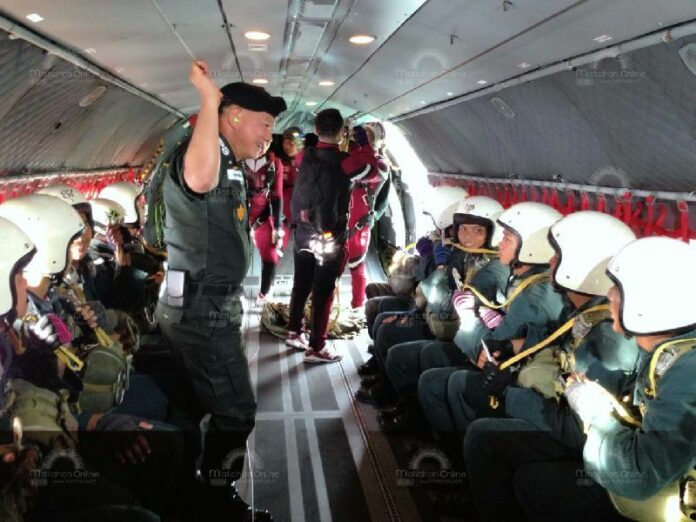
Police cadets en route to their drop zone during a parachute training, 18 May 2014 [Photo: Matichon]

BANGKOK — Police have charged 11 people for manslaughter over the death of two police cadets whose parachutes failed to open because of faulty cable during a training exercise.

Chayakorn Puttichaiyong, 19, and Nattawut Tirasuwansuk, 21, were among those who jumped out of the plane over Cha Am district, Petchburi province, for a parachute training session on 31 March. 

The plane cable failed to open the parachutes carried by the cadets, forcing them to resort to the emergency parachute set. However, Mr. Chayakorn and Mr. Nattawut could not open their spare parachute in time and plunged to their deaths. 

Today police concluded that the cable used in the training session was a low-quality sling that had been substituted for the standard equipment. 

The police's equipment supplier, Thai Aviation Industries Ltd, chose to use 9,300-baht parachute slings made by Thai manufacturers instead of the standard, foreign-made 99,000-baht parachute cables, said Pol.Maj.Gen. Charampon Suramanee, assistant to the chief of Thai police.

The Thai-made slings were not originally designed to fit in the planes used by the Thai police, and the engineers of Thai Aviation Industries Ltd resorted to modifying the equipment on their own, Pol.Maj.Gen. Charampon said.

According to the investigation, several police officers from the Thai Police Aviation Division were aware of the modification, yet turned a blind eye.

The cables were installed on the training plane on 6 March, less than a month before the fatal parachute training session, according to Pol.Maj.Gen. Charampon. 

"The Royal Thai Police take this case very seriously," Pol.Maj.Gen. Charampon said. "We have investigated the matter and explained the case to the families of the two victims. After the incident, we took precaution to ensure that this would not happen again."

Eleven individuals related to the faulty cables have been charged with reckless action leading to death of others. 

The 11 suspects have been separated into three groups: the seven directors and staff of the Thai Aviation Industries Ltd responsible for purchasing the slings, an employee of Thai Airways Ltd involved in the installation of the cables, and three negligent officers from the Thai Police Aviation Division.

Pol.Maj.Gen. Charampon said it is possible for the families of the victims to file separate civil lawsuits against the 11 individuals and demand financial compensation. 

Following the death of the two cadets, the training plane has been re-fitted with high-quality parachute sling, Pol.Maj.Gen. Charampon said.


For comments, or corrections to this article please contact: [email protected]

You can also find Khaosod English on Twitter and Facebook
http://twitter.com/KhaosodEnglish
http://www.facebook.com/KhaosodEnglish

Advertisement

Taxi Driver Returns 145,000 Baht To American Passenger

A taxi driver in Bangkok  returned jewelry and cash worth more than 145,000 baht to an American man who left the items in his car yesterday. 24 Sept 2014.

BANGKOK — A taxi driver in Bangkok has returned jewelry and cash worth more than 145,000 baht to an American man who left the items in his car yesterday.

Steven Hanson, 47, reported to Lumpini police yesterday that he accidentally left behind bags of jewelry in the taxi he hailed from Charoen Krung Road to JW Marriot Hotel. 

Mr. Hanson, who is a jewelry trader, got out of the taxi near Ploenchit Tollway entrance because the driver took a wrong turn, but only realised later that he left his belongings in the car. Police said Mr. Hanson estimated the value of the items to be "at least" 145,000 baht.

The taxi driver, Jakkree Sattanand, called police after realizing Mr. Hanson had left two bags behind. Today, Mr. Jakkree met with police and personally returned the jewelry and cash to Mr. Hanson.


For comments, or corrections to this article please contact: [email protected]

You can also find Khaosod English on Twitter and Facebook
http://twitter.com/KhaosodEnglish
http://www.facebook.com/KhaosodEnglish

Advertisement

Suspected Killer of British Backpackers 'in Bangkok'

Montriwat Toowichian was questioned by police for several hours before being released on 24 Sept 2014.

BANGKOK — The prime suspect behind the brutal killing of two British backpackers on an island in southern Thailand is currently hiding in the capital city, police say.

Warot, 22, reportedly fled Koh Tao shortly after David Miller, 24, and Hannah Witheridge, 23, were found beaten to death on one of the island's beaches last week.

Police say Mr. Warot is currently the primary suspect as DNA test results have cleared all others previously detained by police. 

Police reportedly collected DNA samples from 160 residents on the island, many of them Burmese migrant workers, in an effort to find a match with the DNA traces found on Ms. Witheridge's body and a cigarette near the crime scene.

The police hunt for Mr. Warot, who is the son of a influential figure on the island, came amid reports that the stalling police investigation may be related to the influence of “powerful families” on Koh Tao.

Mr. Warot’s father, a Village Headman (local administrator) on the island named Woraphan Toowichian, visited the police station on Koh Tao yesterday to provide testimony and a DNA sample. His brother, Montriwat Toowichian, also met with police and was questioned for several hours before being released. 

Police have provided conflicting reports about whether forensic tests have cleared the two men of a connection to the murder.

Mr.  Montriwat is the owner of AC Bar on Haat Sai Ri beach, where Mr. Miller and Ms. Witheridge were seen having drinks on the night they were murdered. Police also believe Mr.  Montriwat is the man who was seen "behaving suspciously" on CCTV footage that night.

Two days ago, a Scottish man who worked at AC Bar claimed Mr. Montriwat and another Thai man cornered him in a convenience store on the island and accused him of being behind the murders.

The expat, Sean McAnna, fled the island out of fear for his life on 22 September, media reports say. 

Speaking to reporters yesterday, Mr. Montriwat said he is entirely "innocent." He also disputed reports that Mr. Miller and Ms. Witheridge were involved in a row at the bar he owned prior to their deaths. 

Mr. Montriwat said it was actually the Scotsman who should be treated as a suspect. "On the night of the murder, a spa worker told me [he/she] helped clean splatters of blood from Sean's body."

He also claimed that he and his friend cornered Mr. McAnna because they wanted to question him about his whereabouts on the night the two Britons were killed. 

Read more:
Britons' Murder: Police Chief Dismisses Koh Tao 'Mafia' Allegation


For comments, or corrections to this article please contact: [email protected]

You can also find Khaosod English on Twitter and Facebook
http://twitter.com/KhaosodEnglish
http://www.facebook.com/KhaosodEnglish

Advertisement

UN 'Disappointed' Over Lese Majeste Sentencing

Rupert Colville, spokesperson for the UN High Commissioner for Human Rights (OHCHR).

BANGKOK — The United Nations human rights office voiced disappointment over a Thai court's decision to uphold the ten-year jail sentence of Somyot Pruksakasemsuk, a former magazine editor accused of insulting the monarchy.

In January 2013, a criminal court found Mr. Somyot guilty of lese majeste — ​ offending the monarchy — for overseeing the publication of several articles in the now-defunct Voice of Thaksin magazine in 2010.  Under Thai law, defaming the Royal Family is a criminal offense punishable by up to 15 years behind bars. 

Last week, a Court of Appeals upheld the guilty verdict and Mr. Somyot's ten-year sentence. 

“We are very disappointed by the decision of an appellate court in Thailand affirming the conviction and sentencing of the editor and activist Somyot Pruksakasemsuk," UN Office of the High Commission for Human Rights (OHCHR) spokesperson Rupert Colville told reporters in Geneva yesterday. 

According to the OHCHR, Thai authorities did not notify Mr. Somyot’s lawyer or family of the date of the appeal verdict.

Last month, the OHCHR voiced serious concern over the rise in lese majeste cases following the 22 May coup, calling the measure part of  a “larger pattern of increasing restrictions on freedom of expression in Thailand.”

According to the OHCHR, the number of people under custody in connection with lese majeste charges has risen from 6 to 22 since the coup in May.  Another eight people are facing lese majeste charges but are not currently in custody, the OHCHR reported. 

“The threat of the use of the lèse majesté laws adds to the chilling effects on freedom of expression observed in Thailand after the coup, and risks curbing critical debate on issues of public interest,” a OHCHR spokesperson said on 19 August.


For comments, or corrections to this article please contact[email protected]

You can also find Khaosod English on Twitter and Facebook
http://twitter.com/KhaosodEnglish
http://www.facebook.com/KhaosodEnglish

Advertisement

Thai University Hazing, Southern Style

Senior Students in the RSKU Faculty of Industrial Technology say their hazing rituals are the toughest on the campus [Photo: Estafan Naranode].

By Estafan Naranode

At the start of the school year in mid-August, a Khaosod English correspondent visited three universities in Thailand’s war-torn Deep South to observe their take on “rub nong,” the controversial freshman hazing rituals conducted in many schools across the Kingdom. 

SONGKHLA — It is late afternoon at the start of a new school year at Rajabhat Songkhla University in the southern province of Songkhla.

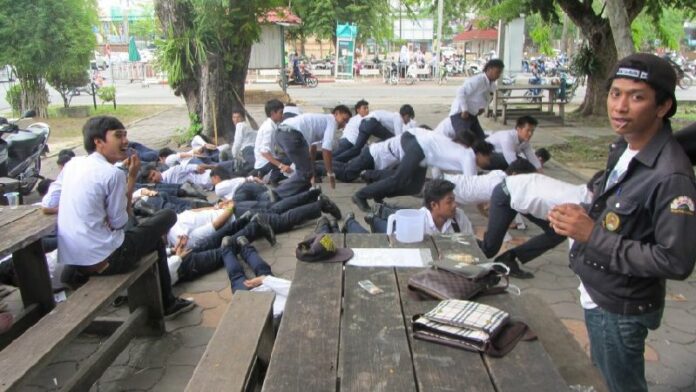
Several dozen freshmen boys, all ‘politely’ dressed in white shirts and black trousers, stand shoulder-to-shoulder just inside the school’s main entrance as cars and motorbikes stream past.

Surrounding them is a group of about ten slightly older males, most of them dressed in what appears to be dark, paramilitary-looking gear. Some are wearing black caps, turned backwards, that read ‘POLICE.’

Suddenly a whistle screeches and the boys haggardly drop to the ground.

“Faster! Faster! Stay down! Hands behind your backs!” one of the seniors screams.

The freshmen do as they are told. They lower themselves onto the dirty concrete ground, hands behind their back, as if preparing to be handcuffed.

They remain motionless, their backs arched like orca whales on display at Sea World in order to keep their faces off the hot concrete. They wait for the next command.

It comes about a minute later. “Stand Up! Quickly! Hurry Up!” They freshmen rise to their feet – some with quite a bit of difficulty, indicating that this has been going on for some time.

When Khaosod English asked to take a group picture, one of the seniors screamed: “Group picture! All fall in immediately!” The ‘freshies,' as they are known in university campuses across Thailand, were quick to comply.

'Welcoming' tradition

The drill was part of the Thai university tradition known as rub nong, which translates to ‘welcoming our young brothers and sisters.'

Although hazing freshmen is considered a cultural import from the United States, the practice has morphed into something uniquely Thai since its introduction to the Kingdom in the 1970s.

In the West, the decision to join a fraternity or sorority – and thus expose oneself to the intimidating initiation process – is optional. But in Thailand, the initiations are conducted by upperclassmen studying the same academic major; as a result, every freshman is considered “fresh meat” and refusal to take part in the initiation rites is tantamount to social suicide on most campuses.

Hazing traditions and the severity of the rituals vary from school to school and faculty to faculty, but the common thread – and ultimate justification for the rituals – is spelled out by an English-language acronym: SOTUS.

In the United States, SOTUS stands for ‘State Of The Union Address,' the annual speech made by the President before congress. But in Thailand, it stands for Seniority, Order, Tradition, Unity and Spirit — the values rub nong is ostensibly meant to instill.

Yet the initiation rituals, which can involve alchohol and physical abuse, are known to get out of hand. This August, one student drowned during a weekend of hazing on a beach in Prachuap Kiri Khan.  In July 2008, a student at Uthenthawai University died after he was reportedly beaten by a group of senior students during a rub nong ritual.

Southern hospitality

Both Rajabhat Songkhla University (RSKU) and its neighbor, Thaksin University, lie on Kanjanawanich Road, the unofficial border between the Thai South and the Muslim-majority “Deep South” region.

Like much of Yala, Narathiwat and Pattani, all four Songkhla districts south of the road have been under Emergency Decree since a Muslim insurgency flared up in January 2004 during the administration of former Prime Minister Thaksin Shinawatra.

According to well-engrained stereotypes nationwide, Southern Thais are largely regarded as loud, fast-talking and somewhat aggressive. These are just the traits one would expect to find in a first-class ‘Varker,’ the name given to seniors who lead the hazing rituals. In Thai, ‘vark’ means ‘to scream.’  

At RSKU, there was certainly no lack of ‘varking’ skills on display; the seniors’ tones were  intense, their volume almost ear-splitting. And while the drill appeared a harsh yet organized form of bullying, most of the freshman boys seemed to take it in stride, smiling throughout.

When asked which of the school’s seven faculties had the harshest rub nong regime, several Varkers replied quickly, loudly, and in unison: “Faculty of Industrial Technology!” Asked what faculty they belonged to, the answer was the same: “Faculty of Industrial Technology!”

Asked if the current freshmen had it easier or harder than the hazing in the past, the seniors shouted,“Easier! Much easier!”

Nearby, a similar initiation rite was taking place with 20 female students sitting cross-legged on the pavement, three of them wearing the school-approved white hijap (muslim woman’s headdress).

The three Muslim girls, Wucharaporn Billah, Nuriyah Khremsan and Misbah Hawang, said they were from Songkhla and hadn’t been given any special treatment because of their religion.

“It’s the same for everyone. We have to do body drops too, but it is not as intense as what the boys go through,” said Ms. Nuriyah.

Asked if she was enjoying her initiation, Ms. Wucharaporn said it was a good way to bond with her new fellow classmates, although she was surrounded by several male Varkers during the interview.

Ms. Wucharaporn added that she hadn’t been forced to do anything that conflicted with her faith.

When asked why there weren’t any female Varkers present, one of the male Varkerrs said, “there are some female seniors who took part in the first few days, but most of them get bored with it after a while, so it is left to the males to take care of.”

Down the road at Thaksin University (TSU), whose student body is half Thai Buddhist and half Muslim, the effort to intimidate freshies was less pronounced.

“In the past there were some problems with harsh initiation rituals,” said Dr Patcharee R. Wichaidit, Assistant Dean of the TSU Faculty of Education. “But that all changed back in 2005, when the government established guidelines for these rituals following some tragic events.”

The role of the Varkers at TSU has morphed into more of “big brother” support role for the newcomers, she said.

TSU’s student body of about 13,500 undergrads is also even more predominantly female that at RSKU, which may explain its gentler approach to rub nong. Diyaporn Wisamitanan, a lecturer in the school Faculty of Humanities & Social Science, estimated that up to 70% of the students are female, in part because the school offers fields of study that tend to attract women, such as education, social science, and business. 

Natchuda Samart, a 19-year-old Buddhist freshie from the remote district of Sukhirin on the Malaysian border in Narathiwat said she appreciated the initiation process.

“At first I was afraid of going through the rub nong induction because I had no idea what would happen,” said Ms. Natchuda. “But it actually allowed us to meet as many of our new classmates, as well as the upper classmen, as quickly as possible. It has left me with a warm feeling; all of the upper classmen really went out of their way to welcome us.”

Ms. Natchuda and all other freshies at TSU can be easily identified by the signs they are required to wear bearing their nicknames, faculties, and the “house” they are assigned to. Ms Nachuda’s new friend in the economics program, a Muslim “freshie” named Pattra Leh-asan from nearby Singhanakhon District of Songkhla, said the signs help seniors identify and assist confused or troubled-looking newcomers.

“They allow seniors to identify [the freshmen] and get them help,” she said.

Asked if there were any special provisions made for Muslim freshies during rub nong, especially women, she said, “No, not at all. It’s exactly the same for all freshies here.”

Initiation in a conflict zone

Thai Universities in the far south tend to reflect local demographics, with student bodies composed of both Thai Buddhists and ethnic Malay-Muslims, two groups that have a tense relationship because of the decade-long separatist insurgency that has claimed the lives of over 6,000 people in the region. Fortunately, these tensions don’t seem to have too much impact on hazing traditions, which seem to become less severe the further south one travels.

At the sprawling Prince of Songkhla University Campus in Pattani (PSU Pattani), there were few signs of hazing during the start of term in mid-August.

“This year it has been less severe than it was two or three years ago,” said Ameen Lateh, a fourth-year English major from Yaha District in Yala. “This is mostly because the university has cracked down and banned the more physical and humiliation rituals, like forcing freshies to roll around in mud and things like that. They created measures to ensure that the rub nong activities are creative and designed to build bonds between the freshmen and their upper classmen.”

The majority of the students at the school are Muslim, which also played a role in moderating the initiation activities, he said.

Certain physical activities like ‘boom screaming,’ in which the freshies yell chants for as long as the seniors deem fit, have been phased out because the Muslim students who now make up the majority of the student body no longer accept them.

“As Muslims we have to look at the Islamic teachings. The activities that are acceptable we will do; others we will not,” he said.

“In my first year I didn’t like some of the rub nong activities very much, so when I became the deputy student union leader in the Faculty of Education I worked to get the inappropriate ones replaced with more creative ones that would be more welcoming for the new students,” he said.

Dr Walakkamol Changkamol, Dean of the PSU Pattani’s Faculty of Communication Sciences, said that the make-up of the student body has shifted due to the ongoing conflict in the region.

In the past, the highly-rated school attracted many students from Bangkok and other parts of the country. But due to the ongoing insurgency and near daily violence in the region, the school now attracts far fewer students from outside the region, she said.

The student body shifted from a Thai Buddhist majority to Muslim majority about five years ago, with Muslims now making up about 90% of the students in her faculty, she said.

The change has affected not only the initiation ceremonies, but the extracurricular student activities such as singing, dancing and cheerleading, which tend to appeal more to Thai Buddhist students than their Muslim counterparts, she said.

“Our faculty is only 12 years old, so from the outset we campaigned for the seniors to conduct the rub nong welcoming in a way that respects the new students,” said Dr Walakkamol.  “We want to give them a warm welcome as if they are joining a new family, one that respects their individuality and human rights.”


For comments, or corrections to this article please contact: [email protected]

You can also find Khaosod English on Twitter and Facebook
http://twitter.com/KhaosodEnglish
http://www.facebook.com/KhaosodEnglish

Advertisement

Thai University Hazing, Southern Style

As a Muslim student leader, Ameen Lateh was among the students who changed the nature of freshie initiation rituals at PSU Pattani Campus in recent years [Photo: Estafan Naranode].

By Estafan Naranode

At the start of the school year in mid-August, a Khaosod English correspondent visited three universities in Thailand’s war-torn Deep South to observe their take on “rub nong,” the controversial freshman hazing rituals conducted in many schools across the Kingdom. 

SONGKHLA — It is late afternoon at the start of a new school year at Rajabhat Songkhla University in the southern province of Songkhla.

Several dozen freshmen boys, all ‘politely’ dressed in white shirts and black trousers, stand shoulder-to-shoulder just inside the school’s main entrance as cars and motorbikes stream past.

Surrounding them is a group of about ten slightly older males, most of them dressed in what appears to be dark, paramilitary-looking gear. Some are wearing black caps, turned backwards, that read ‘POLICE.’

Suddenly a whistle screeches and the boys haggardly drop to the ground.

“Faster! Faster! Stay down! Hands behind your backs!” one of the seniors screams.

The freshmen do as they are told. They lower themselves onto the dirty concrete ground, hands behind their back, as if preparing to be handcuffed.

They remain motionless, their backs arched like orca whales on display at Sea World in order to keep their faces off the hot concrete. They wait for the next command.

It comes about a minute later. “Stand Up! Quickly! Hurry Up!” They freshmen rise to their feet – some with quite a bit of difficulty, indicating that this has been going on for some time.

When Khaosod English asked to take a group picture, one of the seniors screamed: “Group picture! All fall in immediately!” The ‘freshies,’ as they are known in university campuses across Thailand, were quick to comply.

‘Welcoming’ tradition

The drill was part of the Thai university tradition known as rub nong, which translates to ‘welcoming our young brothers and sisters.’

Although hazing freshmen is considered a cultural import from the United States, the practice has morphed into something uniquely Thai since its introduction to the Kingdom in the 1970s.

In the West, the decision to join a fraternity or sorority – and thus expose oneself to the intimidating initiation process – is optional. But in Thailand, the initiations are conducted by upperclassmen studying the same academic major; as a result, every freshman is considered “fresh meat” and refusal to take part in the initiation rites is tantamount to social suicide on most campuses.

Hazing traditions and the severity of the rituals vary from school to school and faculty to faculty, but the common thread – and ultimate justification for the rituals – is spelled out by an English-language acronym: SOTUS.

In the United States, SOTUS stands for ‘State Of The Union Address,’ the annual speech made by the President before congress. But in Thailand, it stands for Seniority, Order, Tradition, Unity and Spirit — the values rub nong is ostensibly meant to instill.

Yet the initiation rituals, which can involve alchohol and physical abuse, are known to get out of hand. This August, one student drowned during a weekend of hazing on a beach in Prachuap Kiri Khan.  In July 2008, a student at Uthenthawai University died after he was reportedly beaten by a group of senior students during a rub nong ritual.

Southern hospitality

Both Rajabhat Songkhla University (RSKU) and its neighbor, Thaksin University, lie on Kanjanawanich Road, the unofficial border between the Thai South and the Muslim-majority “Deep South” region.

Like much of Yala, Narathiwat and Pattani, all four Songkhla districts south of the road have been under Emergency Decree since a Muslim insurgency flared up in January 2004 during the administration of former Prime Minister Thaksin Shinawatra.

According to well-engrained stereotypes nationwide, Southern Thais are largely regarded as loud, fast-talking and somewhat aggressive. These are just the traits one would expect to find in a first-class ‘Varker,’ the name given to seniors who lead the hazing rituals. In Thai, ‘vark’ means ‘to scream.’  

At RSKU, there was certainly no lack of ‘varking’ skills on display; the seniors’ tones were  intense, their volume almost ear-splitting. And while the drill appeared a harsh yet organized form of bullying, most of the freshman boys seemed to take it in stride, smiling throughout.

When asked which of the school’s seven faculties had the harshest rub nong regime, several Varkers replied quickly, loudly, and in unison: “Faculty of Industrial Technology!” Asked what faculty they belonged to, the answer was the same: “Faculty of Industrial Technology!”

Asked if the current freshmen had it easier or harder than the hazing in the past, the seniors shouted,“Easier! Much easier!”

Nearby, a similar initiation rite was taking place with 20 female students sitting cross-legged on the pavement, three of them wearing the school-approved white hijap (muslim woman’s headdress).

The three Muslim girls, Wucharaporn Billah, Nuriyah Khremsan and Misbah Hawang, said they were from Songkhla and hadn’t been given any special treatment because of their religion.

“It’s the same for everyone. We have to do body drops too, but it is not as intense as what the boys go through,” said Ms. Nuriyah.

Asked if she was enjoying her initiation, Ms. Wucharaporn said it was a good way to bond with her new fellow classmates, although she was surrounded by several male Varkers during the interview.

Ms. Wucharaporn added that she hadn’t been forced to do anything that conflicted with her faith.

When asked why there weren’t any female Varkers present, one of the male Varkerrs said, “there are some female seniors who took part in the first few days, but most of them get bored with it after a while, so it is left to the males to take care of.”

Down the road at Thaksin University (TSU), whose student body is half Thai Buddhist and half Muslim, the effort to intimidate freshies was less pronounced.

“In the past there were some problems with harsh initiation rituals,” said Dr Patcharee R. Wichaidit, Assistant Dean of the TSU Faculty of Education. “But that all changed back in 2005, when the government established guidelines for these rituals following some tragic events.”

The role of the Varkers at TSU has morphed into more of “big brother” support role for the newcomers, she said.

TSU’s student body of about 13,500 undergrads is also even more predominantly female that at RSKU, which may explain its gentler approach to rub nong. Diyaporn Wisamitanan, a lecturer in the school Faculty of Humanities & Social Science, estimated that up to 70% of the students are female, in part because the school offers fields of study that tend to attract women, such as education, social science, and business. 

Natchuda Samart, a 19-year-old Buddhist freshie from the remote district of Sukhirin on the Malaysian border in Narathiwat said she appreciated the initiation process.

“At first I was afraid of going through the rub nong induction because I had no idea what would happen,” said Ms. Natchuda. “But it actually allowed us to meet as many of our new classmates, as well as the upper classmen, as quickly as possible. It has left me with a warm feeling; all of the upper classmen really went out of their way to welcome us.”

Ms. Natchuda and all other freshies at TSU can be easily identified by the signs they are required to wear bearing their nicknames, faculties, and the “house” they are assigned to. Ms Nachuda’s new friend in the economics program, a Muslim “freshie” named Pattra Leh-asan from nearby Singhanakhon District of Songkhla, said the signs help seniors identify and assist confused or troubled-looking newcomers.

“They allow seniors to identify [the freshmen] and get them help,” she said.

Asked if there were any special provisions made for Muslim freshies duringrub nong, especially women, she said, “No, not at all. It’s exactly the same for all freshies here.”

Initiation in a conflict zone

Thai Universities in the far south tend to reflect local demographics, with student bodies composed of both Thai Buddhists and ethnic Malay-Muslims, two groups that have a tense relationship because of the decade-long separatist insurgency that has claimed the lives of over 6,000 people in the region. Fortunately, these tensions don’t seem to have too much impact on hazing traditions, which seem to become less severe the further south one travels.

At the sprawling Prince of Songkhla University Campus in Pattani (PSU Pattani), there were few signs of hazing during the start of term in mid-August.

“This year it has been less severe than it was two or three years ago,” said Ameen Lateh, a fourth-year English major from Yaha District in Yala. “This is mostly because the university has cracked down and banned the more physical and humiliation rituals, like forcing freshies to roll around in mud and things like that. They created measures to ensure that the rub nongactivities are creative and designed to build bonds between the freshmen and their upper classmen.”

The majority of the students at the school are Muslim, which also played a role in moderating the initiation activities, he said.

Certain physical activities like ‘boom screaming,’ in which the freshies yell chants for as long as the seniors deem fit, have been phased out because the Muslim students who now make up the majority of the student body no longer accept them.

“As Muslims we have to look at the Islamic teachings. The activities that are acceptable we will do; others we will not,” he said.

“In my first year I didn’t like some of the rub nong activities very much, so when I became the deputy student union leader in the Faculty of Education I worked to get the inappropriate ones replaced with more creative ones that would be more welcoming for the new students,” he said.

Dr Walakkamol Changkamol, Dean of the PSU Pattani’s Faculty of Communication Sciences, said that the make-up of the student body has shifted due to the ongoing conflict in the region.

In the past, the highly-rated school attracted many students from Bangkok and other parts of the country. But due to the ongoing insurgency and near daily violence in the region, the school now attracts far fewer students from outside the region, she said.

The student body shifted from a Thai Buddhist majority to Muslim majority about five years ago, with Muslims now making up about 90% of the students in her faculty, she said.

The change has affected not only the initiation ceremonies, but the extracurricular student activities such as singing, dancing and cheerleading, which tend to appeal more to Thai Buddhist students than their Muslim counterparts, she said.

“Our faculty is only 12 years old, so from the outset we campaigned for the seniors to conduct the rub nong welcoming in a way that respects the new students,” said Dr Walakkamol.  “We want to give them a warm welcome as if they are joining a new family, one that respects their individuality and human rights.”


For comments, or corrections to this article please contact: [email protected]

You can also find Khaosod English on Twitter and Facebook
http://twitter.com/KhaosodEnglish
http://www.facebook.com/KhaosodEnglish

Advertisement

IS Strikes in Syria: Not America's Fight Alone

[US White House News]

23 September 2014, President Barack Obama ordered American armed forces to begin targeted airstrikes against ISIL targets in Syria. Speaking from the White House South Lawn today, the President made it clear that these strikes are part of the U.S. campaign to deliver one message on ISIL: They will find no safe-haven.

The U.S. military actions also included strikes to disrupt plotting against the U.S. and our allies by the Khorasan Group — seasoned al Qaeda operatives in Syria. 

The President made clear that the fight against these terrorists "is not America′s fight alone"

The people and governments of the Middle East are rejecting ISIL, and standing up for the peace and security that the people of the world deserve. Not since the Gulf War has the United States been joined in direct military action by such a broad coalition of Arab partners. Meanwhile, we will move forward with our plan – supported by bipartisan majorities in Congress – to ramp up our effort to train and equip the Syrian opposition, who are the best counter-weight to ISIL and the Assad regime.

Over 40 nations have offered to take part in our comprehensive plan to degrade and destroy ISIL: "to take out terrorist targets; to train and equip Iraqi and Syrian opposition fighters who are going up against ISIL on the ground; to cut off ISIL’s financing; to counter its hateful ideology; and to stop the flow of fighters into and out of the region," he said.

The President once again thanked Congress for taking a bipartisan stand against ISIL:

America is always stronger when we stand united. And that unity sends a powerful message to the world that we will do what is necessary to defend our country. Over the next several days, I will be meeting Prime Minister Abadi of Iraq and with friends and allies at the United Nations to continue building support for the coalition that is confronting this profound threat to peace security. This overall effort will take time. There are challenges ahead. But we’re going to do what is necessary to take the fight to this terrorist group – for the security of our country, the region, and the entire world.

Advertisement

UK to Tackle Deforestation in Developing Countries

Picture: Abbie Trayler-Smith/DFID/Panos

Note: This is a press release. Its contents are not produced by Khaosod English.

Britain will promote new links with businesses to manage scarce natural resources and stop deforestation in the developing world, International Development Secretary Justine Greening announced today

The Department for International Development will establish new partnerships between businesses and farmers in developing countries to create multinational supply chains free from unsustainable deforestation.

The UK will also support a major new drive across Europe to stamp out the demand for wood sourced from illegal logging.

Speaking at the Forest and Climate Challenge conference at the United Nations General Assembly in New York, Ms Greening will warn that climate change is one of the most urgent and pressing challenges to global poverty reduction.


Announcing the new UK support, Justine Greening said:

Climate change has the potential to halt or undo the progress we have made in the last two decades. Without action the world will get hungrier, poorer and more dangerous in the years to come. There is no point in building a health clinic for poor people in Bangladesh if it will get washed away by the next floods.

Investing in the better management of natural resources and putting a stop to deforestation is the smart thing to do. British businesses are already leading the way in setting up long-term sustainable supply chains.

Our assistance will help companies, communities, smallholders and governments work together to reduce deforestation and increase crop yields.

Deforestation is the second largest source of greenhouse gas emissions and affects the lives of more than one billion people who depend on forests for food, fuel and a living. It also makes these communities more vulnerable to natural disasters.


The new British support announced today consists of:

  • £60 million for a new programme to encourage businesses to join the fight against deforestation. The Investments in Forests and Sustainable Land Use initiative will form a number of innovative public-private partnerships with communities, local farmers and local and international businesses including UK companies, to manage forests sustainably and support and encourage agriculture that does not cause further deforestation.
  • an additional £84 million available for the successful Forest Governance, Markets and Climate programme, as a contribution to a global partnership to end illegal logging. The new money will support efforts to close the EU market to illegally-harvested timber, and provide support to developing countries to tackle weak governance that allows illegal practice to flourish.

The new Investments in Forests and Sustainable Land Use initiative will support 10-15 major public-private partnerships and will work with companies that are committed to taking deforestation out of their supply chains, including smallholder farmers, to help them produce palm oil, timber and other agricultural commodities in ways that do not cause deforestation.

Smallholder oil palm farmers, for example, currently receive around half of the yield that they should when compared to professionally run plantations. By supporting investments to improve the productivity of their existing plantations, UK support can help these farmers increase their yields without clearing more forest.

Justine Greening also emphasised the need for the post-2015 development goals agreed in the year ahead to be climate smart and called on the international community to agree ambitious targets for protecting forests and other natural resources.

Advertisement

Hot News

LATEST NEWS

Bangkok
overcast clouds
37.8 ° C
38.8 °
35 °
47 %
3.7kmh
85 %
Tue
34 °
Wed
35 °
Thu
30 °
Fri
31 °
Sat
36 °