























28.8 C
Bangkok
Thursday, July 16, 2026
Home Blog Page 3233

Suthep Files Complaint Postponing 2010 Crackdown Trial

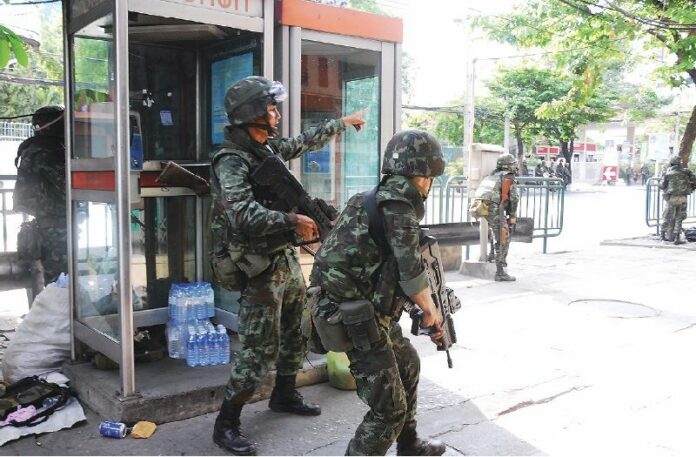
Soldiers deployed to contain Redshirt protesters on 15 May 2010.

BANGKOK — Former politician Suthep Thaugsuban filed a legal complaint today that pushed back the trial over his authorisation of the military crackdown on Redshirt protesters in 2010.

Former Prime Minister Abhisit Vejjajiva and Mr. Suthep, who was the Deputy Prime Minister at the time, face murder charges for their authorization of the crackdown, in which more than 90 people died, most of whom were civilians.

The Division of Special Investigation (DSI) filed charges against Mr. Abhisit and Mr. Suthep separately in 2010, but today the Criminal Court decided to combine the two cases into one, as both cases concern similar sets of evidence, witnesses, and offences.

At today’s court hearing, Mr. Suthep denied the charges and requested the court reconsider whether the DSI has the jurisdiction to file the lawsuit against him. Mr. Abhisit has filed similar challenges in the past.

The judges agreed to deliberate on Mr. Suthep's complaint and scheduled the next court appearance for 28 August. 

Mr. Suthep, who showed up at court today in his monk robe, refused to speak to reporters after the court session was adjourned, but prior to the hearing said that his mind has been very "peaceful" since he took up the monastic order several weeks ago.

The former politician, who is now also known by his ecclesiastic name Phra Paphagaro, said he does not know when he will leave the monkhood. Mr. Suthep became a monk after leading a six month protest campaign against the former government starting last November. The protests came to an end when the military staged a coup on 22 May and took control of the country’s administration.

Mr. Suthep repeatedly postponed his murder trial earlier this year, citing his need to oversee the protests against government.

In 2010, tens of thousands of Redshirts flooded Bangkok and occupied the city’s financial district to demand Mr. Abhisit dissolve Parliament and call a fresh election. After several months, Mr. Abhisit’s government authorised the military to disperse the protesters, culminating in the Redshirts’ surrender on 19 May. 

Both Mr. Abhisit and Mr. Suthep have insisted that the use of force was necessary because the protests were infiltrated by armed militants. They claim that these militants,  and not the military, were behind many of the deaths caused by the crackdown.

However, previous court inquests have determined that many of the fatalities, which included protesters, civilians, and journalists, were killed by military weapons fired from the position of the security forces. 


For comments, or corrections to this article please contact[email protected]

You can also find Khaosod English on Twitter and Facebook
http://twitter.com/KhaosodEnglish
http://www.facebook.com/KhaosodEnglish
 

Advertisement

Junta Reprimands Muslim Leader For Pro-Gaza Rally in Bangkok

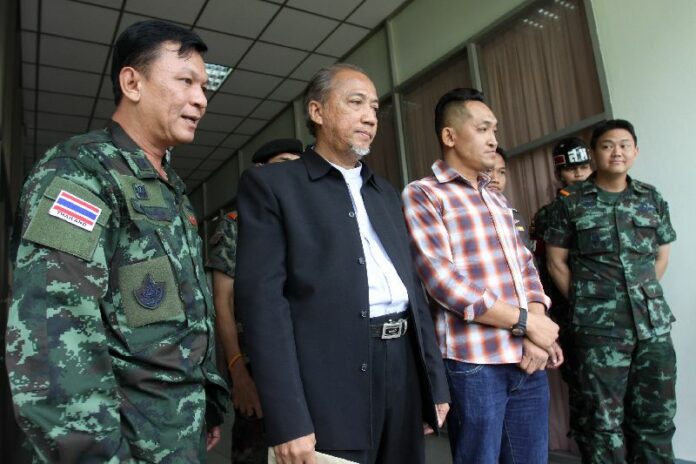
Satienparp Suksamran met with military officers at the Army Club in Bangkok to acknowledge that his anti-Israel protest was a violation of the junta’s ban on public gatherings, 27 July 2014.

BANGKOK – Thailand’s military junta has summoned a Shiite imam for violating the ban on public protests by organizing a pro-Palestine rally in Bangkok last Friday.

Satienparp Suksamran, chairman of Al Quids International Federation of Thailand, led a demonstration in front of Israel Embassy in Bangkok on 25 July to protest Israel's ongoing assault in the Gaza Strip. Israel launched amilitary offensive against Hamas militants in Gaza earlier this month, so far killing more than 1,000 Palestinians, the majority of whom were civilians.

Yesterday, Mr. Satienparp met with military officers at Army Club in Bangkok to acknowledge that his protest was a violation of the junta’s ban on public gatherings, which was imposed shortly after the National Council for Peace and Order (NCPO) staged a coup against the previous government on 22 May.

The press was not allowed to observe the meeting, but Mr. Satienparp told reporters afterwards that he tried to explain to the officers that the protest was solely about the humanitarian situation in Gaza.

"Similar protests have been held in other countries," the Shiite cleric said. "The protest has no connection with Thai politics."

Nevertheless, the Al Quids Federation in Thailand has agreed not to stage any further protests, Mr. Satienparp said.

The NCPO has strictly enforced the ban on public gatherings on all anti-coup demonstrations, but has less frequently interfered with rallies around other causes. In the past month, an anti-America protestpro-death penalty rally, and a previous anti-Israel demonstration were all been permitted without interference from authorities. 


For comments, or corrections to this article please contact[email protected]

You can also find Khaosod English on Twitter and Facebook
http://twitter.com/KhaosodEnglish
http://www.facebook.com/KhaosodEnglish

Advertisement

Oriental Express Derails in Western Thailand, Injuring Two

RATCHABURI — Officials are investigating the derailment of five cars from the Oriental Express train in western Thailand yesterday.

Two passengers were injured when a section of the luxury train, operated by Eastern and Oriental Express company, derailed at a curve in Ban Pong district of Ratchaburi province at around 10.30 am on Sunday.

Two Japanese women were injured and sent to local hospital. Police describe their injuries as "light." 

Train operators say the train was traveling from Hua Lampong station in Bangkok to its final destination in Singapore. The train reportedly carried 77 passengers, mostly European and Asian tourists, staff say. 

Officials from the State Railway of Thailand (SRT) said that heavy rain may have caused the train track to sink and widen, causing the derailment. 

However, SRT officials stressed that a more thorough investigation is needed to establish the true cause of the incident. 

"A central committee will be appointed to investigate the derailment," said Narongrit Sivasarote, a chief engineer of the SRT. "We expect that the investigation will take one month." 

Derailment and delays are common on Thai railways, due in part to old facilities and a lack of proper maintenance. A proposal by the previous government to construct a high-speed train system was struck down by the Constitutional Court on the ground that the project’s budget lacked transparency. 

According to the Eastern and Oriental Express website, a ticket for the four-day Bangkok – Singapore train journey costs approximately 83,000 baht per person.


For comments, or corrections to this article please contact[email protected]

You can also find Khaosod English on Twitter and Facebook
http://twitter.com/KhaosodEnglish
http://www.facebook.com/KhaosodEnglish
Advertisement

Junta Reprimands Muslim Leader For Pro-Gaza Rally in Bangkok

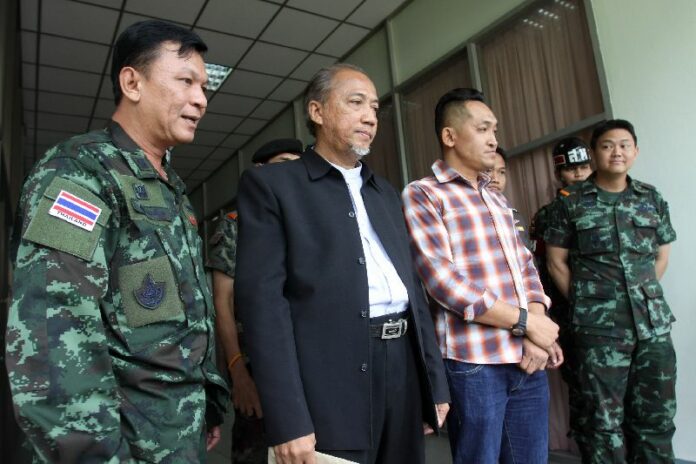
Satienparp Suksamran met with military officers at the Army Club in Bangkok to acknowledge that his anti-Israel protest was a violation of the junta’s ban on public gatherings, 27 July 2014.

BANGKOK – Thailand’s military junta has summoned a Shiite imam for violating the ban on public protests by organizing a pro-Palestine rally in Bangkok last Friday.

Satienparp Suksamran, chairman of Al Quids International Federation of Thailand, led a demonstration in front of Israel Embassy in Bangkok on 25 July to protest Israel's ongoing assault in the Gaza Strip. Israel launched a military offensive against Hamas militants in Gaza earlier this month, so far killing more than 1,000 Palestinians, the majority of whom were civilians.

Yesterday, Mr. Satienparp met with military officers at Army Club in Bangkok to acknowledge that his protest was a violation of the junta’s ban on public gatherings, which was imposed shortly after the National Council for Peace and Order (NCPO) staged a coup against the previous government on 22 May.

The press was not allowed to observe the meeting, but Mr. Satienparp told reporters afterwards that he tried to explain to the officers that the protest was solely about the humanitarian situation in Gaza.

"Similar protests have been held in other countries," the Shiite cleric said. "The protest has no connection with Thai politics."

Nevertheless, the Al Quids Federation in Thailand has agreed not to stage any further protests, Mr. Satienparp said.

The NCPO has strictly enforced the ban on public gatherings on all anti-coup demonstrations, but has less frequently interfered with rallies around other causes. In the past month, an anti-America protest, pro-death penalty rally, and a previous anti-Israel demonstration were all been permitted without interference from authorities. 


For comments, or corrections to this article please contact[email protected]

You can also find Khaosod English on Twitter and Facebook
http://twitter.com/KhaosodEnglish
http://www.facebook.com/KhaosodEnglish
Advertisement

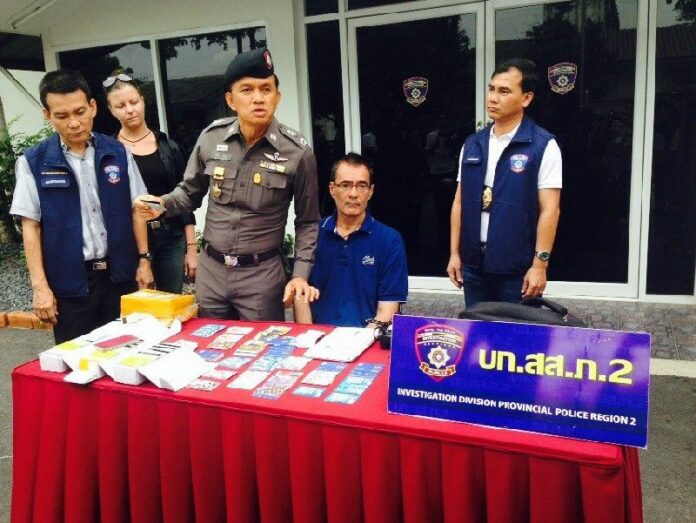
Spanish Man Arrested For 'ATM Skimming' in Pattaya

Police in the resort town of Pattaya say they have arrested a Spanish citizen behind an ATM card skimming scheme.

CHONBURI — Police in the resort town of Pattaya say they have arrested a Spanish citizen involved in an ATM card skimming scheme.

Fernando Manuel Navaro, 56, has been installing skimming devices in a number of ATMs around Pattaya and stealing data from credit cards, said Pol.Maj.Gen. Sanit Mahathaworn. 

Pol.Maj.Gen. Sanit said Mr. Navaro used the data to create copies of the ATM cards and withdraw large amounts of money from the victims' bank accounts.

A police raid on Mr. Navaro's residence reportedly turned up one ATM card skimming device, 109 copies of ATM cards, and more than 1,000 blank ATM cards. 

Police did not say how much money was stolen through the scheme, but Pol.Maj.Gen. Sanit placed the figure at "tens of millions baht."

Mr. Navaro is charged with producing counterfeit electronic cards and possessing a device to produce counterfeit electronic cards. If found guilty, he could face up to six years in prison and a 100,000 baht fine.

According to Pol.Maj.Gen. Sanit, Mr. Navaro said he worked for a "Romanian gang" in Pattaya. 

"He was hired by the Romanians to skim these ATM cards for 15,000 baht," Pol.Maj.Gen. Sanit said.

ATM skimming is a common crime in tourist areas in Thailand. Police have advised the public to check for any suspicious signs on ATMs —  such as loose number pad —  before they withdraw their money. 


For comments, or corrections to this article please contact[email protected]

You can also find Khaosod English on Twitter and Facebook
http://twitter.com/KhaosodEnglish
http://www.facebook.com/KhaosodEnglish
Advertisement

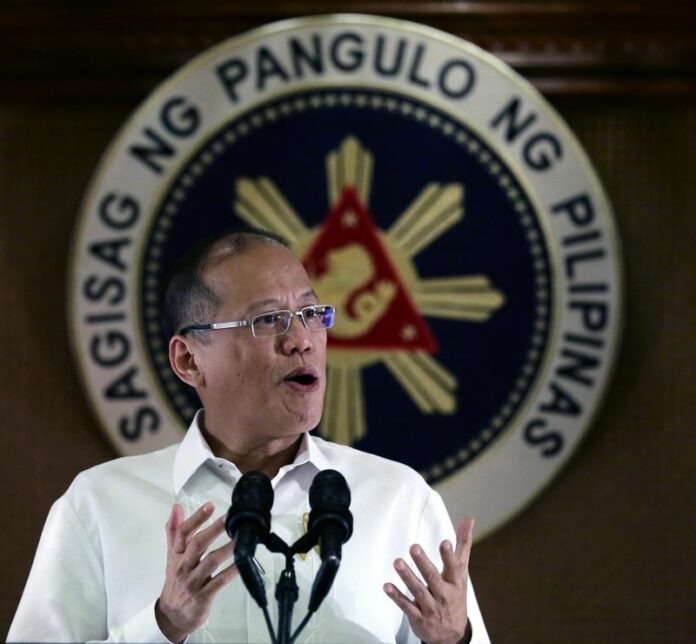
Thousands Protest Ahead of Philippine President's Annual Address

A file photo shows Philippine President Benigno Aquino III in Manila, Philippines, 14 July 2014. Thousands of protesters took to the streets of Manila on Monday ahead of Aquino's state of the nation address. EPA/DENNIS M. SABANGAN

MANILA (DPA) — Thousands of protesters took to the streets in the Philippine capital on Monday, police said, ahead of President Benigno Aquino's annual state of the nation address.

Police blocked off a main road leading to the House of Representatives compound in the Manila suburban city of Quezon, forcing the demonstrators to gather about three kilometres away.

They brought an effigy of Aquino as a thief, accusing him of reneging on a vow to fight corruption by implementing an economic stimulus programme that allows for the discretionary distribution of state funds.

The more than 3-billion-dollar programme was ruled unconstitutional by the Supreme Court, but Aquino's government appealed that decision.

"His anti-corruption campaign is a sham because he is now exposed as the most corrupt," said Renato Reyes, secretary general of the leftist Bayan opposition movement.

"We cannot allow a wannabe dictator to reign for the next two years," he said in a statement. "He has to be made accountable now."

Aquino was expected to give updates on his reform agenda and highlight priority legislation for the next two years in his speech, aides said.

Two impeachment complaints have been filed against him for allegedly violating the constitution for the implementation of the stimulus programme.

A third complaint was filed for an agreement signed with the United States to allow more American troops to stay in the Philippines.

Aquino retains strong support in the House of Representatives, which will deliberate on the charges.

Advertisement

Editorial: Junta’s Charter Paints Grim Future for Thai Democracy

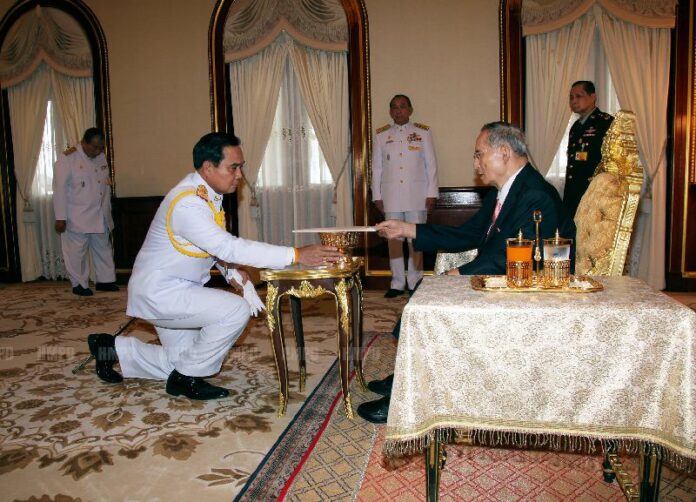
NCPO chairman Gen. Prayuth Chan-ocha receiving the 2014 Interim Constitution from His Majesty the King, 22 July 2014.

The junta's 2014 Interim Constitution is robbing Thai people of their political voices.

Two months after staging a coup d’etat, Thailand’s military junta unveiled a temporary constitution outlining the formation of an interim government that is expected to administer the country until the end of the next year.

The National Council For Peace and Order (NCPO) dissolved Thailand’s 2007 constitution almost immediately after seizing power on May 22, and until last week, ruled over the Kingdom without a charter.

While the return of a constitution should mark a step forward in the direction of democracy, a close look at the 2014 Interim Charter reveals that it is actually a discouraging step backwards.

The most concerning section of the constitution is Article 44, which effectively enshrines the NCPO’s absolute power into the Kingdom’s highest body of law.

Article 44 grants the NCPO power to unilaterally intervene “regardless of its effects on the legislative, executive or judiciary” in the name of defending Thailand against threats to “public order, national security, the monarchy, national economy or sovereignty.”

Not only is the NCPO given this carte blanche to intervene in almost any situation, but “all orders or acts [taken under these circumstances] are to be regarded as lawful and constitutional.”

In other words, nothing the NCPO does can be considered illegal. Furthermore, this absolute power will not be subject to any oversight, judicial or otherwise.

The 2014 interim charter also establishes three governmental bodies that will be tasked with fundamentally restructuring Thailand’s system of government, yet are unlikely to represent broad swaths of the population.

According to the charter, the members of the National Legislative Assembly and Reform Council will be appointed by the King “in accordance with the recommendations of the National Council for Peace and Order,” (Section 6 and Section 28), and the chairman of the Reform Council will in turn appoint the members of the Constitution Drafting Committee (Section 32), which will be tasked with writing a permanent constitution.

Not only is the NCPO granted the power to appoint the members of these bodies, but Sections 8 and 33 of the interim charter preemptively narrow the pool of possible nominees for the NLA and Constitution Drafting Committee to those who have not held positions in political parties over the past three years. With all recently active political figures barred from the get-go, it’s almost certain that the interim government will be dominated by military personnel and their loyal allies.

Finally, the charter makes no mention of putting a draft of the permanent constitution up to a referendum, effectively shutting out Thai people’s ability to weigh in on the future of their country’s government. 

With the power to essentially handpick the writers of Thailand’s political future, the NCPO has ensured that its interests will be protected for years to come. It's also likely that the reforms pursued over the next year will align with the NCPO’s vision for Thailand. Based on how the junta has governed since seizing power on 22 May, this vision will likely involve a curb on human rights, political freedoms, and democratic values. 

As many human rights activists have warned, the current interim constitution robs Thai people of their political voices. Any reforms – constitutional or otherwise – should be carried by an inclusive, democratically elected, civilian government. 


For comments, or corrections to this article please contact[email protected]

You can also find Khaosod English on Twitter and Facebook
http://twitter.com/KhaosodEnglish
http://www.facebook.com/KhaosodEnglish
Advertisement

Editorial: Junta’s Charter Paints Grim Future for Thai Democracy

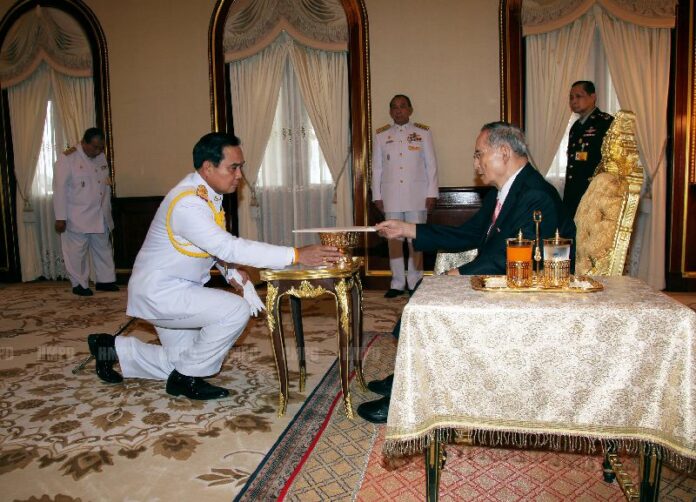
NCPO chairman Gen. Prayuth Chan-ocha receiving the 2014 Interim Constitution from His Majesty the King, 22 July 2014.

The junta's 2014 Interim Constitution is robbing Thai people of their political voices.

Two months after staging a coup d’etat, Thailand’s military junta unveiled a temporary constitution outlining the formation of an interim government that is expected to administer the country until the end of the next year.

The National Council For Peace and Order (NCPO) dissolved Thailand’s 2007 constitution almost immediately after seizing power on May 22, and until last week, ruled over the Kingdom without a charter.

While the return of a constitution should mark a step forward in the direction of democracy, a close look at the 2014 Interim Charter reveals that it is actually a discouraging step backwards.

The most concerning section of the constitution is Article 44, which effectively enshrines the NCPO’s absolute power into the Kingdom’s highest body of law.

Article 44 grants the NCPO power to unilaterally intervene “regardless of its effects on the legislative, executive or judiciary” in the name of defending Thailand against threats to “public order, national security, the monarchy, national economy or sovereignty.”

Not only is the NCPO given this carte blanche to intervene in almost any situation, but “all orders or acts [taken under these circumstances] are to be regarded as lawful and constitutional.”

In other words, nothing the NCPO does can be considered illegal. Furthermore, this absolute power will not be subject to any oversight, judicial or otherwise.

The 2014 interim charter also establishes three governmental bodies that will be tasked with fundamentally restructuring Thailand’s system of government, yet are unlikely to represent broad swaths of the population.

According to the charter, the members of the National Legislative Assembly and Reform Council will be appointed by the King “in accordance with the recommendations of the National Council for Peace and Order,” (Section 6 and Section 28), and the chairman of the Reform Council will in turn appoint the members of the Constitution Drafting Committee (Section 32), which will be tasked with writing a permanent constitution.

Not only is the NCPO granted the power to appoint the members of these bodies, but Sections 8 and 33 of the interim charter preemptively narrow the pool of possible nominees for the NLA and Constitution Drafting Committee to those who have not held positions in political parties over the past three years. With all recently active political figures barred from the get-go, it’s almost certain that the interim government will be dominated by military personnel and their loyal allies.

Finally, the charter makes no mention of putting a draft of the permanent constitution up to a referendum, effectively shutting out Thai people’s ability to weigh in on the future of their country’s government. 

With the power to essentially handpick the writers of Thailand’s political future, the NCPO has ensured that its interests will be protected for years to come. It's also likely that the reforms pursued over the next year will align with the NCPO’s vision for Thailand. Based on how the junta has governed since seizing power on 22 May, this vision will likely involve a curb on human rights, political freedoms, and democratic values. 

As many human rights activists have warned, the current interim constitution robs Thai people of their political voices. Any reforms – constitutional or otherwise – should be carried by an inclusive, democratically elected, civilian government. 


For comments, or corrections to this article please contact[email protected]

You can also find Khaosod English on Twitter and Facebook
http://twitter.com/KhaosodEnglish
http://www.facebook.com/KhaosodEnglish
Advertisement

Nepali Women Climb K2 For The First Time

KATHMANDU (DPA) – Three Nepali women have successfully climbed K2, the world's second-highest mountain and considered to be the most difficult, expedition sponsors said Sunday.

The ascent came as Pakistan celebrated the 1954 feat of two Italian climbers who were the first to reach the 8,611-metre peak.

"A separate team of Nepali women, Maya Sherpa, Dawa Yanjung Sherpa and Pasang Lhamu Sherpa climbed the mountain on Saturday," said Ang Tsering Sherpa, the president of Nepal Mountaineering Association.

It was the first time that Nepali women have climbed the mountain, considered among the most difficult of the world's peaks higher than 8,000 metres.

The women's expedition carries the slogan "Women climbing for climate change," to raise awareness about global warming.

The main climbing season on the world's highest mountain, Everest (8,848 metres) lasts from April to May and ends as the monsoon begins.

"The weather pattern in Pakistan's mountains is different from Nepal's. Summer is the most appropriate time to climb, as they don't have rain like we do in Nepal," said Ang Tsering Sherpa.

"Karakoram is in the rain-shed area, so the climbing season in Pakistan is later than that of Nepal, between July-August."

A joint team of six climbers from Pakistan and Italy also climbed K2 on Saturday to mark the diamond jubilee.

Advertisement

Rakhine Buddhists Oppose Return of Doctors Without Borders

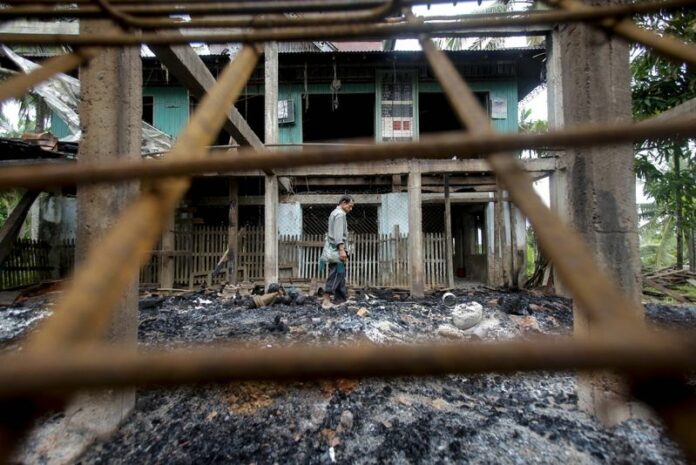
A file photograph from 02 October 2013 of a man walking around the half burned-down mosque at Tha Byu Gyaing village, Rakhine State, western Myanmar. Buddhists in western Myanmar are opposing the government's decision to allow Doctors Without Borders, an aid group, to resume working in the Rakhine state. EPA/LYNN BO BO

YANGON (DPA) – Buddhists in western Myanmar oppose the government's decision to allow international aid group Doctors Without Borders (MSF) to resume working in Rakhine state, reports said Sunday.

More than 100 leaders from ethnic political parties and communities including Buddhist monks said they would urge President Thein Sein to withdraw the offer to non-governmental organizations – especially the medical group – to return to the state, The Voice newspaper said.

"Why did they (government officials) change their mind just four months after blocking MSF at the request of the Rakhine people?" local organizer Thar Pwint said in the state capital Sittwe.

"For certain the Rakhine people cannot accept the MSF operation."

The aid groups were pulled out after Buddhist mobs disrupted their work helping displaced minority Rohingya Muslims during sectarian violence. Local Buddhists accused the aid workers of siding with the Muslims during the conflict.

Clashes between ethnic and religious groups left up to 280 people dead and another 140,000 homeless since 2012, mostly of them Muslims, in Rakhine state, according to human rights groups.

Muslims account for about less than 10 per cent of Myanmar's roughly 60 million people.

The Rohingya are particularly vulnerable, since they are considered stateless people by the government, which regards them as undocumented immigrants from Bangladesh.

Advertisement

Hot News

LATEST NEWS

Bangkok
overcast clouds
28.8 ° C
28.8 °
23.8 °
79 %
2.9kmh
100 %
Thu
31 °
Fri
32 °
Sat
36 °
Sun
36 °
Mon
36 °