28.8 C
Bangkok
Thursday, July 16, 2026
Home Blog Page 3235

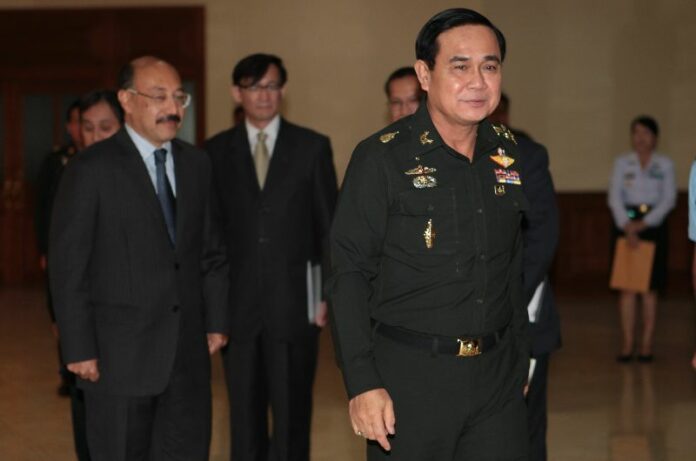
Thai Junta Chief Defends Constitution; Questions Democracy

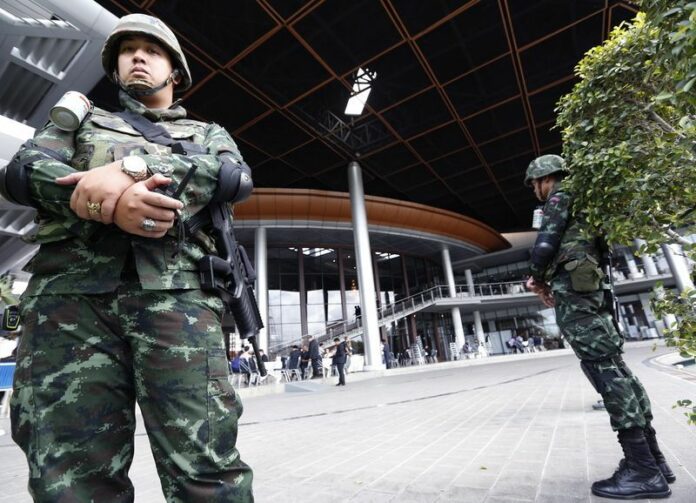
Armed Thai soldiers shown outside the Army Club in Bangkok, Thailand, 13 June 2014. A local magazine editor has been arrested in Thailand, prompting criticism from rights activists, as the domestic media face further possible restrictions [DPA].

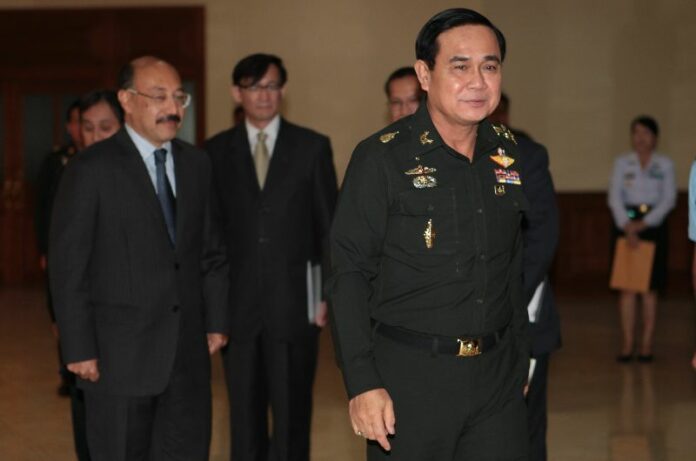
BANGKOK (DPA) — Thailand's junta chief, Prayuth Chan-Ocha, defended an interim constitution put in place earlier this week in his weekly address on Friday.

Critics have been quick to raise concerns about specific articles that increase the regime's unchecked authority, including giving it veto powers and the ability to enact laws and decrees outside the constitutional framework.

"As long as power is used for good, there is no need to worry," Prayuth told the nation in his weekly televised address.

He went on to question a widespread desire for democracy, when he said it had demonstrably failed.

Prayuth pointed out that the country is currently at peace, in contrast to civil unrest and protests that marred the nation when a democracy existed.

"Nevertheless, the junta will continue to work towards democracy," he added.

The general also stressed that no human rights would be violated in dealing with refugees from Myanmar. 

The junta had earlier stated that they would begin repatriating Burmese refugees who had been living in Thailand for the past three decades.

Advertisement

Sri Lanka Elephant Populations Under Pressure From Tourism Drive

A picture made available on 15 July 2014 shows an elephant carrying tourists spraying water over the riders at Pinnawala, Sri Lanka, 13 July 2014. As demand for the animals rises with the growing tourism industry, concerns about the welfare of the endangered species arise. EPA/STRINGER

By Anthony David

COLOMBO (DPA) — An elephant shackled with heavy iron chains on its rear legs shuffles forwards, a foreign couple riding on its back. The mahout prods the elephant with a stick to keep it animal moving at one of central Sri Lanka's top tourist attractions.

The couple visiting Pinnawala, about 100 kilometres east of the capital Colombo, enjoys the unusual bumpy ride, unable from their high vantage point to see the raw chain abrasions on the animal's lower legs.

The elephant has already done several rounds that day in the scorching heat.

"Unfortunately, the foreigners who take elephant rides are unaware that use of domesticated animals for this purpose is illegal, as the government grants permission only to use them in cultural pageants and religious festivals," says Sajeewa Chamikara, director of the Environment Conservation Trust.

Despite the restrictions, demand for the animals has risen along with the fast-growing tourism industry in the previously war-torn nation.

After nearly three decades of ethnic conflict between the government and Tamil rebels, Sri Lanka is on the path to recovery, offering its golden beaches and wildlife parks to visitors from around the world.

The country's herds of elephants, and a state-run elephant orphanage in Pinnawala, have made it a prime tourist destination.

"The demand for elephants in the tourism industry is on the increase. As the laws prevent use of the animals in the tourist industry, some of them have gone to capture them from the wild," environmental lawyer Jagath Gunawardena said.

With an estimated elephant population of 6,000, the government's wildlife department says Sri Lanka annually loses about 250 animals. Most often, the deaths are a result of elephants encroaching on human settlements and being shot or poisoned, or killed with explosives.

But smuggling accounts for more deaths each year, Gunawardena said.

"We believe that for every baby elephant captured, the elephant (mother) is killed, as it is usually difficult to separate the mother otherwise. This is a dangerous trend, as our elephant population is under threat," he said.

He estimated that more than 50 baby elephants have been illegally captured from the wild over the past five years. Other figures indicate that more than 70 such animals are being held.

An attempt to smuggle a baby elephant in May from a wildlife park in central Sri Lanka was thwarted by a group of animal rights activists. The perpetrators escaped.

Those involved in smuggling have a broad network, said wildlife conservationist Deepani Jayantha, a member of the UK-based Born Free Foundation.

"They have a chain of contacts. They befriend local villagers, such as farmers, and even move with certain wildlife officers who are well aware of the area," she said.

"We believe that even some veterinary surgeons may help these people, as they use drugs to tranquilize the animals before capture," said Jayantha, a veterinarian herself.

A smuggled elephant can be sold for an estimated 10 million rupees (77,000 dollars).

Most of them are used simply as display animals to attract tourists, meaning they are kept tied for long hours in limited spaces, said Chamikara. Many are old and under-fed.

The state-run elephant orphanage at Pinnawala has also drawn criticism from animal rights activists, who allege mistreatment with canes and sticks.

Sri Lanka's tourism authority has guidelines on the use of elephants in the tourism sector – despite the absence of a law allowing the practice – but no effective monitoring mechanism.

Without better oversight, experts say the country's tourism industry could suffer, even as the government plans to more than double its annual tourist arrivals by 2016.

"There is growing concern about the ethical use of elephants in promoting the tourist industry," Jayantha said.

"Tourists visiting Sri Lanka and taking elephant rides should be concerned about the conditions under which the animals are held. It is one way which we can draw attention to those holding these elephants," Chamikara said.


Advertisement

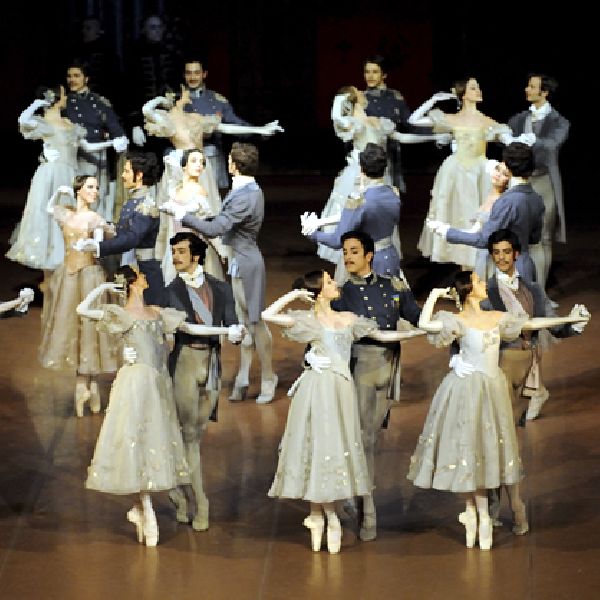
ONEGIN Stuttgart Ballet in Bangkok 25-26 Oct 2014

Supported by Embassy of Germany, Bosch and Thai-Deutsche Kulturstiftung, ONEGIN Stuttgart Ballet, one of the world's most renowned dance company for more than 50 years will perform in Bangkok’s 16th International Festival of Dance and Music in this October.

Saturday 25 October 2014 at 7.30 PM  and Sunday 26 October at 2.30pm
Venue : Main Hall, Thailand Cultural Center
Ticket price : 5,500 / 4,500 / 3,500 / 2,500 / 1,500 Baht 

Stuttgart Ballet is one of the world's most renowned dance companies, at the forefront of the international dance scene for more than 50 years. In Bangkok they present their masterpiece  Onegin choreographed by John Cranko, who created his own distinctive version of Alexander Pushkin’s verse novel in 1965 for the Stuttgart Ballet. Onegin displays all of Cranko’s genius as a narrative choreographer – within a tight dramatic structure, Cranko creates finely drawn characters who are changed by the conflicts that they face.
 
Onegin and Tatiana’s relationship is depicted in intense duets, such as the letter-writing scene, when the youthful Tatiana dances a dream pas de deux with her longed-for lover. Cranko’s choreography that incorporates an eclectic range of dance forms including folk, modern, ballroom and acrobatic – is accompanied by Kurt-Heinz Stolze’s soaring arrangement of Tchaikovsky’s music.

Advertisement

Young Professionals Networking Event

If you are "Young" and "Young at Heart", the Thai-Italian Chamber of Commerce (TICC) together with the Danish-Thai Chamber of Commerce and other partner Chambers are delighted to invite you to the Young Professionals Networking Event on 14 August. Harlem Shakers will rock your young and reckless soul with cool music from special DJ and boost up your enjoyment of networking to unexpected level. 

Come join us in the Young Professionals Networking Event to meet and get great connections with young professional friends from our partnering Chambers. 

Date: Thursday 14 August 2014Time: 6.30 – 8.30 pm.Venue: Harlem Shakers, Thonglor 8  Fee: Chamber member 250 THB / Non-member 500 THB 
Payment: Onsite 

Italian Chamber of Commerce

Advertisement

Industry Ministry to hold 2nd Thailand Culinary World Challenge 2014

BANGKOK, 24 July 2014, (NNT) – The Industry Ministry is set to hold the 2nd Thailand Culinary World Challenge 2014, as part of its continuing efforts to promote the 'Kitchen of the World' campaign. 

According to the Ministry, the food industry has set a goal to expand its exports of agro-products by at least 10% annually by gaining international consumers' confidence, while developing new products to meet a wider range of demands. 

To achieve the said goal, the Ministry will hold a competition at Central Chidlom on August 1st-3rd, in which renowned chefs from more than 10 countries will be competing for the " Best Chef" title. Those attending the event will also be treated to over 60 selected sumptuous dishes for as little as 60 baht each at the event. 

A trophy graciously given by Her Royal Highness Princess Maha Chakri Sirindhorn will be awarded to the winning chef. All the proceeds will go towards Ramathibodi Foundation, which is under the royal patronage of the Princess.

Advertisement

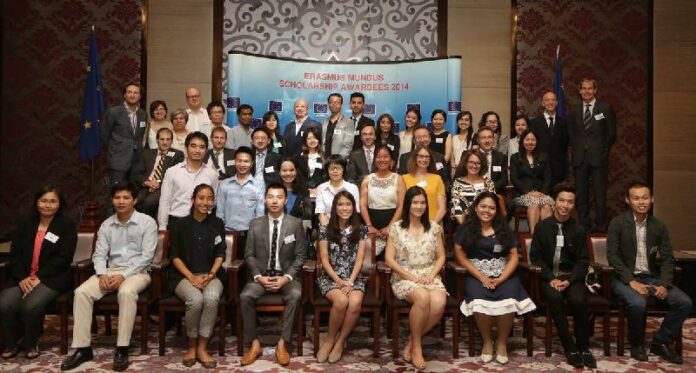
EU has awarded its 'Erasmus Mundus’ scholarships for 2014 to 58 Thai academics

The European Union (EU) has awarded its 'Erasmus Mundus (EM)’ scholarships for 2014 to 58 Thai academics. These Thai students and scholars will benefit from the full scholarships to cover their Bachelor's, Master's, Doctorate and Post-Doctorate studies at European universities during the coming academic year, 2014/ 2015. Their fields of study include, amongst others, subjects like business management, political science, humanities, agriculture, biology, chemistry and software engineering. Since the start of the EU's Erasmus Mundus programme in 2004, more than 600 Thai students and scholars have been granted such scholarships. 

At the EU's annual Erasmus Mundus reception on 9 July 2014 in Bangkok, Ambassador Jesús Miguel Sanz, Head of the Delegation of the European Union to Thailand, congratulated all awardees. "Erasmus Mundus alumni and awardees in Thailand have a good understanding of Europe. EM alumni have friends there, enjoy the European food and, in many cases, speak one (or more) European languages. They return to Thailand, start their working life and contribute to the Thai society.

Today's awardees too can play a valuable role, tomorrow, in bringing Thailand and Europe closer together," Ambassador Sanz said. He also suggested that awardees contacted Ambassadors or representatives from European Union member states and members of the Erasmus Mundus Alumni Association, who have experience in studying in European countries, as a preparation before departure. 

At the reception, EM alumni and awardees were networking with Ambassadors of Austria, Belgium, the Czech Republic, Portugal, Sweden and the UK; representatives of other EU Embassies; of the EU-ASEAN Business Centre (EABC); and of the European private sector in Thailand. 

 

Background 

Erasmus Mundus is the European Union’s flagship cooperation and mobility programme in the field of higher education. It aims to enhance the quality of higher education and promote dialogue and understanding between people and cultures through mobility and academic cooperation. 

Advertisement

The Flying High For Kids World Balloon Project

CHIANG MAI, Thailand, July 10, 2014 – Andrew Parker, a balloon pilot shows hot balloon for children with disabilities in Chiang Mai today. Parker, the founder of Flying High for Kids, will go to 100 countries in next 4 years to help UNICEF promote children’s rights. He shares postcards collected from children around the world so the children can learn and accept different cultures.

 The Flying High For Kids World Balloon Project is a not-for-profit, four-and-a-half year international project in support of UNICEF, which started in December 2013. It is an overland hot air ballooning journey through more than 100 countries. The Flying High For Kids Team will take a hot air balloon with UNICEF branding to schools and UNICEF projects, with an aim of raising awareness and funds for UNICEF’s work, particularly their Schools for Africa and Schools For Asia Programmes. The project has the full support of UNICEF and the project team will be working closely with them throughout.

UNICEF operates in almost every country, at all levels, from grassroots to implementing government policy. We will be working with UNICEF offices in many of the countries we go to, liaising and getting direction from them.

We expect to gain considerable media attention during this project. We will be working with UNICEF offices in each participating country we go to, who will help us liaise with media through their contacts. UNICEF offices will also guide us and provide logistical support in each participating country we travel to.

Schools will be a big theme during our project. We will link first and third world schools around the world by flying or tethering at various schools and exchanging communications between them, giving kids the opportunity to learn about a different way of life to their own.

Throughout the project, the Flying High For Kids Team will be able to witness UNICEF’s work first hand, and will keep track of progress being made on various projects over time.

We will be blogging about our progress in our blog section of this website, so make sure to follow the journey.

The Flying High For Kids Team are hoping to help make people aware of what is going on in the world and to give a broader view of the global community we live in.

Advertisement

Junta's Unchecked Power to Intervene "Normal," Top Official Insists

NCPO leader Prayuth Chan-ocha, 21 July 2014.

BANGKOK — A top official has dismissed criticism from the US-based Human Rights Watch that Thailand's new provisional constitution grants superfluous power to the country’s military junta.

The forty-fourth article the 2014 Interim Constitution states that the National Council for Peace and Order (NCPO) can unilaterally intervene and take any action to protect the Kingdom against "threats" to its national security, monarchy, public order, and economy – without seeking approval from the civilian government.

The NCPO is permitted to intervene "regardless of its effects on the legislative, executive or judiciary," and all orders or acts "are to be regarded as lawful and constitutional," the article says.

The New York-based rights group Human Rights Watch released a public statement today condemning what it’s calling a “charter for dictatorship.”

“Instead of paving the way for a return to democratic, civilian rule, the Thai junta has granted itself unchecked authority to do almost anything it wants, including committing rights abuses with impunity," said Brad Adams, Asia director at Human Rights Watch (HRW). 

But Sihasak Puangketkaew, Thailand’s Permanent Secretary of the Ministry of Foreign Affairs, says that HRW misunderstood the interim charter and the situation in Thailand.

"Human Rights Watch should understand that right now we are going through a period of transition, which requires peace and stability," Mr. Sihasak said in an interview today.

According to Mr. Sihasak, "every country" has a law that allows the authorities to intervene and solve problems when the security of the nation is under threat, but that does not mean that such intervention will happen. 

"Please understand the context of Thai politics," Mr. Sihasak advised, "Don't reach a conclusion too fast. Right now there has not been any invocation of said power [by the NCPO]."


For comments, or corrections to this article please contact[email protected]

You can also find Khaosod English on Twitter and Facebook
http://twitter.com/KhaosodEnglish
http://www.facebook.com/KhaosodEnglish

Advertisement

Junta's Unchecked Power to Intervene "Normal," Top Official Insists

NCPO leader Prayuth Chan-ocha, 21 July 2014.

BANGKOK — A top official has dismissed criticism from the US-based Human Rights Watch that Thailand's new provisional constitution grants superfluous power to the country’s military junta.

The forty-forth article the 2014 Interim Constitution states that the National Council for Peace and Order (NCPO) can unilaterally intervene and take any action to protect the Kingdom against "threats" to its national security, monarchy, public order, and economy – without seeking approval from the civilian government.

The NCPO is permitted to intervene "regardless of its effects on the legislative, executive or judiciary," and all orders or acts "are to be regarded as lawful and constitutional," the article says.

The New York-based rights group Human Rights Watch released a public statement today condemning what it’s calling a “charter for dictatorship.”

“Instead of paving the way for a return to democratic, civilian rule, the Thai junta has granted itself unchecked authority to do almost anything it wants, including committing rights abuses with impunity," said Brad Adams, Asia director at Human Rights Watch (HRW). 

But Sihasak Puangketkaew, Thailand’s Permanent Secretary of the Ministry of Foreign Affairs, says that HRW misunderstood the interim charter and the situation in Thailand.

"Human Rights Watch should understand that right now we are going through a period of transition, which requires peace and stability," Mr. Sihasak said in an interview today.

According to Mr. Sihasak, "every country" has a law that allows the authorities to intervene and solve problems when the security of the nation is under threat, but that does not mean that such intervention will happen. 

"Please understand the context of Thai politics," Mr. Sihasak advised, "Don't reach a conclusion too fast. Right now there has not been any invocation of said power [by the NCPO]."


For comments, or corrections to this article please contact[email protected]

You can also find Khaosod English on Twitter and Facebook
http://twitter.com/KhaosodEnglish
http://www.facebook.com/KhaosodEnglish

Advertisement

Evicted Villagers and Park Officials Reach Compromise

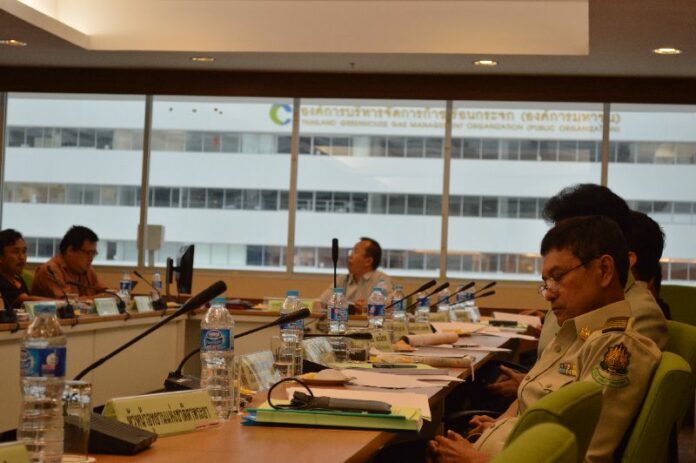
Thailand's National Human Rights Commission chaired a meeting between representative of Kao Bart village, officials from Dong Yai Wildlife Sanctuary, NCPO representatives, and local authorities from Buriram province, 24 July 2014.

BANGKOK — Park officials have agreed to provide housing and land to some of the villagers they recently evicted from a Wildlife Sanctuary in Buriram province.

The agreement was reached after residents from Kao Bart village brought the case to Thailand's National Human Rights Commission (NHRC), which listened to testimonies from representatives of both sides and brokered the compromise. 

Over the past month, soldiers and park officials have evicted hundreds of villagers they say have been living illegally in Dong Yai Wildlife Sanctuary in Buriram province. As of yesterday, the entire community had left — out of fear, villagers said —  except for a group of 30 villagers from Kao Bart.

After hours of heated debate before the NHRC, the villagers agreed to leave the area if the state provides them with new housing and plots of agricultural land. They also requested permission to harvest crops that have already been planted inside the park. 

Park officials and representatives from Buriram's provincial government accepted the villagers' demands, though they did not give details about where, how, and when the new housing and land will be provided. The officials said that only villagers "in need" will receive new land and housing, without elaborating on who will qualify. 

National Human Rights Comissioner Niran Pitakwatchara, who chaired the meeting, said the rights of villagers are very important to the NHRC. 

"We understand that the current situation of the country and lack of land [for farmers] is very important. We want to let the NCPO know that it is the root of inequality," Mr. Niran said, referring to the military junta's National Council for Peace and Order.

The long-running dispute between park officials and the villagers came to a head in June after the NCPO called upon state agencies to put an end to "encroachment" of protected forests across the country.

On 28 June park officials and armed soldiers entered Kao Bart, Saeng Sawan, Talat Kwai, and Lam Nangrong villages and ordered the residents to dismantle their homes and leave the area by 8 July, or else face a forceful eviction by security officers.

Reporters have been barred from entering the disputed area, but villagers say they have been subject to harassment and intimidation by soldiers and park officials. Villagers have also accused security officers of framing them by planting drugs in the community and creating false evidence of illegal logging.

Last week, the New York-based Human Rights Watch condemned the "forced eviction" of the villagers. 

“The Thai military is using threats and arbitrary arrests to forcibly evict villagers from forest areas in Buriram province,” said Brad Adams, the Asia director of Human Rights Watch. “Instead of resolving a land issue through legal means, the military is using its wide-reaching martial law powers to bludgeon human rights protections.”

At yesterday’s hearing, officials denied any use of force against the villagers.

“We have not used force at all," said Chalermpol Palawan, Deputy Governor of Buriram, as representatives from Kao Bart village shook their heads. "We’ve created understanding with the people by being friendly.”

The 2nd Region Army, which villagers say is responsible for the alleged abuse, was invited to yesterday's hearing but declined to send any representatives. NCPO officials told the NHRC that they were not aware of the use of force against villagers, and promised to discuss the matter with the 2nd Region Army. 

Baramee Chairat, a leader of the Thai NGO the Assembly of the Poor, helped represent the evicted villagers at yesterday’s hearing. He said he was disappointed that the abuses villagers faced by park officials and soldiers were not addressed in the final settlement. 

"I am not really satisfied," Mr. Baramee said, "But it's a good compromise if villagers are really given new land to work on."


For comments, or corrections to this article please contact[email protected]

You can also find Khaosod English on Twitter and Facebook
http://twitter.com/KhaosodEnglish
http://www.facebook.com/KhaosodEnglish

Advertisement

Hot News

LATEST NEWS

Bangkok
overcast clouds
28.8 ° C
28.8 °
23.8 °
76 %
3.7kmh
100 %
Thu
31 °
Fri
35 °
Sat
36 °
Sun
36 °
Mon
36 °