30.6 C
Bangkok
Friday, August 28, 2026
Home Blog Page 3348

HM King To Formally Appoint Prayuth As Junta Head

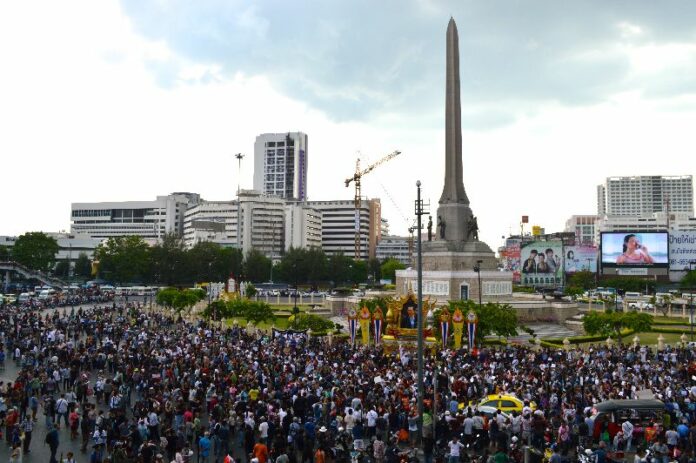
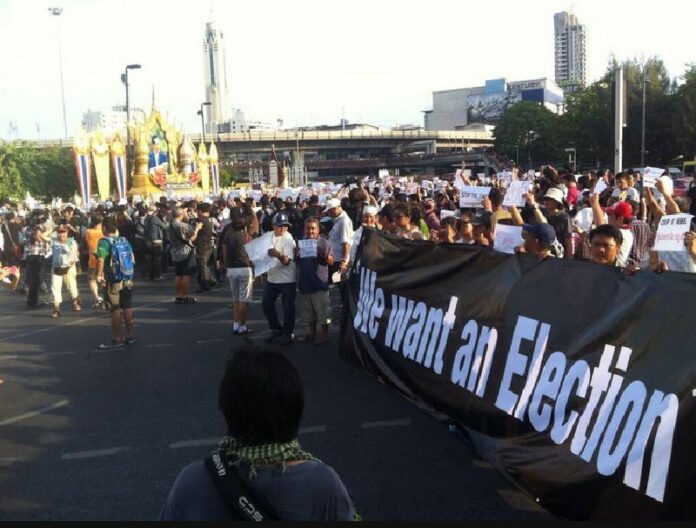
Anti-Coup Protest in Victory Monument, 25 May 2014.

BANGKOK — His Majesty the King will formally appoint army chief Gen. Prayuth Chan-ocha as head of the military junta, a top military officer said.

According to Lt.Gen. Panuwat Nakawong, Thailand’s 86-year-old king will attend a ceremony tomorrow to officially designate Gen. Prayuth as head of the National Council of Peace and Order (NCPO). His Majesty the King is currently recovering from an illness at his summer palace in Prachuap Kiri Khan province.

Gen. Prayuth seized power from the civilian government and established himself as the chairman of the NCPO on 22 May.

The palace’s delay in formally approving the NCPO’s coup has puzzled many observers. In past coups, royal approval has been issued almost immediately.

Yesterday, the NCPO said a letter was sent to notify the palace of the military takeover, and that His Majesty the King “acknowledged" it.

After Gen. Prayuth is formally appointed head of the NCPO, a temporary charter will be drafted and a new Prime Minister will be appointed, said Lt.Gen. Panuwat,

A National Assembly and "Reform Council" will also be established to govern the country, Lt.Gen. Panuwat added.

It is not clear what the time frame for any of these developments will be.

Since seizing power on Thursday, the NCPO has voided the 2007 Constitution and dissolved the country’s Cabinet, Senate, and Parliament.  As a result, all legislative and administrative powers currently rest with the NCPO, which is governing Thailand under martial law. 


For comments, or corrections to this article please contact:[email protected]

You can also find Khaosod English on Twitter and Facebook
http://twitter.com/KhaosodEnglish
http://www.facebook.com/KhaosodEnglish

Advertisement

Anti-Coup Protests in Khon Kaen

At 5:15 p.m., an anti-coup protestor unveiled a banner reading, “No to the Coup Constitution of 2007. Bring Back the 1997 Constitution.” It was quickly confiscated. (The Isaan Record)

(The Isaan Record)

On May 24, the second full day after the overthrow of the caretaker government by a military coup, there was a greater military presence in Khon Kaen, as well as signs of resistance to the  National Council for Peace and Order (NCPO). 

In the span of three hours, at least three independent anti-coup activities took place around Khon Kaen, including two at Central Plaza shopping mall and one at Khon Kaen University.

Read the rest of the story here.


Note: Khaosod English is not responsible for content on other websites.

 
Advertisement

US Cancels Military Exercises in Thailand After Coup

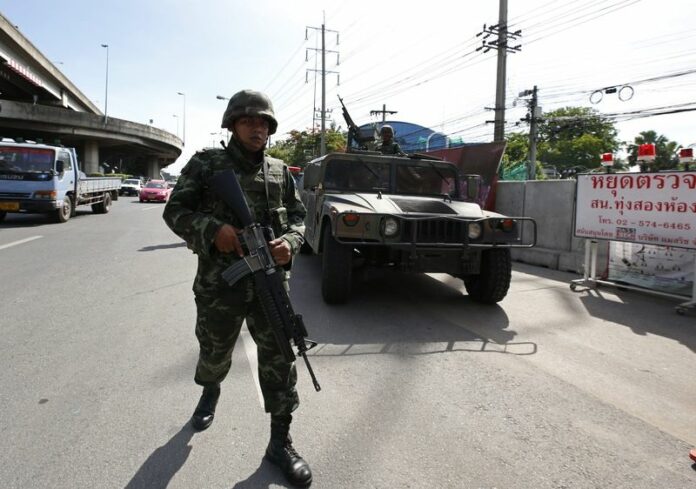
Thai soldiers on patrol outside the Royal Thai Police Sports Club in Bangkok, Thailand, after the army chief declared martial law on 20 May 2014 (DPA).

BANGKOK (DPA) — The US military announced the cancellation of joint exercises with Thailand in the wake of last week's coup.

Army chief General Prayuth Chan-ocha seized power with a coup d'etat on Thursday and has placed the country under martial law, detaining at least 150 politicians, activists and scholars over the past thee days.

On Saturday, the junta dissolved the Senate, strengthening Prayuth's legislative powers as sole ruler of the nation.    

"It is important that the Royal Thai Armed Forces end this coup and restore to the people of Thailand both the principles and the process of democratic rule, including a clear path forward to elections," Pentagon press secretary Rear Admiral John Kirby said in Washington.

Thailand and the US have enjoyed close military ties since the Vietnam War, when the Asian kingdom was allied with US forces and hosted their military bases on its soil.

"While we have enjoyed a long and productive military-to-military relationship with Thailand, our own democratic principles and US law require us to reconsider US military assistance and engagements," Kirby said.

The Pentagon cancelled this year's exercises as well as planned visits in June by US Pacific Fleet Commander Admiral Harry Harris to Thailand and Thai Armed Forces Commander General Tanasak Patimapragorn to the US Pacific Command.

The cancellations followed the US State Department's decision on Friday to suspend 3.5 million dollars in aid to Thailand.

"We are reviewing all programmes to determine other assistance which we may suspend," State Department spokeswoman Marie Harf said.

"As we have made clear, it is important that the Royal Thai Armed Forces end this coup and restore to the people of Thailand both the principles and the process of democratic rule, including a clear path forward to elections."
 

Advertisement

Military Summons Print Media to Army Club

BANGKOK — The military has summoned representatives from 18 Thai newspapers to attend a 2pm meeting at the Army Club tomorrow.

Since seizing power on 22 May, the military junta has directed most of its media censorship towards television and radio stations. Tonight's summons is the first indication that the military may directly target print media as well. 

Khaosod was among those invited to the meeting and will send a chief editor to represent the newspaper. 

After announcing the coup d'etat on Thursday afternoon, the military junta temporarily blacked out all television and radio stations, including international broadcasters like CNN and BBC. Media outlets that tried to stream live coverage online were shutdown as well. 

The military has also warned all news outlets and social media users not to publish anything that could "incite unrest" or cause "public confusion," warning that violaters may face prosecution. In addition, all academics and other non-officials have been forbidden from giving comments to the media that run counter to the military junta's goals. 

Over the past few days, over 100 politicians, activists, and academics have been summoned to the Army Club. 

Many of those who have reported to such meetings have not been released, including Prime Minister Yingluck Shinawatra who was detained after she arrived at the Army Club in compliance with her summons. 

International human rights organisations have unanimously condemned the military's arbitrary arrests and restrictions on media freedom.

“Widespread censorship and threats to the media are aimed at silencing any and all critics of military rule in Thailand,” said Human Rights Watch's Brad Adams. “Thailand’s friends and allies should demand an end to this assault on the media. In a political crisis, free speech is needed more than ever.”

For comments, or corrections to this article please contact:[email protected]

You can also find Khaosod English on Twitter and Facebook
http://twitter.com/KhaosodEnglish
http://www.facebook.com/KhaosodEnglish


Advertisement

Senate Dissolved, Pro-Thaksin Officials Transferred

BANGKOK — The Thai military junta further consolidated its power tonight by dissolving the Senate and transferring top officials allied to the previous government to inactive posts.

The announcement was made in a statement released by the National Council for Peace and Order (NCPO) this evening.

The NCPO provided no reasons for dissolving of the Senate, whose members are half-elected and half-appointed by the Courts and other independent agencies allied with the establishment. This Senate was largely controlled by its appointed members, who were considered to be sympathetic to the anti-government protest movement's cause. 

The announcement effectively voided the last remaining legislative body in Thailand, granting the coup leaders all law-making powers. The House of Parliament and the Cabinet were dissovled by the NCPO when it seized power. 

General Prayuth Chan-ocha, who declared a coup d'etat on 22 May, is now the acting prime minister. There has been no word on whether he will appoint a civilian premier, as was the case under past coups.

The NCPO also announced tonight that it would be transferring three officials to “assistant” duties at the Office of Prime Minister, which are understood to be inactive posts. 

The three transferred officials include chief of the Division of Special Investigation (DSI) Tharit Pengdith, Royal Thai Police chief Adul Saengsingkaew, and Permanent Secretary to the Ministry of Defence Nipat Thonglek.

All three men have been close allies to former Prime Minister Thaksin Shinawatra, the influential former Prime Minister who was ousted in the 2006 military coup, but remained the de facto leader of the former government while living in self-imposed exile abroad.

Since seizing power, the NCPO has summoned hundreds of politicans, activists, and academics. Many of those summoned, including former Prime Minister Yingluck Shinawatra, have been detained in undisclosed locations.

For comments, or corrections to this article please contact:[email protected]

You can also find Khaosod English on Twitter and Facebook
http://twitter.com/KhaosodEnglish
http://www.facebook.com/KhaosodEnglish 

Advertisement

Three Arrested in Anti-Coup Protest in Chiangmai

(Prachatai English)

At least three anti-coup protesters i have been seized and detained by soldiers  at Thapae Gate in Chiangmai. Since the introduction of martial law on May 20, protesters have regularly gathered there to voice their opposition.

See photos here


Note: Khaosod English is not responsible for content on other websites.

 
Advertisement

Senate Dissolved, Pro-Thaksin Officials Transferred

Senate Speaker Surachai, 13 May 2014.

BANGKOK — The Thai military junta further consolidated its power tonight by dissolving the Senate and transferring top officials allied to the previous government to inactive posts.

The announcement was made in a statement released by the National Council for Peace and Order (NCPO) this evening.

The NCPO provided no reasons for dissolving of the Senate, whose members are half-elected and half-appointed by the Courts and other independent agencies allied with the establishment. This Senate was largely controlled by its appointed members, who were considered to be sympathetic to the anti-government protest movement's cause. 

The announcement effectively voided the last remaining legislative body in Thailand, granting the coup leaders all law-making powers. The House of Parliament and the Cabinet were dissovled by the NCPO when it seized power. 

General Prayuth Chan-ocha, who declared a coup d'etat on 22 May, is now the acting prime minister. There has been no word on whether he will appoint a civilian premier, as was the case under past coups.

The NCPO also announced tonight that it would be transferring three officials to “assistant” duties at the Office of Prime Minister, which are understood to be inactive posts. 

The three transferred officials include chief of the Division of Special Investigation (DSI) Tharit Pengdith, Royal Thai Police chief Adul Saengsingkaew, and Permanent Secretary to the Ministry of Defence Nipat Thonglek.

All three men have been close allies to former Prime Minister Thaksin Shinawatra, the influential former Prime Minister who was ousted in the 2006 military coup, but remained the de facto leader of the former government while living in self-imposed exile abroad.

Since seizing power, the NCPO has summoned hundreds of politicans, activists, and academics. Many of those summoned, including former Prime Minister Yingluck Shinawatra, have been detained in undisclosed locations.

For comments, or corrections to this article please contact:[email protected]

You can also find Khaosod English on Twitter and Facebook
http://twitter.com/KhaosodEnglish
http://www.facebook.com/KhaosodEnglish 

Advertisement

Scuffles, Road Blockade Greet Anti-Coup Protests

Anti-coup protesters on May 24, 2014 at Victory Monument. Photo: Matichon

BANGKOK — Hundreds of anti-coup protesters demonstrated in Bangkok for a second day of public protest against the military coup d'etat, despite the military junta’s ban on public gatherings of more than five people.

Earlier in the day, at least 150 demonstrators gathered in front of Major Cineplex shopping mall on Phahonyothin Road. The protesters, who held placards condemning the coup, repeatedly shouted "Ai Ley Org Pai!" ("Cross-eyed, get out!") in reference to coup-leaer Gen. Prayuth Chan-ocha, who is said to be cross-eyed.

"I am frustrated, I can't stand this," said a 33-year-old protester who declined to be identified by name. "Why should I bow down to this lawless power who is using guns to threaten people?"

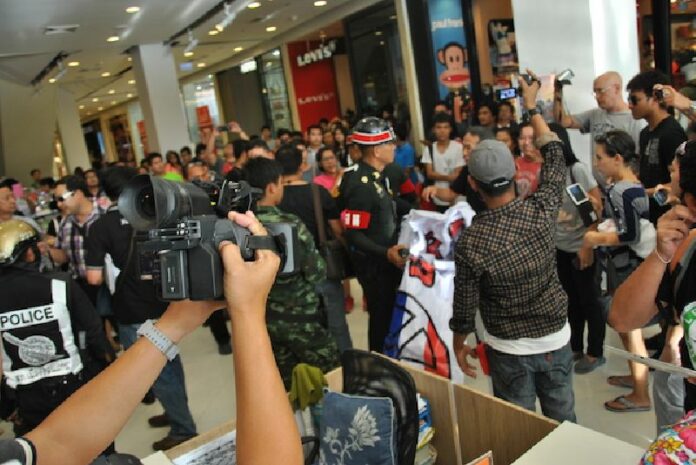
Although the protest was largely peaceful, commotion broke out when a prominent royalist activist, who has previously filed a lese majeste charge against a student activist, was spotted near the soldiers. The crowd rushed to surround Ponnipa Supatnukul, which prompted soldiers to hail a public minivan and whisk her away.

At around 3 pm the protesters attempted to march down Phahonyothin Road to join other protesters at Victory Monument, but were stopped by rows of soldiers and riot police near Soi Phahonyothin. 

Minor clashes broke out, and several protesters were detained but later released by the military after a shoving match and more fistfights. Meanwhile, soldiers took a visibly more aggressive stance toward reporters, asking some journalists not to take photos. 

When it was clear that the soldiers would not yield, protesters changed their plan and took the Skytrain to Victory Monument, where hundreds of other protesters awaited them with huge banners, placards, and paper signs denouncing the coup and demanding an immediate return to a civilian administration.

The protesters initially occupied the elevated Skywalk surrounding Victory Monument, but as the crowd grew the demonstrators took to the road and marched clockwise around the iconic monument.

Dozens of soldiers were stationed near the monument but a large group of protesters later chased them away, forcing soldiers to take positions around the elevated skywalk and the nearby Skytrain station. Many of the soldiers were armed with automatic rifles, but they did not attempt to disperse the protesters.

The protest was initially scheduled to end at 6 pm, but many protesters remained in the area as the sun began to set.

The situation became increasingly tense after sundown, especially when one protester – understood to be one of the event’s organisers – was taken away by the military. An enraged crowd followed, streaming onto Phaholyothin Road, and the group of soldiers who arrested the activist were eventually outnumbered and forced to release the suspect.

Several other protesters were also reportedly arrested. Reports indicate that some soldiers behaved aggressively toward the demonstrators and attempted to detain those who held protest signs.

It is not clear who has been organising the mass protests, but the location of the rally was announced on an anti-coup Facebook page.

Another smaller protest was held in front of the Bangkok Art Cultural Centre today, which was the location of a similar protest yesterday. At least one protester was detained by security forces. 

For comments, or corrections to this article please contact:[email protected]

You can also find Khaosod English on Twitter and Facebook
http://twitter.com/KhaosodEnglish
http://www.facebook.com/KhaosodEnglish


Advertisement

HRW: Rights in ‘Free Fall’ After Coup

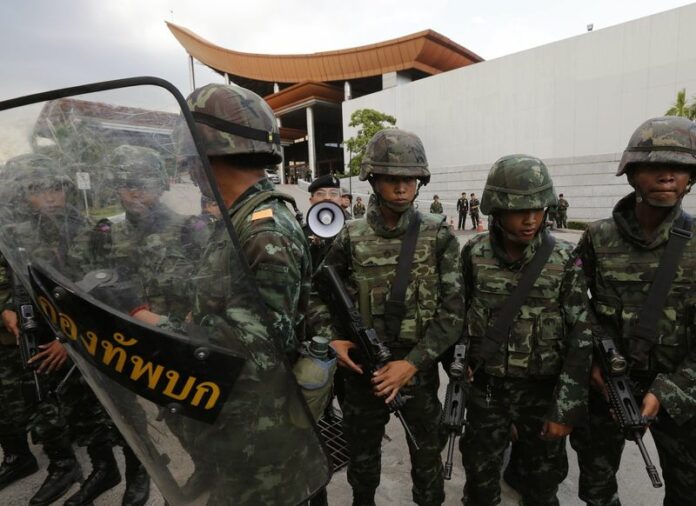
Thai armed soldiers stand guard after a meeting between the army and the main political rivals. Thai Army Chief Prayuth Chan-ocha announced a coup after his efforts to reconcile rival political factions failed (DPA).

Human Rights Watch Press Release, 24 May 2014

NEW YORK – The Thai military should immediately revoke abusive martial law powers, end censorship, and release all people who have been arbitrarily detained, Human Rights Watch said today. The military should urgently restore democratic, civilian rule.

Since the military coup was announced on May 22, 2014, the National Peace and Order Maintaining Council (NPOMC), comprised of all branches of armed forces and the police, has arrested more than 100 ruling party and opposition politicians, activists, journalists, and others accused of supporting the deposed government. While some have been released, the army has also ordered some 155 others to report, including deposed acting Prime Minister Niwattumrong Boonsongpaisan. Those summoned by the military face arrest and prosecution if they fail to report, and are prohibited from leaving Thailand.

The military has also imposed widespread censorship and other broad restrictions on broadcast, print, and electronic media across the country. The NPOMC has imposed a curfew from 10 p.m. to 5 a.m. and banned public gatherings of more than five people. Military authorities ordered rallies of both the pro-government United Front for Democracy against Dictatorship (UDD) and the anti-government People’s Democratic Reform Committee (PDRC) to disband.

“Military rule has thrown Thailand’s rights situation into a free fall,” said Brad Adams, Asia director. “The army is using draconian martial law powers to detain politicians, activists, and journalists, to censor media, and to ban all public gatherings. This rolling crackdown needs to come to an end immediately.”

The military began arresting people on May 20, after the imposition of martial law nationwide.

According to the army spokesman Col. Werachon Sukhondhadhpatipak, more than 100 people have been arrested, including former Prime Minister Yingluck Shinawatra and other politicians, leaders of political movements, and financiers of the ruling Pheu Thai Party in order to “keep them away from the situation.” The spokesman said that Yingluck would be held for two to three days because, “She is one of people involved in the conflict.” A number of Pheu Thai Party leaders reportedly remain in military custody.

Immediately following the coup, military authorities in Bangkok and across Thailand summoned officials from government agencies, professional associations, and civil society groups to report to the military, where they are being instructed not to defy regulations issued under martial law.

Soldiers have dismantled UDD and PDRC rally sites and sent protesters back home by bus. Several people protesting against military rule in downtown Bangkok, including Thanaphol Eiwsakul, the well-known editor of Fah Diew Kan magazine, were arrested by soldiers on the evening of May 23. The whereabouts of those arrested remain unknown.

Incommunicado Detention 
Reports that the military is detaining people in unofficial places of detention, such as military camps, raise grave concerns. There are unconfirmed reports that some UDD leaders and supporters last seen being arrested by soldiers at the Aksa Road rally site outside Bangkok have gone missing. UDD leaders and supporters in other provinces have also reportedly been detained in undisclosed military camps without access to their families and lawyers.

Among those detained incommunicado in secret locations are Boonlert Ruengtim, a core leader of the UDD’s militia who was arrested on May 20, and Chantana Warakornsakulkij and Chawawat Thongpuak, who were arrested on May 21 following raids on alleged UDD weapons caches. The military authorities have thus far provided no information about the names and number of detained or their current whereabouts. The risk of torture and ill-treatment significantly increases when detainees are held incommunicado in unofficial locations and under the control of the military, which lacks training and experience in law enforcement.

“The military’s mass arbitrary arrests are made all the worse by holding people in secret detention,” Adams said. “Those who have allegedly committed crimes should be properly charged and face fair trials in civilian courts.”

Military Media Blackout
Censorship and other restrictions on media and free expression that began after the coup have intensified. Immediately after the coup was declared, military authorities ordered TV and radio stations to stop their regular programs and link their broadcast to the army TV Channel 5 for almost 24 hours. Armed soldiers arrested the deputy director of Thai PBS TV, Wanchai Tantiwittayapitak, and held him for several hours after his station defied the order by broadcasting its regular programs through Internet feeds. Even though those TV stations are now allowed to resume their regular programs, they have to strictly follow the junta’s order not to air any information critical of the military intervention.

The military has directed print media not to publicize commentaries critical of the military’s actions. TV and radio programs have been instructed not to invite on their programs anyone who might make negative comments about the military or the political situation in the country. Military authorities have told journalists that failure to comply will lead to prosecution. 

The NPOMC has invoked censorship against information it considers to be “distorted” or likely to cause “public misunderstanding” in broadcasts, printed publications, on social media, and on websites. At the time of writing, the military has forced off the air 15 satellite and digital TV channels, as well as many community radio networks. Cable and satellite operators were ordered to disconnect their TV links for all international news and entertainment channels, resulting in the nationwide blocking of international stations such as CNN, BBC, Al-Jazeera, and Bloomberg. Soldiers have been placed in newsrooms to censor “negative” reports and comments. On May 23, the military summoned all Internet service providers and ordered them to strictly self-censor content related to the country’s political situation.

“Widespread censorship and threats to the media are aimed at silencing any and all critics of military rule in Thailand,” Adams said. “Thailand’s friends and allies should demand an end to this assault on the media. In a political crisis, free speech is needed more than ever.”

Constitution Suspended Under 1914 Martial Law Act
When army commander-in-chief Gen. Prayuth Chan-ocha announced the coup on May 22, the military suspended most of the 2007 constitution and took over national administration from the government. Prayuth invoked the century-old Martial Law Act of 1914, which grants the military virtually unlimited powers to restrict fundamental human rights and freedoms and provides effective immunity for abuses committed. Under the act, all civilian officials must act in strict compliance with the requirements of the military authority. Furthermore, all the provisions of any law, including human rights safeguards, that are inconsistent with martial law are suspended and replaced by martial law provisions.

Under the Martial Law Act, the military, without judicial oversight, can prohibit any activity, censor the media at will, outlaw meetings and assemblies, search and seize any item, occupy areas, and detain people without charge for up to seven days. There is no effective redress for harms caused since the law bars remedy or compensation to individuals or companies for any damage caused by military actions done in line with martial law authority.

Prayuth said the nationwide intervention will continue “as long as necessary.” He claimed the intervention was needed to prevent imminent riots and widespread disturbances arising from increasingly violent political confrontations between anti-government protesters and government supporters.

The power seizure took place immediately after the military brokered negotiations among representatives of rival factions – including the caretaker government, the ruling Pheu Thai Party, the opposition Democrat Party, the pro-government United Front for Democracy against Dictatorship, and the anti-government People's Democratic Reform Committee. The negotiations failed when the caretaker government was unwilling to resign.

The apparent target of the coup is former Prime Minister Thaksin Shinawatra, who was ousted in a 2006 coup, and his political allies in the ruling Pheu Thai Party. Thaksin, a populist leader with a poor human rights record as prime minister from 2001-2006, has been in exile since 2008, evading a corruption conviction, and has continued to finance and oversee the Pheu Thai Party, installing his sister, Yingluck, as prime minister after the Pheu Thai Party won the last national election in 2011.

“The military and others in Thailand are so desperate to rid the country of Thaksin and his allies that they are now holding the entire country hostage to their whims,” said Adams. “The Thai army needs to recognize that the government should be determined by the ballot, not the bullet.”

Advertisement

US Finally Suspends Military Aid to Thailand After Coup

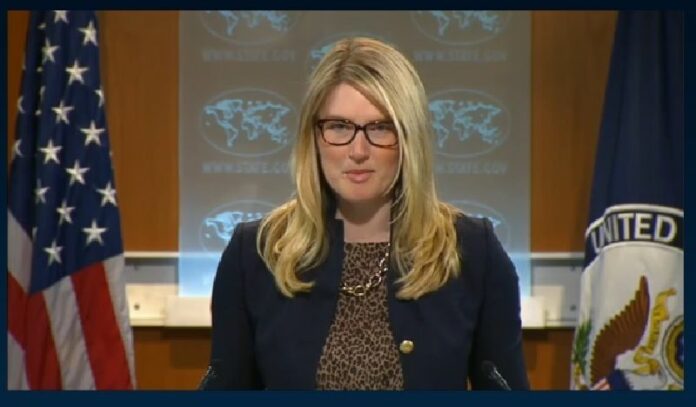
Marie Harf

Washington (AFP) —The United States Friday suspended $3.5 million in military assistance for Thailand, about one-third of its aid to the ally, and urged Americans to reconsider travel plans after the army seized power.

State Department spokeswoman Marie Harf said Washington was also reviewing the rest of US aid to Thailand — which totaled some $10.5 million in 2013 — to look for further cuts.

"We have already suspended approximately $3.5 million" in funding and training for the Thai military, Harf told reporters.

"We are reviewing all programs to determine other assistance which we may suspend."

Harf said the United States was looking through its allocated funding for international bodies, including the 10-nation ASEAN bloc, to identify money directed to Thailand.

The United States has contacted junta leaders to deliver the message, Harf said.

"We urge the immediate restoration of civilian rule, a return to democracy and, obviously, respect for human rights during this period of uncertainty."

Under domestic law, the United States is obligated to suspend assistance to foreign militaries that overthrow elected governments.

In updated travel advice, the State Department recommended that US citizens "reconsider any non-essential travel to Thailand" due to the unrest and restrictions on movements.

It said US government officials would put off all non-essential visits to the kingdom.

"US citizens are advised to stay alert, exercise caution and monitor international and Thai media," the advisory said.

Secretary of State John Kerry has strongly condemned Thursday's coup, saying there was "no justification" and that the move would have "negative implications" for relations between the two countries.

The top US diplomat urged the restoration of a civilian government, respect for press freedom and early elections.

Thailand is the oldest US ally in Asia and provided critical support in the Vietnam and Korean wars.

Advertisement

Hot News

LATEST NEWS

Bangkok
overcast clouds
30.6 ° C
31.9 °
30 °
78 %
4.5kmh
100 %
Fri
32 °
Sat
33 °
Sun
27 °
Mon
27 °
Tue
28 °