In this Oct. 12, 2018, file photo, Chairman of Alibaba Group Jack Ma speaks during a seminar in Bali, Indonesia. (AP Photo/Firdia Lisnawati, File)
BEIJING (AP) — China’s highest-profile entrepreneur, Jack Ma, appeared Wednesday in an online video, ending a 2 1/2-month absence from public view that prompted speculation about the future of the e-commerce billionaire and his Alibaba Group.
In the 50-second video, Ma congratulated teachers supported by his foundation and made no mention of his disappearance or official efforts to tighten control over Alibaba and other internet companies over the past six months. The video appeared on Chinese business news and other websites.
The normally voluble Ma disappeared from public view after he irked regulators by criticizing them in an Oct. 24 speech at a Shanghai conference. Days later, regulators suspended the planned multibillion-dollar stock market debut of Ant Group, a financial platform that grew out of Alibaba’s payments service, Alipay.
That prompted speculation online about whether the 56-year-old Ma, China’s biggest global business celebrity and a symbol of its tech boom, had been detained or might face legal trouble. Alibaba and the government haven’t responded to questions about him.
The Jack Ma Foundation said in a statement Wednesday: “Jack Ma participated in the online ceremony of the annual Rural Teacher Initiative event on January 20.” The foundation and Alibaba didn’t respond to questions about Ma’s status and when his next public event might be.
President Xi Jinping’s government says anti-monopoly enforcement against internet companies will be a priority this year. Alibaba and other companies have been fined for violating anti-monopoly rules. Some social media services have been reprimanded for lapses in enforcing censorship.
In his October speech, Ma complained regulators had an antique “pawnshop mentality” and were hampering innovation, according to Chinese media. He appealed to them to make it easier for entrepreneurs and young people to borrow.
That clashed with the ruling party’s marathon campaign to reduce surging debt in China’s financial system that prompted fears about a possible bank crisis and led rating agencies to cut Beijing’s credit rating for government borrowing.
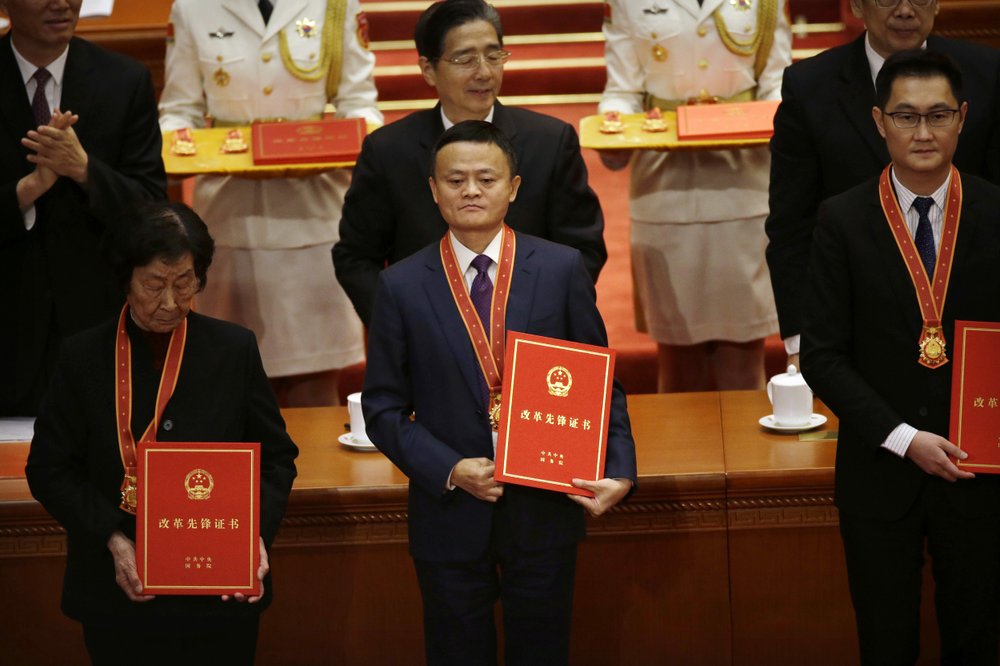
In this Dec. 18, 2018, file photo, Jack Ma, center, chairman of Chinese e-commerce firm Alibaba Group, stands during a conference to commemorate the 40th anniversary of China’s Reform and Opening Up policy at the Great Hall of the People in Beijing. (AP Photo/Mark Schiefelbein, File)
Some people suggested the ruling Communist Party was making an example of Ma to show entrepreneurs couldn’t defy regulators. But finance experts said Xi’s government was uneasy about Alibaba’s dominance in retailing and Ant’s potential financial risks.
Anti-monopoly regulators warned executives Alibaba and five other tech giants in December not to use their dominance to block new competitors from entering their markets. The central bank and other regulators have ordered Ant to overhaul its business before its market debut can go ahead.
Alibaba’s share price in Hong Kong is down 10% since October but recovered some of its loss from its low point this month.
Ma, a ruling party member, stepped down as Alibaba chairman in 2019 but is a member of the Alibaba Partnership, a 36-member group with the right to nominate a majority of the company’s board of directors. He played a leading role in developing Ant, which grew out of Alibaba’s online payment service, Alipay.
In the video Wednesday, Ma, wearing a blue sweater over a white T shirt and gray trousers, smiled and waved to viewers. It included a scene the video said showed Ma visiting a school supported by his foundation on Jan. 10.
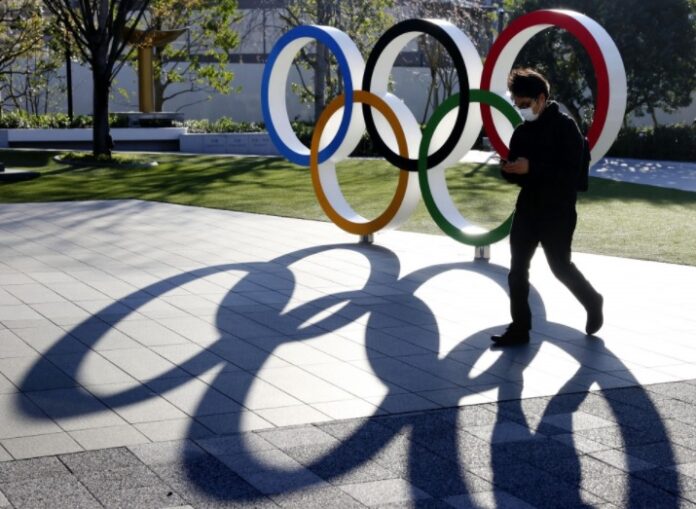
GENEVA (Kyodo) — Keith Mills, deputy chairman of the London Organizing Committee for the 2012 Olympic Games, told the BBC Tuesday he would be preparing for cancellation if he was in charge of the Tokyo Games.
“Looking at the pandemic around the world, in South America, in North America, in Africa and across Europe, it looks unlikely, I have to say,” Mills told BBC Radio 5 live.
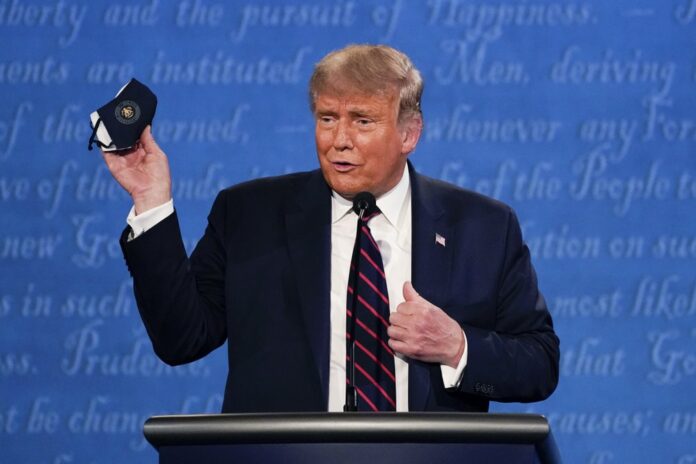
In this Sept. 29, 2020, file photo, President Donald Trump holds up his face mask during the first presidential debate at Case Western University and Cleveland Clinic, in Cleveland, Ohio. (AP Photo/Julio Cortez, File)
By The Associated Press
As President Donald Trump entered the final year of his term last January, the U.S. recorded its first confirmed case of COVID-19. Not to worry, Trump insisted, his administration had the virus “totally under control.”
Now, in his final hours in office, after a year of presidential denials of reality and responsibility, the pandemic’s U.S. death toll has eclipsed 400,000. And the loss of lives is accelerating.
“This is just one step on an ominous path of fatalities,” said Dr. Irwin Redlener, director of the National Center for Disaster Preparedness at Columbia University and one of many public health experts who contend the Trump administration’s handling of the crisis led to thousands of avoidable deaths.
“Everything about how it’s been managed has been infused with incompetence and dishonesty, and we’re paying a heavy price,” he said.
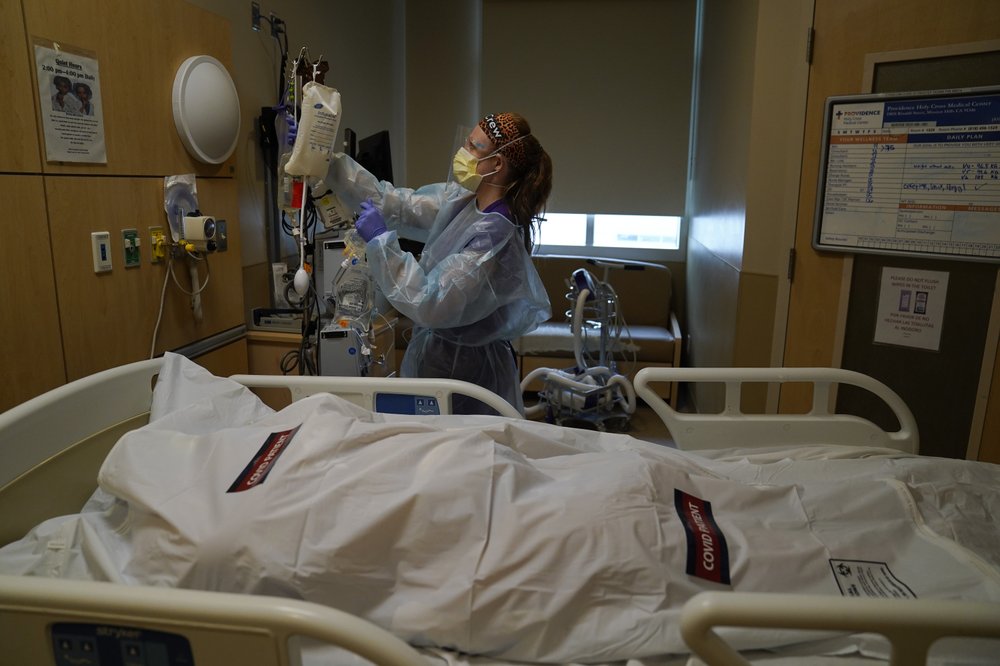
Registered nurse Nikki Hollinger cleans up a room as a body of a COVID-19 victim lies in a body bag labeled with stickers at Providence Holy Cross Medical Center in the Mission Hills section of Los Angeles, Saturday, Jan. 9, 2021. (AP Photo/Jae C. Hong)
The 400,000-death toll, reported Tuesday by Johns Hopkins University, is greater than the population of New Orleans, Cleveland or Tampa, Florida. It’s nearly equal to the number of American lives lost annually to strokes, Alzheimer’s disease, diabetes, flu and pneumonia combined.
With more than 4,000 deaths recorded on some recent days — the most since the pandemic began — the toll by week’s end will probably surpass the number of Americans killed in World War II.
“We need to follow the science and the 400,000th death is shameful,” said Cliff Daniels, chief strategy officer for Methodist Hospital of Southern California, near Los Angeles. With its morgue full, the hospital has parked a refrigerated truck outside to hold the bodies of COVID-19 victims until funeral homes can retrieve them.
“It’s so incredibly, unimaginably sad that so many people have died that could have been avoided,” he said.
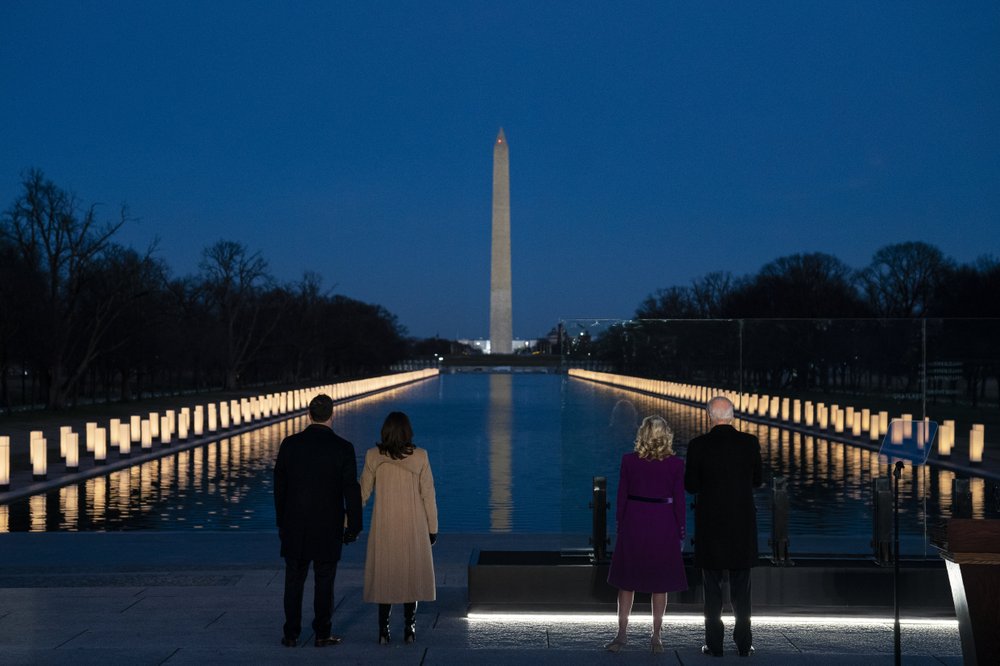
President-elect Joe Biden and his wife Jill Biden are joined by Vice President-elect Kamala Harris and her husband Doug Emhoff during a COVID-19 memorial event at the Lincoln Memorial Reflecting Pool, Tuesday, Jan. 19, 2021, in Washington. (AP Photo/Evan Vucci)
President-elect Joe Biden, who will be sworn in Wednesday, took part in an evening remembrance ceremony Tuesday near the Lincoln Memorial in Washington. The 400,000 dead were represented by 400 lights placed around the reflecting pool. The bell at the Washington National Cathedral tolled 400 times.
Other cities around the U.S. planned tributes as well. The Empire State Building was lit in “heartbeat” red — the same lighting used last year as a show of support for emergency workers at the height of the virus surge in New York City. The red lights pulsed as a visual heartbeat. In Salt Lake City, the bells at the Utah Capitol were to ring 15 times in honor of the more than 1,500 lives lost to COVID-19 in the state.
The U.S. accounts for nearly 1 of every 5 virus deaths reported worldwide, far more than any other country despite its great wealth and medical resources.
The coronavirus would almost certainly have posed a grave crisis for any president given its rapid spread and power to kill, experts on public health and government said.
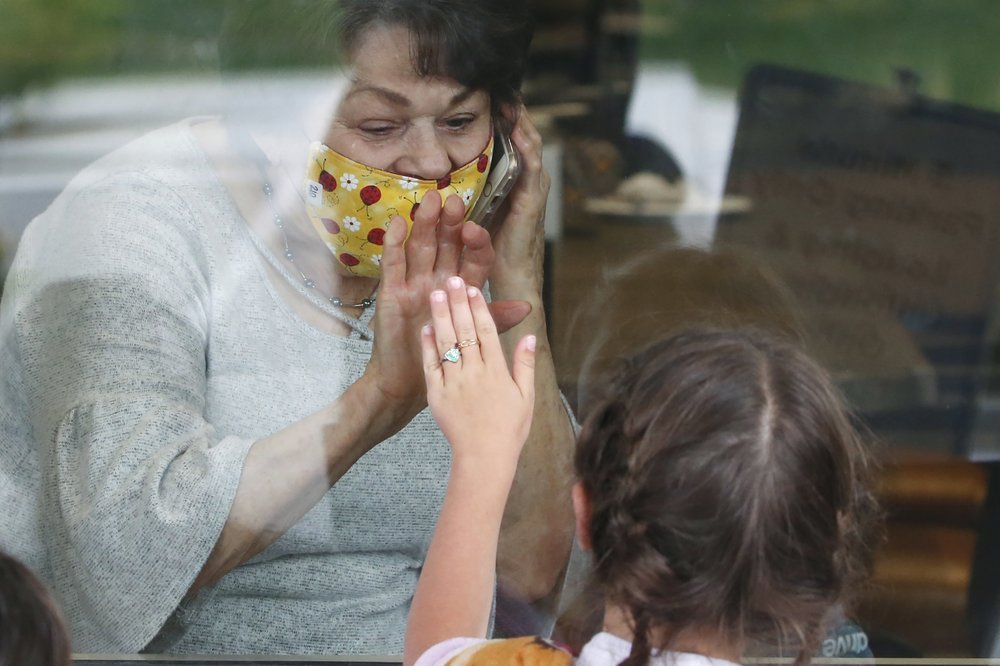
In this April 23, 2020, file photo, Raelene Critchlow, 86, receives a visit from her great-grandchild Camille Carter, 6, at Creekside Senior Living in Bountiful, Utah. (AP Photo/Rick Bowmer, File)
But Trump seemed to invest as much in battling public perceptions as he did in fighting the virus itself, repeatedly downplaying the threat and rejecting scientific expertise while fanning conflicts ignited by the outbreak.
As president he was singularly positioned to counsel Americans. Instead, he used his pulpit to spout theories — refuted by doctors — that taking unproven medicines or even injecting household disinfectant might save people from the virus.
The White House defended the administration this week.
“We grieve every single life lost to this pandemic, and thanks to the president’s leadership, Operation Warp Speed has led to the development of multiple safe and effective vaccines in record time, something many said would never happen,” said White House spokesman Judd Deere.
With deaths spiraling in the New York City area last spring, Trump declared “war” on the virus. But he was slow to invoke the Defense Production Act to secure desperately needed medical equipment. Then he sought to avoid responsibility for shortfalls, saying that the federal government was “merely a backup” for governors and legislatures.
“I think it is the first time in history that a president has declared a war and we have experienced a true national crisis and then dumped responsibility for it on the states,” said Drew Altman, president of the Kaiser Family Foundation, a health care policy think tank.
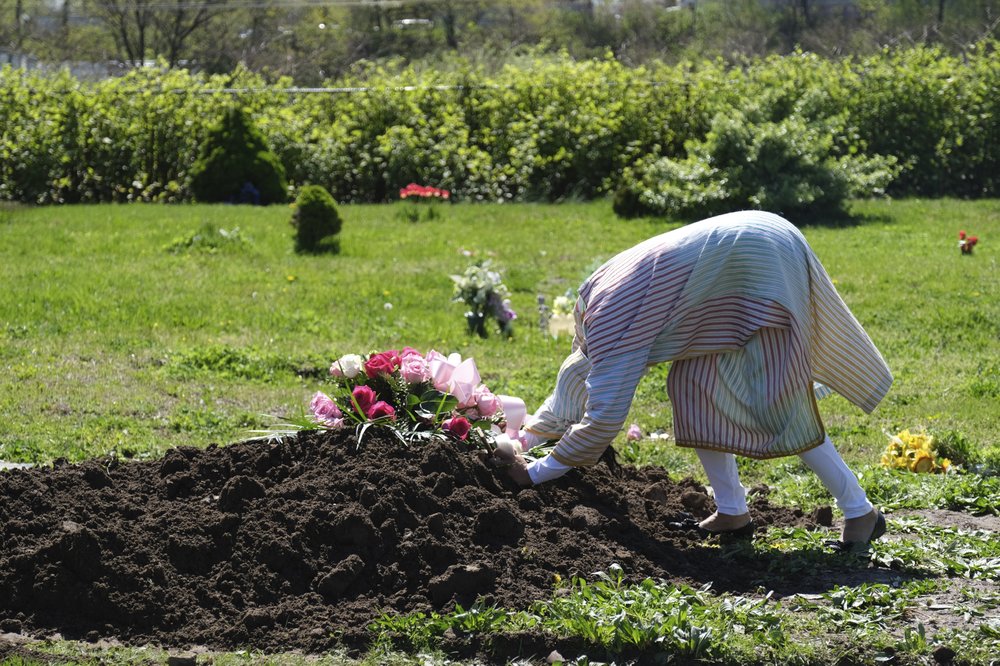
In this May 2, 2020, file photo, Erika Bermudez becomes emotional as she leans over the grave of her mother, Eudiana Smith, at Bayview Cemetery in Jersey City, N.J. (AP Photo/Seth Wenig, File)
When the Centers for Disease Control and Prevention tried to issue guidelines for reopening in May, Trump administration officials held them up and watered them down. As the months passed, Trump claimed he was smarter than the scientists and belittled experts like Dr. Anthony Fauci, the government’s top authority on infectious diseases.
“Why would you bench the CDC, the greatest fighting force of infectious disease in the world? Why would you call Tony Fauci a disaster?” asked Dr. Howard Markel, a medical historian at the University of Michigan. “It just doesn’t make sense.”
As governors came under pressure to reopen state economies, Trump pushed them to move faster, asserting falsely that the virus was fading. “LIBERATE MINNESOTA!” he tweeted in April as angry protesters gathered at the state Capitol to oppose the Democratic governor’s stay-at-home restrictions. “LIBERATE MICHIGAN!”
In Republican-led states like Arizona that allowed businesses to reopen, hospitals and morgues filled with virus victims.
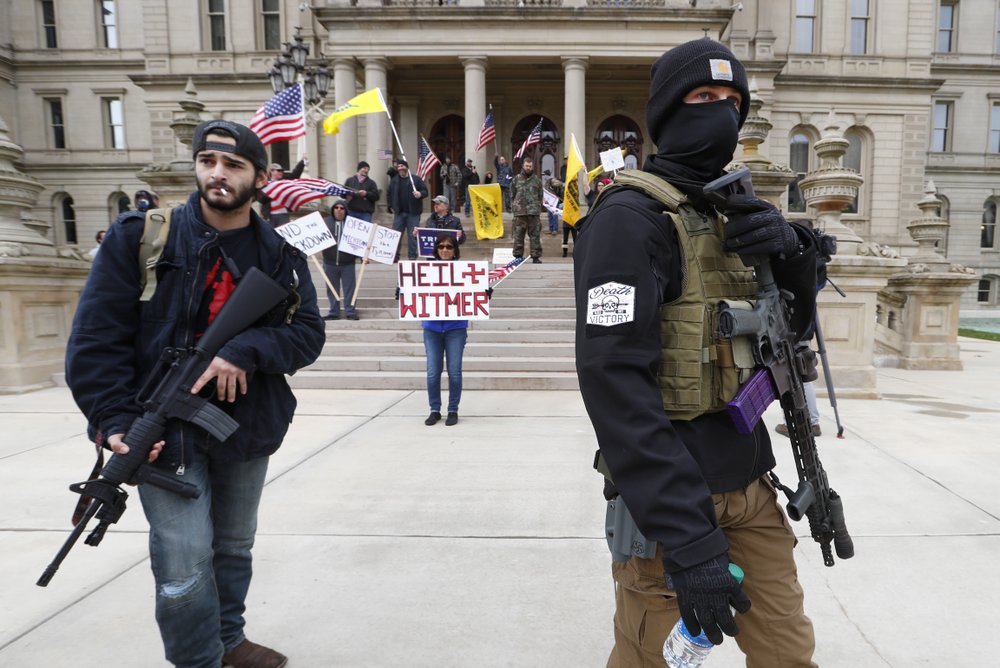
In this April 15, 2020, file photo, men carry rifles near the steps of the State Capitol building in Lansing, Mich., during a protest over Michigan Gov. Gretchen Whitmer’s orders to keep people at home and businesses locked during the coronavirus outbreak.(AP Photo/Paul Sancya, File)
“It led to the tragically sharp partisan divide we’ve seen in the country on COVID, and that has fundamental implications for where we are now, because it means the Biden administration can’t start over,” Altman said. “They can’t put the genie back in the bottle.”
In early October, when Trump himself contracted COVID-19, he ignored safety protocols, ordering up a motorcade so he could wave to supporters outside his hospital. Once released, he appeared on the White House balcony to take off his mask for the cameras, making light of health officials’ pleas for people to cover their faces.
“We’re rounding the corner,” Trump said of the battle with the virus during a debate with Biden in late October. “It’s going away.”
It isn’t. U.S. deaths from COVID-19 surpassed 100,000 in late May, then tripled by mid-December. Experts at the University of Washington project deaths will reach nearly 567,000 by May 1.
More than 120,000 patients with the virus are in the hospital in the U.S., according to the COVID Tracking Project, twice the number who filled wards during previous peaks. On a single day last week, the U.S. recorded more than 4,400 deaths.
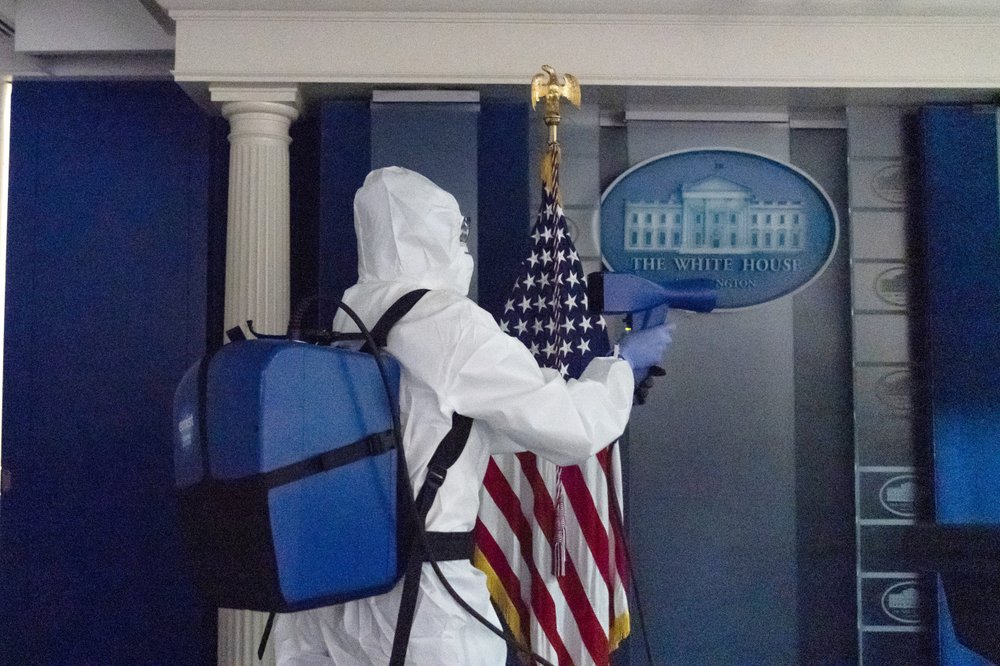
In this Oct. 5, 2020, file photo, a member of the cleaning staff sprays The James Brady Briefing Room of the White House, Monday, Oct. 5, 2020, in Washington. (AP Photo/Alex Brandon, File)
While vaccine research funded by the administration as part of Warp Speed has proved successful, the campaign trumpeted by the White House to rapidly distribute and administer millions of shots has fallen well short of the early goals officials set.
“Young people are dying, young people who have their whole lives ahead of them,” said Mawata Kamara, a nurse at California’s San Leandro Hospital who is furious over the surging COVID-19 cases that have overwhelmed health care workers. “We could have done so much more.”
Many voters considered the federal government’s response to the pandemic a key factor in their vote: 39% said it was the single most important factor, and they overwhelmingly backed Biden over Trump, according to AP VoteCast.
But millions of others stood with him.
“Here you have a pandemic,” said Eric Dezenhall, a Washington crisis management consultant, “yet you have a massive percent of the population that doesn’t believe it exists.”
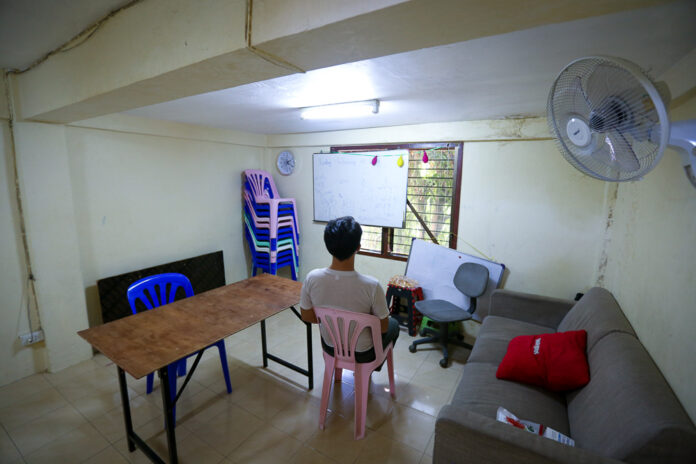
James sits in the living room, which regularly hosts English lessons for children in the local community.
BANGKOK — From his hideout in northern Bangkok, James could hear roars of jet planes taking off from Don Mueang Airport. They gave him hope. He counted down the days until he could finally board one of them, away to safety and a new home.
James, a 20-year-old Vietnamese Hmong has been counting the days since his family fled religious persecution from Vietnam nearly a decade ago. But when the coronavirus pandemic struck, shutting down borders across the world, the planes trickled to a stop – and so did his hope.
He’s one of an estimated 5,000 “urban refugees” scattered throughout the capital who are waiting for the United Nations to find them a new home in a third country. But the resettlement process, which can take up to 10 years, is now entirely suspended as the pandemic throws the world into chaos.
“The coronavirus made things worse,” said James, who asked Khaosod English not to disclose his real name due to his precarious status under Thai law. “The resettlement was nearly granted for my family, but it was put off indefinitely by the pandemic.”
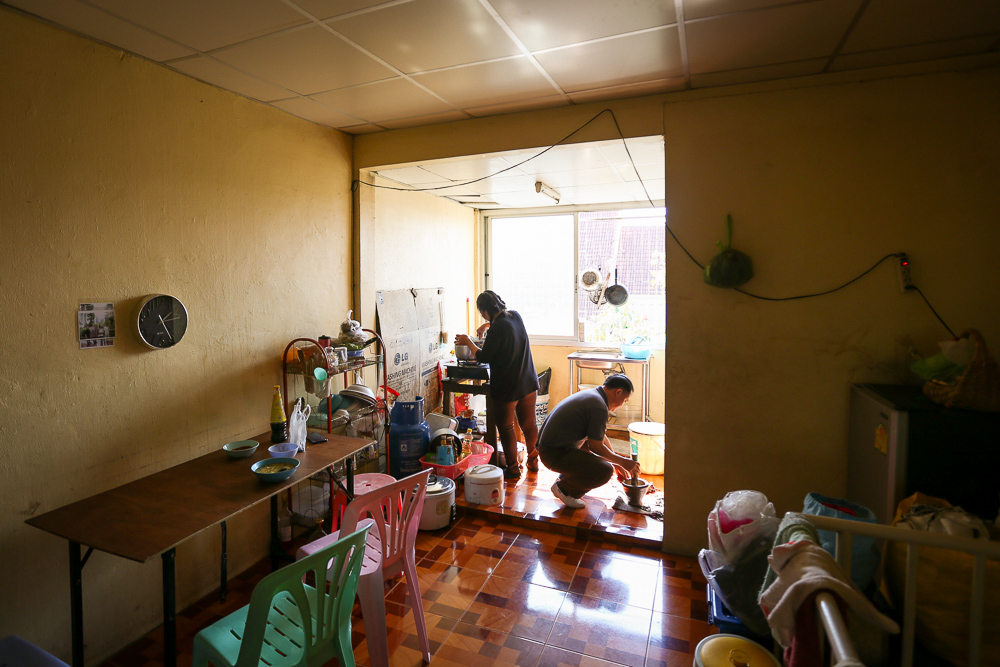
James’ parents prepare lunch in their home in northern Bangkok.
Until this limbo ends, James and many other refugees will carry on living in the shadows. Thai authorities are known for arresting asylum seekers and even deporting them back to the countries they fled, even as a number of security officers continue to profit from the smuggling operations that brought in some of those refugees in the first place.
“Security officials definitely know about it,” Siyeed Alam, chairman of the Burmese Rohingya Association in Thailand, told Khaosod English. “Some of the refugees just simply walked through the border checkpoints.”
None of the experts interviewed for this story were able to establish the exact figure of how many refugees and asylum seekers entered Thailand over the past year, but a report by UNHCR said up to 95,000 refugees are believed to be residing along Thailand’s border towns and camps, mostly from Myanmar.
Another 5,000 to 6,000 are what NGOs term “urban refugees,” or fugitives driven from their home in Vietnam, Pakistan, the Middle East, and Africa due to persecution and bloody civil strife. Many of them are believed to be hiding in low-rent apartments across Bangkok’s residential areas.
Health and Humanitarian Crisis
The coronavirus not only disrupted international travel as governments around the world shut down their borders and cancelled flights, but domestic travel in Thailand is also affected.
Residents in five provinces of Samut Sakhon, Chonburi, Rayong, Trat, and Chanthaburi were barred from visiting other parts of the country unless they have a permit – an obstacle for asylum seekers residing in those areas who had interview appointments with the U.N. refugee office in Bangkok – a crucial process to determine their eligibility for resettlement.
The mandate to ensure social distancing also means an even larger backlog of interviews, the United Nations High Commissioner for Refugees, or UNHCR, said in an emailed statement.
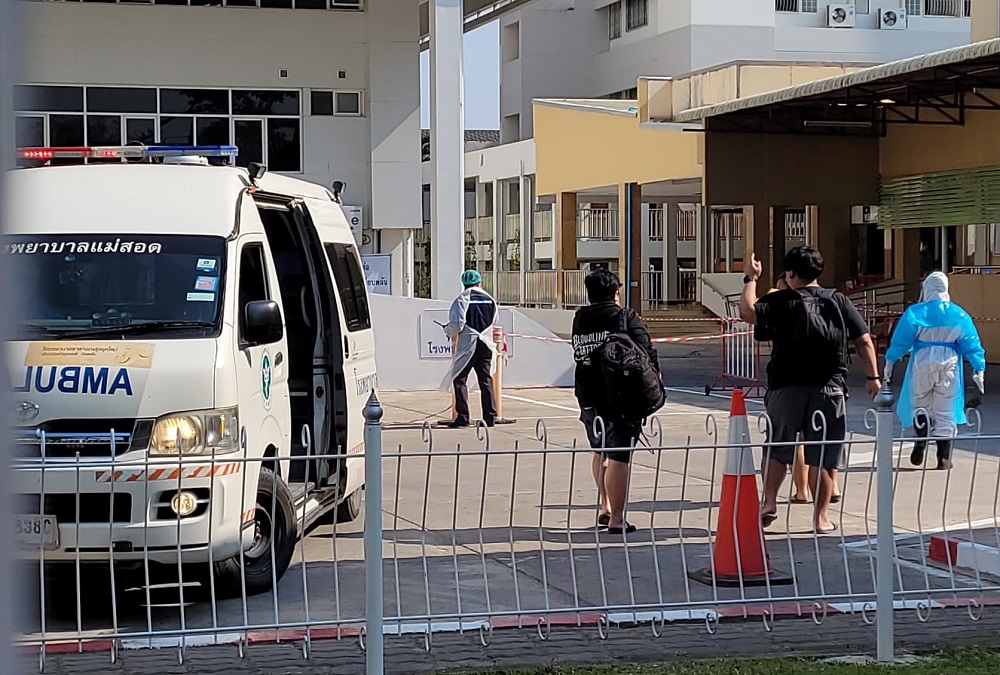
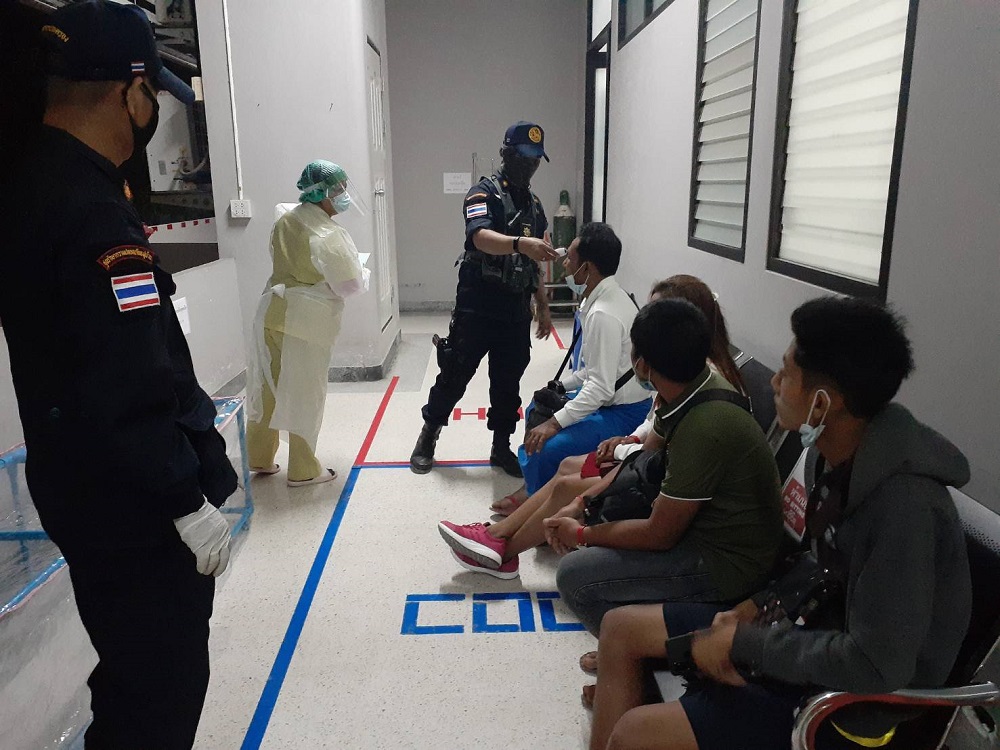
Coronavirus patients are escorted to a hospital in Tak province on Jan. 19, 2021.
“UNHCR in Thailand has been required to reduce its registration and case processing activities in line with WHO advisories to maintain social distancing,” the U.N. refugee agency said.
“While there are severe disruptions in general for international travel and in processing timelines, there’s currently no indication that resettlement programs will be cancelled by resettlement countries.”
That reassurance would hardly comfort the refugees waiting under a cloud of uncertainty. The UNHCR did not say how many cases were successfully relocated from Thailand to third countries over the past year, though the latest available U.N. data shows worldwide resettlement in 2020 fell 68 percent from 2019 levels, from 63,726 to 20,364.
The fall was reflected in the level of refugee intake among receiving countries. The United States, which so far resettles the world’s largest share of refugees, only admitted 11,814 refugees in 2020, compared with 30,000 the year before, according to data from the U.S.-based Migration Policy Institute.
A director of an organization that provides support to refugees in Thailand said only two people under her oversight found new homes in another country last year.
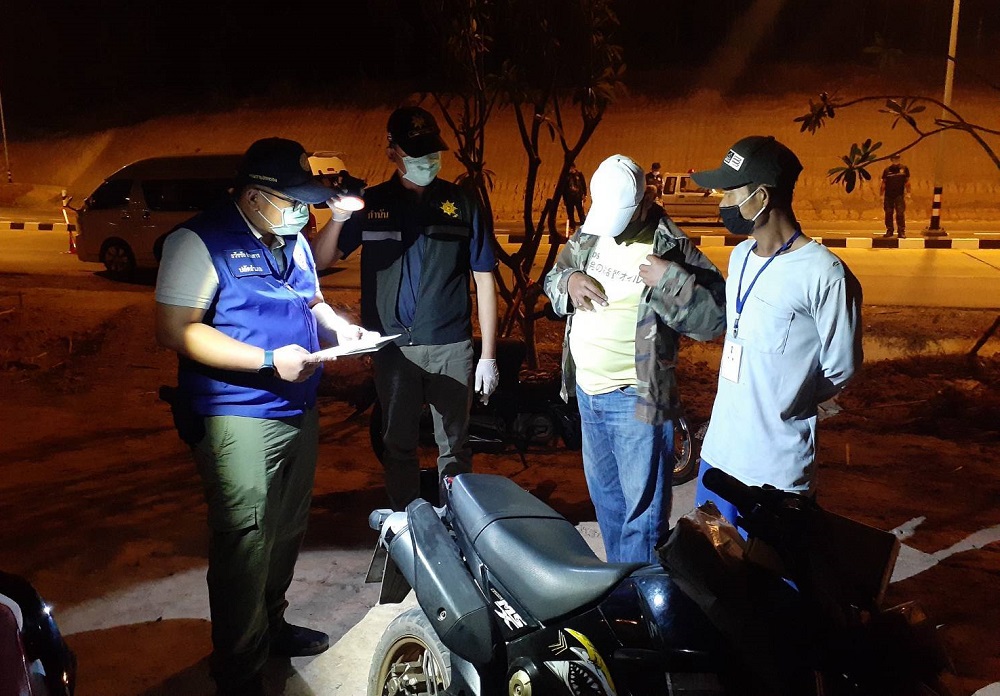
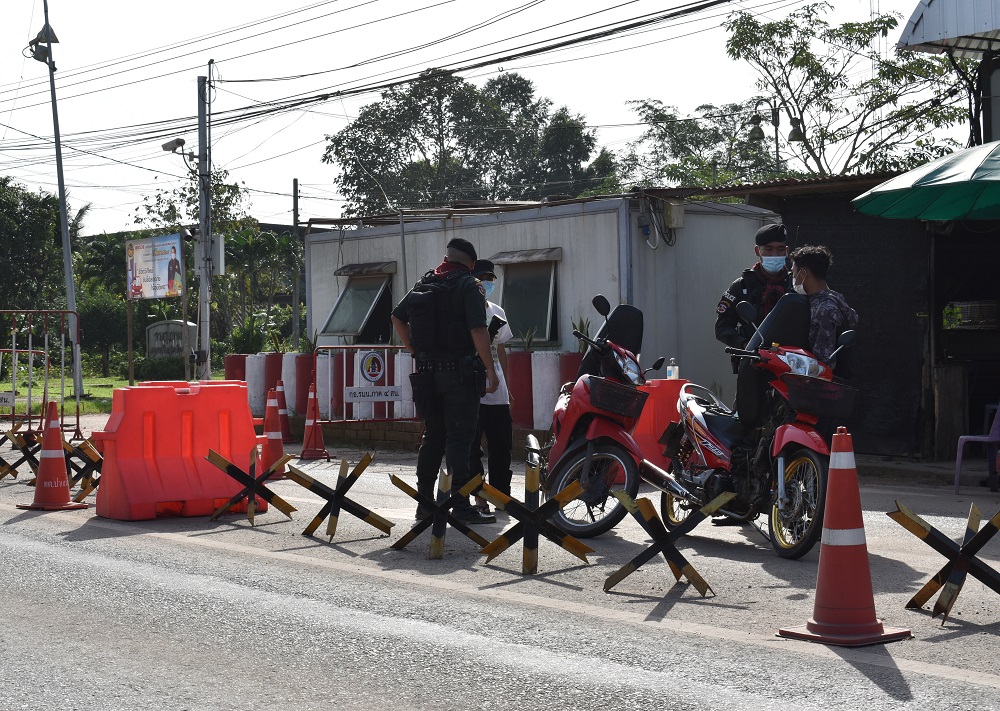
Security officers search a man for identification documents in a hunt for undocumented workers and people who cross the border illegaly in Tak province on Jan. 17, 2021.
“Everything came into a halt,” Naiyana Thanawattho, who runs Asylum Access Thailand, said in an interview. She added that her organization did not take in any new asylum seeker cases in 2020 due to the coronavirus pandemic.
“We didn’t receive any new arrivals, since most urban refugees would fly into Thailand, but they can’t do that now because of travel restrictions.”
Politics also played a role. Puttanee Kangkun, a senior researcher for human rights group Fortify Rights, attributed the drop in the number of refugee intakes to the hardening attitudes toward refugees in countries that might have been more welcoming in the past.
“It’s not only COVID-19 to be blamed, but also the number of quotas in the receiving countries,” Puttanee said. “This is due to a number of factors such as the demands for migration intake and anti-immigration sentiment in many countries.”
From Shadows to Shadows
There are about 300,000 Hmong Christians in Vietnam’s northwestern region, an ethnic minority group that civil rights organizations said often came under assault for their religious beliefs.
In 2018, an activist group said 24 Hmong Christians were attacked by a mob in an attempt to make them renounce their faith. The violence followed warnings from local authorities that they would be expelled from their community if they refused to abandon their religion, according to the Vietnam Committee on Human Rights.
The Hmong are also at the bottom of Vietnam’s ethnic hierarchy, with the highest poverty levels and lowest education levels, The Diplomat reported.
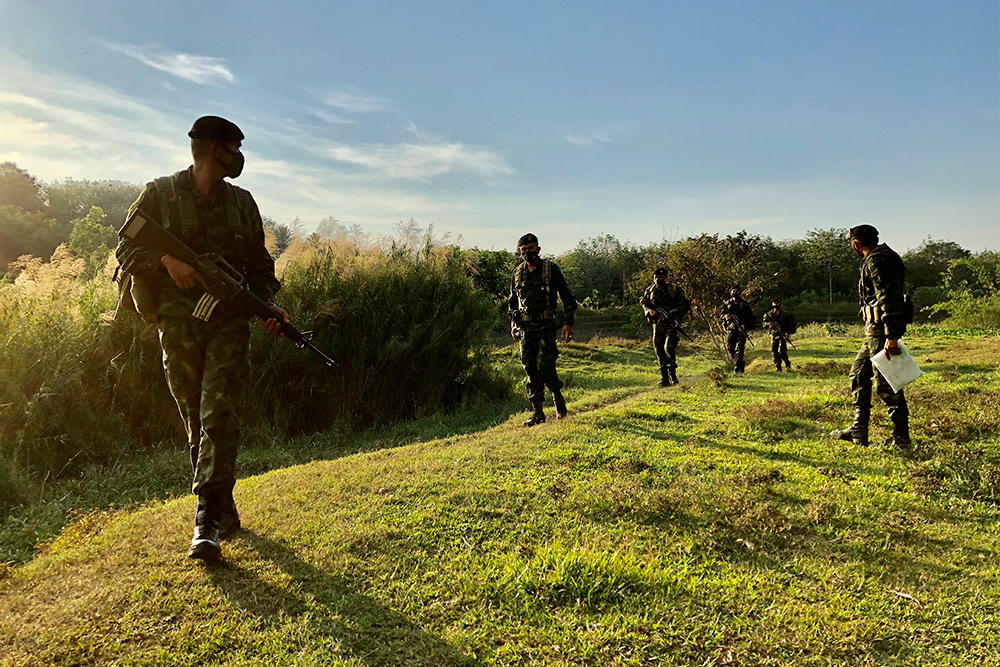
Soldiers patrol the Thai-Myanmar border in Ranong province on Jan. 12, 2021.
James is one of many Hmong Christians who chose to leave in search for a better life. His journey started in 2011, when he was 11 years old. His father told him that the family could not stay in the village any longer due to threats of punishment from the Vietnamese authorities.
So the family of eight packed up, and fled overland to Thailand. Although they found themselves in a land where religious intolerance is almost unheard of, they had yet to fully taste their freedom.
Since Thailand is not a party to the 1951 Refugee Convention, asylum seekers are considered as illegal immigrants by the Thai authorities, subject to arrests, imprisonment in a notoriously overcrowded jail, and deportation back to the countries they tried to escape.
“I can’t go anywhere,” James said. “I used to only watch out for cops, but now I must be careful about COVID-19 as well. If I or any member of my family got sick, we can’t really go to hospitals since we have no money or identification documents.”
Security officers question a man at Thailand-Malaysia border in Narathiwat province on Jan. 19, 2021.
Such arrests are well documented, even in cases where the UNHCR already started the process for their resettlements. In August 2018, police arrested a group of 168 asylum seekers from Cambodian and Vietnam, including 154 people who held I.D. cards issued by the UNHCR, while the other 14 were waiting for an official document from the U.N. agency.
A similar crackdown in October that year saw the arrests of more than 100 refugees, including Syrians and Somalis who fled the unrest in their homelands. An NGO said all of them were being processed by the UNHCR for their refugee status.
Again in May 2019, the police arrested two dissidents from mainland China, one of whom was recognized as a refugee by the UNHCR.
A number of asylum seekers were also imprisoned in the Immigration Detention Center, or IDC, as they awaited the process to resettle their homes, which could typically take years.
No Money and No Future
James recalled that it was “a bit of struggle” when they first arrived in Bangkok, but they were soon able to settle down and find some income to support themselves with the help of local NGOs.
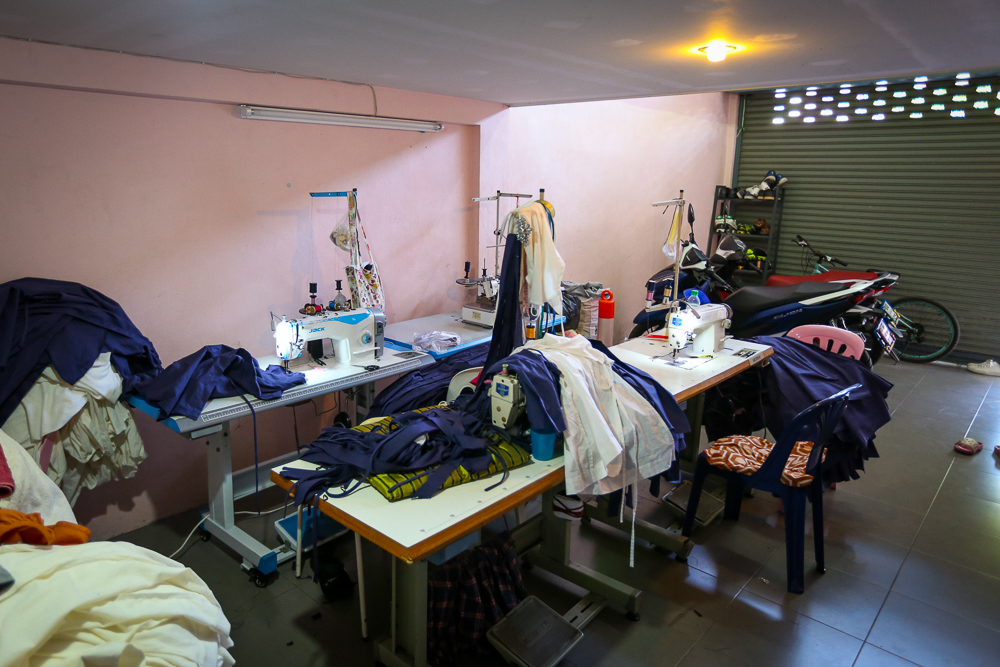
Grown-ups would take up part-time jobs such as construction for men and sewing for women, while children would go to a local primary school.
However, as Thailand grapples with the pandemic, such arrangements are now in disarray. Only James, who works as an interpreter for an NGO, and several siblings who take up sewing jobs, can earn some income for the family.
“Many of us were fired from jobs since the employers became afraid of crackdown on undocumented workers,” James said. “We used to make around 15,000 baht a month, but now we could only find 6,000 to 7,000 baht. The rent alone is 8,000 baht.”
Women in James’ house would sit at sewing machines to work on customers’ orders.
“But luckily, our landlord is kind enough to postpone rent payments for us.”
According to a survey of asylum seekers in Bangkok conducted by Asylum Access Thailand in May, 85 percent of the participants said they lost their jobs after the pandemic struck.
Asylum Access Thailand director Naiyana said almost half of the participants said they have to borrow money from friends and relatives, or ask for donations from NGOs.
“Many of them were employed at markets, but now many markets are closed,” Naiyana said. “Schools were also moved online, but I don’t believe that asylum seekers would have appropriate tools to attend class. Beyond that, fears against migrant workers also exacerbate the problem.”
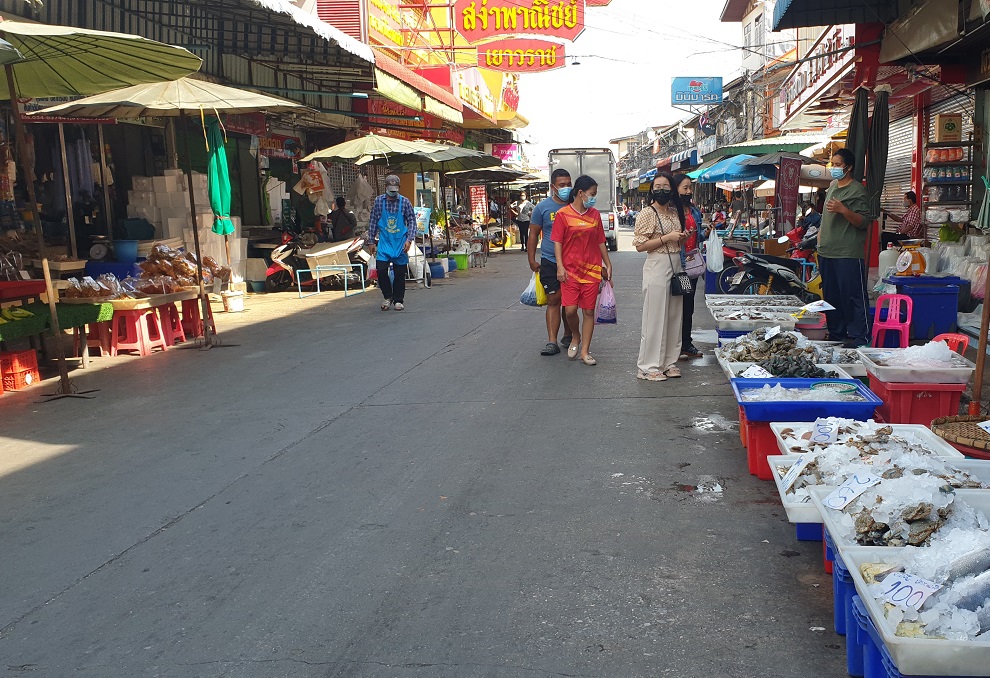
Few shoppers are seen at Mahachai seafood market in Samut Sakhon amid the resurgence in coronavirus cases on Dec. 20, 2020.
Filmmaker-turned-activist Sakda Kaewbuadee said some of the refugees he’s assisting have to survive by eating only bananas or skipping meals every other day.
“It’s really a difficult time for them,” said Sakda, who worked independently to help make appeals to foreign embassies on behalf of asylum seekers. “A Pakistani who I worked with only made 6,000 baht a month, and half of it goes towards the rent.”
The helping hands are strained as well. Naiyana said the pandemic posed new challenges for NGOs, who have to adopt new ways of providing support to asylum seekers.
“We can’t conduct fieldwork at the moment due to risk of infection,” Naiyana said. “We have to rely on phone calls and online meetings, which are less convenient than face-to-face meetings.”
Old Problem in New Normal
Security was tightened along Thailand-Myanmar borders in December after the second wave of coronavirus outbreak was identified at a fish market where many migrant workers from Myanmar were employed. Government leaders quickly blamed Myanmar migrants for “bringing in” the disease, though the facts remain unclear to this day.
Caught in the crackdown on illegal border crossing is a tide of Rohingya refugees fleeing what the United Nations described as an orgy of “ethnic cleansing” in western Myanmar.
Myanmar nationals are arrested by security officers in Tak province on Jan. 17, 2021, for allegedly crossing the border illegally.
Security forces erected barriers and conducted more patrols along the country’s porous border with Myanmar. But they still failed to deter the influx of Rohingya refugees, as well as undocumented workers, who have been crossing the border for decades before the pandemic.
“They can’t be stopped,” said Siyeed Alam, the chairman of the Burmese Rohingya Association in Thailand, whose organization provides assistance to the ethnic minority group.
“The situation in Myanmar’s Rakhine state is really terrible right now. The pandemic aggravates the already dire situation for Rohingya, who now have to flee from both the violence and the disease.”
Rohingyas who want to escape the ethnic and religious persecution in Myanmar have two options. They can either brave dangerous sea voyages across the Bay of Bengal to Bangladesh, or take overland journeys across Thailand to Malaysia.
The latter is somewhat safer, but they still risk arrests and detention by the Thai security forces. Earlier this month, 18 Rohingyas were arrested in Bangkok’s Don Mueang district while they were waiting for their smugglers to transport them to the Thai-Malaysian border.
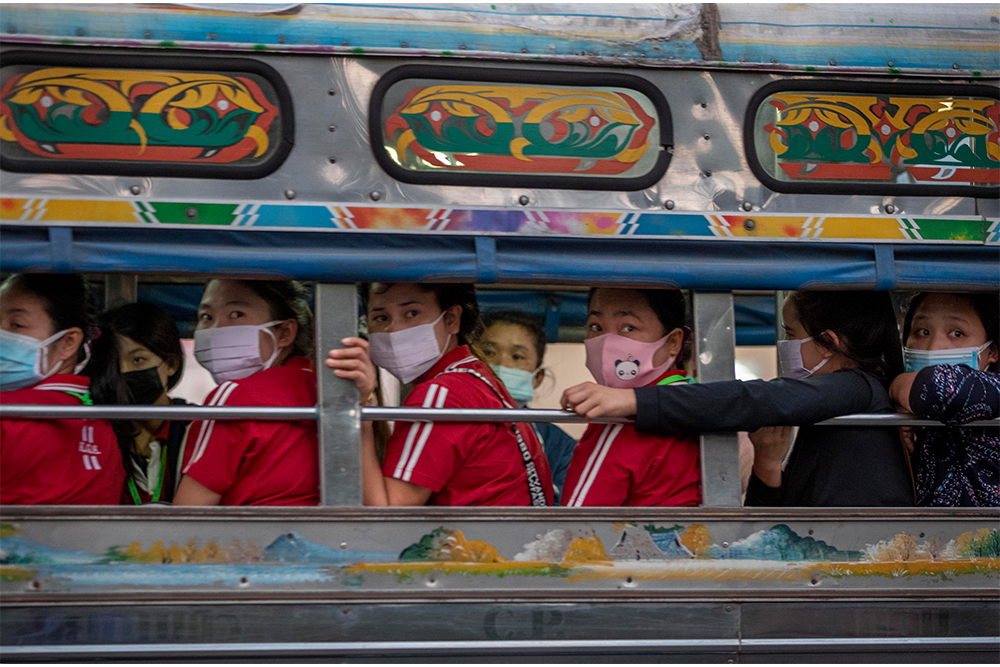
Migrant workers travel after work in the back of a truck in Samut Sakhon province on Jan. 4, 2021. Photo: Gemunu Amarasinghe / AP
Police said seven of them tested positive for COVID-19 and are being treated, while the rest are being held in quarantine.
Seven months earlier, in May 2020, security officials apprehended 12 Rohingya at a house in the border town of Mae Sot. They were later deported back to Myanmar – a fate dreaded by many Rohingyas.
Immigration spokesman Archayon Kraithong said police continue to make arrests of foreign nationals who entered the country illegally throughout the course of the pandemic. A statement from the immigration bureau said “800” people were arrested for illegal entry in the first week of January alone.
Hypocrisy?
But Siyeed from the Rohingya association said the government’s much publicized pledge to crack down on smuggling rings is hypocritical at best, since many members of the security force actually benefit from the operations.
Siyeed said the refugees had to pay approximately 170,000 baht per person for the overland trip bound for Malaysia. Shares of the proceeds were paid to brokers and law enforcement agencies along the way across the three countries, he said.
“Brokers would just bribe officials in exchange for access,” Siyeed said. “There’s no other way for Rohingya since they’re stateless people. A better livelihood awaits them in Malaysia.”
Deputy PM Prawit Wongsuwan says he’s ordered military to tighten control of the borders amid virus pandemic. He also denies reports that some security officers are complicit in smuggling migrant workers into Thailand. “There isn’t any,” Gen. Prawit said. #Thailand#COVID19pic.twitter.com/Mx9Lu35iFE
In late December, police said five policemen in Kanchanaburi, which borders Myanmar, were put under investigation on the suspicions that they colluded with local smugglers, who reportedly charged each migrant worker 15,000 baht for transit into Thailand.
“As long as there are push factors, they will not stop,” Puttanee from Fortify Rights said of the human rights situation in Myanmar. “The plight they are in is more powerful than the virus.”
James, the refugee from Vietnam, said he hopes to wait out the storm in his hideout in Bangkok.
“That’s how life goes for refugees,” he said. “We never know what tomorrow brings.”
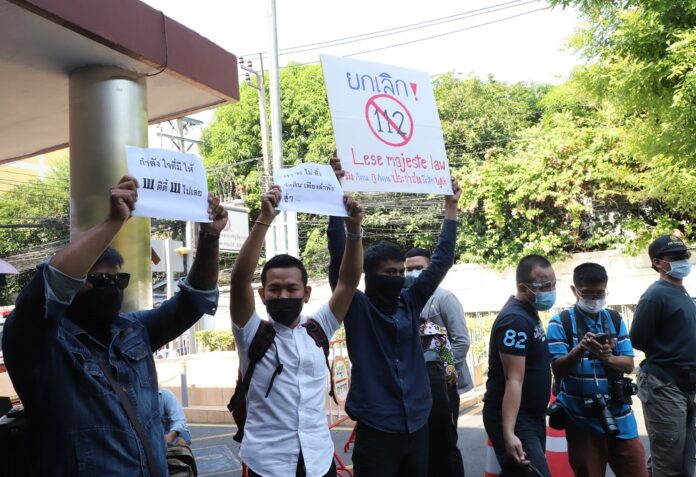
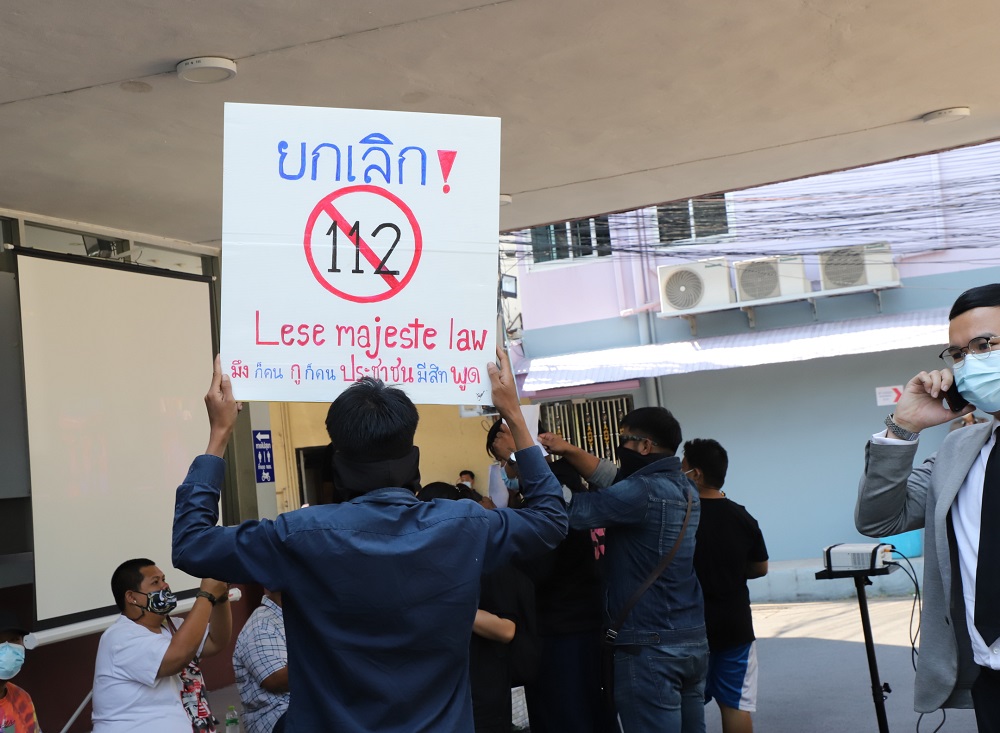
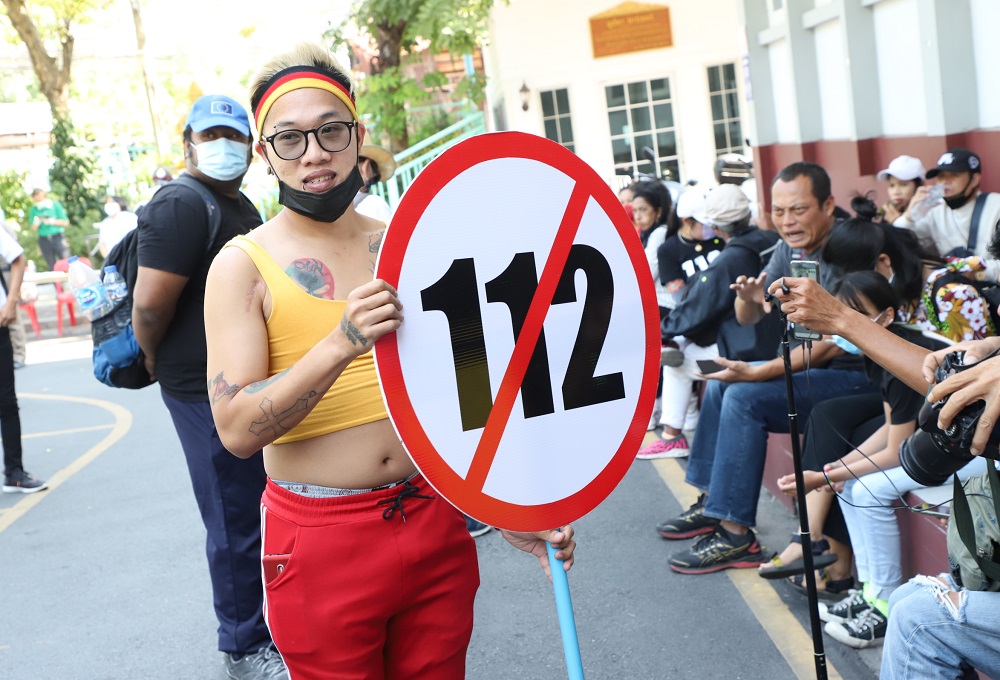
Protesters hold up signs opposing the lese majeste law on Jan. 11, 2021.
BANGKOK — A 64-year-old woman was sentenced to 43 years in prison on Tuesday for sharing audio files deemed to be defaming the monarchy on the internet – a new record set under the draconian law.
Anchan Preelert, a former government official at the Revenue Department, was convicted of 29 counts of royal defamation by a Criminal Court, prompting outcry from human rights activists who said the verdict is disproportionate.
Anchan’s lawyer, Pawinee Chumsri, said the court already gave the lightest punishment because she pleaded guilty – she was initially sentenced to 87 years in jail – but the lese majeste offense states that a minimum penalty must be at least 3 years per count.
“This is the law, the judges couldn’t bring it lower,” Pawinee, an attorney from the Thai Lawyers for Human Rights, said by phone. “The punishment of 3 to 15 years under the law is too high.”
Anchan was arrested in 2015, about a year after the junta, National Council for Peace and Order, came to power through a military coup. She was tried under a military tribunal per a junta’s order that permitted civilians to be court martialed for crimes that affected “national security.”
She was also held in prison for four years while the trial was ongoing, and she was only granted bail in November 2018. Anchan was also fired from her job at the Revenue Department.
The sound clips shared by Anchan were produced and uploaded to YouTube by an activist named Hatsadin Uraipraiwan, aka Banpot, her lawyer said. She reportedly shared the links, which contained critical remarks about King Rama IX and then-Crown Prince Vajiralongkorn, on social media from November 2014 to January 2015.
Speaking to reporters at the court, Anchan said she saw many people sharing the same audio clips without facing any repercussions. The defendant also said she hadn’t “thought it through” before sharing the clips.
The producer of those audio clips, Banpot, was arrested in February 2015 and later given a two and half years jail term by the military court. Banpot was convicted of only one count – making the offensive material – while Anchan was found guilty of 29 separate counts for sharing Banpot’s content.
Anon Chawalawan, a coordinator at iLaw, a law-reform advocacy group, said the harsh sentence highlights the problem with the royal defamation law, which stipulates that a guilty verdict must result in at least three year imprisonment and prevents the court from handing out a lighter jail term.
“The court could not just come out with another number,” Anon, who attended today’s ruling, said by phone.
In August 2015, military courts sentenced two people in one day to a combined 58 years in prison for allegedly insulting the monarchy over Facebook. The 30-year sentence given to a Kanchanaburi man set a new record at the time. A woman in northern Thailand received 28 years in jail.
The record was broken in 2017, when a 35-year-old man was sentenced to a 35-year prison term by the Bangkok Military Court for writing 10 Facebook messages deemed offensive to the monarchy. A new record was set again today with the verdict in Anchan’s case.
Former lese majeste convict and political activist Ekachai Hongkangwan was at the court today to give moral support to Anchan. Ekachai said he believes that the tendency to hand out lengthy sentences has returned, a phenomenon not seen since the early years of King Rama X’s reign.
“I am now worried for the 40 plus people charged under the law,” Ekachai said. “Many of them are facing multiple counts of offences.”
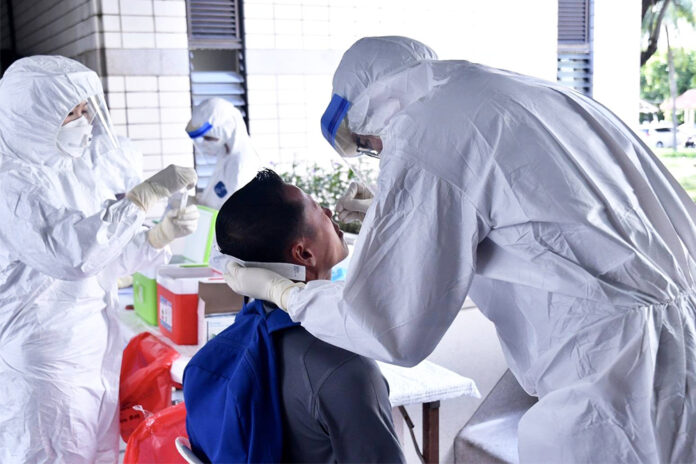
A file photo of a man taking a swab test for the coronavirus.
BANGKOK — A spokesman for the immigration police on Tuesday walked back on his announcement that a negative COVID-19 test result will be mandatory for every foreigner who wishes to extend their stay in the kingdom.
Immigration bureau spokesman Archayon Kraithong previously said on Monday the new measure will be applied to “every type of visa,” regardless of how long the foreigner has stayed in the country.
But less than an hour after his remark was reported on Khaosod English – sparking an uproar among expats on social media – the spokesman reached back to say he was misinformed about the new policy, and offered an apology.
“I apologize for the misunderstanding,” Maj. Gen. Archayon said. “It will only apply to certain types of visa, most likely the permanent resident visa.”
He went on to say that the Immigration Bureau will have to wait for the Council of State – an agency tasked with settling legislative disputes – to interpret the latest regulation concerning coronavirus and arrivals from overseas published on Dec. 25.
“We’re waiting for the Council of State to interpret the new regulation,” Maj. Gen. Archayon said.
The order added COVID-19 to the list of prohibited diseases for foreigners who wish to enter or take residency in Thailand. Other diseases include leprosy, “dangerous stage” of tuberculosis, elephantiasis, drug addiction, and tertiary stage of syphilis.
The announcement did not mention any restriction that must be taken on foreigners already residing in Thailand.
“This is such a pointless exercise,” Twitter user Siobhán Robbins wrote. “If long-term expats have COVID-19 when the borders are basically closed and a 14-day mandatory quarantine imposed, they certainly got it via local transmission in Thailand. COVID-19 doesn’t pick people by race, yet foreigners are once again singled out.”
Local immigration offices appeared to be unaware of any new measure that would require foreign residents to present a negative coronavirus test upon renewing their visas.
“I haven’t heard about it,” Chonburi immigration chief Narain Kheungsanook said by phone.
Phuket Immigration Deputy Chief Col. Nareuwat Putthawiro also told The Phuket News that his office has not received any such order.
“We do not require any medical documents for an application to renew a visa, because there are few foreigners’ movements outside Phuket. Most of them live and work in Phuket, and have done so before the new wave of COVID-19,” Col. Nareuwat was quoted as saying.
It was far from the first time that the immigration contradicted itself on its own enforcement of visa policy.
A spokesman said in July that an amnesty would not be granted to foreigners stranded in Thailand due to the pandemic, though they later did. In 2018, Chinese nationals flying from Hong Kong were also barred from using a premium lane reserved for Chinese nationals at an airport in Bangkok.
BANGKOK — Feed, play with, and pet a little tua mom as it grows and evolves – right from the comfort of your phone.
Himmapan Marshmello Saga is a virtual pet app, similar to the Tamagotchi toy from the late 90s, featuring Thai mythical creatures found in rural temples that went viral online for their cute, unusual appearance.
“In my day we played Tamagotchi and Digimon games,” creator Tinnapop Sornpom, 33, said. “Then I saw the hashtags about non, who were so cute.”
In early December, photos of awkward-looking statues of little-known magical creatures in some rural temples were widely shared on social media in the hashtag #HimmapanMarshmallow, after the mythical Himmapan forest.
Some of the most popular creatures for the online crowds appear to be hera (a half-crocodile, half-Naga) and tua mom (a half-lion, half-dragon in Lanna folklore). Netizens nicknamed them nonnnn (น้อนนนนน), an endearing diminutive of the term nong (น้อง).
The app, produced under Fairplay Studio, is still in beta testing and will be fully launched in mid-February,
Tinnapop says he’s been bowled over by the high level of interest – the app has been downloaded more than 50,000 times since the first version of the beta test was released Dec. 24.
The app’s full release will include microtransactions, some proceeds of which will go toward the temples where the original statues reside. The app also indicates where those temples are located, which will hopefully encourage domestic tourism and pilgrimages when the COVID infections go down, Tinnapop said.
“Of course, we asked for the temples’ permission to feature the nons,” Tinnapop said. “Some abbots were like, ‘do you want me to share it on our page right now?’”
Tinnapop says while an English version is possible in the future, translating the words isn’t the hard part – it’s translating the “very Thai context” in which the little creatures reside. For example, the app will feature elements from Thai temples, such as siam see, fortune telling practice where a person requests answers to a question by shaking sticks from a container.
“The nons are something that most people can easily fall in love with,” he said.
The beta test version of the app can be downloaded on the Google Play Store. Sorry, iOS users – as of Monday, beta testing on the Apple Store is full.
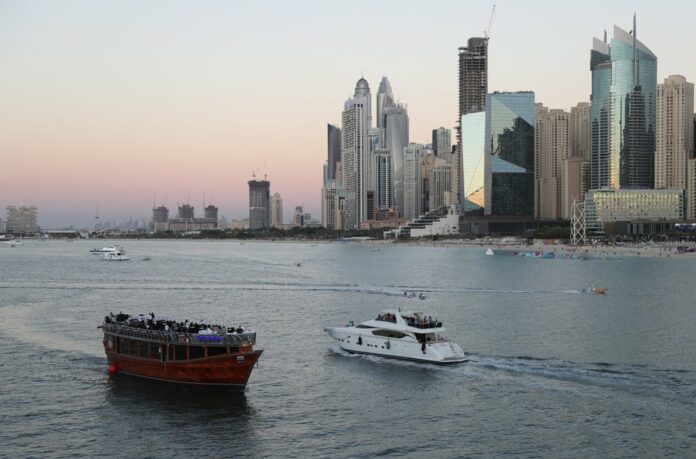
Tourists on a yacht as they pass a traditional dhow serving a dinner cruise, in Dubai, United Arab Emirates, Tuesday, Jan. 12, 2021. (AP Photo/Kamran Jebreili)
DUBAI, United Arab Emirates (AP) — Masks off the minute you step inside. Bars packed and pulsing like it’s 2019. Social media stars waving bottles of champagne. DJs spinning party tunes through multi-hour brunches.
Since becoming one of the world’s first destinations to open up for tourism, Dubai, in the United Arab Emirates, has promoted itself as the ideal pandemic vacation spot. It cannot afford otherwise, analysts say, as the virus shakes the foundations of the city-state’s economy.
With its cavernous malls, frenetic construction and legions of foreign workers, Dubai was built on the promise of globalization, drawing largely from the aviation, hospitality and retail sectors — all hard hit by the virus.
Now reality is catching up to the big-dreaming emirate. With peak tourism season in full swing, coronavirus infections are surging to unprecedented heights. Daily case counts have nearly tripled in the past month, forcing Britain to slam shut its travel corridor with Dubai last week. But in the face of a growing economic crisis, the city won’t lock down.
“Dubai’s economy is a house of cards,” said Matthew Page, a nonresident scholar at the Carnegie Endowment for International Peace. “Its competitive advantage is being a place where rules don’t apply.”
Tourists party on a yacht in Dubai, United Arab Emirates, Tuesday, Jan. 12, 2021. (AP Photo/Kamran Jebreili)
While most countries banned tourists from the U.K. over fears of the fast-spreading virus variant found there, Dubai, home to some 240,000 British expats, kept its doors open for the holidays. Emirates flew five daily flights to London’s Heathrow Airport.
Within days, the new virus strain had arrived in the emirates, but that didn’t stop reality TV and soccer stars from fleeing Britain’s lockdown and wintry weather for Dubai’s bars and beaches — without taking a coronavirus test before boarding. Scenes of pre-pandemic revelry were splattered across British tabloids. Facing backlash, Instagram influencers spotted at raucous yacht parties were quick to proclaim their travel “essential.”
Dubai was glad of the influx. Hotel occupancy rates surged to 71% in December, according to data provider STR. The London-Dubai air route ranked busiest in the world over the first week of January, said OAG, an aviation data analysis firm.
“People have had enough of this pandemic already,” said Iris Sabellano from Dubai’s Al Arabi Travel Agency, adding that many of her clients have been forced to quarantine after testing positive for the virus on arrival or before departure. Travelers coming from a select list of countries don’t need to get tests before their trips but all must at Dubai’s airport.
“With vaccines coming out, they feel it’s not the end of the world, they’re not going to die,” she said.
For those who do die of COVID-19, Emirates Airlines offers to pay $1,800 to help cover funeral costs.
As the outbreak worsens, it seems the stampede will slow. Israeli tourists, who were coming in the tens of thousands following a normalization deal between the countries, have vanished due to new quarantine rules. A decision to suspend visa waivers for Israelis to the UAE until July took effect Monday. Britain’s move to mandate a 10-day quarantine for those returning from Dubai threatens to clobber what’s left of the tourism sector.
“Brits make up such an important proportion of tourists and investors in Dubai,” said David Tarsh, spokesman for ForwardKeys, a travel data-analysis company. “Cutting that pipeline … is a complete disaster for the city.”
British Transport Secretary Grant Shapps tweeted that the government’s decision was prompted by the UAE’s latest virus data. Beyond daily infections, however, the data is scant. The UAE does not make public information about disease clusters or hospitalizations.
Amid an aggressive testing campaign, the country has reported more than 256,000 cases and 751 deaths. Analysts speculate the UAE’s unique demographics — 90% expatriate, comprising mostly healthy, young laborers — have prevented well-staffed hospitals from becoming overwhelmed and kept the death rate low, at 0.3%.
But that hasn’t assuaged Abu Dhabi, Dubai’s more conservative neighbor and the country’s capital. Without explanation, Abu Dhabi has kept its border with freewheeling Dubai shut, despite promises to reopen by Christmas. Anyone crossing into Abu Dhabi must present a negative coronavirus test.
Relations between service-heavy Dubai and oil-rich Abu Dhabi can get tense. During the 2009 financial crisis, Abu Dhabi needed to rescue Dubai with a $20 billion bailout. This time, it’s unclear whether Dubai can count on another cash infusion, given the crash in global oil prices.
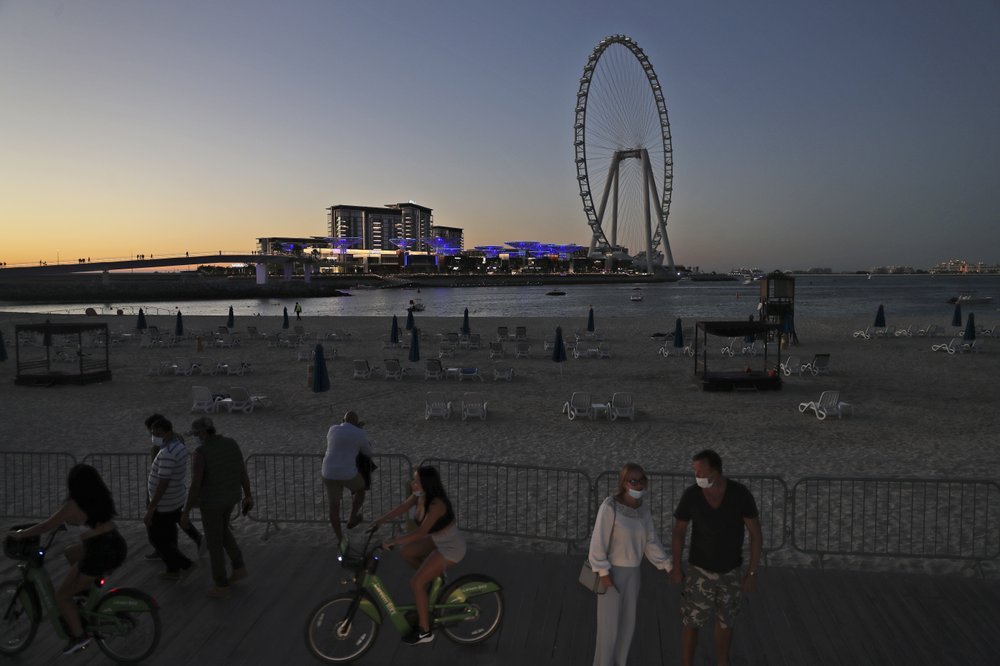
Tourists and residents enjoy the sunset at the Jumeirah Beach Residence, in Dubai, United Arab Emirates, Tuesday, Jan. 12, 2021. (AP Photo/Kamran Jebreili)
Even pre-pandemic, Dubai’s economy was heading toward another downturn thanks to a shaky real estate market, which has plunged 30% in value since 2014 peaks. The emirate and its web of government-linked entities face billions of dollars in debt repayments. Already the government has stepped in to help Emirates Airlines, which received $2 billion in aid last year. Other indebted firms invested in hospitality and tourism may need help, especially with events like World Expo pushed back a year. S&P Global, a ratings agency, estimates Dubai’s debt burden to be some 148% of gross domestic product if state-linked industries are included.
Under pressure, authorities have seized on vaccines as the only way to contain the outbreak. Plastered across front pages of state-linked newspapers are stories touting the mass inoculation drive, which officials claim to be the world’s second-fastest after Israel, with 19 doses distributed for every 100 people as of Tuesday.
The UAE is offering the Chinese coronavirus vaccine Sinopharm to everyone, even as its announcement about the shot’s efficacy lacks data and details. Demand has overwhelmed supply for the Pfizer-BioNTech vaccine in Dubai, where hotline operators say thousands of high-risk residents remain on a waiting list.
With the country shattering its infection record for seven consecutive days, Dubai’s ruler, Sheikh Mohammed bin Rashid Al Maktoum, declared that widespread vaccination, not movement restrictions, would “accelerate the full recovery of our country.”
But even if Dubai meets its goal of inoculating 70% of the population by the end of 2021, Moody’s Investors Service expects the UAE’s economy to take three years to bounce back.
“I don’t think Dubai’s days are numbered,” said Page, the Carnegie scholar. “But if the city were more modest and responsible, it would be a more sustainable place.”
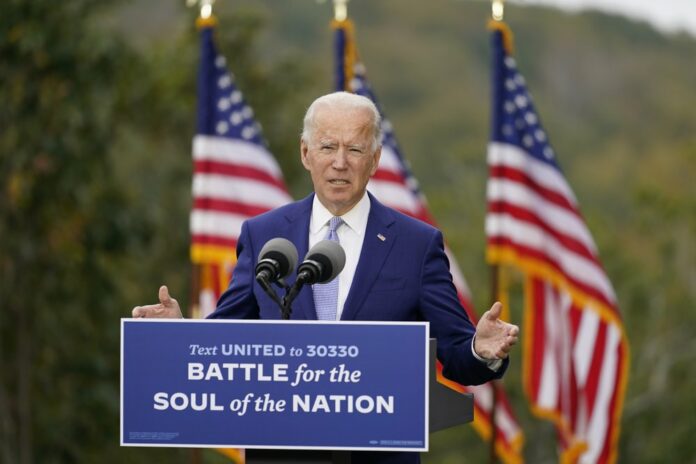
In this Oct. 27, 2020, file photo, then-Democratic presidential candidate former Vice President Joe Biden speaks at Mountain Top Inn & Resort in Warm Springs, Ga. (AP Photo/Andrew Harnik, File)
WASHINGTON (AP) — President-elect Joe Biden plans to unveil a sweeping immigration bill on Day One of his administration, hoping to provide an eight-year path to citizenship for an estimated 11 million people living in the U.S. without legal status, a massive reversal from the Trump administration’s harsh immigration policies.
The legislation puts Biden on track to deliver on a major campaign promise important to Latino voters and other immigrant communities after four years of President Donald Trump’s restrictive policies and mass deportations. It provides one of the fastest pathways to citizenship for those living without legal status of any measure in recent years, but it fails to include the traditional trade-off of enhanced border security favored by many Republicans, making passage in a narrowly divided Congress in doubt.
Expected to run hundreds of pages, the bill is set to be introduced after Biden takes the oath of office Wednesday, according to a person familiar with the legislation and granted anonymity to discuss it.
As a candidate, Biden called Trump’s actions on immigration an “unrelenting assault” on American values and said he would “undo the damage” while continuing to maintain border enforcement.
Under the legislation, those living in the U.S. as of Jan. 1, 2021, without legal status would have a five-year path to temporary legal status, or a green card, if they pass background checks, pay taxes and fulfill other basic requirements. From there, it’s a three-year path to naturalization, if they decide to pursue citizenship.
For some immigrants, the process would be quicker. So-called Dreamers, the young people who arrived in the U.S. illegally as children, as well as agricultural workers and people under temporary protective status could qualify more immediately for green cards if they are working, are in school or meet other requirements.
The bill is not as comprehensive as the last major immigration overhaul proposed when Biden was vice president during the Obama administration.
For example, it does not include a robust border security element, but rather calls for coming up with strategies. Nor does it create any new guest worker or other visa programs.
It does address some of the root causes of migration from Central America to the United States, and provides grants for workforce development and English language learning.
Biden is expected to take swift executive actions to reverse other Trump immigration actions, including an end to the prohibition on arrivals from several predominantly Muslim countries.
During the Democratic primary, Biden consistently named immigration action as one of his “day one” priorities, pointing to the range of executive powers he could invoke to reverse Trump’s policies.
Biden allies and even some Republicans have identified immigration as a major issue where the new administration could find common ground with Senate Republican Leader Mitch McConnell and enough other GOP senators to avoid the stalemate that has vexed administrations of both parties for decades.
That kind of major win — even if it involves compromise — could be critical as Biden looks for legislative victories in a closely divided Congress, where Republicans are certain to oppose other Biden priorities that involve rolling back some of the GOP’s 2017 tax cuts and increasing federal spending.
As a candidate, Biden went so far as to say the Obama administration went too far in its aggressive deportations.
__
Barrow reported from Wilmington, Delaware. Associated Press writer Elliot Spagat in San Diego contributed to this report.
Activists stage a mock abduction in front of a police station on Jan. 17, 2021, to denounce an alleged kidnapping of a pro-democracy dissident named Yale.
BANGKOK — Pro-democracy campaigners on Monday said one of their peers was abducted and held incommunicado by security officers for hours over the weekend, an allegation denied by the government.
The Internal Security Operations Command, or ISOC, which answers directly to PM Prayut Chan-o-cha, said its agents were not involved in the alleged abduction of a 25-year-old activist. Human rights watchdogs also say recent tactics by the police that saw government critics detained without access to lawyers are equally alarming.
“ISOC is not related to the incident,” ISOC spokesman Thanathip Sawangsaeng said in a statement. “Our missions do not cover … protest sites. Based on our preliminary investigation, we affirm that no ISOC unit appeared to have been involved in the case.”
According to activists, a protest guard volunteer named Yale was taken from his home in Pathum Thani on Saturday night by individuals in an unmarked van, who reportedly claimed to be ISOC officers.
The alleged kidnapping took place after Yale joined a protest denouncing the royal defamation law at Victory Monument on Saturday afternoon. He was released 14 hours later, activists said.
Protesters hold up signs opposing the lese majeste law on Jan. 11, 2021.
Deputy PM Prawit Wongsuwan declined to comment on the alleged abduction when reporters queried him on Monday morning.
Tosathep Duangnate, a 24-year-old member of the We Volunteer protest guard unit, was also mistreated while under police custody, according to We Volunteer leader Piyarat Chongthep.
Tosathep, a computer technician by trade, was arrested at his home by plain clothes police officers on Friday evening, Piyarat said, adding that the police did not present any arrest warrant or allowed him to call his attorney.
Piyarat said the group later realized that one of their members was missing, and marched to Bangkaew Police Station in Samut Prakan – which has jurisdiction over Tosathep’s home – to demand answers on Sunday afternoon.
“We asked about his whereabouts and the police didn’t even tell us that they have him in custody,” Piyarat said. “It was only because we saw his name written on a board of those detained at the police station that we discovered he was there.”
He went on to accuse police of slapping Tosathep in his head and threatening his life during an interrogation. “The method was barbaric.”
Tosathep was taken to court on Monday and released on bail. Bangkaew Police Station superintendent Mongkol On-kaew said Tosathep was wanted on charges of destroying public property by spray painting political messages onto the base of a large portrait depicting Royal Family members on Jan. 10.
Protesters hold up signs opposing the lese majeste law on Jan. 11, 2021.
He denied the allegations that police treated Tosathep improperly.
“We definitely worked under the legal process. He was arrested at home and the parents were there. They could’ve come and looked for him. Yet the We Volunteer group is claiming that they couldn’t reach him,” Col. Mongkol said by phone.
Asked if Tosathep was indeed hit in the head by police during the interrogation as alleged by the group, Col. Mongkol replied, “I don’t think police would have done that.”
But Poonsuk Poonsukcharoen, an attorney at Thai Lawyers for Human Rights, said there is a pattern in the way police arrested pro-democracy dissidents in the past week, which includes detaining the suspects at night, confiscating their cellphones, barring them from a visit from lawyers, and failing to inform their immediate family of their whereabouts.
“It’s no longer an isolated case at one or two police stations,” Poonsuk said.
She referred to an earlier case on Jan. 10, when police arrested a Thammasat University student at his apartment and held him incommunicado for hours.
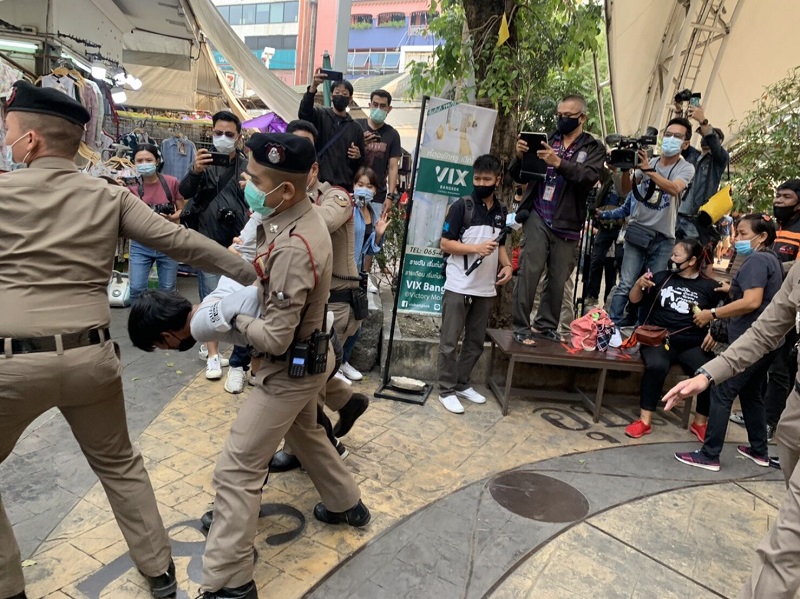
Police crack down on a rally against lese majeste law at Victory Monument on Jan. 16, 2021.
The lawyer, whose group is representing the government critics pro bono, said these tactics are in clear violation of the law and urged national police chief Gen Suwat Changyodsuk to look into the matter.
Human Rights Watch coordinator Sunai Phasuk said police actions in recent days could amount to “state-enforced disappearance,” which is defined by many civil rights organizations as detaining someone without revealing their fate and whereabouts.
“Our main concern is that police conduct arrests with the same pattern which shows disregard to both Thai and international laws,” Sunai said. “It doesn’t matter if someone is missing and unaccounted for for 5 to 10 minutes, or two hours. This is a serious crime under international human rights law.”
Former National Human Rights Commissioner Angkhana Neelapaijit, whose husband was abducted in 2004 and never seen again, said she was disturbed to see how police handled the arrests of pro-democracy activists recently.
Apart from infringing on their rights, police risk leaving the suspects with a long term trauma, she said.
“When these people were taken away in such fashion, they would likely become fearful,” Angkhana said. “They could end up experiencing psychological trauma in the future.”