




























30 C
Bangkok
Sunday, June 28, 2026
Home Blog Page 1388

Opposition Attacks Prayut’s Ties to China in Debate Day 2

PM Prayut Chan-o-cha raises a toast to Chinese premier Li Keqiang on Nov. 5, 2019, at Government House in Bangkok.

BANGKOK — The second day of the no-confidence debate saw PM Prayut Chan-o-cha coming under accusations that he risks giving up Thailand’s sovereignty to China.

Two MPs, one from Pheu Thai and the other from the now-disbanded Future Forward party, said the Prime Minister placed national interests at a disadvantage by kowtowing to China in a variety of issues, from railway to real estate to e-commerce.

“People are saying that Thailand has already become a province of China,” Future Forward MP Ekkapob Pianpises told the House.

Read: China, Thailand Expect More Business Opportunities

Ekkapob pointed to a lack of control over Chinese capital snapping up condominiums in Bangkok, which he said led to a surge in real estate prices and makes them unaffordable to ordinary Thais. According to the MP, some condominiums are now in the hands of Chinese investors who in turn rent them out to Chinese tourists, thus “sending” the money back to China.

“The condominium price index went up 17 percent,” he said. “Allowing condo prices to go up like this turns potential Thai buyers into renters instead.”
บรรยากาศการอภิปรายไม่ไว้วางใจรัฐมนตรีเป็นรายบุคคล 25
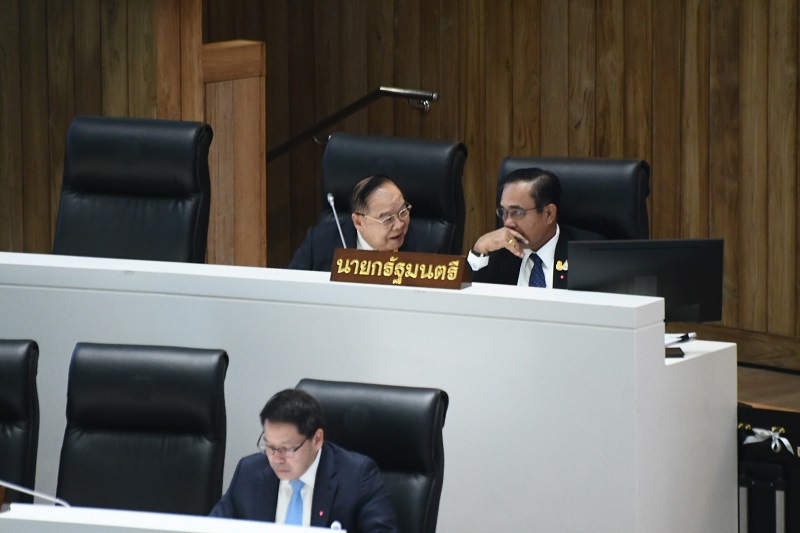
PM Prayut Chan-o-cha chats with his deputy Prawit Wongsuwan during a no-confidence debate on Feb. 25, 2020.

Opposition Pheu Thai MP Saratsanun Unnopporn accused Prayut of allowing Chinese e-commerce giant Alibaba to gain its foothold in Thailand, showering the firm with tax breaks and other privileges, at the expense of small local online businesses.

“Alibaba behaves like a representative of Chinese government. It is seeking an economic colony,” Saratsanun said. “I don’t know if the Prime Minister had good intentions towards Thai people, but it’s impossible that [Alibaba] is helping to revive the Thai economy.”

Thailand’s growing ties with China in recent years alarmed some observers and members of the opposition, who fear the kingdom may end up in vassalage under China’s ever-expanding economic and military might.

Ekkapob, the Future Forward MP, also said Prayut allowed China to bypass competing bids from other nations and snap up the lucrative high-speed rail project even before its environmental impact was fully assessed.
196951
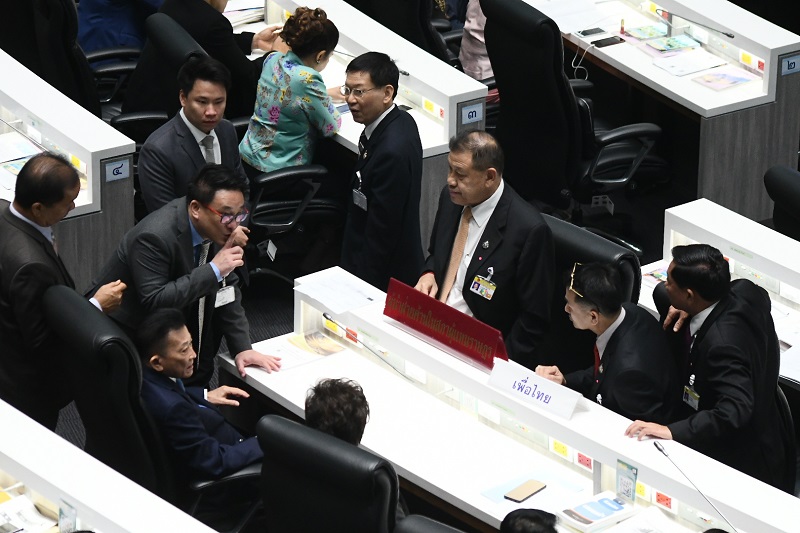
Opposition MPs talk to each other during a no-confidence debate on Feb. 25, 2020.

He then accused the government of having to beg China to increase the waterflow at Chinese-operated dams along the Mekong River in order to lessen the drought situation in provinces along the river.

“Prayut knows what’s happening, but he doesn’t dare do anything because as he said, we are like an ant compared to the lion,” he said, referring to Prayut’s remark to Chinese premier Li Keqiang in November.

Foreign Affairs Minister Don Pramudwinai denied the allegation. He said he visited China in January to discuss the water situation as “friends of equal standing,” and there was “no begging involved.” The minister said China agreed to increase the water volume in the Mekong just a day after the discussion.

“The Thai and Chinese foreign affairs ministries have cordial relations,” Don said. “We made previous requests concerning the Mekong River to each other, and we honored those requests.”

Additional reporting Teeranai Charuvastra

Related stories:
Prayut Accused of Favoring Big Businesses, Amassing Wealth

Advertisement

What to Shop for in Nan to Support Local Producers

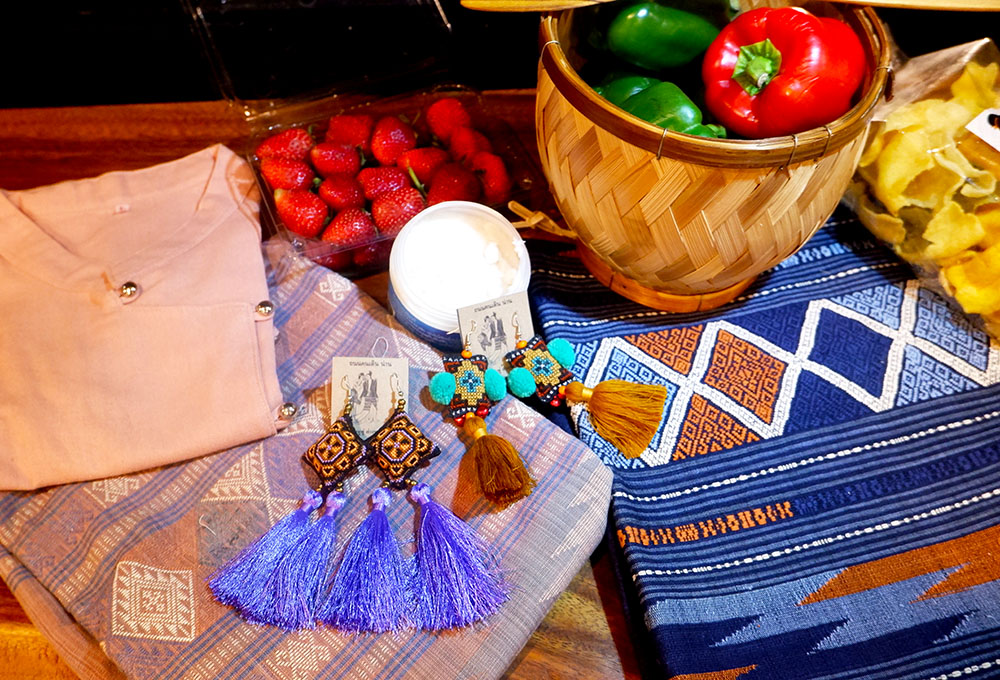
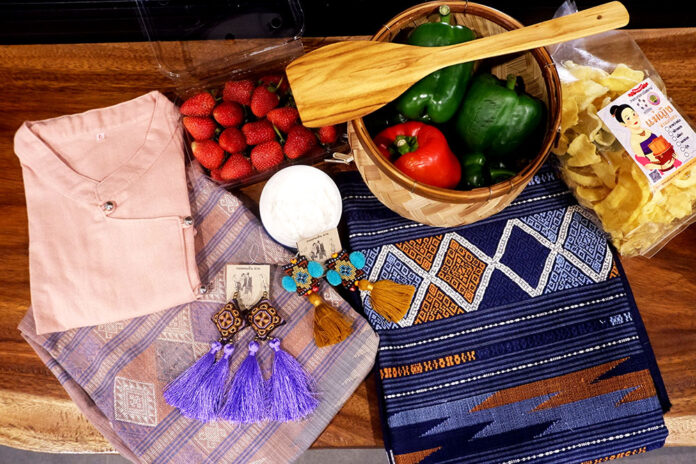
Products purchased in Nan town by the writer in January 2020.

NAN — Although the quiet rural province isn’t known for being a shopping hub, here’s our guide to what to purchase in Nan to support local producers in a province listed as the 19th poorest in the country.

No sponsors here – all items were paid for by the writer.

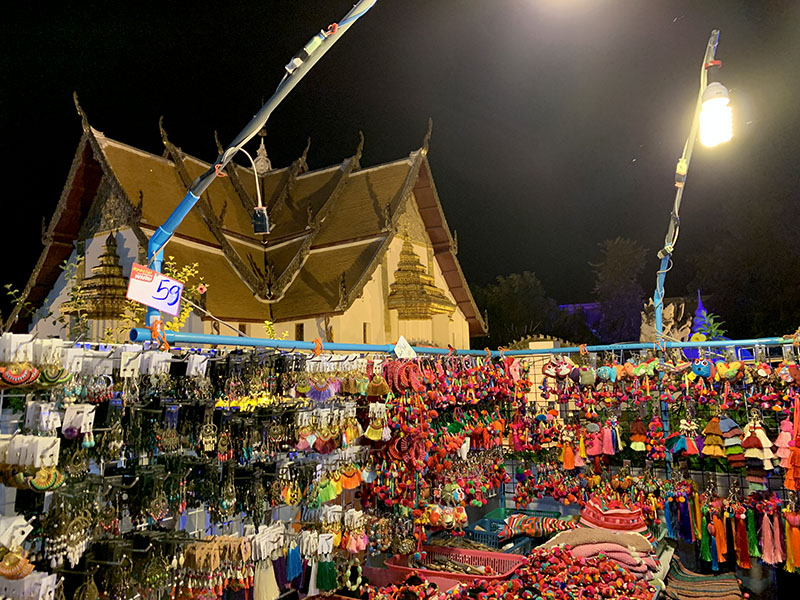
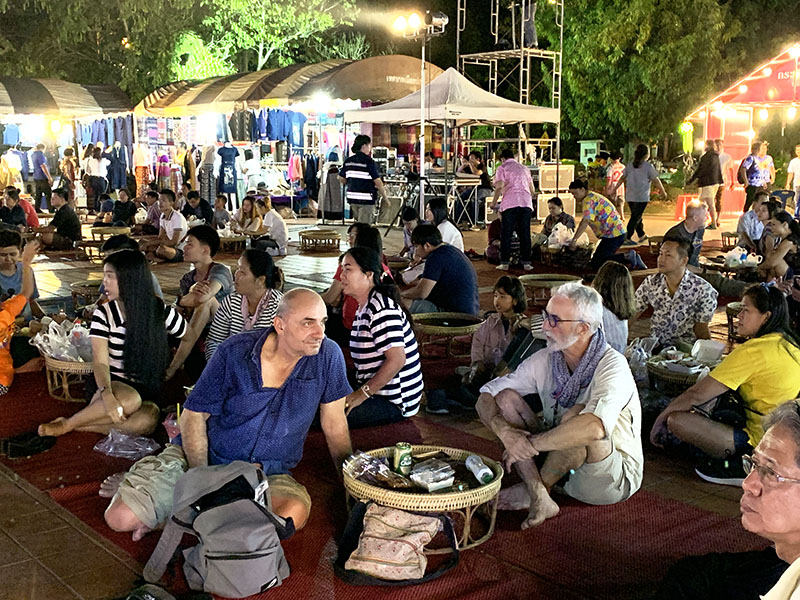
Head down to the Nan Night Market next to Wat Phumin on Fridays and weekends where local shops will set up rows of snacks, clothes, and handicrafts starting at 5pm to about 6:30pm.

On repeated visits in January we purchased shockingly cheap produce: a bag of seven bell peppers for 35 baht and a box of strawberries for 100 baht. We even spotted a shop selling avocados for 60 baht per kilo.

IMG 1317 copy
A night view of Wat Phumin from Nan Night Market.

More ubiquitous were shops selling dyed or woven cloth and Northern Thai clothes. Prices were driven quite low due to the oversaturation, with a 2-yard piece of hand-embroidered Tai Lue patterned cloth sold for as low as 600 baht – although you may have to hunt for patterns that don’t use bright neon greens and fuschias.

The navy-and-brick cloth pictured above was purchased at the night market at an unnamed shop stall for 600 baht.

OTOP-like shops of woven clothes start to blur together until one runs into Kittiya Weaving, distinguishable for its cute pastel-colored tops and ready-made skirts.

Prices range in the thousand-up range for the skirts – more complicated weaving patterns such as the geometric one that depicts flowing water costs more, while tops are 250 baht. This pastel peach skirt pictured above cost 1,850 baht, but we were able to haggle.

DSCF0642
Chaba Nan’s earrings.

Give your look a Lanna flair with colorful tasseled earrings – despite the glut of tassel and pompom earrings, Chaba Nan’s shop stood out for their elaborate structures and embroidery. The pictured purple heart earrings cost 120 baht, while the ochre one cost 99 baht.

We also picked up a Punniga Salt Scrub (220 baht), an OTOP product from Bo Klua district, famous for its natural salt wells. One Tambon One Product, or OTOP, is a national program in which an exemplary product from each subdistrict, or tambon, is produced and sold.

 One shop we hoped to see at the market but didn’t is the Pua Nopphakhaw OTOP brand that sells Tai Lue cloth and apparel, but with one of their collections redesigned to be more fashionable. But if not ordering online, one can only find their items at their shop 50 kilometers north of the town.

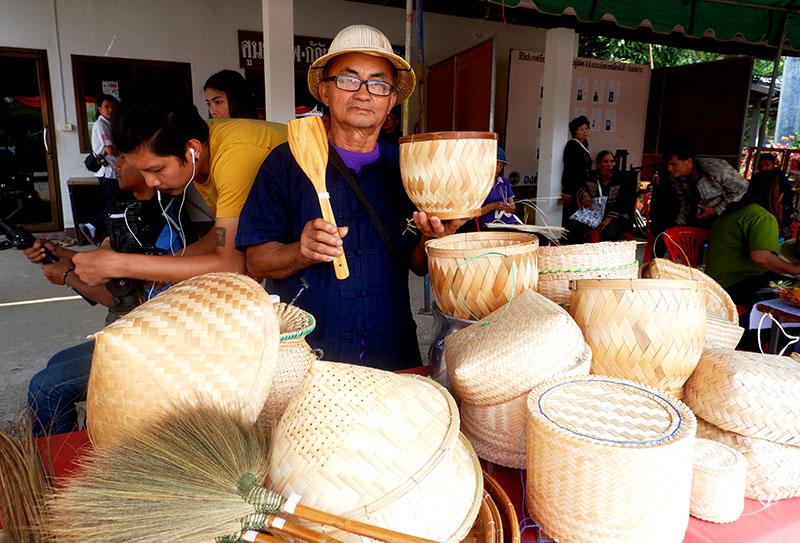
Wooden and woven handicrafts like spatulas and baskets are also available at the Mueang Chan Tambon [Subdistrict] Office, where we purchased the pictured spatula (40 baht) and woven basket (95 baht). 

DSCF0588 copy
Sing Supina holds wooden handicrafts made by his local weaving club in Mueang Chang subdistrict in Nan.

Manning the stall was Sing Supina, 66. He’s the head of the Loong Sing Baan Mueang Chan Moo 8 weaving club, which consists of 10 elderly people in his neighborhood.

For purchasing that basket, Sing said 90 baht goes to the weaver while 5 baht is kept by him for running the club. Loong Sing hawks his wares at local fairs and can be contacted at 089-561-6797.

IMG 1427 copy
Nan Night Market.
IMG 1421 copy
Nan Night Market.

Related stories:

Shop For Thai Souvenirs That Aren’t Elephant Pants

Designers Take OTOP Products From Nope to Dope

Here’s 5 Green Tech That Could Help Lift Thai Farmers Out of Poverty

Makeup Makeover: Startups Changing Minds About Thai Cosmetics

Makeup Makeover: Startups Give Local Cosmetic Market a Refashioning

Thai Folk Arts Get 21st Century Makeover

Startups Make Thai Patterns Great Again

Advertisement

Mobilized by Hashtags, More Verdict Protests Planned at Universities

A protest at Kasetsart University on Feb. 24, 2020.

BANGKOK — Using social media as a mobilization tool, students at a dozen universities on Tuesday announced rallies at their campuses to protest a court verdict that dissolved a key opposition party.

From Mahidol in the west to Ramkhamhaeng in the east, universities in Bangkok are set to witness protests scheduled from Tuesday evening through Thursday to show their anger at a recent court decision to disband the Future Forward Party, a party extremely popular among the youths.

Read: Chula, Kasetsart Students Protest Party Dissolution (Photos)

The move came after two simultaneous rallies at Chulalongkorn and Kasetsart universities on Monday drew a total of more than 1,000 people – the largest student-led political rallies in many years.

Here’s the rough schedule of university protests expected to happen through Thursday:

Tuesday Feb. 25:

3pm at Ubon Ratchathani University

3pm at Bangkok University, Rangsit Campus

5pm at Chiang Mai University

6pm at Maejo University in Chiang Mai province

6:15pm at Mahidol University, Salaya Campus in Nakhon Pathom province

Wednesday Feb. 26:

4:30pm at Srinakharinwirot University, Prasarnmit Campus

5:30pm at Thammasat University, Rangsit Campus

5.30pm at Srinakharinwirot University, Ongkharak Campus in Nakhon Nayok province

6pm at Silpakorn University in Sanam Chan, Nakhon Pathom province

6pm at University of Thai Chamber of Commerce

6pm at Walailak University in Nakhon Si Thammarat province

Thursday Feb. 27:

5pm at Ramkhamhaeng University, Hua Mark Campus

5pm at Rangsit University

Friday Feb. 28:

6pm at University of Phayao

Spread of the protests also prompted students in other universities to encourage each other to come out in a show of solidarity, using hashtags like the trending #RajamangkalaWillNotTakeThisAnymore, for the nine Rajamangala Universities of Technology and #YaMo’sChildrenSayNoToDictators for Suranaree University of Technology in Korat. 

There’s also the envelope-pushing #Can’tBeLoudThey’reNextDoor adopted by students in Suan Dusit and Suan Sunandha Rajabhat Universities; both are located in proximity to the royal estate in Dusit district.

Although the English translations of the hashtags look long, in Thai they slightly rhyme with a poetic quality. Here’s what they mean: 

#RenewedIsThePillarThatWasBroken – Chulalongkorn University, in reference to their official motto “Pillar of the Kingdom.”

#FutureForwardPartyDissolutionHadOurUpperclassmen – Thammasat University, an alma mater of Future Forward founders Thanathorn Juangroongruangkit and Piyabutr Saengkanokkul. 

#KUAreNotCoconutMilkDesserts – Kasetsart University, saying that they are not salim – a Thai dessert whose name has been adopted as a derogatory term for the pro-establishment faction.

#TheWhiteElephantWillNotTolerateThis and #FromAThin-FacedUni – Chiang Mai University

#KKUSorryForBeingLateSalimDeletedOurPost – Khon Kaen University

#HowCan6MillionPiecesofDustFightAgainst9Voices – Prince of Songkla University in Songkhla.

#PhorKhun’sChildrenDon’tServeDictators – Ramkhamhaeng University. ‘Phor Khun’ is an endearment for university namesake King Ramkhamhaeng. 

#SilpakornJoiningIn and #DemocratiamLongaVitaBrevis – Silpakorn University. The latter, “Democracy is long, life is short” is a play on the motto, “Ars longa, vita brevis.”

#SalayaDoesn’tEatColorfulDesserts – Mahidol University, Salaya Campus. Hashtag again refers to the term salim.

#SWUHasAVoice and #TheBaseWillBeDivided – Srinakharinwirot University. The latter term refers to an online joke of dividing jail term with other co-defendants for sharing sensitive news.

#We’reFarawayButSendingOurHeartsFromtheOctagonCourtyard – Maha Sarakham University, which has an eight-sided courtyard.

#NUWantsToLeavetheKala – Naresuan University in Phitsanulok. Referring to leaving the kala, or coconut shell, a Thai idiom for stubborn ignorance.

#ThreePhraJhomWon’tTakeItLyingDown – King Mongkut’s University of Technology North Bangkok, King Mongkut’s University of Technology Thonburi, and King Mongkut’s Institute of Technology Ladkrabang. The latter is also congregating in #PhraJomDrinksBooze,Doesn’tEatSalim.

#YaMo’sChildrenSayNoToDictators and #SurroundedbyArmyCampsDoesn’tMeanILikeDictators – Suranaree University of Technology in Nakhon Ratchasima, home of Ya Mo the heroine. The latter hashtag is a jab at the university’s close proximity to military bases.

#BUIAmNotSalim – Bangkok University

#BlueMagentaIsNotADessert – Rangsit University, whose colors are blue and magenta.

#RajabhatWantsToGrappleWithSalim – Rajabhat group of universities.

#KankraoDoesn’tWantKala – Ubonratchathani University. Referring to the university tree, the Tembusu.

#FahMuiDoesn’tTalktoDictators – University of Phayao. Fah Mui refers to the gold and purple orchid that is the university’s symbol.

#WalailakUStudentsDon’tWantHuTia – Walailak University. Hu Tia is a spoonerism of “Hia Tuu,” or “fucking Tuu.” Tuu is Gen. Prayuth Chan-o-ocha’s nickname.

#EvenFromBangNaWeCanSlapParliament’sFace – Assumption University, located in far eastern Bangkok. 

#FamousUinBangNaWavesByetoThreeColoredDesserts – Huachiew Chalermprakiet University, again referring to salim.

#KasemPlaysWithFireButIsNotAFriendOfSalim – Kasem Bundit University. Refers to the university emblem of a torch.

#WeGrowWeedButDon’tEatSalim – Maejo University in Chiang Mai, known recently for their prototype weed plantation.

#UTCCIsASailboatNotSubmarine – University of the Thai Chamber of Commerce, whose emblem is a sailboat.

#LotusInBloomAgainstStupidGov’t – Sripatum University, whose emblem is a lotus.

In this video meme of “The Twilight Saga: Breaking Dawn Part 2” (2012), university students react to the “death” of democracy and assemble to fight against the government.


Advertisement

Thailand Reports 2 More Cases of Coronavirus, 37 in Total

A man wears a face mask at Suvarnabhumi Airport.

BANGKOK — The Ministry of Health on Tuesday said two more cases of Covid-19 infection were reported in Thailand, bringing the total tally to 37 since the outbreak began.

Health permanent secretary Sukhum Kanchanapimai said two Thais tested positive for the new strain of coronavirus, but none of them are in critical condition.

Sukhum said one of the patients is a maid serving in a house where one of the family members recently traveled to Guangzhou, while the other is a private chauffeur for foreign clients. He did not elaborate on which province where the patients came from.

Fifteen infected patients are also being treated at hospitals, while 22 of the 37 patients have recovered, the health official said. The country has no report of any fatalities so far.

Health minister Anutin Charnvirakul yesterday said the virus has been added to the national list of dangerous communicable diseases, joining ranks with 13 other diseases like plague and smallpox.

Under this measure, Anutin said it will allow health officials to respond to the outbreak more quickly and enforce tougher laws such as ordering suspected individuals to be put into quarantine. The authorities can also impose travel bans to prevent further spread.

“We are not only fighting with the virus nowadays, but also the misinformation that debilitate health officials,” Anutin said. “This measure will give legal basis for our actions such as enforcing quarantine which we previously could only ask for cooperation.”

Advertisement

New Campaign Launched as Chinese Tourists ‘Drop by 90%’

Chinese tourists feed elephants in Lampang province.

BANGKOK (Xinhua) — The Tourism Authority of Thailand (TAT) launched a campaign here on Monday to help tourism operators showcase their products and services after a massive drop in tourists coming from China.

The “Iconsiam, Thais Help Thais” campaign also included massive discounts in domestic flights, and 50 percent discount in leading hotels, food and beverages.

“The COVID-19 outbreak has reduced the number of Chinese tourists by 90 percent and the number of foreign tourists has dropped by over 60 percent,” said Minister of Tourism and Sports Phiphat Ratchakitprakan.

“Therefore I am calling on Thai people to spend money, shop and travel in Thailand. Thais should help Thais.”

Phiphat said the Thai government will be rolling out the “Taste Shop Spend Campaign Phase 4,” as part of the economic stimulus measures to spur a stagnant Thai economy.

Advertisement

Drop Racism and Eat Local Chinese, British Food Critic Says

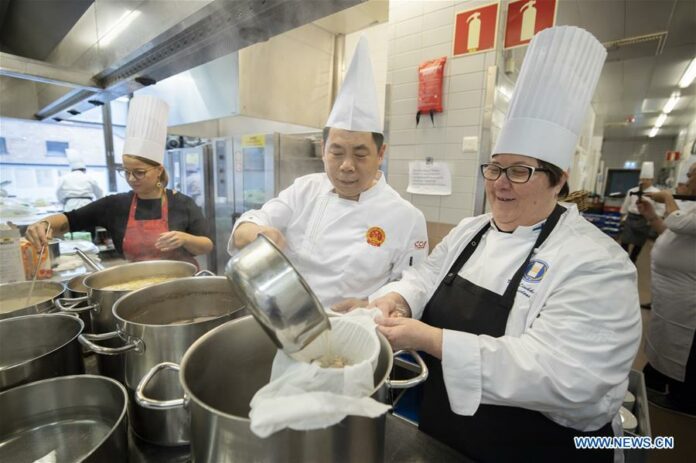
Sun Minghai (2nd R, front), member of the Chinese Cuisine Association and Ulla Liukkonen (1st R, front), Chairwoman of Finnish Chef Association, prepare dinner during Finland Chinese Food Night at the Main Post Office Restaurant in Helsinki, Finland, on Oct. 14, 2019. (Photo by Matti Matikainen/Xinhua)

LONDON (Xinhua) — A British writer and food critic on Sunday expressed his solidarity with the local Chinese community, dismissing racial discrimination linked to coronavirus.

Jay Rayner, a journalist, writer and restaurant critic, visited Chinese restaurant Four Seasons located in London’s Chinatown and published a review in The Observer newspaper.

“This is a review with a simple message: go and support your local Chinese restaurant. Go show them that ethnicity is not a marker for disease,” he said, adding that it was also “an act of solidarity with Britain’s Chinese community which has suffered via misplaced racist fear over coronavirus.”

The 53-year old writer noticed that Gerrard Street in Chinatown was “sparsely populated” and chairs and tables in the restaurants “sit forlorn and empty,” as the fear over COVID-19 has impacted badly the business of the Chinese restaurants, although the “nasty virus has broken out in a city 5,500 miles (about 8,851 km) away from London.”

“I’ve never seen it like this before,” he wrote. “There are reports of abuse on the streets, of Asians being shunned on public transport. Across the Chinese restaurant sector, business is down. The mother of one Anglo-Chinese friend calls it ‘health-linked racial discrimination.’ It doesn’t matter what excuse you choose for your racism. It’s still racism.”

CBBB4A3C 61C5 4E1A 8C4E 8688441738CB 3
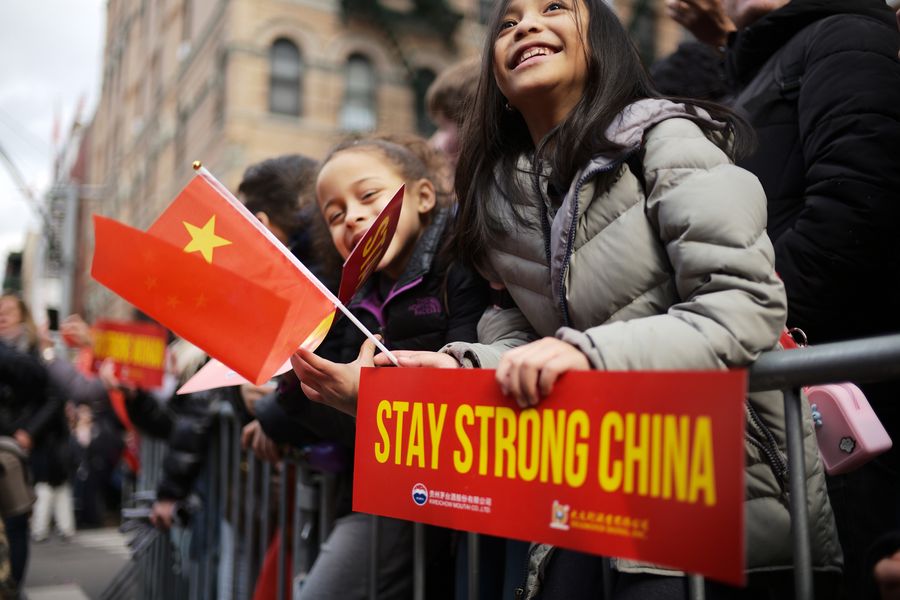
People watch the Chinese Lunar New Year parade in Manhattan’s Chinatown of New York City, the United States, Feb. 9, 2020. (Xinhua/Li Muzi)

As a regular customer, Rayner said he did not need to visit Four Seasons to write about it.

“But this is an act of solidarity that also gets me roast duck,” he said.

“The opening up of China has brought us the country’s thrilling variety from Sichuan to Shanghai, from Hunan to Xinjiang and back again,” Rayner said at the end of his review, adding that he was staggered to see that the once mainly Cantonese Chinatown has grown from “a tiny cluster to a vast district apparently representing all the provinces.”

“Britain’s Chinese restaurant offering is more diverse and exciting than it’s ever been. Please go and eat in one. Now,” he concluded.

Responding to Rayner’s review, one person wrote on Twitter: “I’m baffled people would avoid Chinese restaurants in London for the coronavirus … you’ve definitely inspired me to go ASAP.”

“Such an excellent and timely review. So shameful that some people are avoiding our wonderful Chinese restaurants for the silliest of reasons,” another tweeted.

Advertisement

Syrian Father Teaches Daughter to Laugh When the Bombs Fall

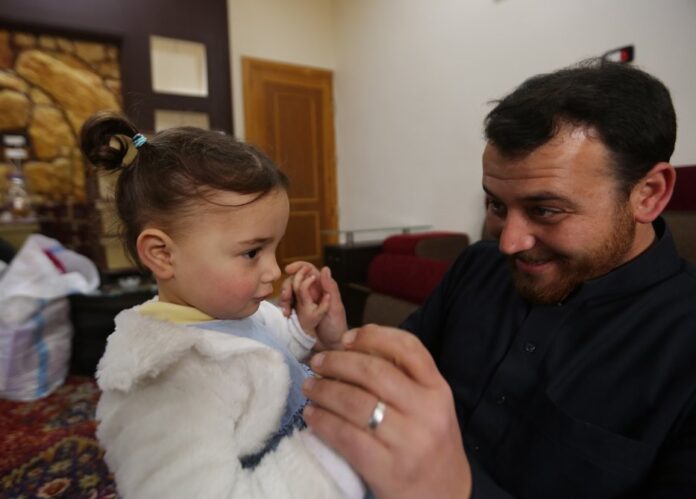
In this Sunday, Feb. 23, 2020 photo, Abdullah Mohammed plays with his daughter, three-year-old Salwa inside a house he recently fled to, near the Syrian-Turkish border, in Sarmada, Syria. (AP Photo/Ghaith Alsayed)

BEIRUT (AP) — Abdullah Mohammed would do anything for his daughter, even forcing himself to laugh with her at the sound of bombs to help her overcome her fear.

In Idlib, that’s a lot of laughter.

The province in northwestern Syria is the last opposition-held stronghold in the war-ravaged country. It has been the subject of a ferocious military campaign and relentless bombardment by Russia-backed Syrian government troops since early December. More than 900,000 civilians have been on the move since then, displaced from their homes.

Many now live in tents, abandoned buildings, makeshift shelters and in open fields near the Turkish border.

As the advancing troops neared his hometown of Saraqeb two months ago, Mohammed fled with his wife and daughter further north to the town of Sarmada, where they are now staying in an abandoned house offered to him by a friend.

Mohammed and his daughter, 3-year-old Salwa, became overnight celebrities after a video they shot was shared widely on social media — a reminder of the horrors faced by children in Syria. In the video, Salwa, wearing a pink dress, stands on a sofa next to her father.

879EB177 CC6E 45E0 8DBB D8D658F013D1 14
In this Sunday, Feb. 23, 2020 photo, Abdullah Mohammed plays with his daughter, three-year-old Salwa inside a house he recently fled to, near the Syrian-Turkish border, in Sarmada, Syria. (AP Photo/Ghaith Alsayed)

Mohammed asks his daughter: “Is that a plane or a shell?”

“A shell, and when it falls we will laugh!” she replies.

As the boom of the explosion is heard in the distance, the little girl jumps slightly and then bursts into hysterical giggles as her father laughs along and says: “It’s funny, right?”

Mohammed said he came up with the game to help his daughter cope with her fear.

Salwa had been hearing bombs all her life. As a baby there was no fear, but that changed after her first year. One day, they were at home in Saraqeb during Eid al-Fitr, the three-day Muslim holiday that marks the end of the holy month of Ramadan. Children outside were celebrating with fire crackers, and a big one exploded nearby.

“She was frightened, but I took her out and showed her that children were playing and laughing … she was convinced,” he recalled. That was how he got the idea to connect the sound of bombs with laughter and kids playing, and to film himself laughing with her every time warplanes hit.

196951 1
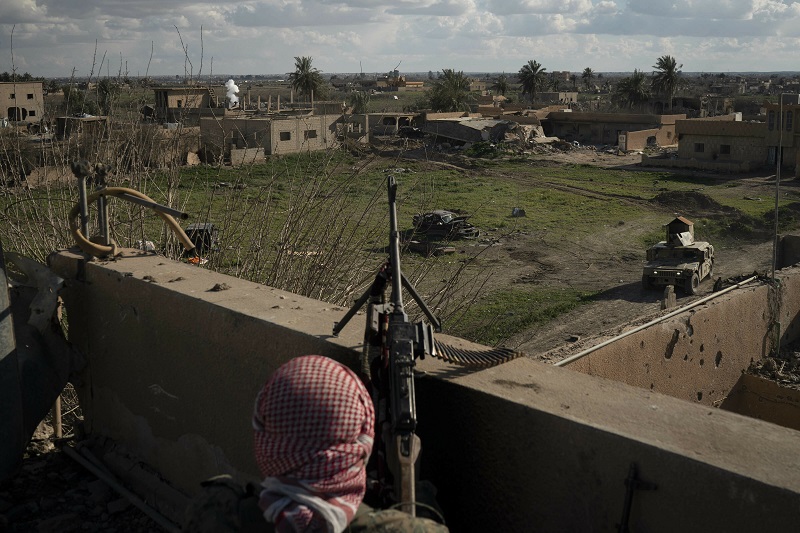
Associated Press file photo of 2019 fighting in Baghuz, Syria.

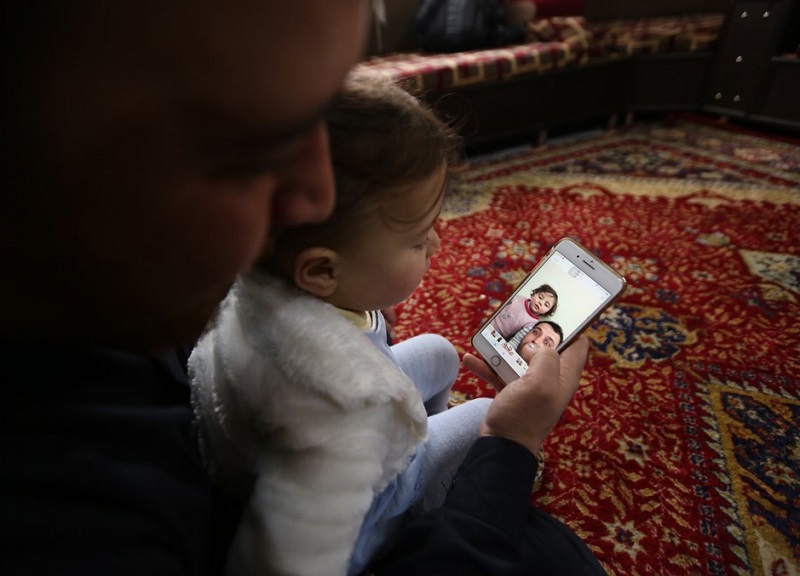
He said now every time they hear the jets or outgoing artillery shells, Salwa turns to him and waits for his reaction. He pulls out his cellphone for a selfie video and they wait for it — and then they burst into laughter.

On a recent day, Mohammed sat watching Salwa as she played with plastic Lego bricks, her hair in pigtails and wearing a blue dress. He said the war has wiped out the hopes and dreams of his generation and those of their children.

“The most I hope for is to stay alive, along with my daughter and everyone else,” he said. “We forgot about the bigger hopes, they don’t exist anymore.”

Mohammed gets emotional talking about it. He says he realizes the bombs they’re laughing about could be ending someone’s life at that same moment.

“Maybe it hit a tent or a child, and this is not funny of course. This is very sad. But I’m laughing so that my daughter doesn’t get affected by this. And if the shell were to fall on us, better that we die laughing than to die scared.”

Advertisement

Russia Denies Interfering in US Elections, Domestic Affairs

U.S. President Donald Trump speaks with Russian President Vladimir Putin during a press conference after their meeting at the Presidential Palace in Helsinki, Finland, Monday, July 16, 2018. (AP Photo/Pablo Martinez Monsivais)

MOSCOW (TASS) — Russia strictly observes the principle of non-interference into sovereign affairs of the United States, sealed almost 90 years ago, Russian Special Presidential Envoy for International Cooperation in Information Security Andrei Krutskikh told the Kommersant daily.

“We strictly and meticulously observe the principle of non-interference into the domestic affairs of the United States, sealed back on November 16, 1933, when Soviet Russia and the United States restored their diplomatic relations,” he said.

“The [Russian] president has repeatedly stressed that Russia had never interfered and was not going to interfere into US internal affairs, including electoral processes.”

“In order to have this issue settled once and for all, we, on our part, expressed readiness to publish technical correspondence on this subject and to have it examined by experts, journalists and the public in Russia and the United States, and suggested this move to Washington,” the Kremlin envoy said.

“Regretfully, Washington’s answer was ‘no, ’ and they justified it by the sensitivity of those files.”

“We have repeatedly suggested the US side to sit at the negotiating table and discuss every concrete accusation, to find it out what was done and what was not done at the level of experts, not through the media,” Krutskikh said. “We also suggested exchanging political guarantees of non-interference into each other’s affairs, similar to those given in 1933.”

According to the Kremlin envoy, Washington “rejected this initiative and keeps declining proposals to negotiate.”

American intelligence agencies continuously hurl accusations at Russia of meddling in the 2016 US presidential election.

In May 2017, the US Department of Justice announced that former FBI Chief Robert Mueller had been appointed as special counsel to investigate alleged Russian interference in the 2016 American election.

In the end, Mueller came up empty-handed, admitting that there was no evidence that US President Donald Trump had colluded with the Russian government to win the election.

Trump and key members of his team have repeatedly rejected all the accusations concerning any collusion between the Trump campaign and Russia. Moscow has also refuted these allegations.

Advertisement

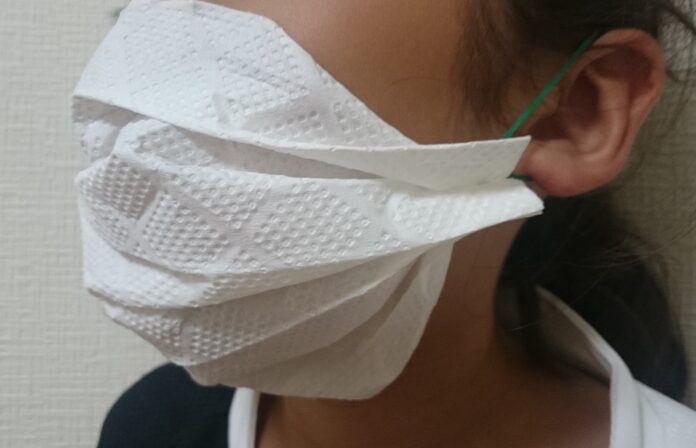
Japanese Get Creative in Face of Mask Shortages

Image: Tokyo Metropolitan Police Department / Twitter

TOKYO (Kyodo) — Desperate to protect themselves against the coronavirus that is sweeping parts of the planet, but unable to buy face masks due to shortages, people in Japan are going to unusual lengths with DIY solutions.

While fearful Chinese people are forced into some extreme, if strange, measures such as using fruit skins, plastic bottles, sanitary pads, and even bras as makeshift face masks, many Japanese are coming up with ingenious solutions of their own.

Top: Metropolitan Police Department tweet in 2017 on how to make a face mask from kitchen paper

Continue reading the story here.

Advertisement

China Sentences Swedish Bookseller to 10 Years in Prison

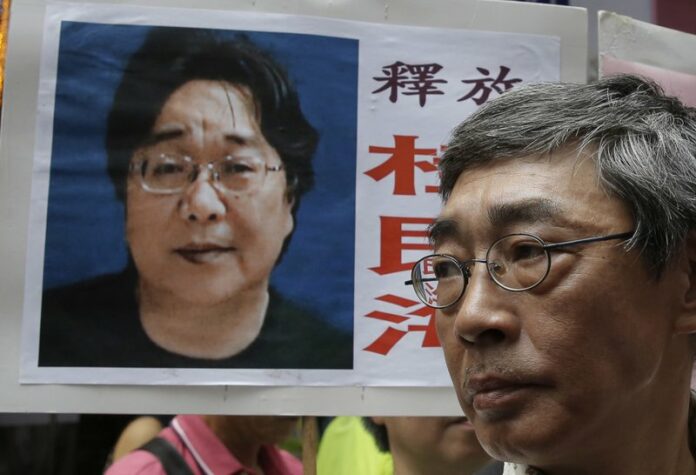
In this June 18, 2016, file photo, a picture of missing bookseller Gui Minhai is shown on a placard beside freed Hong Kong bookseller Lam Wing-kee, as the protesters are marching to the Chinese central government's liaison office in Hong Kong. (AP Photo/Kin Cheung, File)

BEIJING (AP) — A court in eastern China announced Tuesday that it has sentenced Gui Minhai, a naturalized Swedish citizen, to 10 years in prison.

The Ningbo Intermediate People’s Court convicted the 55-year-old Gui of “illegally providing intelligence overseas,” the court said in a statement published online.

For years, Gui sold gossipy books about Chinese leaders in the semi-autonomous city of Hong Kong. He first disappeared in 2015, when he was believed to have been abducted by Chinese agents from his seaside home in Thailand.

Four other people who worked for the same publishing company also went missing that year, only to turn up months later in police custody in mainland China. Gui is the only one who remains in detention.

He was initially released into house arrest in Ningbo, the eastern Chinese city where he was born, but police detained him once again in 2018 while he was on a train to Beijing in the company of two Swedish diplomats.

Gui’s arrest has been a source of friction between Beijing and Stockholm. In November, Sweden’s culture minister awarded the bookseller the annual Tucholsky literary prize despite a threat from the Chinese ambassador to ban her from entering the country.

Standing next to Gui’s empty seat at a ceremony in Stockholm, Culture Minister Amanda Lind said it was “crucial for culture and democracy that artists and authors can work freely.”

The Ningbo court said Gui applied in 2018 to restore his Chinese citizenship. He pleaded guilty and will not appeal his sentence, the court said.

Human rights groups have repeatedly accused China of extracting forced confessions from individuals it perceives to be opponents of the ruling Communist Party.

Advertisement

Hot News

LATEST NEWS

Bangkok
overcast clouds
30 ° C
31.6 °
30 °
75 %
3.5kmh
98 %
Sat
30 °
Sun
34 °
Mon
34 °
Tue
33 °
Wed
32 °