BANGKOK — While shopping for Halloween gear, the King Rama X’s eldest sister took a pic with a sensational item – a fake bloodied head of President Donald Trump.
In a photo posted to her Instagram handle @Nichax on Thursday, Princess Ubolratana posted a photo of her holding up what could be a trick or treat bucket or a rubber head of the US President.
“Happy Halloween in Sampeng!” she wrote in the caption. Her other pics of her in the post were of her shopping in Chinatown market.
Earlier Thursday she had posted a filtered photo of her as a fortune teller, accompanied by the caption, “Happy Halloween!!! Tonight I’m going to London #BusyButStillPretty.”
Photo: Nichax / Instagram
In what can be viewed as a snub, Trump is not coming to the ASEAN summit running in Bangkok Thursday through Nov. 4. In 2018, Vice President Mike Pence attended in place of Trump. The president personally attended the meeting in 2017.
Robert C. O’Brien, US national security adviser, and Commerce Secretary Wilbur Ross, will represent the US at this year’s summit instead.
In the lead-up to Halloween, active social media personality Princess Ubolratana posted several photos of herself in Halloween costumes such as the Joker and Maleficent.
In February, she was nominated as a Prime Minister candidate by Thai Raksa Chart Party, but King Rama X said in a statement that she cannot run for office.
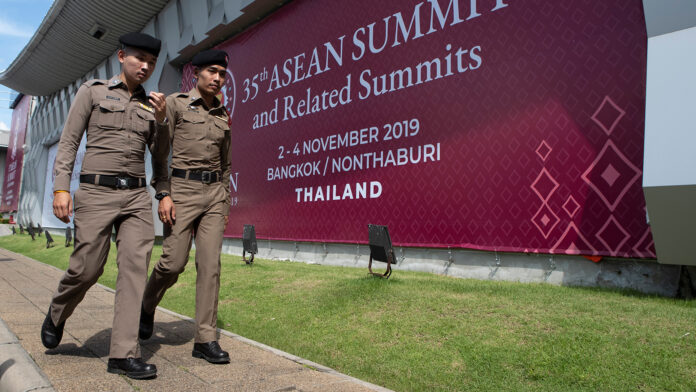
Policemen patrolling the meeting venue for 35th ASEAN Summit at Impact Muang Thong Thani on Oct. 29, 2019. Photo: Sakchai Lalit / AP
BANGKOK — Commuters should expect lengthier travel times on several major roads as more than 3,000 delegates will arrive in the capital for the ASEAN Summit starting Thursday.
Expressways linking the city to the two international airports and the meeting venue at Muang Thong Thani are among the routes to be briefly disrupted from Oct. 31 to Nov. 4, when motorcades of VIPs and delegates will travel on throughout the day, according to the police.
Several roads around downtown hotels are also being affected. The list includes part of Rama IV, Ratchadapisek, Sukhumvit, Ploenchit, Witthayu, Rama I, Ratchadamri, Silom, and Charoenkrung Road.
The police advised commuters to plan alternative routes, spare more travel times, or use public transportation instead. They also suggested detours around the affected roads, which can be found in the interactive map below.
Red lines are routes to avoid, while green lines are alternative routes suggested. In routes where red and green lines overlapped, commuters should avoid elevated tollways and travel on at grade roads instead.
The cabinet also approved additional holidays for all government offices in Bangkok and Nonthaburi on Nov. 4 to Nov. 5 in an effort to lessen congestion. A number of schools, state enterprises, and private companies followed suit and shut their doors on those days.
In a related development, Prime Minister Prayuth Chan-ocha said Thursday that he has ordered the police and armed forces to provide full security support for the summit.
More than 17,000 security personnel have been deployed, while a full scale drill was conducted on Tuesday.
“We are well-prepared this time,” deputy prime minister Prawit Wongsuwan said. “It will not repeat the same mistake we did for the ASEAN Summit in 2009.”
In 2009, the 14th ASEAN Summit was abruptly canceled after anti-government Redshirt protesters stormed into the meeting venue in Pattaya. Eleven leaders who led the march are expected to hear their verdicts in their cases at Pattaya court today.
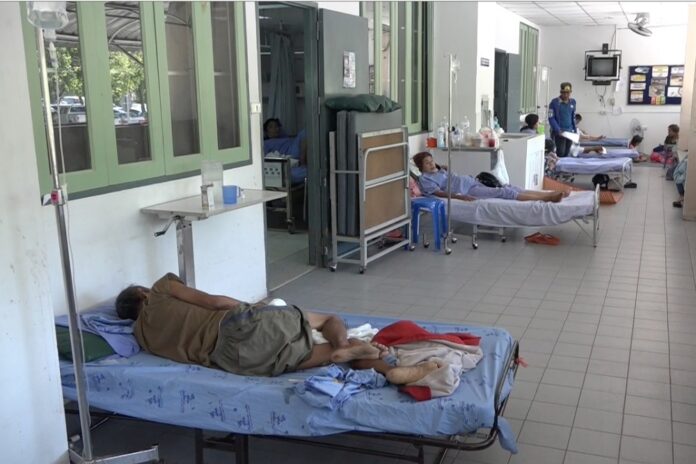
Patients and visitors spill onto a hallway in a hospital on Koh Samui in April 2017. Hospital directors say the facility was overwhelmed with patients.
BANGKOK — Despite being officially “free of charge,” education and universal healthcare in Thailand are still out of reach for many, an economist argued in a new book released earlier this week.
Teachers and doctors are still mostly concentrated in Bangkok and major cities, leaving students and patients in rural areas to education and healthcare of lower quality, Chulalongkorn University lecturer Vimut Vanitcharearnthurn said in the book, which draws from various figures and statistics.
“Schools in Bangkok have better qualified and more experienced teachers than those in Mae Hong Son [province], meaning they are likely to offer quality education,” reads part of the book, Getting Even: Public Policies To Tackle Inequality in Asia.
“It is far more common for teachers to have a graduate degree and significantly more years of teaching experience in the city. Bangkok schools also have more than twice the number of teachers per class room when compared to Mae Hong Son,” it says.
The book was unveiled at a news conference on Tuesday, where Vimut said he’s concerned to see the ultra-rich getting richer at a much faster rate than the rest of the population.
“The closing of the [income] gap cannot keep pace,” said Vimut, who teaches banking and finances.
In his book, Vimut said the share of teachers with graduate degrees in Bangkok is at 19.7 percent, whereas at a typical village school in Mae Hong Son, it’s 8.7 per cent.
Average teacher experience is 25.3 years for Bangkok compared to 10.8 years for Mae Hong Son while the average number of teachers per classroom is 1.61 teacher per classroom for Bangkok versus 0.71 in Mae Hong Son.
Vimut said research shows that around one third of Thai students are functionally illiterate.
“While they know the alphabet and could read, they cannot research for information or identify main messages in a text. This means they lack critical skills for many jobs, especially in an evolving modern economy,” Vimut wrote.
Healthcare isn’t faring much better either. The 30-baht universal healthcare introduced during the Thaksin Shinawatra administration in 2001 has been labeled by experts as “the great equalizer” for Thailand, but Vimut said unequal distribution of resources means access to quality healthcare between Bangkok and the rest of the kingdom differs significantly.
Bangkok has more than twice the number of hospital beds per capita compared to the national average; 203 people per bed in Bangkok compared to 504 people per one bed in the provinces.
Vimut added that Bangkok has around twice the number of pharmacists and professional nurses per person compared to the provinces. Bangkok also enjoys one physician per 722 people. In other provinces, it’s one doctor per 2,613 people.
“As a result, Bangkok and other cities have less congestion and better-quality health services than elsewhere in the country, and despite the progress … a rural urban gap persists,” Vimute wrote.
The economist encouraged a serious tax reform to help close the gap.
“So far it [taxation] has not been used as a tool to intentionally redistribute income,” he wrote. “Reforming the system, so that tax allowances and exemptions and favorable tax regimes do not favor the richest, is key to putting the country on the right path to a more equal society.”
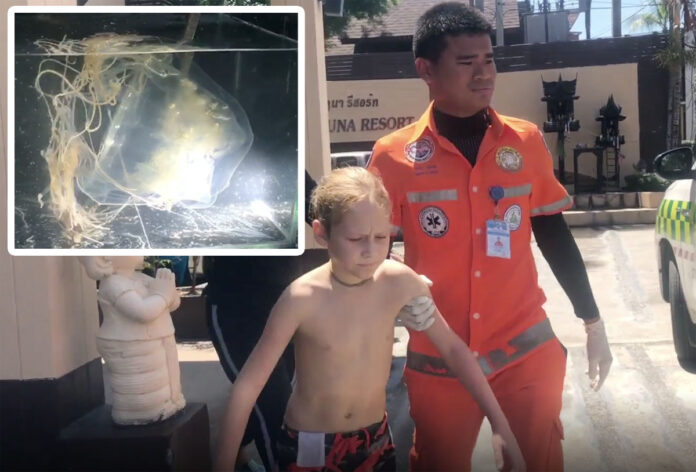
An emergency responder leads a 10-year-old Russian boy stung by a box jellyfish to an ambulance Oct. 30, 2019 on Koh Samui. Insert: the box jellyfish that stung him.
KOH SAMUI — A ten-year-old Russian boy survived an attack from a box jellyfish, a creature known for its fatal toxins, officials said Thursday.
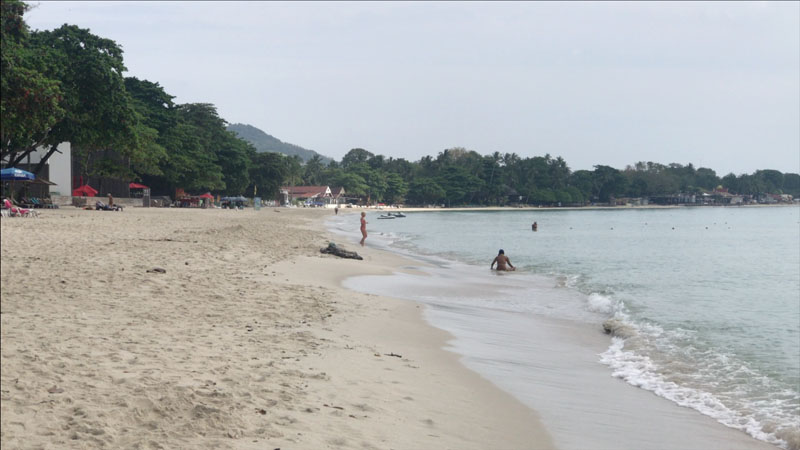
The boy was reportedly stung by a box jellyfish around 8:30am Wednesday while swimming at Lamai Beach. He was then rushed to the hospital by an emergency rescue team, local tourism association official Krissana Pornhomkoh said. As of Thursday, he was released from the hospital, but Krissana warned other tourists to be on the lookout for the creatures.
“Box jellyfish can be found on Koh Samui year-round, but are especially rampant from July through October,” Krissana, Vice President of the Tourism Association of Koh Samui, said Thursday.
An emergency responder commented in a news video during the rescue that fortunately, the box jellyfish’s tentacles that stung the boy were short and small. Several tourists have died from box jellyfish attacks on Thai beaches, including a German visitor in 2015.
Sting marks from the box jellyfish.
The jellyfish’s venom is one of the most deadly in the world, with toxins attacking the heart, nervous system, and skin cells. Its sting is so painful that victims are known to die of shock or heart failure even before reaching the shore.
Eight people have been stung and injured by jellyfish on Koh Samui this year, which Krissana said was slightly less than most years.
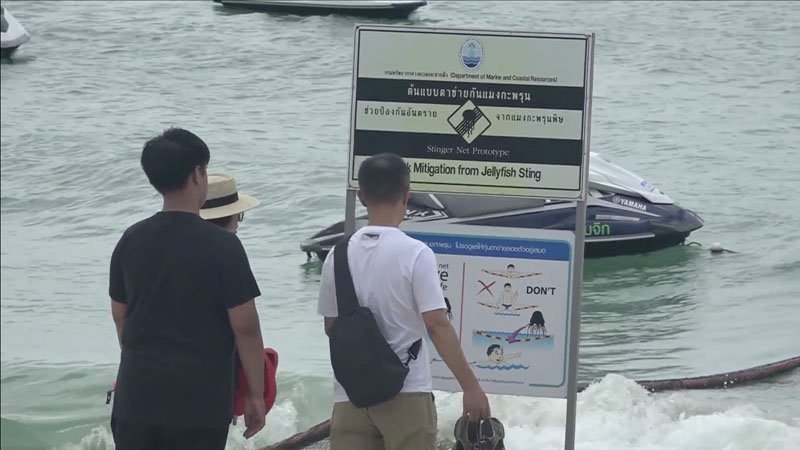
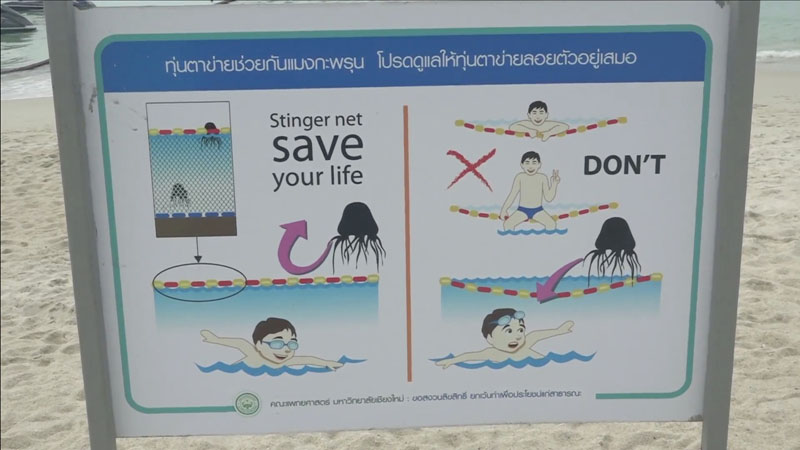
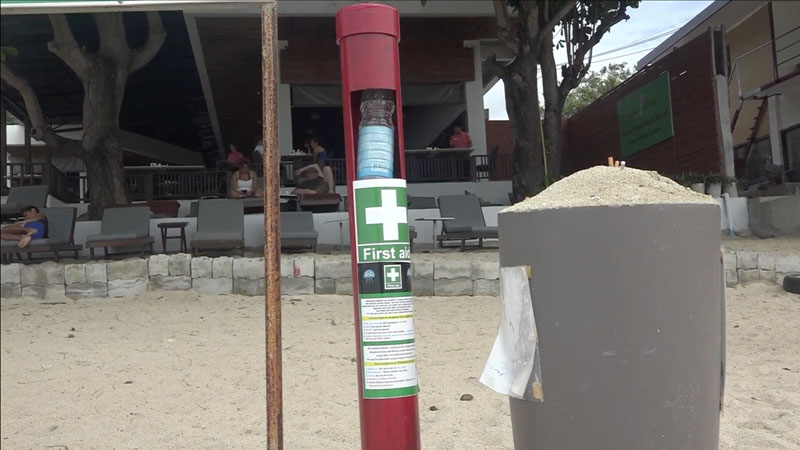
Marine officials and Koh Samui city officials have put up jellyfish nets and put up warning signs along Lamai Beach since July. Poles with vinegar for first aid are also placed at intervals throughout the beach.
If stung by jellyfish, immediately get out of the water and rinse the area with vinegar for at least 30 seconds and remove the tentacles from the skin. Call emergency services. On Koh Samui, dial 1669.
Stills from “Dark Flight” (2012), left, “Pee Mak” (2013), center, “Shutter” (2014). Image: Five Star Production / GMM Tai Hub / GMM Grammy
After killing a girl in a hit-and-run while driving back from a party, Jane and her photographer boyfriend Tun begin to see mysterious white shadows in their photos.
Later on in “Shutter” (2004), it reveals that the spirit is Tun’s ex, Natre. Natre’s shadows in the photos led Jane to a set of films hidden behind a bookcase, where she discoverd what Natre was trying to tell her all along: Tun was involved in a gang rape of Natre that drove her to suicide.
The film wasn’t only a common favorite for many fans of ghost movies (nang phi), it also exemplifies how Thai ghosts change their haunting habits and abodes throughout the ages, while retaining some of the elements that made them so scary for millions of Thais in the first place.
“Shutter is a perfect example of how Thai ghosts can be described, at least in films,” Pilan Poonyaprapha, who teaches film studies at Srinakharinwirot University, said in interviews. “Unlike zombies or demonic entities seen in Western movies, most Thai ghosts don’t haunt people randomly.”
A trailer for “Shutter” (2004), which made about 100 million at the Thai box office.
The film professor and his advisor, Saminee Ratanayongpiroj, spent almost two years watching over 200 Thai horror titles, from black and white classics to modern blockbusters, to sift out the common characteristics of Thai ghosts in silver screen.
They discovered that these ghosts did more than making the audience shiver with spooky goosebumps. They also reflect broader truths in Thai society, serving as a commentary of the very real dangers haunting the society of the living, especially traditionally repressed groups of people like women.
“I think these horror films are trying to show us that humans are scarier than ghosts,” Pilan said. “Many people who become ghosts were oppressed while they were alive. That’s why ghosts explode in their malice, since there are no social or physical limits in the afterlife.”
Spiritual Urbanization
Based on the plethora of films local folk tales, Thai ghosts usually go about their business of haunting at about 2am to 3am. Pilan believes it is because it’s a time when people are drowsy and their spiritual wavelengths are compatible to ghosts.
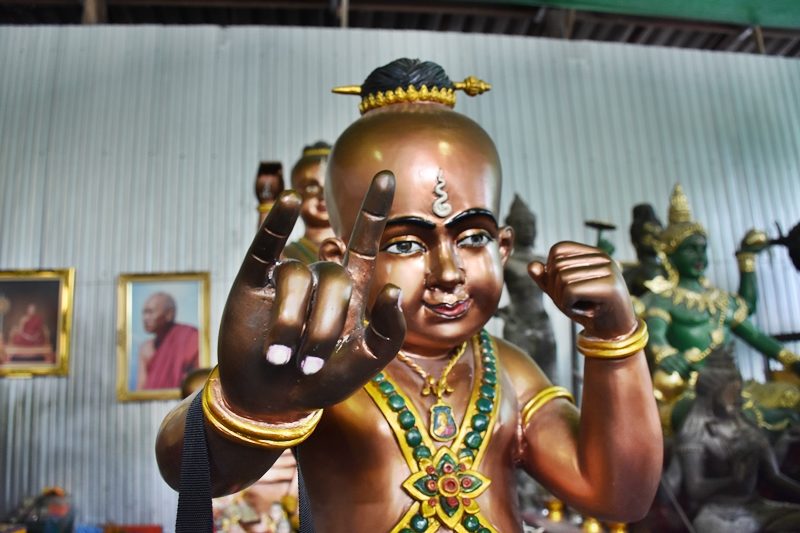
He also noticed that Thai ghosts, especially those depicted as restless souls, are generally in their young adulthood, as they have not lived their entire lifespan. Elder and child ghosts do exist, but they tend to be worshipped as benevolent spirits like san phra phum spirit houses or kuman thong tutelary voodoo boys.
A kuman thong at Wat Sawang Arom in Nakhon Pathom.
“Similar to when they are alive, elder ghosts are respected due to their seniority. People believe that elder souls rest in peace, so they are treated as guardians,” Pilan said. “Child souls normally possess objects because they are too weak to manifest themselves. They are also benign since they are still pure and innocent.”
Traditional ghost stories portray ghosts like krasue (a woman’s head with internal organs hanging down from the neck) and phi pop (flesh-eating ghost) as creatures that roam the countryside and woodlands at night.
But as Thai society moved to urban settings, the spiritual world also found its way into new spaces. In contemporary Thai films, ghosts can be found anywhere, from an airplane cabin to inside text messages (“4Bia”, 2008) – and no longer are they afraid of light.
“Filmmakers have to adapt to the changing way of life. It doesn’t make sense for the main character to run into the middle of graveyard to encounter ghosts anymore,” Pilan said. “However, the main essence of Thai ghosts remain – they are still attached to the places they took their last breath.”
Ghosts move to modern technology like SMS and airplanes in “4Bia” (2008).
Another evolution of Thai ghosts is their anatomy. They appear to show themselves less, as contemporary films tend to depict ghosts as invisible for most of the time. And when they do show up, they would be either in a pale body or some sort of floating, intangible entity.
“You can’t chop off their heads like in Western movies. You can’t touch or see them,” Pilan added.
More Than Just Scares?
Although ghosts have migrated from forests to Bangkokian condos and chat rooms, there’s one constant among the vengeful spirits – they’re almost always women. Just look at “Laddaland” (2011), “Coming Soon” (2008), “Body” (2007), or “The Promise” (2017) for a small example.
This seems to be one of the unbroken links with traditional ghost stories, which also heavily feature female entities, from krasue and Mae Nak to the tree spirits of nang takien and nang tani.
A female ghost on the loose in “Laddaland” (2011).
“Anyone can become a ghost, but it appears that female ghosts are much more common,” Pilan said.
The lecturer said it might be because in a Thai woman’s life, she’s more likely to be oppressed, and therefore to avenge her injustices in the afterlife.
“Souls become ghosts because they are restless. They still have some unfinished business to do or some revenge to commit,” Pilan said. “Thai ghosts are representations of a person’s needs. They’re not there to challenge God or religion.”
Mae Nak was even played by a Western actress, Lisa Farringer, in a 1975 remake “Mae Nak America” aka “The Pot.”
Due to the state of misogyny in Thai society, many ghost films are actually at heart the story of a woman wronged and abused – cheated on, raped, or otherwise suffering in their role as wife or mother, such as the popular story of Mae Nak who died in childbirth while waiting for her husband at war.
“In Shutter, Natre becomes haunted because she committed suicide after being raped. That’s why her soul still hanging around trying to warn Jane,” Pilan said. “Natre also unleashed her rage by killing everyone involved in the gang rape. There her unfinished business is resolved.”
But it’s not only women who suffer. Contemporary films also portray ghosts who used to belong to other marginal groups such as migrant workers (“Ghost Station,” 2007) and queers (“The Victim,” 2006).
The ghostly revenge on people who wronged them also shows the influence of Buddhism, the country’s dominant religion. Sometimes they straight up tell a story of justice served, bad guys meeting bad ending in life, karma style. On other occasions they simply show the audience the suffering female characters had to endure.
“Pee Mak” (2013) is the most successful remake of the legend and Thailand’s highest-grossing film of all time.
However, despite these social and gender undertones, it’s important to bear in mind that Thai ghosts films are usually jump scare-filled love triangles, rather than incisive commentaries on the society we live in.
“Most of them are romantic tragedies, or about a dispute between a small group of people,” Pilan said. “I haven’t seen one that really challenges a broader issue in society yet.”
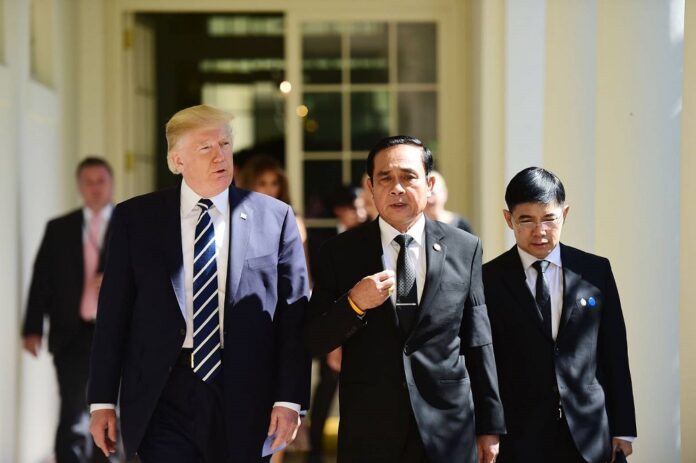
A file photo of US President Donald Trump with Prime Minister Prayuth Chan-ocha at the White House.
BANGKOK (AP) — U.S. national security adviser Robert C. O’Brien and Commerce Secretary Wilbur Ross will represent President Donald Trump at two regional summits in Thailand this weekend, the White House announced, a move that will widely be viewed in the region as a snub.
The decision to send O’Brien, who is a presidential adviser and not a member of Trump’s Cabinet, is likely to be viewed in Southeast Asia as sign of a lack of engagement in the region at a time when China’s influence and investments are quickly growing.
The announcement late Tuesday comes just days before Thailand is to host the 10-nation Association of Southeast Asian Nations annual summit and the accompanying East Asia summit. The summits include sideline meetings that involve the U.S. and other major countries, including China, Russia, Japan and South Korea.
O’Brien recently took on his role after national security adviser John Bolton was ousted by Trump. He earlier was Trump’s chief hostage negotiator and is an established figure in Republican Party circles.
Ross is leading a Nov. 3-8 trade delegation to Bangkok and is to speak at an Indo-Pacific Business Forum on Monday.
Last year, Vice President Mike Pence attended the meetings in place of Trump. Trump attended the summits in 2017 and President Barack Obama attended most of the summits during his time in office, though he sent Secretary of State John Kerry to the 2013 summit in Brunei.
Secretary of State Mike Pompeo did attend a meeting of ASEAN foreign ministers in Bangkok in August. At the time he spoke of how U.S. interests converge with those of countries in the “Indo-Pacific” — the regional concept Washington has promoted in recent years to counter China’s rising profile and its “Belt and Road” infrastructure initiative.
Although Trump attended the 2017 meeting in Manila, he left early and skipped the East Asian Summit, noted veteran Thai political commentator Kavi Chongkittavorn.
In a recent wryly worded piece in the English-language newspaper Bangkok Post, he noted that Trump’s attendance would have been a welcome validation of ASEAN’s importance.
Host Thailand has little choice but to make the best of the situation.
A Thai spokesman said Wednesday that the designation of a “special envoy” showed the U.S. was attaching importance to the meetings.
“The presence of the U.S. in these meetings will surely contribute constructively to these ASEAN-U.S. meetings,” Busadee Santipataks, director-general of the Foreign Ministry’s Department of Information, said in an interview with The Associated Press.
China’s representative to the meetings in Nonthaburi, near Bangkok, will be its premier, Li Keqiang. Japanese Prime Minister Shinzo Abe and other heads of government also are attending.
Trump is expected to attend a Pacific Rim summit of the Asia-Pacific Economic Cooperation forum in Chile next month.
ASEAN’s meetings focus on enhanced trade and security in a region of more than 630 million people. The grouping consists of Brunei, Cambodia, Indonesia, Laos, Malaysia, Myanmar, the Philippines, Singapore, Thailand and Vietnam.
The Thai government has been ramping up security in advance of the summits and warning of road closures. Bangkok residents will get two days of “special holidays” to help alleviate traffic congestion for the summits, which are being held in a neighboring suburb.
Earlier, Thailand announced Trump had accepted an invitation to visit the country. That had raised hopes he might attend the ASEAN meetings.
Regional trade ministers were hoping to make progress toward completing a long-awaited free trade agreement at the meetings. But officials are still working out technical details and rules on market access, competition and investment for the planned Regional Comprehensive Economic Partnership.
The countries negotiating the pact include ASEAN and six of its dialogue partners: China, Japan, South Korea, Australia, New Zealand and India. It does not include the U.S.
If all join, it will be one of the biggest regional trading blocs, covering some 45% of the world’s population and about a third of global GDP, with projected trade of more than $10.3 trillion, almost 30% of the world total.
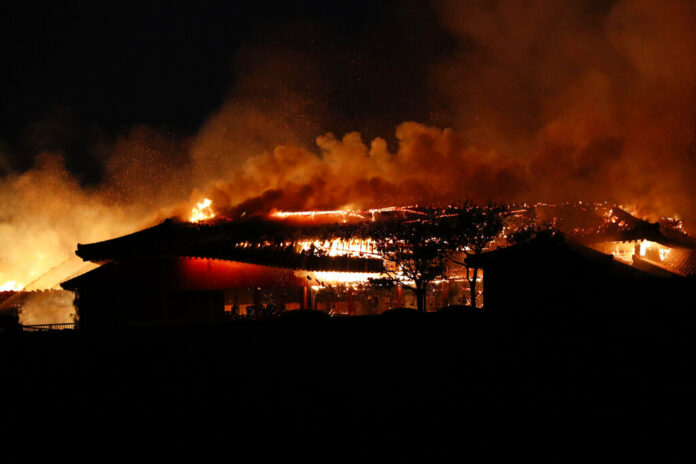
Smoke and flames rise from burning Shuri Castle in Naha, Okinawa, southern Japan, Thursday, Oct. 31, 2019. A fire broke out at the historic Shuri Castle on Japan’s southern island of Okinawa, nearly destroying it. Photo: Jun Hirata / Kyodo News via AP
TOKYO (AP) — A fire early Thursday burned down structures at Shuri Castle on Japan’s southern island of Okinawa, nearly destroying the UNESCO World Heritage site.
Firefighters were still battling the blaze a few hours after the fire started early Thursday and nearby residents were evacuated to safer areas, Okinawa police spokesman Ryo Kochi said.
The fire in Naha, the prefectural capital of Okinawa, started from the castle’s main structure. The main Seiden temple and a Hokuden structure, or north temple, have burned down. A third main structure Nanden, or south temple, was nearly destroyed, Kochi said.
Nobody has been injured. The cause of the fire was not immediately known.
Footage on NHK television showed parts of the castle, engulfed in orange flames and turning into charred skeleton, collapsing to the ground.
“I feel as if we have lost our symbol,” said Naha mayor Mikiko Shiroma, who led an emergency response team. “I’m shocked.” Shiroma vowed to do everything she could to save what is remained of the castle.
Kurayoshi Takara, a historian at Univerisity of the Ryukyus who helped reconstruct the Shuri Castle, said he was speechless when he saw the scene. He told NHK that the castle reconstruction was a symbolic event for the Okinawans to restore their history and Ryukyu heritage lost during the war.
“I still can’t accept this as a reality,” Takara said. “It has taken more than 30 years and it was a monument of wisdom and effort of many people. Shuri Castle is not just about buildings but it reconstructed all the details, even including equipment inside.”
The ancient castle is a symbol of Okinawa’s cultural heritage from the time of Ryukyu Kingdom that spanned about 450 years from 1429 until 1879 when the island was annexed by Japan.
The castle is also a symbol of Okinawa’s struggle and effort to recover from World War II. Shuri Castle burned down in 1945 during the Battle of Okinawa near the war’s end, in which about 200,000 lives were lost on the island, many of them civilians.
The castle was largely restored in 1992 as a national park and was designated as the UNESCO World Heritage site in 2000.
Okinawa was under the U.S. occupation until 1972, two decades after the rest of Japan regained full independence.
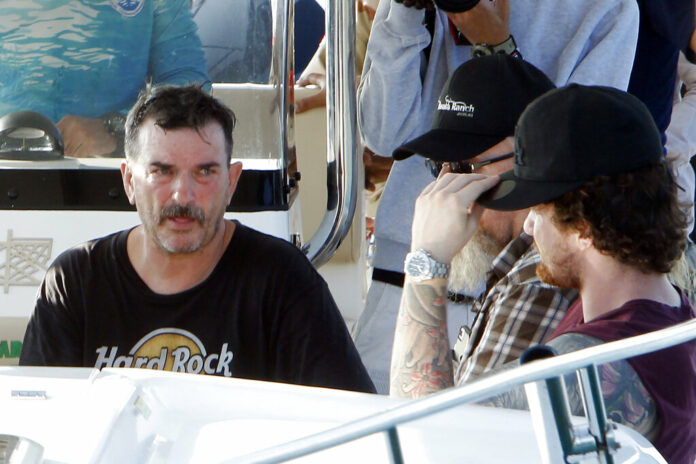
British national Phil Bambridge, left, father of missing backpacker Amelia Bambridge, sits on a speedboat as he talks with his family members as they continue the search on Koh Rong island off southwestern Cambodia, Wednesday, Oct. 30, 2019. Around 150 people are taking part in the search for Bambridge who has not been seen since last Wednesday night when she attended a beach party on Koh Rong island in southwestern Cambodia joined by tourists of various nationalities. Photo: Heng Sinith / AP
KOH RONG, Cambodia (AP) — The brother of a British woman who disappeared after attending a late-night beach party on a Cambodian island said Wednesday her family is planning to hire a private team of professional searchers to comb the jungle for her.
Harry Bambridge, the brother of 21-year-old backpacker Amelia Bambridge, said he “absolutely” believes there is a chance his sister is still alive. She was last seen Oct. 23 on the island of Koh Rong off the coast of southwestern Cambodia.
The brother is one of at least three family members who have come to the island to join the land and sea search.
The police chief for the Cambodian province said earlier Wednesday that he fears she has drowned, but that searches for her will continue. The provincial governor has vowed to search until the case is resolved.
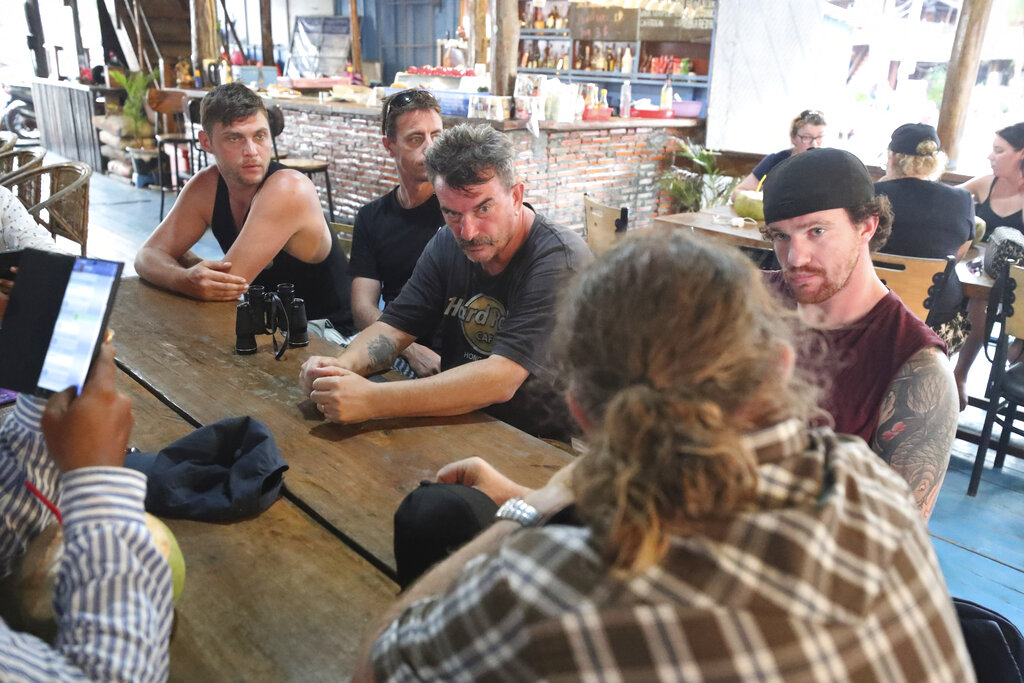
British national Phil Bambridge, center, the father of missing backpacker Amelia Bambridge, sits with his family during a meeting with the governor of Koh Rong City Noun Bunthol, unseen, after a day of searching off Koh Rong island in southwestern Cambodia, Wednesday, Oct. 30, 2019. Photo: Heng Sinith / AP
Harry Bambridge told reporters that his family wants to conduct more searches inland, which has thick jungle.
“We had use of a dog today which proved beneficial and gave us some more hope,” he said. “And also, we are looking to hire a private jungle search team.”
Koh Rong, about 25 kilometers (15 miles) offshore, covers an area of about 78 square kilometers (30 square miles).
Bambridge said his family finds the lack of information about where Amelia went “suspect.”
“You know, it’s a party. It’s not that busy. There’s plenty of staff there. One minute she’s there and next she’s gone. And no one seems to know right now,” Bambridge said. He said he believes there is a chance she was abducted, a possibility his father raised earlier.
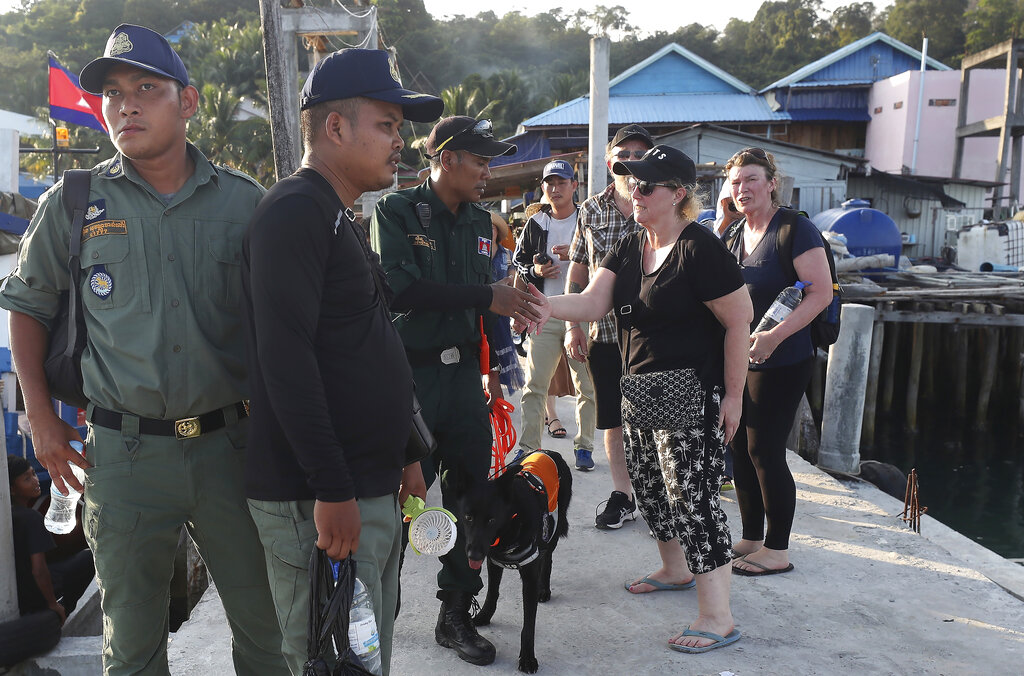
Family members of missing British backpacker Amelia Bambridge, right, shake hands with provincial police officers on a pier on Koh Rong island off southwestern Cambodia, Wednesday, Oct. 30, 2019. Photo: Heng Sinith / AP
“I totally believe that someone knows what’s happened to her. And, you know, it’s just a matter of finding some information that’s going to tell us more about what’s happened.”
Preah Sihanouk provincial police chief Maj. Gen. Chuon Narin said he couldn’t rule out the possibility of murder, but that he doubted it because the island had not experienced any murder or robbery cases. He speculated that she might have drowned, but said the authorities would reach a final conclusion only when the search was competed.
“From my first preliminary conclusion she may have drowned in the sea because we have found her belongings on a rock very close to the edge of the sea,” he said. Her bag with money and a cellphone was found there, and her passport was found in the hostel room where she had been staying.
Bambridge conceded that his sister could have been lost at sea.
“We know there are strong currents here,” he said. “I ask this to Thailand, all the neighboring countries, to all the fishermen, to please if they stumble across a body … let us know.”
Police chief Chuon Narin said six people called in for questioning by police over the previous few days were released Tuesday evening without any charges filed against them. Officials said they were questioned because of a complaint by Western visitors that they had acted badly toward female tourists.
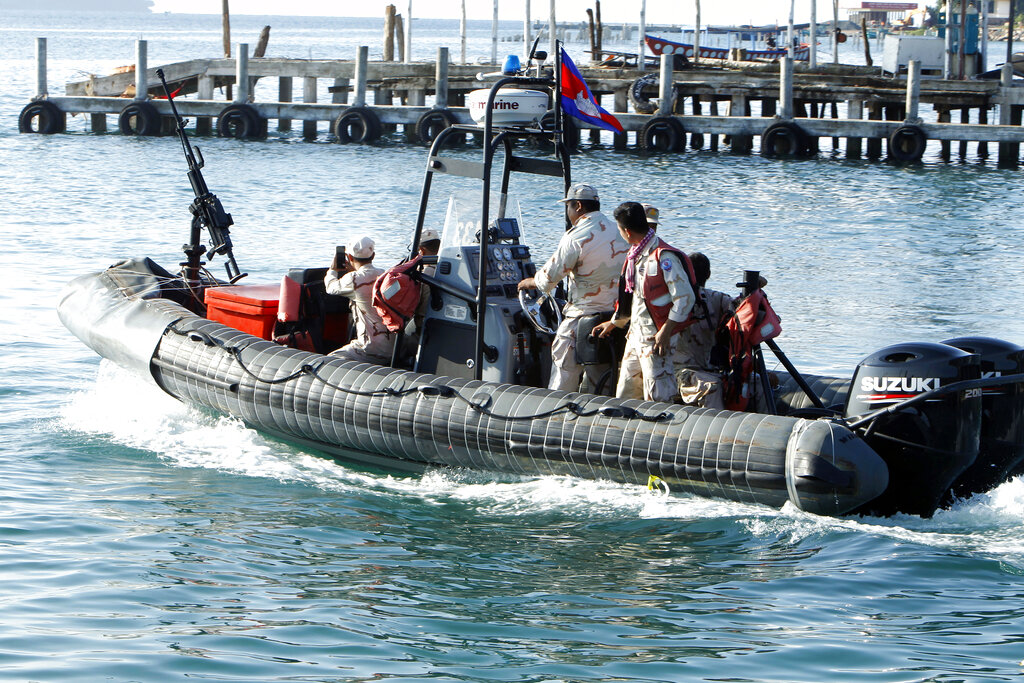
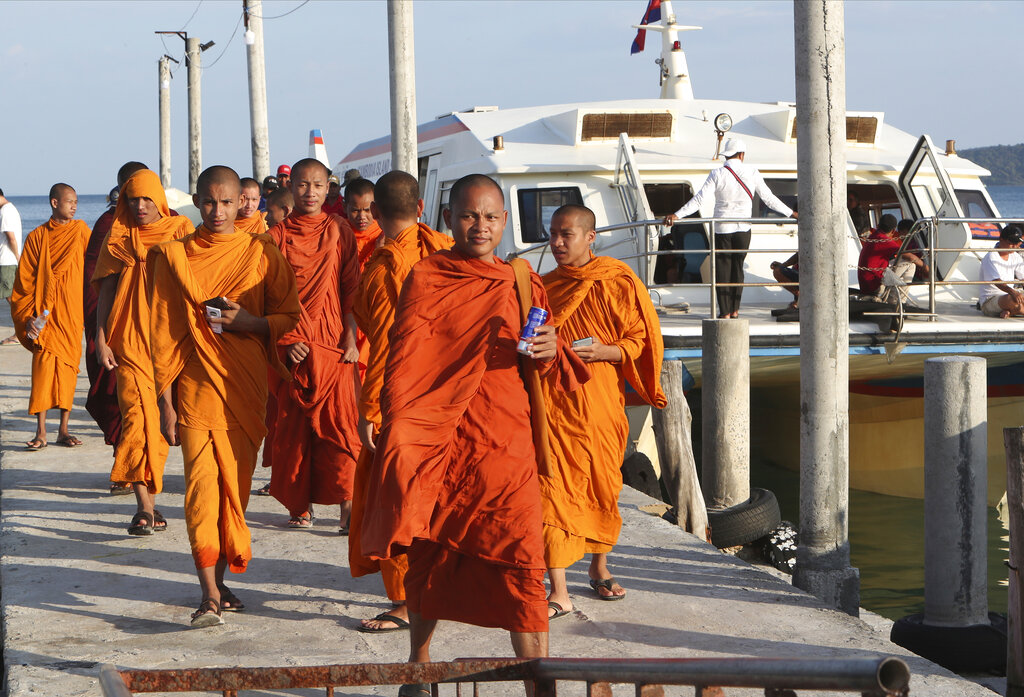
A navy patrol boat heads out to continue the search for missing British backpacker Amelia Bambridge on Koh Rong island off southwestern Cambodia, Wednesday, Oct. 30, 2019. Photo: Heng Sinith / APHarry Bambridge, right, brother of missing British backpacker Amelia Bambridge, sits on a speedboat before leaving to search for her with Cambodian provincial authority at Koh Rong island off southwestern Cambodia, Wednesday, Oct. 30, 2019. Photo: Heng Sinith / APBuddhist monks visit a pier of Koh Rong island where British backpacker Amelia Bambridge went missing off southwestern Cambodia, Wednesday, Oct. 30, 2019. Photo: Heng Sinith / AP
___
Story: Sinith Heng. Associated Press writer Sopheng Cheang in Phnom Penh, Cambodia, contributed to this report.
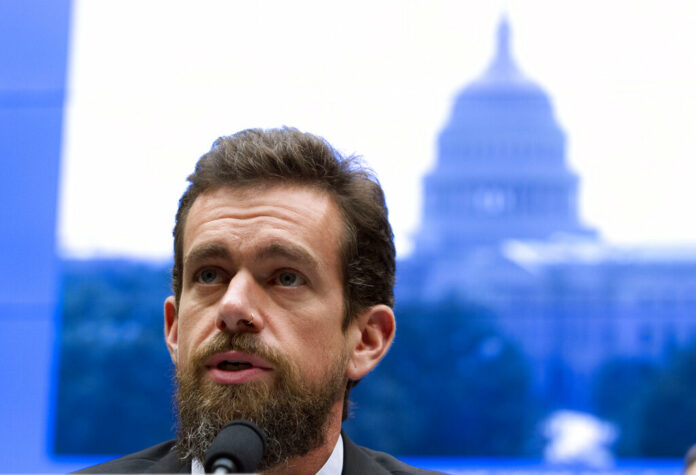
In this Sept. 5, 2018, file photo Twitter CEO Jack Dorsey testifies before the House Energy and Commerce Committee in Washington. "While internet advertising is incredibly powerful and very effective for commercial advertisers, that power brings significant risks to politics, where it can be used to influence votes to affect the lives of millions," Dorsey said Wednesday, Oct. 30, 2019, in a series of tweets announcing Twitters new policy of banning all political advertising from its service. Photo: Jose Luis Magana / AP
SAN FRANCISCO (AP) — Twitter, reacting to growing concern about misinformation spread on social media, is banning all political advertising from its service. Its move strikes a sharp contrast with Facebook, which continues to defend running paid political ads, even false ones, as a free speech priority.
“While internet advertising is incredibly powerful and very effective for commercial advertisers, that power brings significant risks to politics, where it can be used to influence votes to affect the lives of millions,” Twitter CEO Jack Dorsey said Wednesday in aseries of tweets announcing the new policy.
Facebook has taken fire since it reiterated in September that it will not fact-check ads by politicians or their campaigns, which could allow them to lie freely. CEO Mark Zuckerberg told Congress in October that politicians have the right to free speech on Facebook.
Zuckerberg wasted no time responding to Twitter’s move. During Facebook’s conference call for earnings, which began less than an hour after Dorsey’s tweet, the Facebook chief offered an impassioned monologue about what he called his company’s deep belief “that political speech is important.”
Zuckerberg stood by the company’s decision to run unchecked political ads and denied that the choice is financially motivated, saying such ads make up less than half of a percent of Facebook revenue.
Facebook’s recent $5 billion fine from the Federal Trade Commission for privacy violations was more than 10 times what it makes from political ads, he said.
“This is complex stuff. Anyone who says the answer is simple hasn’t thought about the nuances and downstream challenges,” he said. “I don’t think anyone can say that we are not doing what we believe or we haven’t thought hard about these issues.”
Google did not have an immediate comment on Twitter’s policy change.
Trump’s campaign manager called Twitter’s change a “very dumb decision” in a statement Wednesday.
“This is yet another attempt to silence conservatives, since Twitter knows President Trump has the most sophisticated online program ever,” campaign manager Brad Parscale said.
The presidential campaign for former Vice President Joe Biden said it was “unfortunate” that companies would think the only option was to completely ban political ads.
“When faced with a choice between ad dollars and the integrity of our democracy, it is encouraging that, for once, revenue did not win out,” Bill Russo, the deputy communications director for Biden’s campaign said in a statement.
Political advertising makes up a small sliver of Twitter’s overall revenue. The company does not break out specific figures each quarter, but said political ad spending for the 2018 midterm election was less than $3 million. It reported $824 million in third-quarter revenue.
Candidates spend significantly more purchasing ads on Facebook than on Twitter, company records show.
The issue suddenly arose in September when Twitter, along with Facebook and Google, refused to remove a misleading video ad from President Donald Trump’s campaign that targeted Biden.
In response, Democratic Sen. Elizabeth Warren, another presidential hopeful, ran her own ad on Facebook taking aim at Zuckerberg. The ad falsely claimed that Zuckerberg endorsed President Donald Trump for re-election, acknowledging the deliberate falsehood as necessary to make a point.
Critics have called on Facebook to ban all political ads. These include CNN chief Jeff Zucker, who recently called the company’s policy of allowing lies “absolutely ludicrous” and advised the social media giant to sit out the 2020 election until it can figure out something better.
Misleading political ads on social media played a major role in Russian disinformation efforts during the 2016 presidential election.
Dorsey said the company is recognizing that advertising on social media offers an unfair level of targeting compared to other mediums. It is not about free expression, he asserted.
“This is about paying for reach. And paying to increase the reach of political speech has significant ramifications that today’s democratic infrastructure may not be prepared to handle,” he tweeted. “It’s worth stepping back in order to address.”
Twitter currently only allows certified campaigns and organizations to run political ads for candidates and issues. The latter tend to advocate on broader issues such as climate change, abortion rights and immigration.
The company said it will make some exceptions, such as allowing ads that encourage voter turnout. It will describe those in a detailed policy it plans to release on Nov. 15.
It will also still allow politicians to freely tweet their thoughts and opinions, which can then be shared and spread. Trump’s Twitter feed in particular is known for his often bombastic and controversial tweets that are shared widely.
Matt Shupe, a Republican political strategist whose public relations firm has won awards for its use of ads on Facebook, called Twitter’s decision “incredibly dumb.” He said there’s no reason to eliminate all political advertising just to stop the relatively small number of bogus or misleading ads.
“You can’t abolish television advertising because cigarette makers bought ads once,” he said.
The decision will hurt political challengers the most, Shupe said, as they don’t have the name recognition or wide reach of incumbents and need ads to get their message out.
“If you’re a challenger, advertising allows you to make up that difference,” he said. “It’s very hard to organically grow an audience for a state assemblyman campaign.”
Ethan Porter, a professor of media and public affairs at George Washington University, echoed the concerns and called Twitter’s decision disappointing. He said it will deprive voters of one way to learn about those standing for election.
“That loss of information about candidates in an election — I don’t think that should be taken lightly,” he said. “Voters should know who the candidates in an election are and twitter is an important platform.”
Twitter said in June that political figures and world leaders who tweet abusive or threatening messages might get slapped with a warning label, but the tweets would remain on the site. Twitter has not yet used this warning label.
Federal campaigns are expected to spend the majority of advertising dollars on broadcast and cable channels during the 2020 election, according to advertising research firm Kantar, and about 20% of the total $6 billion in spending on digital ads.
Twitter’s policy will start on Nov. 22.
___
Story: Rachel Lerman and Barbara Ortutay. AP reporters David Klepper in Providence, Rhode Island, Amanda Seitz in Chicago, Will Weissert in Washington, Mae Anderson in Atlanta and Tali Arbel in New York contributed to this article.
Charoen Pokphand Foods PCL (CP Foods) commits all fishmeal use for entire group are made from legal practices and traceable sources.
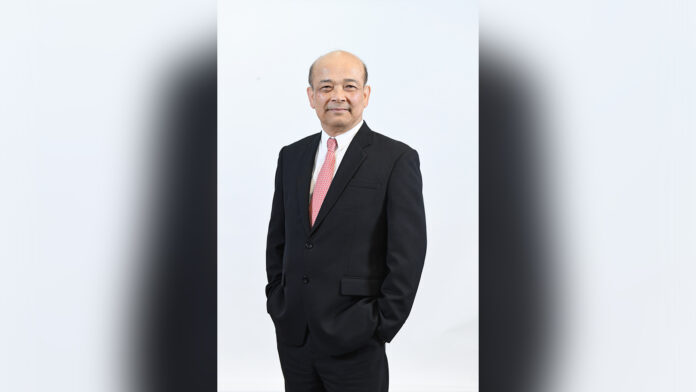
Dr. Sujint Thammasart, DVM, Chief Operating Officer – Aquaculture Business of CP Foods, said all CP Foods’ seafood operations both in Thailand and the overseas investment have integrated UN Sustainable Development Goals (SDGs) into their businesses with social responsibility, environmental footprint and traceability throughout supply chain.
In response to consumer demand for sustainable products, CP Foods has proceeded the Fisheries Improvement Projects or FIPs, which drawn to promote sustainable fisheries and to protect marine resources throughout international and Thai maritime.
Currently, the company has also established CP Food Fishmeal Sourcing Restrictions to guide its aquaculture operations in Thailand and extending to overseas operations. It aimed to ensure that they are all working under a single standard for sustainable sourcing of marine ingredients.
Under the restrictions, CP Foods commits to use by-product fishmeal that is traceable and sourced from processing plants certified by Global Standard for Responsible Supply (IFFO RS), which is consistent with the Code of Conduct for Responsible Fisheries of the Food and Agriculture Organization of the United Nations (FAO).
For by-catch fishmeal, CP Foods commits to source the ingredients from fisheries which have been certified according to international standards or legally examined by various parties that include officials and representatives of the Department of Fisheries, concerned operators, academics and consumers.
At present, 100% of fishmeal sourced and used for Thailand operations has been from by-product of fish processing plants and certified by the IFFO RS.
For our oversea operations, CP Foods in India has collaborated with fishery societies, seafood companies and India’s government to establish the country’s first-ever FIP accepted onto the IFFO RS Improver Programme (IFFO RS IP), which is now ready for implementation. The developed fisheries action plan will push for more assessment of marine stocks in the west coast of India in an effort to prevent overfishing. Under the programme, the company will arrange training courses for partners in the supply chain, including fishmeal producers and fishermen, to guide them through sustainable practices.
For Vietnam’s operation since 2017, CP Vietnam Corporation (CPV) is driving a pilot program for Fishery Improvement Project (FIP) in Baria-Vung Tau province, Vietnam, together with fishmeal processors and feedmill producers in the area. Collaboration with IFFO RS, this pilot program will be an important input to the development of assessment criteria for mixed trawl fisheries, which are unique in the South East Asian region and challenging to manage. Currently, it is in process of drafting a Fishery Action Plan (FAP) and expect to submit the plan to IFFO RS in early of 2020.
Dr. Sujint added that the company operations both in India and Vietnam FIPs practices are the prototype model. To achieve maximum sustainable development, the model need to be expanded its scope to other coastal areas across the countries. Therefore, it requires all sectors in seafood supply chains to join hands and push forward the FIPs together, creating a significant change throughout the seafood supply chain.
“It is important to note that CP Foods is a buyer of fishmeal and producer of farmed shrimp as well as shrimp feed; we have never been an operator nor owner of any fishing vessel, and we do not produce fishmeal. However, CP Foods has a clear policy to make all of its operations worldwide to operate in accordance to international standards in an effort to prevent IUU and promote sustainable supply chain,” he added.
CP Foods also collaborates with Seafood Task Force in Thailand and international organizations such as Seafood Business for Ocean Stewardship (SeaBOS) to crack down illegal fishing as well as providing human rights protection for the fishermen.