Bangkok, Thailand, 31 July 2019 – Fill the love and joy into the heart of your beloved mom this coming Mother’s Day 2019 with special Mother’s Day Promotion at Bangkok Marriott Marquis Queen’s Park. Indulge in a luxe Mother’s Day brunch at Goji Kitchen + Bar, enjoy a month-long of special bird nest menu at Pagoda Chinese Restaurant or pamper your mom with a signature treatment at Quan Spa with 50% off. There’s no better way to say, “I Love You”, to mom!
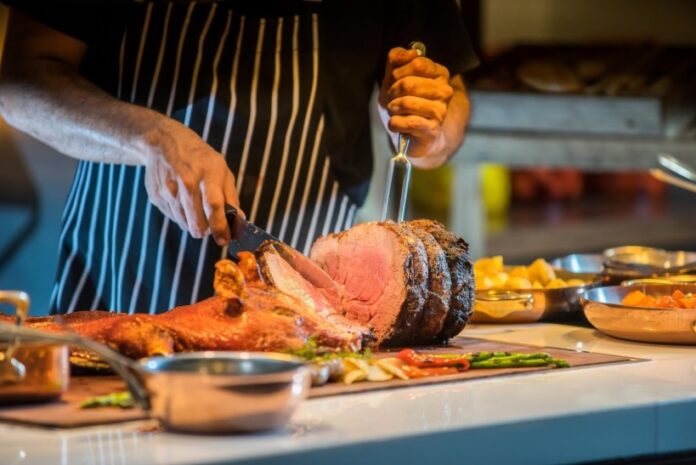
Bangkok Marriott Marquis Queen’s Park, Bangkok’s largest luxury hotel, celebrates the grace of mothers, the center and the heart of every family, with special promotions to be gifted to moms by any members of the family. On August 12, 2019, Goji Kitchen + Bar, a buffet restaurant with contemporary flair and theatrical open kitchen, serves up special brunch from 12:00 to 14.30hrs. and includes highlights such as succulent Maine lobsters, Alaskan king crabs, premium beef cuts and so much more, plus a photo magnet of you and mom to take home as souvenir. The buffer price is THB 2,298++ per person.
The contemporary Cantonese restaurant, Pagoda Chinese Restaurant, also has special treats for moms. Finely selected premium bird nest is transformed into 3 delectable dishes, starting from the healthy and delicious braised bird nest in double boiled chicken broth, scrambled bird nest and egg white with oscietra caviar that is low in cholesterol and, lastly, bird nest egg white custard steamed in coconut. The three special menus are available for both lunch and dinner from August 1-31, 2019 at THB 1,800++ per dish.
Treat the mind to restore balance and peacefulness at Quan Spa, a sanctuary with modernized ancient healing wisdom that aims to cleanse and purify the mind, boost blood circulation, relax and at the same time rejuvenate the body and mind. The spa offers Mommy & Me package that offers 50% discount for moms when booking at least 60-minute or longer treatments for two. The package is available from August 1-31, 2019.
Show mom your love and fill the family with warm and joy on this Mother’s Day with Mother’s Day Promotion at Bangkok Marriott Marquis Queen’s Park from August 1-31, 2019. For more information and reservations, please call +66 (0) 2 059 5999 or email [email protected]. Or to book a treatment at Quan Spa, please call +66 (0) 2 059 5555 or email [email protected].
Bangkok, Thailand, 6 August, 2019 – Bangkok Marriott Marquis Queen’s Park teams up with Korean Food Promotion Institute to offer sensational culinary experiences with “The Taste of Korea” where chefs from Seoul are jetted to cook up authentic Korean sweet and savory dishes of various styles from prime quality ingredients to add more variety to the international buffet at Goji Kitchen + Bar at dinner and Sunday brunch between August 14-25, 2019 only.
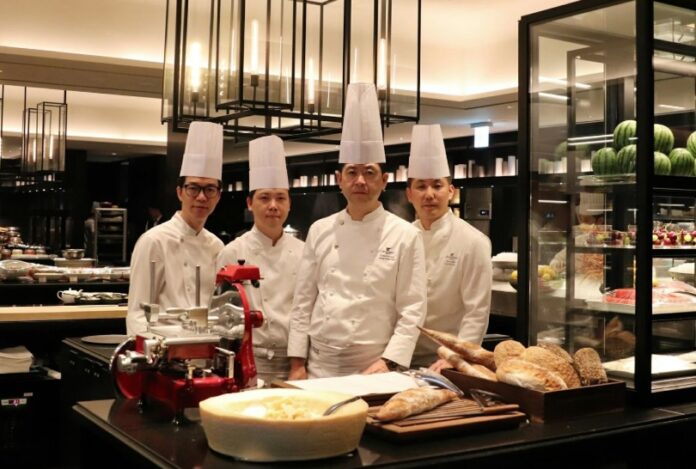
Goji Kitchen + Bar, the buffet restaurant with contemporary flair at Bangkok Marriott Marquis Queen’s Park, Bangkok’s largest luxury hotel, is a culinary destination of delectable dishes meticulously prepared with prime quality ingredients. The Taste of Korea is the latest offering by the restaurant, in association with Korean Food Promotion Institute, where chefs from JW Marriott in Seoul are flown in to cook up authentic dishes at the restaurant open kitchen, making for sensational dining and theatrical experiences.
Highlight menus include grilled short rib patties, BBQ spicy pork belly and chicken leg with soy sauce. If you like the sensation of braised dishes, don’t miss roasted pork belly red chili paste sauce. As for seafood, the chefs cook up stir-fried seafood as well as Korean pancake with seafood for your selection. Also recommended are two varieties of piping hot soups: abalone porridge and kimchi stew, while meat lovers are treated to the succulent beef tartare. End the perfect meal with authentic Korean sweets that include sweet jelly red beans and Korean traditional sweet cookie.
Korean special dishes will be served as part of the international buffet, offered at regular prices for dinner from Sunday to Thursday at THB 1,498++ per person, Friday and Saturday at THB 2,128++ per person and Sunday brunch at THB 2,128++ per person.
Indulge in the authentic flavors of Korea at “The Taste of Korea” at Goji Kitchen + Bar at Bangkok Marriott Marquis Queen’s Park from 14 to 25 August 2019.
For more information and reservation, please contact +66 (0) 2 059 5999 or email [email protected].
BANGKOK — Prime Minister Prayuth Chan-ocha said on Monday the government was not involved in an assault on a dissident exiled in Japan last month.
Gen. Prayuth said he sympathized with monarchy critic Pavin Chachavalpongpun, who says a masked man broke into his home and sprayed him with unknown chemicals on July 8. The General added that he was not behind the incident.
“I sympathize with him, but he was assaulted in Japan,” Gen. Prayuth said at a news conference. “If you are accusing the government of sending someone to do it, who would dare do that? The government didn’t do it, and we would never do so.”
Prayuth was responding to a reporter’s question concerning Pavin’s claim that he was sprayed with a chemical while sleeping in his residence that left him with a burning sensation.
In media interviews, the 48-year-old academic said the unidentified man broke into his bedroom in the early hours, pulled off the blanket, and attacked him with the spray before running away. Pavin said he reported the incident to Japanese police.
“They seemed to understand the context. My context,” Pavin recalled the incident at a recent lecture in Washington DC. “They seemed to suggest that this could have been linked to a conflict in Thailand.”
He added, “Since this happened, I was told not to return to the apartment, so I have to be put in a safehouse.”
Pavin, who teaches at Kyoto University, regularly lashes out at the Royal Family on his Facebook. He was among hundreds of people summoned by the military after the 2014 coup for “attitude adjustment,” which he refused to attend. The academic has chosen to live in self-imposed exile in Japan, where he has stepped up his harsh criticism of the monarchy.
In April 2017, the government issued an order banning communication with Pavin and two other monarchy critics living overseas, though their social media accounts still enjoy large followings.
In today’s news conference, Prayuth hinted that Japan should reconsider housing Pavin.
“Each [government] has a promise not to let someone who attacked another country live in their country,” Prayuth said. “Just like us, we try to make sure we don’t let people who attack other countries live in our country.”
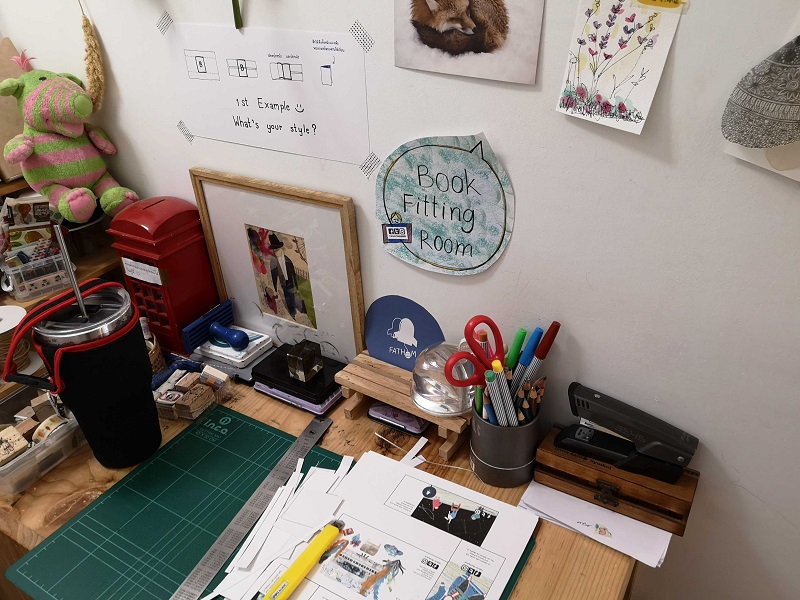
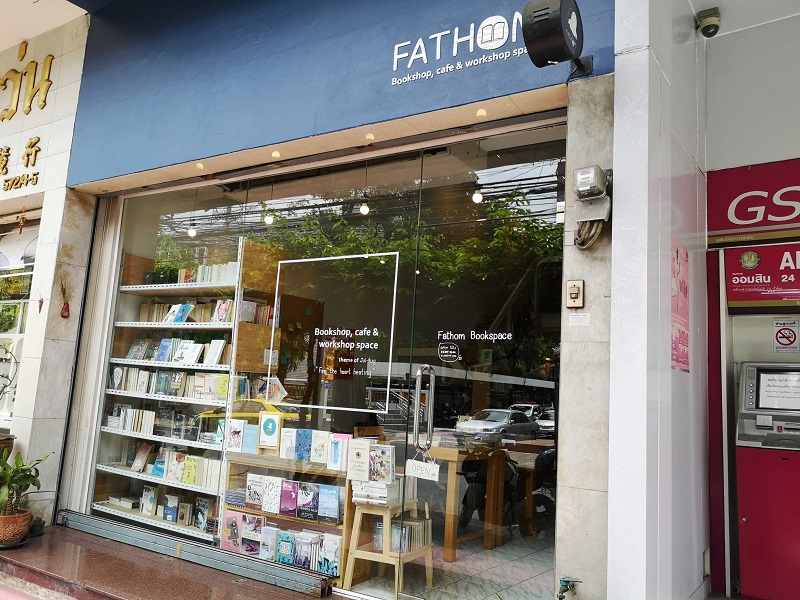
BANGKOK — Fathom Bookspace offers not only books, but a space for people to meet and get to know one another.
“It’s a place where people can share. Online, people can lash out at anyone on a whim. But once we see one another’s faces, we don’t need to agree, even though there’s a difference,” said Khanittha Thammapunya, 35, the co-owner.
The space in Sathon holds weekly workshops on various topics, covering everything from art appreciation, to yoga, and even speed dating. Khanittha insists the format of the workshops are casual and fluid, without a leading “expert” speaker so that people can feel comfortable expressing their thoughts.
“This is a place where people can just air out anything uncomfortable they’re feeling inside. It’s a safe place to share,” the co-founder explained.
She hopes the space can offer middle ground for people to come together not only on deeply divisive issues of Thai politics, but other topics too.
“It’s not just about politics but issues like environmental management and communities,” added Pattaraanong Sireepipat, 31, the other co-owner on Tuesday.
She recalled a memory where a customer learned the Thai word for “marginalized” (khon chai khob) for the first time at the bookspace.
“I think it’s easier to seek knowledge today [with the internet] but it’s more difficult for people to feel. Meeting new people creates new sensations,” said Khanittha.
“The online [world] is very useful but sometimes we need a physical world,” Pattaraanong added.
Pattaraanong readily admits that income from book sales alone isn’t enough to cover the bookspace’s activities. Over the past three years, the shop has sought additional income from side-projects, such as an initiative to promote reading among school children with the Rotary Club.
On one wall of the two-storey shophouse, there’s a space for people to stick post-its describing a moment that made their heart beat fast in 2019: “Meeting my favorite male model and he remembered me,” “Winning the lottery for the first time in 30 years,” “When my mom fell in the bathroom (she is 90).”
The selection of books at the shop reflect the owners’ philosophy of learning. “How to” books common and popular at Thai chain bookstores are nowhere to be found. The pair say such books are dogmatic.
“I don’t like books which are judgmental or force us to do something. If you want to be rich, you must follow these steps. Or if you want to be a good person, you must be like this. People’s lives belong to each individual,” said Pattaraanong.
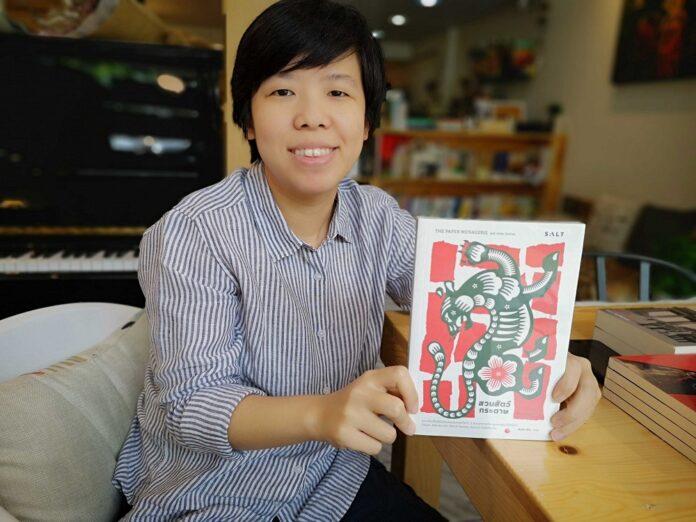
Pattaraanong recommends Ken Liu’s collected short stories “The Paper Menagerie” for a good mix of sci-fi, historical-fiction and realism. The shop carries the Thai translation, which she says is fun to read.
Members at Fathom get a 10 percent discount and can borrow from the owners’ personal book collection upstairs. The shop features several translated works from Western authors and a small selection of English-language books.
Fathom Bookspace is a five-minute motorcycle ride into Soi Suan Plu from MRT Lumphini or even BTS Chong Nonsi. It’s open from 10am to 8.30pm every day, except Wednesday.
Victoria's Secret Angels at the Victoria's Secret Fashion Show 2017 in Shanghai. Photo: Andy Wong / AP
For better or worse, the Victoria’s Secret Angels won’t be strutting down the runway in pink lingerie this year. Throughout the 2000s, Thais tuned in to the annual Victoria’s Secret Fashion Show – many casually viewing the spectacle, others dissatisfied with their own bodies.
“The show definitely triggered my eating disorder. It was one of the main triggers actually,” said Worada Elstow, a model.
Worada, 27, previously opened up to Khaosod English about how suffering from both anorexia and bulimia wracked her university years. On a good day, she would have a meal of vegetables while on others, just black coffee and a cigarette. She would scour pro-ana, or pro-anorexia, content online for inspiration – including Victoria’s Secret models on the runway.
Worada isn’t alone. While the Victoria’s Secret Fashion Show has been roundly criticized and debated in Western media for its promotion of unattainable beauty ideals, Khaosod English spoke to a number of Thai models who argue the spectacle’s effects reach internationally.
In the US, Victoria’s Secret will shut down 53 stores this year alone. But overseas stores have been expanding, jumping from about 1,000 total stores in 2010 to 1,637 in 2019. Thailand has two lingerie stores, one in CentralWorld and another in Iconsiam, and 17 branches selling Victoria’s Secret beauty products.
Meanwhile eating disorders, especially among urban Thai women, are on the rise, although underreported and unstudied. Although Worada says she looked forward to watching the show each year to see what the designers came up with, she says that “it’s also nice to not have to be reminded of how unattractive the rest of us are compared to the models.”
Victoria’s Secret has seemingly been undergoing a period of tumultuous change since Shanina Shaik, one of the fashion show’s regular models, announced that the annual show was cancelled on July 31. On Tuesday, Ed Razek, the CEO of the company’s parent, L Brands, resigned. A year before, he had made comments about the show excluding plus-sized and trans models that ignited backlash. On Monday, Brazilian Valentina Sapaio announced she was the company’s first transgender model.
“[The cancellation] has always been looming in the distance because Victoria’s Secret always emphasised the promotion of unrealistic beauty,” Worada said. “They don’t seem to be evolving while the fashion world has been turning more and more towards realistic beauty.”
The fashion show’s ratings have been dropping across the board in recent years, plunging to a low in 2018 – around 3.27 million viewers in the US, compared to 12.4 million in 2001 during its heyday.
Models of the Victoria’s Secret Fashion Show cheer on stage during the Victoria’s Secret fashion show at the Mercedes-Benz Arena in Shanghai, China, Monday, Nov. 20, 2017. (AP Photo/Andy Wong)
‘Love yourself, don’t fool yourself’
Naticha “Ginger” Watanyutapong, 24, is a rare breed in Thailand – a plus-sized beauty blogger at Gingerie, which has more than 33,000 followers. She gained a viral following after she appeared in a video interview with The Matter, where she spoke about being confident in her naturally large-boned, curvy body. Commenters appreciated her imploration for Thai society to accept different types of beauty, not just the ideal of petite and white-skinned women.
Ginger too was once a long-term viewer of the Victoria’s Secret Fashion Show, checking in each year “like tradition.”
“The models are pretty, but remember that you are too. It’s fun to watch the show and listen to the songs, but you don’t have to say, ‘Oh my gosh, I’m an orangutan compared to them,’” Ginger said. “You don’t have to feel like a failure while watching.’”
Photo: Naticha “Ginger” Watanyutapong / Courtesy
Still, the model acknowledges that the show creates pressure for models and triggers those at risk of eating disorders.
“Looking at past shows, all the models seem cut from the same block, no matter their skin color. And they all have to train very hard to get those bodies, and some even develop eating disorders,” Ginger said. “So it would be good to see the company develop in a better way.”
In 2018, Victoria’s Secret model Bridget Malcolm came forward with a two-year eating disorder.
But Ginger doesn’t advocate demonizing conventionally pretty bodies, and nor does she embody the Western fat acceptance movement. Although she would like to see a plus-sized Angel, she believes they should still embody a healthy image.
“It would be nice to see them appreciate different bodies, like slightly larger bodies but which are still fit, healthy, and where you can see the self-care,” Ginger said.
“Some people think that accepting plus-sizes means accepting obesity,” Ginger continued. “I disagree. I want to push people to love themselves, eat well, get moving, and stop smoking. Don’t be careless while proclaiming that you love yourself. Health is important.”
The blogger warns that deliberately staying at an unhealthy obesity level can create problems for one’s future health, as well as burdens for loved ones and even children who may inherit obesity-linked diseases.
“Love yourself, but don’t fool yourself,” she said.
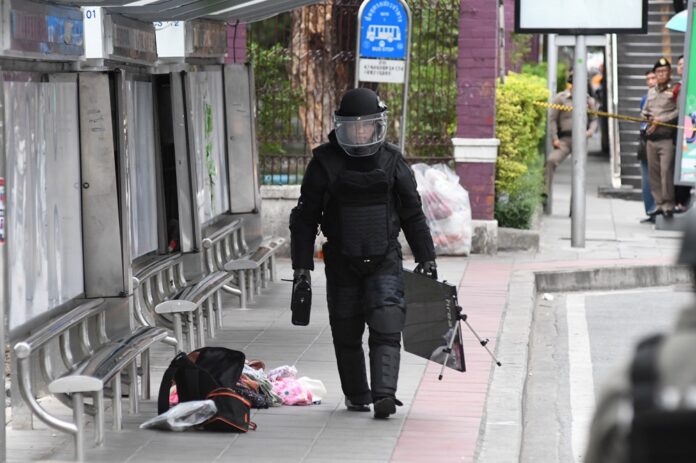
EOD police inspect a suspected explosive device at a bus stop in Bangkok on Aug. 3, 2019. It turned out to be a false alarm.
BANGKOK — A top government official said on Tuesday he believes groups based in Thailand’s restive Southern region are behind a recent bombing spree in Bangkok.
Deputy Prime Minister Prawit Wongsuwan said the plot appears to involve “multiple people,” though he neglected to elaborate. His remark came days after two men from a province known for separatist violence were arrested in connection with Friday’s bombings.
“Yes, we do,” Gen. Prawit said when asked whether he has any idea who the perpetrators are. “They are from the southern groups.”
When a reporter asked whether the authorities have found a link to politics, the deputy PM said, “Not yet. We’re still investigating. We don’t know yet. Many people were involved.”
His statements marked the first time government officials publicly suggested southern militants are connected to Friday’s explosions and fire bomb attacks across the capital. The violence coincided with an ASEAN summit attended by numerous foreign delegates, including those from the United States.
Media reports quoting unnamed officials previously said two men from Narathiwat province confessed they staged the attacks as revenge for military operations in the region, but the authorities quickly disputed the reports.
The secessionist violence has been mostly confined to the three southern border provinces, though it is believed the rebels have taken the bombing campaign north several times.
Speaking today, Gen. Prawit said further investigations are needed.
“Be patient,” the deputy PM said. “We have to find out how they traveled, and where they got the bombs from. Wait for now.”
Friday’s bombings also reignited a feud between pro-government MP Parina Kraikup and opposition spokeswoman Pannika Wanich, with the former publicly accusing the latter of having links to the attacks.
Future Forward’s Pannika rejected the allegation. Her aides said she will file libel charges against Parina this week.
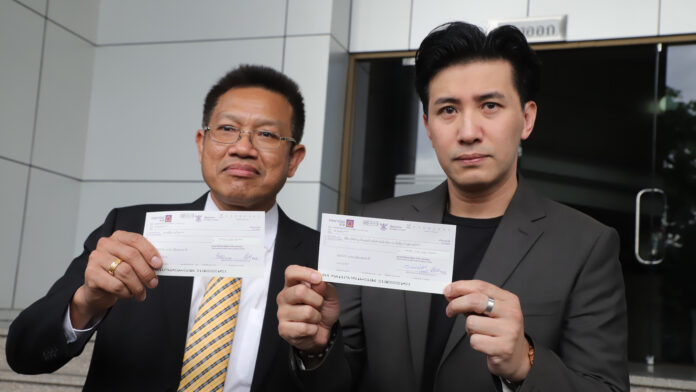
Decha Kittivittayanan, left, and Kanchai “Noom” Kamnerdploy, right, holding the cheques for compensation in front of the Civil Court on August 6.
BANGKOK — After nine years in court, representatives of a wealthy teen convicted of killing nine people in a car crash in 2010 have partially paid compensation to victims’ families.
On Tuesday, the legal representatives of Orachorn “Praewa” Thephasadin Na Ayudhya brought a 41.7 million baht cheque to the Civil Court to pay the compensation owed to the victims of a car crash in which Praewa drove into the back of a university van.
However, there remains 800,000 baht in outstanding compensation. The Supreme Court on May 8 had ordered Praewa, her family, and the man who let Praewa borrow his car on the night of the accident to collectively pay 25 million baht, with 7.5 percent interest, to the families of the victims.
The cheque, presented by lawyer Decha Kittivittayanan and actor Kanchai “Noom” Kamnerdploy, cut close to the deadline of August 28, after which assets owned by Praewa’s family would have been seized.
Neither Praewa nor her family were present at the court. Praewa’s mother, Laddawan Thephasadin Na Ayudhya, instead gave a phone interview on Channel 3 afterwards explaining that the family would like to keep distance from the press to avoid unintentionally disturbing the victims. She promised to pay off the remaining 800,000 baht as soon as possible.
Although Praewa was originally obliged to pay the compensation within 30 days of the verdict, none of the victims received a baht until they took to the media with their story on July 15, igniting a fresh wave of public outrage.
Thawin Chaotiang, the adoptive mother of the victim Sastra Chaotiang, was delighted to hear the news of the compensation.
“Thank you everyone, including the press, for helping us out,” Thawin said. “I will use the money to make merit, pay for my healthcare and my funeral, as I lost my siblings who would have taken care of me. It’s not that big sum of money.”
Justice minister Somsak Thepsuthin said on Tuesday that the case will be settled once all the compensation has been paid.
Over the past month, Praewa family appeared to be in a scramble to pay the compensation. On July 18, Praewa’s mother offered to sell plots of land in Prachuap Khiri Khan worth 105 million baht and a house in Muang Thong Thani reportedly worth 20 million baht to raise funds. However, her efforts failed as buyers turned down the offers.
Kanchai has claimed that Praewa’s family had to borrow from friends and relatives in order to fund the cheque. Although he is neither directly involved in the case nor a member of Praewa’s family, Kanchai was asked by Laddawan to act as a middleman due to his role hosting a TV show on which she gave an interview on July 18.
Praewa, who is now known as Rawinpirom Arunwong, was 16 and without a driver’s license when she crashed her car into the back of a Thammasat University van on Don Muang Tollway, killing nine people onboard while wounding several others.
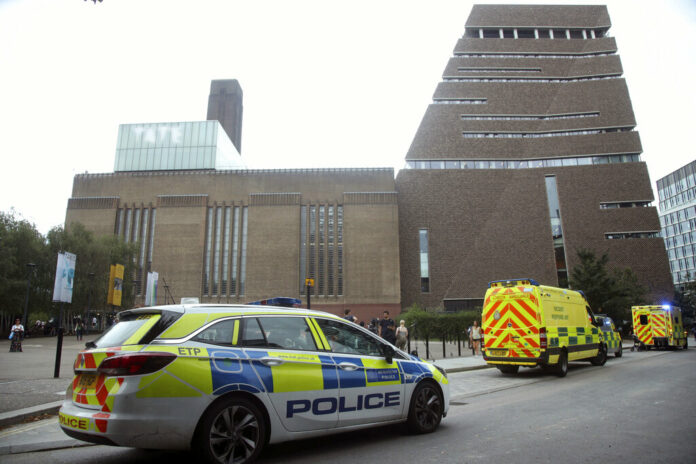
Emergency crews attending a scene at the Tate Modern art gallery, London, Sunday, Aug. 4, 2019. London police say a teenager was arrested after a child "fell from height" at the Tate Modern art gallery. The Metropolitan Police Service said on Twitter that the child was taken to a hospital in an air ambulance, adding "We await an update on his condition." Photo: Yui Mok / PA via AP
LONDON — British police said Monday they were searching for a motive after a teenager allegedly threw a 6-year-old boy from a 10th-floor viewing gallery at London’s Tate Modern museum.
The boy was airlifted to hospital after the incident on Sunday afternoon. Police said Monday that his condition was critical but stable and his life was no longer in danger.
A 17-year-old boy is being held on suspicion of attempted murder over the incident, which happened while the gallery was packed with visitors.
Nancy Barnfield was at the gallery with her family when she heard a “loud bang,” and then saw a woman screaming “Where’s my son, where’s my son?”
The younger boy had fallen from the open-air viewing platform to a fifth-floor roof.
Barnfield said a man on the platform was restrained by other visitors until police arrived. She said he “just stood there and was quite calm.”
Police say they don’t believe the suspect and victim knew each other.
“This was a truly shocking incident, and people will understandably be searching for answers,” said Detective Chief Superintendent John Massey of the Metropolitan Police. “At the moment, this is being treated as an isolated event with no distinct or apparent motive.”
Massey said police wanted to speak to anyone who “witnessed a male whose behavior seemed out of place, suspicious or worrying, in the hour or two before the incident in or near the gallery.”
Tate Modern, Britain’s leading gallery of modern art, sits on the south bank of the River Thames and was visited by almost 6 million people last year.
The 10th-floor terrace is part of a pyramid-shaped extension that opened in 2016 and offers panoramic views over London.
The gallery reopened Monday, but the viewing platform remained closed.
“Tate is working closely with the police to help with their investigations,” a spokeswoman said. “All our thoughts are with the child and his family.”
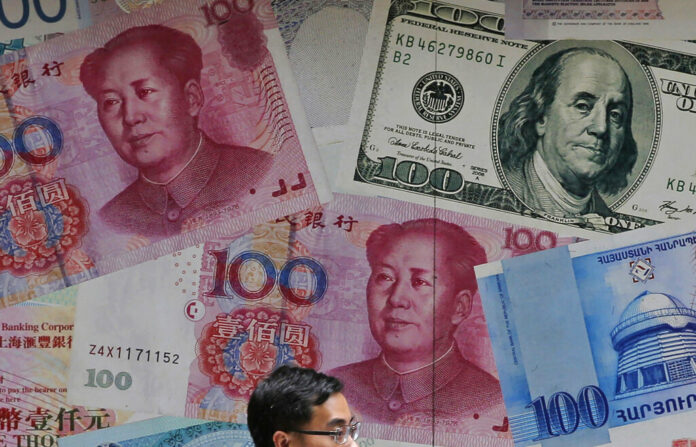
FILE - In this June 10, 2019, file photo, a man walks past a money exchange shop decorated with different banknotes at Central, a business district of Hong Kong. The U.S. Treasury Department labeled China a currency manipulator Monday, Aug. 5, after Beijing pushed down the value of its yuan in a dramatic escalation of the trade conflict between the world's two biggest economies. Photo: Kin Cheung / AP File
WASHINGTON — The U.S. Treasury Department labeled China a currency manipulator Monday after Beijing pushed down the value of its yuan in a dramatic escalation of the trade conflict between the world’s two biggest economies.
The decision, which came hours after President Donald Trump accused China of unfairly devaluing its currency, marks a reversal for Treasury: In May, it had declined to sanction China for manipulating its currency.
The U.S. had not put China on the currency blacklist since 1994.
The designation could pave the way for more U.S. sanctions against China.
Earlier Monday, China had allowed its currency to weaken to an 11-year low, a move that gives its exporters a price edge in world markets and eases some of the damage from U.S. tariffs on Chinese products.
Trump had gone on Twitter to denounce China’s move as “currency manipulation.” He added, “This is a major violation which will greatly weaken China over time.”
In a statement, Treasury said it would work with the International Monetary Fund “to eliminate the unfair competitive advantage created by China’s latest actions.”
The move was unexpected.
“This is an extraordinary action of hostility against a major trading partner, with little economic basis and again driven mostly by presidential whims,” said Cornell University economist Eswar Prasad, former head of the China division at the International Monetary Fund. “The timing and apparent logic for Treasury’s designation of China as a currency manipulator reeks of arbitrariness and retaliation, and will inflict further damage on an already wounded relationship between China and the U.S.”
During the 2016 presidential campaign, Trump had accused China of manipulating its currency to gain trade advantages against the United States and had promised to brand China a currency manipulator as soon as he took office.
However, Trump’s Treasury Department, which issues a report on currency manipulation every six months, has issued five reports since Trump took office, the most recent in May, in which Treasury said China did not meet the criteria to be labeled a currency manipulator.
The Treasury announcement, which came late Monday after the U.S. stock market had suffered its worst day this year, provided few details on the reasons for the abrupt change.
The statement did say that China’s explanations for its recent currency moves were implausible and “confirm that the purpose of China’s currency devaluation is to gain unfair competitive advantage in international trade.”
China’s central bank sets the exchange rate each morning and allows the yuan to fluctuate by 2% against the dollar during the day. The central bank can buy or sell currency — or order commercial banks to do so — to dampen price movements.
Because the Chinese government sets the exchange rate, said Joseph Gagnon, senior fellow at the Peterson Institute for International Economics, the Trump administration views China’s currency policy this way: “Any move is a move they want. Therefore, a move down is a manipulation.”
China’s central bank blamed the yuan’s drop on “trade protectionism” — an apparent reference to Trump’s threat last Thursday to impose tariffs Sept. 1 on the $300 billion in Chinese imports to the United States in addition to the $250 billion he’s already targeted.
For more than a year, the U.S. and China have been locked in a trade war over allegations that Beijing steals trade secrets and pressures foreign companies to hand over technology.
Story: Paul Wiseman and Martin Crutsinger. Marcy Gordon contributed to this report.
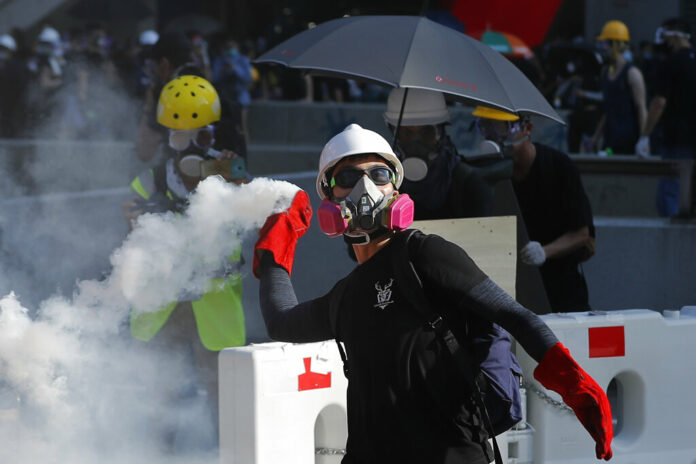
A protester throws back a tear gas canister in Hong Kong on Monday, Aug. 5, 2019. Droves of protesters filled public parks and squares in several Hong Kong districts on Monday in a general strike staged on a weekday to draw more attention to their demands that the semi-autonomous Chinese city's leader resign. Photo: Vincent Thian / AP
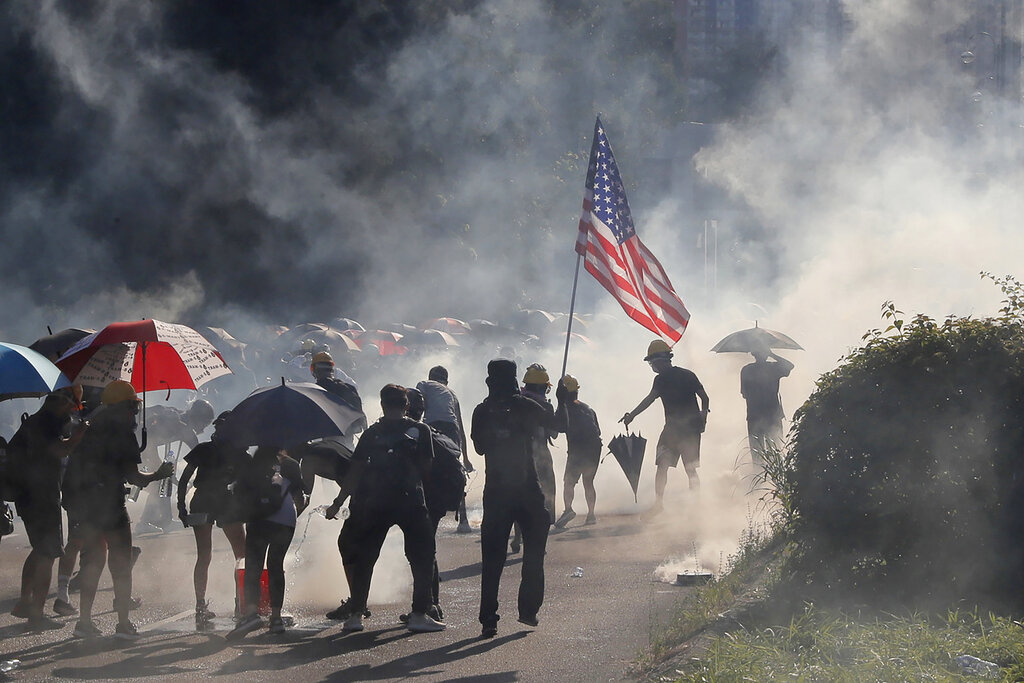
HONG KONG — A general strike in Hong Kong descended into citywide mayhem Monday as defiant protesters started fires outside police stations and hurled bricks and eggs at officers. After disrupting traffic early in the day, they filled public parks and squares in several districts, refusing to disperse even as police repeatedly fired tear gas and rubber bullets from above.
While previous large rallies over the past two months of anti-government protests have generally been held on weekends, Monday’s strike paralyzed city operations in an effort to draw more attention to the movement’s demands.
Hong Kong is on “the verge of a very dangerous situation,” said Chief Executive Carrie Lam, who insisted that she has no plans to resign.
Lam said at a news conference that the protests had “ulterior motives” that threaten Hong Kong’s prosperity and security. “I don’t think at this point in time, resignation of myself or some of my colleagues would provide a better solution,” she said.
Protesters challenged law enforcement in at least eight districts, responding to continuous rounds of tear gas with practiced swiftness. They lobbed the canisters back at police and yelled invectives. When police arrived, the protesters clacked their umbrellas together and pounded on metal street signs, daring the officers to move closer.
“Gangsters!” they jeered at the riot police. “Reclaim Hong Kong, revolution of our time.”
In one neighborhood after nightfall, a band of men wielding wooden poles charged protesters from behind a thin road lane divider. The demonstrators fought back by throwing traffic cones, metal barricades and rods. Hong Kong media also reported a brawl in a different district where men with knives slashed at protesters.
In another neighborhood, demonstrators besieged police headquarters in what they called a “flash mob.” They threw bricks and flaming bottles at the building before rapidly retreating.
The violence followed a day of striking that sparked bedlam throughout the city. Protesters started early, with the aim of hampering the morning rush hour. In the subway, they blocked train and platform doors, activated emergency alarms and threw objects onto the tracks.
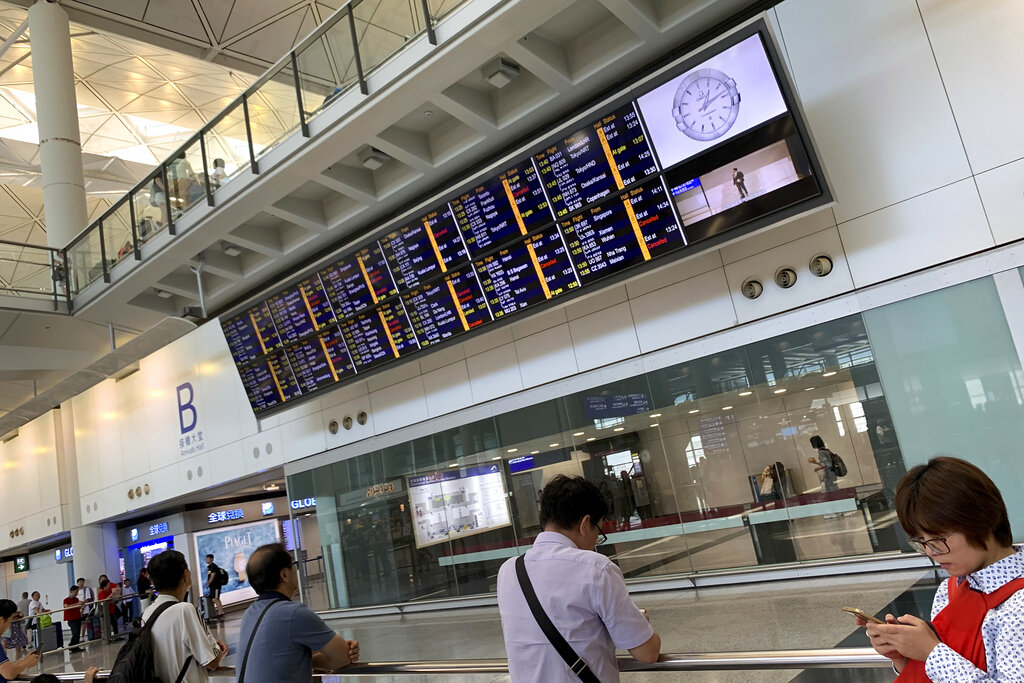
A high number of strikers in the airline industry also led to more than 77 flight cancellations, according to the airport authority.
People wait near an electronic billboard showing some flight cancellation information at the arrival hall of Hong Kong International Airport in Hong Kong, Monday, Aug. 5, 2019. Hong Kong leader Carrie Lam maintained that she has no plans to resign in the face of a turbulent pro-democracy movement that held a general strike Monday leading to more than 100 flight cancellations and major traffic disruptions. Photo: Royston Chan / AP
“Too much,” said 52-year-old John Chan, whose flight to Singapore was cancelled. “Why do they have to create trouble for people not involved in their cause? Hong Kong is sinking. The government, police and protest people have to stop fighting and give us a break.”
The strike was the latest action in a summer of fiery demonstrations that began in response to proposed extradition legislation that would have allowed some suspects to be sent to mainland China for trials.
While the government has since suspended the bill, protesters have pressed on with broader calls for it to be scrapped entirely, along with demands for democratic reforms including the dissolution of the current legislature and an investigation into alleged police brutality. In recent weeks, footage has shown police officers beating protesters and ignoring calls for help during a mob attack that left 44 injured in a commuter rail station.
Hong Kong, a former British colony, was returned to China in 1997 under a framework of “one country, two systems,” which promised the city certain democratic freedoms not afforded to the mainland. With the arrests of booksellers and activists in recent years, however, some Hong Kong residents feel that Beijing has been eroding their rights.
The Communist Party-led central government in Beijing has condemned what it calls violent and radical protesters who have vandalized the Chinese national emblem and more recently thrown the country’s flag into the iconic Victoria Harbour. China has accused unnamed “foreign forces” of inflaming the demonstrations out of a desire to contain the country’s development.
CCTV, China’s state broadcaster, warned Monday that the “maniacs and thugs” will “pay a price.”
“Please become aware of your errors, turn back from your incorrect path and set down the butcher’s knives,” said an editorial read aloud on the noon news program.
A slick publicity video released last week by the Chinese army garrison regularly stationed in Hong Kong fed speculation that Beijing will deploy the military to quell the mass demonstrations. But Kong Wing-cheung, a police spokesman, said the city’s officers are fully supported by the government and there will be no need to deploy the military.
More than 400 protesters have been arrested since June 9, when a massive march drew more than 1 million people and launched the protest movement. Those being held, who range in age from 14 to 76, face charges including rioting, unlawful assembly, possessing offensive weapons and assaulting officers and obstructing police operations, said spokeswoman Yolanda Yu Hoi-kwan.
Yu said police have used 1,000 tear gas grenades and fired more than 300 non-lethal bullets. More than 100 officers have been injured. Yu added that violence has been escalating, with protesters using gasoline bombs and fire.
“If we continue to tolerate and turn a blind eye to lawless behavior, the consequences will be undesirable for our citizens,” she said.
As demonstrators were marching through a business district Monday afternoon, some separated from the line and stopped to heckle a police officer in a watchtower. One person in a balaclava started throwing bricks at the lookout.
A man on his way home from work peered at the scene with a look of anguish.
The 40-year-old I.T. worker named Edward Chan said he couldn’t go on strike because he feared judgment from his superiors. He added he’s tormented by thoughts of the kind of Hong Kong his 12-year-old daughter will inherit.
Tears welled as he watched the ragtag young protesters stream past in their gas masks and helmets. “If we put them all in jail, how will their parents feel?” he asked. “Where will our future go?”
A protester runs with a United States flag as tear gas are released on protesters in Hong Kong on Monday, Aug. 5, 2019. Droves of protesters filled public parks and squares in several Hong Kong districts on Monday in a general strike staged on a weekday to draw more attention to their demands that the semi-autonomous Chinese city’s leader resign. Photo: Kin Cheung / AP
Story: Yanan Wang and Christopher Bodeen. Royston Chan in Hong Kong contributed to this report.