




























28.8 C
Bangkok
Sunday, June 28, 2026
Home Blog Page 1662

Pro-Thaksin Candidates Adopt his Name in Election

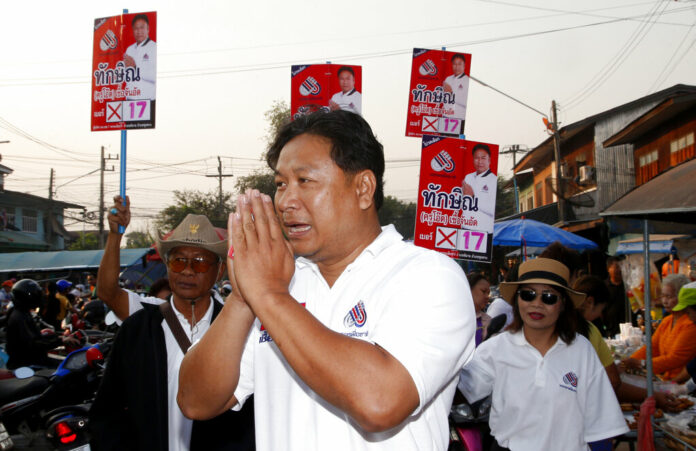
Veerawit Chuajunud, center, who changed his name to Thaksin Chuajunud for Pheu Chart party, makes his election campaign Friday in Nakhon Ratchasima province. Photo: Sakchai Lalit / Associated Press

PHIMAI — It’s election season and a campaign truck is rolling at the crack of dawn through the streets of the northeastern town of Phimai, blaring the slogan “Vote Thaksin, Get Thaksin.”

It’s a bit disconcerting, since the Thaksin everyone in Thailand is former Prime Minister Thaksin Shinawatra, ousted by a 2006 military coup and living in self-imposed exile since 2008 to avoid serving a prison term for a conviction on a conflict of interest charge.

This small-town Thaksin, distributing campaign handbills as he walks ahead of the truck, is a 46-year-old schoolteacher.

He happily explains that sharing his name with the 69-year-old former prime minister is no coincidence, and that he changed his former name – Veerawit Chuajunud – to Thaksin Chuajunud as a vote-getting tactic.

Phimai, in Nakhon Ratchasima province, is in the country’s poor rural Isaan region, the heartland of the neglected farmers and villagers who represent the original and still largely loyal base of the former prime minister, a billionaire now living in Dubai.

“I want to grab the attention of the people, making sure that my name is easy to remember. I only have one to two months to campaign, so I decided to change my name to be symbolic,” said the candidate in Sunday’s general election.

The name-changing tactic may be tricky, but it’s not insincere. Phimai’s Thaksin is running as a candidate for Pheu Chart, one of several small parties established by allies and supporters of the former prime minister.

There is an established flagship pro-Thaksin party, Pheu Thai, but election laws established by the anti-Thaksin military government targeting the former leader’s political machine are aimed at keeping any large party from obtaining a legislative majority. So the pro-Thaksin strategy is to splinter the machine into separate parties that could unite forces after the election.

Name-changing is a tactic to help overcome confusion over political brands, especially for the new, lesser-known satellite parties. It also helps to stand out in a large field of candidates. More than 11,000 are registered for Sunday’s vote, compared to just over 2,800 in the last election.

Thaksin Chuajunud is one of 15 candidates from his party who made opportunistic name changes. Most took on the name “Thaksin,” but four adopted the name of Thaksin’s sister, Yingluck, who became prime minister in 2011 and was forced from office by a controversial court decision just before the military ousted her government in another coup. She also has faced court cases that supporters charge amount to political persecution, and likewise fled into exile.

Phimai’s Thaksin is on fairly friendly ground as he introduces himself at a local market. It’s been more than a decade since Isaan’s political hero, the former prime minister, even set foot on Thai soil, but he is not forgotten.

“I wish he would come back. I wish that every day and every minute. I don’t know how and I have never really said this. I do miss him. I am concerned about him, and I quietly give him my support,” says farmer Pajaree Changkodpanao, wiping away tears.

Pro-Thaksin parties, despite serious roadblocks put in their way by Thailand’s traditional conservative political establishment, have won every national election since 2001.

Thaksin, who made his fortune in telecommunications, used his money to subsume rural and regional political power brokers into his own party, then once in power implemented generous and generally unprecedented social programs benefiting the rural poor and urban working class, cementing his relationship with a majority of the country’s voters.

“No matter what anyone said about him, I always loved him since many years ago,” says 59-year-old Nuwate Jiamwong from Nonrung village, another farmer. “It’s fixed in my mind.”

Thaksin’s populist policies, such as a universal health care scheme and generous farming subsidies, account for a good deal of his popularity in poor rural areas. They also show the people in those areas the gains the political process could bring them aside from the cash handouts they traditionally receive from vote-buyers on election eve.

Virot Ali, a political science lecturer at Bangkok’s Thammasat University, says he believes people in the countryside still think of Thaksin as the main person who guided the economy in the interests of the rural sector, as well as gave them confidence that democracy could work to their benefit.

Thaksin’s populist policies assured him large electoral majorities, but also alienated the country’s traditional power-holders – royalists, the military and their Bangkok middle-class supporters. The 2006 coup that ousted him, after accusations of abuse of power and disrespect toward the monarchy, set off a battle for power between his supporters and opponents that sparked sporadic mass street violence and triggered the army’s second coup in 2014.

The anti-democratic measures still being taken by Thaksin’s opponents to thwart his political comeback – changes to the constitution that offset the direct election of legislators and limit the power of elected lawmakers – are a measure of what Thaksin’s supporters are up against.

Phimai candidate Thaksin says he’s up for the challenge.

“I know that changing my name does not mean that I will automatically win,” he says. “I still have to work hard, visiting and working continuously for the community.”

Story: Thassanee Vejpongsa
Advertisement

Black Panther Verdict: Premchai Sentenced to 16 Months in Jail

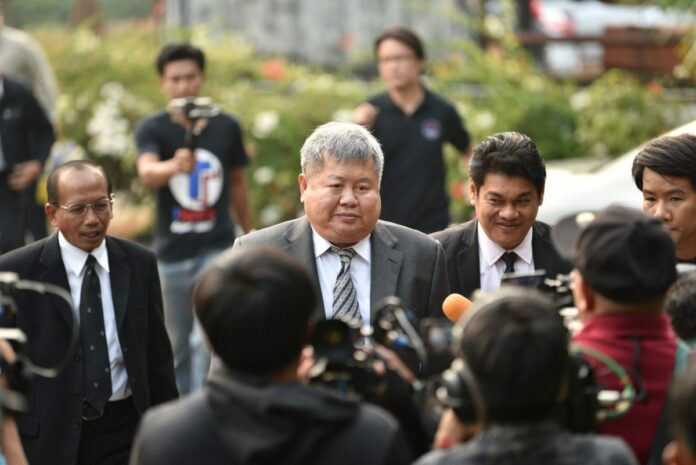
Premchai Karnasuta arrives Tuesday at the Thong Pha Phum Provincial Court in Kanchanaburi province.

KANCHANABURI — A powerful construction tycoon was convicted of several crimes related to a high-profile poaching case last year in a national park but acquitted of the most serious count, a court ruled Tuesday.

The Thong Pha Phum Provincial Court sentenced Premchai Karnasuta to 16 months in prison for weapons-related charges and conspiring to poach wildlife. The court found him not guilty of poaching a black panther in a wildlife sanctuary in a case that sent the nation into an uproar.

Surrounded by a throng of reporters outside the courthouse after the ruling, Premchai said “I’d like to say only one thing – I’m sorry.”

His three co-defendants were convicted of weapons- and poaching-related offenses. Thanee Toommat was the only defendant convicted of poaching and sentenced to 3 years and 5 months in prison. He and Premchai were collectively fined 2 million baht.

Yong Dodkrue and Natee Riamsaen received sentences of 13 months and 4 months in jail, respectively. Natee, who was a helper uninvolved in the hunt, was granted two years probation and fined 10,000 baht.

Premchai and the other two were not granted probation by the court. His lawyers are expected to file an appeal.

All defendants except Premchai were convicted of possessing remains of a black panther. The tycoon was convicted of possessing remains of a wild pheasant. The three men were freed on bonds ranging from 400,000 baht to 500,000 each soon after the verdict was read.

Wichien Chinnawong, the ranger who arrested Premchai and was hailed for standing up against the wealthy and powerful, said after the court ruling that he was satisfied that justice was served to the black panther. Wichien was one of the plaintiffs in the case which ultimately led to the trial on a reduced set of six counts.

“We have done our best,” he said, adding that the legal team will later decide whether to challenge the outcome.

Deputy police commissioner Srivara Rangsibrahmanakul welcomed the verdict, saying he was “relieved” that Premchai and his party were found guilty. Srivara, who was criticized for kowtowing to Premchai after the crime, said the police did their best in investigating the case.

Gen. Srivara added that Premchai still faces a charge of possessing ivory stemming from a subsequent search of his mansion. That trial is underway with a verdict expected in June.

The 64-year-old president of construction conglomerate Italian-Thai and his co-defendants were arrested early last year at a campsite in the Thung Yai Naresuan Wildlife Sanctuary, where authorities found firearms and animal remains, including those of a protected black panther.

Premchai’s arrest provoked an outpouring of anger and low expectations that such a powerful figure would be tried fairly. The black panther became a cause celebre in a spasm of activism that enjoyed wide public support.

One of those activists, Thatchapong Kaedum, said that the fight isn’t over.

“People are assuming we already won. But don’t forget that this case still has to go to the Court of First Instance and the Supreme Court. So in the end, he might not have to step into jail at all,” said Thatchapong, who led a group of activists called T’Challa for the protagonist of “Black Panther.”

He said his group would continue to follow the case but worries it will fade from consciousness.

“This is only his first offense. He is powerful, and people might forget about the case going forward,” Thatchapong said.

The Seub Nakhasathien Foundation, which was named after a renowned activist who committed suicide to provoke awareness of wildlife conservation, released a statement thanking those who helped push the case toward resolution.

“We’d like to commend the staff of the Thung Yai Naresuan Wildlife Sanctuary for their bravery in carrying out their duty and arresting the four defendants, and all the people who kept close watch on the case … until the guilty parties received punishment under the law,” the statement read. “Although the verdict might not fully satisfy the public, we believe the poaching case … is an important lesson to all Thai people.”

Additional reporting Asaree Thaitrakulpanich

Advertisement

Source: Justice Dept. Probing Development of Boeing Jets

Boeing's first 737 MAX 9 jet at the company's delivery center before a ceremony transferring ownership to Thai Lion Air in Seattle in a March 2018 file photo. Photo: Elaine Thompson / Associated Press

WASHINGTON — U.S. prosecutors are looking into the development of Boeing’s 737 Max jets, a person briefed on the matter revealed Monday, the same day French aviation investigators concluded there were “clear similarities” in the crash of an Ethiopian Airlines Max 8 last week and a Lion Air jet in October.

The Justice Department probe will examine the way Boeing was regulated by the Federal Aviation Administration, said the person, who asked not to be identified because the inquiry is not public.

A federal grand jury in Washington sent a subpoena to someone involved in the plane’s development seeking emails, messages and other communications, the person told The Associated Press.

The Transportation Department’s inspector general is also looking into the FAA’s approval of the Boeing 737 Max, a U.S. official told AP. The official wasn’t authorized to discuss the matter publicly and spoke on condition of anonymity. The Wall Street Journal reported on the probe Sunday said the inspector general was looking into the plane’s anti-stall system. It quotes unidentified people familiar with both cases.

The anti-stall system may have been involved in the Oct. 29 crash of a Lion Air jet off of Indonesia that killed 189 people. It’s also under scrutiny in the March 10 crash of an Ethiopian Airlines jet that killed 157.

The Transportation Department’s FAA regulates Chicago-based Boeing and is responsible for certifying that planes can fly safely.

The grand jury issued its subpoena on March 11, one day after the Ethopian Airlines crash, according to the person who spoke to The Associated Press.

Spokesmen for the Justice Department and the inspector general said Monday they could neither confirm nor deny the existence of any inquiries. The FAA would not comment.

“Boeing does not respond to or comment on questions concerning legal matters, whether internal, litigation, or governmental inquiries,” Boeing spokesman Charles Bickers said in an email.

The company late Monday issued an open letter from its CEO, Dennis Muilenburg, addressed to airlines, passengers and the aviation community. Muilenburg did not refer to the reports of the Justice Department probe, but stressed his company is taking actions to ensure its 737 Max jets are safe.

Those include an upcoming release of a software update and related pilot training for the 737 Max to “address concerns” that arose in the aftermath of October’s Lion Air crash, Muilenburg said. The planes’ new flight-control software is suspected of playing a role in the crashes.

The French civil aviation investigation bureau BEA said Monday that black box data from the Ethiopian Airlines flight showed the links with the Lion Air crash and will be used for further study.

Ethiopian authorities asked BEA for help in extracting and interpreting the crashed plane’s black boxes because Ethiopia does not have the necessary expertise and technology.

The Ethiopian Accident Investigation Bureau intends to release a preliminary report within 30 days.

The United States and many other countries have grounded the Max 8s and larger Max 9s as Boeing faces the challenge of proving the jets are safe to fly amid suspicions that faulty sensors and software contributed to the two crashes in less than five months.

Both planes flew with erratic altitude changes that could indicate the pilots struggled to control the aircraft. Shortly after their takeoffs, both crews tried to return to the airports but crashed.

Boeing has said it has “full confidence” in the planes’ safety. Engineers are making changes to the system designed to prevent an aerodynamic stall if sensors detect that the jet’s nose is pointed too high and its speed is too slow.

Investigators looking into the Indonesian crash are examining whether the software automatically pushed the plane’s nose down repeatedly, and whether the Lion Air pilots knew how to solve that problem. Ethiopian Airlines says its pilots received special training on the software.

Dennis Tajer, an American Airlines pilot and a spokesman for their union, said Boeing held a discussion with airlines last Thursday but did not invite pilots at American or Southwest, the two U.S. carriers that use the same version of the Max that crashed in Indonesia and Ethiopia.

Tajer said airline officials told the unions that Boeing intends to offer pilots about a 15-minute iPad course to train them on the new flight-control software on Max jets that is suspected of playing a role in the crashes. He called that amount of training unacceptable.

“Our sense is it’s a rush to comply – ‘let’s go, let’s go, let’s go,'” Tajer said. “I’m in a rush to protect my passengers.”

A spokesman for the pilots’ union at Southwest Airlines also said Boeing representatives told that union they expected the upgrade to be ready the end of January.

The spokesman, Mike Trevino, said Boeing never followed up to explain why that deadline passed without an upgrade. Boeing was expected to submit a proposed fix to the FAA in early January.

Story: Hope Yen, Tom Krischer

Advertisement

Gunman Kills 3 on Dutch Tram; Mayor Fears Terrorism

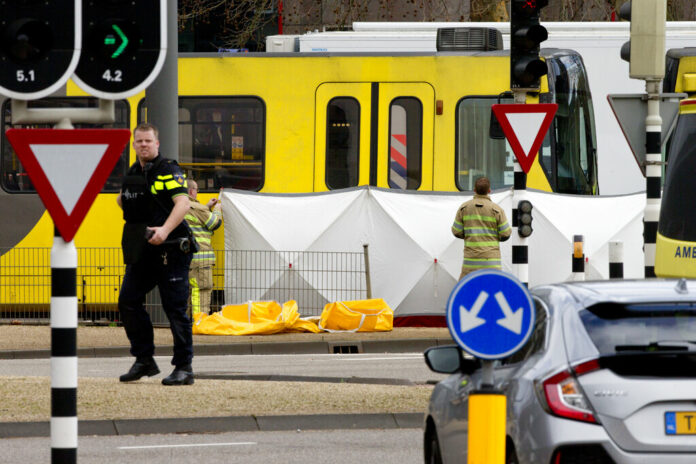
Rescue workers install a screen on the spot where a body was covered with a white blanket following a shooting in Utrecht, Netherlands, Monday, March 18, 2019. Photo: Peter Dejong / Associated Press

UTRECHT, Netherlands — A gunman killed three people and wounded five during a mid-morning tram ride Monday in the Dutch city of Utrecht, raising the specter of another extremist attack only days after the murderous rampage in New Zealand.

Authorities seized a Turkish-born suspect after a manhunt that convulsed the historic city of nearly 350,000 people for most of the day.

As night set in, three victims lay in critical condition, and the motive for the bloodshed remained under investigation. Prime Minister Mark Rutte said authorities were trying to determine whether the attack had “terror motives.”

Justice Minister Ferd Grapperhaus said the suspect, identified as Gokmen Tanis, 37, was known to justice authorities and had a criminal record, but would not elaborate. Police said they also detained another man on suspicion of involvement but released no details.

The shooting came three days after 50 people were killed when an immigrant-hating white supremacist opened fire at two mosques in Christchurch, New Zealand, during Friday prayers. There was no immediate indication of any link between the two events.

The Utrecht attack took place at a busy intersection in a residential neighborhood. The gunman was alleged to have had an automatic weapon, Grapperhaus said.

“We assume a terror motive,” Mayor Jan van Zanen said as police searched for the killer, though he added that other motives could not be ruled out.

In the aftermath of the shooting, Dutch authorities put the Netherlands’ fourth-largest city on lockdown, raised the threat level in the area to the maximum of 5 and tightened security at airports and key buildings in the country. Police issued a photo of a bearded Tanis aboard a tram in a blue hooded top.

“If it is a terror attack,” the prime minister declared, “then we have only one answer: Our nation, democracy, must be stronger than fanaticism and violence.”

Heavily armed officers with dogs searched for the killer, gathering at one point in front of an apartment building close to the scene. However, the suspect was later arrested at another location in the city. The threat level soon returned to 4.

Police said a red Renault compact car was carjacked shortly before the shooting and later found across town.

Local media said Tanis had been charged several times over the past years with offenses ranging from attempted manslaughter to petty crime in and around Utrecht. Two weeks ago he was in court on charges of raping of woman in 2017, news reports said.

The identities of the shooting victims were not immediately released, and Grapperhaus would not say if any were known to the gunman.

Political parties halted campaigning ahead of provincial elections scheduled for Wednesday that will also determine the makeup of Parliament’s upper house. A televised debate also was canceled. It was not clear if campaigning would resume Tuesday.

This is a developing story and will be updated without notice.

Advertisement

Dick Dale, Surf Guitar King, ‘Miserlou’ Composer, Dies at 81

LOS ANGELES — Dick Dale, whose pounding, blaringly loud power-chord instrumentals on songs like “Miserlou” and “Let’s Go Trippin'” earned him the title King of the Surf Guitar, has died at age 81.

His former bassist Sam Bolle says Dick Dale passed away Saturday night. No other details were available.

Dale liked to say it was he and not the Beach Boys who invented surf music — and some critics have said he was right.

An avid surfer, Dale started building a devoted Los Angeles fan base in the late 1950s with repeated appearances at Newport Beach’s old Rendezvous Ballroom. He played “Miserlou,” ”The Wedge,” ”Night Rider” and other compositions at wall-rattling volume on a custom-made Fender Stratocaster guitar.

“Miserlou,” which would become his signature song, had been adapted from a Middle Eastern folk tune Dale heard as a child and later transformed into a thundering surf-rock instrumental.

His fingering style was so frenetic that he shredded guitar picks during songs, a technique that forced him to stash spares on his guitar’s body. “Better shred than dead,” he liked to joke, an expression that eventually became the title of a 1997 anthology released by Rhino Records.

Dale said he developed his musical style when he sought to merge the sounds of the crashing ocean waves he heard while surfing with melodies inspired by the rockabilly music he loved.

He pounded rather than plucked the strings of his guitar in a style he said he borrowed from an early musical hero, the great jazz drummer Gene Krupa.

“Dale pioneered a musical genre that Beach Boy Brian Wilson and others would later bring to fruition,” Rolling Stone magazine said in its “Encyclopedia of Rock & Roll” adding “Let’s Go Trippin'” was released in 1961, two months ahead of the Beach Boys’ first hit, “Surfin.'”

The magazine called Dale’s song “the harbinger of the ’60s surf music craze.”

Although popular around Southern California, Dale might have remained just a cult figure if surfing had not exploded in worldwide popularity during his peak creative years.

When the first of a series of “Beach Party” movies made to cash in on the phenomenon was released in 1963, it included Dick Dale and the Del-Tones performing “Secret Surfing Spot” as teen heartthrob Annette Funicello danced on the beach.

Dale had released his first album, “Surfer’s Choice,” a year earlier. He followed it with four more over the next two years while appearing in several “Beach Party” sequels and other surfer movies.

Other popular Dale songs included “Jungle Fever,” ”Shake-N-Stomp” and “Swingin’ and Surfin’.”

His star dimmed after the Beatles led music’s British invasion onto the pop charts in 1964 and his record label dropped him. His career also was sidelined by a battle with cancer in the 1960s and a serious foot infection in the 1970s that was the result of a surfing injury.

His musical influence was profound and included guitar virtuosos Jimi Hendrix and Stevie Ray Vaughan and movie director Quentin Tarantino, who selected Dale’s “Miserlou,” as the theme song of his 1994 film “Pulp Fiction.” That helped pull the guitarist back into the pop-culture spotlight.

Dale himself had begun to launch a comeback with the 1987 film “Back to the Beach,” which reunited Funicello and her co-star Frankie Avalon as a middle-aged couple returning to their old surfing haunts. He teamed up with Vaughan to record the classic surf instrumental “Pipeline” for that film, earning the pair a Grammy nomination.

In 1993 he released “Tribal Thunder,” his first album of all new material in nearly 30 years. He followed it with “Unknown Territory” the following year.

Dale continued to tour into his 80s, in part he said to pay the medical bills that advancing age was saddling him with. Having beaten cancer in the 1960s, he suffered a serious recurrence in 2015.

Born Richard Anthony Monsour in Boston on May 4, 1937, Dale moved to Los Angeles with his family in 1954, where he immediately fell in love with surfing and the electric guitar.

As a child, he listened to Lebanese and Polish folk tunes played by his parents. Eventually he graduated to big band, swing, country and rockabilly.

Self-taught on guitar, the left-handed Dale couldn’t afford a custom-made model, so early on he played a standard right-hand guitar upside down and backward. That ended after a meeting with legendary guitar builder Leo Fender, who offered to make Dale his own left-handed model if he’d test a line of guitars and amplifiers Fender was developing.

“I became Leo’s personal guinea pig,” Dale told The Associated Press in 1997. “Anything that came out of the Fender company, I played.”

He played so loudly that he blew up one amplifier after another until a frustrated Fender built him a “Dick Dale Dual Showman” doubled-sized amp. It was a model that would become popular with aspiring Los Angeles guitarists.

As he began to become well known, he began calling himself Dick Dale, explaining years later that a radio disc jockey had suggested it was a better name for a rock star than Richard Monsour.

His surfer buddies had already nicknamed him King of the Surf Guitar, a title he said he initially resisted, fearing it would limit his audience. When the spirit of surfing caught on everywhere, however, he came to embrace the crown.

Dale is survived by his wife, Lana, and a son, James, a drummer who sometimes toured with his father.

Story: Lindsey Bahr, John Rogers

Advertisement

Woman Allowed to Mark 17 Votes ‘By Mistake,’ Official Says

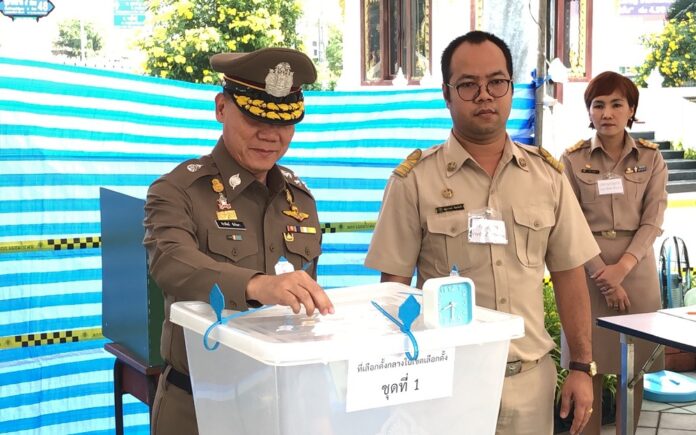
Police Commissioner Chakthip Chaijinda casts his ballot at Sunday’s early voting.

BANGKOK — An election official said Monday a voter in Samut Songkhram province was allowed to mark 17 ballot papers on her own due to a misunderstanding at the polling station.

Pinthong Intarasri, an official in charge of yesterday’s early voting in the province, told reporters the voter was given a bundle of ballots while registering at a voting booth – and somehow assumed she could mark them all. The ballot papers were later destroyed and the voter charged with a criminal offense.

The voter was identified as 27-year-old Benjamaporn Sila-or, who said she had no intent to commit fraud in the election. Under election laws, each voter can only mark one ballot. Benjamaporn said she had the rules mixed up because it’s the second time she voted in her life.

Pinthong said the woman marked the ballots, gave one to an official and then left the rest at a table. They were discovered by another voter in the line, prompting voting to stop for an hour and a half while officials investigated and found replacement ballots, Pinthong said.

Read: More Election Blunders Reported as Scores Flock to Vote Early

She added that Benjamaporn was taken to a police station and charged with causing damage to voting equipment, which carries a maximum penalty of five years in jail. It is unclear which party Benjamaporn voted for.

The incident and other mishaps marred Sunday’s early voting, which saw voter turnout of up to 80 percent. Other complaints included long lines, ballots from the wrong constituencies being handed out and officials putting marked ballots in plastic bags.

The Election Commission faced yet another round of embarrassment when it unveiled what it said to be a QR code for its website at a news conference on Monday. The code turned out to be an error, which led users at the event to a web page selling skincare products instead.

Advertisement

More Election Blunders Reported as Scores Flock to Vote Early

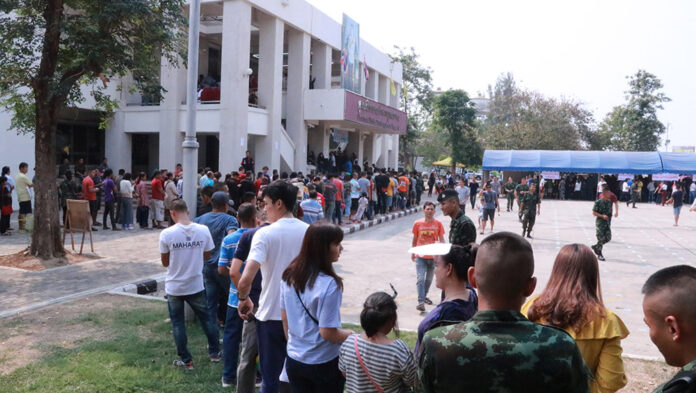
Long queues of voters outside a polling station Sunday in Nakhon Ratchasima province.

BANGKOK — Election officials were under fire for several cases of alleged mismanagement during the weekend’s early voting, including providing the wrong ballots and missing candidate information.

The Election Commission scrambled to win confidence following a storm of complaints on mishaps that could potentially lead to a number of ballots being voided, as polling stations nationwide were overwhelmed Sunday by early voters flocking to their ballots in the kingdom’s first election in five years.

One major problem that emerged during the day were reports of election officials in several districts giving wrong ballots to voters, with some being accused of refusing to provide the correct ones even after they were protested. Commissioner Jarungvith Phumma acknowledged the mistake and said the body would investigate the matter, encouraging those affected to report to their local commissioners.

However, election chairman Itthiporn Boonprakong said if voters submitted the wrong ballots, their votes would automatically be voided. Another commissioner, Nath Laoseesawakool, said the commission received about 50 reports of such cases, but insisted all were eventually able to cast the right ballot.

The confusion stemmed from the voting mechanism designating random numbers to running candidates in each constituency, meaning officials at polling stations had to give each voter a specific ballot assigned to their electoral district.

Concerns and distrust of officials over the credibility of the election process were obvious. Voters questioned efficiency on a number of issues including see-through ballot boxes, the omission of fingerprints on ballot sheets and a visibly poor ballot sorting process. It followed a wave of criticism over many problems that surfaced during overseas votes last week.

Read: Thai Election Gets Messy Start Overseas, Voters Complain

“What kind of election allows people to bring their phones into the booth, no fingerprinting, ballot boxes from [cheap grocery stores] so easy to open? Where’s the transparency of this election?” Twitter user @Jeongbyul_ wrote.

“People from different provinces have to submit their ballots into the same box. District officials told us that the postal officials would be in charge of opening the boxes and sorting the ballots. I asked if there will be election officials overseeing the sorting process and they said no. Where’s the transparency?” @Pattara66966226 wrote.

Thailand Post said it had assigned 3,000 employees to sort the ballots to be delivered to each electoral district, a process expected to take three days. It has also set up security cameras to record the sorting process at all hours and said any observers are welcome to watch the livestream feed in front of the post headquarters in Lak Si district.

The polling station in Bangkok’s Huai Khwang district yesterday didn’t put all candidates’ information on display until four hours after polls had opened, which some reports said was because the Election Commission didn’t send the documents to the station in time.

The district chief Sucheep Ariprachapirom later said the problem was likely caused by mismanagement of district officials, who got “confused because this election is different from the past.” He said he would look into whether the commission had submitted candidates’ information too late.

There were also reports of ballot errors. Numbers of the disbanded Thai Raksa Chart were still present on ballots even though votes for them won’t count. A representative from the Bhumjaithai Party complained the party’s number was missing from ballots for an electoral district in Kalasin, a mistake later denied by head commissioner Jarungvith.

Officials said advanced voter turnout in Bangkok was over 87 percent and several provinces reported the turnout to be more than 85 percent, including in Chiang Mai, Lamphun, Phrae, Trat, Phuket, Khon Kaen and Ranong. Commissioner Nath said the turnout of early voters nationwide could be higher than 75 percent.

Clarification: An earlier version of this story indicated that Sunday’s poll would be the first election in eight years. While it could be the first successful vote since 2011, general elections were held in 2014 and later voided by the courts.

Advertisement

Citing Ethics, Thanathorn Puts Assets Under Blind Trust

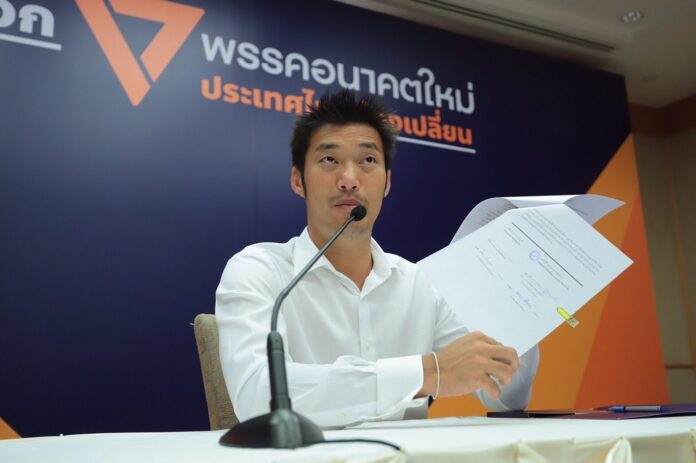
Future Forward Party leader Thanathorn Juangroongruangkit on Monday shows his blind trust agreement to reporters.

BANGKOK — A billionaire turned politician said Monday he has transferred his massive wealth into a blind trust to avoid any conflict of interest in the future.

Though it’s still uncertain whether Future Forward Party leader Thanathorn Juangroongruangkit will hold any political office, the former businessman told reporters he wanted to “set a new standard” for Thai politics. The wealth he transferred into the trust was estimated at about 5 billion baht.

“We cannot deny the fact that the people are already scarred by politicians who … once in power only advance their own gains,” Thanathorn said at a news conference. “My action is meant to settle any skepticism, so that society doesn’t doubt a businessman who enters politics.”

Under a blind trust agreement, Thanathorn’s assets will be overseen by anonymous experts. Thanathorn also said he will not be privy to how his wealth is managed. The system was devised so that the owner of the assets would not know how government decisions could affect his businesses.

Read: ‘I’m Not Part of the Elite,’ Says Billionaire Leader of Progressive Party

It will also save him from a legal restriction that bans members of the cabinets from holding over 5 percent of any public company.

“I will get to see my assets again only when I quit politics. And I took it even further by writing in the contract that the ownership will only be returned to me three years after I quit politics,” said Thanathorn, whose ambition is set on the prime minister’s seat. “This is the highest standard possible for businesspeople working in politics.”

The party leader then signed a contract with Phatara Assets Management in front of reporters. Thanathorn said he selected Phatara because it has no prior history with his own firm.

A transparency activist commended Thanathorn for the effort and urged other politicians to learn from his example.

“It’s a good thing. People should campaign for other politicians to do the same,” Sarinee Achavanuntakul said in an interview. “In terms of transparent governance, this is very good practice.”

Although blind trusts have been recognized since anti-corruption laws came to effect in 2000, few politicians have used them, the activist said. Many instead choose to transfer their assets to close aides who then serve as proxies until their departure from politics.

While Sarinee said Thanathorn was not the first politician to opt for a blind trust – six ministers under then-premier Abhisit Vejjajiva also did – she said others only did so after being confirmed ministers.

“It’s a good sign. Politicians should relinquish control of their assets at the very start of their career in politics,” the expert said.

A scion of an auto parts empire called Thai Summit, Thanathorn entered politics by advocating liberal social policies and economic equality. In multiple press interviews, the 40-year-old maintained he was not seeking office to further his own businesses.

Thanathorn resigned from all positions at private firms last year, including the board of Matichon Group, which owns Khaosod English.

But many of his opponents drew parallels with former prime minister Thaksin Shinawatra, a tycoon-turned-politician whose administration was fraught with accusations of corruption and nepotism. Asked to comment on the suspicion, Thanathorn said he’s truly done with business.

“When I resigned from Thai Summit, I really resigned. I haven’t gone to their meetings or met their clients since,” Thanathorn said. “It’s not worth it to taint myself once I’m in politics.”

He also maintained that his mother’s sizable stake in Matichon Group do not influence its coverage in any way. Somporn Juangroongruangkit owns 19 percent of the company’s total shares.

Advertisement

DLD Senior Managements Praises VIV Asia 2019 for Bringing the Top Agriculture Innovations to Thailand

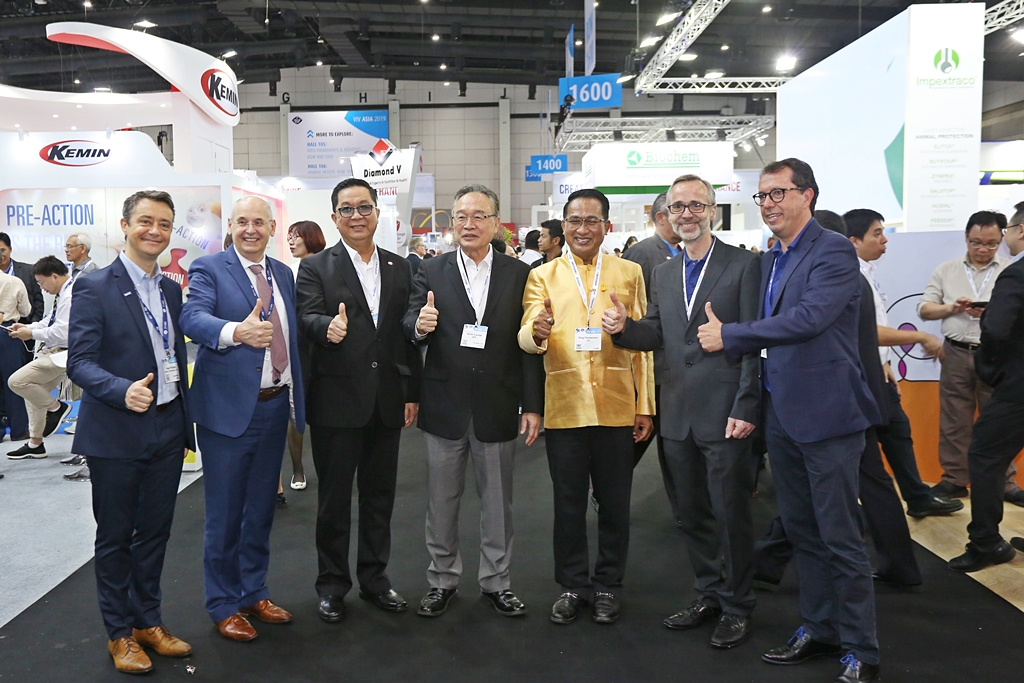
Dr. Soravit Taneeto, DVM, Director-General of the Department of Livestock Development (DLD) and Dr.Somchuan Ratanamungklanon, DVM, Deputy Director General, have commended VIV Asia 2019 for showcasing latest technologies from industry leaders across the world, enhancing agricultural knowledge for Thai agriculture companies.

VIV ASIA 2019 is one of the largest exhibition for agriculture and aquaculture businesses, offering the latest technologies and seminars from global leaders in the field of pig meat, poultry meat, eggs, aquaculture and dairy.

DLD top officers commented that the event is an eye-opening experience for everyone in the industry. Thai livestock companies can leverage technologies and shared knowledge from this event, accelerating competitiveness in the global market.

“It is a proud moment for Thailand to be a host country for a world class agricultural event. It gives such a great benefits to us. Thai experts can share their thoughts and learn from the brightest people in the industry. This will lead to more competitive and sustainable farming practices in Thailand,” Dr. Soravit praised.

He added that it is also a great opportunity for leading Thai companies, such as CP Foods, to present its innovations in the world stage.

VIV ASIA 2019 was held at BITEC, Bangkok during March 13 to 15, 2019. It consisted of 1,245 global leaders and leading regional players in the fields of livestock and aquaculture from 62 countries worldwide.

1 2 3 4 5 6 8 10

Advertisement

Prayuth Shows Suave Side in Latest Campaign Video

BANGKOK — Less than a week before elections, Gen. Prayuth Chan-ocha on Monday released a calm campaign video backed by a soft-rock audio track.

Phalang Pracharat – the party which has nominated Gen. Prayuth as its prime minister candidate – uploaded a Facebook video Monday morning in which the junta leader expresses his hopes for Thailand.

“I have decided to accept the Phalang Pracharat Party’s prime minister candidate nomination,” Prayuth says in the clip. “I am determined to do my duty to serve the country with responsibility and all of my ability.”

While the general is known for his brash words, fiery temperament and songwriting chops, Prayuth appears a mild-mannered man in the 47-second clip set to a melodic guitar riff.

“I believe my job from now on is to create opportunities for Thailand so that we go even further. Our youth will have a better quality of life. That is what I successfully want to do for everyone,” he says.

Prayuth has shied away from appearing in live televised debates during election season despite being cleared to do so, by the Election Commission.

In six hours, the clip gathered more than 88,000 views and 940 shares, evoking both positive and negative comments.

“Keep on fighting. I’m rooting for you. I believe ‘Uncle Tuu’ can do it. Improving the country in such a short time isn’t easy. At least, the chaos in the country is less because of you,” Facebook user Pireeyapong Laobantao wrote.

Tase Ching was less impressed. She wrote, “So fake. People can see through this. Go take more acting classes. You were rude and screeching for five years, but during election season you pretend to be all warm and nice. #CitizensAreNotStupid.”

Related stories:

Gen. Prayuth Can Debate & Campaign, EC Rules

‘Oust Me If You Dare, Jerks,’ Raging Prayuth Says (Video)

‘Tormented’ Prayuth Ready to Punch Critics In the Mouth

Prayuth ‘Regrets’ Yelling at Pattani Fisherman

Advertisement

Hot News

LATEST NEWS

Bangkok
overcast clouds
28.8 ° C
28.8 °
28.8 °
75 %
3.4kmh
100 %
Sun
34 °
Mon
34 °
Tue
33 °
Wed
33 °
Thu
33 °