33.3 C
Bangkok
Sunday, June 28, 2026
Home Blog Page 1775

Shark Population Increases After Maya Bay Tourist Ban: Officials

Blacktip Reef sharks swim in 2011 in Bora Bora, French Polynesia. Photo: Supertoff / Wikimedia Commons

KRABI — Six months after a famous bay was declared closed to tourists, its waters have seen an increase in the population of sharks, park officials said Thursday.

Worapot Lomlim, chief of Krabi province’s National Parks, said marine park officials had spotted more than 60 sharks in the area. He said the school of sharks appeared to be 100 centimeters to 120 centimeters long and weigh between 20 kilograms to 25 kilograms when they were spotted swimming as close as 2 meters from a once overcrowded beach.

When fully mature, Blacktip sharks can grow to a length of 2 meters. The animals seldom pose a danger to humans and are found in shallow seawater with tropical reefs. According to the International Union for Conservation of Nature, the sharks is classified as near threatened.

A video taken earlier this month shows a large school of what officials identified as blacktip reef sharks around Maya Bay.

The famous bay – which was the setting of the famous movie “The Beach” starring Leonardo Dicaprio – has been closed to tourists since June. In October, the government announced its indefinite closure so nature could regenerate.

Park officials said the sharks were swimming in the area for as long as four hours in waters up to 30 centimeter deep the day they were spotted.

Worapot called the sight – captured in the near two-minute video – a “wonder” that has not been seen in decades.

He attributed it to the tourists ban, adding that many other rare marine creatures were returning to their original habitat in the area because they hadn’t been disturbed by tourists.

Advertisement

Summoned by Police, Farmer Briefly Reunites with Smiling Buffalo

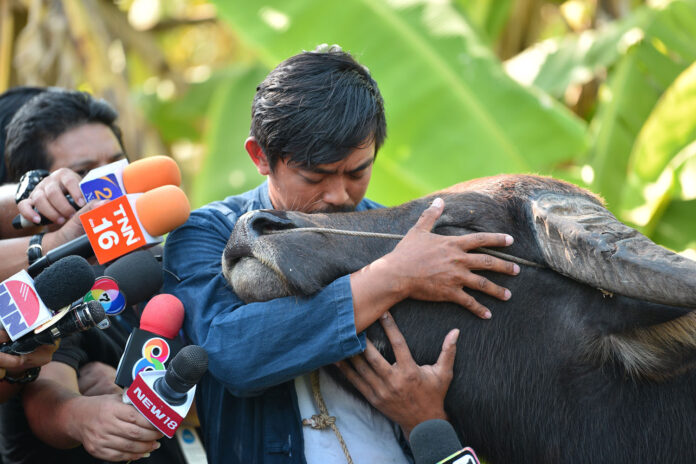
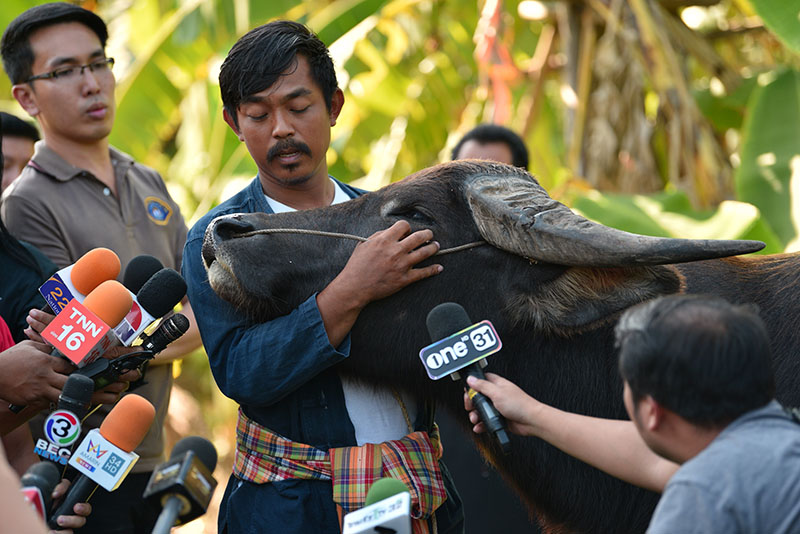
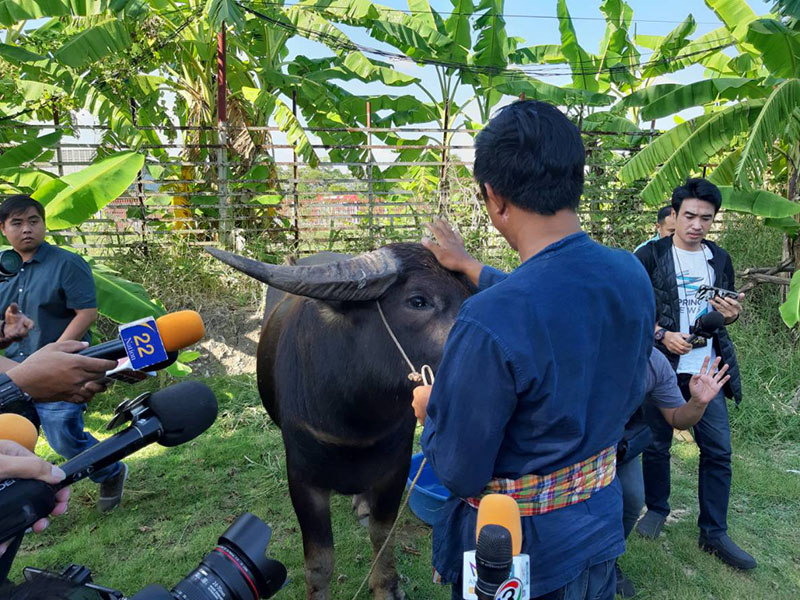
Surat Phaeoket embraces Tongkum on Thursday at Khan Na Yao Police Station.

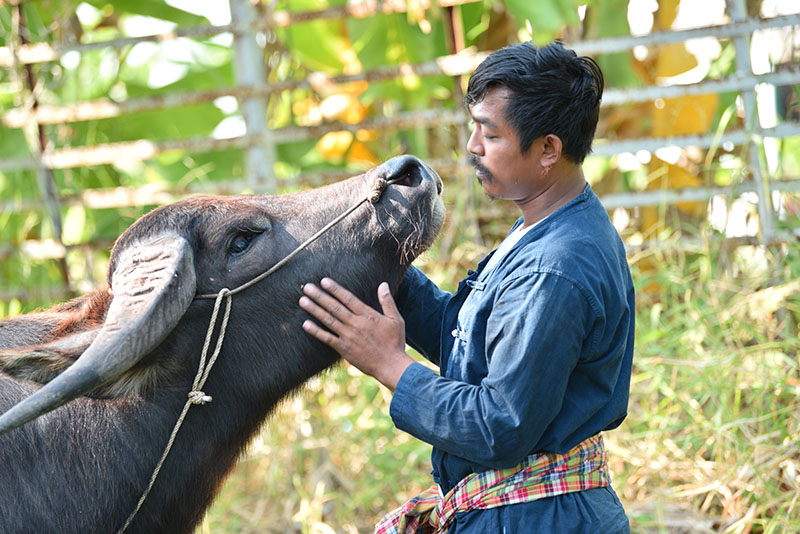
BANGKOK — After spending two days apart from his beloved buffalo, which authorities seized earlier this week, Surat Phaeoket rushed to the police station and past the media to cuddle the animal.

Surat, a farmer charged with serious fraud offenses for crowdfunding the purchase of his buffalo Tongkum, went Thursday to Khan Na Yao police station after he was summoned to present evidence that he had pure intentions in buying Tongkum.

“I never asked for people to send money to save Tongkum’s life. I asked for donations to help me buy him and have him with me forever,” Surat said. “If no one had helped me, I would have nothing left but memories, and my dreams of having a buffalo would be gone. When Tongkum’s not with me, my heart’s not with me.”

S 24764455

“Tongkum! My child! Let’s go home together,” the farmer said while putting his forehead on Tongkum’s snout before leaving to give his testimony to the police.

Surat and Tongkum went viral earlier this month for their smiling online selfies. After the farmer crowdfunded and successfully bought the animal for 100,000 baht, Boonlert Kanpakdee – Tongkum’s former owner and a lesser local official in Chai Nat province – called Surat a beggar Monday for his online appeal.

Boonlert, accompanied by a famous ultra-conservative lawyer, handed the 100,000 baht to police. Tongkum was seized Tuesday and Surat was charged.

“I just wanted to create smiles for people and preserve kwai. I want society to know Chai Nat [province] and the farmer life,” Surat said.

Read: Farmer Who Bought Smiling Buffalo Charged With Fraud, Money Laundering

S 24764451

Unless Surat can prove his good intentions in soliciting donations, Police Col. Singh Singhdet said the farmer was liable for wrongdoing. Since Thursday, Surat has been charged on four separate counts of fraud, money laundering and spreading false information online, crimes punishable by up to 10 years in prison and a 200,000 baht fine.

Singh said that of Surat’s frozen bank accounts, he received close to 160,000 baht in donations and used 100,000 baht to buy Tongkum.

Of the leftover 60,000 baht, Surat said he hasn’t used “a single baht” and wants donors’ input on what to do with it. Surat also thanked his fans for their continued support, which came in all forms – including a woven loincloth locals gave to him for his Thursday trip to Bangkok.

If Surat did not give a clear account and spoke confusingly, it could jeopardize his case, Singh said.

Read: Smiling Buffalo Seized by Police, Impounded as Evidence

According to Surat, Boonlert agreed that the farmer should own Tongkum.

“I’m sad about all that’s happened,” Surat said.

Surat asked for the live interview to end because Tongkum started to display signs of agitation from being surrounded by reporters.

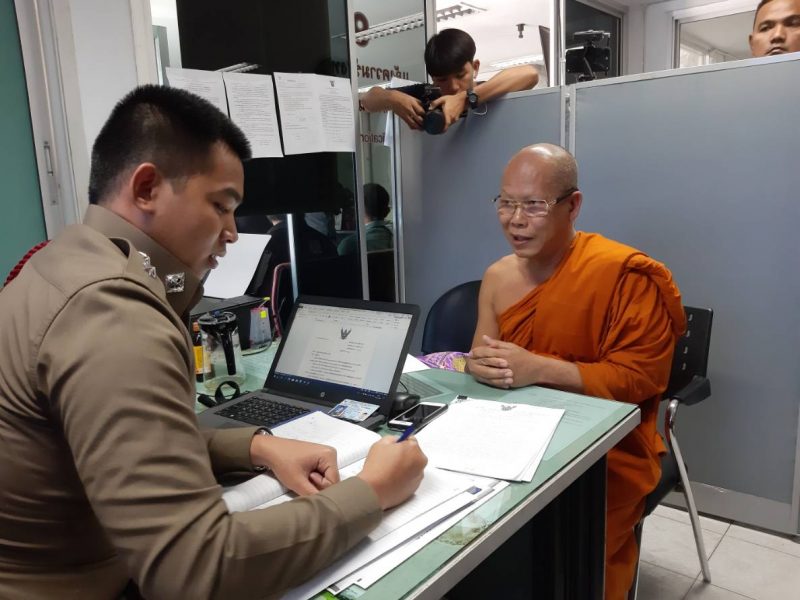
On Thursday, Monk Phra Phuthipnithisorn Kongphokanan of Phetchaburi province’s Wat Maha Thatuworawihan went to Khan Na Yao Police Station to explain to police what it means to tai, or donate for a cause, according to Buddhist vocabulary.

Police say that Surat may have misled the public by claiming that Tongkum would be killed if Surat did not manage to buy him, and used the word “tai” to imply that in one of his Facebook posts. Surat denies writing the words in his online pleas for donations, but admitted to saying them during media interviews.

Phra Phuthipnithisorn said that if used with objects, tai means to help donate and get out of debt, such as getting items back from a pawn shop.

Read: Smiling Buffalo’s Former Owner Mad as Hell About Crowdfunded Sale

“But according to Buddhism, if tai is used with a living thing, it means to help that living thing escape from a life of suffering,” the monk said. “So in this meaning, donating for the buffalo’s life means freeing it from sadness and suffering.”

Still, Phra Phutipnithisorn said Surat’s earthly desire to obtain Tongkum could only be for his personal gain – not the greater good – and advised those who want to donate for livestock to only do so at charity organizations and temples. Phra Phutipnithisorn did not talk about crowdfunding.

S 24764449 S 24764444 S 24764443 108457

Monk Phra Phuthipnithisorn Kongphokanan talks to police on Thursday at Khan Na Yao Police Station.
Col. Singh Singhdet on Thursday at Khan Na Yao Police Station.

Related stories:

Farmer Who Bought Smiling Buffalo Charged With Fraud, Money Laundering

Smiling Buffalo Seized by Police, Impounded as Evidence

Smiling Buffalo’s Former Owner Mad as Hell About Crowdfunded Sale

Internet Saves Beautiful Man-Buffalo Friendship

With His ‘Smiley Buffalo’ to be Sold Off, Farmer Needs Internet’s Help

Chai Nat Man’s Lovely Kwai Friendship Warms Hearts

Advertisement

Jim Gaffigan to Tell Food, Fat Dad Jokes on Bangkok Stage

BANGKOK — Expect a lot of food jokes and highs and lows of fatherhood when the king of “clean” comedy brings his world tour to Bangkok next year.

For the first time, Jim Gaffigan will appear on a Bangkok stage to rhapsodize about food, his “fatness,” joy and the horror parenting five children.

Jim Gaffigan’s Quality Time Tour starts at 8pm on March 22 at Scala Cinema. Tickets start at 1,800 baht and are available online. The standalone theater is located in Soi Siam Square 1 and can be reached from BTS Siam.

Gaffigan, 52, is an actor, producer and comedian whose many shows are featured on Netflix. His face can be recognized from “The Unbreakable Kimmy Schmidt,” “Portlandia” and “The Jim Gaffigan Show.” He’s also a New York Times best-selling author for his work “Dad is Fat.”

Advertisement

Future Forward Fires Youth Wing Leaders Over Alleged Fund Misuse

Future Forward Party secretary general Piyabutr Saengkanokkul compaign in Rayong province earlier this week. Photo: Future Forward Party

BANGKOK — The Future Forward Party removed its youth wing leaders from their duties Wednesday after accusing them of misusing party funds, an allegation denied by one of the expelled leaders.

A party spokeswoman said the decision was made after it received complaints that the five party members misused funds allocated to the youth wing. But one of them, women’s rights advocate Wipaphan Wongsawang, called it an attempt to curb the wing’s independence.

Wipaphan also announced her resignation from the party in protest Wednesday night on a Facebook post which was later deleted.

She referred to a long debate “about the New Generation Network’s authority” and added that talks about budget abuse were intended to distort the facts.

The party’s youth wing is a subsidiary that encourages political participation of younger generations. An estimated 6 million people will be eligible to vote for the first time in February.

“I am saddened by the decision from those in power at the party. You must seriously reflect on where you are leading your people and what led you to this point,” Wipaphan wrote in the deleted post. She declined to comment when contacted.

Party spokesperson Pannika Wanich insisted the problem was the group’s abuse of funds.

“The party reiterates that it cannot ignore inappropriate use of funds because every baht of the budget comes from membership fees and donations from supporters, who wish the party to be an effectively managed and transparent political institution for the people’s benefit,” Pannika said in a Thursday statement.

Pannika added that the party’s accountant had produced evidence of the alleged inappropriate use of funding to the board and a unanimous decision had been made to remove the youth wing members.

Asked how much was misused, Pannika said such information can only be released if and when members of the fired youth wing allow it.

Advertisement

Buddhist Authorities Hunt Monk For Being Too Ripped

Photos: Surasek Kwathijak / Facebook

BANGKOK — Less than a week after anonymous photos of a ripped monk went viral online, national Buddhism authorities are on the hunt for the man, who they say tarnished the religion’s image.

Narong Songarom, deputy director of the National Office of Buddhism said Thursday he had ordered national and provincial Buddhism officials to investigate and find the muscular monk’s identity.

“Against monkhood discipline, this man has put on clothes similar to monk robes and taken photos of himself with fit muscles online. Although not a grave error in the monk’s way, it is an earthly sin that invites societal criticism and damages Buddhism,” Narong said Thursday.

Narong said authorities were unaware if the man in the photo displaying his pecs and abs is a real monk or a layman cosplaying as one. He said the monk would be warned and punished for his behavior if found by local Buddhist authorities, in accordance with the Buddhism Act.

The National Office of Buddhism also asked the Ministry of Digital Economy and Society to stop the photo from being circulated online.

Other monks have pitched in their criticism of the monk and his six pack.

“Building muscles and putting photos up on social media like this is a monk that forgets his vows of monkhood,” Phra Payom Kalyano, abbot of Wat Suan Kaew in Nonthaburi, said. “It’s inappropriate because it invites criticism and tarnishes our religion. If you want to exercise and have have a muscular body just stay home instead of being ordained.”

Phra Payom said the incident was not a large enough offense for disrobing, however, because the monk could be “making his body strong to can carry out his monkhood duties better.”

“The best exercise for monks is meditation, collecting alms and cleaning temples,” he said.

The photos were originally posted Saturday by Surasek Kwathijak and have since been shared over 2,000 times. Surasek said he was just reposting photos he found on Twitter, and does not know the man in the photo or if he is really a monk.

“Going to the fitness isn’t a monk’s activity, but I’ll give it a pass just this once,” the caption reads. “Putting whey into your almsbowl.”

More than one thousand comments by netizens on the post are mostly humorous.

“Going to hell for this,” Yok Pluemchit wrote, tagging a friend. “Wiping up my saliva.”

“[He’s] opening a VIP ticket to hell,” wrote Pornphan Puangthong. “Hell seems like a better place to be now.”

Being ripped frowned upon, but being too large isn’t okay either. The Ministry of Health in May said that over half of monks are obese from being given junk food in almsbowls.

Monks in Thailand’s Theravada Buddhism are often restricted from publicly engaging in many acts. A film featuring a monk crying was censored earlier this month. Even a man who was about to be ordained was criticized online for taking photos commemorating the milestone in his life in May 2017.

Related stories:

Thai Film Minus Crying Monk Approved by Censors

Censors Pulled Thai Film Due to Crying Monk Scene

Thai Film Pulled Over ‘Sensitive’ Buddhist Scene

Please Don’t Feed Junk to Chunky Monks: HealthMin

Man Takes Dope Ordination Photos. Internet Cringes.

Advertisement

Jailed Yingluck Minister Sent to Hospital

Former Commerce Minister Boonsong Teriyapirom arrives at the court on Aug. 25, 2017.

BANGKOK — A former minister currently serving a jail term for corruption was taken to hospital for severe back pain, the head of Corrections Department said Thursday.

Former Commerce Minister Boonsong Teriyapirom was admitted Wednesday to the Police Hospital to treat infection in his intervertebral disk, Narat Savettanan said by phone. He said physicians considered Boonsong’s condition to be serious.

“If his condition weren’t serious, we wouldn’t have transferred him to the hospital,” Narat said, adding that it’s not yet clear how long the former minister will have to stay in hospital.

Boonsong, who served under former premier Yingluck Shinawatra, was sentenced in 2017 to 42 years in prison after the court found him guilty of conspiring with officials and businessmen in a fraudulent rice export deal.

Narat said the amount of days Boonsong spent in doctors’ care would be counted in his serving time.

“We dispatched two guards to monitor him,” the corrections department director said.

Advertisement

UN: Climate Change, Depleted Resources Leave World Hungry

A doctor measures the arm of a malnourished girl in October at the Aslam Health Center, Hajjah, Yemen. Photo: Hani Mohammed / Associated Press

BANGKOK — Feeding a hungry planet is growing increasingly difficult as climate change and depletion of land and other resources undermine food systems, the U.N. Food and Agricultural Organization said Wednesday as it renewed appeals for better policies and technologies to reach “zero hunger.”

Population growth requires supplies of more nutritious food at affordable prices, but increasing farm output is hard given the “fragility of the natural resource base” since humans have outstripped Earth’s carrying capacity in terms of land, water and climate change, the report said.

About 820 million people are malnourished. The FAO and International Food Policy Research Institute released the report at the outset of a global conference aimed at speeding up efforts to achieve zero hunger around the world.

“The call for action is very clear. It is possible in our lifetime and it is also realistic to end hunger and malnutrition,” Inonge Wina, vice president of Zambia, told the gathering.

Food security remains tenuous for many millions of people who lack access to affordable, adequately nourishing diets for a variety of reasons, the most common being poverty.

But it’s also endangered by civil strife and other conflicts. In Yemen, where thousands of civilians have died in airstrikes by a Saudi-led coalition, the aid group Save the Children says 85,000 children younger than 5 may have died of hunger or disease in the civil war.

In Afghanistan, severe drought and conflict have displaced more than 250,000 people, according to UNHCR, the U.N. refugee agency.

FAO Director-General Jose Graziano da Silva noted that the number of hungry and malnourished people in the world has risen to levels last seen a decade ago.

“After decades of gains in fighting hunger, this is a serious setback and FAO and the U.N. sister agencies, together with member governments and other partners, are all very concerned,” Graziano da Silva said in a videotaped address to the conference.

Hunger is still most severe in Africa, but the largest number of undernourished people live in the Asia-Pacific region, the report said. It said good public policies and technology are the keys to improving the situation.

The FAO estimates that global demand for food will jump by half from 2013 to 2050. Farmers can expand land use to help make up some of the difference, but that option is constrained in places like Asia and the Pacific and urbanization is eating up still more land that once may have been used for agriculture.

Increasing farm output beyond sustainable levels can cause permanent damage to ecosystems, the report said, noting that it often causes soil erosion, pollution with plastic mulching, pesticides and fertilizers, and a loss of biodiversity.

China destroys 12 million tons of tainted grain each year, at a loss of nearly USD$2.6 billion, according to the report.

Story: Elaine Kurtenbach

Advertisement

Report Faults Safety Failures, Defects in Lion Air Crash

A Lion Air passenger jet takes off from Juanda International Airport in Surabaya, Indonesia, in a 2012 file photo. Photo: Trisnadi

JAKARTA — Pilots fought against an automated system that pitched a Boeing jetliner’s nose down repeatedly because of a faulty sensor until they finally lost control and plunged into the Java Sea last month, Indonesian investigators said Wednesday.

At a news conference, safety officials said they were still struggling to understand why the plane crashed, killing all 189 people on board.

The National Transportation Safety Commission’s Nurcahyo Utomo said investigators were trying to figure out from interviews with engineers why they certified that the Boeing 737 MAX 8 was airworthy and whether they had followed required maintenance procedures. Pilots of previous flights had reported problems with control systems on the brand-new jet.

The board issued a preliminary report that stopped short of placing blame for the crash –the investigation is continuing – but it provided new details about the pilots’ struggle to fly the highly automated jet and Lion Air’s inability to fix problems with sensors on the plane.

Sensors that measure speed were flushed and checked, and an electrical plug was cleaned before the fatal flight. Mechanics, however, did not check sensors that measure whether the nose of the plane is pointing up or down.

An “angle of attack” sensor gave faulty readings throughout the short flight, triggering a system that automatically pointed the plane’s nose down more than two dozen times, with pilots responding by manually fighting to correct the pitch. Pilots even asked air traffic controllers to tell them how fast and high they were flying.

The malfunctions and warnings from the plane’s control system appeared to overwhelm the pilots almost as soon as the jet became airborne, said another investigator, Ony Suryo Wibowo.

“The problem is if multiple malfunctions occur all at once, which one should be prioritized?” Wibowo said.

In a statement following release of the report, U.S.-based Boeing declared that the MAX, its newest plane, is safe. The manufacturer played up the possibility of pilot error.

Boeing noted that the crew of the plane’s previous flight one day earlier had responded correctly to the automatic nose-down pitch and flew the plane manually. They also ran safety checklists. The preliminary report does not say whether pilots on the deadly flight took those steps, Boeing pointed out.

Boeing has said that the procedure to correct an automatic nose-down pitch is in the plane’s operating manual and pilots should have known about it.

Several experts said, however, that Boeing likely will have to consider changes in the new anti-stall system, perhaps developing an algorithm to disregard sensor readings that appear off-base.

The report offered new details on persistent problems with sensors on the Lion Air jet and the airline’s efforts to fix them.

John Cox, a safety consultant and former airline pilot, said Lion Air should have taken the troubled plane on a maintenance test flight.

“I don’t think the airplane was ready for passenger service because they had not validated that they had fixed the problem,” he said.

Searchers have not yet recovered the plane’s cockpit voice recorder, which could tell investigators what the pilots were doing – or failing to do – to regain control of the plane during the brief, erratic flight.

The report by Indonesia’s safety commission did not draw conclusions about why the crew lost control of the plane, but it repeated earlier recommendations that pilots be better versed in emergency procedures and aware of past aircraft problems. They recommended that Lion Air, a fast-growing low-cost airline based in Jakarta, ensures that pilots follow proper procedures “to improve the safety culture.”

Mary Schiavo, a former inspector general of the U.S. Department of Transportation, said the preliminary report offered a road map of final recommendations that are likely to emerge from the investigation.

“They will be looking for more precise reporting of problems (by pilots), and certainly a better maintenance response,” she said.

Peter Lemme, an expert in aviation and satellite communications and a former Boeing engineer who wrote an analysis of the data on his blog, compared the scene in the cockpit to “a deadly game of tag” in which the plane pointed down, the pilots countered by manually aiming the nose higher, only for the sequence to repeat about five seconds later.

That happened 26 times during the 11-minute flight, but pilots failed to recognize what was happening and follow the known procedure for countering incorrect activation of the automated safety system, Lemme told The Associated Press.

Lemme said he was troubled that there weren’t easy checks to see if sensor information was correct, that the crew of the fatal flight apparently wasn’t warned about the problems on previous flights and that the Lion Air jet wasn’t fully repaired after those flights.

“Had they fixed the airplane, we would not have had the accident,” he said. “Every accident is a combination of events, so there is disappointment all around here,” he said.

The U.S. National Transportation Safety Board and Boeing experts are helping the Indonesian investigators.

Boeing has a great deal at stake in defending its plane.

More than 200 MAX jets have been delivered to airlines around the world. Pilots at American Airlines and Southwest Airlines complained this month that they had not been given all information about the new automated anti-stall safety system on the MAX.

Boeing shares fell 14 percent in the last three weeks through Tuesday, as investigators focused on the possible role of faulty sensor readings on the new plane. They rallied on Wednesday, however, to close up USD$15.47, or 4.9 percent, at $333.50, the stock’s best day in 10 months.

Story: Niniek Karmini, David Koenig 

Advertisement

FIFA Ethics Judge Resigns While Suspected of Corruption

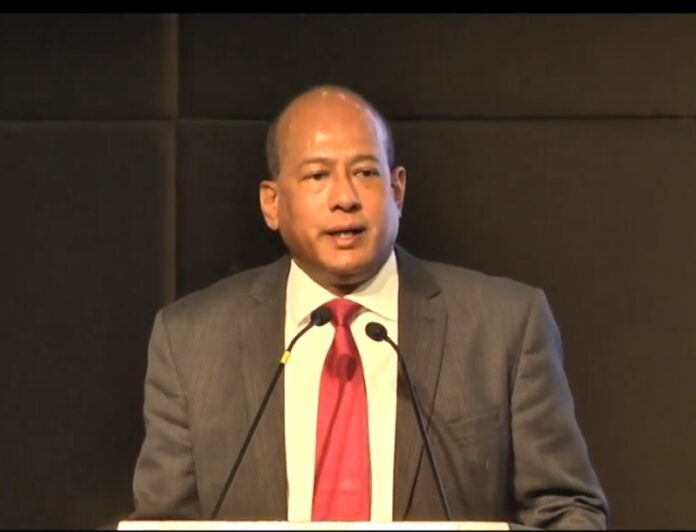
Sundra Rajoo delivers a speech in 2017. Image: Asian International Arbitration Centre / YouTube

ZURICH — FIFA says one of its ethics committee judges resigned after he was investigated for alleged corruption in Malaysia.

Sundra Rajoo was appointed one year ago after passing an integrity check to be a deputy chairman of the FIFA ethics committee’s judging panel.

Rajoo was arrested last week in an investigation of alleged financial wrongdoing as director of the Asian International Arbitration Centre.

A court in Kuala Lumpur gave him an unconditional release citing his diplomatic immunity, though he resigned from the job.

During Rajoo’s time at FIFA, ethics judges imposed life bans on several soccer officials who admitted bribery charges in a sprawling U.S. Department of Justice investigation.

FIFA said last week Rajoo would not be involved in ethics cases while he was under suspicion in Malaysia.

Advertisement

Finnish Christian Missionaries Held in Malaysia Return Home

Spokesman and group leader Timo Valtonen, center, holds up a pen as he makes a statement to the press upon his Wednesday arrival, with three other Finns after being deported from Malaysia, at the airport in Vantaa, Finland. Photo: Associated Press

COPENHAGEN, Denmark — Four Finnish tourists who were arrested in Malaysia last week for distributing Christian materials in public places on a resort island returned to Finland on Wednesday.

Timo Valtonen held up a pen – similar to ones inscribed with Bible verses that were seized in Malaysia – as he and three others were greeted by supporters at Helsinki’s Vanta airport.

They were detained last week in Langkawi and investigated for allegedly causing disharmony and violating their visa status. Police seized 47 pens and 336 notebooks containing Bible texts. They were deported Tuesday.

Proselytizing of Muslims by members of other religions is forbidden in Malaysia, although the reverse is allowed. Muslims, who comprise nearly two-thirds of Malaysia’s 31 million people, are also not legally permitted to change religion.

Advertisement

Hot News

LATEST NEWS

Bangkok
overcast clouds
33.3 ° C
36.6 °
33.3 °
65 %
4.5kmh
100 %
Sun
33 °
Mon
33 °
Tue
34 °
Wed
30 °
Thu
29 °