



























34.4 C
Bangkok
Sunday, June 28, 2026
Home Blog Page 1835

Desperation Explodes to Anger as Indonesia Quake Toll Rises

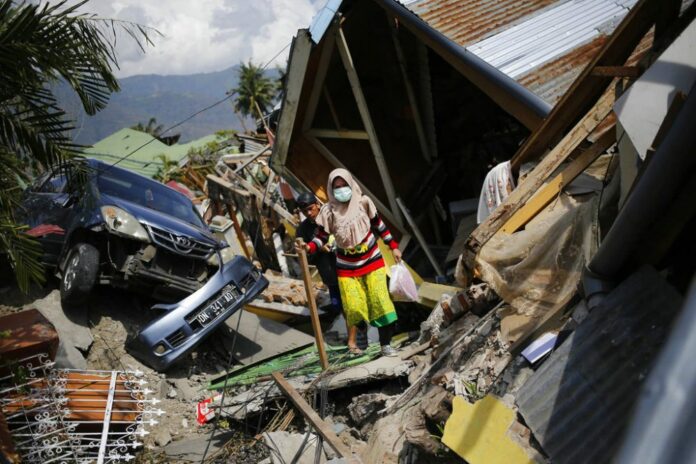
A woman on Tuesday makes her way through the rubble of houses in Balaroa neighborhood in Palu, Central Sulawesi, Indonesia. Photo: Dita Alangkara / Associated Press

PALU, Indonesia — Desperation exploded into anger four days after an earthquake and tsunami severely damaged parts of an Indonesian island, with residents Tuesday showing frustration at the pace of rescues, grabbing food from damaged stores and begging Indonesia’s president to help them. The confirmed toll exceeded 1,200 dead with hundreds severely injured and still more trapped in debris.

“Pay attention to Donggala, Mr. Jokowi. Pay attention to Donggala,” yelled one resident in footage broadcast on local television, referring to President Joko “Jokowi” Widodo. “There are still a lot of unattended villages here.”

Most of the attention so far has focused on the biggest affected city, Palu, home to 380,000 people with considerable damage. The toll was raised to 1,234 on Tuesday afternoon for the towns of Palu, Donggala, Sigi and Parigi Muntong with 799 people badly injured, national disaster agency spokesman Sutopo Purwo Nugroho said at a news conference in Jakarta. In Sigi and the hard-hit area of Balaroa, more people remain trapped, meaning the toll is likely to rise.

He said 153 bodies were buried Monday in a mass grave and the operation continued Tuesday and adding the government was working to speed up aid distribution. A special aircraft carrying 12,000 liters of fuel was expected to arrive and trucks carrying food were en route with police escorts to guard against looters.

Donggala and other outlying areas have received little assistance largely due to impassable roads. The town’s administration head, Kasman Lassa, said residents should take only food staples from shops.

“Everyone is hungry and they want to eat after several days of not eating,” Lassa said on local TV. “We have anticipated it by providing food, rice, but it was not enough. There are many people here. So, on this issue, we cannot pressure them to hold much longer.”

Desperation was visible everywhere among victims receiving little aid. In Palu, signs propped along roads read “We Need Food” and “We Need Support,” while children begged for cash in the streets and long lines of cars snarled traffic as people waited for fuel.

Teams were searching for trapped survivors under destroyed homes and buildings, including a collapsed eight-story hotel in the city, but they needed more heavy equipment to clear the rubble. Nearly 62,000 people have been displaced from their homes, Nugroho said.

Many people were believed trapped under shattered houses in Balaroa, where the earthquake caused the ground to heave up and down violently.

“I and about 50 other people in Balaroa were able to save ourselves by riding on a mound of soil which was getting higher and higher,” resident Siti Hajat told MetroTV, adding her house was destroyed.

In Palu’s Petobo neighborhood, the quake caused loose, wet soil to liquefy, creating a thick, heavy mud that resulted in massive damage. “In Petobo, it is estimated that there are still hundreds of victims buried in mud,” Nugroho said.

Residents who found loved ones — alive and dead — over the weekend expressed frustration that it took rescue teams until Monday to reach Petobo.

The magnitude 7.5 earthquake struck at dusk Friday and generated a tsunami said to have been as high as 6 meters (nearly 20 feet) in places.

President Widodo authorized the acceptance of international help, Nugroho said Monday, adding that generators, heavy equipment and tents were among the most-needed items. The European Union and about 10 countries have offered assistance, including the United States and China, he said.

Australian Prime Minister Scott Morrison said Tuesday that his government had given $360,000 to help victims and was in talks with Indonesian authorities about a second round of aid. The initial funds would go to the Indonesian Red Cross for the most obvious emergency aid needs, such as tarpaulins.

The coastline at Palu was strewn with rubble and a few brightly colored cargo containers poking out of the water. Buildings near the water were ruined shells. The arches of a large yellow bridge rested in the water and eerie drone footage showed a Ferris wheel, untouched, on a beach scraped bare by the waves.

In the Petobo neighborhood, Edi Setiawan said he and his neighbors rescued children and adults, including a pregnant woman. His sister and father, however, did not survive.

“My sister was found embracing her father,” he said. “My mother was able to survive after struggling against the mud and being rescued by villagers.”

Indonesia is frequently struck by earthquakes, volcanic eruptions and tsunamis because of its location on the “Ring of Fire,” an arc of volcanoes and fault lines in the Pacific Basin. A powerful quake on the island of Lombok killed 505 people in August, and two moderate quakes near an eastern island on Tuesday reportedly damaged a bridge.

The vast archipelago is home to 260 million people on more than 17,000 islands that stretch a distance similar to that between New York and London. Roads and infrastructure are poor in many areas, making access difficult in the best of conditions.

Story by Niniek Karmini and Stephen Wright
Advertisement

Firebrand Ultra-Royalist Hiso Joins Democrat Party

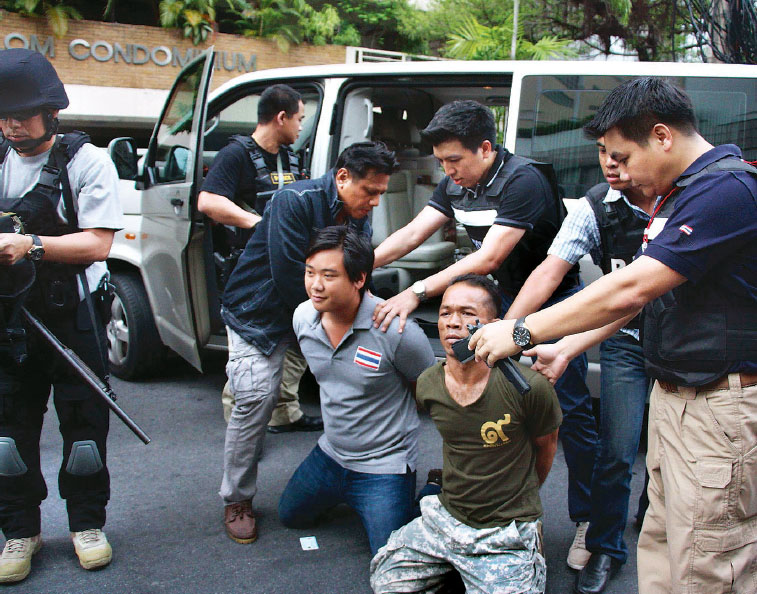
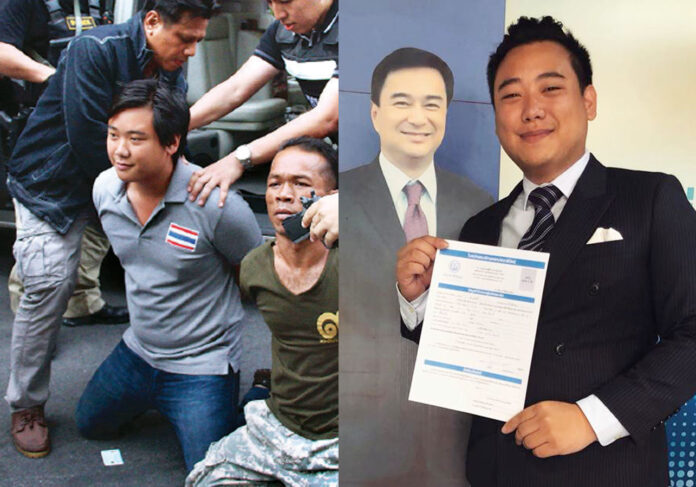
Left, Tanat Thanakitamnuay smiles while apprehended by police on May 16, 2014. Right, Tanat signs up for Democrat Party membership on Monday.

BANGKOK — A young hiso known for vitriolic comments against political opponents and leading protests that prompted the 2014 coup officially joined the Democrat Party Monday.

Tanat “Nat” Thanakitamnuay, who was a leader of the People’s Committee for Absolute Democracy with the King as Head of State, aka PCAD or PDRC, joined the Democrat Party while berating the Pheu Thai Party and ousted ex-Prime Minister Thaksin Shinawatra.

“I want to come into politics because I can’t let this ghost continue to cheat the country. I can’t bear it. Of course, I’m talking about removing the roots of Thaksinocracy. These are the ideals I had since protesting with the PDRC, even before having the opportunity to work for the Democrat party. I will never betray my own ideals,” Tanat, 26, wrote Friday in a Facebook post.

His comments came as a response to a news story about former Pheu Thai Lopburi MP Amnuay Klungpa, who said on the same day that he supported reconciliation and cooperation among the opposing parties.

“I will never cooperate with the Pheu Thai Party as long as Thaksin the criminal remains their leader…they can believe in serving a convict like Thaksin if they want, but don’t go to the media and talk about reconciliation with us. Why don’t you take a hard look at yourself?” Tanat wrote.

This erupted in a flurry of back-and-forths.

ลูกนัท03
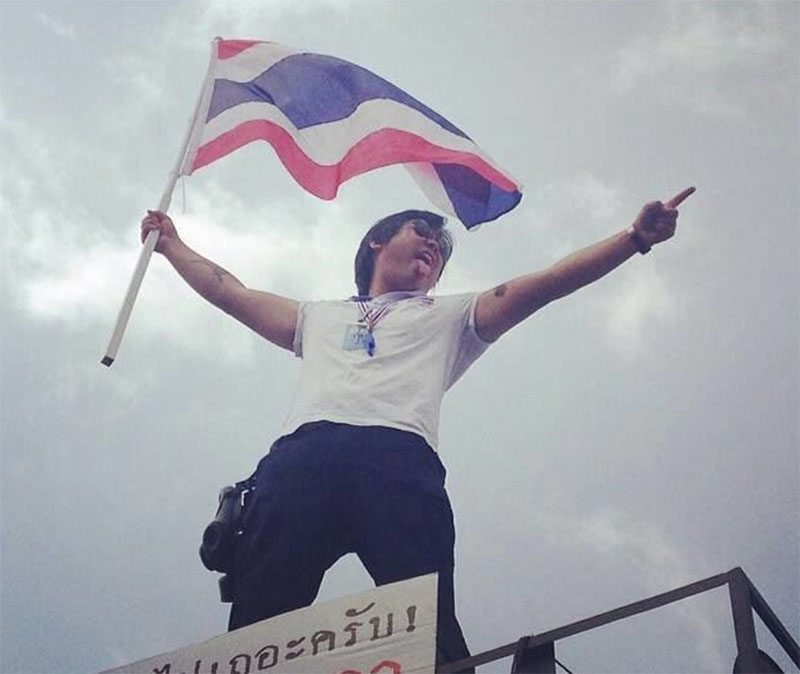
Tanat Thanakitamnuay at a PCAD protest in 2014.

“The Pheu Thai Party has never considered cooperating with minions who blew whistles and brought out crappy crooks that seized power and destroyed the country,” senior Pheu Thai party member and former commerce minister Watana Muangsook, 61, tweeted on Friday. “If you want to uproot anything, you have to become an MP first. Next time, wipe your mouth before you speak so that the smell of your mother’s milk won’t waft out.”

Tanat quickly responded on his page on Saturday.

“Mother’s milk is still better than jailbird water. Does his mouth still stink of jail? My habits aren’t tied to power or status, so I don’t think I have to be a MP exercising my rights to protect my country from illegal slaves that escape justice. I’m not a hairdresser, but I will uproot everything that’s necessary,” Tanat wrote. “If you don’t want to cooperate, then what dog of yours came out barking that they want to cooperate with the Democrat Party?”

During the PCAD protests in late 2013 and early 2014, Tanat was a high-profile young leader who harassed politicians in the Yingluck administration and escaped arrest by mob rube.

On May 16 2014, Col. Uten Nuipan and a force of 20 policemen apprehended Tanat and his PCAD bodyguard at Silom Condominium after the court issued his arrest warrant for treason. The PCAD surrounded the police and pressured them until the two were released.

Untitled 1
Tanat smiles while apprehended by police on May 16, 2014.

On March 15, 2014, Tanat blew his whistle while approaching Kittiratt Na-Ranong, the deputy prime minister of the Yingluck administration, and yelled at him to resign.

“Whatever happens, I will never let someone like this have a place in society,” he says before beginning his verbal assault.

Tanat – then 22 – gained international fame on a Vice news video released April 23, 2014 about his lifestyle and leadership of the PCAD. He was featured with another young rich scion protesting in the mob, Victor Kritsanaseranee.

“I was just taking a joyride,” he said about driving his Porsche Carrera 911 into a crowd of Redshirts, or pro-Thaksin activists, when he was 18.

In April 3, 2010, Tanat slammed his car into their parked motorcycles on the sidewalk by the Holiday Inn Sukhumvit. He crashed into a fire hydrant as protesters smashed his car windows.

Tanat told police he pressed the gas pedal out of surprise, and then added that he was related to famed director Takonkiet Viravan.

“You have a number of Ferraris, but not even one in red color,” Victor says to Tanat, commending him for not having a vehicle of the same color as the Redshirt movement, despite the supposed popularity of red Ferraris. “And it takes a lot of guts for you, not to get a red Ferrari.”

“Driving around a city like Bangkok in your precious little pony, that’s about as good as it gets. That’s exactly what we fight for,” are among the things Tanat says in the video to explain his impetus behind protesting for the PCAD.

Tanat is heir to the Noble Development residential property management responsible for condos such as Noble Around, Noble Nue, Noble Ambience, Noble Be39 and Noble Be33.

“There’s nothing real about the democracy we have under the Thaksin regime. There’s nothing real about this coming election or the election before. All the votes are being bought,” Tanat said in 2014. “We are prepared for violence.”

Tanat’s official Facebook page is relatively new, with the first post dated June 19.

“I sincerely urge YOU – [sic] as member of our society to be politically active once again,” wrote the then-PCAD leader in an Aug. 16 post on his page. “[W]e shall thrive in progress yet preserves [sic] our greatest value in which we hold dear, the institution that is the nation, the faith and The King.”

Untitled 3 copy

Advertisement

Maya Beach Closed Indefinitely to Tourists: Official

Tourists at the popular Maya bay on Phi Phi Leh in Krabi province. Photo: Rajavi Omanee / Associated Press

KRABI — Sorry, tourists, that famous Thai beach Leonardo DiCaprio once set foot on will now remain closed indefinitely.

Initially set to reopen next month, Krabi province’s Maya Beach – which became world-famous as a setting for Hollywood film “The Beach” in 2000, won’t welcome any visitors until the ecology there rejuvenates to its “original state,” a conservation department official announced Tuesday.

“Experts have expressed concerns that there is still not enough [time] for the coral and the newly planted forest to be revived,” said Vorapot Lomlim of the Hat Noppharat Tara and Phi Phi Marine National Park.

He added that more than 1,000 coral have been planted in the bay, with more to come soon. Still, they’ll take years to be fully grown.

Officials first announced in March that the beach would be off limits to tourists from June to September, later extended to November, from concerns that the massive influx of visitors was posing a serious harm to its ecology, especially the coral.

Vorapot today said the department could not set a schedule for the rehabilitation process.

The decision to shut off the beach has been met with both praise from environmentalists and complaints from those in the tourism industry.

Watpol Chantaro, president of Phi Phi Leh Island travel business association, said of the latest announcement that it would badly impact local tourism.

He said the authorities did not inform the island business guild each time they would delay the beach reopening, preventing tourists from visiting the place even though they booked the service in advance.

The association will hold a meeting next week to discuss solutions and will petition the provincial governor and related government agencies later on, Watpol added.

Related stories:

Look Don’t Touch: Maya Beach Cordoned Off From Boats

Maya Beach of ‘The Beach’ Fame Set for Tourism Respite

‘The Beach’ Beach on Phi Phi Leh Gets Vacation From Tourists

Advertisement

Suspects in Chinese Tourist Murder Left Country: Police

Rangers at the scene of Ton Nga Chang Waterfall on Sept. 20.

BANGKOK — Individuals who might be involved in the death of a Chinese tourist in southern Thailand are no longer in the country, police said Tuesday.

Police will ask Chinese authorities to have those individuals brought to Thailand for questioning, Lt. Col. Khemarin Pismai said. Police ruled the 28-year-old woman’s death in Songkhla province a homicide.

“Our next step is to coordinate with the foreign authorities,” Khemarin said.

He added that a Chinese national is in police custody and treated as a person of interest, though the man denied any knowledge of the incident.

“He said he doesn’t know anything about it,” Khemarin said. “But we have suspicions. That is why we are treating him as a person of interest.”

The body of Chinese tourist Tian Lei was found in September in a waterfall in Hat Yai district. Though initially reported as a falling accident, then-deputy tourism police chief Surachet Hakpan later told the media she was murdered.

Surachet said investigators believe the murder to be a crime of passion.

Songkhla provincial police commander Preeda Piamwaree said he’s not allowed to talk to the media about the case.

Speaking to reporters today, tourism minister Weerasak Kowsurat confirmed “many individuals” sought by police have already left the country. Despite Surachet’s assessment, Weerasak maintained that investigators have not ruled out an accident as a potential cause of death.

Advertisement

Prisons to Allow Video Calls Between Inmates, Family

A March 2018 file photo of a Thai prison

BANGKOK — Officials are eyeing a popular messaging application to add video call services between inmates and visitors in prisons.

Five prisons nationwide will allow inmates to receive video calls from family and relatives through Line application for the first time, according to the Department of Corrections on Monday.

Col. Naras Savestanan, chief of the department, said the service had been tested and would initially apply to Phitsanulok Central Prison, Rayong Central Prison, Chiang Mai Central Prison, Nakhon Si Thammarat Central Prison and Khlong Phai Central Prison in Nakhon Ratchasima province.

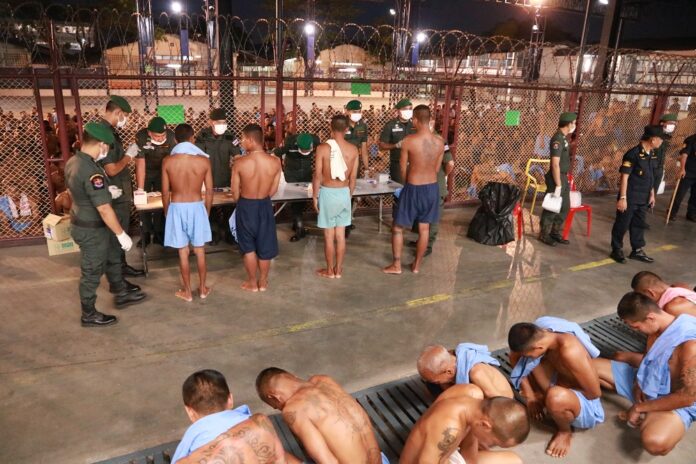
This is not the first time authorities make an effort to adopt technology in the visiting system. Naras said the department tested a video conference call a decade ago, but that the service was terminated due to a technical error.

“But today, communications via social media have developed significantly and the internet speed is much faster, so we decided to use it again,” Naras said.

The trial is expected to be completed within a couple of months, Naras said, adding that the service would expand to other prisons if successful.

The department chief said the process will require that visitors provide their IDs and register at the Department of Correction. Officials will then contact visitors to tell them if, when and how many times they can call.

Advertisement

In Neighborhood Buried by Quake, Kin Found in Final Embrace

Indonesian red cross team carry the body of a tsunami victim following a massive earthquake and tsunami Monday at Talise beach in Palu, Central Sulawesi, Indonesia. Photo: Tatan Syuflana / Associated Press

PALU, Indonesia — For two days, Edi Setiawan helped pull the dead and the living out of a sea of mud and debris, all of them victims of one of Indonesia’s deadliest earthquakes in years.

And then, half-buried in the brown sludge, he saw two motionless bodies that broke his heart.

“I could see my father still embracing my sister,” Setiawan said Monday, recounting the devastating moment he found the pair entombed in mud near their home in the city of Palu.

“I just cried,” he said. “I was able to save other people, but I was unable to save my own family.”

Friday’s magnitude 7.5 quake killed more than 840 people and destroyed thousands of homes, triggering a humanitarian crisis with survivors now in desperate need of food, water and fuel.

Most of the casualties were caused by the quake itself and a deadly tsunami that slammed into the coastline around Palu. But hundreds of others were buried alive by a phenomenon called liquefaction, in which loose soil shaken by a quake gives way and collapses.

Disaster agency spokesman Sutopo Purwo Nugroho said Palu’s Petobo neighborhood, where Setiawan lived, was especially hard-hit. “There are still hundreds of victims buried in mud” in the area, he said.

On Monday, newly arrived rescue teams were confronting the behemoth task of trying to dig them out.

Palu, a city of 380,000 on the western coast of central Indonesia’s Sulawesi island, stood in ruins. Toppled cellphone towers have cut off communications, while downed power lines leave the city in darkness after the sun sets.

While thousands of desperate people swarmed the airport tarmac trying to escape on board a military aircraft that arrived with aid, burials began in a freshly dug mass grave.

When the massive quake struck on Friday, Setiawan said he was cleaning debris from another strong tremor that had cracked the walls of his home just hours earlier but left it standing.

As the 32-year-old rushed outside, “the ground I stepped on cracked … water and mud came out, more and more from all directions.”

His neighborhood seemed to be sinking.

His wife and year-old daughter were fine, but other family members, friends and neighbors were missing.

He tried to reach his parents’ home, about 300 meters (yards) away, but the sea of mud that engulfed the area made it too hard to reach. With other villagers, he turned to saving whoever he could.

“I took a 2-year-old (child) on my head, a 3-year-old on my back, and held a 5-year-old while struggling to swim out from mud to the asphalt road,” Setiawan said.

Villagers hurled ropes to people stuck in pools of thick mud that seemed like quicksand, and pulled them out by hand. Some of them saved his mother.

By Saturday, they had rescued 11 adults, including a pregnant woman, and two other children – although one later died.

Then they turned to the dead, recovering four bodies. It was Saturday when Setiawan saw the bodies of his father and sister in the sludge, locked in the embrace that had marked the last moment of their lives.

Many complained bitterly at the failure of rescue teams, overwhelmed by the scale of the crisis, to make it to their neighborhood in time.

Idrus, 52, who like many Indonesians uses only one name, said that “up to Saturday, we still saw many people screaming for help from the roofs.”

“But we could not do (anything) to help them,” he said. “Now, their cries are no longer heard.”

Setiawan said the first government rescue teams arrived in his area Sunday, but because the mud was still unstable, they were only able to take photos documenting the tragic scene.

On Monday, they returned, and recovered eight bodies.

Story: Todd Pitman, Niniek Karmini

Advertisement

Online Freedom Exhibit at TCDC Talks Memes, Pixels, Censorship

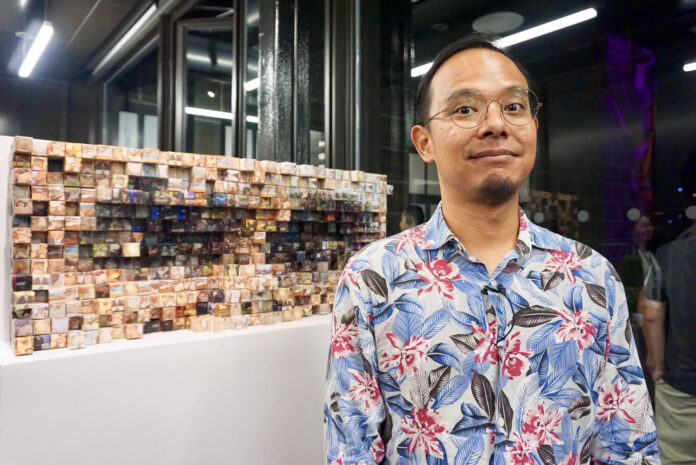
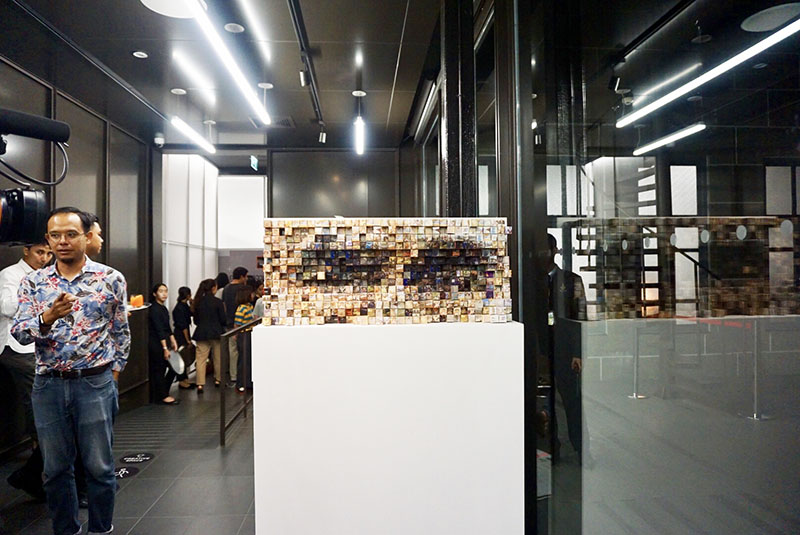
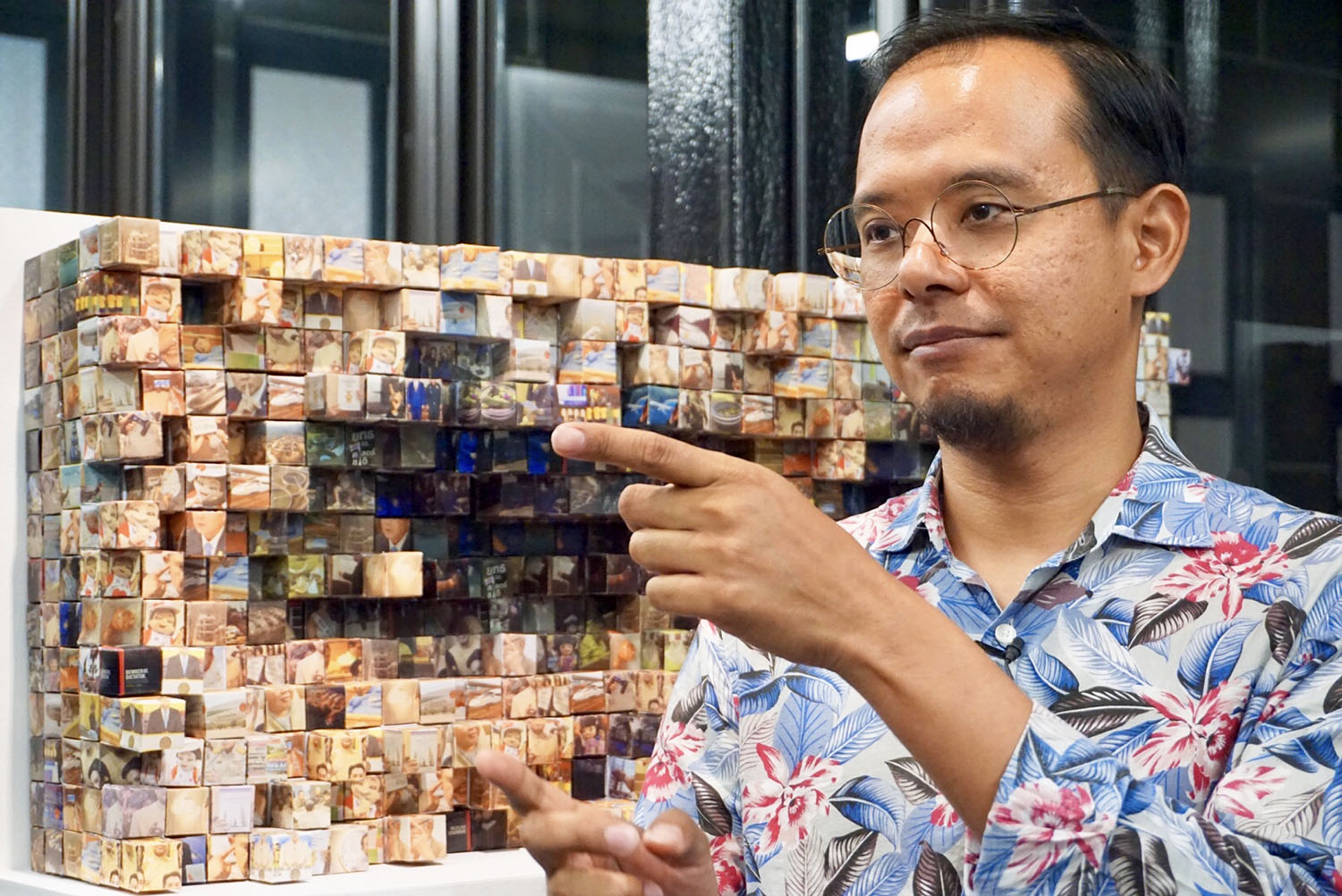
Wee Viraporn with his “Watch!” sculpture.

Top: Wee Viraporn with his “Watch!” sculpture.

BANGKOK — Through a pixelated sculpture of Prayuth’s eyes to a memeified event in Thai history, artists at an exhibition say the internet in Thailand is both a venue for freedom and a tool for surveillance.

A UNESCO-curated exhibition on Thai internet freedom launched Friday at a downtown design-hub to mark Universal Access to Information Day. Through six displays, ranging from hand-drawn infographics to documentaries, artists portray the Thainet as a double-edged sword, granting connectivity on one side but distortion and censorship on the other.

“We are watching what they’re doing but they are also watching us back,” artist Wee Viraporn said. “We will never have total freedom of expression or total freedom to monitor our government as long as it monitors our internet usage.”

LRG DSC04168

Wee created a sculpture titled “Watch!” to show this two-way surveillance. From afar, the mass of small cubes come together to resemble Gen. Prayuth Chan-ocha’s eyes. Up close, each cube is pasted with photos of news stories about unsavory actions of higher ups – from Gen. Prawit Wongsuwan’s undeclared luxury watches and the alleged killing of a black panther by a construction mogul to snoozing MPs and even Nong Kiew Koy, the junta mascot.

LRG DSC04175
“Friendship Ended With Mudasir Now Salman is my Best Friend” by Tewprai Bualoi.

Another artist, Tewprai Bualoi, 25, created “Friendship Ended With Mudasir Now Salman is my Best Friend,” named after the meme of the same name. Shots of memes such as the Soviet anthem and It’s Time to Stop are cut with quick flashes of historical footage to hint at a controversial event in Thai history.

“Thais use memes to talk about things that we can’t talk about because we’re being monitored by the state. So we use memes as language,” Tewprai said. Asked to reveal what event his video tries to portray, he was reticent.

“I want to try and talk about an event that isn’t usually talked about. If I told you, then I wouldn’t need to make this video meme!” Tewprai said.

Khaosod English’s live coverage of the Internet Universality Beyond Words opening.

In contrast to Tewpai’s coded work, Siriwat Pokrajen created “Internet Universality,” a short documentary about the broad interpretations and misuse of the Computer Crimes Act and the lese-majeste law. It features talks by Yingcheep Atchanond of iLaw, a legal reform advocacy.

While less political, the other three exhibits are informative about Thai internet use. Design student Nippita Pongern, 20, created three booklets’ worth of handmade illustrations and infographics about Thai internet usage and literacy in “My Virtual Playground.”

For example, through illustrations of rabbits, chickens and owls, one graphic shows that 60 percent of Thais spend a daily six hours on the internet.

LRG DSC04162
Nippita Pongern with her “My Virtual Playground” exhibit.

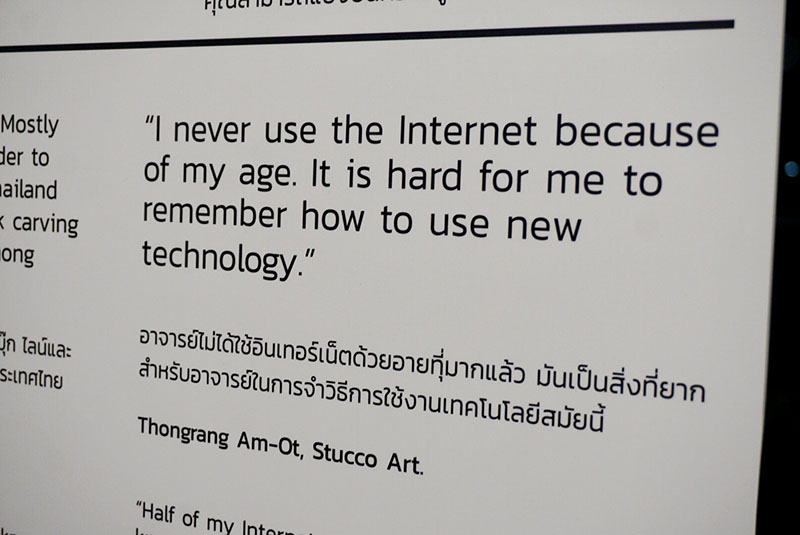
In “Artisan 4.0,” five students from the King Mongkut University of Technology Thonburi interviewed elderly craft artisans in Bangkok and Phetchaburi about the impact of the internet on their lives. While some said the internet helped them sell more products, others rejected its use.

Finally, there’s an exhibit of thirty booklets of the Thailand Wikipedia entry page, each in a different language. “Phasa+Thai(land): The Book of Languages” by Paphop Kerdsup shows that different information is consumed depending on the language used online. Visitors are encourage to parse the booklets for factual differences.

Internet Universality Beyond words runs 10:30am to 9pm every day except Monday through Oct. 14 on the fifth-floor hallway at the Thailand Creative and Design Center, or TCDC. The design space is located in Soi Charoen Krung 34 and can be reached from BTS Saphan Taksin and the Wat Muang Kae pier. Admission is free.

LRG DSC04188LRG DSC04143 LRG DSC04185 LRG DSC04130

LRG DSC04190
“Phasa+Thai(land): The Book of Languages” by Paphop Kerdsup.
LRG DSC04151
The “Artisan 4.0” exhibit.

Related stories:

Throw Coups, Deny Visas at Political Games Exhibit

Advertisement

Passenger’s Body Found in Pacific Lagoon After Plane Crash

Local fishing boats move in to recover the passengers and crew of an Air Niugini flight Friday following the plane crashing into the sea on its approach to Chuuk International Airport in the Federated States of Micronesia. Photo: James Yaingeluo / Associated Press

CANBERRA, Australia — A passenger’s body has been found in the Pacific lagoon where a plane crash-landed last week near an island runway in Micronesia.

Air Niugini had initially said all 47 passengers and crew had survived when the Boeing 737 crashed near the Chuuk island runway on Friday.

The Papua New Guinea national carrier said on Saturday one passenger had not been accounted for but was witnessed reaching a rescue dinghy as U.S. Navy sailors and locals helped people escape the sinking plane.

But Air Niugini chief executive Tahawar Durrani said the man’s body was found by divers Monday. The airline said in a statement on Tuesday the man was Indonesian, but did not reveal his identity.

“Our outreach team is in touch with the man’s family and we are making arrangements to repatriate his body,” Durrani said in a statement.

Four passengers were in stable conditions at a Chuuk island hospital and will be taken soon to Guam for further treatment, Air Niugini said.

Hospital and aviation officials have not responded to requests for comment.

Flight PX73 from nearby Pohnpei island crashed about 145 meters (475 feet) from the Chuuk International Airport runway, the airline said.

What caused the crash remains unclear. The airline and U.S. Navy said the plane landed in the lagoon short of the runway. Some witnesses thought the plane overshot the runway.

A Papua New Guinea accident investigation team flew to Micronesia on Friday, the Post Courier newspaper reported.

Flight PX73 flies from Tokyo’s Narita International Airport to Papua New Guinea’s capital, Port Moresby, via Pohnpei and Chuuk.

Air Niugini has operated since 1973. Data from the Aviation Safety Network indicate the Indonesian passenger is Air Niugini’s first fatality in two decades.

Story: Rod McGuirk

Advertisement

Do Muoi, Former Vietnam Communist Party Chief, Dead at 101

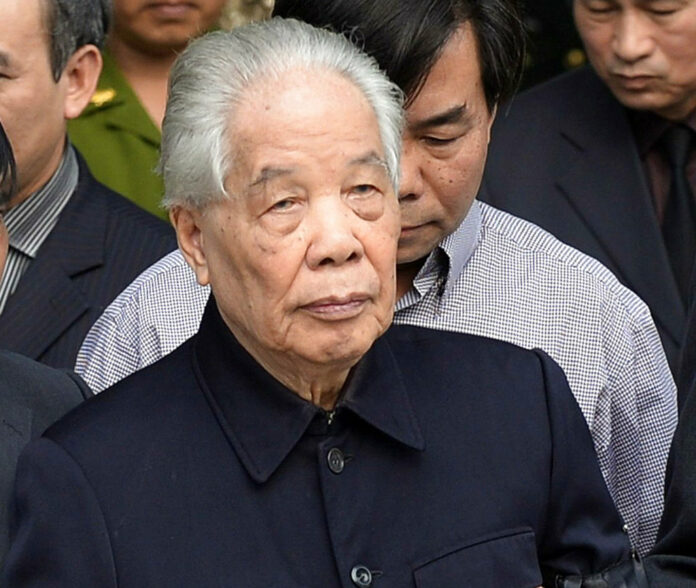
Former Communist Party Secretary General Do Muoi, front center, is helped to walk to pay respects to late Gen. Vo Nguyen Giap at the National Funeral House in 2013 in Hanoi, Vietnam. Photo: Hoang Dinh Nam / Associated Press

HANOI — Former General Secretary of the Communist Party of Vietnam Do Muoi, a committed communist, has died at age 101.

The government said in a announcement posted on its website that Muoi died late Monday night at the National Military Hospital 108 after battling a serious illness despite efforts by Vietnamese and foreign doctors to treat him.

Born Nguyen Duy Cong in suburban district of Thanh Tri in Hanoi in 1917, Muoi joined the Communist Party of Indochina, the former Communist Party of Vietnam at young age and rose through the ranks the party and government before becoming prime minister in 1988.

He served as the head of the Communist Party for more than 6 years before stepping down in 1997. No funeral arrangements have been announced.

Advertisement

Future Forward Party Plans to Raise 300M Baht for Election

Future Forward leader Thanathorn Juangroongruangkit speaks in October at the party headquarters in Bangkok.

BANGKOK — Saying he’s ready to become prime minister, a billionaire-turned-politician on Monday urged people to become members of his party and pledged to raise hundreds of millions of baht for his election campaign.

Speaking at the Future Forward party headquarters in Bangkok, leader Thanathorn Juangroongruangkit said his movement plans to raise 300 million baht for its election campaign, currently scheduled for February 2019. He said the party aims to collect 100 baht on annual membership fees from each member and 2,000 baht from those willing to pay lifetime fees starting Saturday.

“We will definitely raise 300 million [baht] from the public… We will do our best to raise funds,” Thanathorn said Monday as the movement relaunched itself after the Election Commission last week legally recognized it as a political party. He said the party – which vows not to take the path of money politics – currently has 1,000 supporters.

Thanathorn added they would sell memorabilia such as teddy bears, totes and T-shirts at their headquarters on Petchaburi Road in Bangkok, but said selling political goods online is prohibited under election laws.

Asked how much the party had spent over the past seven months – with leaders attending meetings and conferences in the United States, Canada and soon Europe – Thanathorn just said to “wait until after January 2019,” adding that he planned to disclose the party’s ledger on a quarterly basis.

A founding member, who spoke on condition of anonymity for fear of creating conflict within the party, said leaders originally planned to collect a 200 baht annual membership fee, but that some founding members opposed, citing it was too much to shoulder for ordinary members.

“Paying 200 baht may sound little for the urban-middle class but not for ordinary folks,” the source said.

It added that the challenge for a party that vows not to rely on money to win votes continues when it invites people for talks in the provinces.

“There’s a need to pay at least for transportation fees and food. You can’t just invite them and offer nothing. They won’t come for the second time,” the source said.

While it’s common knowledge that former MPs in some big parties are given monthly retention fees of up to 100,000 baht a month, the source claimed to receive 25,000 baht a month from the party and that it’s not really sufficient to travel for meetings in other regions.

“When campaigning time comes, we need a budget to hire a car and some campaigning staff and it will costs money, the source said, adding that the party is still working out on the details.

“Maybe Thanathorn’s family is telling him to put a lid and not piggyback on the family’s coffer,” the source said Monday after the party meet the press. Despite his wealth, Thanathorn said he wouldn’t use that to fund his party, insisting instead on the opposite model.

Campaigning is a challenge for any new party, especially so for a party vowing not to spend money the “conventional” way by handing out cash and retention payments to canvassers.

“We tell them we don’t hand out cash. It’s about ideology,” said Palakorn Jirasophon, team leader for Bangkok and the surrounding provinces.

Thanathorn himself admitted Monday during the questions and answers session with reporters that unlike established political parties, Future Forward doesn’t have a constituency base.

Critics expect the party – which vows to transcend a decade-old political rift – to win some seats through the partylist system, as its strong social media presence has garnered the support of the young and urban middle class. However, Thanathorn remarked on something they lacked.

“We don’t have any constituency base… Every group is new group for us,” Thanathorn said. “Because we are a new party, it’s very difficult to say how many seats we will get.”

However, party spokesperson Pannika Wanich who had earlier boasted about how the party is popular on social media – twice topping as the top trending Thai-language hashtag on Twitter – insisted Future Forward is not just the young urban middle class hipsters or social media users.

“Our party is for everyone,” she said.

Thanathorn, 39, formerly served on the board of Matichon Group, the parent company of Khaosod English.

Advertisement

Hot News

LATEST NEWS

Bangkok
overcast clouds
34.4 ° C
35 °
32.2 °
60 %
3.8kmh
100 %
Sun
34 °
Mon
33 °
Tue
34 °
Wed
30 °
Thu
29 °