29.4 C
Bangkok
Saturday, July 18, 2026
Home Blog Page 1843

Taxi Goes Up in Flames Outside CentralWorld

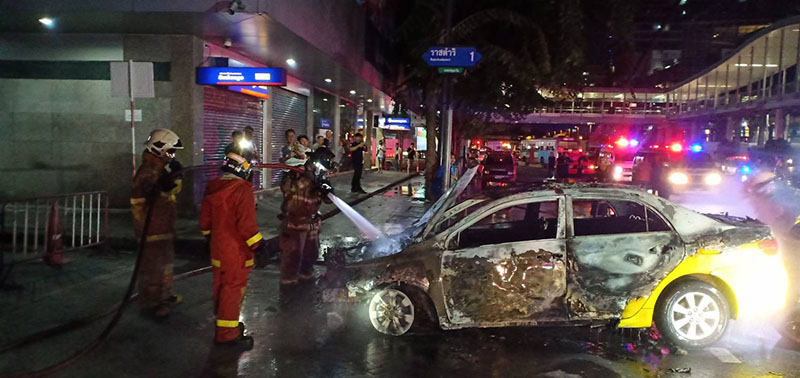
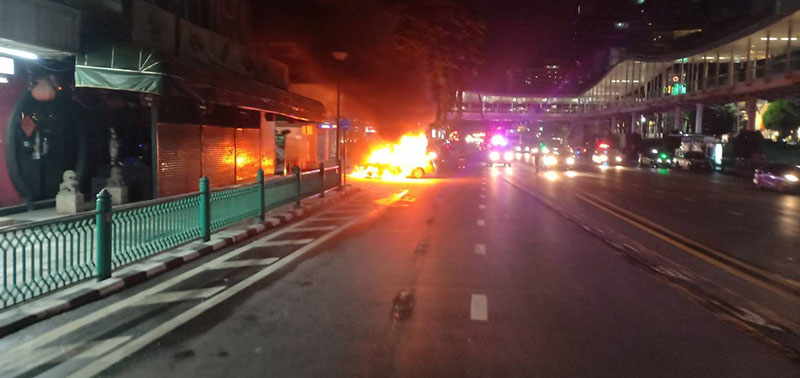
BANGKOK — Two people escaped from a flaming taxi early Wednesday morning across from Bangkok’s largest shopping mall.

A crowd gathered to watch firefighters put out the fire at about 2am on Ratchadamri Road, just across the Ratchaprasong intersection from from CentralWorld.

Taxi driver, Soontorn Kanyaboon, 50, told police he had picked up a fare in the Pratunam area when the smoke and then flames began pouring from the vehicle’s hood. He parked the car, and the passenger fled as flames engulfed the car. Neither was injured.

Soontorn told police his taxi was equipped with a liquefied petroleum gas tank.

36004 36008 35982

Advertisement

Rome Escalator Accident Injures 20 Russian Soccer Fans (Video)

ROME — At least 20 people were injured when an escalator in the Rome metropolitan system collapsed Tuesday night.

A video shown on Sky TG24 shows the escalator accelerating suddenly, and the people riding down on it collapsing one onto another. The dramatic footage shows people on the parallel escalator trying to pull others to safety.

The cause was not immediately known. The metropolitan station at Piazza Repubblica near the main Termini train station was closed by investigators.

“The scene that we found was people piled up at the bottom of the escalator,” said Rome provincial fire chief Giampietro Boscaino. “People one on the top of the other looking for help. They had various injuries caused by the escalator that was twisted, therefore serious injuries.”

The prefect’s office put the number of injured at 20, mostly Russians in town for a Champion’s League soccer game between CSKA Moscow and Roma. Firefighters said seven were in serious condition.

The news agency ANSA quoted Rome Mayor Virginia Raggi as saying that witnesses reported people were jumping and dancing on the escalator before the accident. ANSA also quoted city transport agency officials as saying maintenance is carried out on metro system escalators every month.

Separately, one CSKA fan was slashed with a knife during clashes between opposing fans outside the Stadio Olimpico, the ANSA news agency reported.

About 1,500 CSKA fans were attending the match.

Story: Paolo Santalucia

Advertisement

Acrimony Over Trade, Politics Sinking China-US Ties Further

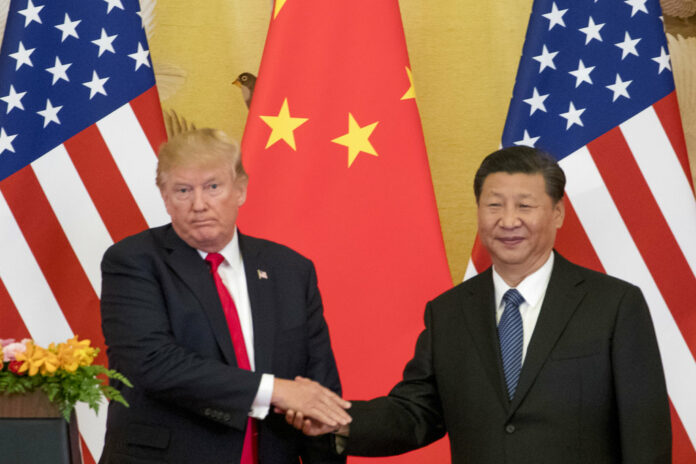
President Donald Trump and Chinese President Xi Jinping shake hands in 2017 during a joint statement to members of the media Great Hall of the People in Beijing, China. Photo: Andrew Harnik / Associated Press

BEIJING — “Both ignorant and malicious” was how the official China Daily newspaper recently described comments by U.S. Secretary of State Mike Pompeo, offering a stinging insight into the current bitter tone of discourse between the countries.

The White House’s move to expand Washington’s dispute with Beijing beyond trade and technology and into accusations of political meddling has sunk relations between the world’s two largest economies to the lowest level since the Cold War.

A major speech by U.S. Vice President Mike Pence on Oct. 4 was the clearest, highest-level sign that U.S. strategy was turning from engagement to confrontation. Pence accused China of interfering in the midterm elections to undermine President Donald Trump’s tough trade policies against Beijing, warned other countries to be wary of Beijing’s “debt diplomacy” and denounced China’s actions in the South China Sea.

“What the Russians are doing pales in comparison to what China is doing across this country,” Pence told an audience at the Hudson Institute think tank in Washington.

Both sides are trading increasingly sharp accusations over human rights and global hegemony, exposing an ideological divide that pits the two on a path of confrontation with no clear resolution in sight.

While a military clash has not been ruled out, American-based analysts envision a continuing push-and-pull for dominance between Trump and his Chinese counterpart, Xi Jinping, China’s most dominant – and repressive – leader since Mao Zedong. Xi’s aggressive foreign policy and authoritarian ways have altered views of China across the board.

“What has happened is a sea change in U.S. perceptions of China,” said June Teufel Dreyer, an expert on Chinese politics who teaches political science at the University of Miami. While Chinese officials privately say they’re concerned about the sharp deterioration in ties, especially given the massive links between the two in trade, immigration and education, it appears Beijing is more than willing to go toe-to-toe under the new circumstances.

Increasingly, the perception that as China grew more prosperous it would fall in line with global values and international law has been exploded. Into that breach has come hardening U.S. rhetoric toward Beijing and actions to counter, deter or defy China’s moves in the international sector, particularly its “Belt and Road” trade and infrastructure initiative that seeks to expand Beijing’s economic and political footprint from Cambodia to Cairo.

Trump’s first national security strategy, released last year, also labeled China a “revisionist power” alongside Russia.

Beijing’s outrage at Pompeo, meanwhile, was prompted by his recent warnings to Latin American countries about the dangers of accepting Chinese infrastructure loans that are a key aspect of Xi’s signature foreign policy project.

“U.S.-China relations have deteriorated to their worst point” since the 1989 Tiananmen Square pro-democracy protests in Beijing that were crushed by the Chinese military, said Michael Kovrig, senior adviser for Northeast Asia at the International Crisis Group.

“It may not be a clash of civilizations, but it is a long-festering conflict of national, political and economic interest and systems that has reached a point of rupture,” Kovrig said.

Xi has abandoned the strategy laid out by reformist leader Deng Xiaoping that China should bide its time and refrain from advertising its ambitions to become a world power. Instead, he has been accused of overreach by promoting China’s drive to become a global technology leader by 2025, including by compelling foreign companies to hand over their know-how, and pushing Chinese-financed energy and transportation projects that leave target countries with unsustainable debt.

On the military front, a Chinese destroyer last month maneuvered perilously close to the USS Decatur in the South China Sea. The Chinese also denied a request for a U.S. Navy ship to visit Hong Kong and rejects U.S. concerns over its policies toward other countries.

“The U.S. simply aims to drive a wedge between China and relevant countries with those remarks,” Foreign Ministry spokeswoman Hua Chunying said Monday. “It is meaningless and futile.”

The tart rhetoric is evident on both sides.

Nikki Haley, the U.S. ambassador to the United Nations, said in a speech last week that China’s government “is engaged in the persecution of religious and ethnic minorities that is straight out of George Orwell,” referencing the internment of Muslims in the country’s northwest in political reeducation camps.

This month, the United States went further by threatening to pull out of the Universal Postal Union because it says the treaty allows China to ship packages to the U.S. at discounted rates at the expense of American businesses.

Underlying the estrangement is the sense that Beijing lacks reciprocity, taking advantage of open markets and free societies to extend its interests, while denying the same benefits to companies, governments and individuals over which it has influence.

“My bottom line view is that Xi Jinping very much overplayed his hand taking advantage of the restrained and moderate (former President Barack) Obama,” said Robert Sutter, a China expert at George Washington University. “Now he has an enormous American series of challenges to deal with, with no easy solutions.”

While Chinese companies – often backed by easy credit from state banks – have been snapping up foreign assets, Beijing restricts such foreign purchases in key sectors such as energy, transport and telecommunications. Although China has loosened some joint-venture demands, including in the auto industry, that may be too little too late.

China is “not very willing to constrain itself under rules that it feels were forced upon it,” said Dean Cheng, senior research fellow at the Heritage Foundation in Washington. “This includes the international trading system, which is dominated by the U.S.”

Still, attempts to contain China along the lines laid out during the Cold War would be “difficult, if not impossible,” given the broad range of contacts across political, economic and personal spheres, Cheng said.

The U.S. has also reinforced ties with Taiwan – claimed by China as its own territory – building an impressive new de facto embassy there, approving a major sale of military parts and services, and authorizing companies to help the self-governing island democracy build submarines to defend itself from China’s threats to use force to bring it under Beijing’s control.

The tensions are underscored by political uncertainties in both countries. Trump faces a referendum of sorts on his policies in next month’s midterm elections, while Xi has come under rare criticism at home since he forced through a constitutional amendment in March to allow him to lead indefinitely.

Xi is also beset by a slowing economy, made worse by U.S. tariffs that threaten the jobs of millions of Chinese workers. While China has retaliated with its own tariffs on U.S. goods, the loss of American markets will likely be a major drag on growth.

All such factors appear to speak poorly for any immediate resolution to the frictions.

Michael Mazza, a foreign policy expert at the conservative American Enterprise Institute think tank in Washington, said “competition will remain the norm” between the two countries unless China is willing to make significant changes in its domestic, economic and foreign policies.

“At this point, there is little reason to suspect that such a shift is in the offing,” Mazza said.

Story: Christopher Bodeen

Advertisement

Trump: Khashoggi Killing is ‘The Worst Cover-up Ever’

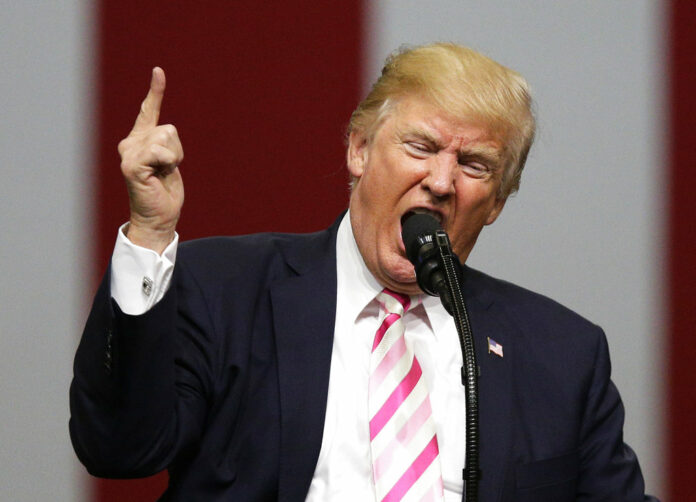
US President Donald Trump speaks in 2017 at a campaign rally in support of Sen. Luther Strange, in Huntsville, Alabama. Photo: Brynn Anderson / Associated Press

ANKARA, Turkey — President Donald Trump is criticizing the Saudi operation that killed journalist Jamal Khashoggi, calling it one of the “worst cover-ups in the history of cover-ups.”

Trump tells reporters in the Oval Office that he’s expecting a full report on the killing soon.

But he says, “They had a very bad original concept” and it was “carried out poorly.”

He calls the events after Khashoggi’s death “the worst cover-up ever.”

Saudi Arabia has claimed Khashoggi, a writer for The Washington Post who wrote critically about Saudi Crown Prince Mohammed bin Salman, died accidentally in a brawl at the Saudi Consulate in Istanbul on Oct. 2.

But Turkish officials say a 15-men team tortured, killed and dismembered the writer and say Saudi officials had planned the killing for days.

Advertisement

UN Expert Says North Korea’s Rights Abysmal Despite Summits

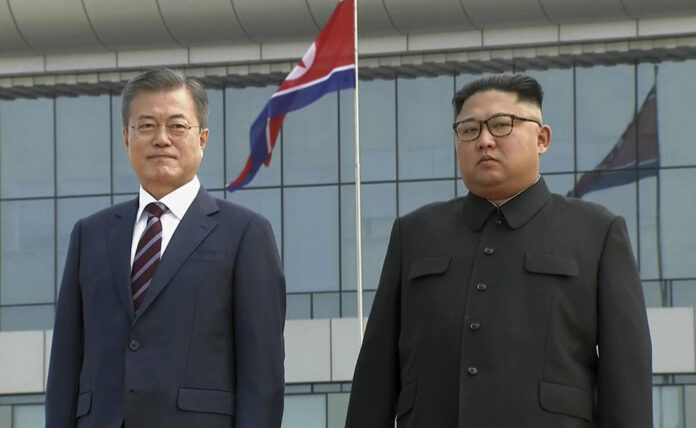
In this image made from video provided by Korea Broadcasting System (KBS), South Korean President Moon Jae-in, left, poses with North Korean leader Kim Jong Un for a photo on the podium upon arrival in September in Pyongyang, North Korea. Image: Associated Press

UNITED NATIONS — North Korean leader Kim Jong Un’s summits with the presidents of South Korea and the United States have not changed his country’s abysmal human rights record, the U.N. independent investigator on human rights in the isolated Asian nation said Tuesday.

Speaking at a news conference, Tomas Ojea Quintana said he is “very concerned” that statements following Kim’s meetings with South Korean President Moon Jae-in and U.S. President Donald Trump made no mention of human rights in North Korea.

He pointed to reports of “systematic, widespread abuses” of human rights and a U.N. commission of inquiry’s findings in 2014 that possible crimes against humanity have been committed in North Korea.

“The human rights situation at the moment, at the moment, has not changed,” Quintana said.

Quintana said dealing with North Korea’s nuclear arsenal is extremely important for humanity, and he strongly supported rapprochement between the two Koreas and talks with the U.S. that have decreased tensions and improved prospects for peace.
But he stressed that North Korea’s human rights record must not be ignored.
Quintana recalled that in his previous job as U.N. investigator in Myanmar, he raised alarm about “crimes against humanity” being committed by the military during that country’s political transition in 2012 but his concerns were put aside.

“And now we see the consequences,” he said, alluding to findings of military abuses against Myanmar’s Rohingya Muslim minority.

He said he isn’t saying the situation in North Korea is the same, but “we shouldn’t undermine the principle of human rights because sooner or later it will come back.”

“As the process of rapprochement and talks are moving so fast, we the human rights people – we also need to move fast and bring proposals, different proposals,” Quintana said.

He said one of his proposals is to ask the new U.N. human rights chief, Michelle Bachelet, to initiate “a process of engagement” with North Korea.

He also urged North Korea “to show commitment to the human rights agenda” and allow him to visit the country and talks to its leaders.

Quintana, a human rights lawyer from Argentina appointed by the Geneva-based Human Rights Council, was in New York to present his latest findings to the U.N. General Assembly’s human rights committee.

He said he proposed to North Korean officials in Geneva last March that the government should start releasing political prisoners as a signal of commitment to human rights.

“We saw in the media there was an amnesty by the leadership and some prisoners were released,” Quintana said. “That was very important news.”

But Quintana added that when he wrote to North Korea seeking details, he got no response.

He said in response to a question that the Trump administration has told him it supports his work and backs a General Assembly resolution condemning North Korea’s human rights situation.

On Monday, North Korea’s official KCNA news agency accused “some dishonest forces including Japan” of “working hard to cook up” a politicized resolution on human rights. It called the annual resolution the result of a “conspiratorial and criminal scenario of the hostile forces to defame” North Korea.

KCNA said Western countries should not be held up as “the human rights standard of the world,” saying that “misanthropy and abnormal way of life are rampant” in the West.

Story: Edith M. Lederer

Advertisement

Activists Filed False Treason Complaint Against Army Chief: Junta

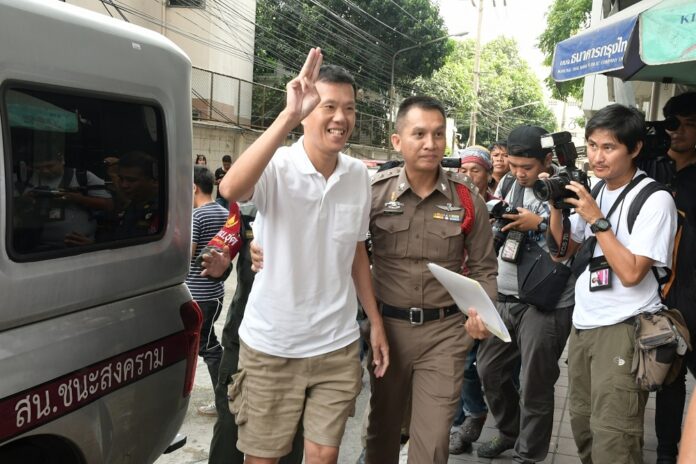
Ekachai Hongkangwan flashes the anti-junta ‘three-finger salute’ in May as he arrives at a Bangkok court.

BANGKOK — The military junta will file a police complaint against two pro-democracy activists for allegedly filing a false police complaint against the new army chief, an unidentified source from the junta said Monday.

The junta instructed its legal officers to report to police that Ekachai Hongkangwang and colleague Chokechai Paiboonratchata filed a false complaint alleging Gen. Apirat Kongsompong had committed treason. The activists went to the police Friday after Apirat said at a press conference that he couldn’t commit to not staging a coup if there are riots after elections slated for February.

“I am not surprised and this was expected,” Ekachai said about the complaint against him and Chokechai. “If they let this slide, there will be others making the complaints so they have to extinguish the fire at its source.”

Ekachai and Chokechai filed the complaint on grounds that Apirat violated Article 113 of the penal code, which criminalizes treason. The offense is punishable by death or life imprisonment. Ekachai on Tuesday denied having falsely accused Apirat or tarnish the image of the armed forces.

Anyone guilty of filing a false police complaint faces six months in prison or a fine of 10,000 baht, or both.

Apirat, who made the remark on Oct. 16, is also ex-officio secretary of the junta, formally known as the National Council for Peace and Order.

Advertisement

2 Arrested for Sharing Fake News About Chinese Tourist Visa

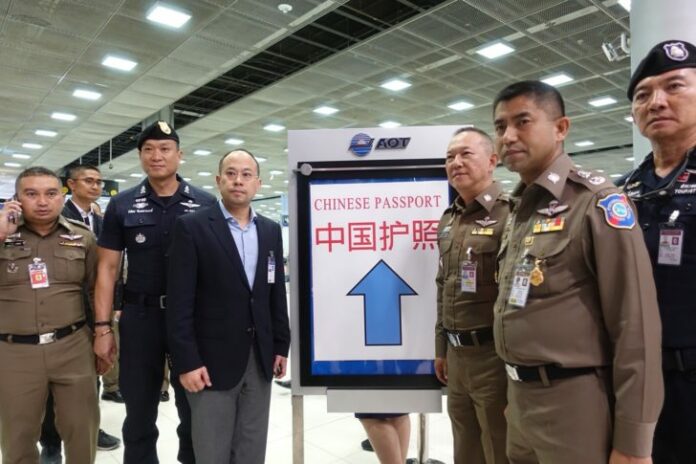
Police pose with a sign for the Chinese tourists fast-track lane on Aug. 3 at Suvarnabhumi Airport.

BANGKOK — Two people were arrested for sharing fake news from a Youtube video saying the government was to reduce tourist visas for Chinese nationals because it ran out of paper, police said Monday.

The immigration police chief said Nathawut Ruayprasert and Napatsawan Kiatvimol were charged with disseminating online fake news by posting the video clip to their Facebook accounts earlier this month.

“Before posting or sharing any information, please verify it directly from the source,” Maj. Gen. Surachet Hakpan said, adding that sharing false information could harm the country’s security and economy.

Both suspects face up to five years in prison and a maximum fine of 100,000 baht. YouTube account owner Chanin Udomsrirat, who translated the clip from Chinese and posted it in December, would be charged with importing fake information under the Computer Crimes Act, Surachet said.

The video, which appeared to show a news presenter speaking in Chinese, was uploaded by the account “johny shoot2china.” It was subtitled in Thai and titled “The reason for the reduction of Chinese tourist visas… You’ll be shocked.”

According to the subtitle, the man said the Thai government had reduced the quota of tourist visas to Chinese nationals because of visa paper shortage, forcing scores to apply for visas on arrival at Thai airports.

Nathawut, one of the accused, said during the press briefing that he only shared the clip because he wanted to know if it was true, and said he was picked up from home by a police car.

On Oct. 11, the Foreign Ministry released a statement saying there used to be a shortage from September to November last year, but that it did not affect services as paper visas could be substituted with stamps. It also said the Thai embassy and consulates in China do not impose visa quotas.

It added that Chinese authorities had prosecuted those responsible for releasing the fake information.

The clip further accused Thai airport staff of extorting bribes from Chinese tourists to fast-track visas on arrival, demanding 200 baht to 300 baht each time.

The issue was raised three weeks ago after a Don Mueang airport security guard was caught on camera throwing his fist at a Chinese tourist, an incident allegedly triggered when he refused to pay the bribe, something later denied by airport authorities.

However, top Don Mueang immigration officers – including the chief – were transferred about a week later after being accused of instructing others to refuse visas to inbound tourists unless they paid “tips.”

Surachet yesterday acknowledged that the number of Chinese tourists to Thailand had decreased due to several mishaps such as tourist scams, cheating taxi drivers and tragic incidents like the ferry accident in Phuket which killed almost 50 Chinese nationals in July.

He said he has been working closely with Chinese authorities regarding problems in tourism, and that the government had ordered him to step up safety measures and standards for tourists in Thailand.

Related stories:

Airport Immigration Head Transferred for Demanding ‘Tips’

DMK Chief Suspended Over Chinese Tourist Assault

Advertisement

Pheu Thai Party Could be Dissolved if Under Thaksin: EC

Pheu Thai Party Could be Dissolved if Under Thaksin: EC
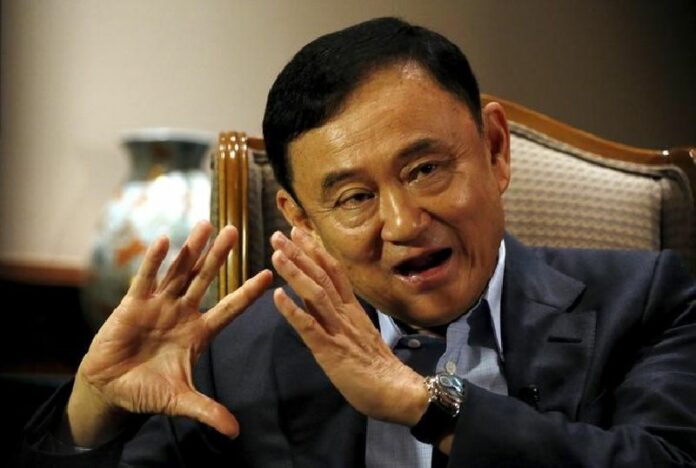
Former Prime Minsiter Thaksin Shinawatra speaks during a Feb. 23, 2016, interview in Singapore. Photo: Edgar Su / Reuters

BANGKOK — The Pheu Thai party could be dissolved if ousted former Prime Minister Thaksin Shinawatra is found to be influencing it despite no longer being a member, the Election Commission’s Secretary General said Tuesday.

Police Col. Jaringvith Phumma said the commission is collecting audio, video and news reports to verify the claim – made by Deputy Prime Minister Prawit Wongsuwan. Under the law, non-members aren’t allowed to influence political parties.

Police Lt. Gen. Viroj Paoin, the party’s caretaker, denied Tuesday that that the fugitive former premier controls Pheu Thai and said the party is ready to explain everything to the commission. He added that Thaksin has no position in Pheu Thai and that his voicing of political views is personal.

Viroj said that former Pheu Thai MPs meeting Thaksin abroad is also a personal matter and not a party activity. He acknowledged however that Pheu Thai must be careful, as many look to find faults in the party to disqualify it from elections slated for next year.

Advertisement

US Treasury Secretary Meets Embattled Saudi Crown Prince

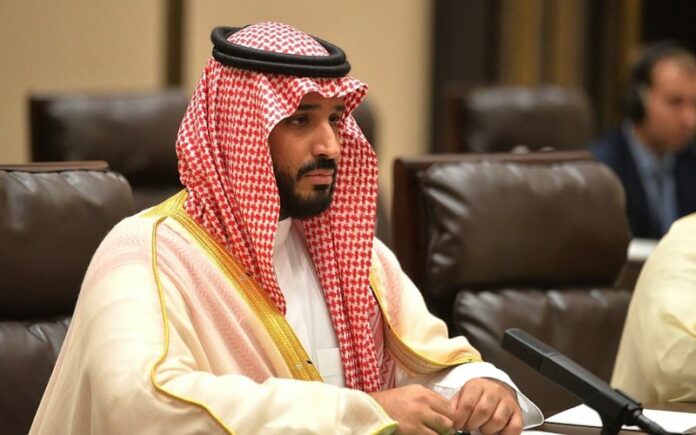
Crown Prince of Saudi Arabia Mohammad bin Salman Al Saud seen here in 2016 during the G20 Summit in Hangzhou, China. Photo: President of Russia

ISTANBUL — U.S. Treasury Secretary Steven Mnuchin has met with Saudi Arabia’s embattled crown prince, Mohammed bin Salman. The meeting took place as the crown prince faces growing international criticism over the killing of Saudi writer Jamal Khashoggi at the kingdom’s consulate in Istanbul.

The Saudi Foreign Ministry posted a photo of the meeting on its Twitter account late Monday, on the eve of a glitzy three-day investment conference in Saudi Arabia. Mnuchin has said he would not attend the conference but would discuss counter-terrorism efforts with Saudi officials.

Saudi Arabia has said Khashoggi, a critic of the Saudi royal family, was killed Oct. 2 in a “fistfight” with officials sent to encourage him to return to the kingdom. Turkish media and officials say the 59-year-old Washington Post columnist was killed and dismembered by a 15-man Saudi hit squad.

Advertisement

2 Rarely Seen Hemingway Stories Coming Out

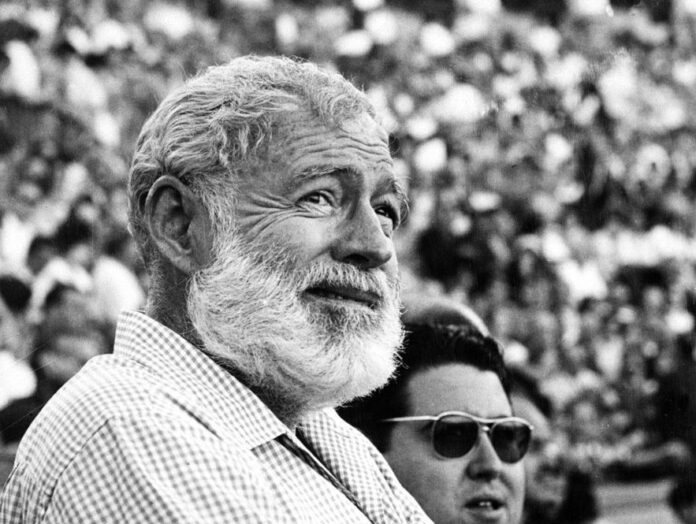
U.S. novelist Ernest Hemingway attends a bullfight in 1960 in Madrid, Spain. Photo: Associated Press

NEW YORK — Two Ernest Hemingway stories written in the mid-1950s and rarely seen since will be published next year.

The director of Hemingway’s literary estate, Michael Katakis, told The Associated Press recently that “The Monument” and “Indian Country and the White Army” will be included with a special reissue of the author’s classic “For Whom the Bell Tolls.” The new edition also will include the story “A Room on the Garden Side,” which had been little known beyond the scholarly community before The Strand Magazine published it over the summer.

“For Whom the Bell Tolls: The Hemingway Library Edition” is scheduled for the summer of 2019. The celebrated novel, set during the Spanish Civil War, was in the news earlier this year. It was a favorite of Sen. John McCain, who died in August, and the title of an HBO documentary about the Arizona Republican and Vietnam War veteran.

Katakis, whose “Ernest Hemingway: Artifacts from a Life” comes out this week, has overseen numerous posthumous projects. He has worked in coordination with the author’s son, Patrick Hemingway, on reissues of “A Moveable Feast,” ”Green Hills of Africa” and other books, along with the controversial publication of “True at First Light,” which Ernest Hemingway had left unfinished when he killed himself in 1961.

“I’ve been talking to Patrick for a long time and we always ask the same question, ‘Is there a reason for this to be released?'” Katakis said during a telephone interview. He declined to comment further on why they had decided to publish the 1950s stories, part of the Ernest Hemingway Collection at the John F. Kennedy Library and Museum in Boston.

Hemingway wrote five pieces in 1956, reflecting upon his time as a correspondent and participant in World War II. He would tell his publisher, Charles Scribner Jr., the stories likely needed to come out after his death because they were “a little shocking” and dealt “with irregular troops and combat and with people who actually kill people.”

One of those works, “Black Ass at the Crossroads,” was released years ago. Another story, “The Bubble Reputation,” will for now remain unpublished.

“Ernest Hemingway: Artifacts from a Life” also draws from the collection at the JFK library. It features photographs, letters and extensive annotations. In a brief foreword, Patrick Hemingway cites a memento not pictured in the book, or anywhere since he was a child: a trout fishing trunk used by the author on outings with his family.

“That fishing trunk for me enhanced the elegant ritual of my mom and dad as they waded side by side six feet off each bank downstream, casting toward each other their terminal cluster of three wet flies, letting their lines drift and straighten out before raising their rods and casting again,” Patrick Hemingway wrote.

But, he added, “even the finest bowl and bell will crack.” The marriage was over by 1940, the trunk was gone a few years later.

Story: Hillel Italie

Advertisement

Hot News

LATEST NEWS

Bangkok
overcast clouds
29.4 ° C
29.4 °
29.4 °
80 %
4.1kmh
96 %
Sat
29 °
Sun
36 °
Mon
36 °
Tue
35 °
Wed
35 °