






























36.6 C
Bangkok
Monday, June 22, 2026
Home Blog Page 2042

Abraham Lincoln to King Mongkut: Thanks but No Thanks For Elephants

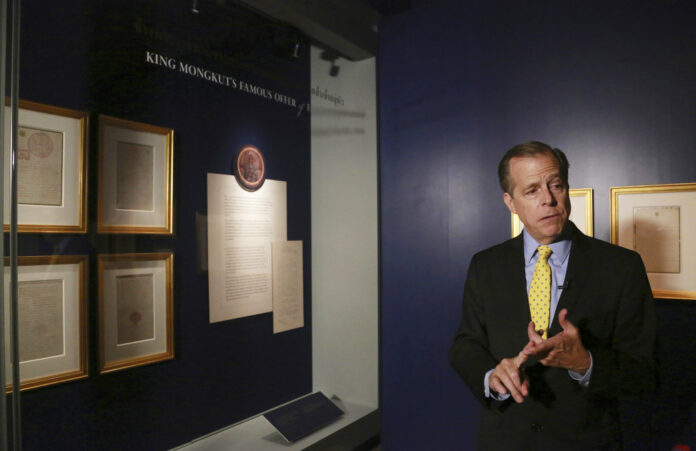
U.S. Ambassador to Thailand Glynn Davies talks to media Thursday in front of hand-written letters from U.S. President Abraham Lincoln and King Mongkut on display at the
U.S. Ambassador to Thailand Glynn Davies talks to media Thursday in front of hand-written letters from U.S. President Abraham Lincoln and King Mongkut on display at the "Great and Good Friends" exhibition inside the Grand Palace in Bangkok. Photo: Sakchai Lalit / Associated Press

BANGKOK — It was only natural that King Mongkut in 1861 to offer a pair of Thailand’s national animal to the United States as a gift of a friendship that has endured 200 years.

President Abraham Lincoln, likely bemused and relieved at the distraction from America’s then-raging Civil War, politely declined, saying his country uses the steam engine and would have no use for the working animals.

As part of the anniversary celebrating the long-lasting relationship, the U.S. Embassy in Bangkok is showcasing historic gifts the two countries have exchanged on the grounds of Thailand’s Grand Palace.
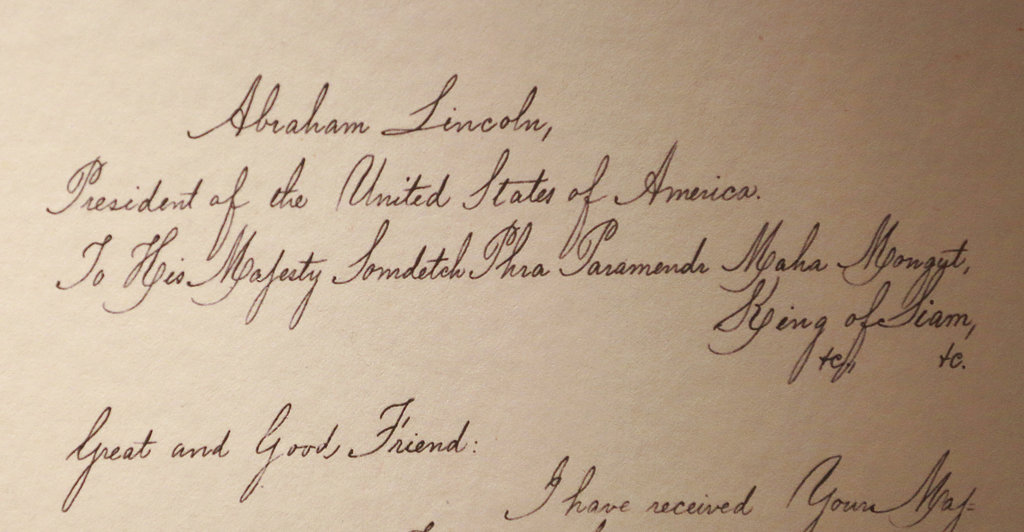
AP18082172284063
A letter written by U.S. President Abraham Lincoln in 1862 in reply to King Mongkut is on display at the exhibition.

It includes the first ever official letter sent in 1818 from a Thai diplomat to President James Monroe — there are documents spanning two centuries — as well as some spectacular Thai objets d’art and portraits.

Then there’s the elephants story, also documented among the exhibits.

In his 1861 letters, Mongkut offered the elephants after learning they were not native to America. He also sent along three gifts: a sword and scabbard, a photograph of the king with one of his daughters, and an impressive pair of elephant tusks.

He addressed the letters to then-President James Buchanan “or whomever would become president” with elaborate paragraph-long salutations.

Lincoln was already president by the time the letters arrived, a year later. He penned a reply where he simply addressing the king as “Great and Good Friend.”

The offer of elephants did not neglect practical details. Mongkut stated, “On this account, we desire to procure and send elephants to be let loose to increase and multiply in the continent of America.” But Thailand — then called Siam — did not have a large enough vessel to transport them, the letter said.

It continued: “In reference to this opinion of ours if the President of the United States and Congress who conjointly with him rule the country see fit to approve, let them provide a large vessel loaded with hay and other food suitable for elephants on the voyage, with tanks holding a sufficiency of fresh water, and arranged with stalls so that the elephants can both stand and lie down in the ship — and send it to receive them. We on our part will procure young male and female elephants and forward them one or two pairs at a time.”

Mongkut then in his letter directs that the elephants should be kept away from the cold and under the sun, and to also “let them with all haste be turned out to run wild in some jungle suitable for them not confining them any length of time.”

“If these means can be done we trust that the elephants will propagate their species hereafter in the continent of America.”

Thai monarchy expert Tongthong Chandransu said the offer of elephants reveals that Mongkut wanted to be part of building the young United States.

“You have to consider that 200 years ago elephants were an important means of transportation and helped a lot with our work, not to mention warfare, but also the building of homes and cities,” Tongthong said.

The ever-practical Lincoln rejected the offer to send wild elephants running through American forests, saying the country “does not reach a latitude so low as to favor the multiplication of the elephant.” He said in his 1862 letter that “steam on land, as well as on water, has been our best and most efficient agent of transportation in internal commerce.”

The exhibition runs until June 30.

Advertisement

Escaping the Present For a Misremembered Past

Thai tourists in traditional costumes at Wat Chaiwatthanaram. Photo: Travel @ Manager / Facebook

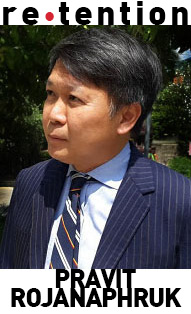
Re•tention: Pravit RojanaphrukInterest in the historic capital of Ayutthaya has been revived by a recent soap opera, leading thousands to visit the site.

But as fans of “Bupphesaniwat” revel in dressing retro, it’s an opportune time to rethink nostalgia and the risks of idealizing the past.

Nostalgia for the “good old days,” particularly those in the more distant past, is potent. People want to remember something more glorious, ideal and undisturbed by inconvenient truths.

Idealization of the past means its negative aspects are often omitted. Like an edited photograph, unpleasant and inconvenient aspects are deliberately excluded. So in the ideal kingdom of Ayutthaya, many people only want to see its positive side, bereft of its class oppression, inequality autocratic cruelty and exploitation of the weak.

These negative aspects challenge our fantasies about the past. Because the present is obviously less than ideal for most people, they opt to romanticize the past.

History is defenseless against those who want to see what they want to see in it.

The past is like a photo – there’s always something outside the frame.

Some may argue similar things could be said about the present. People have a habit of wanting to only see what suits their thinking.

We tend to edit and leave what’s inconvenient and unpleasant out. Moving from the analogy of a picture to a seeing eye. A seeing eye has to focus on something and what’s not focus tends to be blurred or forgotten.

These are inherent deficiencies in human sight.

Politics and even private life can be handled in a much more sympathetic and amicable way if we are able, if not willing, to acknowledge different ways of looking at things. Could it be the deeply entrenched mentality induced by the Thai education system that until recently was mostly based on mulitiple-choice questions and rote memorization?

Too many people think there’s only one right answer and conflate belief in having the right answers with being virtuous or a good people. Sooner rather than later, it boils down to a mortal struggle between good and evil.

Thailand has been stuck in political impasse for too long. It’s been a dozen years now and many still can’t acknowledge the very simple fact none of us has a monopoly on how we see the past, the present and the realities of both.

The sooner more Thais realize this, the better. For we have been stuck in a political quagmire for too long. Major problems facing Thailand are not just clashes between pro-democracy and pro-junta forces, there are more political spectrums in the struggle. Some who oppose Thaksin are not necessarily pro-junta. The belief that only one’s views are right has become too costly for us.

As for glories of Ayutthaya, let us put the past into a richer and more complete perspective.

Advertisement

Trump’s Impulses Put White House Credibility at Stake

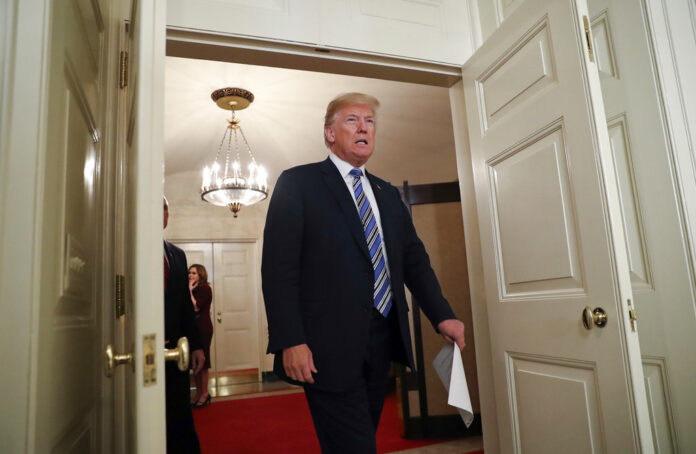
President Donald Trump walks into the Diplomatic Room of the White House on Friday in Washington. Photo: Pablo Martinez Monsivais / Associated Press

WASHINGTON  — What’s the White House’s word worth?

Days of conflicting and misleading statements from President Donald Trump and his top aides have fueled new questions about the White House’s credibility, sowing mistrust and instability within the West Wing and leaving some congressional Republicans wondering if they have a good faith negotiating partner in the president.

One former congressional GOP leadership aide said it was becoming impossible for Republicans to negotiate anything with White House officials, given the president’s willingness to undermine his own team’s public and private assurances. In turn, White House officials have found themselves in the bizarre position of urging lawmakers to ignore some of the president’s own statements.

That was the case on Friday, when Trump blasted out a morning tweet threatening to veto a massive government spending bill that the White House had guaranteed lawmakers and the public that he would sign. White House officials privately insisted the president was simply venting after watching news coverage that cast the deal as a defeat for several of his priorities. After hours of uncertainty, Trump’s veto threat crumbled, and he ultimately signed the legislation.

Still, it left some Republicans rattled.

“The spontaneity and lack of impulse control are areas of concern for lots of members on both sides of the aisle,” said Rep. Charlie Dent, a Pennsylvania Republican who has been critical of the president. “Disorder, chaos, instability, uncertainty, intemperate statements are not conservative virtues in my opinion.”

Trent Lott, the former Republican Senate majority leader from Mississippi, said GOP lawmakers “feel a good deal of consternation” about the White House-induced whiplash. But he added: “I assume there was method in what the president did.”

Members of both parties said they were troubled that Trump seems oblivious to how he has undermined his own clout and agenda by staking out positions and then brazenly abandoning them. Where legislators once might have attributed such missteps to the president’s newness to Washington and its ways, not anymore.

Trump’s vacillating on the spending bill was just one in a series of recent instances that put the credibility of the White House’s words under a microscope. Earlier this month, Trump bragged at a private fundraiser about having made up facts on trade during a conversation with Canadian Prime Minister Justin Trudeau. And in recent days, he and his staff have issued stern denials about the prospects of national security adviser H.R. McMaster departing the White House and a potential shake-up on the legal team that handles Trump’s role in the special counsel investigation into Russian election interference and obstruction of justice. Beyond public statements, White House chief of staff John Kelly had privately assured his staff that no shakeup was on the horizon.

By week’s end, McMaster was out. And the legal team had lost one attorney and appeared to be looking for another one.

Trump’s trouble with the truth is hardly new. He frequently mangles the facts on everything from the size of his inauguration crowd to the scope of the tax bill he signed late last year. And as his boasting about his interaction with Trudeau underscored, the president rarely appears to be embarrassed or ashamed about repeating statements that have been proven false.

“There’s a fundamental difference between this White House and those of the modern era that preceded it,” said Timothy Naftali, a historian and the former director of Richard Nixon’s presidential library. “It doesn’t care about its credibility outside of a narrow swath of the American people.”

Numerous polls show a majority of Americans don’t believe Trump is truthful, including a recent Quinnipiac survey in which 57 percent said the president was not honest. Trump’s backers sometimes point to the fact that he was elected even though polls during the campaign showed similar results.

Trump’s willingness to skirt the truth has frequently put his advisers in the awkward position of issuing strong statements in public that are quickly undermined by the president. Spokeswoman Sarah Huckabee Sanders repeatedly batted down reports about McMaster’s ouster in the days leading up to Trump’s announcement that he was bringing in a new national security adviser.

And on the eve of Trump’s spending bill veto threat, budget director Mick Mulvaney left no ambiguity about the president’s plans to validate the measure.

“Let’s cut right to the chase. Is the president going to sign the bill? Yes. Why? Because it funds his priorities,” Mulvaney said.

White House officials privately contend that they are often left in an impossible situation given Trump’s willingness to change his mind. Even if their statements are true at the time, they say, there’s no guarantee the president’s position will hold.

Peter Wehner, who served in the administrations of Presidents Ronald Reagan, George H.W. Bush and George W. Bush, said Trump ultimately has no one to blame but himself.

“He doesn’t even know what his own stance is,” said Wehner, a frequent Trump critic. “It just devalues his word and his threats and promises and his presidency.”

Story: Julie Pace, Alan Fram

Advertisement

US Charges 9 Iranians in Massive Hacking Scheme

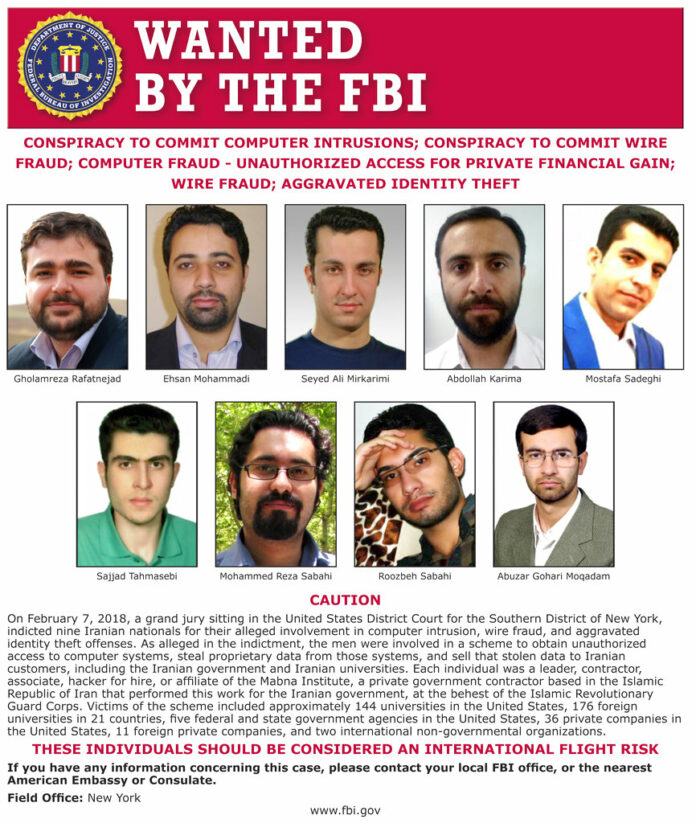
This image released by the FBI is the wanted posted for 9 Iranians that took part in a government-sponsored hacking scheme that pilfered sensitive information from hundreds of universities, private companies and government agencies. Image: FBI

WASHINGTON — The Trump administration announced criminal charges and sanctions Friday against Iranians accused in a hacking scheme to pilfer sensitive information from hundreds of universities, private companies and American government agencies.

The nine defendants, accused of working at the behest of the Iranian government-tied Islamic Revolutionary Guard Corps, hacked the computer systems of about 320 universities in the United States and abroad to steal expensive science and engineering research that was then used by the government or sold for profit, prosecutors said.

The hackers also are accused of breaking into the networks of government organizations, such as the Department of Labor, the Federal Energy Regulatory Commission and the United Nations, and private sector entities including technology companies and law and consulting firms.

The Justice Department said the hackers were affiliated with an Iranian company called the Mabna Institute, which prosecutors say contracted with the Iranian government to steal scientific research from other countries. The institute was founded by two of the defendants.

“By bringing these criminal charges, we reinforce the norm that most of the civilized world accepts: nation-states should not steal intellectual property for the purpose of giving domestic industries an advantage,” Deputy Attorney General Rod Rosenstein said in announcing the charges.

Also Friday, the Treasury Department targeted the Mabna Institute and 10 Iranians — the nine defendants and one charged in a separate case last year — for sanctions that officials say will make it harder for them to do business outside Iran.

The defendants are unlikely to ever be prosecuted in an American courtroom since there’s no extradition treaty with Iran. But the grand jury indictment, filed in federal court in Manhattan, is part of the government’s “name and shame” strategy to publicly identify foreign hackers, block them from traveling without risk of arrest and put their countries on notice.

In Tehran, Bahram Ghasemi spokesman of the Foreign Ministry condemned the move and called it “provocative, illegal and without justification.”

Ghasemi said the charges are “another sign of hostility of the U.S. government towards Iranian nation.” He said the U.S will not take any benefit from the move aimed at “thwarting” scientific growth of Iran.

The approach has been employed with past indictments accusing Iranian hackers of a digital break-in of a New York dam, Chinese military officials of large-scale hacks at energy corporations and Russians of a massive breach of Yahoo user accounts.

“People travel. They take vacations, they make plans with their families,” said FBI Deputy Director David Bowdich. “Having your name, face and description on a ‘Wanted’ poster makes moving freely much more difficult.”

According to the indictment, the Iranians broke into universities through relatively simple but common means — tricking professors to click on compromised links.

The spear-phishing emails purported to be from professors at one university to those at another and contained what appeared to be authentic article links. But once clicked on, the links steered the professors to a malicious Internet domain that led them to believe they’d been logged out of their systems and that asked them to enter their log-in credentials.

Those credentials were logged and stolen by the hackers, prosecutors say.

The Justice Department says the hackers stole roughly 31 terabytes of academic research and intellectual property that was then sent to servers outside the United States for profit. The information that was stolen, which was sold through two websites to customers in Iran, cost U.S. universities about $3.4 billion to procure and access.

More than 100,000 professors worldwide were targeted with spear-phishing emails. The affected professors and their universities were not identified.

“Just in case you’re wondering, they’re not admiring our work,” Bowdich said. “They’re stealing it, and they’re taking credit for it, and they’re selling it to others.”

Advertisement

The Week That Was in Asia (Photos)

In this Tuesday, March 20, 2018, file photo, a model displays a creation by Ohalu Ando of Japan during the 2018 Autumn/Winter Collection at the Tokyo Fashion Week in Tokyo. Photo: Shizuo Kambayashi / AP

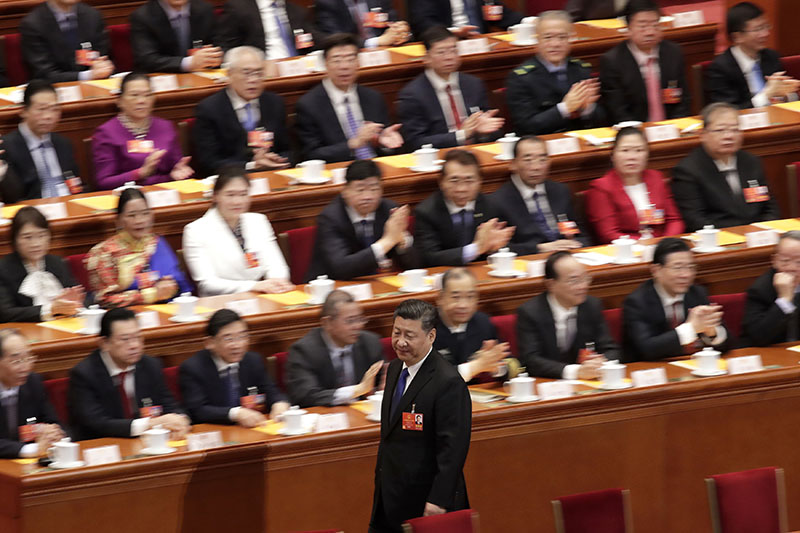
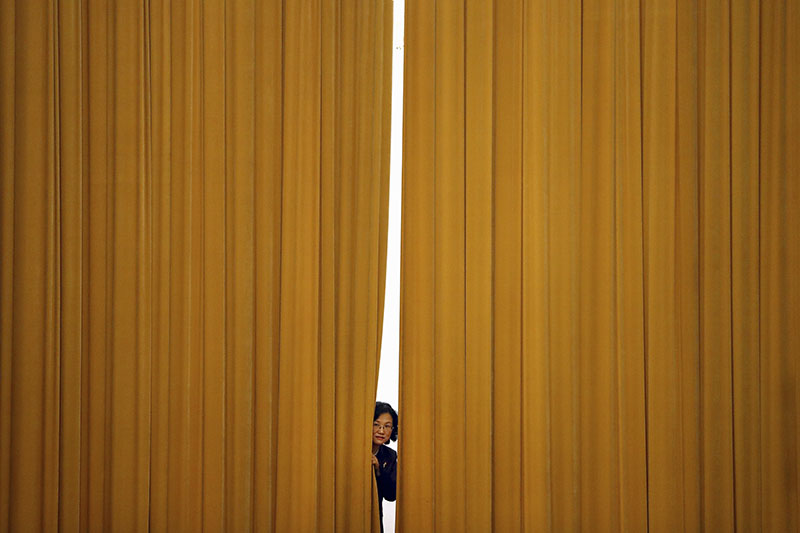
A staff member looks out from a curtain before a news conference following a plenary session of China’s National People’s Congress, which approved constitutional amendments allowing President Xi Jinping to continue in office for an unlimited number of terms.

The rubber-stamp legislature includes nearly 3,000 delegates who unfailingly vote according to the program handed down to them by the Communist Party leadership.

In other images from the Asia-Pacific region this week, a one-horned rhinoceros walks inside the Pobitora Wildlife Sanctuary in Assam state, India. The tiny wildlife sanctuary in northeastern India has reported a jump in the number of one-horned rhinoceroses.

A 14-year-old Indian girl is treated for her wounds in cross-border shelling between Indian and Pakistani troops in the disputed Kashmir region. Five members of a family were killed after an artillery round from the Pakistani side hit their home along the militarized Line of Control that divides the Himalayan territory between the two nuclear-armed rivals. Pakistan in turn has accused India of shelling its territory.

This gallery was curated by Associated Press photo editor Toru Takahashi in Tokyo.

AP18078195632390
In this Monday, March 19, 2018, file photo, Chinese President Xi Jinping walks by leaders after casting his vote for new vice premiers and ministers during a plenary session of China’s National People’s Congress at the Great Hall of the People in Beijing. China on Monday appointed a former missile force commander as its new defense minister amid lingering concerns over the goals of its rapid military modernization. Photo: Andy Wong / AP
AP18078287825626
In this Sunday, March 18, 2018, file photo, a one-horned rhinoceros walks inside the Pobitora Wildlife Sanctuary in Assam state, India. A tiny wildlife sanctuary in northeastern India has reported a jump in the number of one-horned rhinoceroses. Photo: Anupam Nath / AP
AP18078229003467
In this Monday, March 19, 2018, file photo, a staff member looks out from a curtain before a press conference following a plenary session of China’s National People’s Congress (NPC) at the Great Hall of the People in Beijing. China on Monday appointed a former missile force commander as its new defense minister amid lingering concerns over the goals of its rapid military modernization. Photo: Mark Schiefelbein / AP
AP18077305590144
In this Sunday, March 18, 2018, file photo, Nooren Akhtar, a 14-year-old Indian girl injured in cross border shelling between Indian and Pakistani soldiers in disputed Kashmir, arrives for treatment at the Government Medical College hospital in Jammu, India. Five members of a family were killed after a shell fired by Pakistani soldiers hit their home in Poonch region of Indian-controlled Kashmir along the militarized Line of Control that divides the Himalayan territory between the two nuclear-armed rivals, said S.P. Vaid, the police chief. Photo: Channi Anand / AP
AP18075568608771
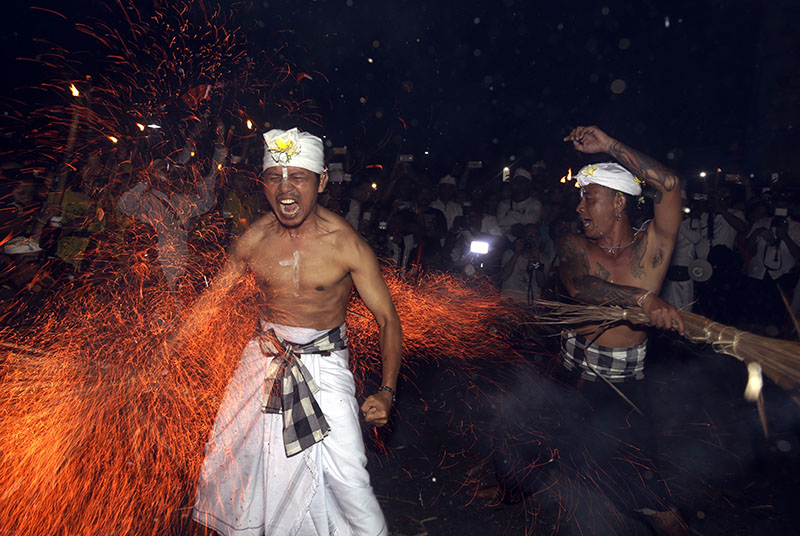
In this Friday, March 16, 2018, file photo, a Balinese man is hit with flaming coconut leaves during the fire fight ritual called ‘Lukat Gni’ before Nyepi, the annual day of silence marking Balinese Hindu new year in Klungkung, Bali, Indonesia. Bali’s annual Day of Silence is so sacred that even reaching for a smartphone to send a tweet or upload a selfie to social media could cause offense. This year it will be nearly impossible to do that anyway, all phone companies have agreed to shut down the mobile internet for 24 hours on Saturday during the holiday that marks the New Year on the predominantly Hindu island. Photo: Firdia Lisnawati / AP
AP18077341726977
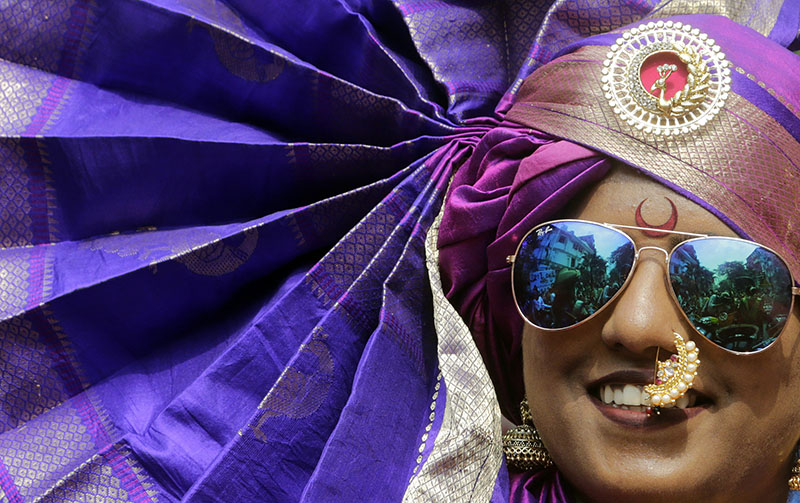
In this Sunday, March 18, 2018, file photo, a woman participates in a rally to celebrate Maharashtrian New Year in Mumbai, India. Photo: Rajanish Kakade / AP
AP18079307822221
In this Sunday, March 18, 2018, file photo, Chinese perform near the logo for the Paralympics after the Beijing mayor received the Paralympics flag during the closing ceremony of the 2018 Winter Paralympics in Pyeongchang, South Korea. Photo: Lee Jin-man / AP
AP18077340227968
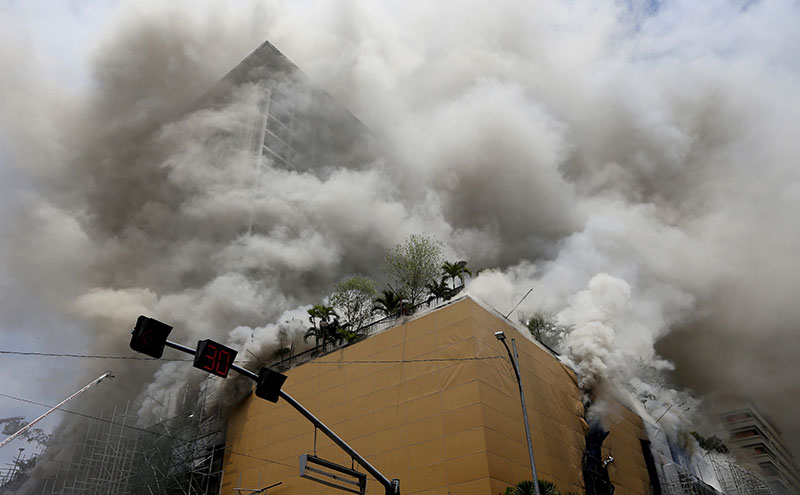
In this Sunday, March 18, 2018, file photo, a fire engulfs the Manila Pavilion Hotel and Casino in Manila, Philippines. The fire hit the hotel, where more than 300 guests were evacuated, some by helicopter, an official said. Photo: Bullit Marquez / AP
AP18078410649515
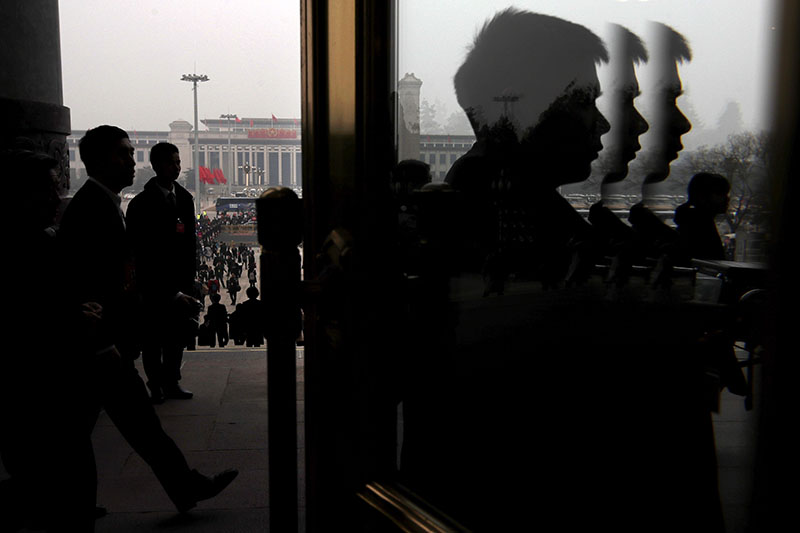
In this March 14, 2018, file photo, Chinese soldiers in usher uniforms stand guard as delegates leave the Great Hall of the People after attending a plenary session of of Chinese People’s Political Consultative Conference (CPPCC) in Beijing. Chinese politics in the main is carried out in the shadows, shielded from public scrutiny and producing pre-determined outcomes through a process termed democracy according to socialism with Chinese characteristics. Photo: Andy Wong / AP
AP18075349821438
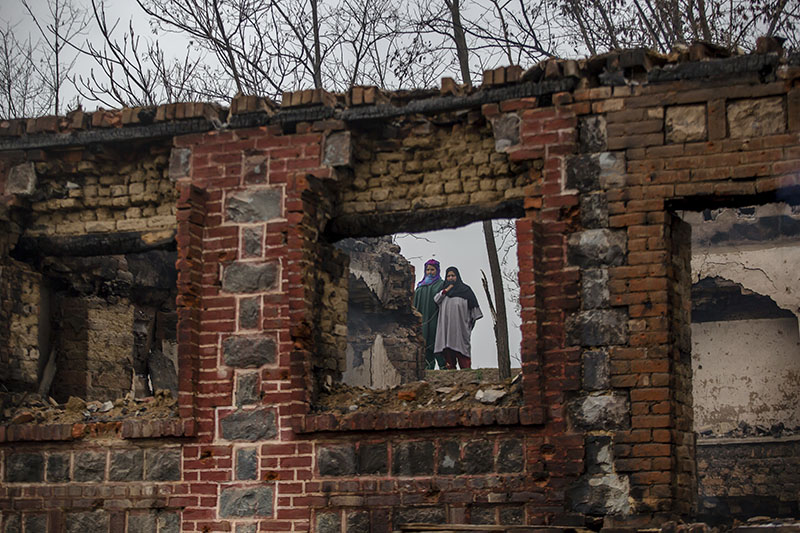
In this Monday, March 19, 2018, file photo, Kashmiri women stand near houses destroyed in a gunbattle on the outskirts of Srinagar, Indian-controlled Kashmir. Officials say two militants were killed and a soldier wounded in a gunbattle with Indian government forces in disputed Kashmir. Photo: Dar Yasin / AP
AP18075492218216
In this Friday, March 16, 2018, file photo, Sri Lanka’s Kusal Mendis successfully completes a run as Bangladesh’s Shakib Al Hasan jumps to avoid being hit by the ball during their second Twenty20 cricket match in the Nidahas triangular series in Colombo, Sri Lanka. Photo: Eranga Jayawardena / AP
AP18078122474087
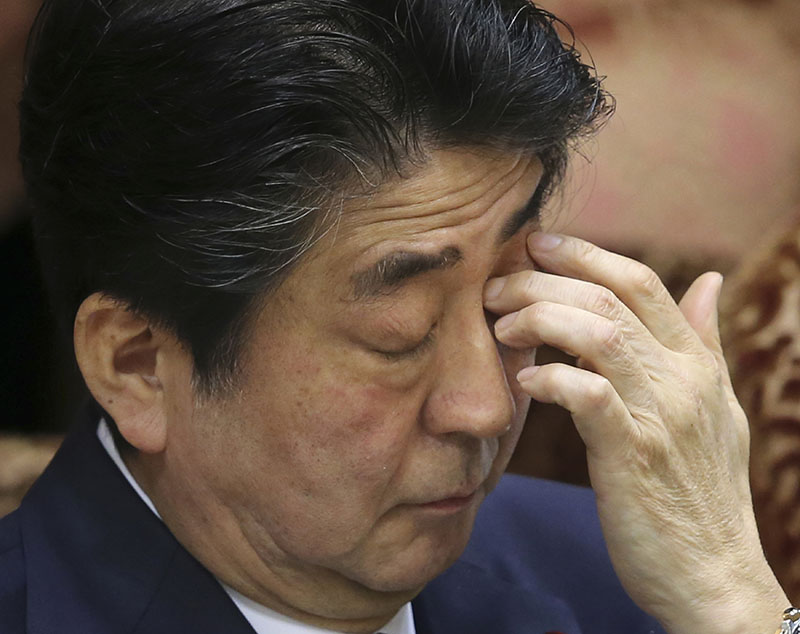
In this Monday, March 19, 2018, file photo, Japanese Prime Minister Shinzo Abe scratches his eyelid during a meeting of the upper house budget committee at the parliament in Tokyo. Support ratings for Abe have plunged amid a widening school land sale scandal linked to his wife, possibly risking chances for his third term in party leadership. Abe’s Cabinet has come under fire especially after Finance Ministry officials acknowledged tampered land deal documents, including deleting references to First Lady Akie Abe. Photo: Koji Sasahara / AP
Advertisement

Chris Evans May Not Return as Captain America

NEW YORK — The actor who plays Captain America may be ready to hang up his shield.

Chris Evans tells The New York Times he has no plans to return to the Marvel movie franchise after reshoots of the fourth “Avengers” movie later this year. Evans says “you want to get off the train before they push you off.”

The movie has yet to be titled and is expected to be released in 2019.

Evans has played the role since “Captain America: The First Avenger” in 2011.

The actor is making his Broadway debut as a police officer in “Lobby Hero,” which is scheduled to open March 26.

Advertisement

Activist Leader Held on Eve of Rally to Dissolve Junta

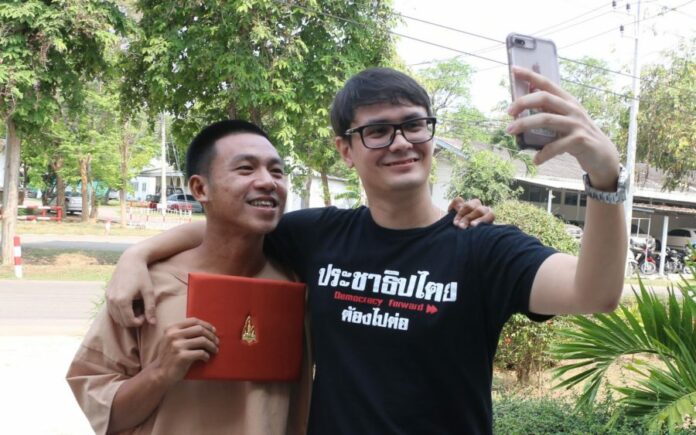
Jatupat ‘Pai Dao Din’ Boonpattaraksa, at left, and Rangsiman Rome take a selfie Friday at the 23rd Military Circle Headquarters in Khon Kaen.

KHON KAEN — A pro-democracy activist was detained briefly at a military court Friday, one day before he plans to lead a protest demanding that the military abolish the ruling junta.

Rangsiman Rome was taken into custody Friday over two-year-old charges he violated the junta’s ban on political assembly while in the northeastern province. He was held five hours before being freed at 3pm on a 10,000 baht bond from the 23rd Military Circle Headquarters.

“I’m not anxious about this case,” Rangsiman said Friday afternoon before pivoting to discuss Saturday’s march. “Tomorrow I will still lead the walk from Thammasat University, Tha Prachan campus, to the army base for a march to raise awareness as planned, even if the court order says I can’t do it.”

Rangsiman has been barred from leaving the country or “inciting incidents.” He will be summoned for questioning on May 7.

Jatupat “Pai Dao Din” Boonpattaraksa, who is serving a prison sentence for royal defamation, briefly met Rangsiman at the court to give evidence. Both men, as students, were charged for campaigning against the junta-backed charter at a July 2016 event at Khon Kaen University.

Rangsiman said he only learned of the charges last month.

“I never received a summons. I only knew last month when I was detained. Today I came to meet with the military court’s prosecutors. Therefore, it’s up to the prosecutors’ jurisdiction if they will charge me or not,” he said.

Rangsiman was greeted upon his release by friends and Jatupat’s parents, Wiboon Boonpattaraksa and Prim Boonpattaraksa.

Saturday’s protest, Rangsiman said, will call for dissolving the junta, restoring democracy and a third point he would not disclose before the march.

“I don’t want to reveal the last point now, because I’m afraid we will be prevented from holding the event,” Rangsiman said.

Rangsiman has been charged with numerous offenses during several years of activism since the 2014 coup. He was most recently among those charged with inciting rebellion and violating the public assembly law when the latest wave of protests erupted anew in January.

Related stories:

Court Frees MBK39 Leaders to Await Trial

Activist Cites Chinese Rail Project as Reason for His Arrest

Pro-Democracy Activist Rangsiman Rome Arrested, Again

Advertisement

Thainet Barbecues Rich Kid Upskirting in London

Photo: Topshop / Facebook

BANGKOK — Thai netizens Friday were ridiculing the a Thai legislator’s son fined for filming up women’s skirts in London.

After 27-year-old Pratyayoud Tupchareon was fined and given a curfew by a London court for surreptitiously recording upskirt videos at a clothing store there, he became an object of online derision back home for his behavior and alleged silver spoon upbringing.

“You sent your son to study overseas. He hasn’t even graduated yet, but he’s already making your family name famous. Totally worth it,” user Wachi Somjai wrote on a Facebook discussion of the incident.

Pratyayoud was nabbed by store security at a Topshop flagship store where he was placing a bag with a below women who wore skirts without leggings or tights, according to British tabloid Daily Mail.

Pratyayoud’s father is Youdtana Tupcharoen, a member of the junta-appointed legislature and a former governor of the state railway. His mother, Jutiporn Tupcharoen, is a judge in the Pathum Thani juvenile and family court.

“Are you following in the footsteps of your dad? In Thailand, whatever you guys do wrong, you’ll still avoid jail, that’s why there’s never news about you,” user Thanit Pisutpong wrote. “Someone who never did bad things can’t suddenly start doing them. You must have done this many times before,”

The London judge was no less sparing.

“I don’t know what you were thinking, you’re 27 years old, you’re not a child,” district judge Elizabeth Roscoe told Pratyayoud, according to the Daily Mail. “You are extremely lucky that you have a very supportive family but this is your responsibility and it was outrageous behavior – unpleasant, disrespectful and potentially, deeply offensive.”

Like the United States, England is a popular destination for the children of Thailand’s elite to study, work or in some cases, run from the law.

Pratyayoud is enrolled at the Regent’s University London, where annual tuition starts at GBP17,000 (750,000 baht). The criminal matter forced him to delay the start of his postgraduate coursework at Westminster University, the tabloid reported.

Under the terms of his conviction, Pratyayoud must wear a monitoring device and remain home 7pm to 6am for three months. He must also pay each of his three known victims restitution of GBP85 (about 3,749 baht), as well as a fine in the same amount for a total of GPB340 (15,000 baht).

Some Thais were impressed with the British legal proceedings.

“British laws really take care of their people,” user Pran Sinsawad wrote. “It really acts on people without looking at their last name. Remember this, you indiscriminate pervert.”

Pratyayoud, who confessed guilt to the charge of public indecency, is also barred from entering the entirety of the central borough of Westminster for four months. In court, he reportedly said he was influenced by YouTube upskirt videos.

S 35479572
Youdtana Tupcharoen. Photo: National Legislative Assembly
mom
Jutiporn Tupcharoen. Photo: Horwang Pathumthani School
Advertisement

123 More Foreigners Arrested in Raids on Schools, Hostels

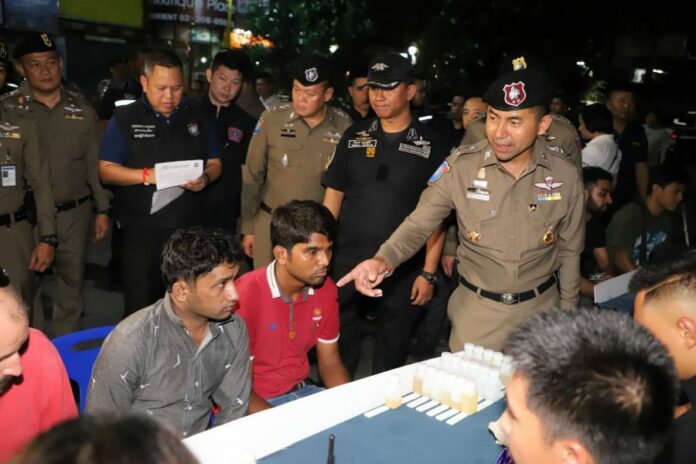
Police Deputy Commissioner Maj. Gen. Surachet Hakpal points some arrested foreigners.

BANGKOK — Police announced early Friday morning the arrest of 123 foreigners suspected of various visa infractions.

In the latest police action as part of a sweeping crackdown on foreigners in the capital, regular and tourist police officers raided 49 schools and 59 hostels throughout the capital Thursday in search of people who entered the kingdom illegally or overstayed their visas.

“Some foreigners come in to do criminal activities under the guise of tourists. There are networks to make fake credit cards, marriage scams, sell fake gems and drug-related groups,” said deputy tourist police chief Maj. Gen. Surachet Hakpal, who led the raid.

Of the 123 suspects paraded before the media at about 1am this morning, 17 were accused of overstaying their visas: nine Indians, two Cambodians, two Pakistanis, and one person each from China, Myanmar, Kenya and Egypt.

A total 91 people were found to have entered the country illegally: 62 Burmese, 14 Laotians, four Cambodians, three Vietnamese, three Indians, three Pakistanis, one Belgian and an Australian.

The 14 others were charged with various other offenses.

Thursday’s raids were the fifth in an operation police are calling “X-Ray Outlaw Foreigner.” Its stated purpose is to remove people who have overstayed their visas, though raids targeting “black people” began under the banner of “Operation Black Eagle” last year. Police say they have arrested 490 people under the new campaign, and acknowledge they are going after “dark-skinned people.”

Related stories:

75 Foreigners Arrested in Soi Cowboy Crackdown

Africans, Indians Arrested in Latest Raid on ‘Black People’ (Video)

Advertisement

‘Casillero del Diablo’ Helps Preserve Thai Elephants (Sponsored)

The following is a sponsored message.

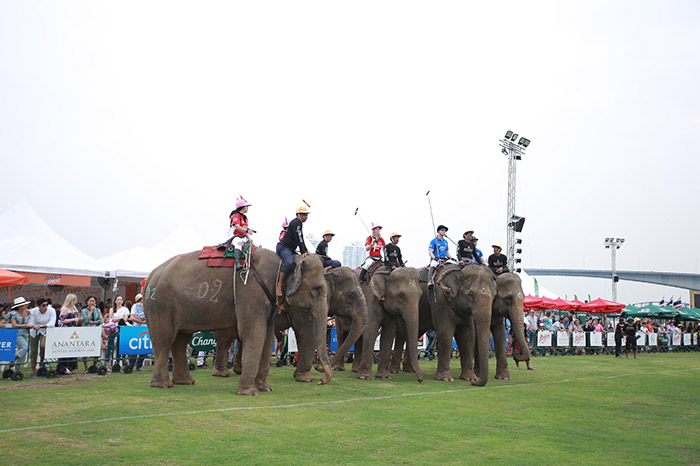
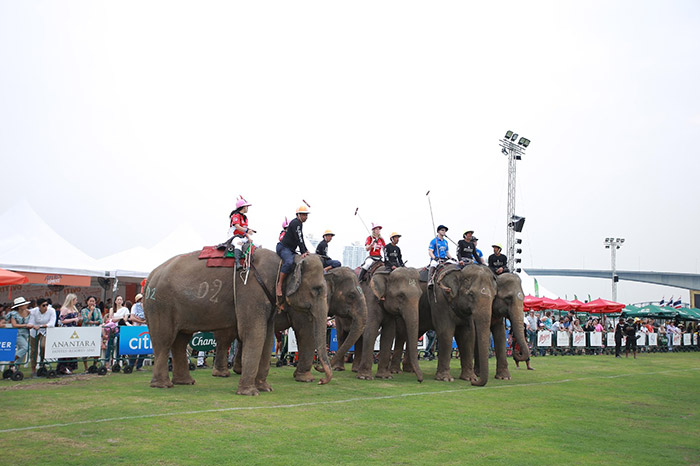
With the awareness of the importance of elephants, and how the majestic animals are a symbol of Thailand, Siam Winery, producer and importer of premium quality wines from all over the world, lent its support to the King’s Cup Elephant Polo 2018 through its premium Chilean wine brand, Casillero del Diablo.

One of the world’s most-prized wines, it can be found in 135 countries across five continents.

This year’s King’s Cup Elephant Polo 2018, where the prize cup was presented by His Majesty King Maha Vajiralongkorn Bodindradebayavarangkun, was hosted last week at the Anantara Riverside Bangkok. It was the 16th edition of the event since its inception in 2001. Proceeds go to benefit elephant welfare and support mahout training.

Guests and celebrities were treated to the exceptional taste of Casillero del Diablo wines, made with meticulous methods and Chile’s prime quality grapes. Five labels of Casillero del Diablo are selected to be served at the King’s Cup Elephant Polo 2018..

The refreshing Casillero del Diablo Sauvignon Blanc, made from pure Sauvignon Blanc grapes, sports pleasant aroma of gooseberry and tropical fruits, suitable for Latin-style fish, avocado and onion.

cup3

The crisp, floral CDD Chardonnay, made with pure Chardonnay grapes, delights with citrus notes of pineapple, lemon and peach and tapers off with sensual vanilla. The wine is a perfect pair with fish, seafood and rich, creamy pasta.

Smooth red, CDD Pinot Noir, showcases complex layers of strawberry and raspberry as well as hint of smoky French oak. The wine is a great match with chicken, pork, vegetable and heavily seasoned dishes.

Robust red CDD Cabernet Sauvignon soothes the palate with gentle tannins and delights the nose with ripe fruit and berries aroma. Best accompanied this exceptional wine is red meat, heavily seasoned dish as well as gruyere and blue cheeses.

Highlight is the charming sparkling wine, CDD Devil’s Brut, with sensual touch of green apple from limestone hill and balanced minerality. It is best to enjoy with fresh fish, seafood and Japanese sushi dishes.

cup3 1

Advertisement

Hot News

LATEST NEWS

Bangkok
broken clouds
36.6 ° C
37.8 °
35.5 °
47 %
3kmh
82 %
Mon
35 °
Tue
37 °
Wed
37 °
Thu
36 °
Fri
36 °