31.6 C
Bangkok
Friday, June 5, 2026
Home Blog Page 2099

Prayuth Willing to Resell Controversial Puppies

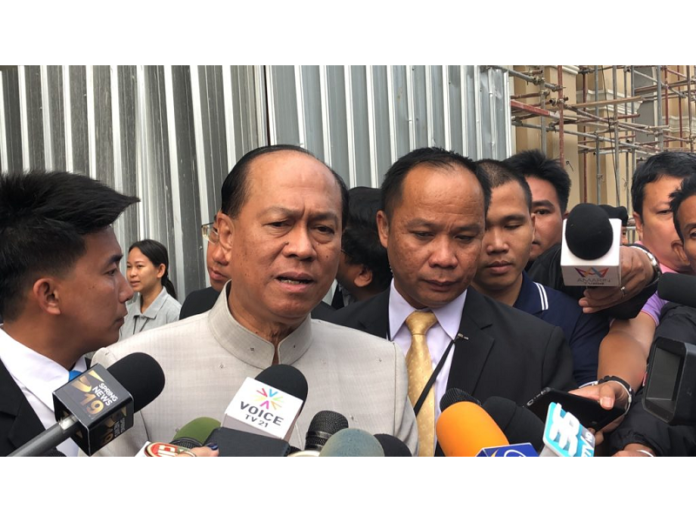
Interior Minister Gen. Anupong Paochinda speaks to the press Wednesday in Bangkok. Photo: Matichon

BANGKOK — Junta leader Gen. Prayuth Chan-ocha said Wednesday morning that he had yet to receive three controversial puppies for which he allegedly overpaid, leading an activist to accuse him of breaching anti-corruption laws.

Activist Srisuwan Janya on Tuesday accused Prayuth of breaching Article 103 of the Anti-Corruption Act – a law prohibiting government officials from giving or receiving gifts in excess of 3,000 baht – when he allegedly paid 7,000 baht above market price for three Bang Kaew puppies last December during a trip to Sukhothai.

Prayuth told reporters Wednesday morning that the animals had yet to be delivered to him, but said he was willing to resell them.

“I have paid the money. Anyone who wants can buy them from me,” he said Wednesday morning at the Government House.

Srisuwan accused the junta leader of further breaking the law for gifting two of the three puppies to Interior Minister Gen. Anupong Paochinda and Deputy Prime Minister Chatchai Sarikulya respectively.

Anupong today told reporters on Wednesday he was aware of the law and said he would not accept Prayuth’s gift, saying he already has dogs at home. Chatchai said he was not worried since the puppy had yet to be delivered.

Prayuth paid a total of 25,000 baht for the trio of puppies, originally priced at 6,000 baht each – or 18,000 baht for three – saying he wanted to give the seller moral support. Srisuwan said the surplus constituted a gift – and thus a breach of the law.

The activist said he would petition the National Anti-Corruption Commission today to determine whether the purchase violated Article 103.

Advertisement

Trump Boasts of Bigger ‘Nuclear Button’ Than North Korea’s

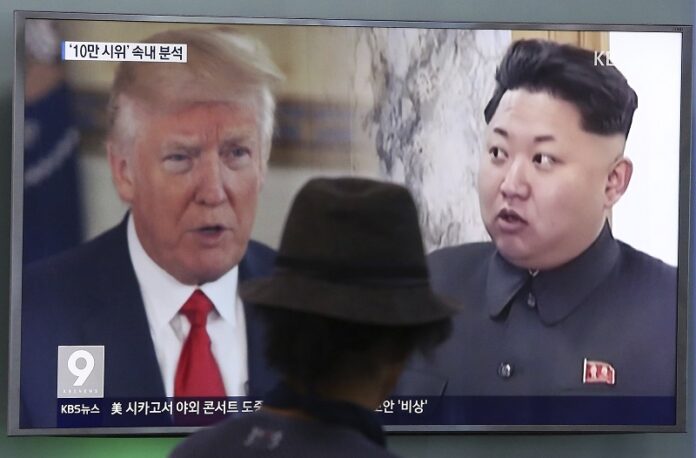
A man watches a television screen showing U.S. President Donald Trump, left, and North Korean leader Kim Jong Un during a news program at the Seoul Train Station, Thursday in Seoul, South Korea. Photo: Ahn Young-joon / Associated Press

WASHINGTON — President Donald Trump boasted Tuesday that he has a bigger and more powerful “nuclear button” than North Korean leader Kim Jong Un.

The president’s Tuesday evening tweet came in response to Kim’s New Year’s address, in which he repeated fiery nuclear threats against the United States. He said he has a “nuclear button” on his office desk and warned that “the whole territory of the U.S. is within the range of our nuclear strike.”

Trump mocked that assertion, writing, “Will someone from his depleted and food starved regime please inform him that I too have a Nuclear Button, but it is a much bigger & more powerful one than his, and my Button works!”

Earlier Tuesday, Trump sounded open to the possibility of an inter-Korean dialogue after Kim made a rare overture toward South Korea in a New Year’s address. But Trump’s ambassador to the United Nations insisted talks would not be meaningful unless the North was getting rid of its nuclear weapons.

In a morning tweet, Trump said the U.S.-led campaign of sanctions and other pressure were beginning to have a “big impact” on North Korea. He referred to the recent, dramatic escape of at least two North Korean soldiers across the heavily militarized border into South Korea. He also alluded to Kim’s comments Monday that he was willing to send a delegation to the Winter Olympics, which will be hosted by South Korea next month.

“Soldiers are dangerously fleeing to South Korea. Rocket man now wants to talk to South Korea for first time. Perhaps that is good news, perhaps not – we will see!” Trump said, using his derisive moniker for the young North Korean leader.

In response to Kim’s overture, South Korea on Tuesday offered high-level talks on Jan. 9 at the shared border village of Panmunjom to discuss Olympic cooperation and how to improve overall ties.

North Korea did not immediately react to the South’s proposal. If there are talks, they would be the first formal dialogue between the Koreas since December 2015. Relations have plunged as the North has accelerated its nuclear and ballistic missile development that now poses a direct threat to America, South Korea’s crucial ally.

The U.S. administration, however, voiced suspicions that Kim was seeking to drive a wedge between Seoul and Washington. Pyongyang could view a closer relationship with Seoul has a way for reducing its growing international isolation and relief from sanctions that are starting to bite the North’s meager economy.

“We won’t take any of the talks seriously if they don’t do something to ban all nuclear weapons in North Korea,” U.S. Ambassador Nikki Haley told reporters at the United Nations. “We consider this to be a very reckless regime. We don’t think we need a Band-Aid, and we don’t think we need to smile and take a picture.”

While Trump ratcheted up the tension Tuesday night, he doesn’t actually have a physical nuclear button.

The process for launching a nuclear strike is secret and complex, and involves the use of a nuclear “football,” which is carried by a rotating group of military officers everywhere the president goes and is equipped with communication tools and a book with prepared war plans.

If the president were to order a strike, he would identify himself to military officials at the Pentagon with codes unique to him. Those codes are recorded on a card known as the “biscuit” that is carried by the president at all times. He would then transmit the launch order to the Pentagon and Strategic Command.

North Korea has been punished with unprecedented sanctions at the U.N. over its weapons programs, and Haley warned Tuesday of more measures if the North conducts another missile test.

In Washington, State Department spokeswoman Heather Nauert did not express opposition Tuesday to South Korea holding talks with North Korea, but voiced deep skepticism about Kim’s intentions, saying he may be “trying to drive a wedge of some sort” between the U.S. and its ally, which hosts 28,000 American forces.

South Korea’s liberal President Moon Jae-in has supported Trump’s pressure campaign against North Korea, but he’s less confrontational than the U.S. president and favors dialogue to ease the North’s nuclear threats. Moon has long said he sees the Pyeongchang Olympics as a chance to improve inter-Korean ties.

White House spokeswoman Sarah Huckabee Sanders said the U.S. would continue to put “maximum pressure” on North Korea to give up its nukes. She added that South Korea shares that goal.

Story: Matthew Pennington

Advertisement

On the Streets of Tehran, Iranians Feel Protesters’ Pain

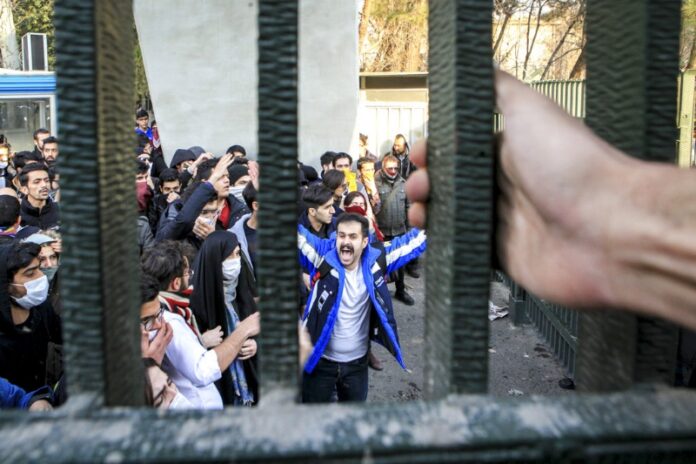
Protesters seen here Tuesday in Iran's capital, Tehran. Photo: Associated Press

TEHRAN, Iran — As Iranians take to the streets in the biggest demonstrations in nearly a decade, residents of the increasingly tense capital say they sympathize with the protesters’ economic grievances and anger at official corruption.

The Associated Press spoke to Iranians in Tehran on Tuesday, the sixth day of protests that have seen at least 21 people killed and hundreds arrested across the country. The protests, which have erupted in several cities, are the largest since those that followed the disputed 2009 presidential election.

Residents cast nervous looks at the growing street presence of police and Basij, a volunteer force that played a key role in the government crackdown that ended the demonstrations nine years ago. But many residents said the country’s soaring unemployment and rising prices had driven people to the point of desperation.

“If authorities do not fight protesters, then they will have peaceful protests,” said Rahim Guravand, a 34-year-old construction worker.

“I’ve been out of work for months. Who is accountable for this? The government should stop spending money on unnecessary things in Syria, Iraq and other places and allocate it for creating jobs here,” he said, referring to Iran’s support for the Syrian government and regional militant groups.

Iranian President Hassan Rouhani, a relative moderate who was re-elected last year, has expressed sympathy for peaceful protesters worried about how to make ends meet amid high unemployment and 10-percent inflation.

But his support appears to be slipping as many Iranians fail to see any gains from his 2015 nuclear agreement with world powers, under which Iran curbed its nuclear program in exchange for the lifting of some international sanctions. Iran has made billion-dollar airplane orders and resumed selling its crude oil on the international market, but the benefits have yet to trickle down.

“I voted for Rouhani, but I see his hands are tied and he cannot fulfill his promises,” said Parisa Masoudi, a 23-year-old student at Tehran’s Azad University. “The government should open the political sphere if it intends to keep the people’s support.”

Nasrollah Mohammadi, a mechanic near Tehran’s Enghelab Square, the site of many past protests, said he supports the demonstrators’ demands.

“They are right. Corruption is high and opportunities are given to their own friends,” Mohammadi said, referring to government officials. “I have two sons, 27 and 30, at home without jobs years after graduation.”

In 2009 the protests were largely centered in Tehran, led by middle and upper class supporters of reformist candidates who lost to the hard-liner Mahmoud Ahmadinejad in an election best by allegations of fraud.

The latest protests began in Mashhad, the country’s second largest city, and have flared across the provinces, with no clear leadership or political platform beyond anger at the government. Tehran has also seen protests, but the most violent clashes have been elsewhere.

Not everyone in Tehran supports the latest demonstrations. Farnaz Asadi, a 31-year-old who sells goods via the popular messaging app Telegram, expressed anger at the government’s decision to shut down the service after protesters used it to organize rallies and share photos and video. The app is used by an estimated 40 million people a day in Iran – half the country’s population.

“It is not fair. Some protesters went into the streets, but why I should pay the price?” she asked. “The government shut down Telegram and my store was shut down too.”

Another university student, 21-year-old Reza Nezami, described the Telegram shutdown as another promise broken by the government. “Rouhani had said his administration would not restrict social networks,” he said.

For others, the protests represent just another hardship.

“I am not happy. Some protesters broke windows and damaged public property,” said Abbas Ostadi, a 45-year-old electrician. “They burned my friend’s taxi. Who is going to compensate him? How will he take home some bread for his family?”

Advertisement

Prayuth Broke Law Buying, Gifting Overpriced Puppies: Activist

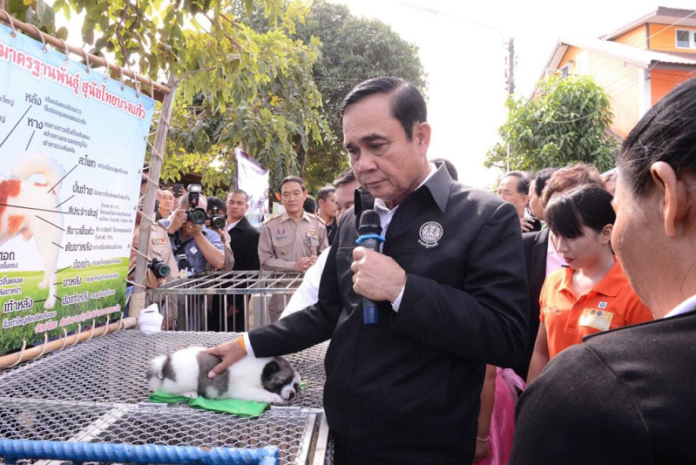
Junta leader Gen. Prayuth Chan-ocha caresses one of three dogs he purchased last December in Sukhothai.

BANGKOK — Anti-corruption activist Srisuwan Janya said he would petition the anti-corruption commission on Wednesday over Prime Minister Gen. Prayuth Chan-ocha’s  purchase of three puppies late last year.

Srisuwan, secretary-general of the Association of Thai Constitution Protection, said Tuesday in a letter that Prayuth broke anti-corruption laws when he bought three Bang Kaew puppies in Sukhothai province last December, after reportedly paying 3,000 baht above the real market price.

Prayuth reportedly paid a total of 25,000 bahts for three puppies originally priced at 6,000 baht each when he visited the province, citing his desire to offer moral support to the seller.

In a Tuesday letter to the media in which he expressed his intentions, Srisuwan pointed out that Prayuth had paid 7,000 baht of extras to the seller, which could be construed as a violation of anti-corruption laws.

Srisuwan cited Article 103 of the 1999 Anti-Corruption Act which forbids government officials from giving or receiving gifts worth more than 3,000 baht.

What’s more, wrote Srisuwan, Prayuth also broke the law by giving two of the puppies to Interior Minister Gen. Anupong Paochinda and his deputy, Gen. Chatchai Sarikulya, meaning they also broke the law by accepting the gifts.

“Thus these acts by [the three] clearly violate said law. In order not to let the incident occur without the law being enforced, the association [I represent] will petition the National Anti-Corruption Commission to examine, scrutinize and exercise its power according to the law,” Srisuwan wrote.
Last month, Srisuwan petitioned the commission over numerous undeclared luxury watches owned by Deputy Prime Minister Gen. Prawit Wongsuwan.

Advertisement

Koh Phangan Bar Busted for Selling Shrooms, Laughing Gas

Psilocybe mushrooms. Photo: Wikimedia Commons

SURAT THANI — A bar on Koh Phangan was raided early Tuesday morning for selling drinks mixed with psilocybin mushrooms and nitrous oxide, or laughing gas.

Acting on a tip off at about 3am on Tuesday, police and army officers raided Bello Bar on Rin Beach which at the time was hosting more than 100 Thai and foreign revelers. The bar sold drinks mixed with psilocybin mushrooms, known as “magic mushroom” and nitrous oxide, or laughing gas.

The officers, with search warrants issued under Article 44 of the constitution, found 30 liters of fruity drinks mixed with “magic mushrooms” and 20 liters of blended magic mushroom smoothies.

Three 20-kilogram cylinders containing nitrous oxide were seized. Authorities also seized more than 1.5 million baht in cash.

Bar owner Duangruedee Saelim and two staff members Chanchai Buakham and Kamnuan Somsuk were taken into police custody and questioned, said Col. Samai Prompakol of Koh Phangan Police.

Duangruedee told police she sold mushroom shakes at 300 baht a glass.

In Thailand, psilocybin mushrooms are classed as a Category 5 narcotic and the sale of laughing gas without a permit is illegal.

Advertisement

Believers in Temples Take to Coffins to Wish for 2018 Luck

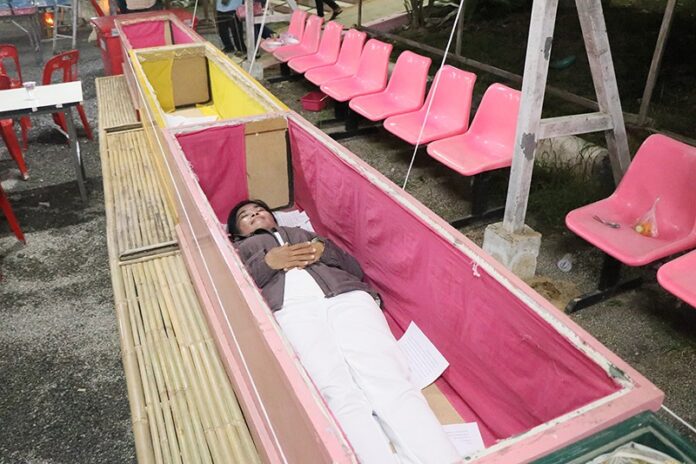
A believer on Tuesday in Suphan Buri lies in a coffin to wish for good luck.

BANGKOK — Believers Monday flocked to Buddhist temples in hopes of being reborn into a new and better life – by lying inside a coffin on New Year day.

Wat Maneepraison, a temple in Tak province’s Mae Sot district is known by believers to be a holy place for such ritual. Clad in white, people on Monday lied inside coffins placed in a row in front of Buddhist monks as they chanted and prayed. This signified symbolic death and rebirth, a new and better life.

Phon Saensak, 60, a resident of Mae Sot district, said he went to the temple because he has suffered from gastric ulcers for many months and doctor have failed to heal his condition. He said he may heal after the ritual.

Elsewhere in Suphan Buri province, another temple hosted a similar ritual. The coffin in this case came with an inner lining of colored cloth reflecting that of the believer’s birthday, from Monday which is yellow to Sunday which is red.

Some people believe they will live a longer and more prosperous life by carrying out such ritual.

Advertisement

42 Survive Boat Capsizing off Indonesia’s Borneo; 8 Dead

Indonesia rescue team on Monday search victims a boat that capsized off Indonesia's part of Borneo island. Photo: Ridwan / Associated Press

JAKARTA — Rescuers have found 42 survivors and are searching for one man still missing after a speedboat capsized off Indonesia’s part of Borneo island.

At least eight people died in the capsizing Monday as the Anugrah Express boat was traveling from Tanjung Selor, the capital of North Kalimantan province, to Tarakan in the same province.

Manangap Djumala, a search and rescue official in Tarakan, said that in addition to the deaths, 42 people were found alive by rescuers. The man still missing is a passenger.

Djumala said the boat’s manifest listed 48 passengers and three crew members. Five passengers are children, though he said infants are usually not listed in the manifest.

Police are investigating the cause of the capsizing.

Ships are a popular and relatively cheap way to travel in the world’s largest archipelago nation, but poor safety enforcement means accidents are common.

Advertisement

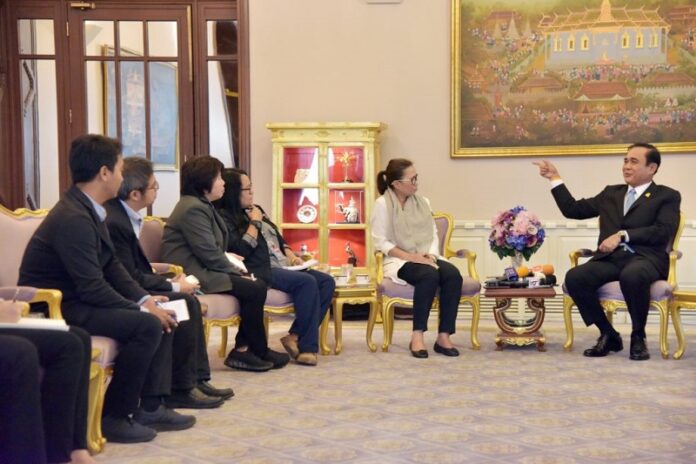
Prayuth Asks Press to Promote Govt’s Work

Gen. Prayuth Chan-ocha speaks to journalists Tuesday at the Government House.

BANGKOK — The press should promote the government’s work, report positive news and enable all sides to talk with one another, junta leader Gen. Prayuth Chan-ocha said on Tuesday.

Prayuth made the remarks Tuesday at the Government House in a meeting with journalists on his first day of work of the year.

Prayuth said the press must understand that some of the government’s work takes time, as many problems overlap. He vowed to work harder in 2018, however.

“I would like to ask the press to promote what can be achieved. And whatever people’s desires are, just communicate them to us… I insist I never have a problem with the press,” he said.

“Please make the new year, the year of happiness because in the past year we were in a state of sorrow the whole year. And before that we had been caught up with chaotic problems for a decade.”

Prayuth was referencing King Bhumibol’s death and cremation and the decade-long political feuds which saw deaths on the streets related to protests, crackdowns and two coups – the latest in 2014.

Prayuth urged journalists to consider how they could collaborate and foster national reconciliation in 2018.

“The press plays an important role in enabling everyone to meet and discuss,” said Prayuth.

He then gave non-specific examples of television programs causing division in society by allowing people to argue on air about small issues, leading the majority of the public to judge who is at fault.

“The press must be careful in presenting [such programs]. But I can’t interfere because it’s a business that must compete for people’s attention.”

He then vaguely said the media has the power absolve those guilty of crimes in the eyes of the public, “causing problems to the judicial system.”

Advertisement

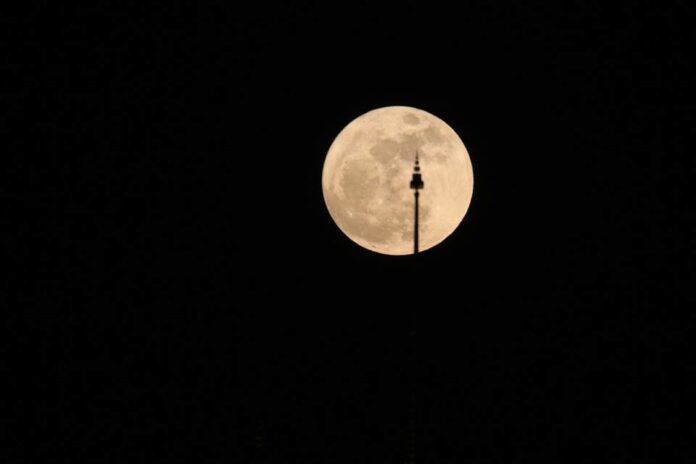
See 2018’s First ‘Supermoon’ Tonight

“Supermoon” captured in Bangkok on November 14, 2016

BANGKOK — Look at the sky tonight and you might see 2018’s first and biggest moon.

Should the skies stay clear Tuesday night, observers will be treated to the year’s first and biggest full moon, which will reach its closest point to earth on 2018. In other words, it will be about 27,000 kilometers closer to earth than usual, look 7 percent larger and 16 percent brighter.

January’s first full moon – traditionally nicknamed “Wolf Moon” after howling wolves heard outside native American villages – will be visible from 6pm on Tuesday, according to Worawit Tanwuttibandit, advisor of the Regional Observatory in Chachoengsao.

The second supermoon of the year will occur on Jan. 31. This is known as a “Blue Moon,” for being the second of two full moons to fall in one calendar month.

The National Astronomical Research Institute will provide telescopes at their locations in Nakhon Ratchasima, Chachoengsao and Songkhla provinces as well as in Chiang Mai’s Maya Lifestyle Shopping Center. They will also be available at more than 260 regional schools countrywide.

A “supermoon” takes place when the moon becomes full on the same day it reaches its perigee – the moon’s closest point to Earth in its monthly orbit – appearing bigger and brighter more than usual.

On Nov. 14, 2016, Thailand celebrated Loy Kratong’s Day under the biggest full moon since 1948, which looked 14 percent larger and 30 percent brighter.

Related stories:

Celebrate Loy Krathong Under Biggest Full Moon Since 1948


Advertisement

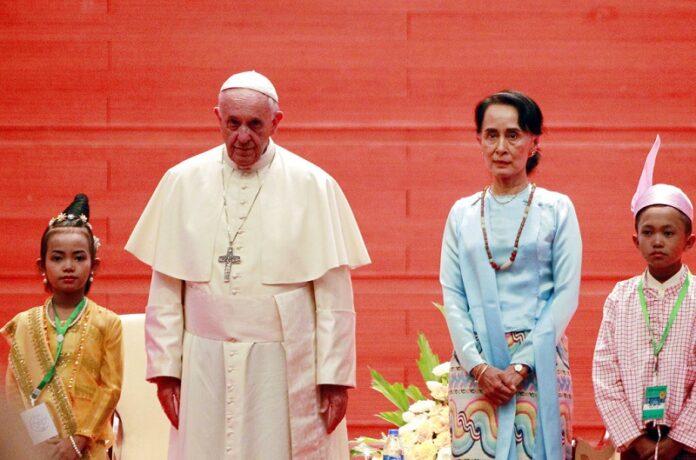
Pope on 2018: Forget Life’s Useless Baggage, Work for Peace

Myanmar's leader Aung San Suu Kyi, center right, and Pope Francis, centre left, pose for media at a meeting with members of the civil society and diplomatic corps in 2017 in Naypyitaw, Myanmar. Photo: Aung Shine Oo / Associated Press

VATICAN CITY — Pope Francis on Monday recommended jettisoning life’s “useless baggage” in 2018, including what he called “empty chatter” and banal consumerism, and focusing instead on building a peaceful and welcoming world, particularly for refugees and migrants.

Francis offered his reflections on paring down non-essentials as he celebrated New Year’s Day Mass Monday in St. Peter’s Basilica and later greeted some 40,000 people in St. Peter’s Square.

His advice included setting aside a moment of silence daily to be with God. Doing so would help “keep our freedom from being corroded by the banality of consumerism, the blare of commercials, the stream of empty words and the overpowering waves of empty chatter and loud shouting,” Francis said.

“At the beginning of the year, we too, as Christians on our pilgrim way, feel the need to set out anew from the center, to leave behind the burdens of the past and to start over from the things that really matter,” he said.

The Catholic church designates Jan. 1 as World Peace Day, and in his comments after Mass to the crowd in the square outside the basilica, Francis noted that this year’s focus of the day was the search for peace by migrants and refugees.

“I desire, yet again, to speak for these our brothers and sisters who invoke for their future a horizon of peace,” Francis said. “For this peace, which is the right of everyone, many of them are willing to risk their life in a voyage that is in the great majority of cases long and dangerous, willing to face hardships and suffering,” the pontiff said.

In the past few years, hundreds of thousands of migrants have crossed the Mediterranean from northern Africa in human traffickers’ unseaworthy boats, desperate to reach European shores. The pope’s foreign travels in 2017 included a voyage to Myanmar and Bangladesh, where the suffering of minority Rohingya Muslims, who have fled from the first country to take refuge in the second, was a central concern of his pilgrimage.

Francis in his appeal Monday said of refugees and migrants: “Let us not extinguish the hope in their hearts. Let us not suffocate their expectations for peace.” He called for all to make commitments “to assure the refugees, the migrants, everyone, a future of peace.”

The pope then prayed that people “work in this new year with generosity to realize a world that is more united and welcoming.”

Advertisement

Hot News

LATEST NEWS

Bangkok
overcast clouds
31.6 ° C
31.6 °
29.4 °
58 %
5.7kmh
100 %
Fri
35 °
Sat
37 °
Sun
35 °
Mon
35 °
Tue
35 °