Malaysian Airlines flight 9M-MRO Malaysia Airlines takes off in 2013 from Los Angeles International Airport. Photo: Paul Rowbotham / Wikimedia Commons
SYDNEY — A Malaysia Airlines plane landed safely in an Australian Outback city after the plane shook violently in midflight and passengers braced themselves for a hard landing.
Flight 122 had been heading from Sydney to Kuala Lumpur and was over the northwest Australian coastal town of Broome when it turned back Thursday. It landed safely in Alice Springs and the airline said “safety was not at any time compromised.”
“We suddenly experienced a very violent shaking of the aircraft and that probably lasted about five minutes and it was coming from one of the engines,” passenger Hugh Wolton told the Australian Broadcasting Corp. “We got a call from the captain on the deck describing how to make plans for an emergency landing, you know, the wording used things like ‘impact,’ so we were suddenly bracing ourselves for a rough landing.”
Passenger Peter Brooks said the captain announced there would be “a couple of impacts” and some passengers thought the plane would come down in the desert. But about 45 minutes later the captain said they would land in Alice Springs, he said.
The airline said the Airbus A330-300 plane experienced a “technical fault” in one of its two engines and the pilot decided to divert the flight.
Passenger Cath Cat said the landing was ultimately smooth.
“We were aware of a sudden shuddering noise and then we were told to prepare for an emergency landing and there were instructions,” Cat told Nine Network television. “But later — fairly rapidly actually — the pilot said that the situation was under control and that we were returning to Alice Springs and although it was an emergency landing technically, it was going to be like a commercial landing, which in fact happened and we were all very grateful for that.”
The airline said passengers would be flown to Kuala Lumpur on Friday.
Malaysia Airlines suffered two disasters in 2014. Flight 370 vanished with 239 people on board while heading to Beijing and is believed to have crashed in the far Indian Ocean, and Flight 17 carrying 298 people from Amsterdam was shot down over Ukraine a few months later.
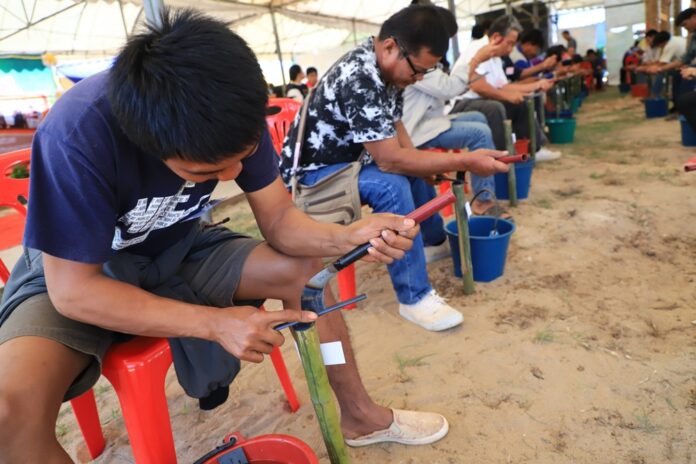
Exhibition participants learn how to extract rubber Thursday
The following is a paid news release. Khaosod English is not responsible for its content.
BUENG KAN — Hosting the biggest rubber expo for the sixth year, Thailand’s newest province, Bueng Kan, has proved that a young age cannot stop an ambitious city from becoming self-reliant.
Kicking off on Wednesday, the annual Bueng Kan Red Cross and Rubber Day event has continued its mission to enrich the knowledge and experience of their local rubber farmers and to open the door to trading opportunities. With this great effort and cooperation, the nearly seven-year-old province has become a role model for local empowerment.
At the opening ceremony, Deputy Interior Minister Suthee Makboon said the event has illustrated that Bueng Kan has a potential to be the leader of the rubber industry. The synergy between government and private sector in the past years, Suthee said, has proved to beneficial for its residents.
“Bueng Kan was just founded in 2011…but its income per capita has now become pleasantly higher,” said Suthee.
As the biggest rubber grower in the northeastern region, Bueng Kan aims to be the center of rubber industry not just in Thailand, but the Greater Mekong Subregion. Their strategy is not only to produce more natural rubber but to also add more value to the commodity by applying new innovations. The existing success is the rubber pillow plant which run by a local farmers cooperative.
Running for a week, the festival this year consists of a new technologies exhibition, workshops, talks and everything useful for rubber growers. Combining with the annual Red Cross Fair, there are also entertainment shows, lucky draws, shops, and beautiful agricultural displays.
“This event will stimulate economy of the province and generate income for our Bueng Kan folks who are now affecting from the fluctuation in rubber price,” Bueng Kan Governor Pisut Bussayapanpong said Wednesday.
Joining the opening ceremony were delegates from China, Laos and Vietnam who aimed to initiate trade negotiation and knowledge transfer.
Director of the National Engineering Research for Rubber and Tire of China and the President of Mesnac Group Co., Ltd, Yuan Zhongxue, said he admired the collaboration of people in Bueng Kan province. Visiting the fair every year, he has witnessed its growth and was confident Bueng Kan would play a significant role in the regional rubber industry in the near future.
The festival will be held until Jan. 23 in front of the Bueng Kan City Hall.
This is a paid advertorial. Khaosod English is not responsible for its content or claims.
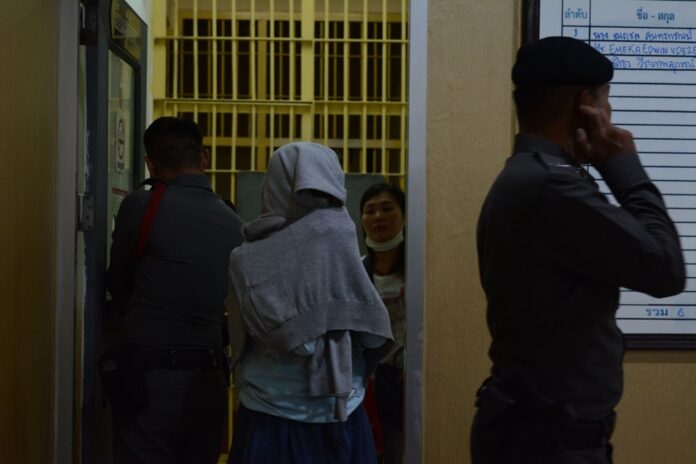
Sasithorn Wirathepsuporn covers herself Wednesday as police escort to the court
BANGKOK — A retired massage parlor kingpin said Wednesday that investigators have it wrong about who owns a brothel where dozens of women were reportedly forced into prostitution.
After police arrested Sasithorn Wirathepsuporn as the person responsible for running Victoria’s Secret, where eight sex workers were found to be underage, former brothel boss turned politician turned talk show host Chuvit Kamolvisit said Sasithorn is merely a proxy for the real owner.
Citing his own experience as a former owner of Victoria’s Secret, which locates close to Rama IX Road, Chuvit said he sold the establishment to businessman Kampol Wirathepsuporn 15 years ago, the ownership has not changed since.
“I told it to Kampol. I negotiated with Kampol. How many places I have sold him? I sold him Victoria. I sold him Copacabana at Ratchada. I sold him Honolulu,” Chuvit said in his talk show on Channel 3. “Kampol got three, four places from me.”
Sasithorn turned herself in to police on Wednesday and was subsequently charged with a number of offenses, including human trafficking. The charges were related to a Friday raid on Victoria’s Secret which turned up at over 100 sex workers. Police said they include those who are underage or trafficked into the sex trade.
The case is being led by the Department of Special Investigation, which operates independently from the police. Deputy department chief Songsak Raksaksakul allowed that Sasithorn might not be the real owner, and investigators are still looking into details.
“Right now it’s not confirmed who was the owner who invested in it,” Songsak said. “We have to look into evidence documents first.”
He added that the force will soon summon Chuvit for questioning about what he knows.
“Mr. Chuvit himself hasn’t produced any document to support his claim. It’s just one person talking,” Songsak said. “The case needs evidence of transaction. He needs to show us the evidence.”
Kampol is listed by business registries as a major shareholder of a massage parlor firm in Bangkok called Pome Thong Ltd. Someone answering the phone there said Kampol does not work from there.
Songsak said at least eight sex workers rescued from Victoria’s Secret have been proven by medical tests to be underage. All of them are from neighboring countries, he said.
The department deputy chief also disputed reports on some media sites that the raid was an attempt to blackmail entrepreneurs connected to Victoria’s Secret into supporting junta chairman Prayuth Chan-ocha’s bid to return as an unelected prime minister after the next election.
“There’s no politics involved,” Songsak said. “Everything is in accordance with the evidence. We are not singling out anyone.”
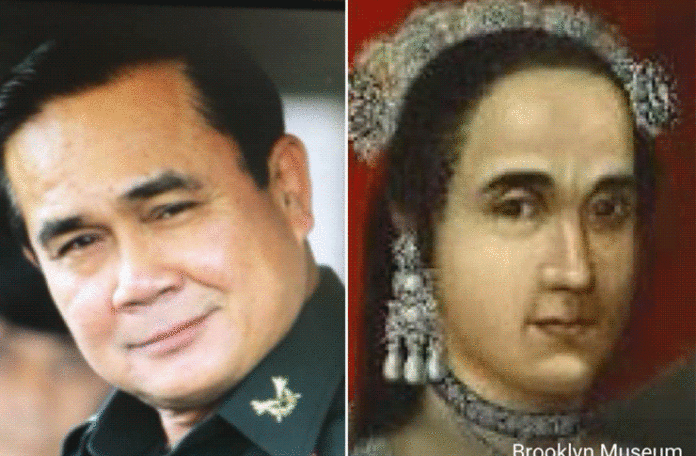
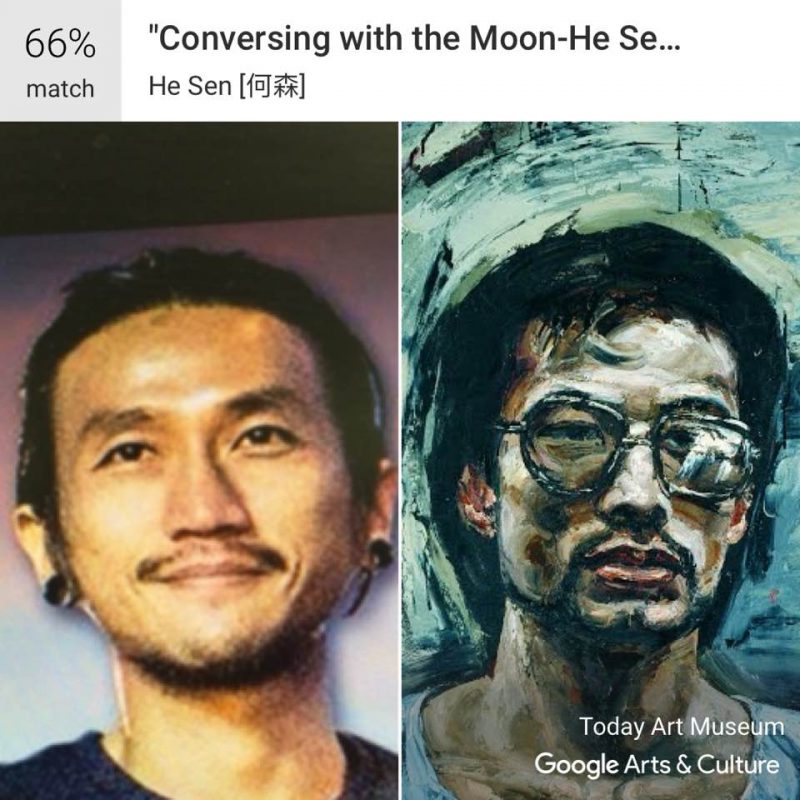
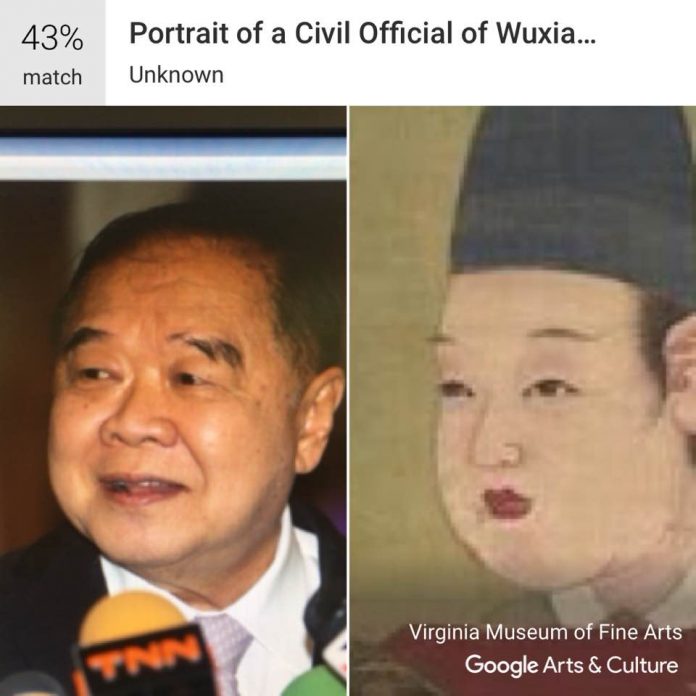
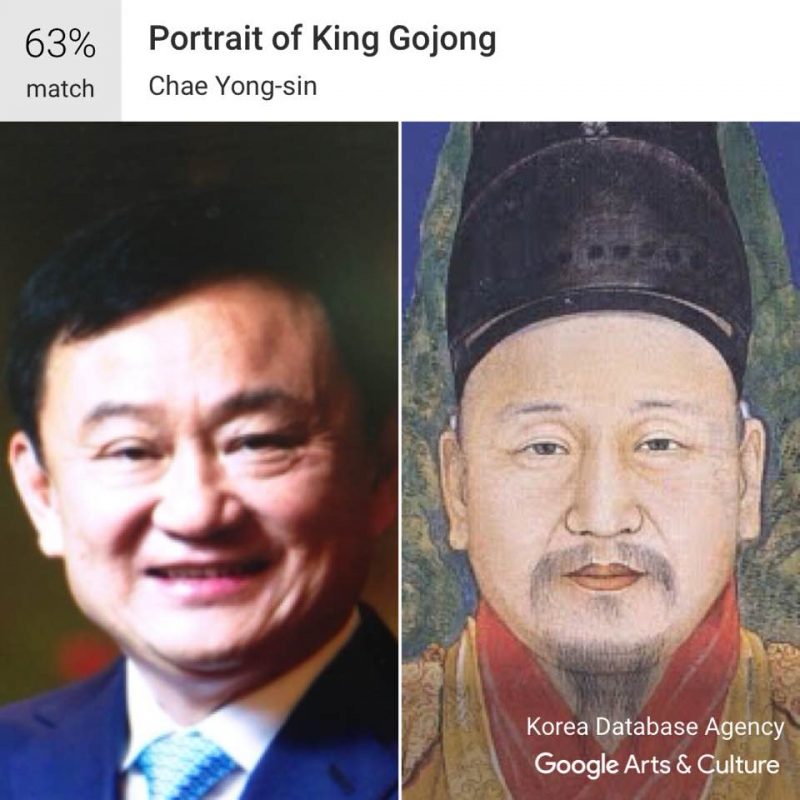
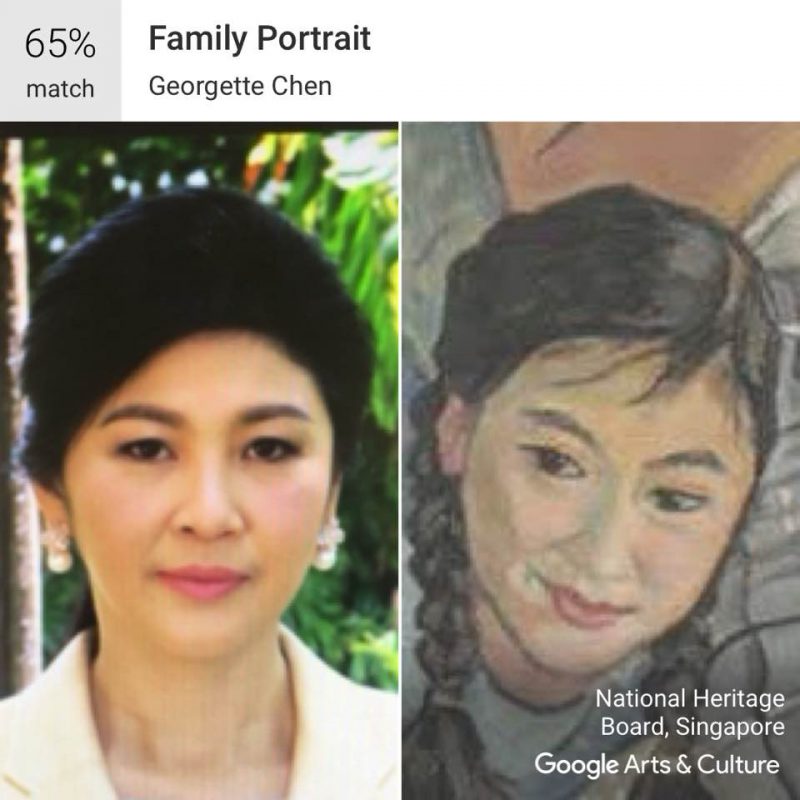
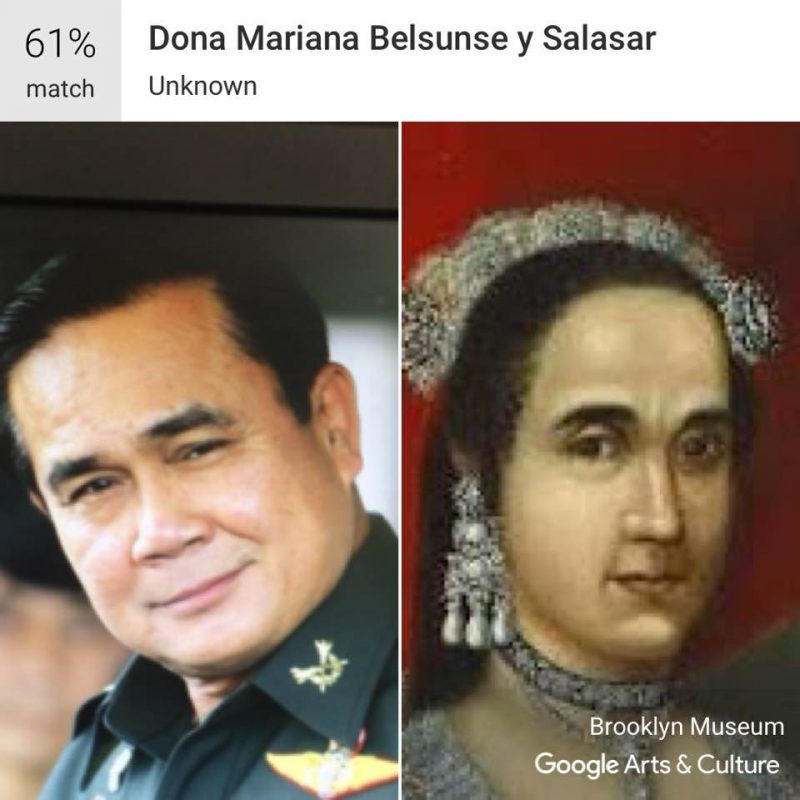
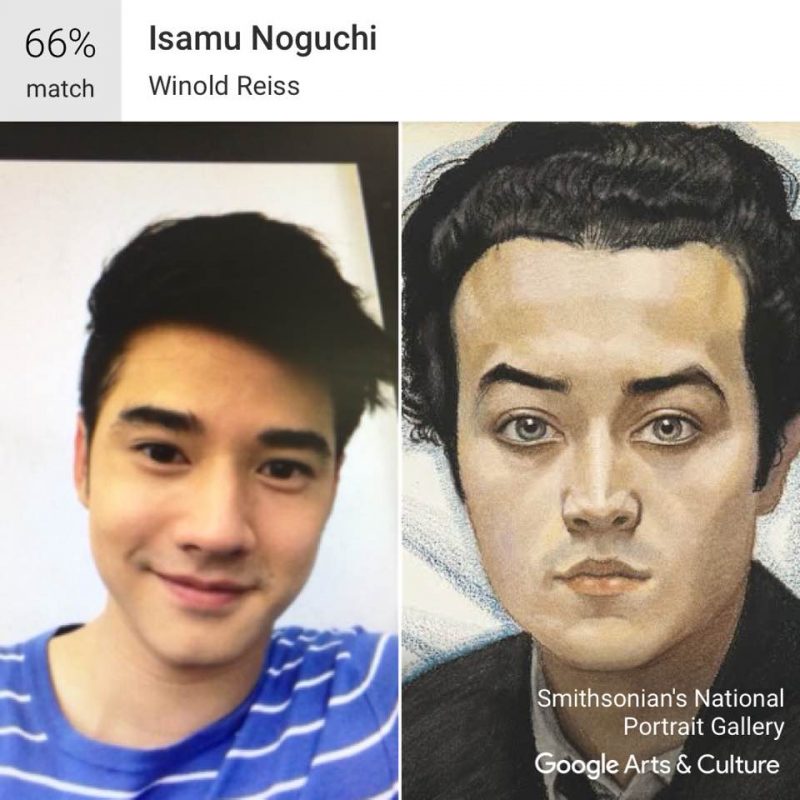
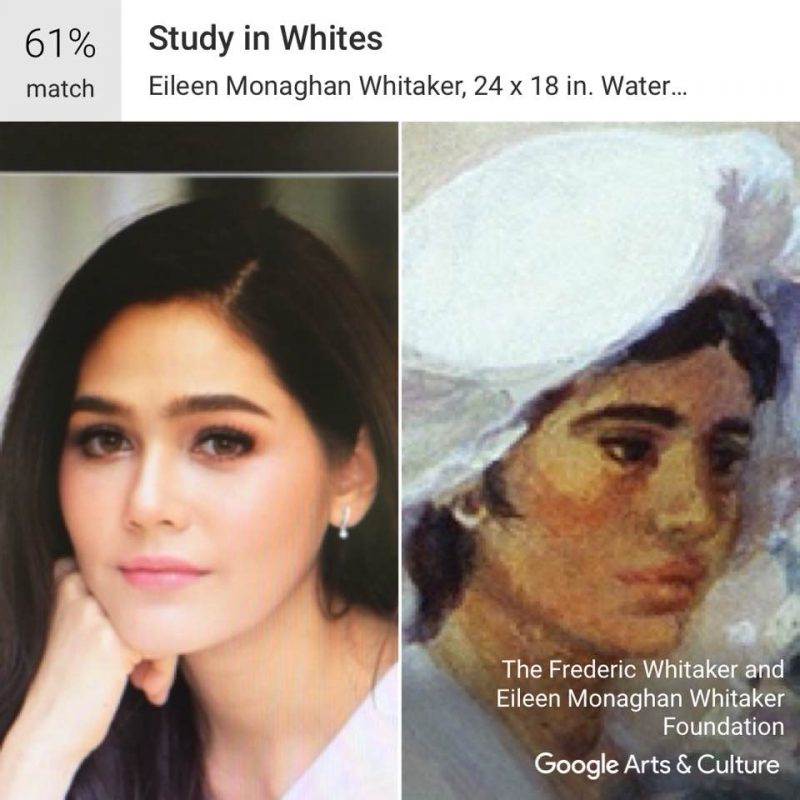
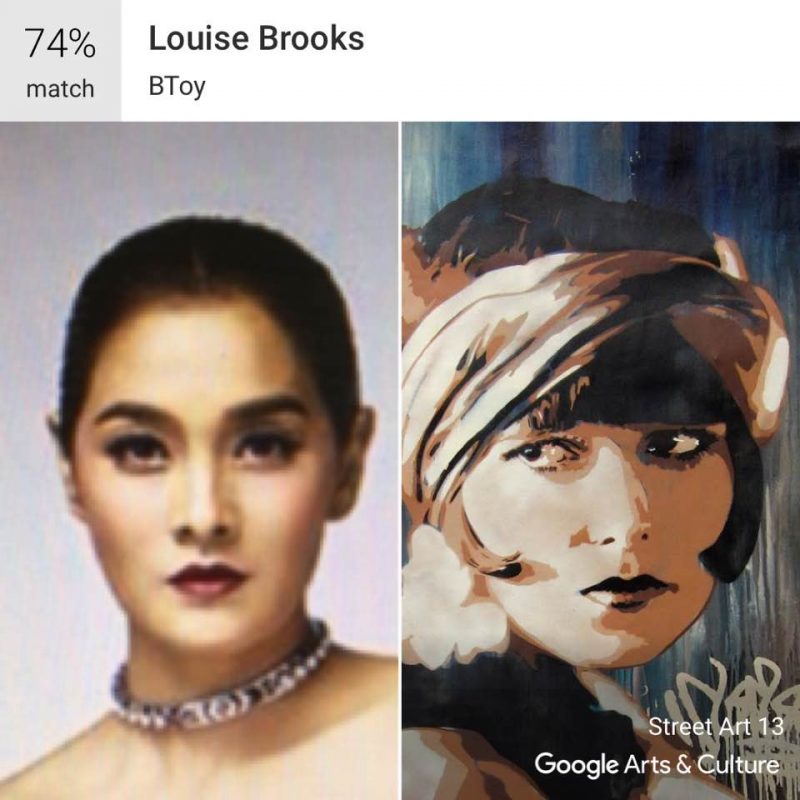
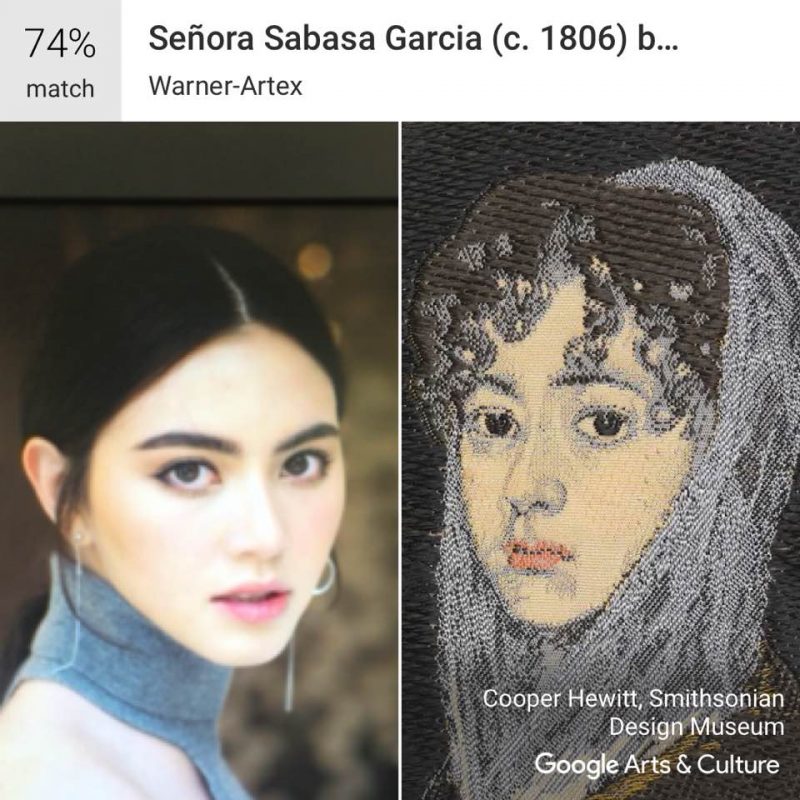
BANGKOK — Were it not for the social media fad of the moment, we would have never known that Gen. Prayuth Chan-ocha has the same eyebrows as woman aristocrat from Spanish colonial Peru in the 1700s.
That was among the more whimsical results we got from matching Thai politicos and celebs to figures from art history using Google’s Arts and Culture App. The app uses facial recognition to match faces with those found in its database of works collected from museums worldwide.
Note: The app’s matching feature is technically only meant for use in the United States, but if the internet’s taught us anything, it’s that there’s a way around anything. You’ll know it’s working when opening the app finds a feature labeled “Is your portrait in a museum?”
Here are some matches the app made with famous Thai figures.
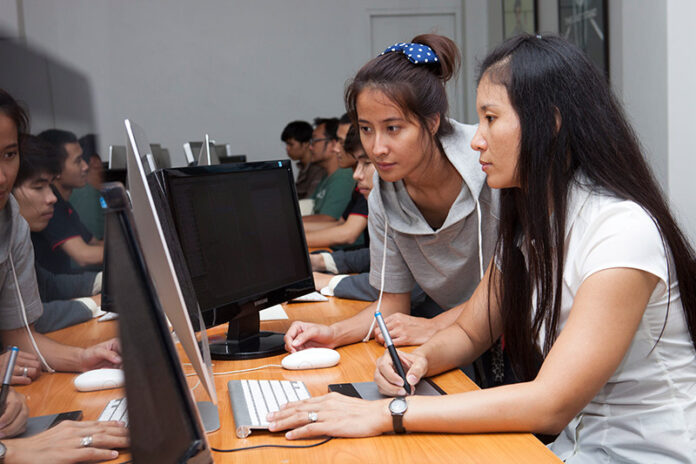
Mayura Sinlee Seagrave, at right, trains a Thai worker at multi-national company Ultrafina. Photo: Michele Zack
Top: Mayura Sinlee Seagrave, at right, trains a Thai worker at multinational company Ultrafina. Photo: Sean Seagrave
By Michele Zack
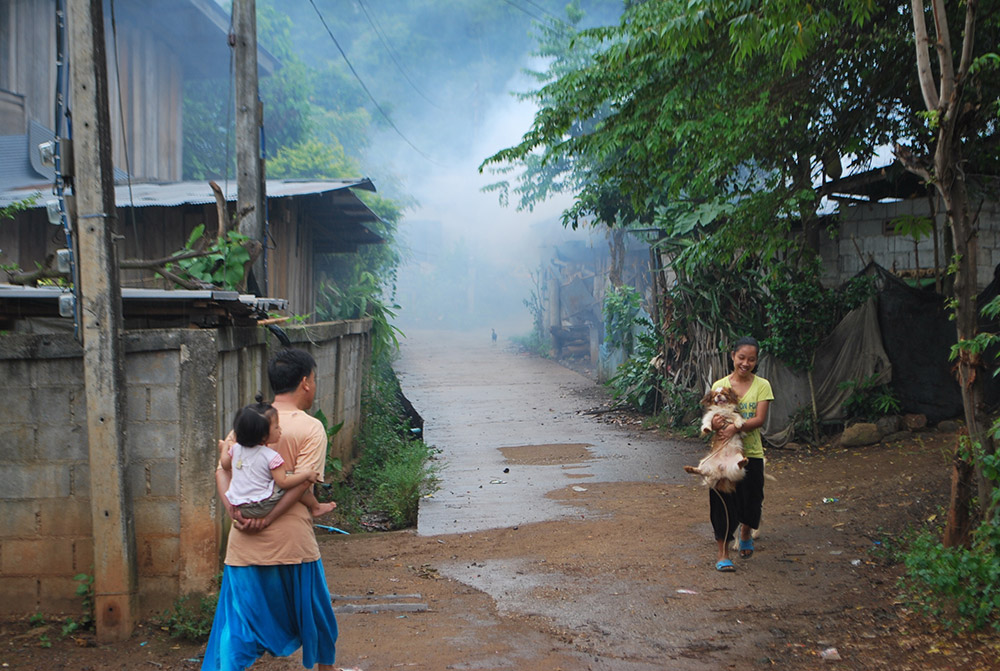
In 2014, I returned to Dton Loong, one of Thailand’s most accessible Lisu villages located an hour’s drive north of Chiang Mai in rising countryside. I was looking for Alay-pa, an amiable headman I’d interviewed in 1997. The village had changed, the old bamboo and wood houses replaced by concrete ones, the former mud lanes paved. But it retained the familiar deserted feel of a village at midday; people were at work – some in fields, and today, some at jobs as far away as Chiang Mai. Many came home only on weekends, leaving behind snarling guard dogs. The day I visited, two minimally protected young men roved the village, section by section enveloping it in thick clouds of pesticide.
Some 1.5 million Lisu are spread across highland Southeast Asia today, united by language, custom and a distinct, skewed sense of humor perhaps developed to help them live with perpetual uneasiness. Their discomfort is born of generations of statelessness, frequent migration to avoid conflicts and Chinese domination, and outsider status.
Adjacent to Dton Loong, Lisu Lodge, one of Thailand’s first ethnic eco-resorts, was still in business. Established in 1992 and still operated by its original owner, the Lodge had scaled up a bit and joined a network of hostelries offering “hill tribe packages” to entertain education-minded tourists. Lisu Lodge provides service employment to local residents as hotel workers as well as singers, dancers and musicians performing in cultural shows. Workers dress traditionally, and they and the villagers make handicrafts to sell to guests. Tourism has become an important factor in preserving Lisu culture.
Dton Loong village in N. Thailand now has a paved road and mosquito abatement program. Development brings advantages and sometimes, new health hazards. Photo: Michele Zack
I was disappointed not to find Alay-pa, but in my search I was directed to homes of other former headmen. At one, an older, energetic woman in Lisu dress beckoned me up to take a seat on the veranda of her sturdy concrete house. She sat overlooking the lane at a tabletop sewing machine surrounded by four or five giant multi-colored plastic bags and stacks of cloth. She was Ali-ma Loy-yee-pa, a member of the Sin-lee clan. She’d been married to a former headman, she said, but he’d taken up with another woman and moved away.
She gave a “what are you going do?” shrug. She was born here and had four daughters, but didn’t read or speak standard Thai well. She spoke Lisu for most needs and got by in the northern Thai dialect at the market in nearby Mae Malai.
Author Michele Zack studied the Lisu in three countries over 20 years, here seen in China’s Salween Valley. Photo: Mark Goldschmidt
There and Back Again
For most of the 1990s, my husband, small daughter, and I lived in Thailand. The first four of our eight years here, we were illegal immigrants, an uneasy and traumatic state that we fortunately had the resources to resolve. I reported for AsiaWeek and the Far Eastern Economic Review, and in 1996 I was asked to write the first book-length ethnography of the Lisu tribe for a Thai-based publisher who was bringing out a series of beautifully photographed books on the hill tribes of Southeast Asia.
I jumped at the chance. I had known about the Lisu, the “anarchists of the highlands” since the mid-1980s when, as a budget tourist, I encountered them living far from roads and, it seemed, independent of the Thai government.
As it happened, my own immigration difficulties proved good psychological preparation for writing about a minority that has forever been on the run. Where the Lisu were originally running from is a matter of conflicting, contradictory theories; what is known is that over the past few hundred years they migrated from high remote valleys in the Upper Salween watershed of Yunnan China into what is now Myanmar, and finally, into northern Thailand. A few also live in Laos and the Arunachal Pradesh state of India.
In the mid-1990s, I spent two years researching and traveling to remote Lisu villages in Thailand, China’s Yunnan province and Myanmar. I consulted with Lisu scholars in Thailand and in the states and read everything written about them, 95 percent of which concerned the Thai Lisu, though they comprise only 5 percent of the total Lisu population. I finished the book, but before it was printed, the publisher went out of business. I returned to California in 1998.
Some 15 years later, I was still thinking about the Lisu. I revived the project with University of Colorado Press. By then, however, the world, especially Asia, had undergone convulsive modernization and change. My research was woefully out of date – so I returned to Asia to catch up with this egalitarian culture, focussing on comparing and updating Lisu adaptation in three countries with very different political and economic styles.
What I witnessed was something like a time-lapse display of globalization and its effects. In a few years, the Lisu had made the journey from stateless tribal minority to citizens in a new world economy. We’ve all made this trip, but most of us don’t remember because, in fact, our ancestors conducted it in stages over generations.
Lisu children play in the Doi Laan community in northern Thailand. Photo: Michele Zack
On my return to Dton Loong, Ali-ma, the Lisu divorcee, told me that things were much better today than 15 or 20 years ago. Her Lisu identity was stronger, her culture more protected. I asked for specifics. First, she said, is that Thai citizenship problems have been solved for most people in her village. Now, only recent immigrants from Burma struggle to gain identity cards. She described herself as a prosperous Thai citizen who was also proud to be Lisu. In the past, this wasn’t possible. She had a smartphone and held it up to show the village’s strong signal. She opened one of the large bags, revealing it to be full of the Lisu purses and bags she makes.
“I do it to keep busy, I don’t need the money,” she said. They were well made, small to big, with tiny colorful folded cloth triangles and squares stitched between multiple borders – a motif adapted from Lisu baby caps.
My eyes found a glass cabinet on the veranda overfilled with household objects and topped with a framed dusty photograph of a young woman and older Western man.
“Oh, “That is my eldest daughter, she lives in California,” Ali-ma explained, adding with a chuckle that all her daughters married foreigners. One was in New York, another in Osaka. Her youngest moved back to Chiang Mai a couple of years ago from Studio City, a Los Angeles suburb. On her cellphone, she showed me the telephone number of that daughter, Mayura, so I could jot it down. While she was at it, she pointed out her absent husband’s number in case I wanted to talk headman business with him. She was pleasant and matter of fact.
I, however, was nonplussed – smartphones with four bars, daughters in America, husband with a mia noi. This was my first day back in the field since 1998, and I’d forgotten how unabashed and friendly the Lisu are. That had not changed, nor had Lisu humor. Saying goodbye, Ali-Ma quipped that she’s thinking of taking up with a farang herself: Did I know a good one who’d like an old woman who had become just a little bit fat?
When I returned to Chiang Mai, I called her daughter, Mayura Sinlee Seagrave who, responding with “cool,” “yeah,” “okay,” – agreed to have dinner with me the following night.
She picked me up from my guesthouse in an SUV, the backseat strewn with the detritus of school-age children: orange peels, soccer jerseys, empty cups. Mayura didn’t sound as much like a Valley Girl in person as she had on the phone. Slim and attractive, with a cascade of shiny black hair, she wore a turquoise tunic over leggings and looked to be in her mid-20s rather than a 35-year-old soccer mom. She chose a hip vegetarian restaurant for dinner and told me her story:
“I grew up in Dton Loong but was sent to Suksasongkra boarding school in Chiang Mai when I was 7. . . the village school was no good. All the kids in my family got decent educations, because we lived so close to Chiang Mai. The school was fun, I liked living in the dormitory and meeting other hill tribe kids, just coming home on weekends. My father was a successful headman and farmer, also a silversmith. He attended ag school, and took classes in things like composting, planting rice between fruit trees, and raising pigs efficiently. Because he was headman, he got involved in economic development. Some Lisu didn’t understand the importance of Thai citizenship. He “got it” earlier than many and moved ahead. For older, poorer people it was hard – too much work. You had to walk a whole day to renew your ID. You had to pay money, be insulted, and many just didn’t do it. And it was actually not so bad in our village, we live closer to government offices than most. Even before Lisu Lodge, foreigners came there and we were exposed to modern things.
“My dad tried to steer me to ag, but I wasn’t into it. Choosing not to go to University, I took a vocational course in sewing instead. Later, I realized it was important, and did a distance learning course through Sukhothai Open University. They send you books, you study anywhere, just turn up to take tests. I got a bachelor’s degree in English. Now I’m trying to get a biz degree, but it is hard with two kids and working in the family business.
“I met my husband Sean 15 years ago in Chiang Mai, when I worked at an internet café. His background is Burmese-American, and his family has lived in Asia for five generations. His parents are both writers. My husband and I have a graphic photography and retouching company, Ultrafina and do advertising for cosmetics, movie posters, and so on. It’s U.S.-based, and first we lived in New York. It was too cold there, though. Then we moved to Studio City in LA for a few years. But after the second kid (her children are now 8 and 14) it was easier to come back to Chiang Mai. We moved here in 2009 to be closer to my mother, for good schools, and because household help is better here. Because we live here, my kids can understand, and one even speaks some Lisu. At home we use English and Thai.”
I asked Mayura if she felt Lisu.
“It’s me, of course. I feel kind of happy to be Lisu, but also Northern Thai, Buddhist, animist, and some American. I also feel good about the opportunities I’ve had to learn and to travel — not just stay in the village like my mother.”
Her sisters, she said, had all married foreigners much older than they and also left the village. As a young girl, she’d thought she would follow their examples: “Marry an older guy, have a peaceful life.”
This was a practical matter: She didn’t judge her parents for allowing her eldest sister, at 16, to marry a man near 60. The age difference wasn’t important. Unlike her parents, whose marriage ended in a divorce that was hard on the family, her sister was still happily married (today, she is in her 40s, her husband in his 80s).
Mayura said her father had picked up “Thai ideas” from involvement with government officials – especially that men have more power than women.
Thai Lisu Village Doi Chang, origin of the eponymous cofee, is now wired for Internet and exports ‘beyond fair trade coffee’ to large US retailers. Photo: Michele Zack
In the standard Thai way of showing success, he took a younger second wife, or mia noi. This practice was antithetical to Lisu values, which hold woman and men as equals. Divorce exists, but taking a mia noi is not part of Lisu culture and her mother would not accept it. This caused terrible fights. Her father divorced her mother but still supports her financially.
Today, Mayura, as the only daughter living close by, sees her mother regularly and encourages her to branch out in the things she makes, to “move into backpacks, and other useful things people need and like.”
I asked Mayura if her father received a bride price for her. This practice persists among both animist and Christian Lisu, though many Christians have dropped it – or claim they have. Mayura’s family are not Christians, however, and like every Lisu woman everywhere, she remembers the exact amount: “Father took 50,000 baht for each of us daughters (then worth about USD$1,300) to keep everyone equal,” she said. “But I think he turned around and spent it all on our wedding feasts.” Mayura’s husband was 11 years older, not a significant difference, she said. Cultural conflict had not been a big issue for them: “Marriage is hard for all couples sometimes, but we are together, we work together at our company. Our kids are happy, our family is good.”
Mayura, whose mother is illiterate (but has clearly held on to her myi-do) and father used the advantages of being headman to advance, has used her own agency in moving from tribal village girl to international businesswoman in one generation.
On that first day back in the field, it became clear to me that my book would be more than a traditional ethnography. Indeed, “The Lisu: Far from the Ruler” is both narrow and deep, the story of one remote, lively, anarchic group’s journey across time and into today’s global economy – illuminating the benefits, trade-offs, choices and losses all modern people make on the way to becoming subjects of a state and participants in the new world order.
This article is adapted from Michele Zack’s latest book, ”The Lisu: Far From the Ruler,” University Press of Colorado, 2017. It’s available in Thailand from most online book sellers, Amazon.com and the publisher.
Michele Zack can be reached at [email protected]. She will be in Thailand to present at an International Lisu meeting Feb. 23-25 at Ban Pang Mai Deng in Chiang Mai’s Mae Taeng district. She will also speak in Bangkok on Feb. 14 at the Foreign Correspondents Club of Thailand and Feb. 15 at the Siam Society.
MOSCOW — Emergency officials in Kazakhstan say 52 people have died when a bus carrying them caught fire.
The Emergencies Ministry of the former Soviet nation in Central Asia said Thursday’s tragedy happened in the northern Aktobe region. The ministry said that only five of 57 people in the bus have managed to get out and survived the fire.
The ministry said they are being treated for injuries.
The ministry said that some of the victims were citizens of neighboring Uzbekistan.
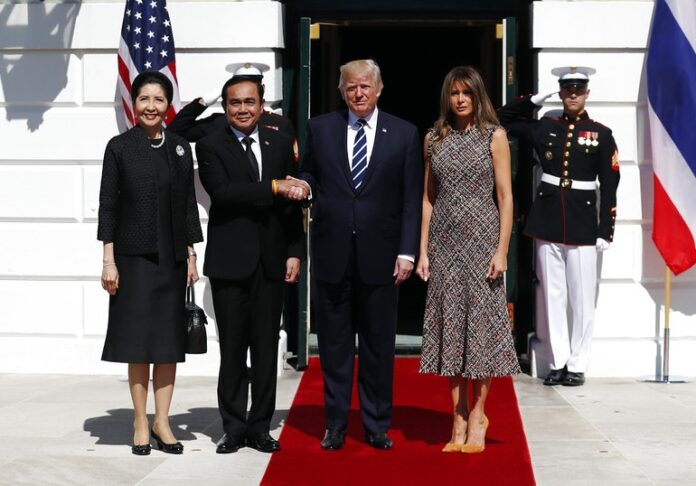
President Donald Trump and first lady Melania Trump greet Thailand’s Prime Minister Prayuth Chan-ocha, and his wife Naraporn Chan-ocha, Monday, Oct. 2, 2017, as they arrive at the White House in Washington. Image: Associated Press
BANGKOK — Commenting on the fashion sense of first ladies and leaders’ wives is a media past time everywhere. Get it wrong in Thailand, however, and one might find themselves in jail, as former Thammasat University rector Charnvit Kasetsiri is discovering.
For misidentifying the purse first lady Naraporn Chan-ocha carried at the White House as a brand-name product, Charnvit will be charged with violating the Computer Crime Act, police said Thursday. The act bans spreading false information online, which it describes as “importing false information into a computer system.”
“We will issue him a summons for him tomorrow,” Col. Olan Sukkasem of the police cyber crime unit said.
The charge stems from a Facebook post Charnvit reshared on Jan. 11 to Facebook. The post shows Naraporn accompanying her husband, Prime Minister Prayuth Chan-ocha, to meet US President Donald Trump in October. It calls attention to the handbag she is carrying and places it beside an image of a similar Hermes bag, implying they are the same.
“Thai leaders must look expensive not cheap,” Charnvit wrote in English and Thai when he reshared the post originally from a user called Ploy Siripong. Police said they are tracking down the original poster.
Charnvit later posted the photo of Naraporn with a caption asking, “How much is this?”
After the posts went viral, officials told the media Naraporn was carrying a locally made purse which she purchased from a royal folk arts project – not Hermes.
Olan said the misidentification showed Charnvit intentionally spread false information against government officials, and that it was police duty to prosecute criminals.
“Of course, you can criticize them, as the media, politicians and activists have done,” Olan said. “But those criticisms are not false accusations. When accusations are false, and when they target puu yai such as government officials, provincial [officials] and judges, they can’t fight court cases with the public.”
Charnvit denied the allegations on Thursday. In an online post, the former Thammasat rector said he was not criticizing Naraporn – even if she had actually been using a luxury purse.
Olan said Naraporn had not filed any complaint. It was police who took action against Charnvit on their own, he said.
“It’s my job. I’m not doing it because she’s the prime minister’s wife,” the police colonel said.
The charge followed revelations that deputy junta chairman Prawit Wongsuwan was in possession of at least 25 luxury timepieces worth millions of baht which he did not disclose in his mandatory asset report. The scandal has drawn protests from transparency activists.
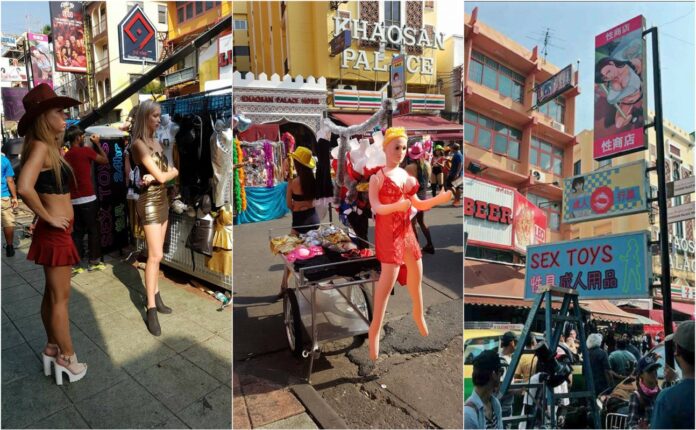
Extras dressed as women that would not have looked out of place on Soi Cowboy raised eyebrows and ire when they appeared on Khaosan Road as part of a film production.
BANGKOK — Khaosan Road looked a little different Wednesday. Women were showing a lot more skin beneath the glow of Japanese and Chinese signs featuring titillating images and stalls were selling lingerie and sex toys.
The problem with this dystopian scene, a sci-fi trope since Blade Runner, was that the foreign production company behind it told the police it would not be identified as Thailand. In addition to having their set demolished, the filmmakers today were charged with three offenses including public indecency for misrepresenting their sexy market scene.
Police said the production had been approved on the condition it would not “damage” the country’s reputation, according to Col. Pitak Sutthikul, chief of Chana Songkram police.
Pitak said the production team said their movie had nothing to do with Thailand and was in fact set in another country.
“That’s what we knew and we approved it,” Pitak said by phone Thursday. “I went to the scene, and to me, it wasn’t right. I had to order it canceled. I blame the lack of communication and understanding [between the film company and authorities]”
Members of the production company were charged with disobeying the authorities, public indecency and blocking public walkways.
Pitak said at a press conference Thursday afternoon that the movie is “Happy Bhag Jayegi Return,” sequel to the 2016 Bollywood romantic comedy “Happy Bhag Jayegi.”
However, when the set was erected Wednesday, a representative of the Khaosan Road Business Association filed a complaint with police against the production company for “destroying” the area’s image.
Khaosan Road is an internationally known destination for backpackers and other budget travelers.
Sa-nga Ruangwattanakul, an adviser to the association, said he was acting on the complaints of members of the community.
“Although it’s a modeling scene that did not relate to Thailand or Bangkok, it can still harm the area’s image,” Sa-nga said.
A video and photosposted online expressed unhappiness with the depiction.
“Is this really Khaosan Road? Who did this? Why? Your film, with a set that needs to be created, hurts Khaosan Road and Thai tradition and culture,” Facebook user Poo Banglamphu said in the post. “Thais’ feelings are hurt.”
The post went viral and drew criticism and debate. Although commercial sex venues operate openly and sex workers are a common sight in Bangkok, depictions in the media are frowned upon.
“Thailand has the most prostitutes and commercial sex in the world and also is ranked as having the second-highest rate of teen pregnancy. If the uncle knew this, he definitely won’t be as serious as you are now,” Facebook user Shalit Bunsanorng wrote in a comment on Queen of Spades, a popular online clearinghouse for social issues.
Former Bangkok Gov. Sukhumbhand Paribatra, at left, walks with Chuvit Kamolvisit in Chuvit Garden in an undated file photo. Photo: Matichon
BANGKOK — A downtown pocket park owned by a former politician who served jail time for demolishing its former tenants’ businesses will be developed into a commercial property.
Chuvit Garden, a small private park at Soi Sukhumvit 10 owned by politician-turned-talk show host Chuvit Kamolvisit, has been leased to Land and Houses Co. Ltd. to build a mixed-use commercial project, according to the developer.
Naporn Sunthornchitcharoen, chairman of the developer’s board of directors said Thursday that his company would sign a 30-year lease for the land in February.
The gates to the park, which Chuvit said was his gift to the public, have been locked since 2016 with a sign saying it was under renovation. Chuvit said he didn’t think it was a done deal.
“I wasn’t shopping around, but buyers keep presenting offers to me,” Chuvit said Thursday. “I can confirm I won’t sell the land, but I might lease it.” Chuvit denied signing any contract as of Thursday.
Asked why the park was closed after he made much of gifting it to the public, 57-year-old Chuvit, a colorful figure who entered politics as a maverick reformer after getting rich as an owner of commercial sex venues, said enough time had passed.
“It’s time to renovate it. I might build it into something else. And it’s been a long time that it’s been a park, over a decade,” he said. “I went to jail and all that, too.”
Land and Houses said it plans to build 20,000sqm of office space, 400 hotel rooms and 3,000sqm of retail space. The project will cost 6 billion baht and construction will begin in 2019.
Chuvit Garden was opened by Chuvit in 2006. It closed in 2016 just a few months after Chuvit was convicted and sent to prison for illegally razing dozens of beer bars and shops on the 7-rai plot in the dead of night in 2003. He said the park was his gift to the public.
He was freed in December 2016 on a royal pardon and after renouncing politics brought his brash and entertaining style to host a popular talk show program.
Correction: An earlier version of this story indicated the land had been sold to the developer. Land and House in fact says they have entered a long-term lease to the property.
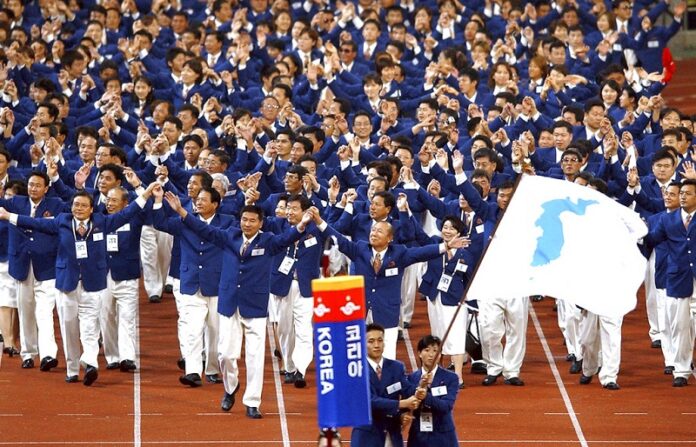
Athletes from North and South Korea march together in 2002 led by a unification flag, during an opening ceremony for the 14th Asian Games in Busan, South Korea. Photo: Associated Press
SEOUL, South Korea — The rival Koreas agreed Wednesday to form their first unified Olympic team and have their athletes parade together for the first time in 11 years during the opening ceremony of next month’s Winter Olympics in South Korea, officials said.
The agreements still require approval from the International Olympic Committee. But they are the most prominent steps toward rapprochement achieved by the Koreas since they recently began exploring cooperation during the Olympics following a year of heightened tension over the North’s nuclear weapons program.
During their third day of talks at the border in about a week, senior officials reached a package of agreements, including fielding a joint women’s ice hockey team and marching together under a blue and white “unification flag” depicting their peninsula in the opening ceremony, Seoul’s Unification Ministry said.
A joint statement distributed by the ministry said the North Korean Olympic delegation will travel to South Korea across their heavily fortified land border before the Feb. 9-25 Pyeongchang Games. It said the delegation will include a 230-member cheering group, a 30-member taekwondo demonstration team, journalists, athletes and officials.
Ahead of the Olympics, the Koreas will hold a joint cultural event at the North’s scenic Diamond Mountain and have non-Olympic skiers train together at the North’s Masik ski resort, according to the statement. It said the North also plans to send a 150-strong delegation to the Paralympics in March. The North earlier said it would send a 140-member art troupe.
The agreements are highly symbolic and emotional. But it’s still not clear how many North Korean athletes will come to Pyeongchang because none are currently qualified. South Korean media have predicted only up to 10 North Korean athletes will end up being covered by an additional quota from the IOC.
A pair of North Korean figure skaters qualified for this year’s Olympics, but the country missed a deadline to confirm their participation. The IOC said recently it has “kept the door open” for North Korea to take part in the games. IOC officials are to meet with sports and government officials from the two Koreas and officials from the Pyeongchang organizing committee in Switzerland on Saturday.
The IOC said in statement Wednesday that it has “taken note of a number of interesting proposals from different sources.”
“There are many considerations with regard to the impact of these proposals on the other participating NOCs (national Olympic committees) and athletes. After having taken all this into consideration, the IOC will take its final decisions on Saturday in Lausanne,” it said.
The two Koreas have sent joint teams to major international sports events twice previously, both in 1991. One event was the world table tennis championships in Chiba, Japan, where the women’s team won the championship by beating the powerful Chinese, and the other was soccer’s World Youth Championship in Portugal, where the Korean team reached the quarterfinals.
During an era of detente in the 2000s, their athletes marched together in the opening and closing ceremonies of nine international sporting events, including the 2000 Sydney Olympics, but they failed to produce a joint team. Their last joint march was at the Asian Winter Games in Changchun, China, in 2007.
The current reconciliation mood began after North Korean leader Kim Jong Un said in a New Year’s speech that he was willing to send a delegation to the games. Critics have said Kim’s overture is an attempt to use improved ties with South Korea to weaken U.S.-led international sanctions on North Korea while buying time to perfect his nuclear weapons program.
The moves nevertheless have provided a temporary thaw in the Koreas’ long-strained ties and fostered optimism that North Korea won’t launch any new provocations, at least during the Olympics. Last year, North Korea carried out its sixth and biggest nuclear test explosion and test-fired three intercontinental ballistic missiles, and Kim and U.S. President Donald Trump traded threats of war and crude insults against each other.
The White House says the joint Olympic team is an opportunity for North Korea to see the value of ending its international isolation by getting rid of its nuclear weapons.
“We hope that this experience gives North Korea and its athletes a small taste of freedom, and that rubs off and it’s something that spreads and impacts in these negotiations and in these conversations,” spokeswoman Sarah Huckabee Sanders said.
Some conservative critics say North Korea’s cheering and artistic groups are too big and worry the North may try to steal the show at the Olympics to launch what they call a “peace offensive” to try to show it’s a normal country despite pursuing nuclear weapons.
North Korea also sent highly trained female cheering groups dressed in bright, attractive outfits when it attended previous international sports events in South Korea. The groups, chosen for their cheering skills as well as their good looks and dubbed “beauty squads” by South Korean media, often received more attention than their athletes. Kim Jong Un’s wife, Ri Sol Ju, was a member of a 2005 squad.
North Korea under Kim has made sports, and especially success in international sporting events, a high priority. While it’s not a major winter sports competitor, North Korean athletes have set several weightlifting world records and its women hold a high profile on the world football scene.
When traveling abroad, however, North Korean athletes and coaches tend to cloister themselves away from outsiders when they are not competing or practicing. Defections are likely a concern, along with what their minders might deem to be ideological “contamination,” so they are kept under close scrutiny.
South Korea wants to the IOC to allow its ice hockey team’s 23-player Olympic roster to be expanded so that several North Korean players can be added without removing any of the South Korean players. But there are worries in South Korea that adding new players less than a month before the Olympics will weaken the team and deprive South Korean players of playing time.
Chief South Korean delegate Chun Hae-sung said the government is well aware of such concerns and North Korea has agreed that the South Korean team’s current coach will be given full authority to select North Korean players to compete.
“If South and North Korea form one team and compete in the games, that will be an everlasting historic event, which I think will move our people and people around the world,” South Korean President Moon Jae-in said Wednesday.