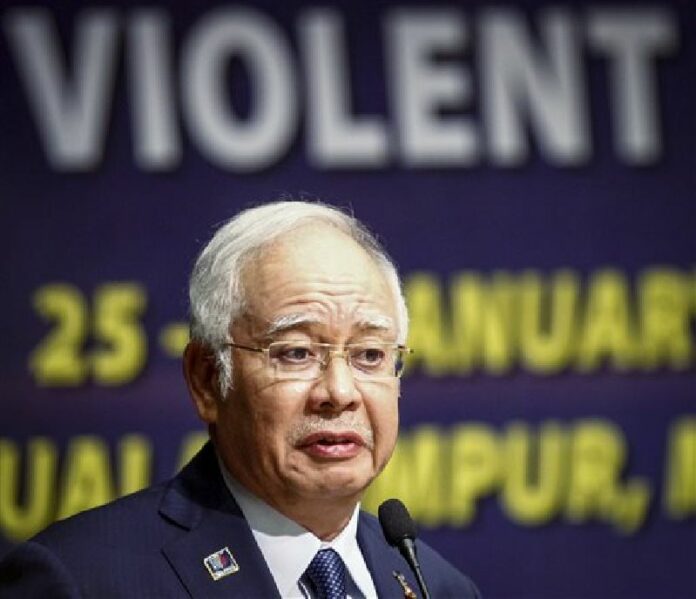
Malaysian Prime Minister Najib Razak delivers a speech at a conference in 2016 in Kuala Lumpur, Malaysia. Photo: Joshua Paul / Associated Press
SINGAPORE — Malaysian Prime Minister Najib Razak praised his country’s relationship with neighboring Singapore on Tuesday, but added a jibe for his closest rival in upcoming elections.
“We believe in good relations with our neighbor, with Singapore, and we’ve proven that we can bring tangible benefits to the people if we work closely together,” Najib said at a news conference in Singapore.
“The other side may have other ideas. We certainly do not want to return to the era of confrontational diplomacy and barbed rhetoric between our two countries,” he added. “It was an era that we want to forget.”
Najib’s closest rival is former Prime Minister Mahathir Mohamad, 92, who heads Malaysia’s opposition coalition.
Mahathir led Malaysia for 22 years before stepping down in 2003. During his term there were frequent sharp exchanges with neighboring Singapore and its first prime minister, Lee Kuan Yew.
“Talking to Lee Kuan Yew was a one-sided affair,” Mahathir wrote in his memoirs. “His style of conversation, like his manner of addressing the Malaysian Parliament when he was a member, was to lecture his listeners about what was right and what was wrong.”
Najib was speaking on the sidelines of the 8th Singapore-Malaysia Leaders’ Retreat. The yearly meeting is an opportunity for the neighbors to strengthen their ties.
This time, officials discussed water and education. They also signed an agreement for a new high-speed rail link to be completed in 2024. It will ease traffic at the main causeway linking the countries, which sees over 300,000 crossings a day.
“Our bilateral relations are in very good shape. Both sides have been able to work well together,” Singapore Prime Minister Lee Hsien Loong said Tuesday.
Singapore and Malaysia briefly merged in 1963, but fell apart after clashing on issues such as the rights of ethnic Malays.
Malaysia’s polls are due by August.
Najib’s United Malays National Organization is the linchpin of Malaysia’s ruling National Front coalition but its support has dwindled in the last two elections. It lost the popular vote for the first time to the opposition in 2013.
Mahathir is still influential among ethnic Malay Muslims who account for about 60 percent of Malaysia’s 32 million people.
JAYAPURA, Indonesia — Indonesian authorities are struggling to contain a monthslong outbreak of measles in easternmost Papua province that has killed dozens of children.
Stefanus Lange, a doctor at a state-run hospital in Papua’s Asmat district, said Tuesday that cases first were detected in September, but a lack of access to remote areas and the high mobility of villagers hampered treatment and vaccination efforts.
Lange said 36 victims died in Pulau Tiga sub-district and 22 died in Agats, the main town and capital of Asmat district.
He said other obstacles to overcoming the disease are a lack of personnel and a failure to reach all districts in the affected area.
A team of more than 50 doctors and paramedics from the Indonesian military arrived Tuesday in the province to help overcome the disease.
Chulalongkorn University professor Ruengwit Bunjongrat holds fourth-year student Supalak Damrongjit in a headlock on Aug. 4, 2017, at a university initiation ceremony held on campus. Photo: Netiwit Chotiphatchaisal
BANGKOK — Seven Nobel laureates signed their names to a petition criticizing the treatment of students who walked out of an initiation ceremony at Thailand’s oldest university.
Former Chulalongkorn University student president Netiwit Chotiphatphaisal announced that 25 international academics denounced the school’s decision to penalize students for not participating in a freshmen induction ceremony during which they were expected to prostrate to statues of past kings.
The episode became an embarrassment for the university when an agitated professor was filmed putting one of the students into a headlock.
The petition was addressed to university President Bundhit Eua-arporn.
“We see that culture is important but also that freedom of expression within a learning institution is equally important,” said the English-language petition addressed to university President Bundhit Eua-arporn. “… It is regrettable that these 8 students have had their behavioral scores deducted, preventing these students from participating in many activities … which diminishes liberty.”
Lawrence Lessig, a professor at Harvard Law School, said that the incident was an “embarrassment.”
“A university teaches with its words and deeds. This lesson is an embarrassment to the tradition of education everywhere,” he wrote in the letter. “Thailand is better than this. Its universities should be as great as its people.”
The Nobel laureates who signed on all came from the sciences: Dudley Herschbach (chemistry, 1986), Richard J. Roberts (medicine, 1993), John Mather (physics, 2006), Roy Glauber (physics, 2005), Jerome Isaac Friedman (physics, 2000), Sheldon Lee Glashow (physics, 1979) and Brian Josephson (physics, 1973).
In the wake of the altercation, the university removed Netiwit from his elected position as student body president. Seven of his friends were academically punished by having scores for behavior deducted.
The letter asks the university to reverse the latter decision, something Netiwit said he’s petitioned the university to do for months.
“I want citizens worldwide to know about this issue,” Netiwit said. “If this kind of thing keeps happening, Thailand’s freedoms will be negatively impacted.”
Bancha Chalapirom, former university vice president of student affairs, said Tuesday that the school was unaware of the petition. He said that Ruengwit Bunjongrat, the professor who assaulted senior student Supalak Damrongjit, was punished with an unspecified salary deduction.
The other academics to sign the petition largely came from US universities: Gerhard Casper, Grainne de Burca, Herbert C. Kelman, James McGaugh, Erica Chenoweth, Peter McLaren, Philip G. Zimbardo, Sidney Harring, Henry Giroux, Shirley R. Steinberg, Antonia Darder, Chandler Davis, John Braithwaite, Kenneth Saltman, Michael W. Apple, David Graeber, Lawrence Lessig and Diane Ravitch.
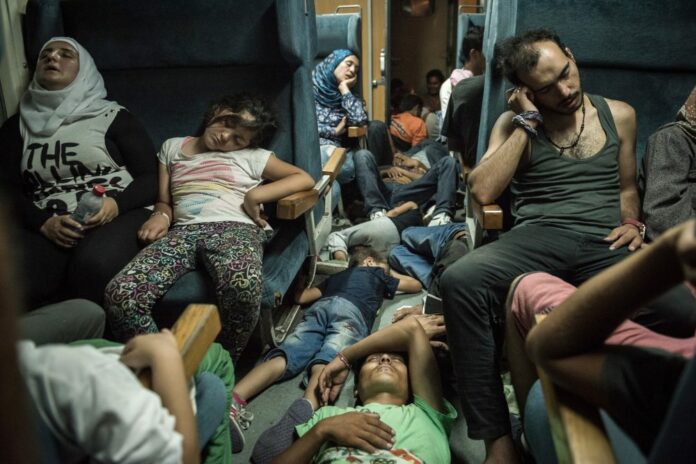
Syrian refugees sleep inside a train as they travel across Macedonia to Serbia. Photo: Sergey Ponomarev via Exodus-deja vu
BANGKOK — Having closely followed refugees as they fled wars and taking on perilous voyages, eight photographers will show the powerful images they captured at a Bangkok exhibition.
Having displayed in Kuala Lumpur, Ankara and Istanbul; Exodus – Deja Vu will travel next to Bangkok, where it will show stills depicting refugees’ daily lives as they flee the threat of war and persecution.
The photo exhibition will feature shots by eight photographers including Aleppo-based Issa Touma, French photojournalist Roland Neveu, Turkish correspondent Coskun Aral and Thai photojournalist Suthep Kritsanavarin, who worked on an investigative report about Rohingyas since 2008.
The latter three will be present at the exhibition’s opening ceremony on Feb. 6. The exhibition will run through Feb. 18 at the Bangkok Art and Culture Centre. It can be reached via skywalk through BTS National Stadium.
More details on talks and a book launch is availableonline.
After Bangkok, the exhibition will move to Berlin, Munich, Paris, Geneva and Toronto.
Border patrol police show off their haul of confiscated marijuana Jan. 23, 2017, in Nakhon Phanom province.
BANGKOK — Marijuana decriminalization activists Tuesday hailed news that cannabis will be grown legally for the first time in Thailand, possibly in the northeast.
Rattapon Sanrak, founder of a group that advocates for cannabis legalization, said that although reported plans to build a plantation in Sakon Nakhon province aren’t a done deal, officials have taken positive steps by going ahead with the project.
“I think it will certainly help build a positive image,” said Rattapon, who heads a group called Highland. “Apart from image, it will help the patients. And if they can distribute it to farmers, instead of letting several corporations have a monopoly, it will also help farmers to have more revenue.”
Word of a possible construction of a 5,000 rai (800 hectare) facility comes months after drug authorities confirmed plans to legalize cannabis for medical purposes, though health officials said Tuesday that they were yet to be informed about it. No time frame was given for the plantation to open.
Farmer association chairman Prapat Panyachartraksa told the media that its crops would be harvested solely for medical research, adding that he had been notified about the plan by the Narcotics Control Board, the agency responsible for enforcing drug laws.
Rattapon said it’s unlikely the marijuana will be sold over-the-counter as is now legal in many US states. Instead, he said, they will likely be processed not for their THC – the substance that gets people high – but for compounds such as cannabidiol, or CBD, which is used in seizure medication and cancer treatment studies.
Any unlicensed cultivation, use or sale of marijuana remains illegal, though in October anti-drug officials said they would move toward the partial decriminalization of cannabis for medical use.
Narcotics Control Board director Sirinya Sitdhichai could not immediately be reached for comment.
But the public health ministry – which would be responsible for facilitating studies using marijuana extracts – said it has only heard about the planned plantation in Sakon Nakhon from the media.
“We have never spoken about this,” spokeswoman Sirima Teerasak said. “The ministry is only doing work with the decriminalization of hemps. But there’s no information about marijuana.”
She said the Food and Drug Administration would hold a news conference about the matter later Tuesday afternoon.
MELBOURNE, Australia — A look at Day 1 of the Australian Open on Monday, where Thailand’s Luksika Kumkhum defeated Johanna Larsson of Sweden, 6-3, 7-5:
Weather: Mostly sunny, high of 21 Celsius (70 Fahrenheit).
Stat of the Day: 9 – Number of U.S. women who lost (out of 10) on day one, out of 16 overall in the main draw.
Quote of the Day: “It was a tough day, and this is a tough sport. This isn’t an indication of anything except we have a lot of depth and we had a bad day” – Nicole Gibbs, the lone American women’s winner.
Featured Matches Tuesday: Defending champion Roger Federer vs. Aljaz Bedene; No. 1 Simona Halep vs. Destanee Aiava; No. 3 Garbine Muguruza vs. Jessika Ponchet; No. 4 Alexander Zverev vs. Thomas Fabbiano; No. 14 Novak Djokovic vs. Donald Young; Maria Sharapova vs. Tatjana Maria.
Image of the family posted April 3, 2016. Photo: David-Louise Turpin / Facebook
PERRIS, California — A 17-year-old girl called police after escaping from her family’s home where she and her 12 brothers and sisters were locked up in filthy conditions, some so malnourished officers at first believed all were children even though seven are adults.
The girl, who was so small officers initially believed she was only 10, called 911 and was met by police who interviewed her and then went to the family home in Perris, about 70 miles southeast of Los Angeles. They found several children shackled to their beds with chains and padlocks in dark, foul-smelling surroundings, according to the Riverside County Sheriff’s Department.
The children, ages 2 to 29, “appeared to be malnourished and very dirty,” according to a press release announcing Sunday’s arrest of the parents. “The victims were provided with food and beverages after they claimed to be starving.”
David Allen Turpin, 57, and Louise Anna Turpin, 49, each were held on USD$9 million (290 million baht) bail and could face charges including torture and child endangerment.
It wasn’t immediately known if they had attorneys.
Suspect David Allen Turpin, at left, and Louise Anna Turpin in photos released Sunday by the Riverside County Sheriff’s Department. Photo: Riverside County Sheriff’s Department / Associated Press
State Department of Education records show the family home has the same address as Sandcastle Day School, where David Turpin is listed as principal. In the 2016-17 school year it had an enrollment of six with one student in each of the fifth, sixth, eighth, ninth, 10th and 12th grades.
Neighbors said they were stunned by the arrests. Andrew Santillan, who lives around the corner, heard about the case from a friend.
“I had no idea this was going on,” he told the Press-Enterprise of Riverside. “I didn’t know there were kids in the house.”
Other neighbors described the family as intensely private.
A few years ago, Robert Perkins said he and his mother saw a few family members constructing a Nativity scene in the Turpins’ front yard. Perkins said he complimented them on it.
“They didn’t say a word,” he said.
The Turpins filed for bankruptcy in 2011, stating in court documents they owed between $100,000 and $500,000, The New York Times reported. At that time, Turpin worked as an engineer at Northrop Grumman and earned $140,000 annually and his wife was a homemaker, records showed.
Their bankruptcy lawyer, Ivan Trahan, told the Times he never met the children but the couple “spoke about them highly.”
“We remember them as a very nice couple,” Trahan said, adding that Louise Turpin told him the family loved Disneyland and visited often.
BANGKOK — Do something to help Bangkok’s refugee population at an event promoting their music, food and crafts next month.
After being canceled due to an immigration crackdown, theIntercultural Bazaar is set to host international music performances and traditional cooking from five countries – Pakistan, Sri Lanka, Syria, Vietnam and Cambodia.
Traditional crafts including embroidery and cool henna designs inspired by refugees from Pakistan, Sri Lanka, Somalia and Vietnam will available along with handmade product workshops hosted by local brand Chamaliin.
Asylum seekers from several nations will prepare dishes from their homelands for sale at low cost. Expect samosas, pakora and biryani rice from Pakistan alongside Syrian kebab, fatayer, hummus and ma’amoul (date biscuits).
Sri Lankan dishes will include savory nuts, watalappam (cardamom spiced coconut custard) and sweet Laddu balls. Vietnamese Bahn Mi sandwiches, spring rolls and loklak (Khmer beef stew) will also be served.
Admission is free. Money from food and craft sales go to the individuals involved in making them.
The event runs 5pm to 11pm on Feb. 10 at Brownstone Studio. The studio-gallery-cafe is located in Soi Sukhumvit 77 near Soi On Nut 25 and can be reached by motorbike or taxi from BTS On Nut.
In Bangkok alone, there are several thousands of refugees and asylum seekers. They are not allowed to work and risk being detained and sent to immigration detention centers.
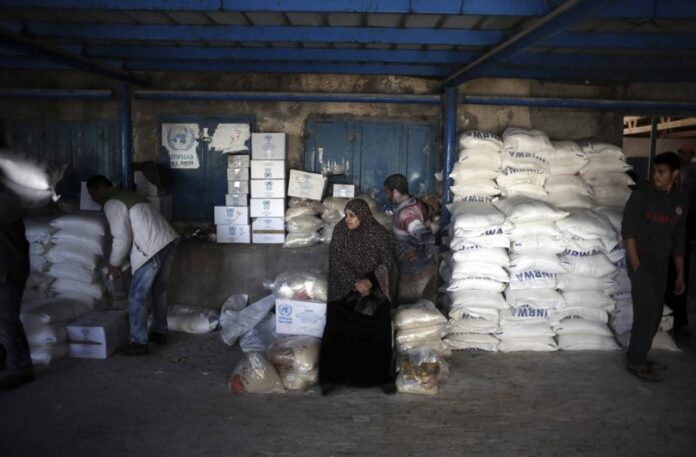
In this Sunday Jan. 14, 2018 photo, a Palestinian woman waits to receive food aid at a U.N. warehouse in the Shati refugee camp, Gaza City. From the Gaza Strip to Jordan and Lebanon, millions of Palestinians are bracing for the worst as the Trump administration moves toward cutting funding to the U.N. agency that assists Palestinian refugees across the region. The expected cuts could deliver a painful blow to some of the weakest populations in the Middle East and risk destabilizing the already struggling countries that host displaced Palestinian refugees and their descendants. (AP Photo/ Khalil Hamra)
SHATI REFUGEE CAMP, Gaza Strip — Mahmoud al-Qouqa can’t imagine life without the three sacks of flour, cooking oil and other staples he receives from the United Nations every three months.
Living with 25 relatives in a crowded home in this teeming Gaza Strip slum, the meager rations provided by UNRWA, the U.N. agency for Palestinian refugee families, are the last thing keeping his family afloat in the territory hard hit by years of poverty and conflict. But that could be in danger as the U.S., UNRWA’s biggest donor, threatens to curtail funding.
“It will be like a disaster and no one can predict what the reaction will be,” al-Qouqa said.
Across the Middle East, millions of people who depend on UNRWA are bracing for the worst. The expected cut could also add instability to struggling host countries already coping with spillover from other regional crises.
UNRWA was established in the wake of the 1948 Mideast war surrounding Israel’s creation. An estimated 700,000 Palestinians fled or were forced from their homes in the fighting.
In the absence of a solution for these refugees, the U.N. General Assembly has repeatedly renewed UNRWA’s mandate, the original refugee camps have turned into concrete slums and more than 5 million refugees and their descendants now rely on the agency for services including education, health care and food. The largest populations are in Gaza, the West Bank, Jordan and Lebanon.
Seen by the Palestinians and most of the international community as providing a valuable safety net, UNRWA is viewed far differently by Israel.
Prime Minister Benjamin Netanyahu accuses the agency of perpetuating the conflict by helping promote an unrealistic dream that these people have the “right of return” to long-lost properties in what is now Israel.
“UNRWA is part of the problem, not part of the solution,” he told foreign journalists last week. Noting that the Palestinians are the only group served by a specific refugee agency, he said UNRWA should be abolished and its responsibilities taken over by the main U.N. refugee agency.
Some in Israel have even tougher criticism, accusing UNRWA of teaching hatred of Israel in its classrooms and tolerating or assisting Hamas militants in Gaza.
Blaming the Palestinians for lack of progress in Mideast peace efforts, President Donald Trump has threatened to cut American assistance to the Palestinians. UNRWA would be the first to be affected.
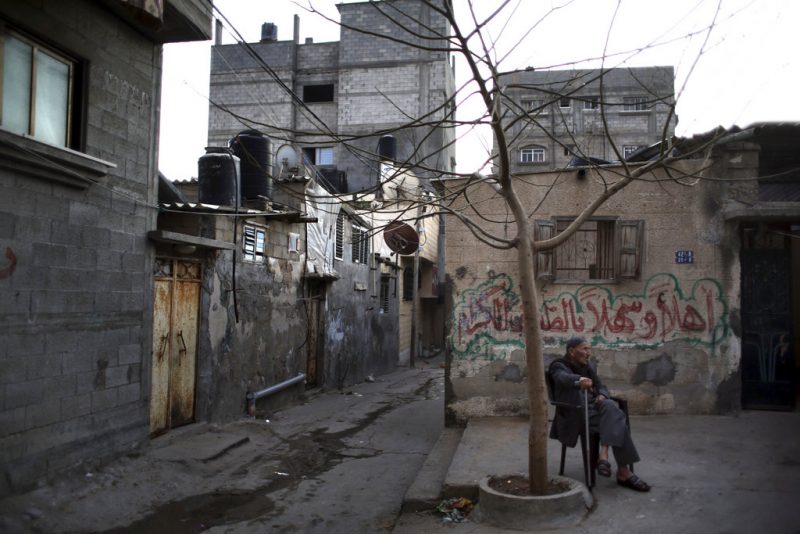
In this Thursday Jan. 11, 2018 photo, a Palestinian sits outside his house in the Shati refugee camp in Gaza City. From the Gaza Strip to Jordan and Lebanon, millions of Palestinians are bracing for the worst as the Trump administration moves toward cutting funding to the U.N. agency that assists Palestinian refugees across the region. The expected cuts could deliver a painful blow to some of the weakest populations in the Middle East and risk destabilizing the already struggling countries that host displaced Palestinian refugees and their descendants. (AP Photo/ Khalil Hamra)
The U.S. provides about $355 million a year to UNRWA, roughly one-third of its budget.
U.S. officials in Washington said this week the administration is preparing to withhold tens of millions of dollars from the year’s first contribution, cutting a planned $125 million installment by half or perhaps entirely. The decision could come as early as Tuesday.
Matthias Schmale, UNRWA’s director in Gaza, said Washington has not informed the agency of any changes. However, “we are worried because of the statements … in the media and the fact that the money hasn’t arrived yet,” he said.
Schmale dismissed the Israeli criticisms, saying that individuals who spread incitement or aid militants are isolated cases and promptly punished. And he said Netanyahu’s criticism should be directed at the U.N. General Assembly, which sets UNRWA’s mandate, not the agency itself.
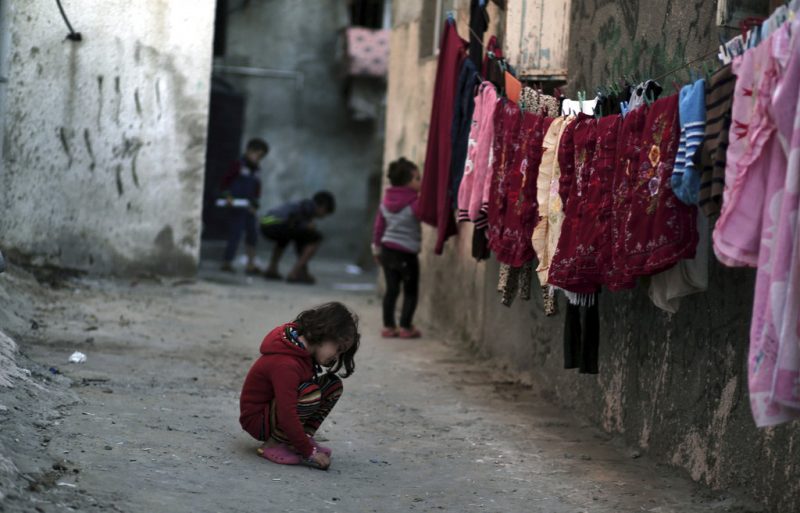
In this Thursday Jan. 11, 2018 photo, Palestinian children play in an alley at the Shati refugee camp in Gaza City. From the Gaza Strip to Jordan and Lebanon, millions of Palestinians are bracing for the worst as the Trump administration moves toward cutting funding to the U.N. agency that assists Palestinian refugees across the region. The expected cuts could deliver a painful blow to some of the weakest populations in the Middle East and risk destabilizing the already struggling countries that host displaced Palestinian refugees and their descendants. (AP Photo/ Khalil Hamra)
Any cut in U.S. aid could ripple across the region with potentially unintended consequences.
Gaza may be the most challenging of all of UNRWA’s operating areas. Two-thirds of Gaza’s 2 million people qualify for services, and its role is amplified given the poor state of the economy, which has been hit hard by three wars with Israel and a Israeli-Egyptian blockade since the Hamas militant group seized power over a decade ago. Unemployment is 43 percent and the poverty rate is 38 percent, according to the official Palestinian statistics office.
“Nowhere else are we the biggest service provider for the population of the entire territory,” Schmale said. He said UNRWA provides food assistance to 1 million Gazans, calling it “an expression of collective shame for the international community.”
With more than 12,500 teachers, nurses and other staff, UNRWA is Gaza’s largest non-governmental employer. It is also involved in postwar reconstruction projects.
The dire situation in Gaza is evident inside al-Qouqa’s home, which is so cramped the family has made sleeping spaces with wood boards and fabric. Two male family members are unemployed. Two others are Hamas civil servants and get paid only intermittently by the cash-strapped movement.
At 72, al-Qouqa is worried about his grandchildren. “If UNRWA provides them with bread, they can remain patient. But if it was cut, what will they become? They will become thieves, criminals and a burden on society,” he said. Many believe Hamas, which administers schools and social services in Gaza, will step in to fill the void.
Jordan, a crucial ally in the U.S.-led battle against Islamic militants, is home to the largest number of Palestinian refugees and their descendants — with nearly 2.2 million people eligible for UNRWA services. This has turned the U.N. agency into a major contributor to social welfare services in the country, which also hosts hundreds of thousands of Syrians displaced by war.
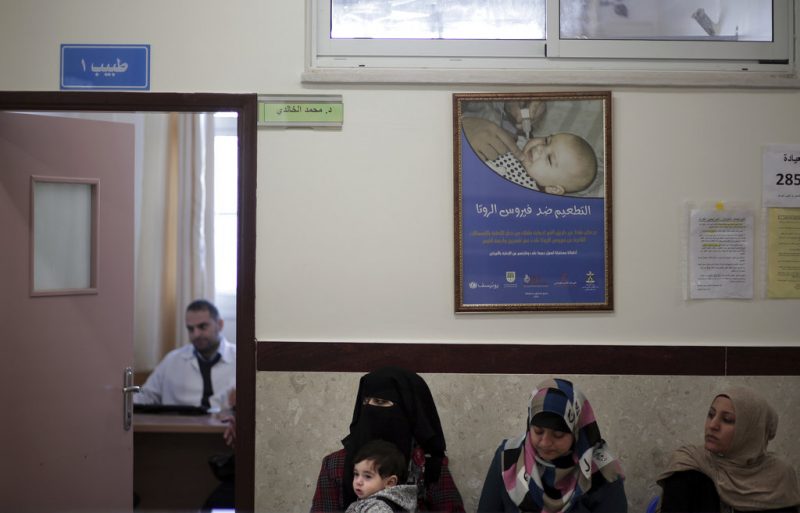
In this Sunday Jan. 14, 2018 photo, Palestinian women wait to see a doctor in the UNRWA-run clinic in the Shati refugee camp, Gaza City. From the Gaza Strip to Jordan and Lebanon, millions of Palestinians are bracing for the worst as the Trump administration moves toward cutting funding to the U.N. agency that assists Palestinian refugees across the region. The expected cuts could deliver a painful blow to some of the weakest populations in the Middle East and risk destabilizing the already struggling countries that host displaced Palestinian refugees and their descendants. (AP Photo/ Khalil Hamra)
U.S. aid cuts could heighten the threat of instability in Jordan, which is grappling with a worsening economy hurt by the spillover from conflict in neighboring Syria and Iraq. More than one-third of Jordan’s young people are without jobs, turning them into potential targets for recruitment by extremists.
Most of the Palestinians eligible for UNRWA services in Jordan hold Jordanian citizenship, and some argue that this has ended their refugee status. But most maintain that UNRWA services are vital to propping up an important ally.
UNRWA’s services are also vital in Lebanon, where Palestinians are prohibited from working in skilled professions and owning property.
Lebanon is the least-welcoming Arab country to Palestinian refugees, because it does not want Palestinians to settle and because it does not want the refugees to upset the country’s delicate sectarian balance. Camps in several cities are ringed by concrete barriers and Lebanese security forces use checkpoints to control who enters and leaves. A recent census found 175,000 Palestinian refugees or their descendants living in the country.
The civil war in Syria has made many Palestinians refugees twice over. Some 32,000 Palestinians who were living in Syria fled to Lebanon, according to UNRWA. In Syria, Palestinians enjoyed the right to own property and to work in all professions. They are not entitled to the same in Lebanon.
Balkees Hameed, 33, arrived in 2013 with her husband, two children and in-laws from Damascus, where their apartment was damaged by rocket fire. The family depends on UNRWA assistance to rent a one-bedroom apartment in a ramshackle building in Bourj al-Barajneh, a Beirut camp. Her husband wipes tables at a restaurant outside the camp. Hameed, like all Palestinians, was painfully aware of the rumors coming out of Washington.
“We are already defeated and now they want to oppress us some more?” she asked.
While more than 5 million Syrian refugees worldwide are entitled to assistance from the U.N.’s general refugee relief agency, Palestinians are barred from it under the logic that UNRWA serves them. But UNRWA in Lebanon is chronically underfunded, and the wave of Palestinians arriving from Syria has strained its finances even further.
“What UNRWA provides is not even a quarter of what a Palestinian refugee needs,” said Ramy Mansour, 34, who fled to Lebanon from the Yarmouk refugee camp in Damascus in 2013. “Take everything and return us to our homes. We don’t want any assistance or anything, just return us to our country.”
FILE - In this Sunday, Jan. 27, 2008 file photo, Cranberries lead singer Dolores O'Riordan performs during the European Border Breakers awards, or EBBA awards, in Cannes, southern France. O'Riordan, lead singer of Irish band The Cranberries, has died. She was 46, it was announced on Monday, Jan. 15, 2018. (AP Photo/Bruno Bebert, File)
LONDON — Dolores O’Riordan, whose urgent, powerful voice helped make Irish rock band The Cranberries a global success in the 1990s, died suddenly on Monday at a London hotel. She was 46.
The singer-songwriter’s publicist, Lindsey Holmes, confirmed that O’Riordan died in London, where she was recording.
“No further details are available at this time,” Holmes said, adding that O’Riordan’s family was “devastated” by the news.
Her Cranberries bandmates — Noel Hogan, Mike Hogan and Fergus Lawler — tweeted that O’Riordan “was an extraordinary talent and we feel very privileged to have been part of her life.”
London’s Metropolitan Police force said officers were called just after 9 a.m. Monday to a hotel where a woman in her 40s was found dead. The police force said the death was being treated as “unexplained.”
The Hilton hotel in London’s Park Lane confirmed that a guest had died on the premises.
Ireland’s President Michael D. Higgins said O’Riordan and The Cranberries “had an immense influence on rock and pop music in Ireland and internationally.”
O’Riordan was born on Sept. 6, 1971 in Ballybricken, southwest Ireland. In 1990, she answered an ad from a local band in nearby Limerick city — then called The Cranberry Saw Us — that was looking for a lead singer.
A name change and a confluence of factors turned The Cranberries into international stars. Their guitar-based sound had an alternative-rock edge at a time when grunge was storming the music scene.
The band’s songs — on which O’Riordan was chief lyricist and co-songwriter — had a Celtic-infused tunefulness. And in O’Riordan the group had a charismatic lead singer with a distinctively powerful voice.
Heavy play on MTV for their debut single “Dream” and the singles that followed helped bring the group to the attention of a mass audience.
The Cranberries’ 1993 debut album, “Everybody Else Is Doing It, So Why Can’t We?”, sold millions of copies and produced the hit single “Linger.”
The follow-up, “No Need to Argue,” sold in even greater numbers and contained “Zombie,” a visceral howl against Northern Ireland’s violent Troubles that topped singles charts in several countries.
Irish Prime Minister Leo Varadkar tweeted Monday that “for anyone who grew up in Ireland in the 1990s, Dolores O’Riordan was the voice of a generation. As the female lead singer of a hugely successful rock band, she blazed a trail and might just have been Limerick’s greatest ever rock star. RIP.”
The band released three more studio albums before splitting up in 2003. O’Riordan released a solo album, “Are You Listening,” in 2007, and another, “No Baggage,” in 2009.
The Cranberries also reunited that year, resulting in the album “Roses” in 2012.
For a time, O’Riordan was one of Ireland’s richest women, but she struggled with both physical and mental health problems.
The Cranberries released the acoustic album “Something Else” in 2017 and had been due to tour Europe and North America. The tour was cut short because O’Riordan was suffering from back problems.
In 2014, O’Riordan was accused of assaulting three police officers and a flight attendant during a flight from New York to Ireland. She pleaded guilty and was fined 6,000 euros ($6,600.)
Medical records given to the court indicated she was mentally ill at the time of the altercation. After her court hearing O’Riordan urged other people suffering mental illness to seek help.
She told London’s Metro newspaper last year that she had been diagnosed with bipolar disorder, and she spoke to the Irish News about her battles with depression.
O’Riordan said depression “is one of the worst things to go through,” but that “I’ve also had a lot of joy in my life, especially with my children.”
“You get ups as well as downs. Sure, isn’t that what life’s all about?” she said.
O’Riordan is survived by her ex-husband, the former Duran Duran tour manager Don Burton, and their three children.