



























31.6 C
Bangkok
Tuesday, June 9, 2026
Home Blog Page 2116

Prawit Spotted Wearing 3rd Multi-Million Baht Watch

Image: CSI LA / Facebook

BANGKOK — A well-known anti-corruption campaigner called for Deputy Prime Minister Gen. Prawit Wongsuwan to be suspended until investigations into his unusual displays of wealth are completed after he was seen wearing another multi-million baht accessory.

Srisuwan Janya of the Association of Thai Constitution Protection issued a letter Monday urging junta leader Gen. Prayuth Chan-ocha to suspend Prawit, who’s also deputy junta leader, until the National Anti-Corruption Commission has completed its work.

“People will then know whether this government is sincere in tackling corruption and reform or not,” Srisuwan said.

Show and Don’t Tell: Gen. Prawit Won’t Explain His Bling Watch to Public

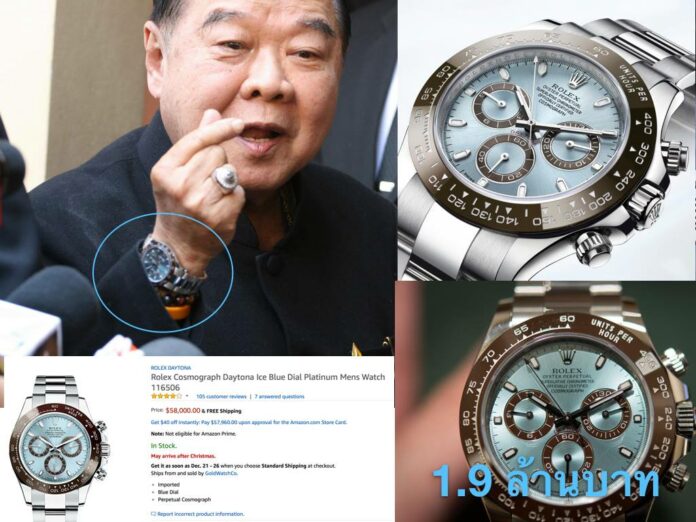
On Saturday, a third premium watch – what appeared to be a platinum Rolex Cosmograph – was spotted on the cover of a Matichon periodical from May, making for the third extravagantly priced timepiece Prawit, a career military man, has been spotted wearing.

The search for evidence of Prawit’s haute horology began earlier this month after he flashed a Richard Mille watch – and bling diamond ring – with an estimated value of over 3 million baht at a photoshoot.

The problem for the 72-year-old deputy junta leader began when a check of his mandatory financial disclosures showed no mention of the watches.

He was given until Jan. 8 to clarify how he obtained the watch, whose sole distributor in Thailand sells at a starting price of at least 3 million baht.

Netizens scouring old photos of Prawit found it wasn’t the only Richard Mille wristwatch. Days later, a Facebook page that crowdsources amateur investigations spotted him wearing a different Richard Mille in a file photo. It appeared to be model RM 30, which also costs at least 3 million baht. On Saturday, members of the same page, CSI LA, spotted a platinum Rolex Cosmograph Daytona. The watch sells in Thailand for just under 2 million baht.

An official involved in the case at the National Anti-Corruption Commission said Monday that the 30-day period for clarification could be extended 15 days or 30 days, if not more, at the commission’s discretion. The employee spoke on the condition of not being named because he was not authorized to speak to the media.

He added that it would be counter-productive for Prawit not to clarify matters to the commission.

“It’s his right to clarify but if he doesn’t, he would be forfeiting his right,” said the source. The source said other complaints about additional watches and rings could be combined into one case with the original case, now with the investigation office of the NACC.

Khaosod English tried to reach Secretary-General Worawit Sukboon for further information Monday but was told he was unavailable.

The commission is a nominally independent agency founded in 1999 as part of anti-graft effort in the newly enacted 1997 constitution. It is tasked with promoting transparency among political office holders and investigating corruption allegations.

Srisuwan, a prolific filer of public malfeasance complaints, is among those who have questioned the commission’s independence.

“Many of the commissioners in this set are questionable. For example, the president used to be a police officer and served administrators in the current government directly,” Srisuwan told Khaosod English back in February. “Therefore, whenever there’s cries about corruption relating to powerful people in the government, there’s a direct conflict of interest.”

Its politically appointed chairman, police Gen. Watcharapol Prasarnrajkit, has ties with Prawit.

Srisuwan said that he does “not fully trust” Watcharapol’s promise not to be involved in the probe.

The commission source said, with or without Prawit’s clarification, the NACC would eventually decide whether to forward the case to the Supreme Court’s Division for Political Office Holders.

If found guilty of not declaring some of his wealth, Prawit could be removed from the post of deputy prime minister.

“There is no time frame for handling the case, however,” the official added.

This past Tuesday, Prawit was expected to explain that the first Richard Mille was loaned to him by a friend. The rumors, true or not, were met with derision and did not come to pass.

A prominent reporter with close ties to the military, Wassana Nanuam, wrote online Saturday that the watches were loaned by a very close businessman friend – who has just died. She cited no source for the information.

Advertisement

Thailand to ‘Upgrade’ Munich Consulate

Image: Nils van der Burg / Flickr

BANGKOK — Thailand’s diplomatic mission in Munich is slated for expansion, with a new Consulate-General to replace its honorary representative, a top foreign affairs official said Monday.

Under a plan approved by the Cabinet, the new Consulate-General’s office will cover the two German regions of Bayern and Baden-Württemberg. The change means Thailand will have a second Consulate-General in Germany in addition to one already in Frankfurt.

“It’s like we are upgrading it,” foreign affairs minister Don Pramudwinai said, though he said the details were not finalized. “We are still working things out.”

Foreign Affairs is tasked tasked with furnishing personnel and funds to make it happen, while Germany was extended a reciprocal offer to expand its diplomatic presence in Thailand.

However, Germany currently has no plans to open a new consulate in Thailand, deputy head of German mission Jan Scheer wrote in an email.

Munich is home to a Thai honorary consulate office which only offers basic consular services such as granting visas but cannot represent Thailand diplomatically.

After the cabinet-approved the plan in August, a Thursday government order said the honorary office would close to make way for the new, larger facility. All Munich visa applications will be processed by the embassy in Berlin and other consular offices in the meantime, the announcement said.

Asked why Thailand was expanding its diplomatic presence in Germany, Don said the two nations enjoy amicable relations.

“We and Germany have been maintaining our friendship for a long time,” he said.

Advertisement

Panda Preview: Tokyo Trots Out Newest Baby (Video)

TOKYO — A baby panda has made a special appearance before Tokyo’s governor, a group of local schoolchildren and the media one day ahead of its official public debut.

Xiang Xiang, a 6-month-old female giant panda, will debut Tuesday in a limited public viewing for avid fans who obtained tickets through a highly competitive lottery process.

Xiang Xiang, or “Fragrance” in Chinese, was born June 12 to a resident panda at Tokyo’s Ueno Zoo and now weighs more than 12 kilograms.

Tokyo Gov. Yuriko Koike, who was all smiles after coming out of the zoo’s panda house on Monday, told reporters that the baby panda was “just adorable.”

Zoo officials said Xiang Xiang’s appearances will be limited to 2.5 hours a day for the time being to minimize stress.

Advertisement

2017 in Review: ‘Disruption, Despair and Dumpster Fires’

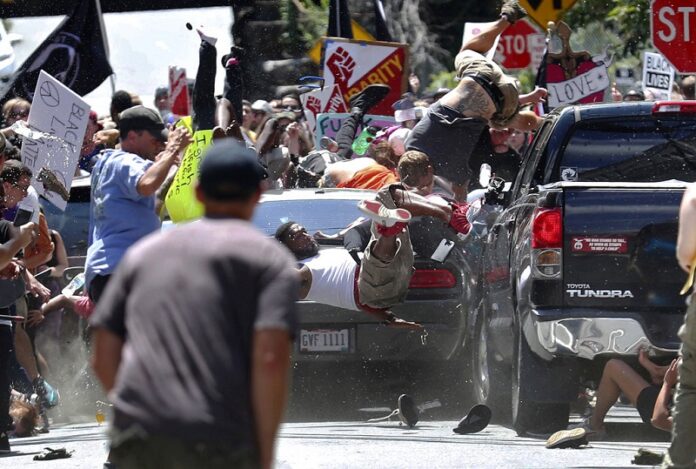
People are thrown into the air as a car drives into a group of protesters demonstrating against a white nationalist rally in August in Charlottesville, Virginia. Photo: Associated Press

NEW YORK — The news alerts gushed in: An attack on a concert, a church, an ice cream parlor; an assailant wielding a gun or hammer or acid. There’s an earthquake in Mexico, a monsoon in India, a volcanic eruption in Bali, hurricane after hurricane after hurricane. Keep up as your phone vibrates with word of your favorite actor accused of misconduct. Make that anchorman. Or politician. Or radio star.

The volatile year 2017 shook us so much and so often it felt like whiplash or worse, and that’s without even considering Donald Trump, at the center of so much of the turmoil.

“It’s almost like one of those horror rides at the amusement park where every time it heads into the next segment it gets worse,” said noted trendspotter Marian Salzman. “Every time I turn off a device, I feel like I have anxiety because I’m not tracking the news.”

The year, she said, boiled down to “disruption, despair and dumpster fires.”

In retrospect, 2017’s destiny seemed sealed in its opening moments.

Just after the new year dawned in Istanbul, a gunman killed 39 people at a nightclub and wounded scores more. The joy of the holiday dissolved into a scene of heartbreak outside the city morgue, where some cried and fell to the ground as they learned of a loved one’s fate.

Around the world this year, vehicles were made into weapons, with trucks, cars and vans plowing down people on the Westminster and London bridges in Britain; in Times Square and on a Manhattan bike path; on a major shopping street in the Swedish capital of Stockholm; on the historic La Rambla in Barcelona.

Terrorism and other violence struck so regularly that many accepted it as a fact of life.

“It can happen anywhere as long as there is one man willing to die,” said Luis Antonio Bone, 66, of Barcelona, who is retired from a cement factory job. Bone is at once realistic and defiant, saying crowded places may make him think about his safety but won’t deter him from outings.

“We have to live with it,” he said, “but keep living as we always have.”

That kind of resilience was mustered again and again, even by some of those marked by some of the year’s biggest tragedies.

In Texas, Pastor Frank Pomeroy vowed that good would persevere over evil. Pomeroy leads the rural church where a gunman killed 25 parishioners, his own 14-year-old daughter among them. “Rather than choose darkness as that young man did that day, we choose life,” he said in an emotional service only a week after the rampage.

In Las Vegas, too, where 58 people were fatally shot at a music festival, some searched for optimism in the face of savagery. Jay Pleggenkuhle, a 52-year-old landscaper, helped create a memorial garden with a tree for each of the victims. Some 1,000 people volunteered to help with his project, putting aside personal or political differences to work hand in hand.

“People have really been bound together following this tragedy,” he said.

A deadly chemical attack in Syria stirred people around the globe. Missile launches by North Korea brought angst that nuclear war was nearing. Rallies by white supremacists, wearing white hoods and clasping torches, roused uncomfortable memories of the United States’ past. All of it broke with such ferocity, it seemed impossible to focus on any one incident too long.

“Even something like a mass shooting that killed 50 people, the story moves on in just a couple weeks,” said Lauren Wright, a lecturer on politics and public affairs at Princeton University.

In Egypt, twin Palm Sunday attacks ambushed Coptic Christians and a November assault on a crowded mosque killed more than 300. In Britain, 22 people died when a suicide bomber detonated a backpack full of explosives after an Ariana Grande show.

Three major storms  Harvey, Irma and Maria  battered Puerto Rico and much of the Caribbean, as well as Texas and Florida, as 2017 went down as one of the most active hurricane seasons in recorded history. Fires tore through California and Portugal; earthquakes rocked Mexico, Iran and Iraq; flooding and an avalanche covered parts of Italy; mudslides leveled homes in Sierra Leone; and a deadly monsoon pummeled India, Nepal, Pakistan, and Bangladesh.

In hotspots around the world, people sought escape. Amnesty International estimated 73,000 refugees took to the Mediterranean in the first half of the year alone, with about 2,000 dying along the way. In Myanmar, the military has been conducting a brutal ethnic cleansing of Rohingya people, killing untold numbers and forcing more than 626,000 to flee into neighboring Bangladesh.

Amid the barrage, other big stories struggled for a spotlight. A grinding civil war in Yemen pushed millions in the impoverished country to famine. A political crisis in Venezuela brought intensifying clashes. In Zimbabwe, Robert Mugabe was ousted from control after a 37-year reign. In Spain, a push for Catalonian independence degenerated at times into ugly scenes of mayhem.

In the U.S., Trump opened his presidency with a dark inaugural address beseeching an end to “American carnage” but saw much of his agenda rejected, with members of his own party providing key votes against him. Divides deepened, with agreement elusive even on core national values. Americans were sadder, a “happiness” report found. Sales of the dystopic novel “1984” surged and a chilling stage adaptation came to Broadway.

Mass protests formed around the country, including droves of women who proudly deemed themselves “nasty,” a label placed on Hillary Clinton in the 2016 presidential race. When U.S. Sen. Elizabeth Warren was silenced through arcane legislative rules, the words of her colleague, Mitch McConnell, became an unlikely rallying cry of feminists: “Nevertheless, she persisted.”

That phrase echoed as a dizzying number of sexual harassment or assault allegations emerged against high-profile men and as thousands of victims of lesser-known men chimed in with two words that made clear the scope of the problem: “Me too.”

There were, in this arguably awful year, moments to hail, too, stories of heroism and bravery that restore faith and give the heart a little hope. More than 80 schoolgirls, abducted by Boko Haram extremists more than three years ago in Nigeria, were released. In South Sudan, a boy abducted and forced into the army  mourned in a funeral two years ago after word of his gunshot death reached his mother  was alive after all, and returned home.

The Islamic State lost power as it was driven from Mosul, Iraq, and Raqqa, Syria. In the U.S., a total solar eclipse gave a break from the unending cacophony, with droves of sky-gazers standing shoulder to shoulder across a swath of the country.

A new calendar page brings with it the chance to start fresh. Jordi Casares, a 71-year-old retired bank employee in Barcelona, lamented the terrorism and radicalism that marred 2017 but said he, for one, is optimistic for a better 2018.

“It can’t be any worse than this year,” he said.

Story: Matt Sedensky

Advertisement

Putin Thanks Trump for CIA Tip He Says Stopped Bomb Plot

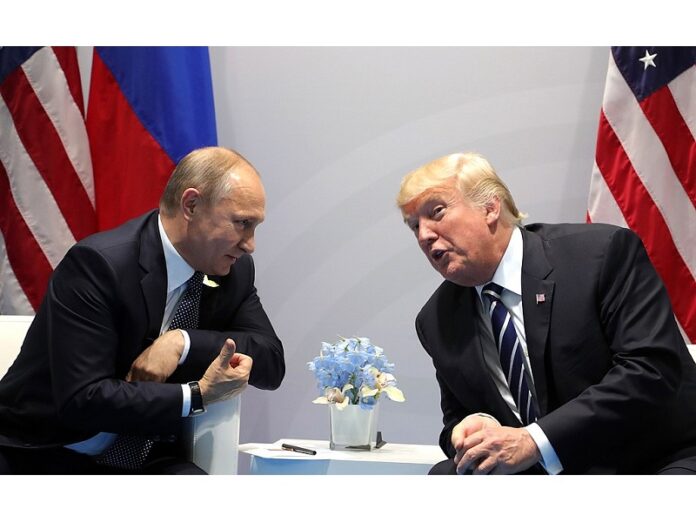
Vladimir Putin and Donald Trump meet at the 2017 G-20 Hamburg Summit in July in Germany. Photo: Kremlin.ru / Wikimedia Commons

MOSCOW — Russian President Vladimir Putin telephoned U.S. President Donald Trump Sunday to thank him for a CIA tip that helped thwart a series of bombings in St. Petersburg, the Kremlin and the White House said.

During the call, the two leaders’ second in three days, Putin expressed gratitude for the CIA information. The Kremlin said it led Russia’s top domestic security agency to a group of suspects that planned to bomb St. Petersburg’s Kazan Cathedral and other crowded sites this weekend.

“The information received from the CIA proved sufficient to find and detain the criminal suspects,” the Kremlin said.

The White House said in its readout of the conversation that “based on the information the United States provided, Russian authorities were able to capture the terrorists just prior to an attack that could have killed large numbers of people.”

The White House added that Putin extended his thanks and congratulations to CIA Director Mike Pompeo and the entire agency. Trump then called Pompeo “to congratulate him, his very talented people, and the entire intelligence community on a job well done!”

“President Trump appreciated the call and told President Putin that he and the entire United States intelligence community were pleased to have helped save so many lives,” the White House said in its statement. “President Trump stressed the importance of intelligence cooperation to defeat terrorists wherever they may be. Both leaders agreed that this serves as an example of the positive things that can occur when our countries work together.”

The Kremlin said Putin assured Trump that “if the Russian intelligence agencies receive information about potential terror threats against the United States and its citizens, they will immediately hand it over to their U.S. counterparts via their communications channels.”

The CIA’s tip to Russia comes even as Russia-U.S. ties have plunged to their lowest level since the Cold War era  first over Russia’s annexation of Crimea and support for pro-Russia separatists in Ukraine, more recently over allegations that Moscow interfered in the U.S. presidential election to help Trump.

While Russian officials have said the two countries were continuing to exchange some terror-related intelligence, Sunday’s statement from the Kremlin was Russia’s first public assertion that information from the United States helped prevent an attack.

The conversation was the second between the Russian and U.S. presidents since Thursday, when Trump thanked Putin for his remarks “acknowledging America’s strong economic performance,” according to the White House.

During the first call, they also discussed during ways to work together to address North Korea’s nuclear and ballistic weapons program, the White House said.

The Federal Security Service, or FSB, announced Friday that seven suspected followers of the Islamic State group had been arrested for allegedly planning to carry out terror attacks in St. Petersburg this weekend.

The agency said the suspects were plotting a suicide bombing in a church and a series of other explosions in the city’s busiest areas this coming weekend on IS orders. It said a search of a St. Petersburg apartment found explosives, automatic weapons and extremist literature.

Russian news reports said that Kazan Cathedral, a landmark 19th century Russian Orthodox church on St. Petersburg’s central Nevsky Prospect, was the prime target.

If the suspects succeeded in bombing the cathedral, it would have been the first major attack on a Russian Orthodox Church by Islamic terrorists, who have blown up apartment buildings, passenger planes and transport facilities in Russia.

In April, a suicide bombing in the St. Petersburg’s subway left 16 dead and wounded more than 50.

Russian TV stations have aired footage daily since Friday of the suspects in the foiled attacks being apprehended and questioned. One segment showed FSB operatives outside a St. Petersburg apartment building detaining a suspect, who appeared later saying he was told to prepare homemade bombs rigged with shrapnel.

“My job was to make explosives, put it in bottles and attach pieces of shrapnel,” the suspect, identified by Russian media as 18-year old Yevgeny Yefimov, said in the footage released by the FSB.

Several other suspects came from mostly Muslim regions in Russia’s volatile North Caucasus, and one man was from the ex-Soviet nation of Tajikistan that borders Afghanistan.

The TV reports included footage of a metal container, which the suspects used as a laboratory for making explosives, according to the FSB. Another video showed operatives breaking the doors and raiding an apartment used by other suspects.

Last week, the FSB said it also arrested several IS-linked suspects in Moscow, where they allegedly were plotting a series of suicide bombings to coincide with New Year’s celebrations.

The latest calls between Putin and Trump came after the Russian leader praised his U.S. counterpart during a marathon news conference on Thursday.

Putin hailed Trump’s achievements, saying that global markets have demonstrated investors’ confidence in Trump’s economic policies. He said he hoped the U.S. president would be able to follow through on his campaign promises to improve ties with Russia despite pressure from his political foes at home.

During the news conference, Putin also reaffirmed his multiple denials of meddling in the 2016 U.S. presidential election and argued that the U.S. is only hurting itself with investigations of alleged collusion between Trump and Russia. The allegations were “invented” by Trump’s foes to undermine his legitimacy, Putin said.

Alexei Chepa, a deputy head of the foreign affairs committee in the lower house of Russia’s parliament, hailed the CIA tip as a “step toward cooperation.”

“The more such actions we have, the better it will be for both our countries,” Chepa told the state RIA Novosti news agency.

Story: Vladimir Isachenkov

Advertisement

Bangkok Gets Block Party with 50+ Music Acts, Food, Art

Photo: Youngohm / Facebook

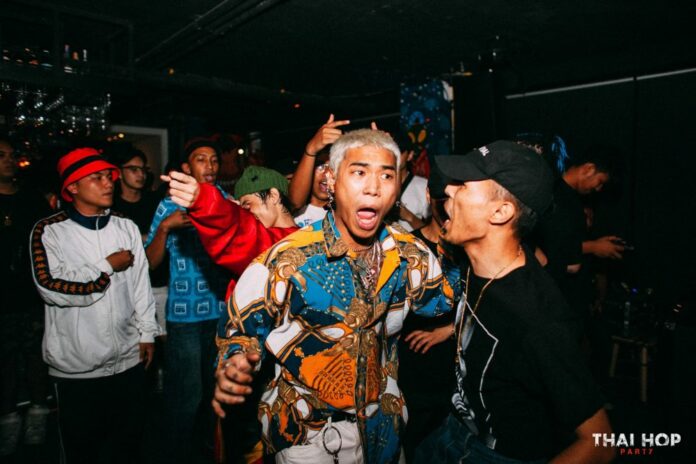
BANGKOK — More than 50 musicians from electronic and hip-hop to heavy rock will gather in an outdoor space for a 12-hour party.

Four stages will go up in the heart of the city for Bangkok Block Party, an all-day event bringing together music, food, drinks, workshops, barbers and tattoo art.

The international lineup leads off with Chicago indie trio Autograf, Nashville-based electro-indie duo Cherub and rap duo The Cozy Boys.

Electropop act X0809’s NoteP and techno DJ Dan Buri will perform as well as underground punk rock group The Greed, hardcore act License to Kill and many more.

Hip-hop scene ain’t dead. Thai-Swedish rapper Thaiboy Digital and Phuket-based hip-hop act Southside will perform along with up-and-coming Fiixd and Youngohm.

The money made from the event will go to “a good cause” to help orphans and refugees in the country, said Supreda “Nick” Sotawong, co-founder of the event and owner of hip-hop nightclub Blaq Lyte.

The “block party” will take place noon through midnight on Saturday, Jan. 13, at A Square. No idea where that is? It’s located on Soi Sukhumvit 26 just off Rama IV Road and shares the same venue with Rockademy Thailand, popular Peking Duck joint An An Lao and simulated surfing center Flow House Bangkok.

Tickets purchased online are 900 baht. They’re 1,500 baht at the door.

Advertisement

Kiradech Aphibarnrat Among 9 Players Projected Into Masters

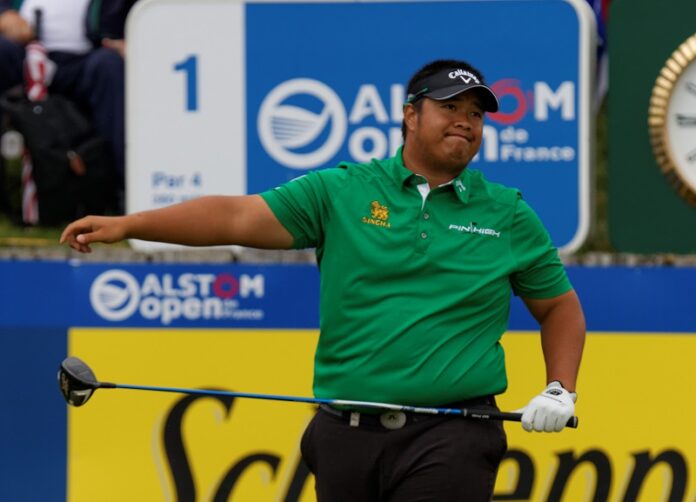
Kiradech Aphibarnrat seen here during the French Open in 2014. Photo: Cyrille BERTIN / Wikimedia Commons

AUGUSTA, Georgia — A late surge by Kiradech Aphibarnrat makes him among nine players projected to get invitations to the Masters by finishing the year in the top 50 in the world ranking.

Kiradech ended his year with four straight top 10s, including a fifth-place finish Sunday in the Indonesian Masters. The Thai is projected to finish the year at No. 49, one spot ahead of Yusaku Miyazato of Japan, who also will get to Augusta National.

The last tournament offering ranking points this year is on the Asian Development Tour and is not expected to affect the top 50.

The other seven who get into the Masters through the world ranking are Tyrrell Hatton, Alex Noren, Matt Fitzpatrick, Branden Grace, Ross Fisher, Yuta Ikeda and Bernd Wiesberger. That puts the field of players expected to compete at 80 going into next year.

The Masters also invites players who are in the top 50 on March 25, and anyone winning a PGA Tour event that offers full FedEx Cup points.

Advertisement

All the Beer Gardens Have Been Declared Illegal – Again

Image: Chang World / Facebook

BANGKOK — A top alcohol regulator said Monday his agency is suing the popular open-air beer gardens at CentralWorld Plaza for violating advertising laws.

The legal action won’t stop there, said Alcohol Control Board director Nipon Chinanonwait, who threatened to crack down on similar events nationwide on the grounds that they entice the public to drink. A trade guild denied Nipon’s allegation.

“Beer gardens themselves are against the law. We have to take action,” Nipon said in an interview. “This is because the form of beer gardens is event marketing. Because, let me ask you, who would open beer gardens without a purpose?”

Nipon’s comment came after he took officials and police to inspect the beer gardens Thursday night at the downtown shopping mall. They are set up annually by major brewers of brands such as Chang, Leo and Singha, and usually feature live music in a festive atmosphere.

Following the raid, Nipon pressed charges against the beer garden organizers for violating Section 32 of a 2008 law that bans attempts to “encourage” drinking. If found guilty, violators face a maximum fine of 500,000 baht.

But Thanakorn Kuptajit, president of the Thai Alcohol Beverage Business Association, said beer gardens do not fall under Section 32 because they sell drinks, but don’t advertise them.

“We believe it’s not illegal,” he said. “Do these beer gardens have a license to sell [alcohol]? As far as I know, they do. Since they have licenses, their actions are lawful.”

Nipon also said he plans to take similar action against other beer gardens.

“We already held a meeting with police. They were told that we will do the same all across the country,” the official said. “Police said we can alert any local unit if we see an infraction anywhere.”

Back in 2015, beer gardens were the targets of prosecution under Nipon’s predecessor, Samarn Futrakul, who threatened legal action against the same beer conglomerates, ThaiBev and Boonrawd. Samarn eventually backed off after junta chairman Prayuth Chan-ocha joined in the backlash, publicly chiding him for going after the multi-billion baht industry.

It is unclear whether the military regime will support or discourage Nipon’s campaign. For the time being, the charges have only been filed against the beer garden organizers instead of the two big brewers.

“We have to take it step by step,” he said.

Advertisement

American Man Recaptured After 5-Day Indonesia Manhunt

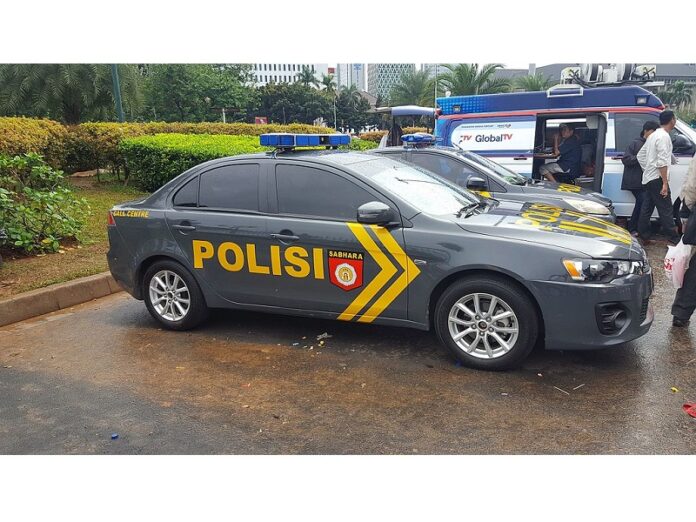
An Indonesian police car in 2016. Photo: Wikimedia Commons

BALI, Indonesia — Authorities have recaptured an American man who escaped from an overcrowded and understaffed prison on the Indonesian resort island of Bali, police said Sunday.

Christian Beasley, 32, is believed to have escaped during heavy rain last Monday from the Kerobokan penitentiary in Bali’s provincial capital, Denpasar, by sawing through a ceiling and then climbing over a 6-meter (20-foot) -high wall behind the prison.

The head of the prison, Tonny Nainggolan, said earlier that another American inmate, Paul Anthony Hoffman, 57, who has been serving a 20-month sentence since July for robbery, was captured while trying to escape along with Beasley.

Beasley was arrested in August at a post office in Bali’s Kuta tourist area while allegedly trying to pick up a package containing 5.7 grams of hashish. He stood trial and the verdict was due last Tuesday, a day after his escape.

Bali police detective Made Pramestia said Beasley had reached the neighboring tourist island of Lombok by boat on the day of his escape.

Pramestia said Beasley was recaptured on Saturday in an alley near a beach on Lombok after a five-day manhunt.

An investigation was underway to determine if prison guards were involved in the escape, said Surung Pasaribu of the local office of the Law and Human Rights Ministry. He also said there is a shortage of guards at the prison, which was built to accommodate about 300 people but has nearly 1,600 inmates.

It was the second escape from the prison since June, when four foreign inmates escaped through a drainage tunnel.

Two of them, Bulgarian Dimitar Nikolov Iliev and Indian Sayed Mohammed Said, were recaptured in East Timor days later and were returned to Bali. The two others, Shaun Edward Davidson of Australia and Tee Koko King bin Tee Kim Sai of Malaysia, are still at large.

Jailbreaks are common in Indonesia, where prisons are overcrowded with people convicted of drug crimes as part of the government’s anti-drug crusade.

Advertisement

In Western China, Thought Police Instill Fear

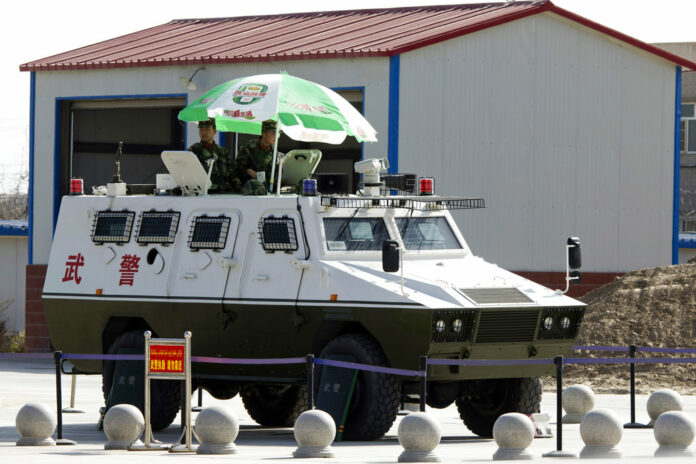
Paramilitary policemen in an armored vehicle on duty Nov. 3 at the airport in Hotan in western China's Xinjiang region. Photo: Ng Han Guan / Associated Press

KORLA, China — Nobody knows what happened to the Uighur student after he returned to China from Egypt and was taken away by police. Not his neighbors, not his classmates, not his mother.

“Is he dead or alive?” the mother said, tears streaming down her face when Associated Press reporters visited her at home unexpectedly and showed her a photo of the student.

The student’s friends think he joined thousands — possibly tens of thousands — of people who have been spirited away without trial into new indoctrination centers. The mass disappearances, beginning the past year, are part of efforts by Chinese authorities to use detentions and data-driven surveillance to impose a police state over the region of Xinjiang and its 10 million Uighurs, a Turkic-speaking Muslim minority that China says has been influenced by Islamic extremism.

Unprecedented levels of police blanket Xinjiang’s streets in many cities. Cutting-edge surveillance systems track where Uighurs go, what they read, who they talk to and what they say.

Through rare interviews with Uighurs who recently left China, a review of government procurement contracts and unreported documents, and a trip through southern Xinjiang, the AP pieced together a picture of a campaign that’s ostensibly rooting out terror — but instead instilling fear.

Most of the more than a dozen Uighurs interviewed for this story spoke on condition of anonymity for fear that Chinese authorities would punish them or their family members. The AP is withholding the student’s name and other personal information to protect people who fear government retribution.

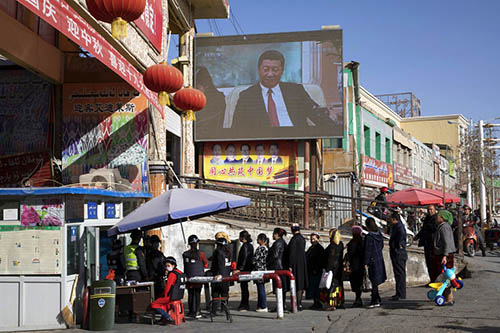
Residents walk through a security checkpoint into the Hotan Bazaar where a screen shows Chinese President Xi Jinping in Hotan in western China's Xinjiang region. Photo: Ng Han Guan / Associated Press
Residents walk through a security checkpoint into the Hotan Bazaar where a screen shows Chinese President Xi Jinping in Hotan in western China’s Xinjiang region. Photo: Ng Han Guan / Associated Press

The Xinjiang regional government did not respond to repeated requests for comment. But China’s government describes its Xinjiang security policy as a “strike hard” campaign that’s necessary following a series of attacks in 2013 and 2014, including a mass knifing in a train station that killed 33. A Hotan city propaganda official, Bao Changhui, told the AP: “If we don’t do this, it will be like several years ago — hundreds will die.”

China also points to decades of heavy economic investment and cultural assimilation programs and measures like preferential college admissions for Uighurs.

Authorities refer to the detention program as “vocational training,” but its main purpose appears to be indoctrination. Training sessions on “Mandarin, law, ethnic unity, de-radicalization, patriotism” are described as lasting anywhere from 3 months to 2 years.

In Korla, one center the AP visited was labeled a jail. Another was downtown on a street sealed off by rifle-toting police.

Southern Xinjiang, where Korla is located, is one of the most heavily policed places on earth.

In Hotan, police depots with flashing lights and foot patrols are set up every 500 meters. Motorcades of more than 40 armored vehicles rumble down city boulevards. Police checkpoints on every other block stop cars to check identification and smartphones for religious content.

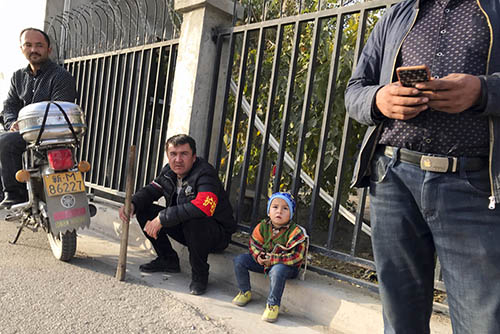
Residents act as neighborhood watch for suspicious activities in a village near Korla in western China's Xinjiang region. Photo: Ng Han Guan / Associated Press
Residents act as neighborhood watch for suspicious activities in a village near Korla in western China’s Xinjiang region. Photo: Ng Han Guan / Associated Press

Xinjiang’s published budget data shows public security spending this year is on track to increase 50 percent from 2016 to roughly 45 billion yuan ($6.8 billion) after rising 40 percent a year ago. It’s quadrupled since 2009, when a Uighur riot broke out in Urumqi, killing nearly 200 people.

But much of the policing goes unseen.

Shoppers entering the Hotan bazaar must pass through metal detectors and place their national identification cards on a reader while having their faces scanned. AP reporters were stopped outside a hotel by a police officer who said the public security bureau had been remotely tracking the reporters’ movements by watching surveillance camera footage.

The government’s tracking efforts have extended to vehicles, genes and even voices. A biometric data collection program appears to have been formalized last year under “Document No. 44,” a regional public security directive to “comprehensively collect three-dimensional portraits, voiceprints, DNA and fingerprints.” The document’s full text remains secret, but the AP found at least three contracts referring to the 2016 directive in recent purchase orders for equipment such as microphones and voice analyzers.

China has also turned to a familiar low-tech surveillance tactic: recruiting the masses.

A Uighur businessman from Kashgar who fled China said his four brothers and his father were in prison because of his escape and that families tasked with spying on one another in his community had also been punished. Members from each were sent to re-education centers for three months, he told the AP.

A document obtained by U.S.-based activists and seen by the AP shows Uighur residents in the Hebei Road West neighborhood in Urumqi, the regional capital, being graded on a 100-point scale. Those of Uighur ethnicity are automatically docked 10 points. Being aged between 15 and 55, praying daily, or having a religious education, all result in 10 point deductions. A neighborhood police official in Urumqi surnamed Tao confirmed that every community committee in the city needed to conduct similar assessments.

Uighurs abroad say it’s too risky to stay in touch with their families in China.

When Salih Hudayar, an American Uighur graduate student, last called his 70-something grandfather this summer, the elderly man told him kindly not to call again. He later heard his grandfather had been sent to an indoctrination camp.

A Uighur student who moved to Washington following the crackdown this summer said that after his move, his wife, a government worker still in Urumqi, messaged to say the police would show up at her home in 20 minutes. She had to say goodbye: after that she would delete him permanently from her contacts list.

Later, he couldn’t help himself placing one last call home. His daughter picked up.

“Mom is sick but she doesn’t want me to speak to you. Goodbye,” she said.

Story: Gerry Shih

Advertisement

Hot News

LATEST NEWS

Bangkok
overcast clouds
31.6 ° C
31.6 °
29.4 °
68 %
3.1kmh
100 %
Tue
35 °
Wed
34 °
Thu
34 °
Fri
28 °
Sat
31 °