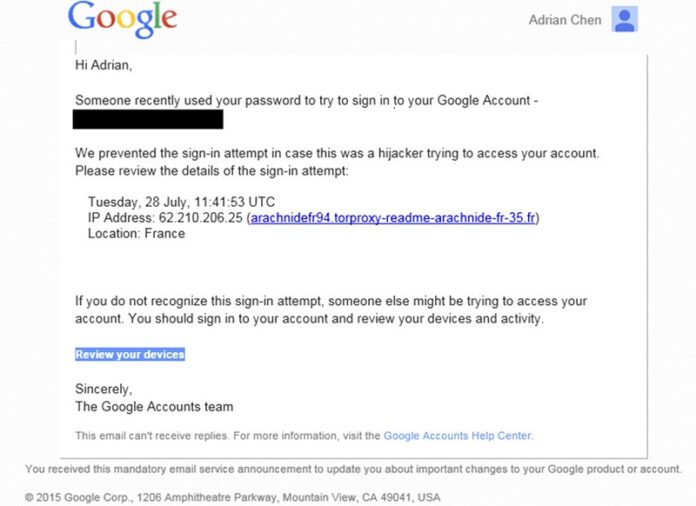
This image shows a portion of a phishing email sent to New York-based journalist Adrian Chen on July 28, 2015. Image: Associated Press
PARIS — Russian television anchor Pavel Lobkov was in the studio getting ready for his show when jarring news flashed across his phone: Some of his most intimate messages had just been published to the web.
Days earlier, the veteran journalist had come out live on air as HIV-positive, a taboo-breaking revelation that drew responses from hundreds of Russians fighting their own lonely struggles with the virus. Now he’d been hacked.
“These were very personal messages,” Lobkov said in a recent interview, describing a frantic call to his lawyer in an abortive effort to stop the spread of nearly 300 pages of Facebook correspondence, including sexually explicit messages. Even two years later, he said, “it’s a very traumatic story.”
The Associated Press found that Lobkov was targeted by the hacking group known as Fancy Bear in March 2015, nine months before his messages were leaked. He was one of at least 200 journalists, publishers and bloggers targeted by the group as early as mid-2014 and as recently as a few months ago.
The AP identified journalists as the third-largest group on a hacking hit list obtained from cybersecurity firm Secureworks, after diplomatic personnel and U.S. Democrats. About 50 of the journalists worked at The New York Times. Another 50 were either foreign correspondents based in Moscow or Russian reporters like Lobkov who worked for independent news outlets. Others were prominent media figures in Ukraine, Moldova, the Baltics or Washington.
The list of journalists provides new evidence for the U.S. intelligence community’s conclusion that Fancy Bear acted on behalf of the Russian government when it intervened in the U.S. presidential election. Spy agencies say the hackers were working to help Republican Donald Trump. The Russian government has denied interfering in the American election.
Previous AP reporting has shown how Fancy Bear – which Secureworks nicknamed Iron Twilight – used phishing emails to try to compromise Russian opposition leaders, Ukrainian politicians and U.S. intelligence figures, along with Hillary Clinton campaign chairman John Podesta and more than 130 other Democrats.
Lobkov, 50, said he saw hacks like the one that turned his day upside-down in December 2015 as dress rehearsals for the email leaks that struck the Democrats in the United States the following year.
“I think the hackers in the service of the Fatherland were long getting their training on our lot before venturing outside.”
‘Classic KGB Tactic’
New Yorker writer Masha Gessen said it was also in 2015 – when Secureworks first detected attempts to break into her Gmail – that she began noticing people who seemed to materialize next to her in public places in New York and speak loudly in Russian into their phones, as if trying to be overheard. She said this only happened when she put appointments into the online calendar linked to her Google account.
Gessen, the author of a book about Russian President Vladimir Putin’s rise to power, said she saw the incidents as threats.
“It was really obvious,” she said. “It was a classic KGB intimidation tactic.”
Other U.S.-based journalists targeted include Josh Rogin, a Washington Post columnist, and Shane Harris, who was covering the intelligence community for The Daily Beast in 2015. Harris said he dodged the phishing attempt, forwarding the email to a source in the security industry who told him almost immediately that Fancy Bear was involved.
In Russia, the majority of journalists targeted by the hackers worked for independent news outlets like Novaya Gazeta or Vedomosti, though a few – such as Tina Kandelaki and Ksenia Sobchak – are more mainstream. Sobchak has even launched an improbable bid for the Russian presidency.
Investigative reporter Roman Shleynov noted that the Gmail hackers targeted was the one he used while working on the Panama Papers, the expose of international tax avoidance that implicated members of Putin’s inner circle.
Fancy Bear also pursued more than 30 media targets in Ukraine, including many journalists at the Kyiv Post and others who have reported from the front lines of the Russia-backed war in the country’s east.
Nataliya Gumenyuk, co-founder of Ukrainian internet news site Hromadske, said the hackers were hunting for compromising information.
“The idea was to discredit the independent Ukrainian voices,” she said.
The hackers also tried to break into the personal Gmail account of Ellen Barry, The New York Times’ former Moscow bureau chief.
Her newspaper appears to have been a favorite target. Fancy Bear sent phishing emails to roughly 50 of Barry’s colleagues at The Times in late 2014, according to two people familiar with the matter. They spoke on condition of anonymity to discuss confidential data.
The Times confirmed in a brief statement that its employees received the malicious messages, but the newspaper declined to comment further.
Some journalists saw their presence on the hackers’ hit list as vindication. Among them were CNN security analyst Michael Weiss and Brookings Institution visiting fellow Jamie Kirchick, who took the news as a badge of honor.
“I’m very proud to hear that,” Kirchick said.
The Committee to Protect Journalists said the wide net cast by Fancy Bear underscores efforts by governments worldwide to use hacking against journalists.
“It’s about gaining access to sources and intimidating those journalists,” said Courtney C. Radsch, the group’s advocacy director.
In Russia, the stakes are particularly high. The committee has counted 38 murders of journalists there since 1992.
Many journalists told the AP they knew they were under threat, explaining that they had added a second layer of password protection to their emails and only chatted over encrypted messaging apps like Telegram, WhatsApp or Signal.
Fancy Bear target Ekaterina Vinokurova, who works for regional media outlet Znak, said she routinely deletes her emails.
“I understand that my accounts may be hacked at any time,” she said in a telephone interview. “I’m ready for them.”
‘I’ve Seen What They Could Do’
It’s not just whom the hackers tried to spy on that points to the Russian government.
It’s when.
Maria Titizian, an Armenian journalist, immediately found significance in the date she was targeted: June 26, 2015.
“It was Electric Yerevan,” she said, referring to protests over rising energy bills that she reported on. The protests that rocked Armenia’s capital that summer were initially seen by some in Moscow as a threat to Russian influence.
Titizian said her outspoken criticism of the Kremlin’s “colonial attitude” toward Armenia could have made her a target.
Eliot Higgins, whose open source journalism site Bellingcat repeatedly crops up on the target list, said the phishing attempts seemed to begin “once we started really making strong statements about MH17,” the Malaysian airliner shot out of the sky over eastern Ukraine in 2014, killing 298 people. Bellingcat played a key role in marshaling the evidence that the plane was destroyed by a Russian missile – Moscow’s denials notwithstanding.
The clearest timing for a hacking attempt may have been that of Adrian Chen.
On June 2, 2015, Chen published a prescient expose of the Internet Research Agency, the Russian “troll factory” that won fresh infamy in October over revelations that it had manufactured make-believe Americans to pollute social media with toxic rhetoric.
Eight days after Chen published his big story, Fancy Bear tried to break into his account.
Chen, who has regularly written about the darker recesses of the internet, said having a lifetime of private messages exposed to the internet could be devastating.
“I’ve covered a lot of these leaks,” he said. “I’ve seen what they could do.”
Story: Raphael Satter, Jeff Donn, Nataliya Vasilyeva
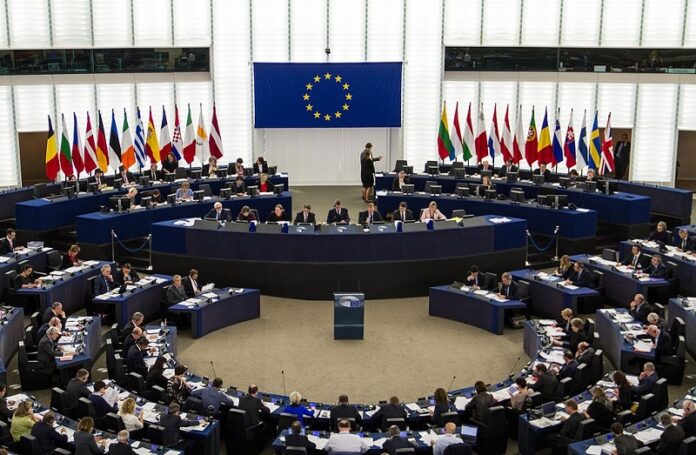
The Hemicycle of the European Parliament seen here in 2015 in Strasbourg, France.
Like it or not, the European Union has decided to resume full relations with Juntaland, three and a half years after cutting them off.
Officially, factors such as the roadmap to restoring democracy, a new junta-sponsored constitution and the end of trying future civilian cases in military courts have been cited to support the political detente. Unofficially, over the past two weeks, I’ve heard two, more detailed versions of the reasoning from senior diplomats with three EU member states in off-the-record conversations.
1: Trying a New Strategy
An ambassador of a key EU member state told me his country has pushed hard for the shift in EU’s stance towards Thailand’s military government. This is because over the past three years, any pressure applied against the junta has been mostly ineffective, so a new strategy was needed.
The ambassador assured me that from now on, every high-level contact with Thai counterparts would come with a reminder about human rights, democracy and the promised roadmap to returning power to the people. Junta leader Gen. Prayuth Chan-ocha, after all, has already made public that elections will take place in November.
From another main EU member state embassy, an army attache recently said he doesn’t like the word “re-engagement.” He said it’s more like lifting automatically downgrading relations. The army attache added that he has been telling his Thai military peers of the need to respect human rights and the roadmap and will continue to do so. He hopes the message will filter up to junta leadership, in one form or another.
2: Time for Defend Business Interests
A deputy head of the mission at a medium-sized EU member state told me European businesses have been pushing Brussels hard, asking how relations can be normal with more repressive countries such as Vietnam but not Thailand.
He added that China, and more recently the US, have been making economic inroads at the expense of the EU economic interests.
I get it: Vietnam is a one-party state and the press is basically all state-owned. I checked the latest report by the New York-based Committee to Protect Journalists, and Vietnam is currently detaining 10 reporters, making it the fifth worst jailer of journalists in the world, after Turkey (73), China (41), Egypt (20) and Eritrea (15).
On a personal note, even if I end up in prison due to sedition and computer crimes charges, I would still need to convince a few more journalists, and perhaps a political cartoonist or two to join me in behind bars to convince the world the situation is worse than Vietnam.
After listening to diplomat, a well-known English expat scholar who was part of the conversation expressed disappointment. I told the European diplomat that it’s regrettable for the union to follow its rapprochement. What’s more, I added, if the rest of the world becomes authoritarian, it would be hard to conceive how the EU remains democratic. No state – or group of nations – is an island, I reminded the thin senior diplomat who politely listened to me before we parted in search of more canape.
Thinking about it, I believe Thais must be primarily held responsible for its sorry state of affairs – not Europeans, the EU, or the United States.
I am hugely more disappointed by Thais who, while not junta supporters, live through one coup after another without taking any risks and doing little more than lamenting in private or anonymously on social media.
These people have unwittingly enabled the military regime to claim that they are accepted, that the country is normal and “peaceful” and handed the junta a veneer of legitimacy.
There are a number of diplomats, senior and junior, at embassies here in Bangkok that are EU members who are genuinely concerned about the continued repression here. Every time I meet them to discuss the state of Juntaland, I implore them to consider the long-term goodwill that could be accrued under these trying times if they are not too short-sighted and concerned about maximizing immediate economic and political gains.
Whatever they may think as an individual, they will have to follow the instructions of the day given by their respective governments, however.
Three and a half years ago, head of the EU mission Jesus Miguel Sanz told me at a lunch after I was released from the first military detention without charge, aka “attitude adjustment”, that there’s only so much the EU can do if Thais are passive.
Ambassador Sanz made it clear even back then that despite the coup, European businessmen want to do business as usual. He added that there’s only so much the EU can do if Thais themselves don’t take the major share of the burden in defending their own rights and democracy.
Sanz was right, many Thais have simply abandoned their basic civic duties to defend their own freedom and democracy and recent anti-junta protests could muster no more than 100 in defiance of the junta’s ban on political gatherings of more than five people.
Election Commission staff demonstrate casting ballots for the August 2016 referendum at a school in Ubon Ratchathani province.
BANGKOK — Junta chief Gen. Prayuth Chan-ocha exercised his absolute power Friday to enable the formation of new political parties and allow them to get to work without engaging in political activities.
The order issued under Article 44 of the constitution – which grants Prayuth sweeping legislative power – was published Friday night in the Royal Gazette. Politicians and members will be allowed to meet, register members, pay fees and register the party starting April 1.
The order also allows the formation of political parties beginning March 1, although these will first require approval from the junta, known formally as the National Council for Peace and Order, or NCPO.
The conditions drew negative responses from politicos and rights activists.
“Why must the foundation of a new political party be approved by the NCPO case by case? Isn’t that the job of the election commission? I don’t get it. Why are they poking their noses into it?” said anti-junta activist Sombat Boonngamanong in a Friday night Facebook post.
“The NCPO has established itself as the father of new political parties,” wrote Sunai Phasuk, a senior Thai researcher for Human Rights Watch.
The order also stated that parties will have to collect membership fees for 2018 from a minimum of 500 qualified members within 180 days, starting April 1. To be legal, parties will be required to establish four regional offices with a leader in each.
The order said meetings to choose party leaders and party executives will need a minimum of 250 participating members.
The ban on political gatherings of more than four people will continue until laws are written on MPs. Government spokesperson Lt. Gen. Sansern Kaewkamnerd said Tuesday that this is expected to be ready by June 2018.
Elections are slated for just five months later in November.
A spokesman for the Democrat Party said Wednesday that maintaining the ban on existing parties would disadvantage them and favor new ones – such as any established to support the military.
“The government must be careful not to favor newly established parties,” Ramet Rattanachaweng said. “A democracy must come with equality … I think this is not equal.”
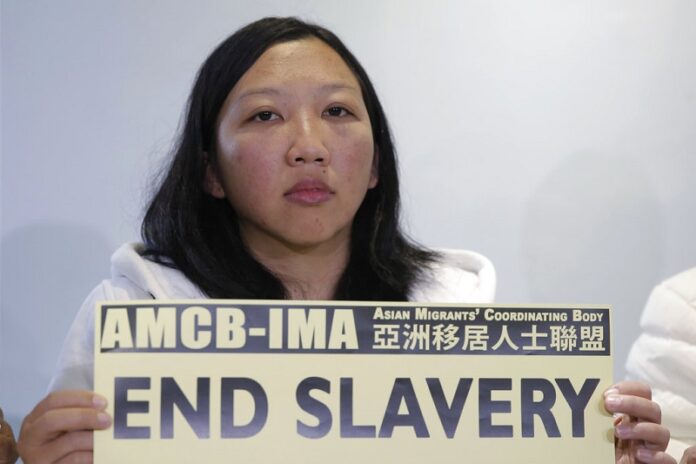
Former Indonesian maid Erwiana Sulistyaningsih holds a placard at a news conference Friday in Hong Kong. Photo: Kin Cheung / Associated Press
HONG KONG — An Indonesian maid who won a civil case this week against her former Hong Kong employer for shocking physical abuse said Friday she’s happy with the result but urged the city to do more to help foreign maids.
Erwiana Sulistyaningsih said authorities aren’t doing enough to protect the southern Chinese financial center’s army of foreign domestic workers, most of whom are women from either Indonesia or the Philippines.
A Hong Kong court ordered Sulistyaningsih’s former employer to pay her nearly 810,000 Hong Kong dollars (USD $103,500) in damages for the abuse, which occurred over eight months starting in 2013.
The employer, mother of two Law Wan-tung, was earlier convicted on assault and other charges, fined and given a six-year prison term.
The case came to light when graphic pictures of Sulistyaningsih’s injuries started circulating among Hong Kong’s Indonesian community showing her face, hands and legs covered with scabs and lacerations and blackened, peeling skin around her feet.
Sulistyaningsih said that since her case she had met with many other foreign maids who were mistreated by the families they work for.
“Still the employers give long working hours,” she said at a news conference. “Other victim also tell me their stories. Like they weren’t given enough food, they didn’t have holiday.”
She urged the Hong Kong authorities to review current policies and practices, saying not enough is being done to protect workers.
Since her case came to light, she said, “I think nothing changed.”
Dhammajayo speaks to his followers in a June 2, 2014 video. Image: DMC Channel / YouTube
BANGKOK — A nighttime raid on the Wat Dhammakaya complex hoping to nab the order’s former abbot came up empty-handed, the official in charge of the operation said Friday.
Dhammajayo, 73, was not found in his quarters despite intelligence reports claiming he was present, said Department of Special Investigation Deputy Director Suriya Singhakamol. The monk is on the run from more than 300 charges, including a multi-billion count of money laundering, which his supporters deny.
“We did our duty. Since we don’t have the suspect yet, we must search any potential target,” police Maj. Suriya said. “There were intelligence reports about his whereabouts.”
The raid took place Wednesday night, he said. Officers searched several buildings inside the sprawling temple grounds, including the bedroom that belonged to Dhammajayo before he disappeared.
“There was no trace of him,” Suriya said.
The charismatic monk is accused of accepting large donations of laundered money in 2016 and refusing summons to appear. He cited health issues at the time. His supporters also maintain Dhammajayo was unaware the donations were tainted and say the charges are politically motivated.
After months of inaction, the junta in February ordered security forces to surround and search the temple’s headquarters in northern metro Bangkok. The elusive monk was not found and the operation was called off after three weeks of confrontation, during which two people died.
In August, officials said Dhammajayo had likely fled the country. Suriya said his agency would continue to look for the fugitive monk.
“Domestically, we still listen to intel reports. Internationally, we have coordinated with Interpol,” Suriya said. “Our mission is not over yet. We have been working on it this whole time, but they aren’t newsworthy things.”
BANGKOK — The daily drip-drop, tick-tock revelations about a top junta official’s collection of spendy watches continues with a sixth and seventh timepiece spotted.
By Friday, amateur sleuths had discovered two more luxury watches worn in past photos by Gen. Prawit Wongsuwan, the junta’s second-in-command who also serves as defense minister and deputy prime minister. In the three weeks since the first multi-million baht watch was spotted earlier this month, the general has refused to answer questions about the bling timepieces, none of which were listed in his mandatory asset disclosure filed upon taking office.
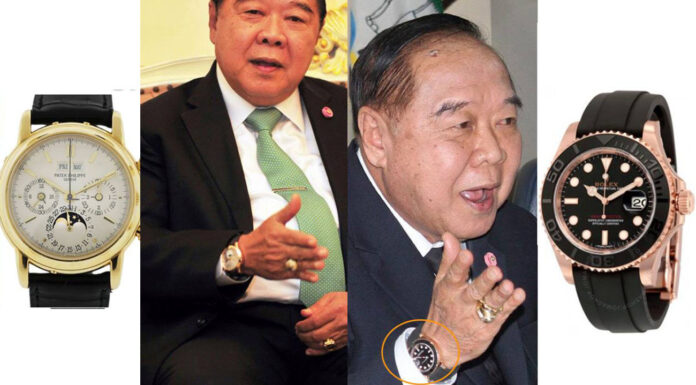
Today the crowd-sourced CSI LA page identified a seventh watch as a Patek Philippe Grand Complications, model 5140J-001 in yellow gold. It starts at retail for 2.9 million baht. Patek Philippe says the Yellow Gold variety was a limited edition no longer in production. Some disputed the claim, saying it was in fact a Patek Philippe Gold Perpetual Calendar 3970, which retails for 3.6 million baht.
Prawit was seen wearing what appears to be the watch in a file newspaper file photo this past April.
That discovery came a day after a sixth fancy watch was identified by the page as a Rolex Yacht-Master with automatic black dial and an 18 karat Everose gold black rubber strap. The model retails for a relatively modest 887,700 baht at Central Chidlom. The Rolex was seen another April story announcing the general’s appointment to the presidency of the National Olympic Committee of Thailand.
Despite 72-year-old Prawit’s possession of what seems to be closing on at least 15 million baht’s worth of high-end wrist accessories, there was skepticism that potential wrongdoing would be properly investigated and punished if found.
“We can’t touch him,” Facebook user Akkarapol Prabpech commented one of the the CSI LA posts. “We just have to wait for his blood vessels to clog up his arteries and diabetes to eat him up.”
Prawit, a career military man, was given until Jan. 8 by the National Anti-Corruption Commission to explain how he came into possession of the expensive items.
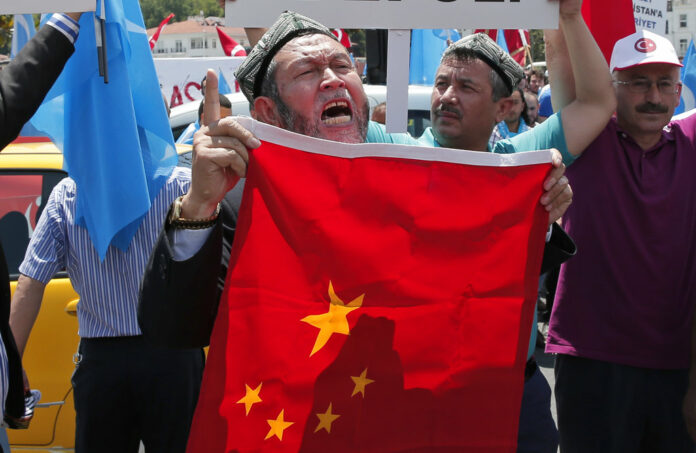
Uighurs living in Turkey and Turkish supporters chant slogans on July 5, 2015, as they hold a Chinese flag before burning it during a protest near China's consulate in Istanbul. Photo: Lefteris Pitarakis / Associated Press
ISTANBUL — It was mid-afternoon when the Chinese police officers barged into Ali’s house set against cotton fields outside the ancient Silk Road trading post of Kashgar. The Uighur farmer and his cowering parents watched them rummage through the house until they found two books in his bedroom – a Quran and a handbook on dealing with interrogations.
Ali knew he was in trouble.
By nightfall the next day, Ali had been tied against a tree and beaten by interrogators trying to force him to say he took part in an ethnic riot that killed dozens in western China. They held burning cigarette tips to Ali’s face, deprived him of sleep and offered him only salt water. When he asked for fresh water, they gave it to him – in buckets poured over his head.
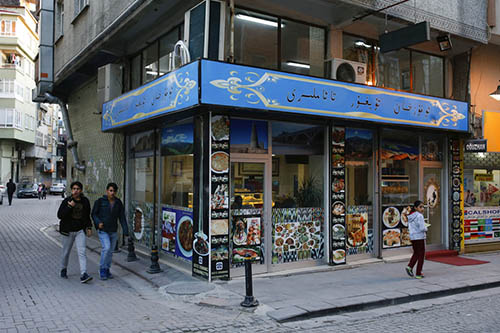
Residents stroll by shops in the immigrant neighborhood of Zeytinburnu. Since 2013, thousands of Uighurs, a Turkic-speaking Muslim minority from western China, have traveled to Syria to train and fight alongside al-Qaida, playing key roles in several battles. Photo: Emrah Gurel / Associated Press
That winter night in 2009, Ali recalled years later, would set him on a path that ended on northern Syria’s smoldering plains, where he picked up a Kalashnikov rifle under the black flag of jihad and dreamed of launching attacks against the Chinese rulers of his homeland.
Since 2013, thousands of Uighurs, a Turkic-speaking Muslim minority from western China, have traveled to Syria to train with the Uighur militant group Turkistan Islamic Party and fight alongside al-Qaida, playing key roles in several battles. Syrian President Bashar Assad’s troops are now clashing with Uighur fighters as the six-year conflict nears its endgame.
But the end of Syria’s war may be the beginning of China’s worst fears.
“We didn’t care how the fighting went or who Assad was,” said Ali, who would only give his first name out of a fear of reprisals against his family back home. “We just wanted to learn how to use the weapons and then go back to China.”
Uighur militants have killed hundreds, if not thousands, in attacks inside China in a decades-long insurgency that initially targeted police and other symbols of Chinese authority but in recent years also included civilians. Extremists with knives killed 33 people at a train station in 2014. Abroad, they bombed the Chinese embassy in Kyrgyzstan in September last year; in 2014, they killed 25 people in an attack on a Bangkok shrine popular with Chinese tourists.
China is just like the West, its officials say: the country is a victim of terror, and Uighur men are pulled by global jihadi ideology rather than driven by grievances at home. Muslims in the Uighur homeland of Xinjiang, as one Chinese official declared in August, “are the happiest in the world.”
But rare and extensive Associated Press interviews with nine Uighurs who had left China to train and fight in Syria showed that Uighurs don’t neatly fit the profile of foreign fighters answering the call of jihad.
There was a police trainer who journeyed thousands of miles with his wife and children to Syria, a war zone. A farmer who balked at fundamentalist Islam even though he charged into battle alongside al-Qaida. A shopkeeper who prayed five times a day and then at night huddled with others in a ruined Syrian neighborhood to study Zionist history.
And there was Ali, a short, soft-spoken 30-year-old with a primary school education who knew little of the world beyond his 35-acre farm when he left China, a home that had become unlivable.
Sitting cross-legged one recent evening in an empty apartment overlooking a kickboxing gym in Istanbul, he recalled the vow he made the night Chinese police beat him for participating in a riot he never joined.
“I’ll get revenge,” he said.
Self-Fulfilling Prophecy
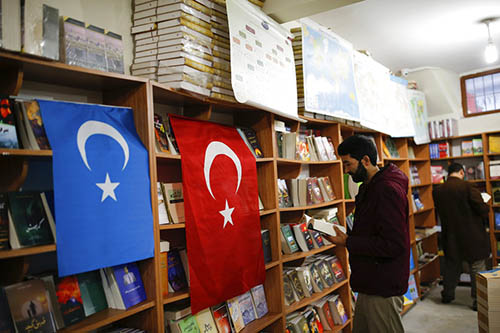
A man reads a book on Dec. 14 in a bookstore where flags which represents Turkey and ‘East Turkistan,’ the name Uighurs who oppose Chinese rule call their homeland, are hung in Istanbul’s Zeytinburnu neighborhood. Photo: Emrah Gurel / Associated Press
Ali’s parents eventually got him out of detention – but it cost them CNY10,000 (50,000 baht) in bribes to local officials, no small amount for the family of farmers.
Despite his release, Ali was not free.
It was late 2009, and Xinjiang was in lockdown. Four months earlier, hundreds of Uighurs had rioted in Urumqi, the capital of Xinjiang, and attacked the Han, China’s dominant ethnic group. An estimated 200 people died in the unrest that night, the bloodiest ethnic violence the country had seen in decades and an event that would change Ali’s life and that of 10 million Uighurs in Xinjiang.
The government, caught off-guard by the unrest, rolled out an expansive security crackdown and surveillance programs in the region that have accelerated in the last year. Thousands of Uighurs, including moderate Uighur intellectuals, are believed to have been arrested or detained, some of them without trial.
Ali was constantly stopped and questioned wherever he went. He couldn’t check into a hotel, buy a train ticket or get a passport.
“I had nowhere to go,” he said. “Except out.”
As the repression mounted, what began as a trickle of Uighurs fleeing China grew into a mass exodus. In 2013, more than 10,000 left across southern China’s porous borders, according to Uighur exiles. Nearly all the Uighurs who spoke to the AP after returning to Turkey from Syria recounted being persecuted by Chinese authorities as a motive for taking up arms.
“The Chinese government had been accusing Uighurs of militancy for a long time when there hasn’t been much of a threat,” said Sean R. Roberts, an expert on Uighur issues at George Washington University. “That changed after the 2009 crackdown. It’s become a self-fulfilling prophecy.”
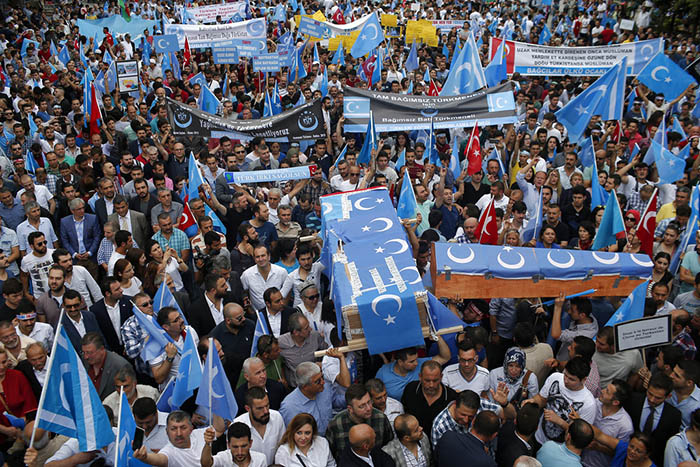
Uighurs living in Turkey and their supporters, some carrying coffins representing Uighurs who died in China’s far-western Xinjiang region, chant slogans July 4, 2015, at a protest in Istanbul against what they call China’s oppression of Muslim Uighurs. Photo: Emrah Gurel / Associated Press
Escape and Road to Syria
Desperate to leave China, Ali paid more than 100,000 yuan ($15,000) to human smugglers and made his way overland through Laos, Cambodia, Thailand and Malaysia, where he received a Turkish travel document.
In Turkey, Ali drifted in Istanbul, working construction and electrical jobs for $300 a month. Within two months, his brother said he had met people who could take them to Syria, where they could learn weapons training and return to China to “liberate” their friends and family.
“We’ll avenge our relatives being tortured in Chinese jail,” he said.
Ali agreed, thinking they would go for a few weeks. They ended up spending two-and-a-half years in Syria.
The story of how Ali ended up in a distant war zone echoed the experiences of other Uighurs the AP spoke to in Turkey, who said they joined religious militant groups at first because of grievances against Beijing or support for the idea of a Uighur nation. Most knew little about political Islam that fueled jihadis in other countries, and none said they met with recruiters inside China.
But that changed as soon as they left China’s borders. As Uighur refugees traveled along an underground railroad in Southeast Asia, they said, they were greeted by a network of Uighur militants who offered food and shelter – and their extremist ideology. And when the refugees touched down in Turkey, they were again wooed by recruiters who openly roamed the streets of Istanbul in gritty immigrant neighborhoods like Zeytinburnu and Sefakoy, looking for fresh fighters to shuttle to Syria.
Uighur activists and Syrian and Chinese officials estimate that at least 5,000 Uighurs have gone to Syria to fight – though many have since left. Among those, several hundred have joined the Islamic State, according to former fighters and Syrian officials.
As Uighurs streamed out of China, militant leaders have seized upon China’s treatment of Muslims as a recruiting tactic. The Islamic State, for instance, regularly publishes Uighur-language editions of its radio bulletins and magazines, while the Turkistan Islamic Party has been releasing videos on a near-weekly basis, said Rita Katz, director of the SITE Intelligence monitoring group.
“How can those who are imprisoned due to their faith be freed? How can they be saved from this humiliation?” a masked Uighur fighter says in a Turkestan Islamic Party video released last year. “Words from our mouths won’t help, but jihad for Allah will.”
A Faraway War
From Istanbul, several of the former fighters described taking buses or being driven to the border region of Hatay, where they would cross on foot at night through lightly guarded hills. After a three-hour hike into Syria, cars waited in a forest clearing to whisk them to separate camps dotting the country’s north. One fighter said he simply drove in, unobstructed, on the highway from the Turkish city of Gaziantep.
When the Uighurs arrived in Jisr al-Shughour, a strategic town on the edge of Assad’s stronghold of Latakia region, men with families, like Ali, moved into a ruined neighborhood of single-story brick homes where 150 families stayed. Single men lived together in larger apartment buildings.
The men undertook three-month training sessions in the use of Soviet AKM rifles, shoulder-mounted rocket-propelled grenade launchers, physical conditioning and mapping.
At the beginning of the course, the trainers showed off their prized cache of captured American M-16s and German G3 rifles, but each fighter received a battered AKM and cheap Chinese ammunition. Boys as young as 12 and 13 – mostly orphans – were taken to a separate camp for religious classes and physical training.
Two fighters said they received boxes of food from IHH, a Turkish Islamic charity group, that included rice, flour, meat and even fish imported from Thailand. One of the fighters said the food supplies were labeled with the foreign fighting group they were being shipped to – for example, “Turkistanis (Uighurs) or Uzbeks.”
IHH spokesman Mustafa Ozbek said the group distributes aid in refugee camps near the Syrian border to civilians, but not armed groups.
“All of our aid is conducted officially, documented and reported,” Ozbek said.
The Uighurs in Syria have a reputation for administering their territory with a light touch, said Aymenn Jawad al-Tamimi, a British researcher at the Middle East Forum who has extensively interviewed jihadis in Syria, including Uighur fighters. They don’t enforce an Islamic court system or replace local councils – unlike their close allies, the al-Qaida-linked Hay’at Tahrir al-Sham, Arabic for Levant Liberation Committee.
Instead, an older Uighur would convene young fighters in the evenings to discuss history and politics. They looked to an improbable model for building an independent homeland: Israel and the Zionist movement.
“We studied how the Jews built their country,” Ali said. “Some of them fought, some of them provided money. We don’t have a strong background of that.”
Few Uighurs spoke Arabic and most didn’t mingle with locals, but at one point some residents joked that Uighurs should rename the city Shughuristan, a play on “East Turkistan,” the Uighur exiles’ preferred name for their homeland. The Uighurs were unconvinced.
“This is not our homeland,” Ali and his comrades told the Arabs. “We want our homeland, we don’t need yours.”
Fearless ‘Pawns’
Like Ali, Rozi Mehmet wanted to do something to help his people fight Chinese oppression. His grandfather, a wealthy Uighur farmer, had been executed in the tumult of China’s Cultural Revolution in the 1960s.
Three years ago, Mehmet left the ancient oasis town of Hotan and hiked into Syria to join a class of 52 Turkistan Islamic Party trainees.
Within six months, he would be on the front lines with a rocket-propelled grenade launcher strapped to his skinny back, sprinting toward government positions near Jisr al-Shughour.
Jihadi clerics have exhorted Uighurs to take up holy war and reap the rewards of martyrdom. But if he would take a bullet, Mehmet thought as he rushed into battle, he wasn’t dying for Islam – or the virgins that the preachers promised. His homeland was the only thing on his mind.
“I didn’t feel fear,” he told the AP. “If I felt fear, how could I be able to build my country?”
As fighting escalated in 2015 and 2016, hundreds of Uighurs died in its campaigns alongside al-Qaida’s Nusra Front, according to two former fighters who fought in northern Syria.
Radical groups have aggressively recruited Uighurs. Al-Qaida’s leader promised in a video that Islamic militants would repay the Uighurs by striking at “atheist Chinese occupiers” after the Syrian war. The Islamic State has echoed similar pledges and the group in March released a Uighur-language propaganda video vowing to one day shed Chinese blood if Uighurs would join the Syrian struggle.
As the chaotic opposition splintered and reorganized, groups vied for the Uighurs’ support and lauded them for their suicide attacks that often kept the Syrian army off-balance, Mehmet boasted.
An older fighter, also from Hotan, chided the young man, saying he was more cynical about why the Arab jihadis lavished them with praise.
“They praise us, which means they want us to follow them and fight for them,” said Rozi Tohti, 40, who fought near the city of Idlib. They “are trying to lure us to become their pawns.”
Dissent in Syria; Threat to China
But several Uighur fighters insisted that, in their minds, there was a distinct line between themselves and the Islamic militants they fought beside. Some Uighurs complained about being stuck in Syria instead of attacking China, as they had been promised.
“We fight for them and help them control the country, and then Uighurs are left with nothing,” Mehmet said.
After joining the TIP in mid-2015, Uighur fighter Abdulrehim visited a graveyard for fallen militants and wondered why there were no Uighur national banners. At one point, he openly challenged a TIP senior leader, Ibrahim Mansour, about what they were doing in Syria, he recalled.
“We haven’t fired a bullet against our enemy, China,” he told a group of gathered Uighur fighters. “We always fight alongside international terrorists. What’s going on here?”
Many Uighur militants have grown tired of the war and are looking to leave particularly as Assad’s forces gain the upper hand, says Seyit Tumturk, a Uighur activist in Turkey who often speaks to fighters in Syria.
He said it was impossible for Uighurs militants to liberate Xinjiang, currently blanketed with paramilitary forces and riot police. But he said Chinese President Xi Jinping’s ambitious project to develop railway lines, ports, and other infrastructure linking various regions to China makes Beijing vulnerable to militant attacks abroad.
The Islamic State took credit in June for kidnapping and killing two Chinese teachers in Pakistan’s Baluchistan province, which is a cornerstone of Beijing’s so-called Belt and Road infrastructure project. In Kyrgyzstan, state security say a suicide bombing of the Chinese embassy in Bishkek was ordered by Uighur terrorist groups active in Syria and financed by al-Qaida’s Nusra Front.
Chinese officials and Western analysts alike say that the Uighurs’ experience in the Syrian jihadi melting pot will likely exacerbate violence against “soft” targets outside China. China’s foreign ministry called the Turkistan Islamic Party a security threat for the Middle East.
“We hope our brothers, including Syria and Turkey, will work with us, strengthen cooperation and cut off the terrorists’ cross-border movements and safeguard regional stability,” the ministry said in a faxed statement in response to questions from the AP.
The ministry did not address questions about the causes of radicalization but said that China’s government has invested heavily in Xinjiang’s economic development, protected its minorities’ rights and treated them just as every other ethnic group.
“Of course, when there are those who try to create tension in Xinjiang, the Chinese government’s commitment to striking against violent terror and ethnic splittism is unquestioned,” it said.
Return to Turkey and an Uncertain Future
By June of this year, Ali had tired of Syria and wanted to get out. For him, the war consisted of spending months at a time manning checkpoints and patrolling borders.
But like many other Uighurs who sought to return to Turkey, he struggled to find a way back. Ali walked for a week to get around a wall built by the Turkish government on the border. He’s now back in Istanbul and selling milk.
Although some of the Uighur returnees said they would attack China if the opportunity arose, others balked at the idea.
Uighur community workers are concerned that many of those cast back into Turkish society would struggle to integrate and be easily pulled back into radical groups. Many of the men make $200 to $300 a month, barely enough to cover rent in Istanbul, and spoke poor Turkish. Many faced daily discrimination.
Activists also worry about TIP recruitment continuing unchecked in Turkey, where it appears to have a degree of official support.
This year, Turkish authorities detained TIP members including a former top commander, ostensibly for his own safety, said a diplomat in Beijing and a Uighur activist who was allowed by Turkish officials to speak with him. But Turkey refused to allow Chinese intelligence to interrogate the former commander, deeply frustrating Beijing, the diplomat said.
Uighur leaders say Turkish police also have released several well-known Uighur jihadi recruiters even after the community offered tips that led to their arrest.
“There are suspicions that these recruiters have links with some individuals or agencies within the government,” said Omer Kanat, director of the Uyghur Human Rights Project in Washington. “They’re turning a blind eye.”
Rozi Tohti, the middle-aged fighter from Hotan, sat in a meadow facing the ruined walls of old Constantinople and ruminated on the choices facing his compatriots in Turkey: give their lives to a radical Islamic movement that they did not believe in or struggle to settle into a Turkish society where they did not fit in.
One thing was clear. Returning to their homeland was out of the question.
“Who wants to live in a war zone?” Tohti said. “We once had paradise in our country. But it was being erased by the Chinese, so instead we looked for paradise in Syria.”
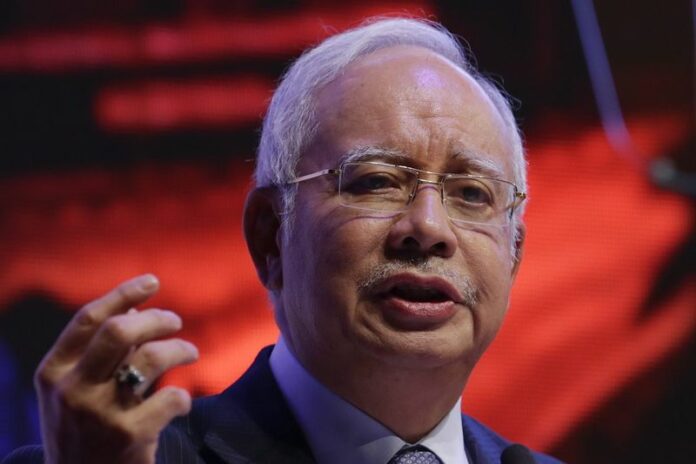
PUTRAJAYA, Malaysia — Malaysian Prime Minister Najib Razak led thousands of Muslims in a rally Friday to show solidarity with Palestinians, slamming the U.S. decision to recognize Jerusalem as Israel’s capital.
Najib told the crowd that Malaysia will do all it can to “save Jerusalem” and that he will not be cowed by the U.S. nor by his close ties with President Donald Trump. Najib in September met Trump at the White House, and last month, posted a photograph of himself with Trump on Twitter on the sidelines of a regional meeting in Manila.
Malaysia on Thursday joined more than 120 countries voting in favor of a U.N. General Assembly resolution calling for the United States to drop its recognition of Jerusalem as Israel’s capital, ignoring a threat by Trump to cut off financial aid to countries voting against his move.
“Yes, I have visited the White House and yes, Trump is a good acquaintance but I will not pawn the sanctity of Islam,” Najib said to loud cheers at the protest outside a mosque in the government capital of Putrajaya after Friday prayers.
“We are firm in our stand. We support the formation of a Palestine that is free and sovereign. We demand a Palestine with dignity and pride. We want East Jerusalem as the capital of Palestine,” he said.
Earlier this month, Trump reversed decades of U.S. policy by announcing the United States recognized Jerusalem – home to major Muslim, Jewish and Christian holy sites – as the capital of Israel and would move its embassy there.
Najib vowed to hold weekly protests in support of Palestinians. Deputy Prime Minister Ahmad Zahid Hamidi told local media that the Cabinet would next month discuss a proposal by Najib for Malaysia to follow Turkey in opening an embassy in east Jerusalem to recognize the city as the Palestinian capital.
BANGKOK — Princess Ubolratana wished people a Merry Christmas this week in a series of widely hailed, viral videos one must see to believe.
Princess Ubolratana, the eldest child of Queen Sirikit and the late King Bhumibol, went all out in costume and setting to sing “We Wish You a Merry Christmas” and “Santa Claus is Coming to Town” in a pair of festive Instagram videos posted this week.
“Today I’m an elf, Santa Claus’ helper, not Santa himself,” she wrote in the caption to one video posted to her private @Nichax account. In the video, she dances next to a gaily appointed Christmas tree.
In the second video, posted Thursday, she sings “Santa Claus is Coming to Town” while dressed in Santa garb. The caption notes, “Six days until Christmas 🎅❤️🎄🎅.”
The videos were met with praise from netizens, with many complementing the 66-year-old princess’ figure.
“I really like her. She’s like, I can’t put my finger on it – down to earth,” wrote Facebooker Claudio D’dorf T’land. “She’s optimistic and modern. Long live the princess!”
Princess Ubolratana is an active social media user. In case you’ve somehow missed her Instagram feed, she was also responsible for a January video in which she performed body percussion on herself to one of her father’s compositions. She also founded the To Be Number One anti-drugs foundation.
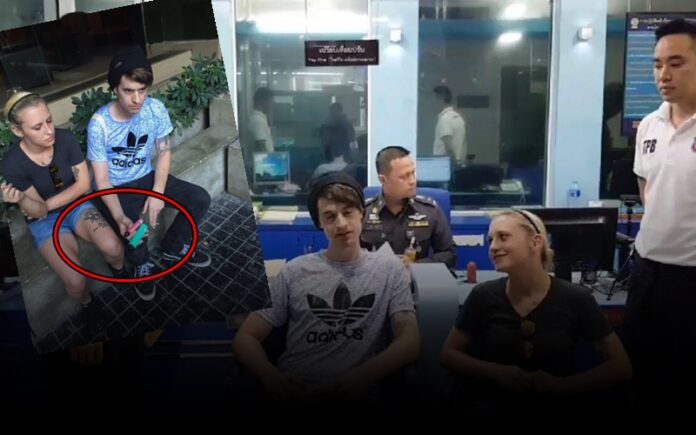
Jessie Christie Jones and Zachary Bruce Beiser with Tourist Police and Thung Maha Mek Police Thursday. Photo: Matichon
BANGKOK — Two Americans who were caught tagging signposts, phone booths and other property on Silom Road were caught in the act and fined for vandalism, police said Friday.
Americans Zachary Bruce Beiser, 29, and Jessie Christine Jones, 22, were arrested Thursday afternoon for leaving tags in mint green and pink paint after a video of them scribbling on poles and electrical boxes went viral a day earlier.
“After some good citizens sent us the video, we went down to that area to look for them,” police Col. Netiwit Thanasitnikitul said. “It didn’t take very long. We found them with the markers in their hands.”
Netiwit said the farangs apologized for the vandalism, which they were fined 3,500 baht apiece at Thung Maha Mek Police Station late Thursday. “Maybe in their home country they’re not so strict about it,” he said. “They got carried away on their vacation.”
The pair were arrested Thursday afternoon according to tourist police.
On Wednesday, Facebook user Vorathep Charoenpornpanich posted a videowhere Beiser and Jones along Silom Road as they scrawled random letters using Montana Colors brand Street Dabber paint.
The incident comes less than a month after the fining of another American duo, two Californian men for posting photos with their pants down at Wat Arun for their “Traveling Butts” Instagram account.
A Facebook account appearing to belong to Beiser lists him as being from Atlanta, Georgia. In 2016, A newspaper just outside Atlanta reported in 2016 that a Zachary Bruce Beiser was arrested on suspicion of driving under the influence for driving erratically because of something he said he heard on the radio.
Footage of Jessie Christie Jones and Zachary Bruce Beiser vandalizing on Silom Road. Image: Vorathep Charoenpornpanich / Facebook


































 Prawit was seen wearing what appears to be the watch in a file newspaper file photo this past April.