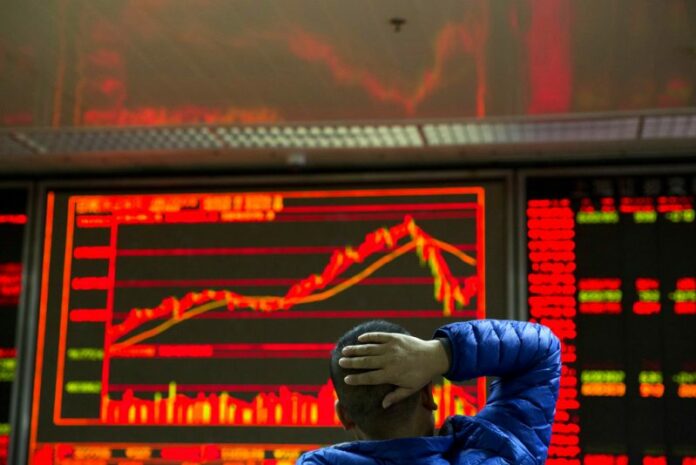
An investor looks at the Chinese market index in 2017 at a brokerage in Beijing, China. Photo: Ng Han Guan / Associated Press
BEIJING — Asian stocks were mixed Wednesday following overnight gains on Wall Street as investors looked ahead to a likely U.S. interest rate hike.
KEEPING SCORE: The Shanghai Composite Index was unchanged at 3,279.43 while Tokyo’s Nikkei 225 lost 0.3 percent to 22,805.80. Hong Kong’s Hang Seng gained 0.5 percent to 28,925.73 and Seoul’s Kospi advanced 0.4 percent to 2,471.74. Sydney’s S&P-ASX 200 was unchanged at 6,015.00. Benchmarks in New Zealand and Singapore declined while Taiwan and other Southeast Asian bourses were higher.
WALL STREET: Big-name companies gained, delivering records for two of the major stock indexes. Banks and other financial stocks led the gainers as the Fed met to discuss interest rates. Technology stocks declined the most. Energy stocks also fell as crude oil prices closed lower. Bitcoin futures fell on their second day of trading. The Standard & Poor’s 500 index rose 0.2 percent to 2,664.11. The Dow Jones industrial average gained 0.5 percent to 24,504.80. The Nasdaq composite lost 0.2 percent to 6,862.32.
FED WATCH: The U.S. central bank is expected to raise rates Wednesday for the third time this year, which allows banks to charge more to lend money. Even though inflation has remained low, the Fed has seen a path to gradually raise rates as the economy and labor market have strengthened. An increase of 0.25 percent in short-term interest rates “is as good as a done deal” based on options markets pricing, Mizuho Bank said in a report. Investors will be listening for any hints the Fed could pick up its pace on rate hikes next year.
ANALYST’S TAKE: “The Fed looks set to hike the Fed funds rate, so it is really down to how quickly we can react to any changes in the ‘dots plot,’ as well as to the general tone of the statement,” said Chris Weston of IG in a report. He noted outgoing Fed chair Janet Yellen will be holding her final press conference. “One questions how much the market will react to her views, although she does speak on behalf of the collective,” said Weston. “Either way, it promises to be a big night for markets even if implied volatility is still quite subdued and options markets are not pricing in fireworks.”
EUROPE: The European Central Bank and the Bank of England will have policy announcements on Thursday. Neither is expected to change rates, leaving the focus on their economic forecasts.
CURRENCY: The dollar declined to 113.45 yen from Tuesday’s 113.54 yen. The euro strengthened to $1.1749 from $1.1739.
ENERGY: Benchmark U.S. crude rose 41 cents to $57.55 per barrel in electronic trading on the New York Mercantile Exchange. The contract fell 85 cents on Tuesday to $57.14. Brent crude, used to price international oils, advanced 61 cents to $63.95 in London. It plunged $1.35 the previous session.
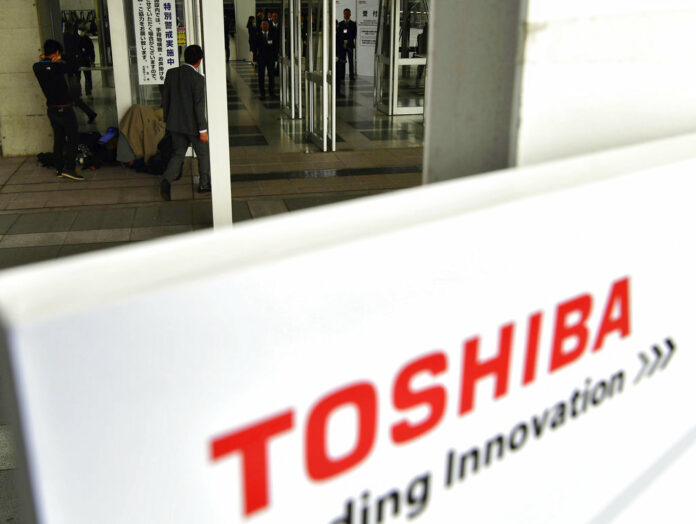
Toshiba's logo is seen at the venue for the company's October stockholders' meeting in Chiba near Tokyo. Photo: Ren Onuma / Kyodo News
TOKYO — Toshiba Corp. and its joint venture partner Western Digital have made peace over the embattled Japanese electronics giant’s plan to sell its flash memory unit to raise cash to stay afloat.
The agreement allows Western Digital to participate in future investments in their joint venture, clearing the way for a consortium led by Bain Capital to buy Toshiba Memory Corp., the companies said Wednesday.
The deal also addresses concerns over protection of valuable patents and other intellectual property in the highly competitive field of flash memory products used in many high-tech products.
The two companies said it settles all disputes in litigation and arbitration over Western Digital’s objections to the planned sale of the companies’ NAND flash-memory SanDisk joint venture.
“The settlement represents the best possible outcome for all parties, clearing the way for the Bain Capital-led consortium to complete its acquisition of TMC as planned,” Yuji Sugimoto, managing director in Japan of Bain Capital, said in a statement.
The two companies said they will jointly invest in a new computer chip fabrication unit at their joint venture in central Japan and in another facility in northeastern Japan’s Iwate prefecture.
The plan calls for Toshiba Memory Corp. to eventually sell shares through an initial public offering.
“With the concerns about litigation and arbitration removed, we look forward to renewing our collaboration with Western Digital, and accelerating TMC’s growth to meet growing global demand for flash memory,” said Yasuo Naruke, a Toshiba senior executive vice president and president and CEO of Toshiba Memory.
He said the plan will ensure Toshiba Memory has the resources it needs to compete in the flash memory market, which is growing quickly with advances in artificial intelligence and networks for products that have internet connections, known broadly as the “internet of things.”
Western Digital’s CEO Steve Milligan said the arrangement with Toshiba adequately protects its own interests.
Toshiba has said it hopes the sale, estimated at 2 trillion yen ($18 billion), will close by the end of March. It may have to clear further hurdles, such as possible anti-trust concerns.
Toshiba is inundated with losses related to its U.S. nuclear operations at Westinghouse Electric Co., which filed for bankruptcy earlier this year. Its decline, worsened earlier scandals over bookkeeping and corporate governance, is one of the most dramatic downfalls of a modern Japanese company. But the company has said it expects to return to the black by the end of this fiscal year, in March.
In the meantime, it has struggled to avoid being delisted. Last week it raised 600 billion yen ($5.3 billion) by issuing new shares with 60 overseas investment funds.
Bain Capital Private Equity, based in Boston, is one of the world’s leading investment firms. The consortium it is leading includes the government-backed Development Bank of Japan and the Innovation Network Corp. of Japan, which is made up of 26 big-name Japanese corporate investors, including Sony Corp., Canon Inc., Toyota Motor Corp. and Sumitomo Mitsui Banking Corp. The consortium also includes South Korea’s SK Hynix.
BANGKOK — An army-run inquiry is set to absolve the armed forces of any wrongdoing in the death of a 19-year-old academy cadet, a source said Wednesday.
According to the source in the committee, the military will repeat its previous explanation that Pakapong Tanyakan died of “sudden heart failure” and declare he was not subject to any punishment or beating as suspected by his family, who pledged today to take legal action.
The final report will quote a number of fellow cadets, drill sergeants and medics as saying that Pakapong was in poor health, said the source, who claimed to have seen the papers and spoke anonymously because they are not allowed to talk to the media.
Military spokesman Nothapol Boonngam said the inquiry is not “100 percent” complete.
“It’s mostly finished now, but it’s not completed yet. It’s not 100 percent yet,” Lt. Gen. Nothapol said, adding that he does not know when the results would be announced to the public.
Nothapol declined to confirm whether the report would exonerate the military or rule out foul play.
“Please wait for the news conference by the armed forces,” he said.
Deputy Chief of Staff Chawarat Marungruang also told reporters Wednesday the results are not yet public.
Pakapong’s family, which initially was vocal in its criticism of the military’s handling before going quiet in late November, signaled it was unlikely to accept such results.
Supicha Tanyakan, said she had no comment on the possibility the army will blame her brother’s death on a heart condition.
“If they want to rule that way, that’s up to them,” Supicha said. “Each person is entitled to the right to defend themselves and prove their innocence.”
She continued, “Everyone who reads the news can think for themselves about what it means … I still have my right to seek the truth.”
The military investigation will not stop her from seeking legal remedy against the armed forces, she said. The law requires that police investigate “unnatural deaths,” and Pakapong is no different, Supicha said.
“If they say the investigation is done, I’ll wait for them to send me the results. They can’t keep them. I need it for the [legal] procedure,” Supicha said. “I have been discussing this with the police.”
Pakapong died in October from what the military described as “sudden heart failure” one day after returning to the Armed Forces Preparatory School, an elite military academy, from a break.
Suspicions about his death became public in late November after the family took his body away in secret from a cremation ceremony to a private hospital where they discovered some of his internal organs went missing.
Following a public outcry, the military returned the organs to Pakapong’s parents and said they had been kept for medical examination.
With all the organs returned, Pakapong’s body was cremated on Sunday. Unlike the cremation ceremony held in November, when his classmates performed drills in front of an audience of high-ranking officers, there was no military honor for the dead cadet on Sunday.
BANGKOK — This American alt-rock icon always finds their way back to Bangkok.
For their fourth time, Incubus will be rocking their hits “Drive,” “Wish You Were Here,” “Dig” and “Pardon Me” in Bangkok, , local promoter Miracle Management announced Tuesday.
The concert will be held Feb. 15 at BCC Hall Central Plaza Ladprao. Tickets are 1,500 baht and 2,200 baht and go on sale at ThaiTicketMajoron Dec. 19.
Formed since 1991, the rock band from Calabasas, California, performed in Thailand for the first time in 2004 at the original Suan Lum Night Bazaar on Rama IV Road. They returned in 2012 for the Silverlake Music Festival and 2015 for Incubus Live in Bangkok at the Thunder Dome, Muang Thong Thani.
This image released by Lucasfilm shows Gwendoline Christie as Capt. Phasma in "Star Wars: The Last Jedi." (Lucasfilm via AP)
A welcome disturbance in the Force, Rian Johnson’s “The Last Jedi” is, by wide measure, the trippiest, scrappiest and most rule-breaking “Star Wars” adventure yet.
Not the exercise in nostalgia that was J.J. Abrams’ “The Force Awakens,” Johnson’s Episode VIII takes George Lucas’ space opera in new, often thrilling, and sometimes erratic directions while finding the truest expression yet of the saga’s underlying ethos of camaraderie in resistance to oppression. Though there are countless familiar broad strokes — rebel escapes, Jedi soul-searching, daddy issues — “The Last Jedi” has discovered some new moves yet, in the galaxy far, far away.
As the second installment in this third “Star Wars” trilogy, “The Last Jedi” is like the inverted corollary of “The Empire Strike Back” (long the super fan’s favorite). While it is, like its part-two predecessor, often murky and weird, Johnson’s frequently comic film distinguishes itself by upending the traditional power dynamics of heroes and bit players in the Star Wars galaxy.
Here, the odds-defying daredevil flyboy (Oscar Isaac as Resistance pilot Poe Dameron) is an impetuous chauvinist, at odds with a female commander (a purple-haired Laura Dern). “Get your head out of your cockpit,” admonishes Leia (the late Carrie Fisher, to whom the film is dedicated). The master-apprentice relationship — previously Yoda instructing young Luke Skywalker (Mark Hamill) on a swampy remote planet — is now tilted more toward Rey, the young Jedi (Daisy Ridley), sent to stir a monkish Skywalker from a windswept, Porg-infested isle. And instead of a Tauntaun’s guts being spilled, there are even moments of animal rights reflections creeping into the galaxy. About to bite into his rotisserie dinner, Chewbacca, with a sad groan, is struck by pangs of doubt.
Abrams’s finest touch in his zippy and nimble reboot was in his diverse casting — in particular Ridley and John Boyega, as Finn, the Stormtrooper turned good guy. But Johnson, who also wrote the film, has gone further to shake up the familiar roles and rhythms of Star Wars. Scattershot and loose-limbed, “The Last Jedi” doesn’t worship at its own altar, often undercutting its own grandiosity.
Those breaks of form — formerly mostly reserved for a smirking Harrison Ford — will throw some diehards. Especially in the surreal isolated scenes of Rey and Luke — where Luke, with a thick gray mane and a hermit’s foul-manner is seen drinking a creature’s breast milk and pole-vaulting from rock to rock — “The Last Jedi” teeters on the edge of camp.
It’s not surprising that Johnson, the director of the twisty time-traveling noir “Looper,” has made a movie full of clever inversions. What’s jarring is that he’s made a “Star Wars” film that tries to not take itself too seriously, while simultaneously making it more emotional.
Yet before its considerable payoff, “The Last Jedi” feels lost and grasping for its purpose. Unlike the earlier films, the less tactile “The Last Jedi” isn’t much for world building, and its sense of place isn’t as firm. As an intergalactic travelogue, it’s a disappointment.
There are exceptions, though, especially the chambers of the Supreme Leader Snoke (Andy Serkis, adding to his gallery of grotesques). Soaked in an otherworldly crimson red, Snoke’s lair looks like something out of Kubrick’s “Eyes Wide Shut.”
Johnson also lacks what Lucas and Abrams alike recognized as the franchise’s most potent weapon: Ford. As the prairie boy turned knight, Hamill has never been the saga’s heart-and-soul. While Luke gets his big moment, “The Last Jedi” doesn’t do him any favors, plopping him on a pitiless jagged rock away from the action and a backstory filled with regret.
As Fisher’s final “Star Wars” film, it’s a shame she isn’t more front-and-center. (The next film was to be hers, the way Ford and now Hamill have had theirs.) But she makes her scenes count.
Though Isaac has been fashioned as the heir-apparent to the bemused Ford, Boyega is the actor I’ve left both episode VII and VIII wanting more of. The downside in a story that spins its characters around the galaxy is that the new generation of Star Wars protagonists hasn’t had time for the small gestures that would shape their characters — close-ups that their forerunners were afforded. Even after two films, Rey is more of an unstoppable sprite than a fleshed-out person.
But “The Last Jedi,” as if with a wind against its back, gathers momentum. By breaking down some of the old mythology, Johnson has staked out new territory. For the first time in a long time, a “Star Wars” film feels forward-moving.
Much of that sense of progress comes in the character of Rose Tico (a superlative Kelly Marie Tran), a maintenance worker who’s thrust into a pivotal role in the rebellion. It’s she who voices the film’s abiding message, one that — as the first “Star Wars” film of the Trump era — has affecting resonance. The Resistance will win, she says, “not fighting what we hate” but “saving what we love.”
In a pop culture juggernaut as imposing as Star Wars, these moments carry more meaning than they would elsewhere. After long skating around anything political, “The Last Jedi” — whether it’s meant to be or not — has the tenor of a rallying cry. Johnson has fully internalized a single line of dialogue from “The Return of the Jedi” — “You rebel scum,” said with disdain by a Nazi-like lieutenant — and turned it into a badge of pride.
“Star Wars: The Last Jedi,” a Walt Disney Co. release, is rated PG-13 by the Motion Picture Association of America for “sequences of sci-fi action and violence.” Running time: 152 minutes. Three stars out of four.
SEOUL — Dozens of Thai nationals have frozen to death in Korea in this year, pointing to a worrying trend, the Thai Embassy in Seoul disclosed Tuesday night.
Harsh winters and lack of access to healthcare are to blame for the deaths of 66 undocumented Thai workers, a number that has more than doubled over four years ago as the ranks of Thai workers have swelled.
Most deaths occurred among Thai workers who are often overworked and cannot access health care due to their legal status, according to the embassy. Most died of brain hemorrhages, heart failure and other sudden causes, pneumonia and asphyxia. While this year’s winter has been typical, the deaths have increased with the number workers. In 2012, 29 Thais died in South Korea, while last year the number peaked at 72.
The Ministry of Foreign Affairs estimated that of the 100,000 Thais in South Korea this year, around half overstayed their 90-day tourist visas to work illegally.
When the workers fall sick, they avoid going to the doctor since medical fees in South Korea are among the highest in the world. Workers have to pay their own hospital bills, and are even billed in the event of death for the cost of transporting their body back to Thailand.
The Royal Thai Embassy advised Thais residing in South Korea to take care of their health, especially during the winter where much of the peninsula’s temperatures reach as low as -10C.
A number of Thais reacted to the news by sharing their experiences working in the Korean winter.
“They have so much work and the middleman delays their very small pay. They work at night and in the morning hide from the police by sleeping in closets and shipping containers,” user Maew Kanittha wrote. “Even though I’m working here legally and sleep in a house with a heater, I’m still freezing.”
“The weather is so damn cold. If your room doesn’t have a heater or heating pipes, you could wrap yourself in 10 blankets and still freeze,” user Nan Kal wrote. “Lots of Thais buy heating fans that cost around a 1,000 baht, but they didn’t leave the window a bit open so many die in their sleep.”
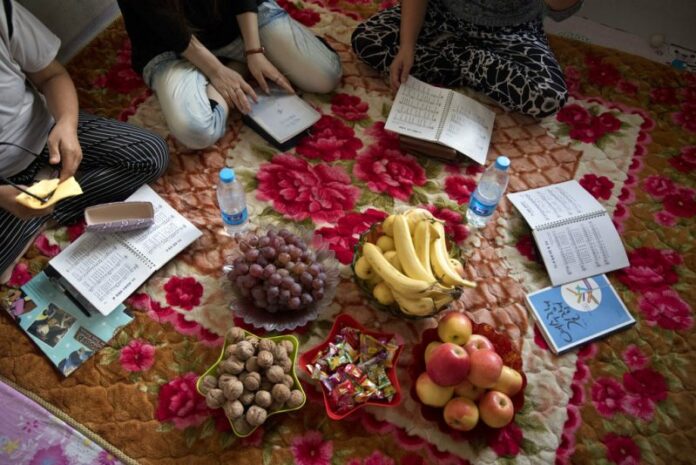
In this Sept. 8, 2017, photo, North Korean women gather for a prayer meeting at a home near the city of Chaoyang in northeastern China's Liaoning province. Photo: Ng Han Guan / Associated Press
WESTERN LIAONING PROVINCE, China — The North Korean woman drives a motorbike slowly down a narrow lane shaded by tall corn to the farmhouse where she lives with the disabled Chinese man who bought her.
It’s been 11 years since she was lured across the border by the prospect of work and instead trafficked into a life of hardship. In those years, she’s lived with the dread that Chinese police will arrest her and send her back to be jailed and tortured in North Korea. She’s struggled with the scorn of neighbors who see her as an outsider.
But most of all, she’s been haunted by grief and regret over the children she had to leave behind.
“When I first came here, I spent all day drinking because I worried a lot about my kids in North Korea,” said the woman, who asked to be identified only as S.Y. due to safety concerns. “I was quite out of my mind.”
Experts estimate that thousands, and perhaps tens of thousands, of North Korean women have been trafficked across the border and sold as brides since a crippling famine in North Korea killed hundreds of thousands of people in the mid-1990s. Brokers tell the women they can find jobs in China, but instead sell them to Chinese men, mostly poor farmers in three border provinces who struggle to find brides in part because Beijing’s one-child policy led to the abortion of many female fetuses.
Like S.Y., many of the women have children still in their homeland.
Their plight is largely ignored, partly because the women almost never agree to interviews. The Associated Press spoke with seven trafficked North Korean women and three Chinese husbands.
Because the women have been trafficked to China, they are living in the country illegally and have never officially married their husbands.
Some of the North Koreans get along with their new families and are satisfied with their new life in China. Others are abused by their husbands or ignored or mocked by their new relatives and neighbors. Others have risked the perilous journey to South Korea — with some having to make the heart-wrenching choice to leave children behind again, this time in China.
In this photo taken Friday, Sept. 8, 2017, a North Korean woman reads from a bible during a prayer meeting near the city of Chaoyang in northeastern China’s Liaoning province. Photo: Ng Han Guan / Associated Press
The Brides Who Stay
The first years were the hardest were for S.Y.
A widow from a city near Pyongyang, North Korea’s capital, she didn’t even give her two sons a proper goodbye when she left for China, thinking she would be able to quickly return home after making some money. Instead a broker sold her to her new husband for 14,000 yuan ($2,100).
Though the now 53-year-old said she was treated well by her Chinese husband — and the two have a daughter together — she was never able to forget her North Korean children who she last saw in 2006.
One day, saddened and frustrated, she swallowed a box of sleeping pills in a suicide attempt. When she was revived she said she began to realize that her half-Chinese daughter needed her.
She’s passed on the chance to flee to South Korea, saying she worries about leaving her daughter and husband, a poor farmer with polio.
“I’m living here because of my family … and because I feel grateful to my husband,” S.Y. said. “What matters is not breaking up our family.”
Her 55-year-old husband and his relatives sold hogs and corn to pay brokers to check on S.Y.’s children in North Korea. They found that her brother was raising her sons and S.Y.’s husband sent 15,000 yuan ($2,260) to help support them.
“I felt really, really good when I first met her,” S.Y.’s sun-bronzed husband said, his crutch by his side. “But I’m a disabled man and I thought it was unfair to her. She could have met a better husband.”
Two other North Korean women interviewed in western Liaoning province said their husbands treated them well, but others described abuse. One former bride who fled to South Korea said her Chinese husband tied her to a post for hours after she once tried to escape.
The women who stay live with the worry of being arrested and repatriated to North Korea. They avoid traveling because they say authorities in recent years require citizens to show their ID cards before leaving the area. They speak little Chinese, have few local friends and don’t enjoy the same social and medical benefits that ordinary Chinese have.
They stay because of their half-Chinese children.
“My 10-year-old son knows his friends’ (North Korean) mothers have all fled, so he’s very obedient to me because he worries I could leave him too,” said another North Korean woman from a village near where S.Y. lives. She asked to be identified by only her surname, Kim.
Chinese authorities, including the Ministry of Public Security in Beijing and police in the three provinces closest to North Korea where most of the women end up, did not respond to requests to comment on the plight of the trafficked brides.
A spokesman for the Foreign Ministry said in a written response that China has worked to fight the trafficking of women and children in recent years by strengthening laws, efforts that “have had noticeable results.”
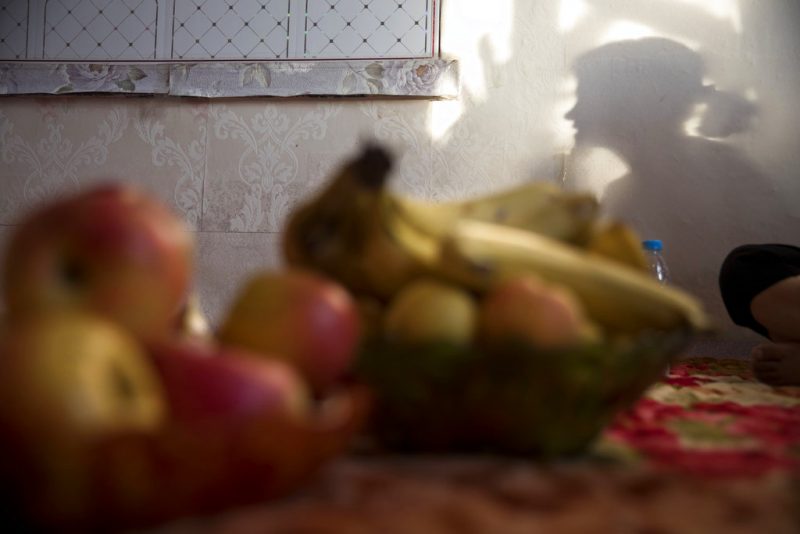
In this Sept. 8, 2017, photo, North Korean woman S.Y. casts a shadow near fruits laid out for a prayer meeting at her home near the city of Chaoyang in northeastern China’s Liaoning province. Photo: Ng Han Guan / Associated Press
The Brides Who Flee
For North Korean brides who want out of Chinese towns, South Korea is a tempting option because of the promise of citizenship, resettlement money, almost-free apartments and no language problems.
But reaching South Korea requires a long, treacherous journey and once again putting trust in brokers. Some lie to their husbands and say they’ll return after making money in South Korea. Some flee in the middle of the night. Often they have to leave their children behind.
After living in a village in China’s northeastern Liaoning province for 2 1/2 years, Kim Jungah could no longer bear the possibility of her daughter seeing her dragged away by Chinese authorities.
“I slept badly every night,” the 41-year-old said. “Whenever I heard the sound of cars, I was afraid they might be the police.”
So in 2009 she left, thinking that later she could persuade her husband to come to South Korea with her daughter if she made enough money. She eventually made such an offer, but her husband rejected it.
Kim hasn’t spoken to her daughter since early 2013, when her husband changed his phone number after finding that she had gotten married in South Korea.
She said her daughter’s biological father is actually North Korean and that she didn’t know she was pregnant when she was sold to her Chinese husband in 2006 for 19,000 yuan ($2,860).
During a recent visit to the man’s house, Kim’s daughter, now 10, looked cheerful and healthy as she ran around her yard. Her Chinese father said he treats the girl like his biological daughter and that she’s doing well at school.
Kim said she would give her former husband 50,000 yuan ($7,530) if he sends her daughter to her and if he refuses she will sue him. He said he won’t allow the girl to reunite with Kim until she becomes an adult.
The man, who asked that his name not be revealed in order to protect the girl, called himself a victim of “marriage fraud.”
“She came here, bore a child and left,” the 50-year-old said. “She had food and a place to live. I don’t understand why she left.”
Others have been able to reunite.
North Korean defector Kim Sun-hee, 38, who came to South Korea in 2008, lives in a small apartment near Seoul with her Korean-Chinese husband, Chang Kil-dong, 48, who bought her for 8,000 yuan ($1,200) when she was 18.
Chang, now a manual laborer in the South, said he was delighted when his wife called him to come to South Korea because he thought she might abandon him. Still the two don’t like to talk about how their relationship started.
Chang said he wishes he could go back and instead of paying a broker, give money to his wife’s family in a traditional marriage contract.
“It was human trafficking,” he said.
Lasting Pain
All three of the North Korean women interviewed in China left children behind in their homeland, thinking their trip across the border would be temporary.
S.Y. wants to raise hogs to make money to hire brokers again so she can find out how her sons in North Korea are doing. Kim, the woman with the 10-year-old half-Chinese son, said she is too poor to hire someone to search for her 12-year-old son who she left back home in 2007.
“I cry whenever I think about my child in the North,” the 46-year-old said.
So many North Korean women have run away — 13 out of 15 in one of the women’s village — that those who stay are looked down on.
“People call us ‘hens.'” S.Y. said. “They say we aren’t real mothers because we lay eggs and then flee to somewhere else.”
The children of North Korean women left behind in China also face a stigma. One of the North Korean women said her daughter’s high school classmate, whose mother fled soon after he was born, is often teased at school.
Some of the women who fled to South Korea are conflicted — torn between the life they have made for themselves and the life they were sold into. A woman who fled to South Korea in 2006 has not contacted her Chinese family even though she has a son there because she was treated poorly.
She asked to be identified only as Y because of worries that publicity about her past could destroy her new life, adding that the South Korean father of her newest child left them when he found out about her life in China.
“Some might say I am cold-hearted, but I left that house determined never to go back,” she said with tears in her eyes. “Now I sometimes feel like going there because I’m curious about how my boy has grown up. But I can’t do that.”
FILE - In this Monday, June 19, 2017, file photo, a user gets ready to launch Facebook on an iPhone, in North Andover, Mass. Photo: Elise Amendola / Associated Press
NEW YORK — Some of Facebook’s former friends are starting to express some serious doubts about the social network they helped create.
Facebook exploits a “vulnerability in human psychology” to addict its users, Sean Parker, the company’s first president, said in a public forum last month. Chamath Palihapitiya, a former Facebook vice president who joined the company in 2007, recently told an audience at Stanford that the company is “ripping apart the social fabric of how society works.”
And Roger McNamee, a venture capitalist and early investor in both Facebook and Google, wrote that both companies “threaten public health and democracy” in an August USA Today op-ed.
It has been a rough year for the tech industry, especially social media companies. It opened with concerns about fake news and “filter bubbles” that can shield people from contrary beliefs, segued into pressure on Facebook and Twitter to clamp down on trolling and online harassment, and culminated with congressional hearings into Russian agents’ alleged use of their platforms to meddle with the 2016 presidential election.
All of that, of course, came against a steady drumbeat of tweets from President Donald Trump, who used the service to praise his allies and castigate his foes, often in inflammatory fashion.
But the unkindest cut of all may have come from three people who helped build Facebook in its early days. In early November, Parkertold the news site Axios that Facebook was built to answer the question, “How do we consume as much of your time and conscious attention as possible?” He called its stream of comments, “likes” and reactions a “social validation feedback loop that exploits how human brains work.”
A few days later, McNamee wrote another essay for the Guardian in which he argued that Facebook and Google have used “persuasive techniques developed by propagandists and the gambling industry,” combining them with modern technology to maximize their profits while pushing “appeals to fear and anger” and other material that reinforces filter bubbles and addictive behavior.
Palihapitiya piled on too, saying at a Stanford Graduate School of Business talk last month that he feels “tremendous guilt” about helping create tools that have widened social divisions. He recommended that people take a break from social media.
Facebook, in an emailed comment, said it is “working hard to improve,” and noted that it’s not the same company it was when Palihapitiya, who left six years ago, worked there.
“We’ve done a lot of work and research with outside experts and academics to understand the effects of our service on well-being, and we’re using it to inform our product development,” the company’s statement read. “We are willing to reduce our profitability to make sure the right investments are made.”
Not all early investors are critical. LinkedIn co-founder Reid Hoffman acknowledged in an interview concerns around how social media systems are causing what he called “lightly addictive behavior.” But, he added, “that’s also been true of television, that’s also been true of sugar.”
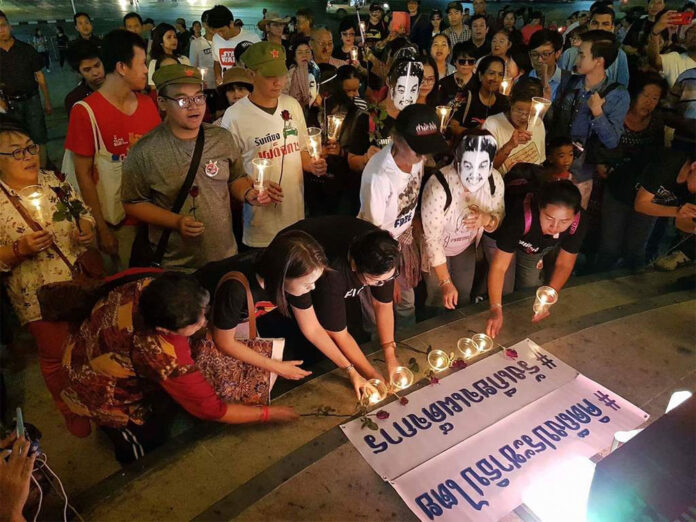
Protesters light candles Sunday at Bangkok's Democracy Monument next to posters which reading #ThinkingOfDemocracy and #DespisedDictatoship. Photo: Noppakaw Kongsuwan
BANGKOK — While the military government welcomes an EU decision to seek “gradual political re-engagement” with Thailand “at all levels,” those in the pro-democracy camp had a mixed response.
Some expressed disappointment Tuesday what they perceive to be the European Union prioritizing trade and warned of negative repercussions, while at least one activist greeted the move as good news.
Among 14 points enumerated Monday in a statement from the Council of the European Union in Brussels was the gradual resumption of political contacts “in order to facilitate meaningful dialogue on issues of mutual importance, including on human rights and fundamental freedoms, and the road towards democracy.”
It signals a reversal from the strong EU reaction three and a half years ago, when Brussels condemned the coup, suspended all official visits to the kingdom and put all important agreements on hold. Back in June 2014, EU ministers expressed “extreme concern” about the coup.
The EU statement now cited the promulgation of the 2017 military-sponsored constitution and junta leader Gen. Prayuth Chan-ocha’s promise to hold elections in November 2018 as reasons to resume ties. Another reason cited was the Thai military’s 2016 decision “to phase out the practice of prosecuting civilians before military courts” in some cases “including for offences against internal security and lese majeste offences.”
The communique also explores the possibilities of resuming talks on an EU-Thailand Free Trade Agreement. It stressed, however, that the signing of such an agreement and others could only resume with a democratically elected civilian government.
The news was hailed today by junta leader Gen. Prayuth Chan-ocha.
Some in the pro-democracy movement who want the international community to more actively oppose the junta were not happy about the news.
“Personally, I am definitely disappointed,” said Virot Ali, a Thammasat University international relations lecturer. Virot predicted it signals a weaker stance from Europe on human rights and democracy.
“While they wait [for elections], I do not want to see them close an eye [to what’s happening],” Virot said, adding that the change likely stems from a belief the carrot approach is more effective than using the stick. Virot warned that election promises should not be held as paramount as the quality of democratic institutions afterward are vital.
Virot said however it’s unfair to expect the European Union to do all the pressuring while pro-democracy Thais do nothing.
“I have chatted with a number of ambassadors,” he said. “It boils down to the point that they can’t really do anything if Thais themselves don’t make a move.”
Sharing disappointment was Titipol Phakdeewanich, dean of political science at Ubon Ratchathani University. “I think it’s bad news for democracy,” the dean said in an interview Tuesday. “The Western world is focusing more on economic interests than human rights. This may delay democratic progress in Thailand.”
Titipol said a positive reading of the news is that the announcement is an attempt to cajole anbd keep the junta to its promise of holding elections.
Still, Titipol said citing the promised election is “rather naive” on part of the EU as the junta has broken numerous electoral promises in the past.
“Even though it has been announced, there’s no confirmation. What’s more, said the dean, elections under the junta-sponsored charter are more like a mechanism to enable the military to remain in power with a veneer of legitimacy and no mechanisms to foster democracy, human rights and freedom of expression.
“The EU stated that there were positive trends on part of the military regime. I think it’s more like a justification,” Titipol said, adding that the United Kingdom, which is leaving the EU, is already doing this.
Taking a contradictory view and welcoming the move was pro-democracy activist Nuttaa Mahattana, who on Sunday helped lead about 100 demonstrators to the Democracy Monument to demand power be returned to the people.
“I think it’s good news and encouraging,” Nutta said.
The EU statement could help shine a spotlight on human rights violations in Thailand.
“Any light shining is better than none,” she said.
“It’s like there are goons in our house and someone is putting a spotlight on them. Can we really say this is not good?” said Nutta, who praised specific problems the EU statement detailed about the military regime.
“Being specific is better than being silent and allowing them to do whatever they like,” Nutta said.
One of the organizations supported by the EU is Thai Lawyers for Human Rights. Sirikan Charoensiri, a lawyer and member of the group who just attended the EU-NGO Human Rights Forum in Brussels said it’s too soon to judge the move.
Sirikan pointed out that Brussels came up with more concrete benchmarks in its demands for the military regime.
Some selections from the statement:
“The [European] Council urges the Thai authorities not to prosecute civilians before military courts including for lese majeste offences committed before 12 September 2016.”
The European Council also reiterates its call for the “urgent restoration of the democratic process in Thailand through credible and inclusive elections and the respect for human rights and fundamental freedoms.
It also noted in point No. 3 that: “The Council recalls with concern that political and civil rights and liberties have been severely curtailed in Thailand following the 2014 military coup. … The Council stresses the importance of such basic freedoms being restored as Thailand proceeds towards democracy, and reiterates the importance it attaches to the role of civil society in a functioning democracy.”
Point No. 12 of the statement also noted that relations with Thailand will be under review with particular emphases on areas such as lifting of restrictions on freedom of expression and the media as well as freedom of assembly and association, the lifting of restrictions on political activity.
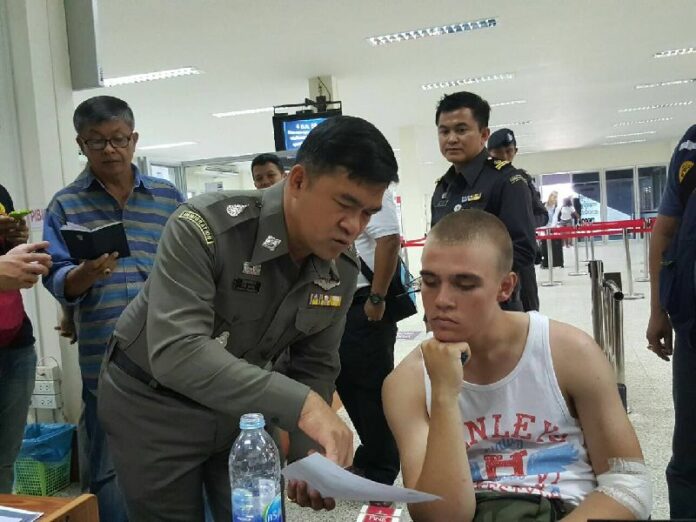
American national Tyler Gerard, then-23, is questioned by police Dec. 3 after his arrest in Sa Kaeo province.
BANGKOK — An Australian man and Thai woman arrested for allegedly running a drug trafficking ring are linked to an American convicted of murdering an Aussie underworld figure two years ago, police said Tuesday.
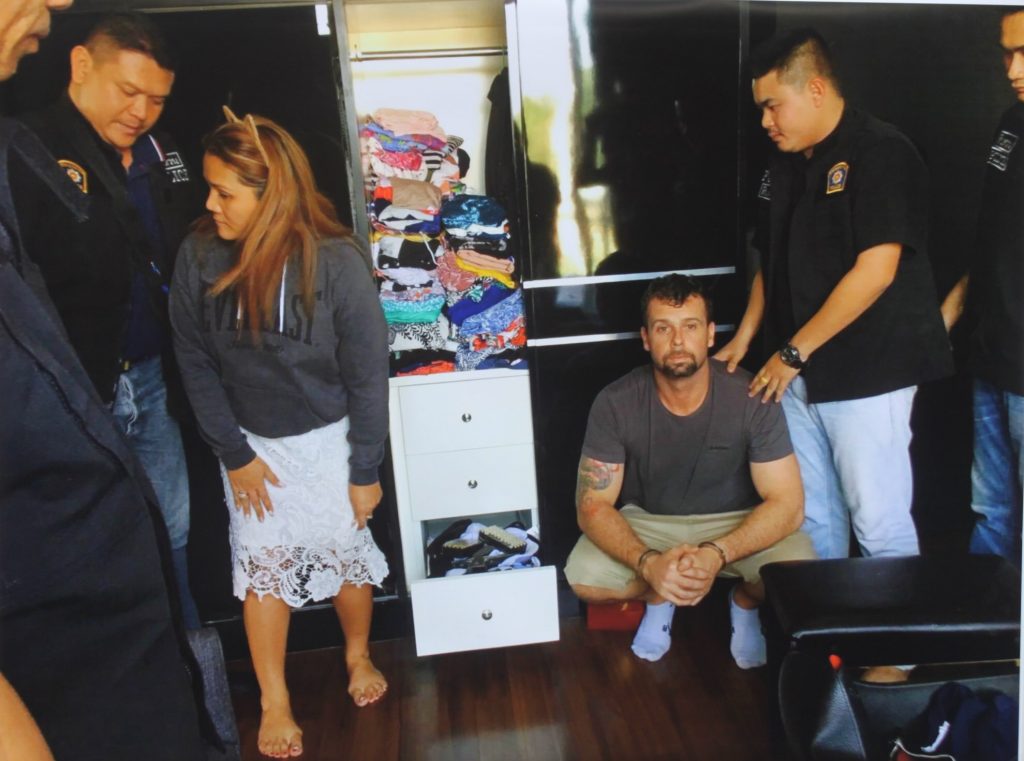
The two suspects – Joshua Cook and his wife Kanyarat Vetchpitak – arrested last night at one of Bangkok’s airports have been fingered by Tyler Gerard, 23 of the United States, as key players in a trafficking operation run out of Pattaya. Police said the two are key players in the transnational drug trade.
“These three individuals are considered ringleaders and part of a transnational drug network that has cells around the world,” Lt. Gen. Veerapong Chuengphakdi, the officer in charge of the case, said Tuesday.
Apart from Gerard, the other suspects are Cook and Kanyarat. They are being held at the Nongprue Police Station in Bangkok.
Police said the investigation began in 2015 after Australian national Wayne Schneider was abducted and executed by Tyler and another Australian in Pattaya. Both Australians – Schneider and 28-year-old Antonio Bagnato, were members of the Hells Angels, an international biker gang that rose to fame during the 1960s and is now considered a criminal enterprise by the United States.
Tyler, a US citizen, was convicted in January and sentenced to three years in prison for his role in abducting and murdering Schneider. Bagnato received the death penalty.
While Tyler has been serving his sentence, police learned about his alleged drug-running partners, Cook and Kanyarat, according to Lt. Gen. Thanitsak Thiraswadi.
A photo of Joshua Cook and his wife Kanyarat Vetchpitak released by police
Police soon gathered information, applied for warrants Saturday and arrested the pair at Suvarnabhumi Airport on Monday night, Thanitsak said. He added that they could not have done so earlier because Cook and Kanyarat were outside the country.
“We knew that both the dead and the living were involved in drugs,” Thanitsak said. “But I cannot yet speak publicly about all the details.”
The information confirms suspicions that Wayne was murdered in a business dispute, he said. Police said that Wayne was killed after threatening to report his partners to the authorities when an expected shipment of meth did not arrive to Thailand.
As part of the investigation, police have seized properties and vehicles in Pattaya belonging to Cook and Kanyarat, which were said to be worth over 30 million baht.