Miss Julie Poster. Photo: Culture Collective Studio/ Facebook.
BANGKOK — An ‘80s classic play on affairs and Darwinism by a prolific Swedish playwright will be performed by Indian actors in Bangkok starting Thursday.
Having been translated into many languages and having featured in several productions worldwide, August Strindberg’s classic “Miss Julie” will be performed in Thailand by Culture Collective Studio, Bangkok’s multicultural and English speaking theater.
“Miss Julie” tells the story of a rich young woman who has an affair with a senior servant already betrothed to a household cook. The play has been regarded by literary critics as the most successful example of a naturalistic play, combining a realistic and simple setting, performance and story conflict revolving around the theme of Darwinian understanding.
The Bangkok production will be performed in English by an all-indian cast: Aarti Kapoor, Vineet Kumar and Prashanthi Subramaniam.
Tickets are 1,000 baht and can be purchased online.
The play launches at 7pm on Thursday. It will start at 8pm on Friday through Sunday, 7pm on June 29 and 8pm June 30 through July 2. It’s suggested not to be late.
It performance venue is the Culture Collective Studio on the third floor of the Chatrium Residence Riverside Bangkok on Charoenkrung Soi 70. It can be reached by taxi or motorbike taxi from BTS Saphan Taksin.
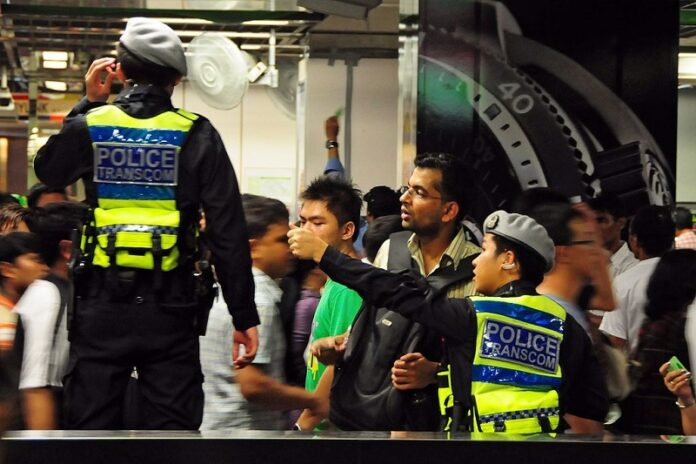
Singapore Police Force officers from the Public Transport Security Command surveys and assists the public during high traffic volume in the immediate hours after the 2010 new year celebrations at City Hall MRT Station. Photo: Huaiwei / Wikimedia Commons
SINGAPORE — A Singapore auxiliary police officer who planned to join the armed conflict against Syria’s government has been arrested along with one of his colleagues, the Home Affairs Ministry said Tuesday.
Muhammad Khairul bin Mohamed, 24, was arrested earlier this month under the country’s Internal Security Act, which allows indefinite detention without trial, the ministry said in a statement.
It said Khairul was “radicalized and had the intention to undertake armed violence in Syria” by traveling there and joining the Free Syrian Army. The group, founded by defectors from the Syrian Armed Forces, aims to overthrow the Syrian government led by President Bashar Assad.
His colleague, 36-year-old Mohamad Rizal bin Wahid, was also arrested in June under the Internal Security Act, but was released under a restriction order that forbids him from moving to a new address or traveling without approval, the ministry said.
Rizal “did not share Khairul’s desire to participate in armed violence,” but had been aware of his plans since 2015 and did not alert authorities, and “even suggested to Khairul various ways to get to Syria and to die there as a ‘martyr,'” it said.
The ministry said Khairul perceived the conflict to be a sectarian struggle between Sunni and Shiite Muslims, who follow different interpretations of Islam.
“Being a Sunni Muslim, he wanted to fight against the Shiites in Syria by joining the Free Syrian Army,” the ministry said. “His readiness and proclivity to resort to violence in pursuit of a religious cause makes him a security threat to Singapore.”
The two men were employed by AETOS, a private security company that provides security guards to companies and auxiliary police to the Singapore Police Force.
At the time of his arrest, Khairul was involved in traffic enforcement at Woodlands Checkpoint, which separates Singapore from neighboring Malaysia. The ministry said he did not carry a weapon in that role.
Since 2015, Singaporean authorities have detained 15 Singaporeans suspected of being Islamic State group sympathizers. The city-state’s immediate neighbors, Indonesia and Malaysia, have large Muslim populations, and hundreds of Islamic State group sympathizers are estimated to have traveled to Syria from the two countries.
BANGKOK — A government spokesman said Tuesday the junta is preparing another volley of its extralegal authority to overturn a court ruling that barred petroleum exploration and production on land allocated for agricultural use.
The order, to be issued under the junta leader’s self-granted authority, will also authorize the use of land reserved for agriculture use for mining and the generation of wind energy, undoing a court decision that regime spokesman Sansern Kaewkamnerd said was costly for the state oil company.
The idea came after the Supreme Administrative Court’s June 1 ruling that land protected by the 1975 Agricultural Land Reform Act could not be used for other purposes – including petroleum exploration – as it went against their law’s principle of promoting farmers’ rights.
The ruling meant the Agricultural Land Reform Office had to revoke concessions granted to several companies, including the state-owned petrochemical enterprise.
The verdict halted operations by seven companies including PTT Exploration and Production Co. Ltd. (PTTEP on SET) – which are majority-owned by state oil company PTT.
Following the verdict, PTTEP had to stop operations in the Lan Krabue district of Kamphaeng Phet province on June 3 despite having been active there since 1982.
When the market opened June 5, the company’s market value dropped 3.61 percent from 90 baht to 86.75 baht – the largest decrease in four months. It closed Tuesday at 89 baht, up 50 satang.
PTTEP said halting production in the area it designates “S1” resulted in the loss of 15,000 barrels of petroleum production daily.
That appeared to bother junta chief Prayuth Chan-ocha. It was one of the issues – along with thehigh-speed rail project – he signaled last week would be solved by using his absolute power.
Government spokesman Sansern said Tuesday the production pause in Kamphaeng Phet’s Lan Krabue district resulted in daily losses between 40 million baht and 50 million baht.
“And where did this money go?” Sansern said. “It went to the government and some was distributed locally.”
“It affects the supply of energy in those areas that use energy produced in Lan Krabue,” he said. “And secondly, it affects investor confidence.”
Sansern insisted the order would only apply to the area had previously obtained permission from the Agricultural Land Reform Office. He said others who wanted to apply after the order was issued would be considered on a case-by-case basis.
However, Sansern’s statements contradicted those of the Agricultural Land Reform Office, who said PTTEP never received permission to operate there.
The office’s top executive Sompong Inthong said on June 9 that he planned to fine the company 20 million baht for operating there without seeking permission, according to Infoquest.
PTTEP responded that it had acquired a company which had obtained permission to the land prior to its being reserved for agriculture, according to Manager news.
PTTEP earned total profits of 1.89 billion baht last year, according to the Department of Business Development.
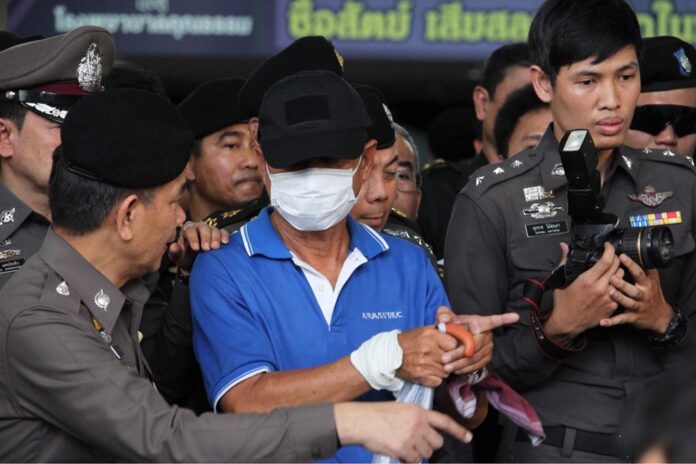
Flanked by soldiers and police, Wattana Pumares tells a policeman Tuesday how he allegedly carried out the bomb attack at Phramongkutklao Hospital last month.
BANGKOK — A 61-year-old man who reportedly confessed to carrying out a bomb attack at an army-owned hospital said Tuesday he’s sorry for his action and apologized to his victims.
As he was taken by security officers to “re-enact” his alleged crime, Wattana Pumares said he acted alone and intended the May 22 blast at Phramongkutklao Hospital to be a symbolic protest against the military regime. He also confessed to having carried out five other attacks in the past decade.
“I didn’t intend to hurt anyone. I’d like to apologize to the injured victims for causing their injuries,” Watana, a former engineer at the state electricity agency, said at a news conference. “I’m really sorry.”
More than 20 people were wounded when the bomb went off at a reception room at the hospital, which, though owned by the army, also treats civilians.
Watana, who worked for the state electric authority until his retirement last year, said he was motivated by his hatred for the military and their frequent intervention in politics, such as the two coup d’etats launched against the civilian governments in 2006 and 2014.
“I’m just an ordinary citizen who doesn’t agree with governments that came from coups, because they made the country face economic disasters, and rights and liberties of the people are violated,” Watana said.
He added that he doesn’t hate all members of the armed forces, only some “who exploit the public as their base to gain power.” The suspect also said he’s not connected to any political group.
Wattana was arrested by soldiers Thursday in his residence in northern Bangkok and identified as the perpetrator behind the hospital blast on May 22, the third anniversary of the coup that brought the current junta to power.
He was held in military detention before he was transferred to police custody for formal prosecution today. The suspect said he was never mistreated in detention.
Police accused him of not only carrying out the May 22 bombing, but also a bomb attack in 2006 in front of a shopping mall in Bangkok on New Year’s Eve. Police said he staged at least four more bombings in 2007 as well as two pipe bomb blasts this past April and May.
At least publicly, Watana admitted responsibility. He said the materials for each attack cost him only 50 baht.
Speaking to reporters after his weekly cabinet meeting, junta chairman Prayuth Chan-ocha described Wattana as a “lone wolf.” Nevertheless, the retired general said police are still expanding their investigation to see if he was backed by any larger group.
“The perpetrator acted individually and independently, or as they call it, a lone wolf,” Gen. Prayuth said. “There are people like this in foreign countries, too. But lone wolves in Thailand usually have someone big behind them [therefore] officers have not stopped here. They’re continuing to investigate.”
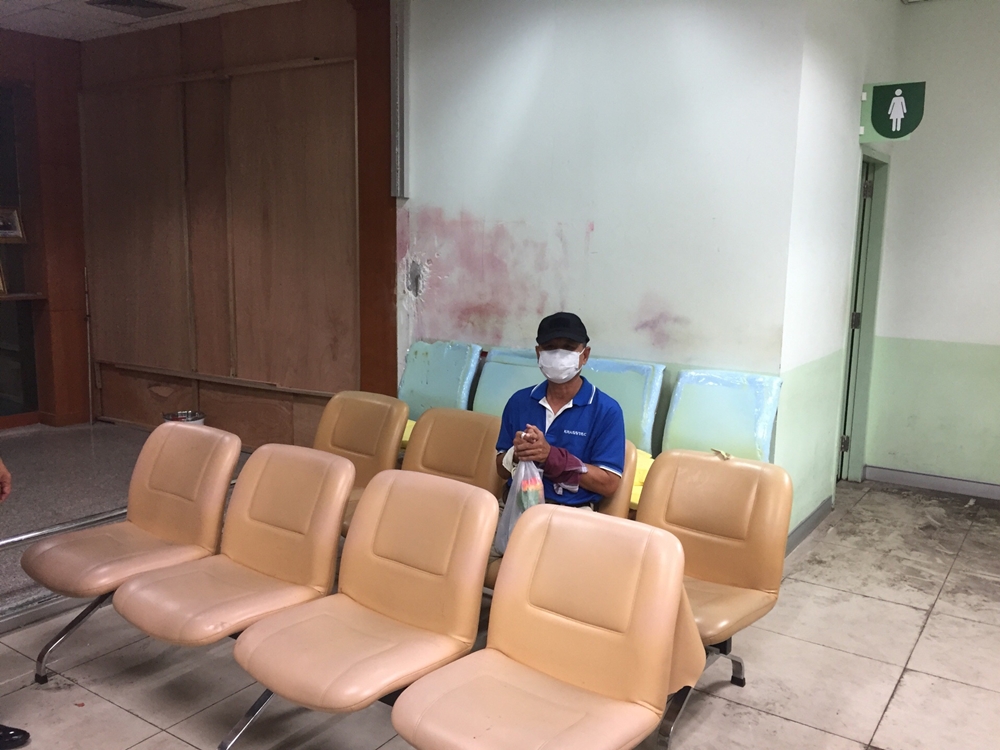
At today’s police reenactment, Watana Pumares sits on the same bench where he allegedly planted the bomb one month ago.
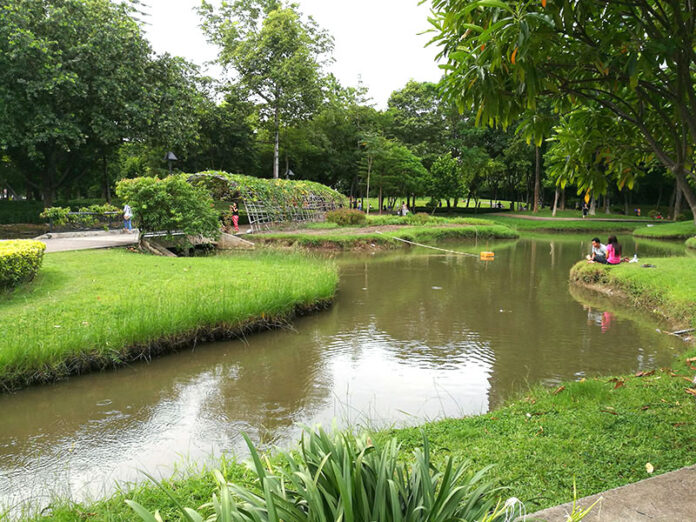
People enjoy the Chalerm Prakiat Park on Sunday in Bangkok.
BANGKOK — Community members threatened legal action Tuesday to save one of Bangkok’s most picturesque parks which is located along the Chao Phraya River.
Managed since 2000 by City Hall, the Chalerm Prakiat Park sits on land owned by the Expressway Authority, which after 17 years wants the land back to build an elevated expressway linking Rama III Road to Dao Khanong on the Thonburi side of Bangkok. Park defenders say there is unused land there large enough for the project.
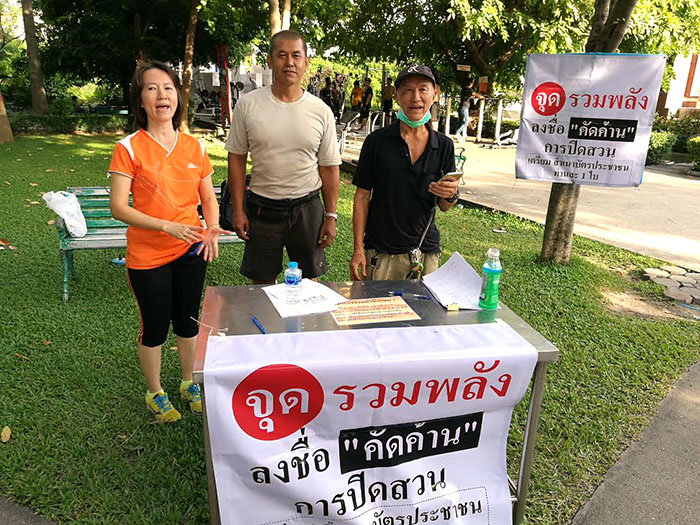
“All we ask that they don’t touch the park,” said Manus Upathambhakul, a 75-year-old park user and protest leader.
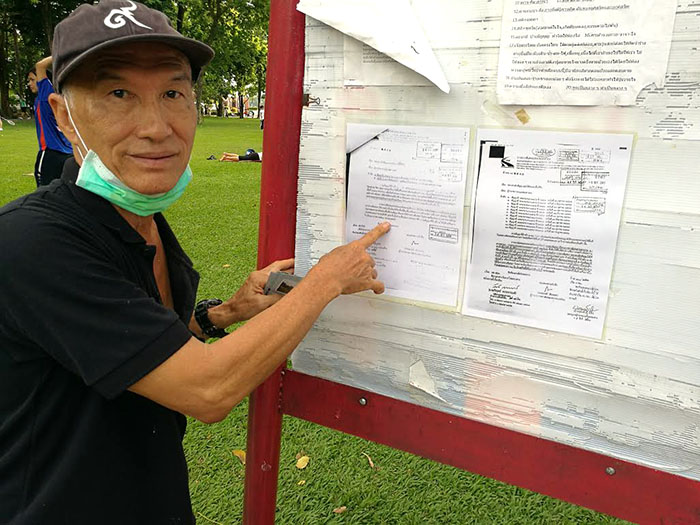
He said some 2,000 people who use the park daily will take the matter to the Administrative Court if needed. Manus and a few fellow park users have collected more than 2,000 signatures so far. He said they learned about the plan to scrap the park when two letters from the expressway authority appeared a notice board in front of the park earlier this month.
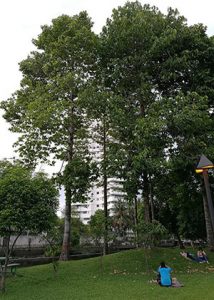
The park, which spans 29 rai (4.6 hectares), is also known colloquially as the Under Rama IX Bridge Park or Rama III Road Park for its location near the suspension bridge and arterial road. It’s a popular place for neighborhood people to jog, rest, play badminton or find a sepak takraw pickup match.
Manus Upathambhakul, 75, shows notices posted by the Expressway Authority, which owns the park land.
Manus and others staged a brief protest Tuesday morning in front of the expressway authority’s Chatuchak district headquarters. An authority spokesman who asked not to be named because he was not authorized to be quoted in the media said protesters may be jumping the gun, as reclaiming the land still awaits approval from the interim cabinet.
He also said the project may not need all the land, and the unused portion could be returned to the city to operate as a park.
Some protesters at the park Sunday said they don’t trust the authority not to use the high-value location near the river and iconic bridge for a profitable real estate development. They said the park contains mature trees, a result of nearly two decades of planting that would be difficult to replace if they were felled.
“It’s a shame, those trees have been planted for 20 years now,” said Walee Sangkakul, a frequent park visitor.
Large trees have taken nearly two decades to grow in the park.
Yuttapan Meechai, secretary to Bangkok Gov. Aswin Kwanmuang, was not optimistic, however.
He said the city has been negotiating with the authority for some time and would seek to keep the park open as long as possible.
He said it would be difficult to convince it to donate part or all of the land for permanent park use, as Benjasiri Park was by the Meteorological Department.
“The chances are difficult. We will just try to prolong it as long as possible,” Yuttapan said, adding that the fate of park may change if the public makes it an issue.
Park users call attention to the threat to the park Sunday.
Jose Mourinho seen here in 2015 during a match against Dynamo Kyiv in Ukraine. Photo: Aleksandr Osipov / Flickr
MADRID — A Spanish state prosecutor has accused former Real Madrid coach Jose Mourinho of tax fraud worth 3.3 million euros (USD $3.7 million) in unpaid taxes.
In a statement released Tuesday, the state prosecutor said Mourinho committed two counts of tax fraud in 2011 and 2012.
It will now be up to a judge to decide whether to take the matter to court.
Mourinho currently coaches Manchester United.
The accusation against Mourinho comes a week after the Madrid-based prosecutor’s office accused Real Madrid forward Cristiano Ronaldo of defrauding Spain’s tax office of 14.7 million euros (USD $16.5 million). Ronaldo has denied any wrongdoing.
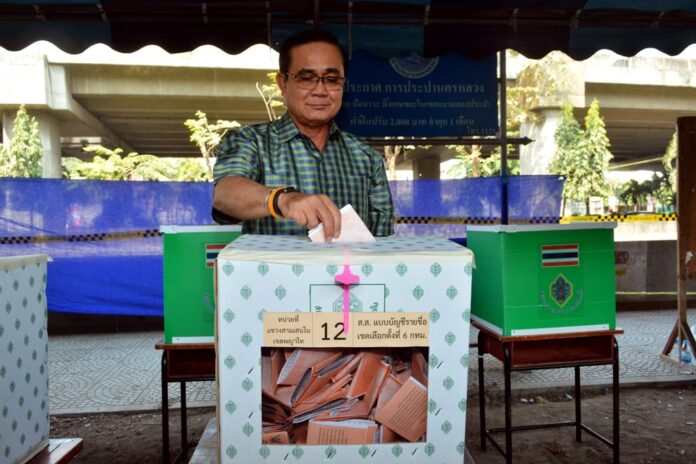
Prayuth Chan-ocha, who served as army chief at the time, casts his ballots in the Feb. 2, 2014, election in Bangkok.
BANGKOK — Next time Thailand prepares to elect new leaders, it may do so through a system never used in its 85 years of democracy: primary elections.
Central party officials voiced skepticism Monday about a system intended to give the public more say in politics after a majority of the junta’s rubber stamp parliament approved introducing such a voting system into law when they last met.
According to the proposal, dues-paying party members in each constituency would vote for their own candidates to stand in elections, and the central party committees would have to respect those choices.
The idea was proposed by Gen. Somjet Boonthanom, a former senator known as a hardline conservative and junta supporter. Somjet was appointed in March to head a subcommittee writing the laws that will regulate political parties.
The interim parliament endorsed the idea 180-0 on Friday after a two-hour debate.
If approved, the primary voting amendment would be among a series of changes to the existing election system under oversight of the military regime that took power three years ago with the stated aim of “reforming the country.”
By this week, however, some politicians and even one senior junta official had voiced skepticism about the idea. Former Democrat MP Nipit Intrasombat said primary elections would only expose the nominating process to local nepotism and interest groups.
“Suppose someone doesn’t want to run but he sends his wife or his children instead,” said Nipit, who has been winning elections in Phatthalung province since 1992. “Who will the local party branch choose? … let me tell you, if we have a primary, nepotism will fully enter our system. It will parade right into our system.”
The idea’s most vocal supporter, a former Democrat Party MP later appointed to the junta’s reform council, has been touting the system as a means to decentralize party politics and empower voters.
“If we keep using old solutions to old problems, the problems will never go away,” Alongkorn Ponlaboot said, adding that the political party system has in over 70 years been unable to shed the taint of money, nepotism and interference by the elite.
Nipit warned that primaries would weaken political parties even further. The new charter drafted under the regime’s oversight has already been criticized for strengthening the military’s hand at the expense of elected leaders and making possible an unelected appointee to become prime minister.
“They never managed political parties, so they don’t know how complicated the issue is,” Nipit said.
Under the amended bill, all registered party members could vote to select their party’s candidate to represent their constituencies.
One former MP from Nipit’s rival party sat more squarely on the fence. Weng Tojirakarn, who represented the Pheu Thai Party in parliament prior to the 2014 coup, said he believes primaries would bring some benefits, such as empowering local voters to choose their own representatives.
“The people in a constituency know better than anyone else which person fits to represent them as an MP,” Weng, a Redshirt activist, said by phone.
But he also had reservations. For instance, he said, it could pit factions and candidates in a political party against each other.
“Opinions will be different from those of the central committees, which can easily lead to conflict,” he said, adding that it’s also unclear how primary voting would work with selecting party-list candidates.
‘It Won’t Be Smooth’
Another to voice skepticism wasn’t a career politician but one of the new constitution’s authors, whose commission will be asked to approve or reject the supporting laws being approved by the interim parliament.
Meechai Ruchuphan, a junta appointee to the Constitution Drafting Committee, told reporters yesterday he’s afraid the system will conflict with other laws related to the election. For example, if the house is dissolved, he said the constitutional mandate for a new poll within 45 days was not enough time for primaries to be held for voters to select candidates.
Because of his reservation, the interim parliament and Meechai’s commission may have to convene in a joint committee to resolve the contentious issue, as required by the charter. If that happens, Meechai said he will raise his disagreements.
“A primary system will cause problems that affect the next election. It won’t be smooth,” Meechai said.
Alongkorn, the former Democrat who supports the idea, maintains that though Thailand has not embraced primaries in eight decades of parliamentary democracy, a new system is needed.
He said primaries have proven successful in the United States, and an experimental primary he once staged in Ayutthaya province four years ago was a success, with younger people participating and increased political engagement.
“We want democracy in Thailand to be truly participatory,” Alongkorn said. “In the past, all we have had is just one-minute democracy.”
Although Nipit, the former Democrat MP, said adding primary voting would see the election delayed even further, Alongkorn said that wouldn’t be the case.
“The roadmap will still be the same,” he said.
According to the timeframe established by the new constitution, elections should take place by late 2018. Deputy junta Prawit Wongsuwan said Tuesday that the timeframe still stands.
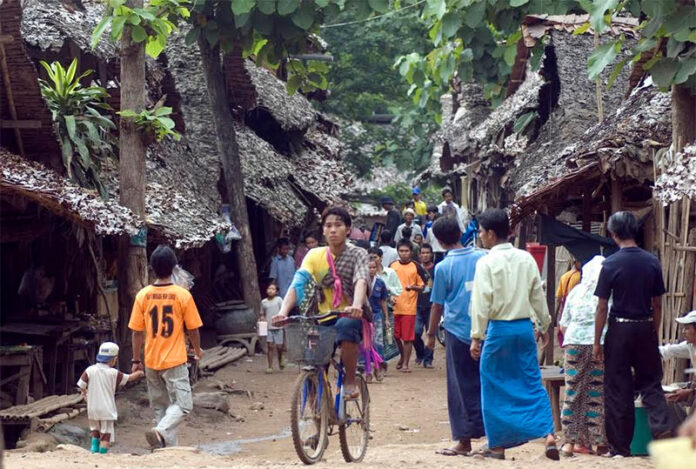
An undated photo of the Mae La refugee camp in Trat province. Photo: IOM / Courtesy
BANGKOK — The suicide rates in a refugee camp along the Thai-Myanmar border have risen to three times the world average during the past two years, according to a report issued Monday by a UN-affiliated migration agency.
According to the International Organization for Migration, or IOM, only one person killed themselves in the Mae La camp in Trat province from June 2014 to May 2015, but 14 people took their lives the next year during the same period and 14 again in the year after that.
The official overseeing the camp on Tuesday rejected the report’s conclusions and demanded it be corrected.
IOM’s data indicates a suicide rate of 36.6 per 100,000 people for the past two years, a rate three times higher than the WHO’s global average of 10.7 per 100,000. As for attempted suicides in the same three-year period, the report said the figure rose less dramatically, from 30 to 31 and 35, respectively.
IOM acknowledged that better monitoring may have be a factor in their reported surge in suicide rates.
“The rates have increased dramatically from 2014 onwards, which may be due to the fact that surveillance and registration systems started to be more comprehensively applied,” the IOM report said.
Preeda Fungtrakoonchai, who heads the Mae La Camp where the study was conducted, said the figures used in the IOM report were simply wrong and denied there has been a spike in suicides there.
The figures he supplied for the total number of suicides from January 2015 to present – 28 people – were the same as IOM’s count for roughly the same period, but were based on different spans of time. Eight people killed themselves in calendar year 2015, 18 in 2016 and two so far this year, he said.
Nonetheless, Preeda, who works under the Department of Local Administration, complained IOM’s data was inaccurate and said its representatives only met with him briefly last month.
“They only interviewed me and didn’t tell me they’re going to write a report. I chatted with them for half an hour, but then things turned out like this,” Preeda said. He said he’s told IOM its figures were inaccurate since the report’s release yesterday.
Reached for a response Tuesday to Preeda’s objections, IOM representatives had no ready answers. They said they would make inquiries with their superiors and respond quickly, but no such response was forthcoming as of press time.
Suicide Factors
An undated photo of the Mae La refugee camp in Trat province. Photo: IOM / Courtesy
Since the early 1980s, refugees from Myanmar have arrived through Thailand’s western border, chiefly in Tak province. The report noted that although Thailand is not a signatory to the 1951 Refugee Convention, it adopted an open-door policy and allowed refugees from Myanmar to stay in the country. Most were fleeing ethnic conflict in Myanmar’s southeast and Burmese military persecution. Many are ethnic Karen. IOM said it received special permission from the government to conduct interviews and studies in the camp focusing on the growing suicide rate.
The report added that suicide rates for 2015 and 2016 inside the camp are “significantly higher than the rates in Thailand in general,” which the Public Health Ministry put at 6.47 per 100,000 people, or roughly one-sixth of the rates in Mae La.
The IOM assessment, presented on the eve of today’s World Refugee Day, said there were no family counseling services inside all nine camps, including Mae La, which altogether house more than 100,000 refugees from Myanmar.
Asked why there’s no counseling in the camps, Dana Graber Ladek, IOM’s chief of mission in Bangkok, cited a decrease in international funding and the fact the Thai government has always seen the camp “as a temporary situation and not a permanent situation,” so it are is reluctant to set up such services and would rather close the camps as soon as possible.
Sally Thompson, chairwoman of the Committee for Coordination of Services to Displaced Persons in Thailand said that since the May 2014 military coup, more control has been exerted and conditions inside the camps have become “more restricted.”
IOM cited distress, hopelessness, substance abuse, domestic conflict and domestic violence as contributing factors in the suicides and attempted suicides.
“All participants report a high level of distress, due to issues related with lack of freedom of movement, uncertainty about the future, decrease in food rations, worries about the fact that the camp will be closed and they will be forced into repatriation while resettlement is slowing down, economic hardship and lack of educational opportunities for the young ones, with increase in alcohol and anti-social behavior among their children,” the 22-page report said.
Preeda disputed those findings also, saying that family conflicts – not despair – were responsible for most suicides in the camp. He said the camp is Thailand’s largest with than 20,000 refugees from Myanmar, 65 percent being Karen and the rest Burman and Burman muslims.
The IOM report, “Assessment of Suicide Risks and Factors in a Refugee Camp in Thailand,” cited no specific cases due to the organization’s policy.
Spokesman Reuben Lim Wende said the camps are off-limits to the media. He also would not identify contacts within the Interior Ministry with knowledge of the camps and policy decisions affecting them, citing the “sensitivity” of the issue.
The report did say that those interviewed for the study said community support and the love for families and the hope for their future, which includes resettlement, good education and the possibility to give their parents better future makes their life worth living.
IOM said it conducted postmortem reviews of 29 of those who killed themselves by interviewing their family members, as well as looking at 20 of the 96 attempted suicides.
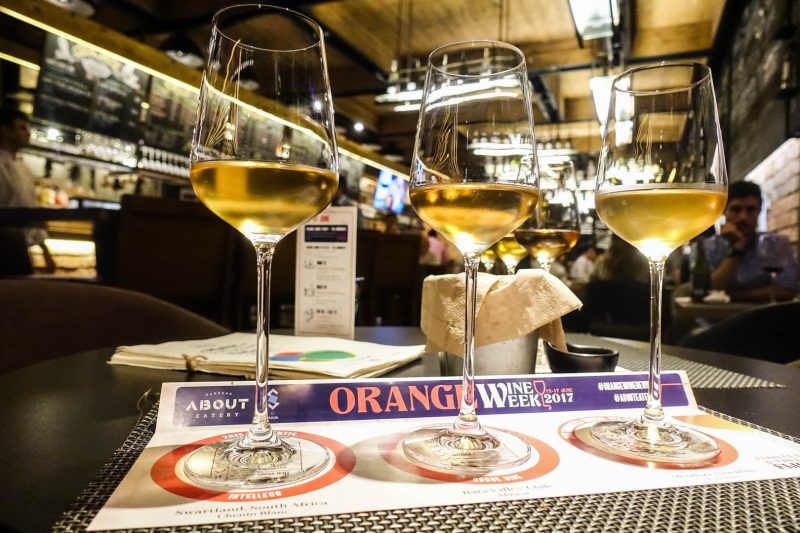
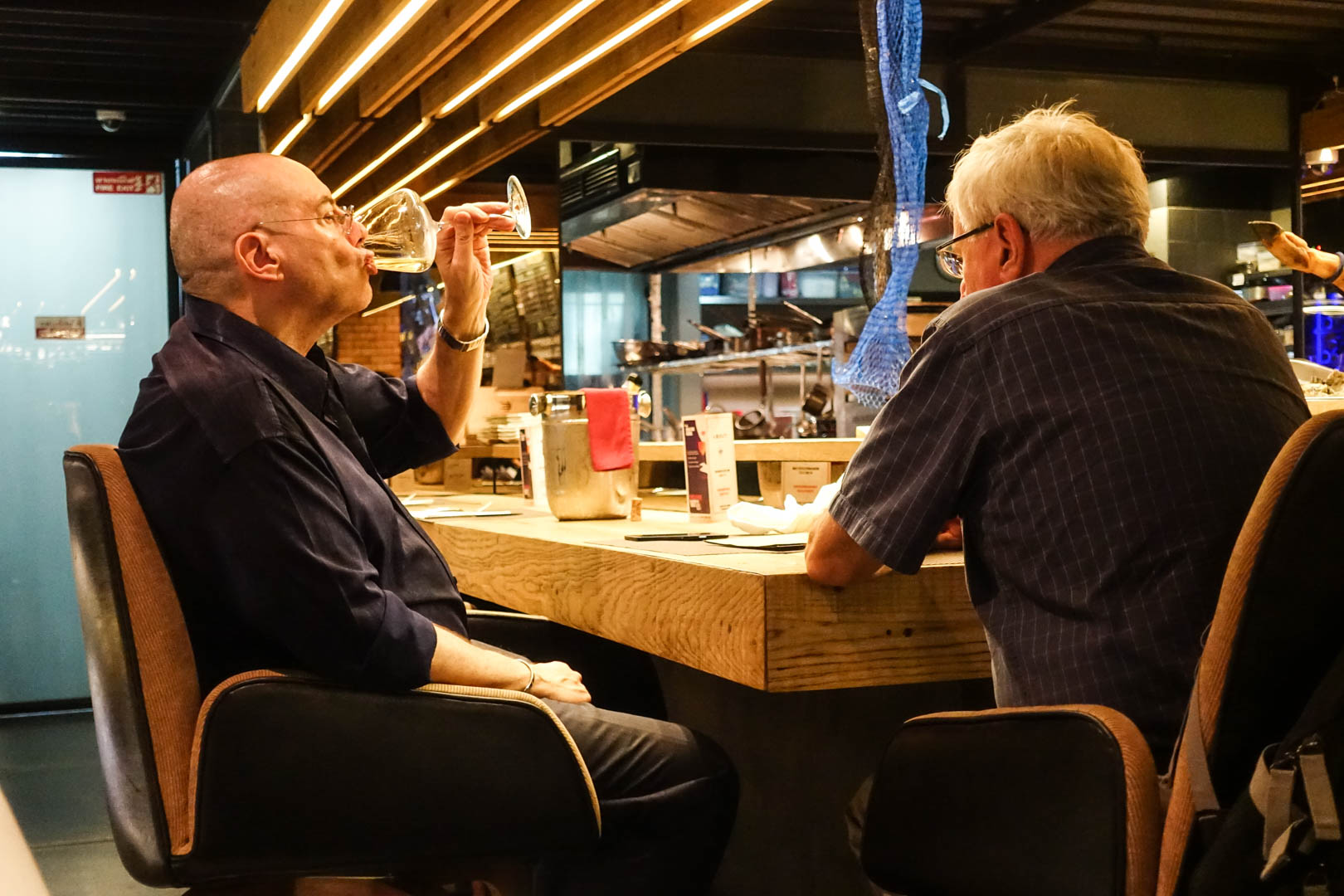
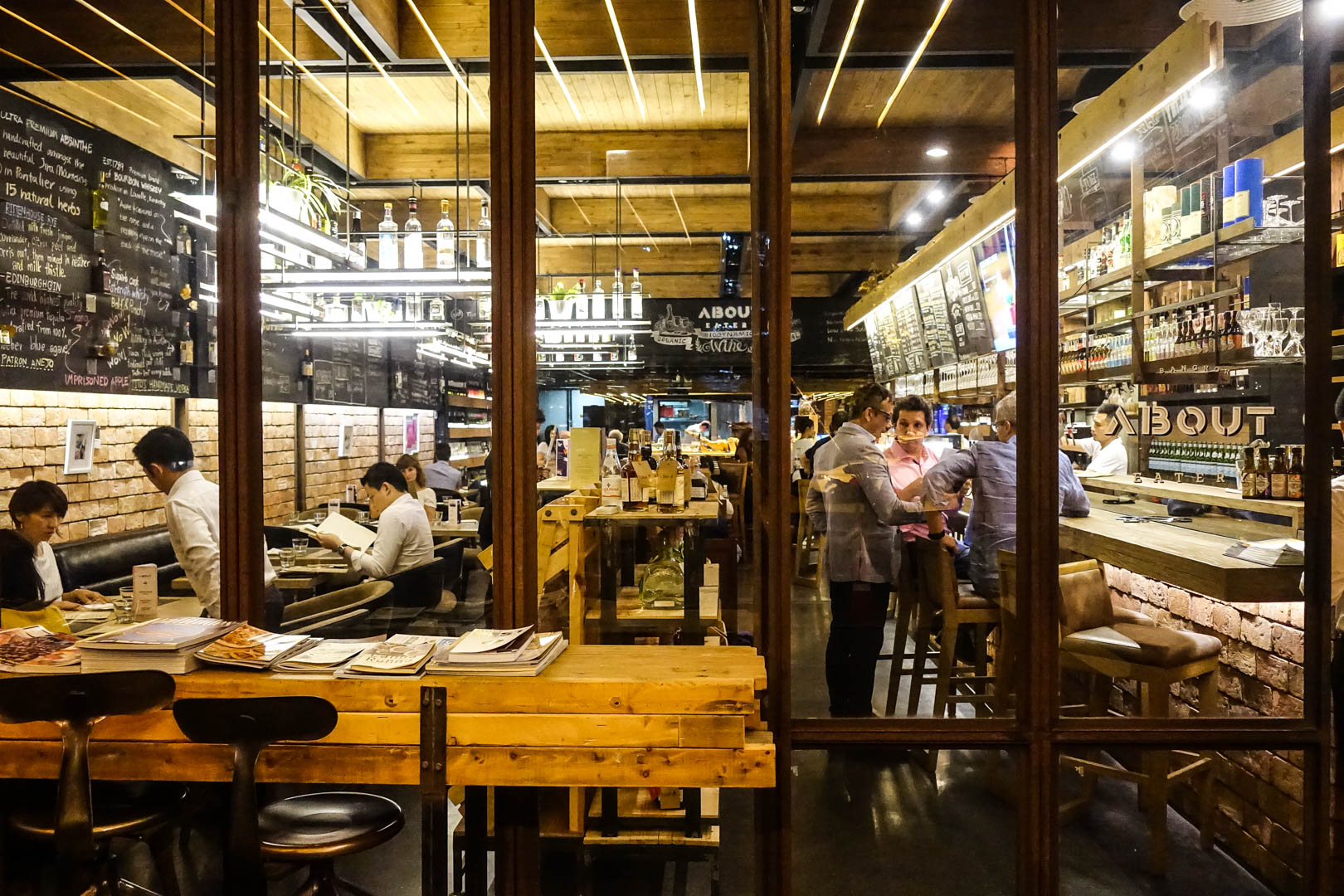
A selection of orange wines available at About Eatery.
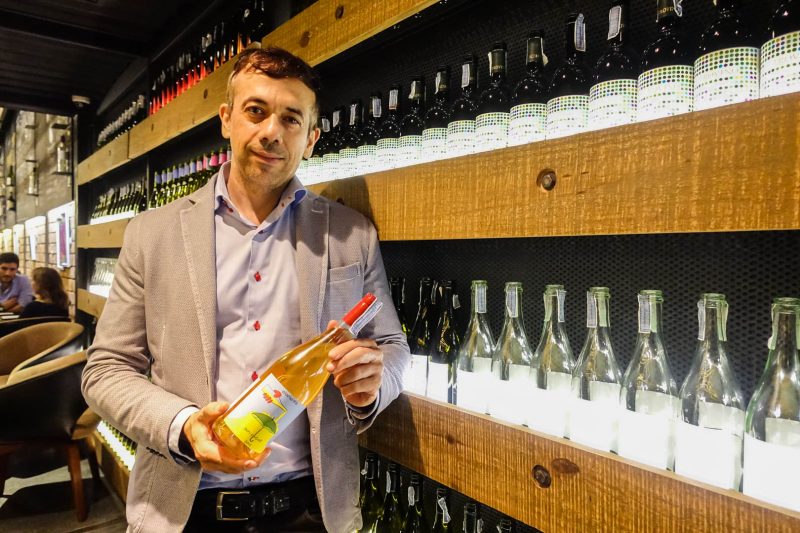
BANGKOK — Giulio Saverino snaps his fingers and a waitress comes over, decanting a persimmon-colored alcohol into his class. He’s drinking orange wine.
The Italian wine expert says orange wine is the hot new thing – despite being thousands of years old – especially for those avoiding impurities or animal products. While conventional wine may use egg whites, fish oils or fish bladders during filtration, Saverino said “nothing is added or removed during the process of making orange wine.”
“You get the freshness of the white wine and the tannins of the red,” Saverino said. “It’s very popular among women here. Seventy percent of my orange wine customers are women.”
The process of making orange wine itself is over 6,000 years old. It involves one of the simplest forms of winemaking, in which organic white grape juice is left in contact with the grape skin for a much longer period, creating a cloudy amber color rather than the mirror-like clarity of conventional reds and whites, according toNew York Times food writer Eric Asimov.
Recently, orange wine has made a comeback as part of the natural wine movement in the greater organic food trend.
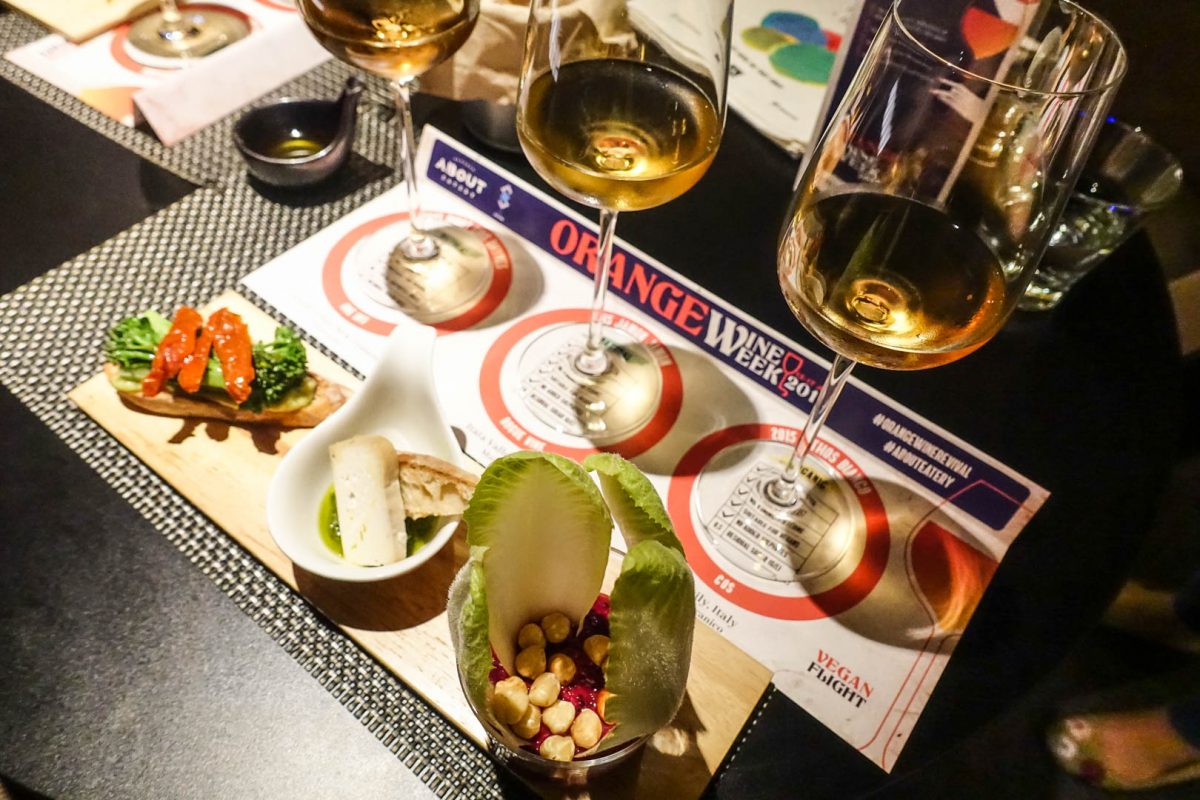
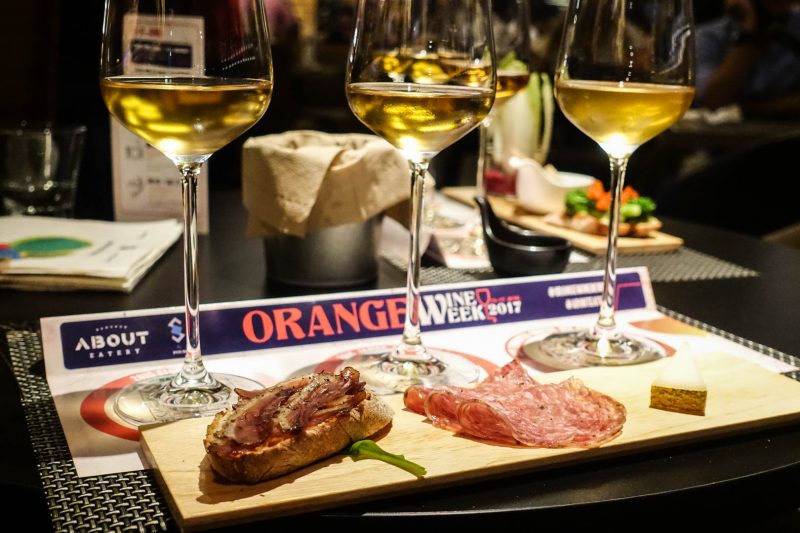
To an uncritical tongue, the orange wine was easier to drink with less of the tannin bitterness of many reds and a fuller, fruitier flavor than whites – and without the morning-after headache. The cloudy unfiltered ones also lend a fruity aroma that paired well with cold cuts and vegan bruschetta. Or, as Saverino put it: “even Asian food.”
Our favorite of the five sampled at a press event last week was the 2015 Jamon Jamon from Chile.
Saverino first brought orange wines from his homeland in northeast Italy in 2016 and says he will expand the selection at About Eatery this year.
You can try them yourself, but as anyone with a nose for wine knows, they are expensive in Thailand. Expect to pay 125 baht to 395 baht for a half glass, 250 baht to 790 baht for a full glass 1,250 baht to 3,950 baht for a bottle.
Saverino broke from sales mode to warn that drinkers should not associate cost with quality.
“Price doesn’t equal quality for orange wine,” Saverino said. “The wine differs bottle to bottle because it depends on the grapes used for each bottle.”
Vegan and meat tapas to munch on with the wine cost 150 baht to 380 baht.
“Of course, you don’t have to be vegan to try the endive with beetroot dip,” Saverino said. “I decided to bring in vegan wine because, nowadays, people want to eat healthy.”
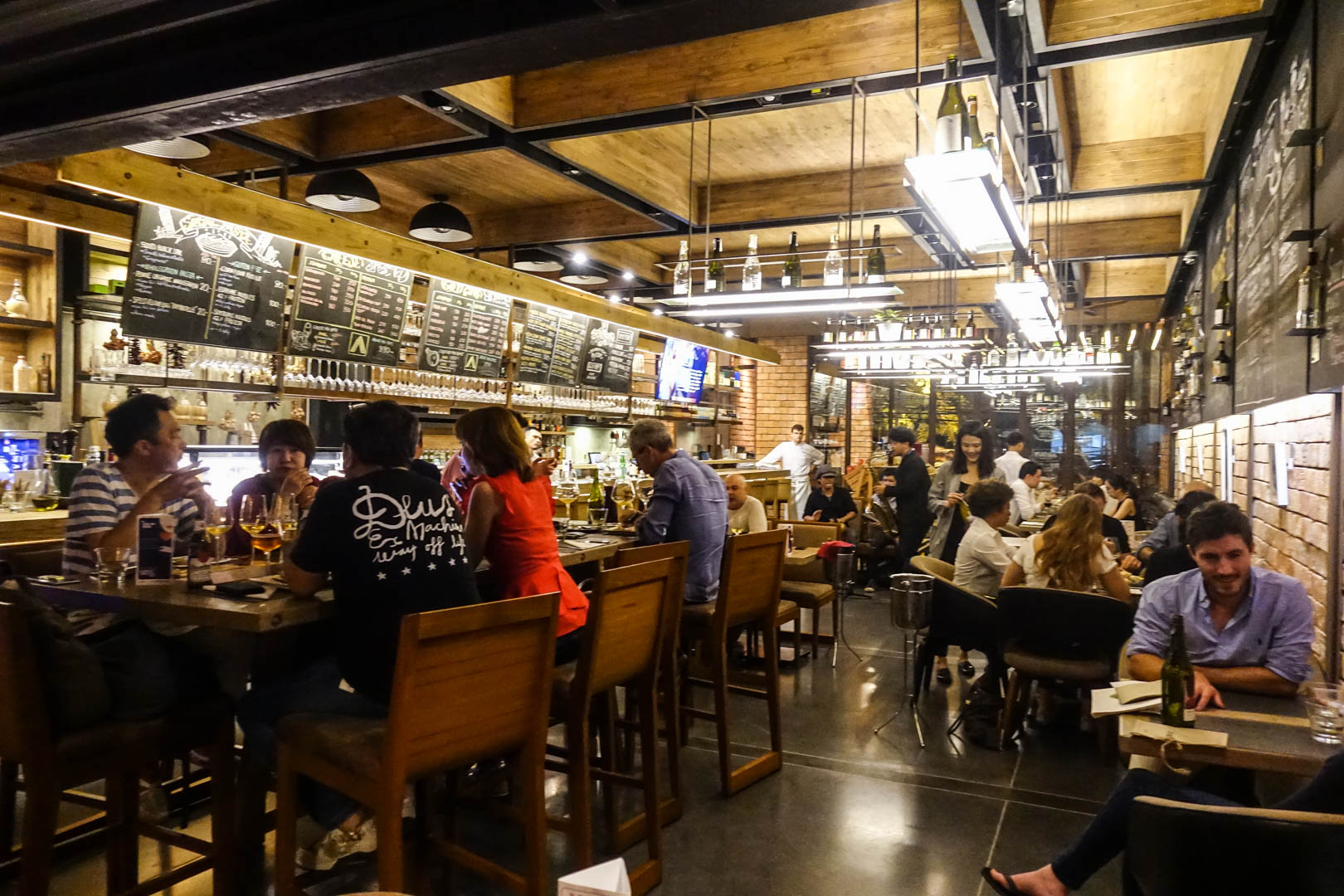
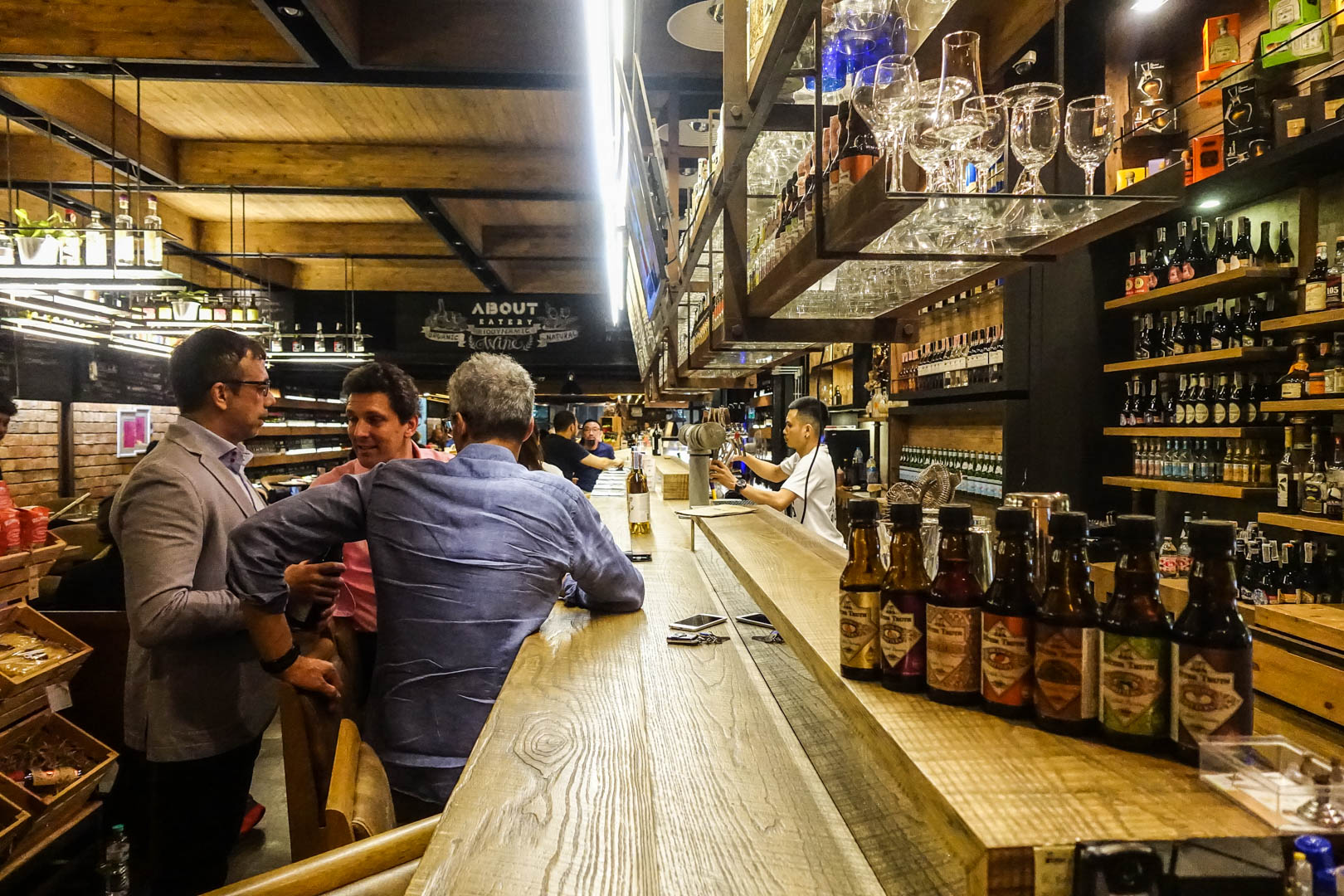
Saverino claims About Eatery is the first natural wine bar in Thailand, as well as the first to serve orange wine. It’s open 11:30am to 2:30pm and 5pm to 1am daily. The restaurant is accessible by foot from MRT Sukhumvit or BTS Asok.
Orange wine of varying clarities at About Eatery.A selection of orange wines available at About Eatery.A selection of vegan tapas by About Eatery.Cold cuts and cheese tapas paired with orange wine.Customers at About Eatery sipping wine.Giulio Saverino, sommelier of About Eatery, holds up a bottle of 2015 Elementis, Intellego orange wine from South Africa.The atmosphere of About Eatery during their Orange Wine Week 12 to 17 June.
BANGKOK — Take a virtual reality tour of the new Thailand Creative and Design Center, or TCDC, which reopened May 5 near the Chao Phraya River in the imposing Grand Postal Building, a modern, brutalist structure dating back to 1940.
The five-story venue fills about 10,000sqm and includes a library, coworking space, maker space, materials room and an outdoor rooftop garden. The renovation cost about 340 million baht.
The video is available embedded above from both Facebook and YouTube On the desktop, use your pointing device to look around. On a smartphone, simply move your phone to change the viewing direction. Users of Samsung Gear VR, Google Cardboard or virtual reality headsets should check how to view them on their devices.