An undated photo of a mobile phone showing popular transportation app Uber. Photo: freestocks.org / Flickr
SAN FRANCISCO — Uber Technologies is paying USD $20 million to settle allegations that it duped people into driving for its ride-hailing service with false promises about how much they would earn and how much they would have to pay to finance a car.
The agreement announced Thursday with the Federal Trade Commission covers statements Uber made from late 2013 until 2015 while trying to recruit more drivers to expand its service and remain ahead of its main rival, Lyft.
The FTC alleged that most Uber drivers were earning far less in 18 major U.S. cities than Uber published online. Regulators also asserted that drivers wound up paying substantially more to lease cars than the company had claimed.
“Many consumers sign up to drive for Uber, but they shouldn’t be taken for a ride about their earnings potential or the cost of financing a car through Uber,” said Jessica Rich, director of the FTC’s Bureau of Consumer Protection.
In a statement, Uber said it’s pleased to resolve the dispute.
“We’ve made many improvements to the driver experience over the last year and will continue to focus on ensuring that Uber is the best option for anyone looking to earn money on their own schedule,” the San Francisco company said.
Most of the proceeds from Uber’s settlement will be paid out to drivers. Documents filed in San Francisco federal court didn’t spell out how many people will get a cut of the settlement or what the average payment will be.
Uber has grown into a cultural phenomenon largely by undercutting the prices typically charged by taxis with rides that can be quickly summoned on its smartphone app.
To ensure cars are widely available, Uber has persuaded hundreds of thousands of people in the U.S. to become drivers by dangling the lure of making money at any time that’s convenient for them. The drivers are treated as independent contractors, another contentious issue because the classification excludes them from many of the benefits and protections given to full-time employees.
As part of its recruitment efforts, Uber has floated enticing estimates about how much drivers can make picking up passengers in densely populated cities.
The FTC’s case took issue with how Uber presented its earnings estimates.
For instance, in a statement published on Uber’s website from May 2015 through August 2015, CEO Travis Kalanick boasted that the mid-range annual incomes of the service’s New York city drivers exceeded USD $90,000 and the mid-range annual earnings of its San Francisco drivers topped USD $74,000, according to the FTC. The agency’s investigation determined that the mid-range income for the New York drivers was nearly one-third less, at USD $61,000, 28 percent less in San Francisco, at USD $53,000, during the year leading up to Kalanick’s statement.
In August 2015, Uber revised its statement to specify its estimates reflected drivers’ “potential” incomes in those two cities. The FTC says less than 10 percent of Uber drivers in New York and San Francisco hit the income levels circulated by the company.
Uber also exaggerated the average hourly earnings of its drivers in 16 other U.S. cities and Orange County in California, according to the FTC’s complaint.
Regulators also blamed Uber for referring people to car financing programs that charged more than the company had promised.
The FTC approved the settlement in a 2-1 vote. The dissenting voter, FTC Commissioner Maureen Ohlhausen, objected because she didn’t believe Uber’s actions harmed consumers.
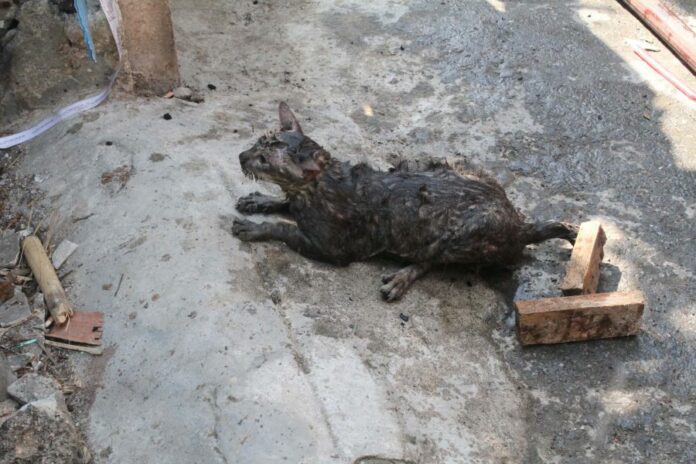
The lucky cat who survived a rai-large complex of burning houses Thursday morning in Rat Burana district, Bangkok.
BANGKOK — A lucky cat survived as eight houses went up in flames Thursday in southern Bangkok. One person suffered minor injuries.
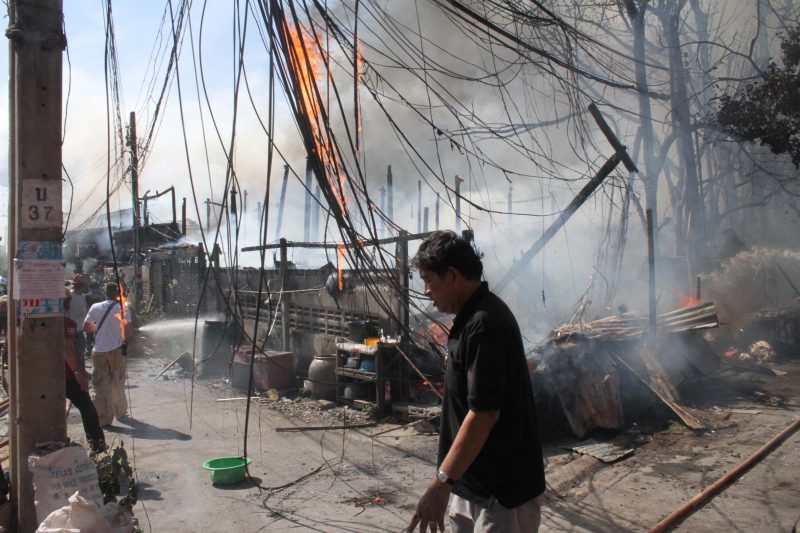
At about 10:50am firefighters and rescue officials rushed to the scene of burning wooden houses in Rat Burana district.
“No one died in the fire, but one person was burned on his arm when he went into a burning house to help firefighters extinguish the flames,” Police Capt. Yotsawat Ratanasri said Friday.
The flames from house number 629/2 in Soi Suksawat 26 spread and burnt an entire rai of wooden houses. Eight people’s homes as well as a car were badly damaged by the flames, which took officials half an hour to extinguish.
People at the scene said they heard an electric transformer exploding moments before the houses started burning, and officials suspect the cause of the fire was an electric short circuit.
As rescue officials extinguished the fire they heard the sound of a cat howling from underneath a pile of wooden rubble. Upon excavating they found and rescued a 2-year-old female cat, wet and shaking with fear.
Burning wreckage after eight houses went up in flames in Bangkok’s Rat Burana district.
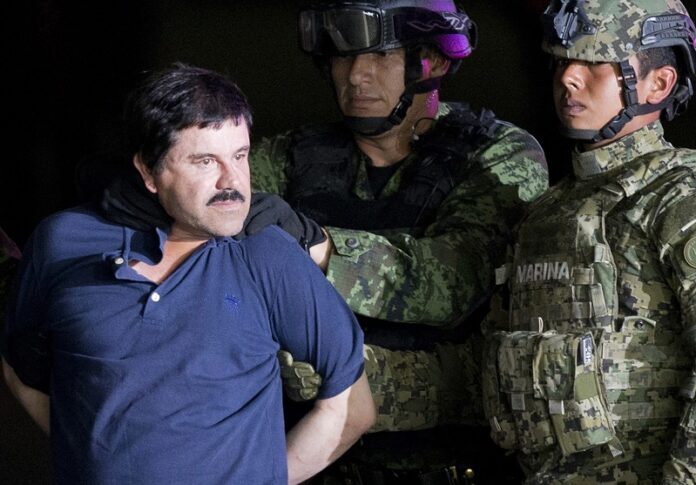
A handcuffed Joaquin "El Chapo" Guzman is made to face the press Jan. 8 as he is escorted to a helicopter by Mexican soldiers and marines at a federal hangar in Mexico City. Photo: Eduardo Verdugo / Associated Press
NEW YORK — Infamous Mexican drug kingpin Joaquin “El Chapo” Guzman, who twice escaped from maximum-security prisons in his country, was extradited at the request of the United States to face drug trafficking and other charges and arrived in New York late Thursday.
A plane carrying Guzman landed at a suburban airport, where a caravan of SUVs waited to take him away. Guzman, the convicted leader of the Sinaloa drug cartel, one of the world’s largest drug trafficking organizations, was expected to spend the night in a New York jail before his first appearance in a federal courthouse in Brooklyn on Friday, officials said.
Mexico’s Department of Foreign Relations announced Guzman was handed over to U.S. authorities for transportation to the U.S. earlier Thursday, the last full day of Democratic President Barack Obama’s administration and a day before Republican Donald Trump’s scheduled inauguration.
Guzman was taken into custody by the U.S. Drug Enforcement Administration in Ciudad Juarez, a border town across from El Paso, Texas.
Guzman, who’s in his late 50s, first escaped from prison in 2001 and then spent more than a decade on the run before he was recaptured, only to escape again in 2015 via a mile-long tunnel dug to the shower in his cell.
The 2015 escape was highly embarrassing for the government of Mexican President Enrique Pena Nieto, and Mexican officials were seen as eager to hand the headache off to the United States afterward. A court denied Guzman’s appeal and found his extradition was constitutional, the Mexican Department of Foreign Relations said.
Guzman’s lawyers had fought extradition since his 2016 recapture and said Thursday the Mexican government sent him to the United States to distract the public from nationwide protests over gasoline prices.
“It was illegal. They didn’t even notify us,” lawyer Andres Granados said. “They handled it politically to obscure the situation of the gas price hike. It’s totally political.”
Besides New York, Guzman faces charges in five other U.S. jurisdictions, including San Diego, Chicago and Miami. He could face the possibility of life in a U.S. prison if convicted.
An indictment in New York accuses him of running a massive drug operation that employed thousands of people, laundered billions of dollars in profits back to Mexico and used hit men to carry out murders, kidnappings and acts of torture.
After his recent escape, he became something of a folk legend for a segment of Mexico’s population for his defiance of authorities. He was immortalized in songs known as narco-corridos, ballads about the drug trade and drug bosses.
It was while on the lam the second time, in fall 2015, that he held a secret meeting with actors Sean Penn and Kate del Castillo. The encounter was the subject of a lengthy article Penn published in Rolling Stone last January, right after Mexican marines re-arrested Guzman in the western state of Sinaloa.
In the interview, Guzman was unapologetic about his criminal activities, saying he had turned to drug trafficking at age 15 simply to survive.
“The only way to have money to buy food, to survive, is to grow poppy, marijuana, and at that age, I began to grow it, to cultivate it and to sell it. That is what I can tell you,” he was quoted as saying in Penn’s article.
The decision by Mexico to extradite one of its most prized prisoners to the U.S. comes as Trump has taken a tough stand on illegal immigration from that country, vowing to build a border wall and make Mexico pay for it. Mexican officials have repeatedly said they will not pay for a wall.
Derek Maltz, who headed the DEA’s Special Operations Division until his retirement in mid-2014, said the timing of Guzman’s extradition less than 24 hours ahead of Trump’s inauguration could be seen as a show of good faith by Mexico.
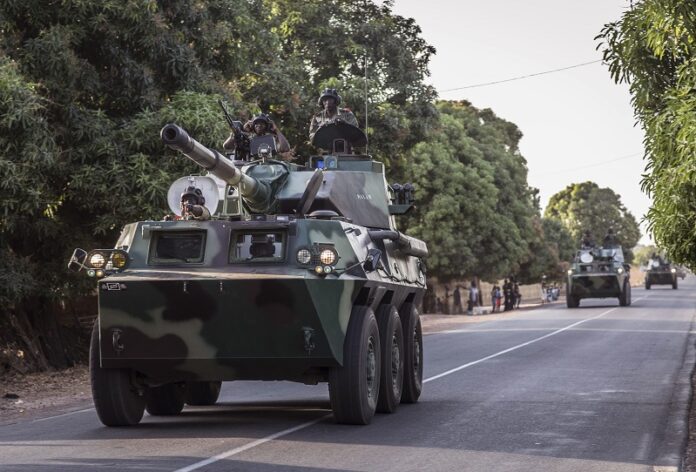
A convoy of Senegal soldiers en route towards the Gambia boarder with Senegal on Thursday near Karang, Senegal. Photo: Sylvain Cherkaoui / Associated Press
DAKAR, Senegal — A West African regional force charged into neighboring Gambia late Thursday to support the country’s newly inaugurated president, while longtime ruler Yahya Jammeh showed no sign of stepping down.
The troops moved in shortly after Adama Barrow was inaugurated at Gambia’s embassy in neighboring Senegal, after a final effort at diplomatic talks with Jammeh failed to secure his departure. His mandate expired at midnight.
Senegalese military spokesman Col. Abdoul Ndiaye confirmed to The Associated Press that the first regional troops had crossed into Gambia and were on their way to the capital, Banjul. AP journalists saw at least 20 military vehicles gathered at the border town of Karang.
In his inaugural speech, which took place under heavy security, Barrow called on Jammeh to respect the will of the people and step aside. The new president also called on Gambia’s armed forces to remain in their barracks as the regional military intervention got underway.
Shortly after the inauguration, the U.N. Security Council unanimously approved a resolution expressing “full support” to Barrow, calling on Jammeh to step down and condemning his attempts to usurp power. The resolution also backed the regional efforts to get Jammeh to respect the election results.
Outside Gambia’s embassy in Dakar, Baal Jaabang held up a freshly framed portrait of Barrow, already printed with the words: “His Excellency Adama Barrow, President of the Republic of Gambia.”
“I’m extremely delighted, so wonderfully happy today,” he said. “But now the situation risks moving into fighting. No Gambian – in the diaspora or back home – wants our country to face fighting.”
Barrow had come to Senegal last week at the urging of West African mediators, who had feared for his safety amid the political crisis.
He arrived at the embassy to cheers of joy from hundreds of Gambians who had gathered, with national flags, for a glimpse of the new president.
“Our national flag will now fly high among the most democratic nations of the world,” Barrow said after the ceremony.
Barrow was declared the winner of the Dec. 1 election and at first was congratulated by Jammeh in a phone call aired on state television. But once it was suggested that Jammeh could face criminal charges linked to human rights abuses during his long rule, he backtracked and challenged the vote in court, alleging irregularities.
In recent days, Jammeh has tried to stay in power by declaring a state of emergency, while lawmakers voted to extend his mandate by three months.
Jammeh on Thursday remained at his official residence and intended to stay there, said an official close to the administration who was not authorized to speak to reporters. If the regional force is going to arrest Jammeh, it will have to be there, the official said.
Many of Jammeh’s loyalists will resist, the official added.
But there were signs that some in Gambia’s military might not put up a fight. One soldier with close knowledge of the situation said several barracks had indicated they would support Barrow. The soldiers spoke on condition of anonymity because they were not authorized to speak to reporters.
Gambia’s army is estimated at well below 5,000 troops.
Jammeh may try to cling to power for a few more days but he is becoming increasingly isolated, said Alex Vines, head of the Africa program at Chatham House in London.
“After the inauguration of Adama Barrow, the trickle of power flowing to him will become more of a flood,” Vines said. “Jammeh clearly believes leaving Gambia in a hurry is an option – his aircraft has been on standby at Banjul airport for two weeks,” he added.
African nations began stepping away from Jammeh, with Botswana announcing it no longer recognized him as Gambia’s president. The African Union earlier announced that the continental body would no longer recognize Jammeh once his mandate expired.
Congratulations to Barrow began pouring in, including from British Foreign Secretary Boris Johnson, and the spokesman for U.N. Secretary-General Antonio Guterres said the U.N. chief expressed his “full support” in a phone call with Barrow.
Thousands have fled Gambia in recent days, including a number of former cabinet ministers who resigned.
But as news of Barrow’s inauguration spread, many people hugged and cheered, chanting “New Gambia, new Gambia!”
“It’s unbelievable! Today I can say anything. I am the happiest man on earth,” said Lamin Sama, a 35-year-old in Banjul. “For 22 years we couldn’t say anything, we were like slaves.”
Monks on a boat Thursday after their temple flooded in Surat Thani.
BANGKOK — More than blaming the flooding which has devastated the south just on record rainfall, those familiar with the issue say mismanaged water resources and unplanned development are to blame.
Long before the floods jammed highways and killed at least 76 people, the conditions for flooding were made possible by unchecked urban sprawl, wetlands destruction and poorly conceived infrastructure projects, a city planner, environmentalist and local flood relief volunteer said Thursday.
The director of Greenpeace Thailand said deforestation is often wrongly blamed, when well-intentioned but poorly considered infrastructure such as dams are at fault.
“Dams don’t help in flood situations,” Tara Buakamsri said. “In fact, water management structures such as dams built for flood relief actually exacerbate the flooding.”
Dams eventually reach their capacity and the water must be released. When that happens, there are no systems to warn those living below them.
The water is released through spillways “without regard for the people downstream,” Tara said. “Instead, they do it to maintain the dam’s condition.”
Development, not just urban but agriculture, is also to blame.
Rangsit Tongsamak, a Nakhon Si Thammarat physician who heads a flood volunteer relief group, said deforestation isn’t replacing jungle with concrete – but a monoculture of commercially grown trees, such as rubber and palm.
“The jungle’s various layers of trees do their job in absorbing rain,” Rangsit said. “But now, some jungle is being replaced with commercial trees like palm or rubber, which only offer one layer of tree and absorb less water.”
Tara added that urban sprawl is also eroding important wetlands and natural water basins.
“In the past, these places could support the drainage of extra water. But if the use of the land in these places changes, then they can’t do their job, so the whole ecosystem is changed,” he said.
Orasa Jansidan, a planner with Songkhla’s provincial Public Works Department, said the slow drainage issues stem from disorganized urban planning.
“Natural disasters are unavoidable, but what we can control is what happens after the rain stops,” Orasa said.
But people keep building “whatever they want, wherever they want,” she said, without any mind for mitigating disaster.
“The issue of city planning and zoning only came up after many cities in Thailand were already built, and usually it’s done without natural disasters in mind,” Orasa said. New city planning laws also do not apply retroactively, meaning past mistakes cannot be undone.
Cities built without consideration for flood drainage showed their faults under this year’s unusual rainfall, Orasa said. In Phattalung, for example, where flooding has been quite heavy, communities built between Songkhla Lake and the Gulf of Thailand were unable to drain water both bodies of water, Orasa said.
“Cities in the Netherlands where I visited deal with water drainage really well,” Orasa said. “As for cities in Thailand, well, I can’t really say.”
TEHRAN, Iran — A high-rise building in Tehran engulfed by a fire collapsed on Thursday, killing at least 30 firefighters and injuring some 75 people, state media reported.
The disaster struck the Plasco building, an iconic structure in central Tehran just north of the capital’s sprawling bazaar.
Iran’s state-run Press TV announced the firefighters’ deaths, without giving a source for the information. Local Iranian state television said 30 civilians were injured in the disaster, while the state-run IRNA news agency said 45 firefighters had been injured.
Firefighters battled the blaze for several hours before the collapse. Police tried to keep out shopkeepers and others wanting to rush back in to collect their valuables.
The building came down in a matter of seconds, shown live on state television, which had begun an interview with a journalist at the scene. A side of the building came down first, tumbling perilously close to a firefighter perched on a ladder and spraying water on the blaze.
A thick plume of brown smoke rose over the site after the collapse. Onlookers wailed in grief.
Jalal Maleki, a fire department spokesman, earlier told Iranian state television that 10 firehouses responded to the blaze, which was first reported around 8 a.m.
The Iranian military sent units to help with the disaster, state television reported.
The Plasco building was an iconic presence on the Tehran skyline.
The 17-story tower was built in the early 1960s by Iranian Jewish businessman Habib Elghanian and named after his plastics manufacturing company. It was the tallest building in the city at the time of its construction.
Elghanian was tried on charges that included espionage and executed in the months after the 1979 Islamic Revolution that brought the current ruling system to power – a move that prompted many members of the country’s longstanding Jewish community to flee.
The tower is attached to a multistory shopping mall featuring a sky-lit atrium and a series of turquoise-colored fountains. It wasn’t immediately clear if the mall was damaged.
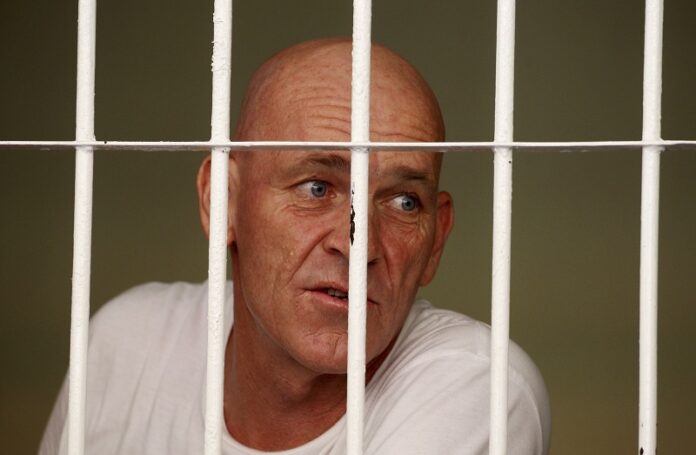
British national and former news correspondent David Fox inside his cell speaks to his lawyer Thursday after his trial in Bali, Indonesia. Photo: Firdia Lisnawati / Associated Press
BALI, Indonesia — An Indonesian court has opened the trial of a former Reuters war correspondent charged with possessing hashish on the resort island of Bali.
David Fox, a British national, was arrested in October along with Australian Giuseppe Serafino. Police confiscated a total of 10.09 grams (0.36 ounces) of hashish from Fox’s clothing and house.
Fox is on trial at the Denpasar District Court, where prosecutor Erawati Susina said Thursday he could face a maximum four years in prison.
Police said the 55-year-old Fox told them he had used the drug for years to overcome stress caused by covering conflicts.
Indonesia has extremely strict drug laws and convicted smugglers are often executed. About 150 people are on death row, mostly for drug crimes.
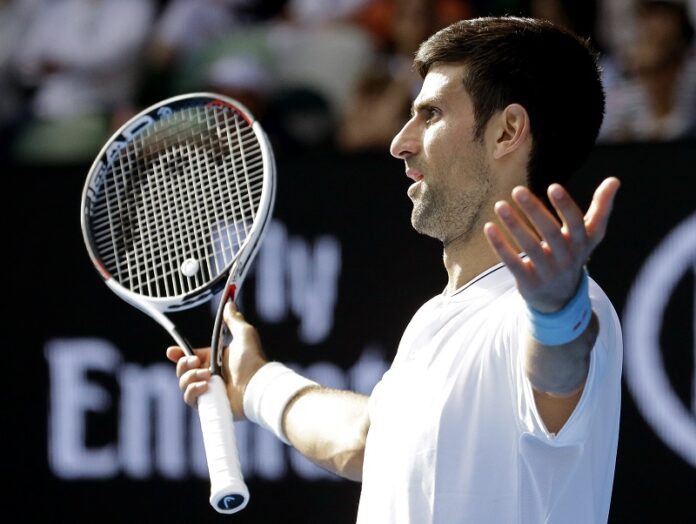
Serbia's Novak Djokovic gestures while playing Uzbekistan's Denis Istomin during their second round match Thursday at the Australian Open tennis championships in Melbourne, Australia. Photo: Aaron Favila / Associated Press
MELBOURNE, Australia — Six-time Australian Open champion Novak Djokovic has been upset in a shocking second-round loss to Uzbekistan wild card Denis Istomin.
Djokovic was aiming to be the first man to win the Australian title seven times, and had won all his previous six head-to-head meetings against Istomin.
It was destined to be a long Thursday afternoon on Rod Laver Arena for Djokovic, though, when he needed 24 serves and a quarter of an hour to hold in the first game, saving six break points.
After 4 hours and 48 minutes, he sent a service return long to give No. 117-ranked Istomin a 7-6 (8), 5-7, 2-6, 7-6 (5), 6-4 win.
“All the credit to Denis for playing amazing. He deserves to win,” Djokovic said. “He was the better player in the clutch moments – he stepped it up and played aggressive.
“Obviously, I was not pleased with my performance overall, but I have to congratulate my opponent. Whenever he needed – he came up with a big serve, big play.”
Istomin, who dropped out of the top 100 last year, had never beaten a top 10 player at a Grand Slam tournament.
“It is the biggest win for me. It means so much,” Istomin said. “Now I feel I can play with these guys, and to be with them on the same level.”
His only previous win in 33 matches against a top 10 player was in 2012 at Indian Wells, when he beat No. 5 David Ferrer.
Djokovic had won five of the previous six Australian Open championships, and had reached the fourth round or better every year since 2007 – the year before he won his first Grand Slam title at Melbourne Park.
“I’m not used to losing Australian Open second round – I’ve done so well here.”
The last time he’d failed to advance beyond the second round at a major was at Wimbledon in 2008.
Rod Laver Arena was not entirely full, with at least one-fifth of the 15,000 seats empty by the fifth set.
Djokovic’s usually vocal Serbian fans were also not a presence, with the exception of a couple women waving Serbian flags. Much of the crowd, sensing an upset, was behind Istomin in the fifth set, yelling “Come on Denis!”
When Istomin made a backhand winner down the line to break Djokovic to go up 3-2, he let out a roar and the audience stood and roared, too.
Djokovic, meanwhile, looked relatively subdued as the set wore on, hanging his head in between points and walking slowly behind the baseline to prepare to receive serve.
When Djokovic’s last ball floated long, the crowd leapt to its feet and cheered as Istomin thrust his arms into the air.
“First of all, I feel sorry for Novak. I was playing so good today,” Istomin said. “I surprised myself, as well, today.”
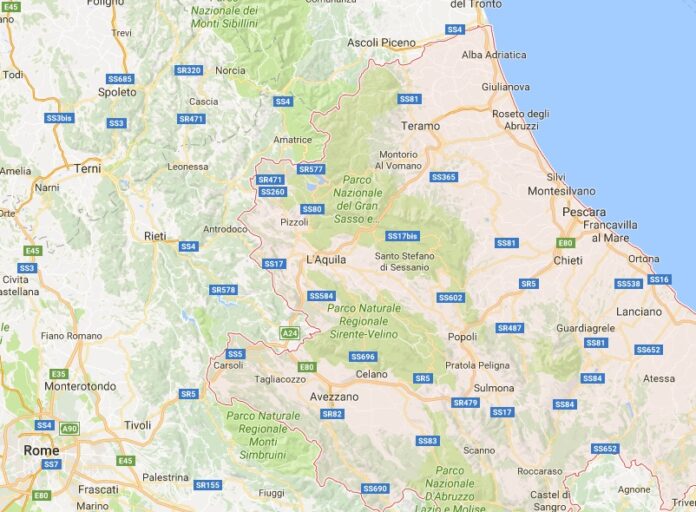
MILAN — An avalanche buried a mountain hotel in an earthquake-hit region of central Italy, leaving at least 30 people missing, authorities said Thursday.
The civil protection agency said that they were working to get rescue vehicles to the Hotel Rigopiano through roads covered in snow, joining initial rescue efforts overnight by alpine rescue teams. The news agency ANSA quoted a rescuer as saying that there were fatalities, but details weren’t immediately available.
Italian media said that the avalanche covered the three-story hotel in the central region of Abruzzo on Wednesday. The hotel is about 45 kilometers (30 miles) from the coastal city of Pescara.
Mountain rescue teams reached the hotel by skis around 4 a.m. (0300 GMT), SKY TG24 reported. Video footage showed rescuers with shovels digging through a wall of snow, and at least one man being led through the cleared path. An ambulance was blocked several kilometers from the hotel, according to SKY.
Earthquakes hit the region on Wednesday, including one with a 5.7 magnitude, but it wasn’t immediately clear if the temblors triggered the avalanche.
This story was revised to clarify that the 30 people are currently not dead but missing.
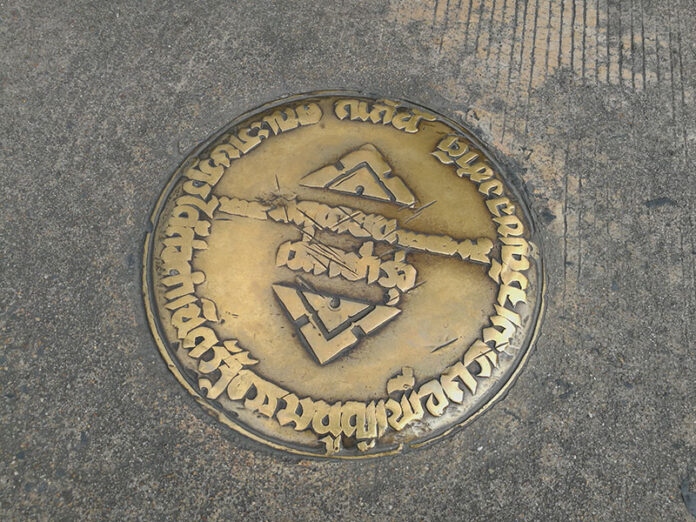
A marker commemorating the 1932 revolt that ended absolute monarchy in Bangkok.
BANGKOK — Just a few days into the new year, Chotisak Onsoong was relieved to learn one of the nation’s most important – if inglorious – symbols of democracy was still intact despite a call for its destruction.
Two months earlier, an open threat had been made to obliterate the worn brass nub which sits in the road at the Royal Plaza and is dedicated to the civilians and officers known as “the Promoters” behind the bloodless 1932 coup which ended absolute monarchy. Eighty-five years later, some revanchist ultra-royalists say that was a mistake.
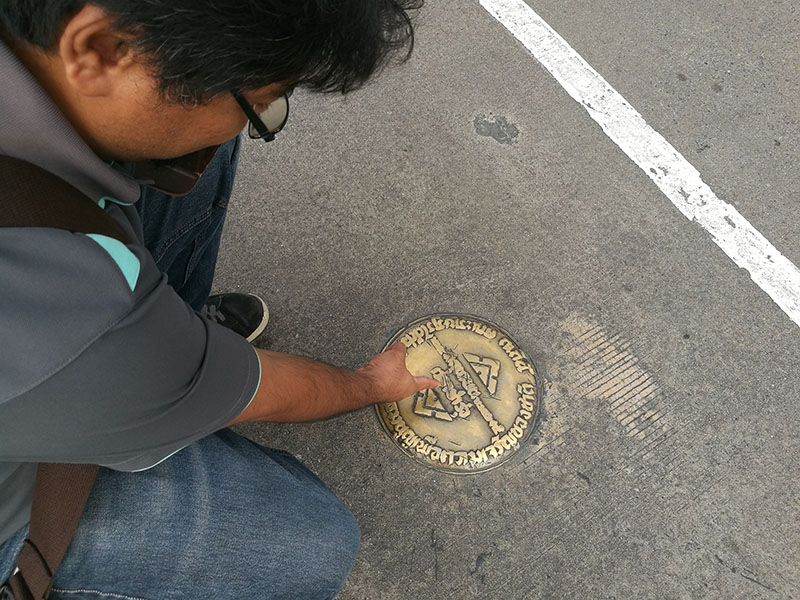
In a message posted online, Chotisak, a pro-democracy activist, said he needed to see it for himself. On Monday, as soon as he could return to Bangkok from the flooded south, he visited and took photographs of the marker, two weeks after its threatened date of destruction had passed.
Visiting the plaque Monday, Chotisak noted several gouges in it he believes were the work of vandals.
The original threat was made Oct. 31 by Thepmontri Limpaphayorm, a royalist and history buff.
“Announcement to owner: If you do not dig it up by December 30, 2016, my friends and I will consider it as lacking ownership and will remove or incapacitate it. If you want to preserve it, dig it up quickly. Thank you,” he wrote.
He didn’t reply to a message sent asking why he wanted the plaque removed and why he didn’t make good on his statement.
But the threat itself, according to experts including historian Charnvit Kasetsiri, is proof the debate over which political system is best suited for Thailand still isn’t over – at least for some.
“In a way this is just a small historical plaque, but its meaning is vast,” said Charnvit, a former rector of Thammasat University, which was founded by one of the Promoters. “It’s a symbol of new power that is democratic, that overthrew absolute monarchy in 1932. That’s why those who still believe in the old system hate and threaten to destroy this plaque.”
In “Thailand: A Short History,” late Cornell University historian David K. Wyatt concisely summarized the revolt:
“[W]hile the king was vacationing at the sea-side, a small group of middle-level officials, numbering slightly more than one hundred, carried out a lightning swift coup d’etat at dawn on 24 June 1932. With only a handful of troops at their command, they bluffed and immobilized other military units in the capital, rounded up the chief officials of the government, and sent a delegation calling upon the king, in the name of the People’s party, to agree to submit to a constitution…”
Faded words on the marker itself carry an even more terse message through time:
“On this spot, the Promoters gave birth to the constitution for the benefit of the nation. June 24, 1932. Dawn.”
Chotisak Onsoong visits a marker Monday commemorating the 1932 revolt that ended absolute monarchy in Bangkok.
The plaque, made of brass and about 30 centimeters across can be found embedded in the asphalt road that is the Royal Plaza, less than 10 meters from the equestrian statue depicting King Rama V. It’s where the revolt took place on June 24, 1932, where a declaration condemning absolute monarchy was read.
Another historian, Thamrongsak Petchlertanan, said the plaque is a reminder that democracy was fought for and not granted by the traditional elites.
“It reminds people that democracy in accordance with international principles must be fought for and built by [people] themselves,” Thamrongsak said.
Though Thepmontri didn’t reply to a reporter’s inquiry, he did pose a question some months ago shedding some light on his thinking.
“Someone asked for my opinion. The person said it’s been about 85 years since the 1932 revolt by the Promoters. We’ve had many prime ministers and ministers who were corrupt. Should we remove the plaque or not? Some say this plaque is a symbol of disgrace for the democratic system. What do you think?” he wrote on Oct. 31, following the original post that caused the stir.
In another message, he suggested more practical considerations:
“It’s useless to keep it. Cars have run over it until [the letters] have become blurred. It should be kept at parliament or anywhere else.”
But then he went back to removing it, saying there are two ways to handle it: dig it out or bury it. One user writing under the pen name Man Koerd-Samart suggested that he should pour acid on the brass plaque.
To those who want self-rule, it’s an enduring symbol. Pro-democracy activist Sombat Boonngam-anong has sold hundreds of wall clocks styled after the plaque to earn a living since the junta froze his bank accounts in response to this call for its ouster. He charges 2,900 baht a pop and said he chose the design for its symbolic value.
“Thepmontri has a problem with the Promoters. He thinks that the revolt in 1932 shouldn’t have occurred and is evil. That it led to elections and corrupt politicians,” said Sombat, adding that these sentiments are being expressed because the backlash against and enmity for politicians are at a zenith.
Should it Stay or Should it Go?
After eight decades, the plaque’s words have faded. Cars continue to run over it. With the threat of vandalism, some have considered ways to preserve it.
Chotisak believes the original plaque should be left alone but cordoned off and turned into a proper monument. Thamrongsak and Charnvit agree it shouldn’t be relocated.
“Moving it to a museum would destroy the historical potency of the plaque,” said Thamrongsak, who said a yellow traffic line should be added to steer cars around it. “But we can only do that when the country is democratic.”
The historian said he has a real fear the authorities under the present military regime would turn a blind eye to vandalism.
Charnvit pointed out that a replica already exists at Thammasat University in front of the Main Conference Hall. Charnvit is also not inclined to replace it with a replica to safeguard the original. “If a replica is placed there it will lack the potency. But even if someone destroys it, they cannot really destroy it,” Charnvit said, because it has long been in the minds of Thais who support democracy.
Sinsawat Yodbangtoey, former manager of the Pridi Banomyong Institute, which is named after the man who led the revolt’s civilian faction, was less attached.
“This plaque is just a symbol of a beginning. It’s neither holy nor has any supernatural powers,” he said. Sinsawat suggested the plaque be left there unaltered with a life-size replica kept somewhere safe.
As for Sombat, he thinks nothing should be done except showing some respect by not allowing cars to run over it.
“Just accord it with some respect it deserves.” June 14, the day of the revolt, was in fact Thailand’s National Day from 1939 to 1959. It was later changed during a surge of royalism to Dec. 5, the birthday of the late King Bhumibol.
Totem of Democracy
Charnvit sees greater symbolism to the peg than just history. In Thai, it is referred to as mued (pin), suggesting something is being pinned to the plaza.
“Might there be a supernatural connotation associated with it?” Charnvit said.
He added that there’s a natural confrontation at work by its placement, so close to the statue of King Rama V, which is revered by royalists as a symbol of absolute monarchy.
“If you believe in superstition, you may believe that the plaque is pinning the power of the monarchy. Thus it must be removed,” he said.