Rescue workers continue their search Saturday at a collapsed building in Soi Sukhumvit 87.
BANGKOK — Police said Saturday they charged engineers responsible for the demolition of a building in Soi Sukhumvit 87 where at least two workers were killed when it collapsed and two remain missing.
Developer, Krittatchaya Sriwanna and engineer Kittiphong Yootairomboon were charged for recklessness resulting in death over the Friday incident, according to Bangkok Police Chief Sanit Mahathavorn.
The offense carries a maximum of 10 years imprisonment and a 20,000 baht fine.
Phra Khanong police commander Chanin Wachirapraneekul said the accused were yet to present themselves to police as of Saturday morning.
Rescue workers Saturday afternoon continued to search for Boonjang Letla-ong, 46 and Phrai Kanoonrum, 38, two workers trapped underneath the ruins.
The bodies of two workers recovered Friday were identified as Singha Sriphet, 53 and Teerasak Snsrisong, 39.
Sanit said the developer and the engineers would also be charged for violating officials’ orders, as they proceeded with the demolition despite being ordered to halt it out of safety concerns.
BANGKOK — “Oh my god, Oh my god!” the woman screams as she fails to block the orange orb hurtling toward her. A meter away, a man fires four times and ducks behind a counter, pumping his shotgun. As the murder-bots close in, he reaches over his shoulder for the katana on his back and swings desperately at them.
Worlds real and virtual are colliding. The murderous melee these two have been living is being projected into their eyeballs by headsets covering their faces. In their hands are not shields or pistols or swords but wireless motion controllers. Where they’re at is neither space station nor robotics lab, but a store in a Ratchada shopping mall.
After decades of false promise, Virtual Reality is here, with consumer-level (if still pricey) products that provide a convincing experience of transporting users to another place.
With the opening of Bangkok’s first commercial VR game cafe, and a VR horror experience made by a young Thai development team, 2016 will be remembered for the technology’s arrival.
But while it can wow users by immersing them in three-dimensional worlds and environments, the technology could either prove the next transformational media experience – or die on the vine as a gimmick with limited appeal.
Playing Space
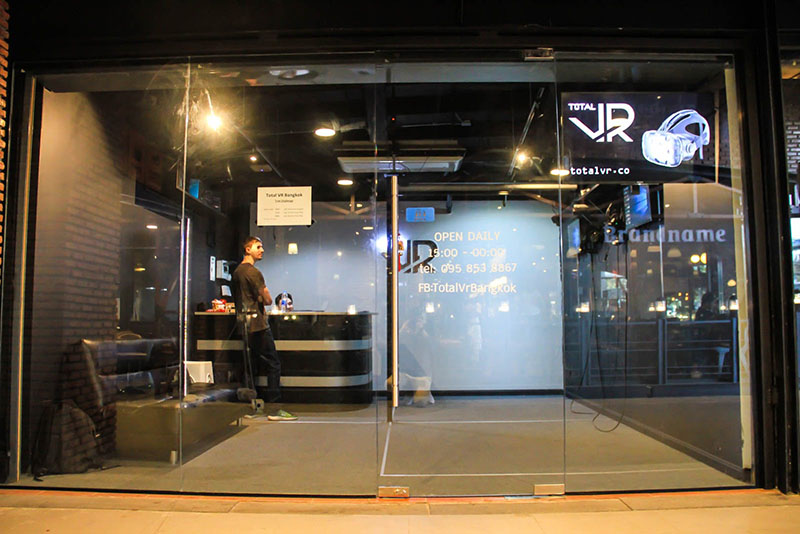
At The Street Ratchada, Total VR operates two “room scale” VR experiences. That means two people are not only seeing a different world but also have 4sqm to walk around them and even crouch behind virtual objects. Players at Total VR can do their own thing or share experiences.
Total VR at The Street Ratchada in Bangkok.
There are two barriers to bringing the best VR into the home. One is the cost for the headsets and powerful computers needed to run them. The second is space. The top product supports upward of 20sqm of room-scale space, but whether 4sqm or 20sqm, good luck finding the space so things don’t get broken during tennis battles.
That’s why Total VR opened in September, said owner Alexandru Damascan.
“VR represents a beginning of how the gaming industry could evolve in future,” Damascan said. “It’s like the first arcade games back in ‘80s. It’s new and exciting.”
Since opening in September with about 40 games and “experiences” available on the Steam platform, he says business has been good.
Oculus Rift headsets hang inside Total VR.
Damascan has been in Thailand nearly two years. He said he looked at other markets such as China, where more than 3,000 unofficial VR arcade centers have popped up. He foresees business in Thailand could be much the same. So far, at Total VR, enthusiasts and skeptics and VR virgins have walked in to enter another world for at least 60 minutes.
“Most clients are not necessary gamers,” said Damascan, whose favorite game is a sniper simulator called The Nest. “[They] scream and laugh. For a few minutes, they’re completely in a middle of totally new world … It’s insane.”
Alexandru Damascan takes aim in ‘The Nest’ at his VR gaming cafe Total VR.
Ready for Prime Time?
In Thailand, the biggest force in computer gaming is Garena Online. From cybercafes, publishing, distribution and competitive e-sports, Garena is everywhere in the kingdom.
Garena Thailand CEO Maneerut Anulomsombut said that while they are researching the technology and studying it in other countries, they don’t believe it’s ready to break out in the mass market. At least not in Thailand, which is dominated by accessible and competitive titles such as FIFA Online 3, League of Legends and Heroes of Newerth.
“For hardcore gamers, high-resolution visuals and being able to play in groups are very important. For that, VR games are not yet the best answer,” she said.
More disadvantages follow. Were the headsets even in stores, the majority of Thai consumers would still be priced out. For room-scale VR, the Oculus Rift and HTC Vive, which are not yet sold in Thailand, run about 21,000 baht (USD$600) and 28,600 baht ($800), respectively. And that’s not including the powerful computer needed for them to work. (More accessible but less impressive is Sony’s PlayStation VR, which should be about 14,000 baht in Thailand.)
And interfacing technology with flesh is still in the crude stages of development. Some people get motion sickness, either suddenly or after prolonged use, that can include dizziness, disorientation and nausea. Maneerut said the side effects are more evidence the tech has a ways to go.
Damascan, who uses the HTC Vice at Total VR, said he’s looking forward to some improvements as well.
“The headsets should be made wireless because the customers want to move freely,” he said.
They Build Worlds
Although mass market adoption is unlikely this year and possibly next, some see virtual gold in the market.
Late last month, users got to enter a virtual Thai horror film through “Araya,” a first-person horror game developed by Bangkok-based Mad VR Studio. The adventure takes place inside a Thai hospital and contains supernatural elements from Thai folklore. In the game, players can experience a thrilling journey through three different characters to crack a murder case.
The studio was founded only a year ago by a businessman and seven new grads from Sripatum University’s School of Digital Media.
The first Thai supernatural horror game to leap into VR began as “The Hospital Haunted: Be Lost,” a haunted hospital-themed game and thesis project of Jatuporn “Kok” Rakthaijaroencheep. The game’s plot moments were plucked from ghost radio programs and movies.
“At first, I wanted to do an actual haunted house where people could have an interactive horror experience, but it’s really expensive,” said Kok, who majored in interactive and game design and graduated last year. “So I thought ‘How do I make people have such experiences without going outside their homes?’ Then I found Virtual Reality as the answer.”
“Araya” wouldn’t have happened if hawk-eyed businessman Alan Archapilaj didn’t spot an opportunity. He invested in the company and started it from scratch in October 2015. It took 13 months for the game to be ready.
So could this be the kind of innovative, creative new enterprise the government talks about supporting?
Alan says it’s too soon to tell. For one, virtual reality entertainment is already lagging behind other countries such as China, the United States and European nations, partly because none of the hardware is yet being imported for sale in the country.
“If you compare technology to four seasons, Virtual Reality in Thailand is now in spring,” Alan said. “Virtual Reality is still very new here. Plus, the hardware is very expensive. It’s like smartphones in their early years.”
Not All Fun and Games
While virtual reality has grabbed attention for its primary application – gaming – it can also be used to enter virtual painting studios to create art, explore the solar system, travel the planet via Google Earth and experience immersive story-telling.
Beyond entertainment, it’s likely to find more practical uses in everything from medicine and engineering to education.
Leading a team of 10 college students, Bangkok University’s Phattanapon Rhienmora has conducted research into using VR to make the world better. They’ve experimented with using it to treat anxieties associated with everything from learning to drive, speaking publicly and acrophobia – fear of heights.
In other faculties, students learning to be guides save time by learning venues and historical details of places like the Grand Palace or historic parks of Sukhothai without actually traveling there. Architecture students can walk through their designs before they even go to blueprints.“The students are so excited. They told me Virtual Reality can be very useful,” said Phattanapon, a lecturer in the university’s School of Information Technology and Innovation.
He said a Virtual Reality Development course will be introduced into the curriculum next semester.
Total VR Bangkok is located on ground floor of The Street Ratchada, a shopping mall walkable from MRT Thailand Cultural Center. “Araya” is for sale on Steam for 369 baht. Though it only supports the Oculus Rift, can also be played on a regular PC without a VR headset.
Gen. Prayuth Chan-ocha chairs a meeting between the junta and Cabinet at the Government House in Bangkok, 19 May 2015.
BANGKOK — Five new cabinet members were introduced Friday as the military government rotated its positions for the fourth time since seizing power in 2014.
The reshuffle was said to be made to improve performance as well as fill the positions of Justice Minister Gen. Paiboon Koomchaya and Minister of Education Gen. Dapong Ratanasuwan, who resigned to become members of the King’s Privy Council.
The new justice minister is Suwaphan Tanyuvardhana, former minister to the prime minister’s office. The new minister of education is Teerakiat Jareonsettasin, who formerly served as deputy education minister.
Pichet Durongkaveroj was moved from the Ministry of Science and Technology to head the new Ministry of Digital Economy and Society.
Industry Minister Achaka Sriboonruang was moved to replaced Pichet as minister of science and technology.
Uttama Savanayana who was previously expected to head the new Digital Ministry after he resigned from his position as minister of information and communication technology, however, appointed back as minister of industry, replacing Achaka.
Minister to Prime Minister’s Office Panada Disakul was moved to be deputy minister of education.
Deputy Minister of Transport Omsin Chiwaphruek and Deputy Minister of Commerce Suvit Maesincee were moved to be minister in the Prime Minister’s Office.
The five newcomers include Uttama who rejoined the cabinet, Veerasak Futrakul as deputy minister of foreign affairs, Pichit Akrathit as deputy minister of transport, Sonthirat Sonthijirawong as deputy minister of commerce and Chutima Boonyaprapat as deputy agriculture minister.
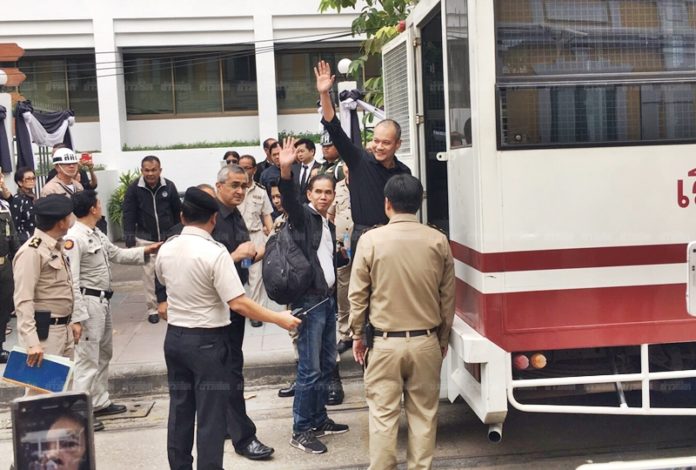
Red Shirt leader wave their hands to media while they are taken from military court to Bangkok Remand Prison Friday.
BANGKOK — Prosecutors on Friday indicted 19 senior members of the anti-coup Redshirt movement for violating a ban on political activities when they sought to open an office to monitor last August’s referendum on a new constitution.
The draft charter, criticized as undemocratic but promoted by the military regime that seized power from an elected government in May 2014, was passed.
The Redshirt movement, also known as the United Front for Democracy Against Dictatorship, is closely associated with the Pheu Thai party that led the ousted civilian government. It led militant street demonstrations in 2010 in Bangkok that were put down with deadly force by the army.
The indictments in a military court appear to mark a resumption of government pressure on its opponents after a period of relative political calm following the Oct. 13 death of King Bhumibol Adulyadej and his succession by his son, King Maha Vajiralongkorn Bodindradebayavarangkun, at the beginning of this month.
The Redshirt leaders were charged with violating a ban on holding political assemblies of more than five people that the military imposed shortly after taking power. If found guilty they could be jailed for one year and fined up to 20,000 baht ($560).
Winyat Chatmontree, a lawyer representing the Redshirts, said the June action for which they were charged was a news conference, not a political meeting, and they would plead not guilty. They were granted release on bail of 20,000 baht ($560) each, he said.
Also Friday, Prime Minister Prayuth Chan-ocha reshuffled 12 positions in his Cabinet. Two military men who resigned ministerial posts last week after being appointed to the Privy Council of advisers to the king were replaced by civilians, and Pichet Durongkaveroj, who had been minister of science and technology, became the first minister of the newly created Ministry of Digital Economy and Society, which replaced the Ministry of Information and Communication Technology.
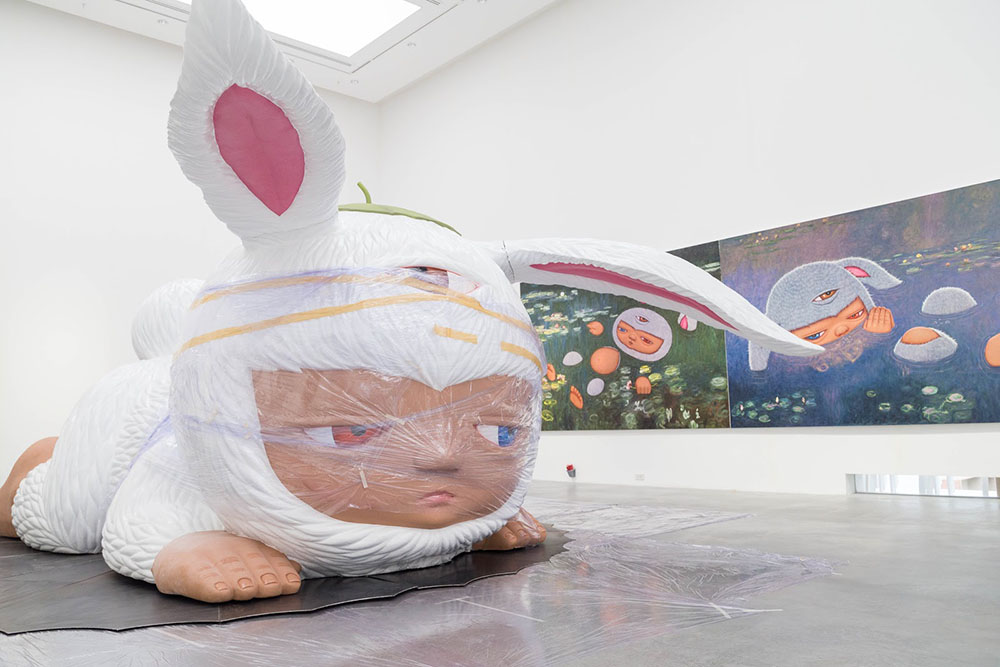
On Sunday afternoon at Bangkok CityCity gallery, a six-wheeler slowly turned into the parking lot. Sprawled on top, a massive humanoid baby with three eyes and bunny ears. “That thing looks crazy,” someone said.
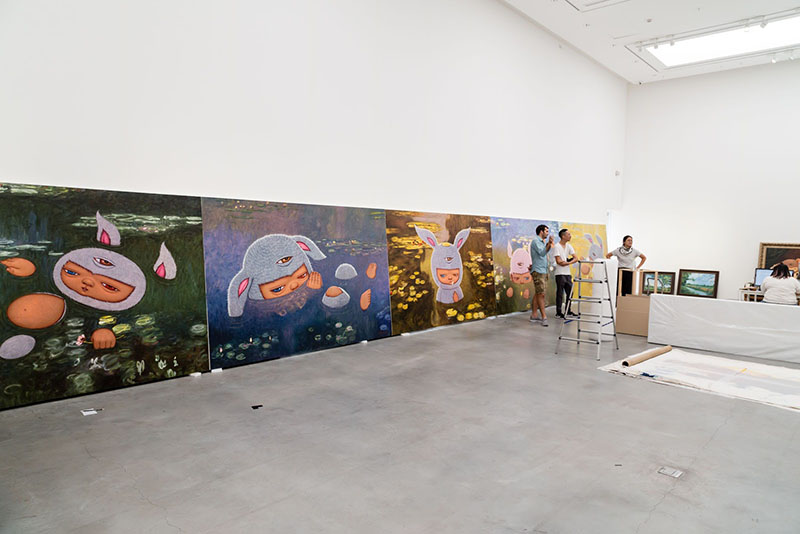
That thing is Mardi, the trademark character of Bangkok graffiti icon Alex Face. With smiling gallery staff looking on, Alex and his team proceeded to unload and assemble the fiberglass sculpture for its debut Wednesday as the centerpiece of “Alive,” a large exhibition of his work.
Alex has risen to fame since his 2002 debut. Like a lot of ne’er-do-wells, skateboard culture was his gateway to graffiti. At first he would tag walls with his name and face for fun. People took notice and he landed a few small painting jobs. It was 2009 when his daughter came into the world that he gave birth to Mardi, the three-eyed character in the bunny suit.
“Alive” will be his sixth such show, but this time Mardi will be immersed in a more natural setting.
“This exhibition is different because of the impressionist element in my new work. When I was growing up, I was always close to nature,” he said. “I lived next to rice paddies and lily ponds, and I wanted to use that theme.”
I asked him why he chose the name Mardi. Alex stopped me and said that he regrets giving it a name.
“I never intended it to have a name, but people started asking me about the character, so I told them it was named after my daughter Mardi,” he said. “But I prefer that it doesn’t have a name because sometimes the character tells other people’s stories and topics.”
Alex Face. Photo: Brady Weeks
In April the character landed Alex in some hot water when some complained a mural on a historic building painted as part of a city art project was too modern. He took it in stride when he was told to take it down.
Dealing with haters is part of any job, but it’s hard to be creative when you’re stressed out. In Alex’s case he started preparing in August for “Alive,” where 30 of his new works will show.
“I never really worry too much about it, I just really enjoy making art. It really makes me happy and it’s a kind of therapy for me. Art is something that I loved since I was kid, I never stopped doing it, and I didn’t expect anything from it,” Alex said.
What he didn’t know, he said, was whether he could survive off it.
“A young artist once said to me, ‘If I don’t make it in two years as an, artist I’m gonna look for another job,’” he said. “I said to him that two years is not enough. I’ve been doing this for over 20 years, and even when other people made fun of me and criticized me, I was always happy to keep on doing my art.”
“Alive” runs Dec. 21 to Feb. 19 at Bangkok CityCity Gallery. The year-old venue is owned and operated by filmmaker Akapol “Op” Sudasna and former Channel [V] VJ Supamas “Louktan” Phahulo.
This undated law enforcement booking photo provided by the Garden Grove, Calif., Police Department shows Minh Quang Hong, known as Minh Beo, a popular Vietnamese comedian. Photo: Associated Press
WESTMINSTER, California — Vietnamese comedian Minh Beo has been sentenced to 18 months in state prison for sexually assaulting a 16-year-old boy in California.
Orange County prosecutors said Friday the 38-year-old must also register as a sex offender.
The comedian, whose real name is Minh Quang Hong, pleaded guilty in August to oral copulation of a minor and attempting to commit a lewd act on a child under the age of 14. The second charge stemmed from a meeting he arranged with a police officer posing as a 13-year-old boy.
He is known in Vietnam as Minh Beo, meaning “Fat Minh.” He has been popular in stage, TV and movie comic roles and has his own theater in Ho Chi Minh City.
BANGKOK — Do donations really help the poor? Or is social enterprise a better answer?
Those are the questions raised by a provocative documentary by a Christian, libertarian think tank in the United States that will show in the year’s final installment of Doc+Talk at the Bangkok Art and Culture Centre.
Directed by Michael Matheson Miller of the Acton Institute, “Poverty, Inc.”examines global charity organizations and their flaws through the lens of those who opposed to institutional charity.
The 2014 documentary draws upon more than 200 interviews and was filmed in 20 countries.
The movie, in Thai and English subtitles, shows at 2pm and 4pm on Dec. 24 in the fifth-floor auditorium of the Bangkok Art and Culture Centre.
Tickets are 100 baht and can be purchased online. The panel discussion in Thai will begin after the screening at 6pm with assistant professor Thanee Chaiwat of Chulalongkorn University’s Faculty of Economics.
The “Doc+Talk” series is a monthly event focused on social issues around the world. It’s hosted by the Documentary Club.
SA KAEO — A music video cover of a popular K-pop song by little girls from the far east of Thailand has been melting hearts online and is the perfect way to end the week.
Mom-mam, Som, Gwang, and Goong-ten, between 7 and 10 from Sa Kaeo province, are superstars of the week for their adorable-yet-skillful, shot-by-shot remake of “Playing With Fire” by Korean girl group Black Pink has racked up more than a million views since it was posted Dec. 9.
Netizens speculated the choice of song and artist band may be due to the presence of Lalisa “Lisa” Manoban, Black Pink’s 19-year-old Thai member.
Opponents of Thailand’s single gateway project have adopted a personification of the project called Nong Kalaland by artist Wisaruth Wisidh.
BANGKOK — Despite strong opposition from the public and private sector, junta-appointed legislators on Friday passed a controversial revision of the Computer Crime Act.
What initially was launched as a bid to fix the law’s propensity for abuse then morphed into a vehicle for granting more powers for authorities to capture and censor content online ended Friday at 3:50pm in a 168-to-0 vote by the National Legislative Assembly to enact the revised law. Four abstained.
Speaking to assembly members after the law passed, the police official who led the revision effort insisted again that all those who opposed it – activists, experts, business interests and 300,000 petitioning citizens – were wrong to suggest it would help fulfill the regime’s desire to gain control of the internet traffic through a project known as “single gateway.”
“It isn’t about that at all,” said police Maj. Gen. Chatchaval Suksomjit. “It was an important and necessary law to be implemented and will not lead to infringement of rights.”
The law will go to the king for royal endorsement within 20 days.
In a six-hour session, the members read through and discussed the revised law’s 20 articles.
Critics cried foul when the live broadcast of the session went silent for about 30 minutes during debate of a key article.
When the assembly accepted the principles set forth in an April draft, opponents began campaigning against it, as the revised law grants expanded powers to authorities and removes mechanisms to keep them in check.
It was originally hoped that rewriting the controversial 2007 cybercrime law would return it to its intended purpose as a tool to fight phishing and other online scams. In recent years it has been taken up by corporations and the military regime to punish critics and silence whistleblowers.
Those drafting the revision held few public hearings and incorporated little of what the public wanted to see.
Among top concerns was that the law would allow authorities to remove or block content that did not violate any law. It empowers an appointed committee with no public accountability to target any content it deems “immoral.” The law also said authorities can use any technical methods, including decrypting encoded computer traffic if they think there is due cause.
Drafters also declined to clarify language used in the law’s problematic Article 14, the vaguery of which was blamed for its use to prosecute activists, human rights defenders and journalists for criminal online defamation.
Rights groups Thai Netizen Network and Amnesty International Thailand on Thursday submitted to the assembly an online petition signed by 300,000 people opposing the new draft.
The petition has now reached 360,000 signatures in a few day while hashtag #ComputerCrimeAct has been trending on social media as netizen gathered to campaign against it.
Top figures from the military government, army and the law’s drafters signaled Thursday the law would sail through. They echoed the same message that its opponents misunderstood and were distorting information about the law.
Despite appearing to create legal cover for authorities to go through with a long-held desire to rein in expression online by establishing a single internet gateway under government control, the law, they said, had no connection.
“Don’t distort the information. Stop talking about the single gateway. We are not doing it,” Prime Minister Prayuth Chano-ocha said Thursday, one day after his No. 2 said it was “still necessary.”
Update: This story was updated to reflect that a fifth abstaining member complained he did not know it was the time to vote. His vote was changed to be in favor of adopting the bill.
Prince Constantijn Aschwin of the Netherlands presents the 2016 Principal Prince Claus Award to Thai filmmaker and artist Apichatpong Weerasethakul Thursday. Photo: Frank van Beek / Prince Claus Fund.
AMSTERDAM — The first Thai filmmaker to win Cannes’ highest award was honored by Dutch royalty Thursday for his unique artistic expression.
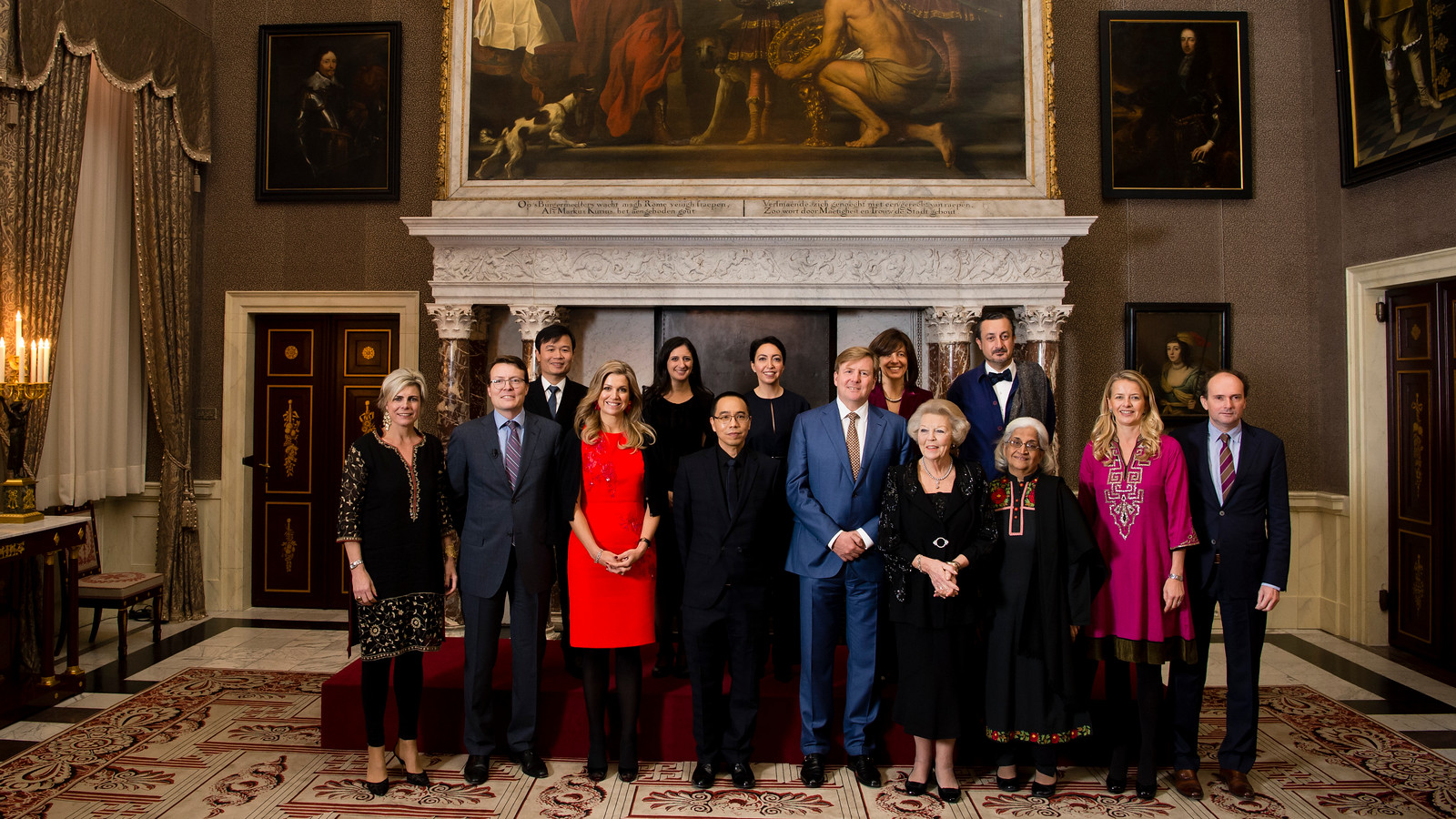
Independent filmmaker and artist Apichatpong Weerasethakul was presented a 2016 Principal Prince Claus Award by Prince Constantijn Aschwin of the Netherlands at the Royal Palace in Amsterdam to honor his outstanding achievement in art and filmmaking.
“We realize more and more the beauty of our differences, and at the same time the atrocities and the prejudices,” Apichatpong, 46, said. “And there are still many places that remembering and sharing is dangerous. I know because I am from such place. My question is, what do we do to reach out, and communicate with empathy, when that place operates on a different logic?”
The ceremony included a screening of Apichatpong’s short film “Fireworks.”
Apichatpong began his career in 1993 and has directed several acclaimed films. His greatest success came in 2010 when “Uncle Boonmee Who Can Recall His Past Lives” won the Palme d’Or at the Cannes Film Festival.
The Prince Claus Awards honor excellent achievements in culture and development, especially in countries where expression is limited.
The five 2016 recipients included a Lebanese food activist, Egyptian-Lebanese artist and Vietnamese architect.
Prince Constantijn Aschwin of the Netherlands presents the 2016 Principal Prince Claus Award to Thai filmmaker and artist Apichatpong Weerasethakul Thursday. Photo: Frank van Beek / Prince Claus Fund.Apichatpong Weerasethakul, sixth from left, poses with Dutch prince Constantijn Aschwin, second from left, and other royals and recipients of the 2016 Prince Claus Awards on Thursday at the Royal Palace in Amsterdam. Photo: Frank van Beek / Prince Claus Fund.