35 C
Bangkok
Monday, June 8, 2026
Home Blog Page 2490

Young Thai Girls’ K-Pop Parody is This Week’s Internet Catnip

SA KAEO — A music video cover of a popular K-pop song by little girls from the far east of Thailand has been melting hearts online and is the perfect way to end the week.

Mom-mam, Som, Gwang, and Goong-ten, between 7 and 10 from Sa Kaeo province, are superstars of the week for their adorable-yet-skillful, shot-by-shot remake of “Playing With Fire” by Korean girl group Black Pink has racked up more than a million views since it was posted Dec. 9.

Netizens speculated the choice of song and artist band may be due to the presence of Lalisa “Lisa” Manoban, Black Pink’s 19-year-old Thai member.

Advertisement

Computer Crime Act 2.0 Passes Unanimously

Opponents of Thailand’s single gateway project have adopted a personification of the project called Nong Kalaland by artist Wisaruth Wisidh.

BANGKOK — Despite strong opposition from the public and private sector, junta-appointed legislators on Friday passed a controversial revision of the Computer Crime Act.

What initially was launched as a bid to fix the law’s propensity for abuse then morphed into a vehicle for granting more powers for authorities to capture and censor content online ended Friday at 3:50pm in a 168-to-0 vote by the National Legislative Assembly to enact the revised law. Four abstained.

Speaking to assembly members after the law passed, the police official who led the revision effort insisted again that all those who opposed it – activists, experts, business interests and 300,000 petitioning citizens – were wrong to suggest it would help fulfill the regime’s desire to gain control of the internet traffic through a project known as “single gateway.”

“It isn’t about that at all,” said police Maj. Gen. Chatchaval Suksomjit. “It was an important and  necessary law to be implemented and will not lead to infringement of rights.”

The law will go to the king for royal endorsement within 20 days.

In a six-hour session, the members read through and discussed the revised law’s 20 articles.

Critics cried foul when the live broadcast of the session went silent for about 30 minutes during debate of a key article.

Read: Why Thailand Should Worry About an Improved(?) Computer Crime Act

When the assembly accepted the principles set forth in an April draft, opponents began campaigning against it, as the revised law grants expanded powers to authorities and removes mechanisms to keep them in check.

It was originally hoped that rewriting the controversial 2007 cybercrime law would return it to its intended purpose as a tool to fight phishing and other online scams. In recent years it has been taken up by corporations and the military regime to punish critics and silence whistleblowers.

Those drafting the revision held few public hearings and incorporated little of what the public wanted to see.

Among top concerns was that the law would allow authorities to remove or block content that did not violate any law. It empowers an appointed committee with no public accountability to target any content it deems “immoral.” The law also said authorities can use any technical methods, including decrypting encoded computer traffic if they think there is due cause.

Drafters also declined to clarify language used in the law’s problematic Article 14, the vaguery of which was blamed for its use to prosecute activists, human rights defenders and journalists for criminal online defamation.

Rights groups Thai Netizen Network and Amnesty International Thailand on Thursday submitted to the assembly an online petition signed by 300,000 people opposing the new draft.

The petition has now reached 360,000 signatures in a few day while hashtag #ComputerCrimeAct has been trending on social media as netizen gathered to campaign against it.

Top figures from the military government, army and the law’s drafters signaled Thursday the law would sail through. They echoed the same message that its opponents misunderstood and were distorting information about the law.

Despite appearing to create legal cover for authorities to go through with a long-held desire to rein in expression online by establishing a single internet gateway under government control, the law, they said, had no connection.

“Don’t distort the information. Stop talking about the single gateway. We are not doing it,” Prime Minister Prayuth Chano-ocha said Thursday, one day after his No. 2 said it was “still necessary.”

Update: This story was updated to reflect that a fifth abstaining member complained he did not know it was the time to vote. His vote was changed to be in favor of adopting the bill.

Related stories:

Single Gateway ‘Still Necessary,’ Deputy PM Prawit Says

‘Back Door’ in CCA Not Trojan Horse for Single Gateway, Drafters Say

New Cybercrime Regs Would Open Back Door to Censorship

Website Shutdowns Soar After King’s Death

Why Thailand Should Worry About an Improved(?) Computer Crime Act

Thailand’s Draconian Cyberlaws Tipping Toward Totalitarian

Computer Crime Act Has Issues, Google Tells Censorship Committee

Online Freedom to Slide Further, Online Activists Predict

Advertisement

Filmmaker Apichatpong Recognized by Dutch Royalty

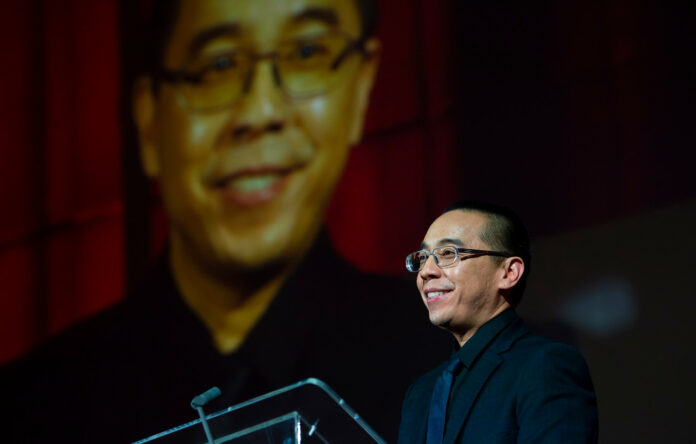
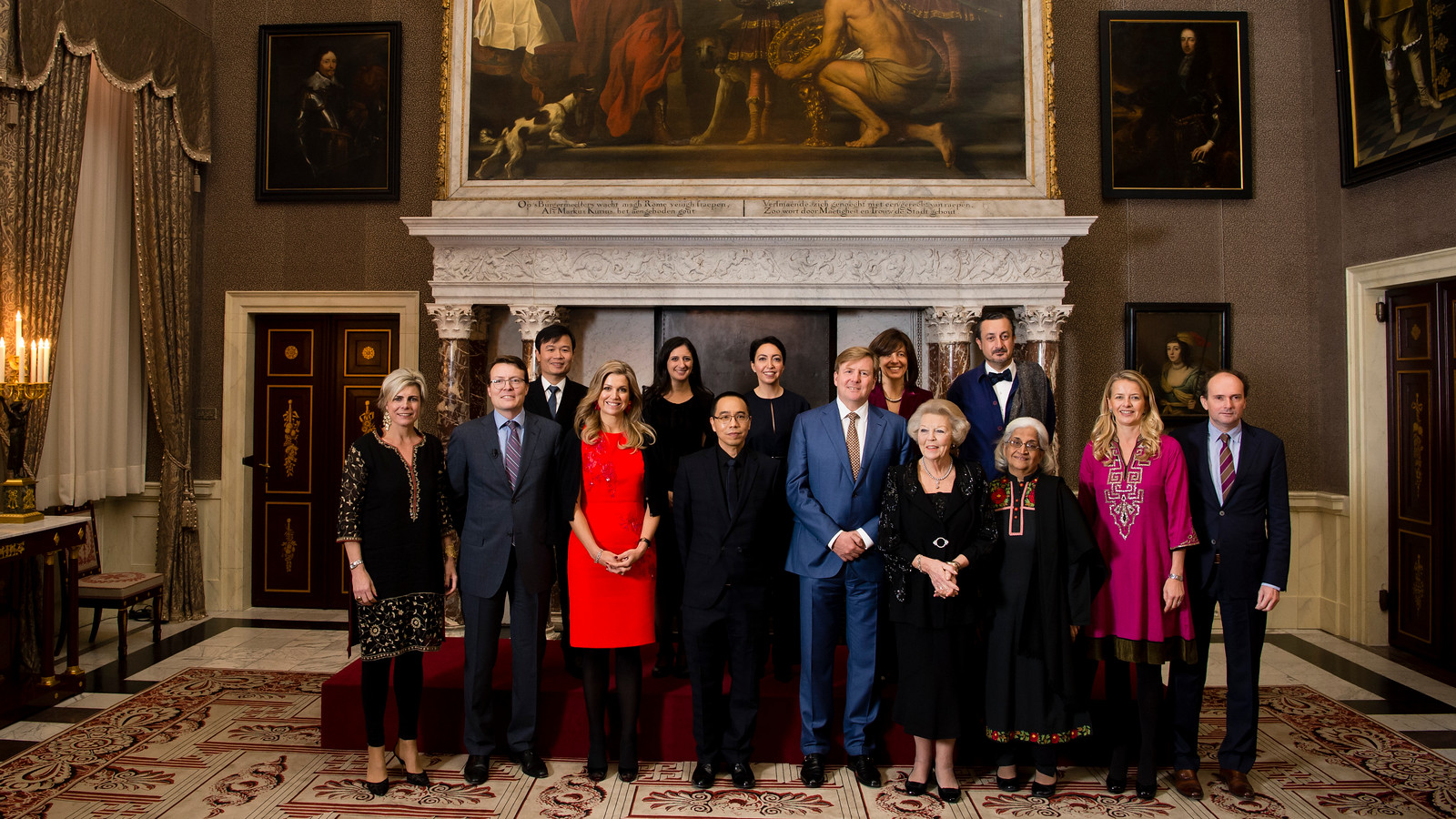
Prince Constantijn Aschwin of the Netherlands presents the 2016 Principal Prince Claus Award to Thai filmmaker and artist Apichatpong Weerasethakul Thursday. Photo: Frank van Beek / Prince Claus Fund.

AMSTERDAM — The first Thai filmmaker to win Cannes’ highest award was honored by Dutch royalty Thursday for his unique artistic expression.

Independent filmmaker and artist Apichatpong Weerasethakul was presented a 2016 Principal Prince Claus Award by Prince Constantijn Aschwin of the Netherlands at the Royal Palace in Amsterdam to honor his outstanding achievement in art and filmmaking.

“We realize more and more the beauty of our differences, and at the same time the atrocities and the prejudices,” Apichatpong, 46, said. “And there are still many places that remembering and sharing is dangerous. I know because I am from such place. My question is, what do we do to reach out, and communicate with empathy, when that place operates on a different logic?”

The ceremony included a screening of Apichatpong’s short film “Fireworks.”

Apichatpong began his career in 1993 and has directed several acclaimed films. His greatest success came in 2010 when “Uncle Boonmee Who Can Recall His Past Lives” won the Palme d’Or at the Cannes Film Festival.

The Prince Claus Awards honor excellent achievements in culture and development, especially in countries where expression is limited.

The five 2016 recipients included a Lebanese food activist, Egyptian-Lebanese artist and Vietnamese architect.

Prince Constantijn Aschwin of the Netherlands presents the 2016 Principal Prince Claus Award to Thai filmmaker and artist Apichatpong Weerasethakul Thursday. Photo: Frank van Beek / Prince Claus Fund.
Apichatpong Weerasethakul, sixth from left, poses with Dutch prince Constantijn Aschwin, second from left, and other royals and recipients of the 2016 Prince Claus Awards on Thursday at the Royal Palace in Amsterdam. Photo: Frank van Beek / Prince Claus Fund.


Advertisement

Korat Gets Triple-Sized Terminal 21

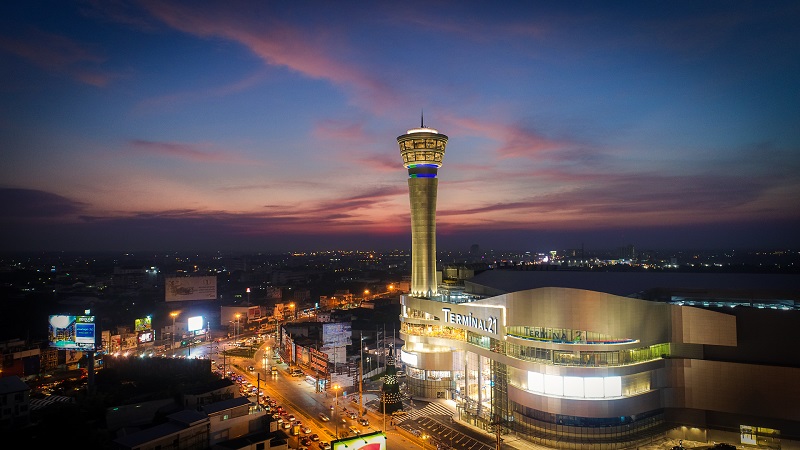
KORAT — A Terminal 21 shopping mall will open in the center of Isaan with all kinds of lifestyle excitement this Monday.

The mixed-use complex Terminal 21 has expanded the realm to the northeast region. Its second branch, Terminal 21 Korat, will stretched up to 7 storeys on a 32-rai land along the city’s Mittraphap highway.

The 6 billion-baht shopping mall is three times bigger than the original in the capital. It has a sky-high airport-style “control tower” said to climb 30-stories.

The venue promises more than 200 shops, seven SF Cinema theatres, an ice skating rink, an amusement park and more. Like the original, each floor will be decorated in the theme of popular cities worldwide including Paris, London, Tokyo and San Francisco.

The parking lot will accommodate 2,500 cars and 1,800 motorbikes. The newest megastore was built by Siam Retail Development, the same group behind the original Terminal 21. Starting Monday, it will be open 10am to 10pm daily.

TERMINAL21KORAT


Advertisement

Monopolyland: Can Thailand’s Markets Ever be Fair?

When a downtown luxury hotel reopens as a wellness center next year, it will be a jewel in the crown of a private healthcare provider that has swallowed its competitors in recent years to become the realm’s largest private medical services provider.

About the time Bangkok Dusit Medical Services, or BDMS, announced its plans for Swissotel Nai Lert Park Hotel’s 15 rai of land, the group spent 1.4 billion baht to buy Mayo, another private hospital. Since 2010 it has acquired BNH, Phyathai, Paolo and Royal hospitals. It also holds majority stakes in Bumrungrad and Ramkhamhaeng hospitals.

That kind of industry consolidation has health care advocates worried about the usual things that come with less competition – rising costs and declining service. In Thailand’s unregulated private health care industry, advocates worry one corporation could gain control of the market and have an outsized influence on public health policy.

“From now on, if people are upset with costs and want to move from one hospital to another, they will likely end up at a private hospital in the same group,” said Preeyanan Lorsermvattana, a health care activist who’s campaigned against the increasing costs of private care.

Oligopolies, duopolies and even monopolies abound in Thailand. Health care isn’t the only industry lacking in competition. Convenience stores, telecoms, brewers, movie theaters and more are dominated by just one or two players, all despite an antitrust law that in 17 years has seen a total of zero rulings against big business.

A toothless law that, by design or defect, left critical portions unfinished and therefore unenforceable.

“The law is not really defective,” said Deunden Nikomborirak, research director at the Thailand Development Research Institute, who has studied antitrust laws. “The law said the detailed regulations must be issued after. They just never made it happen.”

olidefineThe military regime is the latest to tell the public it wants to strengthen the law, but unlike previous governments, it has actually made some progress. Last month a draft revision of the 1999 law was completed. Those advocating reform say it shows some signs of improvement but is unlikely to be a game changer.

That draft, submitted Nov. 1 to the junta-appointed legislature, was among a raft of laws earmarked “urgent” by the cabinet for progress before the year ends.

Meanwhile alarms continue to be raised about anti-competitive practices. 7-Eleven, owned by the same conglomerate as phone service provider True Corp., last month stopped selling prepaid cards from competitor AIS. Earlier this year, a small movie distributor complained it was forced into a type of pay-to-play arrangement by a major cinema chain.

When consumers or their advocates want to cry foul, they can take their complaint to one place: the Trade Competition Committee.

Monopolyland: Top Player

Click above to explore

Earlier this month, Prasert Prasarttong-osoth was named the richest investor on the Stock Exchange of Thailand for the fourth consecutive year, with holdings of over 67 billion baht.

While his portfolio contains television channels and an airline, most of that money is derived from Bangkok Dusit Medical Services, or BDMS. Its stock value increased nearly 20% in 2016, and today the company’s market cap value is just over 350 billion baht. 

As Thailand’s largest private medical services group, BDMS for years has expanded its business and become the market leader through a tried and true method: mergers and acquisitions.


The Deciders

Established under the 1999 law, the committee is headed by the commerce minister with permanent secretaries from the ministries of Commerce and Finance. The membership ranges from eight to 12 cabinet appointees drawn from relevant fields. Half must be from the private sector.

When film distributors were told to buy ads to get their movies shown, it was little surprise to the consumers who have two choices – SF Cinema or Major Cineplex – which sell tickets at the same, high prices.

Someone was annoyed enough to file a trade complaint in 2003, accusing the cinema groups of colluding as a cartel to raise ticket prices.

That case went to the Trade Competition Committee to decide. It soon ruled the movie house operators were clean.

Two years earlier, motorcycle manufacturers Suzuki, Yamaha and Kawasaki filed a complaint against Honda, accusing it of pressuring retailers into not selling other brands. Though Honda was eventually indicted by the commission, the process took so long it exceeded the 10-year statute of limitations and was dropped.

Another controversial case was in 2011, not long after French multinational Carrefour sold its stores to big box retailer Big C. Big C was incensed when archrival Tesco Lotus advertised it would redeem Carrefour coupons at double value. Big C filed a complaint, and the case remains unresolved today.

Reformists say those are just some of the examples which show the problem isn’t with the law but its enforcement. In fact, not once in its 17-year history has the committee ever prosecuted a business for violating the law.

Critics say one reason it is ineffective is because the committee is headed by a political appointee.

“No country lets a minister sit as chairman,” Deunden said.

The minister’s demanding schedule also means the committee holds very few meetings per year. Not to mention the vulnerability to political and business pressures brought to bear.

The new draft tries to fix this problem by replacing the committee members with experts.

But as Deunden pointed out, the underfunded agency – its annual budget is 6 million baht – will have a hard time attracting talented professionals who could earn more sitting on high-profile corporate boards.

Approval With a Nod (Wink Optional)

Many were surprised in 2010 when Big C acquired rival Carrefour for 3.8 billion baht. Authorities signaled concern about the deal, but seems to be the default, nothing more happened.

While mergers and acquisitions are legitimate, they can also be shortcuts to unregulated monopolies. In many countries, concern about the threat they pose to competition is at the heart of antitrust laws and the costs are extremely high. The EU Commission and US Department of Justice have blocked a number of market-changing mergers of some of the world’s largest corporations.

Under Thailand’s 1999 trade competition law, businesses must win approval for such deals if they are likely to affect the market.

In practice, it’s never been a thing. There are no detailed regulations identifying what mergers would need to seek approval.

So drafters of the new draft took another approach. They wrote that businesses won’t need approval, they need only inform the Trade Competition Committee – seven days after the deal is done.

If the committee then determines a monopoly situation resulted from the deal, the new draft fails to say what it should do next.

Duenden said there are a few countries which use this model.

“But then businesses risk being ordered to separate after,” she said. That means, she added, there must be clear regulations about what kind of mergers are okay and advisors available for businesses to make informed decisions.

She worries that may never happen.

This system could ease the creations of monopolies, according to a lawyer with a background in trade competition law.

“If big business grows without regulation, they will have more dominance over the market,” said Wipanan Prasompluem of international law firm Allen & Overy. “That power will create opportunity to commit even more offenses.”

Government in on the Business

Oligopolies aren’t limited to the public sector.

Investors know the wisdom of investing in state-owned enterprises, which always perform well in Thailand stock market.

Besides their built-in monopolistic tendencies, entities such as Thai Airways, PTT and Airports of Thailand also benefit by not being regulated by the 1999 trade competition law.

“It was controversial that state-owned businesses, such as energy and airways, were not under the law, even though they aim for commercial not public interest,” Wipanan said.

That’s a point in favor of the new draft, which includes state-owned enterprises under its purview. Still, it exempts business activities considered necessary for national security and public interest.

Law Handicapped by Defects

Even blatant cases of anti-competitive practices have been met with inaction.

Singha Beer had monopolized the beer market in Thailand for seven decades until Thai Beverage, make of Thai whiskey Mekhong, joined the fray by introducing Chang Beer.

To obtain market share, the brewer, aka ThaiBev, told its distributors it would not sell whiskey to them unless they also bought beer. ThaiBev would do the same when it introduced Archa Beer to the market in 2004, which it sold at a loss.

Singha maker Boon Rawd Brewery filed complaints in both cases. They went nowhere, in part due to, again, portions of the law left undefined. While the included penalties for those who abuse market dominance, it didn’t define just what a “market” was.

Wipanan said this issue was made better under the new draft which also requires updated regulations every three years.

Opening Up the Books

The process of rewriting the law continues and is expected to soon be completed, possibly early next year.

In the end, no matter how the law is amended, its impact in creating fair markets will always depend on those wielding it.

Visit the Trade Competition Committee’s website in search of its case history, and find only brief summaries of why every case was dismissed. More baffling is the decision to redact all names of the brands in questions from its reports.

Duenden said the most important missing regulation is making the review process transparent, so the public knows justice is being done and industries can learn what standards are being applied.

“Otherwise who knows how you exercised judgment?” Duenden said. “The law is not black and white.”

With the argument that the office will still continue to show poor performance due to its low funding, Duenden said the agency also must demonstrate to the public it is crucial to maintaining balancing in the economy. Once that faith is earned, it can negotiate for a larger budget.

Duenden said that would take a landmark ruling that showed it was a force for market justice.

“But they need to make visible achievement, and not by doing some small cases, but a case that really affects a lot of people,” she said.


Advertisement

China’s 1st Aircraft Carrier Carries Out Live-Fire Exercise

Chinese aircraft carrier Liaoning cruises for a test in the sea in 2012. Photo: Li Tang / Associated Press

BEIJING — China’s first aircraft carrier battle group has carried out its first live-fire exercise, the Defense Ministry has announced.

Dozens of ships and aircraft took part in the exercise “a few days ago” in the Bohai Sea in eastern China to test weapon performance and training levels, according to a statement posted Thursday on the ministry’s website.

China said last month that its aircraft carrier, the Liaoning, was ready to engage in combat, marking a milestone for a navy that has invested heavily in its ability to project power far from China’s shores.

The carrier, destroyers and frigates carried out exercises covering air interception, sea-based attacks and air-defense as well as reconnaissance, early warning and anti-missile systems.

The ministry posted photos on its website of China-developed J-15 fighters on the deck of the carrier. J-15 fighters carried live ammunition and performed strike exercises, it said.

The Liaoning was commissioned in 2013 after being purchased as an incomplete hull from Ukraine more than a decade ago.

China hasn’t described specifically how it intends to use the Liaoning, but it is seen as helping reinforce China’s increasingly assertive claims over almost all of the South China Sea, which is home to key shipping lanes, rich fishing grounds and a potential wealth of mineral resources.

Five other governments claim the maritime space either in part or in whole, and the Philippines and Vietnam in particular have sought assistance from the U.S. and others in beefing up their ability to resist China, including its construction of seven islands by piling sand atop coral reefs.

Advertisement

Lawrence Colburn, Vietnam War Hero, 67

My Lai Massacre survivor Do Ba, 48, left, stands with former U.S. Army officer Lawrence Colburn, 58, right, in 2008 who rescued him during the March 16, 1968 My Lai massacre, during the 40th anniversary of the incident in My Lai, Quang Ngai Province, Vietnam. Photo: Chitose Suzuki / Associated Press

Lawrence Manley Colburn, a helicopter gunner in the Vietnam War who helped end the slaughter of hundreds of unarmed Vietnamese villagers by U.S. troops at My Lai, has died. He was 67.

Lisa Colburn, speaking with The Associated Press on Thursday evening, said her husband of 31 years was diagnosed with cancer in late September and died Tuesday.

“It was very quick,” she said by phone from her Canton, Georgia, home near Atlanta. “He was a very peaceful man who had a great desire for there to be a peaceful world.”

She also called him “a compassionate person who was a hero in many people’s eyes.”

Colburn was the last surviving member of a U.S. Army crew that ended the My Lai massacre of March 16, 1968. According to accounts, pilot Hugh Thompson landed the helicopter between unarmed villagers and American troops and ordered Colburn and crew chief Glenn Andreotta to cover him.

Thompson then persuaded members of Charlie Company to stop shooting. The company’s soldiers had begun shooting that day even though they hadn’t come under attack, authorities later said. They added that it quickly escalated into an orgy of killing that claimed as many as 504 civilians — most of whom were women, children and the elderly.

In an initial Facebook post, Lisa Colburn confirmed the death and wrote: “As most of you know, Larry has been very ill for a while but his suffering ended today, 12/13/16/.” She added: “Your friendship meant a lot to him.”

She added the she and their son, Connor, “appreciate your love and support during this difficult time.”

Trent Angers, the biographer for Thompson, who wrote “The Forgotten Hero of My Lai: The Hugh Thompson Story,” said Colburn played an indispensable role in stopping the massacre at My Lai.

“He stood up, shoulder to shoulder with Hugh and Glenn, to oppose and stand down against those who were committing crimes against humanity. Without his assistance, Hugh might not have done what he did,” Angers said.

Colburn and Thompson were nominated for the Nobel Peace prize in 2001 for their actions and received the Soldier’s Medal, the highest U.S. military award for bravery not involving conflict with the enemy.

Thompson, who lived in Lafayette, Louisiana, died in 2006. Andreotta was killed in the Vietnam War three weeks after My Lai.

A memorial service for Colburn is planned Saturday, Jan. 7, at the Darby Funeral Home in Canton, Georgia, the funeral home said on its website. It said that in addition to his wife and son, Colburn is survived by three sisters.

Story: Chevel Johnson

Advertisement

In ‘Barry,’ a Young Obama, Long Before ‘Hope’

This image released by Netflix shows Devon Terrell as Barack Obama, left, and Anya Taylor-Joy as Charlotte, in a scene from "Barry." Photo: Linda Kallerus / Associated Press

Not since young Abe have the early formations of an American president inspired as much moviemaking as Barack Obama’s early life.

Vikram Ghandi’s “Barry,” a snapshot of Obama as a college student, is the second of the year, following Richard Tanne’s “Southside With You,” a presidential rom-com about Obama’s first date with Michelle. These films may be just the start of the wave of Obama nostalgia to soon wash over the country (or at least approximately half of it). But the pleasant surprise is that both are fairly good, thoughtful films. The odds of this happening, while Obama is still in office, even Nate Silver might struggle to compute.

“Barry” is set in 1981 New York and “Southside With You” takes place in 1989 Chicago, but they have much in common. Both are framed as Obama prequels but use him as a prism through which to investigate race in America. They each delight in the novelty of a more human-sized version of the POTUS-to-be: smoking cigarettes, cursing and grooving to ’80s tunes. And both give a sense of a unique mind beginning taking shape. In “Southside” we see him reading Toni Morrison and watching Spike Lee’s “Do the Right Thing”; in “Barry” it’s “Invisible Man” and “Black Orpheus.”

In “Barry,” his destiny is further away. He’s a little more Prince Hal. In early scenes, Obama (an excellent Devon Terrell) argues politics and Plato with young Reaganites at Columbia, but his interest in civic life hasn’t yet manifested. Politics, he tells his girlfriend Charlotte (Anya Taylor-Joy), are useless. “Come on, the president’s an actor,” he says. Later, while strolling arm-in-arm with his mom (Ashley Judd), he talks about fleeing society and becoming a monk. “Hope” is a long way off.

“Your politics are cute,” says Charlotte, a wealthy white girl from Connecticut.

To a certain extent, “Barry” shares the same superficial infatuation with a bachelor Obama. The film, written by Adam Mansbach, has bits pulled from Obama’s memoir “Dreams From My Father,” but large parts of it are invented, as are some characters.

What “Barry” most captures is an Obama struggling to find his identity and his place in the world, highly attuned to his surroundings. He walks the streets of Harlem, playing pickup basketball and perusing the books of sidewalk vendors. Where is from? The answer is complicated whenever he answers it. Hawaii. Indonesia. His father’s from Kenya. He’s harassed both by the security guards at Columbia and his more thuggish neighbors. “I fit in nowhere,” he says.

Pulling him in one direction is Charlotte, who Taylor-Joy (the breakout star of “The Witch”) plays with great tenderness. Her feelings for Barry are genuine, but her understanding of race is precocious. As the two draw closer, Barry is increasingly uncomfortable in the relationship and  as we know  he’ll ultimately reject the future she holds for another.

With much of the detail of Obama’s life from this period needing to be invented, “Barry” sometimes resorts to more clichéd scenes. In one, he’s mistaken for a bathroom attendant at the Yale Club. But much of the film’s reality  not its sometimes forced 1981 period detail but its representation of racial undercurrents  feels genuine. That’s partly due to the fine cast, led by Terrell but also including Jason Mitchell (“Straight Outta Compton”) as a friend met on the basketball court.

Given that we have two Obama dramas before the president has even left the White House, we’re probably in for dozens more. They will likely tackle larger moments in his political life, and will surely trade low-key naturalism for bigger biopic moments. “Barry” and “Southside With You,” more about the man than any myth, have done admirably in setting the stage. But their underlying optimism for the future that lay ahead, though, might already be dated.

“Barry,” a Netflix release, is not rated by the Motion Picture Association of America. Running time: 104 minutes. Two and a half stars out of four.

Story: Jake Coyle

Advertisement

Workers Trapped in Sukhumvit Building Collapse, At Least 3 Dead

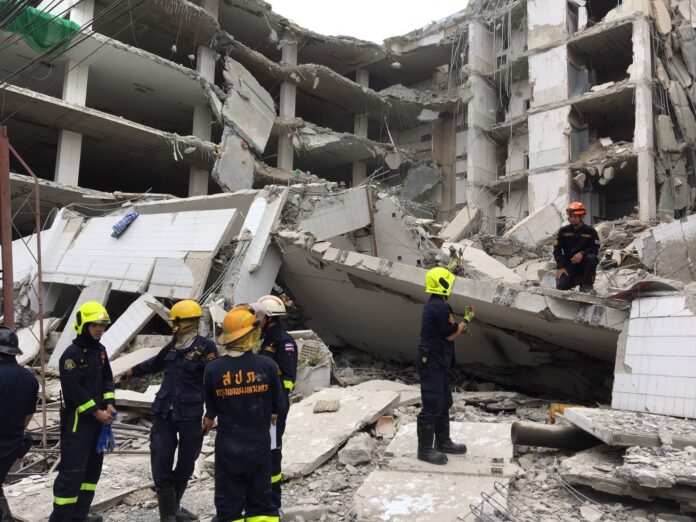
Rescue workers at a collapsed building Friday on Soi Sukhumvit 87.

BANGKOK — Rescue animals were searching for a construction worker Friday afternoon trapped inside a collapsed building in Soi Sukhumvit 87 where at least three people have died.

Rescue workers, Phra Khanong police and firemen rushed to the scene at 9:30am after four workers were caught in the rubble of a six-story building that collapsed while being demolished.

At least three workers were killed.

The nearby Wells International School reportedly evacuated students.

Eight people were inside the building at the time. Four escaped, three of whom were injured. Four remained trapped, three of whom were killed. Two bodies have already been recovered so far.

As of noon, one person was still waiting to be rescued. Officials said they could hear cries for help.

The nearby Wells International School reportedly evacuated students.

Sant Tongsuk, Phra Khanong public works chief, said the building had been greenlighted for demolition. Work was ordered stopped on Dec. 2 after falling rubble injured several people in the area. Sant said the building’s management was told to present a revised, safer demolition plan.

Since then, Sant added, no new plan had been submitted. The reason for the collapse has not been determined yet.

Police Lt. Gen. Sanit Mahathavorn said the apparent continuation of work went against the orders of public works officials, and police are investigating who was behind the work.

This is a developing story and will be updated without notice.

Advertisement

Man who Stole USD 1.4M to Pay Online Romance Scam Imprisoned

Image: Don Hankins / Flickr

PITTSBURGH — A man who stole more than $1.4 million from two Pittsburgh-area companies and lost most of it in an overseas online romance scam was sentenced Thursday to two years in federal prison.

Jeffrey Plimpton, 59, pleaded guilty in August to wire fraud for stealing the money from Alpha Aromatics, a fragrance business, and Pestco Professional Services, an Alpha subsidiary. As Alpha’s controller, he oversaw the finances of both companies.

Plimpton had begun stealing about USD $80,000 to pay his mortgage and credit card bills when he met someone online he believed to be a woman, public defender Linda Cohn said. He was conned into sending money overseas, supposedly as an investment in a business venture that he believed would earn money he could use to repay Alpha, she said.

The bulk of the money he stole  about USD $1.39 million  was lost in the online romance scheme, Assistant U.S. Attorney Shardul Desai said.

“It’s something beyond naive,” Cohn told U.S. District Judge Nora Barry Fischer. Still, Cohn said Plimpton was easy prey after his wife of more than 25 years divorced him. Plimpton’s ex-wife accompanied two friends of Plimpton’s to the sentencing, but she didn’t address the court.

Desai wanted Plimpton to get 33 to 41 months in prison in accordance with federal guidelines driven largely by the amount of money stolen. Cohn sought a probation sentence, saying the longer Plimpton is free the more time he’ll have to work and repay the money.

“Mr. Plimpton fully acknowledges what he did was illegal, and he’s ashamed,” Cohn told the judge. “He is willing to and wants to pay this restitution back.”

One of Alpha’s insurers has covered more than USD $465,000 of the amount stolen. A second insurer notified the court Thursday that another USD $300,000 might be covered as well. That won’t matter to Plimpton, who’s on the hook to repay the entire amount, though some money will now go to the insurance companies. He’s already repaid USD $50,000 by selling his house.

The thefts were discovered in an internal accounting review last December. Plimpton was fired, and he confessed to company officials and, eventually, the FBI, that he took the money, Desai said.

Plimpton, who has since moved to Southaven, Mississippi, honestly believed the overseas money was to be invested by a woman he met online, Cohn said. As such, she argued Plimpton benefited from only the small fraction of money he stole to pay his bills.

“He’s still different than someone who takes the money and buys cars and buys houses with this money,” she argued.

But Desai noted, and Fischer agreed, that money Plimpton stole due to the online romance  as fraudulent and misbegotten as it may have been  was still meant to benefit him, if only by wooing the “woman” he believed he’d met online.

Plimpton offered to help federal authorities track down that person, but authorities told him that would be next to impossible, Cohn said. Some of the money was wired to Malaysia, and authorities haven’t been able to trace it.


Story: Chevel Johnson

Advertisement

Hot News

LATEST NEWS

Bangkok
overcast clouds
35 ° C
35 °
32.7 °
68 %
4kmh
99 %
Mon
35 °
Tue
36 °
Wed
34 °
Thu
31 °
Fri
29 °