


























32.8 C
Bangkok
Thursday, June 25, 2026
Home Blog Page 2500

Japan Ex-PM Yoshida’s Forgotten Pearl Harbor Visit Recounted

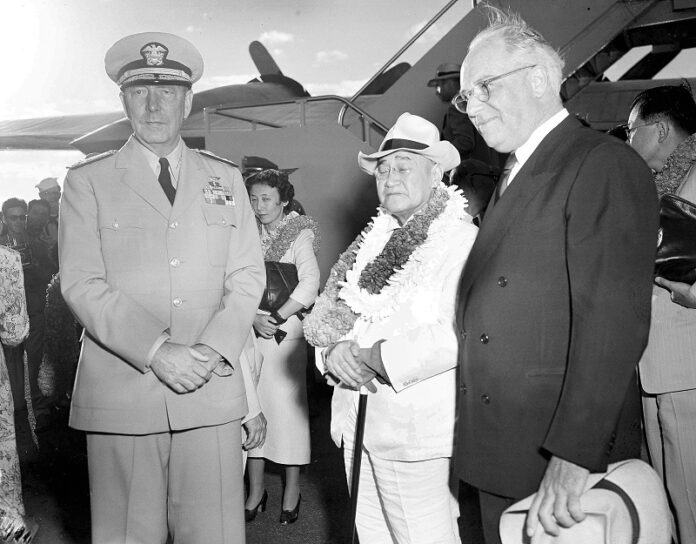
From left to right are, Admiral Arthur Radford, Prime Minister Shigeru Yoshida and Delegate Joseph R. Farrington 1951 in Honolulu, Hawaii. Photo: Associated Press

TOKYO — Japanese Prime Minister Shinzo Abe, who will visit Pearl Harbor with President Barack Obama on Tuesday, wasn’t even born when Japan’s former leader Shigeru Yoshida went there just six years after the country’s World War II surrender, by himself and feeling awkward.

Yoshida is best remembered for signing the San Francisco peace treaty with the U.S. and others in 1951, allowing Japan back into international society after its war defeat. His Pearl Harbor visit, which he made on his way home from San Francisco, was largely eclipsed by the historic treaty.

Archival writings and photos unearthed by The Associated Press reconstruct Yoshida’s visit, from his aim to win U.S. trust to how he was put at ease by the U.S. Navy commander’s dog.

Yoshida arrived at Pearl Harbor on Sept. 12, 1951, shortly after requesting a courtesy visit to the office of Adm. Arthur W.R. Radford, commander of the U.S. Pacific fleet. The office overlooked Pearl Harbor, offering a direct view of the site of the Japanese attack of Dec. 7, 1941.

Radford recalled that he thought Yoshida might feel uncomfortable because of his office’s location. “I could almost see the wreck of Arizona” out of the window, he wrote in his memoir, “From Pearl Harbor to Vietnam,” referring to a battleship that sank in the attack.

Yoshida, westernized and fluent in English, showed up in a white suit, wearing his trademark brimmed hat and carrying a cane, apparently looking a bit stiff.

Then Radford’s dog broke the ice.

His little Scottish Terrier, which was stretched out in front of Radford’s desk, walked slowly to Yoshida to be patted, while sniffing around his shoes and ankles.

“That started a dog conversation that took most of the visit,” Radford wrote.

Yoshida was a dog fancier, and had bought terrier puppies just before leaving San Francisco, his grandson Taro Aso, currently Japan’s finance minister, has said. Yoshida named the pair “San” and “Fran” after his successful trip.

Years later, Yoshida told Radford’s wife how he was embarrassed when he walked into the office after seeing Pearl Harbor, and how happy he was that the dog was able to settle him down.

A Navy archival photo obtained by the AP shows the two men shaking hands, with a smiling Yoshida looking up at the much taller Radford. Yoshida spent about 20 minutes at the office, according to an AP story from Sept. 13, 1951.

Yoshida’s visit to Pearl Harbor was actually on his second Hawaii stopover, having stopped there on his way to San Francisco as well.

But he was more relaxed the second time after completing the important mission in San Francisco, where he also signed the original Japan-U.S. security pact.

On his way to California, Yoshida landed in Honolulu on Aug. 31, 1951, when Japan was still technically an enemy.

During that visit, he laid flowers for the war dead at Honolulu’s National Memorial Cemetery of the Pacific, a military cemetery better known as Punchbowl. Three other Japanese prime ministers have since followed suit. A local Hawaii newspaper recently reported that two others also had visited Pearl Harbor later in the 1950s.

Yoshida’s daughter, Kazuko Aso, who was traveling with him, recalled that security was extremely tight in Hawaii on his first stopover, before the peace treaty was signed, and that Yoshida, who stayed on the top floor of the Royal Hawaiian Hotel, was instructed not to leave the hotel for safety reasons.

“But that old man insisted he wanted to go out … to pay tribute to the war dead,” Aso said in an interview published in the Bungei Shunju monthly magazine weeks after the trip.

She said the Japanese delegation unexpectedly received a warm welcome. Photos in the Japanese newspaper Mainichi showed Yoshida’s face nearly buried in Hawaiian flower necklaces because he had received so many of them at the airport.

At the Sept. 12, 1951, reception attended by U.S. military and Hawaiian officials, Yoshida sought further U.S. economic assistance and cooperation to reconstruct his war-devastated country and pledged to never use aggression.

Two days later, the Honolulu Star-Bulletin welcomed his speech as “a notably frank admission of Japan’s war guilt and a pledge that Japan will do everything possible to repair the enormous damage done by her armies, navy and air force.”

Story: Mari Yamaguchi

Advertisement

TrueVisions Will Stop Showing HBO, Cinemax Channels in 6 Days

Promotional image from HBO’s ‘Game of Thrones.’

BANGKOK Winter will never actually come for “Game of Thrones” fans in Thailand next year after the kingdom’s leading cable provider signaled it will stop offering six channels owned by HBO.

After failing to renegotiate licensing deals, TrueVisions will drop HBO, Cinemax HBO, HBO Family, HBO Signature, HBO Hits, Red by HBO and Cinemax, the National Broadcasting and Telecommunications Commission announced Monday.

That’s short notice for customers who will lose those channels when they are cut off on Sunday. Commission chairman Natee Sukonrat said TrueVisions would present a commission-approved compensation plan to customers on Tuesday.

TrueVisions has reportedly offered to replace HBO’s content with programming from Paramount, Sony, Universal or Fox Action Movies.

Commissioner Supinya Klangnarong, who disclosed the news in a Sunday night tweet,  said she disagreed with the board’s decision to let TrueVisions off the hook for violating regulations by not providing notice 30 days in advance and not having an approved compensation plan.

TrueVisions has made no statement on the matter. A representative reached for comment said the company planned to release something.

In December 2015, TrueVisions’ cancellation of the Food Network invited many online complaints.


Advertisement

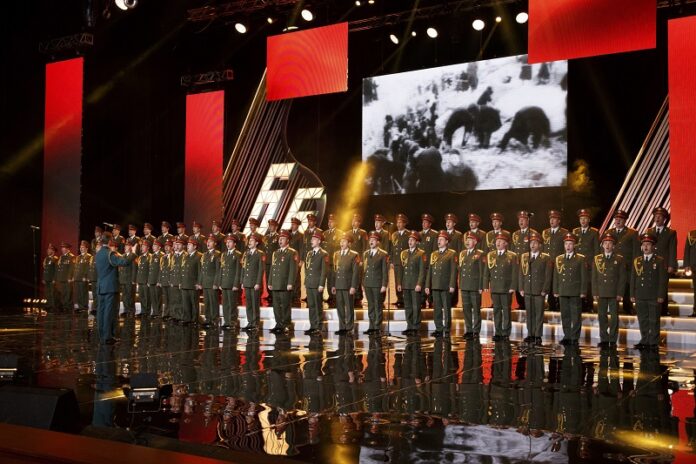
Russia Loses Iconic Choir Ensemble in Sochi Plane Crash

The Alexandrov Ensemble choir performs during a concert in March in Moscow, Russia. Photo: Associated Press

MOSCOW — The Russian military choir that lost most of its singers in a plane crash Sunday is often described as the Kremlin’s “singing weapon.”

The Alexandrov Ensemble, sometimes referred to as the Red Army choir, was founded in the 1920s. It won global fame with its patriotic repertoire during Soviet times, but in recent years has sought to cater to modern audiences. Many of its performances have gone viral, including a rousing rendition of Daft Punk’s “Get Lucky” by singers in full military dress at the opening of the 2014 Winter Olympics in Sochi.

Sixty-four members of the ensemble, including director Valery Khalilov, were heading from Sochi to Russia’s air base in Syria to perform a New Year’s concert for troops when their plane crashed into the Black Sea on Sunday. All 92 people on board are presumed dead.

“It’s difficult to grasp the scale of that tragedy,” Moscow city’s culture department head Alexander Kibovsky said in televised remarks. “They were raising pride for our culture, our country, across the entire world.”

As word of the crash spread Sunday, people placed bouquets of flowers outside the ensemble’s Moscow headquarters.

“We all loved this ensemble,” said Moscow resident Mark Novikov. “We valued it. They are our brothers, our friends, our colleagues.”

The 186-member ensemble includes a band and a dancing troupe along with the choir that had about 70 singers. Viktor Yeliseyev, head of the rival choir of the Russian National Guard, said most of the Alexandrov Ensemble’s singers were on the plane.

Among the few who stayed back was soloist Vadim Ananyev, whose wife just delivered a baby and pleaded with him to remain at home to help. The couple has three small children.

“I feel as if I were hit over the head,” he said. “I still can’t believe it. They are telling me now I was born with a silver spoon.”

The Interfax news agency said another member of the choir was denied access to board at the last minute because his foreign passport has expired.

The choir was founded in 1928 by composer and conductor Alexander Alexandrov, and after his death in 1946 was led by his son, Boris Alexandrov. Alexandrov, who headed the choir for more than 40 years, made it famous worldwide.

Pavel Kogan, the director of Moscow State Academic Symphonic Orchestra, described the choir as “a symbol of the country.”

“It was impossible to imagine what happened, even in a nightmare,” he said, according to Snob online publication.

Story: Jocelyn Noveck

Advertisement

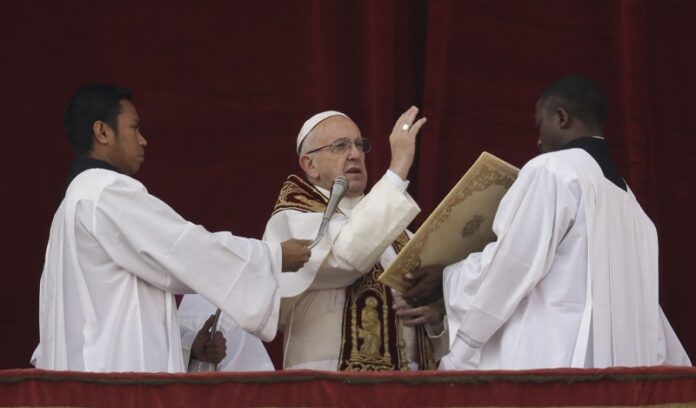
Pope Wishes Christmas Peace for Those Scarred by War, Terror

Pope Francis delivers the Urbi et Orbi (Latin for ' to the city and to the world' ) Christmas' day blessing last December from the main balcony of St. Peter's Basilica at the Vatican. Photo: Alessandra Tarantino / Associated Press

VATICAN CITY — Decrying the suffering in Syria, Pope Francis on Sunday wished Christmas peace and hope for all those scarred by war and terrorism, which he said is sowing “fear and death in the heart of many countries and cities.”

Some 40,000 tourists and Romans calmly endured long security lines to enter St. Peter’s Square to see the pope on the central balcony of St. Peter’s Basilica, where he delivered the traditional “Urbi et Orbi” (“to the city and to the world”) Christmas message and blessing.

Francis spoke sorrowfully of the suffering caused by the Syrian war, especially in Aleppo, pressing the international community to help negotiate a solution. He urged Israelis and Palestinians to “write a new page of history, where hate and revenge give way” toward building a future of understanding and harmony.

He also cited the “brutality of terrorism” in Iraq, Libya and Yemen.

In Nigeria, the pope lamented, “fundamentalist terrorism exploits even children,” a reference to child suicide bombers. He expressed hope that dialogue would prevail over “the mindset of conflict” in both South Sudan and the Democratic Republic of the Congo.

The heavy security at the Vatican reflected apprehension in much of Europe, which is reeling from extremist attacks. Last week, 12 people died in Berlin when a Tunisian man who had pledged allegiance to the Islamic State group plowed a truck through a crowd at a Christmas market. He was killed a few days later in a shootout near Milan.

“Peace to all those who have been injured or have suffered the loss of a loved one due to the brutal acts of terrorism that have sown fear and death in the heart of many countries and cities,” the pope said.

Referring to the meaning of Jesus’ birth, Francis said: “Today this message goes out to the ends of the Earth to reach all peoples, especially those scarred by war and harsh conflicts that seem stronger than the yearning for peace.”

His Christmas message also recalled Colombia, which has seen his personal intervention try to end Latin America’s longest running conflict, and Venezuela, where a papal envoy has tried to facilitate talks between the government and the opposition as Venezuelans endure widespread food and medicine shortages.

Francis expressed concern over tensions on the Korean peninsula, and over Myanmar, which he said should “consolidate efforts to promote peaceful coexistence.”

During Christmas Eve Mass in the basilica, Francis said Jesus’ birth, in a humble stable, calls to mind how some children today must hide in underground bomb shelters, live on the street, lie on the bottom of overcrowded smugglers’ boats, are given weapons instead of toys or aren’t allowed to be born at all.

Throughout his papacy, Francis has denounced the Islamic extremist violence that has driven Christians from Mideast communities that date to Christianity’s foundations. He has also demanded that Europe in particular do more to welcome refugees.

Reflecting the pope’s concern for migrants, refugees and others on society’s margins, Bologna’s archbishop celebrated a Christmas Eve Mass for the homeless in a waiting room of that Italian city’s main train station.

Story: Frances D’Emilio

Advertisement

George Michael, British Pop Superstar, 53

LONDON — George Michael, the British pop superstar who reached early fame with Wham! and went on to a solo career lined with controversies and chart-topping hits that blended soul and dance music with social commentary, has died, his publicist said Sunday. He was 53.

Michael died at his home in Goring, England. His publicist, Cindi Berger, said he had not been ill. His family issued a statement through Thames Valley Police saying that he “passed away peacefully at home over the Christmas period.

“The family would ask that their privacy be respected at this difficult and emotional time. There will be no further comment at this stage.”

Police issued a statement calling the death “unexplained but not suspicious” and that “a post mortem will be undertaken in due course.”

Michael enjoyed immense popularity early in his career as a teenybopper idol, delivering a series of hits such as “Wake Me Up Before You Go-Go,” ”Young Guns (Go For It)” and “Freedom.” As a solo artist, he developed into a more serious singer and songwriter, lauded by critics for his tremendous vocal range. He sold well over 100 million albums globally, earned numerous Grammy and American Music Awards, and recorded duets with Aretha Franklin, Ray Charles, Luciano Pavarotti and Elton John among others.

Throughout his career, his drug use and taste for risky sex brought him into frequent brushes with the law, most famously in 1998 when he was arrested for public lewdness in Los Angeles. Yet, he managed to turn the incident into fodder for a popular song that poked fun at his behavior, and his acknowledgment of his homosexuality at that time made him even more popular with his fans.

Michael, with startling good looks and an easy stage manner, formed the duo Wham! with his school friend Andrew Ridgeley in the early 1980s. Helped by MTV, which was an emerging music industry force at the time, they easily crossed the Atlantic to become popular in the United States with Michael, as lead singer, usually the focal point.

He started his solo career shortly before Wham! split, with the release of the megahit single “Careless Whisper,” making a seamless transition. Critics generally viewed his Wham! songs as catchy but disposable pop and gave his solo efforts far higher marks.

His first solo album, 1987’s “Faith,” sold more 20 million copies, and he enjoyed several hit singles including the raunchy “I Want Your Sex,” which was helped immeasurably by a provocative video that received wide air play on MTV.

The song was controversial not only because of its explicit nature, but also because it was seen as encouraging casual sex and promiscuity at a time when the AIDS epidemic was deepening. Michael and his management tried to tamp down this point of view by having the singer write “Explore Monogamy” on the leg and back of a model in the video.

At the time, Michael had not disclosed his homosexuality, and much of his chart success was based on his sex appeal to young women. His look was raw and provocative, with tight jeans, tight T-shirts, black leather jackets and designer stubble, and his videos pushed the accepted limits with many lingerie-clad models vying for Michael’s attentions on screen.

But Michael’s situation changed abruptly in 1998 when he was arrested for lewd conduct in a public toilet in Los Angeles after being spotted by a male undercover police officer.

The arrest received international media attention, and seemed for a brief time to jeopardize Michael’s stature as a top recording artist.

But instead of making excuses for his behavior, he went on to release a single and video, “Outside,” that made light of the charges against him and mocked the Los Angeles police who had arrested him.

Like all of his efforts at the time, it sold in prodigious numbers, helping him put the incident behind him. The arrest also prompted him to speak openly about his sexual orientation.

These years represented the height of Michael’s commercial success, which at times was marred by a protracted legal dispute with his record company Sony.

He remained a strong musical force throughout his career, releasing dozens of records and touring to adoring crowds despite a growing number of run-ins with police, many of them stemming from a series of driving-under-the-influence-of-drugs incidents, including several crashes.

Michael was an acknowledged user of marijuana and prescription sedatives and several times was found slumped over his car’s steering wheel after using both at the same time.

His driver’s license was finally revoked for five years in 2010 after Michael drove his Land Rover into the side of a Snappy Snap photo shop with so much force that his vehicle dented the wall.

A passer-by remembering Michael’s early career wrote the word Wham! on the spot his SUV had hit.

He was also arrested a second time in public toilets — this time in North London in 2008 for drug use, an incident that prompted him to apologize to his fans and promise to get his life in order.

He also offered an apology to “everybody else, just for boring them.”

A year earlier, he had told a television interviewer that his problems stemmed from a self-destructive streak and his attention-seeking nature.

He said at a press conference in 2011 that he felt he had let young people down with his misbehavior and had made it easier for others to denigrate homosexuals.

Despite these personal setbacks, Michael’s musical performances remained strong even as his material moved farther from the teen tunes that first brought him to stardom.

The Telegraph newspaper in 2011 described a London concert appearance as an impressive event, calling his voice, “A rich, soulful instrument, it’s capable of serious emotional heft, expertly matching the confessional tone of his own material.”

Michael, with strong Greek-Cypriot roots, was born Georgios Panayiotou in England. He and schoolmate Ridgeley formed a ska band called the Executive when they were just 16 before moving on to form Wham!

“I wanted to be loved,” said Michael of his start in the music field. “It was an ego satisfaction thing.”

Michael was active in a number of charities and helped raise money to combat AIDS, help needy children and support gay rights. He had a long-term relationship with Kenny Goss, but announced onstage in August 2011 that the two had broken up.

Story: Nekesa Mumbi Moody, Gregory Katz

Advertisement

Syria-Bound Russian Jet Goes Missing Over Black Sea

File photo of a Russian Air Force Tupolev Tu-154M. Photo: Kirill Naumenko

MOSCOW — A Russian Tu-154 aircraft with 91 people aboard, including a famed military band on the way to Syria, disappeared Sunday over the Black Sea shortly after takeoff from the resort town of Sochi, the Defense ministry said.

The ministry said the plane was carrying the famous Alexandrov military band for a concert at the Russian air base in Syria.

A total of 83 passengers and eight crew were on board when the plane dropped off radar early Sunday. Emergency services are searching for the plane, a Soviet-designed three-engine airliner, the ministry said.

Nine journalists were among the passengers, according to the Interfax news agency.

Russian media reports said the plane disappeared over the sea a few minutes after takeoff.

Interfax reported that the rescuers already have determined the location of the crash, but there has been no official confirmation.

Defense Minister Sergei Shoigu was personally coordinating the rescue efforts, and President Vladimir Putin has received official reports on the incident.

Advertisement

Risk Gave Us Democracy. Thailand’s Dictatorship Survives on Fear.

Image: @OpSingleGateway / Facebook

Retention

Today’s Riddle: Last week, more than 360,000 netizens petitioned against the junta-sponsored Computer Crime Act for fear that it will lead to greater censorship and self-censorship online.

Then eight days ago, after the junta-appointed legislature voted 168 to 0 to endorse the controversial law, calls went out for protests at the Democracy Monument and the Bangkok Art and Culture Centre last Sunday.

So how come only nine people showed up?

Explanation: The junta-appointed National Legislative Assembly lived up to its reputation as the military dictatorship’s rubber-stamp parliament. Although four NLA members abstained from voting, none dared oppose the revised computer bill.

The tally of 168 Ayes and 0 Nays evoked totalitarian states such as North Korea or Iraq under Saddam Hussein. How could there possibly be not a single opponent to the bill among 172 legislators? Do these rubber-stamp parliamentarians all think alike? Or they were simply afraid to go against Gen. Prayuth Chan-ocha, the junta leader who appointed them?

As for the high number of online petitioners and low real-world turnout, fear and self-preservation explain the discrepancy.

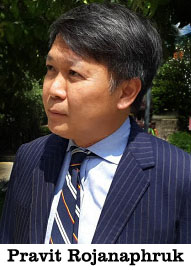
Pravit RojanaphrukThe junta’s ban on more than four people gathering for ostensibly “political” purposes is apparently still effective. No one, if not very few, wants to risk one-year maximum imprisonment term and 20,000 baht fine for violating the ban, which has stood against basic civil rights since it was imposed by the junta over two years ago on May 22, 2014, the day they staged the coup.

“If you come out you would be arrested afterward. So people don’t come out. If you come down, it must be all out [war],” netizen Kittthat Sokhuma wrote in response to my posing the same question posited in this column on Facebook.

A Thai Facebook user writing under the name Tai Evans expressed disappointment:

“Thought [people] would fill up the streets to oppose, so I could share it to show the world that Thais won’t be cowed. Alas.”

Some are looking to Anonymous, the white-hat hacker collective which has aided attacks on various government websites since Monday. “As of now, everyone is placing hope on Anonymous…,” user Manita Chuen wrote.

Even some expats chimed in to try to explain. “It’s just apathy and in difference… as long as the people can still play [P]okemon,” wrote long-time expat and French political cartoonist Peray Stephane.

Facebook user Kris Willems, meanwhile, cited risk as the biggest factor:

“Simply put: they can put you in jail for a long time. Not many people are prepared to take the risk. It’s not the same as protesting in a democratic country. Thailand is a dictatorship.”

Willems wasn’t alone to cite risks as a factor. Another netizen, Supin Tangkaewfa, summed it up well: “Who will go out and take the risk??? Better to stay put. Why should we go out and let others monitor us? Our families will be in trouble…”

The risk for opposing military dictatorship is real. Dozens have been charged with  violating the junta’s ban on assembly or even sedition during the past two years. Hundreds have been summoned for psychological operations euphemistically called “attitude adjustment” with some, myself included, detained. Those die-hard dissidents often find themselves imprisoned.

Think of Khon Kaen University law student-cum-activist Jatupat “Pai” Boonpattaraksa, who had his bail revoked Thursday on spurious grounds. Never mind that he soon has to sit for exams and sought release again. This argument was not accepted by the court as valid. On Friday, five suspected hacktivists were reportedly taken in by the junta for possible involvement with the ongoing hacking of Thai military government websites in retaliation to the passage of the more-draconian revision of the draconian Computer Crime Act. They can be detained for up to seven days without charge by the junta. Another 100 are said to be under monitoring for potential hack-tivities.

The fear is real. A university lecturer was interviewed by this writer on Thursday about the political prospects for next year. After the interview concluded, I asked her to spell out her preferred spelling of her full name in English, but she told me she is in fear and refused to be named in the news article.

“I have been invited for meals [with the junta] twice,” said the contact, who is a Redshirt, sounding desperate and in fear. “Next time they might strip my clothes off.”

Investment comes with risk, and so goes the struggle for democracy. What we collectively, as a society, get back depends on what we are willing to risk.

Advertisement

Singaporean Blogger-Activist Detained in US while Appealing for Asylum

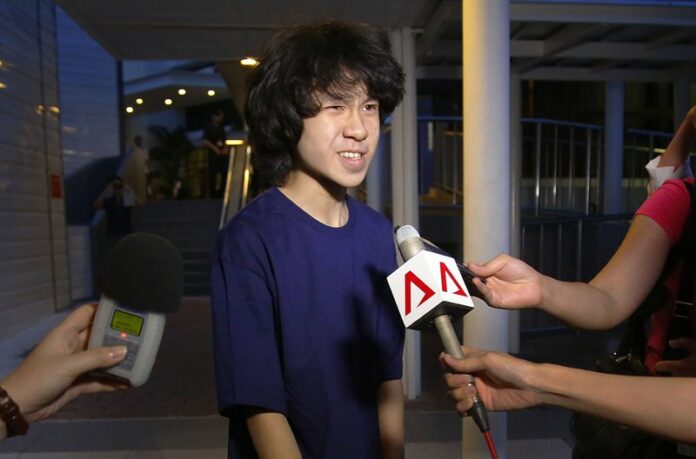
Singaporean teen blogger Amos Yee in a 2015 photo file speaks to reporters while leaving the Subordinate Courts after being released on bail in Singapore. Yee whose video posts and blogs mocking his government and its late founder landed him in jail twice has been detained in the U.S. where he is seeking asylum. Human Rights Watch called on the U.S. to recognize Amos Yee’s asylum claim, saying he has been consistently harassed in Singapore for publicly expressing his views. Photo: Wong Maye-E / Associated Press

SINGAPORE — A Singaporean teenager whose video posts and blogs mocking his government and its late founder landed him in jail twice has been detained in the U.S. where he is seeking asylum, his lawyer and a human rights group said Saturday.

The Human Rights Watch deputy director for Asia, Phil Robertson, called on the U.S. to recognize Amos Yee’s asylum claim, saying he has been consistently harassed by the Singapore government for publicly expressing his views on politics and religion and severely criticizing the city-state’s leaders, including late Prime Minister Lee Kuan Yew.

Yee, 18, was imprisoned for six weeks in September on charges of hurting religious feelings of Christians and Muslims after repeatedly breaching bail conditions following a four-week prison sentence he served in July last year on the same charges.

He was also due to be called up for mandatory military service.

His U.S. lawyer Sandra Grossman told the South China Morning Post on Saturday that Yee was likely detained at Chicago’s O’Hare International Airport because he entered the country on a tourist visa despite an intention to apply for asylum.

She said Yee would have to undergo a “credible fear interview” by an asylum official who would assess if he faces a credible fear of persecution or torture back home. She said the process usually takes a few days, but a holiday season could delay it. He would then appear before an immigration judge, but that could take years because of backlogs in the immigration system.

Yee, who won a local filmmaking prize at age 13, ruffled feathers in Singapore with a video blog laced with expletives as the city-state was mourning Lee’s death in March last year.

Such open criticism and lampooning of leaders is rarely seen in Singapore, where laws are strictly enforced. The government of the multiethnic state says Yee crossed the red line on religion when he mocked Christians and Muslims and the law had to be enforced on him to protect racial and religious harmony.

Robertson said Yee has faced intensive government surveillance and monitoring of his public and online comments.

“Amos Yee is the sort of classic political dissident that the U.N. Refugee Convention was designed to protect, and Human Rights Watch hopes the U.S. will recognize his asylum claim,” he said in a statement.

Advertisement

Star Wars Actress Carrie Fisher Remains in Intensive Care Unit

Carrie Fisher in a 2015 photo file presenting the life achievement award on stage at the 21st annual Screen Actors Guild Awards at the Shrine Auditorium in Los Angeles. Photo: Bucci / Invision / AP, File

LOS ANGELES — “Star Wars” actress Carrie Fisher is receiving treatment in an intensive care unit after suffering a medical emergency on a flight Friday, according to her brother.

Todd Fisher said Friday night that his sister is receiving excellent care, but that he could not classify her condition. He had earlier told The Associated Press that she had been stabilized and was out of the emergency room. In a subsequent interview he said many details about her condition or what caused the medical emergency are unknown.

Carrie Fisher, 60, experienced medical trouble during a flight from London and was treated by paramedics immediately after the plane landed in Los Angeles, according to reports citing unnamed sources.

Celebrity website TMZ, which first reported the incident, said anonymous sources told them the actress suffered a heart attack.

Todd Fisher said much of what had been reported about the incident was speculation.

“We have to wait and be patient,” he said. “We have so little information ourselves.”

Fisher’s publicists and representatives for her mother, Debbie Reynolds, and her daughter, Billie Lourd, did not immediately return calls from the AP.

Los Angeles Fire Department spokesman Erik Scott said paramedics administered advanced life-saving care to a patient at Los Angeles International Airport Friday and transported the person to a nearby hospital. He did not identify the patient.

A large gathering of media personnel was camped outside Ronald Reagan UCLA Medical Center in Los Angeles hospital, where TMZ and the Los Angeles Times reported she had been taken.

Fisher is considered by many to be a member of Hollywood royalty — her parents are Reynolds and the late singer Eddie Fisher.

Catapulted to stardom as Princess Leia in 1977’s “Star Wars,” Carrie Fisher reprised the role as the leader of a galactic rebellion in three sequels, including last year’s “Star Wars: The Force Awakens.”

The author and actress may be best known for her portrayal of Leia, but she is also an accomplished writer known for no-holds-barred accounts of her struggles with addiction and mental illness.

Her thinly veiled autobiography “Postcards from the Edge” was adapted into a 1987 film version starring Shirley MacLaine and Meryl Streep. She also transformed her one-woman show “Wishful Drinking,” which played on Broadway and was filmed for HBO, into a book.

Most recently, Fisher has been promoting her latest book, “The Princess Diarist,” in which she reveals that she and co-star Harrison Ford had an affair on the set of “Star Wars.”

Story: Sandy Cohen


Advertisement

Five Hacktivists Arrested, Junta Source Says

The sign outside the prison located inside the 11th Army Circle base in Bangkok in a Dec. 3, 2015, photo.

BANGKOK — Five people were detained Friday at an army base in the capital on suspicion of waging cyberwarfare against the government, a source inside the junta said.

The hackers are part of an online movement opposed to a controversial law passed by the junta’s rubber-stamp parliament, said the source, who was not authorized to speak to the media.

During the past week, many government websites were targeted by attacks, and some remained offline as of Friday. Netizens organized by Citizens Against Single Gateway in opposition to the law’s further restriction of internet freedoms claimed responsibility for the attacks.

Read: Army Chief Shrugs Off Cyber Assault; Sites Remain Down

The group said it was a protest against the draconian measures of the revised Computer Crime Act which allows authorities to shut down any website deemed “immoral.”

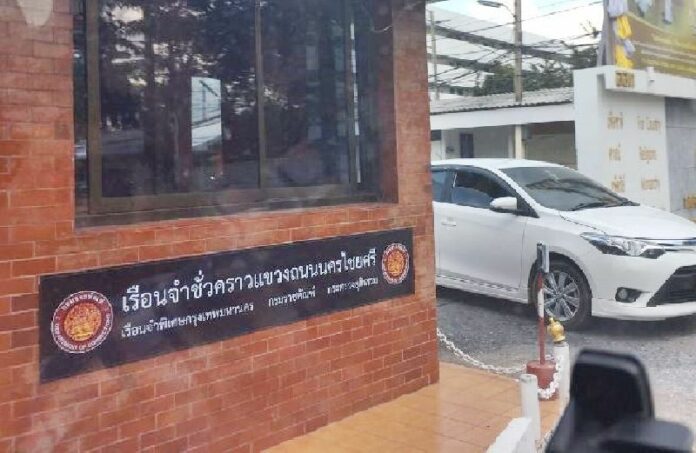
The five were reportedly being held for interrogation at the 11th Army Circle, a military installation converted into a special prison for suspects in national security cases.

Army chief Chalermchai Sittisart told reporters Friday that a number of suspects had been arrested but declined to elaborate.

On the group’s Facebook page, the admin of Citizens Against Single Gateway said it cannot confirm whether any of its members were detained because it is an anonymous movement.

“I’m serious. How can we check, when we are anonymous? No one knows who’s who,” the admin wrote. “Everyone is anonymous.”

Earlier on Friday junta chairman Prayuth Chan-ocha defended the toughened cybercrime law as a necessary measure to safeguard public security and maintained that individual rights will not be violated.

“You look at porn websites, look at dangerous drugs on illegal markets. There’s distortion of news, there’s hacking in the business and economic systems,” Gen. Prayuth said. “That’s the world today. The rest of the world is preventing that, but Thailand has unlocked everything. This is the garbage on social media. We must find a measure to remove the garbage.”

Related stories:

Gov’t Payment System Offline As Hacktivists Focus Online Assault

Dismissive Prayuth Tells Hackers to Knock it Off

Computer Crime Act 2.0 Passes Unanimously

Single Gateway ‘Still Necessary,’ Deputy PM Prawit Says

‘Back Door’ in CCA Not Trojan Horse for Single Gateway, Drafters Say

New Cybercrime Regs Would Open Back Door to Censorship

Website Shutdowns Soar After King’s Death

Why Thailand Should Worry About an Improved(?) Computer Crime Act

Thailand’s Draconian Cyberlaws Tipping Toward Totalitarian

Computer Crime Act Has Issues, Google Tells Censorship Committee

Advertisement

Hot News

LATEST NEWS

Bangkok
overcast clouds
32.8 ° C
32.8 °
32.8 °
92 %
4.7kmh
86 %
Wed
33 °
Thu
36 °
Fri
38 °
Sat
36 °
Sun
36 °