30 C
Bangkok
Monday, June 8, 2026
Home Blog Page 2571

Men Dressed as Soldiers Accused of Stealing 2M Baht (Video)

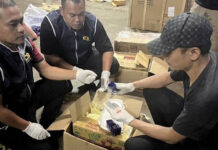
MUKDAHAN — Police on Monday were searching for thieves who allegedly disguised themselves as military personnel to steal 2 million baht from a man in Mukdahan province.

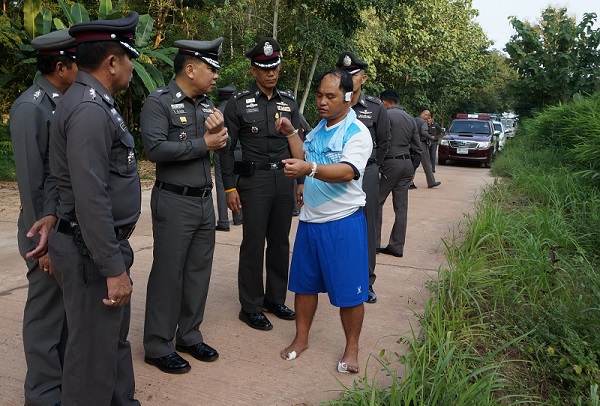
Paisan U-khum said he was driving home Saturday afternoon when a black sedan blocked his way, and three men in military uniforms stepped out to demand he exit his SUV. They then stole the money he was carrying to trade for rubber.

The 44-year-old farmer told police he was handcuffed before the three men ordered him into their vehicle and dumped him at another spot about 10 kilometers away from where he was stopped.

“We checked with the military units in the neighborhood, and we are sure the perpetrators were not military officers,” Mukdahan Police Commander Apichit Thienpermpoon said Monday.

Apichit said police were sure it was not a coincidence and the men must have known Paisan would be carrying a large amount of money.

Police could not yet identify the three men, Apichit said, despite footage of them captured by a video camera in Paisan’s car.

Paisan U-khum, 44, talks to police at the scene where he was robbed by three men in military uniforms Saturday in the northeastern province of Mukdahan.
Advertisement

Surrounded by Alligators, Hurricane Cleanup Goes On in Florida

Jim Darlington takes a phone call while cleaning up Hurricane Matthew debrisSunday at the St. Augustine Alligator Farm, in St. Augustine, Florida. Photo: Brendan Farrington / Associated Press

ST. AUGUSTINE, Florida — Sure, lots of people in St. Augustine are picking up branches and leaves after Hurricane Matthew blew through town. But only a few are doing it surrounded by alligators.

That’s what Jim Darlington and Amie Mercado were doing on Sunday, raking up debris in an alligator pit with the enormous reptiles just a couple of feet away, including one who opened its mouth wide as Mercado approached. That was part of the unusual cleanup at the St. Augustine Alligator Farm, where trees and limbs fell into alligator lagoons and crocodile pools, and enormous African storks were taken out of the bathrooms where they rode out the hurricane.

All in all, the zoo  one of Florida’s oldest tourist attractions and the only place in the world that displays every species of crocodilian  fared well during the storm. However, fears of what could have been were certainly on people’s minds.

“We were all hunkered down listening to the news, and of course everybody is on social media, and sure enough a rumor started that there are alligators out  hundreds of alligators were out,” Darlington said, who said the 123-year-old zoo was inspected by state wildlife officials immediately after the storm passed and before employees were allowed back in. “The walls were still standing. There weren’t alligators running around.”

To prepare for the storm, cobras and other venomous snakes put in drawstring bags, placed in secure containers and then those containers were placed in other containers. Storks were rounded up and placed in bathrooms. Parrots and other birds were caged and alligator hatchlings were crated and placed in a secure building.

“We had to get very creative with where we put animals to make sure they were in the best housing condition for 48 hours that we could possibly give them,” said Gen Anderson, the zoo’s bird and mammal curator.

Storks were put in the bathrooms, where sinks were left dripping.

“Each stork was in a separate bathroom, the floors are really easy to clean and they had a water source. They seemed comfortable,” Anderson said.

Crocodiles and alligators weren’t moved  but the water levels in lagoons and pools were lowered by half to make sure flooding didn’t get too high. Darlington said the surge ended up a bit higher than he expected, but no animals escaped.

“They just stay hunkered down,” Darlington said. “The animals just stay in the pools. In bad weather, they’re not out running around freaking out like a bunch of ostriches or something, they just want to stay in the water.”

The biggest hit to the zoo was its zip line, which visitors take to zoom over the alligators and crocodiles, dipping down to within about 30 feet of the creatures. Several limbs where the lines run came down. While the zoo hopes to open Tuesday, the zip line will take longer to repair.

Story: Brendan Farrington

Advertisement

Vietnam Rejects Lawsuit by Fishermen Over Fish Deaths

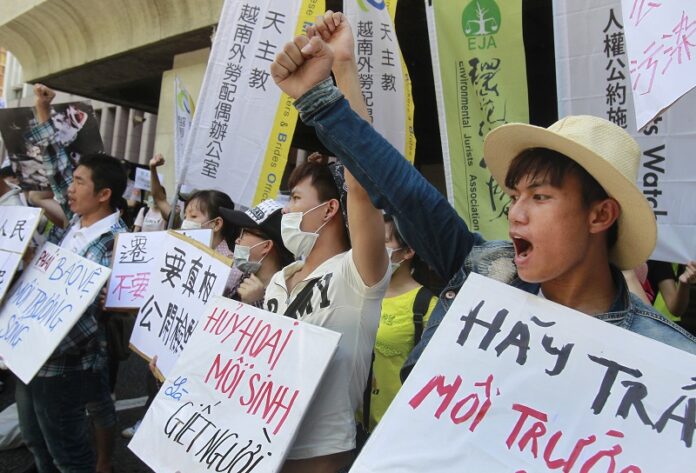
Vietnamese activists shout slogans and hold placards reading ''Destroying the environment is killing, "left, and ''Return clean seawater to us'' during a protest to urge Formosa Plastics Group to take responsibilities for the cleanup in Vietnam last August in Taipei, Taiwan. Photo: Chiang Ying-ying / Associated Press

HANOI, Vietnam — A court in central Vietnam rejected lawsuits from hundreds of fishermen seeking compensation from a Taiwanese steel company for losses caused by its release of toxic chemicals that killed a large number of fish and caused one of the country’s worst environmental disasters.

Catholic priest Dang Huu Nam, who helped the fishermen file the lawsuits at a local court in Ha Tinh province, said the court returned all 506 lawsuits citing legal regulations. He said the fishermen are preparing to appeal the decision.

The factory owned by Formosa Plastics Group acknowledged in June that it was responsible for the pollution that killed hundreds of tons of fish along more than 200 kilometers (125 miles) of coastline in four central provinces and pledged to pay $500 million in compensation.

Advertisement

Ethiopia Declares State of Emergency, Internet Blocked

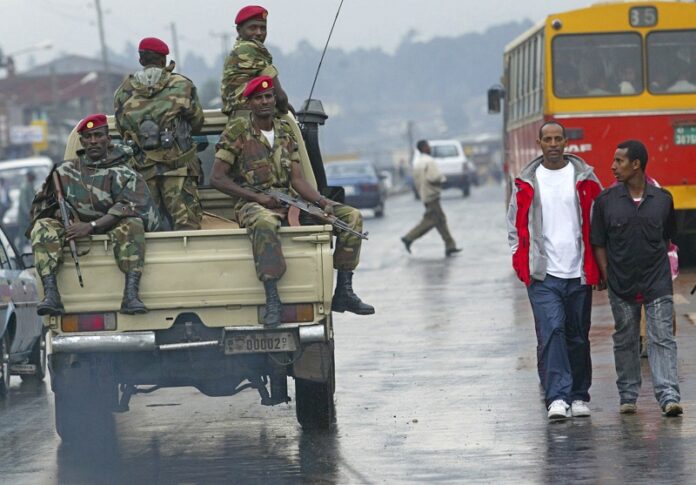
Members of the Ethiopian army patrol the streets of Addis Ababa, Ethiopia in 2005. Photo: Karel Prinsloo / Associated Press

ADDIS ABABA, Ethiopia — The Ethiopian government has declared a state of emergency effective immediately following a week of anti-government violence that resulted in deaths and property damage across the country, especially in the restive Oromia region.

In a televised address on Sunday morning, Ethiopia’s Prime Minister Hailemariam Desalegn said the state of emergency was declared because there has been “enormous” damage to property.

“We put our citizens’ safety first. Besides, we want to put an end to the damage that is being carried out against infrastructure projects, education institutions, health centers, administration and justice buildings,” said Desalegn on the state Ethiopian Broadcasting Corporation.

“The recent developments in Ethiopia have put the integrity of the nation at risk,” he said.

“The state of emergency will not breach basic human rights enshrined under the Ethiopian constitution and won’t also affect diplomatic rights listed under the Vienna Convention,” said Desalegn.

The internet is blocked across many parts of Ethiopia, residents reported Sunday. The government has blocked the internet for more than a week to prevent protesters from using social media to get supporters to attend demonstrations.

Major towns and cities across Ethiopia’s Oromia region are experiencing unrest and widespread violent protests of people demanding wider freedoms. More than 50 people were killed on October 2 in a stampede triggered when police fired teargas and bullets to disperse protestors at the annual Irrecha thanksgiving celebration in Bishoftu town.

An American woman was killed last week when she was hit by a rock thrown by protesters. Some businesses have been targeted because of suspected links to the government, which is promoting Ethiopia as one of Africa’s top-performing economies.

The state-affiliated Fana Broadcasting Corporate said the attacks on factories in Sebeta town on the outskirts of the capital, Addis Ababa, affected more than 40,000 workers. Textile, plastic, cement and bottled-water factories have been targeted.

Anti-government protests continued Sunday. Many roads into and out of the capital, Addis Ababa, are blocked by protesters and those who try to drive through are targeted by people who jump out from behind bushes and hurl rocks, witnesses told the Associated Press by phone on Sunday.

The state broadcaster said details of the state of emergency will be communicated to the public later Sunday.

“There are sufficient grounds to declare a state of emergency in Ethiopia,” said Abiy Chelkeba, assistant professor of law at Mekelle University. “The situation in many areas across the Oromia region has become so severe that law enforcement agencies themselves have become targets and were attacked with a high intensity. Moreover, the constitutional order of the country has been endangered. All in all, the value systems of the constitution like a respect for the national flag and adherence to the governance system are in danger.”

In a separate development, Ethiopian officials summoned Egypt’s ambassador to the country, Aboubakr Hefny, for discussions. The State Minister for Ethiopia’s Foreign Affairs Ministry talked to the Egyptian diplomat after a video appeared online which purportedly shows members of the outlawed Oromo Liberation Front sharing a stage with what Ethiopia’s state broadcaster described as Egyptians.

Story: Elias Meseret

Advertisement

HM King’s Condition ‘Unstable’ After Blood Cleansed

His Majesty the King tours a Golden Place supermarket at Siriraj Hospital in Bangkok in a Dec. 29, 2014, file photo. Image: Royal Household Bureau.

BANGKOK — Doctors detected unusually low blood pressure in His Majesty the King’s heart on Sunday following a procedure to purify his blood and remove excess brain fluid, a palace statement said.

According to the Royal Household Bureau, doctors at Siriraj Hospital noted at around 3am Sunday that King Bhumibol’s blood pressure was low after going through hemodialysis and brain fluid removal operations on Saturday.

Hundreds Join Colorful Rally for King on Auspicious 9/9

“Doctors are closely monitoring his condition and providing treatment, because his overall condition is not yet stable,” said the statement, which was published on early Monday morning. “And they have requested that His Majesty refrain from royal work.”

Nevertheless, His Majesty’s blood pressure had improved by 3pm on Sunday, the statement added.

Stating that King Bhumibol’s condition was not yet stable at the time it was published was a departure from the confident assurances of previous updates on the monarch’s health, which has been plagued by illness for years.

King Bhumibol has spent much of the last seven years at Siriraj Hospital. His delicate health is a cause of concern for many Thais, who see him as the spiritual leader of the nation.

Related stories:

King Treated Again for Too Much Fluid in Brain

King Reportedly Suffering From ‘Severe Infection’

Advertisement

Samsung Halts Production of Galaxy Note 7

Customers wait for recall of their Samsung Electronics Galaxy Note 7 smartphones as powered-off Galaxy Note 7 smartphones are displayed at the company's service center in 2016 in Seoul, South Korea. Photo: Ahn Young-joon / Associated Press

SEOUL — Samsung Electronics has halted production of the Galaxy Note 7 after reports that replacement phones have continued to catch fire, South Korean media reports.

Yonhap News Agency reports that the decision was made in conjunction with regulators in South Korea, the United States and China, citing a Samsung supplier. Samsung has not confirmed the report.

Samsung seemed to have its smartphone troubles under control — until authorities had to evacuate a Southwest Airlines flight in Kentucky last week for an incident that involved a replacement phone.

The reason: Authorities said a Samsung smartphone started smoking and making “popping” noises, just moments after its owner had boarded the plane and turned off the device.

Passenger Brian Green, 43, says the device was a Galaxy Note 7 he had picked up from an authorized AT&T retailer Sept. 21 as a replacement for another Note 7 phone he returned when Samsung announced a global recall a week earlier. The recall came after a series of incidents last month in which Note 7 batteries overheated or caught fire. But Samsung had promised that the replacement models were safe.

Reports of more replacement phones catching fire are trickling in, and the South Korean tech giant faces more scrutiny after earlier criticism for being slow to react and sending confusing signals in the first days of the recall.

“They’re in a really tricky spot,” said Ben Bajarin, a tech industry analyst with the Creative Strategies research firm. “There’s such a stigma around this device now that it’s hard to see how sales can do well going forward.”

Consider Green’s reaction: “I really liked the device. It had a lot of nice features,” he told The Associated Press in an interview Friday. But after the incident on the plane, he bought a new iPhone 7 from Apple, rather than take his chances with yet another Samsung Note. “At this point, I don’t want to mess with it anymore.”

Authorities haven’t confirmed what model of Samsung phone was involved in last week’s incident. A spokeswoman for the Consumer Product Safety Commission said Friday that her agency is still investigating and had no further information.

AT&T, one of the nation’s largest phone retailers, said Sunday that it will stop giving customers the replacement phones.

“We’re no longer exchanging new Note 7s at this time, pending further investigation of these reported incidents,” A&T said in a statement.

AT&T encouraged customers with Note 7 phones to exchange them for other products. The company says it hasn’t sold Note 7 phones since the initial recall was announced.

Verizon, another major seller of smartphones, said it doesn’t have any Note 7 phones but they are on back order. Sprint said customers can exchange their replacement Note 7 phones for any other device while the situation is being investigated.

Meanwhile, other customers have reported problems with their replacement phones.

A Minnesota father says his daughter suffered a minor burn to her thumb when her replacement Samsung smartphone melted in her hand last week.

Andrew Zuis of Farmington, a Twin Cities suburb, said his daughter, Abby, was holding the Galaxy Note 7 in her left hand Friday when it melted. Zuis told The Associated Press on Sunday that the family had acquired the new phone on the day the replacement phones were released. There had been no problem with the original phone, he said.

“It’s very fortunate Abby was not injured and was holding the phone,” Zuis said. “If it was in her pocket, I think it would have been a whole different situation. I’m just very disappointed in Samsung and their product.”

Zuis provided KSTP-TV with receipts showing that the family bought a Galaxy Note 7 in August and then exchanged it Sept. 21 after Samsung announced the recall.

“She’s done with Note 7s right now,” Zuis said of his daughter.

A Samsung representative told KSTP that an investigation is underway.

“We want to reassure our customers that we take every report seriously and we are engaged with the Zuis family to ensure we are doing everything we can for them and their daughter,” the representative said in a statement.

On Saturday, Michael Klering, a Kentucky resident, said on Facebook that his exchanged Note 7 phone caught fire. Klering wrote on Facebook that he and his wife woke up because their bedroom was filling with smoke, and they feared that their children were in danger.

Klering wrote that he and his wife now have bronchitis and are being treated. He said he doesn’t feel the company is taking the situation seriously enough.

Commission officials and Samsung announced a formal recall Sept. 15 after authorities said they received 92 reports of Note 7 batteries overheating in the U.S., including 26 reports of burns and 55 cases of property damage. Authorities urged consumers to turn off the phones and return them for a refund or replacement. Samsung said replacement models that were free of defects became available in this country Sept. 21.

After the Southwest Airlines incident, representatives of the four leading U.S. wireless carriers said customers who had already received replacement Note 7 phones could return those new devices if they have concerns.

The Galaxy Note 7, which sells for $850 to $890, competes in the high-end smartphone market with Apple, which recently released a new iPhone 7, and other premium brands such as Google’s new Pixel phones.

Samsung says it has recalled about 2.5 million Note 7 devices around the world since problems emerged last month. Analysts estimated the recall would cost the South Korean tech giant as much as $1.8 billion.

Still, the company said Friday that its third-quarter profit still rose 6 percent, to about $7 billion, on total sales of $43.9 billion — thanks to income from Samsung’s other products, which include advanced computer chips and high-end smartphone displays.

The Note 7 isn’t Samsung’s biggest seller. The company sold 76 million smartphones in the second quarter of 2016, most of them lower-priced models. Among higher-priced models, Bajarin estimated that Samsung sold well over 10 million Galaxy S7 phones, or four times as many as the Note 7, which has a digital stylus and other distinctive features.

But Bajarin said he’s heard some independent manufacturers may cut production of cases and accessories for the Note 7, in light of slipping sales. He also suggested that some wireless carriers may be hesitant to promote the Note 7 heavily in their retail stores.

As for Green, the Indiana businessman told The Associated Press that he had checked to make sure the phone he got on Sept. 21 had the packaging marks and a green battery indicator that Samsung said would show it wasn’t subject to the recall.

“I don’t know what else you’re supposed to do,” he said.

A photo of the phone’s packaging, which Green provided to The Associated Press, shows a black square on the label, whichSamsung has said would indicate a non-defective phone. The label also has an identifying number that, when typed intoSamsung’s recall website, returns a message that says, “Great News! Your device is NOT in the list of affected devices.”

Green said he had no problems with the replacement until Oct. 5, when the smoke caused him to pull the device from the front pocket of his jeans. After authorities ordered everyone off the plane, Green said he later saw singe marks on his jeans. An airline representative said the phone scorched the carpet where Green left the device on the airplane floor.

After speaking with authorities by phone last week, Green said he had an appointment to meet with them Monday. In a statement last week, Samsung said there was “no evidence that this incident is related to the new Note7.” Samsung and AT&T representatives didn’t respond Friday to a reporter’s questions about how a defective phone might have been provided as a replacement after the recall.

Story: Brandon Bailey, Khaosod English

Advertisement

Debate Round 2: Trump Denies Actions He Bragged About

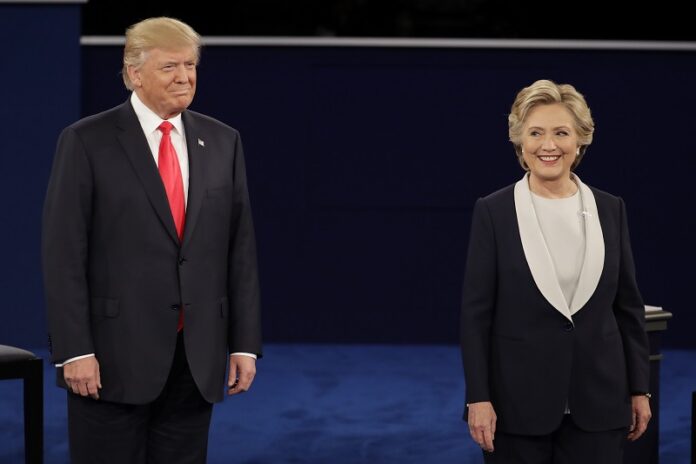
Republican presidential nominee Donald Trump and Democratic presidential nominee Hillary Clinton during the second presidential debate in October at Washington University in St. Louis, Missouri. Photo: Julio Cortez / Associated Press

ST. LOUIS — Donald Trump denied in Sunday’s debate that he ever kissed and grabbed women without their consent, then argued that his crude words from a newly released video paled in comparison to what he called Bill Clinton’s abuse of women. Standing a few feet away from the former president’s wife, he accused Hillary Clinton of attacking those women herself.

“She should be ashamed of herself,” Trump declared.

Clinton stared icily at Trump from across the stage. She did not respond directly to his accusations about her husband’s extramarital affairs or any role of her own, but was blistering in her condemnation of his aggressive comments about women in a 2005 tape released Friday.

“I think it’s clear to anyone who heard him that it represents exactly who he is,” she said, adding that she did not believe Trump had the “fitness to serve” as commander in chief.

Bill Clinton never faced any criminal charges in relation to the allegations, and a lawsuit over an alleged rape was dismissed. He did settle a lawsuit with one of the women who claimed harassment.

The tension between Trump and Clinton was palpable from the start of their 90-minute debate, the second time they have faced off in the presidential campaign. They did not shake hands as they met at center stage. Trump stood and paced throughout Clinton’s answers, repeatedly interrupting her.

This debate was a town hall format, with several undecided voters sitting on stage with the candidates. The voters, all from the St. Louis area, were selected by Gallup.

Ahead of the event, Trump brazenly met publicly with several women who have accused Bill Clinton of unwanted sexual advances and even rape.

The Trump pre-debate event was the clearest sign yet that he planned to use the former president’s sexual history to try to distract from the swirling controversy over his own predatory remarks about women. Trump is under enormous pressure from the Republican Party after the release of a 2005 video in which the businessman can be heard saying his fame allows him to “do anything” to women.

Jennifer Palmieri, Hillary Clinton’s communications director, said she wasn’t surprised to see Trump “continue his destructive race to the bottom.” She said the Democratic nominee was “prepared to handle whatever Donald Trump throws her way” on the debate stage.

Trump refused to answer questions from reporters about his own aggressive sexual remarks about women during the meeting in a hotel conference room with Paula Jones, Juanita Broaddrick and Kathleen Willey. Kathy Shelton, a fourth woman who appeared with Trump, was a 12-year-old Arkansas sexual assault victim whose alleged assailant was defended by Hillary Clinton.

Some of the women seated alongside him, however, were graphic in their accusations against the Clintons.

“Mr. Trump may have said some bad words, but Bill Clinton raped me and Hillary Clinton threatened me,” Broaddrick said. “I don’t think there’s any comparison.”

Broaddrick, a former Arkansas nursing home administrator, first claimed 17 years ago that Bill Clinton raped her during a meeting in Little Rock in 1978. Her lawsuit against him was dismissed in 2001 and criminal charges were never filed. Clinton has denied the allegations.

Trump’s stunt set up an extraordinary scene in the debate hall. His campaign said all four women planned to attend the event, with Bill Clinton also expected to be present.

Trump is trying to change the subject from his own conduct. Even before Friday’s new revelations of his sexual remarks about women, his campaign was slumping. But the release of the 2005 video has some leading Republicans convinced the damage is insurmountable.

The political firestorm was sparked by a 2005 video obtained and released Friday by The Washington Post and NBC News. In the video, Trump, who was married to his current wife at the time, is heard describing attempts to have sex with a married woman. He also brags to Billy Bush of “Access Hollywood” about women letting him kiss them and grab their genitals because he is famous.

NBC said Sunday that it had indefinitely suspended Bush, now a “Today” show personality, for his role in the crude conversation with Trump.

Trump’s own running mate, Indiana Gov. Mike Pence, has declared he could neither condone nor defend the remarks in the video revealed on Friday.

Other Republicans have taken the extraordinary step of revoking support for their party’s nominee. Among them: Ohio Sen. Rob Portman, New Hampshire Sen. Kelly Ayotte — both are running for re-election — and the party’s 2008 nominee, Arizona Sen. John McCain. Some called on Trump to quit the race.

Trump’s troubles have almost completely overshadowed the release of hacked emails from the Clinton campaign that revealed the contents of previously secret paid speeches to Wall Street. Clinton told bankers behind closed doors that she favored “open trade.” Such remarks were at odds with her tough public comments.

Trump has long hinted he would raise Bill Clinton’s sexual history at debates. In what was billed as a videotaped apology for the 2005 videotaped remarks, Trump said “Bill Clinton has actually abused women” and Hillary Clinton “bullied, attacked, shamed and intimidated” her husband’s “victims.”

As early as last week, Trump had said he didn’t plan to raise the issues on the debate stage. But that appeared to change in the hours after his own remarks were made public and a flood of Republicans began turning against him.

Story: Julie Pace, Lisa Lerer

Advertisement

Pitch Imperfect: Khlong Toei Slums Get Funky Football Fields

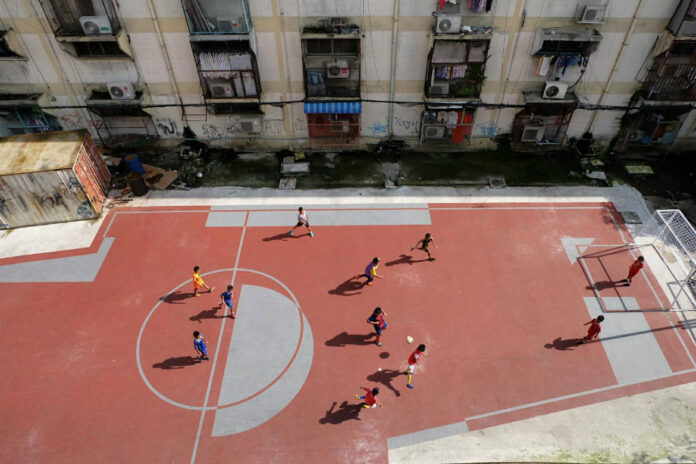
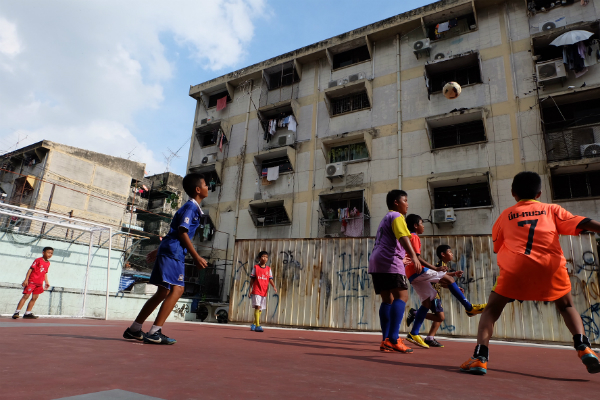
Children play on an irregular football field in Bangkok’s Khlong Toei district.

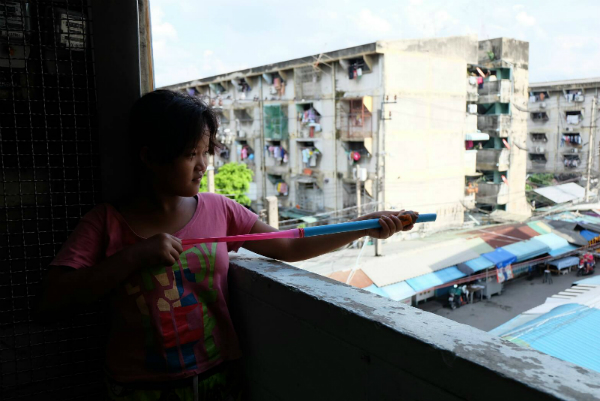
BANGKOK — Five gray, unpainted apartment buildings line a small road in the Khlong Toei Flats community. Under a searing Thursday sun, clouds of dragonflies buzzed and children perched in stairwells, shooting clay balls from guns made of PVC pipe.

While aunties sold rice and snacks and toothy grandpas picked up their children from a nursery, the afternoon was punctured by the sound of a white plastic soccer ball bouncing around a most unusual football field.

A girl shoots balls of clay from a PVC pipe Thursday in a stairwell in Bangkok’s Khlong Toei community.

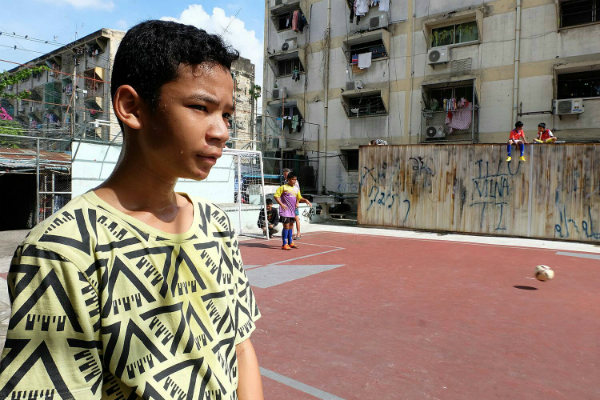
It certainly wasn’t FIFA regulation. It had four too many sides, and the goal area was pinched at both ends. But that didn’t bother Nawaphol ‘Most’ Piangtakoe, 13, one of the boys kicking a ball around the asymmetrical court Thursday.

“Before they came and made this soccer field, there was a basketball field, but the concrete was old and cracked and really dirty,” he said.

It was also occupied by a fallen tree and teenagers who hung out, drinking and using drugs there.

“This spot used to be full of poop and food that people threw from windows,” Wiliyak “Pai” Phromjan said.

Now almost every day, the 10-year-old brings friends both from school and the neighborhood to kick the ball around.


Nawaphol ‘Most’ Piangtakoe, 13, talks Thursday on an irregular football field built between buildings 1 and 2 in Bangkok's Khlong Toei district.
Nawaphol ‘Most’ Piangtakoe, 13, talks Thursday on an irregular football field built between buildings 1 and 2 in Bangkok’s Khlong Toei district.


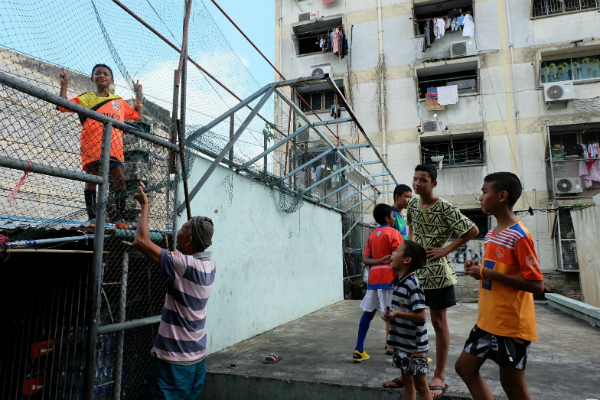
Phuwanat ‘Mike’ Piangtakoe, 12, strikes a pose as he climbs up to retrieve a ball.

Philanthropic Play

The irregular football pitch was made possible by real estate developer AP Thai, which partnered with ad agency CJ Worx on the project to turn vacant, trash-filled plots in the Khlong Toei slums to create irregularly shaped play spaces. The project began four months ago, and the first field was completed in July, according to AP.

It’s not quite the five pitches shown in a slick marketing video AP released last month to promote its good works. Only one of the five play areas seen in AP’s “The Unusual Football Field” video was finished, and the rest appeared to be computer visualizations.

Impoverished areas exist throughout Bangkok, but the infamous “Khlong Toei slums” are the best known, perhaps because they sit so close to the capital’s posh shopping malls and nightlife areas.

Near the old port on the Chao Phraya River, the area is actually a cluster of 40-odd communities housing an estimated 100,000 residents. Some live in decades-old, poorly maintained government housing while others dwell in ramshackle tin shacks piled against each other, with sewage streaming through trash-filled paths in between.

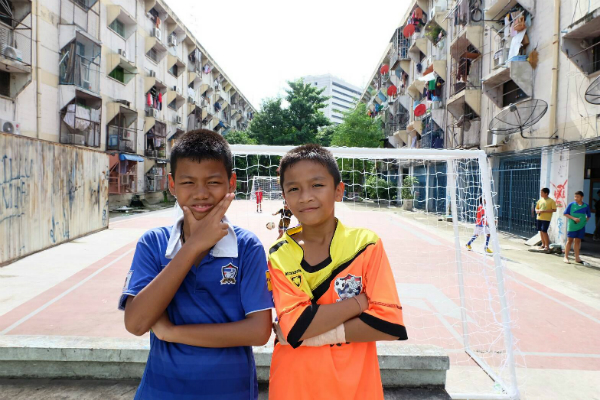
Wiliyak ‘Pai’ Phromjan, 10, at left, and Phuwanat ‘Mike’ Piangtakoe, 12, on the soccer field Thursday in Khlong Toei.

Pattaraphurit Rungjaturapat, 40, who oversees AP’s philanthropic projects, said that the finished field was cut off at both ends to avoid a shipping container sitting on one side and what used to be a squat hovel on the other.

Now children use the container as part of their game, bouncing the ball off it.

“The shape of the field is strange, I like it. I think the field is really good for playing,” Most said.

AP said it was a project that made sense for them to support.

“As a real estate and condo development company, our expertise is in designing living spaces, especially when we are given imperfect spaces,” he said. “Therefore, we collaborated with the community in order to find the best way to develop vacant lots.”

Wiliyak ‘Pai’ Phromjan, 10, and his friend Phuwanat ‘Mike’ Piangtakoe, 12, on the soccer field between flats 1 and 2.

CJ Worx’s Warapan Pornphichitpan said it was important to do something that fit the people and their space.

“We had to understand the space that people live in and how to maximize its potential to make it fulfilling for [them],” the 33-year-old said.

Warapan and his team decided to take on the problem of vacant, blighted lots.

“Vacant, dirty lots can be very bad for the community,” said Warapan. “These places are where rape, drug use, and other criminal activity happens.”


Work in Progress

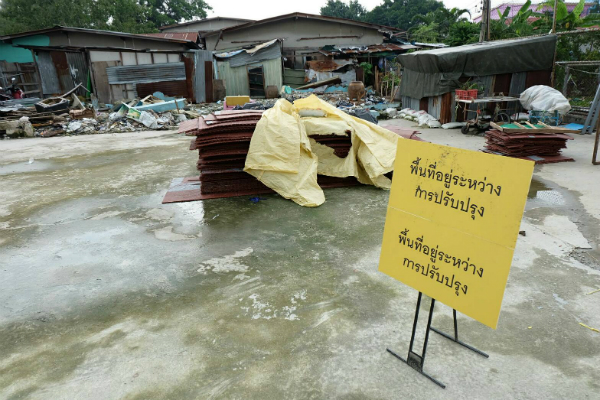
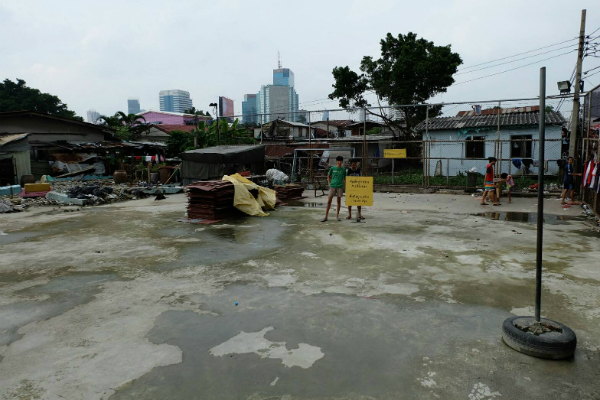
An unfinished football pitch in in a Khlong Toei community on Thursday in Bangkok.

Despite going forward with its feel-good marketing campaign showing creative use of five spaces for fields, only the one field was complete. AP said it has spent 1.4 million baht on the first two pitches and only 90,000 baht on the marketing video.

On Thursday an AP rep discouraged a reporter from visiting the site of a second field, but a 10-year-old boy explained how to find it. Eventually, after heading toward At Narong Road and passing through a tiny, waterlogged alley behind a motorcycle taxi stand, it was found squeezed between makeshift shanties. A messy concrete space with piles of the material used to floor the play areas.

Pichit “Todd” Cherngjorhor and his friends came out in greeting, saying “a bunch of university students” were working on the field, but had to stop when flooding started recently because the flooring just floated in the water.

“They brought a bunch of drones to fly around and take pictures of the area,” the 16-year-old said. He pointed to a vacant, trash-filled area behind a fence on one side of the space, saying it would have to be bulldozed to complete the pitch’s planned L-shape.

“When it’s finished, I’ll definitely come play ball here with my friends,” said the skinny teen in a green shirt. “My field is world-famous, isn’t it? The first L-shaped football field in the world! How’s that for ya?”

Pichit ‘Todd’ Cherngjorhor, 16, stands in front of a construction sign Thursday at an incomplete L-shaped soccer field in Bangkok's Khlong Toei district.
Pichit ‘Todd’ Cherngjorhor, 16, stands in front of a construction sign Thursday at an incomplete L-shaped soccer field in Bangkok’s Khlong Toei district.

Where to find the football pitches:

Advertisement

Putting the Populist Revolt in Its Place

A graffiti of American Republican nominee Donald Trump (left) and current British Secretary of State Boris Johnson is displayed last June days before the UK's EU Referendum on the streets of Bristol, England. Photo: Matt Brown / Flickr

CAMBRIDGE, Massachusetts — In many Western democracies, this is a year of revolt against elites. The success of the Brexit campaign in Britain, Donald Trump’s unexpected capture of the Republican Party in the United States, and populist parties’ success in Germany and elsewhere strike many as heralding the end of an era. As Financial Times columnist Philip Stephens put it, “the present global order – the liberal rules-based system established in 1945 and expanded after the end of the Cold War – is under unprecedented strain. Globalization is in retreat.”

In fact, it may be premature to draw such broad conclusions.

Some economists attribute the current surge of populism to the “hyper-globalization” of the 1990s, with liberalization of international financial flows and the creation of the World Trade Organization – and particularly China’s WTO accession in 2001 – receiving the most attention. According to one study, Chinese imports eliminated nearly one million US manufacturing jobs from 1999 to 2011; including suppliers and related industries brings the losses to 2.4 million.

As the Nobel laureate economist Angus Deaton argues, “what is crazy is that some of the opponents of globalization forget that a billion people have come out of poverty largely because of globalization.” Even so, he adds that economists have a moral responsibility to stop ignoring those left behind. Slow growth and increased inequality add fuel to the political fire.

But we should be wary of attributing populism solely to economic distress. Polish voters elected a populist government despite benefiting from one of Europe’s highest rates of economic growth, while Canada seems to have been immune in 2016 to the anti-establishment mood roiling its large neighbor.

In a careful study of rising support for populist parties in Europe, the political scientists Ronald Inglehart of the University of Michigan and Pippa Norris of Harvard found that economic insecurity in the face of workforce changes in post-industrial societies explained less than cultural backlash. In other words, support for populism is a reaction by once predominant sectors of the population to changes in values that threaten their status. “The silent revolution of the 1970s appears to have spawned an angry and resentful counter-revolutionary backlash today,” Inglehart and Norris conclude.
In the US, polls show that Trump’s supporters are skewed toward older, less-educated white males. Young people, women, and minorities are under-represented in his coalition. More than 40% of the electorate backs Trump, but with low unemployment nationally, only a small part of that can be explained primarily by his support in economically depressed areas.

On the contrary, in America, too, there is more to the resurgence of populism than just economics. A YouGov poll commissioned by The Economist found strong racial resentment among supporters of Trump, whose use of the “birther” issue (questioning the validity of the birth certificate of Barack Obama, America’s first black president) helped put him on the path to his current campaign. And opposition to immigration, including the idea of building a wall and making Mexico pay for it, was an early plank in his nativist platform.

And yet a recent Pew survey  shows growing pro-immigrant sentiment in the US, with 51% of adults saying that newcomers strengthen the country, while 41% believe they are a burden, down from 50% in mid-2010, when the effects of the Great Recession were still acutely felt. In Europe, by contrast, sudden large influxes of political and economic refugees from the Middle East and Africa have had stronger political effects, with many experts speculating that Brexit was more about migration to Britain than about bureaucracy in Brussels.

Antipathy toward elites can be caused by both economic and cultural resentments. The New York Times identified a major indicator of Trump-leaning districts: a white-majority working-class population whose livelihoods had been negatively affected throughout the decades in which the US economy shed manufacturing capacity. But even if there had been no economic globalization, cultural and demographic change would have created some degree of populism.

But it is an overstatement to say that the 2016 election highlights an isolationist trend that will end the era of globalization. Instead, policy elites who support globalization and an open economy will have to be seen to be addressing economic inequality and adjustment assistance for those disrupted by change. Policies that stimulate growth, such as infrastructure investment, will also be important.

Europe may differ because of heightened resistance to immigration, but it would be a mistake to read too much about long-term trends in American public opinion from the heated rhetoric of this year’s election campaign. While the prospects for elaborate new trade agreements have suffered, the information revolution has strengthened global supply chains and, unlike in the 1930s (or even the 1980s), there has not been a reversion to protectionism.

In fact, the US economy has increased its dependence on international trade. According to World Bank data, from 1995 to 2015, merchandise trade as a percentage of total GDP has increased by 4.8 percentage points. Moreover, in the age of the Internet, the transnational digital economy’s contribution to GDP is rapidly increasing.

In 2014, the US exported $400 billion in information and communication technologies (ICT)-enabled services – almost half of all US services exports. And a poll released last month by the Chicago Council on Foreign Relations found 65% of Americans agreeing that globalization is mostly good for the US, while 59% say that international trade is good for the country, with even stronger support among the young.

So, while 2016 may be the year of populism in politics, it does not follow that “isolationism” is an accurate description of current American attitudes toward the world. Indeed, in crucial respects – namely, on the issues of immigration and trade – Trump’s rhetoric appears to be out of step with most voters’ sentiments.

Joseph S. Nye, Jr. is a professor at Harvard and is the author of Is the American Century Over?.

Copyright: Project Syndicate, 2016.
www.project-syndicate.org

Advertisement

Search Continues For Man Who Drowned in Kanchanaburi Dam

Rescue workers search for Anirut Khunwichaeng at the spot where he reportedly drowned Saturday afternoon in Srinagarind Dam, Kanchanaburi province.

KANCHANABURI — Rescue workers Sunday continued their search for a man who disappeared after jumping into the Srinagarind Dam, nearly 24 hours after the incident.

Rescue workers from Pitakkarn Foundation said they resumed looking for Anirut Khunwichaeng, 39, who jumped in to swim at about 3pm on Saturday while visiting the Kanchanaburi province dam and is presumed to have drowned.

Anirut was on a raft floating near the embankment of the dam on the Khwae Yai River with 10 friends when he jump into the water without a life jacket.

The search was proving difficult, as the area where Anirut disappeared is about 80 meters in depth, a rescue worker said.

Advertisement

Hot News

LATEST NEWS

Bangkok
overcast clouds
30 ° C
30 °
28.8 °
78 %
5kmh
100 %
Sun
31 °
Mon
36 °
Tue
38 °
Wed
35 °
Thu
35 °