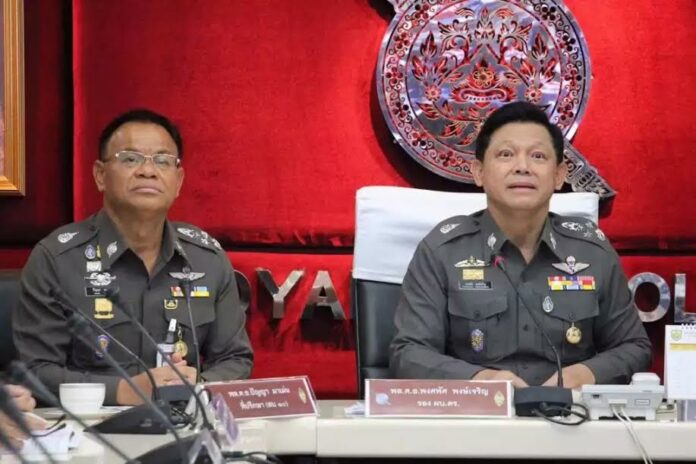
Deputy Police Chief Gen. Pongpat Pongcharoen, at right, speaks Sunday at a police news conference in Bangkok. Photo: Matichon
BANGKOK — Police announced Sunday morning they have made an arrest in connection with a wave of bombing and arson attacks in seven provinces that left four dead.
On Saturday, officers went to an offshore oil rig in the Gulf of Thailand where they arrested Sakarin Karuehat with a court-approved warrant in connection with the a fire at a Tesco-Lotus in Nakhon Sri Thammarat province.
Announcing the arrest, Deputy Police Chief Gen. Pongsapat Pongcharoen called on the perpetrators of the deadly terror attacks, which injured 36 people to turn themselves in. Pongsapat said investigators are closer to identifying the mastermind of the coordinated attacks who they believe to be a Thai national.
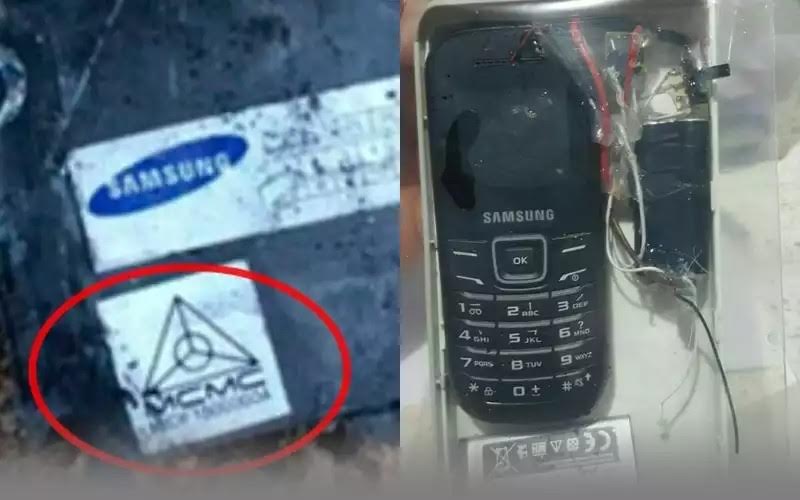
A police image of phones used in the attack. The MCMC sticker stands for Malaysian Communications And Multimedia Commission.
He said an unspecified number of people have been taken by the military for questioning.
Pongsapat, who spoke after participating in a video conference with police from various provinces, said police have gathered various evidence including clothes, cigarette and phones.
The phones used in the attack were reportedly all from the same brand and model, Samsung Hero E1200, with labels identifying them as being purchased in Malaysia. Police are asking Malaysian authorities for assistance.
Pongsapat meanwhile said those summoned by the military should have nothing to fear. Pongsapat refused to say how many have been detained so far, but said there would be no scapegoating.
“Everyone who has been invited should not worry. Just speak the truth,” Pongsapat said. “If you mean no harm to the country, you have nothing to fear.”
Pongsapat said there were probably 10 to 20 people involved. He added that they do not believe at this time any further attacks are coming.
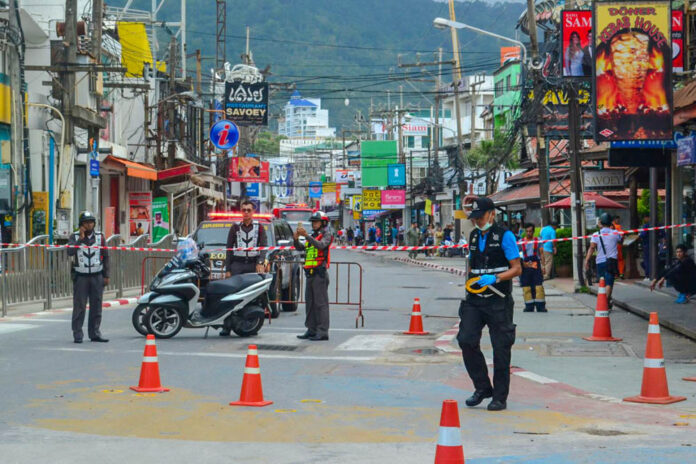
Extra police presence and checkpoints will remain in place for the meantime, and he asked for cooperation from the public.
Correction: An earlier version of this story misspelled the name of the deputy police chief. It is Pongsapat Pongcharoen, not Pongpat.
Phuket's Patong Beach after a bomb struck there Friday.
BANGKOK — Leaders of the anti-regime Redshirt movement Saturday flatly denied having anything to do with a series of bombs that killed four people and injured 35 in the west and south of Thailand and lashed out at the junta leader for making a “cheap” bid to frame them.
A day after authorities including Gen. Prayuth Chan-ocha hinted at their involvement in a wave of terror attacks that killed four and wounded dozens, several prominent Redshirts said it was irresponsible to do so.
“There’s no reason for us to do this. Why do you have to come up with such soap opera drama?” said Thida Thavornsaet Tojirakarn, a Redshirt co-leader and former chairwoman of umbrella organization United Front for Democracy Against Dictatorship.
She was responding directly to comments made Friday night, after bombs and fires ripped through seven provinces, by Prayuth on national television in which he blamed it on “bad people” who had been taking action prior to the Aug. 7 charter referendum.
Those comments came across as a less than subtle reference to the Redshirt movement which had opposed the junta-sponsored charter passed by the public on Aug. 7.
Thida said the regime would lose face if it pinned the attacks on foreign terrorists or even elements within the military unhappy about being left out of power. Instead, she said, the Redshirts were an easy scapegoat.
The provinces hit by the attacks were in reliably strong anti-Thaksin provinces which voted to endorse the charter. The previous Shinawatra-led government was swept out of office by street protests heavily supported by southerners, while the north and northeast of Thailand are Redshirt strongholds.
The targeted cities though are also neighbor to the Deep South provinces where a dozen years of armed struggle for independence has left thousands dead.
While the use of remotely detonated, improvised explosive devices Thursday and Friday is consistent with the tactics used by the southern separatists, they have rarely carried out attacks outside of the three provinces they wish to see secede from Bangkok’s authority.
Soon after attacks happened Friday morning, authorities dismissed their involvement. Prayuth was quick to link the attacks to the referendum held five days earlier.
“I will let you consider why this has happened since before the referendum until now,” he said Friday morning. “Why did it happen when the country is moving forward … who doesn’t want this to happen in Thailand?”
Another Redshirt leader, Sombat Boonngam-anong, said that was “cheap.”
Sombat said the junta refused to even entertain the idea that Thai-Malay Muslim separatists might have been behind the attacks. He compared Prayuth to an alcoholic who gets drunk and quarrels with someone only to unleash his anger.
“Prayuth knows that reds no longer have such capability…. Prayuth dares not point a finger toward the Deep South and say there’s such a possibility. This is because he’s afraid and can’t deal with these people,” Sombat said, in reference to Pattani, Narathiwat and Yala, where the Malay Muslim insurgency has burned for 12 years.
Sombat questioned why, if it was the work of Redshirts, they wouldn’t have gone after leaders of the military junta instead.
Investigators search the area near a som tam cart where 38-year-old Sakonthat Deesukon's body was found after a bomb exploded nearby Thursday evening in Hua Hin. She was one of four victims of a wave of bombings to hit five provinces.
SURAT THANI — Friday, unlike every other evening, when Jongkonnee Pumkrajang picks her two children up from the restaurant where they work, the three had special plan. For a very rare occasion, they would go out as the pair wanted to treat their mom to dinner for Mother’s Day.
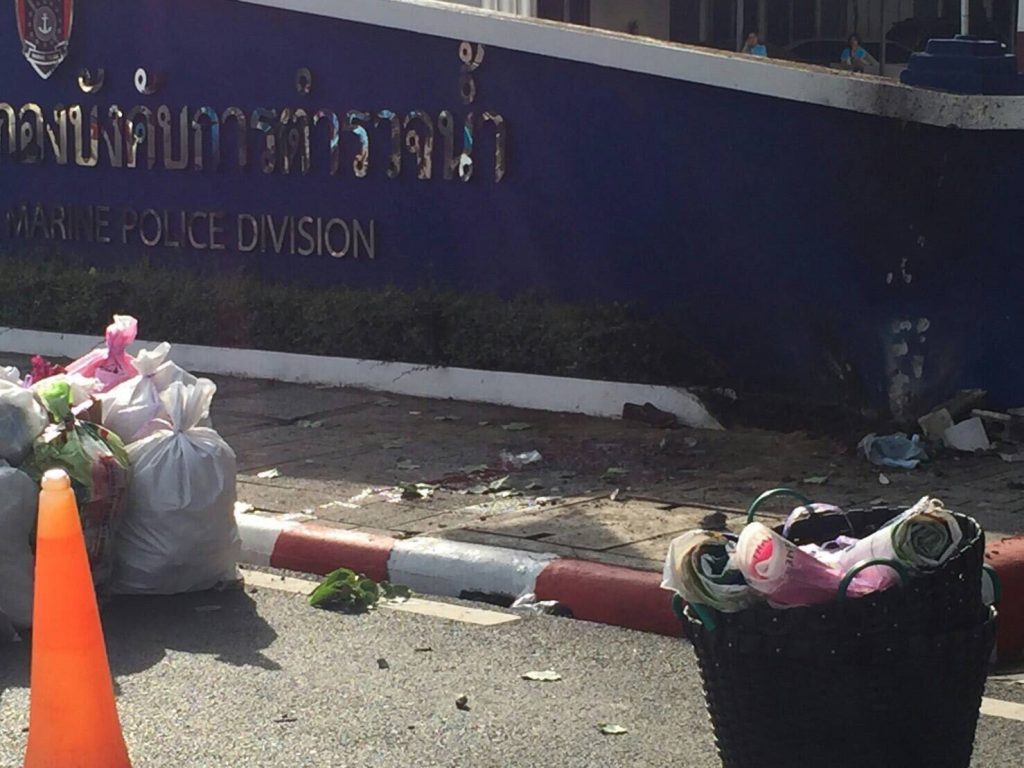
But Jongkonnee never got her dinner. Friday turned to be her children’s last Mother’s Day when a hidden bomb exploded in front of the Marine Police Station in Surat Thani. It was one of many to explode during a 16-hour period starting Thursday afternoon in a series of bombings and fire bombings across the west and south of the kingdom at the outset of a long weekend.
Jongkonnee was one of four to die, along with Hua Hin mom Natcha Suvarnphorm, a Trang husband named Picherd Viriyanuphabphong; and Sakonthat Deesukon, also of Hua Hin.
“I called mom at around 8 o’clock, but I couldn’t reach her,” her 25-year-old daughter Atchima Sanyakorn said through her tears. “Later someone told me she was dead.”
The 51-year-old was a mother of two. They didn’t have much money, so her kids dropped out of school to make some money wrapping fish wontons at a restaurant in Surat Thani.
Jongkonnee herself was a municipal services worker. She left their home at 3am on Friday to prepare a public area for an alms-making ceremony for Mother’s Day, which is celebrated on the Queen’s birthday.
After morning alms were made, the 51-year-old, along with some colleagues, packed the offerings for the monks into bags and piled them in front of the Marine Police Station, waiting for a truck which would carry them to the temple.
Around 8:05am, the bomb went off, injuring her and three colleagues. Jongkonnee died of her wounds.
“She had just called me at 6 o’clock to wake me up for work,” Atchima recalled of their final conversation.
Atchima said when she and her 22-year-old brother told Jongkonnee they should have gone out for dinner on Friday because she always worked so hard, their mother teased back that the best gift she could get was actual money.
The death of their family pillar left the pair profoundly shaken.
It was also just half an hour after morning alms on Friday when a bomb exploded near Hua Hin’s clock tower. Witness said the explosion caused something to shoot into the air before dropping and hitting Natcha Suvarnphorm.
The 36-year-old bar owner was walking back from making merit when she was hit. She later died, leaving a teen daughter behind.
“I was thinking about buying mom perfume since she said she wanted to get some,” her daughter, Natcharika Hummund, said of her initial Mother’s Day plan.
She ended up spending the day at the hospital.
“I want the perpetrator caught very soon,” she said Saturday. “I don’t want any incident that kills some innocent people like this to happen again.”
Sakonthat Deesukon
Before Natcha’s death, Hua Hin was shaken by the night before by a twin explosion in a tourist area which killed Sakonthat Deesukon, who was on her way home from work.
The 38-year-old, misidentified as a som tam vendor because her body was found in front of a food cart, was walking home after work at a nearby massage place, according to her brother, Jeerasak Deesukon.
Jeerasak lives in Chonburi province and only learned about his sister’s death Saturday.
“If all her stuff was not taken after the bombing, I believe police would have been able to contact me sooner,” Jeerasak said. He suspects someone robbed her body, leaving her without identifying documents or cellphone, as neither were found on her body.
The first of the four victims to die was mourned at a funeral on Friday. Picherd Viriyanuphabphong, 51, was among many vendors rushed to the hospital after an explosion tore through the area they were setting up stalls for a downtown evening market at about 5pm on Thursday.
Picherd sold fried Chinese bread sticks, or Pa Tong Ko. His back took the brunt of the explosion.
Though doctors rushed to operate, they were unable to save him. His 45-year-old wife, Watthanee Viriyanuphabphong, remains hospitalized at Trang Hospital.
Some families have received some assistance from state agencies. Junta leader Prayuth Chan-ocha has announced the government will help as possible.
American Michael Phelps reacts after losing the men's 100-meter butterfly final at the 2016 Summer Olympics on Friday in Rio. Photo: Michael Sohn / Associated Press
RIO DE JANEIRO — Michael Phelps is used to being in a league of his own.
So it was strange to see him, after what he insists was his final individual race as an Olympian, crowding onto a medal stand with two other swimmers.
And it wasn’t even the top step.
In a changing of the guard that left him totally at peace, Phelps was beaten Friday by a 21-year-old who grew up idolizing the most decorated athlete in Olympic history. Joseph Schooling of Singapore built a big lead in the 100-meter butterfly and easily held off one of Phelps’ patented comebacks, leaving him at 22 gold medals with one race, a relay, left to go.
And that will be his final event, Phelps insisted.
No more comebacks.
“I’m not going four more years and I’m standing by that,” he said. “I’ve been able to do everything I’ve ever put my mind to in the sport and after 24 years in the sport, I’m happy with how things finished.”
Silver medal winners Michael Phelps, South Africa’s Chad Le Clos and Hungary’s Laszlo Cseh hold up their medals in the men’s 100-meter butterfly medals ceremony during the swimming competitions at the 2016 Summer Olympics, Friday, Aug. 12, 2016, in Rio de Janeiro, Brazil. Photo: Michael Sohn / Associated Press
While Phelps wasn’t all that persuasive when he first retired after the 2012 London Games — and, indeed, he began eyeing a return to swimming about a year later — the big hug for Schooling and the huge smile when it was done told a different story this time.
He’s a father now, to 3-month-old Boomer. He’ll soon be marrying his fiancee, Nicole Johnson.
He’s ready to move on, and this time he really seems to mean it.
“I’m happy,” Phelps said. “I’m ready to spend some time with Boomer and Nicole and watch the little dude grow.”
This being Phelps, he had to do something out of the ordinary, even in defeat.
He was part of the first three-way tie for silver in Olympic swimming history, joined on the next-highest step by longtime foes Chad le Clos of South Africa and Laszlo Cseh of Hungary. They all touched in 51.14 seconds, which was actually faster than Phelps’ gold medal-winning time in 2012.
They clasped hands and stepped up together.
Then they all looked up to Schooling, receiving the gold for his blistering time of 50.39.
“It hasn’t really sunk in yet,” Schooling said. “I don’t know what to believe, like, whether I actually did it or I’m still preparing for my race.”
What made it even more special: Schooling still has a picture that he took with Phelps when the U.S. team trained in Singapore before the 2008 Olympics, the games where Phelps won a record eight gold medals in the pinnacle of his career.
“That’s pretty crazy, what happens in eight years,” said Schooling, who attends the University of Texas. “I’m just honored and privileged to have the chance to race alongside him.”
With four gold medals at these games and 22 for his career, Phelps has an opportunity to pick up one more before he leaves Rio. He’ll need some help from his teammates to do it — he leads off with the butterfly leg of the 400 medley relay on the final night of swimming Saturday.
While Phelps’ loss left the crowd in shock, Katie Ledecky got them on their feet again with another dominating performance, handily breaking the world record in the 800 freestyle.
And two other Americans won gold, too.
Anthony Ervin capped a remarkable personal journey with a gold in the 50 freestyle — 16 years after he won his first individual gold in the same event at the Sydney Games. And Maya DiRado knocked off the Iron Lady in the 200 backstroke, pulling off a furious rally on the final lap to beat Katinka Hosszu. Bronze went to Canada’s Hilary Caldwell.
Ledecky became the first woman since Debbie Meyer to sweep the three longer freestyle events at the same Olympics. Meyer took the 200, 400 and 800 at the 1968 Mexico Games, and Ledecky matched that performance with a couple of world records as well.
Ledecky was merely racing the clock as she powered away from the field to touch in 8 minutes, 4.79 seconds, eclipsing the mark of 8:06.68 that she set at a grand prix meet in Texas back in January.
Then, Ledecky played the waiting game, hanging on the rope for a while to let the rest of the field finish.
Jazz Carlin finally touched in 8:16.17 to claim the silver, just ahead of Hungary’s Boglarka Kapas grabbing the bronze in 8:16.37.
Some 23 seconds after Ledecky touched the wall, the last of the eight finalists chugged to the end of the grueling race.
Ledecky was barely breathing hard.
“I hit all my goals right on the nose this week,” she said.
Ledecky also became only the third American woman to win four gold medals in a single Olympics, following fellow swimmers Amy Van Dyken and Missy Franklin.
While Ledecky, at 19, is the youngest member of the U.S. team, Ervin is the oldest at 35.
In the blink of an eye, Ervin went from one end of the pool to the other in a furious dash, edging the defending Olympic champion, Florent Manaudou of France, by a mere hundredth of a second. Another American, Nathan Adrian, took the bronze.
Ervin won his first gold at the 2000 Sydney Olympics, tying teammate Gary Hall Jr. for the top spot. Then, Ervin walked away from swimming, skipping the next two Olympics while he embarked on a journey to find his purpose in life.
Turns out, it was swimming all along.
Ervin returned to make the American team in 2012, but failed to win a medal in London. Now, improbably, he’s back on the top of the podium again.
DiRado’s upset denied Hosszu a fourth gold in Rio, and capped off a remarkable one-and-done Olympics for the American.
She’s already got a job lined up in Atlanta after the Olympics and made it clear she would be retiring no matter the results. She certainly has nothing to complain about after winning two golds, a silver and a bronze.
“This whole day has been kind of crazy because it’s all of these little last things that I’ve gotten to do, like my last warmup with the girls at the training pool,” DiRado said. “I tried to keep it all under control, but there’s been a lot of tears these last 24 hours.”
BANGKOK — Amnesty International condemned the wave of bomb attacks which killed four people and injured at least 30 others in Thailand as a flagrant disregard of life, and called on the military government to measure its response mindful of its obligations under international human rights law.
The statement issued Friday night by Champa Patel, a senior research adviser for Amnesty’s regional office, seemed in response to past high-profile investigations which have become discredited by accusations of torture and lack of due process.
“Nothing can justify intentionally carrying out indiscriminate attacks, which disregard the basic right to life. These acts of violence show utter contempt for human rights,” Champa wrote.
But the authorities must take action responsibly, the statement continued:
“Those behind the attacks must be brought to justice through fair trials. Amnesty International calls on Thai authorities to ensure their response is in accordance with their obligations under international human rights law.”
Wiboon Boonpattararaksa talks to his son Jatupat Boonpattararaksa, at center, on Aug. 6 at a police station holding cell in Chaiyaphum province. Jatupat was on a hunger strike to protest his arrest for campaigning against the charter. Photo: Thai Lawyer for Human Rights
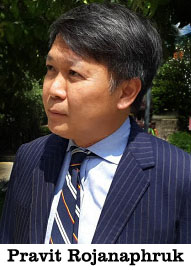
A week before the referendum on the junta-favored charter draft, which ended in a decisive victory for a constitution written entirely by junta appointees, I asked a taxi driver how he would vote.
The question was posed out of curiosity, and the driver’s answer made me even more curious. He said he didn’t like military rule, but the economy is bad so he planned to vote in favor of the charter so there would be quick general elections. I thought he was joking. Vote for the constitution of his hated junta? He wasn’t.
After the Aug. 7 referendum, in which 16.8 million supported the charter versus the 10.5 million who rejected it, it was clear that such a mentality was not isolated, as I interviewed people from the various regions and heard the same anecdotes replayed time and again.
If you think it’s ironic, consider the leader of Thailand’s Democrat Party, Abhisit Vejjajiva, who just days before the referendum denounced the charter draft but said he wanted the junta leader, Gen. Prayuth Chan-ocha, to stay on to preside over another “better” version. A “Democrat” Party leader publicly supporting a junta leader? Go figure.
Never mind the leader of the Democrat Party, there are many Thais who outright support the junta and continued militarization of Thai society. Many of these people are not even shills, they are dictatorial in mind and heart. Many think it’s best to have stability during the transition of the throne at all cost, never mind if it’s only surface deep, as witnessed by the bombs that killed four Thursday and Friday. Never mind if the price to be paid is the civil liberties of those who do not agree with you.
Then there are the democratic idealists who held a symposium at Thammasat University two days after the referendum calling the whole thing an unacceptable fake. One argued the word “referendum” should not even have been used due to the gagging and arrests of charter opponents in the preceding months under the Referendum Act enacted by the junta-appointed National Legislative Assembly. They have their point, but how to move forward with their agenda when many in society do not share their idealism or convictions?
I remind them that we live in a society, and that means that while each of us may have our own idealism and preferences on what is good and acceptable – there’s a need to try to accommodate others and find a social contract acceptable to all. That requires compromise on our values that differ from others.
Since the 1932 revolt ended absolute monarchy, Thailand has been alternating in a seemingly never-ending seesaw between conservative and progressive forces. Twelve “successful” coups have been staged since then, an average of one every seven years (not even counting the seven failed coup attempts), and successive juntas have ripped up various constitutions over the past eight decades, making the latest one the 20th “permanent” charter (and probably not the last). The phrase “permanent constitution” is a high example of oxymoron, worthy of pre-dinner stories to elicit laughter from foreigners.
The seesaw struggle will continue, however, as there are at least 10 million Thais who voted down the charter draft. As the military seeks to tighten its grip on power beyond elections through their appointed senate that will play a decisive role in picking the next prime minister, it’s time for pro-democracy Thais to earnestly ask why a substantial demographic supports the junta.
Is it because they’re just dictatorial minded? Are they too hateful and fearful of ousted, fugitive former premier Thaksin Shinawatra, whom they perceive as a threat to the monarchy? Is it both and more?
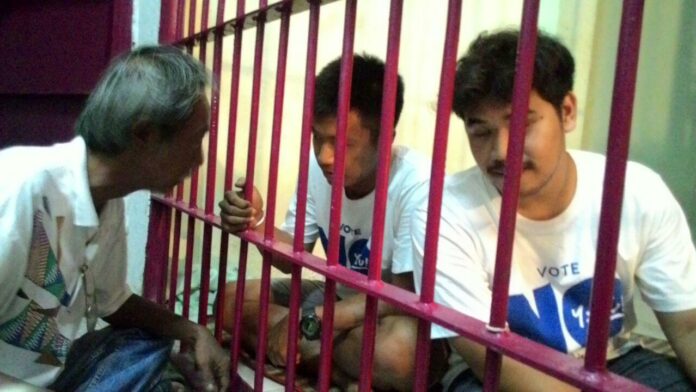
No matter what one makes of the results of the referendum and the continued militarization of Thai society, we also witnessed resistance. Some are in jail right now for campaigning against the junta-sponsored charter.
We are not in a Cold War era where communication is slow; we live in digital age of instant communication and access to information through our social media networks. In this paradigm, resistance against an anachronistic military dictatorship will definitely not be the same. And let’s face it, the mass media today is just not as afraid of Prayuth as they were of Sarit Thanarat back in the 1960s.
The struggle will continue until there exists an unwritten social contract acceptable by most on what Thai society should be. The old and infirm should entertain the possibility they won’t live to see the day an unwritten social contract is achieved. For the young, they should recognize and prepare to carry the torch of liberty, equality and democracy in the decades ahead. I still see hope in the eyes of these youngsters, some of whom have not even finished high school.
The story of the continued democratic struggle goes on, while the players and characters come and go.
In 1994, two producers got ‘90s icon Kejmanee ‘Pin’ Wattanasin to front their act, and the result was the breakout success of Kidnappers, an electric pop trio that were part of the kingdom’s modern musical renaissance. Their first album “Slang” remains a classic synonymous with that era.
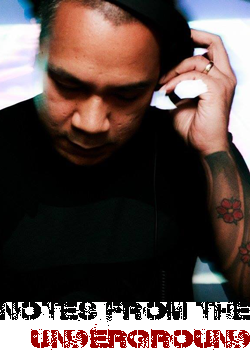
It started in the summer of ‘94 when producers Pakawat ‘May’ Waiwitaya and Traitep ‘U’ Wonpaiboon ditched the pop for a darker breakbeat sound and won street cred at some of the illegal warehouse raves going on and in the process became one of the first proper electronic music bands in Thailand.
Since then, they’ve dropped three critically acclaimed albums and a string of chart-topping singles.
Today, Pin is a mom and busy with her celeb husband J. Jetrin’s media empire.
But Tomorrow, Saturday, Kidnappers will take the stage at Tempology Festival with their new belle, the intoxicating model/actress Dissaya “Tiew” Korakotmas on the mic.
They’ve got a new single, “No Way,” which dishes out their signature brand of stylish grooves and feel-good lyrics. it’s even been given the magic touch by legendary sound engineer Tom Coyne (Adele, Disclosure, Mark Ronson) of Sterling Sound NYC. Already in the works for later this year is another EP to be released on the trio’s current label Spicydisc.
While May and U soak fame on the stage, behind the scenes they’ve got 9-to-5 jobs like the rest of us – albeit a bit more illustrious. U is a sound engineer and managing director at the esteemed Kantana Sound studio, which won a Golden Reel Award for Wong Kar Wai’s film “The Grandmaster.” May is a decorated veteran in his own right with numerous awards for scoring TV advertisements. He also owns the Atomix Clubbing recording studio, where I headed on a a recent cloudy afternoon for an interview.
The studio is stacked full with synthesisers and space-age equipment I dare not let my clumsy fingers touch.
On stage, May and U make the music while Tiew sings and struts. I’ve come to ask what they’ve got planned for Saturday’s Tempo Festival.
“It’s not going to be what you’d expect” May says smiling as he sits down next to U on the studio’s leather sofa. May does most the talking, the band’s spokesman while U tends to the quiet intellectual type (Or maybe it was struggling with my shitty translations from English to Thai).
And then Tiew walked in to join us, and I was admittedly completely starstruck.
We rapped for about half an hour about their two decades in the Thai music scene, EDM and their special performance at Tempo Festival.
Mongkorn: It’s been over two decades since your first album. Will you do this forever?
May: (laughs) We’ve just been signed to Spicydisc records, so because of our contract, we’ve got to release another album through them. I love playing live shows so I have no problem with doing this for as long as I can
Mongkorn: Your fan club must have definitely changed over the years.
May: What’s cool about is our fans from back in the day still come to support us, the only thing is that most of them have kids now. They bring them to our shows, and it’s great to see their kids enjoying our music.
Mongkorn: Tiew your the latest addition to the group how did you guys meet?
Tiew: It was through Tom of Cut the Crab [our mutual friend Thitinun Swasdikula]. I auditioned and after that May and U chose me to be their lead singer. I didn’t really have much experience singing but May and U coached me first and I learned from there. It was really tough.
Mongkorn: Were you a big fan of electronic music before?
Tiew: I like all kinds of music but as of lately I’ve been listening May and U’s music. They gave me a lot of the 80’s electro and synth pop to listen to and get inspiration from.
Mongkorn: You guys are headlining Tempo festival and word on the street is that you’re going to be doing things a bit differently this time?
May: Normally me and U perform as musicians but this time we plan on doing a 3 DJ back to back set with Me, U and Tiew.
Mongkorn: So you guys are gonna play all exclusive kidnappers material?
May: No I think it’s going to be a mix of our favourite tunes mixed with some our own remixes and unreleased tracks.
Mongkorn: You both came up in the underground electronic dance scene, what influenced you to make electro pop?
May: We’ve been a fan of this style of music since we were kids. We wanted to see what would happen if we made this music for a Thai audience.
Mongkorn: I met you guys back in those warehouse days. How do you feel about the scene in Thailand now?
May: Back then crowds in Thailand weren’t so well educated about electronic music, so people were really curious and fascinated with what we were doing, and ultimately that’s how everyone in the scene got to know one another. Now electronic music is very trendy
U: It’s become a proper business nowadays. I think there’s still the hardcore folks out there but just in very small numbers
Mongkorn: Many artists tend to try to renew themselves by going down the EDM path. What’s your opinion on that?
May: Sometimes when we get interviewed by TV stations or commercial radio shows, they tend to think that all electronic music is EDM. The great thing about the scene in Thailand now in comparison to 20 years ago is that we have so many good DJs from overseas coming to play in Bangkok.
Tiew: Yeah there are clubs like Beam as well that have brought the underground sound to a bigger audience, but I don’t think everyone can understand it but for those that do they really enjoy it.
U: Actually EDM is kinda cool in the fact it can bring electronic music to a new audience. I mean it’s definitely created an big interest here in Thailand. If people listen to us and think we’re an EDM group, and they like our music, then I’m totally fine with that! (They all erupt in laughter.)
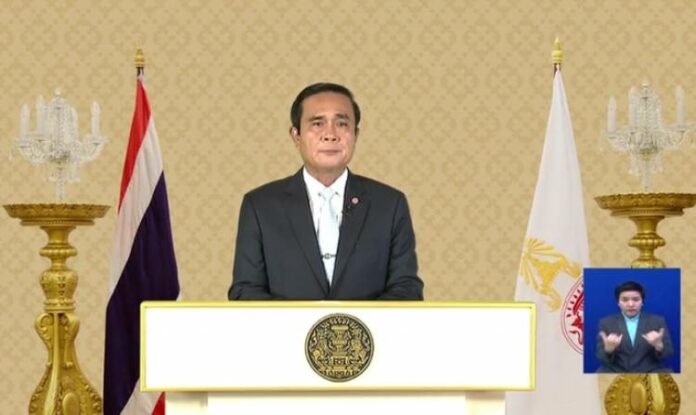
BANGKOK — Junta leader Prayuth Chan-ocha addressed the nation Friday night to call for unity and patience in the wake of a wave of deadly terror attacks that swept Thailand’s west and south.
Prayuth, addressing the nation as prime minister following evening programs devoted to the birthday of Her Majesty the Queen, said that while there’s no clarity about what happened, time should be given for investigators to work.
“These are actions that hurt the hearts of Thais most,” he said.
Though Prayuth asked the public to be patient and not make any assumptions, he let on that he had some idea who was responsible.
“There are still bad people, and they have been acting since before the referendum,” he said, in reference to this past Sunday’s adoption of a new, military-constitution by popular vote.
He also urge communities to be the ears and eyes of the authorities and set up volunteers to look after their communities.
“We must not blame one another. We have never hurt or had conflicts with anyone, be it domestic or abroad,” Prayuth said.
He said his military government would look after the safety of all diplomats and foreigners in the kingdom and fully care for those affected. He promised regular updates of information for the public.
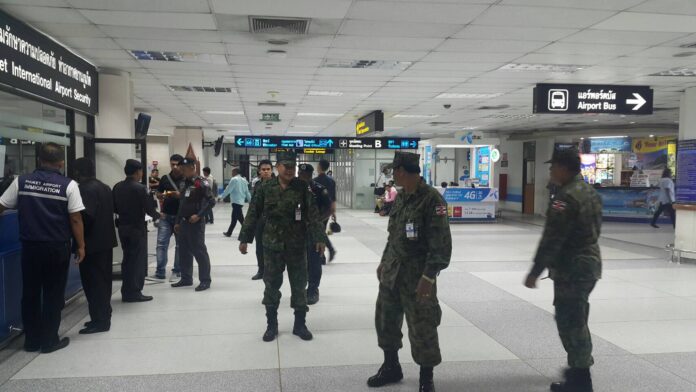
Security personnel at Phuket International Airport
HUA HIN — Authorities on Friday moved to secure cities hit by a wave of bomb attacks during the past 24 hours that killed four people in the west and south of Thailand.
They moved to seal Hua Hin, which was first hit Thursday night and again Friday morning, by closing the main road into town.
People were said to be staying home on what had been a holiday marking Her Majesty the Queen’s birthday. Markets and other places people gather were urged to remain closed.
All airports remained open with heightened security at some.
Here’s what we know about some of the affected areas.
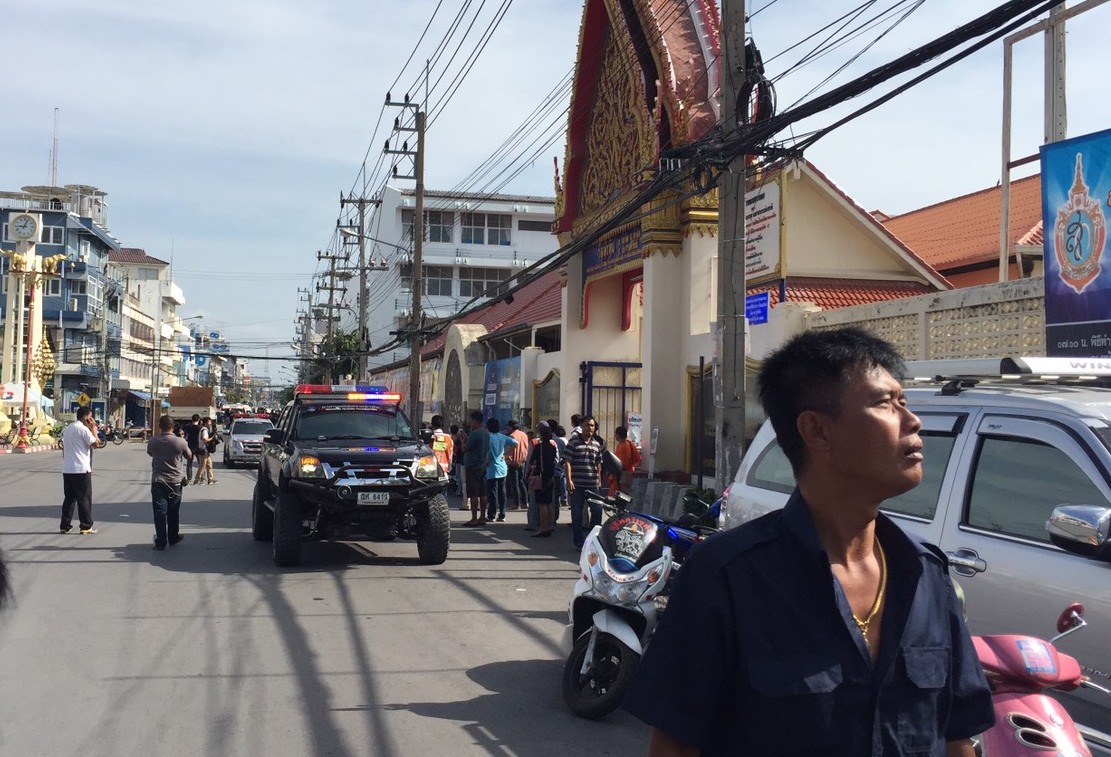
A closed intersection in Hua Hin where a bomb struck.
Mother’s Day celebrations may be canceled
Department stores instructed to close
Petchkasem Road into Hua Hin’s downtown has been closed. Commuters are urged to use alternative routes in.
Tourist attractions such as the Cicada Market, Hua Hin Market Village, Seenspace Hua Hin and night markets were closed Friday
Phang Nga
Mother’s Day evening parade is canceled.
Checkpoints at several roads leading to other nearby provinces.
Police randomly check cars heading to Phuket International Airport
Krabi
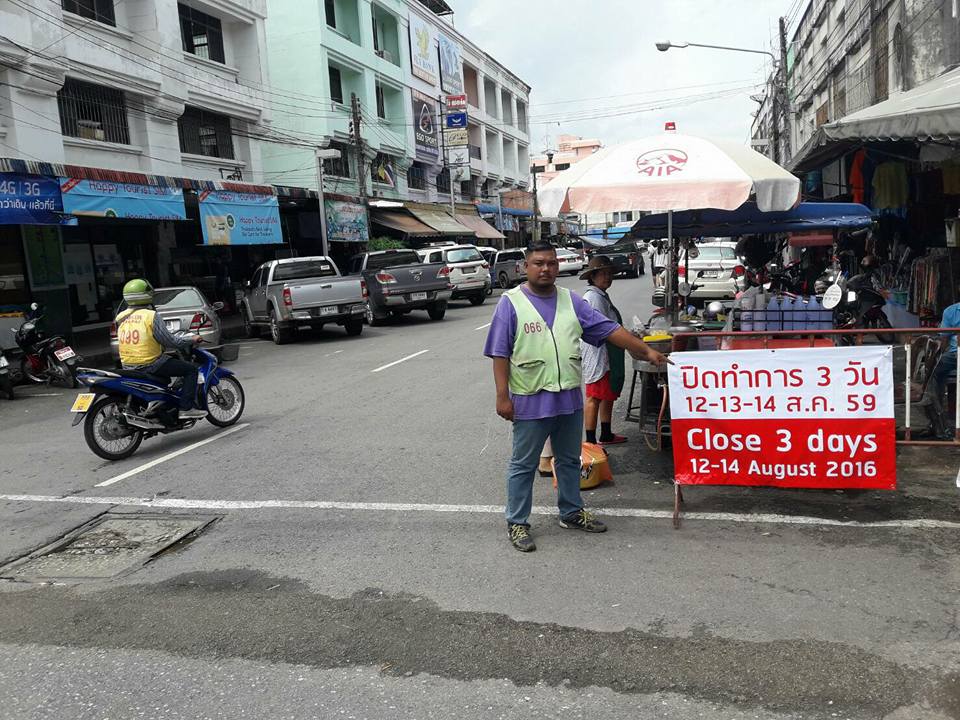
Krabi announced this pedestrian market will be closed three days. Photo: Torik Torik Sakol / Facebook
Krabi Pedestrian Night Market is ordered to shut down Friday, Saturday and Sunday.
Phuket
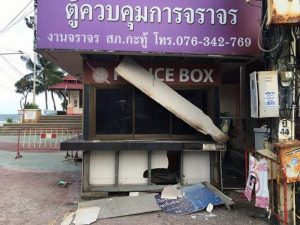
A police box damaged by an explosion Friday morning. Photo: D.Y. Jane / Facebook
Security status raised at Phuket International Airport
Restaurants are temporarily closed
Many roads are closed, checkpoints take place
Only few tourists at Patong Beach, walking along the beach and swimming in the sea.
Patong’s department store Jungceylon still opens as usual, however, the venue has lifted up security system with security guards.
Bangkok
Police Chief Chakthip Chaijnda ordered tighter security at sensitive areas such as embassies, shopping malls and the Erawan Shrine where a bomb killed 20 people one year ago this month.
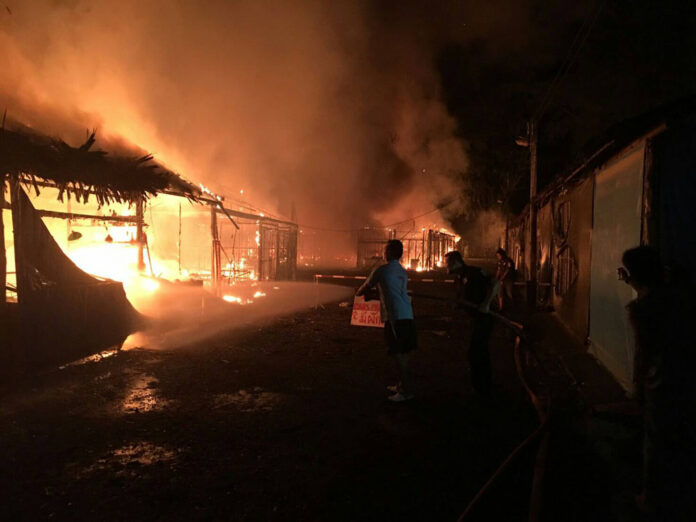
Firefighters work to put out a fire early Friday morning at the Bang Niang Market in Phang Nga province.
BANGKOK — A wave of coordinated, double bombings which began Thursday night and continued Friday morning killed at least four people across the south of Thailand at the beginning of a long weekend vacation marking Her Majesty the Queen’s Birthday.
Tourists, markets and government sites were targeted by apparent terror attacks in Trang, Prachuap Khiri Khan, Phuket, Phang Nga, Surat Thani provinces. No mass casualties were inflicted in the attacks, which each consisted of two bombs exploding in unison. On Friday afternoon, national police chief Chakthip Chaijinda said both firebombs and IEDs were used.
Some of the wounded tourists at a hospital in Hua Hin following the explosion Thursday night.
Two people were killed when eight more bombs exploded Friday morning after twin blasts killed a woman in the popular resort town of Hua Hin late Thursday night, injuring 21 others, including 10 foreign tourists.
Police spokesman Col. Krissana Phatthanacharoen said the injured included three Dutch nationals, four Germans, two Italians and one Austrian.
Twelve more bombs went off in four additional provinces Friday morning, with a repeat bombing in the same town where the first pair happened Thursday evening. Two makeshift bombs were defused Wednesday evening at Phuket’s Patong Beach, another popular tourist destination.
One person was killed and three injured when two bombs hit Surat Thani on Friday morning, one near the police station and another at a Marine Police Station, where the fatality occurred. On Phuket’s Patong Beach, two bombs went off at 8am resulting in at least one injury. At about 9am, Hua Hin was struck again with two more bombs going off near its clock tower, killing one woman and injuring three. Just after 2am, two bombs had detonated earlier at the Bang Niang Market in Phang Nga province with no injuries reported.
Friday’s attacks came early in the morning, several near to where Buddhist alms-giving ceremonies were being held.
Residents in Hua Hin said they were relieved after a bomb unit declared the area clear last night, and were shocked when fresh explosions hit Friday morning right after a 7am alms ceremony.
Police chief Chakthip said at 3pm on Friday that no arrests have been made, despite reports that some suspects had been taken into custody.
Arson Attacks
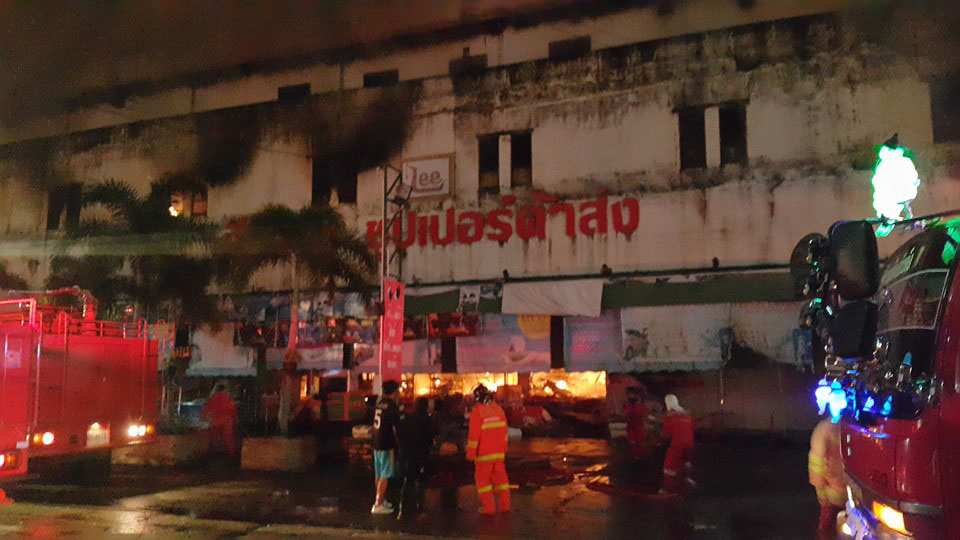
A series of suspicious fires broke out at four locations early Friday morning that seemed linked to the spree, including one followed by another double bombing. Between 2am and 7am, fire hit the Bang Niang Market in Phang Nga, a three-story supermarket in Trang province, the Aonang Market in Krabi and a Tesco Lotus in Nakhon Sri Thammarat were damaged by fires.
Two bombs went off at the market in Phang Nga shortly after the blaze started.
Junta spokesman Piyapong Klinpan said officials in every province were investigating the incidents to collect evidence and track down the perpetrators.
“We still have no information about them. But at this moment, we believe the attacks are all connected. We don’t want to speculate on the motivation, but we believe it’s the work of a coordinated movement.”
Despite saying they have no knowledge, Klinpan was quick to rule out it was linked to separatist violence in the Deep South, a conflict which has mostly been contained in the provinces of Yala, Narathiwat and Pattani.
Two bombs went off Friday morning at a clock tower near Wat Hua Hin
Who Did It?
Like previous terror attacks in Thailand, no group immediately claimed responsibility. The attacks came several days before the one-year anniversary of the bombing of Bangkok’s Erawan shrine, which left 20 people dead.
Chakthip said Friday afternoon the bombs were similar to those used by separatist insurgents in the Deep South. Acknowledging he had no evidence, he said he believed the attacks were linked to Thailand’s political conflict.
“All seven provinces where the incident took place all endorsed the draft charter,” he said.
Chakthip didn’t name the opposition Redshirt movement but intimated his suspicion in reference to the suspected arson attacks.
“I believe this kind of incidents didn’t involve foreigners,” he said. “It’s never been foreigners burning places.”
As was the case after the August 2015 shrine bombing, fingers were quickly pointed at the opposition Redshirts, as well as the southern separatists. That terror attack was later determined to have been the work of ethnic Uighurs, most likely in retaliation to the military regime’s forcible deportation of their people back to China.
In an earlier televised address from National Police headquarters in Bangkok, deputy police Col. Kritsana said the bombs Thursday night were detonated remotely by mobile phone.
Repeating another refrain from last year’s attack, Kritsana pleaded with people not to use the word “terrorism” in favor of “local sabotage.”
A political and national security analyst at Chulalongkorn University said the attacks look like the work of outside terrorists.
“At this time, it looks like terrorists from the outside, not an internal problem,” said Surachat Bumrungsuk. “Attacks related to domestic issues don’t intend to cause mass fatalities, only to make a lot of noise.”
A fire at ‘Lee Mart’ burns early Fridiay morning in Trang province, where a deadly bombing hit the night before.
He discounted the timing of the attacks as being related to the Queen’s birthday.
“Terrorism needs opportunity, not a schedule,” he said, comparing similarities in the bombings to attacks in Kuala Lumpur and Bali.
However the director of Deep South Watch news agency said it was too soon to rule out a connection with the roiling conflict there.
“There is a possibility,” Srisompob Jitpiromsri said. “Though they operate out of their area as widely as this. They do have the network and potential ability.”
He said forensic examination of the devices would be able to tell whether there was a link. Most if not all of the bombs Thursday and Friday were reportedly detonated by mobile phones.
Srisompob noted the bombings comes days after the south sent a political message by rejecting the junta-backed charter which was passed nationally by a wide margin last Sunday.
Talks between separatists and the junta went dark months ago, and Srisompob said the attack could have been hatched by some factions within the different insurgent groups.
Junta leader Prayuth Chan-ocha was quick to link it to last Sunday’s charter vote.
“I will let you consider why it has happened since before the referendum until now,” he said Friday morning. “Why did it happen when the country is moving forward … who doesn’t want this to happen in Thailand?”
The U.S. Embassy offered its condolences among such statements coming from various diplomatic outposts.
“We express our deepest sympathy to all those affected by the bombings in Thailand,” wrote a message posted online. “Our thoughts are with the victims and their families.”
Scene of a bombing attack Thursday night in Hua Hin.
TIMELINE
Wednesday
At 8pm, police found and defused two power banks wired to explode in front of the Paradise Market and Chinatown Market in Phuket’s Patong Beach area.
Thursday
At 5pm, a bomb struck the Center Point Market near Trang City Hall while vendors were setting up their stalls, killing one and injuring at least six others.
At 10:15pm, the first bomb hit Hua Hin in front of the Johnny’s 56 Bar. A second followed at 11pm in front of Raintree Spa. Both places are on Soi Selakam which is home to many bars popular with foreigners. The bombs, believed hidden in tree pots, killed a woman and injured 21 others, including 10 foreign tourists.
Friday
Scene of Friday’s explosion in front of the Marine Police Division in Surat Thani province.
At 8am, bombs went off near the Surat Thani Police Station and a Marine Police Station where a Mother’s Day ceremony was being held. One person was killed by the latter and three were injured, according to Royal Thai Police.
At the same time, two bombs went off at Phuket’s Patong Beach. The first bomb exploded at 7:45am in a park along the beach, causing one injury. The second bomb took place at the Kratu Police box at 8:45am, but no one was injured.
One hour later at 9am, two more bombs hit Hua Hin at the city’s clock tower, killing one woman and injuring three.
At about the same time, another two explosives were reported in front of the Bang Niang market in Phang Nga’s Takua Pa district where a fire had just broken out at 2am, destroying more than 80 shop stalls. No one was injured from the explosion though two cars were damaged.





































 After the Aug. 7 referendum, in which 16.8 million supported the charter versus the 10.5 million who rejected it, it was clear that such a mentality was not isolated, as I interviewed people from the various regions and heard the same anecdotes replayed time and again.
 It started in the summer of ‘94 when producers Pakawat ‘May’ Waiwitaya and Traitep ‘U’ Wonpaiboon ditched the pop for a darker breakbeat sound and won street cred at some of the illegal warehouse raves going on and in the process became one of the first proper electronic music bands in Thailand.