





























27.7 C
Bangkok
Friday, June 26, 2026
Home Blog Page 2662

Punishing Strike by Resident Doctors Grinds on in Haiti

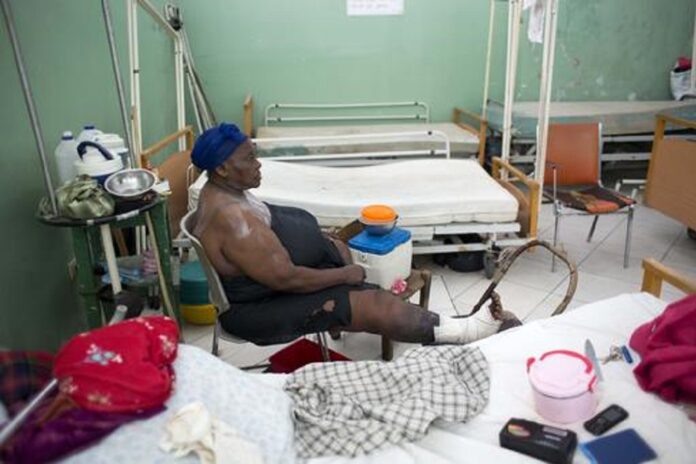
In this July 19, 2016 photo, patient Penina Pierre sits alone in a dermatology ward, her bandaged foot propped on a chair, at the Hospital of the State University of Haiti, in Port-au-Prince. Photo: Dieu Nalio Chery

PORT-AU-PRINCE, Haiti — Empty halls buzz with flies. Rats scamper through the wards at night. The emergency room is empty except for four shackled prisoners, watched over by relatives and missionaries rather than medical personnel.

The Hospital of the State University of Haiti, the largest and most important public medical facility in this troubled country, is at the epicenter of the most punishing strike by Haitian medical workers in memory.

“We’ve been left to rot,” said Alme Cesar, one of the shackled prisoners, who was brought to the hospital months ago for treatment that has yet to materialize. “I would have died here without my wife coming to care for me.”

In this May 12, 2016 photo, one of four shackled prisoners rests in an empty emergency room, watched over by relatives and missionaries, but no medical personnel, at the Hospital of the State University of Haiti, in Port-au-Prince. Photo: Dieu Nalio Chery
In this May 12, 2016 photo, one of four shackled prisoners rests in an empty emergency room. Photo: Dieu Nalio Chery

Young doctors and interns walked off the job in March to protest chronic shortages of basic medical supplies, dismal pay and working conditions so unsafe that relatives of patients routinely threaten them, even storming into operating rooms with handguns.

Nurses and support staff soon joined the walkout. Then waves of strikes spread to 12 other government-run hospitals across Haiti, crippling a severely under-resourced health system that struggles to cope during the best of times.

Health Ministry authorities say four state hospitals are closed and others hit by strikes are functioning at diminished capacity.

They claim hospitals are gradually reopening.

But Associated Press journalists visited one hospital identified as open in the capital’s Delmas district and found it barely scraping along. While a couple of specialists did scheduled consultations, the hospital was nearly empty and support staff sitting at the entrance turned away people seeking treatment.

“I heard this hospital was open. But they just told us to go somewhere else,” Macula Josephe said as she and her sister helped her grandfather into a pickup truck in the hospital’s parking lot.

The government-run hospitals that cater to Haiti’s poorest citizens frequently lack basic supplies like surgical gloves, gauze, antiseptics and sometimes even water. Power outages force night-shift doctors to use light from their cellphones to finish operations.

The director general of the Health Ministry, Dr. Gabriel Thimothe, said public hospitals have been badly underfinanced for many years. The Haitian government devotes 4.7 percent of its budget to health care and has called for increasing the share to nearly 10 percent next year under a proposed budget.

Thimothe said many of the striking resident doctors are “radicals” who trained in Cuba.

“We’re open to negotiations. But we can’t give everything they demand due to the economic situation of the country,” he said.

Since 1996, resident doctors in Haiti have been paid $120 a month (around 4,000 baht), a paltry salary that has been eroded further by the rising cost of living.

After initially demanding $500 (around 17,500 baht) a month, striking residents now say they will accept $360 (around 12,500 baht). They recently rejected a government offer of roughly $200 (around 7,000 baht) monthly to return to work.

Dr. Vanessa Mehu, a third-year anesthesiology resident, said the strike would not stop until all their demands were met. While salaries are a major sticking point, she said doctors need systemic changes to a public health system that has long been unable to give adequate care to many.

“People were dying for nothing. People were dying because they didn’t have money to buy gloves. People were dying because they didn’t have money to buy some serum, syringes,” Mehu said.

Thimothe said at least three deaths, including a pregnant woman who died outside the State University hospital’s gates, have been attributed to the strike.

Haiti’s longest health walkout comes as a political impasse between feuding factions shows no sign of ending, leaving the poorest citizens suffering most amid Haiti’s latest leadership drift.

Interim President Jocelerme Privert, whose term ended last month but remains in office as divided lawmakers delay a vote on his fate, has threatened to strip hospital residents of their medical licenses. The threat has inflamed tensions.

“He’s just trying to intimidate the residents,” said Dr. Joseph Herold, a third-year resident in obstetrics and gynecology.

Recently, specialist physicians tried to report to work at the State University hospital but they were driven away by striking residents.

A hospital strike is the last thing Haiti needs.

Life expectancy has long been the shortest in the Western Hemisphere. Mosquito-borne diseases, measles, meningitis and other scourges are common. Malnutrition and stunted growth are widespread. Cholera has killed at least 10,000 people since 2010, when it was introduced into the country, likely by U.N. peacekeeping troops.

Few patients can afford prescription medicines, and private care is out of reach for many. Those with means seek treatment in Miami or the neighboring Dominican Republic.

About 50 percent of total health care expenditure in Haiti is provided by NGOs, according to the World Bank. Clinics and hospitals run by foreign NGOs such as Doctors Without Borders have been swamped with patients amid the strike.

On a recent afternoon, dozens of poor people trying to get on waiting lists camped outside the Mirebalais public-private hospital created by Boston-based Partners in Health. The well-equipped hospital opened in 2013.

Asania Sineus was in her sixth day outside the teaching hospital’s doors as she waited for her mother to get treated for injuries from a motorbike crash. She first took her mom to a public hospital in Gonaives but it was closed.

“Having to travel here is not good for us. But what else can we do?” the 20-year-old student said from her camp of piled blankets.

At Port-au-Prince’s State University hospital, which was supposed to be rebuilt by now with $83 million (about 2.9 billion baht) from international donors, Penina Pierre sat alone in a dermatology ward. Visiting missionaries are keeping her fed since she has no family.

“Maybe someday the doctors will come back,” said Pierre, the skin around her bandaged foot discolored and inflamed.

Story by: David McFadden

Advertisement

Lanna Pride on Display in Performances Celebrating 720 Years of Chiang Mai

Divine Dance and Music by Chiang Mai Art Sprout Group

CHIANG MAI — Northerners will be able to feast on the sights of proud Lanna tradition with three dance performances next month.

Talented local artists and alumni from Chiang Mai University’s Faculty of Fine Arts will present traditional and contemporary Neo Lanna performances at “Divine Dance and Music” on the occasion of their hometown’s 720th anniversary. Neo Lanna is the contemporary reimagining of the once-lost traditions of the Lanna kingdom.

“Lanna performing art had once disappeared from Thailand. However, the remaining mural arts, literature and language were the sources for performing artists to redevelop their forms,” said Ronnarong Khampha, a traditional northern and contemporary dancer who’s helped organize the event from its beginning. “Neo Lanna recently has enjoyed a resurgence in the past 30 years to explore the roots of Lanna traditional dance and music in the north, but it is presented in a contemporary form to sustain the Lanna identity.”

As the support for local artist and students is scarce, the revenue from the event will be provided to Chiang Mai Art Sprout Group and students of Faculty of Fine Arts, Chiang Mai University to further sustain Thai performing art.

Tickets are 300 baht (100 baht for students). Find more information here.

Performances will be held at 7pm on Aug. 5, as well as 2pm and 7pm on Aug. 6 at the Chiang Mai University Art Museum.

13606846 10210183321441758 3326420221727480677 n

Advertisement

Officials Powerless to Halt Assaults on Referendum by Schoolboys, Monkeys, Coffee Brand

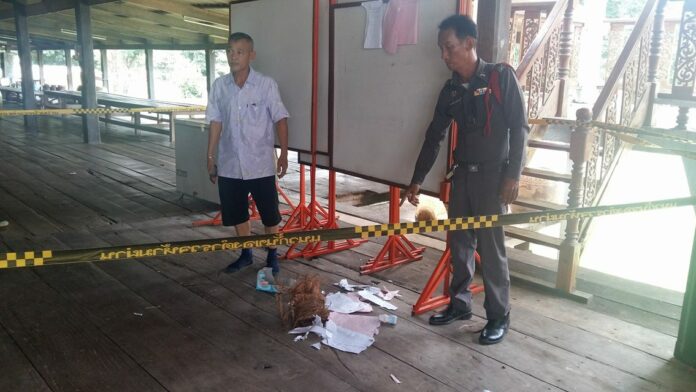
A Pichit police officer points to the devastation of referendum documents left behind by a rampaging pack of macaque monkeys Sunday at a local temple.

BANGKOK — To election officials tasked with vigilantly enforcing a draconian referendum law, it may have looked as though the forces of man and nature conspired against them.

Macaque vandals, teen mischief, destructive weather and even a coffee marketing campaign left grim officials seeking recourse over the weekend against forces largely out of their control.

First, two Mathayom students in Rayong’s Klaeng district were caught Saturday shredding and burning a voter list posted near a community building. The two middle schoolers became the second pair of students charged with violating the referendum law, which penalizes vandalism of voting equipment.

Then rain damaged a voter list in Ratchaburi city, where recent storms left the distinctive pink documents faded beyond recognition. Locals told reporters they were puzzled as to why officials had posted important documents under the open sky.

In Pichit province, the defenders of the pink papers were left with no one to punish Sunday after an onslaught of more than 100 monkeys at a temple where people will vote in the Aug. 7 referendum. Their simian assault annihilated the voter list pinned there. It also proved somewhat ironic as officials have deployed Hanuman, the Monkey God, as their smiling mascot.

“Some of them carried the papers away like they were mocking the police and the people chasing after them,” local official Chatchawan Suksawasdi said. “So we couldn’t catch or do anything to this monkey pack.”

Some of the invading monkeys at the scene.

All told, five of 15 documents listing names of local voters were destroyed, along with 10 papers detailing voting procedures.

Pichit police chief Jaruay Pholprasert said he couldn’t have seen it coming.

“It was an incident beyond all reasonable prevention,” Col. Jaruay said.

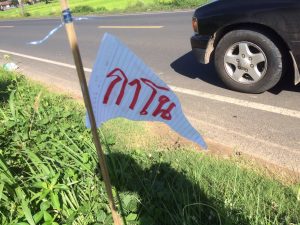
And finally, alarms were briefly raised in Si Saket province when keen-eyed local authorities spotted dozens of small flags proclaiming “Tick No” dotting a road there.

Gov. Thawat Surabal immediately ordered an investigation, as any campaign to “mobilize” or “mislead” the public to vote for or against the proposed constitution is also illegal under the referendum law.

The investigation came to an end after officials realized the flags were in fact promoting a coffee brand called Ga No – a localized reduction of “Americano.” How could that pose offense? The word “Ga” means to tick a ballot.

Small flags promoting 'Ga No' coffee found in Si Saket
Small flags promoting ‘Ga No’ coffee found along a road Si Saket province were deemed too ‘risky’ and ordered removed.

Nevertheless, governor Thawat said he’s asked the coffee producers to suspend their campaign to avoid any further misunderstanding.

“I have asked for the cooperation from the manufacturers of said coffee to stop any PR activity for their coffee brand temporarily,” Thawat said. “Because it’s misleading and risky in the period when we’re preparing to vote in the referendum.”

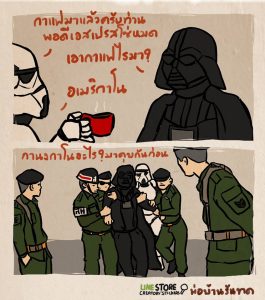
The absurdity proved too irresistible for netizens, and numerous memes mocking the incident blossomed on social media.

In this comic, Darth Vader was arrested after soldiers overheard him ordering Americano coffee. Photo: Chaa Close Beta / Facebook
In this comic, Darth Vader is arrested after soldiers overhear him order Americano coffee. Photo: Chaa Close Beta / Facebook

https://twitter.com/Badbadtzmaru83/status/757375860462592001

‘Ga’ also means crow.

A cartoonist sarcastically suggested that former Prime Minister Thaksin Shinawatra was behind the coffee brand. Photo: Cartoon Egg Cat / Facebook
A cartoonist sarcastically suggests former Prime Minister Thaksin Shinawatra was behind the coffee brand. Photo: Cartoon Egg Cat / Facebook
Advertisement

ASEAN Makes Last-Ditch Attempt at Consensus on S. China Sea

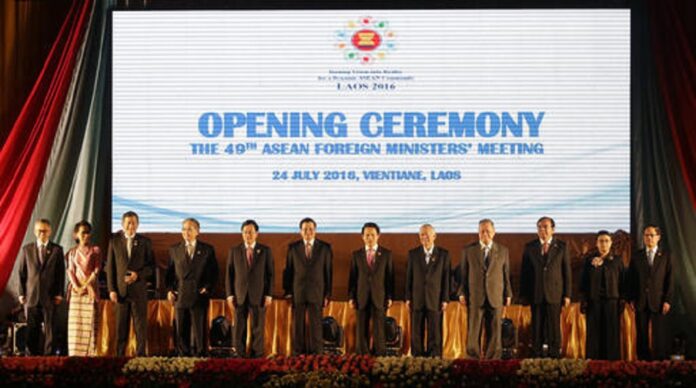
Delegates pose for a group photo during the opening ceremony of the 49th Association of Southeast Asian Nations (ASEAN) Foreign Ministers' Meeting in Vientiane, Laos, Sunday, July 24, 2016. Photo: Sakchai Lalit

VIENTIANE, Laos — Southeast Asia’s main grouping made a last-ditch attempt to reach a consensus on countering China’s territorial expansion in the South China Sea, but their deadlock appeared far from being resolved as minutes ticked by before a critical meeting with the Chinese foreign minister Monday.

The foreign ministers of the 10 members of the Association of Southeast Asian Nations held three rounds of talks on Sunday, and an emergency post-breakfast session on Monday ahead of a scheduled meeting with Chinese Foreign Minister Wang Yi.

The deadlock is over whether ASEAN, in their traditional joint statement, should chastise China for claiming the entire South China Sea, which infringes on territorial claims of four member nations — the Philippines, Vietnam, Malaysia and Brunei.

Because ASEAN works by consensus, it cannot rebuke China unless all 10 members agree. In complete disagreement is Cambodia, a close China ally, and even Laos although its opposition is somewhat muted because of its role as the host of the series of regional meetings this week. Thailand also doesn’t appear too keen to criticize China.

At one point it appeared that the ASEAN ministers will simply have to abandon the idea of issuing a joint statement.

Thai Foreign Minister Don Pramudwinai told reporters after the emergency meeting that South China Sea was not discussed at all. He, however, said ASEAN will issue the joint statement after all, but refused to say if the communique will contain a reference to South China Sea and China.

“You will read it,” he said cryptically.

Indonesian Foreign Minister Retno Marsudi also said: “It’s very positive … We are very much on track” to release the communique. She also would not say if the communique would refer to the South China Sea, or the decision of an international tribunal, the Permanent Court of Arbitration in The Hague, earlier this month that said China’s expansive claims in the region are illegal.

The stalemate puts pressure on ASEAN’s cherished unity and also gives an upper hand to China, which has used every diplomatic means at its disposal to stave off wider international criticism over moves it’s made in the South China Sea that have impacted the four Southeast Asian countries.

“Certainly, Cambodia’s paralysis of ASEAN … hurts ASEAN’s unity, cohesion, relevance and reputation,” said Malcolm Cook, an analyst at the Institute of Southeast Asian Studies, a Singapore think-tank. “It makes ASEAN peripheral, not central, on this issue.”

“For Laos and Cambodia, they clearly see relations with China as more important than their membership in ASEAN and are willing to damage ASEAN to aid their relations with China,” he said.

The South China Sea is dotted with reefs and rocky outcroppings that several governments claim, including China and the Philippines. The arbitration panel didn’t take a position on who owns the disputed territories. It did conclude that many of them are legally rocks, even if they’ve been built into islands, and therefore do not include the international rights to develop the surrounding waters. That and other findings invalidated much of what China has called its historic claims to the resource-rich sea.

In order to ease tensions, China, the Philippines and possibly other claimants must define what the ruling means for fishing, offshore oil and gas exploration, and military and other activities in the vast body of water that lies between the southern Chinese coast and the Philippine archipelago.

China has rejected the ruling as bogus, and called for bilateral negotiations with the Philippines. In recent days, its military has staged live-firing exercises in the area and said it would begin regular aerial patrols over the sea. It also has asserted that it will not be deterred from continuing construction of its man-made islands.

On Sunday, Wang, the Chinese foreign minister, reiterated his government’s position that it will only accept bilateral negotiations.

“Every country has the same position as China, that is that we should fully and effectively implement the regional Code of Conduct, and in that COC it clearly states the dispute should be resolved by peaceful, sit-down talks between the parties directly concerned,” he said.

He is scheduled to give a news conference later Monday after his talks with ASEAN ministers.

Story by: Vijay Joshi, Daniel Malloy

Advertisement

IOC Leaders Stop Short of Complete Ban on Russians From Rio

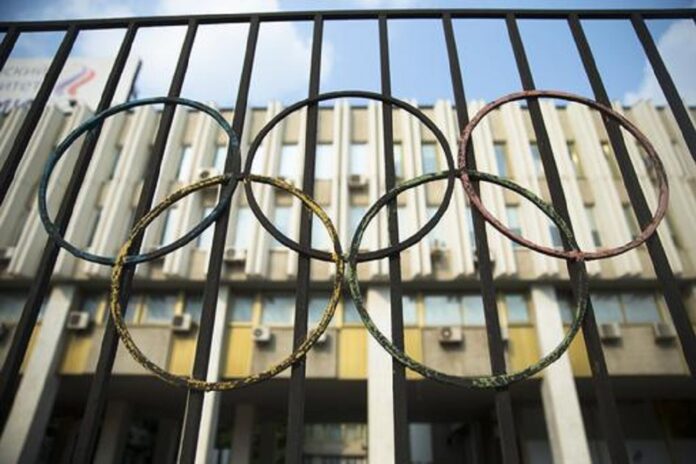
The Olympics rings are seen on a fence in front of the Russian Olympic Committee building in Moscow, Russia, Sunday, July 24, 2016. The IOC has decided against a complete ban on Russian athletes from the Olympics in Rio de Janeiro. Photo: Pavel Golovkin

LAUSANNE, Switzerland — Rejecting calls by anti-doping officials for a complete ban on Russia, Olympic leaders on Sunday gave individual sports federations the task of deciding which athletes should be cleared to compete in next month’s Rio de Janeiro Games.

Citing the need to protect the rights of individual athletes, the International Olympic Committee decided against taking the unprecedented step of excluding Russia’s entire team over allegations of state-sponsored doping. Instead, the IOC left it to 27 international sports federations to make the call on a case-by-case basis.

“Every human being is entitled to individual justice,” IOC President Thomas Bach said after the ruling of his 15-member executive board.

Bach said the IOC had decided instead on a set of “very tough criteria” that could dent Russia’s overall contingent and medal hopes in Rio, where the Olympics will open on Aug. 5.

Under the measures, no Russian athletes who have ever had a doping violation will be allowed into the games, whether or not they have served a sanction, a rule that has not applied to athletes in other countries.

In addition, the international sports federations were ordered to check each Russian athlete’s drug-testing record, with only doping controls conducted outside Russia counting toward eligibility, before authorizing them to compete. Final entry is contingent on approval from an independent sports arbitrator.

The IOC decision was sharply criticized by anti-doping bodies as a sellout that undermines clean athletes and destroys the idea of a level playing field.

World Anti-Doping Agency President Craig Reedie said the organization is “disappointed that the IOC did not heed WADA’s executive committee recommendations” after investigators “exposed, beyond a reasonable doubt, a state-run doping program in Russia that seriously undermines the principles of clean sport.”

Joseph de Pencier, chief executive of the 59-member Institute of National Anti-Doping Organisations, said the IOC “failed to confront forcefully the findings of evidence of state-sponsored doping in Russia corrupting the Russian sport system,” describing it as “a sad day for clean sport.”

U.S. Anti-Doping Agency CEO Travis Tygart said the “IOC has refused to take decisive leadership” in a most important moment for the integrity of the Olympic Games and clean athletes.

“The decision regarding Russian participation and the confusing mess left in its wake is a significant blow to the rights of clean athletes,” Tygart said.

Russia’s track and field athletes were already banned by the IAAF, the sport’s governing body, in a decision that was upheld by the Court of Arbitration for Sport. The IOC accepted that ruling, but would not extend it to other sports.

Russia’s current overall team consists of 387 athletes, a number likely to be significantly reduced by the measure barring Russians who have previously served doping bans.

Calls for a complete ban on Russia intensified after Richard McLaren, a Canadian lawyer commissioned by WADA, issued a report accusing Russia’s sports ministry of overseeing a vast doping program of its Olympic athletes.

McLaren’s investigation, based heavily on evidence from former Moscow doping lab director Grigory Rodchenkov, affirmed allegations of brazen manipulation of Russian urine samples at the 2014 Winter Games in Sochi, but also found that state-backed doping had involved 28 summer and winter sports from 2011 to 2015.

“An athlete should not suffer and should not be sanctioned for a system in which he was not implicated,” Bach told reporters after Sunday’s meeting, acknowledging the decision “might not please everybody.”

“This is not about expectations,” he said. “This is about doing justice to clean athletes all over the world.”

Asked whether the IOC was being soft on Russia, Bach said: “Read the decision. … You can see how high we set the bar. This is not the end of the story but a preliminary decision that concerns Rio 2016.”

Tygart, however, questioned why the IOC “would pass the baton to sports federations who may lack the adequate expertise or collective will to appropriately address the situation within the short window prior to the games.”

The IOC also rejected the application by Russian whistleblower Yulia Stepanova, an 800-meter runner and former doper who helped expose the doping scandal, to compete under a neutral flag at the games. Stepanova, now living in the United States, competed as an individual athlete at last month’s European Championships in Amsterdam.

But the IOC said Stepanova did not meet the criteria for running under the IOC flag and, because she had been previously banned for doping, did not satisfy the “ethical requirements” to compete in the games. The IOC said it planned to invite Stepanova and her husband, Vitaly Stepanov, a former Russian anti-doping official who also turned whistleblower, to attend the games.

Tygart expressed dismay at the decision to bar Stepanova, describing it as “incomprehensible” and saying it “will undoubtedly deter whistleblowers in the future from coming forward.”

That means only one Russian track and field athlete is eligible to compete in Rio: U.S.-based long jumper Darya Klishina was granted exceptional eligibility by the IAAF because she has been tested outside of Russia.

Russian Sports Minister Vitaly Mutko said “the majority” of Russia’s team complies with the IOC criteria, and estimated “80 percent” of the team regularly undergoes international testing of the kind specified by the IOC.

International federations will have only days to process the Russian cases. Many are still waiting for information from McLaren’s report.

The International Tennis Federation has already said Russia’s eight-member team meets the IOC requirements as the players have been through regular international testing.

Sunday’s measures are still a blow to Russia, which finished third in total medals at the 2012 Olympics.

The team could be without some of its star names in Rio because of the IOC measure barring any Russians who have previously served doping bans. However, the impact on the medal tally is likely to be less severe than the damage caused by the earlier ban on its track team, Russia’s most successful contingent in London four years ago.

Among those set to be ruled out are world champion swimmer Yulia Efimova; 2012 Olympic silver medal-winning weightlifter Tatyana Kashirina; and two-time Olympic bronze medal-winning cyclist Olga Zabelinskaya. All three have previously served doping bans.

Russian Olympic Committee president Alexander Zhukov presented his case to the IOC board, promising full cooperation with investigations and guaranteeing “a complete and comprehensive restructuring of the Russian anti-doping system.”

He issued a strong plea against a full ban.

“My question is this: If you treat the cancer by cutting off the patient’s head and killing him, do you consider this as a victory in the fight?” he said in remarks released later. “That does not seem like a victory to me.”

In its decision, the IOC also:

— asked the federations to examine the information and names of athletes and sports implicated in the McLaren report, saying any of those implicated should not be allowed into the games.

— said the federations would have to apply their own rules if they want to ban an entire Russian team from their events in Rio, as the IAAF has already done.

— said Russian entries must be examined and upheld by an expert from the Court of Arbitration for Sport.

— ruled that Russian athletes who are cleared for the games will be subjected to a “rigorous additional out-of-competition testing program.”

The IOC also reiterated its “serious concerns” about the weaknesses in the fight against doping, and called on WADA to “fully review their anti-doping systems.” The IOC said it would propose measures for more transparency and independence.

Story by: Graham Dunbar, Stephen Wilson

Advertisement

Police: Bavarian Official Says Bomber Was Denied Asylum

In this image taken from video fire trucks and ambulances stand in the city center of Ansbach near Nuremberg, southern Germany, Monday morning, July 25, 2016. Photo: Associated Press

ANSBACH, Germany — A man who blew himself up and injured 12 people after being turned away from an open-air music festival was a 27-year-old Syrian who had been denied asylum, Bavaria’s top security official said early Monday.

“We don’t know if this man planned on suicide or if he had the intention of killing others,” Bavarian interior minister Joachim Herrmann said.

He added that the man’s request for asylum was rejected a year ago, but he was allowed to remain in Germany on account of the situation in Syria.

Three of the 12 victims suffered serious injuries, Herrmann said.

A spokesman for the prosecutor’s office in Ansbach said the attacker’s motive wasn’t clear.

“If there is an Islamist link or not is purely speculation at this point,” said the spokesman, Michael Schrotberger.

The explosion in the southern German state came just two days after a man went on a deadly rampage at a Munich mall, killing nine people, and after an ax attack on a train near Wuerzburg last Monday wounded five.

Authorities said they were alerted to an explosion in the city’s center shortly after 10 p.m. on Sunday.

The open-air concert with about 2,500 in attendance was shut down as a precaution after the explosion.

Germany, and Bavaria in particular, have been on edge following the attacks in Munich and on the train, which in turn came shortly after a Tunisian man in a truck killed 84 people when he plowed through a festive crowd celebrating Bastille Day in Nice, on the French Riviera.

Bavarian public broadcaster Bayerische Rundfunk reported that about 200 police officers and 350 rescue personnel were brought in following the explosion in Ansbach.

Story by: Hakan Kaplan, David Rising

Advertisement

Two Groups Opposed to Charter Undecided on Accepting Referendum Results

Opponents of the junta-backed constitution draft on Sunday do a 'Vote No' gesture at Thammasat University's Tha Prachan campus in Bangkok.

BANGKOK — With just two weeks to go before the charter referendum, some of its opponents say they’ve yet to decide whether to accept the outcome.

Despite calls by high-profile and ostensibly neutral parties for the public to unconditionally respect the results of the Aug. 7 vote, pro-democracy activists opposed to the charter said they’re worried about legitimizing the process or possible misconduct.

“If we accept the results [in advance] and there’s cheating, what will we do?” said Rangsiman Rome, a student leader of the New Democracy Movement, whose members have been arrested and charged for campaigning against the proposed constitution written under military oversight.

“We can fully say that the situation so far was not fair, however. …The situation so far is like cheating,” he said. Rangsiman said the group will meet to decide a stance on whether to unconditionally accept the outcome before it happens on Aug. 7.

Last week a group led by former Election Commissioner Gothom Arya issued a call supported by politicians from both sides, including Democrat Party leader Abhisit Vejjajiva, for the public to accept the results of the referendum so long as three conditions are met.

The group, called Platform of Concerned Citizens, said the junta must allow people to freely debate the merits of the charter, clearly define what will happen if the public rejects it and open the process of writing a third draft up to be inclusive should it go down in defeat.

The present draft, presented by the junta as an aegis against corruption, was written by drafters all selected by junta leader Gen. Prayuth Chan-ocha. Critics say it undoes democratic principles and legitimizes ongoing military rule.

Another high-profile activist group of pro-democracy undergraduate students at Thammasat University has also refused to spell out its position.

Worayut Moolsert, a 21-year-old member of the League of Liberal Thammasat for Democracy, the group behind the recent #FreeDollsForFreedom campaign, said they also haven’t decided the matter yet. What’s more, he said their two dozen or so members have yet to agree on whether to support voting no or boycotting the poll entirely in a rejection of its legitimacy.

If they decide to boycott, the group will not endorse the referendum results no matter what they are.

“We can point out now, however, as to how the environment is neither free nor fair,” said Worayut, a senior political science student.

Those calling for a boycott of  the referendum have already taken a clear stance they will disregard its outcome.

“Our group doesn’t just reject the charter draft, but we reject the whole process,” said Jitra Kotchadej, advisor to the Democracy Force Party, a small registered socialist political party with just more than 100 members.

Jitra noted however that, beyond the use of social media, the group hasn’t really campaigned for their boycott due to the Referendum Act, which forbids doing so with a serious punishment of up to 10 years in prison.

“We will wait after the referendum to say what we want,” Jitra said. “The situation now is risky because the punishment is heavy for those campaigning.”

Advertisement

ASEAN Split on How to Deal with China in South China Sea Row

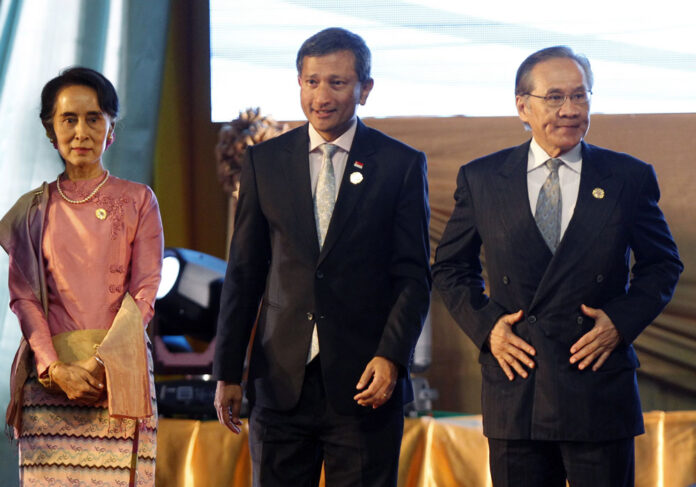
From left, Myanmar Foreign Minister Aung San Suu Kyi, Singapore's Foreign Minister Vivian Balakrishnan, Thai Foreign Minister Don Pramudwinai pose for a group photo during an opening ceremony of the Association of Southeast Asian Nations Foreign Ministers' Meeting in Vientiane, Laos on Sunday. Photo: Sakchai Lalit / Associated Press

VIENTIANE, Laos — Southeast Asia’s main grouping opened a meeting of their foreign ministers Sunday, deeply divided on how to deal with China’s territorial expansion in the South China Sea that has impacted some of its members and whipped up an increasing diplomatic quagmire.

Laos is hosting the gathering of the 10-nation Association of Southeast Asian Nations, which traditionally ends with a joint statement. But the sticking point is whether to include a reference to the South China Sea. ASEAN’s cardinal principle is decisions by consensus, which means any country can veto a proposal. This time, it appears to be Cambodia, China’s close ally.

In welcoming remarks, Laotian Foreign Minister Saleumxay Kommasith made no mention of the dispute.

In 2012, Cambodia also blocked a reference to the dispute, which ended with the ministers failing to issue a statement for the first time in the bloc’s history.

“Despite conflicts and challenges that have occurred in different parts of the world in general, peace, stability and development cooperation among nations remain the prevailing trend in this era,” Kommasith said. “Our collective efforts are imperative to seize opportunities and address challenges facing various parts of the world in an effective manner.”

The Sunday talks are expected to deal with terrorism, economy, climate change, security, the impact of Brexit and other issues. But at the top of everyone’s mind is the July 12 decision by The Hague-based tribunal in a dispute between China and the Philippines.

The Permanent Court of Arbitration found that China had no basis for its expansive claims to territorial waters around the Philippines. China has similar claims against other ASEAN nations, including Vietnam and Malaysia, and the ruling should have emboldened ASEAN to challenge Beijing more forcibly.

But that’s being prevented by Cambodia, said diplomats speaking on condition of anonymity because they were not authorized to discuss the matter with the media. They said the draft statement to be issued by the ministers on Tuesday left blank spaces under the heading “South China Sea” until a consensus can be reached.

Laos, which also is a China ally, has trod carefully and not taken sides because of their position as the host.

A diplomat who attended closed door meetings told The Associated Press: “Cambodia is the villain deja vu 2012. It’s really a loyalist of the big country C,” the diplomat said, referring to China.

Tran Viet Thai, deputy director of the Institute of Strategic Studies, a Vietnamese government think tank, described the arbitration tribunal’s ruling as very important because, theoretically at least, it should help resolve disputes, uphold the law and clarify the stance of the parties. “But at this point, it is not a magic stick … it’s not a solution to everything, but rather it needs to be combined with other measures.” .

The South China Sea is dotted with reefs and rocky outcroppings that several governments claim, including China and the Philippines. The arbitration panel didn’t take a position on who owns the disputed territories. It did conclude that many of them are legally rocks, even if they’ve been built into islands, and therefore do not include the international rights to develop the surrounding waters. That and other findings invalidated much of what China’s called its historic claims to the resource-rich sea.

In order to ease tensions, China, the Philippines and possibly other claimants must define what the ruling means for fishing, offshore oil and gas exploration, and military and other activities in the vast body of water that lies between the southern Chinese coast and the Philippine archipelago.

China has rejected the ruling as bogus, and called for bilateral negotiations with the Philippines. In recent days, its military has staged live-firing exercises in the area and said it would begin regular aerial patrols over the sea. It also has asserted that it will not be deterred from continuing construction of its man-made islands.

The Philippines also remains in a tight spot despite the legal and moral victory it gained through the tribunal’s decision. It simply cannot afford to antagonize China, especially since the country’s new president, Rodrigo Duterte, has made friendly overtures to Beijing to repair relations that were strained under his predecessor, Benigno Aquino III.

The meetings will also be notable for the presence of Myanmar Foreign Minister Aung San Suu Kyi, who will be attending an ASEAN meeting for the first time in that role since her party took power earlier this year after decades of military rule.

Story: Vijay Joshi

Advertisement

ISIS Attack on Afghan Protest Kills at Least 80, wounds 231

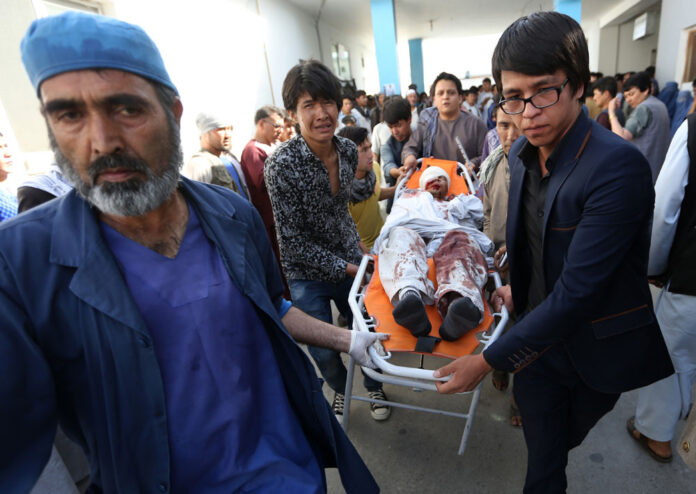
Afghans help a man injured in a deadly explosion Saturday that struck a protest march by ethnic Hazaras in Kabul, Afghanistan. Photo: Rahmat Gul / Associated Press

KABUL, Afghanistan — At least 80 people were killed and another 231 wounded in the Afghan capital on Saturday when a suicide bomber detonated his explosives-packed clothing among a large crowd of demonstrators, officials and witnesses said.

In a statement issued by its news agency, Aamaq, the Islamic State group claimed responsibility for the attack on a protest march by Afghanistan’s ethnic Hazaras. The marchers were demanding that a major regional electric power line be routed through their impoverished home province. Most Hazaras are Shiite Muslims, while most Afghans are Sunni.

Waheed Majroeh, the head of international relations for the Ministry of Public Health, confirmed the death toll and said it was likely to rise “as the condition of many of the injured is very serious.”

Footage on Afghan television and photographs posted on social media showed a scene of horror and carnage, with numerous bodies and body parts spread across the square.

Other witnesses said that after the blast, security personnel shot their weapons in the air to disperse the crowd. Secondary attacks have been known to target people who come to the aid of those wounded in a first explosion.

Road blocks that had been set up overnight to prevent the marchers accessing the center of the city or the presidential palace hampered efforts to transfer some of the wounded to hospital, witnesses said. People took to social media to call for blood donations.

Angry demonstrations sealed some of the area around the square, and prevented police and other security forces from entering. Some threw stones at security forces.

The government had received intelligence that an attack on the march could take place, and had warned the organizers, a spokesman for Afghan President Ashraf Ghani told The Associated Press.

“We had intelligence over recent days and it was shared with the demonstration organizers, we shared our concerns because we knew that terrorists wanted to bring sectarianism to our community,” presidential spokesman Haroon Chakhansuri said.

Two suicide bombers had attempted to target the demonstrators, who were gathering in Demazang Square as their four-hour protest march wound down, Haroon Chakhansuri said. One of the suicide bombers was shot by the police, he told AP. He said that three district police chiefs on duty at the square were injured and another three security personnel were killed.

He said Ghani planned to meet with the organizers later on Saturday, and would make a live television appearance after that.

None of the organizers could be immediately reached for comment.

Earlier, one of the march organizers, Laila Mohammadi, said she arrived at the scene soon after the blast and saw “many dead and wounded people.”

Ghani released a statement condemning the blast. “Peaceful demonstrations are the right of every citizen of Afghanistan and the government will do everything it can to provide them with security,” Ghani said, blaming the blasts on what he called “terrorists.”

The commander of U.S. and NATO forces in Afghanistan, U.S. Army Gen. John Nicholson condemned the attack. He said in a statement that “our condolences go out to those who are affected by today’s attack. We strongly condemn the actions of Afghanistan’s enemies of peace and remain firmly committed to supporting our Afghan partners and the National Unity Government.”

The U.S embassy in Kabul also issued a condemnation, saying: “Our thoughts and prayers are with the families and loved ones of the deceased, and we wish all of those who were wounded a full recovery.”

The rights group Amnesty International said the “horrific attack … demonstrates the utter disregard that armed groups have for human life.”

“Such attacks are a reminder that the conflict in Afghanistan is not winding down, as some believe, but escalating, with consequences for the human rights situation in the country that should alarm us all,” it quoted Champa Patel, Amnesty’s South Asia director, as saying.

Violence had been widely feared at what was the second demonstration by Hazaras over the power line issue. The last one in May attracted tens of thousands of people, also shutting down the central business district.

The May march was attended by Hazara political leaders, who were notable by their absence on Saturday.

At the height of the march, demonstrators chanted slogans against the president and Chief Executive Abdullah Abdullah, shouting “death to discrimination” and “all Afghans are equal.”

The so-called TUTAP power line is backed by the Asian Development Bank with involvement of Turkmenistan, Uzbekistan, Tajikistan, Afghanistan and Pakistan. The original plan routed the line through Bamiyan province, in the central highlands, where most of the country’s Hazaras live.

That route was changed in 2013 by the previous Afghan government. Leaders of the marches have said that the rerouting was evidence of bias against the Hazara community, which accounts for up to 15 percent of Afghanistan’s estimated 30 million-strong population. They are considered the poorest of the country’s ethnic groups, and often complain of discrimination. Bamiyan province, where most Hazara people live in the central highlands, is poverty stricken, though it is largely peaceful and has potential as a tourist destination.

Hazaras, most of whom are Shiite Muslims, were especially persecuted during the extremist Sunni Taliban 1996-2001 regime.

The Taliban’s spokesman Zabihullah Mujahid said in an earlier email that his insurgent group was not responsible for the blast. The Taliban have been waging a vicious insurgency against the Kabul government for 15 years, since their regime was overthrown by the U.S. invasion in 2001. They rarely issue such statements denying involvement in suicide attacks.

Story: Karim Sharifi, Lynne O’Donnell

Advertisement

For Love of Country: Having Conquered Bangkok, DJ Maft Sai Takes Thai Music Global

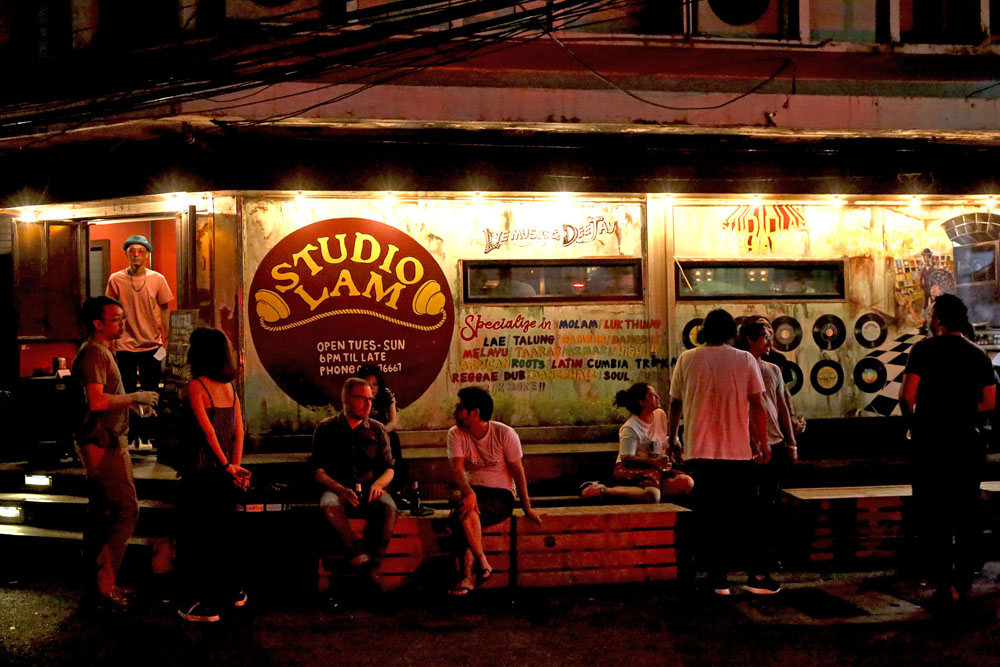
DJ Maft Sai spins Thursday night at Studio Lam in Bangkok.

Once regarded as the best of the best, upcountry musicians Kanmao Perdtanon and Sawai Kaewsombat had faded into obscurity. But due to the leadership of one man, Nattapon Siangsukon, they became cheered again in Bangkok and now play festival stages across Europe.

Notes from the Underground - Mongkorn 'DJ Dragon' TimkulNattapon, better known as DJ Maft Sai, is a Bangkok music geek making a big effort to preserve Thai music. In 2008, the edgy Thai sounds of luk thung and mor lam were virtually unheard of in Bangkok outside of a taxi. Then along came Nattapon, a self-confessed vinyl junkie with the balls to believe he could get Bangkok as excited as he was about this music.

Having spent hours looking through dusty vinyl in Chinaown record shops, Maft Sai was able to amass one of the world’s rarest collections of mor lam and luk thung from the ‘60s and ‘70s.

Wanting to share this music with the world, he and his creative partner, Chris Menist formed their label Zudrangma in 2008. Later that year they also saw the birth of their label’s first release, titled Thai Funk Vol 1. The release was a critically acclaimed compilation album of raw funky rhythms and tongue in cheek covers songs, worlds apart from the more traditional luk thung and mor lam that was produced during that era.

Maft Sai’s project The Paradise Bangkok Molam International Band – a band he’s part of, have just finished their European tour. Headlining clubs and festivals throughout the continent. Their first release, “21st Century Molam,” was praised by the likes of BBC radio DJ Giles Peterson and even name-dropped by Mick Jagger. Not bad for a guy who started collecting records as a hobby. Their second album, due for release in October, will take a more experimental approach and incorporate a more electronic feel.

I met up with the DJ at his Sukhumvit Road venue Studio Lam, a dance venue he built for the underground music crowd a few steps from his record shop. Inside, jars of yadong sit behind the bar, vintage mor lam records adorn the walls and a custom-built sound system tuned especially to play vinyl is in place. Studio Lam recreates an environment our parents would have hung out at in back in the day,  except now, the space is filled with Thonglor hipsters, expats and art students.

It is here that the DJ gave me the low down on how he discovered the music. (Discover more music at the end.)


Mongkorn Timkul: You have quite a profound knowledge of Thai music. Did you grow up listening to this music?

The usual loitering and smoking spot outside Studio Lam on Thursday night.

Maft Sai: I didn’t know anything about Thai music when I moved back to Bangkok. I wanted to buy records but the only shops that interested me were the second hand record shops. I chose records sometimes for their covers. Listening to the records reminded me of African funk music, so I thought it would be cool to mix these in my set.

MT: So I guess you got into this by accident then?

MS: The more I collected the more I realized how big mor lam and luk thung were. There were many genres of luk thung and mor lam. Some of it was very funky, some of it was experimental and some had disco influences. Each city had its own style of the music. It was discovering this that made me so interested. Back then second hand vinyl was really cheap. So I bought as much of it as I could and started to organize and catalogue each release.

MT: How did the funk and disco influences find their way to Thai music?

DJ Maft Sai spins for the crowd Thursday night at Studio Lam.

MS: In the Vietnamese war, American soldiers were based in Isaan. It was from this that luk thung and mor lam artists learned to play American-style music like funk and rock ‘n roll. They took a lot of traditional elements and adapted it to Western pop music.

MT: Giles Peterson and even Mick Jagger give props to your music. What was the reception from locals when you first started?

MS: When we started the label we didn’t get a good reception from people in Thailand. Shade of Retro was the only place in Bangkok that would stock our CDs. I had friends that worked in record labels in Japan and the UK. They said they liked my music and decided to help me sell it abroad. In a few months all the music was sold out.  A lot of Thai people found out about us whilst record shopping overseas after that they were more curious about our label.

MT: Do you feel as if it is your responsibility to preserve this music for a new generation?

MS: It’s a bit of a selfish reason actually. The whole reason I do this is because I was always curious about this music. I always had many questions in my mind about the artists and the labels that made this music. When I did my research my questions were answered

MT: The music that is featured on your compilation albums sounds very different from modern luk thung and mor lam music. Why do you think today’s music sounds so conservative?

MS: Well from collecting old records, I would find one in 10 would sound completely different from the usual luk thung sounds. So most of my time was spent finding the tracks that stood out the most. There were a few artists from back in the day that would take risks with their craft, obviously they didn’t do as well as the more commercial luk thung and mor lam artists.

MT: Your band toured and played at major festivals across Europe. It’s something every aspiring DJ or musician dreams of.  What was it like playing at some of these venues?

MS: I think since the first time we went years ago the reception keeps getting better and better. This year’s tour was a lot of fun and the crowds really got into our music. I’d have to say my favourite places were Poland and Germany. I think the crowd at Glastonbury was awesome as well.

MT: What other projects have you got in the works?

MS: I’m releasing another album with my band Paradise Bangkok Molam International Band. We’re getting UK dub producer Nick Manasseh on board for this project. The album’s gonna be more experimental than the first and will have more electronic influences. As with rereleasing the classic stuff, that’s going to be up to the licensing of the music.


One of Maft Sai’s faves:


Advertisement

Hot News

LATEST NEWS

Bangkok
broken clouds
27.7 ° C
27.7 °
27.7 °
81 %
2.7kmh
67 %
Fri
36 °
Sat
36 °
Sun
37 °
Mon
36 °
Tue
35 °