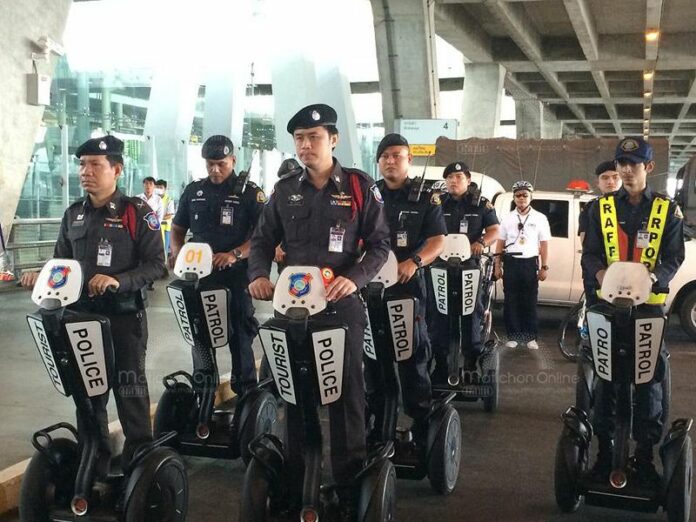
Police officers on Segway patrol on Oct. 8, 2014, at Suvarnabhumi Airport.
BANGKOK — A policeman who said he paid a bribe of 700,000 baht to another officer in exchange for a promised – yet undelivered – promotion has been transferred to an inactive post, along with the officer who allegedly sought the bribe.
Police commissioners said Thursday both Cpt. Chanchai Yensuk and Cpt. Chanintat Rattanachinotrai, who are under criminal and disciplinary investigations for the alleged bribery, may be expelled without any compensation if found guilty.
“This is a case of two policemen bribing each other. It gravely damages the image of the police force,” Maj. Gen. Chaiyaporn Panich-attra, a commander of the Metropolitan Police Bureau, said Thursday.
News of the alleged bribery surfaced after Chanchai accused Chanintat earlier this month of taking a 700,000-baht bribe from him without making good on his promise of getting him promoted to full inspector.
Because both parties in bribery, attempted or otherwise, are guilty of the crime, Chanchai himself was also charged and put under investigation.
Interim Bangkok police chief Sanit Mahatavorn said both officers face a maximum penalty of expulsion without their pensions if they are found guilty.
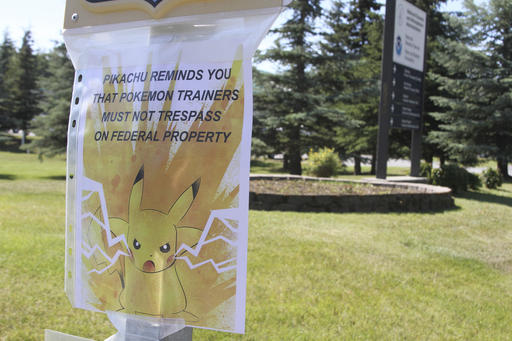
This Tuesday, July 12, 2016, file photo, shows a sign at the National Weather Service in Anchorage, Alaska, informing "Pokemon Go" players that it's illegal to trespass on federal property. The staff started noticing an uptick of people in the parking lot after the location was included as a gym in the popular game. Photo: Mark Thiessen / Associated Press
LOS ANGELES — As throngs of “Pokemon Go” players traipse around to real-world landmarks in pursuit of digital monsters, some ticked-off property owners are asking to have their locations in the fictional Poke-verse removed.
For Valerie Janovic, a 19-year-old psychology major at Brandeis University, the game went too far when the image of a poison-gas-emitting pocket monster called “Koffing” was pictured near the U.S. Holocaust museum’s exhibit on World War II gas chamber victims. Her online petition to have the site removed from the game has collected more than 4,500 supporters by Thursday.
“I just don’t think people should be playing a game where people remember people who suffered and were tortured and who died,” she says.
In this June 12, 2009, file photo, people stand in line to enter the U.S. Holocaust Memorial Museum in Washington. The U.S. museum is requesting that smartphone users refrain from “catching” Pokemon when they are inside the museum. Photo: Alex Brandon / Associated Press
Besides the U.S. Holocaust Memorial Museum in Washington, several churches and cemeteries including Arlington National Cemetery want their in-game locations removed to keep crowds of players away.
The addictive, location-aware smartphone game gives digital incentives like “Pokeballs” as rewards for visiting real places. The locations, known as “Pokestops” and “Gyms,” are based on landmarks submitted by players of Niantic’s earlier game, “Ingress.”
Niantic offers a form to request exclusion, but it’s neither automatic nor guaranteed. It’s a mystery how quickly, if at all, Niantic will respond. Several requesters said they got a stock response saying, “Thank you for reporting this PokéStop/Gym. We will review and take appropriate action.”
At first, web designer Boon Sheridan was just mildly annoyed at the traffic and cars that blocked the driveway to an old church that has become his home in Holyoke, Massachusetts. It was labeled a “Gym” where players pit their Pokemon, or pocket monsters, against each other in battle. His attitude changed when his virtually obsessed visitors began leaving behind physical trash.
“There’s a lovely public park across the street so we’ve suggested (the developers) adjust the GPS coordinates,” he said.
At the East Renton Community Church in Renton, Washington, players have come by day and night, sometimes leaving the gates open, a potential invitation to criminal activity, office manager Rona Heenk said.
“We can’t possibly monitor it all the time, and we don’t have a way to discern whether or not the adults who are coming to play the game are just here to play or ‘casing’ our location,” Heenk said.
Mobile Memorial Gardens, a cemetery in Mobile, Alabama, had a dozen gamers show up Wednesday, some walking around burial plots with cellphones in hand, others driving aimlessly down roads. President Timothy Claiborne said he’s all for people having fun, but would prefer they have it at a local park.
“This is private,” he said. “I owe it to the families we serve to provide a sense of decorum here.”
Ryan Calo, a University of Washington law professor, said private property owners may adopt a “Pokemon No Go” policy and bar players from physically entering their building or grounds. But he said there’s no legal right to compel the game’s creators to remove a location from its lines of code.
“It’s important to note that the Pokemon are not there on the property,” he said. “What’s happening is that a particular location triggers the display of a digital monster on your phone. The monster is only on your phone.”
Niantic, which has Japanese game company Nintendo as a major investor, didn’t respond to requests for comment.
To be sure, gaining designation in the game as a “Pokestop” or “Gym” can be beneficial. Cafe owners have set up in-game lures to attract unique digital creatures in the hopes potential patrons with real money chase them into the store. The Adventure Park playground in a forested part of Maryland invited “Pokemon Go” players to come to take advantage of its lures this weekend and get USD$5 (175 baht) off admission.
Niantic CEO John Hanke told The Financial Times that the company was sell sponsored locations in the game, much like it did with its previous game.
Clever coders like Manmeet Gill, a 13-year-old high school student in Sydney, Australia, even found evidence in the “Pokemon Go” app code that burger giant McDonald’s may be preparing to sponsor locations in the game. Included in the code is text that reads “Sponsor.Mcdonalds.POKEMON_STORE” and a logo of its double arches. Although McDonald’s spokeswoman Lisa McComb said she didn’t have any news to share, Gill said it was “highly unlikely” such code was there by accident.
Police raid the house of Maung Maung Oo in Western Khone Thar Village near Kalay, Sagaing Region, on June 26. He was arrested earlier for drug possession, but no drugs were found in his home. Photo: Swe Win / Myanmar Now
KALAY, Sagaing Region — On a cloudy afternoon in June, Lieutenant Bo Bo Win Htut and several officers of Kalay Police Station were hiding in the long grass near a bridge outside of Kalay, a major trading town in the Sagaing Region.
Dressed in plain clothes, and with backup provided by a local armed militia and members of the civil service, they waited to ambush a small-time drug dealer heading to Tamu, a town on Myanmar’s western border with northeast India located some 80 km from Kalay.
As dusk fell, a middle-aged man and a young man on a motorcycle covered with mud popped up and crossed the bridge. With his hand on the pistol in his waist, Bo Bo Win Htut jumped onto the road and blocked the bike. Other officers simultaneously surrounded the two and then handcuffed them.
After quickly questioning the detained, police sped off to West Khone Thar Village, located on Kalay’s outskirts, to find a man who allegedly provided the confiscated drugs. Photo: Swe Win / Myanmar No
“Give it up openly, if you have any material,” said the officer, but the men did not respond.
Maung Maung, 45, was found to be carrying 1.2 gram of low-grade heroin and a bottle of what appeared to be methamphetamine pills. The young man on the bike, a 21-year-old university student named Aung Kyaw Kaung, was also taken in.
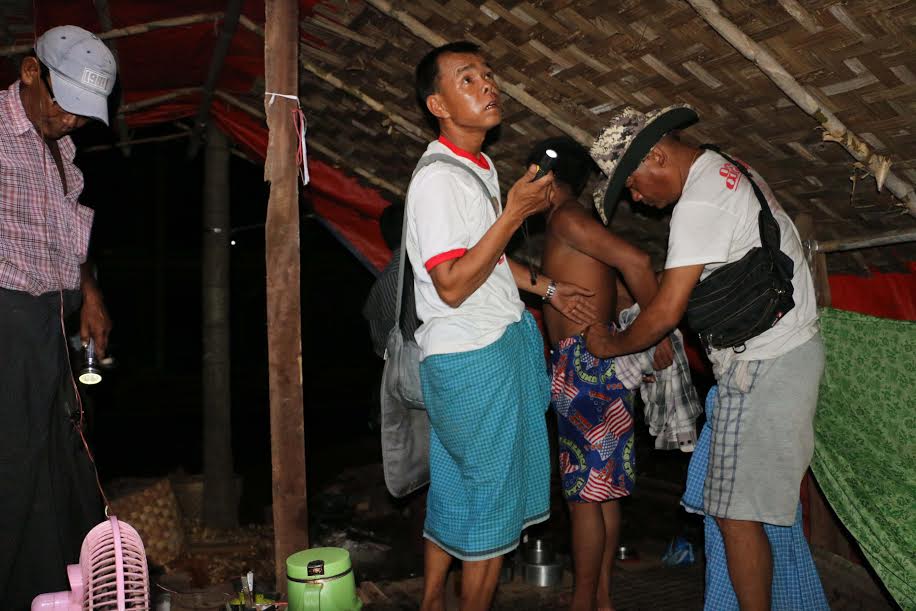
After quickly questioning the detained, police sped off to West Khone Thar Village, located on Kalay’s outskirts, to find a man who allegedly provided the confiscated drugs. At 8 pm, they arrested Maung Maung Oo, a man with a criminal record for dealing, but no narcotics were found at his bamboo hut.
It was June 26, the International Day Against Drug Abuse and Illicit Trafficking, and Kalay police allowed Myanmar Now reporters to join their operations to show they were combating the rampant narcotics trade in Kalay, a rundown market hub of around 400,000 inhabitants – a mix of Bamar and ethnic Chin – in the mountainous border region.
In other cities that day, top police officers held their annual ceremonies to burn large amounts of seized illicit drugs. In the former capital Yangon, state media reported, USD$20 million worth of narcotics was torched in the presence of representatives of the United Nations Office of Drugs and Crime (UNODC).
Despite such public shows of intent, Myanmar authorities have long failed to stem the vast, entrenched narcotics trade. In lawless conflict areas in the country’s rugged north, pro-government militias, transnational criminal gangs and some ethnic rebel groups produce vast amounts of opium, heroin and methamphetamine that are destined for China, Thailand, India, and the domestic market.
Much of the law enforcement response has focused on arresting drug users and small dealers for illegal possession, which carries stiff penalties under Myanmar drug laws.
Asked if they were making gains against the Kalay drug trade, Lt. Bo Bo Win Htut sighed and said, “You arrest one dealer, but then ten more pop up.”
His officers made about 80 drug-related arrests in the past half year, he said, adding that because of the mountainous terrain and lack of resources police struggled to catch any ringleaders.
“The big drug dealers drive land cruisers, but we have only motorbikes,” he said. “They know their areas well, but we don’t and the locals there are also not very helpful… If you are unlucky, you could even get shot.”
‘Heroin is Much Cheaper Here Than Beer’
In the last five to ten years, drug abuse has reached crisis levels among Myanmar’s ethnic communities in Kachin and Shan states, as well as in transport nodes and border towns such as Lashio, Muse, Kalay and Tamu.
Transnational drug-smuggling routes pass through the towns. Vast amounts of precursor chemicals – such as pseudoephedrine, which is used to make methamphetamine – are imported illegally from India and China and flow through the border towns.
In the mountains surrounding Kalay, poverty-stricken ethnic Chin farmers are reportedly also turning to opium poppies to sustain their livelihoods.
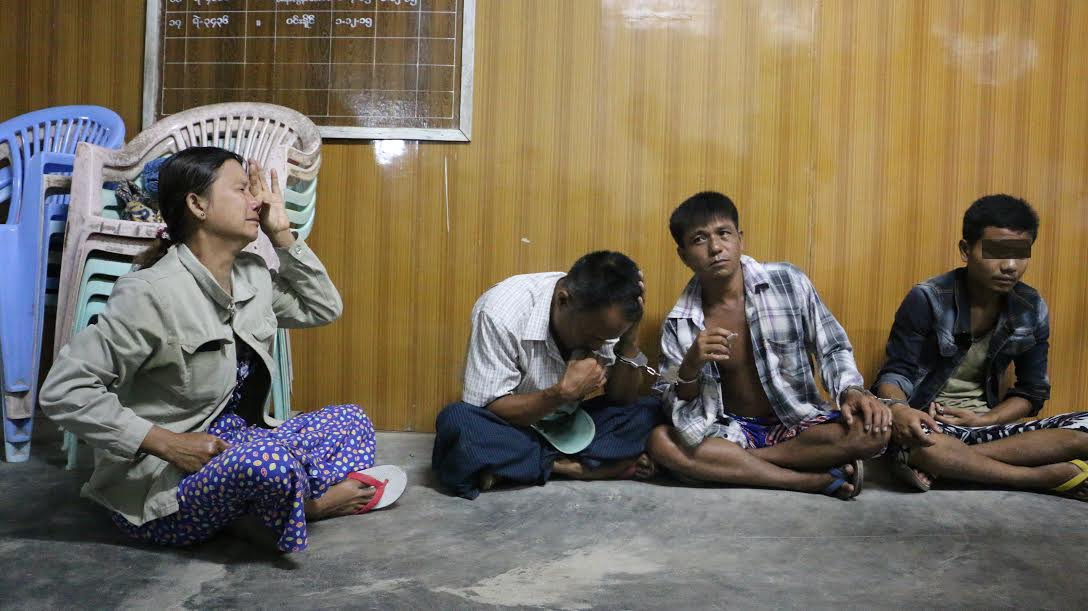
On June 26, Maung Maung and his nephew Aung Kyaw Kaung, were taken handcuffed to Kalay Police Station to be photographed, along with the other alleged dealer, Maung Maung Oo. The mother of Aung Kyaw Kaung came to visit him and wept at the sight of her son in handcuffs.
Just eight months before, Maung Maung had been released after serving a prison term for a drug offence. “I used to be a truck driver and got a lot of back pain from my job – that’s why I started using drugs and became involved in this business,” he told a reporter.
Si Thu Win, an emaciated-looking young man loitering on Kalay’s streets, told Myanmar Now later that drug addiction was a widespread problem in Kalay. “You can buy heroin easily here – it’s much cheaper than beer,” he said, adding that he tried repeatedly to quit drugs but failed.
Police raid the house of Maung Maung Oo in Western Khone Thar Village near Kalay, Sagaing Region, on June 26. He was arrested earlier for drug possession, but no drugs were found in his home. Photo: Swe Win / Myanmar Now
According to data collected by the UNODC in 2014, there are 1,200 injecting drug users in Kalay, making it one of the cities with highest number of users after Mandalay, Lashio, Yangon, and several towns in Kachin State.
Dr. Htet Myat Soe, a physician at Kalay Hospital who specialises in drug addiction and related psychiatric issues, said 200 addicts receive methadone at the state-run hospital every day in order to wean themselves off heroin and opium.
“The main problem is that when they meet their old friends they tend to relapse,” he said.
Police Net Only Small Fry
According to police records obtained by Myanmar Now, a total of 35,481 people were arrested across the country between 2011 and 2015 on drug-related charges.
One of them was a 38-year-old ethnic Chin man from a village in the mountains around Kalay who only give his name as Thang. He was imprisoned in 2012 for drug trafficking and released last August.
Thang explained in an interview that he was assigned by traffickers to move pseudoephedrine coming from India. He would pick up the precursor chemicals at various places around Kalay and bring it to a warehouse.
“Then someone above me would go and carry all of those materials down to Mandalay,” he said.
Kalay Prison and the prison labor camps around the city are filled with poor Chin who had become drug users and small dealers like him, Thang said, estimating that more than half the prison population was arrested for drugs.
Lalremthang, a Chin communityactivist, said poverty among her people was driving the Chin into the trade and drug abuse. “They have nothing for their survival. So they turn to the drug trade, for which they don’t need any capital,” she said.
In recent years, as sweeping reforms ripple through Myanmar’s government, there has been a growing recognition among top law enforcement officers that harsh penalties for drug users and small dealers – who often spend years in prison for possession of small quantities of drugs – are ineffective in combating the drug trade and abuse problems.
Dr. Win Mar, UNODC Myanmar’s national programme specialist for HIV prevention and care, said the police approach to drug users was slowly changing. “But drug users are sometimes still targeted during special operations,” she said.
Maung Maung Oo and his cousin Aung Kyaw Kaung (right), a university student, were arrested for drug possession on June 26. Aung Kyaw’s mother broke into tears when she saw her son at Kalay Police Station. Photo: Swe Win / Myanmar Now
Incapable or Corrupt Cops?
While Kalay’s prisons overflow, the drug trade continues unabated, addiction levels stay high and few ringleaders are arrested, said Aye Aye Mu, a Lower House lawmaker who holds a seat in Kalay for the ruling National League for Democracy (NLD).
“Authorities hardly arrest any major drug traffickers – instead they arrest many users,” she told Myanmar Now. Aye Aye Mu said police had failed to break up drug rings because of a lack of capability and resources, or because they are corrupted.
“They will definitely know the prominent drug traffickers. I wonder why they have difficulty arresting these traffickers,” she said, adding that the central government should boost law enforcement efforts in Kalay.
In 2013, a special police team from the capital Naypyitaw investigated allegations of corruption in the Kalay police force. A district-level officer and several of his lower-ranking officers were later dismissed or imprisoned.
Kalay Police Chief Lieutenant-Colonel Tin Zaw Tun told Myanmar Now that his force was now clean, but struggled to fight the trade due to high demand from traffickers in India, who use the Indian border town of Moreh and the Reed Mountain Range in Chin State to move drugs.
Kyi Ya Aung, 35, is a former addict and member a local volunteer group Kalay Lwin Pyin, which helps communities hit by last year’s devastating floods.
He said the continuous influx of cheap drugs made it nearly impossible for Kalay addicts to quit, adding that he recovered after he left for Yangon, where he worked for 10 years as a trader before returning to Kalay.
Kyi Ya Aung said he had only one advice for local addicts wanting to quit the habit: “Drugs are so abundant here… get out of the town.”
Ambulances and Police cars are seen after a truck drove on to the sidewalk and plowed through a crowd of revelers who’d gathered to watch the fireworks in the French resort city of Nice. Officials and eyewitnesses described as a deliberate attack. Photo: BFMTV / Associated Press
NICE, France — A truck loaded with weapons and hand grenades drove onto a sidewalk for more than a mile, plowing through Bastille Day revelers who’d gathered to watch fireworks in the French resort city of Nicelate Thursday. At least 80 people were killed before police killed the driver, authorities said.
Nice prosecutor Jean-Michel Pretre described a horrific scene, with bodies strewn along the roadway, and Sylvie Toffin, a press officer with the local prefecture, said the truck ran over people on a “long trip” down the sidewalk near Nice’s Palais de la Mediterranee, a building that fronts the beach.
Wassim Bouhlel, a Nice native who spoke to the AP nearby, said that he saw a truck drive into the crowd. “There was carnage on the road,” he said. “Bodies everywhere.” He said the driver emerged with a gun and started shooting.
France’s Interior Minister Bernard Cazeneuve said 80 people were killed, including children, and 18 were in critical condition, and the Paris prosecutor’s office announced an investigation for “murder, attempted murder in an organized group linked to a terrorist enterprise.”
“We are in a war with terrorists who want to strike us at any price and in a very violent way,” Cazeneuve said.
The ranking politician of the Alpes-Maritime department that includes Nice said the truck plowed into the crowd over a distance of 2 kilometers. Many of those on the ground were in shorts and other summer clothing.
Eric Ciotti said on BFM TV that police killed the driver “apparently after an exchange of gunfire.”
The president of the Provence Alpes Côte d’Azur regional council, which includes Nice, said the truck was loaded with arms and grenades. Christian Estrosi told BFM TV that “the driver fired on the crowd, according to the police who killed him.”
Images being broadcast across French media showed revelers running for their lives down Nice’s palm tree-lined Promenade des Anglais, the famous seaside boulevard named for the English aristocrats who proposed its construction in the 19th century.
Video footage showed men and women — one or two pushing strollers — racing to get away from the scenes. And, in what appeared to be evidence of a gun battle, photos showed a truck with at least half a dozen bullet holes punched through its windshield.
It was not immediately clear who would have been behind an attack, but France has recently seen a spate of dramatic assaults by jihadist groups, including the Islamic State group which straddles Iraq and Syria.
President Francois Hollande said in a televised statement that all of France was under an “Islamist terrorist threat” and extended by three months a state of emergency that has been in place since the November attacks that killed 130 in Paris was to end July 26. The decision needs parliamentary approval.
“The terrorist character (of the attack) cannot be denied,” he said.
Hollande said he was calling a defense council meeting Friday that brings together defense, interior and other key ministers, then heading to Nice. He listed several measures to bolster security in France after two waves of attacks last year that killed 147 people. Besides continuation of the state of emergency and the Sentinel operation with 10,000 soldiers on patrol, he said he was calling up “operational reserves,” those who have served in the past and will be brought in to help police, particularly at French borders.
President Barack Obama condemned what he said “appears to be a horrific terrorist attack.”
European Council president Donald Tusk said it was a “tragic paradox” that the victims of the attack in Nice were celebrating “liberty, equality and fraternity” — France’s motto — on the country’s national day.
Writing online, Nice Matin journalist Damien Allemand who was at the waterside said the fireworks display had finished and the crowd had got up to leave when they heard a noise and cries.
“A fraction of a second later, an enormous white truck came along at a crazy speed, turning the wheel to mow down the maximum number of people,” he said.
“I saw bodies flying like bowling pins along its route. Heard noises, cries that I will never forget.”
Graphic footage showed a scene of horror up and down the Promenade, with broken bodies splayed out on the asphalt, some of them piled near one another, others bleeding out onto the roadway or twisted into unnatural shapes.
“Help my mother, please!” one person yells out amid a cacophony of screaming and crying. A pink girl’s bicycle is briefly seen overturned by the side of the road.
The origin and authenticity of the footage could not immediately be verified.
Kayla Repan, of Boca Raton, Florida, was among the hundreds gathered on the promenade to watch fireworks.
“The whole city was running. I got extremely frightened and ran away from the promenade,” she said. “It was chaos.”
Story: Elaine Ganley, Naomi Koppel and Josh Replogle
Indiana Gov. Mike Pence speaks last July in the U.S. state of Indiana. Photo: Darron Cummings / Associated Press
WASHINGTON — Donald Trump is on the verge of picking his vice presidential running mate, with top contenders on standby Thursday afternoon for the Republican nominee’s decision.
On Trump’s shortlist: Indiana Gov. Mike Pence, New Jersey Gov. Chris Christie and former House Speaker Newt Gingrich, according to people familiar with the candidate’s thinking.
Pence quickly exited a speaking event in Indianapolis Thursday morning without taking questions from reporters. His staff had not released details of any other planned appearances Thursday.
Pence is running for re-election, but Indiana law prevents him from seeking two offices at once. He faces a Friday deadline to withdraw from the governor’s race.
A Republican familiar with Pence’s thinking said the paperwork has been drawn up for him to take that step. However, the documents have not been filed, according to the Republican, who insisted on anonymity because that person was not authorized to publicly discuss Pence’s plans.
Trump was making his final decision from California, where he is scheduled to attend a series of fundraisers at a distance from many of his closest advisers. His campaign chair, Paul Manafort, is currently in Cleveland, and none of his children are in the state with him.
All three of the finalists have had extensive conversations with Trump and his family in recent days.
Gingrich told The Associated Press he had expected to hear from Trump one way or the other sometime after 1 p.m. Reached by phone later, Gingrich said he had not heard from Trump, but still expected to receive word Thursday afternoon.
In a Facebook Live chat, Gingrich said he had told Trump in earlier conversations that his choice was between having “two pirates on the ticket or a pirate and a relatively stable, more normal person.”
Trump and his new running mate will make their first appearance as a team Friday in New York. The timing is aimed at energizing Republicans ahead of next week’s Republican convention in Cleveland.
Trump considered a broader group of candidates before settling on the three finalists. Sen. Jeff Sessions of Alabama, the first senator to endorse Trump, was among that larger group, but told reporters Thursday that he was not the choice.
Each of Trump’s top contenders would add significant political experience to the GOP ticket. Trump, a political novice, has said for weeks that he wanted a running mate who could help him work with Congress.
Beyond their political backgrounds, the finalists bring different strengths to the ticket.
Pence, 57, is a steady, staunch conservative who would help calm nervous Republican wary of Trump’s impulsive style. He served six terms in Congress before becoming Indiana governor. He also has deep ties to evangelical Christians and other conservatives, particularly after signing a law last year that critics said would have allowed businesses to deny service to gay people for religious reasons.
Trump took notice of Pence during the Indiana primary, noting that the governor had high praise for him despite endorsing one of his rivals.
Gingrich is a boisterous rabble-rouser who has spent decades in Washington and helped define the political battles of the 1990s. The 73-year-old would be the oldest candidate ever to become vice president.
Gingrich has been a steadfast Trump defender for months and has become a trusted adviser to the businessman.
So, too, has Christie. The New Jersey governor quickly endorsed Trump after ending his own presidential bid, stunning many of his supporters.
A former U.S. attorney, Christie, 53, is widely seen as one of his party’s most talented retail politicians and has proven himself a biting attack dog on the trail. He’s also become a valuable partner for Trump, joining him at events on the trail and taking on the important role of heading Trump’s transition planning.
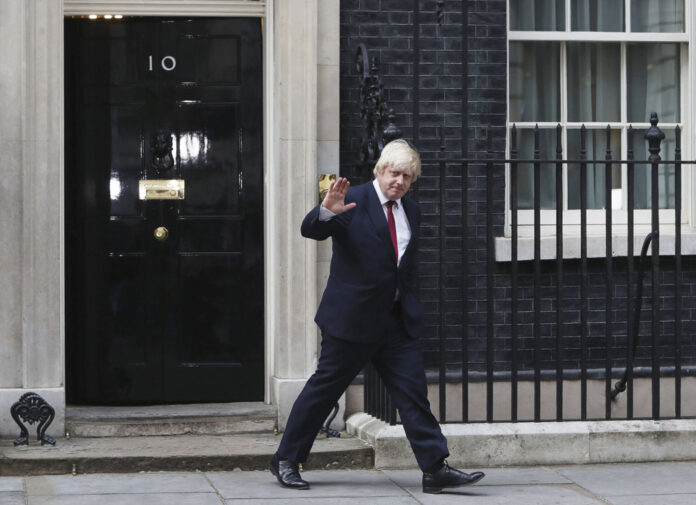
Boris Johnson leaves 10 Downing Street after being appointed Foreign Secretary Wednesday. Photo: Steve Parsons / PA / Associated Press
LONDON — British Prime Minister Theresa May filled out her Cabinet posts Thursday, assembling a government that sweeps away many of her predecessor’s supporters and places strongly anti-EU figures in key international roles.
After filling half a dozen of the top jobs Wednesday — including surprise choice Boris Johnson as foreign Secretary — May made a host of new appointments Thursday.
Some of Cameron’s Cabinet kept their jobs — including Defense Secretary Michael Fallon — but most ministries were shuffled, with new ministers including Justice Secretary Liz Truss and Education Secretary Justine Greening.
Andrea Leadsom, a Conservative leadership contender who quit the race after she appeared to suggest that being a mother gave her an advantage over May, was given the environment department.
May also cleared out rivals, firing stalwarts of David Cameron’s outgoing government including Culture Secretary John Whittingdale, Education Secretary Nicky Morgan and — most significantly — Justice Secretary Michael Gove, her onetime competitor for the job of Conservative leader.
Gove led the “leave” side in Britain’s EU referendum battle alongside former London Mayor Boris Johnson, then betrayed him by making a bid for Conservative leadership — a job Johnson had long sought.
May won the leadership battle and quickly sacked Gove, who is now seen as treacherous by many Conservatives. She rewarded Johnson with the plum job of foreign secretary.
He is a surprising choice to be Britain’s top diplomat. The former mayor of London is internationally famous — but for rumpled eccentricity and distinctly undiplomatic gaffes, rather than statesmanlike behavior.
In April, Johnson suggested that U.S. President Barack Obama had an “ancestral dislike” of Britain because he is part-Kenyan.
Johnson said he was “very excited” to be part of the government. Asked whom he would apologize to first, he said “the United States of America will be at the front of the queue.”
New Treasury chief Philip Hammond reassured a startled world that Johnson — whose responsibilities include oversight of the MI6 spy agency — would be a team player
“The Cabinet works collectively and we have got a range of different characters and a range of different styles and a range of different talent,” he told BBC radio. “The lead and the tone will be set by the prime minister.”
Lesser-known than Johnson but at least as important to Britain’s future is David Davis, the cumbersomely titled Secretary of State for Exiting the European Union. Davis, a veteran lawmaker who has twice run for the Conservative leadership, is one of the staunchest Euroskeptics in British politics.
He is also a formidable battler, as May knows. For years the libertarian Davis has sparred with May over the powers of Britain’s spy agencies. He is currently suing the British government in the European courts against surveillance laws May introduced as home secretary.
Davis has previously said that Britain should take a “brisk but measured” approach to exit talks with the EU. He has said that Article 50 of the EU constitution — the formal trigger for two years of negotiations — should be invoked by the start of 2017.
Other EU leaders are already pressuring Britain to open formal talks — and warning that the U.K. cannot have access to the single European market without accepting free movement of EU citizens, a sticking point for many pro-Brexit Britons.
The foreign policy spokesman for German Chancellor Angela Merkel’s party in Parliament said Thursday that many British suggestions on the country’s future relationship with the European Union are “unworkable.”
Juergen Hardt said that “free access to the common market means, among other things, accepting other fundamental freedoms such as the freedom of movement.”
New British Treasury chief Hammond tried to sound a reassuring note Thursday, pledging that he would not introduce an emergency national budget — even though there are question marks hanging over the economy following the country’s decision to leave the EU.
Hammond offered calming tones to the markets and the public in a series of interviews the morning after taking office.
“The number one challenge is to stabilize the economy, send signals of confidence about the future, the plans we have for the future, to the markets, to businesses, to international investors,” Hammond told Sky News. “Britain is open for business. We are not turning our back on the world.”
The comments came before the Bank of England’s Monetary Policy Committee voted not to cut interest rates in a bid to stimulate the economy.
In a surprise move, it kept the bank’s benchmark interest rate at the current record low of 0.5 percent, where it has stood since in March 2009. It also decided against pumping more money into the economy with a new bout of quantitative easing.
But the committee hinted it would loosen policy in August, when it will have fresh forecasts about the state of the British economy.
Hammond acknowledged that investment in Britain had been shaken since the referendum result.
“There has been a chilling effect,” he told the BBC. “We have seen an effect in markets, we have seen business investment decisions being paused because businesses now want to take stock, want to understand how we will take forward our renegotiation with the EU, what our aspirations are for the future trading relationship between Britain and the European Union.”
BERLIN — A 91-year-old woman is in trouble with a German museum after taking an art work depicting part of a crossword too literally.
“Reading-work-piece,” from 1965, was created by avant-garde artist Arthur Koepcke. It features the phrase “Insert Words” and was displayed at Nuremberg’s Neues Museum.
Museum spokesman Eva Martin on Thursday confirmed local media reports that the woman filled in blank spaces with a ballpoint pen, news agency dpa reported. She was visiting Wednesday with a group of senior citizens.
Martin said museum officials believe the work can be restored. Museum chief Eva-Christina Kraus filed a criminal complaint, saying the case had to be reported for insurance reasons though there was no malicious intent. Police said the woman is being investigated for damage to property.
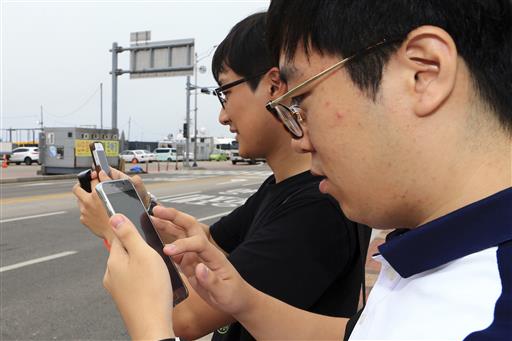
In this July 13, 2016 photo, two South Koreans play the Pokemon Go game with their mobile phones in Sokcho, South Korea. Photo: Lee Jong-hun / Yonhap / Associated Press
SEOUL, South Korea — The seaside South Korean city of Sokcho is enjoying a surge of visitors who are wandering the streets at all hours as they look at their smartphones. Why? It appears to be the only place in the country where Pokemon Go players can chase the mobile game’s virtual monsters.
Local restaurants, hotels and businesses are trying to capitalize on the sudden craze by luring tourists with photos of Pikachu and other monsters in their backyard and promising free gifts to the Pokemon “trainers.” The mayor pledged to increase free Wi-Fi hotspots and battery charging stations, and travel agencies have launched Pokemon-themed tour packages to Sokcho. Hotels in the east coast city near the North Korean border reportedly saw a surge in reservations.
The mobile game has become a blockbuster hit in the U.S. within less than a week of its launch, but it has not been officially launched in South Korea and might never be. The country is likely to be excluded from the Pokemon Go’s Asia launch because South Korea’s government restricts Google Maps service for security reasons.
Niantic Inc., a San Francisco spinoff of Google parent Alphabet Inc., relies on Google Maps to overlay cute Nintendo characters onto the physical world. Gamers have to find spots in the real world to capture and train Psyduck, Meowth and other virtual monsters.
Media reports attributed the monsters’ appearance in Sokcho to map glitches. By the way Niantic organizes the region, Sokcho and its neighboring area bordering North Korea were reportedly categorized as North Korea. Neither Google nor Niantic immediately responded to emails seeking comment Thursday.
Whatever the reason, South Korean Pokemon Go players have been going to great lengths to take advantage.
It was after midnight when college student Han Kyeol and three friends drove out of Seoul, and 4 a.m. when they arrived at a Sokcho beach.
“As soon as we got out of the car, four of us turned on our smartphones and began playing Pokemon Go,” the 24-year-old said by phone from Seoul. “It was very dark but what was amazing was that there were a lot of men roaming around the beaches with smartphones in their hands at 4 a.m.”
Han hadn’t visited Sokcho in more than a decade, and hadn’t considered a return trip before Pokemon Go came around. He enjoyed his overnight trip so much that he plans to return with his girlfriend. “We went to a 24-hour raw fish place, saw the sun rise and stopped by the main tourist attractions,” he said.
Lee Jung-hwan, a 26-year-old video producer, has been traveling to Sokcho and other towns in Gangwon province to find and capture monsters since Wednesday. When he finds Pokestop, a key location where trainers can find items such as eggs that can hatch into a full monster, he shares the location on the Facebook group for Pokemon Go players in South Korea.
“I met people who took a day off to come to Sokcho, people who worked in the morning and left their job in the afternoon and people who took a vacation,” he said by phone from Sokcho.
The city of 80,000 is a popular summer destination for mountain hikers and beachgoers. Local businesses are keen on adding Pokemon Go players who call the place “Pallet Town,” the hometown of Pokemon’s main protagonist.
The city had four times more hotel-room bookings Tuesday and Wednesday than it did on those days the previous week, the Yonhap news agency reported, citing Interpark Tour, a hotel booking website.
On Auction, the South Korean unit of eBay, tour agencies began selling round-trip bus tours to Sokcho, calling the destination Pallet Town. A local restaurant hung a banner outside welcoming the trainers to a glass of cold water and free smartphone charging. Ramada Hotel in Sokcho promised three free hotel stay packages to those who capture three monsters in Sokcho.
The city, however, is hesitant to fully embrace the game, given the central government’s restrictions on Google Maps.
“For the city, it is not easy to promote what the government restricts,” said Lee Se-moon, an official at Sokcho city’s tourism department. “But it is a great help for the city’s tourism because media continues to report about Sokcho and game manias are promoting Sokcho.”
South Korea restricts the use of mapping data by foreign companies that do not operate its servers in the domestic market, citing concerns over disclosing military locations amid tensions with North Korea. It is not clear how the Pokemon Go phenomenon would play out ahead of a government decision expected next month on whether to allow Google to use South Korean mapping data.
Some express regrets over what the country is missing due to tensions with North Korea.
“We can’t play the game because we are a divided country, but this is what the global trend is,” said Lee, the Pokemon Go trainer in Sokcho. “I wish people could play the game here so it could stimulate the regional economy. I got to go to new places and found a beautiful cliff as I was looking for the spots.”
Junta chairman Prayuth Chan-ocha on Monday visits an exhibition about recycled wastes in Bangkok.
BANGKOK — Junta chief Prayuth Chan-ocha Thursday granted special powers for authorities to regulate any TV or radio stations considered to be a threat to national security.
In the order, which came into immediate effect Thursday by the use of the absolute power granted to the junta chief under Article 44 of the interim charter, authorities such as the National Broadcasting and Telecommunications Commission will be shielded from any legal responsibilities when regulating any broadcast media reports deemed as threatening national security or instigating unrest.
Content considered as threatening to national security according to a junta order launched in 2014 includes anything defaming the monarchy, criticizing the junta with “insincere intent,” releasing secret government information, instigating unrest in the kingdom or turning people against the junta.
The order, which was published on the Royal Gazette website, adds that any television or radio stations affected by use of the new powers still have the right to seek compensation from the government.
Natee Sukonrat, the Chairman of the Broadcasting Commission, declined to comment on the matter Thursday evening, saying he was not aware of the details of the order yet.
A screencap of a video of the May 1 concern. Image: Gumbpun Tupdin / YouTube
BANGKOK — Mahidol University announced Wednesday it will sue a royal descendant for allegedly embezzling 2.6 million baht from funds for a charity concert.
According to the university’s allegations, the woman overcharged the university and concert organizers for the May 1 event, which was meant to support a royal charity that assists patients who can’t afford their medical bills.
The concert was hosted by the alumni foundation of the school’s Faculty of Dentistry.
Nitipun Jeerapat, president of the alumni foundation, announced Wednesday that she was brought in to oversee the concert because she was a well-known socialite with relevant experience.
Pradit Somdungjait, director of event organizer Masterpiece Organizer Co., said she earmarked 2.6 million baht in the event’s budget of university funds that she never explained.
Both Nitipun and Pradit referred to the alleged fraudster as “Mom Luang U” and would not name her at the news conference. In today’s phone conversation, Pradit said he did not identify her by name because he fears defamation lawsuit from the noblewoman.
“I want to protect myself from libel charges, but everyone already knows who she is anyway,” he said.
Pradit said he and the university tried asking the socialite to produce evidence for the expense or return the money, at which point she offered to return only 700,000 baht. That led to the decision to file a fraud charge at the criminal court, he said.
“Mahidol University told her to come and explain herself, yet she didn’t come,” Pradit said by telephone on Thursday. “We already gave her so many chances.”
The woman believed to be at the center of the scandal has implied in messages posted to Instagram that she may sue anyone who publishes allegations against her for defamation. In the light of this threat, Khaosod English is withholding her name.
Pradit said he expects to file the suit by the end of next week.