27.7 C
Bangkok
Thursday, July 2, 2026
Home Blog Page 2703

Art/Music/Booze: Speedy Grandma Reborn to Host Saturday Party

Unchalee Anatawat presides over the ‘Unity Management Course’ in November at Speedy Grandma. Photo: Graham Meyer

BANGKOK — After four months in hibernation, the white-haired lady behind a Charoen Krung shophouse-bar-gallery will open her doors again Saturday night.

Regulars, newbies and artists local and international are invited to celebrate the return of Speedy Grandma at its Resurrection party, where they can satisfy their high-culture needs for music, booze and art.

“We closed it around the end of February, and now we wanna see everyone again,” cofounder Unchalee “Lee” Anantawat said. “The new direction will be something like a zine workshop, where people come to get more involved in some way, not just stop by to take a brief look at artwork and go.”

Read: Zines Reborn: Inky Fingers Keep DIY Publishing Alive in Bangkok

Hear the fresh-faced punk aspirants of Radical Rat, a six-piece electronic mini-orchestra from Melbourne called Tek Tek ensemble, as well as the exp-tending sounds of Natchanol Vatanakuljaras. You don’t go to a party without DJs? Well, DJs Target-C and Krit Morton will have you covered.

Apart from the full spectrum of alt-music, Makha Sanewong Na Ayuthaya and Sirasith Poopatanapong will present a visual arts installation.

Admission is 250 baht and includes one drink. The party starts at 7pm on Saturday and goes until 1am at Speedy Grandma, which is located about a kilometer from MRT Hua Lamphong.

Speedy Grandma Soi Charoen Krung 28 Si Phraya Pier

Advertisement

84th Birthday of Thai Democracy to be Marked Friday

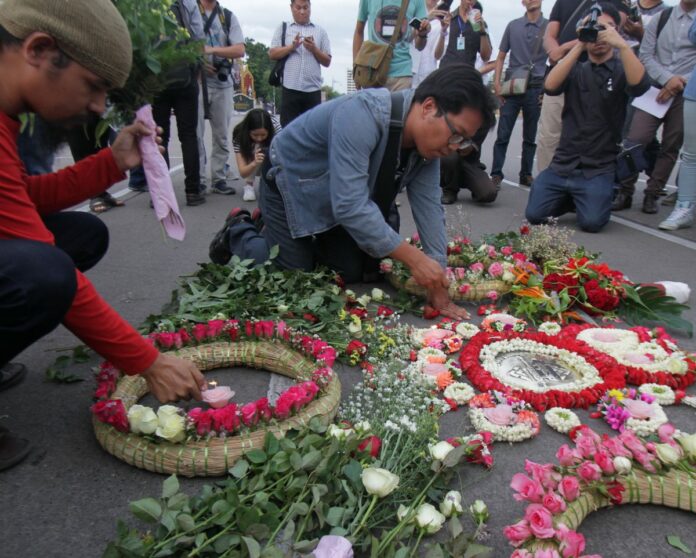
Activists place flowers and garlands around a small plaque memorializing the 1932 Revolution on June 24, 2015 in Bangkok.

BANGKOK — Though democracy may not be restored for at least another year, some people will commemorate its very beginning later this week.

At least four events are already planned across Bangkok on June 24, the 84th anniversary of the revolt that replaced absolute monarchy with parliamentary democracy.

First, there’s an annual vigil at a tiny plaque marking the very spot where revolutionaries announced the beginning of democracy that day. It’s located several meters east of the Rama V Statue in the Royal Plaza in the capital’s Dusit district.

This year’s 6am candlelight vigil will be led by Sirawith “Ja New” Seritiwat, the outspoken pro-democracy activist who faces numerous charges for defying the junta’s ban on protests.

“No group has announced it will host one yet, so this year I will host it myself,” Sirawith wrote on his Facebook.

At 9am, a Kasetsart University student activist group called Free Kasetsart is will commemorate the 1932 Revolution at the Defense of the Constitution Monument in the northern district of Laksi.

The obelisk memorializes the crushing of the royalist rebellion that sought to topple the new democratic regime in 1933. The Free Kasetsart group announced via Facebook that participants will “dust off” the monument to pay tribute to the revolutionary victory over the pro-palace insurgency staged by Prince Boworadet.

“We’ll clean the monument [that marked] victory by the democratic side over the Boworadet Rebellion, which aimed to destroy Thai democracy,” it said.

Two panel discussions are set for that afternoon. The first one, titled “A Democratic Society: Values and Hopes,” will be held at 2.00pm on Soi Sukhumvit 55 at the Pridi Banomyong Institute, an organization that bears the namesake of statesman Pridi Banomyong, one of the leaders of the 1932 Revolution.

The panel will feature political scientists and economists including Thammasat University lecturer Vannapar Tirasangka.

A second panel discussion will be held at Thammasat University’s Tha Prachan campus at 5pm. It will be organized by New Democracy Movement, an activist group opposed to military rule.

Rangsiman Rome, a leader of the group, said the discussion will be about the revolution’s legacy. He said the speakers and specific location would be named later Monday on the group’s Facebook page.

Rome said he informed police about the event.

Watch a video of last year’s commemoration of the revolution:

Advertisement

UN Says 65 Million People Displaced in 2015, a New Record

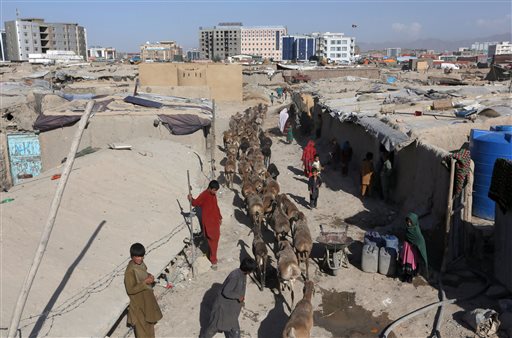
In this Monday, May 30, 2016 file photo, an Afghan boy shepherd walks his sheep near a temporary housing in Kabul, Afghanistan. Photo: Rahmat Gul / Associated Press

GENEVA  — The U.N. refugee agency says persecution and conflict in places like Syria and Afghanistan raised the total number of refugees and internally displaced people worldwide to a record 65.3 million at the end of last year.

The previous year, 2014, had already seen the highest number of refugees worldwide since World War II, with 60 million displaced people. But last year — when Europe staggered under the arrival of large numbers of migrants — topped that record by nearly 10 percent, the UNHCR said Monday in unveiling its annual Global Trends Report.

The Geneva-based agency urged leaders from Europe and elsewhere to do more to end the wars that are fanning the exodus of people from their homelands.

“I hope that the message carried by those forcibly displaced reaches the leaderships: We need action, political action, to stop conflicts,” said Filippo Grandi, the U.N. High Commissioner for Refugees. “The message that they have carried is: ‘If you don’t solve problems, problems will come to you.'”

With stark detail, UNHCR said that on average, 24 people had been displaced every minute of every day last year — or 34,000 people a day — up from 6 every minutes in 2005. Global displacement has roughly doubled since 1997, and risen by 50 percent since 2011 alone — when the Syria war began.

More than half of all refugees came from three countries: Syria, Afghanistan and Somalia.

Turkey was the “top host” country for the second year running, taking in 2.5 million people — nearly all from neighboring Syria. Afghan neighbor Pakistan had 1.6 million, while Lebanon, next to Syria, hosted 1.1 million.

Grandi said policymakers and advocacy groups admittedly face daunting challenges helping the largest subset of displaced people: Some 40.8 million internally displaced in countries in conflict. Another 21.3 million were refugees and some 3.2 million more were seeking asylum.

More than a million people fled to Europe last year, causing a political crisis in the EU.

Grandi called on countries to work to fight the xenophobia that has accompanied the rise in refugee populations, and decried both physical barriers — like fences erected by some European countries — as well as legislative ones that limit access to richer, more peaceful EU states.

Such European policies were “spreading a negative example around the world,” he said.

“There is no plan B for Europe in the long run,” Grandi said. “Europe will continue to receive people seeking asylum. Their numbers may vary … but it is inevitable.”


Advertisement

Auditor-General Revives Probe on Bogus Bomb Detectors

Minister of Interior Affairs Chaovarat Chanweerakul, center, on Dec. 3, 2009, demonstrates the so-called "Alpha 6" narcotics detectors that were later exposed to be bogus.

BANGKOK — The Office of Auditor-General said he wanted to give it another try in the effort to hold the authorities accountable for wasting millions of baht on bogus bomb detectors sold by a British conman.

Five years since it came to light that more than one billion baht was spent on fake devices, a renewed call to hold someone accountable has come days after a British court seized assets belonging to the Briton behind the international scam.

The government’s auditor in chief says he has asked officials to look into the multi-million baht purchases again and see what can be done about it.

“I will also present this issue to the meeting at the Office of Public Sector Anti-Corruption Commission,” Auditor-General Pisit Leelavachiropas told Isra News on Sunday.

From 2005 to 2009, British businessman James McCormick sold Thailand what he claimed were hand-held bomb detectors, devices called GT200. He also sold similar devices said to sniff out narcotics called Alpha 6.

The devices, which were later discovered to do nothing, for 900,000 baht to 1.2 million baht each. A total of 772 devices were purchased. When the deals were done, Thailand had spent more than 1 billion baht.

It later emerged that the “detectors” were nothing more than metal cylinders attached to a radio antennae that McCormick bought at USD$20 per device. A test staged by the government in 2011 found the devices as inaccurate, and security forces were ordered to stop using the equipment.

A British court in 2013 sent McCormick to prison for 10 years and this past Wednesday ordered his property seized. No one in Thailand was ever held accountable for using state funds to buy the bogus bomb detectors, and some officials continued to insist they were useful.

A 2013 inquiry by the Department of Special Investigation went nowhere, and just today deputy Defense Minister Prawit Wongsuwan insisted that the detectors indeed work “sometimes.” He also welcomed the call for a new inquiry by the auditor-general, as he believes the military did nothing wrong.

“They’re welcome to inspect it, because we sought out and bought the devices transparently,” Gen. Prawit said.

Related stories:

Defender of Fake Bomb Detector Appointed Top Forensic Science Job

Army’s 350 Mil Baht Airship Breaks Down Again After Re-launch

Fake Bomb Detectors in Attacked Pakistani Airport Used By Thai Army

Advertisement

Blaze Tears Through Famous Border Market, Again

At least six shops at Rong Kluea Market near the Cambodian border are destroyed by fire early Monday morning.

SA KAEO — A large fire burned through a famous sprawling border market near a popular land crossing into Cambodia in the early hours of Monday.

Police said they were still investigating the cause of the fire which burned down two blocks of shops in the Rong Kluea Market at about 1am. It took 90 minutes to get the blaze under control.

“The goods inside were those which can be fuel for a fire, such as clothes, electronics and umbrellas,” said local police Col. Seksan Wattanapong.

The market, known for selling counterfeit products at bargain prices, was nearly destroyed by fires twice in 2014.


Related stories:

Vendors Shut Down Police Counterfeit Crackdown

Advertisement

‘I’m Capt. Joe’ Road Rager Wasn’t Cop But Gun Was Real

BANGKOK — A man who claimed to be a policeman and pulled a handgun on another motorist in Bangkok was arrested Sunday.

Although Udomsap Lomkaew, 40, was not a police officer as claimed in the now-viral video, the gun he used was definitely real, and he’s now charged with several offenses including possessing a firearm, police said.

“He acted in rage,” Col. Sompot Suwancharas, chief of Bang Pong Pang Police Station, said of Udomsap’s actions. “He’s now under custody.”

Udomsap was arrested in Korat.

Police serve an arrest warrant to Udomsap Lomkaew, in white, Sunday in Korat

Police identified Udomsap as the man seen in a dashcam video stopping another motorist on Rama III Road on Thursday before threatening him with a gun. The video was later widely shared online.

“You think you’re such a badass?” the man was heard shouting in the video. “Do you know who I am? I’m sarawat [police captain] Joe. I’m gonna smash your face. Don’t you think about messing with me you bastard!”

Col. Sompot said Udomsap, who turned out to be a civilian, has been charged with illegal possession of a firearm, carrying a firearm in a residential area without a permit and causing other individuals to fear for their life or liberty.

Advertisement

‘Star Trek’ Actor Anton Yelchin Killed in Freak Accident

Anton Yelchin as Pavel Chekov in a promotional image for 2009's 'Star Trek' reboot.

LOS ANGELES — Anton Yelchin, a rising actor best known for playing Chekov in the new “Star Trek” films, was killed by his own car as it rolled down his driveway early Sunday, police and his publicist said.

The car pinned Yelchin, 27, against a brick mailbox pillar and a security fence at his home in Los Angeles, Officer Jenny Hosier said. He had gotten out of the vehicle momentarily, but police did not say why he was behind it when it started rolling.

Yelchin was on his way to meet friends for a rehearsal, Hosier said. When he didn’t show up, the group came to his home and found him dead.

The freak accident tragically cuts short the promising career of an actor whom audiences were still getting to know, and who had great artistic ambition. “Star Trek Beyond,” the third film in the rebooted series, comes out in July.

Director J.J. Abrams, who cast Yelchin in the franchise, wrote in a statement that he was “brilliant … kind … funny as hell, and supremely talented.”

His death was felt throughout the industry.

“What a rare and beautiful soul with his unstoppable passion for life,” Jodie Foster said. “He was equal parts serious thinker and the most fun little brother you could ever dream of.”

Yelchin co-starred in Foster’s 2011 film “The Beaver.”

“He was a ferocious movie buff who put us all to shame,” said Gabe Klinger, who directed Yelchin in the upcoming film “Porto,” likely to be released this fall. “He was watching four or five movies every night.”

Klinger said Yelchin had a particular affinity for silent films.

Yelchin began acting as a child, taking small roles in independent films and various television shows, such as “ER,” ”The Practice,” and “Curb Your Enthusiasm.” His breakout big-screen role came opposite Anthony Hopkins in 2001’s “Hearts in Atlantis.”

He transitioned into teen roles in films such as the crime thriller “Alpha Dog” and the comedy “Charlie Bartlett.” He also played a young Kyle Reese in 2009’s “Terminator Salvation.”

Yelchin, an only child, was born in Russia. His parents were professional figure skaters who moved the family to the United States when Yelchin was a baby. He briefly flirted with skating lessons, too, before discovering that he wasn’t very skilled on the ice. That led him to acting class.

“I loved the improvisation part of it the most, because it was a lot like just playing around with stuff. There was something about it that I just felt completely comfortable doing and happy doing,” Yelchin told The Associated Press in 2011 while promoting the romantic drama “Like Crazy.” He starred opposite Felicity Jones.

“(My father) still wanted me to apply to college and stuff, and I did,” Yelchin said. “But this is what I wanted.”

The discipline that Yelchin learned from his athlete parents translated into his work as an actor, which he treated with seriousness and professionalism, said Klinger, the director.

He drew on his Russian roots for his role as the heavily accented navigator Chekov in the “Star Trek” films, his most high-profile to date.

“What’s great about him is he can do anything. He’s a chameleon. He can do bigger movies or smaller, more intimate ones,” ”Like Crazy” director Drake Doremus told the AP in 2011. “There are a lot of people who can’t, who can only do one or the other. … That’s what blows my mind.”

Yelchin seemed to fit in anywhere in Hollywood. He could do big sci-fi franchises and vocal work in “The Smurfs,” while also appearing in more eccentric and artier fare, like Jim Jarmusch’s vampire film “Only Lovers Left Alive” and Jeremy Saulnier’s horror thriller “Green Room,” a cult favorite that came out earlier this year.

Klinger recalled a conversation with Jarmusch about Yelchin before Klinger cast him in “Porto.”

“Jim was like, ‘Watch out. Anton read Dostoyevsky when he was like 11 years old!'” Klinger said.

The director said that for Yelchin, every film was an opportunity to learn and study more. He admired Nicolas Cage’s laser-focus on the Paul Schrader film “Dying of the Light” and also got to work with one of his acting heroes, Willem Dafoe, on the film “Odd Thomas.”

“He used to refer to Willem as an artist, not an actor,” Klinger said. “That’s the kind of actor he aspired to be, where people didn’t regard him as an actor, they regarded him as an artist.”

Yelchin’s publicist, Jennifer Allen, confirmed his death and said his family requests privacy.

Story: Lindsey Bahr, Sandy Cohen

Advertisement

The Gulf States’ Expat Dividend

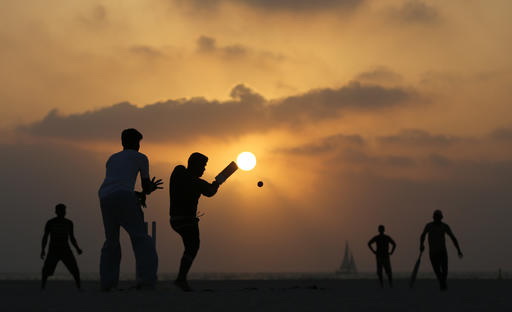
While the sun sets, Asian fishermen of the newly developed Jumeirah Fishing Harbour at the Umm Suqeim district, play cricket by the Gulf waters in Dubai, United Arab Emirates, Tuesday June 14, 2016. Photo: Kamran Jebreili / Associated Press

By Sami Mahroum

PARIS — How should policymakers in the Middle East’s Gulf States manage their countries’ large expatriate workforces? In Saudi Arabia, foreign nationals account for roughly one-third of the population. In Qatar and the United Arab Emirates, nine out of every ten residents is an expatriate. Should these countries’ governments continue to invest heavily in developing indigenous labor forces, with the aim of decreasing dependency on foreign workers?

The extraordinarily high proportion of foreign labor within the Gulf Cooperation Council (GCC) countries is often considered problematic, because, as some see it, it threatens local cultures and national identities, holds down wages, and impedes the development of domestic skills and talent. With so many trades and professions dominated by relatively cheap overseas labor, the indigenous population is often left with few occupational domains offering competitive wages. These tend to be predominantly in the public sector, where oil revenues are used to maintain high pay and attractive working conditions.

But an important dimension of the policy debate within the region risks being overlooked: The Gulf States’ large foreign populations are not just workers; they are also consumers. By inflating the population of the countries in which they live, expatriate workers are helping drive economic growth.

In fact, the GCC benefits from a double expat dividend: not just a diverse consumer base on the demand side, but also a flexible, youthful workforce on the supply side. As a result, following the rapid decline in oil prices of recent years, companies could lay off thousands of workers without having to worry about raising the unemployment rate or putting a substantial burden on government coffers.

This unique feature of GCC labor markets enhances the region’s ability to adapt and adjust to fluctuating economic cycles. Because GCC countries can afford to expand their workforces without running the risk that the share of their elderly population will increase over the long run, they enjoy constant young-to-old and consumer-to-producer “support ratios.”

Moreover, public and private investment in the region – in infrastructure, education, health, and other services – has been geared toward the existing consumer base, inflated by the expat population. Those inflows are now causing the GCC population to grow four times faster than in emerging markets and the United States, seven times faster than in China, and ten times faster than in the eurozone.

This trend is expected to continue, with annual population growth in the GCC averaging 1.8% – twice the average for emerging markets. And, according to an IMF study, population growth in the Middle East and North Africa between 1970 and 2000 has raised the annual rate of growth of output per effective consumer by about 0.5-0.6 percentage points.

Larger consumer markets have sufficient economies of scale and diversity to make the introduction of new products and services into the region economically viable. They have the added benefit of generating what the economist Amar Bhidé calls venturesome consumption: demand-led entrepreneurship and innovation.

Economies of scale also allow the delivery of health, education, and other services, such as entertainment and leisure, at lower prices. And larger markets provide a greater incentive for investors and traders to enter, and for governments to provide new public goods. If not for expat populations in rural and remote areas, there would have been little reason to invest in roads, schools, and hospitals – let alone parks, libraries, and theaters.

GCC countries have made such investments for the past four or five decades, and ongoing construction projects in the GCC are estimated to run in the trillions of dollars. In education, enrollment in K-12 schools across the GCC rose from 2.7 million in 2003 to 10.7 million in 2012, a compound annual growth rate of 16.5%. Investment in this sector stands at around USD$150 billion. In health care, total spending in the region is expected to increase to USD$133 billion per year by 2018.

The foreign population also provides a human-capital dividend to the local population, as talented expats introduce knowledge and innovation in sectors that the GCC wants to develop. Research from MIT has shown that an increase in population size is an important driver of technological progress. And studies in Japan indicate that higher population densities create stronger incentives for individuals to become entrepreneurs; a 10% increase in population density increases the share of people who wish to become entrepreneurs by approximately 1%.

The GCC’s expat dividend could grow much bigger – but only if governments in the region establish the necessary mechanisms. Such mechanisms should be designed to maximize the benefits that foreign nationals provide. Work-and-retire or invest-and-retire visas, for example, would encourage expats to save and accumulate pension funds – thereby enabling them to contribute even more significantly to the region’s rapid economic growth.

Sami Mahroum, Director of the Innovation & Policy Initiative at INSEAD, is the author of “Black Swan Start-ups: Understanding the Rise of Successful Technology Business in Unlikely Places.”

Copyright: Project Syndicate


Advertisement

See World Economic History Through the Medium of Dance

Performers move to reflect daily economic circumstances through dance in “Kin-Yoo-Kue” Photo: Chulalongkorn University / Courtesy

BANGKOK — In a first for Southeast Asia, renowned writer Pascal Rambert’s acclaimed play that entwines everyday life with economics, “Kin-Yoo-Kue” will be staged in Bangkok for three days this week.

“Kin-Yoo-Kue” is a Thai version of Rambert’s original creation “A (micro) history of world economics, danced,” or “Une Micro Histoire Economique du Monde, Dansée.” It will be performed by five main actors, including Sasithorn “Heen” Panichnok and Silapathorn Award winner Nikorn Saetang, along with a cast of 52 local children and adults.

Inspired by the 2008 financial crisis, 54-year-old Rambert, one of Europe’s top writers and directors came up with the idea for the play following a discussion with a philosophy professor at the University of Montreal. The play explores economic history from the Adam Smith era up to the present  day.

The play was first performed in France back in 2010 and later traveled to the U.S., Germany and Egypt. The performance differs in each country as the ensemble cast weigh in with their own stories in some parts of the play, and let their movements reflect circumstances created by local economic issues.

Pascal Rambert, the French writer, director and choreographer behind the play, has won international acclaim for his body of work that encompasses plays, dance, opera and short films. His 2011 play “Clôture de l’amour (Love’s End)” won plenty of prestigious awards including the Grand Prize in Dramatic Literature, and he was awarded the rank of Knight of the Order of Arts and Letters in 2013 in France.

A critically acclaimed version of  “Clôture de l’amour” was successfully staged in Bangkok back in 2014.

“Kin-Yoo-Kue” will be staged in Thai, with English and French subtitles at 7.30pm from June 23 – 25 at Sodsai Pantumkomol Centre for Dramatic Arts.

Regular tickets are 600 baht, tickets for a group of four work out at 400 baht each, and students pay only 400 baht. Tickets can be purchased online.

Sodsai Pantumkomol Centre for Dramatic Arts is on the sixth floor of the Mahachakri Sirindhorn Building, Faculty of Arts, Chulalongkorn University. It is situated on Henri Dunant Road and can be reached on foot from BTS Siam exit No. 6.

Advertisement

Taxi Driver Loses His License for 3 Months for Road Rage Attack (Video)

BANGKOK — A taxi driver who kicked and jumped on foreigner’s car before appearing to attempt to run him over in a viral video has had his license revoked for three months.

Komsan Saejao was identified as the taxi driver who jumped on the bonnet of a car driven by a foreign man Thursday morning in Soi On Nut 30.

In the video, filmed by a bystander, the rage appears to stem from Komsam attempting to turn right and feeling that he was blocked by a foreign driver in the opposite lane. This prompted  Komsan to get out of his taxi, with a young child in his arms and kick the other car.

The angry cab driver then returns to his taxi and puts the young child inside. He then runs at the other car and jumps on the hood.


As seen in widely shared clip, after an exchange of words, Komsan later drives his taxi directly at the foreigner who stepped out from his car during the dispute.

The taxi driver then fled the scene in his vehicle.

After identifying Komsan from a photo of the taxi license plate, authorities from the Department of Land Transport called Komsan in to their office Friday. They revoked his license for three months, effective immediately.

Komsan’s employers were also fined 1,000 baht for not providing the drivers information to authorities.


Related stories:

Axe-Wielding Phuket Taxi Driver Arrested (Video)

Phuket Struggling To Battle Taxi And Nightclubs ‘Mafia’

Taxi Driver Ex-Con Accused of Robbing Chinese Tourists

Taxi Driver Accused of Raping Drunk Passenger Leaving RCA

Cops Arrests Taxi Driver for Robbing Foreigner

Police Seeking Arrest of Masturbating Cabbie

Bangkok Cabbie Arrested for Attempting to Rape Passenger

Advertisement

Hot News

LATEST NEWS

Bangkok
overcast clouds
27.7 ° C
27.7 °
27.7 °
83 %
3.5kmh
100 %
Wed
27 °
Thu
36 °
Fri
34 °
Sat
31 °
Sun
30 °