





















28.8 C
Bangkok
Monday, June 29, 2026
Home Blog Page 2762

Junta’s ‘Polite’ Repression

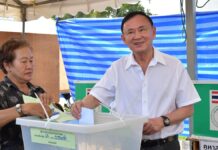
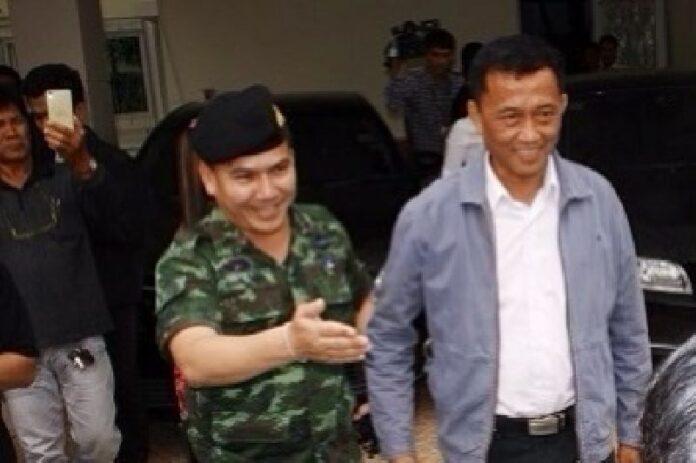
Smiles all around as former Pheu Thai MP Worachai Hema is "politely invited" by a soldier into a van March 27 which then whisked him away to a secret detention facility. Photo: Matichon

By Pravit Rojanaphruk
Senior Staff Writer

\

When the phone rang shortly after 9am on Wednesday it was a junta rep on the other end. He was polite as usual.

“Brother, the commanders think your trip should be deferred,” the soft-spoken Lt. Col. Adisak Showichien informed me. It was about my scheduled trip to Helsinki to attend the World Press Freedom Day organized by UNESCO at the invitation of the Finnish foreign ministry.

Since being detained without charge in the aftermath of the coup, I was “asked” to sign a memorandum of understanding under duress that included having to seek “permission” from the military, more politely and formally known as the National Council for Peace and Order, or NCPO, in order to travel outside Thailand.   

I did not sign anything forbidding me from criticizing the military dictatorship, however.

\

Perplexed for a second about the implicit message, I politely asked Adisak if that meant the NCPO would not permit me to fly to Finland in early May. Adisak said yes, sounding reluctant and very, very polite as usual.

I knew it would be impolite to ask Adisak why, so I didn’t bother. I just thanked him for informing me and finished the call.

Soon after I announced it on social media, The Associated Press wrote several paragraphs about my travel ban in an article about the new police like powers given to the military. Citing military government spokesman Maj. Gen. Sansern Kaewkamnerd as saying he did not know about it, but were it true, “it must be related to national security.”

For the record, I am not a threat to national security – perhaps just a threat to the junta’s deep sense of insecurity which, deep down, probably comes from knowing they are illegitimate. Thus squashing any meaningful dissent became one of their obsessions in returning happiness and “democracy” to the Thai people.

When Bangkok-based ABC News Australia correspondent Liam Cochrane followed on the story Thursday, he got more revealing quotes often obfuscated under the veneer of politeness.

Cochrane quoted NCPO spokesman Col. Piyapong Klinpan as saying:

“The NCPO has followed up on him and found that he still keeps posting [online] and attacking the work of the NCPO. He keeps violating the orders of the NCPO in many ways, so his travel is not approved.”

Does this military regime expect me to kowtow and be a vassal to an illegitimate regime which came to power through a coup in 2014 and praise junta leader Gen. Prayuth Chan-ocha for doing things like banning political gatherings of more than four people? They can’t be serious.

Be that as it may, things went down “politely,” and I am not the only one who took notice. Last month, a visiting MP from a major European nation noted during a lunch meeting that he was surprised that a junta rep which he met was very polite and possessed a good command of English.

He said this was far removed from his expectations of a junta man.

It’s this politeness and lack of outright physical brutality that enables people such as former junta-selected Prime Minister Anand Panyarachun to be able to claim, as he did recently in a keynote speech at the annual Foreign Correspondents’ Club of Thailand dinner, that Westerners should not mistake Thai coup makers for those in the same business in Latin America and Africa because things are not “brutal” here.

Really?

No one’s skull may have been knocked by the butt of an M16 rifle on the streets of Bangkok or upcountry, but detaining people incommunicado, banning political gatherings, freezing bank accounts of opponents and barring critics from traveling are indeed violent, even if executed “politely.”

Politeness only masks repression to a limit. How polite is accusing a Chiang Mai woman of inciting rebellion by merely posting a photo with a red plastic water bucket signed by ousted and fugitive former premier Thaksin Shinawatra and his sister, former premier Yingluck Shinawatra? How polite is empowering soldiers to conduct raids without court order and detain suspects for up to seven days without charge? No politeness can cover up the growing repression or make it palatable.

Last week former Pheu Thai MP Worachai Hema was detained without charge for “attitude adjustment,” a euphemism enabled by the media to obscure the reality of arbitrary detention. In a photo of him being taken away, Vorachai could easily have been mistaken for accepting a smiling soldier’s invitation to a party and not on his way to a secret detention cell.

The perversion of politeness and smiles as tools of repression to make it appear more civil and palatable has been employed for nearly two years now, to the point where it’s no longer polite to insist on being polite.

In Juntaland, politeness is a vessel of military repression to hide the depressing reality and blur the definition of repression. Its emptiness can only be matched by the junta’s notion of “Thai democracy” and befits the situation where Prayuth’s reasoning for not yielding to people’s demands was because, unlike politicians, he was never elected.

Having said all this, I would still prefer having Adisak and other soldiers being polite, as I am always polite to them. (I told them long ago during my first detention that it’s nothing personal: I just support freedom and democracy.)

Indeed, let us fight through military repression in the most polite way possible.


Follow Khaosod English on Facebook and Twitter for news, politics and more from Thailand. To reach Khaosod English about this article or another matter, please contact us by e-mail at [email protected].


Follow @KhaosodEnglish

\

Advertisement

Judge Wanted for Court Throne Theft

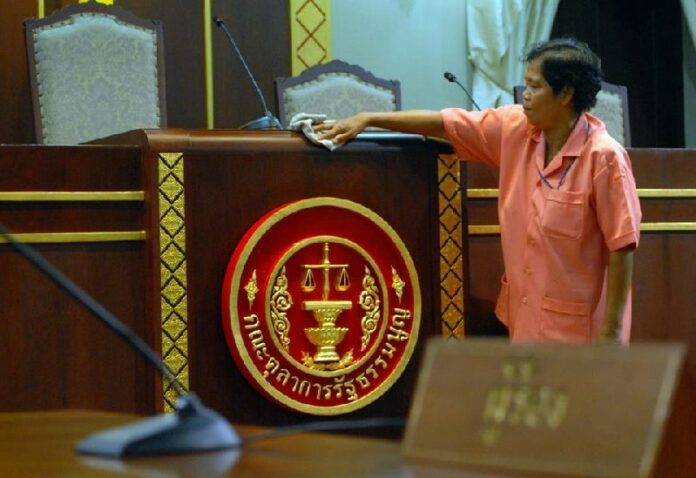
A Constitutional Court seat is cleaned in an undated file photo. Photo: Matichon

By Teeranai Charuvastra
Staff Reporter

CHIANG MAI — A former judge at Chiang Mai provincial court is on the run for allegedly stealing the judge’s seat from his workplace while in office late last year

Along with the ornate wooden seat of judgement, known as a throne in Thai, Jessada Prommek also stole teak desks, cabinets and signs from the court, according to police investigator Sathitchai Nittayawan.

“I don’t know why he stole them,” Maj. Sathitchai of Chang Puak Police Station said Friday. “Maybe he wants to sell the wood. Perhaps he plans to display them in his home.”

Sathitchai said the court noticed that the items went missing some time ago and conducted an internal investigation, concluding that Jessada stole the valuable furniture, probably in November 2015.

Court officials previously requested Jessada to return the throne and other furniture. After refusing to comply, Jessada was removed from his post by the court and criminal charges were filed against him on March 25, Sathitchai said.

After receiving the complaint, Sathitchai said, police raided Jessada’s residence and recovered all of the missing items, but the former judge had already fled, prompting the court to issue an arrest warrant on one of its former members on March 29.

Pollachet Kongraj, a court security guard, was also arrested on March 28 for allegedly assisting Jessada in the theft, the officer added.

Related stories:

Judge in Parking Rage Video Mentally Ill, Court Spokesman Says

Court Warns Against Sharing Videos of Raging Judge

Court Investigating Judge's Appearance At 'Naked Gym Party'


Teeranai Charuvastra can be reached at [email protected] and @Teeranai_C.

Follow Khaosod English on Facebook and Twitter for news, politics and more from Thailand. To reach Khaosod English about this article or another matter, please contact us by e-mail at [email protected].
 

Follow @KhaosodEnglish

\

Advertisement

Prominent Political Prisoner Freed in Myanmar, Many Remain

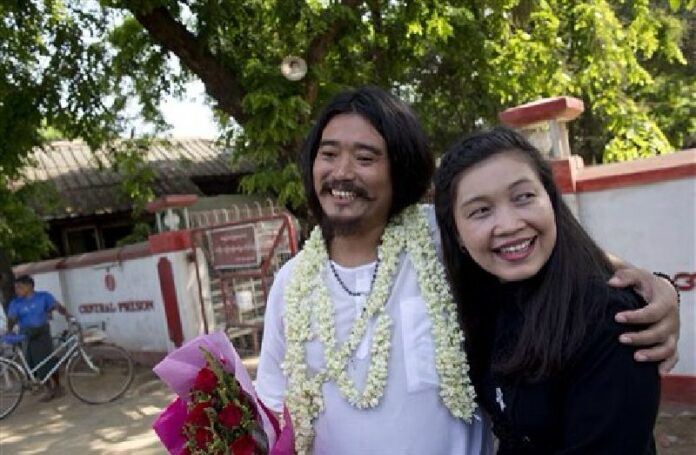
Ethnic Kachin activist Patrick Kum Ja Lee, left, smiles after posing for a picture with his wife and prominent Human Rights activist May Sabe Phyu, right, outside insein prison in Yangon, Myanmar, Friday, April 1, 2016. Photo: Gemunu Amarasinghe / Associated Press

YANGON, Myanmar — A prominent political prisoner was released Friday after he finished his six-month jail sentence, coincidentally on the day that Myanmar's new, democratically-elected government began working.

Patrick Kum Ja Lee's release was on schedule and not ordered freed by the new government. But it serves as a reminder that President Htin Kyaw will soon have to confront the military to free scores of other political prisoners still in jail for speaking out against its rule. Many are supporters of Nobel laureate Aung San Suu Kyi, the force behind the new government.

"I've seen many political activists who are imprisoned by the oppressive laws of the previous government," said Patrick as he walked out of the prison gates, where he was met by his wife, May Sabe Phyu, another human rights activist. "I want the new government to be able to release all the political prisoners."

Patrick, an ethnic Kachin, was arrested in October and sentenced to six months in prison for writing a social media post that was considered offensive to the military commander, Senior Gen. Min Aung Hlain.

Amnesty International recently called on the new government to work to immediately release all political prisoners jailed by the military that has been in power since 1962, and by a subsequent pro-military, quasi-civilian government.

The military loosened its grip on power in 2010 and allowed free elections in November 2015, which Suu Kyi's National League for Democracy swept, allowing it to form a government on Thursday.

Suu Kyi has pledged to release all the remaining 100 or so prisoners but whether that pledge is even practical remains to be seen. The military still controls some key institutions including the Home Affairs Ministry, which runs the Corrections Department. Under the Constitution the president is required to consult the ministry, run by a former general, in order to grant amnesties.

"Aung San Suu Kyi used to say, 'The truth shall make you free,'" said Patrick, "and I hope that really happens to all the political prisoners under her government."

Story: Esther Htusan / Associated Press


To reach us about this article or another matter, please contact us by e-mail at: [email protected].

Follow Khaosod English on Facebook and Twitter for news, politics and more from Thailand.

Follow @KhaosodEnglish

\

Advertisement

Junta to Detain Critical Politicians 7 Days at Military Sites for Reeducation


Watana Muangsook is released from 11th Military Circle in Bangkok Thursday after 3 days of attitude adjustment. Photo: Matichon

BANGKOK — The junta has put the final touches on a seven-day reeducation program reserved exclusively for politicians to be held at military bases, the army chief said today.

The invitation-only program is meant for the junta’s persistent critics. It is currently seeking “students,” Gen. Teerachai Nakwanich said Friday, referring to those who will be forcibly enrolled.

“This course is not available by application,” he said. “It’s only for those who cannot make sense, so we must call them to create understanding.”

Teerachai admitted he already has a list of students in hand, which he described as the usual suspects.

“The course will take place at military bases nationwide including those in Pattani and Yala,” he said.

The idea of a “learning course” for politicians was first raised Monday after two former Pheu Thai MPs, Watana Muangsook and Worachai Hema, were summoned for “attitude adjustment” sessions.

Prime Minister Prayuth Chan-ocha on Tuesday said the course is designed to create better understanding of the military government's work among the politicians who always criticize him.

The content will consist of topics as such politics, good governance, morals and ethics.

Prayuth said the seven-day program will not involve any torture or threats.

Junta spokesman Col. Piyapong Klinphan on Wednesday said it will target those who criticize the draft constitution or make comments against the junta.

The reeducation program will come into effect before a referendum is to take place, likely on Aug. 7, for the public to adopt or reject the draft constitution prepared under the junta’s supervision.

Organized dissent or opposition to the charter has been all but banned.

Piyaphong said the military will notify in advance the families of those it intends to bring in.

Watana Muangsook wrote Friday on Facebook that the program’s aim to silence critics because the election is going to take place soon is in fact a misunderstanding.

“As the NCPO takes charge over the country, that is why they have to let people keep check on their power,” he wrote. “For the draft constitution, as it is during the process of referendum, they must let every party express comment thoroughly, whether they agree or oppose it.”


Related stories:

Activists Expect Increased Use of Detention Before Charter Vote

Watana Charged for Criticizing Junta Deputy Chief’s 'Sexist' Comments

Red Shirt Leader Jatuporn Summoned for Attitude Adjustment

Junta Bars Pheu Thai's Watana From Leaving Country

Soldiers ‘Politely’ Stalk Pheu Thai Politician

Politico Accuses Soldier of Punching Him

Ex-Pheu Thai MP Appeals Junta’s Travel Ban


Advertisement

Giant Whale Killed by Boat Pulled Ashore in Prachuap Khiri Khan

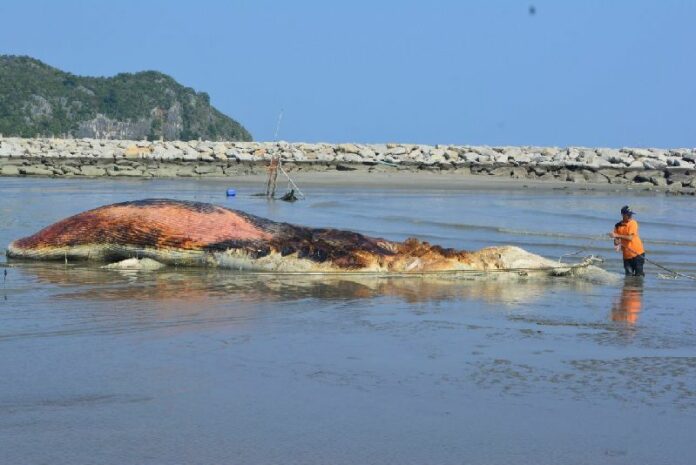
A Bryde’s whale after it was pulled ashore Friday morning on Khlong Wan Beach in Prachuap Khiri Khan province.

PRACHUAP KHIRI KHAN — A huge whale from a threatened species was killed in a boat collision and found Friday morning off Koh Phang beach in the southern province of Prachuap Khiri Khan.

Chumpon Yodwipan, a local wildlife monitor, said the whale was found Friday morning by local fishermen near Koh Phang, located nearly 3 kilometers from the Khlong Wan Beach. The whale’s swollen body reportedly measured 10 meters and weighed over 10 tons.

The whale’s body was pulled to the shore by a boat for examination by marine and coastal resource officers, Chumphon said by phone Friday afternoon.

He said the whale appeared to be about 7 years old. He was told by marine officers that it had been dead for more than seven days and a fatal wound was found on the creature’s back, suggesting it had been hit by a boat.

Bryde’s whales were once commonly found in the Gulf of Thailand, where several die annually, usually from encounters with people.

Legal protection under the 1992 Wild Animal Reservation and Protection Act was extended to the species last year, as only 52 Bryde’s whales were thought remaining in the gulf.

A Bryde’s whale is pulled to the Khlong Wan Beach on Friday morning in Prachuap Khiri Khan province.
Advertisement

Off the Show Floor, Auto Expo’s Raunchy Sideshow Grinds On

One of the many women dancing sexually for photographers in a parking lot behind the Bangkok International Motor Show on March 22. The parking lot display proves a consistent draw for visitors to the show.

BANGKOK — Days before Bangkok’s biggest motor show opened, Culture Minister Veera Rojpojanarat took the moral high ground with a public plea it convey more “Thainess,” meaning fewer scantily clad models acting as hood ornaments.

That didn’t stop the models called “pretties” from putting on a show.

Historically the Bangkok International Motor Show has been about the pretties as much the latest automotive debuts.

Read: Govt Wants Less Sex, More ‘Thainess’ for Motor Show Pretties

Sales reps in sharp suits and pressed blouses and shiny cars serve to somewhat offset the glaring sexuality of pasty pretties flashing timid smiles, but the number of lenses pointed at the women and not the cars is a democratic indicator of what draws crowds.

But walk out the rear exit into the parking lot and find a world that would make Khun Veera’s head spin. The lot is packed with modified pickup trucks blasting tunes usually found in sois Cowboy and Patpong. Astride every vehicle are coyote dancers writhing to the beat, dressed up like characters from The Monkey King or – more often – dressed down in close to nothing at all.

Welcome to the Formula X parking lot bash that runs concurrently with the annual auto show.

Formula X is an importer of automotive audio products such as subwoofers, amplifiers and speakers. It’s part of an automotive subculture in which booming subwoofers and blooming women dancing coyotes. Wolf packs of photographers hunt through rows of modified trucks in search of their favorite pretty to shoot gigabytes worth of media.

I spoke to one dancer about the throngs of girls flying in the face of the culture minister’s request for proper “Thainess.”

“I think most all the customers and people come here for the dancing show. I don’t know why he would do like that.” Nan remarked. “I think he can’t stop it.”

For many Singaporeans, Malaysians, and Japanese this gathering is exactly the reason they travel to Thailand every year to witness the spectacle, zoom lens in hand.

One photographer I spoke to was dispatched by a Malaysian auto magazine. In short, the Formula X show is as unique to Thailand as tuk-tuks and close-cut student uniforms.

Pretend otherwise, but it’s the “Thainess” they’re coming for which they can’t find at home.


\

\

\

\

\

\

\

\

\

Related stories:

Did These Motor Show Pretties Hew to ‘Thainess?’


Advertisement

Police Confiscate ‘Red Bowls’ From Yingluck Supporters

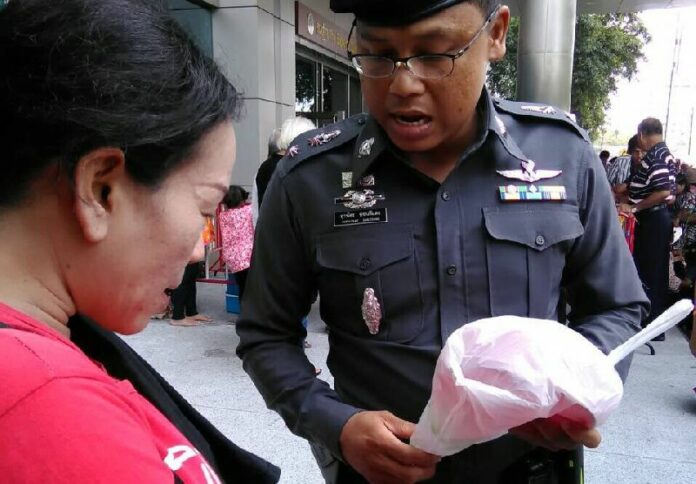
A police officer seizes a plastic red bowl from a supporter of former Prime Minister Yingluck Shinawatra on Friday in Bangkok. Photo: Matichon

BANGKOK — Police officers today were seen confiscating Songkran festival bowls from supporters of ousted Prime Minister Yingluck Shinawatra without giving any clear reason.

The incident is part of the saga of the authorities’ surreal crackdown on the red bowls, which were distributed by the Shinawatra family to its supporters late last month.


Thairath Reporter Taken to Army Base for ‘Red Bowl’ Report


Police moved in on crowds of Yingluck supporters assembled at the Bangkok courthouse where she appeared Friday for a hearing in her trial over alleged corruption and confiscated bowls many were carrying, according to a Matichon reporter.

They reportedly bore messages including “I love the person you hate, I hate the person you love,” and “We Love Prime Minister Pu,” in reference to her nickname.

\

Police officers collect red bowls Friday in Bangkok. Photo: Matichon


While officers were said to take away the items without offering any reason, the local police commander denied giving any such order.

“We didn’t confiscate anything … Nothing happened. Everything went smoothly,” said Col. Termphao Siriphuban, head of Thung Song Hong Station. “I was there today. I didn’t see the officers confiscate anything. If they did, they would have reported it to me already.” 

But he acknowledged other police units present at the court today might have taken the bowls. 

Asked whether Yingluck’s supporters can bring red bowls to public rallies, Termphao said his force has no stance on the matter. 

“We only focused on banners. If there are banners that don’t look good, that verge on political protest, we have to confiscate them.But we have no policy on red bowls,” he said with an audible chuckle.

On Tuesday, a Redshirt activist in Chiang Mai was arrested and charged with sedition for posing for a photo with one of the red bowls distributed by Yingluck and her brother, former premier Thaksin Shinawatra. Thaksin remains de facto leader of his political dynasty despite being ousted in a coup nearly 10 years ago.

A reporter for Thairath, the largest newspaper in Thailand, was also briefly detained and interrogated at an army base in the province for reporting about the bowl. 

Since staging the coup against the pro-Shinawatra government in May 2014, the junta has been working to dismantle political influence of the family and its allies.


Related stories:

Shinawatras Defy Junta With Publicity Drive

A Country Divided by a Calendar

Junta Warns Redshirts Not to Don Red Shirts

Soldiers Confiscate 'Thaksin Strawberry Jam'


Teeranai Charuvastra can be reached at [email protected] and @Teeranai_C.


\

Advertisement

Chinese Dams Blamed for Exacerbating Southeast Asian Drought

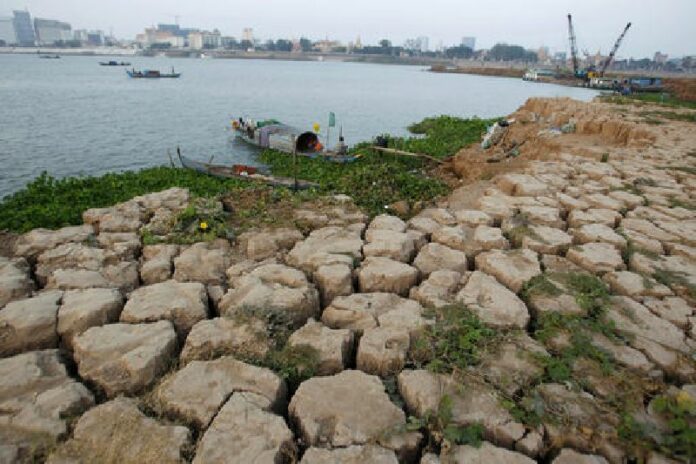
In this March 22, 2016 photo, a Cambodian fisherman anchors their wooden boats on Mekong River bank near Phnom Penh, Cambodia. Photo: Heng Sinith / Associated Press

HANOI, Vietnam — As China opened one of its six dams on the upper Mekong River last month to help parched Southeast Asian countries down river cope with a record drought, it was hailed as benevolent water diplomacy.

But to critics of hydroelectric dams built on the Mekong over the concerns of governments and activists, it was the self-serving act of a country that, along with hydropower-exporting Laos, has helped worsen the region's water and environmental problems.

Much of Southeast Asia is suffering its worst drought in 20 or more years. Tens of millions of people in the region are affected by the low level of the Mekong, a rice-bowl-sustaining river system that flows into Laos, Thailand, Cambodia and Vietnam. Fresh water is running short for hundreds of thousands of people in Vietnam and Cambodia, and reduced water for irrigation has hurt agriculture, particularly rice growing in Thailand, where land under cultivation is being cut significantly this year.

Vietnam estimates that 400,000 hectares (1,500 square miles) have been affected by saltwater intrusion, with some 166,000 hectares (640 square miles) rendered infertile. The affected land accounts for nearly 10 percent of the country's paddy cultivation area in the Mekong Delta, its main rice-growing region.

The water level in the Tonle Sap river as it passes the royal palace in Cambodia's capital, Phnom Penh, has fallen to a 50-year low.

\

In this March 25, 2016 photo, Cambodian Buddhist monks walk through dried earth near pagoda at Trapang Chhouk village in the outskirts of Phnom Penh, Cambodia.Photo: Heng Sinith / Associated Press

Fingers are mainly pointed at the El Nino climate phenomenon, which produces drier and hotter-than-usual weather globally. But environmentalists and some officials say the situation is worsened by the 10 dams on the Mekong's mainstream built over the past two decades, at least partly because they reduce rainy-season flooding and trap sediments, making the downstream delta more vulnerable to seawater intrusion.

"I've lost all my investment. My family was left with nothing," said Thach Tai, a farmer from Ngoc Bien village in the southern Vietnamese province of Tra Vinh, as he surveyed his 2,000 square meters (half an acre) of dead, dry paddies.

"I don't know what to do. And there's nothing I can do to help with my rice paddies."

Tai said his 70-year-old father and other elderly people in the village of more than 180 families had never witnessed such drought and salination.

The current El Nino is one of the strongest climate events in the past 60 years "that is not over yet," said Kundhavi Kadiresan, assistant director-general at the U.N.'s Food and Agriculture Organization. It is the main factor in the drought, but "dams along the Mekong can and certainly do cause some problems," she said.

Vietnam says the saltwater intrusion into its southern Mekong Delta is unprecedented. In mid-March, it asked China to double the amount of water discharged from its Jinghong dam in Yunnan province. China agreed and the increased water flow is expected to continue until April 10.

Pham Tuan Phan, chief executive of the Mekong River Commission, a body set up to mediate the conflicting priorities of upstream and downstream Mekong countries, called the Chinese move a "gesture of goodwill."

China was embarking on unprecedented water diplomacy, declared Thailand's English-language Nation newspaper. China's Foreign Ministry said the government had decided to "overcome its own difficulties to offer emergency water flows."

The Chinese move was hailed as progress because it was the first time it had notified downstream countries of its plans for the Mekong's water level. But it also underlined the power China holds over a shared life-sustaining resource and the Mekong environment overall.

Ma Quang Trung, a department director at Vietnam's Agriculture Ministry, said discharges from the Jinghong dam might help reduce fresh water shortages for 575,000 Vietnamese, but are unlikely to ease the drought overall. Vietnam is so far downstream that only a small portion of the discharged water will reach it. He blames the drought on El Nino and Mekong dams.

\

In this March 28, 2016 photo, water release valves are seen at a almost dry canal in Chai Nat province, Thailand.  Photo: Sakchai Lalit / Associated Press

Thailand, meanwhile, has added to regional tensions over the resource by deciding to pump large volumes of Mekong water to drought-afflicted provinces.

Many more dams are planned for the Mekong, including by China and landlocked Laos, which with Chinese support sees hydropower exports becoming the mainstay of its economy, one of Asia's least developed. As a member of the toothless river commission, Laos must consult Thailand, Vietnam and Cambodia but does not need their approval.

Laos went ahead with construction of the Xayaburi dam in 2012 over the concerns of its neighbors, who first wanted an in-depth study on what they feared would be profound effects on the Mekong, one of the world's largest inland fisheries. Existing research on dams worldwide shows they significantly diminish fishing grounds by creating barriers to breeding-cycle migrations and creating river conditions that destroy habitat and food sources.

Piaporn Deetes, a campaigner in Thailand for Rivers International, an advocacy group, scoffs at the idea that the Jinghong discharge was a selfless act by China to help its neighbors. She said China gets benefits such as electricity generation, and the temporarily higher water level makes for easier navigation on its section of the river.

\

In this March 28, 2016 photo, Thai workers repair a dried up irrigation canal at Chai Nat province, Thailand. Photo: Sakchai Lalit / Associated Press

The discharge also had disastrous consequences that were inevitable because millions who live along the Mekong and depend on it for their livelihoods were unaware water levels would suddenly rise.

River bank vegetable gardens were submerged and boats and fishing equipment swept away, said Deetes. Harvests of kaipen, a freshwater weed exported to Japan that is large source of income for river communities, were destroyed.

"The Mekong is not a tap," she said. "It is a complex ecosystem."

Story: Tran Van Minh and Stephen Wright / Associated Press


Advertisement

Hundreds of Motorcycles Briefly Block Bridge

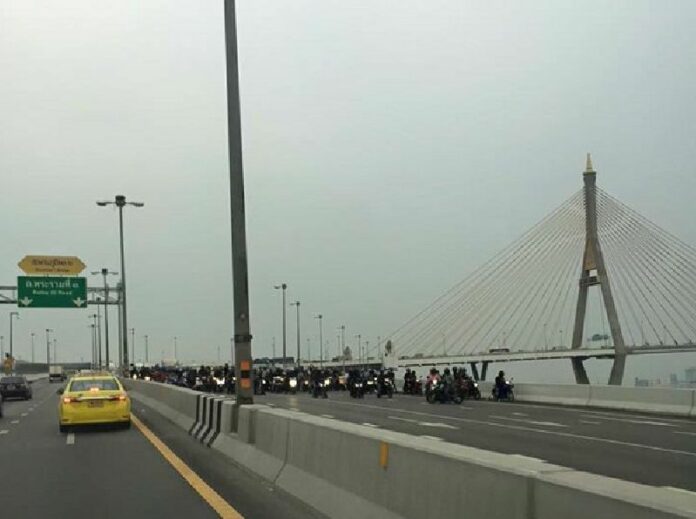
Motorcycles gather on Bhumibol Bridge on Thursday evening in Bangkok. Photo : We Love Checkpoint / Facebook

BANGKOK — Hundreds gathered on Bhumibol Bridge yesterday evening for a two-wheel protest against a new ban on riding across the bridge and dozens of other spans in the capital.

In photos and videos shared online Thursday night, the event was described as a protest against a ban keeping them off a number of flyovers and underpasses around Bangkok. Many said it effectively prevented them from crossing the Chao Phraya River.

Police denied any such act of civil disobedience occurred, saying the cyclists assembled there only because they were afraid of being fined at a police checkpoint on the other side of the bridge.

“They saw a checkpoint, and they knew what they were doing was illegal,” said police Maj. Porameth Tangjitsamathi of the Phra Pradaeng Police Station. “So they waited on the bridge and rode down when we stopped checking.”

Poremeth said the group only gathered in the lane heading from Rama III Road to Phra Pradaeng for 15 minutes at 6pm. He believed there was about a thousand motorcycles.

Under the order issued Wednesday by the Metropolitan Police Bureau, motorcycles, bicycles and tuk-tuks cannot use the 39 flyovers and six underpasses in Bangkok which lack a lane for slower vehicles, such as Bhumibol Bridge.

Deputy Metropolitan police chief Maj. Gen. Adul Narongsak said the ban is aimed at relieving congestion from accidents. Those who violate it will be fined 500 baht to 1,000 baht, he said.


Poremeth said Bhumibol Bridge was higher than a lot of other bridges, as it was built to accommodate cargo ships. Because of its height, strong winds often cause motorcyclists to lose control.

“Every time there is an accident involving motorcycles on the bridge, they are always severely injured,” he said.

He suggested those on two wheels use the ferry service under the bridge to get across, though he admitted there are probably not enough ferries in service to meet demand.

Clip and photos posted online Thursday also showed a long line of motorcycles queued for the ferry.

“I would love to be another voice asking for justice, equality and good enough reasons,” wrote Facebook user Torpong Uttarapong in the We Love Checkpoint group on Facebook.

Some said their livelihoods are affected.

“I am riding my motorcycle to deliver food” wrote another user Karn Dumrongtakulkij. “But I think we should have gathered at the Royal Thai Police Office rather than shutting down the bridge and making trouble for others.”


Advertisement

Charter Draft Second Look: Full Education No Longer Guaranteed (Analysis)

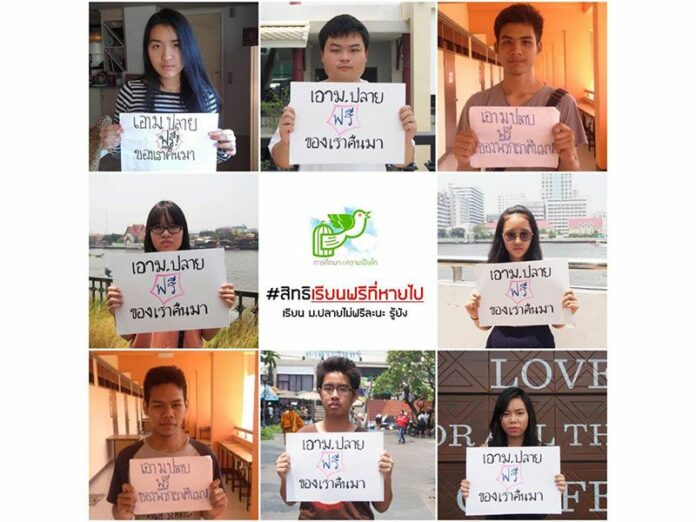
Students campaign for restoring the right to free, full education through the Mathayom 6 level in images posted to social media. Education for Liberation / Facebook

By Pravit Rojanaphruk
Senior Staff Writer

BANGKOK — Digging deeper into the recently released draft charter’s 279 articles finds caveats applied to basic civil rights, education funding that falls three years short of completing secondary school and obstacles to amending the constitution.

Article 54 cuts mandatory funding for the last three years of secondary education (Mathayom 4-6), meaning children would only be guaranteed schooling to about age 15. To complete high school, families would have to pay. While the state would still subsidize 12 years of education, they would begin earlier with three years of kindergarten.


Charter Draft First Look: When Will the Junta be Really Gone? (Analysis)


The move has upset some student activists such as recent grad Netiwit Chotiphatphaisal, who said said education access would be jeopardized by the proposed article. Many parents, the 19-year-old said, would be unable to afford paying out of pocket for the three years of upper secondary school.

Defending the change, head charter drafter Meechai Ruchupan said it’s more important to invest in early education.

But with decent jobs difficult to come by for those who don’t complete the full six years through to Mathayom 6, it’s unclear where the new system would lead Thailand.


Citizen Rights and Duties

On citizen’s rights, Article 4 states that Thai citizens would enjoy equal protection under the constitution. No mention is made of the guarantees for non-Thai citizens living in the kingdom.

Article 30 states that civilians can be forcibly conscripted as laborers not only in times of war but anytime an emergency decree or martial law is in effect.

Free expression is guaranteed in Article 34, unless it needs to be suspended to “maintain peace and order.” We don’t know what laws could be passed in the name of maintaining peace and order, thus leaving a clear loophole. Same for the right to peaceful of assembly guaranteed under Article 44, which can likewise be revoked in the name of state security.

Press freedom is addressed by Article 35. It states that newspapers cannot be shut down by the state, which cannot screen any printed news prior to publication unless the kingdom is in a declared state of war.

On a positive note, Article 39 states that Thai citizens cannot be expelled from the kingdom. Thai nationals also cannot be prevented from entering the kingdom, nor can citizens by birth ever lose their citizenship.

Unity, peace and order are prioritized by Article 50 as “duties” of Thais. Article 50.6 states vaguely without any legal precision that Thais should not cause division or hate in society and should not support any form of graft and corruption.

When it comes to the duties of the Thai state, Article 52 obligates it to protecting the monarchy, sovereignty and “peace and order of the people.” It requires the state to achieve this through effective military, diplomatic and intelligence gathering efforts.

There are some positive developments, such as in Article 72.3, which requires the state to distribute land holdings fairly, so people can have adequate access. Sounds good in spirit, but won’t mean much without strong organic laws and will to see them carried out.


Byzantine Amendment Process

In the end, if the junta-sponsored charter draft is adopted, anyone still unhappy with it can work to amend it. First, Article 256 states, they’ll need to find 49,999 other eligible voter friends to initiate an amendment motion as per.

That motion would have to be taken up three times in the House of Parliament and ultimately endorsed by its members. At its third and final reading, the amendment would be adopted if:

1. More than half the members endorse it

2. That majority contains 20 percent of the MPs from all represented parties

3. A third of the 250-member senate (mostly indirectly appointed by the junta for the first five-year term) go for it

Whether one is predisposed to supporting or rejecting the draft charter, reading all 105 pages and 279 articles is a useful and responsible exercise to making up one’s mind before it comes up for vote.


Here’s the final draft released Tuesday by the Constitution Drafting Committee (Thai)

Advertisement

Hot News

LATEST NEWS

Bangkok
overcast clouds
28.8 ° C
28.8 °
28.8 °
74 %
2.5kmh
97 %
Mon
33 °
Tue
32 °
Wed
33 °
Thu
35 °
Fri
27 °