































32.2 C
Bangkok
Thursday, June 25, 2026
Home Blog Page 2794

No More Heroes: Democracy Fails if We Watch From the Sidelines

Student pro-democracy movement leader Sirawith Seritiwat, at left, with the author, Pravit Rojanaphruk at a Feb. 18 Thamassat University symposium.

By Pravit Rojanaphruk
Senior Staff Writer

\

A Thammasat University lecturer told me Wednesday that democracy activist leader Sombat Boonngam-anong has been too quiet since he was arrested in 2014 for calling for a failed effort to overthrow the coup makers.

But what more should we expect from an individual – Sombat or anyone – in carrying the flickering torch of democracy and human rights with a paranoid military bent on suppressing any views they don’t agree with, while its opposition is mostly comprised of fence-sitters?

Freedom cannot be maintained if we are not willing to do our part in defending it. For this I will never blame Sombat, who’s currently facing a military trial for sedition and violating the Computer Crime Act, and has his money in the bank frozen by the junta.

\

A week ago I sat at the same bench with Sombat almost by chance when he was invited to speak at Thammasat about internet censorship. Sombat was almost apologetic to me when talking about his lack of “actions” during the past year since his arrest. I told him it’s unfair for anyone to expect more given what he had done, and the sacrifice made. Considering his travails, nobody has the right to demand more from him. I said the struggle for democracy and human rights is more than a sprint. It’s more like a relay race where people must take turns contributing whatever they can.

Sombat insisted during our brief tete-a-tete under the late afternoon sun that he might give it another try if the situation became severe, and if he believed there was a realistic chance of restoring democracy.

Soon after Sombat excused himself to prep for his comments on the open-air stage, Sirawith Seritiwat, aka Ja New, arrived by chance and took the spot Sombat had been sitting.

Where Sombat was the face of resistance in the months after the coup, young Sirawith is the man of the hour. Unlike Sombat who’s almost forgotten by the international media, Sirawith is the current darling and hope of the anti-junta movement for rising up from humble origins and a low-income background to provoke the junta and face dramatic repercussions, including being hooded and dragged away in the middle of the night only to be dumped at a police station. He’s currently charged with violating the junta’s ban on political assembly of five or more persons after he led a failed trip to examine a historical park allegedly tainted by army corruption in Hua Hin.

\
Activist Sombat Boonngam-anong, at left, and the author, Pravit Rojanaphruk, at a Feb. 18 symposium held at Thammasat University.
 

Seated on the bench, Sirawith said he’s concerned the situation could turn from bad to worse for Thailand. He admitted to fearing another coup before the promised July referendum on the draft charter if military thinks the junta-overseen document is doomed for rejection.

In that case, I said, the new military rulers will probably make life under current junta leader Prayuth Chan-ocha feel like a walk in the park. I also told him there could be more than one worst-case scenario for Thailand, and it’s always wise to be prepared for the various possible scenarios.

On Tuesday I met U.N. Assistant Secretary-General Miroslav Jenca, who was in town for a two-day work visit. It wasn’t for an interview, but Jenca wanted to hear my views as to how the United Nations can more effectively engage with Thailand in order to see it return to democracy.

While I’ll leave what I told Jenca for a possible future topic, Jenca reminded me that when U.N. Secretary General Ban Ki-moon met Prayuth in September at the U.N. General Assembly, a brief meeting Jenca was present for, more than pleasantries were exchanged.

I thank the United Nations for its tireless and altruistic diplomatic efforts in trying to remind the junta of the need to return power to the people.

Before we adjourned, Jenca reminded me that if there’s “some kind of expectation” that change in Thailand would come from the outside, “it’s not going to happen.”

This is both refreshing and sobering, coming from a top U.N. official. Fence-sitting or begging for outside assistance cannot bring about freedom and democracy.

Back to the same Thammasat academic who questioned Sombat’s inactivity. He said his girlfriend really dislikes military rule, yet doesn’t do anything more than grumble.

No hero can save Thailand from itself – not Sombat, Siriwith, or even the United Nations. The sooner we realize this, the sooner we stop waiting to be rescued by Marvel superheroes and get off the fence to play our part, the better.


Pravit Rojanaphruk can be reached at [email protected] and @PravitR.

Follow Khaosod English on Facebook and Twitter for news, politics and more from Thailand. To reach Khaosod English about this article or another matter, please contact us by e-mail at [email protected].


Follow @KhaosodEnglish

\

Advertisement

Songkran Will Go On Despite Drought: Tourism Authority

A Songkran reveller puts powder on a policeman’s face April 15, 2014, on Khaosan Road in Bangkok. Photo: Matichon

BANGKOK — Despite threats of persistent and severe drought, the Tourism Authority of Thailand said the annual water fight festival that marks the traditional Thai New Year will go on as normal.

The world-renowned Songkran festival will only last for three days in April and therefore not have any significant impact on water use nationwide, said tourism authority Gov. Yuthasak Supasorn. 

“It’s a festival that draws interest from many foreign tourists,” Yuthasak told reporters Friday. “And it won’t affect the drought situation.” 

Though formally held only April 13 to 15, the water fight extends beyond those three days in some provinces, such as Pattaya, where the celebration lasts an entire week. 

Songkran is an important time for the critical tourism sector. In 2014 the tourism authority said it generated over 4 billion baht in revenue.

Yutthasak also urged the hotel industry to prepare for the upcoming drought. 

“Hotels are businesses that consume large amounts of water,” he said. “If the drought lasts through the months of May and June, which is the tourism low season, the situation will be worse for us.” 

Earlier this week the military has ordered all relevant agencies to gear up for the drought season and set aside reserve water supply for the country’s rice farms and orchards. Junta chairman Prayuth Chan-ocha visited farms in Uthai Thani on Friday to inspect drought preparations. 

Related Stories:

Old Versus New at Thailand's Songkran Festival

Official: No Plan To Sue Singapore Over Songkran


Teeranai Charuvastra can be reached at [email protected] and @Teeranai_C.


\

Advertisement

Platini's No. 2 Infantino Elected FIFA President

New FIFA president Gianni Infantino of Switzerland, waves to delegates after his election Friday at the Extraordinary FIFA Congress 2016 in Zurich, Switzerland. Photo: Ennio Leanza / Associated Press

ZURICH — Gianni Infantino is the new president of soccer's corruption-scarred world governing body, winning election after promising national leaders of the sport that he would share the wealth from FIFA's USD$5 billion World Cup revenues.

Infantino was chosen on the second-ballot Friday to fill the unexpired term of longtime FIFA leader Sepp Blatter, who was forced out by the pressure of U.S. and Swiss investigations of bribery and corruption that emerged two days before the previous vote in May 2015.

The stunning outcome seemed to catch the 45-year-old Infantino off-guard. He had to compose himself before starting his acceptance speech and saluted voters by patting his heart with his right hand.

"We will restore the image of FIFA and the respect of FIFA. And everyone in the world will applaud us," said Infantino, who only became a candidate when a case of financial wrongdoing removed his own boss, Michel Platini, at Europe's soccer body UEFA.

"I am convinced a new era is starting," said the Swiss-born former lawyer. Blatter headed FIFA for more than 17 years.

Infantino pledged to meet quickly with World Cup broadcasters and sponsors, saying they "they need to regain trust and confidence in football and in FIFA."

There were only four candidates on the ballot after Tokyo Sexwale withdrew during his campaign speech to voters. The four were Infantino, UEFA's general secretary; Sheikh Salman of Bahrain, the Asian confederation president; Prince Ali of Jordan; and Jerome Champagne of France.

Infantino, who had waged a globe-trotting campaign in the four months leading up to the election, gave an impressive 15-minute speech only 20 minutes before the first-round vote. The Swiss-Italian spoke in several languages without notes and portrayed himself as a leader for the world, not just Europe's wealthy confederation.

His campaign promised to spread the World Cup largesse to more federations, including additional guaranteed funds. He also pledged to expand the World Cup from a 32-team tournament to 40 teams, and give more opportunities to countries to stage the World Cup with multinational regional hosting.

"The money of FIFA is your money," he said, jabbing his left index finger to the 207 members of soccer federations from Afghanistan to Zimbabwe before the election.

"It is not the money of the FIFA president. It's your money," added Infantino, sounding more like a CEO promising a dividend to shareholders.

A rare burst of spontaneous applause followed, signaling a shift in momentum toward Infantino, who since his 30s managed the billion-dollar Champions League revenues for UEFA.

It resonated with members of the corruption ravaged soccer bodies of the Americas, known as CONCACAF and CONMEBOL. FIFA froze a combined $20 million of their funds in December in the aftermath of the U.S. Justice Department's sprawling investigation of bribe-taking by top FIFA officials.

"Gianni's speech was a president's speech," said Kohzo Tshima of Japan, a new member of FIFA's long-tainted executive committee, adding that his words changed the atmosphere in the election hall.

In the first round, Infantino took a surprising lead with 88 votes — just three more than Sheikh Salman but key to making him look like a winner with valuable momentum. Prince Ali received 27 votes, and Champagne seven.

Then, in the second round, Infantino received 115 votes to earn a decisive majority over Sheikh Salman, who received 88 votes. Prince Ali got four votes, and Champagne none.

"I talked to Gianni last night and we said we'd support Prince Ali," said U.S. delegation head Sunil Gulati, "but also he knew where we would be as it unfolded if it did, in the way it did."

No second-round has been needed in a FIFA presidential election since 1974. That year, Joao Havelange of Brazil needed two rounds to defeat 13-year incumbent Stanley Rous of England.

Infantino, like the 78-year-old Blatter, is from the Valais region in the Swiss Alps. He will be president until May 2019, completing the remainder of Blatter's term.

Blatter, 79, won a fifth term last year but, amid the escalating corruption scandals, bowed to pressure four days after the election and said he would resign. He was subsequently banned for six years for financial mismanagement and was absent Friday after 40 years as a fixture at FIFA meetings.

"I congratulate Gianni Infantino sincerely and warmly on his election as the new president," Blatter said in a statement. "With his experience, expertise, strategic and diplomatic skills he has all the qualities to continue my work and to stabilize FIFA again."

Sheikh Salman was expected to lead the first round with backing from Africa and the Asian soccer confederation he has led since 2013.

He also had behind him the Kuwait-based vote-gathering operation of Olympic power- broker Sheikh Ahmad al-Fahad al-Sabah, his FIFA executive committee colleague, who sustained a rare electoral loss.

Still, he had been the most criticized and scrutinized candidate throughout the campaign. The issue of Bahrain's human rights record was often cited by Gulf activists but had not seemed to seriously trouble voters outside Europe.

Sheikh Salman has strongly denied claims about his role in the Arab Spring protests of 2011 when he was Bahrain's soccer federation president.

Infantino takes over a wealthy but vulnerable soccer body whose image and confidence has been shattered by the escalating scandals.

Before electing FIFA's first new president since 1998, 87 percent of the 207 voting federations passed wide-ranging reforms to guard against corruption and curb the powers of its leader.

Those include preventing presidents from serving more than three four-year terms, reducing their powers and guaranteeing more independent oversight for FIFA's decision-making and spending. The executive committee will be renamed the FIFA Council, with more female members. Stricter integrity checks will also control top officials.

FIFA and its lawyers hope the reform will help show U.S. prosecutors the soccer body is serious about changing its culture, and protect its status as a victim in the American investigation. A total of 41 people and marketing agencies have been indicted or made guilty pleas, and Blatter is a target.

Story: Graham Dunbar / Associated Press

Advertisement

Cannery Row Strike Wins Pay Promise for Workers

Workers on strike Friday outside a Golden Prize Canning factory in Samut Sakhon province. Photo: Courtesy Andy Hall / Migrant Workers Rights Network

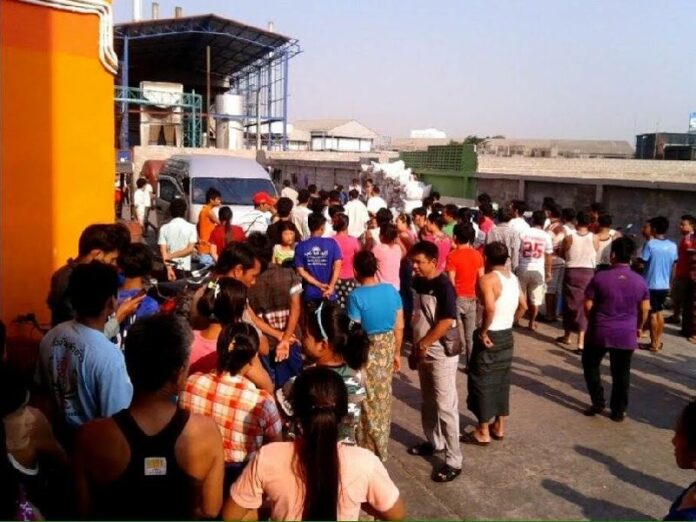
SAMUT SAKHON — A strike of more than 1,100 workers at a canned food factory southwest of Bangkok in Samut Sakhon province ended today with company executives agreeing to pay overtime and wages allegedly withheld from workers.

The strike, which began Thursday and mostly involved workers from Myanmar, was a rare victory in a country where migrant workers routinely suffer discrimination and harsh working conditions with little or no leverage. 

In a deal struck late Friday afternoon, Golden Prize Canning agreed to pay overtime and withheld wages to the workers on Monday so long as the work stoppage ceased immediately. 

“The agreement that was reached today has satisfied both employers and employees,” said provincial Gov. Manrat Ratansukon, who said he would personally visit the factory Monday to make sure the executives honor the agreement. 

Reached for comment over the telephone, a Golden Prize Canning representative declined to comment. 

Sein Htay, president of the Migrant Workers Rights Network, said it was still unclear who would be paid how much.

“It’s still too early to call it a victory,” Htay said. “The agreement is still preliminary.” 

He said the company will announce Monday what it will pay to which employees.

Andy Hall, a coordinator for the labor group, said in an email the strike was called after the government and trade federations ignored complaints for months without ever taking action.

In a statement released Thursday by the group, strike organizers said workers at Golden Prize Canning Ltd. had never received a 2013 national minimum wage increase or any overtime pay. 

The statement also alleged other unfair practices at the factory in Samut Sakhon, such as the refusal to grant sick leaves to workers, even those who provided medical certificates as evidence.

“The trend with the Thai government labor protection systems are always the same,” Hall said “Only after protests, threats of protests or mass action does rule of law for migrant workers actually progress forward.”

The strike started Thursday evening. On Friday about 200 of the workers marched to a government labor complaint center. The protest prompted government officials and company representatives to enter negotiations with the strike organizers. 

There are at least two million Myanmar workers in Thailand, mostly working in low-paid menial jobs as factory workers and housekeepers. Samut Sakhon is home to some of the world’s largest seafood suppliers, such as Narong Seafood Co. and Thai Union Group.

A majority of the workers were not registered legally, which made the migrant workers vulnerable to unfair wages and other forms of exploitation, according to documented claims by various rights groups.

Related stories:

US Congress Bans Import of Forced Labor Products

Nestle Admits to Slavery in Thai-Sourced Seafood

McDonald’s Denies Boycotting Fish From Thailand

Greenpeace Calls Out Thai Union Group Over Fishing Practices

EU Warning on Illegal Fishing Has Thai Fishing Industry Reeling

Thai Tuna Company Buys US Bumble Bee Foods


Teeranai Charuvastra can be reached at [email protected] and @Teeranai_C.


\

Advertisement

Tobacco Monopoly Readies Cigarettes for the Poor

One of a number of government-mandated visual warnings which have been printed on packs of cigarettes sold in Thailand.

BANGKOK — Weeks after the military government hiked taxes on cigarettes to discourage smoking, it announced today it will take measures to keep smoking affordable for the poor.

The director of the government cigarette agency said Friday it will release a new type of low-cost cigarette in order to keep them in the hands of low-income smokers, who may otherwise resort to the black market or rolling their own.

“Some customers turn to tobacco that they can roll up on their own, and some turn to untaxed and bootleg and illegal cigarettes,” Daonoi Suttiniphapunt, director of Thailand Tobacco Monopoly, told Matichon Online. “Because they are a third cheaper than the cigarettes on the market.”

The solution, she said, is to launch a new brand of smaller, inexpensive cigarettes no later than April.

“The price will be about 40 baht per pack in order to target the market of low-income consumers, and help them afford cigarettes,” Daonoi said.

The plan provides a fresh example of paradoxical programs launched by different components of the government, which occasionally run counter to each other’s interest.

One year ago in February 2015, the Ministry of Public Health moved in to install condom vending machines in schools and colleges to combat teen pregnancy and HIV, a plan soon blocked by social conservatives within the Ministry of Education.

While the state has invested money into the Thai Health Promotion Foundation and the Alcohol Control Board, which run extensive morality campaigns against smoking and drinking, it also operates whiskey breweries and tobacco factories, whose products bring in billions of baht in tax revenue each year.

Roughly one in five adults in Thailand are regular smokers, according to 2014 data from the National Statistics Office.

Daonoi estimated the 3 percent tax increase added to cigarettes Feb. 9 will cost the tobacco concern, which operates under the Finance Ministry, nearly 1 billion baht in revenues – each month.

To encourage a crackdown on untaxed cigarettes, Daonoi said, the monopoly will pay bounties to officers who confiscate cartons of unauthorized tobacco.

The payout will range from 1,500 baht per carton to 50,000 baht for large hauls that involve at least 50 cartons, Daonoi said.

Established in 1939, the tobacco monopoly for nearly six decades was just that, the only authorized producer of cigarettes, until the market was opened under a regional trade agreement in 1992.

Advertisement

Japan's Population Falls by Nearly 1 Million

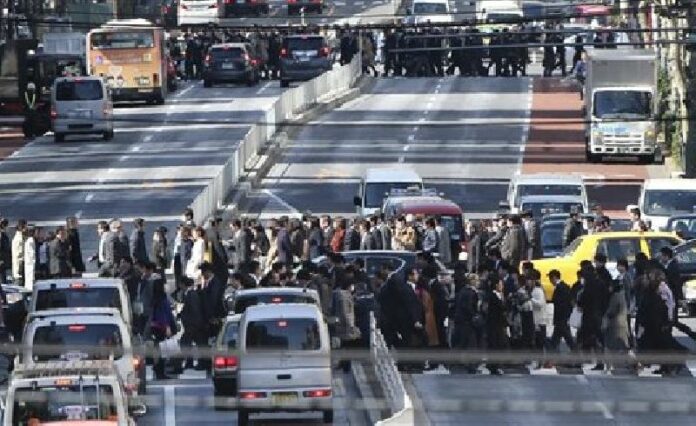
People cross crosswalks on a street in Tokyo, Friday, Feb. 26, 2016. Photo: Koji Sasahara / Associated Press

TOKYO — Japan's latest census confirmed the hard reality long ago signaled by shuttered shops and abandoned villages across the country: the population is shrinking.

Japan's population stood at 127.1 million last fall, down 0.7 percent from 128.1 million in 2010, according to results of the 2015 census, released Friday. The 947,000 decline in the population in the last five years was the first since the once-every-five-years count started in 1920.

Unable to count on a growing market and labor force to power economic expansion, the government has drawn up urgent measures to counter the falling birth rate.

Prime Minister Shinzo Abe has made preventing a decline below 100 million a top priority. But population experts say it would be virtually impossible to prevent that even if the birth rate rose to Abe's target of 1.8 children per woman from the current birthrate of 1.4.

Without a substantial increase in the birthrate or loosening of staunch Japanese resistance to immigration, the population is forecast to fall to about 108 million by 2050 and to 87 million by 2060.

Tokyo's rush hour trains are just as crowded as ever: Japan's biggest cities have continued to grow as younger workers leave small towns in search of work. The census showed Tokyo's population grew to 13.5 million, up 2.7 percent since the 2010 census.

\

In this Nov. 17, 2015, file photo, a shopper walks past a clothing shop display at a shopping street of Ginza area in Tokyo. Photo: Eugene Hoshiko / Associated Press

But a visit to any regional city will find entire blocks of small shops shuttered, the owners usually either retired or deceased. In rural areas, even just outside Tokyo, villages are mostly empty, fields overgrown and bus and train services intermittent thanks to scant demand.

The rate of population growth peaked in 1950 and has fallen continuously since 1975. By 2011 it had hit zero, the census figures show.

Though Japan is leading this demographic shift, the rest of Asia is following. In South Korea, China and elsewhere in Asia, improved life spans and falling birthrates are raising worries over how to provide for the rapidly expanding ranks of seniors with shrinking labor forces.

A World Bank report issued late last year forecast that health and pension spending will rise sharply at a time when elders can count on less support from their families.

"The rapid pace and sheer scale of aging in East Asia raises policy challenges, economic and fiscal pressures and social risks," the report said.

It recommended that governments facilitate more participation in the labor force by women and seniors, provide better childcare and elder-care, and revamp their pension and health systems to cope.

For Japan, the demographic crunch is one of the biggest challenges to a postwar economic model based on rising incomes and consumption.

Nearly a third of all Japanese were over 65 years old in 2015. By 2050, almost 40 percent will be older than 65, according to projections by the National Institute of Population and Social Securities Research.

Richard Katz of The Oriental Economist forecasts that by 2045 there will be 13 percent fewer workers per person in Japan. That means each worker would need to produce 13 percent more in terms of economic value to offset the decline and maintain current living standards.

Japan's economy has stagnated for most of the past two decades partly because companies are reluctant to invest in a market they are convinced will continue to shrink.

Abe took office in late 2012 vowing to spur growth through massive stimulus and sweeping reforms to improve Japan's competitiveness. So far few of the reforms have been realized, though corporate profits soared thanks to the resulting weakening in the Japanese yen against other currencies.

Meanwhile, Abe's growth agenda has stalled, as companies have opted to invest their cash piles overseas, in faster growing markets, instead of upgrading factories and raising wages — moves that might stimulate demand inside Japan.

Story: Elaine Kurtenbach / Associated Press

Advertisement

Police Dispute Photo of Alleged ‘Royal Impostors’ in New Zealand

An image purportedly showing fugitive army officers Maj. Gen. Suchart Prommai, at left, and Col. Kachachat Boondee in New Zealand. Police brass deny its authenticity. Photo: I Must Have Received 100 Million Baht from Thaksin / Facebook

BANGKOK — Senior police commanders insisted a viral photo of two fugitive lese majeste suspects living “a life of luxury”’ in New Zealand is false, though they decline to say where the pair is currently hiding.

Police on Thursday threatened legal action against those behind an anti-government Facebook page that spread the photo, which was the first indication of where the two fugitives, themselves army officers, might be since they apparently fled Thailand amid a high-profile purge in November.

The photo posted Thursday to I Must Have Received 100 Million Baht from Thaksin was said to show Maj. Gen. Suchart “Toe” Prommai and Col. Kachachat “Joe” Boondee dining at a hotel in New Zealand. 

Suchart and Kachachat were charged with royal defamation in November for allegedly exploiting their ties to the monarchy for personal gain, but they fled the country before police could arrest them. They have not been publicly seen or heard from since. 


Army Colonel Accused of Insulting Monarchy as ‘Royal Impostor’


“Toe Suchart and Joe Kachachat are living a life of luxury in New Zealand,” wrote the admin of the page, which styles itself as a Thai version of Wikileaks by occasionally posting what it claims to be secret government information

Police commanders disputed the claim.

“The photo is not true. It’s not accurate as claimed by the person who posted it,” deputy police chief Sriwarah Rangsipramkul said Thursday. “Right now police are still tracking down the two suspects. I insist that we will find them and prosecute them. As for the country where the two are residing, I cannot disclose that.”

His comment was echoed by the chief of the Central Investigation Bureau, Thitirat Nonghanpithak.

“It’s an old photo, and it wasn’t taken in New Zealand,” Thirirat said Thursday.

Sriwarah said he will file charges against those responsible for the Facebook page for allegedly disseminating false information on the internet, an action outlawed by the Computer Crime Act. 

“The person who published the photo is liable for prosecution under the Computer Crime Act, because the photo is untrue,” Sriwarah said at a Thursday news conference. “Police will investigate who are the individuals who published the photo.” 

‘Royal Impostors’ 

Kachachat and Suchart were identified by investigators as belonging to a clique of high-ranking army and police officers and businesspeople who exploited their ties to the Royal Family to enrich themselves. 

Police announced the crackdown on the network of in October. Three people were arrested and held at a military prison where two of them died in custody, while persistent rumors suggest a third suspect died in custody earlier that month. In November, four more arrest warrants were issued, including those seeking Kachachat and Suchart, but no one else is known to have been arrested since.


Purge Continues as Cops, Army Chief Aide Charged


All suspects have been charged with violating Section 112 of the Thai Criminal Code, which prohibits any action or remark that insults the monarchy. The offense carries a maximum penalty of 15 years in jail.

Immigration records seen by Khaosod English showed Kachachat left Thailand for Myanmar on Oct. 31.

\

Responding to deputy police chief’s rebuke, the Facebook page that published the purported photo of Kachachat and Suchart said it’s confident of the accuracy of its information.

“The daughter of Toe or Maj. Gen. Suchart Prommai is a student in Nelson, New Zealand. It shouldn’t be difficult to find,” the page wrote. “If you want to find the father, just follow the trail of the daughter. The money that he pocketed from corruption, he used it for his daughter’s studies, and he is using it to support his life there.” 

The page accused authorities of shielding the fugitive pair.

“It’s not fair to just let him run away. We have to expose him. Why are they [the police] protecting him?” it said.

Related Stories:

Kingsguard Named ‘Royal Impostor,’ Stripped of Decorations 

Seven More Warrants Issued For ‘Royal Impostors’ Network

Famous Astrologer 'Mor Yong' Dies in Custody

‘Royal Imposters’ Suspect Found Hanging in Prison, Officials Say


Teeranai Charuvastra can be reached at [email protected] and @Teeranai_C.


\

Advertisement

Pedal Furiously in Underground ‘Alleycat’ Race Through Bangkok’s Mean Streets

A still image from a video documenting a 2014 alleycat race in Bangkok. Image: Wicharn Panyasai / YouTube

BANGKOK — As the high-end bicycle trend sweeps Thailand, more and more weekend warriors are pedaling the roads. The airport track has helped popularize cycling and national events such as Bike for Dad prove cycling has become mainstream.

On the flipside are “alleycat” races, no-holds-barred, informal races originally organized by bicycle messengers in the 1990s. The antithesis of mainstream cycling, alleycat races are part scavenger hunt riders must snap pictures with their bike or other objects along a route kept secret until the start of the race. It’s completely unsanctioned and cyclists race through open traffic.

On Saturday, an alleycat race will be held in Bangkok backed by Bkkcrit, which puts on criterium races across Thailand.

“While criteriums are fast and competitive, the alleycat race, on the other hand, is totally open to anyone of any riding ability,” Vissaves “Bon” Kumpanthong said. “You don’t need expensive bike equipment, all you need to do is ride.”

A number of underground alleycat races have been staged in Bangkok in recent years, and Bon is at the center of the scene. Two years ago he put on the first alleycat event. Racers departed from his Town in Town fixed-gear bicycle shop in northern Bangkok and pedaled through 20 kilometers of traffic-filled streets. Bon said the race was a success, which in these races means no one crashed.

“I can say no one has ever gotten hurt on an alleycat race.” he said.

Although the riders were unhurt, they didn’t escape unscathed. The race drew the ire of netizens on popular forum Pantip after a video was uploaded of a rider blowing through a red light and generally ignoring traffic rules while participating in an alleycat race.

Bon hopes Saturday’s race brings all types of riders together to celebrate the rush of adrenaline experienced from cycling.

“I wanted to find a way to bring together the social spheres of cycling, no matter kind of riding they’re into.” Bon said.

Traditionally alleycat races are reserved for fixed-gear bicycles, but in Bon’s race, any bike with two wheels is welcome."

Saturday’s event, which will also include music and a market, begins at 6pm at Lucky Squid on Soi Lat Phrao 80. Registration is 100 baht.

\


Related Stories: 

New Year Gift for Cyclists: Suvarnabhumi Bike Lane Returns Saturday

These 84 Bangkok Roads will Shut Down Friday for ‘Bike for Dad’

Advertisement

Grassroots Activists in Myanmar on March to Destroy Poppies

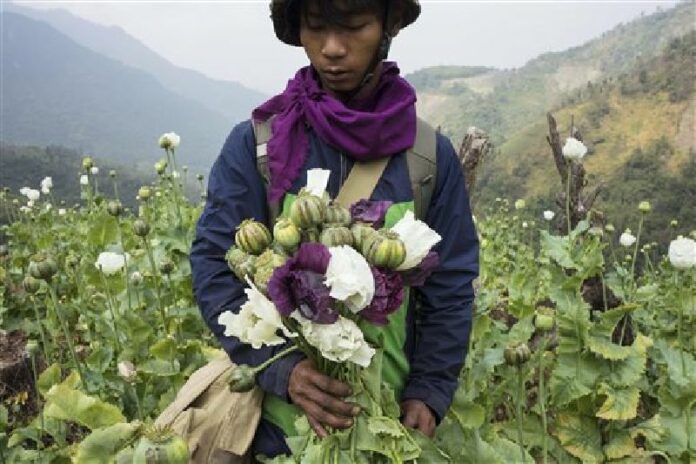
In this Feb. 3, 2016, photo, a member of Pat Jasan holds poppies as his group slashes and uproots them from a hillside, in Lung Zar village, northern Kachin State, Myanmar. Photo: Hkun Lat / Associated Press

LUNG ZA, Myanmar — Opium is a scourge to many of Myanmar's poor communities ravaged by drug addiction, but to the farmers who grow it, it is a living.

The contradiction is highlighted, sometimes violently, by a grassroots movement in northern Kachin state that has mobilized thousands of men, women and youths to march through the countryside — many dressed in camouflage vests and helmets, as if for battle — on a mission to destroy fields of poppy flowers from which opium and its derivative, heroin, are made.

Fifteen years ago, drug enforcement authorities in Myanmar announced a plan to eliminate opium by 2014. They achieved a significant reduction, but the decline has stalled in recent years, leaving the country the second-biggest producer after Afghanistan, and forcing the drug-free target date to be pushed back to 2019.

With drug abuse on the rise, especially among young people, activists joined with the Kachin Baptist Convention, the state's most influential civil institution, to create a loose organization called Pat Jasan to stamp out the drug trade their area. Many Kachin, one of the largest ethnic minorities in Myanmar, are Christian and motivated by their faith to root out drugs.

\

In this Jan. 22, 2016, photo, a leader of Pat Jasan plans their opium eradication march in Wai Maw, northern Kachin State, Myanmar.  Photo:  Hkun Lat / Associated Press

One group of 1,300 marchers has been hiking through the hills for more than a week. Along the way, they try to convince poppy farmers to destroy their crops, or they fan out into the fields and slash away at the bulb-topped plants with machetes.

Poppy production has flourished in the region due to a power vacuum amid the decades-long conflict between government forces and the Kachin Independence Army, which is pressing for self-determination. In some cases, ethnic minority groups including the Kachin have financed their struggle through the drug trade. Amid the off-and-on fighting, neither side has clamped down on poppy-growing, a key source of income for many farmers who are not happy about Pat Jasan's crusade.

Violence has erupted along the way. On Thursday, 14 marchers were injured in an attack by unidentified assailants using automatic weapons and hand grenades while they were destroying poppy fields in Wai Maw township. Earlier, the government had stopped the group from proceeding because of the danger of armed farmers.

Last month, a 19-year-old was shot to death by a farmer, and three other Pat Jasan activists were injured by a land mine.

\

In this Jan. 23, 2016, photo, a member of Pat Jasan prays at Wai Maw village at the start of their poppy eradication march in northern Kachin State, Myanmar. Photo: Hkun Lat / Associated Press

The government has provided a modicum of protection by sending some soldiers or police as escorts, but they fled when the group was attacked on Thursday, said Lum Hkawng, the secretary of the group.

While the drug trade has ruined many lives, the United Nations says surveys show that many villagers depend on the crop to earn a living.

"Opium poppy is cultivated because it provides a means of subsistence in the face of poverty," Tun Nay Soe of the United Nations Office on Drugs and Crime office in Yangon said in a statement.

A march last month took activists to Hkam Ju village in Kam Pai Ti sub-township, where poppy farmers told them there was no need to destroy their crop, they would do it themselves — if they were given rice and other food in return. One of the Pat Jasan leaders, Tang Gun, said they didn't bring rice, but could send them food later if the farmers insisted. The campaign is funded by the Kachin Baptist Convention and donations from local residents.

Later, in Lung Za village, the Pat Jasan members proceeded to slash away at poppy fields.

"All we wanted is to stop poppy production and drug addiction among young people," said Tang Gun. "We are losing our society and this is why we are campaigning against poppy production."

Story: Hkun Lat / Associated Press

Advertisement

Netizens’ Reactions Mixed to Facebook’s ‘Reactions’

BANGKOK — Notice something new on your screens today?

Social media giant Facebook rolled out its new set of emoticons worldwide Thursday night, and they were immediately met with mixed reactions by Thai netizens. The five new responses Facebook is calling “Reactions” add “Love,” “Haha,” “Wow,” “Sad” and “Angry” to the traditional “Like” button.

Debating the feature online, some users said it’s finally a chance to express more of themselves while others said they’ll be more cautious about expressing opinions online.

“Good. Now when I saw someone showing off their bae, I can press ‘angry,’” Facebook user Chekchon Demonster Anchaisri wrote Friday morning.

Another user said it would increase anxiety over how updates were received.

“I’ll be careful next time when I update my status because not everyone will ‘like’ it anymore, haha,” user Warisa Intaratana commented.

In a thread seriously arguing whether Facebook CEO Mark Zuckerberg took the idea from Line or Thailand’s Pantip discussion forum, some expressed dissatisfaction that there was still no way to express dissatisfaction.

“Too bad there’s no ‘disgusting’ button yet. I wanna see some kind of drama,” user Phongphiphat Arm Boonprasertpaisal wrote Thursday night.

User Didtita Simcharoen joined the call for openly hostile emoticons: “Need a middle-finger button!”

To add one of the new reactions, desktop users must hover the mouse cursor over the “Like” button, while smartphone users should long-press the button for the alternative reactions to pop up.

If the new emoticons don’t pop up, users most likely need to update or relaunch the application.

A sixth reaction, “Yay,” was reportedly dropped after tests found its meaning couldn’t be understood internationally.

Before Thursday, the Reactions underwent a period of testing in a few countries, namely Ireland, Spain, the Philippines and Japan.


Related stories

Facebook to Go Angry, Wow, Sad and More 'Pretty Soon'


Chayanit Itthipongmaetee can be reached at[email protected] and @chayaniti92.


\


Advertisement

Hot News

LATEST NEWS

Bangkok
light rain
32.2 ° C
32.2 °
32.2 °
95 %
3.7kmh
15 %
Wed
32 °
Thu
37 °
Fri
37 °
Sat
36 °
Sun
36 °