






























31.6 C
Bangkok
Friday, June 19, 2026
Home Blog Page 2820

More Terror Attacks Expected in EU

The seat of Europol director Rob Wainwright prior to a meeting of EU Justice and Home Affairs ministers at the Maritime Museum in Amsterdam, Netherlands, Jan. 25, 2016. Photo: Peter Dejong / AP

PARIS — Europe's top police agency issued a stark warning Monday: Islamic State extremists will keep attempting lethal attacks on soft targets in Europe as the militant group increasingly goes global.

Some 2½ months after suicide bombers and gunmen killed 130 people in Paris, the Europol agency said, "there is every reason to expect that IS, IS-inspired terrorists or another religiously inspired terrorist group will undertake a terrorist attack somewhere in Europe again, but particularly in France, intended to cause mass casualties among the civilian population."

The sobering conclusions reached by experts from the European Union's chief agency for law enforcement cooperation and EU member states make clear that many, perhaps virtually all in Europe, may be at risk.

"Without reliable intelligence on the intentions, activities and contacts and travels of known terrorists it is nearly impossible to exactly predict when and where the next terrorist attack will take place, and what form it will take," the Europol report said.

Hours before the report was issued, a new video was released by the Islamic State group celebrating the killers who carried out the Nov. 13 attacks in the French capital — while also threatening fresh bloodshed.

The grisly recording ends with one militant holding a severed head, footage of British Prime Minister David Cameron giving a speech, and an IS warning that whoever stands with the unbelievers "will be a target for our swords."

The 17-minute video, released Sunday, shows the extent of the planning that went into the multiple attacks in Paris, which French authorities have said from the beginning were planned in Syria. All nine men seen in the video died in the Paris attacks or their aftermath.

All but two of the attackers were from Belgium and France and spoke fluent French. The two others — identified by their noms de guerre as Iraqis — spoke in Arabic.

Seven of the militants, including a 20-year-old who was the youngest of the group, were shown standing behind bound captives, described as "apostates," who were either beheaded or shot.

"Soon on the Champs-Elysees," says Samy Amimour, who was raised in a Paris suburb, as he holds a captive's head aloft.

The Nov. 13 attacks targeted a packed concert hall, a restaurant and cafe, and a soccer match at the French national stadium. The video glorifying the Kalashnikov-wielding gunmen and suicide bombers responsible for that carnage was probably also meant as a recruitment tool.

French Interior Minister Bernard Cazeneuve said Monday's Europol report did not go markedly beyond previous warnings and was not intended to sow fear but "to look lucidly at reality."

Gilles Kepel, a political scientist who wrote "Terrorism in France," said even if Islamic State extremists carry out new attacks in Europe, the video shows the group is increasingly desperate and likely on the wane — in part because of the indiscriminate killings Nov. 13.

"They emphasize their ability to be cruel, to kill all their opponents and to terrorize everyone. But what is very striking is that I do not believe that they will have a significant amount of new sympathizers after those videos," he said.

"I believe that it's not really a display of strength. It's rather a display of weakness. Terrorism has its political economy of sorts. You have to terrorize people. On the one hand, you have to spread terror, but at the same time you have to gather sympathizers. If you're not able to have the two going together, then the model fails," he added.

But releasing the video draws attention anew to attacks that terrorized central Paris and shows the group's ability to turn Europeans against their homelands in a relatively short time, said Magnus Ranstorp, a counterterrorism expert at the Swedish National Defence College. The youngest of the group, a 20-year-old, had been in Syria only since February.

"They were not only battle-hardened but they were cruel. Their threshold for killing was low. They wouldn't blink to kill," Ranstorp said. He said the video's release two months after the attacks fell into a typical delay by Islamic State's propaganda apparatus.

Expert reviews conducted by Europol on Nov. 29 and Dec. 1 concluded that the Islamic State "is preparing more terrorist attacks," including copycats of the so-called Mumbai method of coordinated bombings and shootings by multiple teams of assailants that claimed 164 lives in India's financial capital in November 2008.

"The attacks will be primarily directed at soft targets, because of the impact it generates," the Europol report said. "Both the November Paris attacks and the October 2015 bombing of a Russian airliner suggest a shift in IS strategy toward going global."

Numerous independent analysts have conjectured that as Islamic State has increasingly lost ground in Iraq and Syria, including to a U.S.-led international coalition and the Russian military, it has lashed out at its foes abroad.

IS commanders are given tactical freedom depending on local circumstances, making it much harder to detect plots, the report said. That degree of liberty, it said, makes it harder for law enforcement "to detect such plans and identifying the people involved at an early stage."

Calling the danger of extremist violence "the most significant in over 10 years," Europol on Monday also officially opened a new European Counter Terrorism Center at its headquarters in The Hague, Netherlands. Europol director Rob Wainwright said the new unit will have 40-50 experts in counterterrorism and deal in intelligence-sharing, tracking foreign fighters and sources of illegal financing and firearms, and assisting EU countries in counterterrorism actions and investigations.

Wainwright told a news conference in Amsterdam that over 5,000 EU nationals have been radicalized by fighting with Muslim extremists in Iraq and Syria, and that many have returned home to present a clear and present danger to public safety.

"The current threat demands a strong and ambitious response from the EU," Europol's chief said, referring to the experts' warnings of IS plans for "large-scale attacks on a global stage with a particular focus on targeting Europe."

The IS video released Sunday was shot before the men sneaked back into Europe and contains no footage of the attackers during the days of terror that began Nov. 13 and ended only on Nov. 18 with the death of Abdelhamid Abbaoud, who was believed to be the leader of the attack cell.

Instead, it was assembled from material shot before the men left for Paris, news video and amateur video. The video did not specify where the nine men were filmed, but it was believed to have been in IS-controlled territory in Syria. Abbaoud is seen simply speaking in a room.

One militant, Brahim Abdeslam, is seen at a makeshift shooting range. Abdeslam, whose brother Salah fled Paris that night and remains at large, blew himself up at a Paris cafe where he was the only victim. Salah Abdeslam is not seen in the video.

Kepel, an expert in Islamic extremism, predicted the Islamic State's long-term prospects were dim not just in Europe, but in the very territory it most wants to control in Iraq and Syria.

Wages of the fighters have been cut in two because the militants "have no access to the smuggling of oil — the oil rigs have been bombed and destroyed," he said. "That's one thing. And the morale is not very high. This is one of the reasons they try to boost the morale with those horrendous videos."

Though graphic, it left Parisians uncowed in the neighborhood where the carnage unfolded the night of Nov. 13, including at the Carillon cafe, where gunman targeted customers out for the evening.

"It's part of their propaganda. This is one of their methods. Of course it's pretty strong because pictures carry a lot of weight," said Gerard Faure. "But I don't think that here, people I know in this neighborhood, Parisians as a whole are not really afraid."

Story: Lori Hinnant and  John – Thor Dahlburg / Associated Press

 

Advertisement

‘Luk Thep’ Drug Mule Busted at Chiang Mai Airport

CHIANG MAI — As soon an airline announced haunted spirit dolls could fly as passengers, someone was already turning one into a drug mule, according to police.

While the media buzzed Monday over Luk Thep, a kind of 21st century kumarn tong, after an airline announced they were welcome aboard flights, police at Chiang Mai Airport intercepted what they said was one loaded with 200 yaba tablets.

Lt. Col. Kom Chetkhuntod said police discovered the drugs inside a girl Luk Thep doll inside a black suitcase at the airport parking lot Monday evening.

The doll mule and suitcase were sent to Phuphing Ratchanivet police station for further investigation.

Luk Thep dolls, first popularized last year by a number of celebrities, are like a regular doll but with a child’s soul inside. Similar to the kumarn thong of old, Luk Thep do not require a human fetus or genuine child’s soul, instead one is simply “invited” inside to possess a factory manufactured doll.

On Monday, police chief Gen. Chakthip Chaijinda said he was concerned about the Luk Thep trend, especially after Thai Smile Airways announced that passengers wanting to travel with their haunted doll companions were welcome to buy them a ticket. Chakthip said this could be abused by drug smugglers because police have caught dolls with drugs before.
 

\

Luk Thep dolls are displayed Sunday in BB Market in Nonthaburi’s Bang Yai district.


Related stories:

Chonburi Man Admits Dealing Meth for Dowry


To reach us about this article or another matter, please contact us by e-mail at: [email protected].

Follow Khaosod English on Facebook and Twitter for news, politics and more from Thailand.

Follow @KhaosodEnglish

\


Advertisement

Junta Quashes Labor Movement Despite Role in 2014 Protests

A Dec. 24, 2013, file photo of PCAD protesters besieging the Thai-Japanese Din Daeng Stadium in Bangkok.

By Pravit Rojanaphruk
Senior Staff Writer

BANGKOK — Earlier this month, veteran labor leader Wilaiwan Sae-tia traveled to Bangkok to lend her support to auto parts factory workers from Rayong province. It was routine for the 60-year-old chairwoman of what is arguably the kingdom’s most influential labor group; the kind of thing she’s done many times in four decades with the movement.

This time, however, she paid a price for advocating for the workers of Sanko Gosei Technology Ltd. She’s now under order by the ruling junta to report any plans to engage in any labor-related activities or even travel to the capital. And since that day on Jan. 6, Wilaiwan said, four or five military officers have shadowed her on and off.

“I don’t feel comfortable when they are trailing me like this. There’s no freedom,” said Wilaiwan, chairwoman of the Thai Labor Solidarity Committee. “Humans should be free to go anywhere, but I am being followed as if I am under their custody. It’s not appropriate, and if possible, please stop! It will only make soldiers look negative in other people’s eyes.”

On Jan. 6, Wilaiwan had traveled to the Labor Ministry in Bangkok to bargain with the Japanese company and ministry officials on behalf of the workers in a dispute over layoffs, Wilaiwan said.

Two other Thai Labor Solidarity leaders, Chalee Loysoong and Amorndech Srimuang, had been briefly detained at the ministry after leading about 300 workers for a sit-in at the ministry before dawn that morning.

Wilaiwan said she tried to explain and plead with the officers assigned to follow her. They reportedly told her they were just following orders from their superiors, who wanted to make sure she is not taking part in any political activity.

Wilaiwan insisted she’s not, and that everything she does pertains to workers’ rights issues regardless of who is in power.

Now, while the veteran labor leader has soured on the outlook for workers’ rights under the junta, she finds her standing eroded among the opposition for organized labor’s previous alignment with the forces that paved the way for the military to seize power.

While organized labor finds itself hamstringed by the junta’s intimidation tactics, it’s on the defensive for labor itself is The intimidation tactics used on Wilaiwan have ignited a debate not just about repression by the military but also Wilaiwan’s alleged role in bringing about the coup.

Junta critics have said Wilaiwan reaped what she sowed for participating in the movement which ushered in the coup d’etat.

Wilaiwan and other labor leaders were visible figures on the stage of the People’s Committee for Absolute Democracy with the King as Head of State, or PCAD, a group that used the same stage to call for military intervention.

“Although I went up on the PCAD stage in the past, I only made demands about labor rights,” Wilaiwan said.

“Even under a democratic regime, labor rights are violated. I don’t want to recall old stories; let bygones be bygones. I don’t want to see the issue being used to spark conflict,” she said, adding that it’s impossible to please everyone.


Silence Under the Junta

Two labor experts said what happened to Wilaiwan should come as no surprise, and such repression should be expected to continue as long as the junta remains in power.

“They want absolute stillness, and it doesn’t matter what political color you belong to,” said labor rights defender Bundit Thanachaisethavut of the Arom Pongpangan Foundation, a Bangok-based labor organization. “I wasn’t surprised at all.”

Bundit is concerned that the already lopsided power between workers and factory owners is tilting further in the business owners’ favor. Staging a strike or protest has become even more restricted in the wake of last year’s Public Assembly Act.

Sakdina Chatrakul Na Ayudhya, a veteran labor expert, said the same.

“I wasn’t that surprised because they want people to be quiet,” said Sakdina, referring to the military junta. “Their goal is for people to not express any views.”

Sakdina warned that the labor movement is not alone in facing restrictions and crackdowns. He added that although he is sympathetic to people like Wilaiwan, who he has known for decades, the movement under her committed a strategic blunder by actively joining PCAD. He added that the movement must reflect on past mistakes and strengthen its power base instead of aligning with those who might hold different political ideologies.

“I was among those who disagreed,” Sakdina said of the labor movement’s alignment with the anti-government protest movement. “The labor movement didn’t call for a coup, but they must bear in mind the goal of the movement they joined and the pros and cons of joining. We say we must foster democracy, but should we not care how it’s achieved?”

Wasana Lamdee, a former factory worker and current editor of Voice Labor, a pro-labor movement news website, said she feels bad about the situation but blames it on the weakness and diminished size of the labor movement. Only about 300,000 workers are union members out of the 13-million strong formal-sector workforce, she said. Only about 300 of 1,500 registered unions are active, Wasana said, and only 100,000 to upward of 200,000 workers can be mobilized.

“The problem is, we don’t believe we can organize ourselves and create bargaining power,” she said. “Our strength today is hardly noticeable. What’s more, we don’t even respect ourselves.”

She warned that the junta would be unable to stop poor workers from fighting for their rights because of the economic hardships they are facing.


To reach us about this article or another matter, please contact us by e-mail at: [email protected].

Follow Khaosod English on and Twitter for news, politics and more from Thailand.

\

Advertisement

Junta Quashes Labor Movement Despite Role in 2014 Protests

Soldiers pay a visit Jan. 19 to the Samut Sakhon home of labor rights advocate Wilaiwan Sae-tia, second from right in foreground.

By Pravit Rojanaphruk
Senior Staff Writer

BANGKOK — Earlier this month, veteran labor leader Wilaiwan Sae-tia traveled to Bangkok to lend her support to auto parts factory workers from Rayong province. It was routine for the 60-year-old chairwoman of what is arguably the kingdom’s most influential labor group; the kind of thing she’s done many times in four decades with the movement.

This time, however, she paid a price for advocating for the workers of Sanko Gosei Technology Ltd. She’s now under order by the ruling junta to report any plans to engage in any labor-related activities or even travel to the capital. And since that day on Jan. 6, Wilaiwan said, four or five military officers have shadowed her on and off.

“I don’t feel comfortable when they are trailing me like this. There’s no freedom,” said Wilaiwan, chairwoman of the Thai Labor Solidarity Committee. “Humans should be free to go anywhere, but I am being followed as if I am under their custody. It’s not appropriate, and if possible, please stop! It will only make soldiers look negative in other people’s eyes.”

On Jan. 6, Wilaiwan had traveled to the Labor Ministry in Bangkok to bargain with the Japanese company and ministry officials on behalf of the workers in a dispute over layoffs, Wilaiwan said.

Two other Thai Labor Solidarity leaders, Chalee Loysoong and Amorndech Srimuang, had been briefly detained at the ministry after leading about 300 workers for a sit-in at the ministry before dawn that morning.

Wilaiwan said she tried to explain and plead with the officers assigned to follow her. They reportedly told her they were just following orders from their superiors, who wanted to make sure she is not taking part in any political activity.

Wilaiwan insisted she’s not, and that everything she does pertains to workers’ rights issues regardless of who is in power.

Now, while the veteran labor leader has soured on the outlook for workers’ rights under the junta, she finds her standing eroded among the opposition for organized labor’s previous alignment with the forces that paved the way for the military to seize power.

While organized labor finds itself hamstrung by the junta’s intimidation tactics, it’s on the defensive for labor itself is The intimidation tactics used on Wilaiwan have ignited a debate not just about repression by the military but also Wilaiwan’s alleged role in bringing about the coup.

Junta critics have said Wilaiwan reaped what she sowed for participating in the movement which ushered in the coup d’etat.

Wilaiwan and other labor leaders were visible figures on the stage of the People’s Committee for Absolute Democracy with the King as Head of State, or PCAD, a group that used the same stage to call for military intervention.

“Although I went up on the PCAD stage in the past, I only made demands about labor rights,” Wilaiwan said.

“Even under a democratic regime, labor rights are violated. I don’t want to recall old stories; let bygones be bygones. I don’t want to see the issue being used to spark conflict,” she said, adding that it’s impossible to please everyone.


Silence Under the Junta

Two labor experts said what happened to Wilaiwan should come as no surprise, and such repression should be expected to continue as long as the junta remains in power.

“They want absolute stillness, and it doesn’t matter what political color you belong to,” said labor rights defender Bundit Thanachaisethavut of the Arom Pongpangan Foundation, a Bangok-based labor organization. “I wasn’t surprised at all.”

Bundit is concerned that the already lopsided power between workers and factory owners is tilting further in the business owners’ favor. Staging a strike or protest has become even more restricted in the wake of last year’s Public Assembly Act.

Sakdina Chatrakul Na Ayudhya, a veteran labor expert, said the same.

“I wasn’t that surprised because they want people to be quiet,” said Sakdina, referring to the military junta. “Their goal is for people to not express any views.”

Sakdina warned that the labor movement is not alone in facing restrictions and crackdowns. He added that although he is sympathetic to people like Wilaiwan, who he has known for decades, the movement under her committed a strategic blunder by actively joining PCAD. He added that the movement must reflect on past mistakes and strengthen its power base instead of aligning with those who might hold different political ideologies.

“I was among those who disagreed,” Sakdina said of the labor movement’s alignment with the anti-government protest movement. “The labor movement didn’t call for a coup, but they must bear in mind the goal of the movement they joined and the pros and cons of joining. We say we must foster democracy, but should we not care how it’s achieved?”

Wasana Lamdee, a former factory worker and current editor of Voice Labor, a pro-labor movement news website, said she feels bad about the situation but blames it on the weakness and diminished size of the labor movement. Only about 300,000 workers are union members out of the 13-million strong formal-sector workforce, she said. Only about 300 of 1,500 registered unions are active, Wasana said, and only 100,000 to upward of 200,000 workers can be mobilized.

“The problem is, we don’t believe we can organize ourselves and create bargaining power,” she said. “Our strength today is hardly noticeable. What’s more, we don’t even respect ourselves.”

She warned that the junta would be unable to stop poor workers from fighting for their rights because of the economic hardships they are facing.

Advertisement

‘Tiger Temple’ to Sue NatGeo Over Damning Report

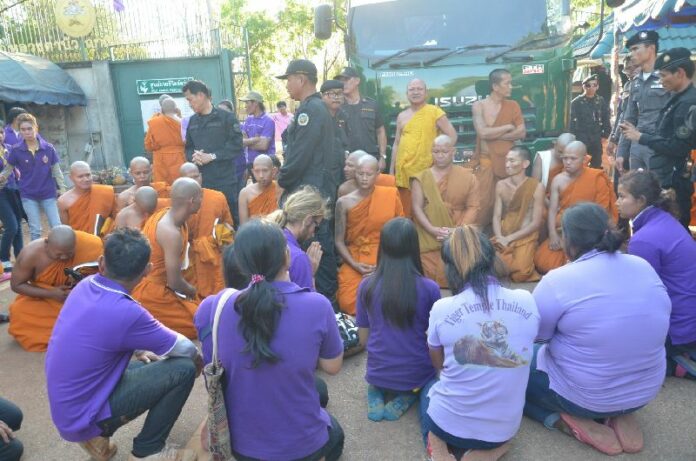
Monks and volunteers block government vehicles in April 2015 from leaving a commercial wildlife center operating as a temple in Kanchanaburi province.

By Teeranai Charuvastra
Staff Reporter

KANCHANABURI — Days after National Geographic published an article accusing the infamous Tiger Temple in western Thailand of trafficking some of its 147 tigers, a lawyer for the temple announced that he’s preparing a libel suit against the news agency.

Responding to the Jan. 21 article, "Tiger Temple Accused of Supplying Black Market,” the temple spokesman admitted Monday his organization is breaking the law by keeping its tigers there but said the article was wrong to assert that money changed hands with a Laotian breeder, as alleged in the report.

“We are about to press charges. I’ve already read the article,” lawyer Saiyood Pengboonchoo said on behalf of the temple, which is formally known as Wat Pha Luang Ta Bua Yanasampanno in an interview with Khaosod English today.

As to the latest effort by wildlife officials to remove the temple’s tigers, most recently delayed to today, Saiyood said the temple did not feel the tigers were ready to go.

According to National Geographic, the Tiger Temple authorized a trade of tigers with a commercial breeder in Laos in 2004. The article went on to note that cross-border commerce in live tigers is outlawed under CITES, an international treaty on wild animals to which Thailand is a signatory.

Although Saiyood confirmed that the temple did swap some tigers with a farm in Laos, it was not done for profit.

“It’s defamation. It’s a distortion of facts,” Saiyood said. “We did swap them once. We asked for an exchange with Laos. But no money was involved. I insist that we didn’t buy or sell any tigers.”

He continued, “We did not break any laws. We did not violate CITES.”

The temple has long been dogged with allegations and accusations it mistreats and trafficks the very animals it says it protects. In late 2014 a former temple veterinarian accused the temple of selling three big cats. The temple denied it and put up fierce resistance to wildlife officials to investigate.

Saiyood said the monk who gave the interview to National Geographic, Jakkrit Apisuthipangsakul,  felt “very disappointed” by the article and would name himself as a plaintiff in the upcoming libel suit. He said Jakkrit will file the charge to police within this week.

Defamation is both a civil and criminal offense in Thailand, where the law is defined as causing “damage to the reputation” of any individual.

Saiyood also disputed assertions in the National Geographic article that temple staff secreted tigers out and sold them.

“There’s no such thing. The tigers are all here,” Saiyood said. “If we want to sell them, we would have just given them to the Department of National Parks already. Wouldn’t it be better for us? We would be able to save hundreds of thousands of baht in costs of keeping the tigers.”

National Geographic estimates the temple brings in about 100 million baht in annual revenues.


Animals First, Law Second

Breeding tigers without permission, possessing tigers without permission and profiting from those tigers are all considered illegal under the 1992 Wildlife Preservation and Protection Act. Those offenses are punishable by up to three years, one year or two years in prison, respectively.

Saiyood acknowledged that the temple’s insistence on keeping the tigers is against the law, but said the temple doesn’t want to let them go out of concern for their wellbeing.

“We don’t know that if the tigers are removed, will they be sad? Will they die?” Saiyood said. “Concerning the laws, we fully cooperate with the authorities, but only on the basis of the animals’ safety. This is our primary concern. The laws are secondary. But of course, directors and administrators [of wildlife agencies] have to say they have to follow the laws. I understand them.”

His comment came a week after the Department of National Parks, Wildlife and Plant Conservation renewed its on-again-off-again effort to remove the tigers. All previous attempts have failed, including an operation in April 2015, during which the temple at one point fielded monks and foreign volunteers to blockade the property.

The latest effort also appears to hit the same dead end. Saiyood said wildlife officials visited the temple Tuesday through Thursday to negotiate the tigers’ departure. According to Saiyood, the temple asked them not to remove the animals because they may not be in good condition to move.

“They can’t move the tigers, because they can’t drug them. The weather has been rapidly changing,” Saiyood said, explaining that the hot and cold temperatures in recent days may make the tigers ill.

Asked when the tigers would be ready to go, Saiyood said he’s not sure. He also said the temple is applying for a permit to open a commercial zoo, like the one in Sriracha, where tigers are legally maintained.

“We are under the process to bring the tigers into the proper system, and we are also taking care of the tigers for now. We are doing both things simultaneously,” Saiyood said.


National Heritage

He also said the authorities should think of the acclaim that the temple and its tigers have brought to Thailand:

“Tigers are a part of our national heritage,” he said. “Even though what we are doing is illegal, the tigers made us famous. They are the face and fame of our country. People around the world may not know much about Kanchanaburi, but if you mention tiger temple, they instantly recognize it.”

But a prominent animal rights activist doesn’t share Saiyood’s opinion.

“This is a big issue. It’s already been concluded that they not only violated Thai law, but also international law, the CITES,” said Edwin Wiek, founder of Wildlife Friends of Thailand, an organization that has called on authorities to remove the tigers from the temple.

While Saiyood prepares his libel case against National Geographic, Wiek said his organization plans to file a complaint with local police in Kanchanaburi province for not taking action against the Tiger Temple.

“It’s a clear violation of the Wildlife Preservation and Protection Act,” Wiek said Monday. “If police are not handling this, they are guilty of negligence of duty. We will send a formal letter to police, to urge them to take action. They cannot let this issue off the hook.”

Wiek did not say when his organization will file its complaint.

Related stories:

Temple Refuses to Release Tigers, Again

‘Tiger Temple’ to Give Up Big Cats, Activist Says

Thailand's Tiger Temple Ordered to Give up Tigers

Asian Black Bears Seized From Thailand's Tiger Temple


Advertisement

Social Media Surveillance System Planned

Photo: EFF Photos / Flickr

BANGKOK — The Royal Thai Police plan to spend 12 million baht on a system to monitor messages and track users on the most popular social media platforms.

A company is being sought to provide software, hardware and training courses for such a system to be used to monitor public posts on Facebook, Twitter and Pantip, the kingdom’s biggest message board, according to procurement documents, which said it is intended to suppress increasing online crime.

The documents, which appear to have been published Jan. 19 to the Technology Crime Suppression Division’s website, specified a public hearing to discuss the project would be held. It was this past Friday. The division has been at the forefront of investigating internet users accused of defaming the monarchy or violating the Computer Crime Act.

The system, according to the project description, must be able to notify authorities when specified keywords are posted by a targeted account. It also must be able to interface with the government’s data systems for storing investigation case data.

Any users interacting with a targeted message by liking, sharing or commenting upon it, would also be tracked, along with the names of the target account’s followers, or those who reply to Pantip topics. This information would help authorities to create maps of networks of users and data obtained from the targeted accounts together.

Information about the plan was first posted to tech site Blognone, where commentators criticized the plan.

“I think this is not going to resolve any problems since it fixes the wrong thing,” read one representative message from user Polwath. “It is such a waste of the budget.”

Data collected from public messages has no legal protection. An expert on the law and the internet said she was more concerned about the system in practice.

“Technically, it is possible that they might ask the hired company to create tons of fake avatars to specifically add friends with the targeted accounts,” said Thammasat University professor Sawatree Suksri.

Since seizing power in a 2014 coup d’etat, the military government has put an end to political discourse or dissent in the public sphere and has made strides toward achieving its long-held desire to gain control over content online.

Junta representatives have said they are acting to protect the monarchy, children and national security. Recently a growing number of people have been arrested to face trial in military tribunals on charges of sedition for criticizing the junta.

Though the social media monitoring project is described as a means to boost the efficiency of digital forensics, Sawatree said it appears more likely to be a form of surveillance, as the courts do not have the technical capacity or knowledge to support such a system.

“The data privacy law is still just a draft, but the government has already deployed many tools to watch us,” she said.


Related stories:

Junta Approves 20 Billion Baht for Internet Broadband, Gateway

Junta Readies ‘Great Firewall of Thailand’

‘Anonymous’ Declares War on Thai Junta

Gamers, Geeks on Epic Quest for Internet Freedom

Cyber Activists Bring Down Govt Sites to Protest ‘Single Gateway’


Advertisement

Metal on Thai Beach Likely to be Rocket, Not Plane Part

TOKYO — A Japanese rocket maker says a large piece of metal that washed up on a beach in Thailand is likely part of a rocket launched by Japan, not a missing Malaysian plane.

The discovery of the metal sparked speculation that it might be from Malaysia Airlines Flight 370, which disappeared almost two years ago.

Mitsubishi Heavy Industries said Monday that the metal piece is highly likely to be part of a Japanese H-IIA or H-IIB rocket that was launched from southern Japan, based on an initial examination of photos and videos of the object.

Flight 370 lost communications and made a sharp turn away from its Beijing destination before disappearing in March 2014. It is presumed to have crashed in the Indian Ocean, far away from Thailand.

Story: Associated Press


Advertisement

Dozens of Deaths Blamed on Rare Cold Snap in Taiwan

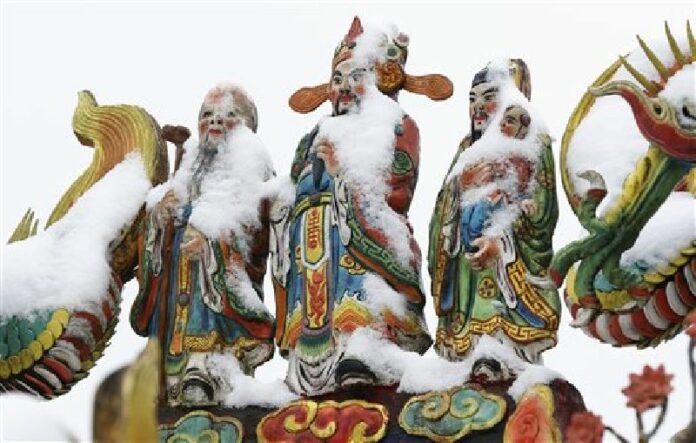
Snow sits on statues at the Pinglin temple in the high mountain area of New Taipei City, Taiwan, Monday, Jan. 25, 2016. Photo: Wally Santana / AP

TAIPEI, Taiwan — An unusually cold weather front has been blamed for killing 57 mostly elderly people in Taiwan's greater Taipei area.

The cold wave abruptly pushed temperatures to a 16-year low of 4C in the subtropical capital where most homes lack central heating, causing heart trouble and shortness of breath for many of the victims, a city official said.

"In our experience, it's not the actual temperature but the sudden drop that's too sudden for people's circulatory systems," said a city spokesman who identified himself only by his surname, Chang.

The cold snap was blamed in the deaths of 40 people in the capital, Taipei, while the neighboring New Taipei City attributed an additional 17 deaths to the cold weather. Strokes and hypothermia were among the causes of death in New Taipei City, officials there said.

Temperatures in Taipei average 16C in January, according to Taiwan's Central Weather Bureau. Because of the relatively mild norms, most households in Taiwan lack central heating, another suspected factor in the recent deaths.

New Taipei City said it was providing shelter for 91 homeless people endangered by the cold.

The cold front also left 9 centimeters of snow on Taipei's highest peak Saturday and stranded vehicles as people headed into the mountains to see the snow.

The same polar front closed schools Monday in Hong Kong, where 130 people had been trapped at day earlier on a peak in the city that also seldom gets such cold weather. Hong Kong temperatures reached 3.1C Sunday.

Temperatures in Taipei are forecast to reach 17C Tuesday.

Story: Ralph Jennings / Associated Press


To reach us about this article or another matter, please contact us by e-mail at: [email protected].

Follow Khaosod English on Facebook and Twitter for news, politics and more from Thailand.

Follow @KhaosodEnglish

\

Advertisement

German Denies Insulting King on Facebook

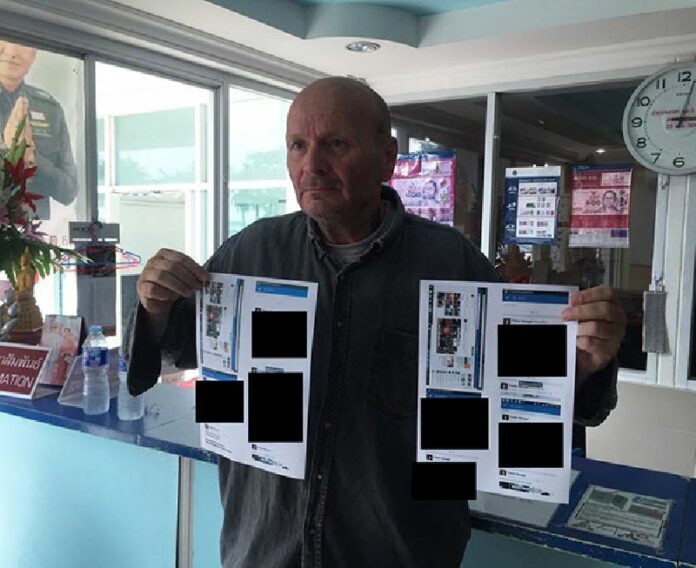
A censored image of German national Manfred Gallus displaying Facebook posts with crude messages about the royal family he said were wrongly attributed to him Sunday at the Nong Prue Police Station in Chonburi province.

CHONBURI — A German expat in Chonburi province went to police yesterday to complain that not only was someone impersonating him on Facebook but doing it to post insulting messages about the monarchy.

Manfred Peter Gallus, 58, told police he had nothing to do with a Facebook profile used primarily to publish crude remarks about the royal family, libelous statements punishable by up to 15 years in prison per offense under the law.

Gallus said he recently found the Facebook profile, which uses his image for the profile photo and makes extensive use of images he said were taken from his real Facebook account, and was shocked to see the defamatory messages. according to Lt. Col. Winai Horian, an officer at the Nong Prue Police Station.

Many of the messages are written in poor Thai and seem the likely results of automated translation. Khaosod English is withholding further information about the remarks to comply with Thai law, which bans dissemination of remarks deemed offensive toward the monarchy. Gallus’ personal photographs indicate he is either a member or associates with members of the Hells Angels motorcycle gang.

Lt. Col. Winai said Gallus insisted he never insulted the monarchy, as he himself also loves and respects His Majesty the King and other members of the Royal Family. According to Winai, Gallus offered a 30,000-baht bounty for information leading to the Facebook impersonator.

If his claim is true, Gallus’ case would be an example of what the sweeping law’s critics, such as Thammasat University law professors Worachet Pakeerat and Piyabutr Saengkanokkul, have described as its potential for abuse to pursue political or personal vendettas. Anyone can accuse anyone of the crime, and police are obligated to investigate the complaint.

Reached for comment today, Col. Pramote Ngampradit, commander of Nong Prue Police Station, declined to give further details about the ongoing investigation.

“We cannot give information because it’s a sensitive matter,” Col. Pramote said.

Although critical discussion of the monarchy has long been taboo – and illegal – in Thailand, the lese majeste law has been more harshly enforced since the military government came to power in May 2014.

Most lese majeste trials are now held in military court, where reporters are often barred from the proceedings and defendants have no right to appeal.

On Jan. 20, the court sentenced a man named Piya Chunkittiphan to six years in jail after finding him guilty of insulting the monarchy on his Facebook profile. Piya insisted on his innocence, arguing that he was impersonated on Facebook. The court rejected his argument.

Related news: Facebooker Sentenced to 6 Years for Defaming Monarchy


To reach us about this article or another matter, please contact us by e-mail at: [email protected].

Follow Khaosod English on and Twitter for news, politics and more from Thailand.

\

Advertisement

2 Chinese Killed in Laos Suspected Bombing

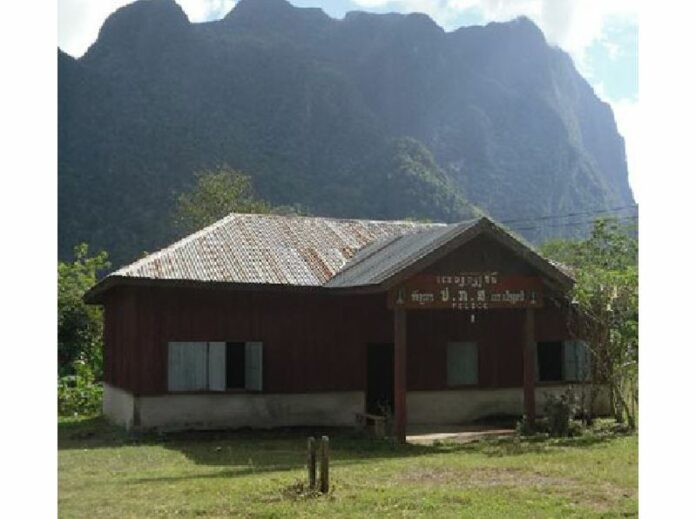
A police station in the mountains of Northern Laos, Nov. 23, 2013. Photo: Simon Duncan

BEIJING — Two Chinese citizens have been killed and one injured in a suspected bomb attack in central Laos, China's official Xinhua News Agency reported Monday, a mountainous area that in recent months has seen an increase in violence and in years past was the scene of clashes between government forces and the Hmong ethnic minority.

The incident took place about 8am on Sunday in the province of Xaysomboun when the victims, one of whom was employed by a Chinese mining company, were riding in a vehicle, Xinhua reported.

Chinese diplomats have visited the survivor, identified by the surname Zhou, and have requested a swift investigation, Xinhua said. An official contacted at the Lao Embassy in Vietnam, the country's closest ally, said he was unaware of the report.

China is a major investor in Laos' rich abundance of minerals and other natural resources and shares its one-party form of authoritarian communist government. A special Chinese presidential envoy, Song Tao, is due to visit the country this week, Xinhua said.

Since November, there has been an increase in violence in the province, though the perpetrators have not been identified, nor has the tightly controlled state press provided any details.

In a notice posted on its website, the U.S. Embassy in Laos in November prohibited its employees from traveling to Xaysomboon province due to what it described as nighttime shooting attacks by unidentified assailants. It said one person was killed Nov. 17 and another wounded Nov. 18.

The Hmong fought on the side of a pro-American regime during the Vietnam War, and after the communist Pathet Lao took over in 1975, many fled abroad or hid in the jungle. Until a few years ago, there were several small bands of Hmong resisters who continued to hide in the jungle and occasionally clash with security forces, but most eventually surrendered.

The U.S. government-funded news service Radio Free Asia, or RFA, has reported additional attacks in November, December and January, citing unnamed police and other sources. In the latest reported attack, a bus came under fire on Jan. 14, leaving about a dozen passengers hurt but none killed, said RFA.

While RFA's reports could not be independently confirmed, it has a record of being well-informed about Laotian affairs.

In a report forwarded to The Associated Press earlier this month, Hmong sympathizers gave their own version of the recent violence, saying that from mid-November until the end of December, there had been six attacks by government forces on groups of Hmong, killing at least seven and wounding 21.

The report, which came from a source which has provided accurate information in the past, also said that 13 Hmong villagers had been arrested in November for contacting people in the jungle, meaning Hmong who are hiding from the authorities. The source declined to be named because of fears for his personal security.

Story: Christopher Bodeen / Associated Press

Advertisement

Hot News

LATEST NEWS

Bangkok
overcast clouds
31.6 ° C
32.2 °
31.6 °
68 %
2kmh
100 %
Fri
33 °
Sat
29 °
Sun
35 °
Mon
36 °
Tue
37 °