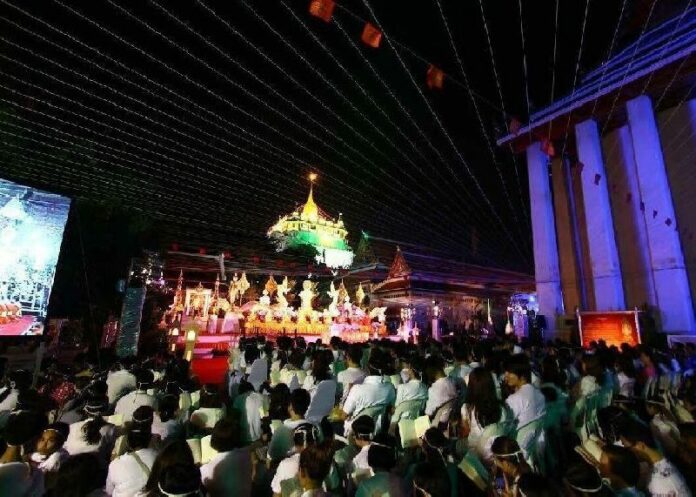
Crowds gather to ring in the new year with a night of prayer Dec. 31, 2014, at Bangkok’s famed Wat Saket.
BANGKOK ― A disgraced former abbot who was once under investigation for mismanaging a 67 million-baht fund was found this morning today after apparently committing suicide, police said.
Phra Phromsuthi, former abbot of Bangkok’s famed Wat Saket, aka The Golden Mount, reportedly hanged himself in his residence today, two years after the state audit agency opened – and eventually closed – an investigation into him for suspected fraud.
Police received the report of his death from monks at the temple at around 8am today. Forensic investigators are collecting evidence at the scene of the temple located near Bangkok’s historic quarter, Lt. Cpt. Nitchapol Piewkham, an officer at Samranrat Police Station, said.
The temple administration has yet to make a statement about the former abbot’s death.
Prior to his death, Phra Phromsuthi was the subject of a 2014 investigation by the Office of Auditor General into his mismanagement of state funds for the 2013 funeral of Somdet Kiaw, deputy to the Supreme Patriarch.
As the head of Wat Saket, Phra Phromsuthi was assigned by the national Buddhist authority to organize a yearlong funeral and cremation for the late Somdet Kiaw, with a budget of 67 million baht.
In December 2014, the auditor’s office announced Phra Phromsuthi spent 42 million baht for the funeral without a proper paper trail and alleged that many purchases were overly expensive.
Phra Promsuthi also never returned the remaining 25 million baht to the state, Auditor General Pisit Leelavachiropas said Jan. 18, 2015.
In response the scandal, the Supreme Patriarch dismissed Phra Promsuthi as the temple’s abbot, though he still resided there as a monk. The temple then returned 25 million baht to the authorities in June 2015, prompting the auditor-general to announce the case was closed.
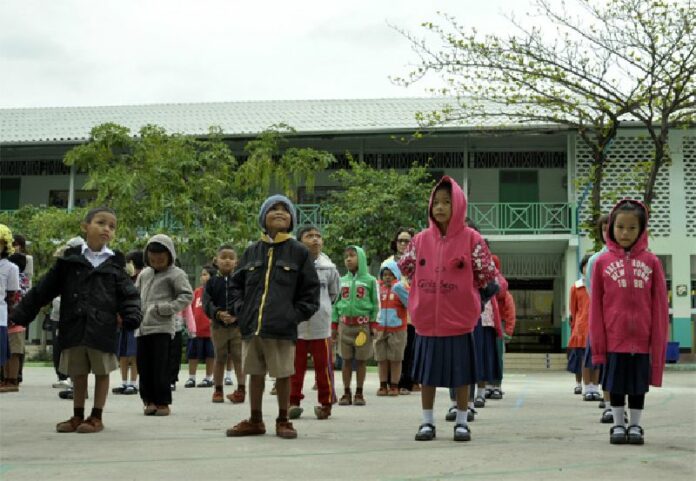
Students in Korat this morning exercise before class to warm up their little bodies.
BANGKOK — For at least the next two days Thais will continue to bundle up for warmth while expats make smug comments about how it’s not that cold.
Sweaters and long-stored jackets are are in rotation again after Bangkok temperatures fell this morning to below 20C in all areas. The sudden cool which took hold Sunday came from a powerful high pressure front moving in from China over the upper parts of Thailand.
Overall temperatures in the country will drop 2C to 4C in the next two days with lows in Bangkok falling to between 16C and 18C. Highs could reach 30C to 31C. Things should be relatively warm again in time for the weekend.
In its latest advisory issued this morning, the Meteorological Department warned that cold weather in the north could be accompanied by thundershowers and strong winds. A small craft advisory urges small boats to stay ashore today through Wednesday as gusts are in the Gulf of Thailand are expected to drive 2-to-4 meter waves.
MERS Coronavirus particles. Image: US National Institute of Allergy and Infectious Diseases, Colorado State University
BANGKOK — A second confirmed case of Middle East Respiratory Syndrome, or MERS, has been detected in a 71-year-old man from Oman who arrived in Bangkok on Friday.
Thailand's Public Health Ministry announced Sunday that the man is in stable condition at an infectious disease center in Bangkok's outskirts. His children are also being quarantined. The authorities have identified 252 people the patient came into contact with, and are seeking 37 they consider at high risk for surveillance.
The World Health Organization said in early January that it had been notified of 1,626 confirmed MERS cases, including at least 586 related deaths, since the disease was first identified in Saudi Arabia in 2012.
Thailand's first MERS case was a 75-year-old Omani man who was hospitalized last June and released several weeks later after recovering. In both cases, the men had first fallen ill in Oman and came to Thailand to seek diagnosis and medical treatment.
According to WHO, typical symptoms include fever, cough and shortness of breath. Pneumonia is common, but not always present.
Although most cases are attributed to human-to-human infections, the U.N. agency says the virus does not seem to pass easily from person to person unless there is close contact, such as when providing unprotected care to a patient.
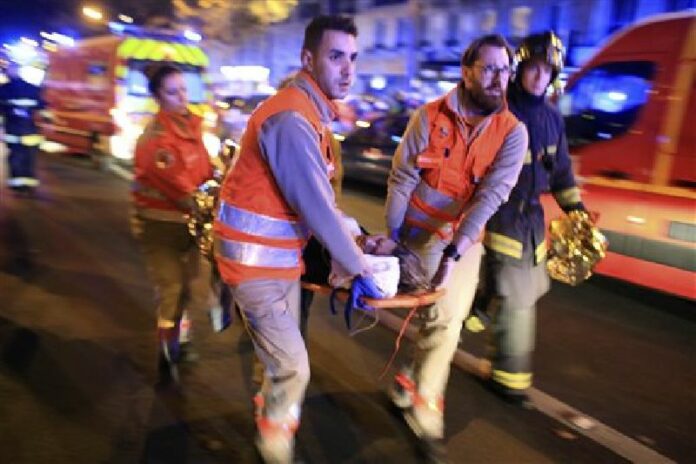
In this Nov. 13, 2015, file photo, a woman is evacuated from the Bataclan concert hall after gunmen attacked the venue in Paris. Photo: Thibault Camus / AP
PARIS — New video released by the Islamic State group on Sunday shows the extremists who carried out the Nov. 13 attacks in Paris committing atrocities in IS-controlled territory while plotting the slaughter in the French capital that left 130 people dead and hundreds injured. The group also threatened to attack Britain.
The 17-minute video shows the extent of the planning that went into the multiple attacks in Paris, which French authorities have said from the beginning was planned in Syria. The video was provided online by the SITE Intelligence Group, which monitors jihadi websites.
All nine militants seen in the video died in the Paris attacks or their aftermath. Seven of the attackers — four from Belgium and three from France — spoke fluent French. The two others — identified by their noms de guerre as Iraqis — spoke in Arabic.
Seven of the militants, including a 20-year-old who was the youngest of the group, were filmed standing behind bound captives, described as "apostates," who were either beheaded or shot.
"Soon on the Champs-Elysées," says Samy Amimour, who was raised in a Paris suburb near the French national stadium, as he holds a captive's head aloft.
The Nov. 13 attacks targeted a packed concert hall, a restaurant and cafe, and a soccer match at the national stadium.
French Foreign Ministry spokesman Romain Nadal said the government is studying the video but would not comment on its contents. France's Interior Ministry and the Paris prosecutor's office had no immediate comment.
The video was filmed before the men sneaked back into Europe and contains no footage shot by the attackers during the days of terror that began Nov. 13 and ended only on Nov. 18 with the death of Abdelhamid Abbaoud, who was believed to be the leader of the attacks.
Instead, it was assembled from material shot before the men left for Paris, news video and amateur video. The video did not specify where the nine men were filmed, but it was believed to have been in IS-controlled territory in Syria. Abbaoud is seen simply speaking in a room
One militant, Brahim Abdeslam, is seen at a makeshift shooting range. Abdeslam, whose brother Salah fled Paris that night and remains at large, blew himself up at a Paris cafe where he was the only victim. Salah Abdeslam is not seen in the video.
According to the anti-islamic State activist group Raqqa is Being Slaughtered Silently, Brahim Abdeslam and two other attackers were trained in Raqqa, the extremist group's stronghold and the capital of its self-proclaimed caliphate.
In the video, as in other Islamic State propaganda trying to drive a wedge between European Muslims and their governments, the men say it is a religious duty to join them. They threaten more attacks in Europe, and the footage closes with one of the militants holding a severed head and footage of Cameron giving a speech — with a text in English warning that whoever stands with the unbelievers "will be a target for our swords."
Story: Lori Hinnant / Associated Press
To reach us about this article or another matter, please contact us by e-mail at:[email protected].
Follow Khaosod English onFacebookand Twitterfor news, politics and more from Thailand.
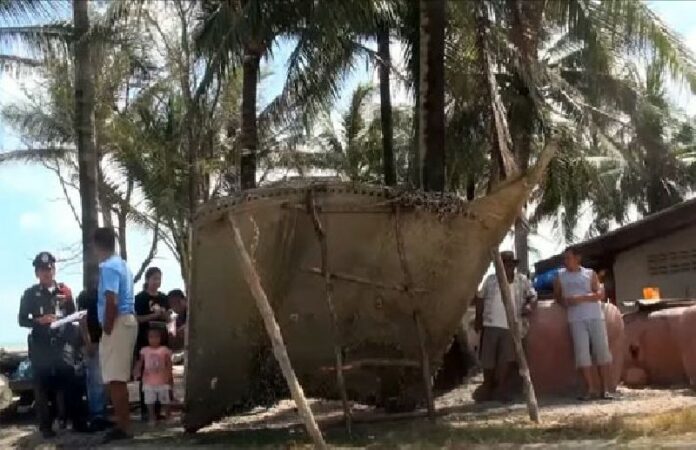
BANGKOK — A large metal chunk has washed ashore in southern Thailand, but Malaysian authorities are cautioning against speculation of a link to a Malaysia Airlines flight missing almost two years.
Malaysian Transport Minister Liow Tiong Lai said Sunday he has instructed Malaysian civil aviation officials to contact Thailand about the newly found wreckage.
Malaysia Airlines Flight MH370 lost communications and made a sharp turn away from its Beijing destination before disappearing in March 2014. It is presumed to have crashed in the southern Indian Ocean, and only one piece of debris has been identified as coming from the plane, a slab of wing that washed ashore on Reunion Island off the African coast last July.
The Guardian reported Sunday however that some experts were already casting doubts on the claim, with some suggesting the debris more likely came from a Japanese rocket.
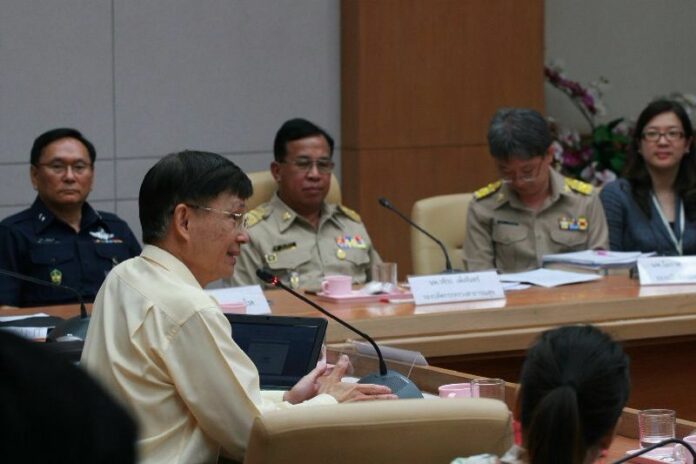
Government officials attend a meeting about efforts to contain a potential MERS outbreak at the Ministry of Public Health in Bangkok, 22 June 2015
BANGKOK ― A second confirmed case of Middle East Respiratory Syndrome, or MERS, has been detected in a 71-year-old man from Oman who arrived in Bangkok on Friday.
The Public Health Ministry announced Sunday that the man is in stable condition at an infectious disease center in Bangkok's outskirts. His children are also being quarantined. The authorities have identified 252 people the patient came into contact with, and are seeking 37 they consider at high risk.
It is the second case of MERS in Thailand. The first was a 75-year-old Omani man who was hospitalized last June and released several weeks later after recovering.
The World Health Organization says the viral respiratory disease has killed at least 586 people since 2012.
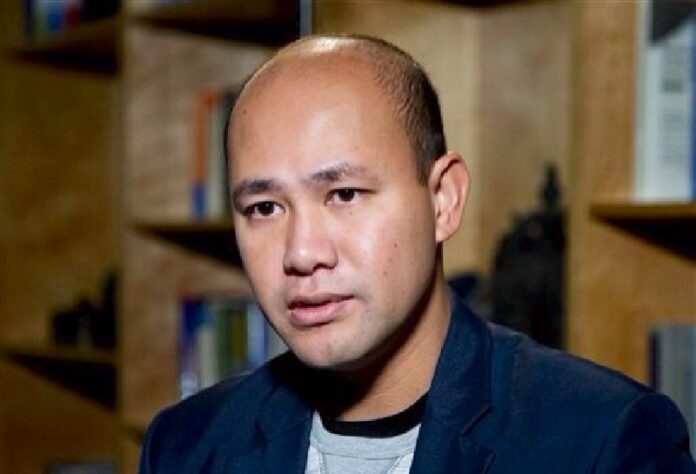
Hun Many, the son of Cambodian Prime Minister Hun Sen, speaks during an interview with AP in Washington, Jan. 21, 2016. Photo:Manuel Balce Ceneta / AP
WASHINGTON ― The youngest son of Cambodia's prime minister has an easy smile and conciliatory air. Hun Many's genteel manner contrasts with the ruthlessness that has characterized his father's 30 years in power, but that doesn't mean he's not ambitious.
The 33-year-old lawmaker told The Associated Press that he also wants to become the Southeast Asian nation's leader one day. But he says he should be judged by his performance, not his family name.
"Yes, I was born as his son, but it doesn't mean I don't have to perform, I don't have to deliver," he said in an interview during a visit to Washington this week. "It is not about judging me as Hun Many or (as) the son of the prime minister, but more on what I do. And I leave that to the public and the Cambodian people."
Hun Many expressed deep admiration for Prime Minister Hun Sen and his achievements, bringing stability and a measure of prosperity to impoverished Cambodia, but put a little distance between himself and some of his father's threatening rhetoric. He sounded far less confrontational than his father toward the political opposition, which has faced growing intimidation in recent months.
In October, two opposition lawmakers were savagely beaten outside parliament by members of a pro-government mob. Opposition leader Sam Rainsy, who has long had acrimonious relations with Hun Sen, is living in exile again to avoid arrest in what critics say are politically motivated legal cases.
Hun Many described the lawmakers who were beaten by the mob as his friends. He said the attack against them was "unacceptable" although he declined to identify who were the alleged perpetrators, saying that was a matter for the courts. He also said that he expected Rainsy would be allowed to contest the 2018 elections despite his legal woes, but didn't explain how. Hun Sen last month declared he would "rather cut off my right hand than sign a pardon for Rainsy."
Hun Sen took power in 1985 at the head of a Vietnamese-backed government in the aftermath of the genocidal Khmer Rouge regime that was responsible for the deaths of an estimated 1.7 million Cambodians. He has used a combination of guile and brute force to crush his political rivals during his long career, including a violent coup in 1997.
There's little question about his continued dominance, and Hun Many said his father will lead the ruling Cambodian People's Party into the next elections in 2018. But declining support for the party at the last, flawed national vote three years ago has fueled speculation about who might eventually succeed him.
Attention has focused on his three sons, who all hold senior positions. The eldest son, Hun Manet, 38, who was educated at West Point, leads Cambodia's counterterrorism department and was long perceived to be most likely to follow in his father's footsteps. Second son, Hun Manith, 34, was promoted to become head of military intelligence in September.
But Hun Many, who leads a Cambodian youth movement linked to the ruling party, is another, emerging possibility. He has acquired a higher profile since becoming the nation's second-youngest lawmaker in 2013. He has spent about half of his life outside the country, living and studying in France, Australia and the U.S., where he got a masters degree from the National Defense University in Washington.
On his visit to Washington this week, he gave an address at another university calling for stronger U.S.-Cambodian relations, ahead of an unprecedented official U.S. visit by his father for a summit of Southeast Asian leaders to be hosted by President Barack Obama in California in mid-February. Secretary of State John Kerry is set to visit Cambodia Tuesday to discuss the upcoming summit.
Unsurprisingly for a visitor to the U.S., Hun Many is keen to give a positive view of Cambodia, and what he describes as its progress toward a more competitive democracy. Asked about his personal aspirations for office, Hun Many told AP on Thursday: "Not only me but every Cambodian should aspire to become prime minister."
In reality, many rising leaders in government and the security forces are the sons of the powerful. Hun Many conceded that his background has "opened doors" for him. He previously served as his father's personal secretary, but says he wasn't given an easy ride.
"Sometimes there's a misperception that being my father's son, it's much easier to work for him and actually it is other way around," Hun Many said, adding that his father believes that his children "need to stand on their own two feet." He said his father was a "very caring and warm man" who had always encouraged debate around the family dinner table.
Hun Many denied there was competition among his powerful siblings to lead Cambodia. He said the only rivalry among them was in losing weight, and he was winning.
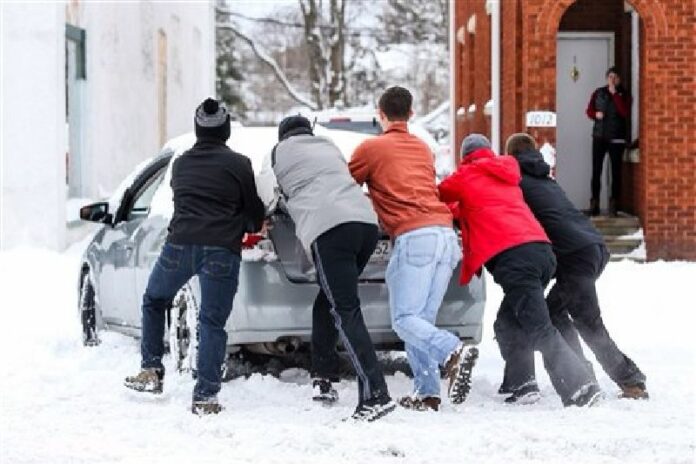
People push a car stuck in snow in Huntington, West Virginia, Saturday Jan.23, 2016. Photo: Sholten Singer / AP
SILVER SPRING, Maryland ― A blizzard with hurricane-force winds brought much of the U.S. East Coast to a standstill Saturday, dumping as much as 3 feet (90 centimeters) of snow, stranding tens of thousands of travelers and shutting down Washington and New York City.
After days of weather warnings, most of the 80 million people in the storm's path heeded requests to stay home and off the roads, which were largely deserted. Yet at least 18 deaths were blamed on the weather, resulting from car crashes, shoveling snow and hypothermia. And more snow was to come, with dangerous conditions expected to persist until early Sunday, forecasters warned.
"This is going to be one of those generational events, where your parents talk about how bad it was," Ryan Maue, a meteorologist for WeatherBell Analytics, said from Tallahassee, Florida, which also got some flakes.
The system was mammoth, dropping snow from the Gulf Coast to the northeastern New England states. By afternoon, areas near Washington had surpassed 30 inches (75 centimeters). The heaviest unofficial report was in a rural area of West Virginia, not far from Harper's Ferry, with 40 inches (100 centimeters).
Airlines canceled nearly 7,000 weekend flights and started to cut Monday service.
As the storm picked up, forecasters increased their snow predictions for New York and points north and warned areas nearly as far north as Boston to expect heavy snow.
"This is kind of a Top 10 snowstorm," said weather service winter storm expert Paul Kocin, who co-wrote a two-volume textbook on blizzards.
It was Top 3 in New York City, where more than 25 inches (62.5 centimeters) of snow had fallen as of 7 p.m. Saturday, close to the record, 26.9 inches (68.3 centimeters), set in February 2006.
Three people died while shoveling snow. The normally bustling streets around Rockefeller Center, Penn Station and other landmarks were mostly empty. Those who did venture out walked down the middle of snow-covered streets to avoid even deeper drifts on the sidewalks.
With Broadway shows dark, thin crowds shuffled through a different kind of Great White Way in Times Square.
Officials imposed a travel ban in the city, ordering all nonemergency vehicles off the roads. Commuter rails and above-ground segments of the nation's biggest subway system shut down, too, along with buses.
As recently as Friday night, New York officials had expected the storm to top out at 18 inches (45 centimeters). But that prediction jumped to 28 inches (71 centimeters) by Saturday evening.
In Washington, monuments that would typically be busy with tourists stood vacant. All mass transit in the capital was to be shut down through Sunday.
Throughout the region, drivers skidded off snowy, icy roads in accidents that killed several people as the storm raged Friday and Saturday. Those killed included a 4-year-old boy in North Carolina; a Kentucky transportation worker who was plowing highways; and a woman whose car plunged down a 300-foot (90-meter) embankment in Tennessee.
An Ohio teenager sledding behind an all-terrain vehicle was hit by a truck and killed, and two people died of hypothermia in southwest Virginia. In North Carolina, a man whose car had veered off an icy-covered road was arrested on charges of killing a motorist who stopped to help.
In Kentucky, Pennsylvania and West Virginia, drivers were marooned for hours in snow-choked highways.
Roofs collapsed on a historic theater in Virginia and a horse barn in Maryland, while seaside towns in New Jersey, Delaware and Maryland grappled with flooding.
The snow was whipped into a maelstrom by winds that reached 75 mph (120 kph) at Dewey Beach, Delaware, and Langley Air Force Base, Virginia, the weather service said. From Virginia to New York, sustained winds topped 30 mph (48 kph) and gusted to around 50 mph (80 kph). And if that weren't enough, the storm also had bursts of thunder and lightning.
The storm also knocked out electricity to thousands of homes and businesses.
Group Capt. Rawin Thanomsingha. Photo: Courtesy Rawin Thanonmsginha
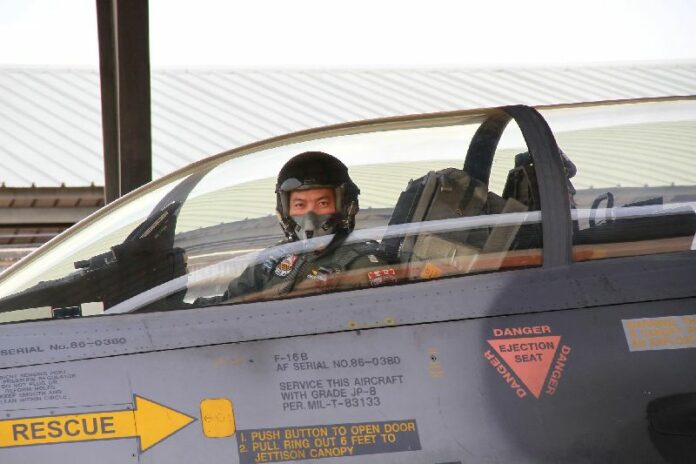
KORAT — Group Capt. Rawin Thanomsingha was soaring nearly five kilometers above Thailand when the engine acted up.
Normally it wouldn’t be a big deal for the fighter jock with 20 years experience flying F-16s, but on that day in November, he was seated in the back with an inexperienced pilot-in-training up front where the engine start-up and kill controls are located.
“At 15,000 feet we had engine trouble,” Rawin said. “We had to shut it down.” Thailand flies around 50 F-16s, some built in the early days of the jet fighter’s production, so engine trouble isn’t unheard of.
The trainee managed to kill the engine and the unpowered plane started sinking. The F-16 is capable of gliding, but not for very long.
Rawin, 49, kept his cool and explained the startup procedure over comms to the trainee, who then proceeded to blow it. Pilots have a saying, “Speed is life, altitude is life insurance,” and they were losing both, very quickly.
Rawin considered ejecting to safety and ditching the multi-billion baht aircraft in an empty field, but with only 1,000 feet beneath the plane, he chose to talk the pilot through the process again. The engine roared to life and the rapidly falling F-16 shot upward with full afterburner.
Both pilots narrowly escaped a fiery death.
Rawin recounted their narrow escape from death with a perpetual grin in a small coffee shop behind the Wing 1 control tower at Korat Air Force Base earlier this month on Children’s Day, away from the deafening howl of the 103 Squadron’s jets.
Grp. Capt. Rawin Thanomsingha cruises around the tarmac on a bicycle.
Earlier I had been stuck in traffic heading toward the airbase when I first saw him – or at least heard him – and saw first-hand why he’s earned the nickname “Hollywood” for breaking all the rules with fearless, high-flying antics.
A hazy, fast-moving metal mass ripped through the sky low and loud over the row of red brake lights. Still being early in the day, I assumed it was one of the less showier jets – perhaps a Czech-designed L-39 Albatros or Northrop-engineered F-5.
Then came the unmistakable roar of a Pratt & Whitney F100-PW-200 engine, which only belongs to the loudest airplane in the Royal Thai Air Force's inventory. It could only be one aircraft: The Viper, officially known as the F-16. As it turned out, no time is wasted bringing out the crowd-pleasers for Children’s Day. It was only 10:30am.
After reaching the tarmac, I saw a small group of pilots under the wing of an F-16 while mechanics combed over the airplane performing post-flight checks.
Seated on a bicycle hiding from the rain under the wing of an F-16 wearing a flight suit and a toothy grin was Hollywood. His name is synonymous with the F-16, and he’s logged nearly 3,500 hours on the fighter.
Soon we were in the cafe, where I laid out some questions.
Your favorite aerobatic maneuver?
“Anything prohibited. They say you can’t roll the plane with the landing gear down. That’s not true,” he said.
What of the mighty F-16?
“She can do it all and she’s comfortable,” he said. “Sometimes I feel like she’s flying by herself, and I’m just along for the ride.”
Why become a fighter pilot?
“When I graduated high school I decided to try to become a professional soccer player, but my father, a fighter pilot flying the F-86F Sabre, had other plans for me.”
How did you end up in Isaan?
“After I finished flight school in Bangkok, my instructor said I was going to be relocated to the 231 Squadron out of Udon Thani, where a fleet of F-5s was based,” Rawin said. “I graduated second in my class. I was a rabbit with one leg; I had no say in the matter.”
What was training like?
“I trained on the F-5 for two years, putting in 500 hours of flying each year. 500 hours is too much for a pilot in training, we would never do that today. Udon became my home, I loved it,” he said.
An F-16 performs a low pass with landing gear down.
Just as Rawin was embracing life in Isaan, his captain approached with a choice: Stay in Udon or move to Korat to fly F-16s as part of the newly formed 103 Squadron. In the mid-1990s, Thailand had purchased the newer F-16s to replace its aging F-5s. Only the best pilots were recruited to fly Thailand’s newly acquired flagship fighter.
There wasn’t really a choice, after all. He was ordered to move to the F-16 and thus, Korat.
Wing Commander
Twenty years have gone by, and after thousands of hours in the F-16, Rawin has risen to group captain and Wing 1 commander.
In 2012 a special livery was applied to a RTAF F-16 to celebrate 100 years of Thai aviation. The plane is affectionately named the “Century Falcon”.
By now he knows Korat so well he can fly there without the help of any navigation. This proved fortunate last year during another system failure on another training flight.
“Suddenly the power cut out while we were cruising,” he said. Rawin was instructing a young pilot at altitude and flying high above cloud cover when they quickly lost track of where they were without the aid of electronic navigation systems or visual aid.
They guessed they were somewhere over Lopburi but couldn't be sure. Backup power only lasts for a short time, so they had to look for somewhere to land. Rawin ordered the novice pilot to get down below the clouds and have a look around. They saw a large river and military air base.
Bangkok!
The plane can’t use air brakes on backup power, and they couldn’t land at Don Mueang because it doesn’t have a brake cable, like that found on an aircraft carrier. So close but so far. Somewhere over Bangkok, a F-16 without any communication devices soared closer to disaster.
From Bangkok, the veteran pilot said he knew exactly how to get back to Korat.
“Sometimes we fly using ‘IFR,’” he said.
Assuming IFR referred to Instrument Flight Rules, under which a pilot can navigate using only cockpit instruments, I asked him how that was possible without power.
“IFR!I Follow the Road!” he spurted out between chuckles.
To reach us about this article or another matter, please contact us by e-mail at:[email protected].
Follow Khaosod English onFacebookand Twitterfor news, politics and more from Thailand.
BANGKOK — Get ready for the junta-sponsored constitution-drafting festival again. Twenty-one (mostly male, all with zero public accountability) members, appointed by junta leader Gen. Prayuth Chan-ocha (also unaccountable to the public), will unveil the next draft charter Friday.
Here are some things you might not want to know about the next constitution, as it is being written:
1. Less Than ‘Permanent’
In Thailand, there’s nothing “permanent” about a “permanent constitution.” In case you’re perplexed by this factual statement, let me remind you that if this junta-sponsored charter passes national referendum, it will become our 20th “permanent constitution.” Twenty charters in a span of eight decades means the average lifespan of a permanent constitution in Thailand is roughly 4 years, making the the notion of a permanent constitution an oxymoron.
2. Free of Participation
As mentioned, 21 people, mostly men, were handpicked by the junta leader to draft a charter presentable to the junta, which is not accountable to the public. Sure, the drafters say anyone can submit suggestions to them, but whether they consider them is another matter. The supreme legal framework is supposed to be participatory, but what we’re getting is the total opposite. Political parties are still banned from even discussing the draft charter.
A real social contract requires genuine involvement of the people. The current process doesn’t even try to make it look that way. And unless this group of drafters think they are at liberty to draft whatever they like, they should only look at the “instructions” laid down in the current junta’s provisional charter to realize that in the new draft charter that it’s not likely to be the case. Also, these charter drafters operate knowing a previous draft written by others has already been rejected by the the junta’s rubber-stamp council. So they better know how to please those that count.
3. Enrhsines Undemocratic Interference
A sneak preview of the proposed constitution spread through the media recently suggests it would grant more power to unelected bodies such as the Constitutional Court in solving political conflicts. Bodies such as the Election and National Anti-Corruption commissions can act against elected governments when their policies are deemed to have damaged the country. Meanwhile the independence of vital organizations such as the National Human Rights Commission is undermined. Critics say mechanisms are being introduced to undermine the sovereign power of the electorate, as elected parliamentarians and politicians can expect less power vis-a-vis unelected state bodies. What’s more, according to law expert Vorajaed Pakeerut of Thammasat University, it appears that changing the charter once it’s adopted is being made very difficult if not virtually impossible. No wonder two bitter political rivals, the Pheu Thai and Democrat parties, are suddenly singing in unison for voters to reject the draft charter.
4. No Social Contract
With no meaningful participation available in the drafting process, the public is unlikely to have a sense of ownership over the charter, even if it passes referendum. The promised up-or-down vote can only provide a veneer of legitimacy. Don’t expect any democracy-loving Thai to be able to cite any article from the charter by heart or with pride. What we will get will be yet another temporary “permanent” constitution.
5. It’s a Distraction
The junta’s sponsored draft charter is a convenient way to buy time and distract the public from other issues.
Think about the number of words and hours spent analyzing, debating and assessing a draft charter (including here), instead of discussing the miraculous state of the economy under the junta or the alleged corruption at Rajabhakti Park. You might think it’s not a bad strategy. It’s a perfect distraction, especially considering the fact that this draft charter may be the second to end up in the trash bin in the latter half of this year. No wonder the media, including Matichon newspaper, a sister publication of Khaosod English, suspects this draft might have been written regressively to court rejection.
6. It’s a Bad Choice
We’re stuck between either endorsing a junta-sponsored constitution that is undemocratic or further extending a prolonged roadmap to restoring democratic rule well past the horizon. Vote it down in the referendum at your own peril and enable the junta to prolong its illegitimate hold on power, reinstall any past, and possibly even less democratic charter, and put it into use or possibly restart a third round of junta-sponsored charter-writing process.
7. Confused Loyalties
The 21 people writing the draft charter are not accountable to us as they are hand-picked by the junta leader Prayuth. If anything, Meechai Ruchuphan, chairman of the drafting committee, might think the people should actually be accountable to them when he said that if this draft is rejected in the referendum, it’s due to people distorted its content, and he won’t be responsible for that.
8. Self-Perpetuating Cycle
The military monopoly over the recent charter drafting process is to replace the 2007 charter, annulled by the coup-makers led by Prayuth on May 22, 2014, which was in fact also a junta-sponsored constitution.
9. Built-in Amnesty
Will the coup-makers be granted amnesty in the temporary provisions of this new draft charter? Is this a serious question? Do you really think these hand-picked drafters will bite the hand that feeds them? In fact, this tradition of granting amnesty to coup-makers is one of the most enduring aspects of any junta-sponsored charter. It is instrumental in implicitly encouraging future coups as coup makers can always count on enjoying amnesty. Granting amnesty to coup makers in the new charter would only pave way for more coups – but do you think these army generals care?
10. Neither Unique nor Extraordinary
Can you still be enthusiastic given all the points raised? If you are a Thai citizen and not near the end of life, you will probably have many more chances to endorse or reject draft permanent constitutions well into the future. And if after reading this column you are still enthusiastic and optimistic, then I can only say, “Good luck to you and Thailand!”
Pravit Rojanaphruk can be followed on Twitter at @PravitR
To reach us about this article or another matter, please contact us by e-mail at:[email protected].
Follow Khaosod English onFacebookand Twitterfor news, politics and more from Thailand.