25.5 C
Bangkok
Saturday, June 20, 2026
Home Blog Page 2844

Royal Dog ‘Thong Daeng’ Dies at 17, Palace Confirms

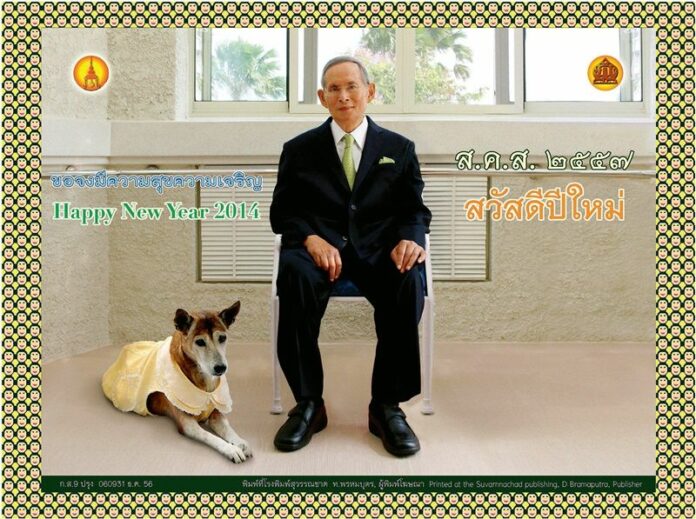
His Majesty the King and Thong Daeng pose together in the 2014 New year greetings card released by the Royal Household Bureau.

BANGKOK — The King’s dog is dead.

Thong Daeng, who was regularly seen at the side of His Majesty the King throughout her 17-year life, died of old age at Klai Kangwon Summer Palace on Saturday night, said Kasetsart University’s Faculty of Veterinary Medicine in a statement today.

In the statement, the Faculty said its veterinarians have been treating Thong Daeng for some time now. Her death resulted from deterioration to her liver, kidneys and other vital organs, according to the statement.

“She is considered a dog that has lived for a long time,” the statement notes.

Dissathorn Watcharotai, Deputy Secretary of the Royal Household Bureau, confirmed to Matichon newspaper Monday evening that Thong Daeng has passed away.

King Bhumibol has been informed about her death, Dissathorn added.

In this Feb. 13, 2005, photo released by the Royal Household Bureau, His Majesty the King and Thong Daeng play together at Chitralada Palace in Bangkok.

As the chief pet of His Majesty the King, Thong Daeng is held in high regard in Thai society. Media agencies in Thailand call her by the honorific “khun,” which is usually reserved as a sign of respect for people. An animated film based on Thong Daeng’s life opened in Thai cinemas this month.

She was often seen walking with King Bhumibol in public events. Thong Daeng also appeared in many New Year greetings cards issued by the King in the past years.

According to her official royal biography, Thong Daeng was born to a stray dog in Bangkok in November 1998. She was reportedly later adopted by Rama 9 Medical Center, and given as a gift to His Majesty the King when he visited the facility in December that year.

Advertisement

The Negative Force Awakens After Star Wars Run Thailand

A promotional photo for "Star Wars Run Thailand" from the Facebook page of the organizers / Facebook

By Teeranai Charuvastra
Staff Reporter

BANGKOK — From the city that gave runners an extra seven kilometers in a half marathon comes a Star Wars-themed run that added an extra hour.

The much-anticipated event, called Star Wars Run Thailand, was marked by an hour delay to the scheduled start time, substandard prizes and souvenirs and several traffic interruptions. 

Star Wars Run Thailand cost 900 baht to enter and was heavily advertised in recent weeks. Hype for the event was also partly fueled by the release of the latest Star Wars film installment, The Force Awakens, which opened in Thailand on Dec. 17. 

But many participants gave in to hate and anger, and flooded the organizers’ Facebook page with complaints and criticism almost as soon as the event was over. 

Among the chief complaints was the delayed starting time, which interfered with many runners’ plan to blow this thing and go home before midnight. Runners were supposed to start on Saturday night from Siam Square, following several hours of performances on  stage, but organizers did not release the runners until around 11.30pm. 

“Why didn’t you manage the time when you planned the run and just call it a midnight run?” wrote Jedsada Wannasri on the event’s official Facebook page. “You can’t just tell runners [the start time is] 10.30pm. This is wrong. Many people came to the event. It was so packed and hot. And they came from far away, they already planned their departure times to return home.” 

Organizers of the event did not respond to Khaosod English’s message requesting for comments. According to its promotional material, Star Wars Run Thailand was organized by a toy company called Hobbies Plus. The company did not list any contact number on registration sites. 

Other complaints involved “stations” along the 7-kilometer running route that lacked any innovative touches. Reded lights at intersections forced runners to stop in their tracks, while poor lighting in some roads and alleys made it difficult to stay on target.

The run’s prizes also took a direct hit from the runners. Medals were of poor quality compared to Star Wars-themed run events held in other nations, while the commemorative shirts failed to “glow in the dark” as promised by the organizers, and unexpectedly came complete with large logos of sponsors. 

\

A photo of the Star Wars Run medal posted to the Facebook page of the organizers.

“The medals were so fucked up. I thought I would at least get some good stuff after all those horrible stations,” wrote another runner, Rachata Weerachaising. “But it’s so different from the design. You used ribbons to hang the medals and screened sponsor logos on it. Erm.. I didn’t sign up for a school sports day, ok?” 

His post continued, “I once made this kind of medal, it cost me 15 baht. It turned out so shoddy, what happened to my 900 baht?” 

In response to these disturbances in the Force, the organizers published a statement on their Facebook page and apologized for the shortcomings. It said the run start time was delayed due to “unforeseen circumstances” without elaborating, and promised to issue new sets of medals that match the advertised version. The new medals will be available by Jan. 2016, the statement said.

“The organizers read every comment and suggestion, and we will use this to fix our mistake and improve our work,” the organizers said in the post. 

Running events have been booming in Bangkok in the past year, including high-profile events like BMW Charity Midnight Run, Color Run and a recent Half Marathon. 

The latter inadvertently became the longest half marathon in the world after organizers placed a wrong U-Turn, forcing runners to run an extra seven kilometers. 


To reach us about this article or another matter, please contact us by e-mail at: [email protected].

Follow Khaosod English on and Twitter for news, politics and more from Thailand.

\

Advertisement

Prayuth Defends Murder Verdict in Koh Tao Case

Junta chairman Prayuth Chan-ocha greeting supporters at an event in Surat Thani today.

BANGKOK — Junta chairman Prayuth Chan-ocha defended the judicial system, after two Myanmar migrant workers were sentenced to death in a case that provoked widespread skepticism.

The system must be respected and the court process followed, Prayuth said, after last week's verdict in the murders of two British tourists stirred outrage in neighboring Myanmar.

Protests have been staged at the Thai embassy in Yangon, the house of political majority leader Aung San Suu Kyi, and at two Thai-Myanmar border crossings.

Zaw Lin and Wai Phyo were found guilty of the rape and murder of Hannah Witheridge and the murder of David Miller on the resort island resort of Koh Tao in September 2014.

The police investigation was plagued with allegations of torture and incompetence. Many critics said the two men were scapegoats and demanded a review of the case.

The consular section of the Thai embassy announced it would close Monday through Wednesday due to an "unexpected and prolonged demonstration" around its compound in Yangon.

The border crossing at the Three Pagodas Pass in western Thailand was closed Monday for the second straight day.

Story: DPA


Advertisement

Mayor Apologizes Over Lewd New Year Dance Show

Coyote dancers on pick-up trucks in Uttaradit City last night.

UTTARADIT — A mayor in northern Thailand said he’s sorry for allowing a sexualized dance show to be featured in a state-sponsored New Year party last night.

Uttaradit City Mayor Samrarn Euachirawanic, told reporters today that he was not aware that the dance show was to be included in the event, and promised that such a mistake would never happen again. 

“I’d like to apologize the people of Uttaradit,” Samrarn said with an apologetic wai. 

The event was organized by a local sound equipment club, who billed it as both a car sound system show and New Year party. It took place in front of Uttaradit Railway Station Sunday night, with more than 30 vehicles parked on the roads, displaying their sound systems. 

Controversy started after a group of scantily-clad female dancers climbed onto the pick-up trucks  and started dancing in a sexually-suggestive way. Some of the dancers and onlookers were also seen drinking alcohol.

Such dancers, known as coyotes, are a common sight in concerts and bars throughout the country, but are considered offensive by the more conservative Thais.

Complaints about the event soon surfaced on social media, with some comments calling on Samrarn to take responsibility over the issue, since the event received endorsement from the City Office. 

Speaking to reporters today, Samrarn said his office did indeed give the greenlight to the sound equipment club’s party and closed off two road lanes for the event, but he said the club did not tell him about any sexy dance show. 

“It was Sunday, when traffic isn’t bad, so I allowed them to organize activities until 6pm, and there was no mention about coyotes whatsoever,” Samrarn said. 

He said he would also reprimand the organizers for the act. 

The incident is far from the first time coyotes made appearance in events organized by state agencies. In January, local officials in Trat were forced to apologize for including a coyote dance in a National Children's Day celebration, while in September a party held by the Ministry of Labour also featured coyote dancers. 


To reach us about this article or another matter, please contact us by e-mail at: [email protected].

Follow Khaosod English on and Twitter for news, politics and more from Thailand.

\

Advertisement

Japan-South Korea Talks Aim to Settle Sex Slavery Issue

A tribute to the war dead during a ceremony at the controversial Yasukuni Shrine precinct in Tokyo, on Aug. 15, the day of the 70th anniversary of the end of World War II. Photo: Franck Robichon / EPA

SEOUL — The Japanese and South Korean foreign ministers are to hold talks in Seoul Monday, aiming to resolve a row over Japan's use of sexual slavery in wartime, the two governments said.

Japanese Foreign Minister Fumio Kishida and his South Korean counterpart Yun Byung Se, were to discuss a Japanese proposal to set up a fund to support Korean survivors of the military brothels in exchange for Seoul's assurance that it will consider the issue resolved once and for all, Kyodo News agency reported.

The two governments have been in talks to resolve the issue and the size of the proposed fund, with Tokyo initially offering to give about Y100 million (30 million baht), but Seoul is calling for a Japanese contribution of more than Y1 billion (300 million baht), Kyodo reported, citing unnamed diplomatic sources.

Kishida is expected to tell Yun that Japan is ready to provide up to Y1 billion on condition that South Korea jointly finances the fund, never bring up the sexual slavery issue and remove a statue of a girl symbolizing the issue erected in front of the Japanese embassy in Seoul, the report said.

Tokyo's official stance is currently that the issue of compensation was fully settled under a 1965 treaty with Seoul that normalized diplomatic relations.

Many survivors of the wartime sexual slavery have urged Japan to issue an official apology, make reparations and include wartime atrocities in Japanese school textbooks.

Story: Takehiko Kambayashi / DPA


Advertisement

How Slacktivism Can Make a Change Under Military Rule

BANGKOK — Warisara Sornpet, the Campaign Director of Change.org, said she was surprised when she found out that the online petition calling for the junta-appointed National Legislative Assembly to outlaw possession of child pornography was actually started by a member of the assembly. The petition succeeded in May.

“She was one of the decision makers but she still used our platform to campaign,” said Warisara. “She said she wanted the assembly to know they are being watched by many people.” 

Change.org first set up a branch in Thailand four years ago. Warisara said the number of petitions started, significantly dropped in 2014 when that military seized power, but surprisingly the number has  increased by 120 percent this year. Though there are a number of other factors behind the current growth trend, Wisara believes suppression by the junta is no doubt one of them. 

“Whenever society becomes less open, people will be eager to find a way to speak,” said Nattawat Suttiyotin, a communication arts professor from Sukhothai Thammathirat Open University. 

Despite the infinite power of the internet, online activism around the world currently faces criticism that it is actually just “slacktivism”. By signing, liking or changing profile pictures, people are not required to devote much time or thought to supporting issues. Yet, under the current political climate, with public discussion banned and official petitions unreliable, clicktivism seems to serve some semblance of basic rights ripped out under the junta rule. 

Seven months ago, Prachamati.org (‘referendum’ in Thai) was formed to voice both sides of public opinion about the drafting constitution. Even though internet in Thailand is not guaranteed 100 percent safe, website admin said it is still the safest place to talk at the moment. 

“There was an attempt from the group called Citizen Forum, to hold a public discussion about the constitution and they were finally requested to end it by the military,” said site staff member, Narongsak Niamsorn. “So it is clear that this conversation cannot happen offline.”

The era of social movements often led by NGOs, has been transformed by cheaper smartphones and lower-cost internet packages, transferring power to anyone who identifies themselves as an active citizen.

“This year our platform tends to be used more for campaigns about national discourse,” said Warisara. “Some said our open platform [on Change.org] is a game changer.”
 

Not all campaigns are equal

Compared to those who protest on the street, signing an online petition comes with minimal cost. But does the number of names signed by lazy slacktivists lead to nothing, media experts argue this is not always the case. 

“The number [of people who sign an online petition], can be used as measurable evidence which increases the power to negotiate,” said Nattawat. “Especially when it was endorsed by an online opinion leader.” 

While the petition against the government’s attempt to create the single internet gateway, attracted more than 150,000 signatures and had some sway, the campaign against the junta’s ambition to build a promenade along Chao Phraya river could also slow down the project with only 16,000 names supported. 

The campaign initiator, Yossapon Boonsom, believes that to achieve their aims, online petitions still need to be supported by offline action to engage with followers and ensure the issue reaches a wider audience.
 
“People online are usually middle class and students,” said the landscape architect. “Those who live in local communities, affected by the issues didn’t receive information from our Facebook page, but rather from the leaflets we gave to them directly.”

Change is irreversible

While  suppression by the junta was one of the obstacles to public discussion, according to the experts who have been monitoring the petitions for the past four years, it was apparently not the biggest.

“The biggest challenge to change  is not the coup, but actually our Mai Pen Rai culture,” Warisara said, referring to Thailand’s common trait.

With the idea that the little people cannot make a big change firmly entrenched in society and made worse by the threat from people in power, Warisara said, “For some petitions, we consider it an achievement already just when people dare enough to sign it.” 

In days when the government channel proves to be ineffective and mainstream news shows on TV rely on the kingdom’s biggest discussion webboard Pantip, for their agenda, both media experts and Change.org’s campaign director argue – why can’t the internet be the new standard platform?

“Looking back over the last five years, have you ever seen any petition call for removal of a politician, achieve success, even when they received more than the 50,000 required names for support?,” asked Nattawat.

“The world has already changed and it will not go backward,” said Warisara. “With the internet, the power is now in everyone’s hands and it has proved that it can work.” 


To reach us about this article or another matter, please contact us by e-mail at: [email protected].

Follow Khaosod English on and Twitter for news, politics and more from Thailand.

\

Advertisement

How Slacktivism Can Make a Change Under Military Rule

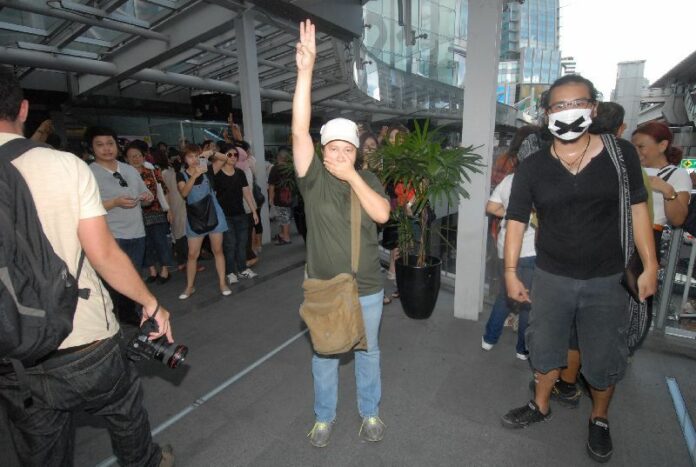
A protester flashes the 'three-finger salute' at a June 1, 2014, anti-coup demonstration at Terminal 21 Mall in Bangkok. After the junta cracked down on physical protests, many activists relied on virtual campaigns instead.

BANGKOK — Warisara Sornpet, the Campaign Director of Change.org, said she was surprised when she found out that the online petition calling for the junta-appointed National Legislative Assembly to outlaw possession of child pornography was actually started by a member of the assembly. The petition succeeded in May.

“She was one of the decision makers but she still used our platform to campaign,” said Warisara. “She said she wanted the assembly to know they are being watched by many people.” 

Change.org first set up a branch in Thailand four years ago. Warisara said the number of petitions started, significantly dropped in 2014 when that military seized power, but surprisingly the number has  increased by 120 percent this year. Though there are a number of other factors behind the current growth trend, Wisara believes suppression by the junta is no doubt one of them. 

“Whenever society becomes less open, people will be eager to find a way to speak,” said Nattawat Suttiyotin, a communication arts professor from Sukhothai Thammathirat Open University. 

Despite the infinite power of the internet, online activism around the world currently faces criticism that it is actually just “slacktivism”. By signing, liking or changing profile pictures, people are not required to devote much time or thought to supporting issues. Yet, under the current political climate, with public discussion banned and official petitions unreliable, clicktivism seems to serve some semblance of basic rights ripped out under the junta rule. 

Seven months ago, Prachamati.org (‘referendum’ in Thai) was formed to voice both sides of public opinion about the drafting constitution. Even though internet in Thailand is not guaranteed 100 percent safe, website admin said it is still the safest place to talk at the moment. 

“There was an attempt from the group called Citizen Forum, to hold a public discussion about the constitution and they were finally requested to end it by the military,” said site staff member, Narongsak Niamsorn. “So it is clear that this conversation cannot happen offline.”

The era of social movements often led by NGOs, has been transformed by cheaper smartphones and lower-cost internet packages, transferring power to anyone who identifies themselves as an active citizen.

“This year our platform tends to be used more for campaigns about national discourse,” said Warisara. “Some said our open platform [on Change.org] is a game changer.”
 

Not all campaigns are equal

Compared to those who protest on the street, signing an online petition comes with minimal cost. But does the number of names signed by lazy slacktivists lead to nothing, media experts argue this is not always the case. 

“The number [of people who sign an online petition], can be used as measurable evidence which increases the power to negotiate,” said Nattawat. “Especially when it was endorsed by an online opinion leader.” 

While the petition against the government’s attempt to create the single internet gateway, attracted more than 150,000 signatures and had some sway, the campaign against the junta’s ambition to build a promenade along Chao Phraya river could also slow down the project with only 16,000 names supported. 

The campaign initiator, Yossapon Boonsom, believes that to achieve their aims, online petitions still need to be supported by offline action to engage with followers and ensure the issue reaches a wider audience.
 
“People online are usually middle class and students,” said the landscape architect. “Those who live in local communities, affected by the issues didn’t receive information from our Facebook page, but rather from the leaflets we gave to them directly.”

Change is irreversible

While  suppression by the junta was one of the obstacles to public discussion, according to the experts who have been monitoring the petitions for the past four years, it was apparently not the biggest.

“The biggest challenge to change  is not the coup, but actually our Mai Pen Rai culture,” Warisara said, referring to Thailand’s common trait.

With the idea that the little people cannot make a big change firmly entrenched in society and made worse by the threat from people in power, Warisara said, “For some petitions, we consider it an achievement already just when people dare enough to sign it.” 

In days when the government channel proves to be ineffective and mainstream news shows on TV rely on the kingdom’s biggest discussion webboard Pantip, for their agenda, both media experts and Change.org’s campaign director argue – why can’t the internet be the new standard platform?

“Looking back over the last five years, have you ever seen any petition call for removal of a politician, achieve success, even when they received more than the 50,000 required names for support?,” asked Nattawat.

“The world has already changed and it will not go backward,” said Warisara. “With the internet, the power is now in everyone’s hands and it has proved that it can work.” 


To reach us about this article or another matter, please contact us by e-mail at: [email protected].

Follow Khaosod English on and Twitter for news, politics and more from Thailand.

\

Advertisement

Kill The Boy and Let the Beer Be Born

Craft beer in Chinatown at Let The Boy Die. Photo: Let The Boy Die.

BANGKOK — In the Game of Thrones episode “Kill The Boy,” Jon Snow meets Maester Aemon, seeking advice. The wise old man tells him to “kill the boy, and let the man be born.”

The watershed moment represents a turning point in the young leader’s life. He must make a decision that he knows he’ll be hated for, but also knows it’s what he must do.

Pieak Pipattanaphon sees a parallel between this “Thrones” storyline and the battle to legalize small scale brewing in Thailand. While he hasn’t drawn the ire of his peers for opening Chinatown craft beer bar Let The Boy Die, he may, at some point, face the penalties of operating an illegal brewery and bar. To build up the courage to take the risk to pursue his dream of opening a bar serving Thai-made craft beer, to him, is to let the boy inside him die.

When I meet him at his hip Chinatown bar, he’s relaxed. Clad in a flannel shirt with the sleeves rolled up, he peppers his speech with the phrase “man, you know.” He’s suave. Earlier this year I interviewed him just as the underground brewing scene was garnering mainstream attention. He was unsure of his future plans as he was just starting to grow Golden Coins, his own beer brand.

This time around he – like the Thai homebrew scene – seems to have come of age. It’s clear he’s at home here in his own space, where Golden Coins beer has found a permanent home as part of the larger operation Let The Boy Die.

Exterior of Let The Boy Die. Photo: Let The Boy Die

Beer Battle

Pieak is one brewer among a group of roughly 50 who see each small victory against the law as part of a larger story about good guys, small beer brewers, pitted against evil guys, big breweries and the government that supports them.

If this is indeed a good vs. evil story, then Let The Boy Die is a major win for the good guys, as it’s remained open since the middle of October without any trouble.

The bar has taken Thai homebrew, known for its “growing pains” (read: inconsistent taste), refined it, brought it to Chinatown, and presented it to the public with quiet bravado.

“It’s not the police I’m worried about.” Pieak says. The bar occupies the space that used to contain his family’s restaurant. His mother’s fare earned a stellar reputation among the local community. “The police respect my mother and her cooking. They aren’t the problem. They even come try my beer!”

Pieak says the real problem is tax inspectors. Personal connections and cold pints can’t thwart their efforts. However, taxes will only be a problem for a short while, he thinks. “This coming year my beer should be legal. That’s why I opened the bar.”

He plans to use the bar as a way to meet the minimum production requirements in order to file for the appropriate brewing licenses. At present, he said, he drains three kegs daily, with weekends sometimes seeing double that. In conjunction with his wholesale distribution of Golden Coins beer, he may very well be on the way to becoming the first legal small-scale brewery in Bangkok proper.


Origin Story

Let The Boy Die started when a man named Avi Yashaya placed an order for Pieak’s Golden Coins beer. The two immediately connected and now Avi runs operations, marketing, and creates the menu for Let The Boy Die. Avi also owns a beer distribution company and plans to help Pieak distribute Golden Coins brew to foreign markets in the near future.

The establishment is an overnight success. Perhaps it’s a testament to the strength of the Thai-made craft brew market or perhaps it’s just something new in Chinatown, an area experiencing a boozing renaissance.

Its style is uncharacteristically subdued, as Pieak, who has an architectural background, explains, “interior style trends come and go. They change every five years. When you design for function, it becomes architecture.” The bar utilized a seating formula straight out of Game of Thrones: medieval-looking, long communal tables like you might find in a beer hall. He says the layout helps strangers strike up a convo. He’s also made sure the everyone has to go to the taps to order beer, there are no service staff buzzing around taking orders.


Craftsmanship

The beer served isn’t exceptionally experimental, and that’s a good thing for an establishment just starting out. Pieak says he “wants people to come and just enjoy what they’re drinking.”

Imbibers can expect pilsners, IPAs, pale ales and brown ales. Three taps are reserved for Golden Coins beers, while three taps rotate with beer from up-and-coming brewers.

It isn’t all bubbly in the craft beer world, though. Pieak says he’s concerned about the brewing society, “There’s a race to see who can be the first legal beer.” He worries that quality and integrity could suffer by trying to take things too quickly. In short, it’s not a race, it’s a mission. Everyone has to band together rather than act independently.

“Thai beer right now is right on the level of Japanese beer when it first started out. We need to grow steadily and focus on getting everything right,” he said; Japan has had decades to perfect their beer, and it’s now one of the most respected Asian brewing nations.

Pieak thinks with the appropriate support and a community effort Thailand could easily hang with them in terms of transforming Thai-made beer into a world-class brew.

For now, we have Let The Boy Die.

Here’s to hoping Let The Boy Die does not meet the same fate as [REDACTED].

Let The Boy Die is located on Luang Road, between Plubplachai and Yukon 2 Roads in Chinatown.

Advertisement

Mine Owner Reportedly Commits Suicide In Eastern China

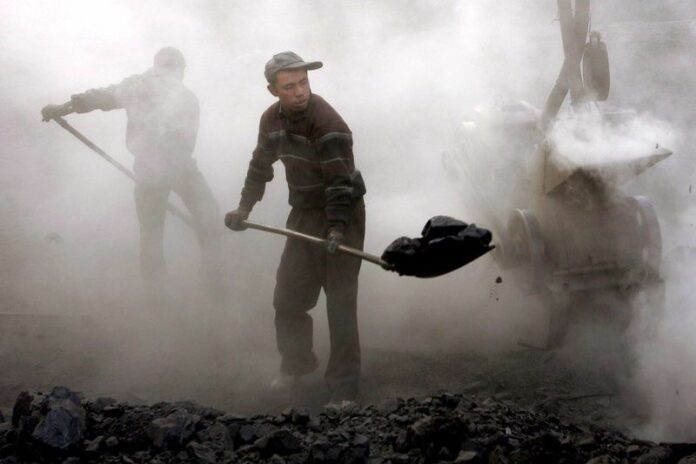
A cloud of dust and dirt engulfs a group of Chinese workers shoveling coal at a mine in Yaojie, Gansu province, China, 01 Dec. 2007.Photo: Michael Reynolds / EPA

BEIJING — The owner of a collapsed mine containing 17 trapped miners committed suicide Sunday, state media reported.

Ma Congbo, president of Yurong Commerce and Trade Company, was aiding rescue efforts on Sunday morning when he jumped into a mine well and drowned, the Xinhua news agency reported.

Seventeen miners remained trapped two days after the gypsum mine collapsed in Shandong province, state media reported.

Structural instability and falling rocks were hindering the efforts of 700 rescuers using heavy machinery to dig along existing shafts to reach them, the Xinhua news agency reported.

Rescuers were trying to contact the miners through a hole drilled at one location and hoped to supply them with water and provisions, Xinhua said.

A miner whose leg was stuck under a boulder was brought to safety early Saturday morning, bringing the total rescued to seven, the agency reported. Four other miners found their own way out on Friday.

Survivor Zhai Guangmong recalled Friday's collapse when he and 28 others were working at the mine.

"After the cave-in, I could see nothing at all," he said.

Gypsum is a soft grey or white mineral used in tofu, fertilizers, toothpaste and plaster of Paris.

The owner of a deadly mine accident can expect heavy punishment in mainland China where accidents are common but declining.

In 2010, a Chinese court sentenced a mine owner to death for illegally storing explosives that killed 17 people near a coal mine in the northern province of Shanxi.

In the first nine months of this year, mainland China suffered 420 accidental mine deaths, down 39 per cent from the same period the previous year, the State Administration of Work Safety vice director Yang Yuanyuan said.

In the whole of 2014, 931 people were killed in mine accidents, a reduction of more than 86 per cent from about 7,000 in 2002, state-run news agency Xinhua said.

However, rights groups say mine accidents are often unreported or under-reported, due to China's lack of free press, independent trade unions or watchdog groups.
 

Story: DPA

Advertisement

New Discontent Brewing In The Northeast

Members of the New Isaan Movement gather in Khon Kaen on Dec. 10. Photo: New Isaan Movement / Facebook

By Pravit Rojanaphruk
Senior Staff Writer

BANGKOK — “We aim high, to rise up and fight politically,” said Khornchanok Saenprasert, the New Isaan Movement’s coordinator and a trained human rights lawyer from Khon Kaen province. “This is not something that has been cooked up by four or five people; this is the result of wide-ranging consultations.”

Kornchanok said around 500 people from seven provinces in the northeastern region, known in Thai as ‘Isaan’, are on board. Members of this new region-based umbrella movement include the Dao Din student group, NGO activists as well as rural villagers. Those involved are from different backgrounds, they’re all from the much-neglected northeastern region and share a common pain and vision.

Long regarded as inferior and poor, once again people in the Northeast are rising up to fight for equality. The latest attempt began on Dec. 10, in Khon Kaen province, when a declaration announcing the formation of the New Isaan Movement was publicly read out.

The announcement of the New Isaan Movement was meant to be a renewed attempt by people in the Northeast to fight for equal political and social rights said Khornchanok. 

 “Being Isaan people is to be condemned to being second-class citizens and having no meaningful participation in politics. It also means being at the receiving end of [the adverse effects of] development projects. We have no part in determining our own future,” Kornchanok said.

He added that the coup has made the situation more acute with those opposing development projects in the region unable to even properly exercise their basic rights to protest.

Their second foray will be on Feb. 16 next year when they will launch their own people’s draft constitution just ahead of the junta’s draft charter.

“We hope to make society realize that the current [junta-sponsored] charter drafting process was not done by the people. We want to show what local people really want in their constitution. We don’t expect the junta to listen though.”

He said the junta has since contacted the group and asked them to participate in the charter drafting process but the movement declined the junta’s invitation, saying they see the whole process as undemocratic.

Periodic Discontent

David Streckfuss, a longtime Khon Kaen- based independent academic, said he’s not surprised by the latest development, though he said it is too premature to say how big the movement will become.

“There’s an age-old grievance that many Isaan people have against what they see as the uncaring and distant capital, which allows resources to be taken away from the Northeast for the benefit of others.

“This was clear and so Isaan people have been more politically aware and cognizant that they do not share the same set of rights as those in Bangkok.”

Streckfuss, originally from the U.S., has lived in Khon Kaen for 25 years and is married to a Thai. He said back in the 1960s and 1970s, people in the region were involved in the communist insurgency and in the 1990s they worked with the Assembly of the Poor. Over the past decade there was the so-called Redshirt movement too, he added.

“There is also a recognition that the Northeast, with its huge electorate, is not going to be allowed to have an equal [political] voice on a national level. And so it’s not strange to see a periodical call from the Northeast – for more autonomy. Whether the new Isaan Movement can find traction in this politically dark time remains to be seen.

“There’s no doubt that the coup and subsequent events have alienated the majority of Isaan people who wanted and still want a democratic government. Whether this Northeastern group can turn their grievances into a movement seems uncertain at present,” Streckfuss concluded.

Isaan Identity

Not all see identity politics as the key point in the New Isaan Movement, however.

Titipol Phakdeewanich, a lecturer at Ubon Ratchatani University, in the major Isaan province of Ubon Ratchathani, doesn’t think the creation of a separate Isaan identity is at the heart of the movement.

“It doesn’t mean they want regional strength but they want greater equality – that’s why they’re out demanding. Everyone wants equality and they [people from Issan] feel they are Thai too, but they don’t have equal rights.”

Titipol said the fact that many Redshirts in the region have voted for the Pheu Thai Party reflects their political aspiration to see a more responsive government it terms of policies. “They understand democracy better than Bangkokians assumed,” he said, referring to the prevailing belief among many in Bangkok that Isaan people can be bought (politically) and that they are manipulated by politicians as they don’t understand democracy.

“Vote buying is no longer the sole factor behind electoral success,” Titipol, who hails from the south but has lived in Ubon Ratchathani for 10 years, said. He added that some politicians, who paid more money to attempt to buy votes, did not win elections in the region, proof that voters consider other factors as well.

Not a Normal Struggle

Khornchanok meanwhile said given the current political situation under the junta since the May 22, 2014 coup, many Isaan people who are Redshirt supporters have been suppressed.

“Having a dictatorial state means they can’t make a political move and they don’t much dare to challenge autocratic powers. For us, New Isaan Movement, we start with defending our communities [from the adverse impacts of development projects]. Our backs are against the wall and if we don’t fight we will end up dying anyhow,” he said.

“What we would like to say is that we’re for equality and are against dictatorship and we are friends and allies to all those who share our values.”


Advertisement

Hot News

LATEST NEWS

Bangkok
overcast clouds
25.5 ° C
25.5 °
25.5 °
93 %
3.2kmh
100 %
Fri
25 °
Sat
32 °
Sun
35 °
Mon
37 °
Tue
37 °