






























28.3 C
Bangkok
Saturday, July 25, 2026
Home Blog Page 2929

Junta Launches Crackdown on 'Influential Figures' Stoking Crime

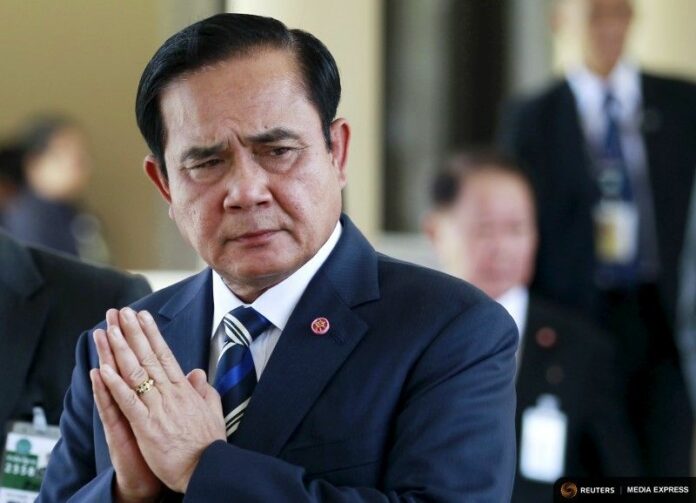
Junta chairman Prayuth Chan-ocha 'wais' on Sept. 9 at Government House in Bangkok. Photo: Reuters / Chaiwat Subprasom

By Amy Sawitta Lefevre
Reuters

BANGKOK — Thailand's junta launched a crackdown today on organized crime, its latest effort to clean up the country and improve the image of the military government as it struggles to get a sluggish economy on track.

Prime Minister Prayuth Chan-ocha, ushered in a "clean up Thailand" campaign shortly after he, as army chief, took power from an elected government in a 2014 coup, promising to root out vice and corruption in government and society in general.

This time, he said, the junta was targeting mafia-style crime bosses styled as "influential figures."

"We want people to be able to live their lives normally away from violence and its instigators, including those who use weapons," said defense ministry spokesman Col. Kongcheep Tantrawanit.

"We will use laws that target influential figures and ask people to cooperate to help give the state information," he said, without giving details.

Prayuth has said he wants mafias eradicated in six months. His government has flagged the need to suppress crime, ban weapons and investigate some of Thailand's infamous nightlife venues.

The military sees itself as the champion of clean government, distinct from venal civilian politicians and their business cronies, although the military itself has long had extensive interests in various sectors of the economy.

Numerous governments, both civilian and military, have vowed to tackle crime and social ills though over the years, invariably with limited success.

The military's main rival over a decade of turbulent politics, former populist premier Thaksin Shinawatra, launched a tough war on drugs when he was prime minister in the early 2000s, in which several thousand people were killed.

Organized crime bosses often have shadowy political links and the children of some have entered politics.

Critics said the crackdown was another cosmetic, quick-fix campaign at a time when Southeast Asia's second-largest economy is in the doldrums, with exports and consumption sluggish.

"The junta sees a problem and tries to patch it up quickly," said a Thai social critic, who declined to be identified out of fear of repercussions.

"This is similar to the trafficking crackdown."

Police launched a crackdown on human trafficking syndicates in May following the discovery of mass graves along the border with Malaysia believed to contain the bodies of trafficking victims from Myanmar.

The clampdown triggered a regional migrant crisis because it prompted criminals to abandon boats crammed with thousands of migrants at sea, rather than risk landing on Thai shores.
Advertisement

Chiang Mai Driver Charged With Punching Japanese Golfer

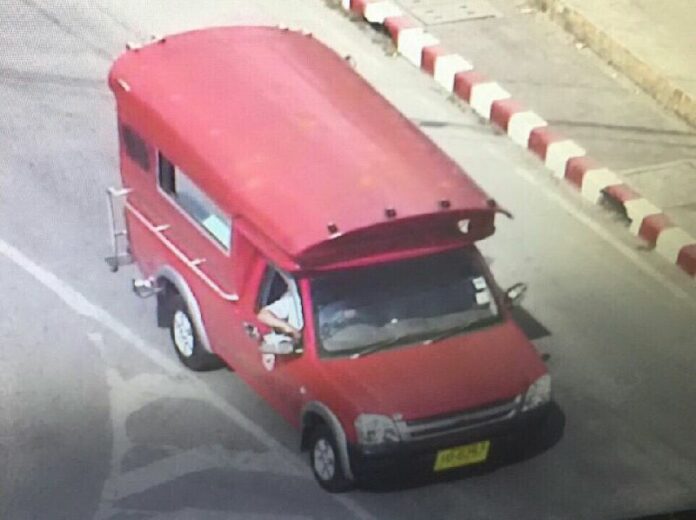
A CCTV image police said captured taxi truck driver Asang Ayiku on Tuesday when he is accused of assaulting a Japanese expat after a fare dispute in Chiang Mai.

CHIANG MAI — A taxi truck driver suspected of assaulting a Japanese man in the northern city of Chiang Mai has reportedly been arrested today.

Asang Ayiku, 58, was arrested and charged with assault two days after someone posted details of the alleged assault online and police tracked down the driver of the type of red truck taxi, or rot daeng, commonly found in the northern city.

Police Maj. Gen. Pacha Rattanapan said at a police news conference that Isuke Shimoda, the 76-year-old victim, hired Asang to take him to Star Dome Golf Course for 40 baht on Tuesday. The altercation arose after Asang declined to take the man into the course.

“The driver wouldn’t drive into the golf course because there were passengers in the truck,” Pacha said. “The Japanese national became angry and threw two 20 baht banknotes at the driver, but missed. This upset Mr. Asang.”

Asang then punched the Japanese man in the left eye and then fled the scene, Pacha said.

“Based on a discussion through an interpreter provided by the Japanese consulate, we learned that the victim is still frightened by what happened, because he has been living in Chiang Mai for 10 years, and he never had this experience before.”

Asang has been charged with physical assault. He told reporters today that he regretted his actions as it had damaged Chiang Mai’s reputation as a tourist destination.


To reach us about this article or another matter, please contact us by e-mail at: [email protected].

Follow Khaosod English on and Twitter for news, politics and more from Thailand.

\

Advertisement

Thailand Drowns in Sugar to Slake Thirst for Big Prizes

Children worship the cult of juice in an image collected by the 'Message to the Green Tea God' Tumblr, which features images posted to social media under the hashtag #ichitan.

BANGKOK — A new iPhone, Mercedes-Benz and other riches are only the twist of a cap away, according to the endless promotions for brands such as Ichitan, Yen Yen and Oishi.

While consumers drink their way through bottle after bottle in search of winning codes, they’re also burning out their pancreases on an overload of sugar, and health officials are calling for regulation of the advertisements.

“Thai people like lucky draw campaigns,” said the Department of Health’s Sutha Jienmaneechotchai. “Letting companies freely arrange the promotions has boosted consumption.

Sutha said other countries such as Japan have reined in such campaigns by limiting the rewards offered.

Every day a Thai consumer eats about 26 teaspoons of sugar, according to new data yesterday from the department.

According to the Ministry of Public Health, Thais consume 104 grams of sugar daily, which is about three times higher than what’s recommended by the World Health Organization, or WHO.

Those numbers are different from other studies. A February report from market research firm Euromonitor put Thai consumers at 29.3 grams of sugar per day, with an average American eating 126 grams on any given day.

In 2014 the WHO recommended an adult of average body size should keep daily sugar intake down to about 50 grams.

Sutha said his office will ask authorities to regulate ads for sugary products to fight rising levels of diabetes, as diabetes in the country has been on the rise.


Tan Passakornnatee, owner of Ichitan Co., is a household name and features prominently in his juice company’s aggressive advertising – often in his signature ‘Tanman’ costume


Most of that sugar, he said, was coming from sugary beverages. Green tea was found to contain the most – 12 to 14 teaspoons – while fresh coffee and soft drinks contained around 10 teaspoons of sugar.

Bottle cap contests and similar promotional tools have exploded in the highly competitive beverage market after they were introduced by well-known, costumed businessman Tan Passakornnatee some years back.

Competitors in the lucrative juice trade, which is expected to hit 1.7 billion baht this year, quickly followed suit by appealing to consumers with expensive prizes.

Advertisement

Why Everyone Should Really Avoid Ratchadamnoen on Saturday

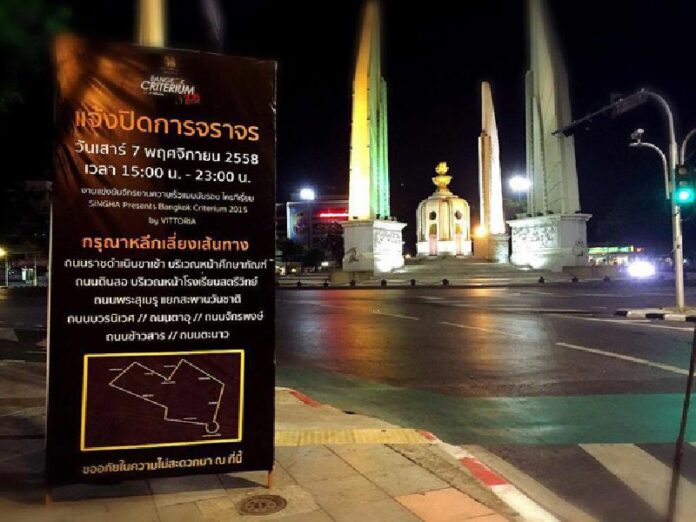
A image of a sign warning motorists of traffic on Saturday was posted online today by organizers of the Bangkok Criterium. Photo: Bangkok Criterium / Facebook

BANGKOK — Between a commercial cycling event and university graduation, traffic Saturday on Ratchadamnoen Avenue is expected to hit nightmare level, even by Bangkok standards.

Organizers of the Bangkok Criterium asked the public via Facebook today to avoid the area Saturday, as their event would close several roads from 3pm to 11pm.

The race, sponsored by Singha Corp., said arrangements had been made in cooperation with the police, but Senior Sgt. Maj. Chalakom Kijthongsai of the nearby police station on Khaosan Road told Khaosod English his office had heard nothing about it.

Dinso Road and Ratchadamnoen Avenue from the Khok Wua intersection to the Democracy Monument, organizers said. Four of the avenue’s eight lanes would remain open for two-way traffic.

Some online said they were alarmed by the announcement as traffic around the Sanam Luang was already expected to be awful as it was Thammasat University’s graduation rehearsal day. Thousands attend the event every year, which is known for crippling traffic in the area.

Facebook user Pitchakorn Poompayoong said it seemed to be poor planning.

“The schedule of the graduation day was already out, and we all know from the past how congested traffic gets during the rehearsal day,” he wrote in reply to the Criterium announcement. “… Let’s see Saturday whether it’s gonna be a mess or not.”

Completing the trifecta of traffic torture, the Chao Phraya river’s nearby Tha Chang Pier, another popular way to avoid traffic, shut down today for two weeks of renovation.

It should be back in service Nov. 20.

Advertisement

Suu Kyi Tells Reporters Not to 'Exaggerate' Persecution of Rohingya

Myanmar's National League for Democracy Party leader Aung San Suu Kyi speaks to media today about the upcoming general elections at her home in Yangon. Photo: Reuters / Soe Zeya Tun

By Timothy McLaughlin
Reuters

YANGON — Myanmar opposition leader Aung San Suu Kyi told reporters not to "exaggerate" the problems of the country, in response to a question about Rohingya, the country's persecuted Muslim minority living in western Rakhine State.

Speaking at a news conference in Yangon ahead of the Nov. 8 election, Suu Kyi said that the whole of Myanmar was experiencing a "dramatic situation," not just Rakhine State.

The political activity of the radical Buddhist group Ma Ba Tha, which has sharply criticized her National League for Democracy for not supporting a raft of legislation seen as anti-Muslim drafted by the group, was unconstitutional, she said.

Advertisement

Assassins Gun Down Shaman, Lucky Numbers Blamed

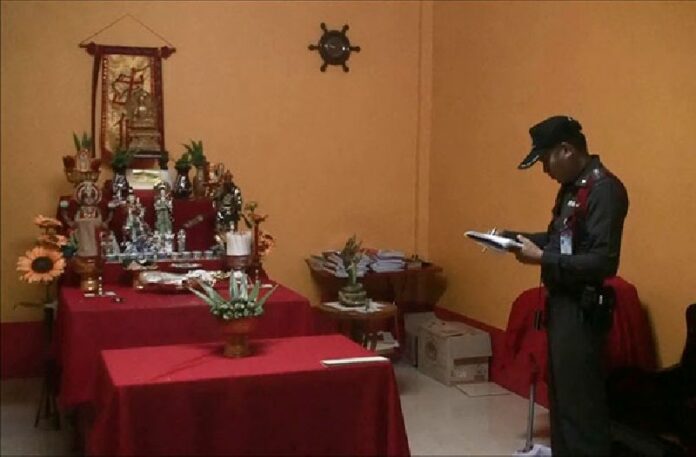
An investigator at the shrine of a shaman murdered last night in Nakhon Si Thammarat province.

NAKHON SI THAMMARAT — Chaiyuth Phetsringen had an uncanny ability to divine winning numbers, according to locals in the southern province of Nakhon Si Thammarat. So good was the 41-year-old shaman at foretelling winning digits, it might have killed him.

Chaiyuth – called “Guan Yu” for the dead Chinese general believed to inhabit his body – died in a hail of bullets as he was walking out from the shrine where he held court. Police arrived to find him dead on the scene with six apparent gunshot wounds witnesses said were fired from a black car 10 meters from the shrine.

Two people won the street lottery jackpot with Chaiyuth’s numbers last month, according to police Lt. Col. Prapan Decharath, and locals believe those running the numbers racket were angry at having to make big payouts.

\

Police last night examine the body of Chaiyuth Phetsringen, who was slain outside his shrine.

Reached by phone today, police Gen. Somkid Damklieng said adultery and drugs were also possible factors in Chaiyuth's murder, not just his acumen. He'd just checked security cameras on the road and said it looked like two people might have opened fire.

Chaiyuth’s brother, Chamnan Phetsringen, 44, told police the deceased was a three-time champion of the Rajadamnern Stadium’s Muay Thai competition in Southern Thailand under the name “Samliam Singhamanee.”

It was only a year ago he built his shrine after quitting boxing, Chamnan said.

Advertisement

Travel Through ASEAN Soundscapes at Museum Siam

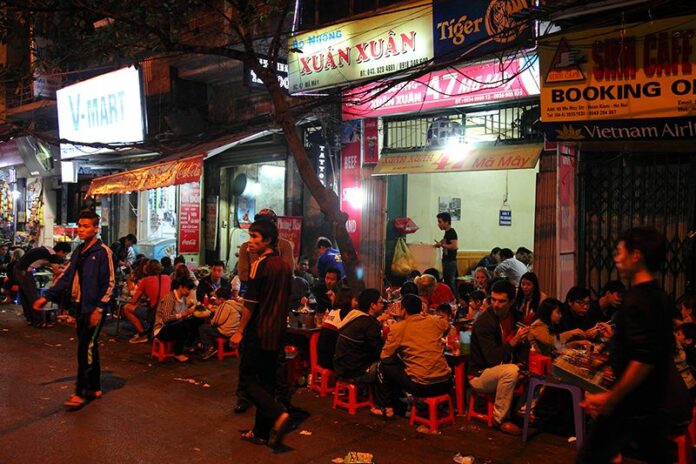
People listen to bamboo street music in Hanoi, Vietnam, in an undated photo. Photo: Courtesy Museum Siam

By Lisnaree Vichitsorasatra
Staff Reporter

BANGKOK — Take your eyes off the screen and open your ears to escape into another world that’s not so far away. Hear birds warble and chirp in a lush national park in coastal Cambodia. A master strikes notes from bamboo instruments on Borneo. Torrents of rain pound a village in the north of Vietnam.

Southeast Asia’s diversity of culture is poorly understood or experienced, and with Thailand on the verge of joining this broader community of neighbors, people can go on an aural adventure at As((ear))n, an exhibition of curated sounds from throughout the region now showing at Bangkok’s Museum Siam.

“This exhibition will encourage visitors to open their eyes and ears to the sounds, stories and histories, tastes and tales of the region,” Jean David-Caillouët, one of eight artists featured in the exhibition.

Sounds for the immersive installation were collected from Cambodia, Vietnam and Malaysia, and many from around Thailand.

To create a kind of ASEAN radio station tuned into its built and natural environments, the artists contributed video footage and sounds to archive the region’s diversity of sounds.

The As((ear))n exhibition is divided to two parts: an information and documentary room, and an interactive room with a 360-degree projector and eight speakers.

AS((EAR))N sound exhibition runs now through Dec. 20 at Museum Siam.

Here are a few of the sounds:


Hear more samples at Asearn.com.

Advertisement

Japanese Golfer Allegedly Beaten Over Disputed Fare in Chiang Mai

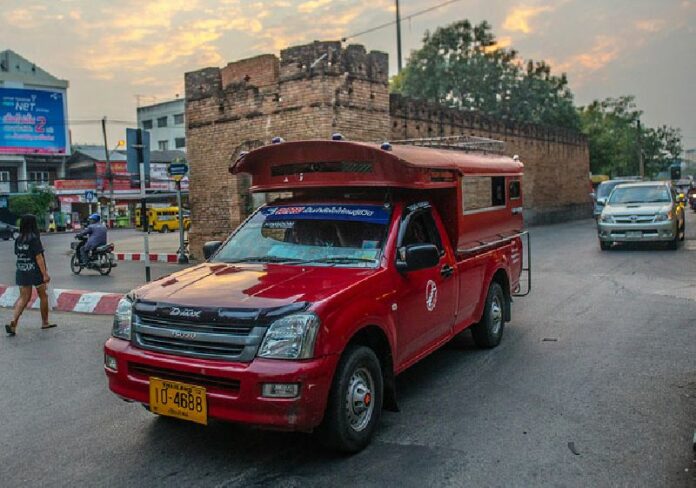
A red truck taxi called 'rot daeng' seen in a December 2013 file photo. Photo: Abdul Rahman

CHIANG MAI — A Japanese man was allegedly assaulted Tuesday by a driver of one of the red songtaew which circulate through Chiang Mai, and police said they are searching for his attacker.

Police were alerted to the incident through social media when someone posted a photo of what looked like a local driver punching an elderly Japanese man near the entrance to a golf course on Mahidol Road. 

“We are inspecting CCTV footage to track down the taxi,” Chiang Mai police Lt. Col. Nitikorn Sangkhakorn said today. “From the information we have read, it won’t be difficult. I believe we will be able to arrest and prosecute the driver who committed this crime for the sake of Chiang Mai’s city image.”

Nitikorn said police learned of the incident from Facebook and immediately dispatched officers to the scene to gather evidence. 

According to the story from Fang Fary on Facebook, the unidentified tourist hailed the red truck taxi, or rot daeng, from a condominium to the golf course. They reportedly settled on a 50 baht fare, but the driver demanded more money at the end of the trip, which the Japanese man refused to pay. 

\

Photo of the alleged wounds on the Japanese man's face posted by Fang Fary

An argument ensued. That’s when Fang said the driver started beating the Japanese man.

“Right now, the uncle is very scared. His eyes are swollen and his lip is bleeding. He’s too scared to go anywhere now,” Fang wrote. “He didn’t even want me to take photo of him, because he’s scared.”

She posted a close-up photo described as a wound to the Japanese man’s face as proof of the assault, which she said took place at around 9:30am on Tuesday. 


To reach us about this article or another matter, please contact us by e-mail at: [email protected].

Follow Khaosod English on and Twitter for news, politics and more from Thailand.

\

Advertisement

Toyota Logo Removed from Building Under Buddhist Pressure

The Toyota logo on a building in a cemetery in Lopburi province. Some Buddhists mistook it to be in a famous temple in Kanchanburi province.

LOPBURI — A Toyota logo at a cemetery in Lopburi province will be removed after it outraged a number of Buddhists online who thought it was affixed to a famous temple in Kanchanaburi province.

As it later turned out, the offending logo was not on Kanchanaburi’s Wat Wang Wiwekaram, as alleged in a viral post, but in fact some 400 kilometers away in Lopburi at a cemetery in the compound of Wat Takra Thong.

Toyota Motors Thailand today said it would remove the logo to defuse the outrage expressed by some Buddhists on social media, explaining it was placed on the building because it overlooks the tombs of a family with a historical connection to Toyota.

“It is located at the edge of the temple compound, which was not an area used by monks for religious services,” the statement said. Toyota said the family buried in view of the logo had once founded a local distribution company for the Japanese automaker. 

Efforts to chip away the logo were already underway when a reporter visited the temple this afternoon.

\

Toyota will commission new art for the building, according to local official Bamrung Srilachai.

“The representative of the company said they are preparing to carve Buddha figures or kanok lines [traditional drawings],” Bamrung said.

The allegation that Toyota desecrated the famous Kanchanaburi temple appears to have originated from the Facebook account of Tan Rasana.

In a post set to public-view on Tuesday morning, Tan posted that Toyota chairman Sumon Sutheewong ordered the logo emblazoned at Wat Wang Wiwekaram.

“This amounts to a corruption and grave disrespect of Buddhism,” Tan wrote. The post soon went viral on the internet, drawing condemnation from some Buddhists.

It didn’t take long, however, for the administrators at Wat Wang Wiwekaram to clarify that there was no such logo there. As of publication time, Tan had yet to remove or alter his post, which was shared more than 3,000 times.


To reach us about this article or another matter, please contact us by e-mail at: [email protected].

Follow Khaosod English on and Twitter for news, politics and more from Thailand.

\

Advertisement

Junta Turns to Populist Schemes to Ease Rural Tensions

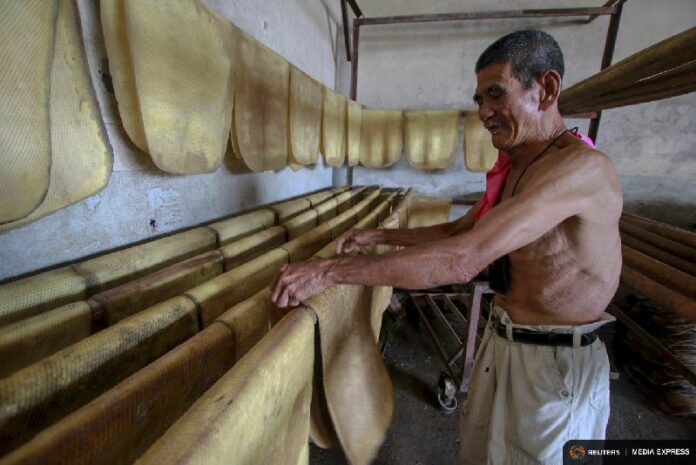
A man works inside a rubber factory today in the Raman district of Yala province. Photo: Reuters / Surapan Boonthanom

By Amy Sawitta Lefevre
Reuters

BANGKOK — Thailand's junta has approved USD$1.3 billion (46.1 billion baht) in rural subsidies, akin to the populist policies of the government it ousted, to appease disgruntled and politically powerful farmers who are struggling with record low commodity prices and weak exports.

The rural heartland of Thailand's deposed leader Yingluck Shinawatra and her exiled billionaire brother Thaksin is hurting as a result of the military government's economic policies, stirring discontent and the threat of protests.

The military government had pledged to wean farmers off expensive subsidies used by the previous government which it ousted in a 2014 coup.

But last week it approved measures worth around $1 billion (35.5 billion baht) to help rice farmers and on Tuesday gave the greenlight to USD$365 million (12.9 billion baht) to help rubber farmers who had threatened to rally in defiance of a ban on political gatherings.


Rising Anger in Boom-to-Bust Isaan


"In a situation of economic difficulty they have to stimulate consumption and what they think is: Give grassroots people money and it will circulate," said Gothom Arya, an advisor to the Institute of Human Rights and Peace Studies at Bangkok's Mahidol University.

"Though the junta's action is exactly the same as previous governments, they claim that this time money will not leak," said Arya.

Such measures would have been unthinkable immediately after the coup which ushered in a junta pledging to "clean up" Thailand and move the country away from corruption associated with politicians and their populist policies.

But seventeen months on, incomes in rural areas, where more than 34 million Thais live, have collapsed and farmers in the world's second-biggest rice exporter and top rubber exporter have been calling for the re-introduction of subsidies.


Junta Failing to Soothe Tensions

Thailand's farmers have been at the center of a decade of political turmoil. Military attempts to disperse 10 weeks of protests by Thaksin's "red shirt" supporters in 2010 left scores dead and sparked the worst violence in modern Thai history.

The subsidies are the latest in a raft of measures, including soft loans through village funds, by newly appointed Finance Minister Somkid Jatusripitak, one of the architects of the Shinawatra's populist policies, to appease farmers and boost the economy.

But while aid is rising, farmers remain critical of the junta, which has not guaranteed crop prices as farmers demand, and their measures are far from the scale of Yingluck's schemes.

"Rubber prices drop. We make less money. I would rather see the government help raise rubber prices," said Samai Sribang, 58, a rubber farmer.

A Yingluck rice program which paid almost 50 percent above global market prices, cost around $14 billion, and fueled criticism of vote-buying. She also spent $620 million building rubber stockpiles under a price support program.

In January, a military-appointed legislature impeached Yingluck for negligence over the rice scheme that distorted markets and built up massive rice stockpiles.

Additional reporting Patpicha Tanakasempipat and Aukkarapon Niyomat

Advertisement

Hot News

LATEST NEWS

Bangkok
light rain
28.3 ° C
28.3 °
28.3 °
82 %
3.6kmh
73 %
Sat
30 °
Sun
33 °
Mon
33 °
Tue
30 °
Wed
29 °