33.3 C
Bangkok
Saturday, July 25, 2026
Home Blog Page 2936

McDonald’s Denies Boycotting Fish From Thailand

BANGKOK — McDonald’s Thailand today denied rumors the multinational franchise did not use fish from Thailand due to the use of slave labor.

Responding to a fake photo of a McDonald's sign saying it was boycotting fish from Thailand – which inspired some online to threaten a counter-boycott in response – the fast food chain’s local partner announced on Facebook page today that while it only imports fish from the U.S. state of Alaska, it does so just for the sake of great taste.

“Regarding the latest picture shared via social media, it’s not a true story! Please carefully consider prior to sharing that one,” read the post.

The viral photo on social media yesterday convinced some netizens their source of Filet-O-Fish is boycotting fishery products from Thailand out of concern about the use of slave labor in Thailand’s seafood industry.

“We don’t use fish caught in Thailand by slave labor in our fish sandwiches,” it read.

Some were incensed.

“They’re so clearly against us, so how can we still go to McDonald’s? Think about it … Are you actually Thai?” read a comment circulated with the image online.

McDonald’s isn’t known for making political statements on the signs of its stores, and the photo was quickly exposed to be fake made by an online sign generator.


\

The original image circulated online


Thailand’s seafood industry has been criticized internationally since its dark realities were exposed last year by investigative reports from major news outlets. Those reports contributed to Thailand being ranked again at the lowest level in an annual human trafficking report issued by the U.S. State Department.

The European Union has also warned that Thailand might be given a “red card” this month due to its failure to curb illegal fishing and labor abuse after the country was warned in April. The ban would severely affect the over 200 billion baht industry, which is heavily dependent on exports.


Related stories:

Greenpeace Calls Out Thai Union Group Over Fishing Practices

EU Warning on Illegal Fishing Has Thai Fishing Industry Reeling

Raid on Southern Fishing Pier Finds No Human Trafficking: Police


Advertisement

Further Autopsy of Lese Majeste Inmate Unnecessary, Minister Says

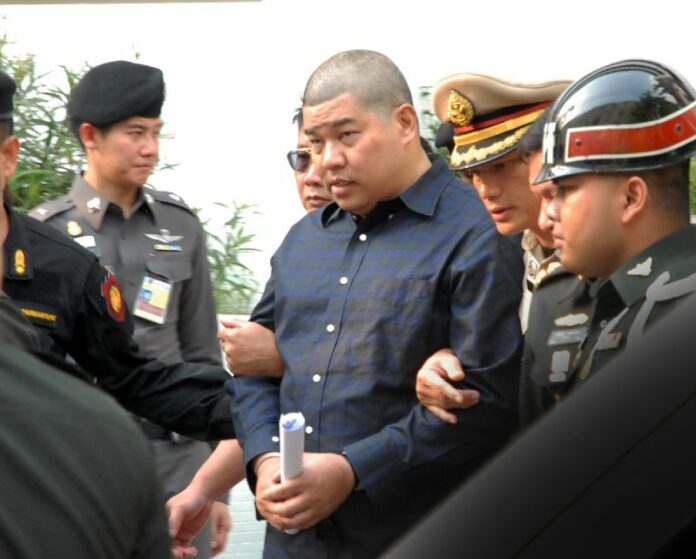
Police officers escort Police Maj. Prakrom Warunprapha to the martial court in Bangkok on Oct. 21, 2015

BANGKOK — Officials have already completed an autopsy of the lese majeste suspect who died in custody and have already returned his body to his family, the Minister of Justice said today.

Justice Minister Paiboon Khumchaya told reporters that police completed an autopsy of the inmate, Police Maj. Prakrom Warunprapha, at the prison hospital where he was taken Friday after after hanging himself. Prakrom’s body, Paiboon said, has been handed over the body to his family.

“This case is now over, because the family already picked up the body,” Gen. Paiboon said.

A former police officer in the online crime division, Prakrom reportedly hanged himself two days after he was taken to a martial court Oct. 21 and formally charged with lese majeste (insulting the monarchy) along with two other suspects. The trio was then placed in custody at the 11th Infantry Division base in Bangkok, which has been converted into a special prison for cases said to affect national security.


‘Royal Imposters’ Suspect Involved in Past Lese Majeste Crackdowns


Authorities on Saturday announced Prakrom had committed suicide in solitary confinement by hanging himself with prison garments. A statement released to the press by the Department of Corrections said a fact-finding committee would investigate Prakrom’s death, and his body would be sent to the Forensic Medicine Institute at the Police Hospital for autopsy.

But Paiboon said today there was no reason for an autopsy to be conducted at the police hospital.

“In this case, the Department of Corrections invited a committee to verify [the death], which consists of a prosecutor, police, administrative officials and forensic medicine doctors, to examine the body to find the cause of death, and we have already issued a death certificate for him,” Paiboon said.

“There was no need to send the body for examination at the Forensic Medicine Institute,” he said.

Asked why no camera was installed to track suspects’ movements in their holding cells, Paiboon replied that doing so risked violating their human rights.

“You have to look at whether it violates the inmates’ human rights,” Paiboon said. “The temporary prison is not a high-security prison. It’s not a supermax like Khao Bin Central Prison, where they track movement of inmates all the time.”

Prakrom and two other men, Suriyan Sujaritpalawong and Jirawong Watanathewasilp, were arrested Oct. 16 and accused of falsely claiming ties to the monarchy for personal gain.


Famous Astrologer Among Accused ‘Royal Imposters’


They have been charged under Section 112 of the Thai Penal Code, a law also known as lese majeste, which outlaws any action or remark that damages the reputation of the Royal Family.

Speaking to reporters today, Paiboon also dismissed rumors on the social media that Suriyan is also dead. According to Paiboon, Suriyan did suffer from stress and high blood pressure, but he had already been sent to a hospital for treatment.

“I received a report just this morning that Mr. Suriyan requested congee as his breakfast,” Paiboon said. “So, I don’t understand people who spread this rumor, what kind of intentions they have.”


Correction: The original version of this article misspelled the name of the Department of Corrections. We regret the error. 

Note: A blanket ban has been issued on reporting this issue, apart from official announcements. Due to this, portions of this story have been self-censored.


To reach us about this article or another matter, please contact us by e-mail at: [email protected].

Follow Khaosod English on and Twitter for news, politics and more from Thailand.

\

Advertisement

US Regulator in Thailand to Inspect Aviation Safety

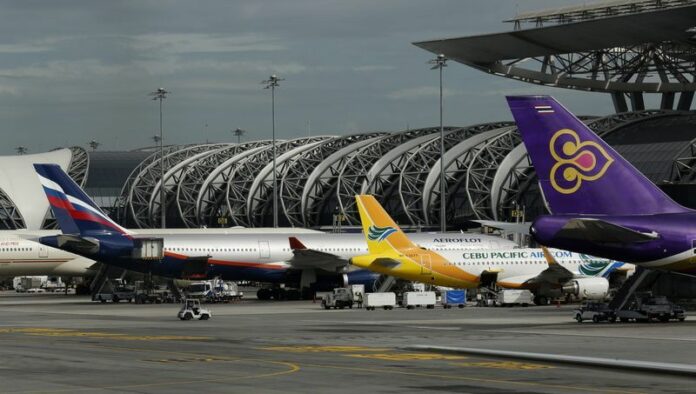
Aircraft at Bangkok's Suvarnabhumi Airport in a July 2014 file photo. Photo: Barbara Walton / EPA

Reuters

BANGKOK — U.S. authorities are in Thailand to inspect progress made in aviation safety standards after it told the country to address shortcomings or face a downgrade, the transport minister said today.

The three-day inspection comes after the U.S. Federal Aviation Administration, or FAA, gave Thai aviation authorities 65 days in July to take corrective measures over what it said were critical omissions in its commercial aviation safety standards.

Thailand faces a downgrade from a category 1 to a category 2 if it does not show improvement.

That could impact the industry's credibility after the United Nations' aviation agency downgraded safety ratings for Thailand's civil aviation body in June.

Carriers could also face a flight ban to the United States although no Thai-registered airline currently operates direct flights to the United States.

Transport Minister Arkhom Termpittayapaisith said Thailand had addressed and rectified 35 problem areas identified by the U.S. regulator and a decision over whether to downgrade Thailand will come next month.

"The FAA is here to follow up our progress on six major points and 35 issues they raised," Arkhom told reporters in Bangkok. "I've been told that we have solved them all."

"This is an important issue that we need to solve because it will affect the Thai aviation sector in the long-term," he added, without specifying what action Thailand had taken to improve safety.

In March, South Korea, Japan and China stopped Thailand-based airlines from flying charters and new routes because of safety concerns raised in an international audit. Those restrictions have since been relaxed.

The inspection comes at a time when Thailand's vital tourism sector is making an impressive rebound after anti-government protests in 2014 took a heavy toll on tourism in the capital Bangkok and a bomb attack in August killed 20 people, more than half of them foreigners.

A record 30.3 million tourists are expected to visit this year, the tourism council said last week.

Arkhom said the FAA would give its decision on whether to downgrade Thailand next month.

Story: Aukkarapon Niyomyat and Amy Sawitta Lefevre

Advertisement

Koh Tao Murders: Defense Asks Court to Drop Charges

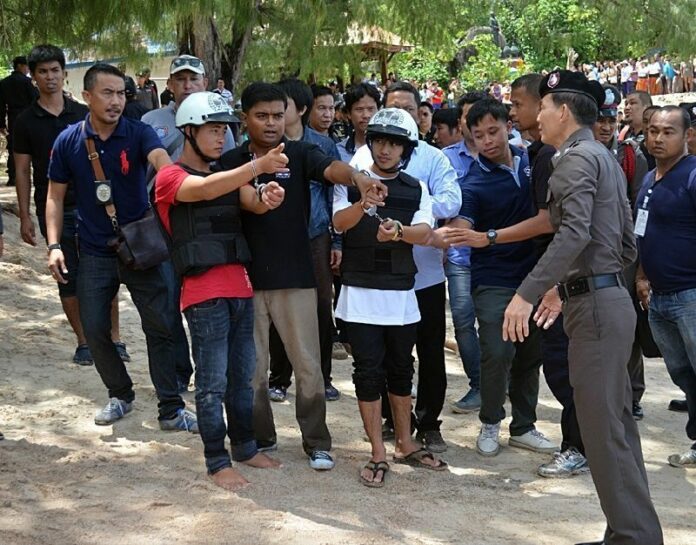
Zaw Lin and Wai Phyo are guided through a 're-enactment' of the past September's double-murder on Koh Tao On October 3, 2014, file photo.


SURAT THANI — Lawyers representing two Myanmar migrant workers accused of killing two British tourists on Koh Tao murder called on the court today to drop all charges against the accused.

In a written closing statement submitted to the Koh Samui Court today, the volunteer legal team stressed the court should dismiss the charges against Zaw Lin and Wai Phyo due to the weakness of the evidence against them and procedural abuses at the time of their arrest.

“The prosecution’s case is marked by an absence of significant evidence needed to prove the guilt of the accused for the crimes they are charged with,” read the statement filed with the court today.

The two men have been accused of murder, rape and theft. They face the death penalty if convicted.

The legal team, provided by the Lawyers Council of Thailand, said the two men standing trial for the September 2014 murders were arrested illegally as they were denied legal representation and qualified translators. The statement also repeated key testimony to emerge during the trial including claims the suspects weretortured into confessing, a top forensic examiner concluding DNA collected from the alleged murder weapon did not match the accused.

Hannah Witheridge, 23, and David Miller, 24, were found murdered Sept. 15, 2014, on Koh Tao, a resort island in the south of Thailand. Investigators later determined Witheridge was raped.

The investigation got off to an unimpressive start and was widely criticized as unprofessional.

Police subsequently arrested the two men who worked at a restaurant near to the crime scene. The prosecution’s case was largely based on forensic evidence collected from the scene and security camera footage.

Police quickly announced the two men, both 21 at the time, had confessed. On Oct. 14 the men retracted their confessions, and they were soon extended legal representation by the defense team. Myanmar officials and human rights group expressed concern the two migrants might have been used as scapegoats.

The trial ended one year later on Oct. 11. Thirty-four witnesses were called during its 21 days. The Koh Samui Court has summoned all involved parties to hear the verdict Dec. 24.

The statements went into depth on what it described were deficiencies in the handling and analysis of the DNA evidence.

It said results furnished by police showing a match with the accused should not be accepted, as the material was not collected following international standards, and many significant items were absent from the prosecution’s case, including details on how the autopsy and forensic examinations were conducted. Certain items which might have contained trace samples were never tested, it said.

In the final testimony delivered Oct. 10 and Oct. 11, the accused told the court they were both mentally and physically abused by police. Before they were led through a much-publicized “re-enactment” of the crime, the men said they were instructed on how to act and told to confess as they had no rights as illegal immigrants.

Police officials have repeatedly denied all allegations of abuse or scapegoating, saying their evidence and test results established the pair’s guilt.


Related stories:

Accused Detail Torture in Final Testimony of Koh Tao Murders Trial

Koh Tao Murders: DNA on Weapon ‘Does Not Match’ the Accused

Koh Tao Murders: More Forensic Evidence Available for Re-Test, Witness Reveals

Koh Tao Trial Resumes, Court Shown Footage of Victims’ Final Night

Lack of Evidence, Local Media Coverage Adds to Mystery of Koh Tao Murder

Year in Prison Has Been ‘Torture,’ Says Koh Tao Suspect

Timeline of Koh Tao Murder Investigation


To reach us about this article or another matter, please contact us by e-mail at: [email protected].

Follow Khaosod English on and Twitter for news, politics and more from Thailand.

\

Advertisement

Koh Tao Murders: Defense Asks Court to Drop Charges

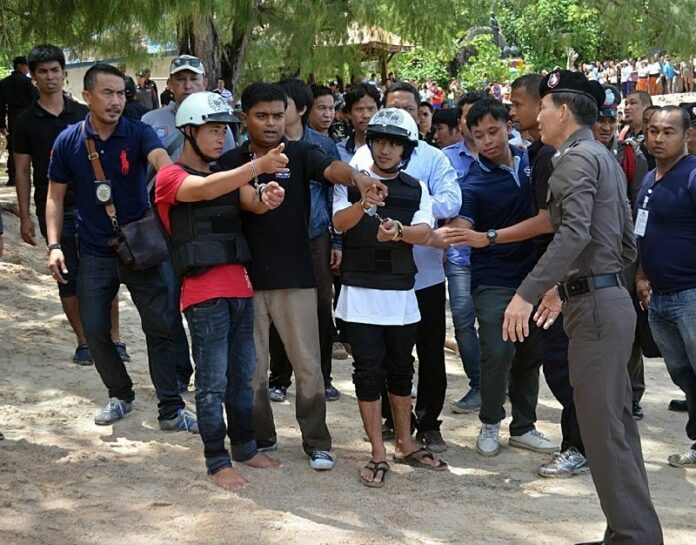
Zaw Lin and Wai Phyo are guided through a 're-enactment' of the past September's double-murder on Koh Tao On October 3, 2014, file photo.

SURAT THANI — Lawyers representing two Myanmar migrant workers accused of killing two British tourists on Koh Tao murder called on the court today to drop all charges against the accused.

In a written closing statement submitted to the Koh Samui Court today, the volunteer legal team stressed the court should dismiss the charges against Zaw Lin and Wai Phyo due to the weakness of the evidence against them and procedural abuses at the time of their arrest.

“The prosecution’s case is marked by an absence of significant evidence needed to prove the guilt of the accused for the crimes they are charged with,” read the statement filed with the court today.

The two men have been accused of murder, rape and theft. They face the death penalty if convicted.

The legal team, provided by the Lawyers Council of Thailand, said the two men standing trial for the September 2014 murders were arrested illegally as they were denied legal representation and qualified translators. The statement also repeated key testimony to emerge during the trial including claims the suspects were tortured into confessing, a top forensic examiner concluding DNA collected from the alleged murder weapon did not match the accused.

Hannah Witheridge, 23, and David Miller, 24, were found murdered Sept. 15, 2014, on Koh Tao, a resort island in the south of Thailand. Investigators later determined Witheridge was raped.

The investigation got off to an unimpressive start and was widely criticized as unprofessional.

Police subsequently arrested the two men who worked at a restaurant near to the crime scene. The prosecution’s case was largely based on forensic evidence collected from the scene and security camera footage.

Police quickly announced the two men, both 21 at the time, had confessed. On Oct. 14 the men retracted their confessions, and they were soon extended legal representation by the defense team. Myanmar officials and human rights group expressed concern the two migrants might have been used as scapegoats.

The trial ended one year later on Oct. 11. Thirty-four witnesses were called during its 21 days. The Koh Samui Court has summoned all involved parties to hear the verdict Dec. 24.

The statements went into depth on what it described were deficiencies in the handling and analysis of the DNA evidence.

It said results furnished by police showing a match with the accused should not be accepted, as the material was not collected following international standards, and many significant items were absent from the prosecution’s case, including details on how the autopsy and forensic examinations were conducted. Certain items which might have contained trace samples were never tested, it said.

In the final testimony delivered Oct. 10 and Oct. 11, the accused told the court they were both mentally and physically abused by police. Before they were led through a much-publicized “re-enactment” of the crime, the men said they were instructed on how to act and told to confess as they had no rights as illegal immigrants.

Police officials have repeatedly denied all allegations of abuse or scapegoating, saying their evidence and test results established the pair’s guilt.


Related stories:

Accused Detail Torture in Final Testimony of Koh Tao Murders Trial

Koh Tao Murders: DNA on Weapon ‘Does Not Match’ the Accused

Koh Tao Murders: More Forensic Evidence Available for Re-Test, Witness Reveals

Koh Tao Trial Resumes, Court Shown Footage of Victims’ Final Night

Lack of Evidence, Local Media Coverage Adds to Mystery of Koh Tao Murder

Year in Prison Has Been 'Torture,' Says Koh Tao Suspect

Timeline of Koh Tao Murder Investigation


Advertisement

‘Special Police’ Prepare for Myanmar Elections

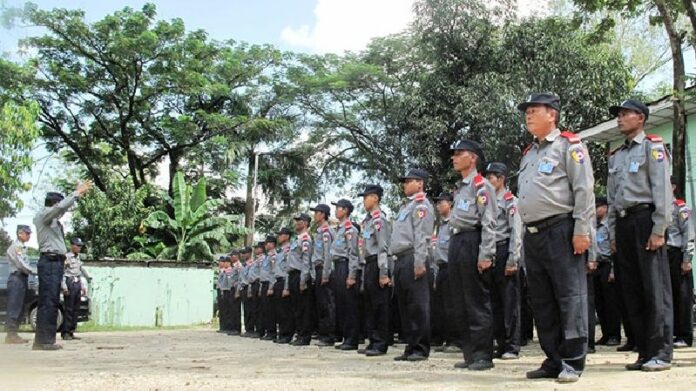
Members of the "Special Police" on their first day of training Oct. 20 on the grounds of the township administration office in Thinganggyun Township, Yangon. Photo: Myanmar Now / Htet Khaung Lin

YANGON — Clad in a Myanmar policeman’s uniform of grey shirt, navy trousers and matching cap, 20-year-old Kyaw Ye Lin puts on a brave face as he sweats in the scorching morning heat.

The only thing setting him apart from the rank and file of Myanmar’s police force is his red epaulettes, which marks him as a member of the “special police” recruited to provide security at polling stations in the Nov. 8 elections.

This is his first day of training as one of 60 recruits in Thinganggyun Township in Yangon, an eclectic group composed of both young and old men with varying levels of policing experience.

They are part of some 40,000 new police officers hired by the Myanmar Police Force across the country to guard the landmark polls, billed as Myanmar’s first free and fair vote in 25 years.

In the run-up to the elections, activists and human rights groups have expressed fears that special police officers would be recruited from plainclothes gangs often used to break up protests and gatherings on behalf of the authorities.  

Rumors are already rife within Myanmar’s lively social media scene that members of these gangs are now donning special police uniforms.  

But recruiting officers told Myanmar Now the special police would be properly trained and disciplined, and their powers would be limited.

Kyaw Ye Lin has yet to complete high school but said he has always dreamt of joining the police. So when the opportunity came up to be part of this group, he jumped at it.

“I’m going to take the 10th standard exam again this year and then apply to become a police officer so (this work) would give me experience,” he told Myanmar Now during a break from training, which began at 8 o’clock in the compound of the township administrative office.

“I’m excited. I have friends who are auxiliary firemen in our neighborhood  but I’ve never really worked with police officers before,” added Kyaw Ye Lin, who lives with his widowed mother.

\

A photo on the March 12 front page of local-language journal The People’s Age shows Swan Arr Shin militia men detaining student protestors in Yangon. Photo: Myanmar Now

No More Red Armbands

It is estimated that Myanmar Police Force has around 150,000 officers but the authorities say more are needed to bolster security and ensure a smooth process at polling stations nationwide.

They have so far recruited more than 40,000 special police officers, the vast majority of them with no education beyond high school. A special police officer will be stationed in each polling station.

Recruiting was conducted through ward officials, in a similar fashion to recruitment of ordinary police officers, and the candidates were selected based on 12 physical requirements, including good overall health, appearance and not having “bandy legs,” said Thet Oo, an inspector at Thinganggyun Township police station and an instructor on special policing methods.

“In the training, we will teach them how to police without weapons, human rights, police ethics, community participation in policing, security plans for the elections, election laws and by-laws,” the inspector told Myanmar Now.

Training sessions are being held across the country between Oct. 20 and 31, and the officers will work until Nov. 13, the police said, a shorter period than when the plan was originally announced.

The 2010 elections were held with the help of security guards wearing red armbands and without any special police officers. The same system was used for security of subsequent major events.

But such security methods came under scrutiny during violent crackdowns on peaceful protesters by armband-wearing guards this year, said Khin Wai, a member of the group overseeing the recruitment of special police in Yangon as well as former local leader of the ruling Union Solidarity and Development Party in Thinganggyun.

“We didn’t have special police in the 2010 elections. We just had men with red armbands. But as everyone knows, in one particular event, a man with tattoos wearing a red armband was pictured choking a person. Those photos spread nationwide and it became clear the red armband can no longer be used,” he said.

The Nov. 8 elections take place amid simmering sectarian tension in Myanmar and the growing power of Buddhist nationalist movements.

And although the Myanmar army has taken a back seat in reforms leading up to the first elections to be contested by all main opposition parties, there are still hardliners in its ranks who could choose to scuttle the process, as they did following the 1990 polls.

The conduct of security forces on election day will not only determine whether the election is carried out smoothly, but also whether it is perceived as credible, according to a report published earlier this year by Princeton University’s Woodrow Wilson School of Public and International Affairs.


Who Are the Special Police?

Existing policemen and recent recruits are not eligible to become special police.

A majority of special police are civilians but also include auxiliary firemen, former soldiers and army officers, Red Cross volunteers and members of ward administration offices, according to sub-inspector Khin Maung Kyaing of Thinganggyun Police Station.

They are paid 120,000 kyats (about USD$95) a month, as well as a 1,000 kyat daily allowance and are given a booklet with 12 rules and obligations to follow. (See FACTBOX)  

The recruits include people like 45-years-old Khin Maung Tun, a former auxiliary firemen turned insurance salesman, and 55-years-old community elder Saw Thein.

“I take pride in having this responsibility as a special policeman. It’s only because of the elections that we are working with the state. I never thought something like this would happen,” Khin Maung Tun said.

Saw Thein said he too had never taken a responsibility such as this.

“This is the first time I’m working with the ward authorities. I’ve only ever focused on religious and social issues so I thought I should get some experience doing something for the country,” he said.

In the opening speech of the training, township administrator Kyaw Lwin told the recruits what they should do (listen to the polling officer at the station) and not do (be rash or overzealous).

“Your duty is to prevent (people) from violating election laws. Even if the ward election commission asks you to do something, you have to inform the polling officer first,” he said.

He also warned them not to escalate tensions and that action would be taken against them if they themselves violated the law.

Thet Oo, inspector at Thinganggyun Township Police Station, said special police would not be carrying handcuffs or batons and could only go inside the polling station with the permission of the polling officer.

“They don’t have the authority to arrest anyone,” he said. 

Story: Htet Khaung Linn

Advertisement

Thousands Arrested as Visa Overstay Bans go for PM’s Endorsement

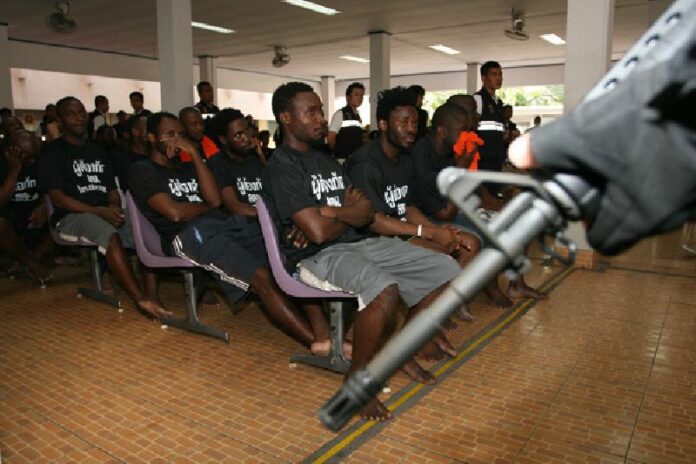
Wearing shirts that say "detainee," foreign nationals accused of being in the country illegally were displayed on Oct. 25, 2015, at the immigration police headquarters in Bangkok.

BANGKOK — Harsher punishments introduced last year for foreigners who overstay their visas might be strengthened by the prime minister’s pen as immigration police announced more than 9,000 people were arrested during the past week.

Aiming to reduce illegal immigration by 80 percent, immigration officials have asked Gen. Prayuth Chan-ocha to use his special power granted after the 2014 coup to reaffirm rules introduced last year banning foreigners from Thailand for one to 10 years, depending on the length of overstay.

“The current punishment for overstaying is a 500-baht fine, the maximum is a 20,000-baht fine and sending them back to their countries,” said Immigration chief, police Lt. Gen. Nathathorn Prousoontorn. “So the next day, they can just travel back here as we don’t have a blacklist system like other countries.”

The rules have already won approval from the Interior Minister and have been submitted to Prayuth to consider.

Authorities on Sunday also revealed they arrested 9,265 people suspected of being in the country illegally during a seven-day operation which ended Sunday. Police said they want to reduce the estimated 800,000 people in Thailand illegally by 80 percent.

Almost all – nearly 98 percent – of those arrested face charges under the 1979 Immigration Act, police said, with 18 others facing other criminal charges and 209 accused of other offenses.

Immigration, a matter of cyclical enforcement and periodic crackdowns, returned to urgency after the bombing of a popular tourist attraction in August killed 20 people. Most of the suspects identified in the ensuing investigation appeared to have entered the country illegally, possibly by paying cash bribes at border checkpoints.

In 2013, 70,175 foreigners were arrested for overstaying their visas.

The penalties announced Sunday are identical to regulations announced by the immigration bureau last year that have been in effect since Aug. 17, 2014.

Foreign nationals who remain in the country more than 90 days after their visa expires are to be banned for one year. Those who overstay for one year, three years or five years are forbidden from re-entering the country for three years, five years and 10 years respectively. If they don’t turn themselves in and are instead caught by police, those who have overstayed less than a year would be blacklisted for five years while those with over a year face a 10-year ban.

Police also announced they arrested six foreigners from four cases including two Russian fraud convicts sought by Interpol, two Cameroonians convicted of forging documents, a Korean man sought on a Korean warrant relating to onling gambling and a Burmese man convicted of using a faking the immigration stamp.


Advertisement

Nong Khai Readies for ‘Naga Fireballs’ (Photos)

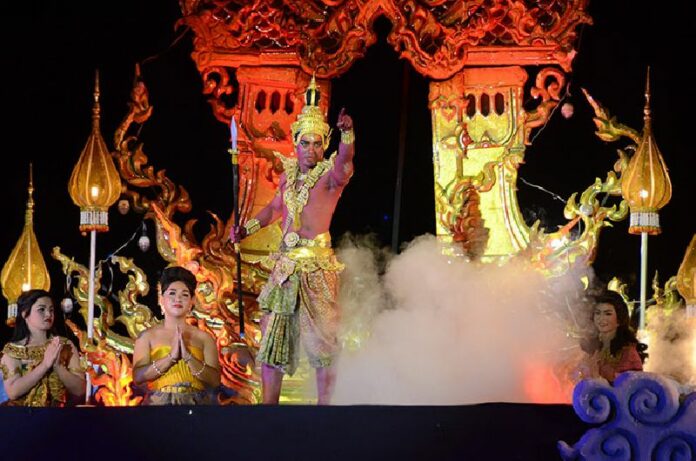
A show at Wat Sri Boonruang in Nong Khai province Sunday night opened Naga Fireball season.

NONG KHAI — When the waxing moon hits full Tuesday, the nagas will come out and play.

As the story goes, the mythical serpents which reside in the depths of the Mekong River celebrate the end of Buddhist Lent and a celestial sojourn by the Buddha by belching magical orbs of fire into the sky.

In practice, it’s a curious mix of stagecraft and myth that draws tourists to witness fire shot into the sky above the river running between Thailand and Laos, along with fireworks and light shows.

Opening theatrics kicked off Nong Khai’s Naga season Sunday night at Wat Sri Boonruang. The show explains, in mythical terms, just how the fireballs came to be. Some suspect more mundane means are behind the fiery display, but such speculation is generally ignored for being boring.

An encore of the show will be held tonight.

\

\

\

Advertisement

Indonesian Smog Reaches Indonesian Capital

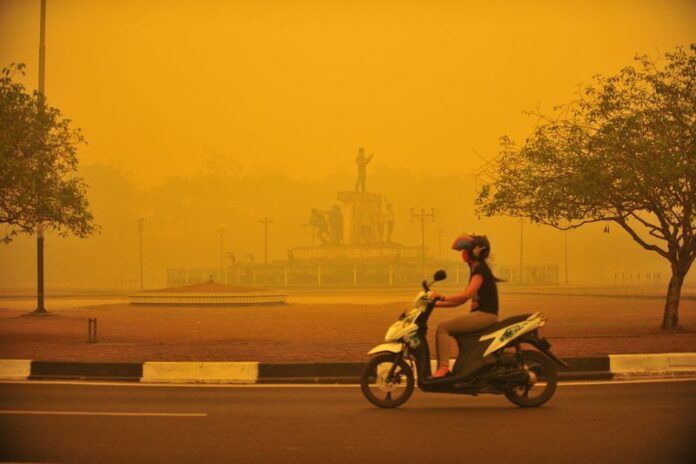
Instead of the customary blue, smog has turned the sky yellow over Kalimantan, Indonesia, in this undated photo. Photo: EPA / Hugo Hudoyoko

JAKARTA — Haze from forest fires in Indonesia's Sumatra and Kalimantan reached the capital Jakarta on Sunday.

"A thin haze has been shrouding Jakarta's sky since Friday until now at 1,000 to 1,300[-meter] altitude," Sutopo Purwo Nugroho, a spokesman for the National Disaster Management Agency said.

"It looks thicker in the morning because it has been mixed with fog. This is only temporary and it can change any time depending on where the wind blows. Jakarta's air quality is still normal to moderate," the official said. 

He added that the smog from forest fires in both islands has spread widely, and satellite monitoring on Sunday morning showed that a third of Indonesia's territory was shrouded in smog.

Central Java, Yogyakarta, parts of East Java, East Nusa Tenggara, North Sulawesi and northern part of Papua island remained unaffected by the haze.  

Nugroho said thick smoke continues to shroud many parts of Sumatra and Kalimantan and there is low visibility of less than 1 kilometer in a number of cities on both islands. 

Air quality in the Sumatran cities of Pekanbaru, Jambi and Palembang and Kalimantan's Pontianak and Palangkaraya remained unhealthy and hazardous.

"It has been almost two months now that people in Riau, Jambi and Palangkaraya are choking with hazardous smog," Nugroho said.

Story: DPA

Advertisement

Junta Warns Redshirts Not to Don Red Shirts

Redshirts don their red shirts at a rally at Ratchaprasong Intersection in Bangkok in this April 8, 2010, file photo.

By Teeranai Charuvastra
Staff Reporter

BANGKOK — The ruling military junta warned that Redshirt leaders will be held responsible if their supporters go ahead with a plan to wear red shirts simultaneously all across the country Sunday.

Deputy junta chairman Pravit Wongsuwan issued the warning this morning, referring to calls made by Redshirt activists on social media to wear red on Nov. 1 as a gesture to support former Prime Minister Yingluck Shinawatra – despite Redshirt leaders have already denied any involvement in the campaign.

“If the mass wearing of red shirts does take place, those who do it and their leaders will be held responsible, because there are laws that can prosecute this kind of action,” said Gen. Pravit, who also serves as Minister of Defense. “I insist that anyone can wear red, because today there is no [political] division based on different colors anymore, but it doesn’t mean that they can wear red to band together to do something.”

The campaign, which seemed to surface among Redshirt supporters on social media last week, urged Redshirts across the nation to show support for former PM Yingluck, who is currently facing a court trial on allegations of corruption in her administration.

Political activities and protests of any kind have been banned since the military junta seized power from the Redshirt-backed government in May 2014. Redshirt leaders and politicians have also kept a low profile since the coup, largely to comply with the junta’s ban on political activities. 


Read more: the Yellowshirts and Redshirts


Some of those leaders were quick to clarify to the press that they had nothing to do with the ongoing campaign on social media to wear red on Nov. 1. 

“The UDD didn’t arrange it, and I don’t know who is arranging it,” Weng Tojirakarn, a leader of the United Front of Democracy Against Dictatorship, or UDD, an umbrella group of the Redshirt movement, said on Saturday. “But it’s probably people who are frustrated by the [legal cases against] Ms. Yingluck.”

He also urged the junta to relax.

“The more the government warns about this, the more people will rise up and wear red. And I don’t understand why it’s a crime to wear red? It’s what they wear in daily life. They don’t wear it for any gathering or rally. I’d like to tell the government that this matter is about freedom and rights of the people.” 

UDD chairman Jatuporn Prompan suggested that it was in fact opponents of Redshirts who created the campaign to lure Redshirts into an act of provocation that could be used as the grounds to file more charges against Yingluck. 

“I insist that the campaign is not arranged by the UDD. It was arranged by opponents of Ms. Yingluck, who want to use Redshirts as bait,” Jatuporn said Saturday. 

“It’s a trap,” Jatuporn told Khaosod. “Redshirts can love and care for Ms. Yingluck, but don’t be dumb. To love someone, you have to be rational, and avoid becoming a burden for the person you love. Otherwise, it would just lead to problem and disaster for the person you love, because they are waiting to seize on this kind of thing to bully the former prime minister.”

For much of the past decade, political factions in Thailand have been divided into two camps, the Yellowshirts and the Redshirts; the name refers to color of the shirts they don at protests and rallies to distinguish themselves for their rivals. 

Yellowshirts are dedicated to removing former Prime Minister Thaksin Shinawatra and his influence from politics, while Redshirts are staunch supporters of Thaksin and his allies and proxies, which include Yingluck – Thaksin’s younger sister – who served as prime minister from 2011 to 2014.

Following months of anti-government protests organized by groups affiliated with the Yellowshirts, the military intervened and staged a coup against the Yingluck administration on May 22, 2014. The junta subsequently banned all form of protest. It also set out on what it called an effort to “end color politics” and restore reconciliation in Thailand. 

However, Redshirt activists have complained its policies are unevenly applied to target only their movement. 

Related news:

Chiang Mai Army Hunts Down 'Red Buffalo' Shirts

Soldiers Confiscate 'Thaksin Strawberry Jam'

Junta Nixes Redshirt News Conference


To reach us about this article or another matter, please contact us by e-mail at: [email protected].

Follow Khaosod English on and Twitter for news, politics and more from Thailand.

\

Advertisement

Hot News

LATEST NEWS

Bangkok
overcast clouds
33.3 ° C
33.3 °
32.7 °
57 %
5.7kmh
94 %
Sat
35 °
Sun
32 °
Mon
30 °
Tue
31 °
Wed
32 °