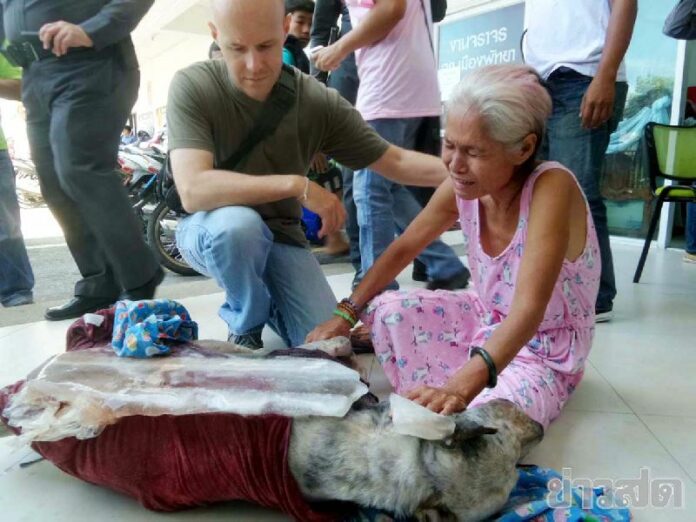
Duangporn Srabua, at right, arrives to the Pattaya Police Station with the remains of Rod Thang, her dog which was stabbed to death July 9 outside her restaurant in the Jomtien Beach area.
PATTAYA — There may be few dull days for cops in Pattaya’s coastal enclave of sunshine and vice, but some eyebrows were likely raised when a woman walked into the station yesterday with the frostbitten remains of a beloved pet.
Following the arrest of a Russian man on an unrelated issue, Duangporn Srabua, 58, arrived with the body of Rod Thang (Tank), the pitbull she kept frozen three months in the name of justice, to accuse him of the crime.
Animal advocates from the Pattaya Animal Coalition assisted Duangporn in bringing the American Pit Bull Terrier’s body to the station as evidence against Alexsandr Ponomarev, the 30-year-old Russian accused of killing the dog July 9 on Jomtien Beach.
Alexsandr Ponomarev, 30 of Russia, sits yesterday in a police station in Pattaya. He's been charged with animal abuse for allegedly stabbing a pitbull to death three months ago.
Supaporn Kobaishi, a 41-year-old staff member of the group, said they had notified immigration officers to be on the lookout for Ponomarev after he left Thailand after Rod Thang was killed July 9.
She said he returned and got picked up by police for carrying an expired passport. Police had zero interest in bringing him to justice for Rod Thang’s death, she added, until a reporter inquired about the case.
Ponomarev has now admitted to stabbing Rod Thang using the two knives he was carrying that day, according to police Lt. Col. Somkid Sittisatra. He told police the dog bit him first, so he was angry.
The dog was killed outside Duangporn’s restaurant in the Jomtien Beach area. At the time, it was reported that an unidentified foreigner had assaulted him in the street.
Police said Ponomarev is likely to be charged under Thailand’s animal abuse law, which is punishable by up to two years in jail and a 40,000-baht fine.
Now that Rod Thung has thawed out, Duangporn said she would have him stuffed so that he could be used as evidence, should there be a trial.
To reach us about this article or another matter, please contact us by e-mail at:[email protected].
Follow Khaosod English onFacebookand Twitterfor news, politics and more from Thailand.
Security personnel aid the injured in a still image from video released of the Sept. 28 incident in which a speedboat carrying Maldives' president exploded as it entered port in the capital of Male.
COLOMBO — Investigations into an explosion on a speedboat carrying Maldives President Abdulla Yameen Abdul Gayoom took a new turn on Wednesday with authorities saying it was an attempt on his life.
International investigation teams had shown the explosion was premeditated and meant to assassinate the president, the president's spokesman Mohamed Hussain Shareef told reporters.
According to Sri Lankan investigators assisting in the probe, the explosion was not due to a technical fault as claimed earlier.
Hours after the comments the vice president of the Maldives denied any involvement in the incident, although he has not been officially named by any authority.
Ahmed Adheeb told a news conference in Male that reports he had planned the explosion on Sept. 28 were not correct and had no basis in fact.
He continued to remain loyal to the president, but was ready to step down if necessary, he said.
President Yameen had been returning from a religious pilgrimage in Saudi Arabia with his wife when the incident took place. His wife received spinal injuries and remains in hospital.
Maldivian security authorities on Wednesday released additional video footage of the explosion, which shows a fire inside the boat.
"A six-member commission consisting of military and police personnel are probing the incident. We will do everything needed to find out the cause of the explosion," presidential spokesman Ibrahim Muaz Ali said.
Meanwhile two officers of the Maldives National Defence Force have been placed in custody until October 15 in connection with the investigations. Their involvement has not been disclosed, but they had permission to board the vessel.
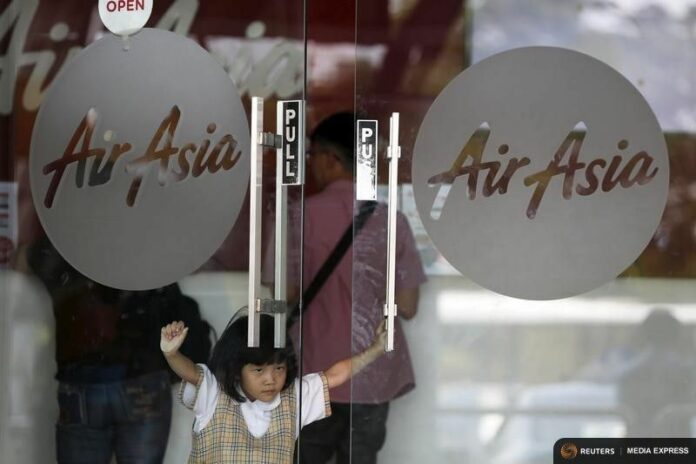
A girl pushes the door of an AirAsia ticketing office at Soekarno-Hatta Airport in Jakarta on July 8, 2015. Photo: Reuters / Beawiharta
KUALA LUMPUR/SINGAPORE — AirAsia founder Tony Fernandes may find it tough to take the budget airline private due to large funding needs as potential partners worry about a floundering Malaysian economy and a weak regional aviation market.
Reuters exclusively reported on Tuesday that AirAsia's founders were talking to banks to secure financing for a management-led buyout, which could be launched this year.
Fernandes and his business partner Kamarudin Meranun, who together own about 19 percent of AirAsia through a holding firm, would need about USD$800 million (28.75 billion baht) to take it private, based on a 25 percent premium, analysts said.
"We think it is a challenge to secure financing," Maybank analyst Mohshin Aziz said in a report.
Fernandes founded AirAsia in 2001 with two aircraft and it has since become Asia's largest budget airline with a fleet of over 170 Airbus jets serving Thailand, Indonesia, Philippines and India.
But after the 2008 financial crisis and the growth of Jetstar Asia and Lion Air, AirAsia's business has been hit.
AirAsia has come under scrutiny since June when GMT Research issued a critical report questioning its accounts and warned of high debt levels, driving its shares down to seven-year lows.
Fernandes has steadfastly backed AirAsia's finances. He said in June the airline could easily raise USD$1 billion by sale and lease back of aircraft and that it had investments worth $500 million.
But AirAsia's valuations are still cheaper than smaller rivals. It is trading at less than six times expected earnings for the next twelve months, while Philippine rival Cebu Air is trading at more than 7 times, according to Thomson Reuters data.
"It would make one of Asia's most over-leveraged airlines even more leveraged," GMT's founder Gillem Tulloch told Reuters, referring to a possible debt-funded buyout.
Like its Asian peers, AirAsia's sales are largely in local currencies such as the Malaysian ringgit, which has lost 17 percent this year, while costs are mostly in U.S. dollars. AirAsia had net debt of 10.5 billion ringgit ($2.4 billion) as of June 2015.
"The founders may not have the financial muscle to launch a privatization bid on their own, so a consortium together with another airline or PE fund is more likely," said Jian Bo Gan, an analyst with brokerage CLSA.
AirAsia said on Wednesday it had no knowledge of a privatization.
Its shares jumped 5.6 percent on Wednesday with 108 million shares changing hands, more than double the daily average volume traded over the past three months.
Mr. Mitsuyuki Nakamura and Mr. Norasit Sitivechvichit
Thailand/Bangkok, October 7th, 2015. Dentsu Media (Thailand), a subsidiary network brand of Dentsu Aegis Network, announced today the launch of Dentsu Media Laboratory (DM Lab), an innovation unit aims to harness the latest technology and create new digital experiences for the market.
Mr. Mitsuyuki Nakamura, Chief Executive Officer of Dentsu Media Thailand and President of Dentsu Media Southeast Asia, said: “DM Lab is global initiative designed to accelerate the development and exploration of new technologies to build new experiences connecting people and brands. It is not only innovative extraction of cutting-edge global technologies, but also to generate opportunities for Thai startups to experience and collaborate with expert to push the boundaries. DM Lab's mandate is fully aligned with Dentsu Group’s philosophy of 'Good Innovation.' and to contribute back to the society by delivering result through innovative and creative technologies with the power of people. In short, our ambition is to deploy world-class technologies in local context together with local business partners in each market.
DM Lab is composed of two key primal pillars: (1) Local Incubation and (2) Gateway to Global Innovation, an initiative led by Dentsu Aegis Network. Mr. Norasit Sitivechvichit, Executive Director of Digital Business, Dentsu Media Thailand, explained further: “Under the Local Incubation, we are working with Thai & Regional Startups in order to scale up and expand mutual opportunities for business to launch locally, regionally and globally. And this platform enables our partners to access pool of knowledge, consult with business professionals, and tap into new revenue streams, and access funds through Dentsu Aegis Network investment arm.
To illustrate the local incubation pillar, 'Rootan', an Open Social Monitoring Platform, which is not only enable marketers to listen to brand voice but also foresee the social trend, 'Wireaction', Big Data Management Platform which recording offline data for multiple usage applications. Furthermore, O2O (Online to Offline/Offline to Online) ideas which are tentatively to launch by the end of this year.”
Another pillar of DM Lab – ‘Gateway to Global Innovation’ – is an original Dentsu Aegis Network innovation project which was launched in Thailand in June 2015. For instance, the latest technology which DM Lab has recently brought to Thai market is ‘Neuro Technology’ which is able to detect your emotions based on an analysis of users’ brainwaves. Mr. Norasit added that “The Neuro Technology will change the way we conduct qualitative research, developing creative ideas or designs, as we can quantify emotional information by censoring brain-waves which we could not before. Furthermore, there are still bunches of interesting areas of technologies from Dentsu Inc. such as “Data Visualization" that enables us to grasp and analyze big data in much easier way, or “Robotics business operation” where we are happy to collaborate with the best teams globally renowned who created the first astronaut robot called Kirobo or an android that was recently awarded in Cannes Lions, the biggest festival of creativity. We see a lot of opportunities for these technologies which we can adapt to and further develop in Thai Market.”
[Gateway to global innovation: Examples]
“DM Lab is not only a unit in Thailand, but the network which is expanding both regionally and globally. We’ve already had one in Taiwan for years with similar concept and we also have been successful to launch unique technological platforms for clients in several countries in Southeast Asia region as well. Vietnam, Indonesia and Malaysia are potential markets to launch DM Lab shortly where we have unique and innovative significance of existence in diversified service area. I believe establishment of DM Lab will re-ignite to perform our innovative genes and allow us to keep the promise delivering the best solutions to our clients, business partners, and society in general.”, Mr. Nakamura concluded
News releases are submitted for consideration by third parties and Khaosod English is not responsible for their content. To reach us, please contact by e-mail at:[email protected].
Follow Khaosod English onand Twitterfor news, politics and more from Thailand.
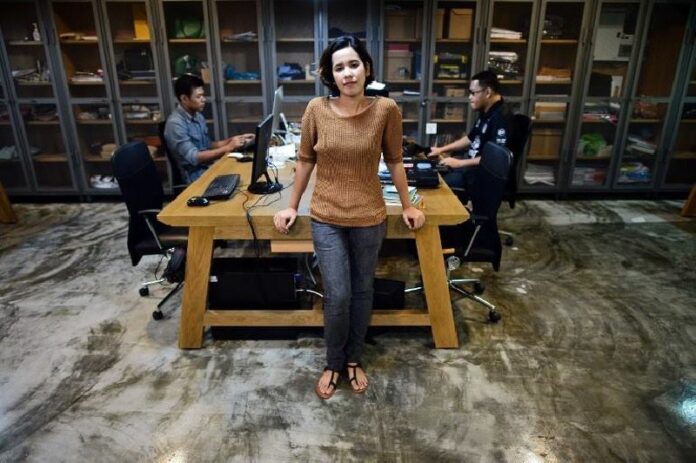
Mutita Chuachang poses for a photograph in her newsroom at Prachatai online's Bangkok newsroom on Monday. Photo: AFP Kate Webb Prize
BANGKOK — Unlike other crime reporters who haunt police stations for stories, Mutita Chuachang spends most mornings at prisons, pleading for just 15 minutes with her sources: those accused of defaming the monarchy.
For her dogged commitment to telling these stories, the 33-year-old Prachatai online assistant editor was today awarded the Kate Webb Prize by Agence France-Presse for her dedication to reporting on those accused of lese majeste – insulting the monarchy – a topic most media in Thailand strain to avoid due to its sensitivity.
“Most of the lese majeste prisoners hate reporters, as they feel we are part of the social oppression,” Mutita told Khaosod English today. “Fifteen minutes is almost impossible for building trust. That’s why I have to visit them all the time.”
The AFP prize honors outstanding journalists working under difficult conditions in Asia. Recipients receive a certificate and EUR3,000 in cash (120,000 baht) from the Paris-based news organization.
Mutita was chosen because of her “powerful and persistent reporting,” the AFP wrote, especially under the current, challenging climate. Lese majeste cases had been rising for some years prior to Thailand’s May 2014 coup d’etat, but since the military seized power, there’s been a spike in convictions, according to rights groups.
Numbers are hard to come by as many cases unfold out of public view and without media coverage. iLaw, an advocacy group tracking legal cases involving political offenses in Thailand, reports it was aware of 53 cases between May 22, 2014, and July 31.
In August, sentencing records were broken when military courts sent two people in separate cases to prison for a combined 58 years for comments they wrote on Facebook.
After writing about lese majeste cases for seven years, Mutita said she can’t even keep up with all the cases since the coup. She said it’s also become more difficult to access those accused or convicted of the crime: Strict rules now only allow them to receive visits from up to 10 approved people.
She said that’s bad for her as a reporter and bad for those incarcerated.
“This is the serious problem I have tried to communicate to society, though they might not understand,” she said. “But for all these prisoners, the only thing that can help them fight is getting courage from outside.”
Mutita Chuachang poses for a photograph in her newsroom at Prachatai online's Bangkok newsroom on Monday. Photo: AFP Kate Webb Prize
Turning Point
Mutita’s interest in lese majeste cases started in 2008, four years into her career. Mutita said she was struck by the arrest of Thaksin supporter Darunee Charnchoensilpakul, aka “Da Torpedo,” who was accused of royal defamation during a public speech at a Redshirt rally.
To Mutita, it was the first time the lèse majesté law was used to eliminate the political opposition in Thailand’s modern era. Darunee trial was conducted in secret, and she is now serving a 15-year prison sentence from that case. To Mutita, the use of the law to convict her made Darunee a new kind of political prisoner.
King Bhumibol, 87, is highly revered in Thailand, where many regard him as a father figure.
Mutita soon found that trying to write fairly about those accused of offending the royal institution invited hostile responses from some readers.
“This issue is indisputable. Anyone who crosses the line and goes into this territory will be labelled as a monster,” she said. “There is only black or white.”
She said before people judge them, they should understand their roots.
“I want to discover backgrounds of these people, dig deep into what makes them think or behave like they do, and show readers the human sides of them,” she said.
There’s an advantage to covering what is all but a forbidden topic. Mutita said there’s little competition; therefore, she doesn’t have to worry about scooped on stories.
But the hardest part is trust. Those accused of the crime are often ostracized and shunned – even by members of their own families – meaning Mutita struggles to build rapport with sources, including lawyers and the suspects themselves.
Gaining access to them at the prisons where they are held is difficult, she said.
“The lese majeste prisoners are always disliked by both other prisoners and officers. They always face severe torture,” she said. “There was one time a prisoner himself secretly sent me a letter telling about how he was abused. I passed it to the National Human Rights Commission. They went to inspect the case and were able to protect other prisoners.”
The Reluctant Reporter
Mutita didn’t always focus her reporting on lese majeste cases; in fact, she wasn’t serious about making a career of journalism.
At Thammasat University, she said she preferred to sit in on political science classes rather than those of her major, journalism. She thinks she spent more time in classes she wasn’t actually receiving grades for, she said.
In 2004 the fresh graduate from Thammasat’s journalism program didn’t want to work for a news organization. But that same year saw the birth of Prachatai, with its stated mission of being a “voice for the voiceless.” For Mutita, it proved a perfect match.
When she started in 2004, Mutita first focused on covering policy matters, with an emphasis on reflecting voices from those outside the system to call attention to conflict between lower and upper classes.
Blurring Lines
Mutita admitted her proximity to such scorned members of society can make it difficult to maintain her professional objectivity.
Sometimes, she said, she has bought necessities for prisoners who don’t get visits from family. At one point she even got involved in helping care of a prisoner’s parents.
“My colleague said I went over the line,” she said. “But what can I do when my new source was in jail, and his aged parents, who could barely walk, suddenly had no one to take care of them?”
Mutita said organizing a caretaker for them using donation money was a private act.
“In the end … I don’t have to be a journalist 24 hours,” she said. “I did it in my own name.”
Mutita told AFP she was “moved and honored” to receive the award today, saying it comes at a critical time for press freedom in Thailand.
“The important thing is that it draws attention to this difficult time for human rights in Thailand,” she told AFP. “When we wrote these stories, we were not thinking about being courageous. We all just felt that it was something we had to do, and my organisation Prachatai was incredibly supportive.”
Lamai Beach on Koh Samui in a 2010 file photo. Photo: Anthony Spratt
SURAT THANI — Tourists on a popular resort island have been warned to stay out of the water after a German tourist was killed last night by box jellyfish.
Thies Saskia, 20, was swimming at night when she was stung, at which time an unidentified friend entered the water to help her and was also stung. Both women were taken to the hospital where Saskia was soon pronounced dead. Her friend was slightly injured.
“It was reported by our members today that there are many box jellyfish at Lamai Beach, so I coordinated with marine police and sent out our jet ski drivers to warn tourists to get out of the water,” said Witthaya Suksom, president of the Samui Jet Ski Club.
The box jellyfish can produce extremely potent venom. Victims can die quickly and painfully after being stung. Jellyfish populations can reach dangerous levels during the wet season in the Gulf of Thailand, which typically lasts through the end of October.
In August, a 31-year-old woman from Bangkok was also killed by box jellyfish on Koh Pha Ngan, another gulf island popular with travelers. A 5-year-old French boy also died there under the same circumstances in August 2014.
In a warning posted last year, the Tourism Authority of Thailand advises tourists to wear protective swimwear and be aware of their surroundings while swimming. Should one come into contact with jellyfish venom, apply vinegar to reduce toxicity and seek immediate medical care.
Thai labor rights activists rally in this October 2013 file photo. Photo: IndustriALL
GENEVA — IndustriALL, a global labor union with 50 million members, has filed a complaint against Thailand at the International Labour Organization in Geneva, the union announced today.
The complaint, sent to the ILO's committee on freedom of association, details 18 cases of worker and labor abuses, IndustriALL said in a statement.
"IndustriALL, which has seven affiliate trade unions in the country, accuses the Thai government of failing to protect its workforce of 39 million workers, nearly half of whom are employed in the informal sector," it said.
IndustriALL helped create the landmark Accord on Fire and Building Safety after Bangladesh's Rana Plaza garment factory collapsed in April 2013, killing at least 1,130 people.
That legally binding agreement, signed by more than 150 apparel firms and the unions, requires factories to have independent safety inspections with the results made public.
The Bangladesh disaster and the subsequent accord has bolstered labor unions in several Southeast Asian countries, making unions more confident and visible.
"Thailand is a hub in the global supply chain for many multinational companies. The government must do more to protect its workers, who are the backbone of the economy," IndustriALL's general secretary, Jyrki Raina, said in the statement.
"Likewise, multinational companies must not allow worker violations at their suppliers and subsidiaries in Thailand just because they can get away with it."
IndustriALL said Thailand failed to guarantee the rights of freedom of association and collective bargaining to about 75 percent of the workforce, leading to it having the lowest unionization rate in Southeast Asia at 1.5 percent.
"Workers are frequently sacked for being trade unionists or trying to bargain collectively," the statement said.
"In cases where the courts have ordered workers to be reinstated, companies often ignore the ruling or put intolerable pressure on workers to quit. In other instances, court proceedings drag on for so long that the workers are forced to accept a payout and resign."
Story: Reuters / Tom Miles
To reach us about this article or another matter, please contact us by e-mail at:[email protected].
Follow Khaosod English onFacebookand Twitterfor news, politics and more from Thailand.
'Nong Kalaland' is a character created by artist Wisaruth Wisidh as a Single Gateway-tan type personification of the government plan to implement a single point of control for internet traffic in and out of Thailand.
BANGKOK — Drawn in a form familiar to internet otaku everywhere, Nong Kalaland is a busty, geek villain holding the power to control the internet in her fist.
What looks like a helm from some fantasy game is her namesake headpiece, a coconut shell (kala), meant to represent Thailand’s self-obsession and willful ignorance of the larger world; the frog who only knows the coconut shell it calls home.
With the government beating a hasty retreat from its plan to build a single gateway for all internet traffic, the character has become a symbol to netizens who, whatever their politics, have been roused from apathy by what they see as an unwelcome coup d’etat in their virtual world.
That metaphor isn’t lost on the artist who created Nong Kalaland. Wisaruth “Phu Phu” Wisidh and activists opposed to the project, who see the character as nothing less than evil personified.
“Imagine the Dark Lord as the ‘Last Boss’ who creates a catastrophe and brings the end of the world,” wrote Wisaruth, now an influential voice in virtual Thailand.
No extra points for guessing who the Dark Lord represents.
Wisaruth’s language may be melodramatic hyperbole, but for the geek class, the idea of the military government seizing power online fits the quest-to-save-the-world narrative familiar to all the Dovahkiin of Skyrim or other nerd-culture heroes.
The ‘F5 Army’ as drawn by Facebook user Krisanat Umpornpairoj.
So why would online gamers, who invest more time perfecting headshots and pushing lanes than engaging in social issues, suddenly engage in a policy matter?
A law professor at the University of the Thai Chamber of Commerce said online warriors are motivated members of a community who have rallied to defend their turf.
“The online gaming space is reserved for imaginary worlds as an escape from reality,” Jompon said. “The offline world is already full of rules. Some gamers are not interested in politics, but when the government decided to funnel the internet through its gateway, it was like intervening in their last private space.”
Just search hashtag #Teamgamers (#ทีมเกมเมอร์) to get a sense of the reaction.
“At first I thought I would just watch and not join in myself, but after I saw the official statement from the government, I felt irritated. #TEAMGAMER,” read a typical message posted 30 Sept.
They’re also the demographic to rally around Nong Kalaland, whose image has been appropriated by opponents of the project to represent the “final boss” that must be overcome – an unsubtle stand-in for junta chairman Prayuth Chan-ocha – to beat the game and save the cyber-realm, according to Wisaruth, her creator.
And now, in the way that things do online, the campaign has taken on a life of its own, spawning slick graphics for the “F5 Cyber Army” – named for a keyboard shortcut to refresh a web page, a fan-art contest and of course memes beyond count.
Single Gateway parody video by YouTuber Kanninich
No ‘Leet’ Hacks
There’s no secret cells of cyberterrorists at work here. No Mr. Robot-level hacking tactics are involved. The campaign is organized in plain sight on Facebook.
Citizens Against Single Gateway first struck 30 Sept. when more than 100,000 people loaded and reloaded six major government websites until their servers were paralyzed. It achieved two aims: sending a message of dissent and illustrating the vulnerability of government-managed systems.
The admin responding to messages sent to Citizens Against Single Gateway said the operation was just a “whispered warning” from netizens. He asked not to be identified for fear of prosecution.
He repeated a threat to escalate their attacksif the junta does not abandon the project by issuing a fresh Cabinet Resolution to countermand the four issued since June which authorized the project.
“The decision entered into the Cabinet Resolution on 30 June was legally binding,” he said. “To properly reject this policy, the government can’t just say empty words.”
The 30 June Cabinet Resolution ordered various agencies “to proceed with implementation of a single gateway to be used as a device to control inappropriate websites and flow of news and information from overseas through the internet system.”
Officials have said the system is intended to improve national security and aid in combatting online crime.
Following the first strike on state web operations last week, Prayuth himself addressed the criticism by saying the single gateway is just an idea proposed for study, with no concrete plan for making it happen.
Characters created for the ‘Battle for Kalalaland’ fan-art contest. Left by artist ‘Gin Tonic’ and right by Facebook user Thanawee Awera.
Drawing Support
In Wisaruth’s gamer-influenced parable, the “Dark Lord” behind the plan seeks to force people into two groups: Those who “surrender to his power and … allow the Dark Lord to take their clothes off from head to toe; and those who resist, who will be killed in the lava pond.”
He gets that some will dismiss him and other geek activists as frivolous or silly. But that’s why internet freedom must be protected from censorship and intrusion, he said, for the sake of a place where young people can “unlock their potential.”
“If we try to express our ideas to our teachers by drawing cartoons, for instance, we will definitely be criticized as doing something stupid,” he said. “But the internet exists for everyone to showcase their imaginations, as a place where we can truly express our creativity.”
Giving government oversight of that world would spell the end of unfettered expression, he said, and possibly shut off other sources of information.
“If the single internet gateway is actually implemented, we will be under watch and unable to freely access the global network outside, like the frog living in a coconut shell, just like this character,” the freelance illustrator said, referring to Nong Kalaland.
He said he first heard of the “single gateway” plan from tech site Blognone. As a freelancer and harcore gamer whose life is largely lived online, he thought he should learn more. So he dug deep into academic papers and critiques and concluded it was an important issue people needed to be aware of.
He also realized it involved arcane matters.
“It might be hard to understand all the technical terms. So I thought it would be better if we simplified and made the information more accessible for the masses rather than just let it happen without trying to do something,” he said.
That’s when Nong Kalaland was born as a cartoon character to put a face to the “single gateway” and help attract a youthful audience.
Since then there’s been an explosion of user-generated media opposing the policy, from pencil drawings to parody animations.
“I believe Thai people are normally creative but have been repressed by a conservative social system,” Wisaruth said.
After his petitioncrested 100,000 signatures, Wisaruth’s follow-up campaign is a design contest called “The Battle of Kalaland.” Competitors must design a superhero to fight Nong Kalaland, along with the character’s backstory, weapons arsenal and skills.
“It’s so interesting that we have a lot of kids participating,” he said. “I was very surprised there are some entries from junior high school kids. I think this is the first time children have taken part in a social issue without being obligated by their school or parents.”
Unsurprisingly, he credits the internet for their engagement.
“When I was that age, I didn’t even know the name of the prime minister. I just recited what the adults told us to,” Wisaruth said. “But kids nowadays are able to criticize and decide by themselves whether they should support or oppose an issue, because the internet provides free information and free expression without framing their thoughts and actions.”
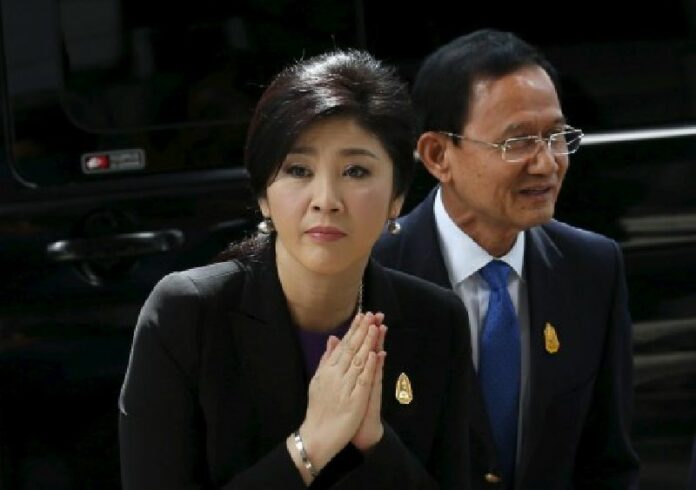
Ousted Thai Prime Minister Yingluck Shinawatra arrives at the criminal court in Bangkok on 29 Sept. Photo: Reuters
BANGKOK — A court on Tuesday threw out a case against the attorney general filed by deposed prime minister Yingluck Shinawatra, saying it found no evidence of any abuse by prosecutors.
Thailand's first female prime minister filed the lawsuit last month alleging unfair handling of negligence charges against her, relating to a multi-billion dollar rice-buying scheme that incurred big losses.
Yingluck faces up to 10 years in jail if she is found guilty of negligence.
Yingluck's legal team said in their lawsuit the attorney-general had charged her with insufficient evidence.
One of Yingluck's lawyers said an appeal against Tuesday's ruling was being considered.
"We will first look at the court's explanation because there are many details, and decide whether to appeal," lawyer Sommai Koosap told Reuters.
"I personally believe we will appeal."
Rivalry between the royalist-military establishment and the Shinawatra family, in particular Yingluck's brother, ousted populist premier Thaksin Shinawatra, has been at the heart of a decade of political turmoil in Thailand.
Yingluck was removed from office in May 2014 after a court found her guilty of abuse of power, days before the army staged a coup after months of street demonstrations in Bangkok.
She has defended the policy which bought rice from farmers at above-market prices.
The ruling junta says the rice scheme was tainted by graft and caused USD$16 billion in losses.
In January, Yingluck was banned from politics for five years after a military-backed legislature found her guilty of corruption relating to the rice subsidy scheme.
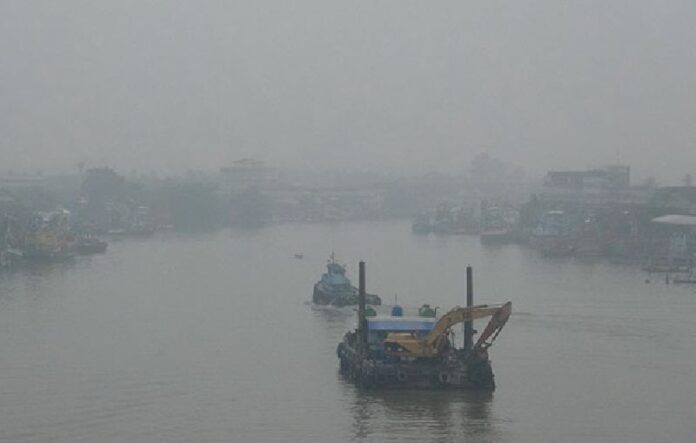
The mouth of the Pattani River in Pattani province today. Air quality levels surged above unsafe levels today throughout the south of Thailand as smoke from illegal Indonesian agricultural fires spread over the region.
SONGKHLA — Hundreds have sought medical help in the south of Thailand as smoke and haze from Indonesia’s slash-and-burn farming spread has spread to blanket the region.
Residents in Songkhla province converged on an Indonesian consulate there to call on Jakarta to control the fires creating the smoke which has drifted throughout the region as air pollution levels spiked today to levels far exceeding safety standards.
“I have a running nose and have a cold for days. My mom took me to the doctor and I need to take medicine,” said Natat Thibhadi, a 9-year-old boy who joined the rally with his mother. “I also need to stay inside my house and cannot go play outside as usual, as the weather is not clean.”
Residents rally outside the Indoniesian consulate in Songkhla province today.
The smoke, which has choked Singapore and Malaysia for weeks, first reached Thailand on Saturday.
Satun City was identified as having the worst air pollution in the nation, followed by Hat Yai in Songkhla province and Phuket Town, according to the Pollution Control Department.
In Satun, officials warned people to wear masks and be careful driving, as visibility was reduced to less than 200 meters. Masks were also distributed in the southern provinces of Krabi, Trang and Pattani.
In Yala province, 214 patients reportedly visited hospitals due to respiratory conditions blamed on the pollution.
Krabi Mayor Keeratisak Phukaoluan said his municipality would send a letter asking Indonesia to take action, as the fires have become an annual phenomenon plaguing the region.
Malaysian Prime Minister Najib Razak also called on Indonesia to act, saying it was affecting his country’s air quality and economy.
"Only Indonesia alone can gather evidence and convict the companies involved in these actions.” Razak told the Malaysian National News Agency.
El Niño weather conditions have been blamed for dry weather which have made this year especially bad.
The planet’s insatiable demand for cheap palm oil is routinely cited as the leading cause of the illegal forest burning. Indonesian President Joko Widodo said in an interview with BBC the haze problem cannot be solved easily.
He insisted Indonesia has already “gone to great lengths” to take on the outbreak including building water reserves in the forests and enforcing laws against illegal burning.
"You will see results soon and in three years we will have solved this," he said.