

























26.6 C
Bangkok
Friday, July 24, 2026
Home Blog Page 2951

Police Link Bomb Attack to Uighurs, Deep South and Thai Politics

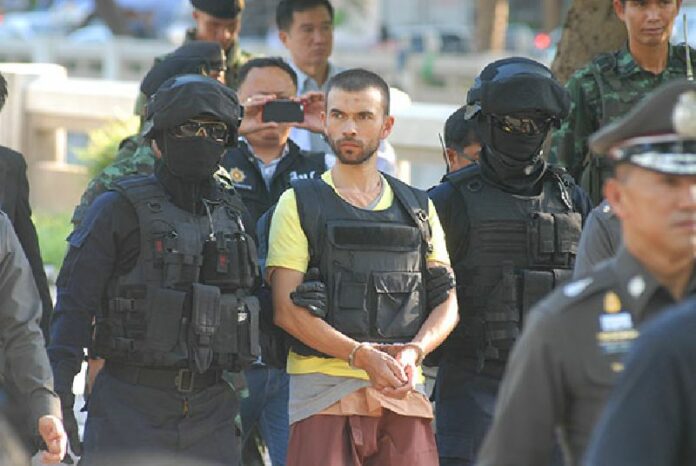
Suspect Adem Karadag, aka Mohammed Bilal, is led to the location near Bangkok's Hua Lamphong Railway Station where police say he was handed the bomb later planted at the Erawan Shrine by bombing suspect Yusufu Mieraili during a police "re-enactment" on Sept. 26, 2015.

BANGKOK — Domestic and international politics motivated those who last month bombed one of Bangkok’s landmark attractions, police said today as they laid out the attack’s links to a Chinese ethnic group, separatists in Thailand’s Deep South and a radical Redshirt bomb-maker.

Officials made a largely circumstantial case this afternoon against 17 people they believe were behind last month’s bombing of the Erawan Shrine, an attack they said brought disparate groups of Chinese, Turkish and Thai nationals together in a common cause to carry out the worst attack of its type in Thai history.

“They shared the same objective. They shared the same benefits,” police chief Somyot Pumpanmuang said this afternoon. “One may have used the other to carry out the attack.”

Investigators said the two perpetrators, both Chinese Uighurs, were aided by a network of Turkish nationals as well as Yongyuth Pobkaew, a Thai man accused of building bombs for politically motivated attacks in 2010 and 2014.

Updated: Who’s Who in the Bangkok Bombing Investigation

Six weeks on from the bombing police officials today seemed on the verge of calling the investigation a wrap as they pored over an organizational chart of the “network” behind the blast in a nationally televised address.

\

From the left, head metro police investigator Maj. Gen. Sombat Milintachinda, metro police chief Lt. Gen. Sriwarah Rangsipramnakul, deputy national police chief Gen. Chakthip Chaijinda, national police chief Gen. Somyot Pumpanmuang and national police spokesman Lt. Gen. Prawuth Thawornsiri took turns speaking to reporters at this afternoon’s nationally televised event.

Frequently citing “luck” in bringing breaks to the case, top brass took turns recounting their efforts in bringing those responsible to justice but did not provide any “smoking gun” evidence.

After emergence of new CCTV footage led them to conclude late last week that a man already in custody was the shrine bomber, police said today that bomb fragments recovered after the attack were the same type found late last month in rooms used by suspects.

Ball bearings and metal pipes used in both the shrine bomb and another which exploded the next day near the Sathorn Pier matched items found in a room at the Poon Anan apartment in Bangkok’s Nong Chock district, Police Lt. Gen. Sriwarah Rangsipramnakul said.

“And most importantly, a detonator we found at the Sathorn Pier,” said Sriwarah, who commands Bangkok Metropolitan Police. “There was a one inch-long fragment left. We also found it at Poon Anan. Forensic police confirm it was the same type.”

For the first time they identified a foreign national named “Zubair” as the man they believe dropped a bomb into water near the pier less than an hour after the shrine blast.

During the weekend, police led suspects Yusufu Mieraili and Mohammed Bilal, who have been in custody for several weeks, through “re-enactments” of the crime. They posit that Bilal planted the bomb in the shrine which was then detonated remotely by Mieraili from a nearby vantage point.

Sriwarah also said the home-made bombs “resembled” those used by insurgents in Thailand’s violence plagued province of Narathiwat, where fighting between security forces and insurgents have reportedly claimed more than 6,000 lives since 2004.

\

Suspected Erawan Shrine bomber Mohammed Bilal sits on the bench inside Bangkok’s Erawan Shrine where a man in a yellow shirt was seen leaving a backpack minutes before the 17 Aug. blast.

There was no incontrovertible evidence incriminating any of the suspects presented at today’s event.

Asked what supported the belief Bilal and Mieraili carried out the attack, Gen. Somyot cited witnesses, CCTV footage, “accurate” re-enactments, confessions and “a special technique by high-tech equipment, which is classified.”

Bilal’s lawyer, Chuchart Khanpai said he was denied access to his client today. He’s previously denied Bilal confessed to the crime and said he wasn’t even in Thailand at the time of the attack.

As recently as one week ago police were still searching for the shrine bomber, with a deputy chief flying to Kuala Lumpur to chase rumors he’d been captured in Malaysia.

Shifting their attention back to Bilal on Friday after CCTV footage seemed to pick up the bomber’s trail in Lumpini Park, officials said they needed more evidence to conclude Bilal was the man seen in the video. On Saturday, they staged the re-enactments.

Three Lumpini Police Station officers, including deputy commander Lt. Col. Apichart Thongchantee, were transferred to inactive posts yesterday for telling investigators earlier they had found nothing in the park’s security footage.

Earlier this month, 18 officers from two police stations in eastern Bangkok were similarly transferred to inactive posts for claiming they found nothing suspicious after searching residences in their jurisdiction where the perpetrators are believed to have stayed.


\

Three people were killed when a home-made bomb exploded in October 2010 in an apartment building northwest of Bangkok in Nonthaburi’s Bang Bua Thong district.

Min Buri Link

Bilal was arrested 29 Aug. when security forces raided the Poon Anan apartment building. A fake Turkish passport in his possession at the time identified him as Adem Karadag. Through his lawyer, he’s said he is a naturalized Turkish citizen bornin Xinjiang, China, home of the Muslim majority Uighurs. Police immediately celebrated the arrest by giving themselves the 3 million-baht reward which had been offered.

Another set of raids at the Maimuna Garden Home in the Min Buri district turned up several rooms police said were used by the bombers. They said the rooms were secured for them by a Thai woman suspect named Wanna Suansan and her Turkish husband, Emrah Davutoglu.

Min Buri is also where a bomb exploded in 2014 during the height of anti-government street protests, killing two men transporting it by motorcycle.

Police said that bomb was partly made by Yongyuth Pobkaew, who was previously given a suspended, one-year sentence for a 2010 bombing which killed four people northwest of Bangkok in Nonthaburi province.

Thai authorities have alleged a radical cell of the Redshirt movement was behind both incidents.

Bangkok Shrine Bombing: Those Who Died

Police said Yongyuth purchased materials used for the Erawan Shrine bombing. A warrant for his arrest was issued on Friday but police said his whereabouts were unknown.

Police spokesman Lt. Gen. Prawuth Thawornsiri today insisted they are not making scapegoats out of anyone.

“Let me confirm that there is no scapegoat in this case,” he said. “We are not hurrying to finish the investigation. We have complete evidence.”

Speaking at today’s televised press conference, police chief Somyot also told reporters that domestic Thai politics could not be ruled out as a motive.

“We cannot rule out politics,” he said. “We are not falsely accusing anyone here. My words are based on evidence.”

Authorities describe the attack as revenge by criminal elements angered by a crackdown on human trafficking earlier this year. Although they’ve strenuously avoided describing it as a terrorist attack, they have acknowledged anger over the forcible return of 109 Uighurs to China under pressure from Beijing as a factor for the attack.

Uighurs share strong bonds with Turkey, where nationalists stormed a Thai diplomatic outpost in July in response to the deportations.

Related stories:

Police Return to ‘Karadag’ as Bangkok Bomber

Bangkok Bombers Not in Malaysian Custody, Deputy Police Chief Rules
Bangkok Bombers Rumored to be in Malaysian Custody

Tests to Confirm Whether Man is ‘Bangkok Bomber’

Advertisement

Police Return to 'Karadag' as Bangkok Bomber

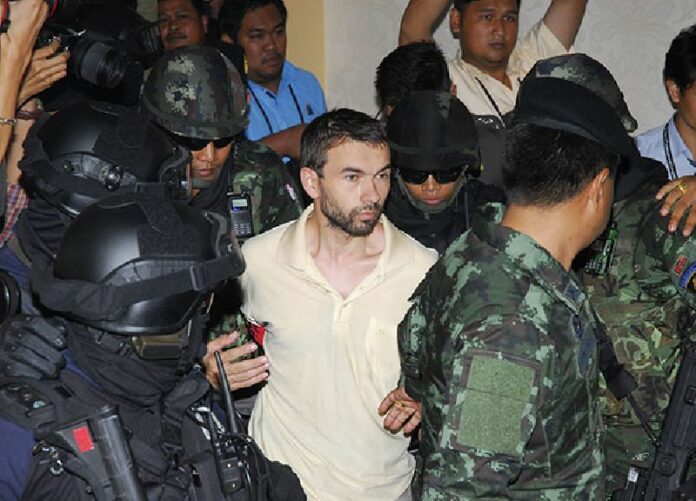
Mohammed Bilaturk, aka Adem Karadag, is transferred from military custody to civilian police at the Bangkok Metropolitan Police headquarters on 4 Sept.

BANGKOK — Police investigating last month’s bombing of Bangkok's Erawan Shrine now believe they already have their most wanted man in custody.

A day after officials played down reports Mohammed Bilaturk, aka Adem Karadag, confessed to being the “Yellow Shirt Man," several top officials today went on the record to say they believe they are one and the same. At the same time a report was leaked by investigators showing a man purported to be Bilaturk in Lumpini Park minutes after the blast.

Among top brass suggesting Bilaturk’s key role in the attack was Police Maj. Gen. Sriwarah Rangsipramnakul, commander of Bangkok police, who today said he's confident Bilaturk is the bomber.

"Yesterday I didn't have clear information yet, but based on interrogation information obtained at around 9pm last night, I can now confirm that Adem Karadag or Bilal Mohammed [sic] is the yellow-shirted man."

To lend weight to the claim, the leaked police report shows a man walking through Lumpini Park minutes after the blast, that due to numerous, entirely circumstantial elements, appears to pick up the trail of the Erawan Shrine bomber as he enters the park, changes clothing and walks out.

Royal Thai Police chief Somyot Pumpanmuang said this evening he’s convinced Bilaturk is the same man seen in the park’s CCTV footage.

“One of the pieces of evidence is CCTV footage in front of a restroom in Lumpini Park. It shows the grey-shirted man, which I believe to be Mr. Bilaturk. I think I don’t have to explain this any further. From the news that the media present, it should be clear already.”

It was his opinion the man "really looks like" Bilaturk, he added.

Although he believes Bilaturk is the shrine bomber and in the man in the video, Somyot stopped short of declaring the shrine bomber is the man in the video.

In the police report there is no clear evidence indicating the man seen is Bilaturk.


\

Leaked police report outlines route taken by bombing suspect through Lumpini Park about 20 minutes after the bombing of the Erawan Shrine on 17 Aug.


‘Grey Shirt Man’

In a series of grainy, low-quality images taken from security cameras, the man identified in the report as “the perpetrator,” enters Lumpini Park from Gate 5 near Ratchadamri Road and walks into a park toilet at 7:04pm.

That’s six minutes after the yellow-shirted suspect was last seen on a motorcycle taxi about 150 meters away, heading toward the park.

Four minutes later, according to the narrative set forth in the report, he emerges from the toilet and continues walking south through the park toward Rama IV Road.

Again the links are circumstantial, but the man seen in the images holds a similar looking phone and blue plastic bag in the same hands as those seen carried minutes earlier by the suspected bomber.

An additional image from police in Min Buri is said to show the man inside a 7-Eleven at 9:06pm.


\

Left: From CCTV image of the 'Yellow Shirt Man' moments after he left a backpack in the capital's Erawan Shrine at left. Right: From CCTV image of a man seen later in Bangkok's Lumpini Park


\

Leaked police report claims to show the man enter a Lumpini Park restroom 22 minutes after a bomb exploded 17 Aug. at Bangkok's Erawan Shrine.

\


Military Warrants Sought for ‘Murder’

At 6pm this evening police asked a military court in Bangkok to approve a fresh set of warrants for all 15 suspects to date, including Bilaturk, with a new charge of premeditated murder attached to each warrant.

Police officials said that on Wednesday night, Bilaturk confessed to being the bomber, but said they want more evidence.

Bilaturk's lawyer, Chuchart Kanpai, denied again today that his client had confessed, according to DPA. He's previously said Bilaturk, a naturalized Turkish citizen from China's Xinjiang district, did not enter Thailand until 24 Aug. and was uninvolved in the attack. 

Asked to comment on Bilaturk’s alleged confession, Somyot this evening said that because it came during interrogation, it would not be be good enough for court without additional evidence.

The reliance of Thai police on confessions has been under heightened scrutiny since they were accused of using torture to obtain one last year in another high-profile case in the kingdom. Two Myanmar men currently on trial for the 2014 murders of two Britons on Koh Tao said police tortured them into admitting the crime. They are widely considered as scapegoats for a police force that failed to execute a competent investigation.

Somyot referenced this in his comments this evening.

“It’s a technique many defendants use. They confess in the interrogation process and retract it in the court, and they will claim that officers coerced their confessions, or that officers assaulted them, as you have seen from many news, which is untrue, because this is no longer the era that police can do something like that,” he said. “It’s outdated.”


Related stories:

Police Chief Plays Down Bombing Suspect’s Alleged Confession

Turkish Suspect Denies Involvement in Erawan Bomb Attack

Leaked Police Report Tracks Lead Suspect Before, After Bombing

Man Dropped Bag into Water Night Before Sathorn Pier Blast


To reach us about this article or another matter, please contact us by e-mail at: [email protected].

Follow Khaosod English on Facebook and Twitter for news, politics and more from Thailand.

Follow @KhaosodEnglish

\

Advertisement

Police Seize Booze, Aston Martin and Alleged Tax Dodger

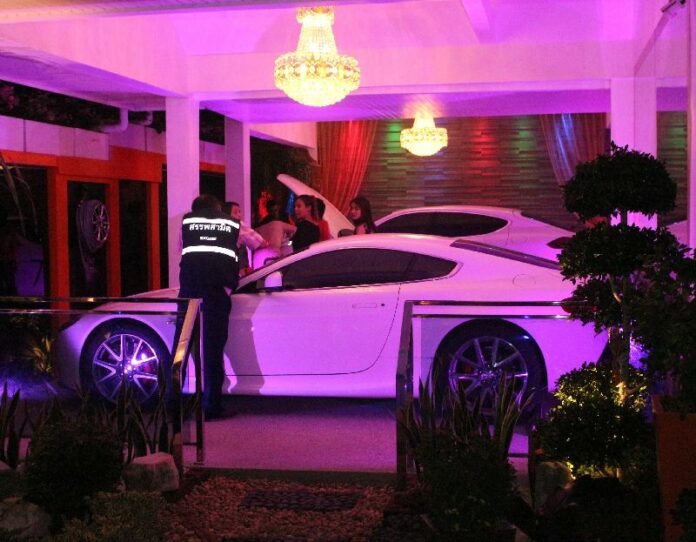
Customs officers checks out sports cars parked in front of a mansion house party in Pattaya last night.

CHONBURI — What started as a call on a noisy house party reportedly turned into discovery of a hoard of untaxed alcohol, tobacco and a sports car, which the Thai state sees as at least 1.2 million baht in lost revenue.

When neighbor’s complaints led security officers to a mansion in Pattaya’s Jomtien Beach area late last night, they found more than 30 foreign men and 20 Thai women along with a well-stocked bar of about 1,000 bottles of alcohol, 100 cigars, an Aston Martin, a Porsche and a Rolls Royce.

The problem, officers said, was that no duties had been paid for much of the luxury goods – including the Aston Martin. Therefore, district official Prapan Prathumchumpoo said, they confiscated a number of the untaxed items – including the Aston Martin.

\

\

Altogether, he estimated the combined value in unpaid taxes to be at least 1.2 million baht.

Neighbors said the residence regularly hosted loud parties at night. Police said it’s owned by a woman named Pornchanok Kamphapan. She told security officers in the raid that her husband, a foreigner who works at a hotel in Pattaya, actually owns the place and likes to invite his friends to parties at the mansion. He was not present at the time and unidentified by officials.

Pornchanok insisted all of the items were bought and taxed legally.

Police said Pornchanok was placed under arrest and taken into custody for further questioning.

\


To reach us about this article or another matter, please contact us by e-mail at: [email protected].

Follow Khaosod English on Facebook and Twitter for news, politics and more from Thailand.

Follow @KhaosodEnglish

\

Advertisement

Indonesian Haze Forces Singapore to Close Schools

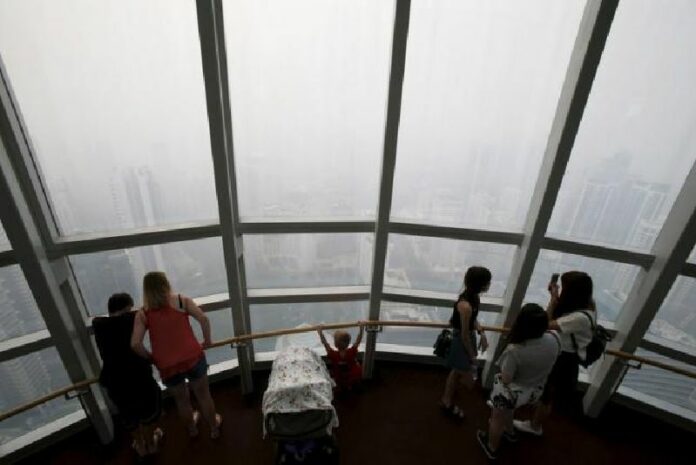
People look from an observation room yesterday at the haze-shrouded shopping district of Singapore's Orchard Road.

SINGAPORE — Singapore will close all primary and secondary schools on Friday as worsening pollution causes air quality to deteriorate, the Ministry of Education said last night.

Slash-and-burn agriculture in neighboring Indonesia has blanketed Singapore in a choking haze for weeks, and the air quality has worsened since Wednesday night.

The three-hour Pollutant Standards Index reading climbed to 314 and the 24-hour figure rose to 223-275 at 10pm local time. Anything over 300 indicates "hazardous" air quality and 201-300 is "very unhealthy," Singapore's National Environment Agency says on its website.

Kindergartens run by the Ministry of Education and special education schools will also be closed, according to a statement on the ministry's website.

In addition, Singapore Sports Hub, which includes an outdoor stadium and aquatic sports center, said on its website that it would suspend all outdoor activities. Fast-food restaurants, including KFC, Pizza Hut and McDonald's, have halted delivery service as the pollution worsens.

Story: Reuters / Rujun Shen


To reach us about this article or another matter, please contact us by e-mail at: [email protected].

Follow Khaosod English on Facebook and Twitter for news, politics and more from Thailand.

Follow @KhaosodEnglish

\

Advertisement

Committee Convened to Probe Welfare Agency’s Sexy Dance Show

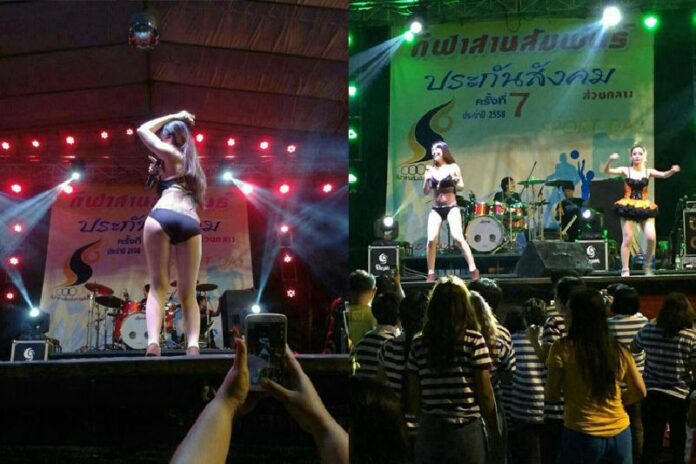
Attendees of a Saturday event organized by the Social Security Office document the offending show using their smartphones.

BANGKOK — The Ministry of Labor is investigating why a bikini-clad singer was invited to serenade officials at a recent concert organized by the Social Security Office.

The Ministry’s permanent secretary Nakhon Silpa-archa said a committee has been convened and ordered to look into a Saturday concert held for Social Security Office officials which included a sexy dance show by a woman in a black bikini, photos of which quickly spread online and drew criticism.

“This incident affects the image of the Ministry of Labor and the government,” Nakhon said.

He said the committee will report back in five days with its findings.

\

“We have to investigate whether the organizers intentionally [invited her],” Permanent Secretary Nakhon said. “The punishment won’t be as high as an expulsion, but the offenders will have to made an example. Punishments range from a warning to a salary cut and demotion. I and the Minister [of Labor] are very angry about what happened.”

“Someone will have to be held responsible for this,” he added.  

Boonsong Thapchaiyuth, sec-gen of the Social Security Office, told reporters he was in charge of planning the concert, but insisted the musical line-up did not originally include the provocative singer’s act. He said the company that organized the event has been blacklisted, and its owners would be summoned to give testimony.

According to Boonsong, some officials at the concert were immediately offended by the singer, and the show was stopped just two minutes after it began.

“We had no intention to organize that kind of lewd show,” Boonsong said today.

\


To reach us about this article or another matter, please contact us by e-mail at: [email protected].

Follow Khaosod English on Facebook and Twitter for news, politics and more from Thailand.

Follow @KhaosodEnglish

\

Advertisement

Koh Tao Murders: Defense Team Pleads for More Time

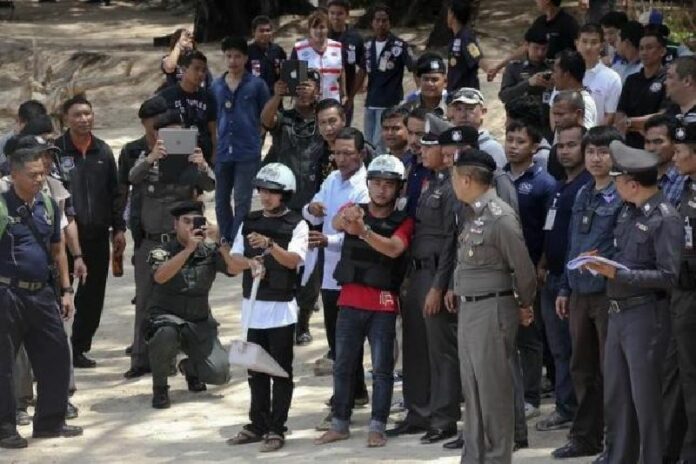
Wearing helmets and handcuffs, two Myanmar migrant laborers accused of killing two British tourists on Koh Tao in September 2014, participate in a 're-enactment' of the alleged crime in this 3 Oct., 2014, file photo. Photo: Reuters

SURAT THANI — Lawyers for two Myanmar migrant workers accused of killing two British tourists on Koh Tao appealed for more time on Thursday to prove they were scapegoats innocent of the brutal, high-profile murders.

Hannah Witheridge and David Miller, both in their 20s, were beaten to death a year ago on the southern holiday island of Koh Tao, causing outrage in Britain. Witheridge was also raped, a post-mortem examination showed.

Lawyers are trying to convince the judge that Zaw Lin and Win Zaw Htun were framed by police under pressure to solve a case that has caught international attention and hurt Thailand's image as a tourism haven.

The defense tentatively had until Friday to wrap up its case, but chief lawyer Nakhon Chomphupat said there were problems convincing witnesses to testify as some feared retribution.

"I don't think we can have all of the witnesses (before Friday)," he told reporters outside the court on Samui island. "There's a problem, our informers lack courage to stand as witnesses because some of them still work on Koh Tao."

This evening migrant labor activist Andy Hall, who has been consulting with the defense team, said on Twitter the judge agreed to an extension with the details to be finalized on Friday.

"Defence requested extra 2 days after tomorrow's hearing, prosecution said agreed to only one day. Judge agreed extension but finalise 2mrw," he wrote on Twitter.

Central to the defense is disproving what it sees as a patchy investigation marred by disputed forensics, a contaminated crime scene and selective use of surveillance video to implicate the accused.

A human rights expert was due to testify on Thursday about his own investigation, which lawyers said showed the suspects had suffered police abuse under interrogation. Another witness, a former lawyer, was expected to testify that false confessions were forced from the suspects.

Police have stood by their probe and Prime Minister Prayuth Chan-ocha has ruled out foul play.

Allegations of torture and police misconduct have caused a stir in Britain and its Prime Minister David Cameron raised concerns during a meeting with Prayuth, who agreed to allow London police to carry out their own internal investigation.

They have refused to disclose their final report to anyone other than the victims' families, as a pre-agreed condition.

Many people from Myanmar, known also as Burma, work on the Thai holiday islands of Koh Tao, Koh Phangan and Koh Samui, just a short trip from southern Myanmar across a narrow mainland peninsular.

The estimated 2.5 million Myanmar workers in Thailand provide vital remittances. Many complain they suffer maltreatment, including extortion, from Thai police.

Story: Reuters / Prapan Chankaew, with additional reporting by Jutarat Skulpichetrat in Bangkok and Khaosod English


Related stories:

Defense Points to Flaws in Probe of Koh Tao Murders

Koh Tao Murders: DNA on Weapon ‘Does Not Match’ the Accused

Koh Tao Trial Resumes, Court Shown Footage of Victims’ Final Night


To reach us about this article or another matter, please contact us by e-mail at: [email protected].

Follow Khaosod English on Facebook and Twitter for news, politics and more from Thailand.

Follow @KhaosodEnglish

\

Advertisement

Junta Readies ‘Great Firewall of Thailand’

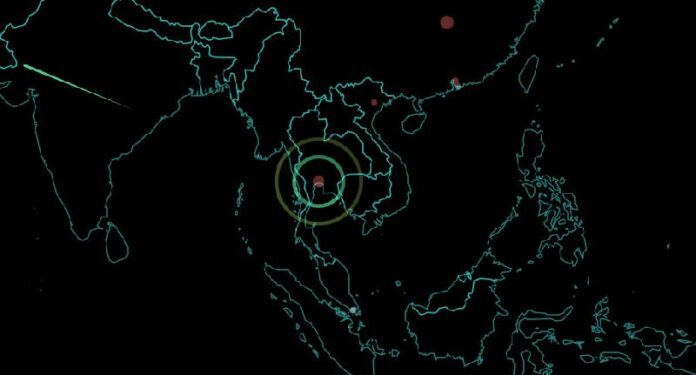
Map of malicious internet traffic. Image: NorseCorp.com

BANGKOK — Thai authorities have taken steps toward achieving their stated desire of gaining greater control of internet use by creating a single gateway for all internet traffic in and out of the kingdom.

The military government’s intention to police internet content by channeling it all through a single point of control has taken practical steps toward becoming a reality in recent weeks, with officials being instructed to “speed up” the process of implementation of a system which alarm advocates of a free and competitive internet.

Although the idea was first floated almost immediately after the ruling junta came into power, it only went into writing last month. On 4 Aug. the military government approved the plan, and on 27 Aug. issued an order to the ministry tasked with regulating the internet to make it happen, according to cabinet meeting records.

\

Officials inspect an internet cafe in Phuket province in this 19 June, 2013, file photo from the Phuket provincial Public Relations Office.

“The Ministry of Information Communication Technology is hereby instructed to speed up the aforementioned issue and report any progress to the prime minister by September 2015,” read the 27 Aug. cabinet minutes of the gateway project.

Col. Setthapong Malisuwan, deputy chairman of the National Broadcasting and Telecommunication Commission, told BBC Thai that he prefers to call the “single gateway” a “hub” to avoid any negative connotation.

He defended the plan, saying the “single hub” would allow Thai security forces to monitor internet traffic more easily. Col. Setthapong also insisted that the idea would promote, not hamper, Thailand’s digital economy, and claimed other modern countries have similar surveillance measures.

"Singapore, United Kingdom and United States, many countries already have this kind of law. Cybersecurity laws,” the colonel said in an interview with BBC Thai. “We are really latecomers."

Arthit Suriyawongkul, coordinator of internet freedom advocacy group Thai Netizen Network, told Khaosod English that the Ministry of Information, Communication and Technology recently gave two options to ISP representatives in the meeting: Either direct all signals through a central gateway operated by the ministry or consent to having tracking devices installed in their ISPs.

The meeting was the latest development in creating a technical means for the military state to get a grip on the internet following failed attempts to win cooperation from the likes of Google, Facebook and Line one month after it seized power from the civilian government in May 2014.

The junta's campaign for greater control of internet use was born after those requests were rejected in June 2014. At the time Thai authorities vowed to have it in place within two months.

According to Arthit, no conclusion was reached in the recent meeting with ISPs, and not one has yet to commit to one of the two options presented.

“There were concerns whether the [Ministry] can handle all that traffic,” he said. The Ministry of ICT currently operates Thailand’s porous blocking infrastructure which gives them some measure of censorship capacity by maintaining a black list of sites intended to be inaccessible in Thailand, measures which in reality are easily circumvented.

A spokeswoman at True Corp., who declined to identify herself, said the project has yet to go anywhere.

“There have been no developments in the single gateway, but True is willing to cooperate with the authorities if a single gateway is implemented,” she said.

True’s True Internet is Thailand’s largest ISP. Calls to state-owned CAT Telecom, which controls Thailand’s telecom infrastructure and international gateways, were not returned.

Officials insist that a single gateway – similar to China’s control over internet traffic via its “Great Firewall” – is necessary to protect national security because it would allow law enforcement authorities to easily track down individuals responsible for online crimes.

In July police chief Somyot Pumpanmuang made a fresh call for a tighter grip over the internet in response to online rumors of financial malfeasance by junta chairman Gen. Prayuth Chan-ocha.

"As long as Thailand still uses the 12-gateway system, when these messages are sent in, we need to have people monitoring them, and rely on the media or the people to report offending messages individually to police,” Somyot said. “I have petitioned the government about this many times. There should be a single gateway in Thailand."

Most commonly, netizens face prosecution for running afoul of some combination of Thailand’s criminal defamation law, Computer Crime Act and broadly applied lese majeste laws.

Military tribunals handed down record sentences last month in some of the latest cases involving comments made on Facebook deemed an insult to the monarchy.

But internet freedom and civil rights activists have criticized the plan on the grounds it would threaten privacy and anonymity enjoyed by internet users in Thailand, where online forums and social media are increasingly vibrant with discussions about taboo subjects.

The Computer Crime Act already provides a tough, sweeping means of criminalizing any discussion or message deemed to affect “national security,” or more broadly, the “morality of the people.”

Violators face up to seven years in prison for each offense.

Arthit, the activist from the Thai Netizen Network, said privacy concerns aside, a single gateway is also a bad idea for Thailand’s thriving digital economy in the modern era.

“Once you group all of this traffics into one place, if something goes wrong, the whole system will be broken,” he said. “The ICT has previously promoted that Thailand will be a hub for digital economy in the region, but this plan doesn’t make sense, because data center businesses need guarantees their services will always be operational, 24 hours a day, 365 days a year.”

The principal of “redundancy,” under which backup systems stand ready to keep a service running in case of failure would be rendered moot by a single gateway, which would not include any failsafe device.

“No one will dare invest in Thailand,” Arthit said.

Police Gen. Somyot however said the precedent was out there for such a system.

"Civilized countries like Singapore, or Middle Eastern nations that have strict regulations about religion, have already switched to using a system that involves a single gateway,” he said.

Related stories:

Thai Internet Freedom Threatened by Junta's New Bill, NGO Warns

DTAC Punished For Revealing Junta’s Role in Facebook Shutdown


To reach us about this article or another matter, please contact us by e-mail at: [email protected].

Follow Khaosod English on Facebook and Twitter for news, politics and more from Thailand.

Follow @KhaosodEnglish

\

Advertisement

Pattaya Declares War on Crime: Footpath Intrusion

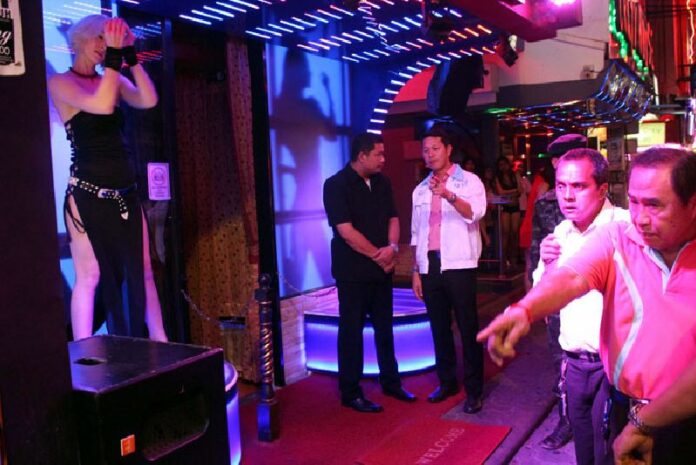
An official discusses the importance of complying with municipal regulations on use of public space last night outside a go-go bar on Pattaya's Walking Street.

CHONBURI — Thailand's vice city, a known haven of transnational crime syndicates where sex, drugs and money are fluid commodities, isn't going to tolerate any more scofflaws. At least not where its sidewalks are concerned.

A band of Pattaya City officials, policemen and soldiers called upon its infamous Walking Street last night to demand go-go bars, vendors, nightclubs and other businesses stop violating city regulations on use of public space and keep the footpath clear.

There they discovered vendors hawking goods and parked vehicles in the street whose name is derived from its intended purpose: A pedestrian-only stretch reserved for adult entertainment and indulgence.

Among the 20-or-so-strong group was local official Morakot Noohuang, who said business operators along Walking Street have been told to keep within legal boundaries so that members of the public can fully use the public pavement.

More than half of them even said they would comply, Morakot said.

“A majority of business operators agreed to cooperate with us,” he said.


\

\

An official discusses the importance of complying with municipal regulations on use of public space last night outside the "Sugar Baby Ago-Go' on Pattaya's Walking Street.

He said local authorities will convene a meeting to determine how to punish those that refuse to cooperate. No arrests were made last night, and officials merely confiscated signs and goods that intruded upon the pavement, Morakot added.

The media was invited along last night’s show of intent to enforce the law, much as it was earlier this month when officials once again renewed their vows to someday do something about the plague of jet ski operators scamming tourists.

Home to a variety of go-go bars, sex shows and sex workers, Pattaya’s Walking Street is a well-known destination of sex tourists from around the world.

Although prostitution and salacious entertainment are outlawed, the authorities largely tolerate their presence, and only make arrests when particular cases gain attention, most often from social media.

\

A fried food vendor listens to an official explain the importance of complying with municipal regulations on use of public space last night on Pattaya's Walking Street.

Related stories:

30 Pattaya 'Jet Ski Mafia' Warned to End Scam

Soldiers Bust Illegal Sidewalk Bars in Pattaya

Police Close Down 'Oral Sex Club' in Pattaya for Ten Days

Police, Soldiers Raid Pattaya 'Naked Sushi' Restaurant


To reach us about this article or another matter, please contact us by e-mail at: [email protected].

Follow Khaosod English on Facebook and Twitter for news, politics and more from Thailand.

Follow @KhaosodEnglish

\

Advertisement

Police Chief Plays Down Bombing Suspect’s Alleged Confession

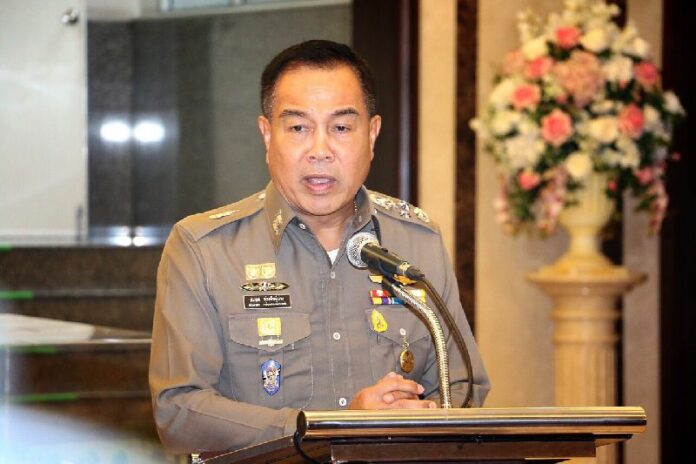
Royal Thai Police Chief Gen. Somyot Pumpanmuang speaks to reporters today about unsourced media reports claiming a suspect in Thai custody had confessed to being the Erawan Shrine bomber.

BANGKOK — The Royal Thai Police commander today dismissed an alleged confession by a suspect already in custody that he was the bomber behind the attack that killed 20 people in Bangkok last month.

Citing unnamed police sources, several Thai media agencies reported last night that the man police call Adem Karadag, who was detained during a raid on an apartment in Nong Chok district on 29 Aug., had confessed to interrogators that he was not only part of the group responsible for the bombing of the Erawan Shrine on 17 Aug. but the bomber himself.

But police chief Somyot Pumpanmuang played down Karadag’s reported confession, saying the man had been giving contradictory testimony to police since he was arrested.

“Police are not yet convinced. I don’t want you to conclude that this news is correct until there is evidence that matches [his confession], because since Mr. Adem was arrested, in each interrogation, Mr. Adem has changed his testimony,” Police Gen. Somyot said today.

\

A fake Turkish passport found in the possession of a man who claims to be Mohammed Bilaturk, a naturalized Turkish citizen originally from Xinjiang, China.

Karadag, who reportedly has said he is a naturalized Turkish national originally from Xinjiang, China, named Mohammed Bilaturk, has previously denied through his lawyer any involvement in the attack and said he was not even in Thailand at the time.

His lawyer, Chuchart Kanpai, said last week his client entered Thailand on 24 Aug. en route to Malaysia where he hoped to find work. He said a human smuggler facilitating his journey from Turkey ordered him to stay in an apartment room where police discovered him five days later.

Authorities have yet to indicate what day he entered Thailand.

As for the reported confession, Somyot told reporters that police would require much more than a verbal confession to make the case that Karadag is indeed the most wanted man in Southeast Asia, such as a clear timeline of the bomber’s movements and forensic evidence.

“Today, I don’t dare conclude that Mr. Adem is the yellow-shirted man, because one day Mr. Adem said one thing, another day he said another thing,” Somyot said. “If I concluded that he is, and the media reported my words, and if Mr. Adem changed his testimony again, both I and the media would be damaged.”

Chuchart said today he was unaware his client made any confession as reported by the media.

“I insist that he has always denied that he was the yellow-shirted bomber,” Chuchart said, adding that he did not see Karadag yesterday – when he reportedly made the confession – because the suspect was seeing a doctor at the prison because he was ill.

Chuchart added that he will next see Karadag on Monday.

Police have said Karadag was arrested along with a large cache of bomb-making materials in an apartment room in Bangkok’s Nong Chok district. He was then interrogated without a lawyer present at an army base in Bangkok for a week before being handed over to the police and formally charged.

He is being held at the 11th Army District headquarters – which has been converted into a “special prison” by the military – along with several other suspects including Chinese national Yusufu Mieraili.


Related stories:

Turkish Suspect Denies Involvement in Erawan Bomb Attack


To reach us about this article or another matter, please contact us by e-mail at: [email protected].

Follow Khaosod English on Facebook and Twitter for news, politics and more from Thailand.

Follow @KhaosodEnglish

\

Advertisement

As Malaysia's PM Struggles in Graft Scandal, His Party Plays the Race Card

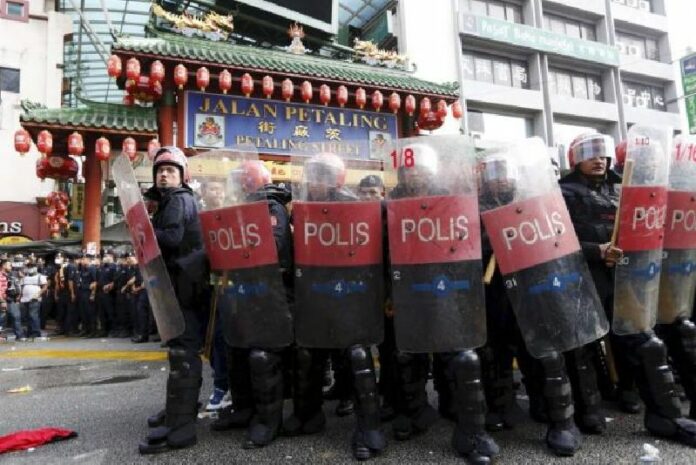
Riot police protect the entrance to Chinatown from 'Red Shirt' demonstrators during a rally to celebrate Malaysia Day and to counter a massive protest held over two days last month that called for Prime Minister Najib Razak's resignation over a graft scandal, in Malaysia's capital city of Kuala Lumpur on 16 Sept. Photo: Reuters / Olivia Harris

KUALA LUMPUR — When thousands of Malay Muslims marched through Kuala Lumpur last week to support his scandal-wracked government, Malaysian Prime Minister Najib Razak kept his distance.

He neither attended nor officially endorsed the racially charged rally by members of Malaysia's majority community.

But several members of Najib's political party told Reuters they helped an ultranationalist Malay group stage the "Malay Pride" rally. Critics accused the organizers of stoking racial tensions in multicultural Malaysia to distract from a multi-million-dollar corruption scandal swirling around the prime minister.

Protesters at the rally held signs reading "Don't insult Malays and Islam" and "#najibstays". Some were eventually dispersed by riot police outside Chinatown, where many Chinese businesses are located.

There, witnesses said, they hurled racial abuse against ethnic Chinese and threatened a repeat of 1969, when ethnic rioting killed hundreds of people, mostly Chinese. Communal tension has simmered in the succeeding decades, and some fear that racially volatile mass gatherings like the Sept. 16 rally could spiral into violence.

"It's not a threat," Ali Rustam, the head of the Malay group, said of the rally in an interview. "It's a reminder: Don't play with fire. Don't insult the Malays too much."

Malays make up about 60 percent of Malaysia's 30 million people and Chinese about 25 percent. There is also a sizeable Indian minority.

Many opposition supporters are ethnic Chinese, who dominated an anti-government protest last month that demanded Najib's resignation.


'Support Your Boss'

In a rural region of Selangor state last week, an official from the ruling United Malays National Organisation (UMNO) told Reuters that his party division hired 25 buses to ferry about 1,000 supporters to the pro-Najib rally in Kuala Lumpur. Five UMNO members said they were paid by party officials to attend.

"You have to support your prime minister, your boss," said Ahmed Samsuri, an UMNO division secretary in Selangor. Participants were fed and given a red T-shirt to wear, but weren't paid, he said. 

But five protesters, all UMNO members in their teens or twenties, told Reuters that party officials had given them up to 50 ringgit (USD$12) when they boarded the buses. These small sums represent at least half a day's wages in rural areas.

"We didn't go because of the money. We went to unite the Malays," said Shahrizan Ahmad, 18, a fisherman.

The prime minister's office did not respond to a request for comment. Two senior UMNO party officials also declined comment.

About 30,000 people attended the rally, which was held as Najib faces allegations of graft and mismanagement at indebted state fund 1Malaysia Development Bhd, or 1MDB.

According to reports in July, investigators found that nearly $700 million was put into a private bank account in Najib's name.

Authorities in several countries are now scrutinizing the fund. The New York Times has said a U.S. federal grand jury was examining allegations of corruption involving Najib and people close to him.

Najib has denied taking any money for personal gain.


Martial Arts Group

The Sept. 16 rally was officially organized by a Malay martial arts group called the National Silat Organisation, known by its Malay-language acronym Pesaka.

About half its members are also members of UMNO, said the group's chief Ali Rustam. He himself is a senior UMNO functionary.

Authorities allowed the rally to go ahead although the opposition protest march last month was deemed illegal.

Ultranationalist groups like Pesaka have become more visible since the long-ruling party's poor showing in a 2008 general election.

"To mobilize people they have to play on the same kind of rhetoric: that Malays are under threat and need defending," said Sophie Lemière, an expert in Malay militancy at the European University Institute in Italy.

"Najib is in a very vulnerable moment. He needs these groups to create the impression that he's strong."

Business has returned to normal in Chinatown, but some traders there told Reuters they were still rattled by last week's rally.

One said rumors of attacks against the community still circulated on social media.

The bulk of the protesters were mobilized by Pesaka, which says it is a civic organization and claims hundreds of thousands of members nationwide. 

While the prime minister didn't attend the rally, he was guest of honor two days later at a mass gathering of Pesaka members in Kuala Lumpur's Merdeka Square.

There, in traditional Malay dress, the British-educated Najib watched a martial arts display in which fighters appeared to dip their hands in boiling oil. 

Afterwards, in a fiery speech, Najib praised Pesaka members as "willing to die" for the government.

"Malay people can also show that we are still able to rise when our dignity is challenged, when our leaders are insulted, criticized, shamed," he said.

He added: "We respect other races. But don't forget: Malays also have their feelings. Malays also have their limits."

Story: Reuters / Trinna Leong and Andrew R.C. Marshall


To reach us about this article or another matter, please contact us by e-mail at: [email protected].

Follow Khaosod English on Facebook and Twitter for news, politics and more from Thailand.

Follow @KhaosodEnglish

\

Advertisement

Hot News

LATEST NEWS

Bangkok
moderate rain
26.6 ° C
27.2 °
26.6 °
88 %
4.8kmh
89 %
Fri
32 °
Sat
36 °
Sun
34 °
Mon
31 °
Tue
31 °