





















35.5 C
Bangkok
Friday, July 24, 2026
Home Blog Page 2953

Please Don't Protest Prayuth at UN, Govt Asks Thai Expats

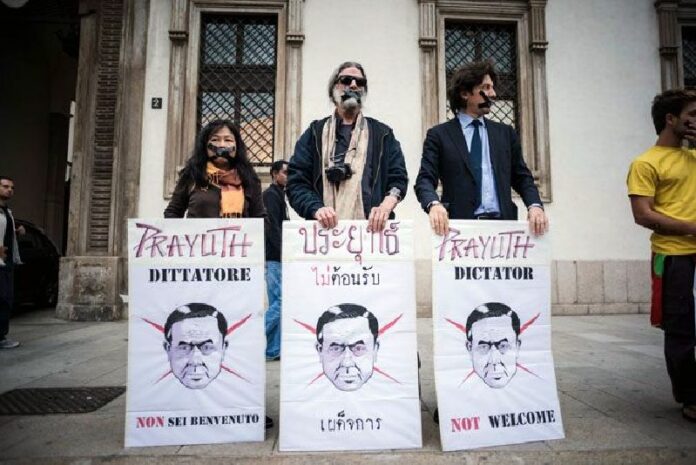
Thai dissident Junya Yimprasert and Italian activists hold signs in three languages at a protest against junta chief Prayuth Chan-ocha's visit to Milan, Italy, in October 2014. Photo: Eugenio Marongiu

BANGKOK — The military government has urged Thai expats in the United States to refrain from protesting junta chairman Prayuth Chan-ocha’s upcoming visit to the United Nations headquarters in New York City.

Gen. Prayuth, who came to power by staging a coup, is due to attend the UN General Assembly meeting Thursday – 1 Oct. in Manhattan, where anti-coup Thais are expected to greet the general’s visit with a protest, similar to the small rallies which met his trips to Milan and Tokyo last year. A government spokesman today urged protesters to think twice.

“I think this concerns the face of Thailand,” Maj. Gen. Weerachon Sukhonthapatipak said. “Whoever intends to discredit the government, I want to urge them to reconsider their thoughts, because doing so would mean discrediting Thailand as well. I think people who have good intentions for the country and Thai people can see that they shouldn’t do that kind of thing.”

Yesterday a group called Red USA put out a call online for protesters to gather Saturday at a park near the UN headquarters.

"We are inviting Thais to come out and exercise their rights in the Land of the Free,” it said. “Do not wait for anyone else. It is us who will return our country to normalcy again."

\

Prime Minister Gen. Prayuth Chan-ocha samples langsat today at a farming produce exhibition at Government House in Bangkok.

However Weearachon pleaded with those looking to make a statement to think of what it would say about Thailand.

“I think the impact of those actions won’t be just on certain individuals,” he said. “It would be on the entire country … it may affect the country’s face. We will be seen as a society that is still divided.”

When a reporter asked Weerachon whether the government would directly ask anti-coup critics not to stage the protest, the spokesman said, “We won’t, because it’s an issue about individuals rights. But whatever they do, they should refrain from causing frictions or using words that will cause ill feelings.”

Speaking at Government House today, Gen. Prayuth said he is not concerned by prospects of being met by protesters during his trip.

“They will take care of me. Don’t worry. It’s a world-class summit,” Prayuth said, adding “I won’t be distracted. They criticize me every day anyway. Why would I be distracted?”

Nevertheless, the junta chairman, who also serves Prime Minister, echoed the worry a protest against him during the trip may negatively impact Thailand’s image.

“So many countries will attend the meeting. Aren’t they embarrassed? Our country is our country. If you want to pick a fight with me, do it in the country. Don’t pick a fight elsewhere. I’m embarrassed.” he said.

Since coming to power in May 2014, Gen. Prayuth has imposed a ban on protests, political activities and any public challenges to his regime. Some violators of the ban have been sent to stand trial under martial court, where they face up to two years in prison if found guilty by the all-military judges.

Since the coup, Thai activists living abroad have staged small protests when Prayuth visited their countries of residence, such as Milan, Italy in October 2014 and Tokyo, Japan in February 2015.


Related stories:

Junta Spokesperson Dismisses Anti-Coup Protest in Japan

Govt Insists Images of Milan Anti-Prayuth Protest Are Fake


To reach us about this article or another matter, please contact us by e-mail at: [email protected].

Follow Khaosod English on Facebook and Twitter for news, politics and more from Thailand.

Follow @KhaosodEnglish

\

Advertisement

Navy, Army Officers Charged with Human Trafficking

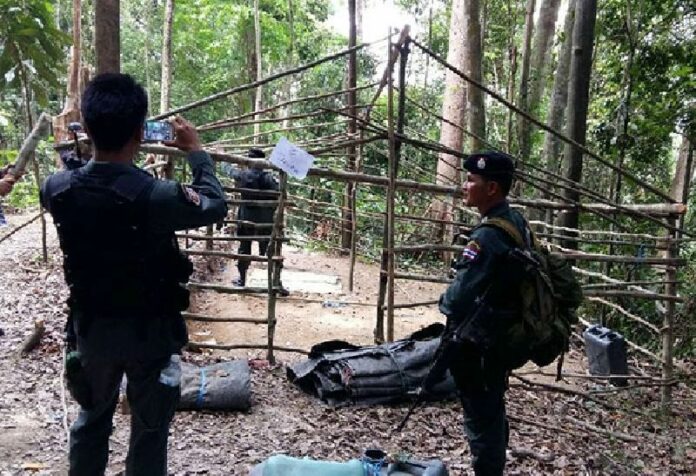
Security forces inspect a just-abandoned jungle stockade where human traffickers kept captives under dire conditions in this 5 May file photo

BANGKOK — A court yesterday approved arrest warrants for four officers – three from the army and one naval officer – in connection with trafficking of Rohingya refugees in southern Thailand.

Despite widespread accounts in recent years of security forces being heavily involved in the trafficking of Rohingya refugees, only one officer had been previously implicated and yesterday’s warrants included the first issued for an officer in the navy.

Cmd. Kampanart Sangthongchin is the first Royal Thai Navy officer to be accused of engaging in trafficking operations, along with warrants for army officers Col. Nattasit Maksuwan, Cpt. Visoot Boonnag and Cpt. Santhat Petchnoi. All three army officers work for the Internal Operation Security Command, a government counter-insurgency agency.

All four are charged with human trafficking.

Defense Minister Pravit Wongsuwan said today he had not studied the warrants’s deatails and urged the public not to assume the men’s guilt.

“I think every [organization] has both good people and bad people,” Pravit said. “Right now, don’t accuse anyone of anything, because they are merely charged with the crime. What the facts are, you have to wait for the investigation first. Don’t slap allegations on anyone.”

The court has issued 150 arrest warrants so far in the crackdown on human trafficking rings in the Thai south, of which 89 have been arrested, police said. Local officials, business owners and bureaucrats have been counted among the suspects.

The crackdown on trafficking networks came after security forces discovered deserted detention camps deep in the jungle near the Thai-Malaysian border in May. The camps were reportedly used by traffickers to hold refugees from neighboring countries – mostly Rohingyas from Myanmar – as hostages to extort ransom from their families.

More than 100 bodies were found in mass graves of refugees who died or were murdered.

Prior to yesterday’s warrants, three-star army general Maj. Gen. Manas Kongpaen was the only military officer to be charged with trafficking. Arrested in June, he is currently being held without bail and awaiting trial.

Defense Minister Pravit said the campaign against trafficking will embrace as many “international principles as possible.” He stopped short of saying those implicated would face criminal prosecution.

“We have been neglecting the problem for too long. From now on, officials will give importance to this matter,” he said. “Those involved in human trafficking will be transferred.”

The complicity of naval officers was the central issue in a recently dismissed defamation case brought by the Royal Thai Navy against two journalists with online news site Phuketwan.


Related stories:

Court Dismisses Charges Against Phuketwan Journalists

Death Camps: Police Arrest 12, Seek 56 Others in Trafficking Probe

Thai Govt: US Should Clarify Human Trafficking Rankings

Human Trafficking Crackdown: Army General Denied Bail

Mass Grave Found at Thai Trafficking Camp


To reach us about this article or another matter, please contact us by e-mail at: [email protected].
Follow Khaosod English on Facebook and Twitter for news, politics and more from Thailand.

Follow @KhaosodEnglish

\

Advertisement

Navy, Army Officers Charged with Human Trafficking

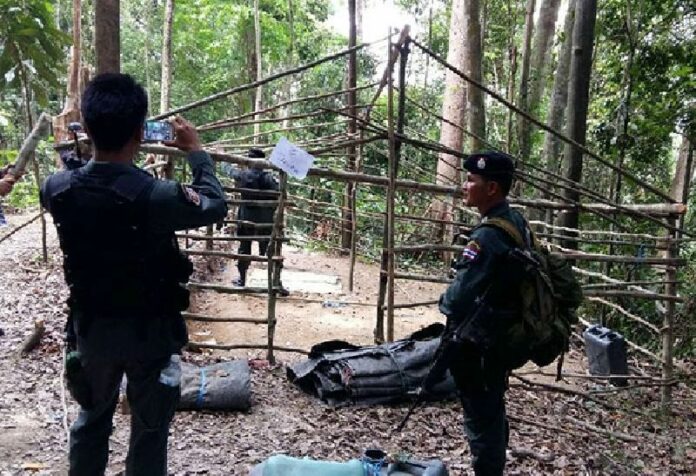
Security forces inspect a just-abandoned jungle stockade where human traffickers kept captives under dire conditions in this 5 May file photo.

BANGKOK — A court yesterday approved arrest warrants for four officers – three from the army and one naval officer – in connection with trafficking of Rohingya refugees in southern Thailand.

Despite widespread accounts in recent years of security forces being heavily involved in the trafficking of Rohingya refugees, only one officer had been previously implicated and yesterday’s warrants included the first issued for an officer in the navy.

Cmd. Kampanart Sangthongchin is the first Royal Thai Navy officer to be accused of engaging in trafficking operations, along with warrants for army officers Col. Nattasit Maksuwan, Cpt. Visoot Boonnag and Cpt. Santhat Petchnoi. All three army officers work for the Internal Operation Security Command, a government counter-insurgency agency.

All four are charged with human trafficking.

Defense Minister Pravit Wongsuwan said today he had not studied the warrants’s deatails and urged the public not to assume the men’s guilt.

“I think every [organization] has both good people and bad people,” Pravit said. “Right now, don’t accuse anyone of anything, because they are merely charged with the crime. What the facts are, you have to wait for the investigation first. Don’t slap allegations on anyone.”

The court has issued 150 arrest warrants so far in the crackdown on human trafficking rings in the Thai south, of which 89 have been arrested, police said. Local officials, business owners and bureaucrats have been counted among the suspects.

The crackdown on trafficking networks came after security forces discovered deserted detention camps deep in the jungle near the Thai-Malaysian border in May. The camps were reportedly used by traffickers to hold refugees from neighboring countries – mostly Rohingyas from Myanmar – as hostages to extort ransom from their families.

More than 100 bodies were found in mass graves of refugees who died or were murdered.

Prior to yesterday’s warrants, three-star army general Maj. Gen. Manas Kongpaen was the only military officer to be charged with trafficking. Arrested in June, he is currently being held without bail and awaiting trial.

Defense Minister Pravit said the campaign against trafficking will embrace as many “international principles as possible.” He stopped short of saying those implicated would face criminal prosecution.

“We have been neglecting the problem for too long. From now on, officials will give importance to this matter,” he said. “Those involved in human trafficking will be transferred.”

The complicity of naval officers was the central issue in a recently dismissed defamation case brought by the Royal Thai Navy against two journalists with online news site Phuketwan.


Related stories:

Court Dismisses Charges Against Phuketwan Journalists

Death Camps: Police Arrest 12, Seek 56 Others in Trafficking Probe

Thai Govt: US Should Clarify Human Trafficking Rankings

Human Trafficking Crackdown: Army General Denied Bail

Mass Grave Found at Thai Trafficking Camp


To reach us about this article or another matter, please contact us by e-mail at: [email protected].
Follow Khaosod English on Facebook and Twitter for news, politics and more from Thailand.

Follow @KhaosodEnglish

\

Advertisement

From Street Life to the Sweet Life: Thailand's Rescued Strays

Photo: DPA / Ian Robert Knight

BANGKOK — Among the non-stop crowds at Bangkok's main international airport are a small group of more unusual travelers going on the trip of a lifetime.

Rocket, Pippi, Palin and Smartie are sitting in their individual crates on luggage trolleys waiting to be checked in among airline passengers, bringing smiles to onlookers. Their destination is Los Angeles, California.

Soon to board his first flight, Rocket appears nervous, barking loudly and scratching away at his large blue kennel trying to get the door open.

His canine companions look relaxed, lying down quietly while chewing treats in their blanket-lined kennels, equipped with a water dispenser.

\

All packed up and ready for long journeys to new homes. Photo: DPA / Ian Robert Knight

A few days ago, the four dogs were in a crowded shelter alongside thousands of other rescued street dogs. But now they are about to start a 20-hour, 13,000-kilometer journey to the western United States.

"These dogs have better chances of finding owners abroad than in Thailand," says Emily Bernie, the founder of California-based Life Animal Rescue, who is accompanying the canines on their flight.

Each year, her organization finds homes in the United States for about 50 dogs from Thailand.

"I used to work with local shelters in California but the situation there has improved significantly so I'm reaching out to other countries like Thailand," says Bernie.

Rocket and his friends are part of a special project to take dogs to a shelter overseas to await possible adoption. In most cases, dogs in Thai shelters are first adopted by a foreign owner before being transported to their new home abroad.

About 700 dogs are adopted internationally each year, according to an estimate by James Reynolds, a Bangkok-based volunteer who works as a kind of fixer for stray dogs: transporting them from the shelters to the Thai capital; arranging paperwork and vaccinations; and finally seeing them safely onto the plane.

Foreign adoptions, mainly by owners in Europe and the United States, are more common than local adoptions.

Foreigners seem to be more aware and willing to take in rescued dogs, Christy Baker of Phuket-based Soi Dog Foundation observes. Around 85 per cent of all adoptions at South-East Asia's largest private animal rescue organization come from foreign countries.

"I fell in love with Noshi right away when I saw him," says Katharina Tesch, recounting her experience of meeting the puppy in 2014 at a shelter on the southern resort island of Phuket.

"He was so tiny and wrinkly but also very cute," the 24-year-old marketing student from Germany says of her one-year-old dog.

Noshi was rescued from the streets when he was a few days old along with his six siblings. Their mother died after being poisoned – a common, although illegal, method local people use to kill unwanted street dogs.

Noshi is now set for celebrity, as his image will soon adorn the packaging of a German brand of dog food.

The whole adoption process from Thailand takes an average of three months and transportation costs range from 300 dollars to more than 1,000.

\

Photo: DPA / Ian Robert Knight

Private organizations, like Life or Soi Dog, usually help cover costs through money donated to them.

The donations also go toward sterilization programmes to curb dog populations in Thailand. Soi Dog has spayed and neutered about 80 per cent of street dogs on the southern resort island of Phuket.

It is estimated that more than 720,000 dogs roam the streets in Thailand, and the number is rising annually, according to the Department of Livestock Development.

Shelters teem with dogs that are disabled or unhealthy, or were abandoned by owners or rescued from the dog-meat trade.

Euthanasia is not practiced in Buddhist-majority Thailand, where killing other beings is a cultural taboo, so these dogs stay in the shelters until they die or are adopted.

"Adoption is not the answer to controlling the stray populations," says Bernie, arguing that more street dogs need to get neutered or spayed.

British health consultant Lorraine Hepburn adopted four Thai dogs, three of whom were rescued from a truck transporting hundreds from Thailand to be sold for meat in Vietnam or China.

"I want to give them a chance at life," says Hepburn. Her first adopted dog, Odie, contracted distemper at the shelter, leaving him with severe twitches in his head and limbs.

Two years after being adopted his tremors disappeared completely, Hepburn says.

There are more than 1,600 dogs waiting to be adopted from the Soi Dog Foundation, while five government-run shelters across the country are overwhelmed.

"There are so many of them in the shelters that need help but I can only take so many each time," Bernie says, as she sends Rocket and his friends to their special section of the cargo hold.

Bernie chose the four dogs herself from a government-run shelter in central Thailand.

"These dogs are incredibly lucky – it's like they have won the lottery."

Story: DPA / Siraphob Thanthong-Knight

Advertisement

Police Protest Giving Officer Position to Former PCAD Leader

Chitpas Kridakon speaks at an anti-government protest in Bangkok on 19 May, 2014. Photo: Chitpas Kridakon/Facebook.

BANGKOK — A former leader of the group which organized anti-government protests preceding the 2014 coup is reconsidering her application for an officer position in the Royal Thai Police, a police official said, after her candidacy was criticized as political favoritism.

Chitpas “Tant” Kridakon, 30, is being considered for the position of deputy inspector in the force’s 191 emergency response unit, Royal Thai Police chief Somyot Pumpanmuang confirmed yesterday. Although Chitpas did not attend police academy, he said such applicants can be considered if they possess the “special talents and abilities” needed by relevant agencies.

“As the commander of the Royal Thai Police, let me assure my fellow police officers that I will exercise my power and duty in accordance with the laws to consider [this matter] carefully, and I will uphold the principle of appropriateness, regulations and laws,” Somyot said yesterday.

He insisted police are treating Chitpas’ application like any other.

\

Chitpas and PCAD leader Suthep Thaugsuban at her graduation ceremony in Bangkok on 17 June, 2014. Photo: Chitpas Kridakon/Facebook.

Chitpas, once a scion of the family which owns Thailand’s largest brewery, was one of the core leaders of the People’s Committee for Absolute Democracy with the King as Head of State, or PCAD, during its campaign to oust the elected government from November 2013 to May 2014. The protest came to an end when the military intervened and staged a coup on 22 May, 2014.

In December 2013, Chitpas told AFP that she believes Thai people lack “true understanding of democracy … especially in the rural areas,” sparking condemnation from the government’s supporters, which consisted mostly of urban and rural poor.

During the weekend, a Facebook page published photos purporting to show some police officers tieing black ribbons to their radios in protest of Chitpas’ application.

According to the “Thai Police Fight Fight!” group on Facebook, officers were opposed to Chitpas’ joining the force because of her history of frequently denouncing the the Royal Thai Police during the anti-government protests she helped lead last year.

Many supporters of the former government also accuse the police of appointing allies of the military junta into its ranks.

\

Images from a police Facebook group showing black ribbons said to be in protest of hiring Chitpas. Photo: 'Thai Police Fight Fight'/Facebook

“Applying for police job is just an excuse. There’s more to this than that,” said Siriwat Chupamattha, a coordinator of the Redshirt umbrella organization in Payao province, which supported the toppled government. “There’s a hidden agenda.”

But Police Maj. Gen. Panurat Lakboon, commander of the 191 police unit, said he believes Chitpas would be a great contribution to the force because of her English language skills.

“It is nice of Ms. Chitpas to apply for a job with the police, because we need female police officers who are talented in English, in order to prepare for Thailand’s entry to the ASEAN Economic Community,” Panurat told reporters yesterday.

He added that he heard that Chitpas was thinking of withdrawing her application due to the wave of criticism.

“That would be a pity,” he said.


Related news:

Singha Beer Family Scion 'To Change Surname'

Singha Beer Brewery Distances Itself From Anti-Govt Socialite


To reach us about this article or another matter, please contact us by e-mail at: [email protected].

Follow Khaosod English on Facebook and Twitter for news, politics and more from Thailand.

Follow @KhaosodEnglish

\

Advertisement

Hundreds Denounce Junta at Democracy Monument (Photos)

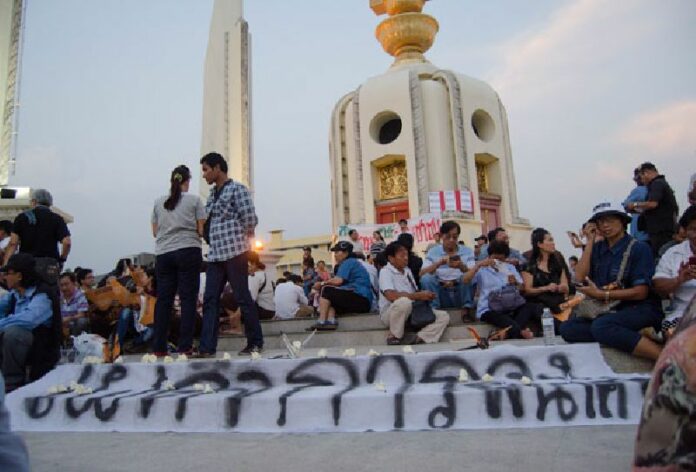
'Down with Dictatorship' reads a banner unrolled Saturday on the steps of Bangkok's Democracy Monument by pro-democracy protesters.

By Grace Moore

By Grace Moore
Correspondent
BANGKOK — Activists from the New Democracy Movement led hundreds of demonstrators in a march Saturday, challenging the military government’s ban on protests.

Marching from Thammasat University to the Democracy Monument at around 5pm, the crowd of approximately 200 demonstrators chanted and waved signs denouncing thailand's military regime.

“Thai people must take part in the democracy movement,” said organizer and student-activist Rangsiman Rome. “If anything is going to be the enemy of the military regime, it's the democracy we represent."

The protest occurred as Prime Minister Gen. Prayuth Chan-ocha prepares to travel to New York, where he is to address the United Nations General Assembly about Thailand’s plans for poverty alleviation, sustainability and the possibility of holding an open election within the next two years.

The protests was led by student activists Rangsiman and Siriwit Serithiwat, along with others including some of the 14 activists arrested in June on charges of sedition and violating the junta’s ban on public assembly.

The protest marked the nine year anniversary of the 2006 coup d'etat, which ousted then-Prime Minister Thaksin Shinawatra. Demonstrators also pointed to the most recent coup, which toppled a pro-Thaksin government in May last year, as a sign of the military hindering democracy in Thailand.

Following the 2014 coup, political participation has been monitored in Thailand and hundreds have been arrested for anti-junta demonstrations, said Rangsiman Rome.

The need for a protest shows that there has been little progress toward democracy in Thailand for nearly a decade, Rome said.

As the march approached Democracy Monument, protestors were met by more than 100 police officers standing shoulder to shoulder, blocking the path. Demonstrators peacefully pushed through the police line and climbed the steps of the monument. Though police monitored the protest, searching bags and asking protestors to remove large banners from the monument, no arrests were made.

Piyarat Chongthep, an activist known for his views against student hazing rituals in Thailand's universities, also spoke at the protest about his desire to see democratic leadership.

“We need to be patient, but we will not stand a dictatorship,” said Chongthep.

Prayuth announced last week that an election could take place in Thailand in July 2017.

For activists such as Serithiwat, two years is too long to wait.

“We will keep trying," said Siriwit. "More and more of us will join this fight, until they give us back the power."

Correction: Due to a reporting error, an earlier version of this story incorrectly stated Prime Minister Gen. Prayuth Chan-ocha had already departed for New York.  He leaves Thursday.


\

Student activist Siriwit Serithiwat addresses the crowd in front of Democracy Monument,  demanding a swift return to democratic rule in Thailand.


\

A young demonstrator holds a sign during Saturday's march from Thammasat University to Democracy Monument.


\

\

\

Approximately 200 police officers were posted around Democracy Monument to observe the protest. No arrests were made and protestors were allowed inside the monument. Police asked protestors to remove large banners from the monument and searched the bags of people entering the area.


\

\

Some demonstrators carried signs during the march, others waved pamphlets, many tweeted and posted updates to Facebook spreading the protest across social media.

\

\

The three-finger salute, popularized by the Hunger Games, is often used by those advocating democratic change in Thailand.


\

Student advocate and leader Rangsiman Rome was among 14 activists arrested 26 June, 2015, for sedition and violating the military junta’s ban on public assembly. He said Saturday's protest was "to show the power of the people in a democracy." The protest held on the ninth anniversary of the 2006 military coup d’etat shows "nothing has changed" Rome said. "Thai people must take part in the democracy movement," he said. "If anything is going to be the enemy of the military regime, it's the democracy we represent."


\

Student activist Siriwit Serithiwat marches at the head of hundreds of demonstrators Saturday to protest against military rule in Thailand. "We will keep trying," said Serithiwat, addressing the crowds later that evening. "More and more of us will join this fight, until they give us back the power."


Grace Moore is a Bangkok-based photographer and political science and visual journalism graduate of Western Washington University. Her work is available at www.gracelinmoore.com.


Related stories:

Police Allow Coup Anniversary Protest

Democracy Activists Ignore Junta Order to Call Off March


To reach us about this article or another matter, please contact us by e-mail at: [email protected].

Follow Khaosod English on Facebook and Twitter for news, politics and more from Thailand.

Follow @KhaosodEnglish

\

Advertisement

Police Allow Coup Anniversary Protest

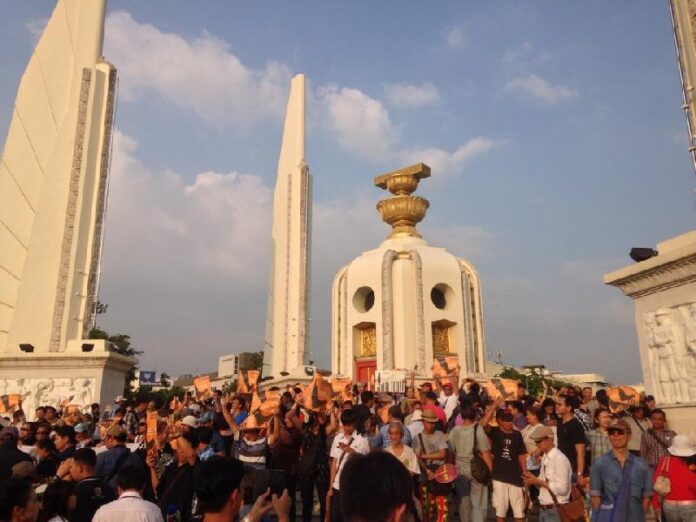
Pro-democracy protesters rally early this evening at the Democracy Monument in Bangkok.

BANGKOK — A demonstration to mark the ninth anniversary of the 2006 military coup d’etat ended tonight without confrontation with the authorities, who yesterday ordered the march be called off.

Activists from the New Democracy Movement led scores of protesters on a march from Thammasat University to the Democracy Monument at around 5pm where they rallied around the historic site to deliver speeches against the military government and sing songs until dispersing without incident just after 9pm.

“Return power to the people!” read one of the banners. “Down to dictators!” proclaimed another.

The protesters denounced both the 2006 coup, which ousted then-Prime Minister Thaksin Shinawatra on this day nine years ago, and the most recent coup which toppled a pro-Thaksin government in May last year. They demanded a swift return to democratic rule in Thailand.

Approximately 100 police officers were posted around the area to observe. They interfered briefly to order the organizers to take down some large banners from the monument. No arrests were made.

The military junta, which came to power when it staged Thailand’s latest coup in May 2014, earlier instructed the activists to abandon their plans for the march, citing the ban on protest it has imposed since the coup.

Police officers also arrived at an earlier panel discussion at Thammasat University, also organized by New Democracy Movement, to ask organizers not to go ahead with the march. But the protesters eventually set out from the university compound without intervention from police.

Video of today's march and rally by Matichon TV.

It was unclear whether today’s protest leaders will face any legal repercussion for defying the junta’s ban on protest. The 14 leaders of the New Democracy Movement are still facing criminal charges for an anti-junta march in June at the same location. They were later arrested and held in prison for nearly two weeks before a martial court granted them temporary release.

Speaking at the panel discussion before the march, activist Pakorn Areekul said he was opposed to Thaksin before the military seized power from his government in 2006.

“When the coup happened, I felt relieved that Thaksin was gone, but I wasn’t glad about the coup,” Pakorn said. “After that, society went through a process of turning Thaksin into a devil. But in reality, there are more evils in Thailand than just Thaksin.”

Pakorn said Thailand has other problems now, such as the inability for people to express their opinions or open debate .

Social activist Sombat Boonngam-anong, who was among the first to protest against the 2006 coup, said at today’s forum that what happened nine years ago derailed development of democracy in Thailand. He argued that Thaksin would have lost power without a coup anyway, and many lives would have been saved.

“If there was no coup d’etat on 19 Sept., 2006 , Thai society would still have a taxi driver named Praiwan Nuamthong [who committed suicide to protest the coup on 31 Oct., 2006]. No color-coded politics. No events in April 2010, and people wouldn’t have died in that violence,” he said.

He also suggested that coups in Thailand are tolerated not only because the military is willing to seize power from elected government, but also because some portions of the public tolerate it.

“If you don’t want to see any more coups, you have to change people’s minds,” Sombat said.

\

Related stories:

Police Stand by as Coup Anniversary Protesters Rally


To reach us about this article or another matter, please contact us by e-mail at: [email protected].

Follow Khaosod English on Facebook and Twitter for news, politics and more from Thailand.

Follow @KhaosodEnglish

\

Advertisement

Millionaire's Son Gets 2 Years for 'Mercedes' Murder

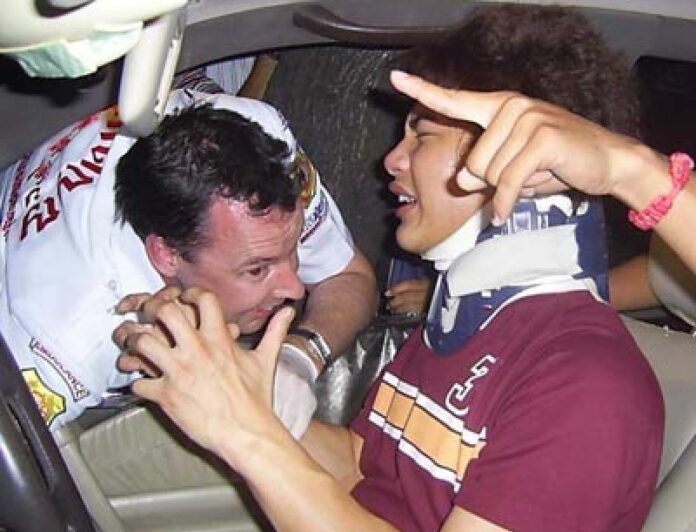
Kanpitak "Mooham" Patchimsawas in an image taken after he drove his Mercedes-Benz into a group of people, killing one woman bus conductor.

BANGKOK — The Supreme Court sent the son of a well-known businessman to jail Friday for killing a bus conductor with his Mercedes-Benz eight years ago, reversing a previous verdict that spared him from jail term on the grounds of mental illness.

Kanpitak Patchimsawas, 33, was found guilty of premeditated murder, attempted murder and physical assault, and sentenced to two years and one month in prison. His parents, millionaire Kananek Patchimsawas and former Miss Thailand Sawinee Patchimsawas, were not in court to hear the verdict.

The dead woman’s daughter was, however.

“I have gone through so much sadness, despair and hopelessness. But today, my fight is successful. I am glad to have successfully fought for my mother,” said Sucheera Intarasuwansaid, the daughter of bus conductor Saichon Luangsaeng.

In 2007, Kantipak’s car was hit by a public bus in front of Soi Sukhumvit 26. An argument between Kantipak and the bus driver soon ensued, escalating when Kantipak hit the driver in the face with a rock.

Kantipak then returned to his car, and as a crowd started to gather around his vehicle, slammed his vehicle into the bus stop, killing bus conductor Saichon Luangsaeng and injuring a number of others.

For his legal defense, Kantipak said he was suffering from mental illness and unable to control himself when the incident took place. His insanity plea was rejected by the Court of First Instance in 2009, which sentenced him to 10 years in prison, but was later accepted by the Court of Appeals in 2013, which handed down a suspended jail term of two years and one month.

The victim’s family appealed the verdict, and today the Supreme Court reversed the previous court’s ruling that found Kantipak to be mentally unstable.

According to the Supreme Court, the fact that Kantipak conversed with the bus driver, police officers and other witnesses minutes before the altercation took place, and that he attempted to drive away from the scene proved Kantipak was in control of himself at the time.

The court also argued that Kantipak was also somehow allowed to drive by his family, in spite of the claimed history mental illness.

“The court has considered the circumstances, age, history, behavior, mental state and environment of the defendant. The court deemed it inappropriate to suspend the punishment on charge of premeditated murder, which has been suspended by the Court of Appeals,” the verdict read.

Kantipak, who showed no obvious sign of emotion as he listened to the verdict with his lawyer, was immediately taken away to prison after the judges finished the read-out.

Kerdphol Kaewkerd, a lawyer who represented the dead bus conductor’s family, told reporters he felt two years in prison was too lenient, in light of the 10 years Kantipak initially received.

“But the case is now considered closed. We have to accept the court’s judgment. We are satisfied,” Kerdphol said. “What we can do now is to forgive him, and we forgive him. We did our best and won justice for the deceased and her daughter.”

He added that Kantipak’s family had also paid the victim’s family around 2.2 million baht in compensation.


To reach us about this article or another matter, please contact us by e-mail at: [email protected].
Follow Khaosod English on Facebook and Twitter for news, politics and more from Thailand.

Follow @KhaosodEnglish

\

Advertisement

Democracy Activists Ignore Junta Order to Call Off March

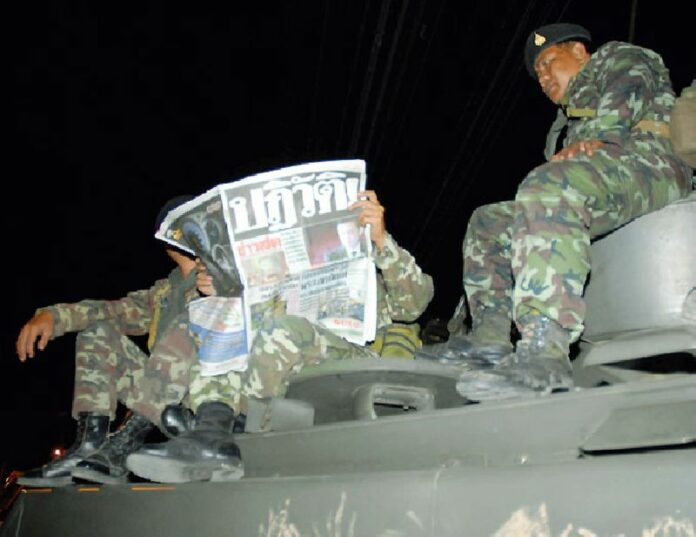
'COUP!' reads the headline of a Khaosod newspaper read by soldiers atop a tank one day after the military staged a coup against then-Prime Minster Thaksin Shinawatra in this 20 Sept., 2006, file photo.

BANGKOK — A pro-democracy group vows to go ahead with a demonstration tomorrow to mark the anniversary of the 2006 coup d’etat despite being warned to call it off by the military junta.

On the eve of the nine-year anniversary of the previous coup; which ousted then-Prime Minister Thaksin Shinawatra on 19 Sept., 2006; a junta security wing reminded activists of the New Democracy Movement by letter today that the regime will not allow any activity which may affect peace and order.

The group was planning to mark the anniversary with an afternoon panel discussion at Thammasat University followed by a nighttime march to the Democracy Monument.

But the letter from the Armed Forces for Maintaining Peace and Order, obtained by Khaosod reporters, states that it has yet to receive a request from the activists to hold the event, and says the junta will only approve events that take place inside Thammasat’s campus.

The current military junta has banned any kind of protest, public gathering and political activity since it seized power from a pro-Thaksin government in May 2014, except events directly approved by the regime.

Some dissidents who have defed the ban have been arrested and sent to stand trial under a military court, where they face up to two years in prison.

However, Rangsiman Rome, a Thammasat student and leader of the movement, told reporters his group will go ahead with the forum and march tomorrow, despite the junta’s warning.

“We already sent a letter to ask for permission from the NCPO, but we never received any reply,” said Rangsiman, referring to the junta’s formal name, the National Council for Peace and Order.

Speakers at tomorrow’s events include long-time activist Sombat Boonngam-anong, who was among one of the first who protested the 2006 coup nine years ago, and political scientist Puangthong Pawakapan.

Rangsiman and and thirteen other members of the New Democracy Movement are still facing criminal charges for an anti-junta march in June at the Democracy Monument. They were later arrested and held in prison for nearly two weeks before a martial court granted them temporary release.


Turning Point

The 2006 coup is regarded by many experts as a crucial turning point in Thailand’s political crisis. It pit Thaksin, a populist leader popular among poor and rural voters, against the Yellowshirts, an anti-Thaksin coalition of middle-class urbanites and traditional elites.

The Yellowshirts accused Thaksin of corruption, abuse of power and anti-monarchy sentiments. Starting in 2004, Yelowshirt leaders organized street protests aimed to remove Thaksin from power.

Two days before a major demonstration by the Yellowshirts and a counter-rally by Thaksin supporters, the military intervened to seize power in a coup d’etat as he was about to give a speech at the United Nations in New York City.

However, the coup failed to end Thaksin’s influence in Thai politics. His allies and proxies later returned to power by winning elections, with Thaksin as the de facto leader calling the shots from exile. The power struggle between the pro- and anti-Thaksin factions continues to this day.

Many political scientists also viewed the 2006 coup as the event that unwittingly turned Thaksin into a martyr for democratic causes among his supporters.


To reach us about this article or another matter, please contact us by e-mail at: [email protected].

Follow Khaosod English on Facebook and Twitter for news, politics and more from Thailand.

Follow @KhaosodEnglish

\

Advertisement

Thailand Wins ‘Ig Nobel’ Distinction for Bribing Cops not to Take Bribes

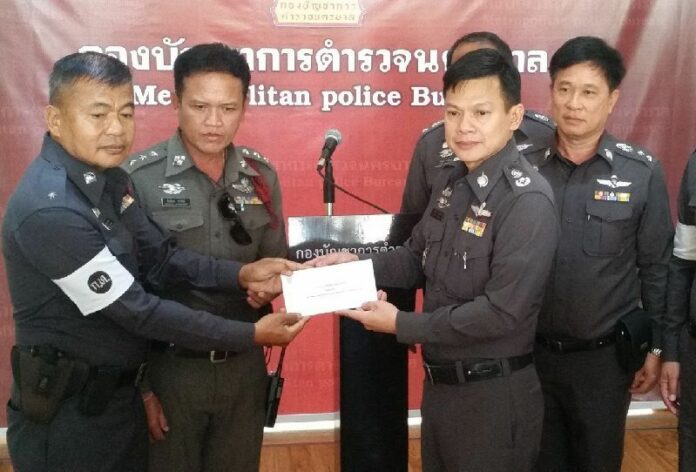
Pol. Lt. Rachan Chomsuwan, at left, receives a 10,000 baht reward for refusing to accept a 100-baht bribe from a motorcyclist in this 10 Oct., 2014 file photo.

BANGKOK — Thailand’s police force is more accustomed to criticism and calls for reform when it comes to the international community. But that changed today with a US-based organization honoring the force for creative economics.

At the 25th annual Ig Nobel awards ceremony, a satirical prize in economics was bestowed upon the Bangkok Metropolitan Police Bureau for a short-lived policy of rewarding police officers who refuse to take bribes.

Organizers of Ig Nobel, a parody of the prestigious Nobel Prize, named the metro police a winner “for offering to pay policemen extra cash if the policemen refuse to take bribes,” according to its website.

The award is organized by science humor magazine “Annals of Improbable Research.” Its stated aim is to recognize scientific achievements that “make people laugh, and then think.”

Other winners of this year’s prizes included: Chemistry to partially un-boil an egg, the discovery that “huh?” exists in every human language and proof that nearly all mammals empty their bladder in about 21 seconds.

'The Stinker' is the official mascot of the Ig Nobel Prize. Image: Improbable Research
‘The Stinker’ is the official mascot of the Ig Nobel Prize. Image: Improbable Research

The Metropolitan Police Bureau did not send any representatives to attend the awards ceremony, which was held in a Harvard University auditorium in Cambridge, Massachusetts. It was the second win for Thailand in recent memory. A 2013 Ig Nobel in public health was awarded for decades-old research into surgical solutions to cope with an epidemic of penis involuntary amputations.

Today’s award recognized a policy announced in early October 2014 to combat rampant bribe-taking among traffic police. Under the policy, officers who refused to take bribes would receive a cash reward of up to 10,000 baht.

Under Thai law, state officials including police who accept bribes from the public face life in jail if convicted. However in reality bribery is extremely common among the Thai bureaucracy, especially the police and military forces.

The much-ridiculed policy only lasted about two weeks before being canceled, after at least two police officers received 10,000 baht each for refusing to take bribes.

Explaining the scheme’s ignoble end, MPB commander Sriwarah Rangsipramnakul said the measure ended up causing criticism in social media and damaging the force’s reputation.

Nevertheless, the idea of rewarding police officers for performing their duty was resurrected in the aftermath of last month’s bomb attack that killed 20 people in central Bangkok.

After offering to pay 3 million baht to members of the public providing information leading to the arrest of those responsible, the Royal Thai Police eventually handed the reward to themselves for taking one suspect into custody in a raid of an apartment in capital’s Nong Chok district.

The suspect, Adem Karadag, has denied any involvement in the bombing and suggested he was set up by a human trafficker, according to his lawyer.

Related stories:

Noodle Vendor Gives Free Meals to Traffic Violators

BKK Police Defend ‘Anti-Bribery’ Cash Reward

Policeman Rewarded 10,000 Baht For Declining Bribe

Advertisement

Hot News

LATEST NEWS

Bangkok
broken clouds
35.5 ° C
35.5 °
33.3 °
54 %
5.2kmh
68 %
Fri
34 °
Sat
37 °
Sun
32 °
Mon
31 °
Tue
29 °