29.4 C
Bangkok
Tuesday, June 23, 2026
Home Blog Page 2953

Army Apologizes for Implicating Pro-Junta Activist in Anti-Junta Network

Supot Piriyakiatsakul (center) listens to apologies from army commanders at a military base in Nakhon Ratchasima, 10 July 2015.

NAKHON RATCHASIMA — Army commanders have apologized to a pro-junta activist in northeastern Thailand who was falsely accused by soldiers of supporting an anti-junta student activist group last week.

Supot Piriyakiatsakul, a 69-year-old veteran Yellowshirt activist who welcomed the 22 May 2014 coup, said seven soldiers from the 21st Army District Army arrived at his house in Nakhon Ratchasima last week while he was out. They then asked his neighbors to warn him to stop "getting involved" with seven anti-coup student activists who were arrested by police last month. Otherwise, "we will get involved with you," the soldiers reportedly told his neighbors.

Supot was shocked and angered by the warning because of his staunch support for the ruling military junta. 

Today two army commanders invited Supot to a military base in Nakhon Ratchasima to deliver a formal apology. Col. Patikorn Eiamla-or, a senior commander of 21st Army District, said the incident was a misunderstanding.

"I would like to apologize to you, brother," Col. Patikorn said. "I insist with my dignity as a soldier that I had no intention to use my power or duty to cause conflict in society."

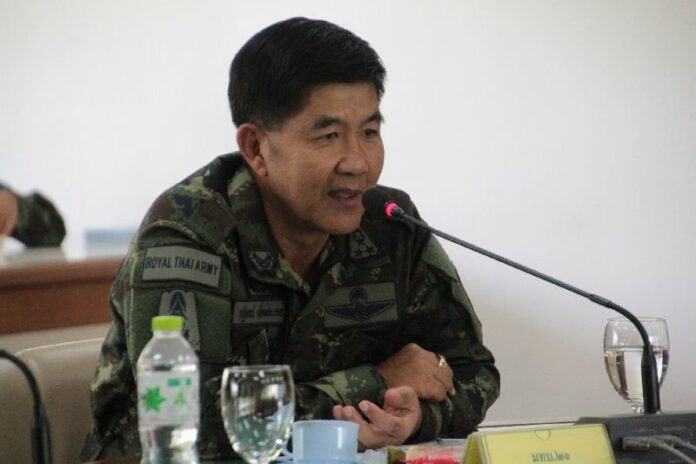
Col. Patikorn Eiamla-or, a senior commander of 21st Army District, apologizing to Supot Piriyakiatsakul for sending soldiers to his house, 10 July 2015.

Maj.Gen. Prawit Hookaew, a commander of the Second Region Army, said he would teach his subordinate units to act more "softly and politely" in order to avoid unnecessary confrontations.

Supot said he accepted the apology and hoped that the incident would not happen again.

"Even though I am a Thai of Chinese descent, my heart is dedicated to love for my country. I have been campaigning in politics since 2006 by choosing to stand on the side of the righteousness," said Supot, who has participated in several campaigns organized by Thailand’s Yellowshirt movement. "I have always supported the military in all their actions."

He continued, "But soldiers' attempt to search my residence has damaged my reputation. They acted like they were arresting some bandit. It's like pushing a friend to join the enemy. I am not a person of great influence. I do not want anything more than apology and assurance that this incident will not happen again." 

The anti-junta activists Supot was accused of supporting, members of a Khon Kaen University student network known as "Dao Din," are now facing trial in military court on charges of inciting unrest and violating the junta's ban on protests. 


For comments, or corrections to this article please contact: [email protected]

You can also find Khaosod English on Twitter and Facebook
http://twitter.com/KhaosodEnglish
http://www.facebook.com/KhaosodEnglish

Advertisement

Tourist Speedboat Sinks Off Pattaya Coast

A speed boat is brought to shore after it began sinking off the coast of Pattaya on 10 July 2015.

CHONBURI — Ten tourists were rescued off the coast of Pattaya today after their speed boat started to sink.

Rescue workers say the boat, named Choke Charee 2, began to sink one nautical mile away from Bali Hai Pier. Ten tourists, including women and children, were on the boat at the time, rescue workers told reporters. No injuries have been reported. 

Samorn Sriprasert, 42, a tourist from Saraburi province, said seawater rushed into the boat shortly after it left the pier, causing panic among the passengers. 

"Luckily a speed boat that belonged to another operator was passing by, so they helped us back to the shore safely," Samorn said. 

Police officers say they believe the incident may have been caused by cracks in the ship’s hull. It is not immediately clear whether anyone has been charged with a crime. 

In August 2013, two Chinese tourists were killed and eight were injured in a speedboat crash near Bali Hai Pier.


For comments, or corrections to this article please contact: [email protected]

You can also find Khaosod English on Twitter and Facebook
http://twitter.com/KhaosodEnglish
http://www.facebook.com/KhaosodEnglish


Advertisement

Six 'Illegal Chinese Guides' Arrested By BKK Police

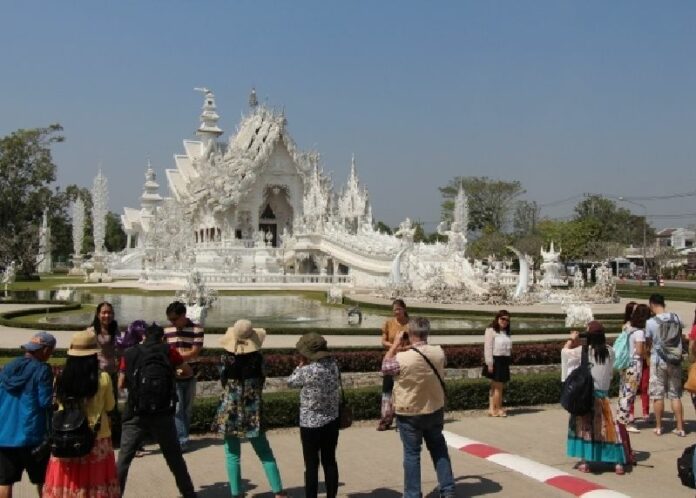
Chinese tourists at Wat Rong Khun, aka the White Temple, in Chiang Rai province, 19 February 2015 [Prachachat]

BANGKOK — Police say they have arrested six Chinese nationals who were working as guides for Chinese tourists without permits in Bangkok.

Pol.Col. Archayon Kraithong, deputy commander of Tourist Police, announced their arrest yesterday. He said the four men and two women were detained near Anantasamakhom Throne Hall in Dusit district. 

Under a law passed in 2008, only Thai nationals are permitted work as tour guides. The six face a maximum penalty of one year in prison for violating the regulation.

"Tour companies in Thailand must only use Thai guides, but these suspects disguised themselves as licensed guides and took Chinese tourists to visit important attractions in Thailand. Sometimes they explained details about the attractions with some inaccuracy," said Pol.Col. Archayon. "Sometimes, they took the tourists to buy goods that are excessively expensive. It damages the reputation of our country." 

Pol.Col. Archayon said police will continue to crack down on illegal guides operating in Thailand. 

Official records say 4.5 million Chinese tourists visited Thailand in 2014 – more than any other nation – bringing in more than 190 billion baht in revenue for the Kingdom. 


For comments, or corrections to this article please contact: [email protected]

You can also find Khaosod English on Twitter and Facebook
http://twitter.com/KhaosodEnglish
http://www.facebook.com/KhaosodEnglish

Advertisement

The Limits of Chinese Soft Power

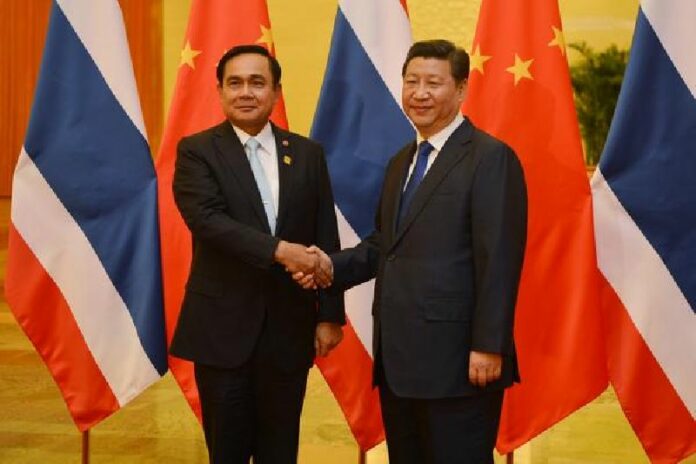
Thai junta chairman and Prime Minister Prayuth Chan-ocha with Chinese President Xi Jinping in Beijing, 9 November 2014

By Joseph S. Nye

CAMBRIDGE – China has been making major efforts to increase its ability to influence other countries without force or coercion. In 2007, then-President Hu Jintao told the Communist Party that the country needed to increase its soft power; President Xi Jinping repeated the same message last year. They know that, for a country like China, whose growing economic and military power risks scaring its neighbors into forming counter-balancing coalitions, a smart strategy must include efforts to appear less frightening. But their soft-power ambitions still face major obstacles.

To be sure, China’s efforts have had some impact. As China enrolls countries as members of its Asian Infrastructure Investment Bank and doles out billions of dollars of aid during state visits abroad, some observers worry that, when it comes to soft power, China could actually be taking the lead over countries like the United States. The American sinologist David Shambaugh, for example, estimates that the country spends roughly $10 billion a year in “external propaganda.” By comparison, the US spent only $666 million on public diplomacy last year.

Yet the billions of dollars China is spending on its charm offensive have had only a limited return. Polls in North America, Europe, India, and Japan show that opinions about China’s influence are predominantly negative. The country is viewed more positively in Latin America and Africa, where it has no territorial disputes and human-rights concerns are not always high on the public agenda. But even in many countries in those regions, Chinese practices like importing labor for infrastructure projects are unpopular.

Combining hard and soft power into a smart strategy, it turns out, is not easy. A country derives its soft power primarily from three resources: its culture (in places that find it appealing), its political values (when it lives up to them at home and abroad), and its foreign policies (when they are seen as legitimate and having moral authority). China has emphasized its cultural and economic strengths, but it has paid less attention to the political aspects that can undermine its efforts.

Two major factors limit China’s soft power, as measured by recent international polls. The first is nationalism. The Communist Party has based its legitimacy not only on a high rate of economic growth, but also on appeals to nationalism. Doing so has reduced the universal appeal of Xi’s “Chinese Dream,” while encouraging policies in the South China Sea and elsewhere that antagonize its neighbors.

With, for example, China bullying the Philippines over possession of disputed islands in the South China Sea, the Confucius Institute that China established in Manila to teach Chinese culture can win only so much goodwill. (China has opened some 500 such institutes in more than 100 countries.) The consequences of the country’s foreign policy can be seen in last year’s anti-Chinese riots in Vietnam following the positioning of a Chinese oil drilling rig in waters claimed by both countries.

The other limit is China reluctance to take full advantage of an uncensored civil society. As noted by the Economist, the Chinese Communist Party has not bought into the idea that soft power springs largely from individuals, the private sector, and civil society. Instead, it has clung to the view that the government is the main source of soft power, promoting ancient cultural icons that it thinks might have global appeal, often using the tools of propaganda.

In today’s media landscape, information is abundant. What is scarce is attention, which depends on credibility – and government propaganda is rarely credible. For all of China’s efforts to position the Xinhua news agency and China Central Television as competitors of CNN and the BBC, the international audience for brittle propaganda is vanishingly small.

The US, by contrast, derives much of its soft power not from the government, but from civil society – everything from universities and foundations to Hollywood and pop culture. China does not yet have global cultural industries on the scale of Hollywood or universities capable of rivaling America’s. Even more important, it lacks the many non-governmental organizations that generate much of America’s soft power.

In addition to generating good will and promoting the country’s image abroad, non-governmental sources of soft power can sometimes compensate for the government’s unpopular policies – like the US invasion of Iraq – through their critical and uncensored reaction. China, by contrast, has watched its government policies undermine its soft-power successes.

Indeed, the domestic crackdown on human-rights activists undercut the soft-power gains of the 2008 Beijing Olympics. And the benefits of the 2009 Shanghai Expo were rapidly undermined by the jailing of Nobel Peace Prize laureate Liu Xiaobo and the television screens around the world broadcasting scenes of an empty chair at the Oslo ceremonies. Marketing experts call this “stepping on your own message.”

China’s aid programs are often successful and constructive. Its economy is strong, and its traditional culture is widely admired. But if the country is to realize its enormous soft-power potential, it will have to rethink its policies at home and abroad, limiting its claims upon its neighbors and learning to accept criticism in order to unleash the full talents of its civil society. As long as China fans the flames of nationalism and holds tight the reins of party control, its soft power will always remain limited.

Joseph S. Nye, Jr., a former US assistant secretary of defense and chairman of the US National Intelligence Council, is University Professor at Harvard University and a member of the World Economic Forum Global Agenda Council on the Future of Government. 

Copyright: Project Syndicate, 2015.
www.project-syndicate.org

Advertisement

Army Apologizes for Implicating Pro-Junta Activist in Anti-Junta Network
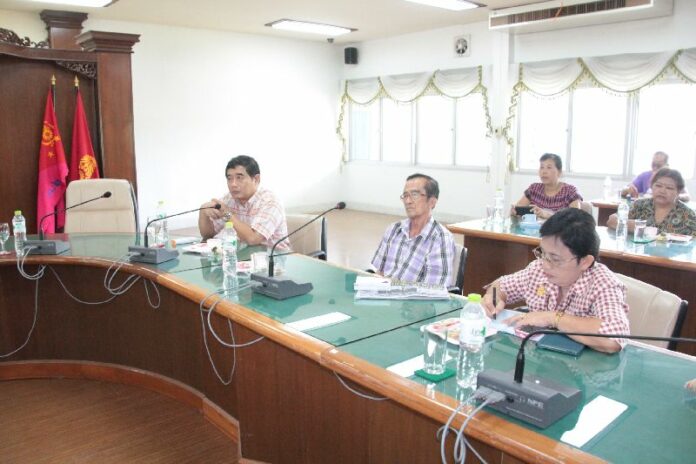
Col. Patikorn Eiamla-or, a senior commander of 21st Army District, apologizing to Supot Piriyakiatsakul for sending soldiers to his house, 10 July 2015.

NAKHON RATCHASIMA — Army commanders have apologized to a pro-junta activist in northeastern Thailand who was falsely accused by soldiers of supporting an anti-junta student activist group last week.

Supot Piriyakiatsakul, a 69-year-old veteran Yellowshirt activist who welcomed the 22 May 2014 coup, said seven soldiers from the 21st Army District Army arrived at his house in Nakhon Ratchasima last week while he was out. They then asked his neighbors to warn him to stop "getting involved" with seven anti-coup student activists who were arrested by police last month. Otherwise, "we will get involved with you," the soldiers reportedly told his neighbors.

Supot was shocked and angered by the warning because of his staunch support for the ruling military junta. 

Today two army commanders invited Supot to a military base in Nakhon Ratchasima to deliver a formal apology. Col. Patikorn Eiamla-or, a senior commander of 21st Army District, said the incident was a misunderstanding.

"I would like to apologize to you, brother," Col. Patikorn said. "I insist with my dignity as a soldier that I had no intention to use my power or duty to cause conflict in society."

\
Supot Piriyakiatsakul (center) listens to apologies from army commanders at a military base in Nakhon Ratchasima, 10 July 2015.

Maj.Gen. Prawit Hookaew, a commander of the Second Region Army, said he would teach his subordinate units to act more "softly and politely" in order to avoid unnecessary confrontations.

Supot said he accepted the apology and hoped that the incident would not happen again.

"Even though I am a Thai of Chinese descent, my heart is dedicated to love for my country. I have been campaigning in politics since 2006 by choosing to stand on the side of the righteousness," said Supot, who has participated in several campaigns organized by Thailand’s Yellowshirt movement. "I have always supported the military in all their actions."

He continued, "But soldiers' attempt to search my residence has damaged my reputation. They acted like they were arresting some bandit. It's like pushing a friend to join the enemy. I am not a person of great influence. I do not want anything more than apology and assurance that this incident will not happen again." 

The anti-junta activists Supot was accused of supporting, members of a Khon Kaen University student network known as "Dao Din," are now facing trial in military court on charges of inciting unrest and violating the junta's ban on protests. 


For comments, or corrections to this article please contact: [email protected]

You can also find Khaosod English on Twitter and Facebook
http://twitter.com/KhaosodEnglish
http://www.facebook.com/KhaosodEnglish

Advertisement

Top Democrat Accuses 'Former Communists' of Backing 14 Anti-Junta Activists

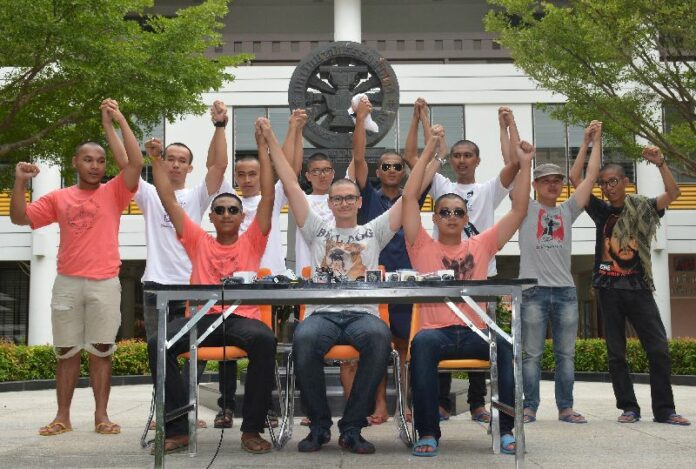
Fourteen activists facing trial in military court hold a press conference vowing to continue their fight for democracy, 9 July 2015.

BANGKOK — A prominent Democrat Party politician has alleged that a group of former Communist insurgents are pulling the strings behind the fourteen anti-junta activists who are facing trial in military court.

Bhumisan Seneewong na Ayutthaya, chairman of the party's strategic committee for northeastern Thailand, said today that although the fourteen activists have "good intentions," the Democrat Party has received information that they are being backed by former leftist and communist fighters who fought in the northeast during the 1970s. 

According to Bhumisan, these ex-leftists also served as advisers to former Prime Minister Thaksin Shinawatra, the de facto leader of the Redshirt movement who was ousted by the military in 2006 and has been living in self-imposed exile since 2008 to avoid a corruption conviction. 

"Today, Thaksin is now a convict on the run, but these former leftists are still trying to establish the regime that they like, by using the same old trick of exploiting young people – those who are innocent and not – as their instruments," Bhumisan said at a press conference at the Democrat Party's headquarters in Bangkok.

The fourteen activists, eleven of whom are university students, are facing up to seven years in prison on charges of violating the military government's ban on protests and inciting unrest with their peaceful campaign against the junta, which seized power from a pro-Thaksin government in May 2014.

Leading members of the military junta have accused the activists of being puppets of "politicians," yet they have not provided any evidence or identified anyone by name. 

Bhumisan asserted that the information he gave to the press today was confirmed by former communist insurgents who have become "defenders of the monarchy" in recent decades. 

"They lamented to me that those people [the pro-Thaksin former leftists] have lost their ideology to the vicious capitalist regime, yet they still exploit the proletariat class as instruments in their game," Bhumisan told reporters. "They also told me, today there is no communist left in Thailand, only [corruption]. Therefore, I would like to ask young people who truly have democracy in their hearts to exercise their judgement and wisdom to understand what the real world really is like, and who has been continuously harming our homeland." 

Known for its conservative, pro-establishment stance, Thailand's Democrat Party has acted as a major figure behind the successive campaigns against Thaksin and his political allies in the past decade. However, the party has not won a single national election since 1992. 

Yesterday, the fourteen activists held a press conference and vowed to continue their effort to revive democracy and civil rights in Thailand.

"I insist that we will continue our campaign as students, activists, and people who believe in democracy," said Rangsiman Rome, a law student at Thammasat University. "We hereby announce that we are willing to cooperate with all organizations whose stances are in favor of democracy, human rights, justice, public participation, and non-violence." 

Rangsiman added, "Government officials keep saying that we have been hired or are backed by politicians or connected to foreign organizations, but they have no evidence. I would like to ask, who are these organizations? What evidence do you have? The coup regime has been attempting to smear us in order to build legitimacy to use of violence against us, like what the students experienced on 6 October 1976." 

Rangsiman was referring the October 6 massacre, when at least 46 people were killed after security forces and right-wing militants stormed the site at Thammasat University where several thousand left-leaning students were holding a peaceful rally. The massacre was described by authorities at the time as an operation to clear Communist insurgents from the university.  


For comments, or corrections to this article please contact: [email protected]

You can also find Khaosod English on Twitter and Facebook
http://twitter.com/KhaosodEnglish
http://www.facebook.com/KhaosodEnglish

Advertisement

Redshirt Behind Prayuth 'Cash Transfer' Rumor Linked to Anti-Monarchy Cell

Police lead 45-year-old Rinda Parichabutr to a press conference in Bangkok on 10 July 2015.

BANGKOK — Police say a 45-year-old woman arrested for spreading a libelous rumor about junta chairman Prayuth Chan-ocha is connected to an anti-monarchy network.

Thai police announced the arrest of Rinda Paruechabutr, 45, at the police headquarters in Bangkok today. Police say she is a supporter of the Redshirt movement, which backed the government toppled by Gen. Prayuth in a coup d'etat last May. 

She now faces up to twelve years in prison after being charged with violating Computer Crime Act, inciting unrest, and causing panic among the public. 

According to Thai police chief Pol.Gen. Somyot Pumpanmuang, Rinda wrote on her Facebook on 6 July that Gen. Prayuth transferred 10 billion baht to an offshore bank account in Singapore. Gen. Prayuth, who also serves as Prime Minister, has denied the allegation.

"Mrs. Rinda admitted to us that she wasn't fully aware of consequences [of her postings]," Pol.Gen. Somyot said at the press conference. "I would like to warn people to be careful when they post or send messages that are potentially illegal, and I want them to consider that the rights and freedom of others should not be violated. If the action breaks any laws, officials will strictly take action."

Citing police’s investigation, Pol.Gen. Somyot also asserted that Rinda has a "connection" to the overseas anti-monarchy network headed by Manoon Chaichana, aka 'Anek San Francisco,' a Redshirt activist believed to be residing in the United States. Manoon is wanted by Thai police for violating Section 112 of the Thai Criminal Codes, which outlaws criticism of the monarchy and carries up to 15 years in prison.  

"She has connection to the network of Mr. Anek San Fran[cisco], the suspect who violated Section 112 and who is still on the run," Pol.Gen. Somyot said. 

At the press conference, Rinda said she posted the message after someone texted in to her through the chat application LINE, and insisted that she had no intention to damage the country.

"I think that, as a citizen, I have the rights to criticize and express my opinion, since the Prime Minister is a public figure," Rinda said. "But I concede that my words affect other people. So I'd like to warn other people who use social media to be careful, because this is a sensitive issue." 

Last month, a 49-year-old woman was arrested for allegedly spreading a rumor about a counter-coup in Thailand. She was charged with violating the Computer Crime Act and insulting the monarchy, and is now facing trial in military court. Police said she also has ties to Anek, who police have accused of backing the "terrorist network" behind an abortive plan to stage bomb attacks in five different locations around Bangkok earlier this year. 

Since staging the coup against the Redshirt-backed government in May 2014, Gen. Prayuth has kept a tight lid on freedom of expression in the name of restoring peace and order. Wielding near-unlimited powers granted to him by the interim constitution, the junta chairman has banned protests, sent anti-junta dissidents to stand trial in martial court, and repeatedly asked media agencies to refrain from criticizing his military regime. 


For comments, or corrections to this article please contact: [email protected]

You can also find Khaosod English on Twitter and Facebook
http://twitter.com/KhaosodEnglish
http://www.facebook.com/KhaosodEnglish

Advertisement

Thai Junta Chairman Defends Deporting Uighurs to China

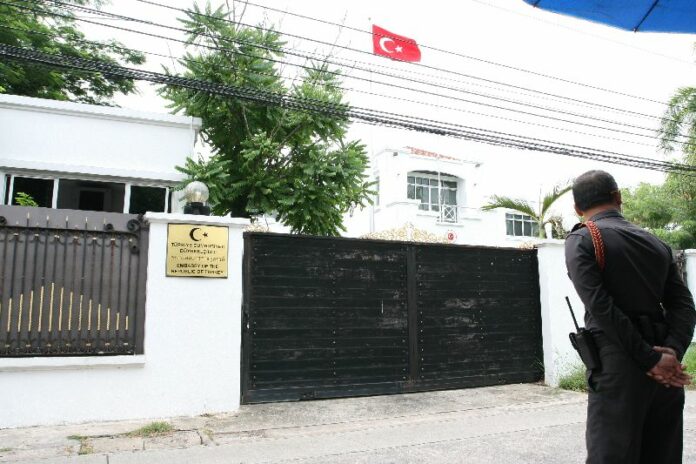
Police in front of the Turkish Embassy in Bangkok, 9 July 2015.

BANGKOK — Junta chairman and Prime Minister Prayuth Chan-ocha has defended his government’s decision to deport nearly 100 members of a persecuted ethnic minority to China.

Officials confirmed that 90 Uighurs who entered Thailand illegally were flown this morning to China, where human rights groups have documented state-sanctioned discrimination against the Muslim group. One hundred and seventy three other Uighur immigrants were also sent to Turkey last week, according to a government spokesperson.

Last night, crowds attacked the Thai Consulate in Istanbul to protest the Uighur’s impending deportation to China. The protesters broke into the Consulate office and smashed windows, according to Thai officials.

In a statement issued today, the UN High Commissioner for Refugees expressed alarm at the Thai government’s move.

"UNHCR urges the Royal Thai Government in the strongest possible terms to allow those remaining to depart voluntarily and as soon as possible to a country of their choice which is willing to receive them,” the statement said.

Speaking to reporters today, Gen. Prayuth said his government has fully adhered to "laws and international obligations" by identifying the nationalities of the Uighur immigrants and sending them back to their respective countries. 

"As an intermediary country, we have to inspect and categorize them clearly," Gen. Prayuth said. "If we didn't do this, there would be problems."

When a reporter asked whether Gen. Prayuth is confident that the Uighurs sent back to China will be safe, the junta chairman replied,

"China has guaranteed their safety to us. They insist they will be processed in justice system. If they are not involved [in any wrongdoings] they will be freed. They will be given jobs. If evidence clearly establishes [their guilt], they will face legal action, and the severity will depend on their offence."

Maj Gen Weerachon Sukhondhapatipak, a spokesperson of the Thai government, said this morning that Chinese authorities have assured Thailand that the deported Uighurs will be provided with jobs, welfare, and "assistance consistent with human rights principles."

He told reporters that China expressed concern that Thailand previously deported 170 Uighurs to Turkey, because Chinese authorities suspected that the deportees may have been involved in a "[political] movement" in China. However, Thai authorities established that the 170 were Turkish nationals, and were not clearly implicated in any illegal behavior in China.

"The Chinese government has contested the deportation and asked for inspection, but there was no clear evidence, so we sent them to Turkey," Maj.Gen. Weerachon said. 

\
Junta chairman Gen. Prayuth Chan-ocha speaking at the Government House, 9 July 2015.

Speaking to reporters today, Gen. Prayuth said that Thai and Turkish authorities are coordinating closely to ensure the safety of Thai nationals living in Turkey.

He then asked the media to help ease tension between Thailand and other nations. 

"Why are you dragging Thailand into a conflict with Turkey, China, or with the Uighurs?" Gen. Prayuth said. "In reality, we are not having a conflict with anyone. Don't worry about this. It will be resolved soon. Otherwise, it will escalate into this issue and that issue, into issues about Muslims, and things will be out of control. The media should help reduce these issues. I am not opposing the media's viewpoint, but I want you to look where the national interest is." 


NOTE: Khaosod English has censored parts of Gen. Prayuth's speech that contained obscene remarks. 

For comments, or corrections to this article please contact: [email protected]

You can also find Khaosod English on Twitter and Facebook
http://twitter.com/KhaosodEnglish
http://www.facebook.com/KhaosodEnglish

Advertisement

Anti-Coup Student Activists Tell Stories From Jail

Freed anti-junta activists from Dao Din after they were released from jail. [Prachatai]

(Prachatai English)

BANGKOK – On Wednesday 8 July, the 14 anti-junta activists from the New Democracy Movement (NDM) were released after they were detained for 12 days due to their peaceful anti-junta protests. However, the charges against them still stand.

Prachatai talked to three student activists from Khon Kaen University about their lives in prison and what they learned behind bars. 

Read the interviews here


Note: Khaosod English is not responsible for content on other websites.
 

Advertisement

University 'Accidentally' Sells 3 Tons of Rare Books to Recyclers

File photo of Silpakorn University in Bangkok [Matichon].

BANGKOK — A prominent state university in Thailand is frantically buying back 3,000 kilograms of rare books and magazines that it mistakenly sold as recycling materials to a vendor for 6,000 baht last week.

According to Matichon, library staff at Silpakorn University's Thapra campus arranged for a recycling truck to pick up piles of books and magazines that were marked for disposal at the library on 30 June. However, the staff somehow mixed up the order and gave away 3 tons of the library's archival collections instead, at the meager price of 2 baht per kilogram, according to university officials. 

The collection includes essays, books, pamphlets, and dissertations on historical and anthropological subjects in Thailand. The collection also reportedly included magazines published by student activists in the years leading up to the 1973 student uprising that toppled the military junta at the time.

Matichon said the university administration discovered the mix-up a few days later, and ordered an investigation into the incident.

"Silpakorn University has already convened a committee to investigate to see how many important books are missing," said Sakdipan Tanwimolrat, director of Silpakorn University's library department. "From what I know so far, it's quite a lot. But we cannot answer for sure. Silpakorn University will try to track down and bring these books back as soon as possible."

Sakdipan added that the librarian who oversaw the sale offered a letter resignation, but the university turned it down because "it's not a solution. We want people to stay and solve this problem together … I want everyone to sympathize with the officials and librarians, because they also love these books." 

Udom Rattanawong, the 60-year-old owner of the recycling operation that bought the books, said he was contacted the University’s librarians after he posted an advertisement on the internet seeking old books and paper scraps.

He and four staff then arrived at the library on 30 June and moved the piles of books onto his truck, Udom said. According to Udom, a library official pointed to the piles and left shortly afterwards. No one else supervised the operation, as it was their lunch break, he said.

By the time the university contacted him to buy the books back at the same price of 2 baht per kilogram, Udom said he had alreaday discarded 100-200 kilograms of books because they soaked from a rainstorm. He added that he was about to send the rest to a recycling plant when he received the phone call from Silpakorn University.

"I didn't know they were rare books," Udom said. "I left school when I was in fourth grade."


For comments, or corrections to this article please contact: [email protected]

You can also find Khaosod English on Twitter and Facebook
http://twitter.com/KhaosodEnglish
http://www.facebook.com/KhaosodEnglish

Advertisement

Hot News

LATEST NEWS

Bangkok
broken clouds
29.4 ° C
29.4 °
25.5 °
71 %
2.9kmh
60 %
Mon
29 °
Tue
38 °
Wed
37 °
Thu
36 °
Fri
37 °