





















28.3 C
Bangkok
Friday, July 24, 2026
Home Blog Page 2964

Hounded Online and Off, Man Commits Suicide Over Bombing Claim

PATHUM THANI — A man committed suicide last night in his northern metro Bangkok home, days after an online claim was made that he was the bomber behind the Erawan Shrine attack.

Kittisak Meemang, 36, was discovered hanged in his bedroom at his home in Pathum Thani province at around 9pm last night, police told reporters, and his family believes he was hounded into taking his life after someone used his Facebook account to post a message in his name.

“The [statuses] said something like, ‘I am the one who bombed Ratchaprasong Intersection,’” his sister Anchittha Meemang said, referring to the intersection where the shrine is located.

Police ruled his death a suicide, saying they found nothing to indicate he’d been assaulted.

Anchittha said that before killing himself, Kittisak had recounted visiting an internet cafe on Sunday where he forgot to logout from his Facebook account. He told Anchittha that someone must have used his account to post a message claiming he was responsible for the bomb which killed 20 people and injured 150 more.

“I tried talking to him and deleted all the messages on my brother’s Facebook, and I deactivated it to end the problems,” she said, adding they went together to a local police station to file a report together as evidence his account was misused to post the message.

His family told reporters that Kittisak was involved in a car accident last year which left him with unspecified “brain damage.” They believe he took his life after becoming distraught over the chorus of condemnation he received for the message, including death threats and intimidation that carried over into the physical world.

His aunt Usa Meemang said Kittisak said he received “many” death threats via Facebook before deleting his account.

Two men on a motorcycle stopped Kittisak while he was going to work at around 9am yesterday and punched him before driving away, she said, adding that he filed a police complaint and then chose to stay home from work.

“After I cooked my dinner, I didn’t see my nephew coming down from his bedroom to eat dinner, so I went to see him, and I discovered that he was hanged dead,” Usa said.

Police sent Kittisak’s body for an autopsy and said the incident is under investigation.


To reach us about this article or another matter, please contact us by e-mail at: [email protected].

Follow Khaosod English on Facebook and Twitter for news, politics and more from Thailand.

Follow @KhaosodEnglish

\

Advertisement

In Run-Up to Charter Vote, Govt Forbids Campaigning

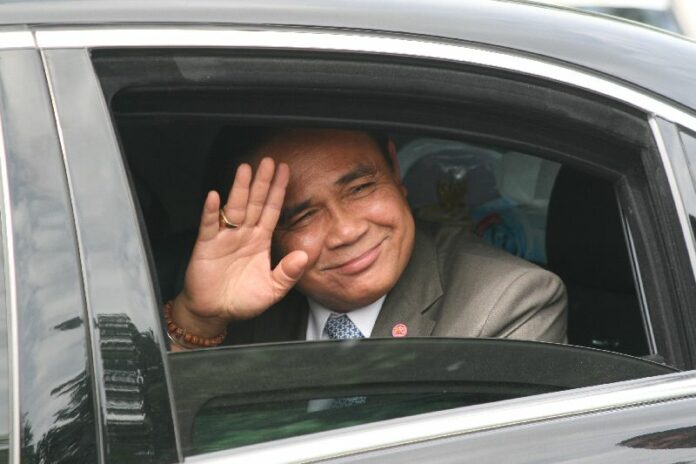
Junta chairman and Prime Minister Prayuth Chan-ocha waves at reporters in Bangkok on Aug. 26, 2015.

BANGKOK — Thais will not be allowed to independently campaign either for or against their new constitution before it goes before voters in a referendum as soon as January.

As the military government encounters rising internal and external dissent to the draft charter, a top junta official said yesterday that public debate over its merits and deficiencies will only be allowed at officially sanctioned forums organized by the Election Commission and balanced accounts in recognized news media. Organized rallies and campaigns will be forbidden under the existing injunction against political gatherings.

“The Election Commission will arrange for the two sides to express their opinions,” Deputy Prime Minister Visanu Krue-ngam said yesterday. “As for campaigning, it cannot be done, whether to accept or reject the charter.”

He echoed comments made Tuesday by the chairman of Thailand’s Election Commission.

“Campaigns to influence the referendum cannot be done, whether to tell people to accept or reject the charter draft,” Suphachai Somcharoen said. “If anyone or any group comes out to campaign about the referendum, they will be guilty of violating NCPO order No. 7, which bans political assemblies.”

The first hurdle for the charter, which represents the future laws of the land, will be when it’s put to the junta-appointed National Reform Council’s 200 members for an up-or-down vote next month. A hardliner faction of about 20 council members have actively called for it to be rejected in favor of keeping the junta in power for another two years to complete its reform campaign.

Players from both sides of the political divide have panned the proposed constitutionas undemocratic.

Should the draft charter pass the 6 Sept. vote, it will go to national referendum in January.

In the meantime, people can can still express their opinions “through the media,” Visanu said.

“For example, on TV shows that invite both sides to join. That is expression of opinion, not campaigning … If they talk through the media, they can do it,” he said. “They can talk about anything. There will be no punishment. Because that is an expression of opinion.”

Visanu did not mention whether expression via other platforms – such as social media – will be accepted. He also admitted that “the line between campaigning and expressing opinion will be difficult to discern.”

Ultimately he said the power to decide will like with the commission.

“It will be the duty of the Election Commission to take care and ensure that both sides will have equal treatment,” he said.

Political activities and public protests of any kind have been banned in Thailand since the military junta seized power from an elected government in May 2014. Since the military takeover, the junta has ordered that discussion about politics be confined to forums sanctioned by the regime, and instructed independent organizers to seek permission from the military first.

On Tuesday junta chairman and Prime Minister Prayuth Chan-ocha lashed out at politicians who have been critical of the new charter, saying that “They have no right to suggest [their opinion] to anyone. Do they have the right? Why do the media give a platform to these people?”

Visanu, the Deputy Prime Minister, told reporters yesterday that the government will have to keep its the lid on free speech in the months leading to the referendum for the sake of stability.

“To say whether people should accept or not accept the constitution can be done. It’s not something strange,” Visanu said. “But they cannot hold rallies. They cannot mobilize people.

If they talk through the media, they can. They can talk anything. There will be no punishment. Because that is expression of opinion. We are worried that if we permit rallies to be held, their opposition will do the same. Country will be divided. I can see that image already. The government can see what’s going to happen. That’s why I am telling you, you cannot do that. It’s forbidden by the laws.”


Related stories:

Prayuth Fumes at Politicians Critical of Charter


To reach us about this article or another matter, please contact us by e-mail at: [email protected].
Follow Khaosod English on and Twitter for news, politics and more from Thailand.

\

Advertisement

In Run-Up to Charter Vote, Govt Forbids Campaigning

Campaign posters in Bangkok before general elections in 2011. Photo: Michael Coghlan

BANGKOK — Thais will not be allowed to independently campaign either for or against their new constitution before it goes before voters in a referendum as soon as January.

As the military government encounters rising internal and external dissent to the draft charter, a top junta official said yesterday that public debate over its merits and deficiencies will only be allowed at officially sanctioned forums organized by the Election Commission and balanced accounts in recognized news media. Organized rallies and campaigns will be forbidden under the existing injunction against political gatherings.

“The Election Commission will arrange for the two sides to express their opinions,” Deputy Prime Minister Visanu Krue-ngam said yesterday. “As for campaigning, it cannot be done, whether to accept or reject the charter.”

He echoed comments made Tuesday by the chairman of Thailand’s Election Commission.

“Campaigns to influence the referendum cannot be done, whether to tell people to accept or reject the charter draft,” Suphachai Somcharoen said. “If anyone or any group comes out to campaign about the referendum, they will be guilty of violating NCPO order No. 7, which bans political assemblies.”

The first hurdle for the charter, which represents the future laws of the land, will be when it’s put to the junta-appointed National Reform Council’s 200 members for an up-or-down vote next month. A hardliner faction of about 20 council members have actively called for it to be rejected in favor of keeping the junta in power for another two years to complete its reform campaign.

Players from both sides of the political divide have panned the proposed constitution as undemocratic.

Should the draft charter pass the 6 Sept. vote, it will go to national referendum in January.

In the meantime, people can can still express their opinions “through the media,” Visanu said.

“For example, on TV shows that invite both sides to join. That is expression of opinion, not campaigning … If they talk through the media, they can do it,” he said. “They can talk about anything. There will be no punishment. Because that is an expression of opinion.”

Visanu did not mention whether expression via other platforms – such as social media – will be accepted. He also admitted that “the line between campaigning and expressing opinion will be difficult to discern.”

Ultimately he said the power to decide will like with the commission.

“It will be the duty of the Election Commission to take care and ensure that both sides will have equal treatment,” he said.

Political activities and public protests of any kind have been banned in Thailand since the military junta seized power from an elected government in May 2014. Since the military takeover, the junta has ordered that discussion about politics be confined to forums sanctioned by the regime, and instructed independent organizers to seek permission from the military first.

On Tuesday junta chairman and Prime Minister Prayuth Chan-ocha lashed out at politicians who have been critical of the new charter, saying that “They have no right to suggest [their opinion] to anyone. Do they have the right? Why do the media give a platform to these people?”

Visanu, the Deputy Prime Minister, told reporters yesterday that the government will have to keep its the lid on free speech in the months leading to the referendum for the sake of stability.

“To say whether people should accept or not accept the constitution can be done. It’s not something strange,” Visanu said. “But they cannot hold rallies. They cannot mobilize people.

If they talk through the media, they can. They can talk anything. There will be no punishment. Because that is expression of opinion. We are worried that if we permit rallies to be held, their opposition will do the same. Country will be divided. I can see that image already. The government can see what’s going to happen. That’s why I am telling you, you cannot do that. It’s forbidden by the laws.”

Photo: Michael Coghlan

Related stories:

Prayuth Fumes at Politicians Critical of Charter


To reach us about this article or another matter, please contact us by e-mail at: [email protected].
Follow Khaosod English on Facebook and Twitter for news, politics and more from Thailand.

Follow @KhaosodEnglish

\

Advertisement

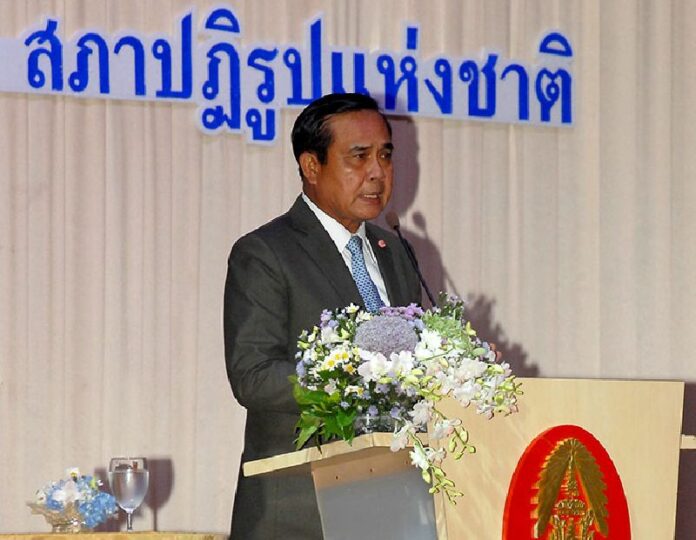
Prayuth Fumes at Politicians Critical of Charter

Junta chairman Gen. Prayuth Chan-ocha speaks at a news conference today. Earlier, he blasted critics of the draft constitution written by his appointees.

BANGKOK — Junta chairman and Prime Minister Prayuth Chan-ocha said politicians have no right to criticize the new constitution being drafted under the junta’s oversight.

The retired general today lashed out at politicians from rival factions who have urged his appointed National Reform Council to reject the new charter when it goes to a vote early next month – a move that could torpedo the junta’s promise of a smooth transition to the next election.

“They have no right to suggest that to anyone. Do they have the right?” Prayuth told reporters yesterday. “Why do the media give a platform to these people?”

Several top politicians from rival factions have suggested that the council reject the draft, citing numerous defects that they believe would hamstring elected administrations in the future.

Their main grievance is a clause creating a military-stacked committee with the authority to unilaterally intervene and take any action in the event future governments are unable to exercise their power due to “chaos.”

Any action taken by this “Committee of Reform Strategy and National Reconciliation” would be considered administratively and legislatively binding, according to how it’s written.

The new charter also permits a non-MP to be appointed prime minister and abolishes direct election to the Senate. In the new constitution, 77 out of the 200 senators would be indirectly elected from a pool of chosen candidates, and the rest appointed by panels of “experts.”

The council is due to vote whether to accept the new charter on 6 Sept. If the draft is accepted, a referendum will be held January 2016 and a new election in late 2016; if not, the entire process will be restarted.

However Prayuth stated unequivocally his opinion that civilian politicians are overstepping their bounds by expressing opinions on the proposed constitution’s merits.

“Politicians are not involved,” he said in his characteristically gruff and querulous style. “It’s already generous of me for letting these people talk. “Usually, these people shouldn’t be allowed to speak at all.”

But speak they have, from across the fractious political spectrum.

“The Democrat Party believes that it is best if the council rejects this constitution,” former Prime Minister Abhisit Vejjajiva, who leads the pro-establishment Democrat Party, said yesterday. “If it makes it to the referendum … there will be more confusion and complication.”

He continued, “I want you to remember that we will have to adhere to that set of rules [new charter] forever. Don’t think that we should just pass it first. You cannot do that.”

Jatuporn Prompan, core activist of the Redshirt movement which opposes the Democrat Party, said Sunday that he and other Redshirt leaders will campaign against the charter should it win the council’s approval.

“If this constitution is to be used, this country will be in ruins, because the content of this constitution has been a problem since the very first day,” Jatuporn said. “There is no good option for the people. There are only big losses and small losses. If this charter is rejected, there will be small losses, but if it is passed, there will be big losses.”

Wattana Muangsuk, a former MP of Redshirt-backed Pheu Thai Party, went so far as to say he would boycott the next election if the constitution in its current form is adopted by public referendum.

Speaking at news conference today, Prayuth responded to these challenges with fury.

“These people, now that they are being harsh to me, I will have to be harsh in return,” he said. “Well, they shouldn’t reject the laws if there’s legal action against them. Don’t whine and scream that they are treated unjustly. That would be wrong thinking, because they did it to themselves.”

He stopped short of saying he would gag politicians from expressing their opinion.

“There’s no need for a prohibition now. But when the time comes, I will deal with them,” Prayuth said. “Today I have to teach people to think. Why do they allow anyone to misguide them?”

Expressing frustration, the junta chairman told reporters his reasoning for Thailand’s seemingly intractable political strife.

“Today we are still stuck in the trap of democracy, a trap of conflicts,” he said. “We still let emotions dictate our judgment. We have to fix these issues.”


To reach us about this article or another matter, please contact us by e-mail at: [email protected].
Follow Khaosod English on Facebook and Twitter for news, politics and more from Thailand.

Follow @KhaosodEnglish

\

Advertisement

12 Men Rescued from Pig Farm Slavery

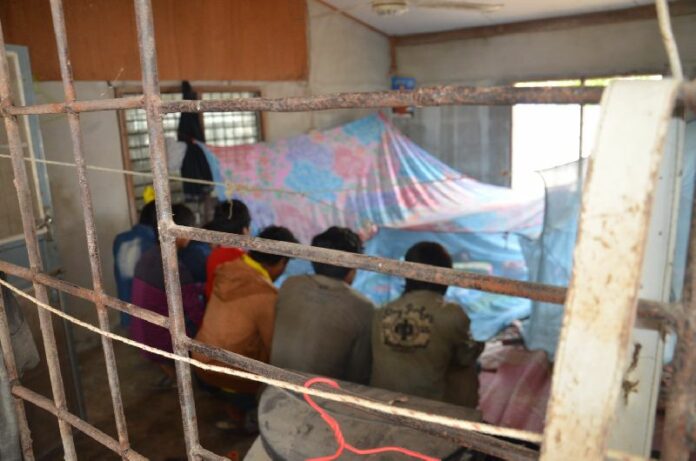
A group of Laotian men who were among 12 kept as slaves on a pig farm west of Bangkok in Nakhon Pathom province until their rescue by security forces after two escaped Saturday.

NAKHON PATHOM — A dozen men have been rescued from slavery at a pig farm west of the Thai capital, prompting police officials to hand out administrative slaps on the wrist yesterday to five officers for failing to combat trafficking.

Soldiers rescued 12 Laos men from captivity and forced labor at a pig farm owned by a local bank manager, according to a local military official, after two of them escaped and sought help Saturday; an incident resulting in five police officers being transferred to inactive posts.

At the farm, a three-hour drive west of Bangkok, three soldiers discovered the men locked inside a row of prison-like cells, according to Sgt. Paithoon Sriracha. The men told security officers they were forced to work at the farm without pay.

One of the Laotian men, who asked not to be named, said he ended up on the farm three months ago after being tricked by job broker. The broker, he said, offered to smuggle him from Laos for 5,000 baht and promised the job would pay 7,000 baht per month. However the man said he was never paid.


\

The locked cells where the men were kept on the farm owned by Chaiyadet Sonut, the manager of a local Krung Thai Bank branch in Nakhon Pathom province.

He also told security officers that he and other Laotian workers were sometimes beaten by the Thai staff, and said they were forced to defecate in bags and dispose of them in the morning because there were no toilets in the cells.

Farm owner Chaiyadet Sonut, who is also a manager of a Krung Thai Bank branch in Nakhon Pathom, was later arrested and charged with human trafficking, physical assault, harboring aliens and illegal detention.

Chaiyadet has since been released on a 500,000-baht bond. He denied any wrongdoing.

Speaking to reporters yesterday, provincial police commander Maj. Gen. Poj Boonmapak said he has ordered all police stations in Nakhon Pathom to inspect every farm and factory to make sure no other slave labor is being used.

“From the past two days of mass inspection, we have not received a report of any irregularity,” Poj said.

Poj said he signed an order indefinitely transferring five officers from the Sam Khwai Puek Police Station to inactive posts at the national police headquarters in Bangkok.

He said the order was punishment for failure by the five policemen, which included the station superintendent, to crack down on human trafficking and slave labor in their jurisdiction.

Being transferred to an inactive post are is a routine sanction against officers suspected of wrongdoing.

He added that police chief Somyot Pumpanmuang has also ordered an investigation into whether the five transferred police officers committed any wrongdoing.

Human rights groups have long criticized Thai authorities for failing to stamp out slave labor and human trafficking, which mostly targets vulnerable migrants from neighboring countries like Laos, Cambodia and Myanmar.

Last month the United States government gave Thailand – for the second year in a row – its lowest possible ranking in an annual global trafficking report, citing a lack of serious effort in combating human trafficking.

Three U.S.-based law firms are also suing a California court to stop American retailer Costco from selling prawns unless they are labeled a product of slave labor. According to the plaintiff, the Thai seafood supplier for Costco, CP Foods, regularly uses ships manned by slaves to catch feeds for its prawns.

CP Foods has consistently denied the allegation about its use of slave labor, which first came to light in a report by The Guardian in 2014.

Advertisement

Video Game Ratings System Coming to Thailand

Scene from the upcoming "Gears of War 4." A non-binding ratings system has been proposed by the Ministry of Culture to label all video games sold in Thailand. Photo: Microsoft Game Studios

BANGKOK — A six-tier system has been devised for rating video games released in the kingdom to provide “guidance” to parents without regulating retail sales.

Six age-based ratings for games have been floated by the Ministry of Culture that would be placed on all games released in Thailand but would not be legally binding on retailers to enforce, Pradith Posew of the Film and Video Censors Board said yesterday.

“There won’t be any legal effect in banning kids from playing games,” Pradith said. “It’s merely a guidance for guardians to take care of their kids’ video game playing, based on the appropriateness to their age.”

He said it was also intended to help internet and gaming cafes “to advise kids who play games at their shops.”


\

Minister of Culture Vira Rojpojchanarat and other officials inspect an internet and game cafe in Bangkok on 22 Nov., 2014.


In addition to a “general audience” category, the six ratings would include recommendations for minimum ages of 3, 6, 13, 15 and 18.

Those ratings are similar to that used internationally by the U.S.-based Entertainment Software Rating Board. Widely adhered to due to market forces, that system is voluntary and was created by the international gaming industry to stave off threats of government regulation.

Thailand already has ratings for films and TV shows. Cinemas that show films rated “Over 20 Only” by the Ministry of Culture are required to check customers’ ID cards, but other ratings have no legal effect.

The ratings system has been sent to the interim parliament and military government for final approval, Pradith said.

While films and TV shows are subject to strict review by the censorship boards; who screen materials for nudity, drug use, and other matters that may affect “public morals;” authorities have been mostly laissez-faire toward video games.

However on several recent occasions video games have been banned. In 2008, the Ministry of Culture banned sales of Grand Theft Auto IV, a video game simulating pulp-fiction criminality in a fictional city, after a 17-year-old student stabbed a taxi driver dead and blamed the game for his actions.

In August 2014, three months after the military seized power from an elected government, Thai authorities also banned sales of Tropico 5, which allows players to assume the role of a dictator running a fictitious tropical island nation. The Film and Video Censors Board ruled the game could possibly affect the kingdom’s political situation.

The game creator hit back at Thailand this past June by launching new missions tasking players with crippling the Thai tourism industry.


To reach us about this article or another matter, please contact us by e-mail at: [email protected].
Follow Khaosod English on Facebook and Twitter for news, politics and more from Thailand.

Follow @KhaosodEnglish

\

Advertisement

Top Adviser to HM King Showers Praises on Junta

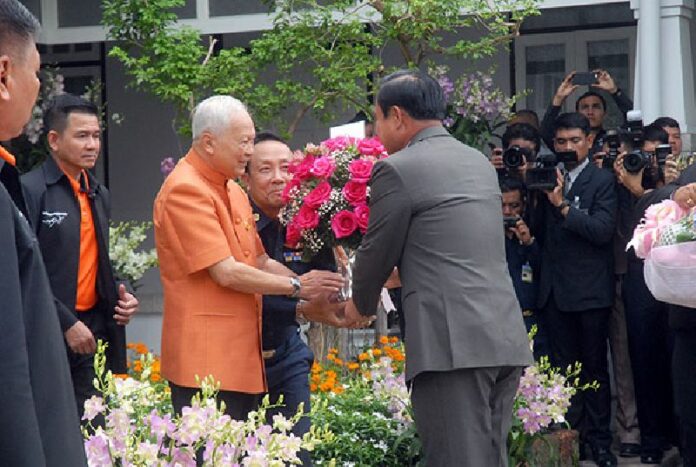
Privy Council Chairman Gen. Prem Tinsulanonda, a longtime fixture in the firmament of military and political power, greets Prime Minister Gen. Prayuth Chan-ocha today at his home in Bangkok.

BANGKOK — Leaders of the military government and the armed forces traded praise with the top adviser to His Majesty the King on the occasion of his 95th birthday today.

Privy Council chairman Gen. Prem Tinsulanonda, whose vast influence has far outlasted his eight-year stint as premier in the ‘80s, welcomed high-ranking delegates including junta chairman Prime Minister Prayuth Chan-ocha to his residence in Bangkok where they extended mutual plaudits.

“Today is a day that I am very proud, happy and confident, to see the prime minister, Khun Pom and all military branches displaying their love, unity, sacrifice and loyalty for the people to see,” Prem said, referring to Prayuth deputy Gen. Prawit Wongsuwan by his nickname.

Gen. Prayuth was also joined by members of his new cabinet and and top commanders from the army, navy, air force and police.

\


Prem, who served as Prime Minister during a period of “semi-democracy” between 1980 and 1988, remains extremely influential in the armed forces despite retiring decades ago. Due to his position as the chief adviser to King Bhumibol, he is also widely recognized as being near the center of the palace’s inner circles.

Prem, once called the “invisible hand” by former Prime Minister Thaksin Shinawatra for his role in the 2006 coup which saw Thaksin ousted from power, did not appear to play an active role in Thailand’s latest coup d’etat staged by Prayuth against the pro-Thaksin government in May 2014.

Prayuth wished Prem a happy 95th birthday and thanked him for his “contributions” to the country. “You are most loyal to the nation, the religion, and the King, which earns you respect and admiration, and you have become a role model for us,” he said.

Prem returned the praise, referring to Prayuth and his Prawit by their nicknames – Tuu and Pom, respectively.

Prem similarly praised the junta in a December speech, saying that Prayuth’s coup d'etat against the elected government in May 2014 was a necessary effort to “rescue” the nation from chaos.

“Uncle Tuu has rescued the nation and brought peace to all Thais. We have taken action, and will continue to do so. I want to tell all of you that this opportunity is an important one. It is the opportunity that shows that when the nation is in crisis, when there is no reconciliation, we will always step in and take care of it. That is our duty,” Prem said 29 Dec.

Prayuth seized power following six months of anti-government protests, in which nearly 30 people were killed. The military junta said it was forced to intervene to prevent the situation from spiralling out of control.

Since the coup, there has been several waves of rumors among the Redshirts, who supported the toppled government, about discord between Prayuth and Prem. One rumor, circulated in June, went as far as claiming that a group of generals loyal to Prem was about to launch a counter-coup against Prayuth’s government. The purported putsch never happened.

Chayapha Chokepornboonsri, a 49-year-old woman, was accused of spreading the rumor and arrested in June.

Police initially charged her with violating the Computer Crime Act, which outlaws spreading false information online that "affects national security," but later added an additional charge of lese majeste (insulting the monarchy) after they reportedly found she had posted critical remarks about the monarchy on social media.  

Chayapha is awaiting trial by military tribunal.

Related stories:

Counter-Coup Rumor Suspect Charged With Lese Majeste

Thai King's Chief Adviser Praises 2014 Coup


To reach us about this article or another matter, please contact us by e-mail at: [email protected].

Follow Khaosod English on and Twitter for news, politics and more from Thailand.

\

Advertisement

No British Police Report for Koh Tao Defense, UK Court Rules

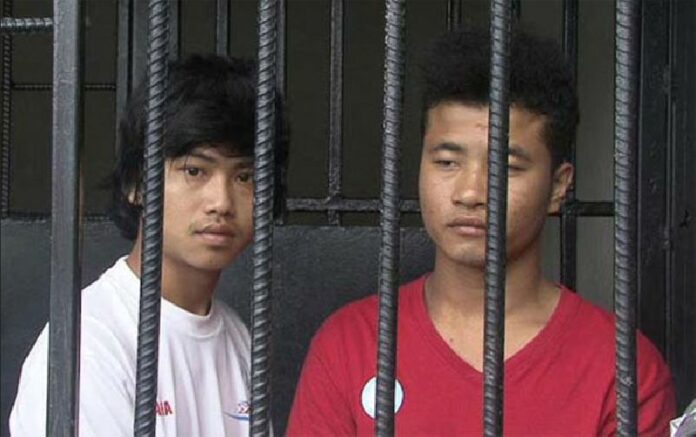
Zaw Lin, left, and Wai Phyo, right, in a file photo courtesy Migrant Worker Rights Network.

LONDON — Two Myanmar workers on trial in Thailand for the murder of two British tourists should not be given access to a confidential British police report about the case, a British judge ruled on Tuesday.

Wai Phyo and Zaw Lin, both 22, risk the death penalty if found guilty of murdering Hannah Witheridge, 23, and David Miller, 24, in September last year on a beach on Koh Tao, an island popular with backpackers and divers.

Post-mortem examinations showed both suffered severe head wounds and Witheridge was raped.

The case is sensitive because of Thailand’s reliance on tourism, which makes up nearly 10 percent of the economy, and because of questions that have emerged over police tactics.

The two suspects initially confessed in police interviews and were taken to the crime scene where they re-enacted the murders in front of the world’s media. They later retracted the confessions, alleging they had been tortured by Thai police.

The allegations caused disquiet in Britain. In a ruling handed down in London on Tuesday, High Court Judge Nicholas Green said the misgivings were such that Prime Minister David Cameron had discussed the case with his Thai counterpart Prayuth Chan-ocha.

The two leaders agreed that Britain’s Metropolitan Police would send a team to Thailand to conduct an independent inquiry. However, as it is British policy not to assist foreign police forces in death penalty cases, the scope of the mission was to observe and record the Thai police investigation.

Thai police cooperated fully under the pre-agreed condition that the British team’s final report would be shared only with the Witheridge and Miller families.

But the two murder suspects, who have been on trial since early July, applied to the court to hand over the report, arguing that it might be of use to their defense case.

The Metropolitan Police opposed their application, arguing that disclosure would impede the force’s ability to enter into cooperation agreements with foreign authorities in future.

Having seen the full report, the judge ruled that the interests of the police outweighed those of the suspects.

“In short I have concluded that there is nothing in the police report which is exculpatory, i.e. would be of material assistance to the claimants in the trial,” he said in a summary of his ruling.

Story: Reuters / Estelle Shirbon

Related stories:

Koh Tao Murder: Top Forensic Scientist to Testify for Defense

Koh Tao Trial Resumes, Court Shown Footage of Victims’ Final Night

Lack of Evidence, Local Media Coverage Adds to Mystery of Koh Tao Murder

Koh Tao Suspects’ Alleged Recantation ‘Normal,’ Police Officer Says

Koh Tao Murder: Police ‘Willing’ To Probe Abuse of Burmese Suspects

Shock and Anger on Koh Tao Over Murder of Two Britons

Advertisement

Girl Suicide Bomber Kills 15 in Northern Nigeria

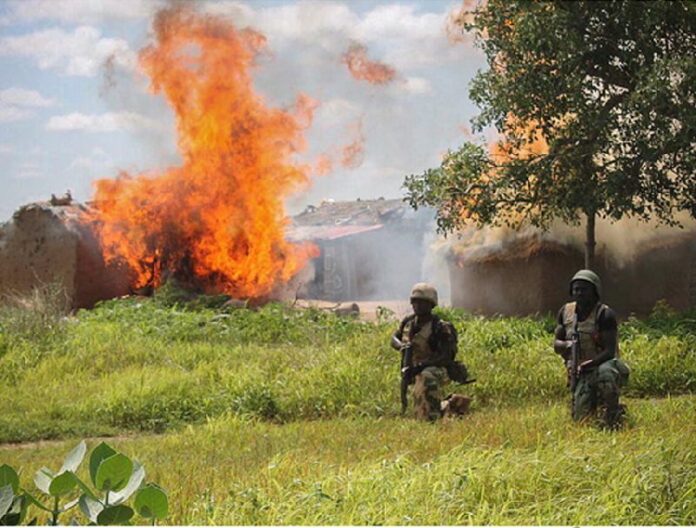
Nigerian army soldiers clear Boko Haram camps at Chuogori and Shantumari in Borno State, Nigeria, 30 July 2015. Attacks by the extremist group have resulted in over 430 fatalities in July. EPA/STR

KANO, NIGERIA (DPA) – A girl suicide bomber killed at least 15 people at a bus terminal in north-eastern Nigeria, hospital sources and witnesses said Tuesday.

At least 30 others were injured when the girl, who is estimated to be 11 or 12 years old, detonated explosives strapped to her body in the town of Damaturu, the capital of Yobe State, said resident Haruna Ibrahim.

"The girl came into the car park and refused to be searched [by security officials]. She later went near one car filled with passengers and detonated herself," a health worker from a nearby hospital told dpa on condition of anonymity.

Damaturu police spokesman Toyin Gbadegesin could only confirm six deaths and three people with critical injuries immediately after the blast.

Last month, three people were killed and at least five injured by a suicide bomber who exploded his car at a security checkpoint in Damaturu.

No group immediately claimed responsibility for the attack, but Islamist terrorist group Boko Haram, which seeks to establish a state with its very strict interpretation of Islamic law, has killed thousands of people since 2009 in similar attacks.


To reach us about this article or another matter, please contact us by e-mail at: [email protected].

Follow Khaosod English on and Twitter for news, politics and more from Thailand.

\


Advertisement

Bangkok Bombing: Cabbie Recalls Taking ‘Foreigner’ to Hua Lamphong

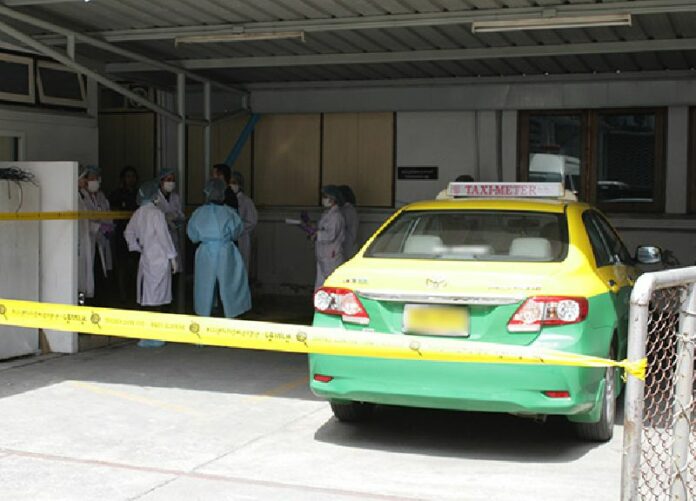
A taxi police believe took the suspected Bangkok bomber from Sala Daeng intersection to a location near Hua Lamphong train station about two hours before last week's bombing of the Erawan Shrine.

BANGKOK — A taxi driver who reportedly picked up the lead suspect in last week’s Erawan Shrine bombing told the press today he’s confident the man was a foreigner.

Speaking to the media today while delivering his taxi for examination at the Office of Forensic Science, the driver said he picked up the yellow-shirted man police believe to be the bomber and dropped him off near Hua Lamphong Railway Station less than two hours before the bomb exploded, killing 20 people and injuring scores more at the shrine.

“As far as I can recall, his appearance and demeanor looked like a farang,” said the cabbie, who requested that his name be withheld.

CCTV footage released after the attack showed a yellow-shirted man walking to the shrine, putting down his backpack amid the crowd and walking away just minutes prior to the explosion.


Bangkok Shrine Bombing: Those Who Died


The driver said he picked up the yellow-shirted man from Sala Daeng intersection in the Silom area between 3pm and 4pm on 17 Aug. He said the man spoke a few words in Thai with a foreign accent.

“When I picked him up, he acted normal. He didn’t say the words ‘Hua Lamphong’ clearly. It’s sounded like a farang speaking Thai,” said the driver. “When he got out, he paid the fare. He gave me a hundred baht bill. During the ride, he didn’t say anything. I didn’t notice if he had any belongings.”

Before reaching the destination, the man indicated he wanted to get out by saying "jod," or stop, again with an accent.

The driver was adamant about one thing: “I assure you, he’s not Thai.”

The CCTV footage and composite sketch of the suspect struck many Thais as Eurasian-looking, mostly due to his light skin. In Thailand, persons with lighter skin are often thought to be foreigners at first glance.  

Several media agencies and possible witnesses also described the alleged bomber as khaek khao, which means “White Arab.”

However, police have yet to publicly conclude whether the suspect is indeed a foreigner.

The taxi driver added that he had given testimony to police officers at Lumpini Police Station and the Metropolitan Police Bureau.

The police investigation appears to have made little progress since the attack, with top officials acknowledging the perpetrator or perpetrators may have already fled the country.

The chief suspect was last known to be seen minutes after the attack riding back toward Sala Daeng, and most revelations have pertained to piecing together the suspect’s movements prior to the attack.

The taxi driver’s account unwinds the suspect’s trail that night back to Sala Daeng, where the taxi took him near the train station. After that he is believed to have taken a tuk-tuk from a location a five-minute walk away to the scene of the crime.

Placing him back near Sala Daeng fits a pattern of activity and possible sightings in the area of lower Silom and Sathorn roads, where several witnesses said they gave rides to a man shown to them in immigration and passport photos by investigators between December and March.

Another man was seen walking down Sathorn Road on Monday night minutes after the blast to place something in the water near Sathorn Pier, where a device exploded the next afternoon.

Related stories:


No Longer Whole, a Family Buries its Dead and Waits for Answers

City Officials Bridle at Claims of Broken CCTVs

Bangkok Bombing Dragnet Yields 142 Unrelated Arrests

Bangkok Bomber May Have Fled Thailand: Police

Man Dropped Bag into Water Night Before Sathorn Pier Blast

Seen Often on Sathorn 10, Suspect Thought to Use Fake Turkish Passport

Leaked Police Report Tracks Lead Suspect Before, After Bombing

1M Baht Bounty for Bangkok Bomb Suspect

Police Widen Hunt for Bombing ‘Network’

Bangkok Shrine Bombing: Those Who Died

Day in Photos: Expressions of Grief, Unity After Terror Attacks

Briton Dies in Bangkok Shrine Bombing

Despite Lack of Evidence, Thai Media Points Blame at Uighurs

Tourists Narrowly Escape Second Bangkok Bombing in 24 Hours

Bangkok Shrine Bombing: Police Hunt Backpack Man

Tourists Among 19 Killed by Bomb at Bangkok's Erawan Shrine


To reach us about this article or another matter, please contact us by e-mail at: [email protected].

Follow Khaosod English on Facebook and Twitter for news, politics and more from Thailand.

Follow @KhaosodEnglish

\

Advertisement

Hot News

LATEST NEWS

Bangkok
light rain
28.3 ° C
28.3 °
26.1 °
85 %
3.5kmh
100 %
Thu
27 °
Fri
35 °
Sat
35 °
Sun
31 °
Mon
34 °