28.8 C
Bangkok
Thursday, July 16, 2026
Home Blog Page 3238

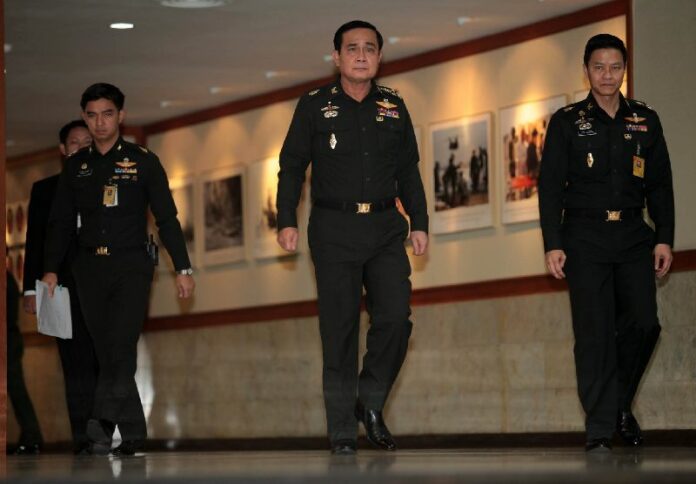
Gen. Prayuth Could Be PM Under New Constitution

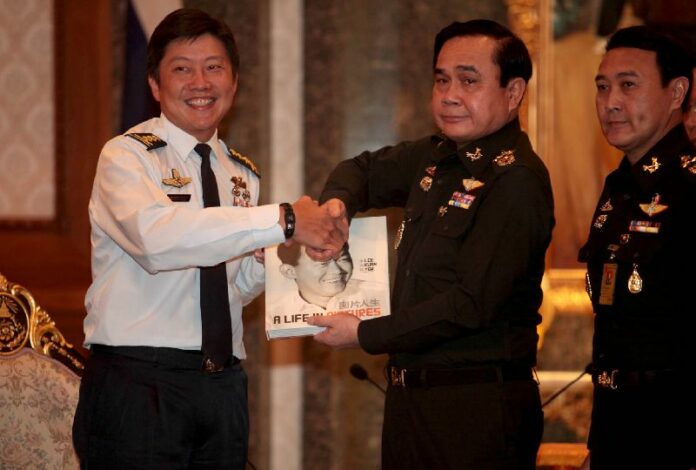
Gen. Prayuth Chan-ocha meeting the Commander of the Singaporean Military Ng Chee Meng, 23 July 2014.

BANGKOK — A top official has confirmed that the leader of Thailand’s military junta leader could become Prime Minister under the Kingdom’s new temporary constitution.

"This Constitution does not bar the NCPO leader from being Prime Minister," said deputy chief of the Royal Thai Army Gen. Paiboon Koomchaya, referring to the chairman of the National Council of Peace and Order, Gen. Prayuth Chan-ocha.

According to Article 19 of the new constitution, which was unveiled last night following a royal endorsement by His Majesty the King, an appointed National Legislative Assembly will choose a new Prime Minister to govern the country until the next election, which is set for the end of 2015 at the earliest.

Article 20 states that the new Prime Minister must be Thai, older than 40 years of age, and not a member of any political party in the past three years. The article also bars judges, attorneys-general, Election Commissioners, state treasury auditors, and National Human Rights Commissioners from taking the premiership.

In effect, the article prohibits many prominent and active political figures from taking the top job without placing any restrictions on military officers and bureaucrats, who were barred from office in Thailand’s previous constitution.

The 2007 Constitution was dissolved  by the NCPO after it seized power in the 22 May coup d’etat.

However, even if Gen. Prayuth does not take the office, Article 44 of the provisional constitution grants the NCPO chairman sweeping power to "order, suspend, or take action regardless of its effect on the legislative, executive, or the judiciary."

Gen. Prayuth has refused to address speculation that he will be Prime Minister.


For comments, or corrections to this article please contact: [email protected]

You can also find Khaosod English on Twitter and Facebook
http://twitter.com/KhaosodEnglish
http://www.facebook.com/KhaosodEnglish


Advertisement

Pheu Thai 'To Boycott Reform Council'

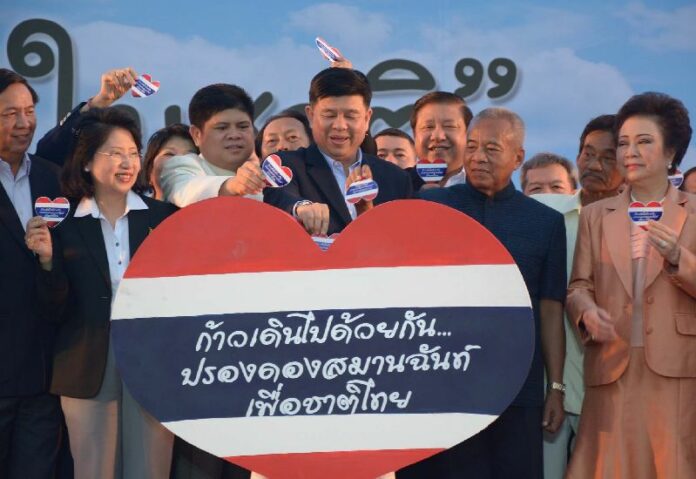
Pheu Thai party members at the Army's Happiness Festival in Bangkok on July 22, 2014.

BANGKOK — The ruling party of the former government will not send any members to join the "National Reform Council" outlined in Thailand’s new interim constitution, sources inside the Pheu Thai Party say.

The junta’s newly inaugurated 2014 Interim Constitution calls for the appointment of a 250-member National Reform Council that will propose political, economic, and social reforms to ensure that Thailand can become a "true" democracy.

According to sources, Pheu Thai leaders have concluded that even if their members are appointed to join the reform council, they will only manage to constitute a minority.

Deputy secretary-general of the Pheu Thai Party Chavalit Wichayasutthi said he thinks it’s unlikely that Pheu Thai members will ask to participate in the 35-member Constitution Drafting Committee either.

Mr. Chavalit explained that no one will want to join the committee, which is tasked with penning a permanent charter, because the 2014 Interim Constitution prohibits the committee members from running for political office for two years. 

The military junta ousted the elected government led by Pheu Thai Party on 22 May. Since the coup, a number of Pheu Thai Party supporters have attempted to protest the junta and the military takeover, but their resistance has been stamped out by authorities.

However, prominent Pheu Thai Party members have urged their supporters to cooperate with the military rulers. Some of them, such as Veera Musikapong and Suphon Attawong, even participated in the army-organised "Return Happiness to the People of the Nation" fair in Bangkok yesterday.


Read more:
Gen. Prayuth Could Be PM Under New Constitution
Official Defends Carte Blanche For Junta In New Charter


For comments, or corrections to this article please contact[email protected]

You can also find Khaosod English on Twitter and Facebook
http://twitter.com/KhaosodEnglish
http://www.facebook.com/KhaosodEnglish


Advertisement

Officials Defend Carte Blanche For Junta In New Charter

NCPO chairman Gen. Prayuth Chan-ocha, 23 July 2014.

BANGKOK — A legal adviser to Thailand's military regime says the sweeping powers granted to the junta under the new charter are necessary to maintain order and unity in the country.

Prof. Pornpetch Wichiatcholchai, adviser to the ruling National Council for Peace and Order (NCPO), said in a press conference today that NCPO chairman Gen. Prayuth Chan-ocha should reserve the power to suppress or prevent any activity that threatens national security or the monarchy.  

The official was referring to Article 44 of the newly inaugurated 2014 Interim Constitution, which allows the head of the NCPO "to order, to suspend or to take action, regardless of its effects on the legislative, executive or judiciary" in response to any perceived threats against "public order, national security, the monarchy, national economy or sovereignty of the country."

According to the article: “All orders or acts are to be regarded as lawful and constitutional. At the conclusion of that order or act, the speaker of the National Legislative Assembly and the Prime Minister are to be notified as soon as possible.”

The section effectively permits the NCPO to reserve absolute power over the new government and unilaterally continue its suppression of dissent in the name of public order and national security.

However, Mr. Pornpetch defended the provision, saying "it is not a harsh law." 

"It's for the creation of peace and order, and a political atmosphere that will lead to reforms," Mr. Pornpetch explained. 

He admited that Article 44 resembles the infamous Section 17 of the Thai 1959 Charter imposed by Field Marshal Sarit Thanarat, following his military takeover.

That article granted Sarit as Prime Minister the power to "to prevent or suppress an act giving rise to the subversion of the national security of Throne or an act contributable to the impairment, disturbance or threat against the internal or external peace of the Kingdom … Such order or act shall be deemed lawful." 

Field Marshal Sarit regularly invoked Section 17 to crack down on activists and suspected Communists during his tenure as Prime Minister.

"Article 44 is like Section 17 in the past," Mr. Pornpetch said. "But it will be used in a constructive way, not a destructive one."

NCPO Advisor Wissanu Kru-ngam, who was also present at today's press conference, insisted that Article 44 does not grant the NCPO inordinate powers. 

"It merely allows the NCPO to stay and ease the burden of the Cabinet in issues about national security, and peace and order, so that the Cabinet can focus on administrative works and not be distracted by complicating problems over the period of the the next year," Mr. Wissanu said. "I believe the NCPO will rarely use this power."

The 2014 Interim Constitution — the 19th charter in Thailand's history as a constitutional monarchy — outlines the formation of an interim government that will administer the country until elections are held, scheduled for October 2015 at the earliest.

 The temporary government will consist of a National Legislative Assembly who will appoint a Prime Minister and Cabinet, a National Reform Council tasked with proposing widespread national reforms, and a Constitutional Drafting Committee in charge of penning a permanent charter.


CORRECTION: The new interim charter is Thailand's 19th, not 18th, constitution since 1932.

For comments, or corrections to this article please contact[email protected]

You can also find Khaosod English on Twitter and Facebook
http://twitter.com/KhaosodEnglish
http://www.facebook.com/KhaosodEnglish

Advertisement

Officials Defend Carte Blanche For Junta In New Charter

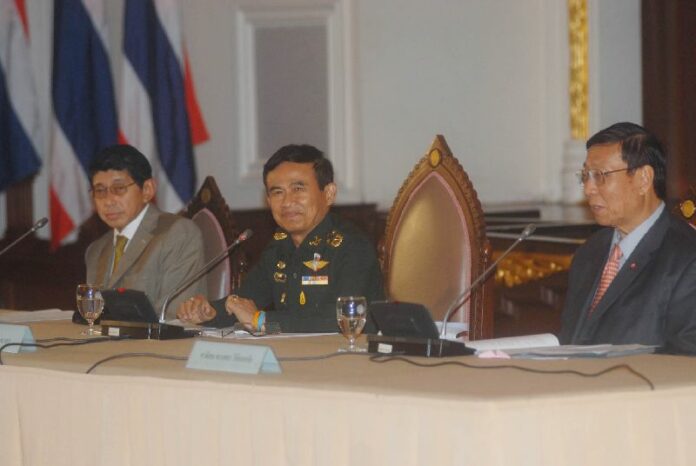
Prof. Pornpetch Wichiatcholchai (right) at a press conference discussing Thailand's new interim charter, 23 July 2014.

BANGKOK — A legal adviser to Thailand's military regime says the sweeping powers granted to the junta under the new charter are necessary to maintain order and unity in the country.

Prof. Pornpetch Wichiatcholchai, adviser to the ruling National Council for Peace and Order (NCPO), said in a press conference today that NCPO chairman Gen. Prayuth Chan-ocha should reserve the power to suppress or prevent any activity that threatens national security or the monarchy.  

The official was referring to Article 44 of the newly inaugurated 2014 Interim Constitution, which allows the head of the NCPO "to order, to suspend or to take action, regardless of its effects on the legislative, executive or judiciary" in response to any perceived threats against "public order, national security, the monarchy, national economy or sovereignty of the country."

According to the article: “All orders or acts are to be regarded as lawful and constitutional. At the conclusion of that order or act, the speaker of the National Legislative Assembly and the Prime Minister are to be notified as soon as possible.”

The section effectively permits the NCPO to reserve absolute power over the new government and unilaterally continue its suppression of dissent in the name of public order and national security.

However, Mr. Pornpetch defended the provision, saying "it is not a harsh law." 

"It's for the creation of peace and order, and a political atmosphere that will lead to reforms," Mr. Pornpetch explained. 

He admited that Article 44 resembles the infamous Section 17 of the Thai 1959 Charter imposed by Field Marshal Sarit Thanarat, following his military takeover.

That article granted Sarit as Prime Minister the power to "to prevent or suppress an act giving rise to the subversion of the national security of Throne or an act contributable to the impairment, disturbance or threat against the internal or external peace of the Kingdom … Such order or act shall be deemed lawful." 

Field Marshal Sarit regularly invoked Section 17 to crack down on activists and suspected Communists during his tenure as Prime Minister.

"Article 44 is like Section 17 in the past," Mr. Pornpetch said. "But it will be used in a constructive way, not a destructive one."

NCPO Advisor Wissanu Kru-ngam, who was also present at today's press conference, insisted that Article 44 does not grant the NCPO inordinate powers. 

"It merely allows the NCPO to stay and ease the burden of the Cabinet in issues about national security, and peace and order, so that the Cabinet can focus on administrative works and not be distracted by complicating problems over the period of the the next year," Mr. Wissanu said. "I believe the NCPO will rarely use this power."

The 2014 Interim Constitution — the 19th charter in Thailand's history as a constitutional monarchy — outlines the formation of an interim government that will administer the country until elections are held, scheduled for October 2015 at the earliest.

 The temporary government will consist of a National Legislative Assembly who will appoint a Prime Minister and Cabinet, a National Reform Council tasked with proposing widespread national reforms, and a Constitutional Drafting Committee in charge of penning a permanent charter.


CORRECTION: The new interim charter is Thailand's 19th, not 18th, constitution since 1932.

For comments, or corrections to this article please contact[email protected]

You can also find Khaosod English on Twitter and Facebook
http://twitter.com/KhaosodEnglish
http://www.facebook.com/KhaosodEnglish

Advertisement

Dark Tourism Venues Proving Popular in Bangkok

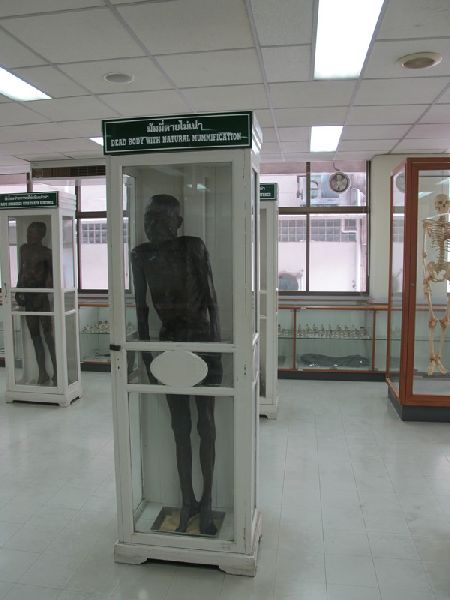
Mummified bodies and skeletons are displayed at Siriraj Medical Museum, Bangkok, Thailand, 17 July 2014. Dark tourism venues in the Thai capital have become popular with foreign visitors. Siriraj Medical Museum attracted 20,000 foreign visitors in 2013. Photo: dpa

By Bill Bredesen

BANGKOK (DPA) — Mummified serial killers, deformed foetuses and bisected human heads probably are not what most travellers dream of seeing on their Thai holiday.

But then again, some do.

On a recent weekday morning in Bangkok, two university-age British backpackers were among the steady number of foreign visitors emerging from Siriraj Medical Museum, on the campus of the country's oldest medical school. They were wide-eyed at what they had seen.

"You've got to have a fairly strong stomach," said Nick Bushell, from London.

"I wasn't expecting it," agreed Chris Lock. "It was pretty shocking."

Originally established as a teaching venue for the school's medical students, Siriraj Medical Museum today is increasingly better known as a tourist destination.

Last year, it attracted more than 20,000 foreign visitors, representing one-quarter of all admissions, museum director Tumtip Sangruchi said.

The museum has become famous for its morbid photographs of murders and accidents; for its mermaid babies and conjoined twins preserved inside glass jars; and for its embalmed human cadavers in various states of dissection, housed in permanent display cases.

"We have very unique exhibitions. Initially, they were for teaching purposes only, but since the specimens are rare, we decided to open the museum to the public," Tumtip said.

Detailed scientific exhibitions on forensic medicine, pathology, anatomy, parasites and pre-historic human evolution are all on display at the museum, but foreigners tend to overlook the less-sensational elements and concentrate on the gore.

"It's rare to see these things," said Cara Hull, a biology student from Australia. "A lot of universities have them, but people don't always have access to them."

"I really liked the anatomy section, where they have cross-sections of all the bits of the human body," she said.

As a tourist destination, Siriraj Medical Museum stands in stark contrast to the vision of palm-fringed beaches, Buddhist temples and bejewelled elephants promoted by Thailand's tourism authority.

"The tourism board wants to give visitors a 'Disneyland' picture of the country, just the bright and glossy side. But oftentimes it's an obsolete side, just quaint anachronisms," said Jim Algie, author of the book Bizarre Thailand, which explores the country's darker sides.

"Travellers want authentic experiences these days, and they often want to see the nitty-gritty of the countries they go to," he added.

Globally, the trend of "dark tourism" has already gone mainstream. In neighbouring Cambodia, tourists flock to the Tuol Sleng Genocide Museum and Killing Fields, while in Vietnam they head to war sites, including the infamous torture den known as the Hanoi Hilton.

At the University of Central Lancashire in England, there is even an Institute for Dark Tourism Research, which has been in operation since 2005, studying why tourists seek out places of death, disaster or the seemingly macabre.

The medical museum in Bangkok "combines elements of supernatural tradition and Buddhist compassion," said Algie, noting that droves of Thai schoolchildren pass through the museum each week, often leaving candy or dolls as offerings to the babies who died before childbirth.

"We pretty much just wanted to see something different," said Bushell, the British backpacker. "We also went to the capital punishment museum. That was good too, but less graphic."

At the Bangkok Corrections Museum, set in a leafy public park on converted former prison grounds, the dark history of Thailand's criminal justice system is put on display.

It features graphic depictions of jailhouse tortures that were ultimately abolished under a new penal code in 1908.

One punishment involved a large rattan ball with inward-pointing spikes. Guards would force a prisoner into the ball and allow elephants to kick it around. The torture was known as "takraw," named after the foot-volleyball game native to South-east Asia.

The museum has also preserved one original cellblock, now used to showcase ghastly artefacts such as the clay dishes used in condemned prisoners' last meals, the wooden cross that prisoners would cling to during execution, and the red flag that signalled an execution site.

Capital punishment in Thailand was carried out by sub-machine gun until 2003. Condemned prisoners were fixed to a wooden cross, and the executioner would fire bullets through a screen into their hearts.

The country now uses lethal injection.

Thailand's last firing-squad executioner, Chavoret Jaruboon, remains an enduring figure in the country. His life story was recently made into a film, The Last Executioner, which won a best actor award for its star Vithaya Pansringarm at the 17th Shanghai International Film Festival in June.

The movie's success on the festival circuit, and the fact that part of it was filmed at the Bangkok Corrections Museum, might drive more visitors to the site, Algie said.

"Tourism is definitely becoming more sensationalistic," he said.

Advertisement

New Constitution In Effect Following HM King's Endorsement

BANGKOK — The new constitution of Thailand – the Kingdom's 19th – is now in effect following His Majesty the King's royal endorsement.

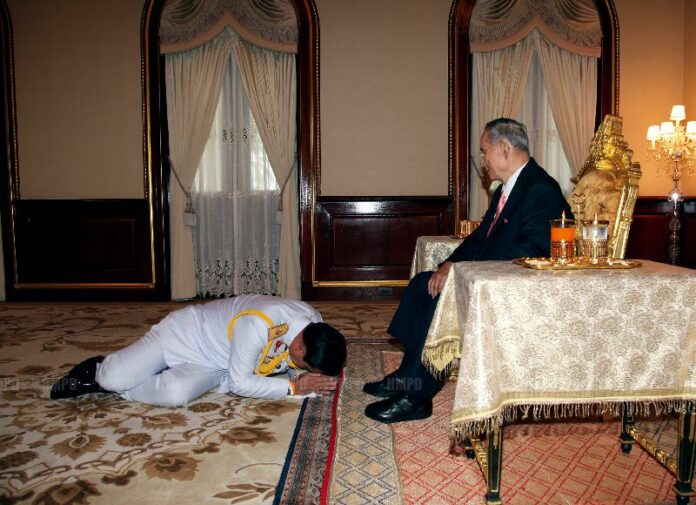
Gen. Prayuth Chan-ocha, chairman of the military junta, was granted an audience by King Bhumipol this evening at his seaside residence, Klai Kangwon Palace, in Prachuap Kiri Khan province.

Per tradition, no reporters were allowed to observe the ceremony, in which the monarch handed a signed copy of the interim charter to the junta leader.

Col. Sirichan Nga-thong, a spokesperson for the National Council for Peace and Order (NCPO), said the new constitution is effective immediately.

According to a statement by the NCPO, the new charter will be enforced by an interim government, which will consist of 220-person National Legislature Assembly, who will appoint a new Prime Minister and Cabinet. There will also be 250-person Reform Council and 35-member committee tasked with drafting a new permanent constitution. 

Elections are scheduled to take place at the end of 2015 if conditions are stable and the new government has accomplished "reconciliation," the NCPO said.

Gen. Prayuth is expected to address the nation about the new charter tomorrow at 10 am. 


For comments, or corrections to this article please contact: [email protected]

You can also find Khaosod English on Twitter and Facebook
http://twitter.com/KhaosodEnglish
http://www.facebook.com/KhaosodEnglish

Advertisement

New Constitution In Effect Following HM King's Endorsement

BANGKOK — The new constitution of Thailand – the Kingdom's 19th – is now in effect following His Majesty the King's royal endorsement.

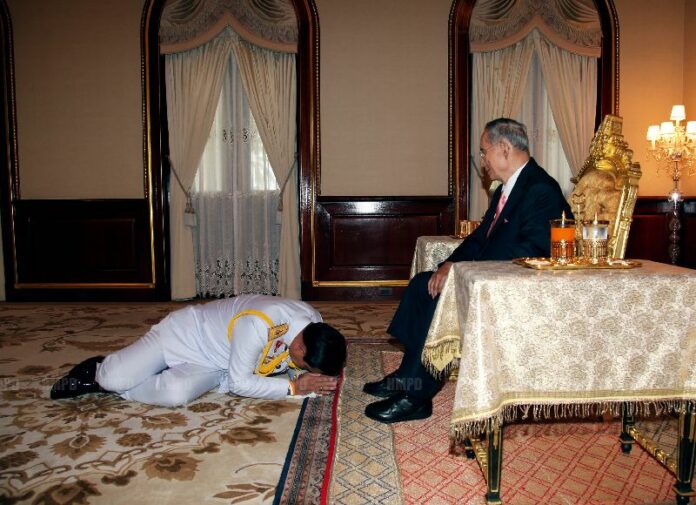
Gen. Prayuth Chan-ocha, chairman of the military junta, was granted anaudience by King Bhumipol this evening at his seaside residence, Klai Kangwon Palace, in Prachuap Kiri Khan province.

Per tradition, no reporters were allowed to observe the ceremony, in which the monarch handed a signed copy of the interim charter to the junta leader.

Col. Sirichan Nga-thong, a spokesperson for the National Council for Peace and Order (NCPO), said the new constitution is effective immediately.

According to a statement by the NCPO, the new charter will be enforced by an interim government, which will consist of 220-person National Legislature Assembly, who will appoint a new Prime Minister and Cabinet. There will also be 250-person Reform Council and 35-member committee tasked with drafting a new permanent constitution. 

Elections are scheduled to take place at the end of 2015 if conditions are stable and the new government has accomplished "reconciliation," the NCPO said.

Gen. Prayuth is expected to address the nation about the new charter tomorrow at 10 am. 


For comments, or corrections to this article please contact: [email protected]

You can also find Khaosod English on Twitter and Facebook
http://twitter.com/KhaosodEnglish
http://www.facebook.com/KhaosodEnglish


Advertisement

Week-Long Feud Between National Taekwondo Coach & Athlete Settled

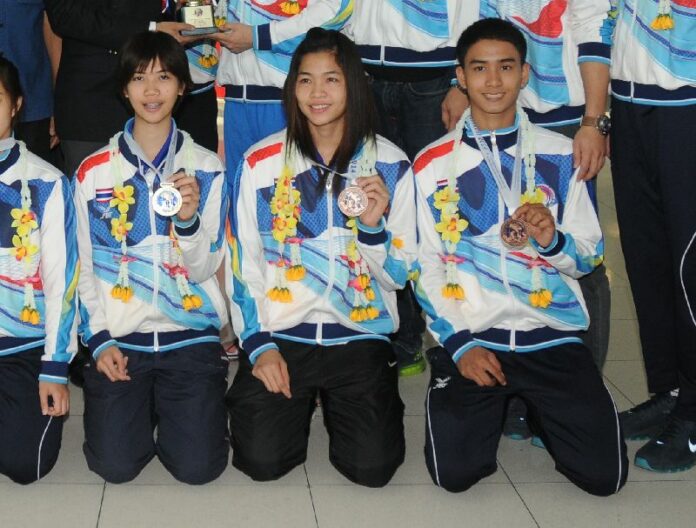
Rungrawee Kusara (center) accused her Taekwondo coach of punching her after she lost a match.

BANGKOK — The coach of Thailand’s National Women’s Taekwondo Team is due to meet with the athlete who accused him of physically assaulting her, raising hopes that their public feud will finally come to an end.

South Korea-born Choi Young-Seok said today that he would like to apologise to the public for being a part of the controversy that has gripped Thai media for over a week. 

"I didn't think [my actions] will lead to such an escalating consequence," Mr. Choi said at a press conference at the Taekwondo Association of Thailand. 

Mr. Choi also told reporters that he already apologised to the athlete, Rungrawee Kusara, shortly after he "punished" her during the Korea Open tournament in South Korea on 11 July. 

Last week, Ms. Rungrawee publicly accused Mr. Choi of savagely punching her in the stomach and face after she lost a match in the tournament. On national television, Ms. Rungrawee demanded the coach, who was still in South Korea at the time, apologise to her publicly. 

Over the past week, many Thais have taken to social media to fiercely debate whether Mr. Choi’s behavior was acceptable and Ms. Rungrawee’s response warranted. Prominent Taekwondo athletes, including former Olympian medalists, also weighed in with their opinions, further deepening the debate. The controversy continued to escalate, eventually leading a top official of the Ministry of Sports and Tourism to call on related authorities to step in and end the conflict.

At a press conference today, Mr. Choi insisted that he punished Ms. Rungrawee because he wanted to instill a sense of discipline in her.

"Discipline is very important for me. Every National Team athlete should have a sense of responsibility, because their duty is for the nation, not to clubs that they are members," Coach Choi said. "Everyone must have the spirit of a fighter."

Ms. Rungrawee, Mr. Choi's accuser, told Khaosod that she has received a phone call from the Taekwondo association to arrange a meeting between her and Mr. Choi and that she has accepted the offer.

"I will talk to him soon," she said in a phone interview.

Ms. Rungrawee continued, "In the past week, I've been spending time with myself. I have been talking to my family. I have been thinking about many things. I now understand that the coach really means well for me. It's just the way he expressed himself was too violent."

Preecha Tortrakul, director of the national Taekwondo association, said he believes Mr. Choi's method of punishment should be reconsidered, especially when it comes to touching athletes’ head or faces "because it's a big thing in our country." In Thai culture, it is considered disrespectful to touch another person’s head.

However, Coach Choi said at the press conference that he would have to talk with his supervisors before he decides whether he will drop physical punishments altogether.

Sources inside the Taekwondo Association of Thailand say the meeting between Ms. Rungrawee and Mr. Choi will take place at 3 pm tomorrow. Ms. Rungrawee is expected to apologise to Mr. Choi in a traditional manner, the sources say.


For comments, or corrections to this article please contact: [email protected]

You can also find Khaosod English on Twitter and Facebook
http://twitter.com/KhaosodEnglish
http://www.facebook.com/KhaosodEnglish

Advertisement

Cambodian Opposition To End Deadlock, Eight To Be Released From Jail

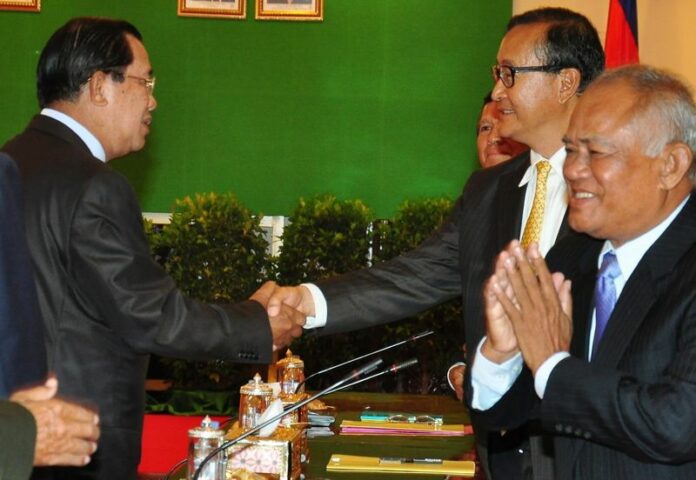
Cambodian Prime Minister Hun Sen (L), shakes hands with Sam Rainsy (2-R), President of the opposition National Rescue Party (CNRP), during a meeting in Phnom Penh, Cambodia, 22 July 2014. The CNRP ended its boycott of Cambodia's parliament on Tuesday, and the government agreed to release seven activists from jail to end a political stalemate. EPA/KHEM SOVANNARA

By Kate Bartlett

PHNOM PENH (DPA) — The main opposition party ended its boycott of Cambodia's parliament, and the government agreed to release eight activists from jail to end a political stalemate Tuesday.

Talks between Prime Minister Hun Sen and Cambodia National Rescue Party leader Sam Rainsy produced the agreement, party whip Son Chhay said.

"Both parties have reached an agreement," Chhay said.

"I think it's likely they'll be sworn in Friday or Saturday," he added, referring to the 55 party members who won legislative seats in the July 2013 elections.

The opposition had alleged electoral fraud and refused to take its seats for almost a year. It frequently staged demonstrations demanding the prime minister's resignation and new elections.

"We got what we want," he said, rejecting suggestions that they had caved on some demands to secure the release of their colleagues, who were arrested after a violent protest last week.

Seven opposition lawmakers-elect and one party activist were charged with incitement and insurrection last week after some of their supporters fought back against security guards who tried to break up a rally.

The US State Department called for their immediate release and Human Rights Watch condemned the charges.

They have been held in pre-trial detention at Phnom Penh's Prey Sar prison. At Prey Sar families of those detained and supporters waited in the rain for their release Tuesday.

While the CNRP had originally called for long-ruling Prime Minister Hun Sen to step down, they had more recently only demanded reform of the National Election Committee (NEC), which is stacked with ruling party sympathisers, and an early next election.

Son Chhay would not say if or when an early election would take place. It is currently scheduled for 2018.

Phay Siphan, chief government spokesman, said that the government welcomed an end to tensions.

"We all prefer national unity on behalf of the people," he said.

The NEC will now be made up of four members of the ruling party, four from the opposition, and a ninth chosen by consensus, he added.

"Both parties will talk again about the date of the election," he said.

Ou Virak, a political analyst and president of the Cambodian Center for Human rights, said he did not think the deal reached Tuesday meant tensions were quite over, noting that there were still many points to be quibbled over.

"The devil is in the details," he told dpa.

"I think it's a welcome temporary settlement but there will be a lot of wrangling to continue," he said.

Virak added that he thought most opposition supporters would welcome an end to the deadlock, but a few in the more radical camp would not

So far there has been no investigation into police shootings that killed seven people at protests over the past year.

Advertisement

State Petroleum Enterprise Sued For Resort Island Oil Spill

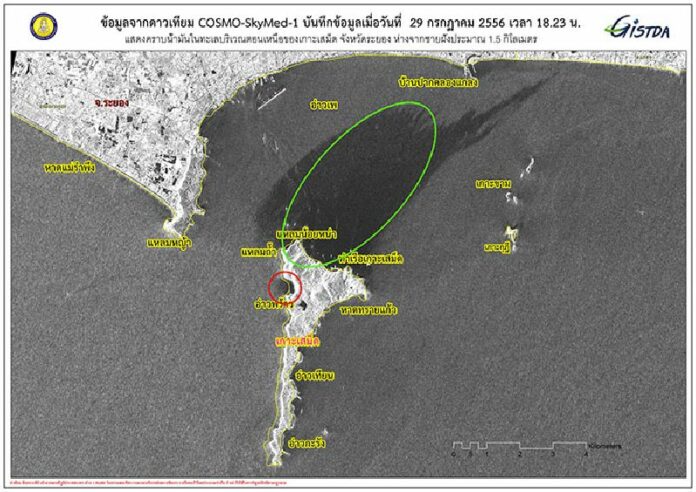
Satellite image of oil spill north of Koh Samet island, 27 July 2014

RAYONG — Business owners on Koh Samet island are suing a state-owned petroleum enterprise for the oil spill that polluted the resort island's beaches last year.

More than 50,000 litres of crude oil leaked from pipeline operated by PTT Global Chemical in July 2013 and blackened several beaches on Koh Samet island, prompting many tourists to leave the area. Others cancelled their trips to the island, resulting in a sharp drop in revenuefor many businesses.

Pitsanu Khemaphan, president of the Restaurant and Hotel Association on Koh Samet, arrived at Rayong Provincial Court with his lawyer today to file a lawsuit against PTT Global Chemical for the incident, demanding 300 million baht in compensation. 

The suit was co-filed by owners of Nimmanoradee Resort, Samet Cabana World Resort, and Heaven Resort, who say their businesses were severely affected by the oil spill. The case has been accepted by court officials for further procedure.

According to Mr. Pitsanu, he and other business owners decided to file the lawsuit after negotiations with PTT Global Chemical regarding financial compensation broke down. 

"We have been trying to settle for an agreement with PTT, but we have not received any response," Mr. Pitsanu explained. "So we have to band together and file the lawsuit to ask for damage compensation." 

He added that the statute of limitations on PTT Global Chemical's alleged offence is due to expire by 28 July 2014.

Komkai Sanguannapaporn, Mr. Pitsanu's lawyer, said PTT Global Chemical should be held responsible for business owners’ lost revenue, as well as any environmental consequences the spill has caused.

"PTT Global Chemical is the cause of the oil spill that was brought by waves to Koh Samet. It has damaged the beaches on Koh Samet and driven tourists away," Ms. Komkai said. 

Following the oil spill, room bookings at local hotels and resorts on Koh Samet dropped as low as 15% of their full capacity, while health officials warn that hazardous substances associated with the oil spill were found in nearby waters. 
An internal investigation blamed the incident on faulty designs in pipelines operated by PTT Global Chemical. The enterprise vowed to improve its safety standards to prevent further incidents and launched a PR blitz aimed at convincing the public to visit Koh Samet once again. 

However, critics have accused the petroleum giant of using its well-funded public relations mechanism to refurbish its tainted reputation and cover up the full extent of the environmental damage caused by the spill. 

There is also speculation that as a regular buyer of advertisements in a number of newspapers —  including Khaosod — PTT may have persuaded many media agencies to refrain from investigating the consequences of the oil spill.


For comments, or corrections to this article please contact: [email protected]

You can also find Khaosod English on Twitter and Facebook
http://twitter.com/KhaosodEnglish
http://www.facebook.com/KhaosodEnglish


Advertisement

Hot News

LATEST NEWS

Bangkok
overcast clouds
28.8 ° C
28.8 °
28.8 °
79 %
3.7kmh
100 %
Wed
28 °
Thu
31 °
Fri
35 °
Sat
36 °
Sun
37 °