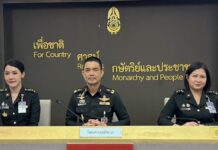
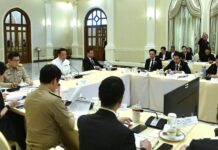
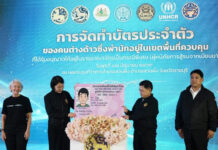
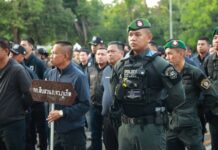
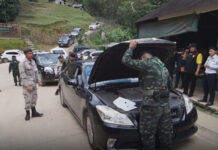
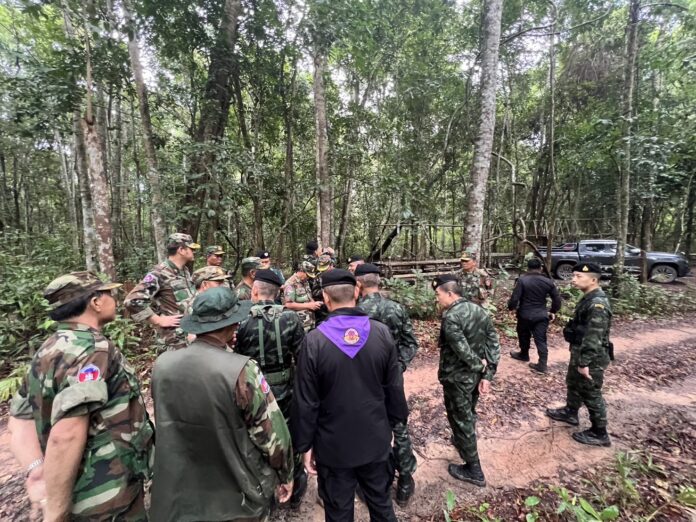
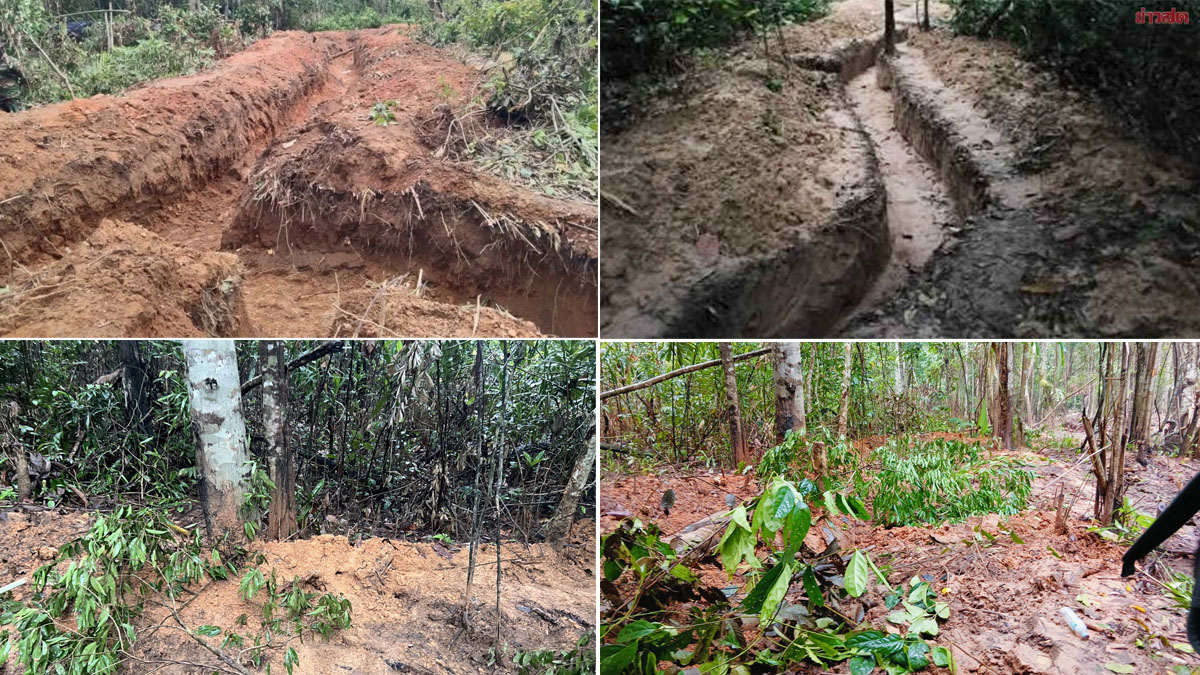
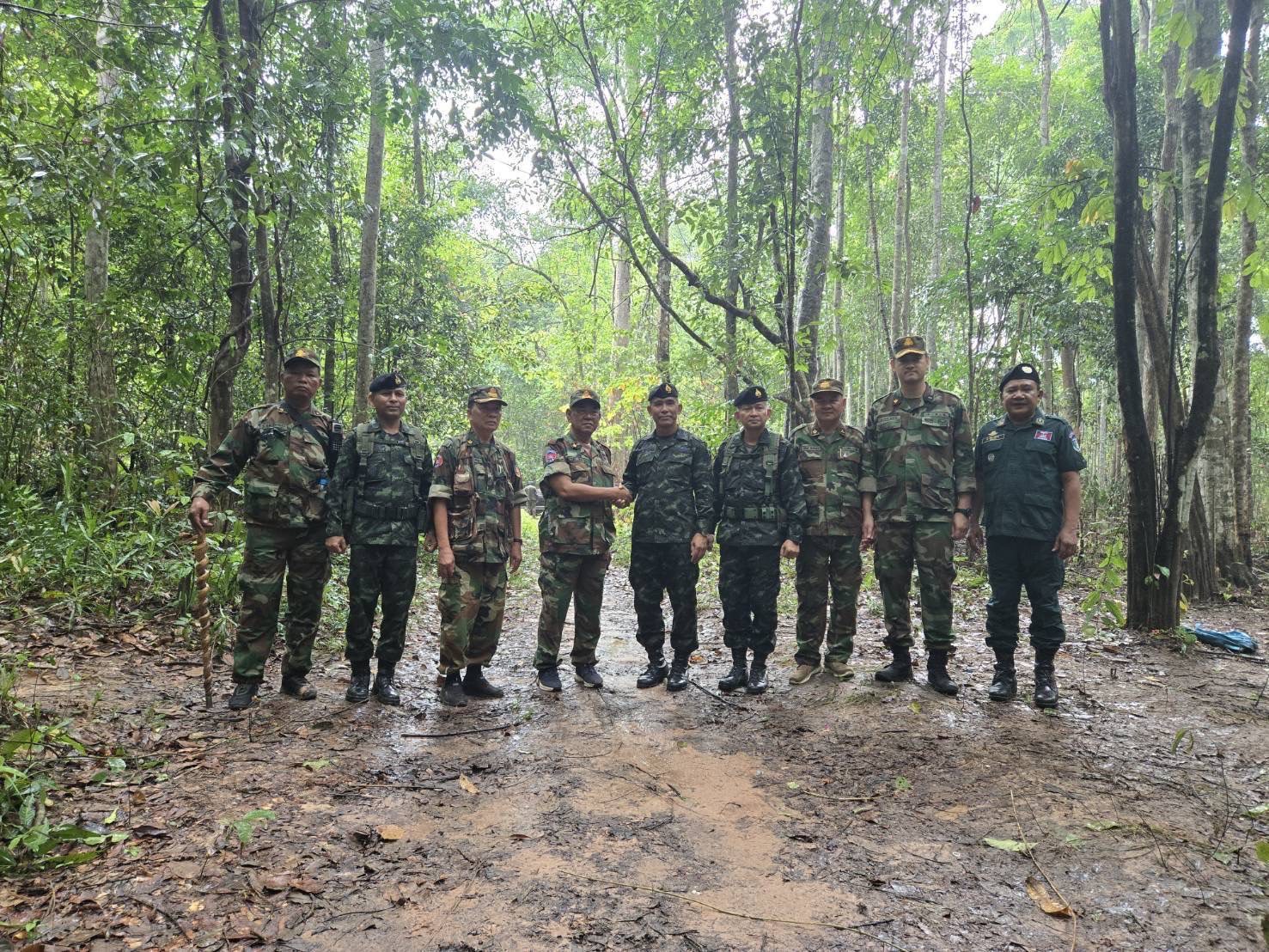
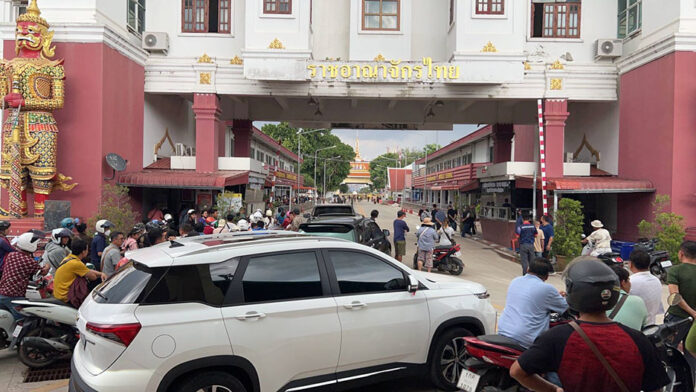
The Royal Thai Army released photos of Thai military personnel from the Suranaree Task Force traveling to negotiate with Cambodian soldiers to discuss matters regarding the territorial encroachment issue in Chong Bok area on June 8, 2025, with both sides agreeing to reduce confrontations.
BANGKOK — Thailand and Cambodia have successfully reduced border tensions through coordinated diplomatic and military efforts, with both governments announcing significant progress in resolving the Chong Bok territorial dispute.
Prime Minister Paetongtarn Shinawatra posted on social media on June 8 that discussions with the Cambodian government had reached “conclusions that positively affect the situation.” Both sides agreed to jointly adjust military forces at friction points to reduce confrontational atmosphere ahead of crucial talks.
The breakthrough came during military negotiations led by Cambodia’s Lieutenant General Saray Dek, Deputy Commander of the Royal Cambodian Army, and Thailand’s Major General Somphop Parawej, Commander of Suranaree Task Force. Army Spokesperson Major General Winthai Suvaree revealed that Cambodia agreed to redeploy troops to their 2024 positions and fill trenches to restore original natural conditions.
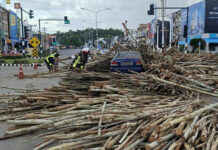
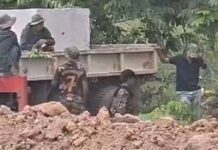
The photos provided by the Army show the first two images released on May 18 and May 28, 2025, revealing a 650-meter trench that Cambodian soldiers dug in the disputed Thai-Cambodia border area at Chong Bok, the site of clashes with Thai forces. The bottom two images, released on June 8, show that Cambodia has filled in the trenches and restored the area to its original condition.The Royal Thai Army released photos of Thai military personnel from the Suranaree Task Force traveling to negotiate with Cambodian soldiers to discuss matters regarding the territorial encroachment issue in Chong Bok area on June 8, 2025, with both sides agreeing to reduce confrontations.
“The Cambodian side expressed willingness to proceed with filling in the trenches to restore them to their original natural condition as proposed by the Thai side to reduce tensions and create a cooperative environment,” Suvaree said. “Both sides have agreed to utilize the Local Border Committee mechanism as a channel for ongoing discussions to resolve area-level issues in the future.”
Deputy Prime Minister and Defense Minister Phumtham Wechayachai confirmed on the same day that joint border patrols had successfully reduced tensions, with both sides conducting land restoration work. The Defense Ministry praised Thai forces for their restraint throughout the crisis.
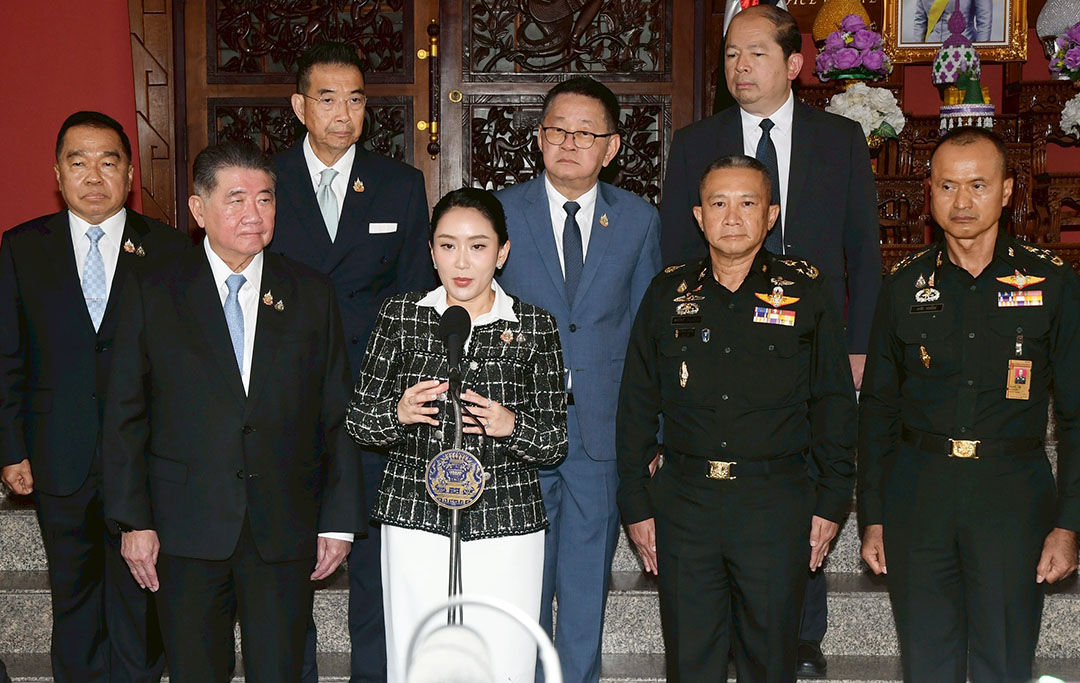
Prime Minister Paetongtarn Shinawatra holds a press conference alongside military leaders, the Defense Minister, and Foreign Minister following the National Security Council meeting on the Thai-Cambodia border situation at Government House on June 6. (Khaosod Photo/Yokin Charoenyiing)
“On behalf of the Ministry of Defence and the Royal Thai Armed Forces, I would like to express our gratitude to the Government of Cambodia, particularly the front-line units of the Cambodian army, for engaging in dialogue and helping to ease tensions in a manner consistent with the principles of peace, for the benefit of the people of both nations,” Phumtham said.
All parties now look toward the Joint Boundary Commission (JBC) meeting on June 14 to further resolve issues peacefully. Both governments will utilize Local Border Committee mechanisms for ongoing area-level discussions.
Prime Minister Paetongtarn urged the public to “ease their concerns and have confidence in the government’s problem-solving approach,” assuring citizens that “there will definitely be no severe incidents of conflict.” The Defense Ministry echoed calls for public caution with information sharing to prevent new conflicts.
The diplomatic resolution demonstrates effective cooperation between Thailand and Cambodia in managing sensitive border issues through dialogue rather than confrontation.
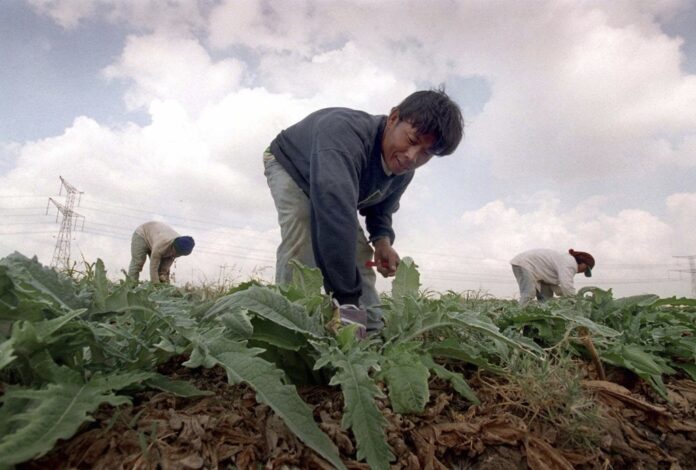
FILE - Workers from Thailand prune artichoke crops prior to the start of the ritual crop sabbatical, which begins at the Jewish New Year, so the vegetable will be kosher when it sprouts, at Beit Uziel in central Israel, September 14, 2000. (AP Photo/Jacqueline Larma, File)
Nattapong Pinta was among 31 Thais taken by the Hamas militant group. Thailand’s foreign ministry in a statement Saturday confirmed that Pinta, the last Thai hostage in Gaza, was confirmed dead. It said the bodies of two others have yet to be retrieved.
The ministry has said 46 Thais have been killed during the war. Thais were the largest group of foreigners held captive by Hamas. They were among tens of thousands of Thai workers in Israel. Here’s a look at what they were doing.
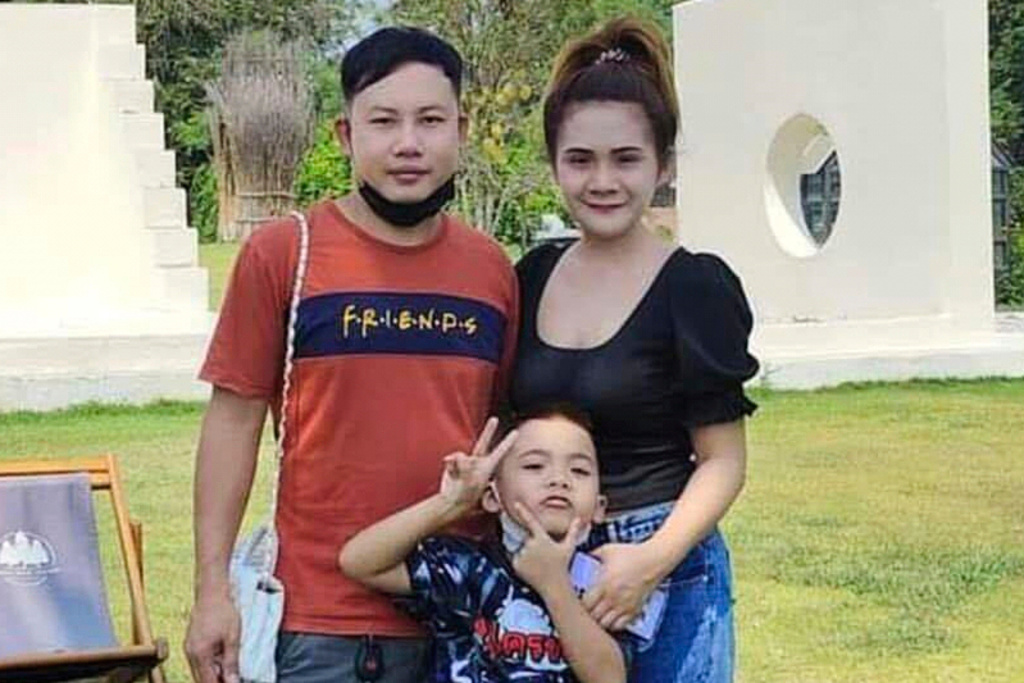
This undated photo provided by the Hostage’s Family Forum shows Nattapong Pinta, with his wife and son. (Hostage’s Family Forum via AP)
Why are there so many Thais in Israel?
Israel once relied heavily on Palestinian workers, but it started bringing in large numbers of migrant workers after the 1987-93 Palestinian revolt, known as the first Intifada.
Most came from Thailand, and Thais remain the largest group of foreign agricultural laborers in Israel today, earning considerably more than they can at home.
Thailand and Israel implemented a bilateral agreement a decade ago to ease the way for workers in the agriculture sector.
Israel has come under criticism for the conditions under which the Thai farm laborers work. A Human Rights Watch report in 2015 said they often were housed in makeshift and inadequate accommodation and “were paid salaries significantly below the legal minimum wage, forced to work long hours in excess of the legal maximum, subjected to unsafe working conditions and denied their right to change employers.”
A watchdog group found more recently that most were still paid below the legal minimum wage.
How many Thai nationals work in Israel?
There were about 30,000 Thai workers, primarily working on farms, in Israel prior to the attack by Hamas.
In the wake of the attack, some 7,000 returned home, primarily on government evacuation flights, but higher wages than those available at home have continued to attract new arrivals.
The Thai ambassador to Israel, Pannabha Chandraramya, recently said there are now more than 38,000 Thai workers in the country.
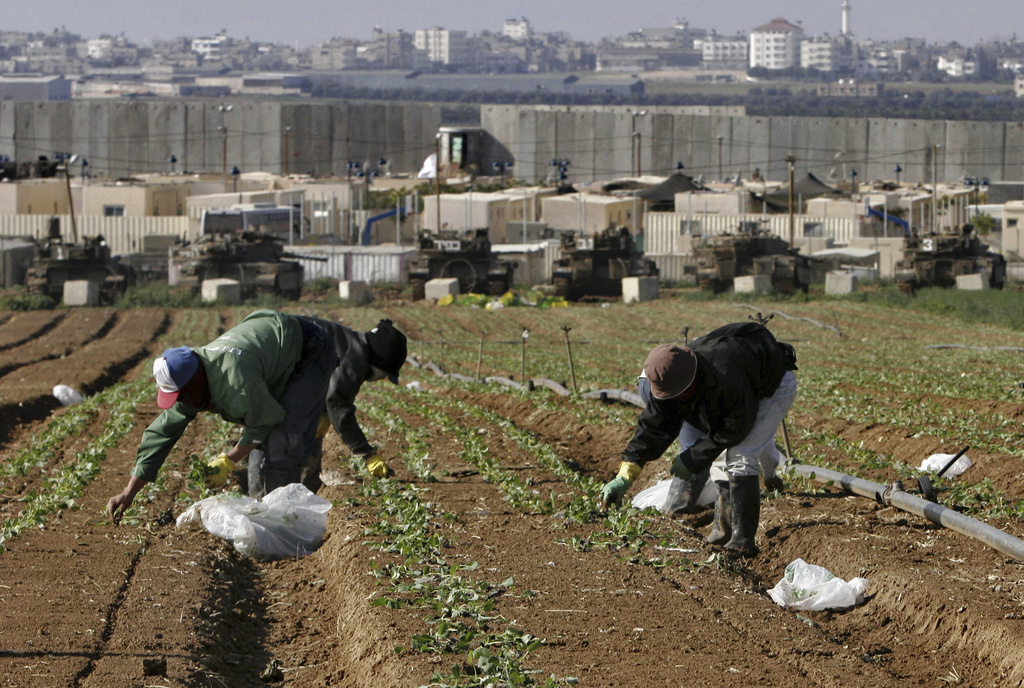
FILE – Thai workers work in a field next to an Israeli army base outside the Gaza Strip, near the southern Israeli Kibbutz of Nahal Oz. Thursday, Nov. 30, 2006. (AP Photo/Tsafrir Abayov, File)
What happened after some left?
Faced with a labor shortage in the wake of the exodus, Israel’s Agriculture Ministry announced incentives to try to attract foreign workers back to evacuated areas.
Among other things, it offered to extend work visas and to pay bonuses of about $500 a month.
Thailand’s Labor Ministry granted 3,966 Thai workers permission to work in Israel in 2024, keeping Israel in the top four destinations for Thais working abroad last year.
Thai migrant workers generally come from poorer regions of the country, especially the northeast, and even before the bonuses, the jobs in Israel paid many times what they could make at home.
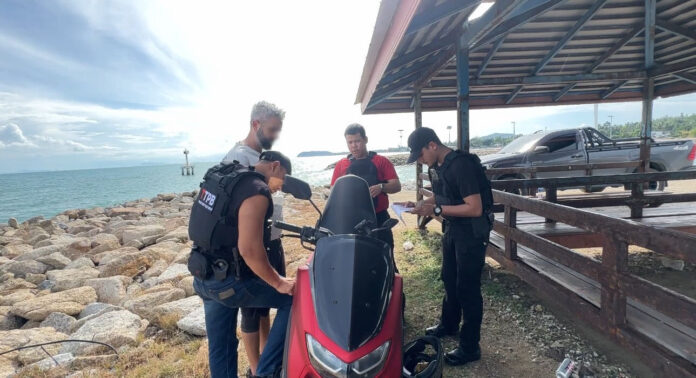
Tourist police arrested Russian drug dealer suspect at Hua Thian Pier in Tambon Ban Tai, Koh Phangan District, Surat Thani Province on June 7, 2025.
KOH PHAGNAN — Tourist police on Koh Phangan have arrested a 37-year-old Russian DJ who had turned to drug dealing, using sophisticated AI-powered automated sales systems to distribute narcotics to tourists.
The arrest of Mr. Vigen came after Koh Phangan tourist police received reports of a foreign DJ suspected of selling drugs to tourists in the area. Working jointly with local police, officers conducted an undercover investigation and arranged to purchase drugs through a messaging app.
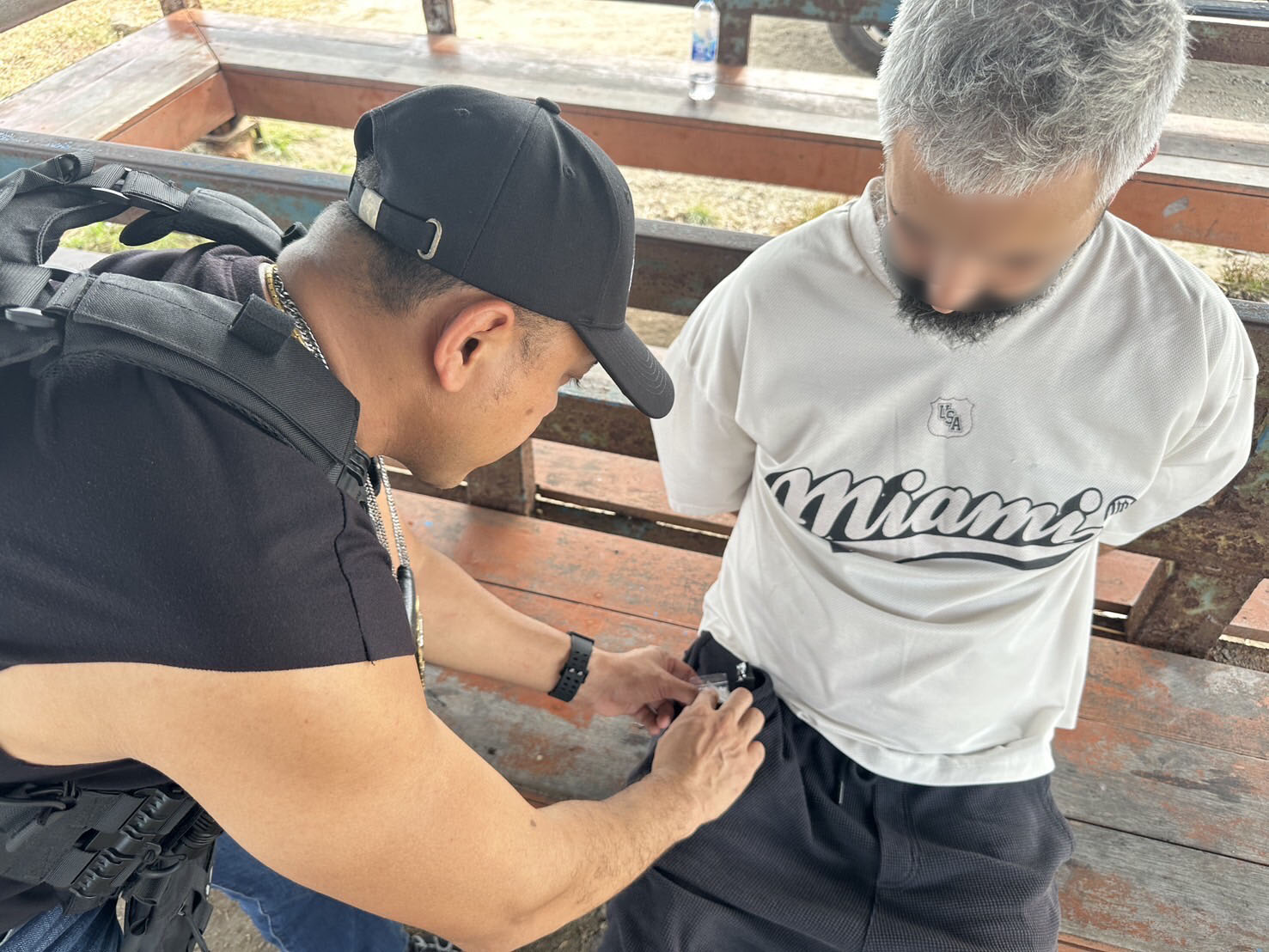
On June 7, police apprehended the Russian national at Hua Thian Pier in Tambon Ban Tai, Koh Phangan District. Despite attempting to flee when he realized he was meeting with police officers, and throwing away drug evidence, arrest team officers retrieved the discarded narcotics from nearby rocks.
Evidence seized included: 2.20 grams of cocaine, 1.12 grams of MDMA (brown tablets in zip-lock plastic bags), Ketamine, Electronic cigarettes, and 13,000 baht in cash used in the sting operation.
Vigen faces multiple drug-related charges, including possession of Category 1 and Category 2 narcotics for distribution, unauthorized sale of Category 2 narcotics (cocaine), and charges related to electronic cigarettes for concealing and selling goods that had not cleared customs procedures without authorization from customs officials.
Tourist police arrested Russian drug dealer suspect at Hua Thian Pier in Tambon Ban Tai, Koh Phangan District, Surat Thani Province on June 7, 2025.
Sophisticated AI Sales System Exposed
During interrogation, Vigen confessed to using Telegram specifically for drug transactions through an automated AI system with a step-by-step purchasing process: 1. Select drug type, 2 Choose location coordinates (Phuket, Samui, Phangan, Krabi, Bangkok, Chiang Mai, Chonburi, Pattaya), 3. Payment through digital currency systems, and 4. System sends photo and coordinates where drugs are hidden.
The suspect explained he turned to drug dealing after becoming unemployed as a party DJ, needing income to support his family. His established reputation as “DJ Vigen” on Koh Phangan and Koh Samui helped him easily find customers for drug sales.
Growing Concern Over Automated Drug Networks
This arrest has revealed to police that AI-powered automated drug sales systems represent a new method causing serious proliferation among foreign tourists visiting Koh Phangan and Koh Samui areas.
The case highlights the evolving nature of drug trafficking operations targeting Thailand’s popular tourist destinations, with dealers leveraging both technology and their social connections to expand their criminal networks.
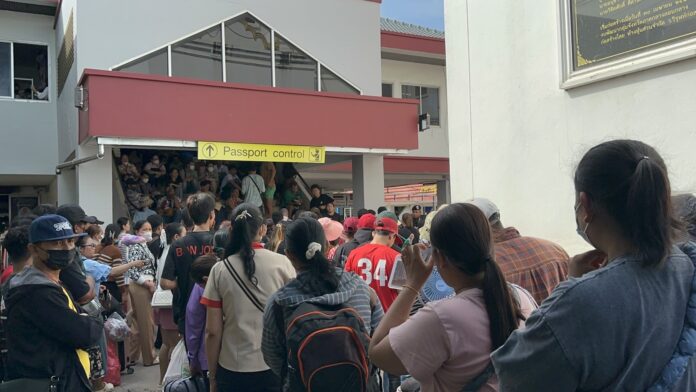
People traveling through the permanent Ban Khlong Luk checkpoint in Aranyaprathet District, Sa Kaeo Province, Thailand, experience inconvenience on the first day of new checkpoint operating hours announced by both Thai and Cambodian authorities due to tense border situations between the two countries on June 8, 2025.
I n less than two weeks, the Thai-Cambodian border conflict is already spilling out of control and, if not handled calmly, will lead to a toxic legacy that would affect Thais and Cambodians alike for a generation, if not more.
What began as a border dispute, with one Cambodian death, has now led to the Thai side choosing to shut down some border checkpoints, beginning to affect trade and cross-border movements of people between the two neighbouring nations.
Some Thais, including former yellow-shirt co-leader Sondhi Limthongkul, said on social media earlier this week that all Cambodians cannot be trusted because this negative trait is “in the DNA” of every Khmer. Even the main opposition People’s Party is calling for the use of economic measures to coerce Cambodia into bilateral talks, despite Cambodia’s call for the use of the International Court of Justice to settle the border disputes.
Thai PM Paetongtarn Shinawatra has refused to accept the jurisdiction of the ICJ, as has been the case for many decades, after Thailand perceived the ICJ, which is in The Hague, as being partial to Cambodia, a former colony of France, a Western colonial power at the time.
Just this morning, the Royal Thai Navy posted a modern rendition of a classic Cold War-era patriotic song, Sued Phan Din (The End of the Earth), which alluded to the belief that Thais cannot retreat any further as we had been doing in the face of foreign aggressors including during the time of French and British colonial conquests in the late 19th century. Such songs can stir a strong sentiment in many Thais, particularly those who grew up during the Cold War when the perceived threat of Communist takeover of Thailand, or Vietnamese invasion, was real.
When so many nationalist calls, it’s thus “understandable” that some Thais are now acting unreasonably. Some call for Thai products not to be sent to Cambodia, thinking that it is the way to punish Cambodians, while not considering that it will affect the Thai economy more, because Thailand enjoys a huge trade surplus with Cambodia.
It’s not just here in Thailand; in Cambodia, some Khmers are also fanning ethnic hatred against Thais. Former Cambodian PM Hun Sen warned on a social media post last night that Cambodians should not escalate the border dispute into racial hatred. I agree with that and I urge Thais, including people like Sondhi, who should have known better, to do the same.
On the impact on trade, Hun Sen, who is currently President of the Cambodian Senate, was quoted by the Khmer Times as saying: “Earlier, I saw that [businessman] Duong Chhay posted a message whose main content was a call to stop using Thai products. Prime Minister Hun Manet and I have already made repeated appeals: please do not escalate the dispute to the point that it spreads into other sectors and fuels ethnic hatred,” he added. “I merely wish to remind both the Cambodian and Thai people that if Thai products are absent from the Cambodian market, it is not because Cambodians have collectively chosen to boycott them. Rather, it is the consequence of a border closure—because when people are blocked, so too are goods.”
Hun Sen then went on to cite 2024 trade statistics, saying Cambodia exported more than $1.1 billion worth of goods to Thailand, while Thailand exported over $5.2 billion to Cambodia, meaning Thailand’s exports exceeded Cambodia’s by more than $4.1 billion. “In the first five months of this year alone, Cambodia exported over $200 million to Thailand, while Thailand exported over $1.5 billion to Cambodia,” he added.
Believe it or not, some Thai ultranationalists are delighted at the fact that fewer Thai products will be sold in Cambodia due to the closure of border checkpoints. Praiwan Wannabutr, a social media influencer and former monk with 4 million followers on Facebook, expressed schadenfreude at the fact that some border checkpoints are now being closed and Cambodians will have less access, or will be deprived of access, to Thai instant noodles, canned sardines, and monosodium glutamate. It is as if Cambodians were handed these goods for free. It is as if these people do not understand that substitute products from Vietnam or China are available and it will be hard for Thai goods to be sold there once Cambodian consumers switch the brands and hate Thais to the guts.
Others on social media are now calling for a purge of Cambodian migrant workers in Thailand – a very disturbing idea.
Yes, we have to settle the border disputes, but let us not unnecessarily allow the conflict to spread into the economic realm and ethnic hatred. The situation is fast getting out of control and will damage both nations and their people. It’s time for reasonable Thais and Cambodians who are patriots and not ultranationalists to try to contain the unnecessary damage and de-escalate the tensions.
It’s time for patriots, both Thais and Cambodians, to speak out and not allow ultranationalists to drag the conflict into the abyss of Thai-Cambodian relations, which will hurt our two countries and our two peoples more than absolutely necessary and take decades to mend.
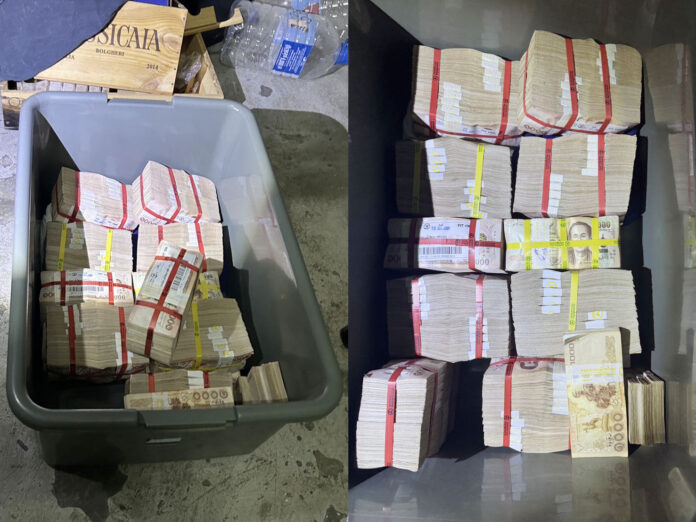
12 million baht in cash is unexpectedly discovered hidden in a plastic container dumped at a condominium garbage area in Nonthaburi province on June 6, 2025.
BANGKOK — What began as a bizarre discovery of 12 million baht ($366,000) in cash hidden in a plastic container and dumped at a condominium garbage disposal area in Nonthaburi province has escalated into a politically charged investigation amid suspicions of corruption, as the money’s owner is revealed to be the husband of a National Anti-Corruption Commission (NACC) member.
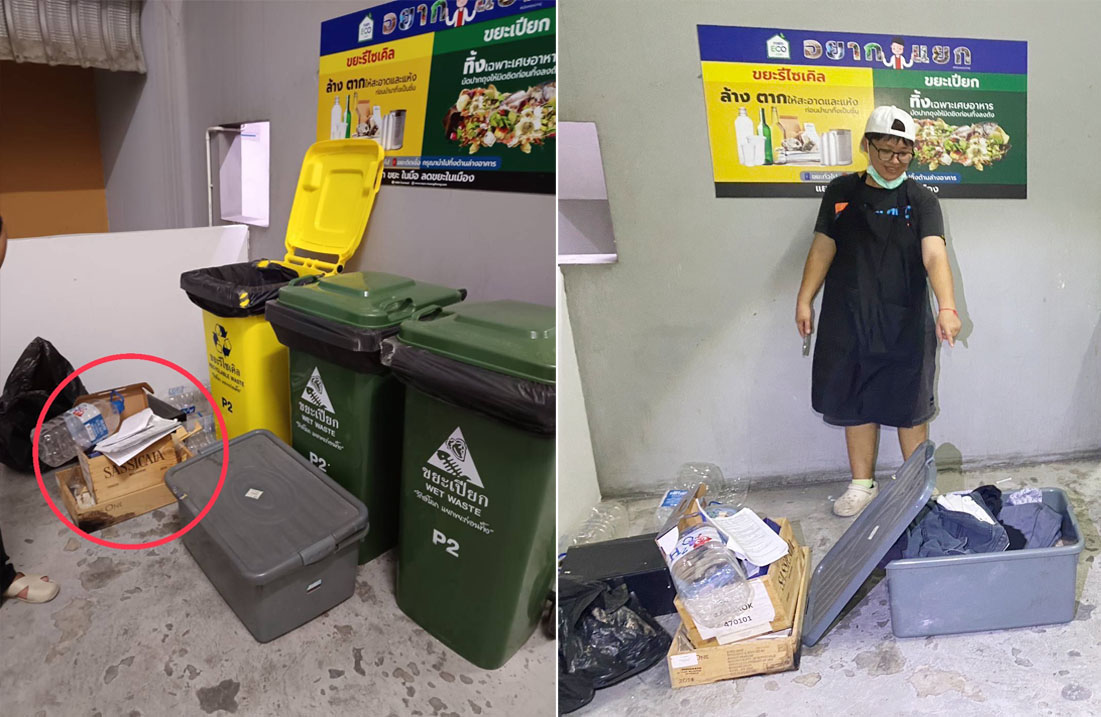
The unexpected case came to light when Ms. Usa spotted a large plastic container in good condition placed in front of garbage bins near the elevator on the 4th floor of Muang Thong Thani Condominium in Ban Mai Sub-district, Pak Kret District, Nonthaburi. Thinking the container could be reused, she opened it to find old clothes on top, but was shocked to discover thick bundles of cash underneath.
Ms. Usa called Ms. Bua, a 40-year-old scrap collector she knew, to witness the discovery due to concerns the money might be connected to criminal activity. Ms. Bua, who later became a witness in the case, said she and another friend examined the money and recorded video while opening the container before calling police.
The investigation revealed the cash totaled 12 million baht ($366,000), with tax-related documents also found beside the plastic container.
Ms. Bua, who has become a witness, poses at the scene where she inspected 12 million baht ($366,000) in cash hidden in a plastic container, with tax-related documents (left) also found dumped at a condominium garbage disposal area in Nonthaburi province on June 6, 2025.
Police investigation identified the money’s owner as Thawiwat Sengkaew, a resident of the same condominium building who lives on the 5th floor. He presented himself to Pak Kret Police Station claiming ownership of the money, explaining that recent flooding had inundated his room. He said he doesn’t regularly stay there but checks weekly, and when he returned on June 4 to find his room flooded, he hurriedly disposed of water-damaged items, mistakenly thinking the container held only unwanted clothes.
Thawiwat insisted the money came from his work as a lawyer and was withdrawn from the bank in 2020 when he intended to enter politics, but kept it in the room due to theft concerns.
However, Thawiwat’s explanation hasn’t closed the case, particularly given his background as an advisor to the National Broadcasting and Telecommunications Commission (NBTC) and husband of a director-level official at the NACC office. This has prompted an NACC investigation into whether the official properly declared assets.
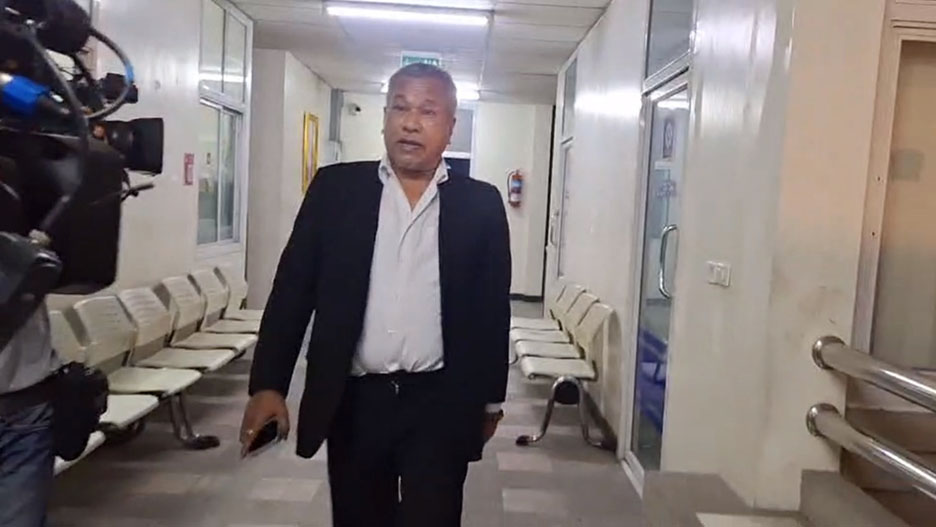
Thawiwat Sengkaew presents himself to Pak Kret Police Station in Nonthaburi Province claiming ownership of the money on June 6, 2025.
The incredible claim that someone could forget 12 million baht and accidentally throw it away has triggered an intensive police investigation. Police Colonel Kittithanet Thanantweesin, Nonthaburi Provincial Police Commander, personally questioned Thawiwat.
The Nonthaburi police chief stated that officers have seized the money pending verification of its withdrawal and owner identification, requiring money trail verification with coordination from the Anti-Money Laundering Office (AMLO) to send specialist investigators.
Regarding the flooded condominium room, building management confirmed Thawiwat’s unit was indeed flooded with supporting evidence. However, CCTV cameras on the 5th floor near Thawiwat’s room have been non-functional since April repairs were reported, and no cameras cover the 4th floor garbage disposal area near the elevator.
Authorities plan additional forensic examination of the cash bundles, focusing on the banknotes themselves and potentially testing for latent fingerprints and DNA evidence.
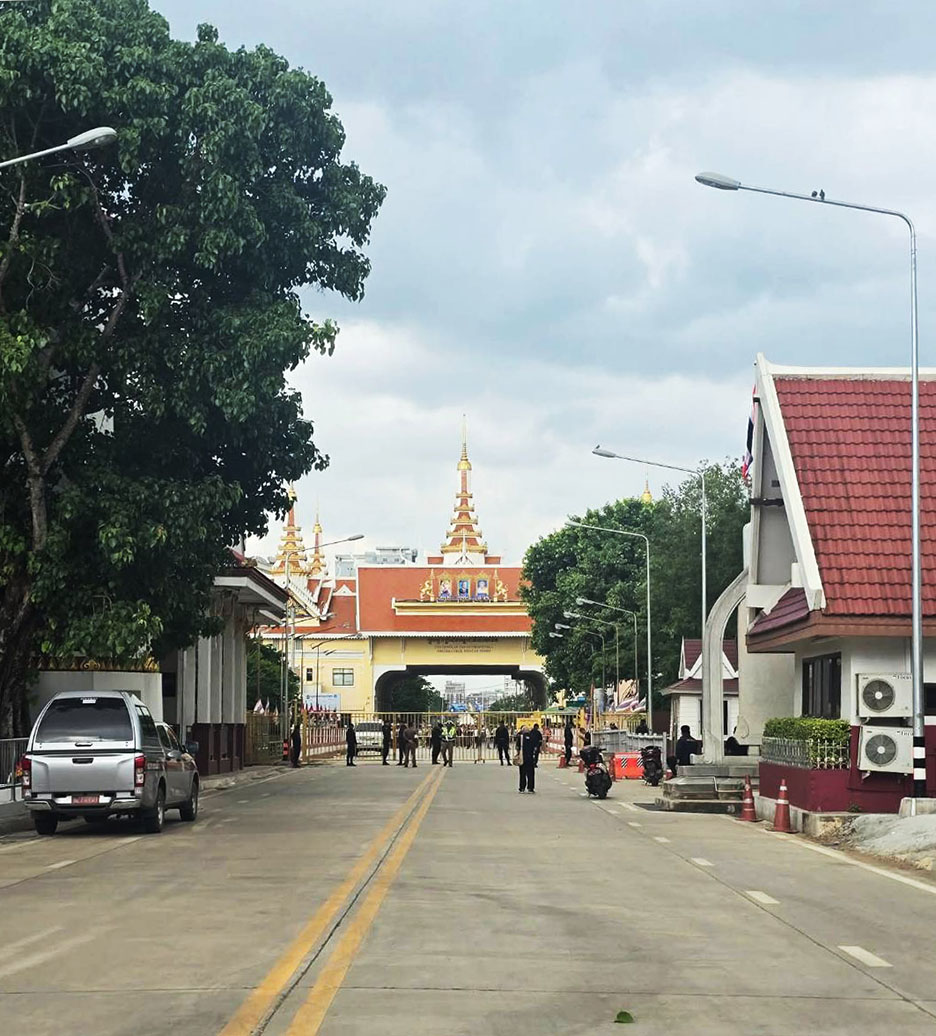
Ban Khlong Luek Permanent Border Checkpoint in Aranyaprathet District, Sa Kaeo Province, where operating hours have been reduced under new border control measures, on June 7, 2025.
BANGKOK — Thailand has implemented strict control measures at all border checkpoints along the Thai-Cambodian frontier following escalating tensions and Cambodia’s refusal to de-escalate the situation, according to official statements from both military and diplomatic sources on June 7.
The Royal Thai Army, under the command of Army Chief General Pana Klaewplodthuk, issued Order No. 806/2568 on June 7, 2025, authorizing comprehensive border control measures after what officials described as repeated Cambodian encroachments into Thai territory.
According to the Army order, Cambodian civilians and armed personnel have “repeatedly and continuously encroached into Thai territory” and undertaken provocative actions including singing the Cambodian national anthem and entering armed into clearly sovereign Thai territory, particularly in the Chong Bok area, Nam Yuen District, Ubon Ratchathani Province.
Diplomatic Efforts Rebuffed
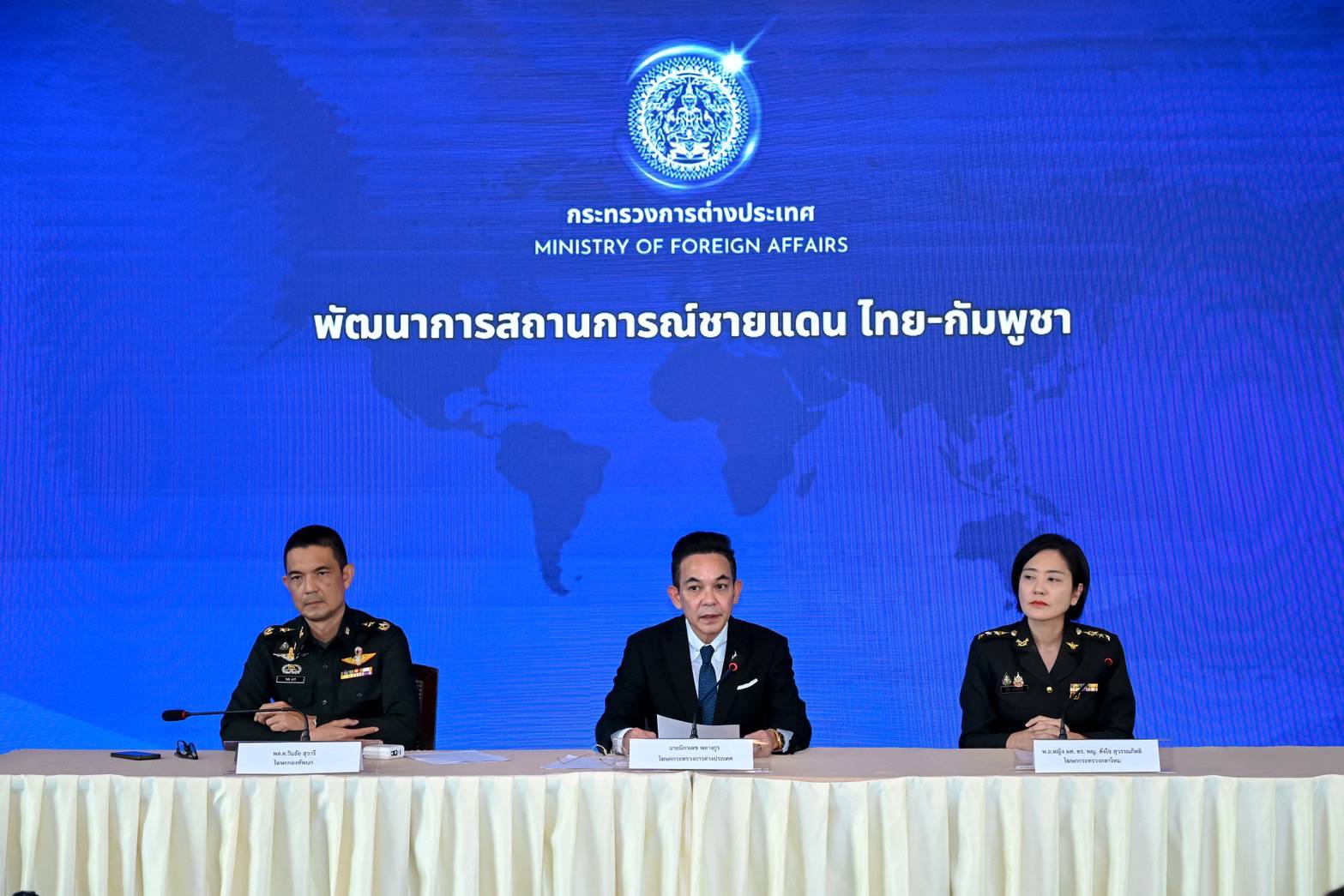
At a joint briefing at the Ministry of Foreign Affairs in Bangkok, spokesperson Nikorndej Balankura, Director-General of the Department of Information, alongside Defense Ministry and Royal Thai Army representatives, explained that the measures became necessary after Cambodia rejected Thailand’s demands to withdraw military forces to their positions prior to a brief clash on May 28.
Ministry of Foreign Affairs spokesman Nikorndej Balankura (center), alongside Defense Ministry and Royal Thai Army spokesperson, hold a press conference at the Ministry of Foreign Affairs, Bangkok on June 7, 2025.
“This reflects the lack of good intention and lack of good faith to cooperate with the Thai side in normalizing the situation,” the Foreign Ministry statement said, noting that Cambodia had not only refused to comply with the 2000 MOU between the two countries but had also reinforced its troops instead.
The Army order detailed that despite Thai forces responding “peacefully engaging in dialogue, explaining the situation, and pushing back individuals in accordance with peaceful principles while showing restraint,” Cambodian personnel “persisted in their incursions and provocative behavior openly and without cessation.”
Security Council Authorization
Following a National Security Council meeting on June 6, 2025, the Royal Thai Army was assigned to control the opening and closing of all types of border checkpoints along the Thai-Cambodian border as deemed appropriate to uphold national security.
The 1st Army Area, through the Commander of the Burapha Task Force, and the 2nd Army Area, through the Commander of the Suranaree Task Force, have been authorized to determine necessary measures, criteria, procedures, conditions, and timeframes for border crossings within their respective areas.
Different measures will be applied at various border crossing points along the frontier, in accordance with the level of tension and level of cooperation extended by the Cambodian side in resolving the issues.
Ban Khlong Luek Permanent Border Checkpoint in Aranyaprathet District, Sa Kaeo Province, where operating hours have been reduced under new border control measures, on June 7, 2025.
Balancing Security and Humanitarian Concerns
“It should be underlined that the main objective of the Thai side is to maintain safety of both Thai and Cambodian people in border areas, and to maintain peace and order along the Thai-Cambodian border,” The Foreign Ministry spokesman emphasized. “The Thai side will take into consideration the necessary care to ensure that any measures will not impact trade, livelihood and the wellbeing of people from both sides, including the humanitarian dimension.”
The Army order specifically requires commanders to “consider the needs of trade and the daily lives of the local populations of both countries” while maintaining the authority to close or open border checkpoints when necessary to protect Thai sovereignty, territorial integrity, and citizen safety.
Treaty Violations Cited
Thai officials accused Cambodia of violating the Treaty of Amity and Cooperation in Southeast Asia, signed on February 24, 1976, which underpins peaceful coexistence among ASEAN members. The Army order stated that Cambodia’s military buildup and construction of fortifications “clearly indicate a lack of cooperation with Thailand’s peaceful intentions.”
“These provocations, and the build-up of military forces, indicate a clear intent to use force. This is unacceptable and poses a serious threat to Thailand’s sovereignty, national security, and territorial integrity,” the order stated.
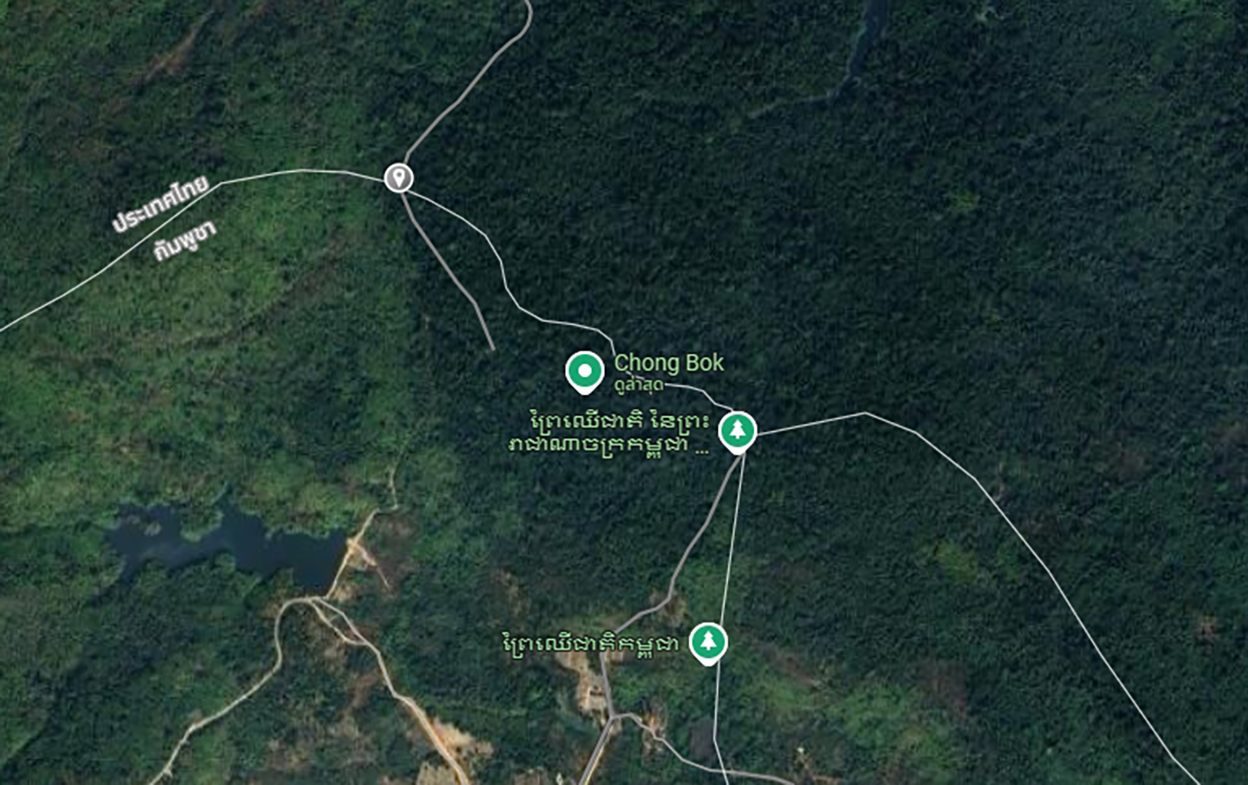
Map showing Chong-bok, the site of brief cross-border gunfire between Thai and Cambodian soldiers on May 28, 2025.
Specific Border Control Measures Implemented
Later at 7:10 PM, Police General Benjapol Dechatiwong Na Ayudhya, Commander of the Burapha Task Force, issued an urgent letter to the Sa Kaeo Provincial Governor regarding control measures for permanent border checkpoints and trade relaxation points in the Sa Kaeo border area, with attached Army orders and operational guidelines for relevant security agencies as follows:
1. Ban Khlong Luek Permanent Border Checkpoint, Aranyaprathet District
Operating hours adjusted from the normal Sa Kaeo Immigration schedule of 6:00 AM-10:00 PM to 8:00 AM-4:00 PM
Thai nationals traveling for gambling and tourism are prohibited from exiting the country
Cambodian traders may cross with valid passports or Border Pass only, with validity reduced from 14 days to 7 days as determined by Sa Kaeo Immigration
Humanitarian medical transfers permitted only with approval from the Thai-Cambodian Border Coordination Office, 1st Army Area Operations Center
Thai nationals working or trading in Cambodia may exit with passports or Border Pass validity reduced from 14 days to 7 days
Trucks with 6 wheels or more prohibited; must use Thai-Cambodian Friendship Bridge checkpoint only
Operating hours adjusted from normal 6:00 AM-6:00 PM to 8:00 AM-4:00 PM
Trucks with 6 wheels or more prohibited; must use Thai-Cambodian Friendship Bridge checkpoint only
3. Ban Khao Din Permanent Border Checkpoint, Khlong Hat District
Operating hours adjusted from normal 6:00 AM-6:00 PM to 8:00 AM-4:00 PM
Thai nationals traveling for gambling and tourism prohibited from exiting
Cambodian traders may cross with valid passports or Border Pass only, validity reduced from 14 days to 7 days
Humanitarian medical transfers permitted only with approval from Thai-Cambodian Border Coordination Office
Thai workers and traders may exit with passport/Border Pass validity reduced to 7 days
Trucks with 6 wheels or more must use Friendship Bridge checkpoint only
4. Ban Ta Phraya Trade Relaxation Point, Ta Phraya District
Operating hours: 8:00 AM-12:00 PM
Normal border crossings with enhanced screening; military personnel have discretion to allow or deny passage
Large trucks prohibited; must use Friendship Bridge checkpoint
5. Ban Nong Prue Trade Relaxation Point, Aranyaprathet District
Operating hours: 8:00 AM-12:00 PM
Normal border crossings with enhanced screening; military discretion applies
Large trucks prohibited; must use Friendship Bridge checkpoint
All measures are to be strictly implemented effective June 7, 2025.
Call for De-escalation
Despite implementing the border measures, Thailand continues to call on Cambodia to reduce tension levels to prevent unnecessary escalation. The Foreign Ministry spokesman said Thailand remains ready to use bilateral mechanisms, particularly the Joint Border Committee (JBC) meeting scheduled for June 14, and other mechanisms based on mutual respect and sincerity.
“Thailand remains committed to peaceful coexistence and seeks to reduce tensions through reasoned negotiation, while ensuring that citizens of both nations do not suffer unduly from the current tensions,” the Army order concluded.
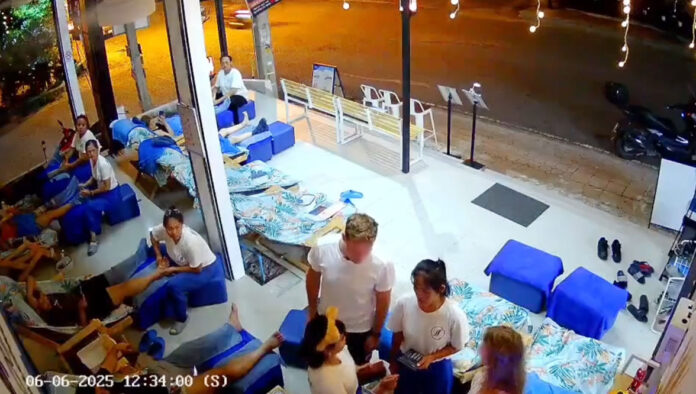
CCTV screenshot shows Russian couple negotiating massage payment at the counter of a Pattaya massage parlor before fleeing on their motorcycle without paying on June 6, 2025.
PATTAYA — A massage parlor employee in Pattaya has filed a police complaint against a Russian couple who allegedly fled without paying for services in the early hours of June 6.
Ms. Anyamanee Thantim, 48, an employee at Smooth Day Thai Massage located in Soi Phra Tamnak 5, Nong Prue subdistrict, Bang Lamung district, Chonburi province, reported the incident to investigators at Pattaya City Police Station, Khong Dong Tan branch on June 7. She provided CCTV footage as evidence to pursue legal action against the Russian tourists.
According to Ms. Anyamanee’s account, the Russian couple, aged approximately 30-40 years old and well-dressed like typical tourists, entered the establishment requesting traditional Thai massage services. The pair specifically asked for a “full course” massage package, which the parlor was prepared to provide, and staff members were assigned according to the customers’ preferences.
Smooth Day Thai Massage is located in Soi Phra Tamnak 5, Nong Prue subdistrict, Bang Lamung district, Chonburi province.
After the massage session was completed, staff informed the couple of the service charges. The Russian tourists then began showing reluctance to pay, prompting the establishment to explain that different massage packages carried different prices. When the couple expressed dissatisfaction with the rates, the parlor offered a compromise by charging them the basic package rate of 350 baht per person per hour to avoid confrontation.
The couple agreed to pay via bank transfer and showed what appeared to be a payment slip to the staff. However, when the parlor checked their account, no money had been received. By this time, the couple had already rushed to their black automatic motorcycle and sped away, ignoring staff requests to wait for verification.
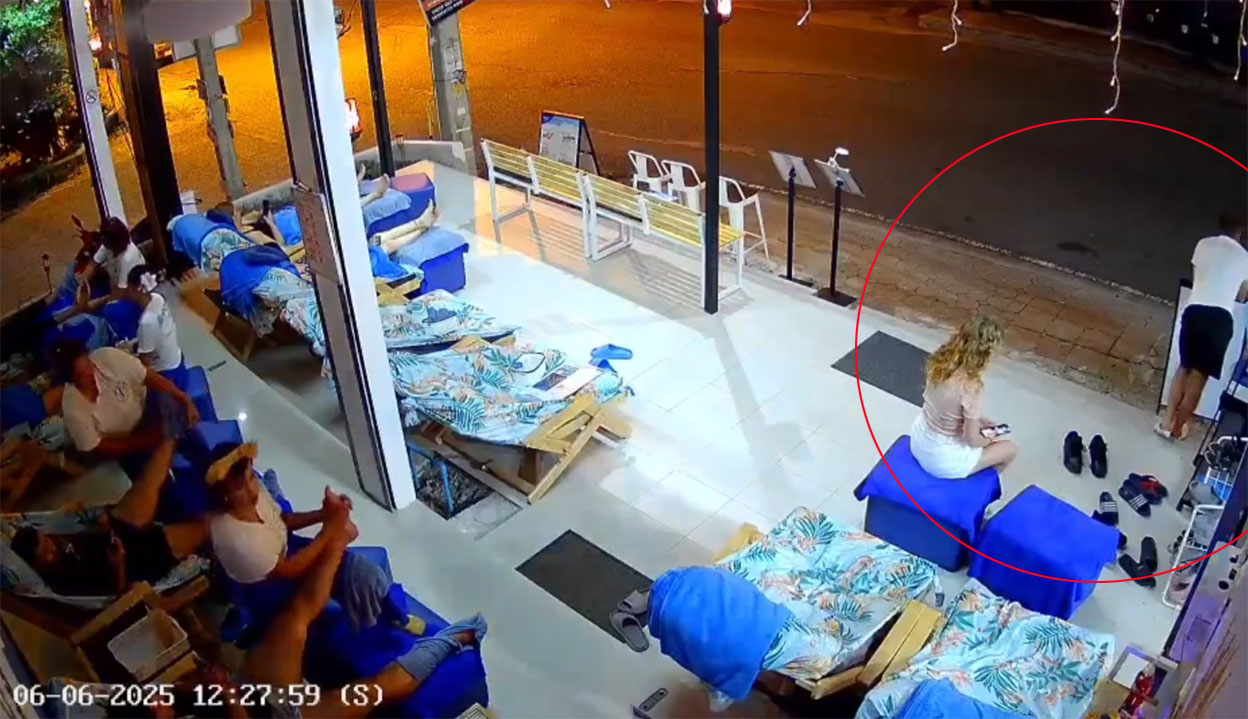
CCTV screenshot shows Russian couple after completing their massage at a Pattaya massage parlor before fleeing on their motorcycle without paying on June 6, 2025.
Ms. Anyamanee stated that CCTV cameras clearly captured the incident, showing the Russian nationals fleeing on their black automatic motorcycle. The establishment has posted the footage on social media and shared it with local news outlets as a warning to other business operators to exercise caution.
The incident comes during a particularly challenging period for local businesses, as the economy remains sluggish and the area is experiencing low tourist season. Ms. Anyamanee emphasized that falling victim to such incidents during these difficult times causes significant hardship for small business owners.
The case remains under investigation by Pattaya police authorities.
The figure of a hand is marked with blood on the wall of a bomb shelter located in the Thai workers' housing section of Kibbutz Nir Oz, Israel, near the Gaza Strip, Thursday, Nov. 9, 2023. The kibbutz was attacked on Oct. 7 by Hamas militants, who killed and kidnapped members of its community. (AP Photo/Bernat Armangue)
TEL AVIV, Israel (AP) — Israel says it has retrieved the body of a Thai hostage kidnapped into Gaza on Oct. 7, 2023.
The Prime Minister’s office said Saturday that the body of Thai citizen Nattapong Pinta was returned to Israel in a special military operation.
Pinta was kidnapped from Kibbutz Nir Oz and killed in captivity near the start of the war, said the government. Thais were the largest group of foreigners held captive by Hamas militants.
This comes two days after the bodies of two Israeli-American hostages were retrieved.
Fifty-five hostages remain in Gaza, of whom Israel says more than half are dead.
The defense minister said Saturday that Pinta’s body was retrieved from the Rafah area. He had come to Israel from Thailand to work in agriculture.
A statement from the hostage forum, which supports the hostages, said it stands with Pinta’s family and shares in their grief. It called on the country’s decision makers to bring home the remaining hostages and give those who have died a proper burial.
This undated photo provided by the Hostage’s Family Forum shows Nattapong Pinta, with his wife and son. (Hostage’s Family Forum via AP)
Thais were the largest group of foreigners held captive by Hamas militants. Many of the Thai agricultural workers lived in compounds on the outskirts of southern Israeli kibbutzim and towns, and Hamas militants overran those places first. A total of 46 Thais have been killed during the conflict, according to Thailand’s Ministry of Foreign Affairs.
The retrieval of Pinta’s body comes as Israel continues its military campaign across Gaza. Hospital officials said they received the bodies of nearly two dozen people Saturday.
One strike hit an apartment killing seven people including a mother and five children. Their bodies were taken to Shifa hospital.
Israel said Saturday that it’s responding to Hamas’ “barbaric attacks” and is dismantling its capabilities. It said it follows international law and takes all feasible precautions to mitigate civilian harm.
A combination photo from Sri Racha Tiger Zoo in Chonburi Province. Left: Screenshot from the viral video showing a tourist walking with a tiger before being pounced on. Right: Promotional image of tiger walking activities from Tiger Topia Zoo's FB page before the Department of National Parks ordered the activity's cancellation.
BANGKOK — Following viral videos showing a shocking incident where a tiger pounced on an Indian tourist during a photo session at a Tiger Park in Thailand, which was widely reported by Indian media, Thailand’s Department of National Parks has now ordered the tiger park to ban its tiger walking activities.
The viral clip that circulated online was initially reported to have occurred in Phuket Province, prompting Tiger Park and Tiger Kingdom Phuket to issue statements clarifying that the incident did not occur at their facilities. They have outlined their comprehensive safety protocols and animal welfare policies in response to the confusion.
On June 6, Attapon Charoenchansa, Director-General of the Department of National Parks, Wildlife and Plant Conservation, provided details that the incident actually occurred at a tiger zoo in Sri Racha District, Chonburi Province, on May 26. He ordered department officials to inspect the area following the incident, beginning May 31.
🚨🇮🇳An Indian tourist was viciously attacked by a tiger he tried to take a photo with. pic.twitter.com/O29mfV8lej
The facility is operated by Sri Racha Crocodile Farm and Products Co., Ltd., which holds proper operating permits valid until May 26, 2028.
During the inspection, officials found that the zoo was operating normally for tourists. The incident occurred at an area called “Mini Tiger Topia,” where tourists can experience close encounters with tigers in a simulated natural forest environment through tiger walking activities.
According to staff interviews, a group of three Indian tourists visited together. One of them participated in the tiger walking activity, which was nearing its end when the tourist wanted to take photos. The tiger handler instructed the tourist to sit down for photos, but while sitting, the tourist embraced the tiger’s back, petted its head, and played with the animal.
This caused the tiger to turn and look at the tourist. The handler used a baton and pulled the chain to redirect the tiger’s attention forward, but this startled the tiger, causing it to pounce on the tourist. All tiger handlers then worked to separate the tiger from the tourist.
Screenshots from viral videos show a violent incident between a tiger and an Indian tourist that appears to have happened in Thailand.
The entire incident lasted only 5-6 seconds. Staff immediately transported the tourist to Phyathai Hospital’s emergency department, where he stayed overnight with minor leg injuries resembling dog bites.
He then returned to India, with the tiger zoo covering all medical expenses and flight costs totaling 202,046 baht ($6,175), broken down as follows: medical treatment (126,546 baht), return flights for three people to India (30,000 baht), and ongoing medical care in India including wound cleaning and vaccinations (45,500 baht).
The Department of National Parks has ordered the tiger zoo to cancel such activities and enhance safety equipment for both tourists and staff, including electric batons. The facility must also install additional warning signs and provide detailed explanations to ensure tourist safety, while increasing the number of tiger handlers to prevent inappropriate behavior.
Tiger parks in Thailand often face opposition from animal rights groups, including WWF Thailand, which disagrees with the captivity, breeding, or use of wild animals in unnatural activities.
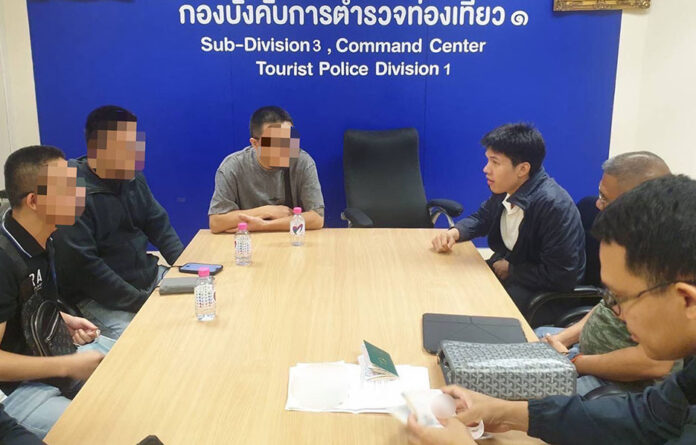
Police officers interrogate three Taiwanese suspects in the scam case at Tourist Police Division 1 on June 3, 2025.
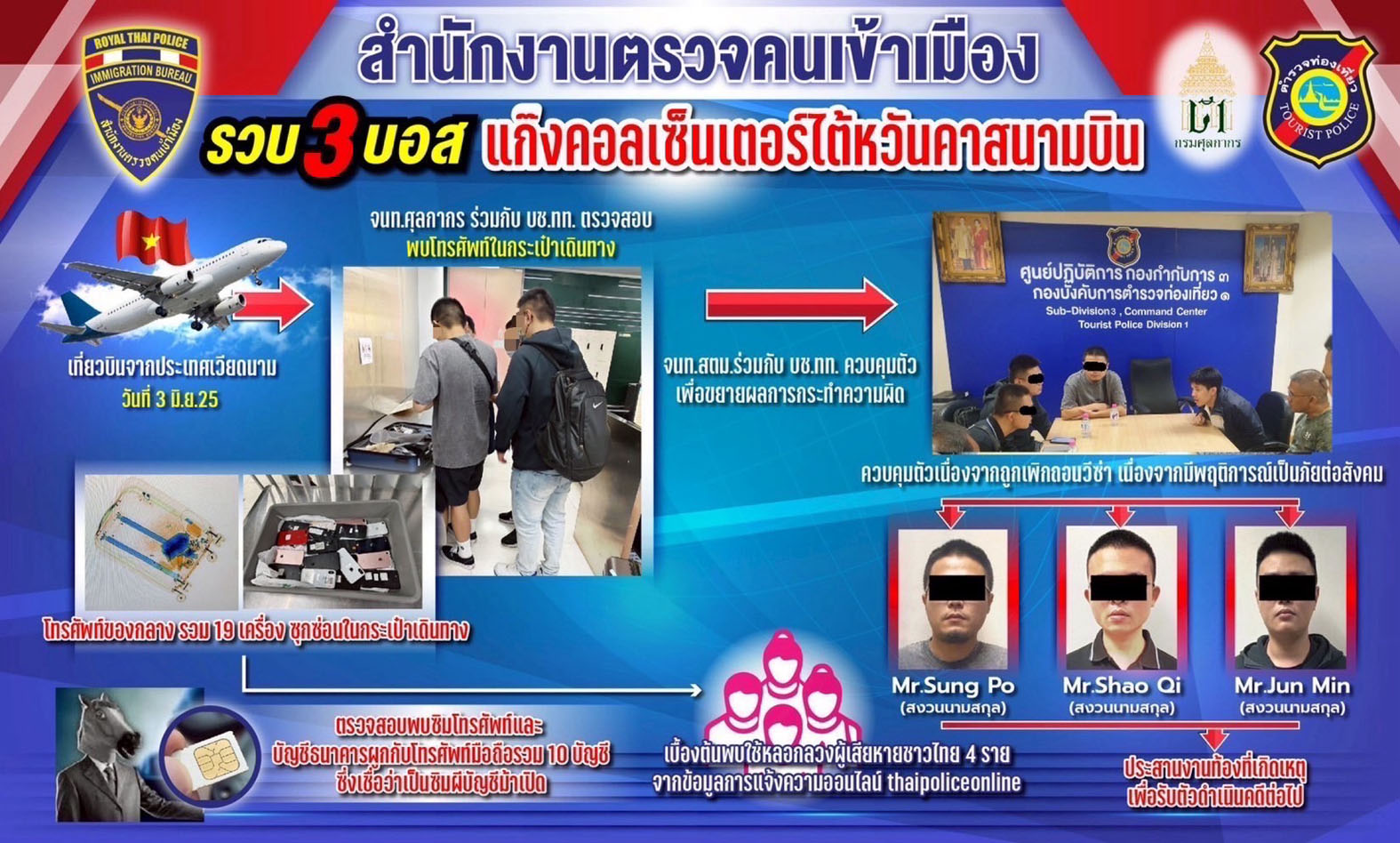
BANGKOK — The recent arrests of foreign suspects who fled to Thailand involve both Chinese and Taiwanese nationals. In the first case, the Chinese authorities requested the Thai authorities to arrest and extradite a suspect. In the second case, three Taiwanese nationals came under suspicion after being caught with 19 mobile phones.
Pol. Maj. Gen. Phanthana Nuchanart, deputy commissioner of the Immigration Department, held a press conference at the Immigration Department on 5 June where he explained both cases in detail.
Chinese Suspect Wanted for $47.2M Fraud
The first suspect is a 55-year-old Chinese citizen named Dong, against whom an arrest warrant was issued on 19 May 2025 for illegally obtaining public funds.
The Embassy of the People’s Republic of China in Thailand had sent an official letter to the Thai Ministry of Foreign Affairs requesting assistance in the arrest and extradition of Mr Dong. He is also on an Interpol Red Notice.
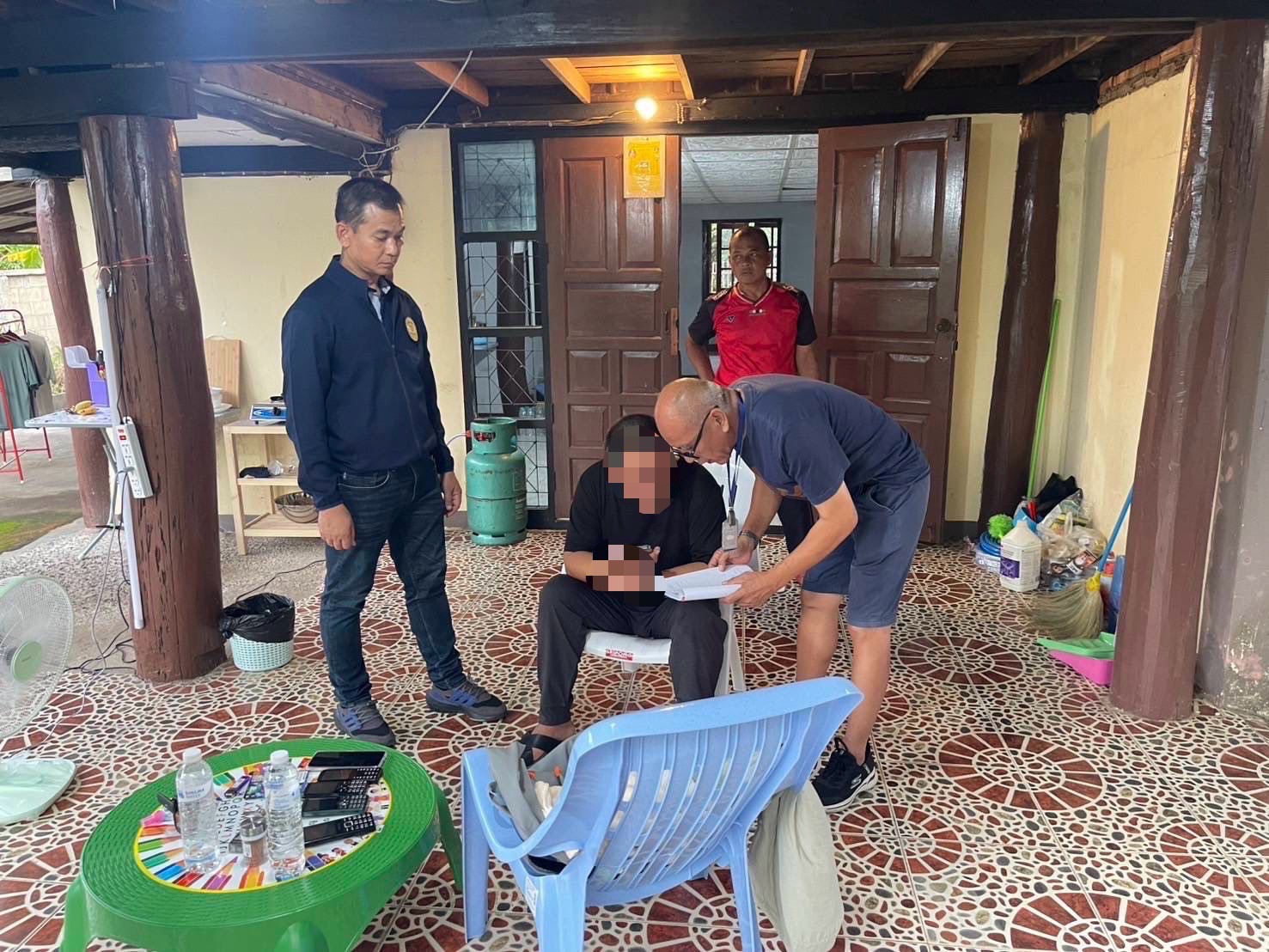
Immigration Police officers arrest a 55-year-old Chinese suspect, who is also on an Interpol Red Notice, at his residence in Li District, Lamphun Province.
Mr Dong is accused of defrauding 878 victims in China with a fake product distribution company. He promised returns of 2% per month and a doubling of investments in two years. The total loss is estimated at 339 million yuan (about 1.542 billion baht or USD 47.2 million).
Dong fled to Thailand and initially stayed in the province of Chachoengsao. When he realised he was under surveillance, he moved to a house in Moo 14, Li Subdistrict, Li District, Lamphun Province. The authorities finally arrested him when he was walking near his residence. He refused to make a statement. The authorities have handed him over to the Chief Public Prosecutor’s Office for extradition.
Suspicious Taiwanese Trio Caught with 19 Phones
In the second case, immigration authorities were informed on 3 June by customs officers at Suvarnabhumi Airport and the Tourist Police about three Taiwanese nationals who had entered the country from Vietnam and attempted to smuggle 19 mobile phones into Thailand for scam operations.
Initial investigations revealed that the phones were already registered with SIM cards and linked to bank accounts, which were then used to defraud Thai victims. These accounts matched four suspect profiles linked to online fraud reports via the Thai police online system in both major cities and regions (Region 6).
Multiple mobile phones belonging to three Taiwanese suspects seized for investigation at Suvarnabhumi Airport on June 3, 2025.Immigration Police chart showing investigation routes and arrests of three Taiwanese suspects who scammed victims across Bangkok and other major cities, displayed at a press conference on June 5, 2025.
The group’s tactics included fake online sales, top-up fraud and currency exchange scams. Victims were tricked into transferring money without ever receiving goods or services. According to the authorities, the scam caused hundreds of thousands of baht worth of damage in several provinces.
Database checks confirmed that this was the trio’s first entry into Thailand. Further investigations revealed that all three had criminal records in Taiwan for money laundering and illegal gambling.
As their activities posed a threat to society, the Thai authorities revoked their permission to stay in the country. They were handed over to investigators from the Third Investigation Division of the Immigration Bureau for prosecution. Authorities are working with local police to pursue the charges and expand the investigation to uncover further financial links to other suspects.