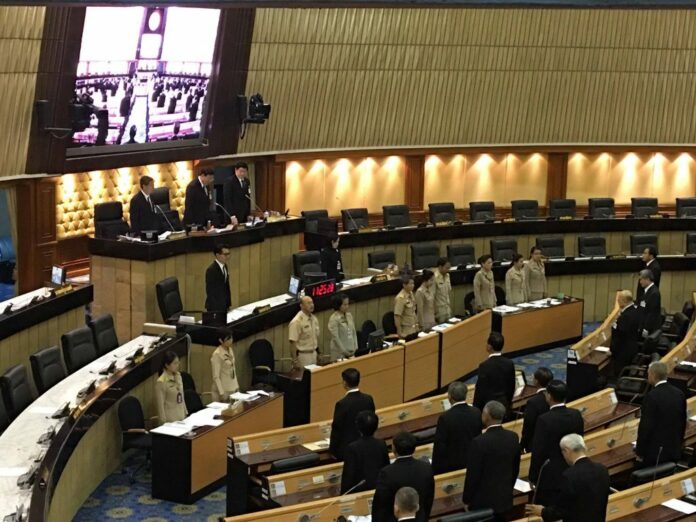
BANGKOK — The House of Parliament will close its doors for good New Year’s Eve as part of a plan to relocate the legislative seat of power to a new riverside location, an official said Wednesday.
Staff are scheduled to clear the 44-year-old building of any belongings by Dec. 26, deputy house speaker Surachai Liengboonlertchai told reporters. A farewell party will also be held that day, Suracha said.
The new parliament building – a massive complex designed to resemble a temple – is being constructed in Kiak Kai, a neighborhood that also houses many military facilities. The project, approved back in 2008, has cost about 23 billion baht.
Surachai said construction is expected to finish by June 2019, and lawmakers are currently planning to rent conference halls for sessions to be held after the current building shutters. He named the United Nations building and Thammasat University auditorium as possible options.
The parliament website lists no further sessions to be held in its final weeks.
The parliament in Dusit district opened in 1974 as Thailand’s second legislative assembly building. Parliament meetings were previously held in Ananta Samakhom Throne Hall and, very briefly, at the Royal Turf Club Racecourse.
Future plans for the location of the old building have yet to be announced.
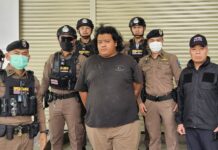
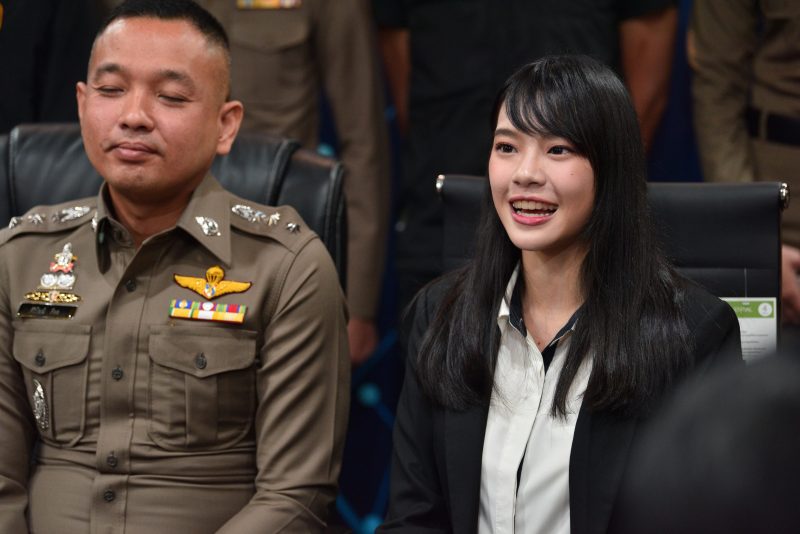
Cherprang Areekul at the Technology Crime Suppression Division on Tuesday.
BANGKOK —One of the kingdom’s top pop singers filed a police complaint Tuesday against whoever digitally inserted a sex toy into a photo of her posted on social media.
Cherprang Areekul, frontwoman of superstar idol group BNK48, went to the Technology Crime Suppression Division with a representative from her music label BNK48 Office to report the Facebook page that posted the photoshopped image.
“Thanks to my fan club for always alerting me and encouraging me. As for the people who are photoshopping me obscenely, I want to say that this kind of action really shows what kind of conscience you have. So I want you to stop,” she said.
Cherprang, 22, said it wasn’t the first time trolls photoshopped her and her bandmates into sexually suggestive or obscene images, but it was becoming increasingly frequent.
The page that posted the doctored image has also posted images of her fellow band members, some minors as young as 14, with digitally enhanced breasts and in suggestive poses.
Police Col. Siriwat Deepor said that police would investigate as spreading doctored images is illegal under the Computer Crime Act. He said the page’s owner could be punished by up to three years in jail and fined 200,000 baht. Those commenting in a “damaging” way, he added, are also liable for prosecution.
Similar to how ex-Prime Minister Yingluck Shinawatra was insulted as a “stupid bitch,” “slut” or “whore,” some in the pro-democracy camp have taken to calling Cherprang a “cunt cliff” (hew hee) for, by their logic, making men “fall.” The episode continues to pit those who remain fans against those who condemn her as a collaborator.
“So her fans are saying she went to report it to protect her Women’s Rights? Wow, I’m rolling my eyes at your 48 group system and the dildo. How feminist you are!” activist Pipat Wattanapanit wrote on Facebook. “She must have a lot of photoshopped photos of her, so what is she going to do, report every page? I guess the dildo effect is really strong.”
“A whitewashing singer is reporting someone who photoshopped her obscenely. She can’t take it that she’s been violated. But I’m being violated by the NCPO, which the whitewashing singer is supporting,” wrote exiled academic Pavin Chachavalpongpun, referring to the ruling junta by its acronym. “What a fake society!”
Founded in 2017, BNK48 is the sister group of Japanese idol band AKB48. It’s managed by a company owned by Rose Artist Management, a private Chinese investor and AKB48’s parent company. The company lost 22.3 million baht in 2017, according to Isranews.
Plan B Media bought a portion of shares this year, and a joint venture production company was launched in June with Workpoint Entertainment.
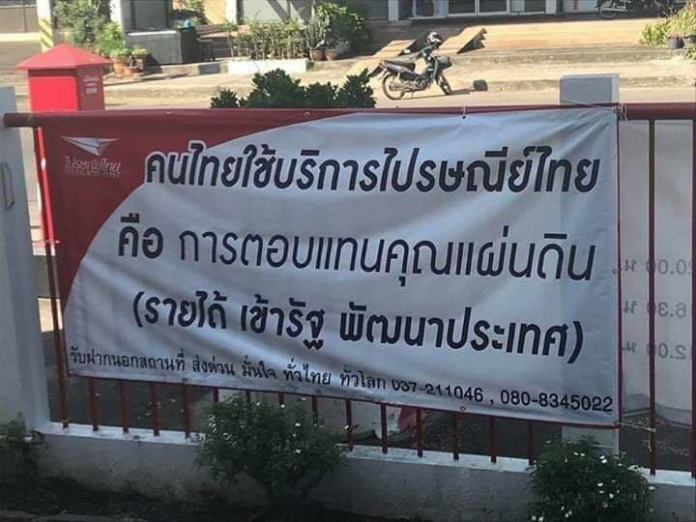
BANGKOK — In the face of growing competition from private courier companies Kerry and Lalamove, the official post service unveiled a new marketing message evoking patriotism.
“Using Thailand Post service is showing gratitude to the country (Revenues go to the state to develop the nation),” the agency declared in a Tuesday banner which was quickly ridiculed on the internet.
The message drew salty criticism from netizens who say they are fed up with Thailand Post’s track record of delays, mishaps and even occasional damaged parcels.
A few of the many responses included:
“I sent a package to Phuket. It ended up in Lampang and Nakhon Pathom,” Praphan Changklom wrote in a reply to the photo.
“When is Thailand Post improving its quality of services to match the private companies in terms of speed and safety of packages?” Chanyaphat Surakkhaka said.
“The Kerry package in my hand is shaking!” Kornravitch Tampetch wrote in another thread.
“Paying the staff to vandalize my mail packages is showing gratitude to the country?” Pison Rukjinda fired off.
“Revenues to the state so that the state can buy watches and submarines?” Alicee Cnx mocked.
Thailand Post, a state enterprise, is still reeling from a recent controversy in which a passer-by discovered undelivered mail including dozens of packages abandoned in a wooded area in northern metro Bangkok.
After the news invoked internet fury, the service admitted the items were left there by a mailman who would be subject to discipline.
In September, a woman in Chonburi complained to the media that boxes of chocolate mailed by her Canadian husband were opened and damaged by Thailand Post staff, who reportedly refused to pay compensation.
Low Taek Jho during the 2014 "Social Good Summit" in New York City. Image: Jynwel Foundation / YouTube
KUALA LUMPUR — Malaysian police said Wednesday that they have filed new criminal charges against fugitive financier Low Taek Jho and four others over the multibillion-dollar looting of state investment fund 1MDB.
Low is wanted for his alleged role as the mastermind in a massive money laundering and bribery scheme that pilfered billions of dollars from the indebted 1MDB fund. He remains at large but maintains his innocence. Malaysian authorities charged Low and his father for money laundering in August. Last month, U.S. prosecutors charged Low and two former Goldman Sachs bankers with conspiracy to launder 1MDB money.
Malaysian police chief Mohamad Fuzi Harun said Low and four others, mostly former 1MDB employees, were charged Tuesday with 13 new money laundering and criminal breach of trust offenses involving losses of USD$1.17 billion of 1MDB funds.
He said Wednesday that arrest warrants have been issued for the five, who had fled Malaysia. If they are found in any country, the government will request their extradition so they can be brought back to Malaysia to face charges in court, Fuzi said in a statement.
Former Prime Minister Najib Razak started the 1MDB fund when he took power in 2009 to promote economic development but it accumulated billions in debts, and is being investigated in the U.S. and several other countries. Anger over the huge scale of the scandal led to the shocking election ouster of Najib’s coalition, and ushered in the first change of power since the country’s independence from Britain in 1957.
The new government reopened the probe into 1MDB that was stifled under Najib’s rule. Najib and his wife have been charged with multiple counts of corruption over the scandal and slammed the charges as political vengeance. His lawyer, his former deputy, two ex-senior government officials and a former chief state minister have also been charged with graft.
Fuzi said Low, 36, was charged with five counts of money laundering involving transfers totaling $1.03 billion into a Swiss bank account between September 2009 and October 2011. Low and his aide, Eric Tan Kim Loong, face two more money laundering charges for receiving $126 million in a Singapore-based bank account, he said.
1MDB’s former lawyer Jasmine Loo Ai Swan, its ex-business development director Casey Tang Keng Chee and former finance director Terence Geh Choh Heng were also charged.
A spokesman for Low, in a statement issued through his lawyers, slammed the fresh charges against him as a “continuation of the trial by media and political reprisals” by Malaysia’s new government.
“Mr. Low maintains his innocence. As has been previously stated, Mr. Low will not submit to any jurisdiction where guilt has been predetermined by politics and there is no independent legal process,” the statement said, alleging that Low cannot get a fair trial in Malaysia.
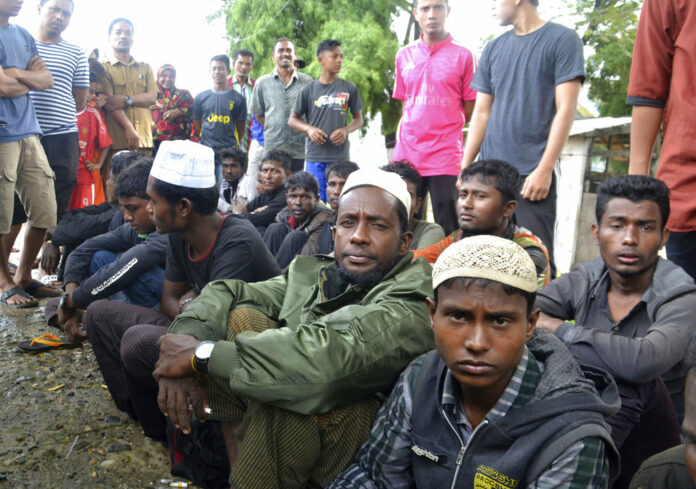
Rohingya men who were rescued by local fishermen sit on the ground Tuesday in Kuala Idi, Aceh province. Photo: Iskandar Ishak / Associated Press
KUALA IDI, Indonesia — Indonesian fishermen rescued a wooden boat carrying 20 hungry, weak Rohingya Muslims on Tuesday after it was found adrift off Indonesia’s northernmost province of Aceh, an official said.
The group of men and boys was discovered on the rickety boat about 3 kilometers off the coast, said Syahrial, the head of East Aceh’s local disaster mitigation office.
Syahrial, who goes by a single name, said it wasn’t clear where the group had traveled from or where they were heading.
An outbreak of violence that began in 2012 prompted thousands of Rohingya to flee Myanmar by sea to Thailand, Malaysia and Indonesia. A fresh crisis last year sent hundreds of thousands of Rohingya fleeing by land to Bangladesh.
The people who were found Tuesday were brought ashore and placed in a navy shelter house in the Kuala Idi fishing port of East Aceh district while awaiting identification by Indonesian immigration officials.
The group, ranging in age from 14 to 28, were weak from hunger and dehydration after a 15-day voyage, Syahrial said, adding that villagers donated clothes, food and drinking water.
“We could not yet communicate much with them as none of them speak English or Malay,” Syahrial said.
Some 300 Rohingya are still being sheltered in Aceh. Indonesia, the world’s most populous Muslim-majority nation, is a strong supporter of the Rohingya cause.
Teh Deryin holds up a patch of nasi lemak and mango sticky rice.
Photos by Siri Thaitrakulpanich
The first things that flash in the minds of Thais when asked about cute crafts are those from East Asia or the West — Japanese character merch, Korean clothes, flashy American bath products. When it comes to Malaysia, most are likely to think of the food – nasi dagang and the like – but not things that give one the fuzzies and elicit an “Awww.”
But Salang Designs, a craft shop run by three 24-year-olds, is changing some minds through the power of shared cultural references and adorable iron-on patches.
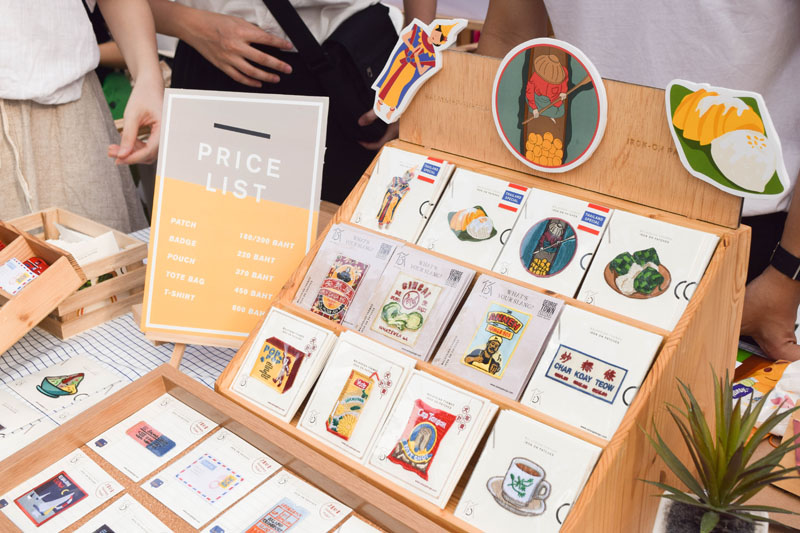
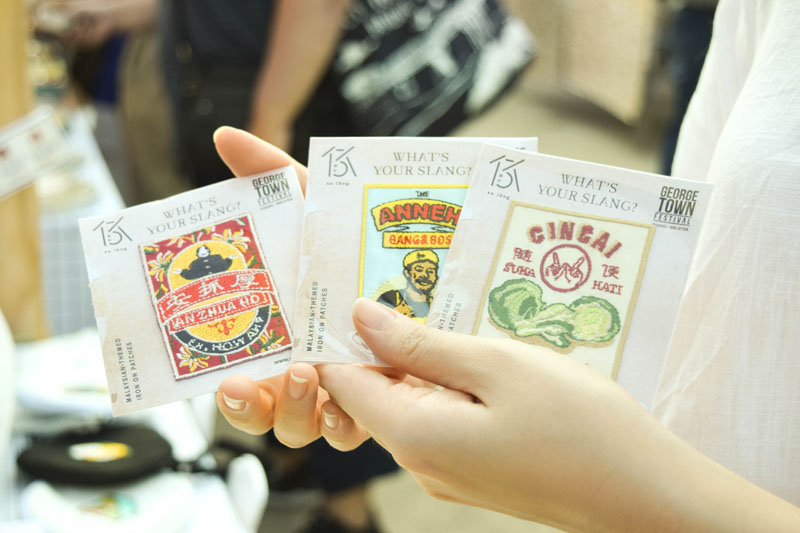
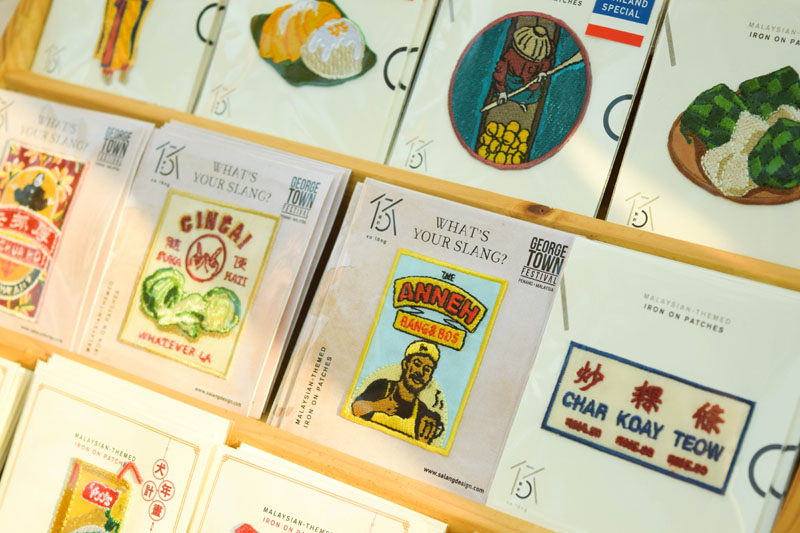
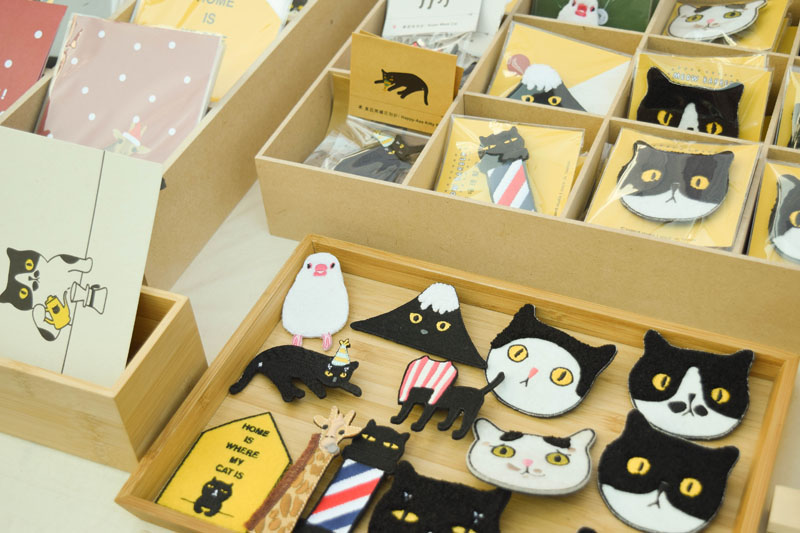
Salang Design patches of Malaysian food items include a bread bag fastener, kopi, nasi lemak, a peanut brand, char koay teow, xiao long bao, Anglia beer, ice cream, laksa and ice kacang.
A cup of kopi. A bowl of shaved ice kacang. A mamak stall waiter. Cultural images of Malaysia are condensed into iron-on patches that present the quotidian side of Thailand’s peninsular ASEAN neighbor.
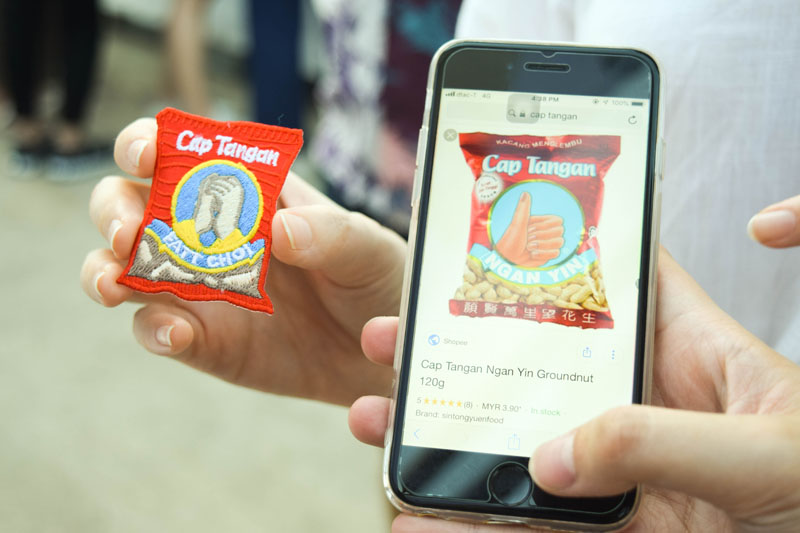
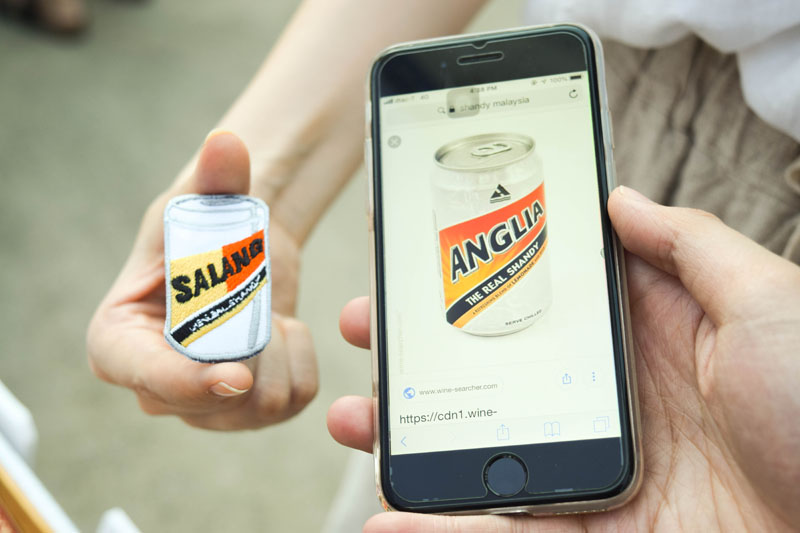
“Do you know what this is?” designer Teh Deryin asks a customer looking at a patch resembling a brand of peanuts sold in Malaysia called Ngan Yin. She displays a photo of the real thing on her phone so a customer can compare.
A Salang Design resembling a Ngan Yin package of nuts.
Schoolmates Teh Deryin, Chia Jiun Pheng and Tan Wei How, all 24 and owners of Salang Design (“three people” in Hokkien) say they want to spread “good vibes” about Malaysian culture and seemed visibly excited at their first exhibition in Thailand this past weekend as the only Malaysians represented among regional designers Saturday at a fair held riverside.
“We want to push the good vibes, the positive side of Malaysian culture,” Deryin said. “You can’t bring nasi lemak home, but you can bring this patch back to your country.”
From left, Salang Design’s Teh Deryin, Tan Wei How and Chia Jiun Pheng.
Thais approaching the booth recognized the patches of banana leaf-wrapped nasi lemak, signs for char koay teow stir-fried noodles and laksa soup and even surprising ones like a seascape of a sailboat or the cover of Staedtler colored pencils, which hearken back to childhoods in both countries, apparently.
“I’m surprised some people recognized some stuff; I thought they wouldn’t,” a delighted Deryin said.
Non-Southeast Asians may assume Thais and their neighbors are similar, but to those born here, more distant cultural imports from East Asia and the West feel closer to home.
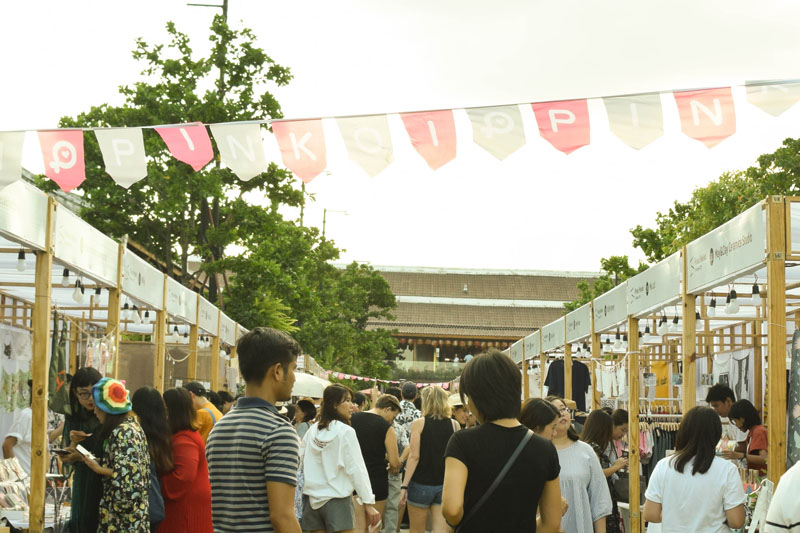
The Salang Design booth at the Pinkoi Fair at Lhong 1919 in Bangkok.
“To people from the outside, we seem similar, but it’s not really the same. Even food is really different, like nasi lemak and tom yum,” Deryin said.
For their first time in Bangkok, the three also made special patches about Thailand for the exhibition: a Thai dancer, mango sticky rice and a floating market boat.
Comel, as we learned from How, is narak in Malay.
Deryin says there are many aspects of Malaysian culture to explore, from the Chinese, Malay and Indian ethnic groups.
“[Malaysia culture] is so fruitful and there’s so many perspectives to explore,” she said.
She said the three wanted to make Malay culture cool to people in their home as well, rather than immediately deferring to Western fashion. “We wanted to make it not shameful or weird to ‘wear’ Malaysian culture,” she said. “We got the idea from scout patches, but [this is] more fun, la.”
Salang Design patches inspired by vintage Malaysian packaging.
Some of the patches, although distinctly Malay, when explained to Thais reveal cultural similarities.
The patch showing an anneh, or a waiter at a mamak stall eatery, literally means “brother-in-law” in Tamil, Deryin said. It’s accompanied by bang, the Malay word for both “brother” and “boss” – terms used to address servers in the same way Thais call them pii, which is usually reserved for someone more senior.
Deryin and Pheng attend design institute The One Academy in Penang, and How goes to Taylor’s University in a suburb of Kuala Lumpur.
Salang Design
1 of 9
Salang Design patches on stationary used by Malaysians.
A patch resembling Anglia beer.
Various Salang Design patches.
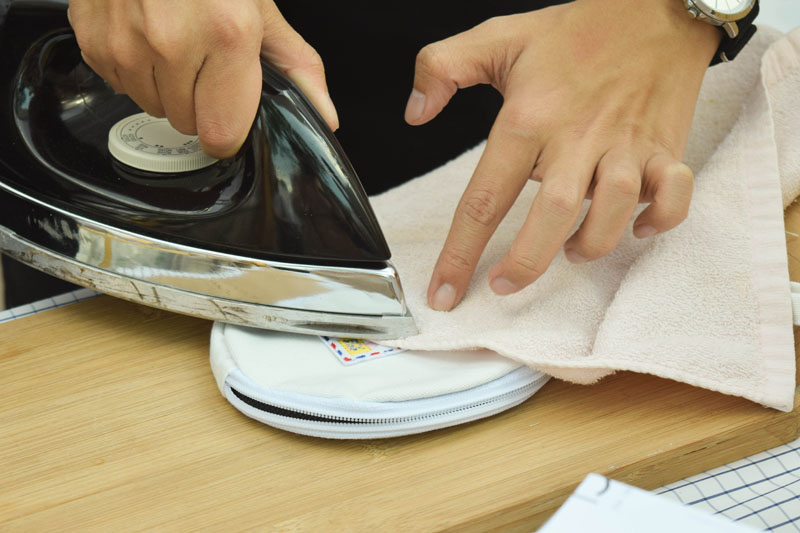
Tan Wei How irons a patch onto a pouch.
The Salang Design booth at the Pinkoi Fair at Lhong 1919 in Bangkok.
Salang Design patches inspired by vintage Malaysian packaging.
Salang Design patches of Malaysian food items include a bread bag fastener, kopi, nasi lemak, a peanut brand, char koay teow, xiao long bao, Anglia beer, ice cream, laksa and ice kacang.
From left, Salang Design’s Teh Deryin, Tan Wei How and Chia Jiun Pheng.
Teh Deryin holds up a patch of nasi lemak and mango sticky rice.
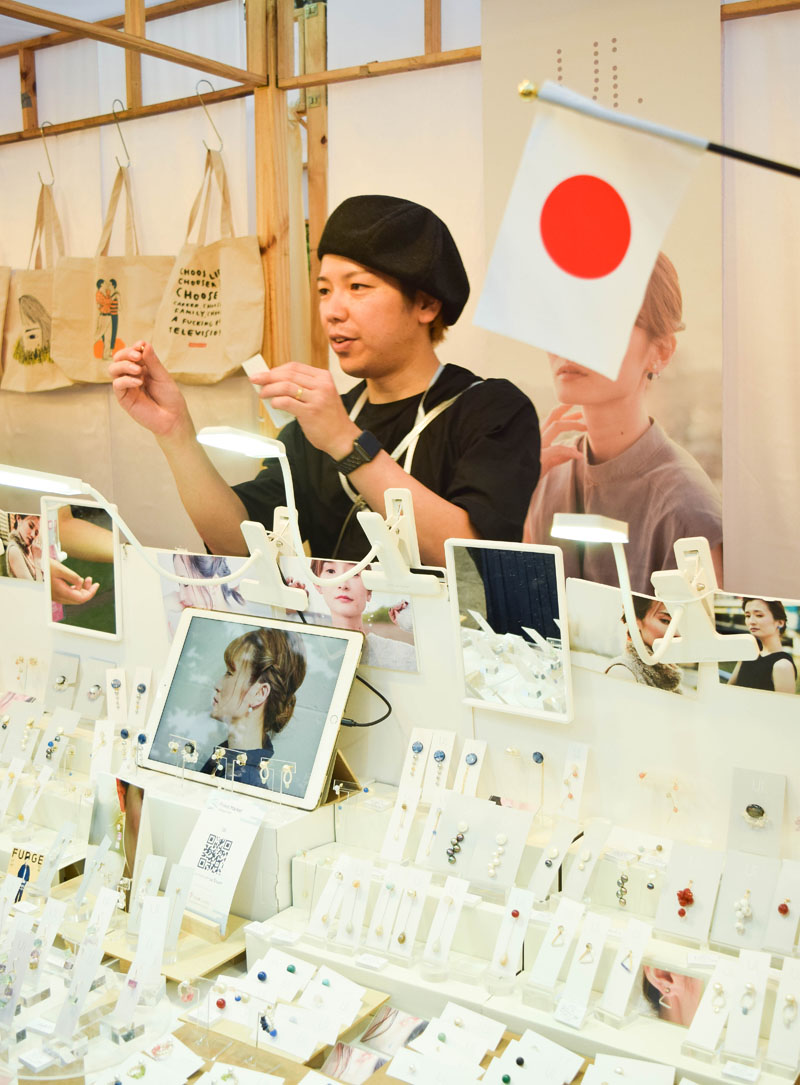
The weekend market also included designers from Thailand, Taiwan, China, Japan and Korea. It was organized by Pinkoi, a Taiwanese online storefront for small-scales designers from across Asia.
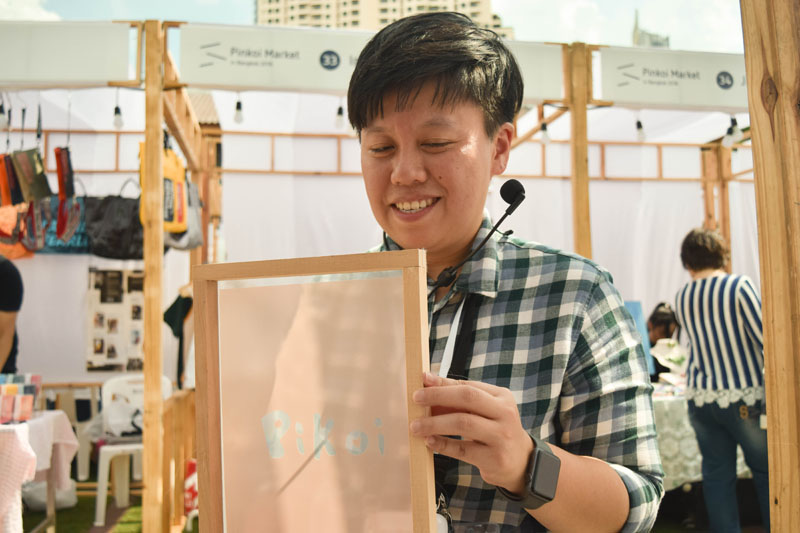
Chiu Chiung-yu of Taiwanese brand inBlooom, was there teaching participants how to screen print designs onto bags.
Chiu, 33, says that she and two other friends started making bags and other printed products to counter use of plastic bags, especially for bubble tea. The designs of Formosan nature and culture have sold well throughout Asia, she said.
“Thai people really like to order bright colors. Maybe it’s because of the weather and the passionate people,” Chiu said amiably, cleaning up some paint. “In April we had an exhibition at BITEC and there was this Thai couple who really loved Taiwan and bought 20 table mats for their wedding. They were so cute.”
Chiu Chiung-yu of inBlooom brand holds up a screen printing frame.
The fair also had Thai brands such as Numgunde, by 29-year-old Korat native Katchaporn Seetho; and Thitiya Ploysopol, 32, who sold colorful bags including ones made from sack cloth plastic, similar to those used by market vendors.
Chiu Chiung-yu, at right.Katchaporn Seetho holds up bags from her Thai brand Numgunde.Taiwanese brand Apoozi’s booth.Thai greeting card brand Pianissimo Press.Ceramics from Thai brand May&Clay.Earrings by Thai brand Into the Jungle.Japanese jewelry brand Ui.Taiwanese brand Yohand.Japanese brand Makers’ Base.Taiwanese brand SuperB Studio.Taiwanese brand Loopy.
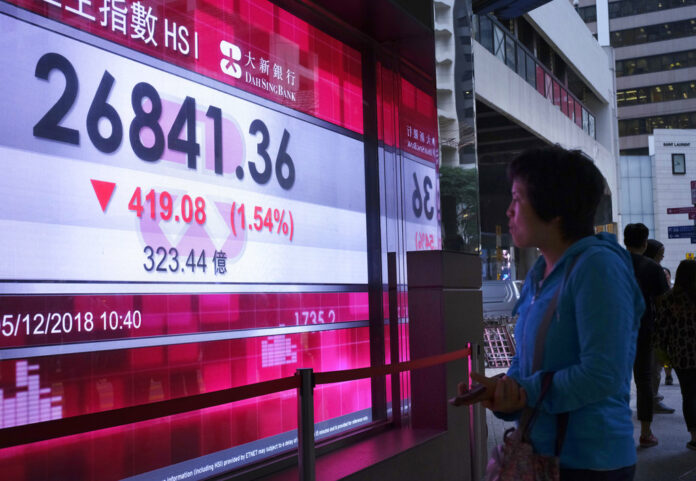
A woman looks at an electronic board showing Hong Kong share index outside a local bank Wednesday in Hong Kong. Photo: Vincent Yu / Associated Press
BEIJING — Asian stocks sank Wednesday after Wall Street plunged amid confusion about what Washington and Beijing agreed to in a tariff cease-fire.
Investor confidence in the U.S.-China agreement faltered after confusing and conflicting comments from President Donald Trump and some senior officials. That revived fears that the disagreement between the two economic powerhouses could slow the global economy.
The Stock Exchange of Thailand was closed for the holiday Wednesday.
We are either going to have a REAL DEAL with China, or no deal at all – at which point we will be charging major Tariffs against Chinese product being shipped into the United States. Ultimately, I believe, we will be making a deal – either now or into the future….
KEEPING SCORE: Hong Kong’s Hang Seng index fell 1.6 percent to 26,840.74 points and the Shanghai Composite Index lost 0.7 percent to 2,647.55. Tokyo’s Nikkei 225 lost 0.4 percent to 21,946.94 while Sydney’s S&P-ASX 200 retreated 1.2 percent to 5,641.50. Seoul’s Kospi shed 0.6 percent to 2,102.17 and benchmarks in Taiwan, New Zealand and Southeast Asia also declined.
WALL STREET: The Standard & Poor’s 500 slid 3.2 percent to 2,700.06. The Dow Jones Industrial Average lost 3.1 percent to 25,027.07. The Nasdaq composite lost 3.8 percent to 7,158.43. Tech companies, banks and exporters including Boeing and Caterpillar all declined.
TRADE TURMOIL: The Trump administration raised doubts about the substance of a U.S.-China trade cease-fire. That revived fears their tariff battle could chill global economic growth. Trump previously said the agreement in Buenos Aires would lead to sales of American farm goods and cuts in Chinese auto tariffs, but Beijing has yet to confirm that. Trump renewed threats of tariff hikes on Tuesday, saying on Twitter that Washington would have a “real deal” with China or else would charge “major tariffs” on Chinese goods. That made the weekend agreement seem even less likely to produce a long-lasting settlement.
FED WATCH: Markets got jolt from remarks by the president of the Fed’s New York regional bank. During a briefing with reporters, John Williams said given his outlook for strong economic growth, he expects “further gradual increases in interest rates will best sponsor a sustained economic expansion.” That seemed to counter Fed Chairman Jay Powell’s remarks last week. The jitters helped drive demand for government bonds. The yield on the 10-year Treasury note fell to 2.91 percent from 2.99 percent late Monday, a large move. The slide in bond yields, which affect interest rates on mortgages and other consumer loans, weighed on bank stocks.
ANALYST’S TAKE: “Positive sentiment from the China-U.S. trade war truce dissipated quickly,” said Eugene Leow and Radhika Rao of DBS Group in a report. “Questions on trade, worries about US growth and perceived dovishness on the Fed all play a part in explaining these market moves. Concerns were also compounded by increasing news narrative on inverted curves and risks of a recession.”
ENERGY: Benchmark U.S. crude fell 53 cents to $52.72 per barrel in electronic trading on the New York Mercantile Exchange. The contract rose 30 cents on Tuesday to close at $53.25. Brent crude, used to price international oils, lost 63 cents to $61.45 per barrel in London. It gained 39 cents the previous session to $62.08.
CURRENCY: The dollar gained to 112.95 yen from Wednesday’s 112.78 yen. The euro declined to $1.1330 from $1.1343.
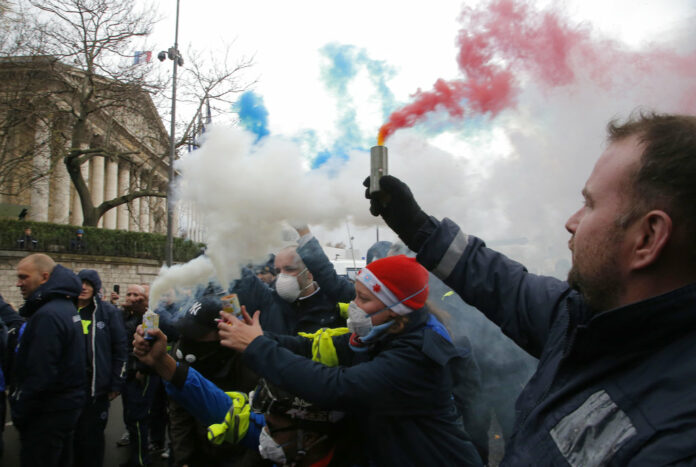
Ambulance workers hold flares Monday outside the National Assembly in Paris. Photo: Michel Euler / Associated Press
PARIS — The French government caved in after Paris’ worst rioting in decades and delayed an increase in energy taxes Tuesday — but it was seen as “too little, too late” by many protesters whose anger seems increasingly focused on embattled President Emmanuel Macron.
Demonstrators were back in the streets wearing their signature yellow vests. They blocked several fuel depots and, on a highway near the southern city of Aubagne, commandeered a toll booth to let motorists pass for free near a sign reading “Macron dictator.”
The protests began Nov. 17 with motorists upset over the fuel tax increase, but have grown to encompass a range of complaints — the stagnant economy, social injustice and France’ tax system, one of the highest in Europe — and some now call for the government to resign.
Last weekend, more than 130 people were injured and 412 arrested in rioting in the French capital. Shops were looted and cars torched in plush neighborhoods around the famed Champs-Elysees Avenue. The Arc de Triomphe was sprayed with graffiti and vandalized.
Four people have been killed, officials said, and more protests are planned for this weekend.
One unifying complaint among the leaderless protesters, who come from across the political and social spectrum, has been the anger at Macron and the perceived elitism of France’s aloof ruling class.
Since returning from the G20 summit in Argentina, Macron has either remained in his palace residence or else shied away from speaking publicly about the protests that have created his biggest political crisis since taking office last May.
It was Prime Minister Edouard Philippe who announced a six-month delay in the fuel tax increase that was to have begun in January. Just three weeks ago, Philippe had insisted the government would be steadfast in the tax plans aimed at weaning French consumers off fossil fuels. He also announced a freeze in electricity and natural gas prices until May.
“No tax is worth putting the nation’s unity in danger,” Philippe said in a live televised address.
Macron, for his part, visited a regional government headquarters that was torched by protesters, but he did not speak to reporters.
The government U-turn appeared to appease few of the protesters, who wear the yellow vests that France requires motorists to have in their vehicles in case of roadside emergencies.
“It’s a first step, but we will not settle for crumbs,” said Benjamin Cauchy, a self-proclaimed protest leader.
Another self-proclaimed leader Thierry Paul Valette told The Associated Press that protesters now are unhappy not just about the price of fuel but general discontent with economic inequality.
“It’s coming too late. … I’m calling this government to resign,” Valette said.
Damien Abad, a lawmaker from the center-right Les Republicains party, also called it “too little, too late.”
“If your only response, Mr. Prime Minister, is the suspension of Macron’s fuel taxes, then you still haven’t realized the gravity of the situation,” Abad said. “What we are asking of you Mr. Prime Minister, is not a postponement. It’s a change of course.”
Protest and street violence has been a central part of France’s political culture — from the Revolution in the late 1700s to the student riots in 1968 — and the yellow vest movement reflects this tradition.
In the port city of Marseille, students clashed with police outside a high school — one of about 100 high schools around France that were blocked or otherwise disrupted by student protests, according to the Education Ministry. Many are protesting a new university application system.
Philippe held crisis talks with representatives of major political parties on Monday, and met with Macron, who canceled a two-day trip to Serbia.
“This violence must end,” Philippe said.
Far-right leader Marine Le Pen tweeted that the delay in price increases was “obviously not up to the expectations of the French people struggling with precariousness,” and noted sarcastically that it is “surely a coincidence” that the rise in prices will take effect a few days after European Union elections.
Singer and entrepreneur Kerika "Jinny" Chotivichit poses for a photo at an event promoting online shopping held by Shoppee.com in October 2016.
BANGKOK — The interim parliament on Tuesday unanimously approved a new bill that would increase government monitoring of private banking to collect tax revenue.
After a long debate, the assembly by a 139-0 vote approved the draft law, which would nominally tax online shopping. The bill requires individuals whose bank accounts show over 2 million baht worth of transactions per year to disclose those accounts to the revenue department for tax assessment.
Deputy finance minister Wisudhi Srisuphan, the bill’s sponsor, told the parliament it would also target anyone with an unusually high amounts of financial transactions.
“Another benefit of the draft law is to scrutinize and suppress shady businesses,” Wisudhi said.
Bank accounts with more than 3,000 transactions per year or those with more than 400 transactions totaling at least 2 million baht annually would be affected. The bill will become law if the parliament passes it in three more sessions.
Thailand’s e-commerce industry is valued at 3 trillion baht and growing, according to July data released by the Electronic Transactions Development Agency. Government officials in recent years have called for measures to ensure those sales are taxed.
But an e-commerce entrepreneur warned the bill, if passed, would hobble the fledgling industry of online shopping and e-payments.
“People who are deciding whether to enter a cashless society would be convinced not to use online platforms for financial activities, even though they are more convenient,” Pawoot Pongvitayapanu, founder of Tarad.com, told the media. “The policy of a cashless society in Thailand may not succeed.”
Pawoot added that the government should focus on enforcing the existing tax code more effectively instead of going after online shopping.
Even some of the lawmakers raised concerns over the scope of the law. Vorapol Socatiyanurak said during the debate that the draft bill is too broad and would grant too much authority to the state to monitor financial transactions.
Vorapol also said he’s received letters from several financial institutions voicing worries over the bill.
The alley opposite Wat Ratchabophit where the attack allegedly took place.
Update: Arnat Uddee was denied bail Thursday
BANGKOK — A man suspected of raping a tourist from New Zealand has been arrested, police said Wednesday.
Arnat Uddee, 34, allegedly assaulted the woman in the early hours of Saturday while she was lost close to the Grand Palace. Police said Arnat fled to Chonburi province after the attack, where he was apprehended Tuesday.
A police news conference will be held in Bangkok tomorrow.

































 “So her fans are saying she went to report it to protect her Women’s Rights? Wow, I’m rolling my eyes at your 48 group system and the dildo. How feminist you are!” activist Pipat Wattanapanit wrote on Facebook. “She must have a lot of photoshopped photos of her, so what is she going to do, report every page? I guess the dildo effect is really strong.”