In this October 2018 photo, American adventurer John Allen Chau, right, stands for a photograph with Founder of Ubuntu Football Academy Casey Prince, 39, in Cape Town, South Africa, days before he left for in a remote Indian island of North Sentinel Island, where he was killed. Photo: Sarah Prince / Associated Press
NEW DELHI — Indian authorities were struggling Thursday to figure out how to recover the body of an American killed last week after wading ashore on an isolated island cut off from the modern world.
John Allen Chau was killed by North Sentinel islanders who apparently shot him with arrows and then buried his body on the beach, police say.
But even officials don’t travel to North Sentinel, where people live as their ancestors did thousands of years ago, and where outsiders are seen with suspicion and attacked.
“It’s a difficult proposition,” said Dependera Pathak, director-general of police on India’s Andaman and Nicobar Islands, where North Sentinel is located. “We have to see what is possible, taking utmost care of the sensitivity of the group and the legal requirements.”
Police are consulting anthropologists, tribal welfare experts, forest experts and scholars to figure out a way to recover the body, he said.
While visits to the island are forbidden, Chau paid fishermen last week to take him to the island. He used a kayak to paddle to shore, bringing gifts including a football and fish.
He interacted with some of the tribesmen — who survive by hunting, fishing and collecting wild plants and are known for attacking anyone who comes near with bows and arrows and spears — until they became angry and shot an arrow at him. The 26-year-old adventurer and Christian missionary then swam back to the fishermen’s boat waiting at a safe distance.
That night, he wrote about his visit and left his notes with the fishermen. He returned to North Sentinel the next day, Nov. 16.
What happened then isn’t known, but on the morning of the following day, the fishermen watched from the boat as tribesmen dragged Chau’s body along the beach and buried his remains.
Pathak said the seven people have been arrested for helping Chau, including five fishermen, a friend of Chau’s and a local tourist guide.
“It was a case of misdirected adventure,” Pathak said.
Chau was apparently shot and killed by arrows, but the cause of death can’t be confirmed until his body is recovered, Pathak said.
In an Instagram post, his family said it was mourning him as a “beloved son, brother, uncle and best friend to us.” The family also said it forgave his killers and called for the release of those who assisted him in his quest to reach the island.
“He ventured out on his own free will and his local contacts need not be persecuted for his own actions,” the family said.
Authorities say Chau arrived in the area on Oct. 16 and stayed on another island while he prepared to travel to North Sentinel. It was not his first time in the region: he had visited the Andaman and Nicobar Islands in 2015 and 2016. North Sentinel is part of the Andaman Islands and sits at the intersection of the Bay of Bengal and Andaman Sea.
With help from a friend, Chau hired fishermen for $325 to take him there on a boat, Pathak said.
After the fishermen realized Chau had been killed, they left for Port Blair, the capital of the island chain, where they broke the news to Chau’s friend, who in turn notified his family, Pathak said.
Police surveyed the island by air on Tuesday, and a team of police and forest department officials used a coast guard boat to travel there Wednesday and another trip was planned Thursday.
India has a very hands-off approach to the island’s people. Tribespeople killed two Indian fishermen in 2006 when their boat broke loose and drifted onto the shore, but Indian media reports say officials did not investigate or prosecute anyone in the deaths.
Chau had wanted ever since high school to go to North Sentinel to share Jesus with the indigenous people, said Mat Staver, founder and chairman of Covenant Journey, a program that takes college students on tours of Israel to affirm their Christian faith. Chau went through that program in 2015.
“He didn’t go there for just adventure. I have no question it was to bring the gospel of Jesus to them,” Staver said.
Chau was carrying a Bible that was hit by an arrow when he was first shot at by the tribesmen on Nov. 15, according to notes Chau left with the fishermen that Staver said he has seen.
Staver said Chau’s last notes to his family on Nov. 16 told them that they might think he was crazy but that he felt it was worth it and asked that they not be angry if he was killed.
One of Chau’s friends said the American spent a month at his home in Cape Town, South Africa, before going to India.
“If he was taking a risk, he was very aware of it,” said Casey Prince, 39.
The two first met about six years ago, when Chau was a manager on the soccer team at Oral Roberts University in Oklahoma. Chau and others on the team traveled to South Africa to volunteer at a soccer program Prince founded
Prince described him as easy to like and driven by twin passions: a love of the outdoors and fervent Christianity.
Before attending Oral Roberts University, Chau had lived in southwestern Washington state and went to Vancouver Christian High School. Phone messages left with relatives were not immediately returned Wednesday.
Survival International, an organization that works for the rights of tribal people, said the killing of the American should prompt Indian authorities to properly protect the lands of the Sentinelese.
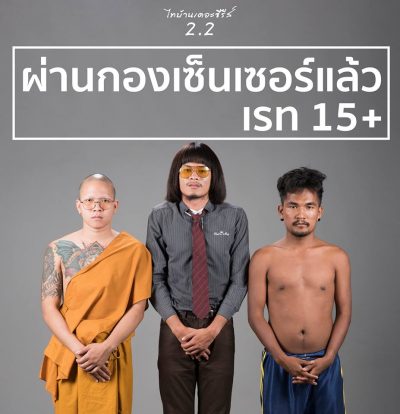
BANGKOK — A film set in Isaan was approved by state censors after its makers did away with what they say was its most powerful scene: A monk bawling over his ex-girlfriend’s coffin.
After cutting out the brief scene in which monk Phra Siang despairs at his ex-girlfriend’s funeral, “Thi Baan The Series 2.2” was approved Thursday by the National Film and Video Committee. It will premiere Saturday in cinemas nationwide rated for audiences over 15.
On Tuesday, the filmmakers announced the film had not passed the board because it contained “sensitive” content about Buddhism. The film’s release was indefinitely postponed at the time.
The film, shot in Isaan, is directed by 27-year-old Surasak Pongsorn from Isaan’s Sisaket province. He said the team put in hard work to shoot the scene.
“We prepared for this scene one day and took two days to shoot it because we hoped it would be the saddest part of the film,” Surasak wrote, adding that they had to “beg” a homeowner for permission to shoot the funeral scene as it is considered bad luck.
“If this scene needs to be cut out, I’m okay,” Surasak continued. “But I gotta admit that the film won’t be as perfect as it was meant to be. I feel sorry for the fans who won’t be able to watch the scene, which is supposed to represent the film’s climax.”
“Thi Baan The Series 2.2” was initially scheduled for release in theaters today before it was pulled.
Although the crew agreed to delete the scene, representatives of the Thai Film Director Association on Wednesday demanded the censor board use consistent standards when reviewing movies. They also said the move damages the artistic value of films for audiences.
“The cinematic work will be ruined because that scene is so emotional,” said Thanit Jitnukul, association director. “If the scene is cut out so it can be shown in cinemas, it is once again means Thai audiences get to watch a film that isn’t its best. This has happened many times before.”
Junta leader Prayuth Chan-Ocha points at mackerel Thursday in Bangkok's Minburi Market.
BANGKOK — The Election Commission said Thursday it will investigate whether the military government’s decision to hand out nearly 87 billion baht to the poor during the run-up to the election amounts to illegal vote buying.
The statement by commission president Ittiporn Boonpracong came as the leader of the ruling junta defended his cabinet’s provision of 86.9 billion baht as a transparent means of decreasing the financial burden on low-income Thais.
Speaking on Thursday in Bangkok’s Minburi district, Prayuth defended his cabinet’s resolution this week to dole out additional welfare in the form of one-time and monthly disbursements of cash to registered poor and seniors beginning next month.
Those holding state welfare cards – about 14.5 million low-income Thais – will get 500 baht for New Year’s and 330 baht to help with utility bills every month for 10 months starting December. Seniors over 65 will get a one-time 1,000 baht and 400 baht per month for the same period to help with housing expenses.
“The 500 and 1,000 baht we have was aimed at reducing the burden on the people. They could buy groceries such as shrimp paste and fish sauce. You can buy it at any shop that has a scanner for the cards. Do not let anyone misrepresent that you are buying it from rich [businesses],” Prayuth said.
Four members of Prayuth’s cabinet have registered with political parties that will contest the next election and may attempt to keep the junta leader, who also serves as prime minister, in power afterward.
Critics said Wednesday it was a thinly veiled attempt to win votes with elections promised for just three months from now.
Democrat Party leader Abhisit Vejjajiva said the move was no different from the so-called populist policies the military government criticized after it seized power. Asked if he thought the move was meant to gain an electoral upper hand, Abhisit said he believes the people can see what’s happening.
That was the same sentiment expressed by Chamnan Chanruang, deputy leader of the Future Forward Party, who said the move was a clear example of the kind of campaigning that remains illegal for everyone else.
Pheu Thai Party spokeswoman Ladawan Wongsriwong said Wednesday that the aid would only last 10 months and that beneficiaries should not feel indebted or any gratitude toward the government since it came from taxpayers’ money, not Prayuth.
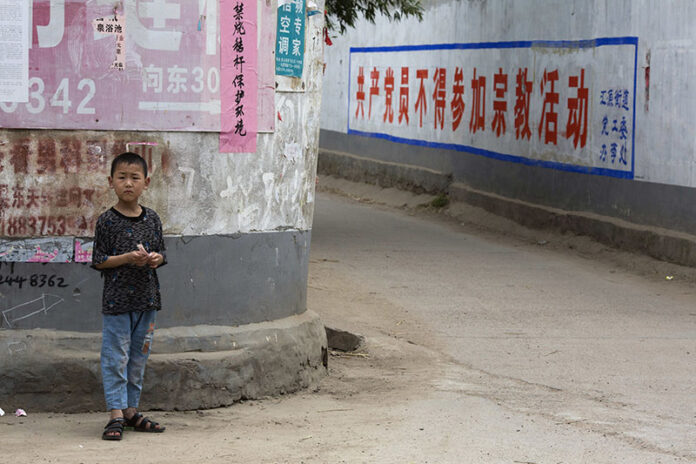
A child stands in the street in June in China's Henan province. Photo: Ng Han Guan / Associated Press
BEIJING — A car plowed into a crowd of children outside a primary school in northeastern China on Thursday, killing five people and injuring 18, state media reported.
The driver was taken into custody after the crash around noon in the coastal city of Huludao in Liaoning province, state broadcaster CCTV said.
Eighteen people were hospitalized with injuries, the reports said. The cause was under investigation, according to the reports.
Security camera footage showed a line of children crossing the street in front of their school when a car approaches, then changes lanes and swerves into a crowd of the children.
Government spokesmen reached by phone said they were not authorized to release information about the crash.
While it wasn’t clear if the crash was a deliberate attack, China has recently seen a number of such incidents.
Last month, a knife-wielding man drove a vehicle into a crowd of pedestrians in the eastern city of Ningbo, killing two people and wounding 16.
And in September, 11 people were killed and 44 hospitalized after a man drove an SUV deliberately into people at a plaza in the central province of Hunan, before jumping out and attacking victims with a dagger and shovel.
The most common motivations are identified as mental illness, alienation from society or a desire to settle scores.
Other deadly attacks have occurred at schools, including several in 2010 in which nearly 20 children were killed, prompting a response from top government officials and leading many schools to beef up security.
However, in June, a man used a kitchen knife to attack three boys and a mother near a school in Shanghai, killing two of the children. Last year, police said a man set off an explosion at the front gate of a kindergarten in eastern China, which struck as relatives gathered to pick up their children at the end of the day, killing eight people.
Aliosha Herrera at the top of Cinema Oasis. Courtesy Ing K.
She remembers it was a Saturday in the spring of 2007 that she entered a Paris cinema to see her first Thai film.
It was critically acclaimed director Apichatpong Weerasethakul’s “Blissfully Yours.” Afterward, the woman devoured more of his works, including 2004’s Cannes-winning “Tropical Malady.” The next day she returned again to see “Syndromes and a Century.”
What initially was a weekend’s diversion lit a passion that would become the topic of her master’s thesis – “The Invention of a Critical Memory in the Work of Apichatpong Weerasethakul.”
“I was enthralled by his narrative inventiveness and profoundly moved by the rural Thailand that he depicted, imbued with ancient tales and ghostly memories,” she said. “I had to choose a topic for my dissertation and it could only be about his works.”
It’s no exaggeration to say that Aliosha Herrera, or “Yo,” has seen more Thai movies than most Thais. The 30-year-old Frenchwoman is not only an admitted hardcore cinephile with a thirst for the Thai oeuvre, but has cultivated enough expertise that she now shares her knowledge with Thai audiences.
Recently Herrera curated a double-feature of two classics, both from 1965, at downtown arthouse theatre Cinema Oasis. “Ngoen, Ngoen, Ngoen” (“Money, Money, Money”) – a blockbuster musical comedy at the time starring Mitr Chaibancha and Petchara Chaowarat – and Rattana Pestonji’s final romantic comedy “Sugar is Not Sweet.”
I felt nostalgic. It’s funny because I had never been to Thailand but I was already nostalgic about Thailand.”
It wasn’t the first time she helped bring a Thai film to new audiences. After 1954’s “Santi-Vina” was rediscovered two years ago, Herrera got the long-lost movie shown in Paris.
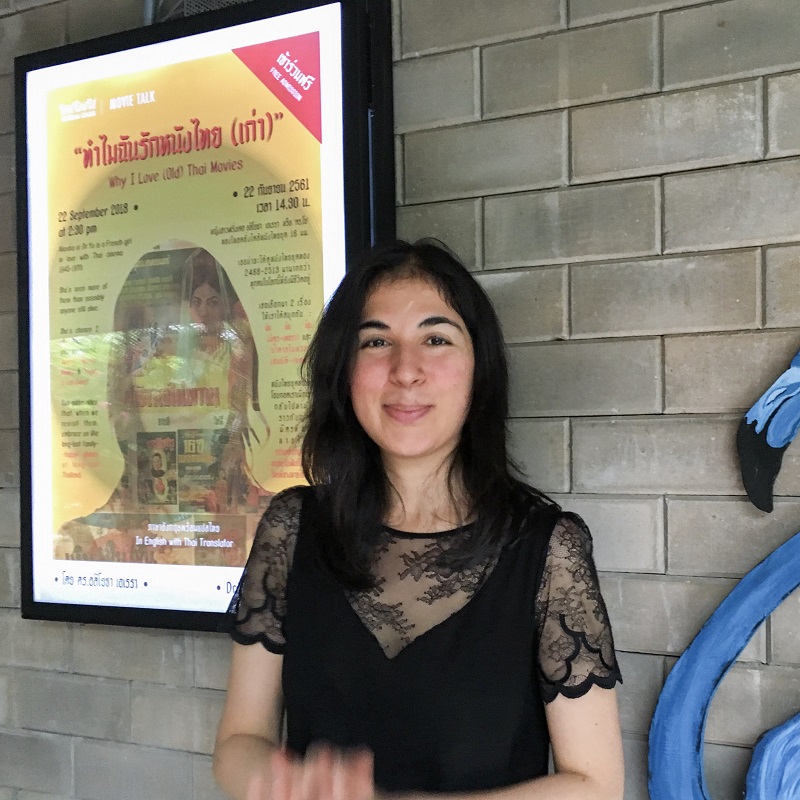
Aliosha Herrera in front of a poster promoting her talk at Cinema Oasis. Courtesy Ing K.
Born to French and Panamanian parents, Herrera grew up in the Paris suburb of Arpajon. During her childhood, she, her mother and sister would take monthly trips to small standalone cinemas in the capital, especially those in the fifth arrondissement, aka the Latin Quarter.
“Watching films and discussing them with my family was a whole part of my education,” Herrera said. “The shelves of our home were filled with books and a myriad of classic films on VHS. I also spent a great amount of time at the French Cinematheque, where I could discover many gems of world cinema and exchange views on them with my cinephile friends.”
Though naturally introverted and soft-spoken, Herrera couldn’t hide her love for Thai movies when conversation brought them to the table, literally, as we sipped warm tea recently at Cinema Oasis. When her fluent Thai speaking skill is commended, she smiles shyly and politely says “khob khun ka.”
A promotional poster of Aliosha Herrera’s talk in September at Cinema Oasis.
Learning at the Source
Fascinated by Apichatpong’s cinematic offerings, which left her mind “relentlessly pounding,” Herrera first came to Thailand in 2010. That’s when a door opened to her embrace of a whole new world.
“I wanted to know more about this place, this country,” Herrera said. “[Watching Apichatpong’s films], I felt nostalgic. It’s funny because I had never been to Thailand but I was already nostalgic about Thailand.”
Samanrat “Ing” Kanjanavanit, one half of the daring filmmaker duo behind Cinema Oasis and controversial works such as thebanned “Shakespeare Must Die,” gave high praise.
“In a previous life, she definitely was born Thai,” Ing said.
On her first trip to Bangkok, Herrera visited the Thai Film Archive and met then-director Dome Sukwong. The film archivist is regarded by Herrera as the “Henri Langlois of Thailand” after the French pioneer of filmpreservation.
Dome Sukwong
There she was introduced to 16mm and 35mm Thai oldies, many post-World War II works that were made through the 1970s.
It was at the archive that Herrera embarked on her next level of studying Thai cinema history, since it began in 1897.
It was that knowledge and more she shared with audiences recently at Cinema Oasis in a 2-hour talk touching on the cultural bridge between live cinema vocalists and older Thai traditions, anecdotes of the silver screen’s most important figures and its post-World War II golden age.
The Live Sound Experience
Due to a shortage of 35mm stock after the war, Thai filmmakers shot on 16mm celluloid, with no sound-on-film. Producing silent films was less expensive and made productions easier and faster.
The silent films were then brought to life in theaters by professional voice artists.
Sin Sribunruang, considered the first professional voice dubber who founded the profession in Thailand, in a file image.
That’s when the live performers came in handy. They would add their voices to silent films or do live dubbing of foreign films. Sometimes following the script and sometimes improvising. Some also did live foley work by making sounds to accompany car engines, gunfire and animal noises.
It breathed new life into what had been a traditional art of voice actors performing at shadow plays (nang yai or nang talung) and the masked dance of khon. It made each showing distinctive.
Herrera said she would have loved to have experienced that era, which vanished several decades ago.
“I found this kind of film production tremendously original,” she said.
“By inscribing itself in this oral paradigm, the Thai film production put cinema, a Western invention, at the service of an original local tradition,” Herrera continued. In her home country France, oral accompaniment only existed briefly and had ended by the mid-1920s.
‘Art Out of Time’
After leaving Thailand, Herrera decided to return, this time to research her doctoral thesis focusing on Thai 16mm-format celluloid between 1945 and 1970.
Watching the old films – which offered no English subtitles – Herrera decided to take a leap. She signed up to study Thai for five months and has practiced the language daily since.
Not that it entirely demystifies the old films, many of which contained archaic terms and phrases no longer in usage.
“Sometimes I would not get the jokes in the movies, so I needed to ask or get help from Thai friends,” Herrera said.
A promotional poster for romantic comedy ‘Sugar is Not Sweet’ (1965)
Asked how many Thai films she has seen so far, Herrera said that while her dissertation focused on 39 movies, which she analyzed in detail and translated into French, she has seen hundreds of them.
“I watched as many films as I could,” Herrera said. “[There are] hundreds of Thai movies, from all periods, in their entirety or in fragments.”
“I see Thai cinema as an art out of time … and a precious form of intangible heritage.”
Thai movies are widely derided by critics for failing to reach international standards. The term ‘nam nao’ (‘stinking water’) is often used to dismiss overly melodramatic soap operas and movies that feature overacting, overt villainy and extreme moral polarization, for examples.
But Herrera sees otherwise.
“I tend to believe that, instead of moving ‘backward’ in the history of cinematic techniques, this old Thai cinema became a significant horizon of cultural resistance,” she said, though she noted some were hired by the US government to dub propaganda films.
“I see [Thai cinema] as an art out of time … and a precious form of intangible heritage,” she said, naming off admired Thai filmmakers that include Thae Prakatwuthisan and Rattana Pestonji. “[They] endeavoured to make and produce movies with all their heart despite economic hardships.”
A promotional poster of “Money, Money, Money” (1965)
Herrera took five years to complete her research. During the time she visited some Thai actors, now in their 70s and 80s, to interview them in Thai.
One of her subjects, the comic actor and filmmaker Dokdin Kanyamarn, died earlier this year from heart failure at 94.
“[Dokdin] told me a lot about his first successes. Then he showed us a big swimming pool specially built in his garden to shoot underwater scenes and sang us lovely songs. He has a very melodious and dulcet voice.”
Dokdin Kanyamarn
Herrera also talked to Sombat Metanee, who once held the Guinness World Record for most film appearances and starred in 1966’s “Suek Bang Rajan” (The Battle of Bang Rajan) and “Chula Trikhun” (1967).
“[Sombat] remembers so many aspects of that period,” Herrera said of the 81-year-old actor. “He helped me understand the gentlemanliness proper to the heroes of old Thai movies. He is a genuine suphap burut.”
Herrera landed rare interviews not only with the heroes of Thai cinema, but its heroines as well. Among them was Thai-French Amara Asavanond or “Thailand’s Elizabeth Taylor,” who embodied the a particular kind of heroine in the 1950s – mysterious – especially in her role in “Hao Dong” in which Amara subrogates her father who is the most wanted thief.
A promotional poster of “Hao Dong” showing Amara Asavanond holding a gun in black suit featuring a cobra.
“Thanks to her, I could get the gist of these movies, which are considered lost today,” Herrera said.
But it’s probably her conversation with “Miss Honey Eyes” Petchara Chaowarat that Herrera says struck her the most. The 75-year-old actress went blind from spending so many hours exposed to bright set lights. She’s best known for co-starring in more than 100 movies with Mitr Chaibancha – the acting legend who died after falling from a helicopter in 1970 while filming the finale of what would be his last film. They became a koo kwan (heartthrob screen couple) and earned the nickname “Mitr-Petchara.”
“We talked together [for] six hours. Petchara was holding my hand and recounting anecdotes about the key moments of her career, especially her legendary collaboration with Mitr,” Herrera said.
Phetchara Chaowarat in her movie debut ‘The Love Diary of Pimchawee’, (1962, 16mm), with Mitr Chaibancha.
“I still feel extremely lucky when I think about these times,” Herrera said of her encounters with the Thai film greats.
As of this writing, Herrera is in France trying to organize a special screening of “Saen Rak” (1967) to be voiced live by two professional Thai performers.
Authorities investigate the scene at a Catholic Supply store where a gunman went into the religious supply store, sexually assaulted at least one woman and shot a woman in the head, Monday, Nov. 19, 2018, in Ballwin, Missouri. Photo: Associated Press
ST. LOUIS, Missouri — Authorities say a woman who was killed at a suburban St. Louis religious supplies store earlier this week refused her attacker’s demands to “perform deviant sexual acts on him.”
Detectives say in a probable cause statement released Wednesday that the attacker forced the three women who were in the store into a back room at gunpoint and forced them to strip. They say he shot the 53-year-old married mother of three in the head and then sexually assaulted the other two women.
St. Louis County Prosecutor Bob McCulloch identified the suspect in Monday’s attack at the Catholic Supply store in Ballwin as 53-year-old Thomas Bruce, of Imperial, which is another St. Louis suburb.
Bruce is charged with 17 counts, including first-degree murder, sodomy or attempted sodomy and others.
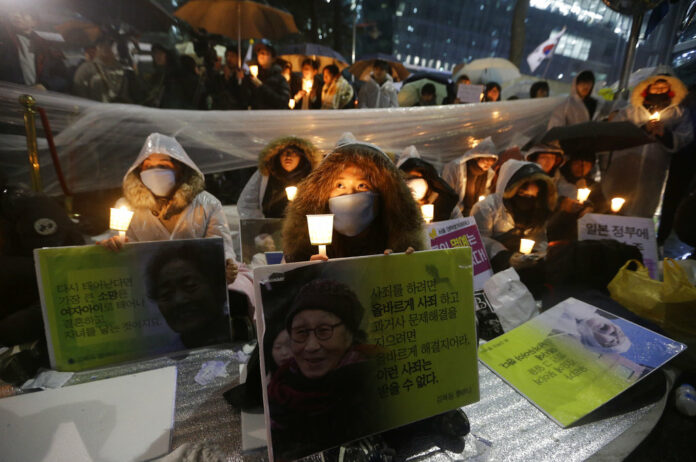
College students hold portraits of the deceased former South Korean sex slaves who were forced to serve for the Japanese military in World War II, and lit candles during a rally against Japanese government in front of the Japanese Embassy in Seoul, South Korea. Photo: Ahn Young-joon / Associated Press
SEOUL, South Korea — South Korea’s decision to dissolve a foundation funded by Japan to compensate South Korean women who were forced to work in Japan’s World War II military brothels has thrown fuel on the diplomatic fire between the countries, who have a bitter wartime history.
The announcement Wednesday was expected as many South Koreans believe that Seoul’s previous conservative government settled for far too less in the 2015 deal, and that Japan still hasn’t acknowledged legal responsibility for atrocities during its colonial occupation of the Korean Peninsula from 1910 to 1945.
Japan, meanwhile, is angry that South Korea is effectively walking back on an internationally recognized agreement.
A look at the intensifying dispute between South Korea and Japan:
The Women
The women forced to work in the brothels were mainly from Japan and Korea, but also from the Philippines, China, Taiwan, Indonesia and elsewhere in Asia. They were sent to hundreds of front-line brothels called “comfort stations” to provide sex for the Japanese army that invaded and occupied Asian countries from the early 1930s through the end of World War II.
Wartime documents show that Japan’s military supervised the brothels, and set the tariffs, service hours and hygiene standards. Government documents say the purpose was to keep soldiers from raping women and triggering anti-Japan sentiment, as well as preventing venereal disease and Chinese espionage.
Initially, some were professionals or from poor Japanese families, historians say. In South Korea, they were often deceived by local agents who recruited them promising factory work. Later in the war, many minors in the Philippines were kidnapped, raped or tricked into working in the brothels, some victims said.
Japan’s Stance
Japan’s government has repeatedly denied there was any coercion, and more recently has refused to use the term “sex slave” for the women in English media and U.N. documents.
Japan has intensified its stance in recent years, especially under Prime Minister Shinzo Abe’s nationalist government, which says there is no official record showing the wartime government’s systematic use of coercion. Some ultra-right-wing lawmakers say the South Korean women forced to work in the brothels were all prostitutes, and there is increasing bashing of supporters of the survivors, as well as journalists for writing stories about them.
The issue flared in 2014 after a former reporter from Japan’s left-leaning Asahi newspaper was accused of fabricating his report on the first South Korean survivor who came forward, leading to defamation lawsuits still pending in Japan.
Statues honoring the victims erected in the U.S. and elsewhere by South Korean groups have also upset the Japanese government.
The Women’s Demands
The former victims have demanded compensation and an apology from Japan’s government. Japan in 1995 set up the semi-government Asian Women’s Fund, a scheme to finance compensatory projects for victims from across Asia, including South Koreans.
In all, the fund paid nearly 5 billion yen (USD$44.2 million) for medical and welfare projects for all the recognized women from across Asia, including 61 South Koreans. But many others in South Korea rejected the fund because of pressure from their support group’s policy to keep demanding official compensation.
Estimates by historians for the total number of victims range from 20,000 to 200,000. In South Korea, about 240 women came forward and registered with the government as victims, and only 27 of them are still alive.
The 2015 Deal
Under the agreement reached in December 2015, Japan pledged to fund a Seoul-based foundation to help support the victims. However, Japan said it didn’t consider the 1 billion yen it provided to the fund as compensation, insisting that all wartime compensation issues were settled in a 1965 treaty that restored diplomatic ties between the countries and was accompanied by more than $800 million in economic aid and loans from Tokyo to Seoul.
South Korea, in exchange, vowed to refrain from criticizing Japan over the issue and will try to resolve a Japanese grievance over a statue of a girl representing victims of sexual slavery that sits in front of the Japanese Embassy in downtown Seoul.
The deal initially described by Seoul and Tokyo as “final and irreversible” turned out to be anything but. Many victims refused payment. Anti-Japan activists rallied furiously, accusing the government of former conservative President Park Geun-hye of “selling away” the honor and dignity of the aging victims. College students began camping out in the street across the embassy to protect the statue from potential attempts to remove it. A 64-year-old Buddhist monk died after setting himself on fire to protest the deal in January 2017.
Japan expressed anger that South Korea didn’t taken specific steps to remove the statue and similar monuments in other places in the country, insisting there has been a clear understanding to do so.
Liberal South Korean President Moon Jae-in, who won office in May last year following Park’s removal from office over a corruption scandal, said in December 2017 that the 2015 agreement was seriously flawed because Park’s government failed to properly communicate with the victims before reaching the deal.
Historical Issues
The legacy of sexual slavery is hardly the only issue of contention between South Korea and Japan.
The countries are at odds over a ruling by Seoul’s Supreme Court last month that a major Japanese steelmaker should compensate four South Koreans for forced labor during Japan’s colonial rule of the Korean Peninsula before the end of World War II.
Seoul has also expressed resentment about Tokyo’s territorial claims over the disputed eastern islands occupied by South Korea. Japan last month refused to send a warship to an international fleet review hosted by South Korea after Seoul requested the removal of the Japanese navy’s “rising sun” flag, which many South Koreans see as a symbol of Japan’s wartime aggression.
Seoul and Tokyo’s bitter disputes over history have complicated Washington’s efforts to strengthen trilateral cooperation to deal with North Korea’s nuclear threat and China’s growing influence in the region. Japan has also expressed wariness over South Korea’s outreach to rival North Korea in past months, stressing the need to maintain pressure until the North takes concrete steps toward relinquishing its nuclear weapons and missiles.
“The Moon government is trying to maintain a two-track approach – cooperating with Tokyo on security and economic issues, but firmly responding to issues surrounding history and territorial claims,” said Bong Young-shik, an analyst at Seoul’s Yonsei University.
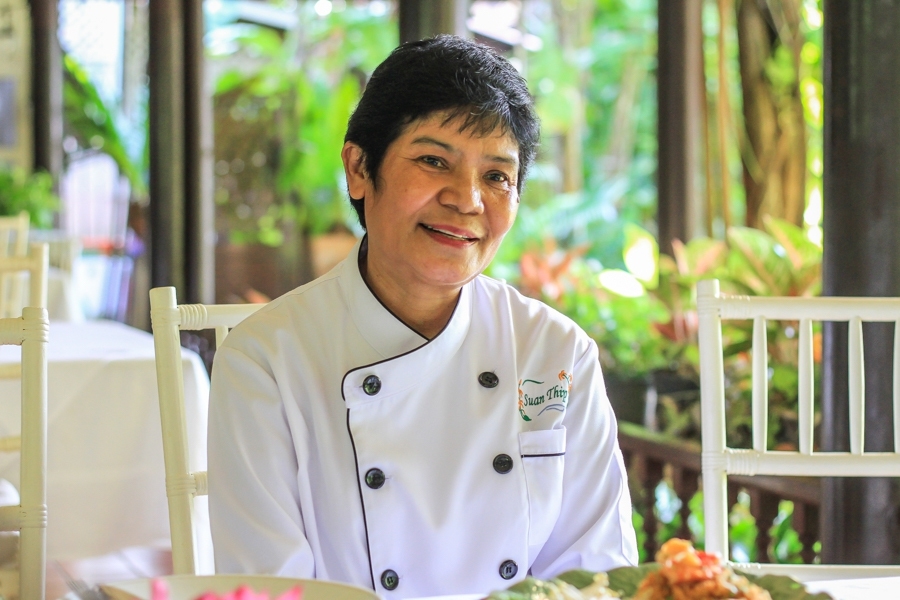
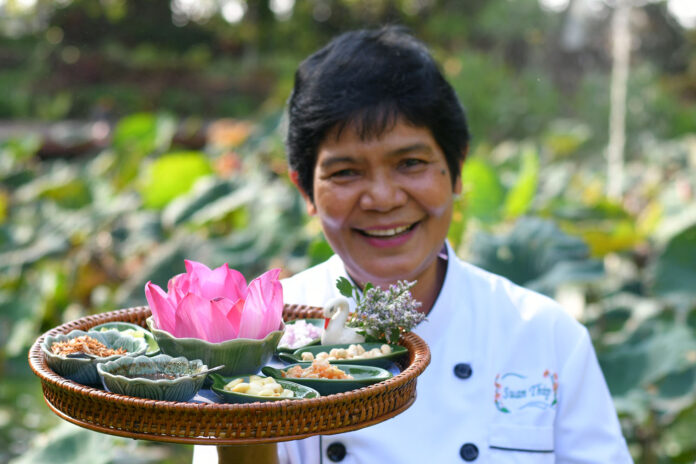
Banyen Ruangsantheia holds a tray of Lotus Wraps in November 2018, soon after she won her first Michelin star.
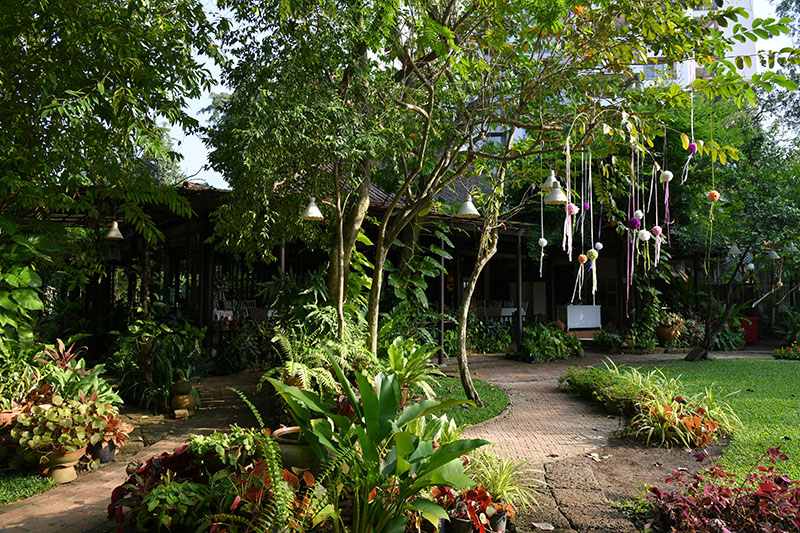
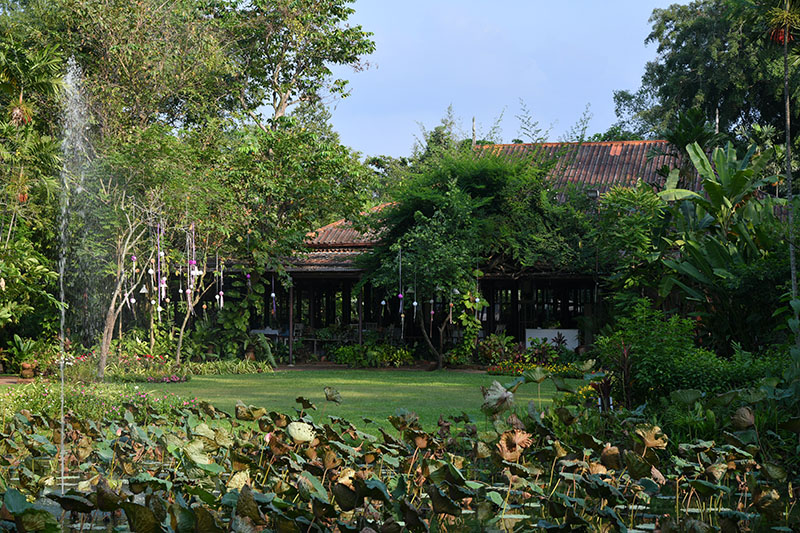
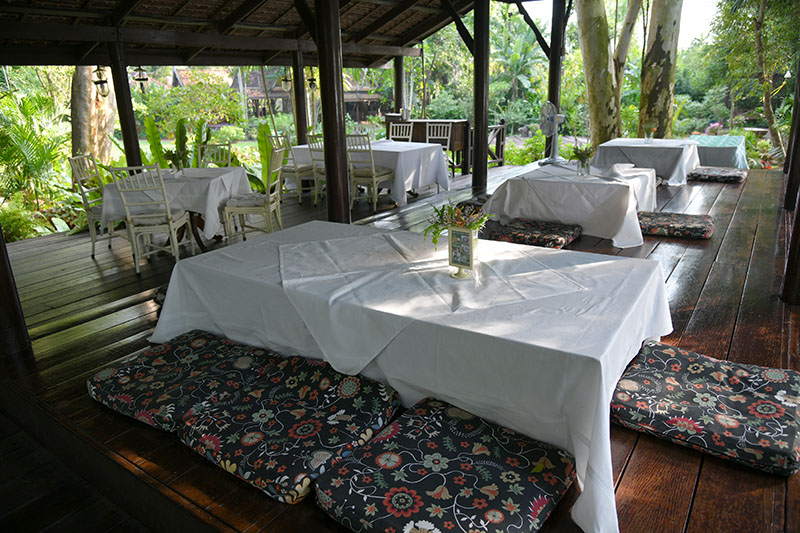
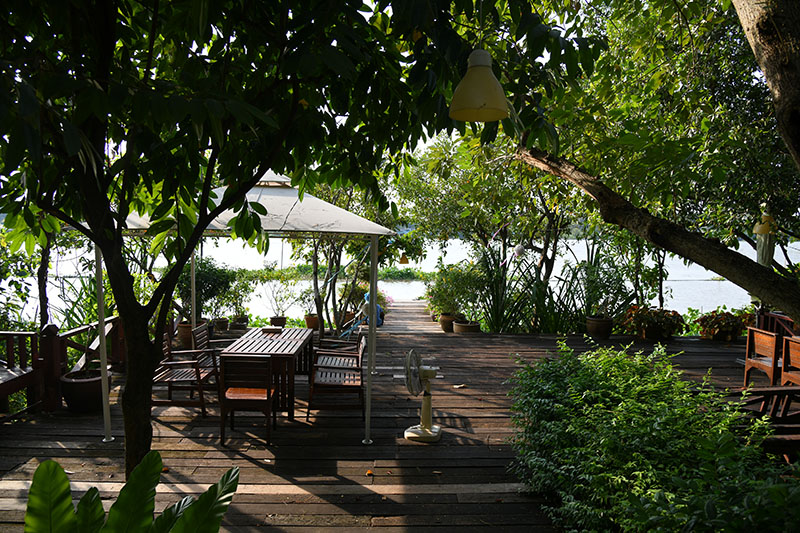
North of Bangkok the Chao Phraya River flows more languid and clear than in the city. Mats of water hyacinth bob past a weathered wooden deck where pots of bougainvillea spray blots of pink. Guests chat at scattered tables and chairs in a dining area staff say floods when the river rises each year. Pompoms and streams of ribbons spin in the breeze. At the center of a nearby garden, a large fountain showers a lotus-choked pond before a backdrop of Thai-eaved roofs.
This past Friday, there were no pink blooms in the lotus pond. They had already been picked by Banyen Ruangsantheia for her Lotus Wraps.
The fusion of place and cuisine are distinctive of Suan Thip, which last week became the first restaurant in neighboring Nonthaburi province to win a Michelin star. At an awards ceremony at an upscale Bangkok hotel, most chefs and owners cheered their achievements. A few others looked overwhelmed by the prospect of a crush of new customers the recognition would bring.
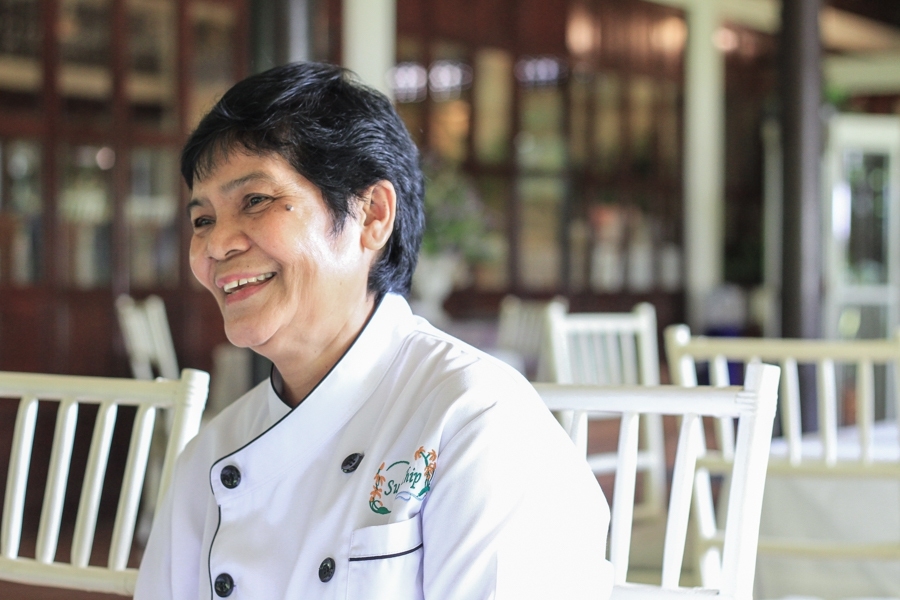
Then there was Auntie Banyen. Laughing and appearing a bit confused by all the fanfare, she appeared simply delighted to be there and may go down as one of the award’s most humble recipients. Just weeks earlier, she’d never even heard of the Michelin Guide.
“One day a staff member ran to me while I was cooking, telling me that I had to go to the Michelin Star announcement. I was thinking, ‘Why would I go there?’ because I had no idea what a Michelin Star was,” she said.
The dishes that won 62-year-old Banyen her star are not buried in any recipe book, but memorized by rote, in part because she is functionally illiterate. Born to poor rural farmers in Korat, she was the third daughter among nine children. She stopped going to school in the fourth grade. To help make ends meet, she started doing heavy farm work at 13 for 10 baht a day.
“I carried crates of cassava. I can carry this,” she said, lofting a tray overloaded with Lotus Wraps. “I’ve faced many hardships. I’m a fighter.”
When she was 15, she traveled to Bangkok alone to work as a housemaid for a Chinese family in Yaowarat for monthly pay of 800 baht. The mistress of the house saw that Banyen was a neat cleaner and tidy laundress and told her that the next step was to cook for them. She had little experience.
How is it that some normal, folksy dishes got such a high award to be praised internationally?
Thus began an education that would, decades later, elevate her to global culinary recognition.
“Cooking isn’t easy; it’s hard. And the Chinese family didn’t eat so much gaeng [curry], they had things like tom yum, water mimosa stir-fry and palo [five-spice soup],” she said.
Not long after, in 1974, a relative tipped her off that a riverside restaurant in Nonthaburi would be opening. So Banyen hung up her apron to fold jasmine flowers out of cotton for Suan Thip, which wouldn’t become the full-fledged restaurant of today until 1985. At the time, the restaurant was only open intermittently and on a good day pulled in only a couple thousand baht.
But the traditional Thai recipes the restaurant called for brought back memories of her mother’s cooking. Coupled with the kitchen know-how she picked up as a maid, Auntie Banyen was soon being asked by the cooks to taste test their curries.
“I tried to remember what I had learned from watching my mom. She used to say that I had to learn before when there was no one to teach me,” she said. “They would ask me to taste and I would say, ‘It’s not right.’ ‘More salt, more sugar,’ I would say.”
With little history of customers, Banyen relied on her memory and grit to rise through the ranks at the restaurant.
“I told myself: Taste it, remember it, don’t forget it. Every time you cook, it has to taste the same,” she said, stressing the words. “Everything relied on memory. I can read and write my name but not very much else. I have to memorize how to cook everything.”
Banyen would claim a couple of the bubbling curry pots as hers so that she could carefully monitor them, refusing to let others in the kitchen near.
“At some points I even remembered the taste some customers liked, such as extra sour,” she said. “I was always afraid some customers would get a runny stomach. If I got any complaints, I would lie awake thinking about it.”
A Star is Born
When a Michelin taster came to Suan Thip in April – staff there remember it being a farang – he left a card after eating. Banyen was in the kitchen at the time, and the busy restaurant staff forgot to contact the card holder.
It wasn’t until a couple weeks later that he called the restaurant and said Banyen should keep Nov. 14 free to pick up her award.
“How is it that some normal, folksy dishes got such a high award to be praised internationally?” Banyen said, in a sort of amazed wonderment.
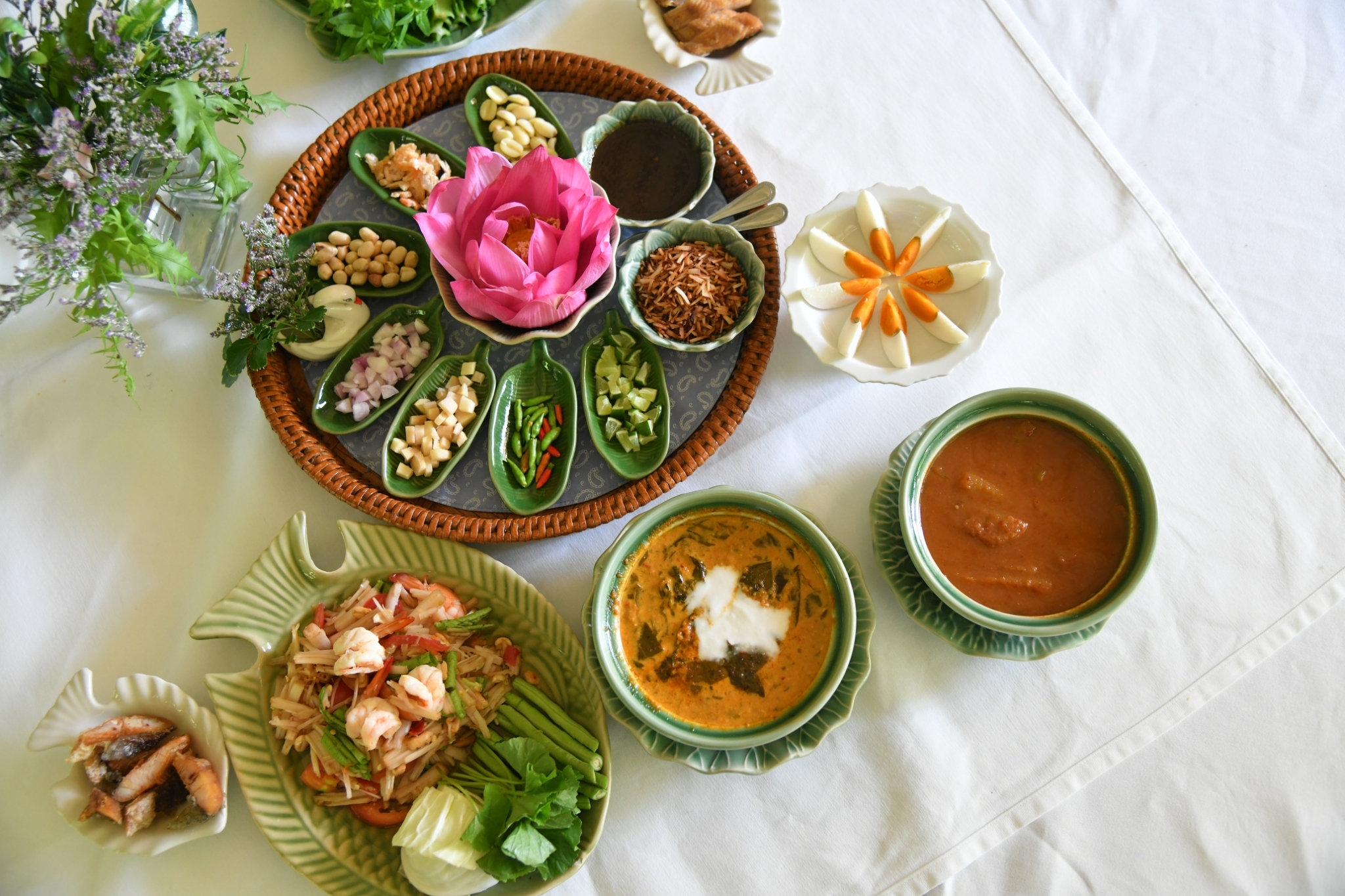
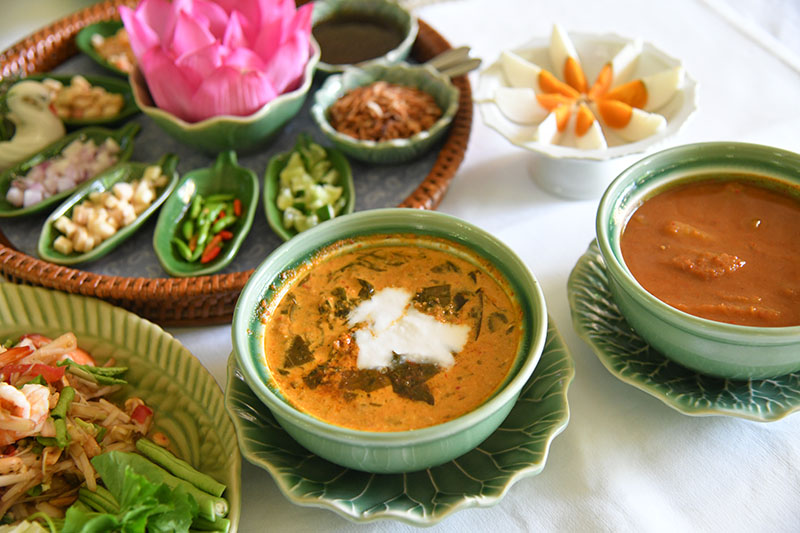
Suan Thip dishes such as the Lotus Wraps, Lotus Root Som Tam, gaeng bon and gaeng kee lek.
Suan Thip’s clientele, despite its distance from downtown, includes a large foreign clientele. She suspects that and its popularity as a venue for small weddings and official functions are probably what clued Michelin in to the restaurant.
“Farangs always order the kaeng kee lek,” she said, referring to one of her signature dishes, the Siamese cassia curry. “I don’t know why they love it just so darn much.”
We cooks shouldn’t be stingy about good ingredients. Use them, and the taste will come out fully
What of the coming storm guide-toting customers who’d never heard of the place until last week?
Despite her initial bewilderment, Banyen is happy she can now pass on the kind of very traditional Thai dishes absent from many restaurants to a larger audience.
“I have to keep passing on these folksy foods, generation to generation,” she said. “Still, none of my staff so far want to take up the mantle after me. They see that I have to work and stand all day. I always ask them, ‘If something happens to me, what will you do?’”
Khaosod and Khaosod English’s interview with Auntie Banyen.
In the weeks before and after getting her star, Banyen said she’s had no days off, working from 5am to prepare until closing time at 9pm.
“They want to come support the restaurant, so I don’t think about being tired,” Banyen said with a sudden fire in her voice, raising a wrinkled fist. “I tell myself, ‘I can fight, I can fight a little bit more!’ The award gives me inspiration, I’m so honored to get it. I will keep improving; I won’t make any mistakes.”
Gaeng kee lek, or Siamese cassia curry (260 baht).
Eating at Suan Thip
Suan Thip is set amid a lush garden (“There’s so many trees people think a tiger might jump out!”) with the lotus pond and about 32 tables arranged outdoors by the river, under small pavilions and indoors. One of the outdoor pavilions remains closed since it was heavily damaged by the severe flooding of 2011.
In addition to a great view, customers can enjoy relatively low prices as well as the food itself, all Thai and tangy with a spice level to make the proudest native break into a satisfying, sa jai, sweat.
Lotus Wraps (250 baht).
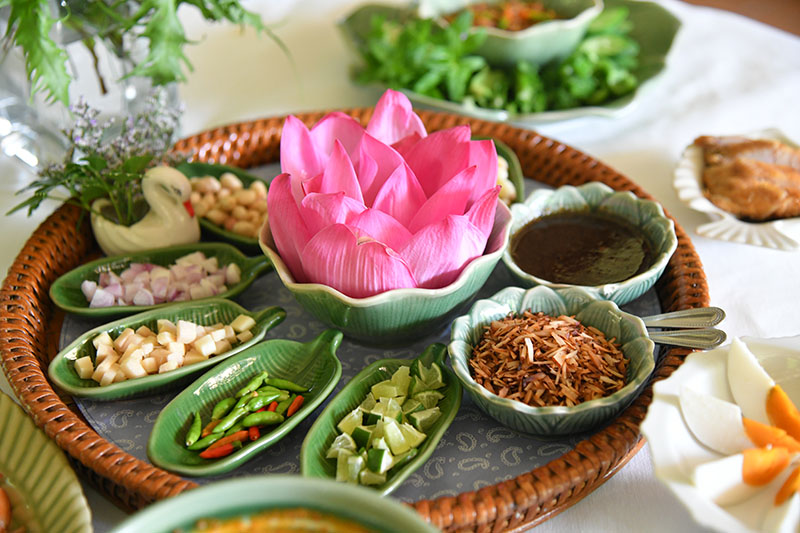
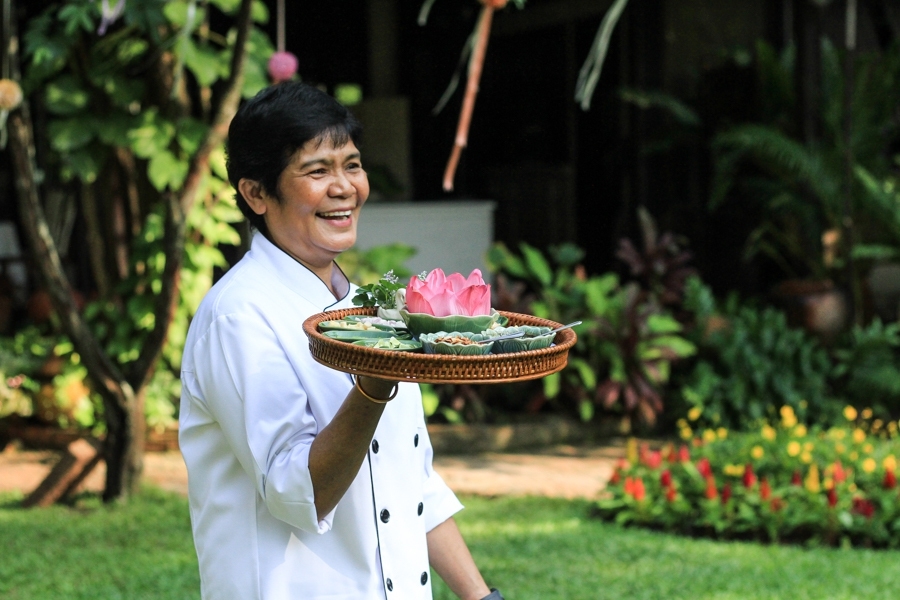
The most photogenic dish is the miang kum gleeb bua, or Lotus Wraps (250 baht). A pink lotus blooms in the center of the tray, its puckered stigma intact. Palm a fresh petal and spoon into it some chilies, lime, shallots, peanuts, ginger, toasted coconut, dried shrimp, lotus seeds (also from the pond) and a galangal sauce for a lovely, raw, refreshing starter. Note: Availability depends on the pond’s output.
Naam prik Nakhon Ban (325 baht).
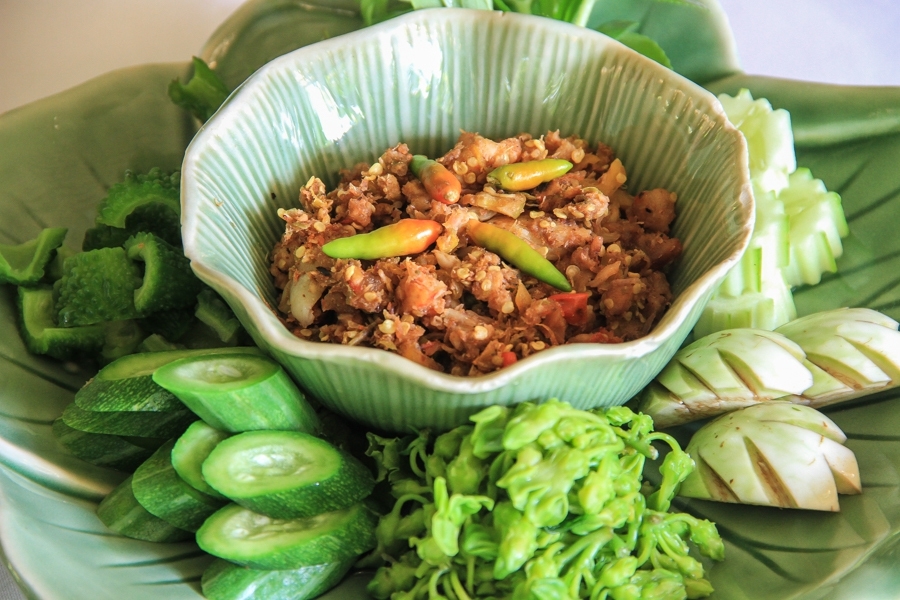
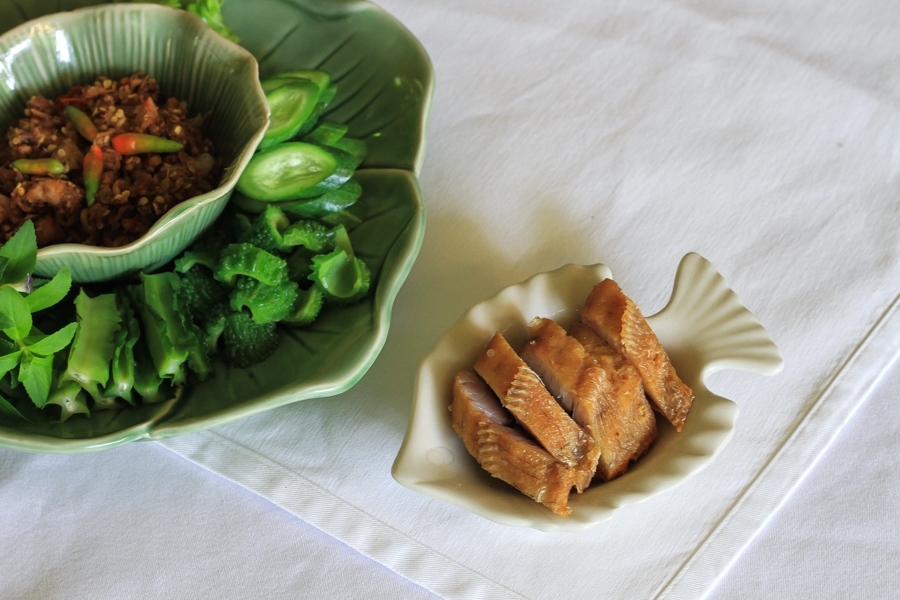
Unlike most other chili pastes, the Naam prik Nakhon Ban (325 baht) is chunky and full of pork crackling and unfamiliar vegetables like madan and fuzzy eggplant. Restaurant lore says it was based on the personal recipe of ‘70s-era Prime Minister Kukrit Pramoj. Into the chili, dip milkweed flowers (dok kajon), culantro tips, cucumber, white eggplant, winged beans and bitter melon slices for a lesson in edible tropical plants. It’s all sourced from the kitchen’s garden and further educates diners on how well sweat can cool off a spicy burn.
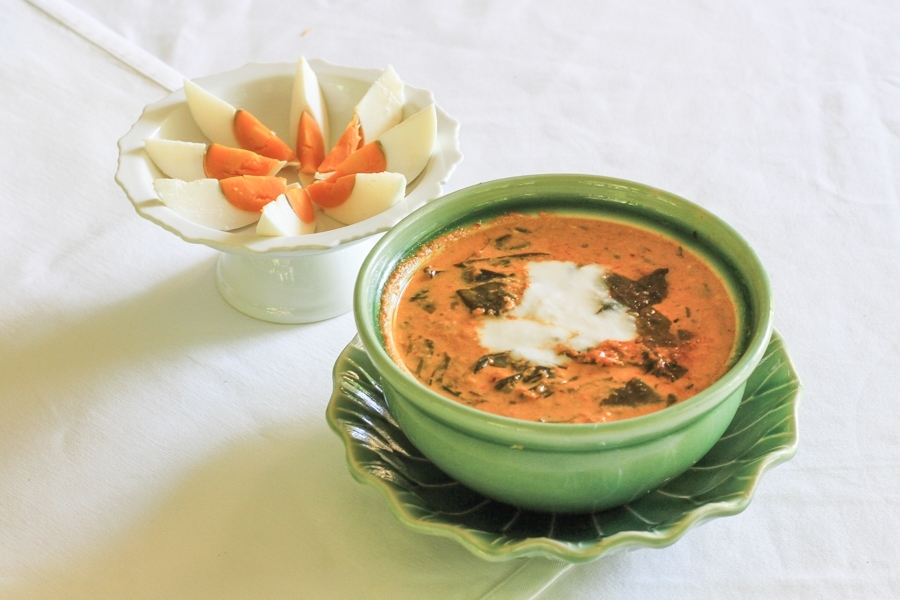
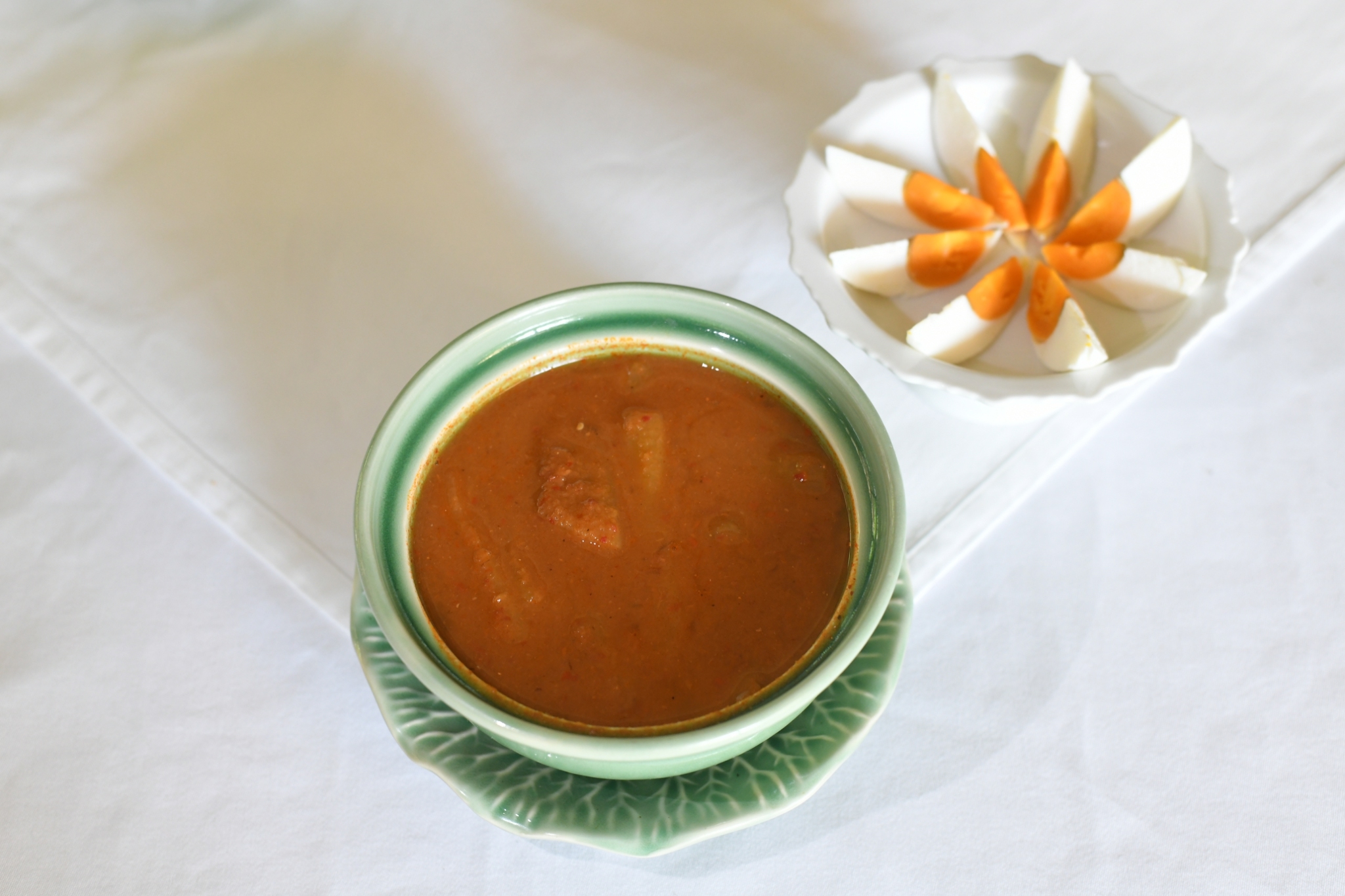
Gaeng kee lek, or Siamese cassia curry (260 baht).Gaeng bon, a curry made from stems of the elephant ear plant (260 baht).
Still, the uncontested stars of the newly starred restaurant are the humble chaobaan (country) dishes that are Banyen’s pride: the gaeng kee lek, or Siamese cassia curry, and gaeng bon, a curry made from stems of the elephant ear plant. The gaeng kee lek, which comes paired with crispy-skinned snakehead fish, brims with a coconut creaminess for palates averse to spice or seeking to tame existing mouth-infernos. The gaeng bon’s stems are carefully boiled to the point where the grilled mackerel stewed into the soup seeps in, fortified by an extra punch from salted egg on the side. These two curries (both 260 baht) seem to best summarize Banyen’s decades of cooking.
“We cooks shouldn’t be stingy about good ingredients. Use them, and the taste will come out fully,” she said as she launched into the importance of boiling the cassia and grilling the mackerel at the right time.
Lotus Root Som Tam (250 baht).
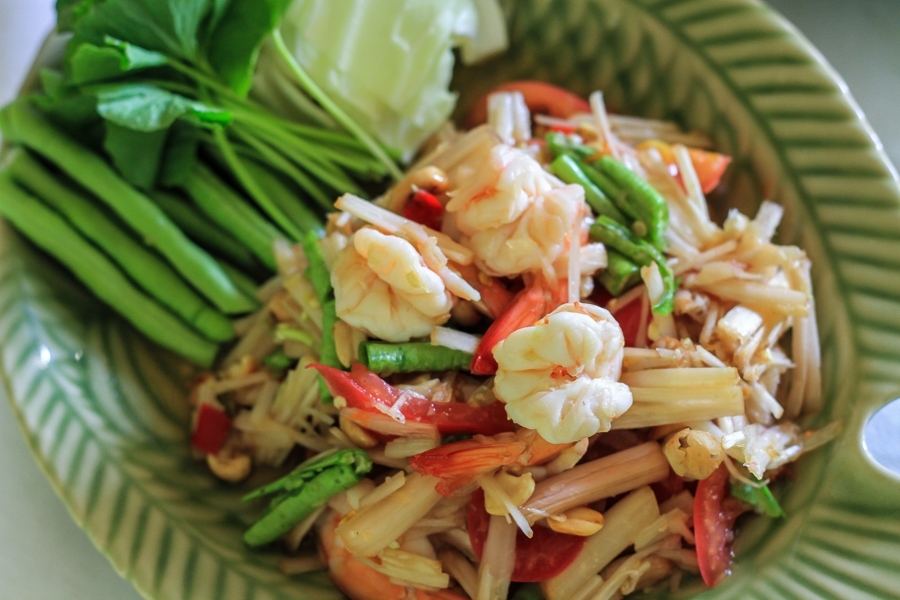
The pond isn’t done giving yet. It’s also the source of the som tam lai bua, or Lotus Root Som Tam (250 baht). Not terribly spicy and satisfactory for Thai and foreign tongues, both of which will enjoy the novelty of crispy, fleshy pulp topped with fresh shrimp instead of the usual papaya and dried shrimp.
Coconut ice cream (95 baht).
The use of quality coconut milk is evident in the first scoop of desserts such as the coconut ice cream (95 baht) and bua loi rice balls in taro and pumpkin flavor (135 baht).
Any source of coconut ice cream, whether from a boutique creamery or a pushed cart, is unlikely to hold a candle to that served here, with thoughtfully placed toppings of sugar palm fruits, mock pomegranates and pandan cendol. The bua loi itself are delightfully bouncy, with coconut milk so creamy a born and bred Thai would swear they’ve never tasted gati before, ever.
With its weathered deck, pond-sourced food and lovely veteran aunt in the kitchen, Suan Thip’s simple, honest fare and ascension to Michelin status won’t please all the self-proclaimed foodie snobs – but it humbly deserves all the glory it never asked for.
Naam prik Nakhon Ban (325 baht) with snakehead fish.Bua loi (135 baht).
Suan Thip is located on Soi Sukhaprachasan 2 in the Pak Kret district of Nonthaburi province. By car, it is about 20 kilometers from BTS Mo Chit and MRT Chatuchak. Alternately, take the MRT Purple Line to the Yaek Nonthaburi 1 station, from which it lies 10 kilometers away by road.
A woman walks out of an outlet of Dolce&Gabbana in Shanghai, China Wednesday Nov. 21, 2018. Photo: Chinatopix Via AP
BEIJING — Thai celebs Mario Maurer and Davika “Mai” Hoorne on Thursday expressed disappointment about not attending a Dolce&Gabbana show in China the fashion giant canceled over insulting remarks conveyed on its Instagram.
Dolce&Gabbana apologized Wednesday for the remarks it allegedly made in exchanges on Instagram but claimed its accounts had been hacked. Chinese celebrities reacted angrily after screenshots of the conversations were posted on social media and several said they would boycott a Dolce&Gabbana show scheduled for Wednesday night.
The company later said the show, an extravaganza meant as a tribute to China with Asian stars invited to take front-row seats, had been called off.
Mario and Davika were invited to be part of the show. They said they were disappointed about the abrupt cancelation but said they respected the decision of all parties involved.
The screenshots of what appeared to be private messages from co-founder Stefano Gabbana show him using poop emojis to describe China with the phrase “China Ignorant Dirty Smelling Mafia,” while those appeared coming from the brand official account include “eat dog bitch im block you.”
Dolce&Gabbana apologized on Instagram and said the accounts had been hacked. “We are very sorry for any distress caused by these unauthorized posts,” it said. “We have nothing but respect for China and the people of China.”
Zhang Ziyi, who starred in “Crouching Tiger, Hidden Dragon,” said on one of her social media accounts that the Italian brand had “disgraced itself.”
The studio for pop idol Karry Wang, an Asia-Pacific brand ambassador for Dolce&Gabbana, said late Wednesday that it had informed the fashion house that it would terminate all cooperation with the brand. Both Wang and Zhang had been invited to attend the event.
Stefano Gabbana also wrote on his Instagram that his account had been hacked, adding “I love China and Chinese culture. I’m sorry for what happened.”
The three promotional videos, which have been deleted from the company’s Weibo account, feature a Chinese woman using chopsticks to eat pizza and other Italian food. Many Chinese social media users called the videos racist and full of outdated stereotypes.
The videos still appear on its Facebook and Instagram accounts. They’re captioned “First up today is how to use this stick shaped cutlery to eat your GREAT traditional Pizza Margherita.”
欢迎收看Dolce & Gabbana “起筷吃饭” 第1弹。今天我们将率先向大家展示,如何用这种小棍子形状的餐具,来吃意大利伟大的传统玛格丽特披萨。Welcome to Episode 1 with Dolce&Gabbana’s “Eating with Chopsticks”. First up today is how to use this stick shaped cutlery to eat your GREAT traditional Pizza Margherita. #DGLovesChina#DGTheGreatShow
In a statement from Milan headquarters, designers Gabbana and Domenico Dolce said, “What happened today was very unfortunate not only for us, but also for all the people who worked day and night to bring this event to life.”
The Shanghai extravaganza was to include 300 models previewing a new collection on a rotating stage, including super model Eva Herzigova and Isabella Fontana during a brand DNA section, and a lineup of millennial stars and influencers for a second section dedicated to the future. The final part of the show was to be dedicated to Asia, with Asian models and a front row of Asian stars among the 1,000 invited guests, including actor Darren Wang, actor Jing Kang Liang, singer Stan Young and actress Bing Bing Lee, along with Wang and Zhang.
Asia, and China in particular, is key to European luxury brands’ success. A recent study by Bain consultancy said one-third of all high-end purchases are made by Chinese consumers, shopping both at home and abroad. That is expected to rise to 46 percent by 2025, fueled especially by millennials and generation Z teens.
Dolce&Gabbana has 44 boutiques in China, including four in Shanghai, having entered the Chinese market in Hangzhou in 2005.
Dolce told The Associated Press in an email interview before the controversy erupted that the designers had planned an “homage to China, to celebrate the country, and at the same time, to tell our story and love for fashion.”
“‘We want to give life to a great show that we hope will be unforgettable to everyone. We used details that belong to the local culture, but always with sensitivity, without being intrusive.”
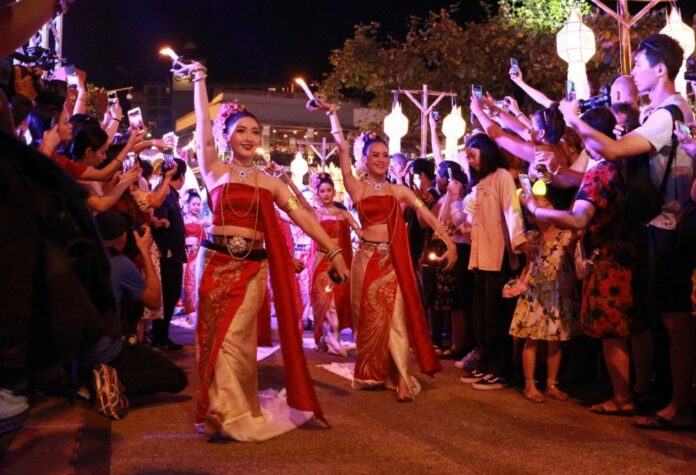
Dancers perform to mark beginning of Yi Peng, a northern variation of Loy Krathong, in Chiang Mai on Wednesday night
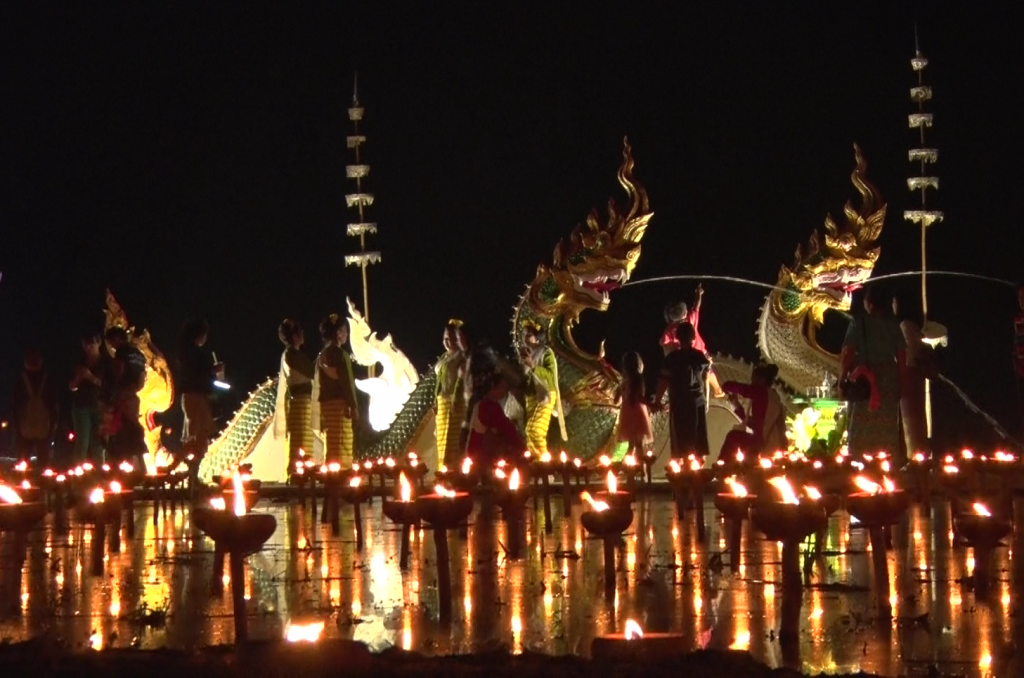
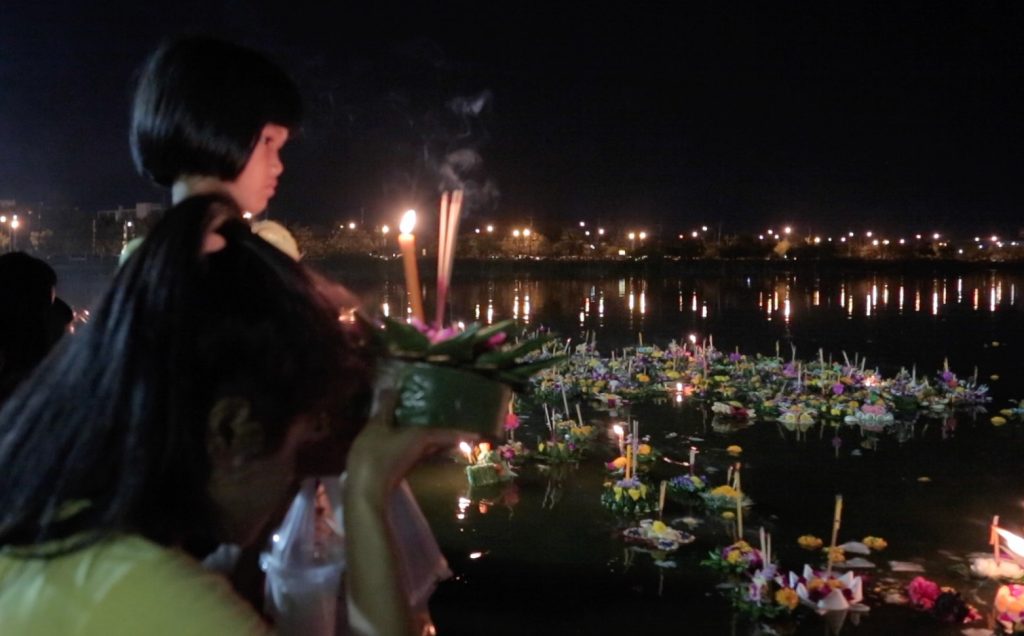
BANGKOK — After a two year hiatus, the river lantern festival of Loy Krathong is making a comeback in its blazing glory this evening.
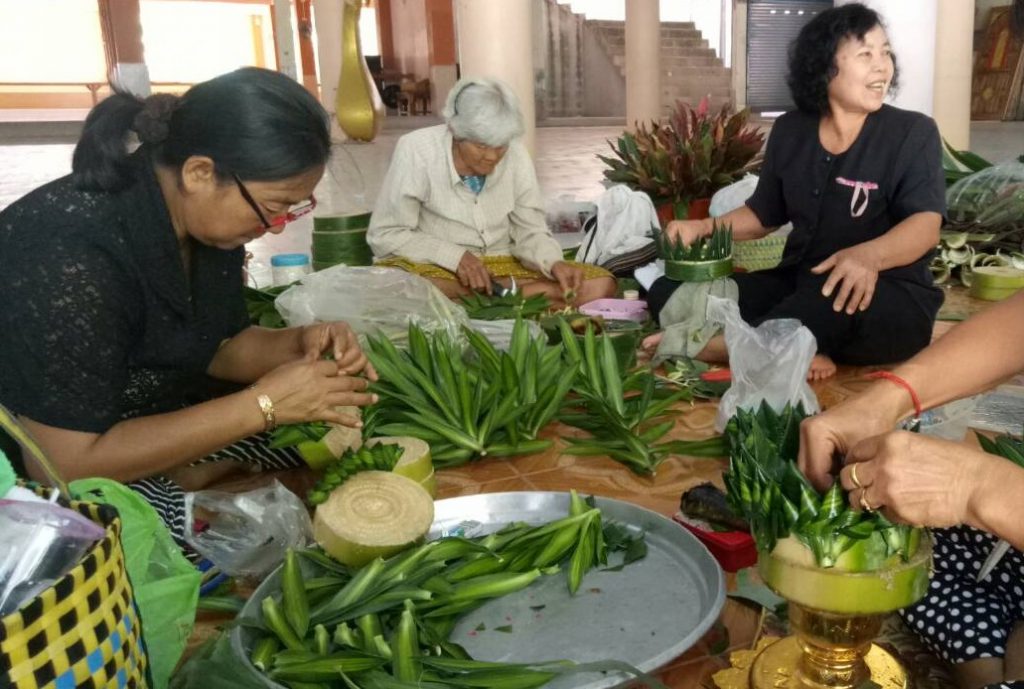
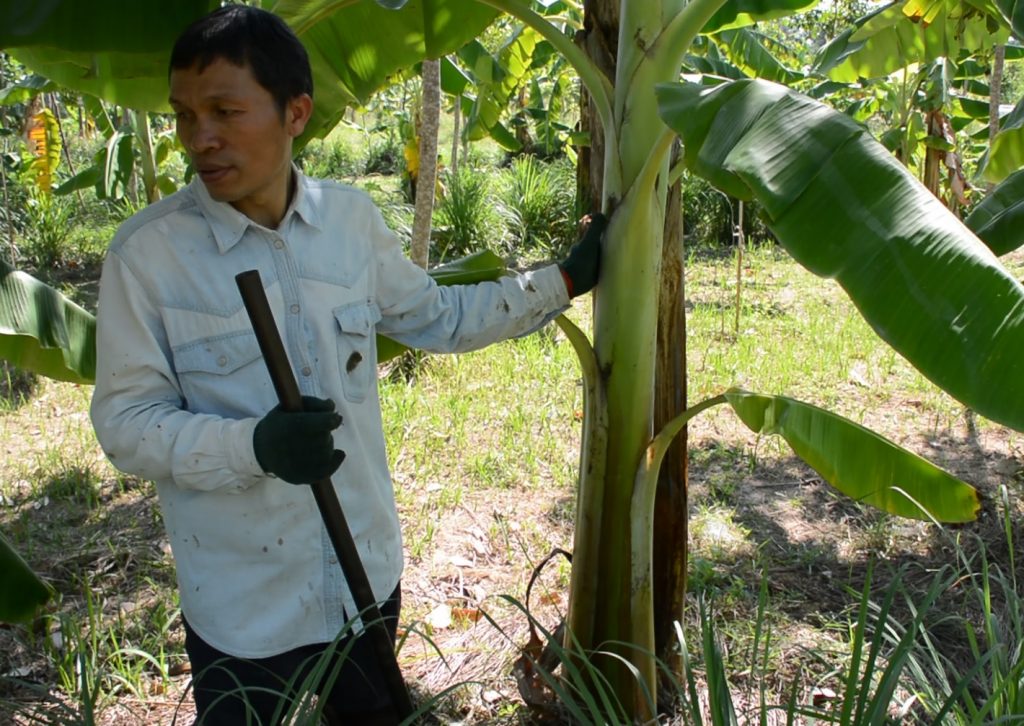
Vendors countrywide are busy sewing banana leafs into krathongs, festivities are planned and even junta chairman Prayuth Chan-ocha will personally float his krathong at a canal next to Government House later today, according to officials.
Up north in Chiang Mai province, the local variation of Loy Krathong kicked off last night. Called Yi Peng festival, it involved floating krathongs in rivers and releasing lit lantern balloons into the night sky.
In Sukhothai province, identified by official historical narratives as the birthplace of Loy Krathong, palace aides brought a royal lantern lit by King Vajiralongkorn himself for ceremonial use tonight.
In Bangkok, up to 30 parks will be opened to Loy Krathong revellers tonight.
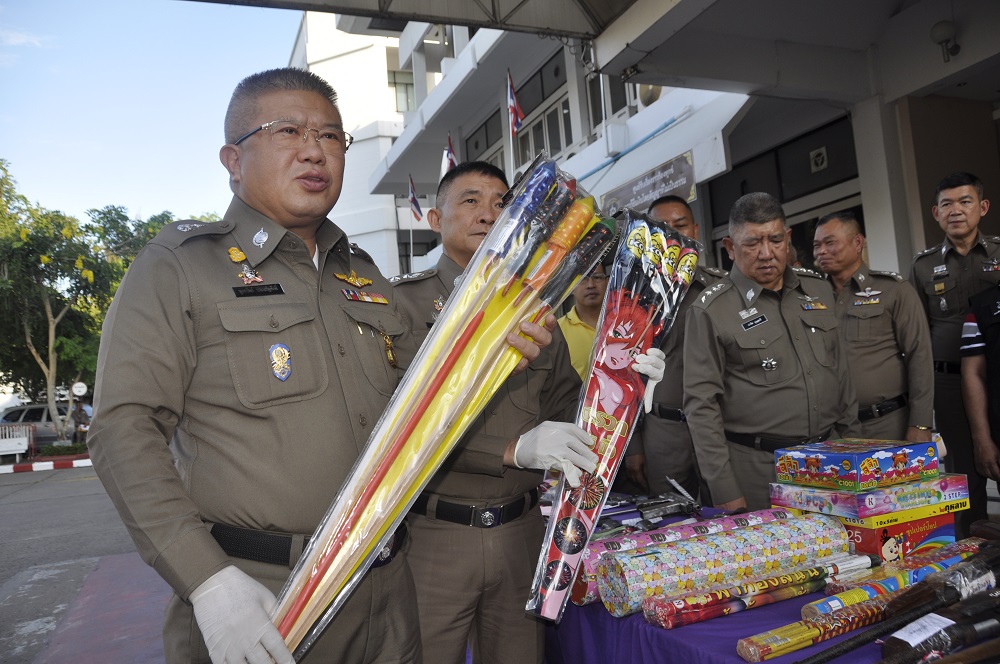
A palace aide in Sukhothai province guards a royal lantern lit by His Majesty the King.Revelers at Yi Peng festival in Chiang Mai.Temple-goers sew krathongs at a temple in Prachinburi provinceAn early Loy Krathong celebration in Khon Kaen province.A farmer in Amnat Charoen province selects which banana trees to be cut down to make krathongs.A police officer shows illegal firecrackers confiscated in Korat. Police have banned unsanctioned use of fireworks during Loy Krathong.











































 Not long after, in 1974, a relative tipped her off that a riverside restaurant in Nonthaburi would be opening. So Banyen hung up her apron to fold jasmine flowers out of cotton for Suan Thip, which wouldn’t become the full-fledged restaurant of today until 1985. At the time, the restaurant was only open intermittently and on a good day pulled in only a couple thousand baht.