BANGKOK — It’s neither the part of the brain associated with memory or a school for African herbivores, but an indie quintet taking a stand for the #Metoo movement.
Hippo Campus is heading to Bangkok as part of their Bambi Tour, according to local gig promoter Seen Scene Space, who recently co-organized November’sMahorasopoutdoor music fest.
The alternative pop rock outfit will perform March 22 at Live Arena in the RCA area. Bangkok’s catchy tropical indie band Gym and Swim will play as the opening act.
The concert is 20 and up.
Tickets purchased onlineare 1,000 baht and 1,200 baht at the door. They go on sale at noon on Saturday.
Hippo Campus was formed in 2013 in the American midwest and has performed at major music festivals such as South by Southwest and Lollapalooza. In September, their sophomore studio album “Bambi,” a thoughtful look at sexism and harassment post-#Metoo, won critical acclaim.
An undated photo by David Callisch shows cats Tina, at top, and Louise relaxing at home in San Jose, California.
SAN JOSE, California — Two cats are living large in a studio apartment costing USD$1,500 (47,500 baht) a month their owner rents for them in Silicon Valley, where a housing shortage has sent rents skyrocketing.
The Mercury News reports the 9-kilogram cats named Tina and Louise moved to the studio in San Jose after their owner moved away to college.
The student’s father, Troy Good, was unable to keep them and asked friend David Callisch to rent him the kitchen-less studio so he could keep his daughter’s beloved cats.
The newspaper reports Good and his cats got a decent deal because an average studio apartment in San Jose rents for $1,951 a month, according to RentCafe.
Callisch says he feels bad wasting valuable living space on animals during a housing shortage, but he wanted to help a friend.
Brazil's President Jair Bolsonaro smiles during a ceremony where he signed a decree loosening restrictions on owning firearms Tuesday at Planalto presidential palace in Brasilia, Brazil. Photo: Eraldo Peres / Associated Press
RIO DE JANEIRO — President Jair Bolsonaro on Tuesday signed a decree making it easier for many Brazilians to own firearms, the first of many expected changes by the nascent administration to overhaul gun laws in the nation that leads the world in total homicides.
Bolsonaro signed the decree in a televised ceremony in the capital of Brasilia, arguing that it and other changes expected to be pushed in Congress would help people defend themselves. The former army captain and far-right leader, who won last year’s election on promises to crack down on crime, said citizens in Latin America’s biggest country have long made clear that they wanted to arm themselves.
“The people decided in favor of buying guns and ammunition and we can’t deny what the people wanted at that moment,” Bolsonaro said, referring to a 2005 referendum in which Brazilians voted against banning the manufacturing and selling of guns.
The decree established a wide range of categories for gun ownership qualification, and government officials said it was crafted to cover just about any citizen wanting a firearm.
The categories include citizens living in rural areas, in urban areas with high levels of homicide, business owners, gun collectors and hunters. Prospective gun owners must still meet other requirements, such as not having a criminal record, taking a psychological exam, completing a course at a gun club and being at least 25.
Before the decree, the law stipulated that civilians who wanted to own a gun had to justify their interest. Bolsonaro and other proponents of relaxing legislation argued that such a requirement was arbitrary — such reviews happened with a federal police official — and meant that in practice many would-be owners were denied.
The decree also extended from five to 10 years the period to renew the registration of each firearm, and increased from two to four the number of guns each person can own.
In one area that could be interpreted as tightening the law, it required gun owners have a safe with a key in any home with children, adolescents or a person with a mental disability.
While the decree allows more people to buy weapons, it remains illegal for most civilians to carry them in public. Bolsonaro and the so-called “Bullet Caucus” in Congress plan a legislative push to overturn that.
Security experts have long argued that more guns will lead to increased violence.
“If the Brazilian government is sincere about improving public security and fighting organized crime, it will enforce existing gun laws rather than dismantling them,” said Igarape, a Brazilian think tank, in a statement. “Specifically, it should strengthen national data gathering on seized firearms to disrupt trafficking. It must improve oversight over the arms holdings of police and private security companies.”
For decades, Brazil has been the world leader in annual homicides. Last year, nearly 64,000 were killed, the majority by firearms.
Despite tight gun laws, arms are widely available. Drug traffickers in slums are commonly seen brandishing automatic weapons. Many guns possessed illegally begin as legal, and were then stolen from police or military personnel or sold by corrupt people in those institutions.
Several studies, both in the United States and Brazil, have found a correlation between increased guns and homicide and suicide rates. However, some social scientists, and gun proponents, argue such data is inconclusive.
Bolsonaro and others in his administration have argued that allowing more Brazilians to carry guns would help combat criminality, one of his key campaign promises.
“Any criminal in any part of the world fears an armed citizen,” said chief of staff Onyx Lorenzoni minutes after the decree was signed.
“England saw its home assaults increased by 40 percent since guns were banned there,” he added, without providing more details.
Polls have consistently shown most Brazilians want tighter restrictions on guns.
A Datafolha poll published at the end of last year found that 61 percent believed firearms should be prohibited and posed a threat to others. The poll interviewed 2,077 people Dec. 18-19 and a had a margin of error of 2 percent.
There were many signs Tuesday that fights over gun laws were just beginning. In an editorial titled “Reckless Decree,” the newspaper O Globo criticized the changes for not being paired with better mechanisms to track guns.
Many Bolsonaro supporters took to Twitter to laud the changes or argue, in angry language, that the decree didn’t go far enough.
Shares of gun manufacturer Taurus, which has enjoyed steady gains the last several months in anticipation of sweeping changes, closed 22 percent down. Many interpreted that as sign investors had expected Bolsonaro to go further, particularly in the number of guns each person can have. Proponents of loosened laws have long pushed for no limit.
Meanwhile, Sou da Paz Institute, a rights group dedicated to violence reduction, launched an online campaign with ads blasting the government for its central argument for the change: that guns put people in a better position to protect themselves.
“When you are sick, the government doesn’t ask you to buy a scalpel and operate on yourself,” said one of the ads. “If you’re suffering because of crime, why do you have to protect yourself?”
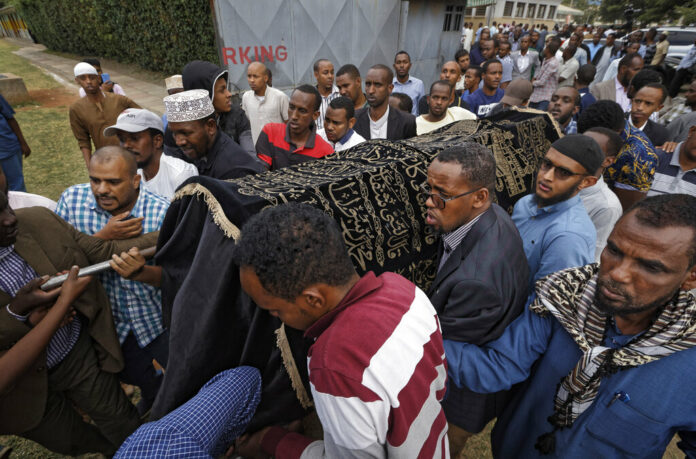
Mourners on Wednesday carry the body of Feisal Ahmed, who was killed with his colleague Abdalla Dahir in Tuesday's attack, as they leave a mosque and head to the funerals in Nairobi, Kenya. Photo: Ben Curtis / Associated Press
NAIROBI — The death toll from an extremist attack on a luxury hotel and shopping complex in Nairobi climbed to 21, plus the five militants killed, police said Wednesday in the aftermath of the brazen overnight siege by al-Shabab gunmen. Two people accused of facilitating the attack were arrested.
The number of those killed at the DusitD2 complex rose with the discovery of six more bodies at the scene and the death of a wounded police officer, said Joseph Boinnet, inspector-general of Kenyan police. Twenty-eight people were hurt and taken to the hospital, he said.
In a televised address to the nation earlier in the day, President Uhuru Kenyatta announced that the all-night operation by security forces to retake the complex was over and that all of the extremists had been killed.
“We will seek out every person that was involved in the funding, planning and execution of this heinous act,” he vowed.
In an attack that demonstrated al-Shabab’s continued ability to strike Kenya’s capital despite setbacks on the battlefield, extremists stormed the place with guns and explosives. Security camera footage released to local media showed a suicide bomber blowing himself up in a grassy area in the complex, the flash visible along with smoke billowing from the spot where he had been standing.
Of the civilian victims, 16 were Kenyan, one was British, one was American and three were of African descent but their nationalities were not yet identified, police said.
Al-Shabab, which is based in neighboring Somalia and allied with al-Qaida, claimed responsibility. The Islamic extremist group also carried out the 2013 attack at Nairobi’s nearby Westgate Mall that killed 67 people, and an assault on Kenya’s Garissa University in 2015 that claimed 147 lives, mostly students.
While U.S. airstrikes and African Union forces in Somalia have degraded the group’s ability to operate, it is still capable of carrying out spectacular acts of violence in retaliation for the Kenyan military’s campaign against it.
The bloodshed in Kenya’s capital appeared designed to inflict maximum damage to the country’s image of stability and its tourism industry, an important source of revenue.
The government said late Tuesday that buildings were secure. However, gunfire continued into Wednesday morning, and dozens of trapped people were rescued overnight. Several loud booms were heard Wednesday as teams sought to clear the complex of booby traps and other explosives.
Kenyatta’s announcement that the security operation was complete came about 20 hours after the first reports of the attack.
The Kenyan Red Cross said about 50 people were unaccounted for. But many of those were believed not to have been in the complex during the attack.
Ken Njoroge, CEO of a company in the DustiD2 complex that offers mobile banking services, said he was unable to locate several employees. “It’s very difficult for the families because the passage of time only makes the problem bigger,” he said.
The American killed in the attack was identified as Jason Spindler, co-founder and managing director of San Francisco-based I-DEV International. Spindler’s father, Joseph, said his son worked with international companies to form business partnerships in Kenya that would boost local economies.
The Houston-raised Spindler had a brush with tragedy on 9/11: He was employed by a financial firm at the World Trade Center at the time of the 2001 terrorist attack but was running late that morning and was emerging from the subway when the first tower fell, according to his father. He became covered in dust and debris as he tried to help others, the elder Spindler said.
In the Nairobi attack, a man who gave only his first name, Davis, described how he had escaped with colleagues by fleeing down a fire escape.
“It’s a traumatic experience. It shakes you,” he said. Still, Davis said he was impressed by the “inner strength” and compassion of people who helped each other in the midst of danger.
His own thoughts, he said, were: “Get people out and get out yourself. That’s it.”
Gen. Prawit Wongsuwan talks to reporters Wednesday at the Defense Ministry.
BANGKOK — Thailand’s deputy junta leader said Wednesday it was “good enough” that no Thais were killed in an apparent terror attack on a Thai-owned hotel complex in Kenya that left at least 14 people dead.
Addressing reporters during a daily morning briefing, Gen. Prawit Wongsuwan’s flippant comment came as the Dusit Thani Co. this afternoon announced its Thai employees were all safe after Tuesday’s heavy assault on Nairobi’s DusitD2 hotel, which it will close temporarily.
“It’s good enough that no Thai people died,” he said. “The Foreign Affairs Ministry is dealing with this.”
A reporter then asked him why he thought a Thai hotel had been targeted.
“I don’t know. Maybe because the food is delicious,” he responded.
In its statement, Dusit Thani said it has provided full support to its employees and guests affected by the deadly attack.
“We’re deeply sorry about what happened. Our guests and employees’ safety is our top priority, and we will take care of them with our best effort,” the statement read.
Al-Shabab, a Somalian-based Islamist group, claimed it was behind the attack at the hotel’s cafe which left scores injured and killed at least 14 people, including an American. Assailants stormed the hotel Tuesday afternoon before setting off explosions and gunning people down. The standoff with Kenyan security forces dragged on for at least eight hours.
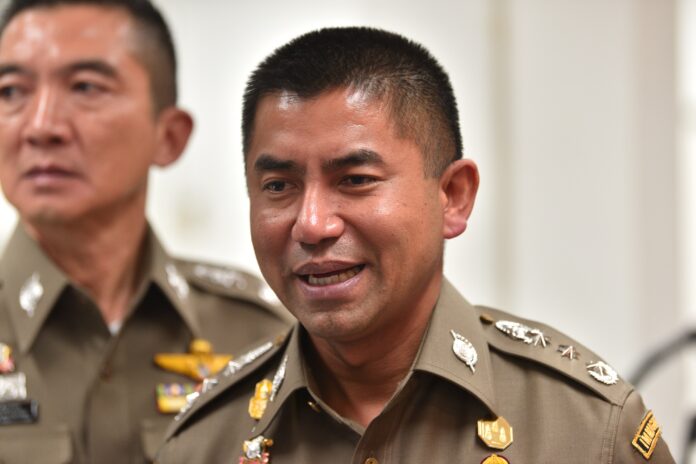
BANGKOK — The announcement that Thailand’s best-known police officer had arrived sent gasps of shock across a news conference at Royal Thai Police headquarters.
“Whoa, he’s not late this time?” one reporter cried aloud, to the laughter of those familiar with his inhuman schedule.
But before Lt. Gen. Surachate Hakparn could enter the room earlier this week, a phone call stopped him. It was a Pattani police official briefing him on the latest insurgent attack to leave an officer dead.
It would be an understatement to say that Surachate’s a busy man. Last week his handling of a Saudi runaway turned global derision into praise before he was back in the streets busting more foreigners. He only found time to sit down for a Monday interview with Khaosod English after appearing at two news conferences – one in the Pathum Thani outskirts – about four cases ranging from child rape to online scams. Soon after the interview began, aides started laying a fraud case out across the table for his attention.
Such cases fall under a much broader domain than his official role as immigration bureau chief, a job he was awarded in October after becoming the public face of weekly crackdowns on foreigners.
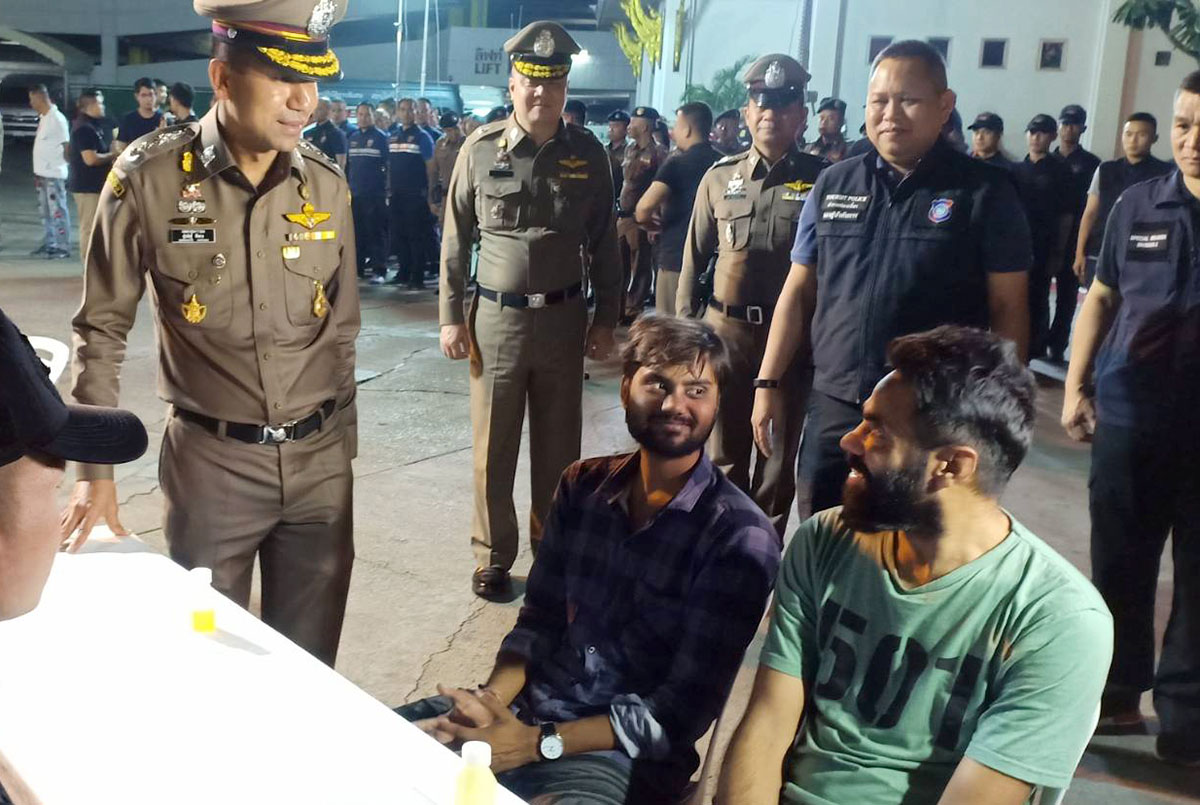
In this undated photo, Lt. Gen. Surachate Hakparn, left, talks to foreigners in Bangkok during the Songkran festivities.
“My goal is to make visitors to our country, whether here for tourism or business, feel safe,” said Surachate, who goes by a nickname that makes English readers chuckle: Big Joke.
If that weren’t enough, he also helps lead the police cybercrime unit, where he has taken credit for busting scammers.
At Monday’s news conference, one reporter whispered that Big Joke oversaw so many cases because their investigating officers wanted him to get the fame in return for expected favors, but Surachate himself said it’s more about efficiency.
“We work with every unit,” Surachate said. “Online world and technology are present in every aspect of our lives … so we have to integrate our efforts in suppressing crimes that come with it.”
A New Playbook
A political scientist familiar with police affairs said Surachate’s meteoric rise cannot be explained solely by his connections – the usual lubricant of bureaucratic advancement.
“Big Joke revolutionized the police organization by adopting the management style of the army,” said Wanwichit Boonprong, who teaches at Rangsit University. “In the police, underlings take care of their superiors. In the army, superiors take care of their underlings.”
He added that Surachate’s filial loyalty to those responsible for his successes – such as annual donations to his high school – helped convince the puu yai to back him for key positions.
Surachate was born in 1970 in Songkhla. His father, also a policeman, based his son’s nickname on his favorite playing card: the joker. Surachate quickly rose through the ranks to command a local police station and later move to Bangkok to head the 191 task force.
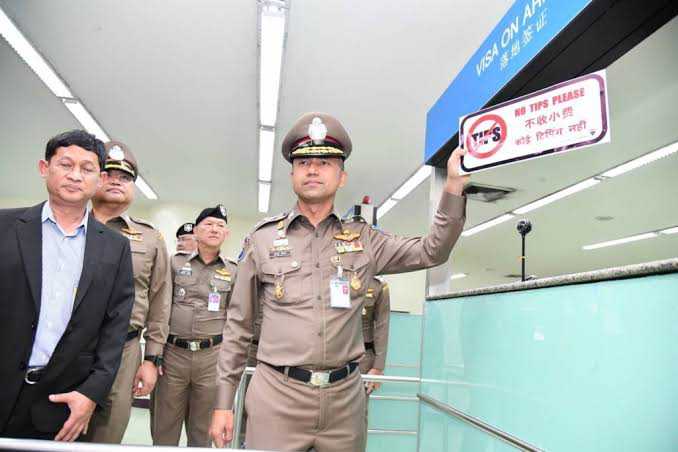
From there he sprang to the tourist police before landing the top post at the immigration bureau last year.
Two foreigners react as Lt. Gen. Surachate Hakparn looks on Friday morning at Bangkok’s Montien Riverside Hotel.
Connections cannot be totally discounted, Wanwichit the lecturer said. Surachate’s father is a close friend of both deputy junta chairman Prawit Wongsuwan and Pheu Thai MP Sanoh Thienthong.
At the age of 42, Surachate was promoted to the rank of police major general – the first among his year’s academy graduates to do so – earning him the additional nickname big, a media moniker for major generals and up.
Because he has more than a decade left before mandatory retirement – and now just one rank shy of police general – many observers consider him a likely future police commissioner. Surachate does not deny such ambitions.
“I think everyone wants to be police commissioner,” Big Joke said. “Whether I can become one is a matter of karma and destiny, but as of today, I want to live with the present and perform my duties to my best.”
Where some police brass would wince at the suggestion they stage publicity stunts to advance their careers, Surachate suggested that’s just how things work.
“If I’m a police commissioner but no one knows me or has trust in me, what’s the point?” he said. “There’s no use. So I want to do my duty and build my cases so the people can see them and have faith in me.”
Unlike many higher-ups, his audience doesn’t seem limited to impressing his superiors.
Outside the chain of command, Big Joke has won public notice for taking the kind of principled stands – or at least voicing them – rarely expressed by top brass.
Last week, he responded to the crucible of pressure by reversing a deportation order against Rahaf Alqunun, insisting he would not “send someone to their death.” In a surprising break from protocol, she was allowed to enter the kingdom and obtain refugee status from the UNHCR.
In October, as legal threats mounted against underground rap artists over a video slamming military rule, he came out to say they not only had a constitutional right to free speech, but that senior officials should listen.
Wanwichit said Big Joke has one advantage his older peers don’t: He can afford to bide his time
“Even if the next government doesn’t like him and moves him to [an obscure post] he can simply wait for a government that likes him to be in power and promote him to commissioner,” Wanwichit said.
Were he not a lifelong policeman, what other job would Surachate imagine doing?
“I would want a career dedicated to helping society, like the police do,” Surachate said. “I would be in an NGO.”
Good Guys, Bad Guys
Surachate’s rise has put him into close contact with issues involving foreigners in Thailand. He oversaw investigations into alleged Chinese-run boiler room scams and so-called zero dollar tours.
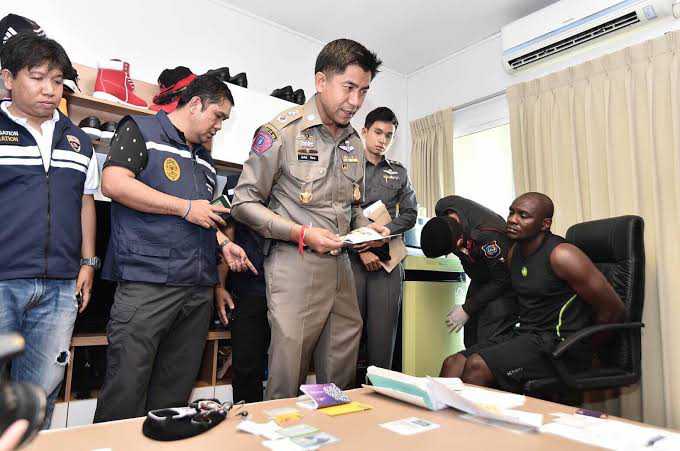
But many know him best for the dozens of raids on foreignerssuspected of working without authorization – an operation initially called Black Eagle but later renamed X-Ray Outlaw Foreigner.
Under his command, the bureau whose slogan proclaims “Good Guys In, Bad Guys Out,” will undergo several changes. Surachate said he’s drafting suggested amendments to the 1979 immigration law to make things smoother for expats seeking to reside, retire or work in the kingdom.
“I can guarantee it will be easy to apply and live here,” Surachate said. “[But] bad people will have a hard time.”
Proposed changes include abolishing 90-day reports and introducing 10-year visas for foreign retirees, Surachate said. A data link between the immigration and Thailand’s consular affairs around the world was recently established. Experts will also be consulted to see what restricted professions should be open to foreigners.
“The amendment process will take probably about two or three months,” Surachate said – an optimistic assessment when at least half a year is usually needed to pass legislation.
At the same time, he said the immigration is working with the Anti-Money Laundering Office to inspect past tax records of expats living in Thailand in order to weed out those with suspicious activities.
“I’d like to remind all foreigners that their stays and businesses in this country have to be legal,” Surachate said. “We’re watching you.”
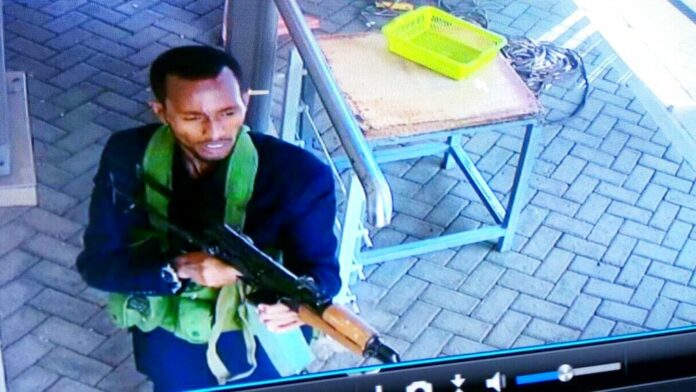
In this grab taken from security camera footage released to the local media, an armed attacker walks in the compound of a hotel, in Nairobi, Kenya on Tuesday. Photo: Security Camera Footage via Associated Press
NAIROBI — Kenya’s security forces have killed the Islamic extremist gunmen whose assault on a luxury hotel and shopping complex took 14 “innocent lives,” the country’s president said Wednesday.
“All the terrorists have been eliminated,” President Uhuru Kenyatta said in announcing an end to the operation to secure the complex in the capital, Nairobi.
In a televised address, he did not say how many attackers were involved. He said more than 700 people were evacuated during the security operation and urged Kenyans to “go back to work without fear,” saying the East African country is safe.
In the hours before Kenyatta spoke, sporadic gunfire could be heard from the scene after scores of people were rescued at daybreak during what police called a “mopping-up” exercise.
Surveillance video showed the attack involved at least four armed men.
Al-Shabab — the extremist group allied to al-Qaida and based in neighboring Somalia — claimed responsibility for the carnage at the DusitD2 hotel complex, which includes bars, restaurants, offices and banks and is in Nairobi’s well-to-do Westlands neighborhood with many foreign expatriates. Al-Shabab carried out the 2013 attack at the nearby Westgate Mall in Nairobi that killed 67 people.
The U.S. State Department confirmed that an American citizen was among those killed, but did not release the victim’s identity. The British high commissioner in Kenya said at least one British national had been killed, without giving details.
Authorities sent special forces into the hotel to flush out the gunmen. At dawn, another explosion and gunfire were heard. Scores of people were rushed to safety in the early morning hours.
“To God be the Glory. We have been rescued. Over 50 people in my group. No injuries,” tweeted a Kenyan businesswoman, Aggie Asiimwe Konde.
Describing the ordeal, Lucy Wanjiru said she had been trying to flee when she saw a woman on the ground floor get shot. She ended up in a washroom with several other scared people. Her friend Cynthia Kibe stayed in contact with her by phone overnight.
“I think I panicked when she told me that the gunshots are next to her,” Kibe said. “I had to keep telling her ‘Just wait, help is on the way, they are almost there, they are almost there.’ And then at one point she was like, ‘Please tell me I am getting out of here alive’ and then it was just like my breaking point.”
Mourning families and friends gathered at a nearby mortuary.
“I am a Muslim and I am Somali, I am Kenyan living here, and in that way I can assure you if al-Shabab found me today they call us what they call ‘Mortad’ (apostates), that is, someone who works against them and they wouldn’t differentiate me from yourself,” said Mohamed Yasin Jama, a friend of two work colleagues killed in the attack.
The coordinated assault began with an explosion that targeted three vehicles outside a bank, and a suicide bombing in the hotel lobby that severely wounded a number of guests, said Kenya’s national police chief, Joseph Boinnet.
Kenyan hospitals appealed for blood donations even as the number of wounded remained unclear.
Associated Press video from inside the hotel showed Kenyan security officers searching the building and scared workers emerging from hiding while gunfire could be heard. Some climbed out a window by ladder. One man got up from the floor where he appeared to be trying to hide under a piece of wood paneling, then showed his ID.
Like the attack at the Westgate Mall, this one appeared aimed at wealthy Kenyans and foreigners. It came a day after a magistrate ruled that three men must stand trial in connection with the Westgate Mall siege.
Al-Shabab has vowed retribution against Kenya for sending troops to Somalia to fight it since 2011. Tuesday’s violence came three years to the day after al-Shabab extremists attacked a Kenyan military base in Somalia, killing scores of people.
The group has killed hundreds of people in Kenya. In the deadliest attack, al-Shabab claimed responsibility for an assault on Kenya’s Garissa University in 2015 that killed 147 people, mostly students.
The latest carnage demonstrated al-Shabab’s continued ability to carry out spectacular acts of bloodshed despite a dramatic increase in U.S. airstrikes against it under President Donald Trump.
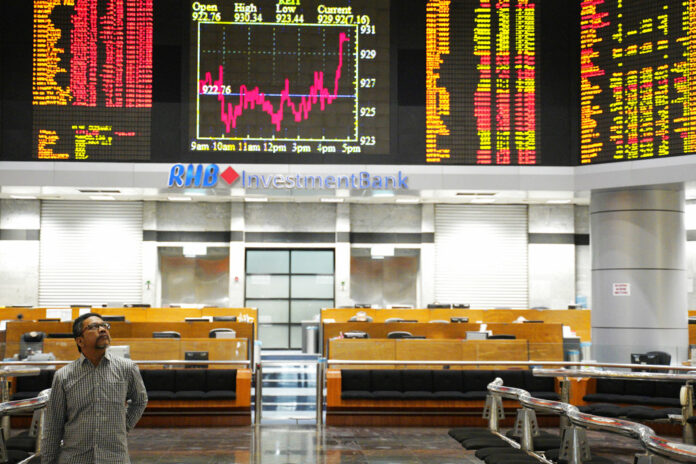
An investor walks in front of private stock trading boards in November at a private stock market gallery in Kuala Lumpur, Malaysia. Photo: Yam G-Jun / Associated Press
SINGAPORE — World shares were mostly higher Wednesday as investors shrugged off the parliamentary defeat of British Prime Minister Theresa May’s plan for leaving the European Union.
Keeping Score
Thailand’s SET traded at 1,577.41 on Wednesday afternoon. In Europe, Germany’s DAX rose 0.1 percent to 10,899.16 and France’s CAC 40 added 0.3 percent to 4,802.02. Britain’s FTSE 100 sank 0.4 percent to 6,869.00. Wall Street was positioned for gains, with Dow futures up 0.3 percent at 24,064.00 and broader S&P 500 futures gaining 0.3 percent to 2,614.10.
Brexit Vote
British Prime Minister Theresa May suffered a major setback Tuesday when lawmakers rejected a Brexit deal by 432 votes to 202. She was expected to lose despite last-minute campaigning for the widely unpopular deal she had brokered with the EU. Britain is set to leave the bloc on March 29. World markets were largely unaffected and the British pound tumbled before the vote but bounced back afterward. May faces a no-confidence vote later Wednesday that could trigger a general election but she is expected to survive it.
Analyst’s Take
“The parliament’s vote came as no surprise because everybody predicted it will be overwhelmingly rejected,” said Francis Lun, a stock analyst in Hong Kong. “Actually what it does is really remove uncertainty that Britain will leave the EU. I think we are on firmer ground now that eventually Britain will stay in the EU.”
Japan Economy
On Wednesday, Japan said its core machinery orders were flat in November at 863.1 billion yen, compared with October’s 7.6 percent rise. This was also lower than analysts’ expectations of a 3 percent increase. There was a sharp drop in orders from the manufacturing sector, although overseas orders climbed. The data suggests Japanese companies may be less confident in making big-ticket purchases in the face of global risks.
Asia’s Day
Japan’s Nikkei 225 index, weighed down by weak machinery orders in December, slipped 0.6 percent to 20,442.75. South Korea’s Kospi added 0.4 percent to 2,106.10 and Hong Kong’s Hang Seng rose 0.3 percent to 26,902.10. Australia’s S&P ASX 200 added 0.4 percent to 5,835.20 while Shanghai’s Composite index was flat at 2,570.42. Shares fell in Taiwan and Indonesia but rose in Malaysia and Singapore.
Energy
Benchmark U.S. crude oil picked up 19 cents to USD$52.30 per barrel in electronic trading on the New York Mercantile Exchange. The contract added $1.60 to settle at $52.11 per barrel on Tuesday. Brent crude, the international standard, rose 30 cents to $60.94. It gained $1.65 to $60.64 a barrel in London.
Currencies
The dollar slipped to 108.59 yen from 108.69 late Tuesday. The euro rose $1.1418 from $1.1413, while the British pound rose to $1.2892 from $1.2859.
Konh Korm of Cambodia's Sam Rainsy Party in photo posted last month. Photo: Kong Korm / Facebook
PHNON PENH — A veteran Cambodian politician and his son on Wednesday became the first among 118 opposition members banned from politics for five years to have the restriction lifted.
Kong Korm and his son, Kong Bora, had their bans lifted when Cambodian King Norodom Sihamoni signed a royal decree approving their application for restoration of political rights.
The two were among the members of the Cambodia National Rescue Party who were banned from politics when the group was dissolved by court order in November 2017 on a contrived charge of conspiring with the United States to overthrow Prime Minister Hun Sen’s government.
The move against the opposition was seen as the government’s effort to ensure it won last July’s general election. It swept all 125 National Assembly seats.
However, the successful move to keep power – Hun Sen on Monday marked 34 years in power – raised criticism that the polls were neither free nor fair. Western nations already disturbed by Hun Sen’s authoritarian ways have imposed diplomatic sanctions and are threatening to apply economic sanctions, a move that Hun Sen has warned recently would end up hurting the opposition.
Allowing politicians to apply to have their bans lifted is part of a government effort to mollify its critics, especially in the international community. However, members of the dissolved Cambodia National Rescue Party are split over whether to apply, with many opposing playing by Hun Sen’s rules and hoping the international community will step up pressure on Hun Sen.
The split in the opposition is also fueled by rivalries between factions loyal to the party’s two former leaders, and there is widespread belief that Hun Sen – one of the region’s wiliest political players – is encouraging the factionalism.
The 77-year-old Kong Korm and his son had been members of the Cambodia National Rescue Party but in recent months have been publicly expressing differences with their colleagues.
Speaking by telephone to The Associated Press on Wednesday, Kong Korm said he was delighted to have his ban lifted, and would continue in politics by joining the Khmer Will Party, which was formed last year before the election by another of his sons. He described the party as representing new hope for Cambodians, espousing moderation rather than the “extremist” policies he attributed to the dissolved Cambodia National Recue Party.
“Starting from today, my ban has been lifted and my past worrying that I could no longer be engaged in politics has been resolved,” Kong Korm said. “In short, I am delighted to be back in Cambodia’s political arena again.”
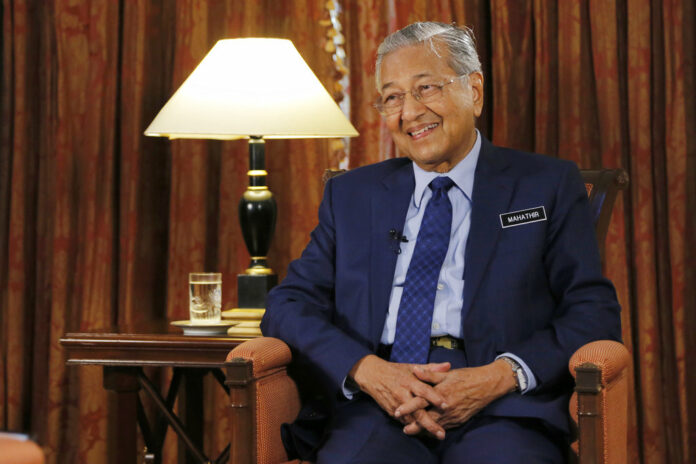
Malaysia's Prime Minister Mahathir Mohamad is interviewed in Putrajaya, Malaysia, Monday, Aug. 13, 2018. Photo: Yam G-Jun/ Associated Press
PUTRAJAYA, Malaysia — Malaysia’s foreign minister said Wednesday that the government will not budge over a ban on Israeli athletes in a para swimming competition and has decided that the country will not host any events in the future involving Israel.
Malaysia, a strong supporter of the Palestinian cause, is among the predominantly Muslim countries that do not have diplomatic relations with Israel. The government has said Israeli swimmers cannot join the competition in eastern Sarawak state in July, which serves as a qualifying event for the 2020 Tokyo Paralympics.
Foreign Minister Saifuddin Abdullah said the Cabinet affirmed last week that no Israeli delegates can enter Malaysia for sporting or other events in solidarity with the Palestinians.
“The Cabinet has also decided that Malaysia will not host any more events involving Israel or its representatives. This is to me, a decision to reflect the government’s firm stance over the Israeli issue,” Saifuddin said after meeting a coalition of Muslim groups. The groups submitted a memorandum urging the government to stick to the ban and not to repeat mistakes in the past of allowing Israel delegates into the country.
Saifuddin said the Palestinian cause was not just a religious issue but also a human right violation.
“It’s about fighting on behalf of the oppressed,” he said.
Israel’s Paralympic Committee did not immediately reply to an email requesting comment on Malaysia’s move.
Prime Minister Mahathir Mohamad has said the International Paralympic Committee can withdraw Malaysia’s right to host the July 29-Aug 4 championship involving athletes from some 70 countries if they wish to do so. The committee has said it was disappointed with Mahathir’s comments but hopes to find a solution to the issue.
This isn’t the first time Malaysia has stopped Israeli athletes from competing in a sports event. In 2015, two Israeli windsurfers had to withdraw from a competition on the resort island of Langkawi after they were refused visas to enter. The following year, Malaysia decided not to host a 2017 conference of the world football governing body FIFA because an Israeli delegation was scheduled to participate.
But earlier this year, the government allowed a high-level Israeli delegation to attend a U.N. conference in Kuala Lumpur, sparking widespread anger among Muslim groups.
Some 60 percent of Malaysia’s 32 million people are ethnic Malay Muslims. Many have taken to the streets in the past to support the Palestinian cause.