29.4 C
Bangkok
Sunday, July 19, 2026
Home Blog Page 1844

UK Govt Accused of Lack of Action on Russian Fake News

Britain's Prime Minister Theresa May listens as the declaration at her constituency is made for in the general election in Maidenhead, England on Friday. Photo: Alastair Grant / Associated Press

LONDON — The chair of an influential British parliamentary committee said Monday that the government has failed to take seriously the threat posed by Russia and other malign actors in the digital age

The comments come three months after the influential parliamentary media committee warned of a democratic crisis due to the manipulation of information. Committee Chairman Damian Collins said that the government has fully accepted only three of the committee’s 42 recommendations.

“We need to see a more coordinated approach across government to combat campaigns of disinformation being organized by Russian agencies seeking to disrupt and undermine our democracy,” he said. “The government’s response gives us no real indication of what action is being taken on this important issue.”

Social media companies have come under pressure globally following allegations that political consultant Cambridge Analytica used data from tens of millions of Facebook accounts to profile voters and help U.S. President Donald Trump’s 2016 election campaign. The committee investigated the impact of fake news distributed via social media sites.

Collins has been critical of tech companies like Facebook for allowing Russian agencies to use its platform to spread disinformation and influence elections. The committee wanted the Silicon Valley giants to take responsibility for the way the platforms are used.

But the government offered no direct response to a committee recommendation that the Electoral Commission establish a code for advertising for social media during electoral periods, though a consultation on the matter is under way.

The government did say it was committed the maintaining a news environment where accurate content can prevail. Allowing that mechanisms exist to make print and broadcasts reports accurate and fair, it agreed with the “spirit” of the recommendation that greater regulation is needed online.

However, Collins offered praise for the government’s demand that Facebook take action to tackle speech that has contributed to the slaughter of the Rohingya in Burma.

The committee’s final report is expected in December.

Story: Danica Kirka

Advertisement

Rupaul Survivor ‘Shangela’ to Halleloo in Bangkok

Photo: Shangela / Facebook

BANGKOK — Earlier this year, drag glamazons BKK Kim Chi and Naomi Smalls lit up a Bangkok runway with fashion, lip-syncing and shade. In December, it’s trans-sation Shangela’s turn.

Fresh off appearing in “A Star is Born,” Shangela, a star queen from “RuPaul’s Drag Race,” will bring her-larious one-woman show “Shangela is Shook” to Bangkok. What will she do? Death drop, lip-sync, or slay as comedy Mariah Carey one more time? Prepare to be shook.

Tickets are available online starting at 1,500 baht. The show, organized by LA Comedy Live, starts at 8pm on Dec. 13 at the Dr. Thaworn Phornprapha Auditorium. The concert hall is located on the fifth floor of the Siam Motors Building across from the National Stadium, a short walk from BTS National Stadium.

Shangela, borned as D.J. Pierce, is a Los Angeles drag queen best known for twice battling to be the top queen on RuPaul’s transcendent reality show. She was the first contestant eliminated in the show’s second season and made it to sixth in its third. Shangela has also appeared in television shows and movies such as “2 Broke Girls,” “Glee” and “The X-Files.”

In March, Kim Chi and Naomi Smalls, runners-up from the show’s eighth season, performed in Bangkok at KBank Siam Pic-Ganesha.

Related stories:

RuPaul’s Drag Duo to Hit Bangkok Runway in March

Advertisement

Harry and Pregnant Meghan Travel in Different Style in Australia

Britain's Prince Harry and his wife Meghan, Duchess of Sussex, clap duirng a lunchtime reception hosted by Australian Prime Minister Scott Morrison with Invictus Games competitors, their families and friends in Sydney Sunday, Oct. 21, 2018. (Paul Edwards/Pool Photo via AP)

SYDNEY — The Duke and Duchess of Sussex took separate boats Monday to Queensland’s Fraser Island as their tour of Australia and the South Pacific continued with a reduced schedule for the pregnant duchess.

Prince Harry took a barge for the 70-kilometer crossing from Australia’s mainland to the island, while the former American actress Meghan rode in a far more comfortable cruiser.

Meghan is some four months pregnant and has had her schedule reduced after a hectic start to the 16-day tour.

The Duchess was expected to rest for the first part of the day while Prince Harry undertook several engagements focusing on environmental issues, before rejoining her husband for a reception.

Harry and Meghan touched down midmorning at Hervey Bay, 1,200 kilometers north of Sydney, in a Royal Australian Air Force plane. The couple descended the stairs hand-in-hand, before going their separate ways: Harry boarding a bus and Meghan a car.

Harry was scheduled for a range of engagements on the world’s biggest sand island, known as K’gari in the local indigenous language, on day seven of their Australian tour.

After taking part in a traditional “Welcome to Country” smoking ceremony with representatives of the local Butchulla indigenous people, Harry was set to unveil a plaque dedicating the popular holiday island’s pristine rainforests to Queen Elizabeth’s Commonwealth Canopy project.

Harry’s itinerary also touched on the history of logging on Fraser Island, whose famed hardwood trees were used to build the London’s docks in the 1930s.

Harry and Meghan were due to attend a reception and meet Hervey Bay paramedics Graeme Cooper and Danielle Kellam.

The paramedics were to be recognized for their act of kindness after a photo of them last year granting a dying woman’s wish to see the ocean at Hervey Bay one last time went viral and captured hearts around the world.

Harry and Meghan are due to leave Australia for Fiji and Tonga on Tuesday. They will return to Sydney on Friday night for the final days of the Invictus Games, Harry’s brainchild and the focus of their tour, before finishing off with a visit to New Zealand.

Story: Trevor Marshallsea

Advertisement

Ed Again: More ‘Shape of You’ Returning to Bangkok

Photo: Ed Sheeran / Facebook

Update Feb. 14, 2019: Tokyo-based arena rock outfit One OK Rock announced that they will play as an opening act.

BANGKOK — If there’s anyone who didn’t get to propose marriage the last time he was in town, Ed Sheeran is returning for another chance.

Despite breaking an arm, British singer-songwriter Ed Sheeran made his way to perform in Bangkok nearly a year ago, and it didn’t take long for him to come back.

The pop singer announced that he will return to Bangkok in April, only this time, he’ll play on an outdoor stage. Tokyo-based arena rock outfit One OK Rock, who performed in Bangkok in January, 2018, announced that they will play as an opening act.

The concert will take place April 28 at Rajamangala Stadium. Tickets start at 2,000 baht and are available online.

Sheeran, 27, is best known for “Photograph,” “Thinking Out Loud” and “The A Team.” He made a major comeback after a year-long hiatus in 2017 after his third album “÷” shot to No. 1 on the Billboard 200 chart upon release. The album’s first two singles, “Shape of You” and “Castle on the Hill,” became worldwide hits.

Related stories:

Phew? Ed Sheeran Doesn’t (Yet) Cancel Bangkok Concert

Confirmed: Ed Sheeran to Bring ‘Shape of You’ to Bangkok

Advertisement

Stephen Hawking Wheelchair, Thesis up for Sale

A Book, signed with a thumb print by Stephen Hawking is one of the personal and academic possessions of Stephen Hawking, photo behind, at the auction house Christies in London, Friday, Oct. 19, 2018. Photo: Frank Augstein / Associated Press

LONDON — Stephen Hawking was a cosmic visionary, a figure of inspiration and a global celebrity.

His unique status is reflected in an upcoming auction of some of the late physicist’s possessions: It includes complex scientific papers, one of the world’s most iconic wheelchairs and a script from “The Simpsons.”

The online sale announced Monday by auctioneer Christie’s features 22 items from Hawking, including his doctoral thesis on the origins of the universe, some of his many awards, and scientific papers such as “Spectrum of Wormholes” and “Fundamental Breakdown of Physics in Gravitational Collapse.”

Thomas Venning, head of Christies’ books and manuscripts department, said the papers “trace the development of his thought — this brilliant, electrifying intelligence.”

“You can see each advance as he produced it and introduced it to the scientific community,” Venning said.

Of course, Hawking’s fame rests only partly on his scientific status as the cosmologist who put black holes on the map.

Diagnosed with motor neuron disease at 22 and given just a few years to live, he survived for decades, dying in March at 76.

The auction includes one of five existing copies of Hawking’s 1965 Cambridge University Ph.D. thesis, “Properties of Expanding Universes,” which carries an estimated price of 100,000 pounds to 150,000 pounds ($130,000 to $195,000).

Venning said the thesis, signed by Hawking in handwriting made shaky by his illness, is both a key document in the physicist’s scientific evolution and a glimpse into his personal story.

“He was diagnosed with ALS (amyotrophic lateral sclerosis) just as he arrived in Cambridge to begin his Ph.D. studies,” Venning said. “He gave up his studies for a time because he was so despondent.

The thesis “was the fruit of him reapplying himself to his scientific work,” Venning said, and Hawking “kept it beside him for the rest of his life.”

The disease eventually left Hawking almost completely paralyzed. He communicated through a voice-generating computer and moved in a series of high-tech wheelchairs. One is included in the sale, with an estimated price of 10,000 pounds to 15,000 pounds ($13,000 to $19,500). Proceeds from its sale will go to two charities, the Stephen Hawking Foundation and the Motor Neurone Disease Association.

Venning said the wheelchair became a symbol not just of disability but of Hawking’s “puckish sense of humor.” He once ran over Prince Charles’ toes — and reportedly joked that he wished he had done the same to Prime Minister Margaret Thatcher — and appeared in a “Monty Python” skit running down fellow physicist Brian Cox.

Venning said Hawking “very much thought of himself as a scientist first and a popular communicator second,” but accepted and even enjoyed his celebrity status. He appeared several times on animated comedy show “The Simpsons” and kept a figurine of himself from the show in his office.

The sale includes a script from one of Hawking’s “Simpson’s” appearances, a copy of his best-seller “A Brief History of Time” signed with a thumbprint and a personalized bomber jacket that he wore in a documentary.

Hawking’s daughter Lucy said the sale gave “admirers of his work the chance to acquire a memento of our father’s extraordinary life in the shape of a small selection of evocative and fascinating items.”

Hawking’s children hope to preserve his scientific archive for the nation. Christie’s is handling negotiations to hand it over to British authorities in lieu of inheritance tax.

The items — part of a science sale that includes papers by Isaac Newton, Charles Darwin and Albert Einstein — will be on display in London for several days from Oct. 30. The auction is open for bids between Oct. 31 and Nov. 8.

Advertisement

One of Taiwan’s Fastest Trains Derails, Killing At Least 18

Rescue workers gather at the site of a train derailment in Lian county in northern Taiwan on Sunday. Photo: Johnson Lai / Associated Press

DONGSHAN TOWNSHIP, Taiwan — One of Taiwan’s fastest passenger trains derailed Sunday on a curve along a popular weekend route, killing at least 18 people and injuring more than 170 others, authorities said.

The Puyuma express was carrying more than 360 passengers from a suburb of Taipei in the north to Taitung, a city on Taiwan’s southeast coast, when it went off the tracks shortly before 5 p.m., the government said in a statement.

There was no immediate word on the cause of the accident.

Most of the deaths were in the first car, and it was unclear whether other people were trapped in the train, according to a government spokesman, who spoke on the customary condition of anonymity.

Some passengers were crushed to death, Ministry of National Defense spokesman Chen Chung-chi said.

“Their train car turned over. They were crushed, so they died right away,” Chen said.

Earlier, the government put the death toll as high as 22, but the National Fire Agency, citing the Cabinet spokesman’s office, later reduced that figure and blamed a miscalculation.

Photos from the scene just south of the city of Luodong showed the train’s cars in a zig-zag formation near the tracks. Five cars were turned on their sides.

Local television reports said passengers tried to escape through windows and that bystanders gathered to help them before rescuers arrived.

Hours after the accident, one of the eight cars was seen tipped over at about a 75-degree angle, with the entire right side destroyed.

Fearing people may be trapped beneath the car, firefighters with lights on their hard hats peered underneath as a crane prepared to upend it. The firefighters were joined by soldiers and Buddhist charity workers who gathered on both sides of the tracks.

Soldiers removed bodies to identify them, but nightfall complicated the rescue work.

On a live feed provided by Taiwan’s United Daily News, rescuers could be seen carrying what appeared to be a body wrapped in white plastic away from the site.

At the scene, searchers walked through an upright car with flashlights. The search-and-rescue work was to continue until early Monday to make sure everyone aboard was accounted for, Premier William Lai told reporters shortly after midnight.

“The underlying cause should be investigated to the maximum extent to avoid anything like this happening in the future,” Lai said. “We will make the whole thing transparent.”

Ensuring that rail traffic goes back to normal is also a priority, he said.

Most people who were seriously hurt suffered head injuries and one was bleeding internally, said Lin Chih-min, deputy director of Luodong Boai Hospital, where four people were in intensive care. The hospital had treated 65 people total.

The wreck happened at a railway station called Hsin Ma, but the train was not scheduled to stop there.

The Puyuma was launched in 2013 to handle the rugged topography of Taiwan’s east coast. It is distinct from the high-speed rail that runs on the west coast. The Puyuma trains travel up to 150 kilometers (93 miles) per hour, faster than any other in Taiwan except for the high-speed rail.

The train that derailed had its most recent inspection and major maintenance work in 2017, Taiwan Railways Administration Director Lu Chie-shen said at a televised news conference.

Sunday’s derailment was at least the third deadly rail accident in Taiwan since 2003.

A popular tourist train overturned in the southern mountains in April 2011 after a large tree fell into its path. Five Chinese visitors were killed.

A train undertaking a test run ignored a stop sign and crashed into another train in northeastern Taiwan in June 2007. Five people were killed and 16 others hurt.

And in March 2003, a train derailed near a popular mountain resort, killing 17 people and hurting more than 100 people. Investigators blamed brake failure.

Advertisement

Melting Glacier in China Draws Tourists, Climate Worries

This Sept. 21, 2018 photo shows a tourist posing with a yak atop the Baishui Glacier No.1 on the Jade Dragon Snow Mountain in the southern province of Yunnan in China. About 2.6 million visitors come every year to see the glacier which scientists say is one of the fastest melting glaciers in the world due to climate change and its relative proximity to the Equator. (AP Photo/Sam McNeil)

YULONGXUESHAN, China — The loud crack rang out from the fog above the Baishui No. 1 Glacier as a stone shard careened down the ice, flying past Chen Yanjun as he operated a GPS device.

More projectiles were tumbling down the hulk of ice that scientists say is one of the world’s fastest melting glaciers.

“We should go,” said the 30-year-old geologist. “The first rule is safety.”

Chen hiked away and onto a barren landscape once buried beneath the glacier. Now there is exposed rock littered with oxygen tanks discarded by tourists visiting the 4,570-meter-high blanket of ice in southern China.

Millions of people each year are drawn to Baishui’s frosty beauty on the southeastern edge of the Third Pole – a region in Central Asia with the world’s third largest store of ice after Antarctica and Greenland that’s roughly the size of Texas and New Mexico combined.

Third Pole glaciers are vital to billions of people from Vietnam to Afghanistan. Asia’s 10 largest rivers – including the Yangtze, Yellow, Mekong, and Ganges – are fed by seasonal melting.

“You’re talking about one of the world’s largest freshwater sources,” said Ashley Johnson, energy program manager at the National Bureau of Asian Research, an American think tank. “Depending on how it melts, a lot of the freshwater will be leaving the region for the ocean, which will have severe impacts on water and food security.”

Earth is today 1C hotter than pre-industrial levels because of climate change — enough to melt 28 to 44 percent of glaciers worldwide, according to a new report by the U.N. Intergovernmental Panel on Climate Change. Temperatures are expected to keep rising.

Baishui is about as close to the Equator as Tampa, Florida. And the impacts of climate change already are dramatic.

The glacier has lost 60 percent of its mass and shrunk 250 meters (820 feet) since 1982, according to a 2018 report in the Journal of Geophysical Research.

Scientists found in 2015 that 82 percent of glaciers surveyed in China had retreated. They warned that the effects of glacier melting on water resources are gradually becoming “increasingly serious” for China.

“China has always had a freshwater supply problem with 20 percent of the world’s population but only 7 percent of its freshwater,” said Jonna Nyman, an energy security lecturer at the University of Sheffield. “That’s heightened by the impact of climate change.”

For years, scientists have observed global warming change Jade Dragon Snow Mountain in the Chinese province of Yunnan.

One research team has tracked Baishui’s retreat of about 30 yards (27 meters) per year over the past decade. Flowers, such as snow lotus, have rooted in exposed earth, says Wang Shijin, a glaciologist and director of the Yulong Snow Mountain Glacial and Environmental Observation Research Station, part of a network run by the Chinese Academy of Sciences.

Nestled into a suburb of Lijiang, population 1.2 million, the station is home to Wang and his team: geologist and drone operator Chen, postgraduate glaciology student Zhou Lanyue and electrical engineer Zhang Xing, a private contractor.

After breakfast, the team heads off by van for the day’s mission. A cable car carries them up to a majestic view of the Jade Dragon Snow Mountain.

The team shuffles past a line of tourists – many in red ponchos, most sucking oxygen canisters, a few vomiting from altitude sickness – before descending to replace a broken meteorological station.

The team operates remote sensors that collect data on temperature, wind speed, rainfall, and humidity. Other sensors measure water flow in streams fed by melted ice. Cold, downpours, rock slides, gales and glacier movement break the equipment.

“It is not easy to encounter good weather here,” Wang said.

This weather will ensure Yunnan has plenty of freshwater while other glacier loss poses serious risk of drought across the Third Pole, he said.

The next day, the team wore crampons while repairing more sensors scattered across the glacier’s crags.

“Where we’re at right now was back in 2008 all covered with ice,” Wang said. “From here to there at the side, the glacier shrank about 20 to 30 meters. The shrinking is very remarkable.”

The team forded streams and jumped crevasses in search of long iron bars they previously embedded in the ice. GPS tells them how much the bars, and thus the glacier, have moved. They also measure how much height the glacier has lost during the summer.

Back on the viewing platform, Che launched a buzzing camera drone over the white expanse. The photographs help tell a story of staggering loss. A quarter of its ice has vanished since 1957 along with four of its 19 glaciers, researchers have found.

Changes to the Baishui provide the opportunity to educate visitors about global warming, Wang said.

Last year, 2.6 million tourists visited the mountain, according to Yulong Snow Mountain park officials.

On blustery day recently, hundreds of tourists climbed wooden stairs through grey fog to snap selfies in front of the glacier.

Hou Yugang said he wasn’t too bothered over climate change and Baishui’s melting. “I don’t think about it now because it still has a long way to go,” he said.

To protect the glacier, authorities have limited the number of visitors to 10,000 a day and have banned hiking on the ice. They plan to manufacture snow and to dam streams to increase humidity that slows melting.

Security guard Yang Shaofeng has witnessed a warming world melting this mountain, which his local Naxi minority community considers sacred.

Yang remembers being able to see the glacier’s lowest edge from his home village. No longer.

“Only when we climb up can we see it,” he said sadly, as tourists lined up to have their names engraved on medallions bearing the glacier’s image.

The etching is already outdated.

Story: Sam McNeil, Olivia Zhang

Advertisement

Japan Deepens Southeast Asian Ties With Airmen Program

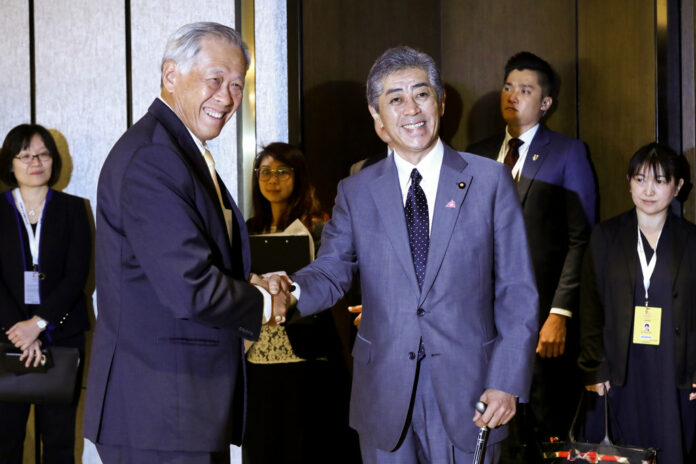
Singapore Defense Minister Ng Eng Hen greets Japan Defense Ministe Takeshi Iwaya at the ASEAN and Japanese Defense Ministers' Informal Meeting at the 12th ASEAN Defense Ministers' Meeting in Singapore on Saturday. Photo: Don Wong / Associated Press



SINGAPORE — Japan’s defense minister says he plans to start a program for professional airmen to strengthen ties between his country and Southeast Asia.

Takeshi Iwaya says the program fits in with the government’s vision to raise defense cooperation with the 10-member Association of Southeast Asian Nations, which has “gained momentum” since it was announced in 2016.

The program hopes to promote shared values and interoperability among Japan’s Air Self-Defense Force and airmen of ASEAN countries.

Iwaya did not give details on when it will be launched or its frequency. He was speaking on the sidelines of an Asian security conference in Singapore, which was also attended by regional defense ministers, U.S. Defense Secretary Jim Mattis and his Chinese counterpart, Gen. Wei Feng.

Advertisement

Opinion: Understanding the Rogue Thai Army

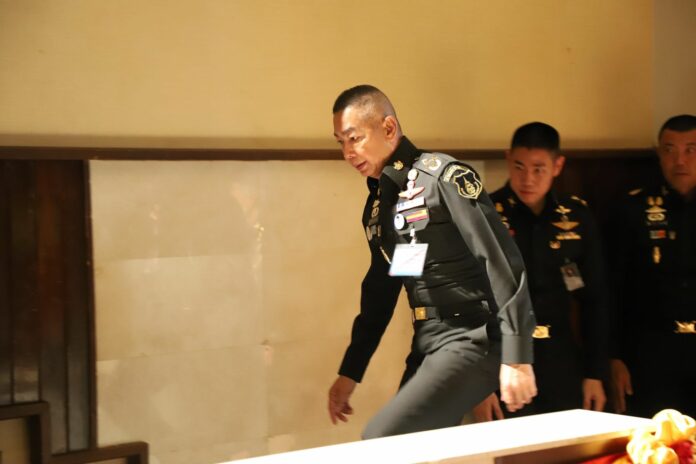
Apirat Kongsompong arrives at a news conference Wednesday at the army headquarters in Bangkok.

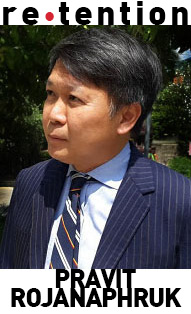
Re•tention: Pravit RojanaphrukHearing new army chief Gen. Apirat Kongsompong leave the door open Wednesday to another coup – one he’d likely lead – was like hearing the head of condominium security saying he will seize control if those paying his salary don’t behave.

Absurd as it may sound, we should take Apirat’s words seriously. After all, this is the Juntaland version of Thailand where coups are not only common, one was led by his late father, Gen. Suthorn Kongsompong, in 1991.

The Thai army is a state within a state. They have staged a dozen “successful” coups over the past 86 years since the 1932 revolt ended absolute monarchy. That’s roughly a coup every seven years. Since the most recent was four years ago, another might not be too far away, statistically speaking. The concept of civilian supremacy is still rather alien, not only among some of these rogue generals but also some in the media and public as well.

Thai Post newspaper columnist Pakkardhom on Thursday simply placed the blame on politicians, not rogue generals. “If politicians didn’t cheat, soldiers wouldn’t have an excuse to stage coups,” he wrote.

No wonder Apirat feels he can rely on the press, at least those covering the military.

“Army-beat reporters are like an army unit although you may wear civilian clothes,” he told the journalists covering him Wednesday.

Indeed, Apirat resorted to the tried-and-true discourse of the noble, altruistic soldier vs. self-serving politicians when he said to the same group, “We are not politicians. We do not seek anything in return. We do not want people whom we helped to choose us.”

There’s more, beside presenting itself as free of vested interests, the army is also quick to cite its undying loyalty to the throne.

“Some soldiers might have forgotten this, so let me remind them their supreme commander is the monarch. The army is a servant whose duty and heart are for protecting the monarchy. … [T]he army will use all of its capabilities and capacity to defend the monarchy,” Apirat said during his first press conference as army chief.

Unlike politicians who claim a mandate from voters, the coup-maker’s claim to alternative legitimacy is two-pronged: First they are supposedly incorruptible, unlike selfish politicians. Second, they are loyal to the monarchy, unlike some politicians who have been painted as anti-monarchist.

With those two big claims, the seemingly absurd act of staging a coup is made “sensible” in the eyes of some Thais, and their mafia-like threats made acceptable if not palatable.

In a way, the new army chief is bolder or more honest than junta leader Gen. Prayuth Chan-ocha, who as army chief in the months leading up to the 2014 coup repeatedly discounted the prospects he would do so, only to then do so.

Apirat is bold enough to be non-committal when it comes to accepting civilian supremacy over the military, thus laying bare the rogue nature of the Thai army.

It’s not clear if Thailand should welcome such a candid admission. The new army chief’s words serve at least as advance warning to remind us how far Thailand has to go before it can truly keep the army to the barracks for good.

These rogue generals are like condominium guards who have forgotten who feeds them. They have gotten used to every now and then taking control of the building. They are no longer content to just be security guards. They want those who feed them to continue to do so while becoming their master and telling the what to do, or not so, as well.


Advertisement

Che Guevara Remembered by Daughter at Bangkok Fair

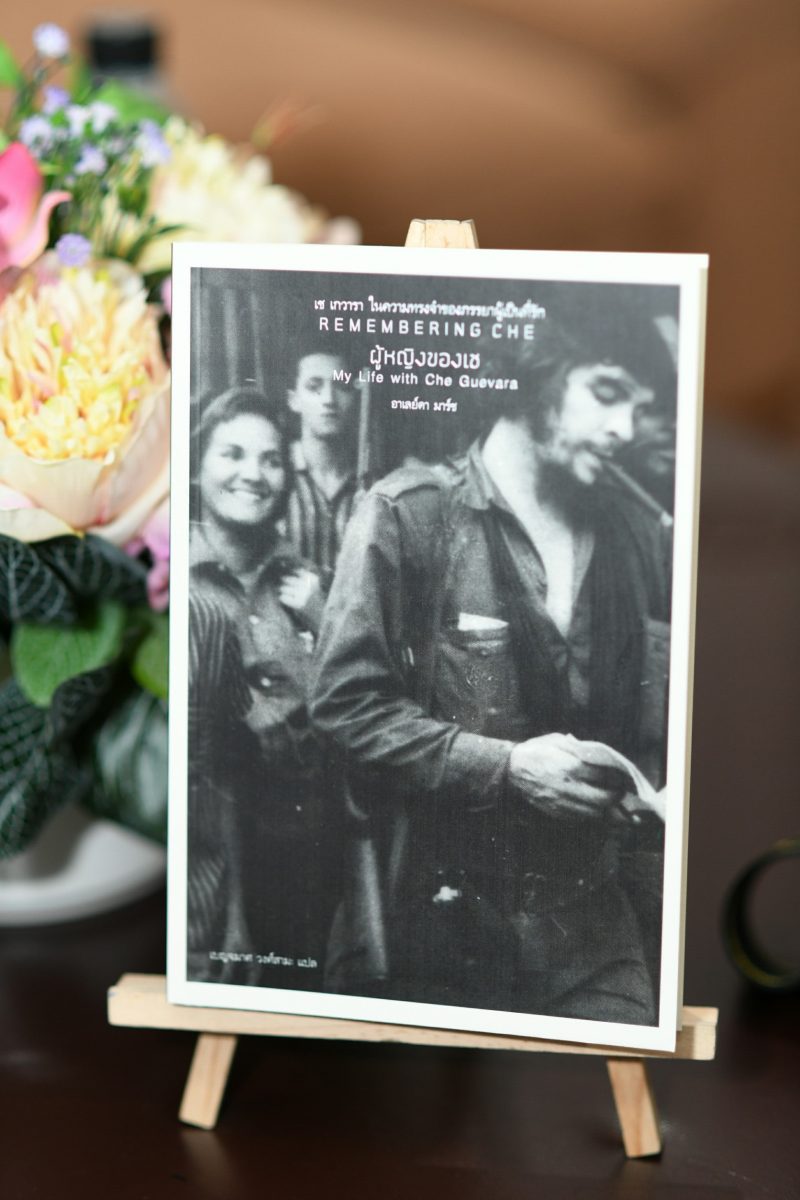
Aleida Guevara March on Friday signs a book “Remembering Che: My Life with Che Guevara” at a book fair at the Queen Sirikit National Convention Center.

BANGKOK —Mi papa was in a room with my mom. As she was holding my little brother, mi papa patted the baby dearly with his big hands. This is the clearest memory of him I can remember,” said a woman in Spanish, referring to her parents Ernesto “Che” Guevara and Aleida March.

On Friday, fans of Che Guevara, the revolutionary icon, queued in a long line for Aleida Guevara March to sign a Thai translation of “Remembering Che: My Life with Che Guevara.” The 290-page book was written by her mother and translated by Benchamas Wongsam.

Among the crowd gathered to hear Aleida talk about her life was veteran rocker Yeunyong “Ad Carabao” Opakul, who brandished his guitar to perform “Che is Not Dead” in Thai and Spanish.๑๘๑๐๑๙ 0005 e1540012427953

Aleida, 57, flew from Cuba for the launch of the book written by her mother Aleida March, who was Che’s second wife. Originally published in 2012, the book was the first time Che’s widow recounted her personal stories about the legendary guerrilla fighter from her point of view.

“When my father disappeared, my mother built her walls up. She kept her life private,” Aleida said in translated comments at the Queen Sirikit Convention Center. “But when she wrote this book, it is like the walls are coming down once again.”

The book includes affectionate tales of the couple’s courtship during the Cuban Revolution, their marriage in 1959 and includes anecdotes such as Che coming home disguised as a bald, overweight businessman.

It also contains poems by Che, letters he wrote to his wife and several unpublished photographs of the Guevaras.

Nearly 60 years after the Argentine Marxist put a handsome face on Fidel Castro’s revolution, Che Guevara today has become a symbol of resistance. In Thailand, his image is commonly plastered on T-shirts and truck mud flaps. He remains controversial – some revile him as a war criminal.

Although Aleida was only 6 when her father was captured and killed in Bolivia, she said his legacy, for her, will always be love.

“In my life I had never seen my parents kiss, but this book shows me how much they loved each other. So, for me, it’s not only a love story, but it shows me that I’m the product of their true love,” Aleida said.

“It is not because I am Che Guevara’s daughter, but it’s because I’m a daughter of two people who truly love each other. This is what most important.”

Aleida, who has dedicated her life to health care, avoided politics Friday in a discussion fixed on her family.

There is a Cuban saying, Aleida said, that “behind every great man, there is a great woman.” And for the great Argentine hero Che Guevara, for Aleida, that woman was her mother.

“I love all the letters my father wrote to my mom … I cried every time I read Chapter 8,” Aleida said before reading aloud a letter Che wrote from Africa, where he’d adopted the nom de guerre “Tatu.”

She often cites her father, who had a medical degree from Argentina, as her inspiration to become a pediatrician in Havana, Cuba.

“I grew up in a city where everyone loves my father, so in a way I wanted to reciprocate to the people in my country by being a doctor,” she said. “And I think I made the right choice.”

๑๘๑๐๑๙ 0022 e1540012438546๑๘๑๐๑๙ 0007 e1540012759350๑๘๑๐๑๙ 0004 e1540012782323

Advertisement

Hot News

LATEST NEWS

Bangkok
overcast clouds
29.4 ° C
29.4 °
26.1 °
85 %
2.7kmh
86 %
Sat
28 °
Sun
36 °
Mon
38 °
Tue
35 °
Wed
35 °