
































28.3 C
Bangkok
Friday, July 24, 2026
Home Blog Page 1864

Montserrat Caballe, Iconic Opera Singer, Dead at 85

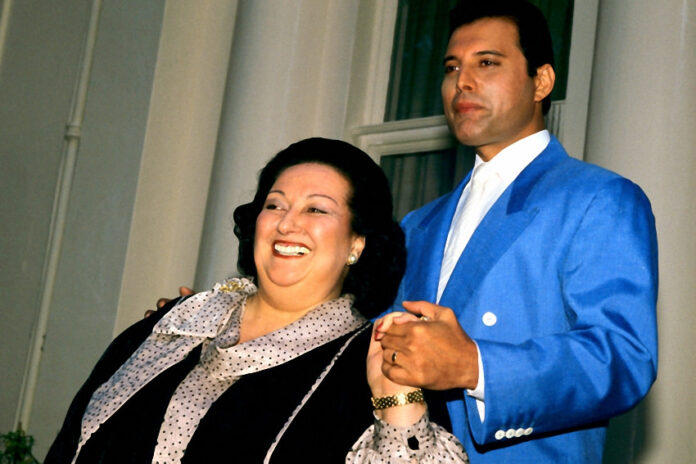
Montserrat Caballe, left, with Queen's lead singer Freddie Mercury in 1987 in Barcelona, Spain.

BARCELONA, Spain — Montserrat Caballe, a Spanish opera singer renowned for her bel canto technique and her interpretations of the roles of Rossini, Bellini and Donizetti, has died. She was 85.

Caballe died early Saturday at Hospital San Pau in Barcelona, hospital spokesman Abraham del Moral told The Associated Press. Caballe’s family requested the cause of death not be released, saying that she had been in the hospital since September, del Moral said.

Spanish media said that Caballe entered the hospital last month because of a gall bladder problem.

“A great ambassador of our country has died,” Spanish Prime Minister Pedro Sanchez said in a tweet . “Her voice and tenderness will remain with us forever.”

Born into a working class family in Barcelona, Caballe unveiled her musical talents early on, singing Bach cantatas at the age of 7.

In her almost unlimited repertoire, she starred in 90 opera roles with nearly 4,000 stage performances.

At 8, Caballe entered the Liceo’s Conservatory in Barcelona with Eugenia Kenny, Conchita Badea, and Napoleone Annovazzi among her first teachers. She won the school’s Gold Medal on graduating in 1954. She went on to study opera in Milan and in 1956 joined the Basel Opera and played her first major role that year in the city’s Staatstheater as Mimi in Puccini’s “La Boheme.”

Four years later, she was a principal singer with the Bremen Opera.

In 1964, Caballe gave a highly praised performance of Jules Masenet’s “Manon” in Mexico City, but it was a year later in New York that a lucky break launched her on the road to international stardom.

On short notice, Caballe stood in for indisposed American soprano Marilyn Horne in a concert performance in Donizetti’s “Lucrezia Borgia” at New York’s Carnegie Hall and achieved a thunderous success. It opened the doors to all the major opera venues around the world.

She produced a highly-acclaimed performance as Elisabetta of Valois in an all-star cast of Verdi’s “Don Carlo” at the Arena di Verona in 1969. The concert became famous for her “la” on the final “ah” at the very end of the opera, which lasted for more than 20 bars up, driving the audience wild with delight.

Caballe was also a noted recitalist, particularly of songs of her native Spain. She was particularly admired for her purity of voice, vocal shadings and exquisite pianissimos.

In a brief excursion into pop music, Caballe’s duet “Barcelona” with Freddie Mercury, of the rock group Queen, was a hit single in 1987, accompanied by an album of the same name. The title track later became the anthem of the 1992 Summer Olympics in the city.

Caballe performed the song live, accompanied by a recording of the late Mercury, at the 1999 UEFA Champions League soccer final in Barcelona’s Camp Nou stadium. In 1997, she sang on two tracks on an album by New Age composer Vangelis.

In 2015, Caballe was convicted of tax fraud and was given a suspended sentence of six months in prison, which she avoided since first convictions resulting in sentences of less than two years in Spain can be suspended by a judge. She had failed to pay the Spanish treasury more than 500,000 euros (USD$550,000) in taxes on her earnings.

Caballe, who was born Maria de Montserrat Viviana Concepcion Caballe i Folch, dedicated herself to various charities and was a UNESCO Goodwill Ambassador. She also established a foundation for needy children in Barcelona. In 1964, she married Spanish tenor Bernabe Marti. They had two children, Bernabe Marti, Jr. and Montserrat Marti, herself a successful soprano.

Story: Ciaran Giles, Joseph Wilson

Advertisement

Interpol President Reported Missing During Trip to China

Interpol President, Meng Hongwei, walks toward the stage to deliver his opening address in 2017 at the Interpol World congress in Singapore. Photo: Wong Maye-E / Associated Press

PARIS — He left his home in Lyon, France, for a visit to his homeland, and then vanished – putting the International Criminal Police Organization, best known as Interpol, at the center of its own missing persons case.

Meng Hongwei, Interpol’s president, boarded a plane and arrived in China, according to a French judicial official. But then, nothing. His wife, who put out a call on Friday, said she hasn’t heard from her 64-year-old husband since the end of September, the official said.

To make matters murkier, Meng is not just the head of Interpol: He’s also a vice minister for public safety in China.

Interpol, based in Lyon, would say only that reports that its president is missing is “a matter for the relevant authorities in both France and China.”

France launched its own investigation on Friday morning, according to the judicial official who wasn’t authorized to speak publicly and asked for anonymity.

Whether China was taking action was unknown. But the South China Morning Post, a Hong Kong newspaper, hinted that Meng may have been the latest target of an ongoing campaign against corruption in China.

The newspaper said that upon landing last week Meng was “taken away” for questioning by what it said were “discipline authorities.” The term usually describes investigators in the ruling Communist Party who probe graft and political disloyalty. The Central Commission for Discipline Inspection, the party’s secretive internal investigation agency, had no announcements on its website about Meng and could not be reached for comment.

Meng is the first from his country to serve as Interpol’s president, a post that is largely symbolic but powerful in status and not without political weight. But because Interpol’s secretary general is responsible for the day-to-day running of the police agency’s operations, Meng’s absence may have little operational effect.

Far from being a Hollywood-style agency with agents toting weapons across the globe, Interpol is low-profile and discrete about its cases, unless it wants to talk.

The organization links up police officials of its 192 member states, who can use Interpol to disseminate their search for a fugitive, or a missing person. Only at the behest of a country does the information go public via a “red notice,” the closest thing to an international arrest warrant. “Yellow notices” are issued for missing persons.

But Interpol walks a fine line between its noble mission – facilitating international police cooperation – and the politics and policies of some of its member countries.

Meng’s appointment as president in 2016 – amid Chinese leader Xi Jinping’s sweeping anti-corruption drive – alarmed some human rights organizations, fearful it would embolden China to strike out at dissidents and refugees abroad.

Such actions would be contrary to Interpol’s mission statement: “Action is taken within the limits of existing laws in different countries and in the spirit of the Universal Declaration of Human Rights.” It adds that “intervention or activities of a political, military, religious or racial character” are prohibited.

Meng has a shiny curriculum vita, having held down various positions within China’s security establishment, including as a vice minister of public security – the national police force – since 2004. In the meantime, he served as head and deputy head of branches of the coast guard, all while holding positions at Interpol. His term in Lyon runs until 2020.

His duties in China would have put him in close proximity to former leaders, some who had fallen afoul of Xi’s campaign. He likely dealt extensively with former security chief Zhou Yongkang, now serving a life sentence for corruption.

Xi has placed a premium on getting officials and businesspeople accused of fraud and corruption to return from abroad, making Meng’s position even more sensitive.

The anti-corruption drive recently drew headlines after the disappearance three months ago of “X-Men” star Fan Bingbing, one of the country’s best-known actresses.

Her whereabouts remain unknown. But on Thursday, Chinese tax authorities spoke publicly about her disappearance public, ordering her and companies she represents to pay taxes and penalties totaling USD$130 million. Fan is being fined around $70 million personally for tax evasion. Still out of the public eye, she issued a statement apologizing for her actions.

China, in the midst of a weeklong holiday, offered no comment on the disappearance of Meng.

In France, there were only questions.

The French are “obviously aware of the disappearance but know nothing more at this stage,” said one diplomatic official, unauthorized to comment publicly on the matter and speaking only on condition of anonymity.

Story: Christopher Bodeen, Elaine Ganley

Advertisement

At Mass Grave Above Indonesian City, Many Questions Linger

Indonesian red cross team carry the body of a tsunami victim following a massive earthquake and tsunami Monday at Talise beach in Palu, Central Sulawesi, Indonesia. Photo: Tatan Syuflana / Associated Press

PALU, Indonesia — From the mountain range, the bay was a sparkling blue and the small city huddled around it a mosaic of bright buildings and mosque minarets.

Suddenly a blaring siren and clouds of dust shattered the tranquility. An ambulance bumped along a dirt road, racing to the top.

An idle excavator whirred into life. People, some wearing surgical masks, others with scarfs across their faces, walked toward a wide mass grave dug into the flat top of the range.

“How many?” shouted a man, running to the ambulance as it drove by. “Two,” a voice replied.

The ambulance backed toward the shallow end of the trench. Two men jumped out. With tight, serious expressions on their faces they opened the back and struggled with the two body bags inside.

They pulled out a black body bag emblazoned in red with the acronym of the search and rescue agency and stumbled across the uneven floor of the grave, carrying it to its resting place.

Then they brought the second. The excavator scooped up a load of dirt, swung toward the trench, and its articulated arm and bucket, moving almost elegantly, dropped the earth over the bags.

The bodies were found at Talise, a popular beach in the Indonesian city of Palu that was struck by a magnitude 7.5 earthquake and powerful tsunami on Sept. 28. Officials say more than 1,500 people were killed. Miles (kilometers) of coastline were obliterated by tsunami waves that swept away people, smashed houses off their foundations, beached ships and overturned trucks.

Volunteers said the two bodies were brought directly from the beach. Due to advanced decomposition, authorities are no longer trying to identify who they find in the rubble.

Minutes before the ambulance arrived, Septi Eka Saputra had left.

Before that he’d spent a long time staring at the ground littered with medical gloves and face masks, wondering if his younger sister would end up there.

She was at the Roa Roa hotel in Palu, meeting friends when the earthquake hit, shattering the concrete structure beyond recognition. He said friends had told him her body, if found, could be brought to the mountain. He’d got information that four from the hotel were being delivered.

“This scene is beautiful,” Saputra said. “But for me and my family what is most important is that she is buried properly in our home town,” he said. “The best resting place is our home town.”

Forty-five minutes after the first ambulance arrived, another made it up the dusty road, delivering a body in a bright yellow bag. Within minutes another came, this time the body bag was orange and emblazoned with an Indonesian Red Cross logo.

Foreign reporters and their local assistants crowded around one of the volunteers. A sweaty European journalist wanted to know how many bodies were expected Friday. “Yes but how many today?” he barked at his translator.

One of the volunteers, Muhamad Ardi, didn’t want to talk.

Everyone was standing on top of the recently buried, he said. On an embankment next to where reporters, soldiers and the grieving were milling, a dark meter-wide splotch had formed.

But 48-year-old Asep Junaedi patiently answered everyone’s questions, his voice often quavering with emotion.

Including six bodies brought on Friday morning, there were 643 people buried in the mountaintop grave, he said, filling up most of what had been a 30-meter (100-foot) -long space.

He and Ardi had been handling bodies for four days, he said.

“I feel called to do humanitarian work,” Junaedi said. “It is also a kind of worship for me because they are our brothers. Even though they’ve become corpses, we must treat them properly.”

Later, Ardi spoke. “I cried every time I saw the dead victims,” he said. “I’m ready to do anything to help wherever needed.”

Another vehicle arrived. “Zero,” shouted a soldier, laughing.

Meters away, two women, each with a child missing, discussed whether it would be right to open the bags. One said she’d look everywhere. The second said she couldn’t bear that to be the last memory.

Some of the people left. The bay glistened. And the call to prayer rang out from Palu.

Story: Stephen Wright

Advertisement

Unfreeze My Bank Accounts: Sombat, Chaturon Tell Junta

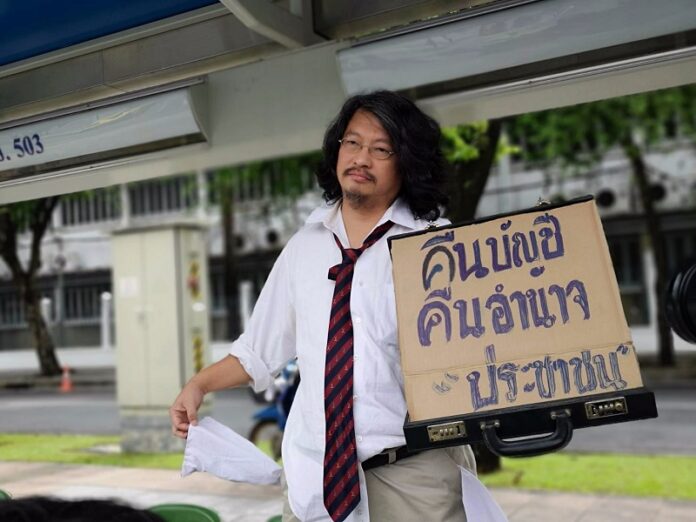
Sombat Boonngam-anong protests Friday at Government House.

BANGKOK — Pro-democracy activist Sombat Boonngam-anong vowed Friday that he would erect a tent and sleep in front of Government House if there was no progress on the unfreezing of his bank accounts.

Sombat’s bank accounts have been frozen for nearly four and a half years after he led calls for the overthrow of the junta which staged the May 2014 military coup.

Holding a placard reading “Return My Bank Accounts. Return Power to the People,” Sombat said the freezing of his 1 million baht had caused him much difficulty over the years. On Friday, he was prevented from entering the Government House as officials shut the gate.

In a related development, former Pheu Thai MP Chaturon Chaisang – whose accounts have also been frozen four years – said Friday that the Administrative Court accepted a complaint urging Prime Minister Gen. Prayuth Chan-ocha and the cabinet to unfreeze the money.

Chaturon did not say how much is frozen. He did say that he’s been unable to buy life insurance, invest in stocks or engage in any bank transactions including making e-payments.

“I lost tremendous opportunities,” Chaturon said.

Chaturon said the court turned down without explanation a similar complaint to have the junta revoke its order. He said the court may consider the order finite and above its purview.

Advertisement

First Temple Bell Tower, Now Mosque Lowers Prayer Call

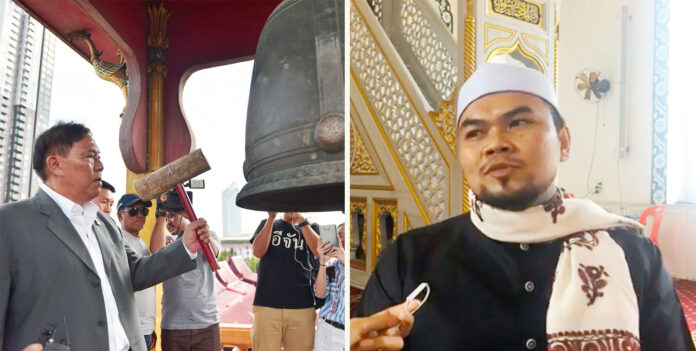
Left: Gov. Aswin rings the bell at Wat Sai on Thursday. Right, Anusorn Ongard, imam of Bang Uthit Mosque on Friday.

BANGKOK — Morning in Bangkok, the city awakes to bells of Wat Sai and the calls of Bang Uthit Mosque. But the awakening is daily, at 4am. And the citizens of high-rise condos want to sleep.

A day after district officials filed a complaint to demand Wat Sai lower the volume of their bell tolls, a local mosque revealed on Friday that they had also received similar warnings and refuted claims that their daily calls to prayer disturbed others in the same Bang Kho Laem district.

“Is our masjid really loud? If it is, we will lower the volume,” Anusorn Ongard, imam of the mosque said in an interview with Khaosod. “Our volume is within the standard limit, but I don’t want to cause trouble for our brothers of different faith. … But we are so greng jai nowadays that Muslims ask me why the volume is so low.”

Read: Bangkok Temple Bell to Lower Toll Volume After Condo Complains

The century-old Bang Uthit Mosque has five daily calls to prayer, including one at 4:30am. On July 3, the Bang Kho Laem district office sent a letter to the mosque asking them to lower their volume. Anusorn said district officials come ask them to lower their volume from time to time.

“You can come as many times as you want, but we are still within the volume range and following the rules,” Anusorn said.

The imam said that the mosque’s prime spot, across from the Asiatique Riverfront shopping area, helps to serve tourism in the area.

“Bang Uthit Mosque is the face of Bang Kho Laem. Right across is Asiatique. Don’t forget that Malaysians, Bruneians, Singaporeans and Indonesians are largely Muslim. We do our job of providing religious services to tourists every single day,” he said.

Thursday, the three-century-old Wat Sai came to public attention when the nearby Star View condominium pressed them to lower their 4am bell tolling. The abbot agreed to lower the noise, while everyone remotely related to the city leaped in to offer their two cents to the drama.

Bangkok Gov. Aswin Kwanmuang went to the temple and rang the bell himself to see if it was too loud.

“It’s not just the drama about the loud Wat Sai bell… come look at another production of Bang Kho Laem district officials. This 100-year-old mosque in the Muslim community has never had problems, but suddenly a letter from the district office came and asked the imam to lower the volume of the call to prayer,” wrote a Thursday night post by Songkran Menthong.

Aswin and the abbot agreed that the monks would lower the volume of the bell tolling rather than stop ringing it.

“District officials will go measure the amount of noise there to make sure it doesn’t go over the set limit, which I believe it won’t,” Aswin said. “But the temple can’t stop ringing the bell, as it’s a long religious tradition. It would be easier for people who complain to move.”

Frenzy erupted online as some tried to point fingers at anyone complaining about the bell tower, with one woman saying she had to report to the Computer Crimes Division for allegedly false posts attributed to her.

“Communities should be built on the basis of diversity…for me, hearing the temple bell is a normal thing,” imam Anusorn said, adding that he sympathized with the Wat Sai abbot. “When there are no sounds like the temple bell or call to prayer, society will fall into a darker place.”

Wat Sai bell tower tolling.

Advertisement

Deep South’s Drug Problems Need New Approach: New Party

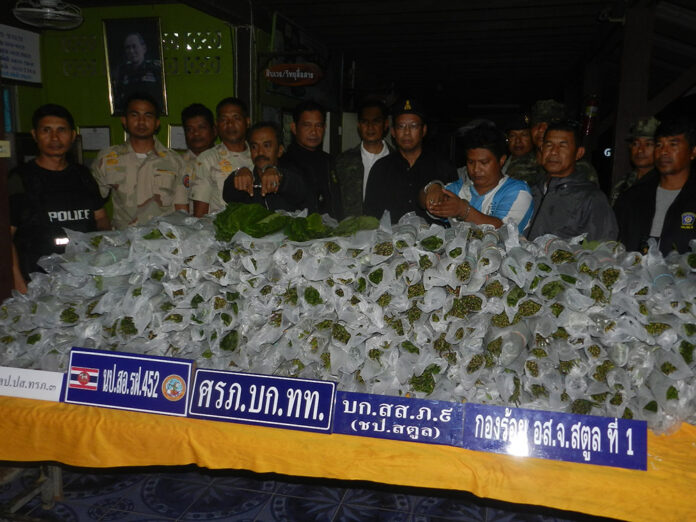
Kratom bust in Satun province on Dec. 2, 2016

BANGKOK — The government should introduce more effective approaches including supporting local communities in the deep south to play a role in eradicating drugs problems, a newly established party said Friday.

Prachachart Party, which has its stronghold in the deep south, said more than half the inmates in prisons there are being detained for drugs-related charges, adding that there was a needed to introduce more diverse strategies to reduce that number.

It called for the state to support the construction of more sports centers at sub-district level and the establishment of youth councils to lure young people away from drugs.

The party, which published the proposal on its official Facebook page, said drug addiction had been widespread in the three southernmost provinces of Yala, Pattani and Narathiwat for nearly two decades, adding that it was “complex” and deeply related to the area’s separatist violence.

It said bai kratom – a chewed drug which though illegal is widely grown in the south – is particularly widespread.

Suppression must also be carried out along with effective prevention, treatment rehabilitation and appropriate measures for each locality, the party added.

Advertisement

South Korean Ex-leader Lee Gets 15-year Term for Corruption

In this March 14, 2018, file photo, former South Korean President Lee Myung-bak arrives for questioning over bribery allegations at the Seoul Central District Prosecutors' Office in Seoul, South Korea. Photo: Kim Hong-Ji / Associated Press

SEOUL — South Korea’s former President Lee Myung-bak was convicted and sentenced to 15 years in prison Friday in a corruption case badly tainting his status as the country’s first leader with a business background who once symbolized the country’s economic rise.

Lee’s conviction came six months after his successor and fellow conservative Park Geun-hye was convicted in a separate corruption scandal that triggered the country’s biggest political turmoil in decades. She is serving 33 years in prison. The back-to-back scandals badly wounded conservatives in South Korea and deepened a national divide.

Few past South Korean leaders are free from corruption scandals. Before Lee and Park, former liberal President Roh Moo-hyun jumped to his death in 2009 amid a high-profile corruption investigation on his family. His liberal predecessor and Nobel Peace Prize winner Kim Dae-jung was forced to apologize at the close of his term after all three of his sons were arrested or embroiled in scandals.

On Friday, the Seoul Central District Court convicted Lee of embezzling 24.6 billion won ($21.7 million) from a company he owned; taking bribes from Samsung, one of his spy chiefs and a former lawmaker; causing a loss to state coffer; and committing other crimes. The court fined Lee 13 billion won ($11.5 million). It said Lee committed those crimes before and during his presidency, from 2008 to 2013.

Lee “has bitterly disappointed not only citizens who trusted and supported him but also our entire country,” the court said in a televised verdict.

Lee, who has denied most of the allegations, didn’t attend the court session, reportedly citing his health and in protest of a court decision to allow a live broadcast of Friday’s trial. His lawyer said the live broadcast would hurt South Korea’s international image and undermine national unity, according to Yonhap news agency.

Lee and prosecutors have one week to appeal, according to the Seoul court.

Before serving as president, Lee, 76, was one of the most famous businessmen in South Korea and had been a Seoul mayor.

He started at Hyundai Group in the mid-1960s and led the company’s rapid rise at a time when South Korea’s economy grew explosively from the rubble of the 1950-53 Korean War. Lee, who once peddled cheap snacks and ice cream on the streets as a poor teenager, started at Hyundai with an entry-level job and rose to various top company posts. He was dubbed a “salaryman legend” or a “bulldozer,” and his success story was chronicled in popular TV dramas.

While serving as Seoul mayor from 2002 to 2006, Lee further built up his can-do image by pushing through an ambitious yet tough project to demolish an inter-city highway and open up a long-paved-over stream to create a new landmark in central Seoul.

Lee won the 2007 election by the widest margin in South Korean history owing to public hopes that he could revitalize the faltering economy. But his five-year term was eventually marred by a global financial meltdown, massive street protests over the resumption of U.S. beef imports and rising military animosities with North Korea.

Before his arrest, Lee accused the current liberal government of President Moon Jae-in of retaliating over the 2009 death of Roh, whose corruption investigation occurred when Lee was in office. Moon, who was Roh’s friend and his presidential chief of staff, responded with fury, calling his accusation a challenge to South Korea’s judiciary order. Previously, Moon called the Roh investigation politically motivated by the Lee government.

Story: Kim Hyung-Jin

Advertisement

For the First Time, L’Atelier de Joël Robuchon Introduces Friendly BYO Policy, Selected Wine List (Sponsored)

After a significant change in policy on dining enjoyment, L’Atelier de Joël Robuchon Bangkok now offers more opportunities for wining and dining. For the first time, L’Atelier de Joël Robuchon has introduced a hassle-free BYO policy. Diners can bring their own wine for a corkage fee of Bt1,500.

The restaurant has a select wine list featuring great tasting new- and old-world vintages. Bottles come with different price points, from Bt1,000 to Bt680,000 per bottle.

The restaurant offers a choice of premium wine by the glass under  Bt1,000.

Some of the premium wines to pair with dinner include 2002 R.D Extra Brut, Maison Bollinger (Bt26,500), 2005 Mersault 1er Cru Les Caillerets, Domaine Jean-Francois Coche Dury (Bt61,000) and 1996 Clos-Vougeot Grand Cru, Chateau de La Tour (Bt34,000).

C:\Users\dell\Downloads\khaosodenglish83100latelierdejol\3.jpg

True to its core values of quality, conviviality and friendliness, L’Atelier provides the best fine dining experiences at all price points in a cheerful, laid-back atmosphere unlike any other classic French eatery.

For more information, visit http://robuchon-bangkok.com/. Or check out the restaurant’s Facebook fan page at https://www.facebook.com/atelier.bkk/ . Call +662-001-0698.

C:\Users\dell\Downloads\khaosodenglish83100latelierdejol\└╥╛╗í - └╥╛ß├í .jpg

Advertisement

Ko-ee Mimee, Evicted Karen Spiritual Leader, Dies at 107

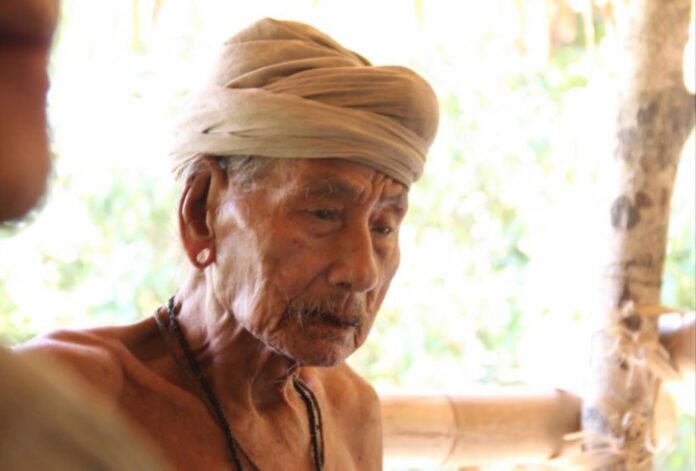
PHETCHABURI — Having failed to fulfil his last wish of returning to his birthplace, Karen community’s spiritual leader Ko-ee “Grandpa Ko-ee” Mimee died early Friday. He was 107.

Ko-ee died from complications to his pneumonia at 4am on Friday at the King Mongkut Memorial Hospital (Phra Chom Klao Hospital) in Phetchaburi province, announced the hospital. He had been in hospital since Sunday.

Ko-ee was born in 1911 as an ethnic Karen in a jungle on the border between Ratchaburi and Phetchaburi province. He was known as a skillful huntsman in the Kaeng Krachan jungle and made a living from selling animals and guiding tourists from Bangkok to hunt, before a wildlife preservation and protection act came into force.

Following the formation of Kaeng Krachan National Park in 1981, Ko-ee was among the Karen minority group who was threatened to leave and find a new home.

43187038 472201243284417 6482037704811872256 n

In May 2011, National Park officers evicted the Karen villagers and set about 100 of their houses on fire.

Ko-ee’s house was one of them.

In 2012, Ko-ee and another five Karen filed a case against the Department of National Parks to the Central Administrative Court.

The court in 2014 ordered the National Park Department to pay 10,000 baht in compensation to the six Karen plaintiffs. However, the court also rejected the Karen’s request to return to the national park as they did not possess legal document proving their rights to live in the forest.

In September 2018, the Supreme Administrative Court ruled the national park department pay about 50,000 baht to each of the six Karen in compensation of their destroyed houses and rice barns. Five of them traveled to Bangkok to receive the money, except Ko-ee who was unable to travel.

Ko-ee’s wish was to return to his hometown in Ban Bangkloi village, located in the Kaeng Krachan National Park.

“I want to die at my birthplace,” Ko-ee often said in many media interviews.

In the end, it wasn’t to be.

Advertisement

Anti-Junta Royal Petitioners Freed, Military Says

Suwaroj Chawanunthanaphokin, at right, speaks to reporters at the City Pillar Shrine on Thursday.

BANGKOK — The military on Friday said five people arrested for attempting to file a royal petition at the Grand Palace had been released.

The five, led by businessman Suwaroj Chawanunthanaphokin, were apprehended Thursday at the City Pillar Shrine just before they made way to the palace to submit their petition, which urged His Majesty the King to replace the junta with a national government.

Prior to their arrest, Suwaroj told reporters a summary of his royal petition had already been sent to the palace for the king’s consideration, and his group was to submit a full draft Thursday.

The group was taken to an army base for questioning before they were freed without charges at 5pm on the same day, military sources told the media.

Security officers accused Suwaroj and his group of violating the junta’s ban on political gatherings.

Advertisement

Hot News

LATEST NEWS

Bangkok
light rain
28.3 ° C
28.3 °
26.1 °
85 %
3.5kmh
100 %
Thu
27 °
Fri
35 °
Sat
35 °
Sun
31 °
Mon
34 °