37.2 C
Bangkok
Thursday, June 25, 2026
Home Blog Page 2142

DTAC Asked to Explain Why it Thinks Customers Are Trillionaires

BANGKOK — One of the three largest telecoms was called upon by regulators Friday to explain what appeared to be some errors on some of its customers’ phone bills.

An unknown number of DTAC customers got the unfortunate news Thursday that they’d gone way over their previous month’s bills, mostly in the hundreds of baht.

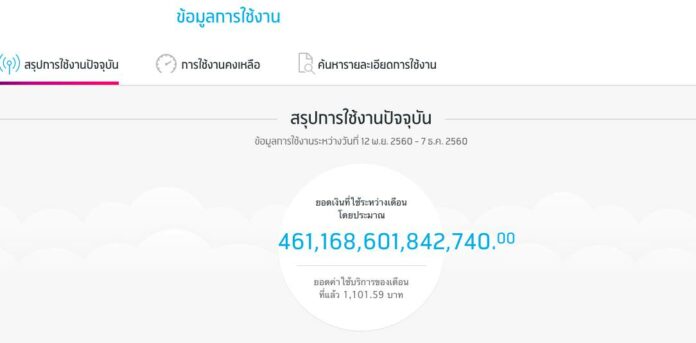
A lot over. As their latest bill from DTAC explained, they had racked up 461 trillion baht in charges for November.

The National Broadcasting and Telecommunications Commission released a letter today asking DTAC to explain how it charged customers more than 100 times the national GDP – one bill came in at 461,168,601,842,740 baht – and then suspended their service on Thursday.

According to the letter, DTAC has until Tuesday afternoon to explain.

The colossal bills came to wider attention after one unidentified man took to popular social issues forum Queen of Spades to complain his monthly phone bill had exceeded 400 trillion baht. He said the error was later fixed and explained as the result of a “wrong calculation.”

In what may become numerical inspiration for the next lottery draw, the exact same number was billed to Chayada, who salted her complaint to DTAC with a little attitude Thursday.

“I can’t call out, and my number is suspended because the bill is insanely high. How many stocks do I have to sell so I can clear this out? Is this the outstanding balance I didn’t pay from former lives?” Chayada wrote on DTAC’s Facebook page.

Advertisement

Go Full Mulan at Interactive Chinese Opera Exhibition

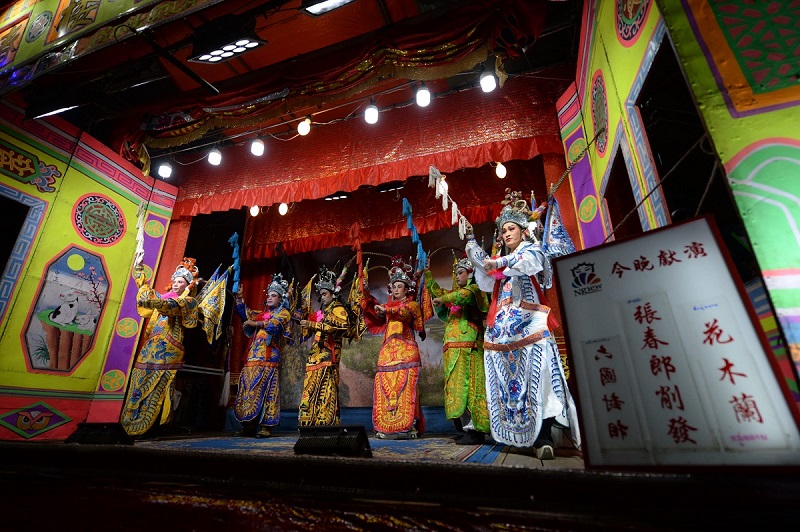
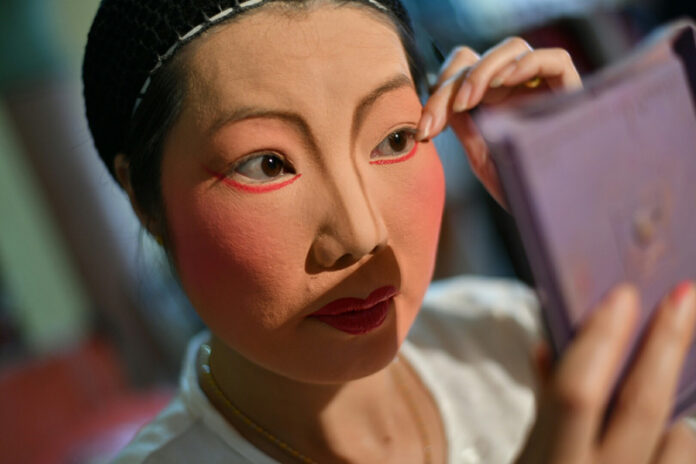
A ngiew actress from the Sai Yong Hong troupe puts on her stage makeup.

BANGKOK — Dress up as an operatic warrior or blushing court lady at an interactive museum exhibition on Chinese opera next week.

For “Night at the Musuem 7: Ngiew Glaa Gao,” Museum Siam is making the old ngiew again in with a full weekend of Chinese operatic edu-tainment.

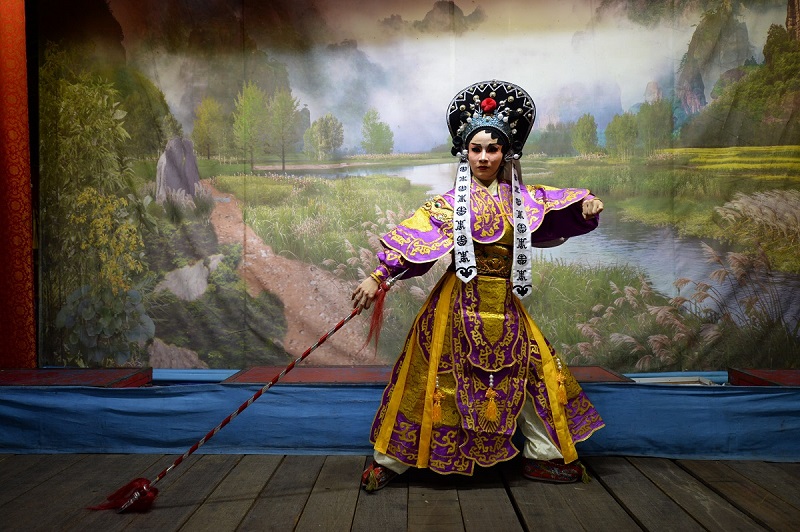
Slather on grease paint and learn what the bright reds and whites mean, or don mirror-covered costumes and poke friends with stage weapons for your Instagram followers. Visitors can even try their hand at being a Chinese opera performer by testing their acrobatic skills in a bamboo obstacle course.

The Ballad of Mulan, an ancient Chinese folktale about a girl who takes her father’s place in the army, will be performed in Thai with a script specially written for the event at 9pm on all three days. Experts will give talks about the opera’s history and culture from 8:30pm to 9pm.

Themed Food and goods will be sold at the event. All exhibitions are in Thai and English.

The exhibition will run 4pm to 10pm, Dec. 15-17 at Museum Siam, located down Sanam Chai Road from the Grand Palace. Admission is free. Get there by Chao Phraya River Express boat via the Rajini Pier.

ตัวอย่างการแสดง 7 2
Rehearsal photos of The Ballad of Mulan.

ตัวอย่างการแสดง 5 ตัวอย่างการแสดง 9

Related stories:

Sold Into Opera Slavery to Become Master of Dying Art

Watch a Chinese Opera Telling of the Sino-Thai Immigrant Story (Video)

Thousands Turn Out For New Riverside Attraction ‘Lhong 1919’

Advertisement

‘Oyster Mask’ Baffles World, Wins YouTube For 2017

BANGKOK — Sorry, it’s not Ed Sheeran’s carpool karaoke or Lady Gaga’s Superbowl show.

It was a true shocker when YouTube revealed that a reality show performance of a man in an oyster costume was the single most trending video worldwide this year.

What for Thailand was an episode of popular singing competition The Mask Singer was, for nearly 200 million viewers on YouTube, a major WTF spectacle of a man in sparkly ruffled chiffon delivering an upbeat rendition of a song to an enraptured audience.

The seemingly Google-translated lyrics might also have added to the mystique for foreign viewers:

“I don’t have money, crown and headdress.

I don’t have a car or air conditioner like they do.

I don’t have Mighty X, [but an] old pickup truck with loud exhaust pipe

I’m non-appearance in gentility

and you can find me just in Sic-Bo”

Under the mask and costume was Panthapol “Ohm” Prasarnratchakij, singer for Bangkok rock band Cocktails. The performance was broadcast on local television and streamed online in June.

Thirty-two-year-old Ohm nailed the original version of the song, called “Trab Thuree Din,” by putting his unique voice through a dynamic range, drawing out some ballad notes before escalating into R&B and rap stylings.

And then there’s the audience and judges, who by the latter half of the performance are moved to cheer, clap and dance along.

Despite criticism the song is too “cheesy” and crowds “going heads over heels” in the comments, the video got a lot of applause from fans around the world.

“Not able to understand but it’s so pleasant to listen  :),” Umesh Singh Mehta wrote.

“Such beautiful lyrics and melodies – I wish I spoke the language,” Greg Bennett wrote.

The video on YouTube is now available in many languages including phonetic subtitles.

The video topped a list that included “Ed Sheeran – Shape Of You | Kyle Hanagami Choreography,” “Inauguration Day — A Bad Lip Reading of Donald Trump’s Inauguration” and “Lady Gaga’s Full Pepsi Zero Sugar Super Bowl LI Halftime Show | NFL.”

Top-trending videos are not the most viewed, but rather those YouTube measures by audience engagement such as views, shares and likes.


Advertisement

Russian Strategic Bombers Fly Patrol Mission From Indonesia

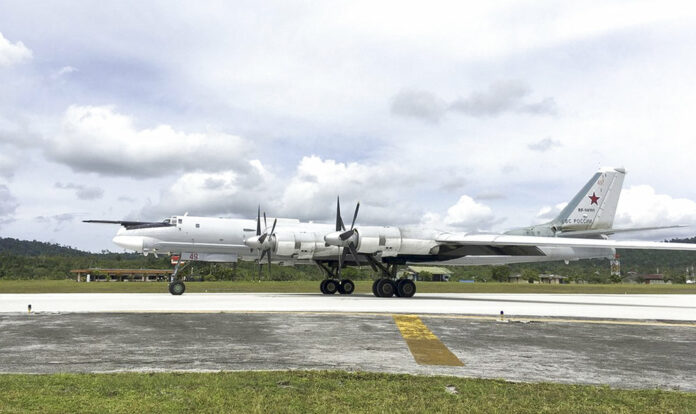
A Russian Tu-95 bomber arrives on Biak Island in Indonesia in a photo released Tuesday. The visit by the bombers capable of carrying nuclear weapons seems to underline Russia's resurgent military might and its desire to expand its foothold around the world. Photo: Russian Defense Ministry Press Service
A Russian Tu-95 bomber arrives on Biak Island in Indonesia in a photo released in December. The visit by the bombers capable of carrying nuclear weapons seems to underline Russia's resurgent military might and its desire to expand its foothold around the world. Photo: Russian Defense Ministry Press Service

MOSCOW — The Russian military says its strategic bombers have flown a patrol mission over the Southern Pacific after taking off from Indonesia, part of Moscow’s efforts to restore its Cold War-era military foothold around the world.

The Russian Defense Ministry said the two Tu-95 strategic bombers flew from Biak Island in Indonesia’s easternmost Papua province where they arrived Tuesday. It said Thursday’s patrol lasted eight hours.

Russian state television stations reported that the nuclear-capable bombers accompanied by heavy-lift transport planes would spend a few days on Biak, but there was no immediate signal that such visits could continue in the future.

The bombers’ visit to Indonesia marked the first such deployment since Cold War times, when Soviet maritime patrol planes flew over the Pacific from a base in Vietnam.

Advertisement

Unmasked: Anonymous Historian Who Chronicled ISIS ‘Killing Machine’

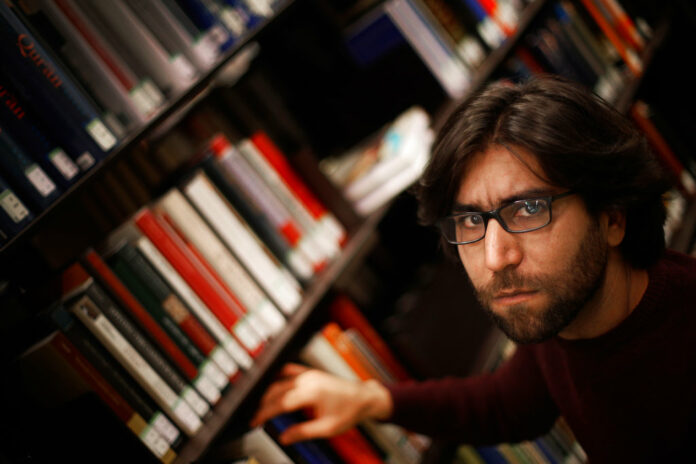
For more than three years, he has been known only as Mosul Eye, an anonymous blogger documenting Islamic State atrocities. Now Iraq's Omar Mohammed, in Europe on Tuesday, wants the world - and his family - to know his identity. Photo: Associated Press

The historian carried secrets too heavy for one man to bear.

He packed his bag with his most treasured possessions before going to bed: the 1 terabyte hard drive with his evidence against the Islamic State group, an orange notebook half-filled with notes on Ottoman history, and, a keepsake, the first book from Amazon delivered to Mosul.

He passed the night in despair, imagining all the ways he could die, and the moment he would leave his mother and his city.

He had spent nearly his entire life in this home, with his five brothers and five sisters. He woke his mother in her bedroom on the ground floor.

“I am leaving,” he said. “Where?” she asked. “I am leaving,” was all he could say. He couldn’t endanger her by telling her anything more. In truth, since the IS had invaded his city, he’d lived a life about which she was totally unaware.

He felt her eyes on the back of his neck, and headed to the waiting Chevrolet. He didn’t look back.

For nearly two years, he’d wandered the streets of occupied Mosul, chatting with shopkeepers and Islamic State fighters, visiting friends who worked at the hospital, swapping scraps of information. He grew out his hair and his beard and wore the shortened trousers required by IS. He forced himself to witness the beheadings and deaths by stoning, so he could hear the killers call out the names of the condemned and their supposed crimes.

He wasn’t a spy. He was an undercover historian and blogger. As IS turned the Iraqi city he loved into a fundamentalist bastion, he decided he would show the world how the extremists had distorted its true nature, how they were trying to rewrite the past and forge a brutal Sunni-only future for a city that had once welcomed many faiths.

He knew that if he was caught he too would be killed.

“I am writing this for the history, because I know this will end. People will return, life will go back to normal,” is how he explained the blog that was his conduit to the citizens of Mosul and the world beyond. “After many years, there will be people who will study what happened. The city deserves to have something written to defend the city and tell the truth, because they say that when the war begins, the first victim is the truth.”

He called himself Mosul Eye. He made a promise to himself in those first few days: Trust no one, document everything.

Neither family, friends nor the Islamic State group could identify him. His readership grew by the thousands every month.

And now, he was running for his life.

But it would mean passing through one Islamic State checkpoint after another, on the odds that the extremists wouldn’t stop him, wouldn’t find the hard drive that contained evidence of IS atrocities, the names of its collaborators and fighters, and all the evidence that its bearer was the man they’d been trying to silence since they first swept in.

The weight of months and years of anonymity were crushing him.

He missed his name.

From the beginning, Mosul Eye wrote simultaneously as a witness and a historian. Born in the midst of the Iran-Iraq war in 1986, he had come of age during a second war, when Saddam Hussein fell and the Americans took over. At 17, he remembers going to a meeting of extremists at the mosque and hearing them talk about fighting the crusaders. “I should be honest, I didn’t understand.”

As for the Americans, whose language he already spoke haltingly, he couldn’t fathom why they would come all the way from the United States to Mosul. He thought studying history would give him the answers.

The men in black came from the north, cutting across his neighborhood in brand new trucks, the best all-terrain Toyotas money could buy. He had seen jihadis before in Mosul and at first figured these men would fade away like the rest. But in the midst of pitched fighting, the extremists found the time to run down about 70 assassination targets and kill them all, hanging enormous banners announcing their arrival in June 2014.

By then a newly minted teacher, the historian attended a staff meeting at Mosul University, where the conquerors explained the Islamic State education system, how all classes would be based upon the strictest interpretation of the Quran. To a man who had been accused of secularism during his master’s thesis defense just the year before, it felt like the end of his career.

In those first few days, he wrote observations about IS, also known by the acronym ISIS, on his personal Facebook page — until a friend warned that he risked being killed. With the smell of battle still in the air, he wandered the streets, puzzling over its transformation into a city at war. He returned to find his family weeping. The smell of smoke and gunfire permeated the home.

On June 18, 2014, a week after the city fell, Mosul Eye was born.

“My job as a historian requires an unbiased approach which I am going to adhere to and keep my personal opinion to myself,” he wrote. “I will only communicate the facts I see.”

By day, he chatted with Islamic State fighters and vendors, and observed. Always observed. By night, he wrote in his native Arabic and fluent English on a WordPress blog and later on Facebook and Twitter.

The city turned dark, and Mosul Eye became one of the outside world’s main sources of news about the Islamic State fighters, their atrocities and their transformation of the city into a grotesque shadow of itself. The things IS wanted kept secret went to the heart of its brutal rule.

“They were organized as a killing machine. They are thirsty (for) blood and money and women.”

He attended Friday sermons with feigned enthusiasm. He collected and posted propaganda leaflets, including one on July 27, 2014, that claimed the Islamic State leader was a descendant of the Prophet Mohammed’s daughter. Back home, writing on his blog in his other, secret identity, he decried the leaflet as a blatant attempt “to distort history” to justify the fanatics’ actions.

He drank glass after glass of tea at the hospital, talking to people who worked there. Much of the information he collected went up online. Other details he kept in his computer, for fear they would give away his identity. Someday, he told himself, he would write Mosul’s history using these documents.

The most sensitive information initially came from two old friends: one a doctor and the other a high school dropout who embraced the Islamic State’s extreme interpretation of religion. He was a taxi driver who like many others in Mosul had been detained by a Shiite militia in 2008 and still burned with resentment. He swiftly joined an intelligence unit in Mosul, becoming “one of the monsters of ISIS” — and couldn’t resist bragging about his insider knowledge.

Once he corroborated the details and masked the sources, Mosul Eye put it out for the world to see. He sometimes included photos of the fighters and commanders, complete with biographies pieced together over days of surreptitious gathering of bits and pieces of information during the course of his normal life — that of an out-of-work scholar living at home with his family.

“I used the two characters, the two personalities to serve each other,” he said. He would chat up market vendors and bored checkpoint guards for new leads.

He took on other identities as well on Facebook. Although the names were clearly fake, the characters started to take on a life of their own. One was named Mouris Milton whom he came to believe was an even better version of himself — funny, knowledgeable. Another was Ibn al-Athir al-Mawsilli, a coldly logical historian.

International media picked up on Mosul Eye from the first days, starting with an online question-and-answer with a German newspaper. The anonymous writer gave periodic written interviews in English over the years. Sometimes, journalists quoted his blog and called it an interview. In October 2016, he spoke by phone with the New Yorker for a profile but still kept his identity masked.

Intelligence agencies made contact as well and he rebuffed them each time.

“I am not a spy or a journalist,” he would say. “I tell them this: If you want the information, it’s published and it’s public for free. Take it.”

First the Islamic State group compiled lists of women accused of prostitution, he said, stoning or shooting around 500 in the initial months. Then it went after men accused of being gay, flinging them off tall buildings. Shiites, Christians and Yazidis fled from a city once proud of its multiple religions.

When the only Mosul residents left were fellow Sunnis, they too were not spared, according to the catalog of horrors that is Mosul Eye’s daily report. He detailed the deaths and whippings, for spying and apostasy, for failing to attend prayers, for overdue taxes. The blog attracted the attention of the fanatics, who posted death threats in the comments section.

Less than a year into their rule, in March 2015, he nearly cracked. IS beheaded a 14-year-old in front of a crowd; 12 people were arrested for selling and smoking cigarettes, and some of them flogged publicly. Seeing few alternatives, young men from Mosul were joining up by the dozens.

The sight of a fanatic severing the hand of a child accused of stealing unmoored him. The man told the boy that his hand was a gift of repentance to God before serenely slicing it away.

It was too much.

Mosul Eye was done. He defied the dress requirements, cut his hair short, shaved his beard and pulled on a bright red crewneck sweater. He persuaded his closest friend to join him.

“I decided to die.”

The sun shining, they drove to the banks of the Tigris blasting forbidden music from the car. They spread a scrap of rug over a stone outcropping and shared a carafe of tea. Mosul Eye lit a cigarette, heedless of a handful of other people picnicking nearby.

“I was so tired of worrying about myself, my family, my brothers. I am not alive to worry, but I am alive to live this life. I thought: I am done.”

He planned it as a sort of last supper, a final joyful day to end all days. He assumed he would be spotted, arrested, tortured. The tea was the best he had ever tasted.

Somehow, incredibly, his crimes went unnoticed.

He went home.

“At that moment I felt like I was given a new life.”

He grew out his hair and beard again, put the shortened trousers back on. And, for the remainder of his time in Mosul, smoked and listened to music in his room with the curtains drawn and the lights off. His computer screen and the tip of his cigarette glowed as he wrote in the dark.

The next month, he slipped up.

His friend the ex-taxi driver told him about an airstrike that had just killed multiple high-level Islamic State commanders, destroying a giant weapons cache. Elated, Mosul Eye dashed home to post it online. He hit “publish” and then, minutes later, realized his mistake. The information could have come from only one person. He trashed the post and spent a sleepless night.

“It’s like a death game and one mistake could finish your life.”

For a week, he went dark. Then he invited his friend to meet at a restaurant. They ate spicy chicken, an unemployed teacher and the gun-toting ex-taxi driver talking again about their city and their lives. His cover was not blown.

The historian went back online. Alongside the blog, he kept meticulous records — information too dangerous to share.

His computer hard drive filled with death, filed according to date, cause of death, perpetrator, neighborhood and ethnicity. Accompanying each spreadsheet entry was a separate file with observations from each day.

“IS is forcing abortions and tubal ligation surgeries on Yazidi women,” he wrote in unpublished notes from January 2015. A doctor told him there had been between 50 and 60 forced abortions and a dozen Yazidi girls younger than 15 died of injuries from repeated rapes.

April 19, 2015: “The forensics department received the bodies of 23 IS militants killed in Baiji. They had no shrapnel, no bullets, no explosives and the cause of death does not seem to be explosion. It is like nothing happened to the bodies. A medical source believes they were exposed to poison gas.”

July 7, 2015: “43 citizens were executed in different places, this time by gunfire, which is unusual because they were previously beheadings. A source inside IS said that 13 of those who were executed are fighters and they tried to flee.”

He noted a flurry of security on days when the Islamic State leader, Abu Bakr al-Baghdadi, seemed to be in town.

Many in Iraq, especially those who supported the Shiite-dominated leadership in Baghdad, blamed Mosul for its own fate. Mosul Eye freely acknowledged that some residents at first believed the new conquerors could only be an improvement over the heavy-handed government and the soldiers who fled with hardly a backward glance at the city they were supposed to defend.

But he also wrote publicly and privately of the suffering among citizens who refused to join the group. He was fighting on two fronts: “One against ISIS, and the other against the rumors. Trying to protect the face of Mosul, the soul of Mosul.”

He tested out different voices, implying one day that he was Christian, another that he was Muslim. Sometimes he indicated he was gone, other times that he was still in the city. “I couldn’t trust anyone,” he said.

In his mind, he left Mosul a thousand times, but always found reasons to stay: his mother, his nieces and nephews, his mission.

But finally, he had to go.

“I had to run away with the proof that will protect Mosul for years to come, and to at least be loyal to the people who were killed in the city.”

And he did not want to become another casualty of the monsters.

“I think I deserve life, deserve to be alive.”

A smuggler, persuaded by $1,000 and the assurances of a mutual acquaintance, agreed to get him out. He was leaving the next day. Mosul Eye had no time to reflect, no time to change his mind.

He returned home and began transferring the contents of his computer to the hard drive. He pulled out the orange notebook with the hand-drawn map of Mosul on the cover and the outlines of what he hoped would one day be his doctoral dissertation. Into the bag went “Father Bombo’s Pilgrimage to Mecca,” an obscure American satirical novel from 1770 that he had ordered from Amazon via a new shop that was the only place in town to order from abroad online.

It was time to leave.

He wanted to make sure his mother would never have to watch the capture and killing of Mosul Eye.

On Dec. 15, 2015 he left Mosul, driving with the smuggler to the outskirts of Raqqa, a pickup point that alarmed him. From there he and other Iraqis and Syrians were picked up by a second set of smugglers and driven by convoy to Turkey.

They had no trouble crossing the border.

In Turkey, Mosul Eye kept at it: via WhatsApp and Viber, from Facebook messages and long conversations with friends and relatives who had contacts within IS. From hundreds of kilometers away, his life remained consumed by events in Mosul.

By mid-2016, deaths were piling up faster than he could document. The IS and airstrikes were taking a bloody toll on residents. His records grew haphazard, and he turned to Twitter to document the atrocities. In February 2017, he received asylum in Europe with the aid of an organization that learned his backstory. He continued to track the airstrikes and Islamic State killings.

He mapped the airstrikes as they closed in on his family, pleading with his older brother to leave his home in West Mosul. Ahmed, 36, died days later when shrapnel from a mortar strike pierced his heart, leaving behind four young children.

It was only then that Mosul Eye revealed his secret to a younger brother — who was proud to learn the anonymous historian he had been reading for so long was his brother.

“People in Mosul had lost hope and confidence in politicians, in everything,” his brother said. Mosul Eye “managed to show that it’s possible to change the situation in the city and bring it back to life.”

As the Old City crumbled, Mosul Eye sent coordinates and phone numbers for homes filled with civilians to a BBC journalist who was covering the battle, trying to get the attention of someone in the coalition command. He believes he saved lives.

Then, with his beloved Old City destroyed, Mosul Eye launched a fundraiser to rebuild the city’s libraries because the extremists had burned all the books. None of his volunteers knew his identity.

An activist who helped co-found a “Women of Mosul” Facebook group with Mosul Eye describes him as a “spiritual leader” for the city’s secular-minded.

“He was telling us about the day-to-day events under ISIS and we were following closely with excitement as if we were watching a movie. Sometimes he went through hard times and we used to encourage him. He won the people’s trust and we became very curious to know his real personality,” said the activist, who spoke on condition of anonymity because she believed she was still in danger.

From a distance, finally writing his dissertation on 19th century Mosul history in the safety of a European city, he continued to write as Mosul Eye and organize cultural events and fundraisers from afar — even after Mosul was liberated.

The double life consumed him, sapped energy he’d rather use for the doctoral dissertation and for helping Mosul rebuild. And it hurt when someone asked the young Iraqi why he didn’t do more to help his people. He desperately wanted his mother to know all that he had done.

He felt barely real, with so many people knowing him by false identities: 293,000 followers on Facebook, 37,000 on WordPress and 23,400 on Twitter.

In hours of face-to-face conversations with The Associated Press over the course of two months, he agonized over when and how to end the anonymity that plagued him. He did not want to be a virtual character anymore.

On Nov. 15, 2017, Mosul Eye made his decision.

“I can’t be anonymous anymore. This is to say that I defeated ISIS. You can see me now, and you can know me now.”

He is 31 years old.

His name is Omar Mohammed.

“I am a scholar.”

Story: Lori Hinnant, Maggie Michael

Advertisement

MBK Fight Night Back and Ready to Brawl

Update Jan. 16: MBK Fight Night returns 6pm on Wednesday with five matches including a headlining bout featuring female fighters.

BANGKOK — The Bangkok institution that is MBK Fight Night has returned for a seventh season of Muay Thai action after more than a year’s layoff.

The popular fights, which take place in a roadside ring in public view at the downtown mall, returned in force Dec. 1 with action-packed match-ups from beginning to end in front of a packed crowd.

“We knew that it would be a while for its return as MBK were building the connecting roof that now covers the ring,” organizer Arran Sirisompan said of the prolonged downtime.

Anyone who has been to MBK Center in the past year and a half would know the construction area Arran is referring to. And while it’s now awesome the fights will be safe from rain – and run year-round, Arran says – the downside is that some of the best viewing points from the skywalk have lost line of sight.

Another reason for the long delay was a change in mall management.

“The team at MBK that helped organize the fight night left and was replaced with a new team that seemed hesitant about having the fights,” Arran said.

That made this return more of an audition for Arran and partner Adam Marin. That being the case, I can’t imagine it having gone any better. The fights were fantastic and the crowd was packed and full of energy.

There were some format changes this season that add to the events marketability. Firstly they have brought on social media fitness icon Mark Abbott of the Caption Mark Podcast and Thai Top Fitness fame to MC the event in his unique style that allows him to flow between English and Thai. Local fight fans might know Mark as having previously MC’d FMD in Thai.

The other massive change to the fight night was the overall format, fights are now three rounds instead of five rounds. When I spoke with the promoters about this Arran said “This will be the first season we will be live streaming the fights on YouTube so it helps keep the action fast paced.  Muay Thai fans will know that by the 5th round fighters have decided who the winner is and the action dies. With 3 rounds it’s a sprint to the finish rather than a marathon and that makes for a more exciting fight for the viewer.” I couldn’t agree more, all but one of the six fights went the distance and each of them was action packed from start to finish.

The shorter fights also means the event ends while MBK is still open so once it’s done you can head inside for dinner or any last minute shopping you might need to do.

This season will also be structured a bit differently, in the past MBK fight night was held on a weekly basis. If this seventh season gets the greenlight from MBK it will move forward on a monthly basis, but instead of being packed into the a few months between the rainy season it will span the whole year. That new format offers some new possibilities to the promoters, Arran said “Now we will hopefully host an event once a month which gives us more time to plan, and allows a bigger budget to feature bouts where more well known fighters can apply their trade.”

From what I saw at the opener of the seventh season of MBK fight night it’s off to a great start and was a real crowd pleaser. With the new format and the vision of Arran and Adam coming into it’s own this is going to be a must see event in my opinion. But check out the video and see for yourself.

The schedule for this season of MBK Fight Night has yet to be set. Stay up-to-date via MBK Fight Night on Facebook.

Advertisement

Falling Crane Severs Worker’s Leg (Video)

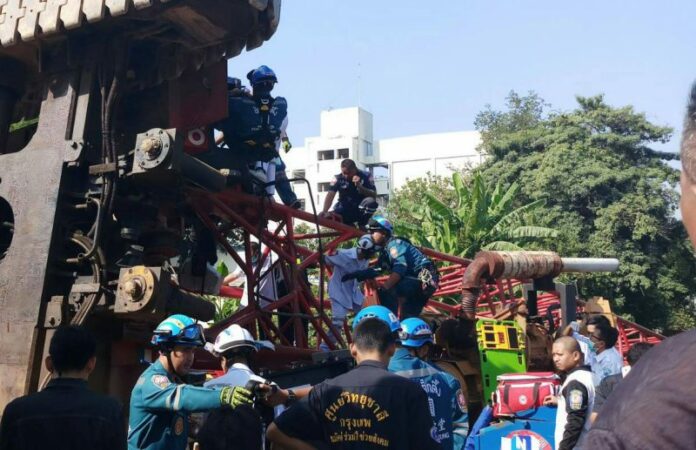
Emergency officials pull Somphong Kaewduangjan, 54, from a fallen crane Friday morning at Khlong Bang Sue.

BANGKOK — Another day, another crane falls in Bangkok.

This time, when a crane came crashing down Friday morning at a construction site in northern Bangkok, it left a man disabled for life. Work was halted on a water diversion tunnel at Khlong Bang Sue after the crane topped onto its side, pinning 54-year-old operator Somphong Kaewduangjan. His right leg was severed from his body.
Emergency workers rushed to the scene at about 10am and it took them 20 minutes to free Somphong from the crane. He was taken to Vachira Hospital for treatment. He was expected to survive.
Chuchart Ngamwas, who was overseeing the construction site, said that Somphong was operating the crane to move materials used in lining the tunnel. However, the sling got stuck and Somphong’s attempt to pull it free caused the crane to tip over.

Police had not charged anyone as of Friday morning but said they will continue to investigate for any signs of negligence.

Construction accidents, sometimes fatal, are pervasive at the many projects across the capital.  In April, three workers were killed while working on the elevated Red Line extension.

Related stories:

Green Line Construction Crane Topples on Phahonyothin Road

Legal Action Against Italian-Thai Weighed After Red Line Collapse Kills 3

Another Accident Lands Italian-Thai in Hot Water For Safety Lapses

No Charges Over Fallen Crane at BTS Phra Khanong

Dead Workers Probably at Fault for Fatal Crane Failure, Cop Says

Advertisement

Prawit Given 30 Days to Come Clean on Fancy Watch

Photo: ThaiPBS

BANGKOK — A deputy prime minister and top junta leader was given an ultimatum by a corruption watchdog agency to explain pricy luxury items that he never declared among his assets.

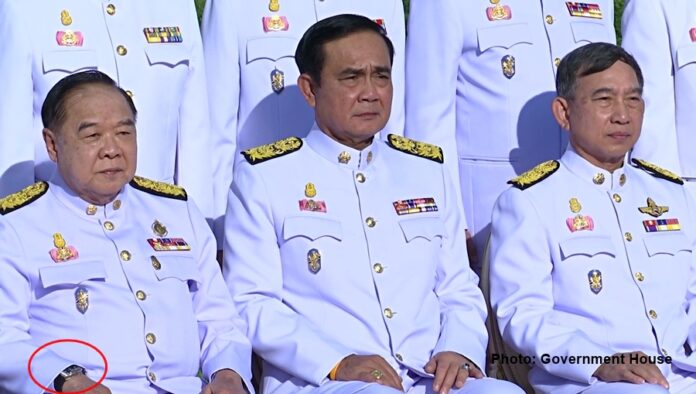
The National Anti-Corruption Commission, or NACC, on Thursday asked Gen. Prawit Wongsuwan to explain personal accessories including a Richard Mille wristwatch – worth at least 3 million baht – and diamond ring seen in photos which prompted questions about how he could have afforded them.

It turned out the items were not included on a list of declared assets when Prawit took his position in the ministerial office after helping stage the 2014 coup d’etat.

The deputy junta leader and his expensive items came under spotlight Monday when a portrait of the new cabinet revealed Prawit’s flashy watch peeking out from under the his sleeve. It quickly invited mockery and implicit accusations of corruption against the junta second-in-command.

Good-governance activist Srisuwan Janya filed a complaint to the NACC on Thursday, urging the commission to investigate the issue.

Prawit declared assets of 87 million baht including 53 million baht in cash. He has refused to discuss the matter since Tuesday and skipped at least one scheduled public appearance since the controversy erupted.

Related stories:

Show and Don’t Tell: Gen. Prawit Won’t Explain His Bling Watch to Public

Deputy Junta Head Sports Spendy Haute Horology

Advertisement

Bitcoin Soars to $19K Then Falls Back

A bitcoin logo is displayed at a 2014 Inside Bitcoins conference and trade show in New York. Photo: Mark Lennihan / AP

NEW YORK — The price of bitcoin swung wildly Thursday, rising to more than USD$19,000 (620,000 baht) only to fall sharply within minutes, as both the euphoria and anxiety surrounding the virtual currency escalated just days before trading in bitcoin futures begins on a major U.S. exchange.

The concerns about its volatility have led some Wall Street banks and trade groups to raise concerns about the potential implications of trading bitcoin. Banks also appear likely to limit customers’ access to the futures when they first start trading.

Bitcoin was valued at $17,167 as of 6pm EST, according to large bitcoin exchange Coinbase, after briefly surging above $19,000 Thursday morning. At the start of the year, one bitcoin was worth less than $1,000.

Read: Bitcoin’s Going Nucking Futs, Here’s How to Buy From Thailand

Bitcoin’s wild swings occurred as Wall Street prepares for bitcoin futures to start trading on the Chicago Board Options Exchange on Sunday evening and on the Chicago Mercantile Exchange a week later. The futures are designed to reflect the price of bitcoin without an investor having to physically hold the currency, not unlike how oil, gold, copper or cocoa prices are determined by futures contracts.

Yet the dawn of futures trading has some parties on Wall Street concerned. A group of banks, brokerages and clearinghouses came out and complained that federal regulators approved the futures too quickly and without properly considering the risks inherent in bitcoin.

The Futures Industry Association, a trade association that represents Wall Street banks, brokerages and clearinghouses, sent a letter to the Commodities Futures Trading Commission this week, saying the institutions should have been consulted before trading in bitcoin futures was approved. The association’s members expressed concern that they could be on the hook for large sums of money if extreme volatility in bitcoin resulted in big losses for some customers.

Goldman Sachs, one of the nation biggest investment banks, said it will allow only a limited number of clients to trade the CBOE’s bitcoin futures when they launch next week. Bank of America will not allow clients access to the futures.

A person familiar with the matter said JPMorgan Chase will not allow clients access to the futures on the first trading day, and will make an evaluation after that based on what it sees in the futures market. This person requested anonymity because the decision hasn’t yet been announced publicly.

The Wall Street Journal reported that Citigroup will also not allow clients access to bitcoin futures, although a Citi spokesman declined to comment. Morgan Stanley declined to comment.

Thomas Peterffy, chairman of the broker-dealer Interactive Brokers Group, expressed deep concerns about the trading of bitcoin futures last month, saying “there is no fundamental basis for valuation of Bitcoin and other cryptocurrencies, and they may assume any price from one day to the next.”

Peterffy noted that if bitcoin futures were trading at that time, under the CBOE’s rules those futures likely would experience repeated trading halts because of limits on how high or low the price can move during the trading day.

The futures signal more mainstream acceptance of the currency, but also open up bitcoin to additional market forces. Futures allow for the shorting of bitcoin — that is betting that the price of bitcoin will go down — which presently is very difficult to near impossible to do. With the currency’s tremendous run up in price in recent days, it could become a target for those who doubt that it deserves its current lofty value.

The frenzy of interest and the rapid rise in the price of bitcoin has put significant strain on the major bitcoin exchanges. Coinbase, the largest bitcoin exchange, at one point tweeted that record-high traffic had caused interruptions to its service. Bitfinex, which trades several digital currencies including Bitcoin, tweeted out that it had suffered an unusual surge in traffic the last few days.

Bitcoin is the world’s most popular virtual currency. Such currencies are not tied to a bank or government and allow users to spend money anonymously. They are basically lines of computer code that are digitally signed each time they are traded.

A debate is raging on the merits of such currencies. Some say they serve merely to facilitate money laundering and illicit, anonymous payments. Others say they can be helpful methods of payment, such as in crisis situations where national currencies have collapsed.

Miners of bitcoins and other virtual currencies help keep the systems honest by having their computers keep a global running tally of transactions. That prevents cheaters from spending the same digital coin twice.

Online security is a vital concern for such dealings.

In Japan, following the failure of a bitcoin exchange called Mt. Gox, new laws were enacted to regulate bitcoin and other virtual currencies. Mt. Gox shut down in February 2014, saying it lost about 850,000 bitcoins, possibly to hackers.

Earlier Thursday, NiceHash, a company that mines bitcoins on behalf of customers, said it is investigating a breach that may have resulted in the theft of about $70 million worth of bitcoin.

Story: Ken Sweet

Advertisement

Pantone Picks Deep Purple ‘Ultra Violet’ as Color of Year

Image: Pantone

NEW YORK — What we have here in 2017 is a heap of chaos and disruption. What we need in 2018? The Pantone Color Institute thinks whatever that might be will come in the deep purple hue of “Ultra Violet,” its color of the year revealed Thursday.

The color wasn’t chosen because it’s regal, though it resembles a majestic shade. It was chosen to evoke a counterculture flair, a grab for originality, ingenuity and visionary thinking, Pantone Vice President Laurie Pressman told The Associated Press ahead of the announcement.

“We are living in complex times,” she said. “We’re seeing the fear of going forward and how people are reacting to that fear.”

Pressman wasn’t keen on talking politics. The color, she said, playing out in home design, industrial spaces and products, fashion, art and food, reflects the idea of living not inside the box or outside the box but with no box at all. Specifically, she called the color “that complexity, that marriage, between the passionate red violets and the strong indigo purples.”

Ultra Violet leans more to blue than red and that, Pressman said, “speaks to thoughtfulness, a mystical quality, a spiritual quality.” There’s still a passionate heat from enough red undertones, and a touch of periwinkle, but “it’s really the cool that prevails.”

The 2018 color of the year follows 2017’s “Greenery,” a grassy fresh, revitalizing shade that reflected new beginnings.

The purple choice, a la Prince and the glam rock of David Bowie — both of whom died in 2016 — speaks to rebellion, finding new ways to interpret our lives and surroundings, Pressman said. It also speaks to the pleasing calm of Provence and its purple flower fields.

“I see this as very much an optimistic color, an empowering color,” she said. “We want to find some peace and calm within ourselves. How do we quiet our minds?”

Well, there are meditation and yoga studios, some of which rely on violet light that some believe has a power to heal. A company in the United Kingdom has come up with a shower head fitted with the same hue of light that turns bathing into purple rain. There’s an embrace of purple cauliflower and sweet potato, joining eggplant and purple-colored cocktails.

The color has a history that has shifted over the decades.

It played a role in logos used by the women’s suffrage movement of the early 1900s in Britain, lent a flash to flappers in the 1920s and has popped in paintings through history, from the seated woman’s dress in “The Pained Heart” of Pre-Raphaelite Arthur Hughes and the work of Gustav Klimt to Bauhaus modernists such as Wassily Kandinsky and on to Keith Haring and Andy Warhol.

Fast forward to Jimi Hendrix and his “Purple Haze,” the penultimate song he played in concert on Sept. 6, 1970, days before his death. Grace Jones, Lady Gaga, Kylie Jenner, Beyonce, Katy Perry (remember her purple hair?) and Rihanna have embraced the color, Pressman said.

Richard Wagner surrounded himself with purple when he composed and Leonardo da Vinci wrote that meditation and prayer were “10 times more powerful if done while sitting in the violet light, shining through a stained glass window.”

Ultra Violet represented on fashion runways for fall 2016, continuing into this year’s collections, including those of Alberta Ferretti and Marni. For spring ’18, Kenzo put a model in a bright sleeveless purple dress paired with high black-and-white socks and a yellow handbag.

In beauty, versatile purple is prevalent for eyes, lips and nails. Ultra Violet brings the drama but it’s an easy drama, a non-threatening color, on the body and in the home.

“It’s a color that can be worn by so many different skin tones,” Pressman said.

So who wears it best? Rihanna, Pressman said. Particularly, Rihanna in a 2017 Dior ad with gorgeous violet lips and purple-tinted sunglasses.

“When you think of this color she perfectly sums up the originality, the inventiveness, the forward thinking, the non-conformity,” Pressman said. “The exploration, the expression, the do your own thing. She thinks about things differently than anybody else. No boundaries.”

Story: Leanne Italie

Advertisement

Hot News

LATEST NEWS

Bangkok
broken clouds
37.2 ° C
37.2 °
35 °
58 %
4kmh
77 %
Thu
37 °
Fri
37 °
Sat
36 °
Sun
36 °
Mon
37 °