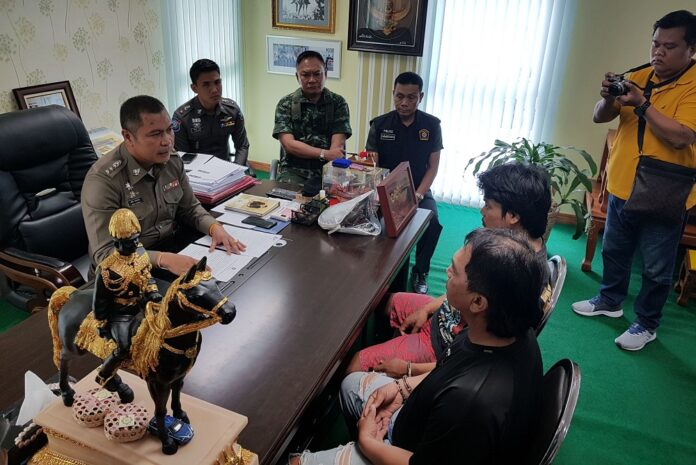
Surasak Intarachote, 50, and Rattanapol Sae-ui, 21, talk to Col. Apichai Klobpetch on Tuesday
PATTAYA — Two operators of a speedboat in Pattaya were arrested Tuesday and accused of stealing goods worth a million baht from a Chinese tourist, police said.
Surasak Intarachote, 50, and Rattanapol Sae-ui, 21, are accused of stealing money, jewelry and a mobile phone from the victim’s bag while he was swimming in the sea off Koh Larn. They have been charged with theft, according to the Pattaya police chief, who would not divulge further details.
Told it was for a news report, Col. Apichai Klobpetch hung up the phone.
At a news conference earlier today, the colonel said the incident took place Monday. Police and soldiers tracked down and arrested the two suspects soon after the tourist filed a complaint, Apichai told reporters.
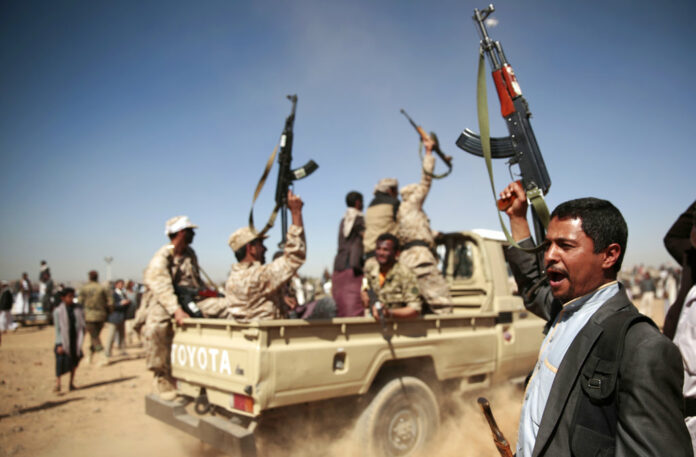
Tribesmen loyal to Houthi rebels chant slogans at a Jan. 3, 2017, gathering aimed at mobilizing more fighters into battlefronts to fight pro-government forces, in Sanaa, Yemen. Photo: Hani Mohammed / Associated Press
SANAA, Yemen — The killing of Yemen’s longtime strongman and ex-President Ali Abdullah Saleh by the country’s Shiite rebels as their alliance crumbled amid street clashes in the capital, Sanaa, has thrown the nearly three-year civil war into unpredictable new chaos.
A video circulating online on Monday showed Saleh’s body with a gaping head wound dumped in a pickup truck by rebels — a grisly end recalling that of his contemporary, Libya’s Moammar Gadhafi, in 2011.
Saleh’s slaying likely gives the rebels the upper hand in the days-long fighting for Sanaa while also shattering hopes by Yemen’s Saudi-backed government that the former president’s recent split with the Iranian-backed rebels, known as Houthis, would have weakened them.
That would give Yemen’s internationally recognized government and the Saudi-led coalition backing it and waging war on the Houthis a chance for a turning point in the stalemated conflict that has brought humanitarian disaster.
But with Saleh’s forces seemingly in disarray, it was not immediately clear if the Saudi-led coalition will be able to turn the split to its advantage in the war.
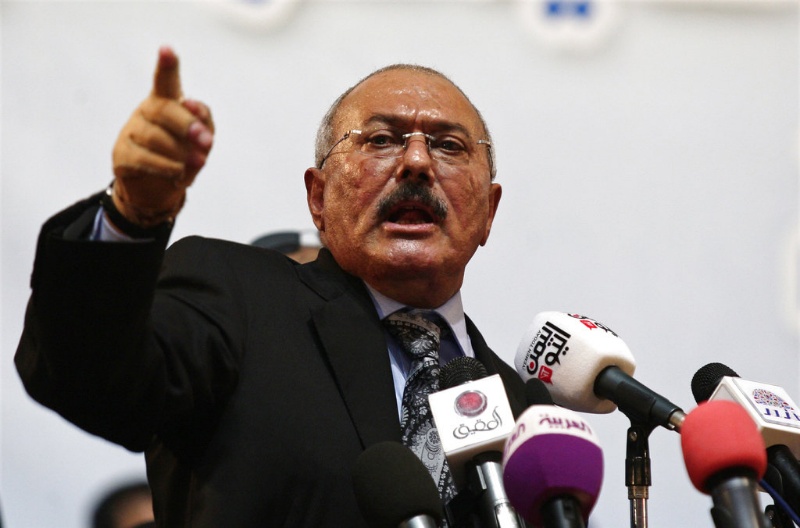
Former Yemeni President Ali Abdullah Saleh in a file photo. Photo: Associated Press
It was a grisly end for Saleh, who ruled Yemen for more than three decades until an Arab Spring uprising forced him to step down in 2012. He later allied with the Houthi rebels hoping to exploit their strength to return to power. That helped propel Yemen into the ruinous civil war that has spread hunger and disease among its 28 million people.
Saleh’s death was announced by the Houthis and confirmed by two Saleh associates and a Yemeni government official. The exact circumstances were unclear: Houthi officials said their fighters killed him as he tried to flee the capital for his nearby hometown of Sanhan. The Houthis’ top leader said Saleh paid the price for his “treason,” accusing him of betraying their alliance to side with the Saudi-backed coalition.
Houthi and Saleh-loyalist forces have been fighting in Sanaa since late last week. The Saudi-led coalition has been hitting Houthi positions with airstrikes, hoping that having Saleh on its side after his split with the rebels could provide a foothold in the capital for the forces of the Saudi-backed president, Abed Rabbo Mansour Hadi.
But by Monday evening, hours after Saleh’s death, witnesses said his forces had abandoned some of their positions in Sanaa and that Houthi fighters had moved into one of the most heavily contested districts, seizing Saleh’s house and those of some of his family members. Saudi airstrikes hit several Houthi positions in the evening, but otherwise the city saw the first easing of fighting in days.
In a televised speech, the Houthis’ top leader, Abdul-Malek al-Houthi, called Saleh’s killing a “dark day for the forces of the coalition.” He said he had known Saleh was communicating with the coalition and had warned him to stop.
Hadi, in turn, gave a televised speech of his own on Monday from the Saudi capital, Riyadh, where he has been in self-imposed exile for most of the war. He tried to rally Saleh’s allies to keep up the fight against the Houthis.
“Let’s put our hands together to end this nightmare,” Hadi said. He said his government forces would support any “uprising” against the Houthis in Sanaa.
An official in Hadi’s government told The Associated Press that members of Saleh’s political party and military forces were cooperating with the coalition and would provide coordinates for airstrikes against the Houthis. He said strikes will intensify so that the closest pro-Hadi ground troops — located at Nihm about 48 kilometers (30 miles) northeast of Sanaa — can push toward the capital.
The hope is that as the forces advance, tribes in the area will be encouraged to rise against the Houthis, he said, speaking on condition of anonymity to discuss the plans.
One of Saleh’s sons, Salah Saleh, posted a call on his Facebook page for his allies to take up the fight against the rebels. He also urged the United Arab Emirates to allow Saleh’s most prominent son, Ahmed Saleh, who headed the elite Republican Guard under his father’s rule, to return to Yemen and lead forces against the Houthis.
When Saleh left power, he stayed in the country and kept the loyalty of many military commanders, splitting the armed forces between himself and Hadi. Saleh’s forces were key to helping the Houthis overrun Sanaa in 2014 and then much of the north and center of the country.
But over the past year, the Houthis appear to have undermined Saleh, wooing away some of his commanders, strengthening their own fighters and reducing their need for him. It appears that pushed Saleh into flirting with the coalition, ultimately leading to the breakdown of the alliance with the Houthis and the recent outbreak of clashes.
The fighting has brought new suffering to Sanaa’s residents.
Suze van Meegen, the Sanaa-based protection and advocacy adviser for the Norwegian Refugee Council, said the violence left aid workers trapped inside their homes.
“No one is safe in Sanaa at the moment. I can hear heavy shelling outside now and know it is too imprecise and too pervasive to guarantee that any of us are safe,” she said.
Residents said the night was shattered by the sounds of gunfire and children screaming.
Witnesses said the bodies of slain civilians and fighters littered the streets as no ambulances were able to reach the area. The ICRC said at least 125 people had been killed and some 240 wounded in Sanaa since the fighting began last week.
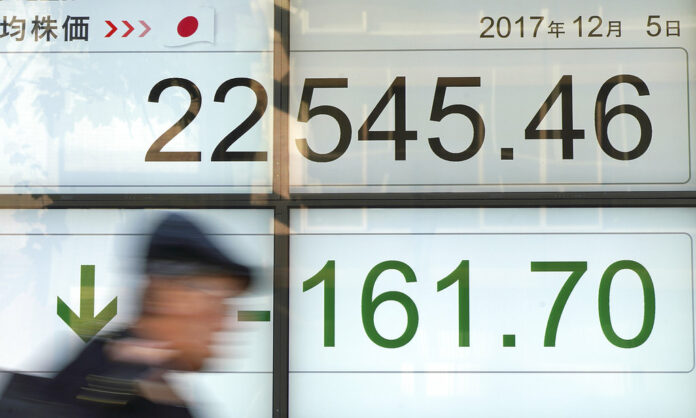
A man walks past an electronic stock board showing Japan's Nikkei 225 index at a securities firm in Tokyo on Dec. 5, 2017. Photo: Eugene Hoshiko / Associated Press
TOKYO — Shares were mostly lower in Asia on Tuesday after a lackluster session on Wall Street, where technology stocks tumbled. Investors are keeping an eye on U.S. tax legislation and Brexit negotiations.
KEEPING SCORE: Tokyo’s Nikkei 225 index slipped 0.4 percent to 22,622.38 and Hong Kong’s Hang Seng index dropped 0.5 percent to 28.977.54. The Kospi in South Korea gained 0.2 percent to 2,507.44, while the Shanghai Composite index shed 0.2 percent to 3,303.05. Australia’s S&P ASX 200 fell 0.2 percent to 5,971.80. Shares in Southeast Asia were mostly higher. Taiwan declined.
WALL STREET: Telecom stocks, banks and other sectors that stand to benefit the most from Washington’s drive to cut corporate tax rates jumped, but technology stocks slumped, giving up a chunk of the gains that made them the best-performing part of the market by far this year. Losers and gainers were nearly evenly split. The S&P 500 dipped 0.1 percent to 2,639.44, while the Dow Jones industrial average rose 0.2 percent to 24,290.05. The tech-heavy Nasdaq composite fell 1.1 percent, to 6,775.37.
U.S. TAXES: Indexes initially jumped on expectations that lower tax rates will boost corporate profits. But technology companies that already pay the lowest effective tax rates of the 11 sectors in the S&P 500 skidded. Uncertainty over the tax overhaul persists since the Senate and House of Representatives must iron out differences in their respective proposals, with a Friday deadline to avert a government shutdown looming.
BREXIT TALKS: The European Union and Britain ended a flurry of top-level diplomacy on Monday without a deal on the terms of their divorce, as agreement on how to maintain an open Irish border after Brexit slipped out of the negotiators’ grasp. But the two sides said they were within striking distance of consensus, setting up a hectic negotiating rush ahead of an EU summit next week.
ANALYST VIEWPOINT: “The two overarching macro themes the market honed in on overnight have been the response from European and U.S. traders to the Senate passing its tax plan and that no deal has yet been formally reached in the Brexit negotiations,” Chris Weston of IG said in a commentary. “What we have seen though is a fairly upbeat session, but perhaps not as strong as we had anticipated.”
CURRENCIES: The dollar rose to 112.61 Japanese yen from 112.41 yen late Monday. The euro climbed to $1.1868 from $1.1866, and the British pound fell $1.3472 from $1.3479.
ENERGY: Benchmark U.S. crude gained 4 cents to $57.51 per barrel in electronic trading on the New York Mercantile Exchange. It slumped 89 cents to settle at $57.47 per barrel on Monday. Brent crude, the international standard, lost 5 cents to $62.40 per barrel. It fell $1.28 to $62.45 a barrel in London.
BANGKOK — The investigation into a 19-year-old cadet’s academy death will be completed “soon,” military officials said Tuesday.
It’s been a week since the military convened an inquiry into Pakapong Tanyakan’s death, which has drawn widespread attention and suspicion of foul play, and an independent attempt to explain his death stalled out. While the top armed forces commander renewed his pledge for a swift process, a spokesman said there is no deadline.
“We want a little more time. We are not dragging our feet,” armed forces spokesman Nothapol Boonngam said. “We don’t want to put a limit on the time, but we want to complete it as soon as possible.”
Earlier today Chief of the Defense Forces Thanchaiyan Srisuwan told reporters he expected the inquiry to be done “soon.” The general did not give any timeframe.
Pakapong, a freshman at the prestigious Armed Forces Preparatory School, died from what the military described as “sudden heart failure” in October.
His family later realized Pakapong’s body was returned to them with several organs missing, raising public outcry and suspicion of mistreatment. Pakapong also noted in his diary he was subjected to beating at the academy.
In the wake of the widespread uproar, the military returned the organs to Pakapong’s parents and said they had been kept for medical examination. They also announced that an army-run investigation into the chain of events that led to the cadet’s demise.
Lt. Gen. Nothapol said more than 30 people have been questioned by the fact-finding committee, mostly his classmates at the academy.
“In the past week, they worked until 8 or 9pm,” Nothapol said. “Next week they will question more people who were involved.”
Deflections
Pakapong’s family had requested the Central Institute of Forensic Science, which operates independently from police and the military, to perform an autopsy on the dead cadet.
But any hope of a speedy answer was quashed when the institute announced Thursday, to much public ridicule, that it could not complete the autopsy because a routine chemical had somehow run out.
Pakapong’s family, which had been outspoken in its criticism, has not spoken publicly in over a week. Calls and messages seeking comment to them were not returned.
A Thursday article on Manager newspaper alleged the military had attempted to “lobby” the Tanyakans into silence.
Because the family had supported a hardline conservative movement led by Suthep Thaugsuban during the 2014 anti-government protests, the military asked two leading activists from Suthep’s group to talk them into accepting the army’s explanation of the events, the article said. It added that the Tanyakans were not moved.
Lt. Gen. Nothapol said he hasn’t heard anything about the alleged mediation.
“Maybe there was or there wasn’t, I don’t know,” the spokesman said.
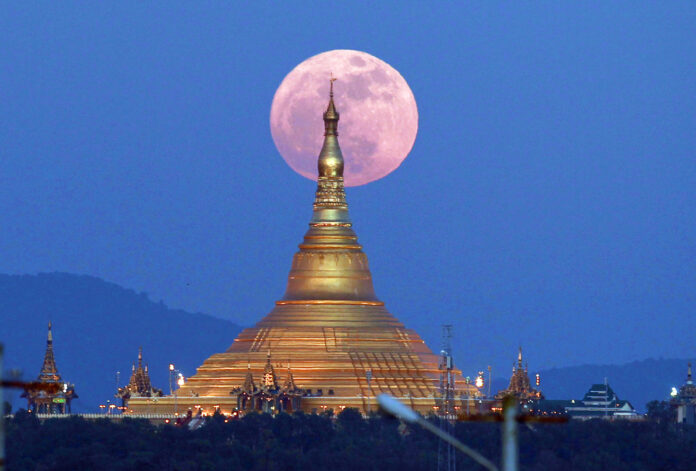
The moon rises behind the Uppatasanti Pagoda seen in Naypyitaw, Myanmar, Sunday, Dec. 3, 2017. The Dec. 3 full moon is the first of three consecutive supermoons. The two will occur on Jan. 1 and Jan. 31, 2018. Photo: Aung Shine Oo
Photo: Aung Shine Oo / Associated Press
Sunday’s full moon was the first of three consecutive supermoons. In this photo, the moon rises behind the Uppatasanti Pagoda in Naypyitaw, Myanmar. The next two supermoons will occur on Jan. 1 and Jan. 31, 2018. A supermoon is a full moon or a new moon that approximately coincides with the closest distance that the moon reaches Earth in its orbit, resulting in a larger-than-usual apparent size of the lunar disk as seen from Earth.
This image was made with a lens at a focal length of 300mm, a shutter speed of 1/200, aperture of f3.5, and ISO 320.
PATTAYA — A man who blamed an epileptic fit for causing a scene of carnage Monday on a Pattaya street that killed two tested positive for drug use, police said Tuesday.
Drugs were reportedly found last night in Akkaradet Udomrat’s blood. Though his medical records indicate the 44-year-old man has been diagnosed with epilepsy, he was charged with fatal recklessness while under the influence, according to Pattaya police.
The test results indicated that Akkaradet was high on a Category 1 drug, a list which includes methamphetamines, heroin and ecstacy, Maj. Pitak Noensang of Pattaya city police said.
Sanit Promwong, director of the Land Transport Department, said officials would permanently revoke Akkaradet’s driving license if doctors find he indeed has epilepsy as claimed.
Akkaradet possessed a lifetime driver’s license before they were changed to be renewable, Sanit said.
Sanit said his department has discussed with the Medical Council how to raise the requirements for driver’s licenses, including using a standard form for medical certifications declaring physical conditions that pose a risk to driving, such as epilepsy and serious infectious diseases. Applicants who are diagnosed with such would be disqualified from obtaining driver’s licenses.
Akkaradet on Monday morning crashed his black pickup truck into a large crowd of commuters, running over nearly a dozen motorcyclists on Pattaya Tai Road, killing two people, a dog and sending 15 commuters to hospitals.
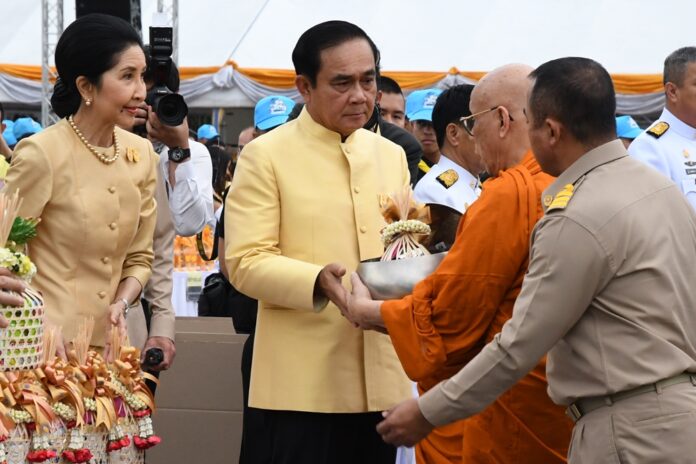
Junta chairman Prayuth Chan-ocha gives alms to a monk Tuesday at the Royal Plaza in Bangkok
BANGKOK — National Day was being marked Tuesday with a series of religious rites dedicated to His Majesty the Late King Bhumibol, six decades after it was moved to fall on his birthday.
In lieu of the usual pomp, parades and fireworks that awe the public and tourists, prayers and monk alms-giving ceremonies were staged nationwide in memory of the late monarch, who died in October 2016.
Junta chairman Prayuth Chan-ocha hosted a religious ceremony in the Royal Plaza this morning on behalf of the military government. Gen. Prayuth was joined by his cabinet, junta officials, interim parliament members and commanders of the armed forces. Similar ceremonies were held in each province.
The current monarch, King Vajiralongkorn, is scheduled to attend a Buddhist ritual for his late father later this evening.
Charity was also the theme of this year’s celebration. Food donated to monks in Buddhist ceremonies would go to flood victims, officials said. Volunteer groups across the country also mobilized to do civic work today such as cleaning streets, clearing rubbish from canals and planting trees.
The only festivities expected for Tuesday were canceled. Rock star Toon Bodyslam was initially set to resume his charity run through Bangkok downtown today, giving chance for the throngs of his admirers to catch glimpse of him. His organizers postponed the event to Wednesday, citing doctor’s orders.
Thailand’s National Day was originally observed on June 24, the date of a revolt that ended the direct royal rule. The date was changed to Dec. 5, the birthday of then-King Bhumibol, under a royalist military regime in 1960.
After King Bhumibol died last year, the future of National Day was briefly uncertain. But King Vajiralongkorn in January not only affirmed Dec. 5 would remain the holiday, he also formally designated it National Father’s Day. A separate cabinet resolution declared it a public holiday.
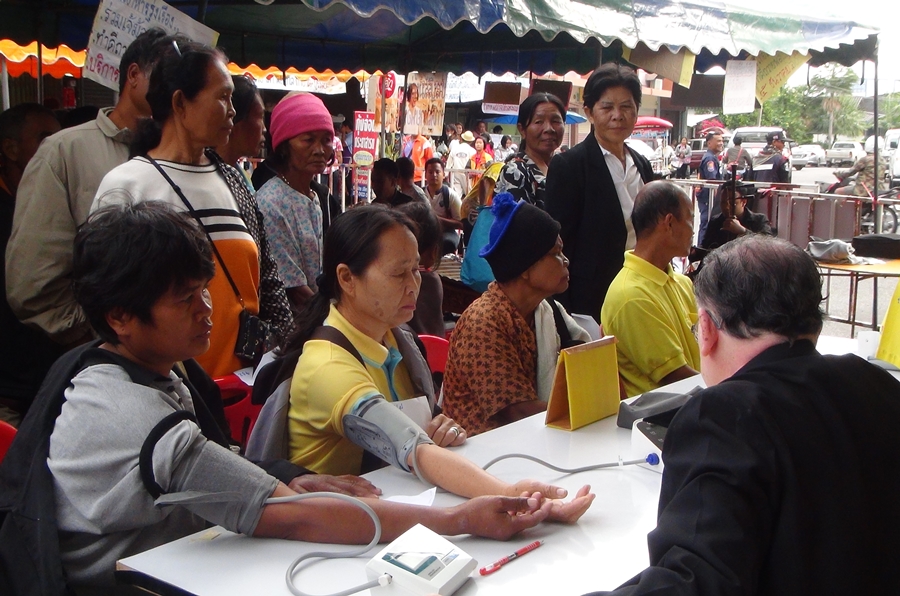
A vendor hands out free food on a train in Ratchaburi province.Volunteers clean up a plaza in front of Thao Suranari Monument in KoratPhysicians give free health check-up in Buriram province
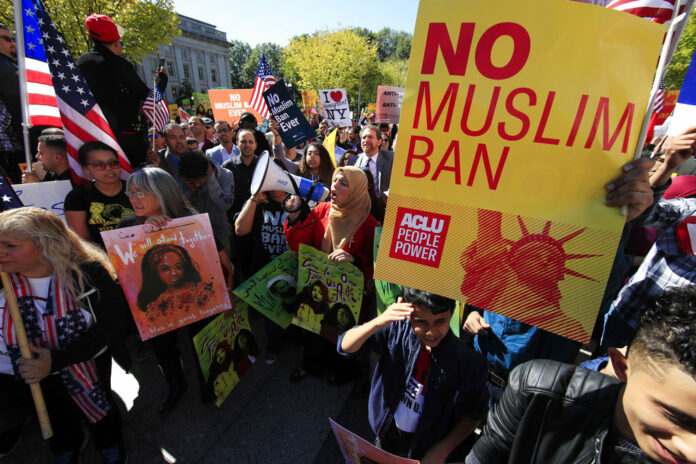
Protesters gather Oct. 18, 2017, at a rally in Washington. Photo: Manuel Balce Ceneta / Associated Press
WASHINGTON — The Supreme Court on Monday allowed the Trump administration to fully enforce a ban on travel to the United States by residents of six mostly Muslim countries.
This is not a final ruling on the travel ban: Challenges to the policy are winding through the federal courts, and the justices themselves ultimately are expected to rule on its legality.
But the action indicates that the high court might eventually approve the latest version of the ban, announced by President Donald Trump in September. Lower courts have continued to find problems with the policy.
White House spokesman Hogan Gidley said the White House is “not surprised by today’s Supreme Court decision permitting immediate enforcement of the President’s proclamation limiting travel from countries presenting heightened risks of terrorism.”
Opponents of this and previous versions of the ban say they show a bias against Muslims. They say that was reinforced most recently by Trump’s retweets of anti-Muslim videos.
“President Trump’s anti-Muslim prejudice is no secret. He has repeatedly confirmed it, including just last week on Twitter. It’s unfortunate that the full ban can move forward for now, but this order does not address the merits of our claims,” said Omar Jadwat, director of the American Civil Liberties Union’s Immigrants’ Rights Project. The ACLU is representing some opponents of the ban.
Just two justices, Ruth Bader Ginsburg and Sonia Sotomayor, noted their disagreement with court orders allowing the latest policy to take full effect.
The new policy is not expected to cause the chaos that ensued at airports when Trump rolled out his first ban without warning in January.
The ban applies to travelers from Chad, Iran, Libya, Somalia, Syria and Yemen. Lower courts had said people from those nations with a claim of a “bona fide” relationship with someone in the United States could not be kept out of the country. Grandparents, cousins and other relatives were among those courts said could not be excluded.
The courts were borrowing language the Supreme Court itself came up with last summer to allow partial enforcement of an earlier version of the ban.
Now, those relationships will no longer provide a blanket exemption from the ban, although visa officials can make exceptions on a case-by-case basis.
The justices offered no explanation for their order, but the administration had said that blocking the full ban was causing “irreparable harm” because the policy is based on legitimate national security and foreign policy concerns.
In lawsuits filed in Hawaii and Maryland, federal courts said the updated travel ban violated federal immigration law. The travel policy also applies to travelers from North Korea and to some Venezuelan government officials and their families, but the lawsuits did not challenge those restrictions. Also unaffected are refugees. A temporary ban on refugees expired in October.
All the rulings so far have been on a preliminary basis. The San Francisco-based 9th U.S. Circuit Court of Appeals and the 4th U.S. Circuit Court of Appeals in Richmond, Virginia, will be holding arguments on the legality of the ban this week.
David Levine, a University of California Hastings law school professor, said that by allowing the ban to take effect just days before the appeals court arguments, the justices were signaling their view.
“I think it’s tipping the hand of the Supreme Court,” Levine said. “It suggests that from their understanding, the government is more likely to prevail on the merits than we might have thought.”
Both appeals courts are dealing with the issue on an accelerated basis, and the Supreme Court noted it expects those courts to reach decisions “with appropriate dispatch.”
Quick resolution by appellate courts would allow the Supreme Court to hear and decide the issue this term, by the end of June.
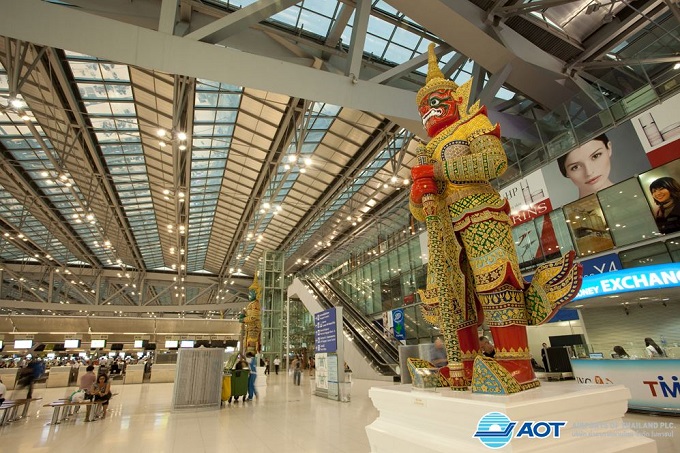
Statues of yak, or giants, at Suvarnabhumi Airport in an undated file phone. Image: Airport of Thailand
SAMUT PRAKAN — Like to offer blood-red Fanta to a statue? Please do it at spirit houses and shrines, not at the airport, asks Airports of Thailand.
After photos of Fanta bottles placed at the base of the yak in the departure level of Suvarnabhumi Airport went viral, the organization issued a statement Monday saying that offerings of worship should not be placed at Suvarnabhumi’s traditional Thai statues.
The statement said a man was seen placing a bottle of Fanta on 5pm on Sunday at the base of the giant’s feet. It added that any future offerings would be swiftly removed by cleaning staff.
The giant, which depicts a Suriyapop giant from the Ramakien, is located on the fourth floor of the departure concourse and weighs 12 tons. According to animist beliefs, offerings of food, especially blood-red Fanta, appease local spirits.
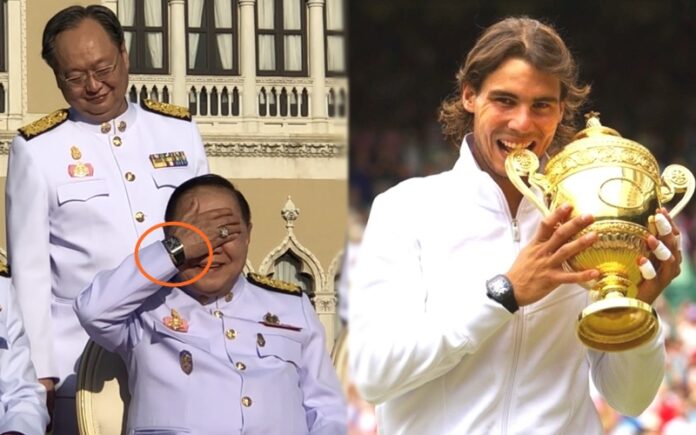
Gen. Prawit Wongsuwan, at left, is seen sporting the same brand of luxury worn by tennis superstar Rafael Nadal, at right.
BANGKOK — There are fewer things in life to better cheer an old man up when things are tough than a nice new watch.
Deputy junta leader Gen. Prawit Wongsuwan, who’s already known for his flashy watches, was sporting reliable bling bling Rolex on his wrist Monday. Dressed to the nines for an official group photograph as part of the new cabinet, the man who’s also deputy PM was wearing what’s been identified as a Richard Mille.
In Thailand, an entry-level Richard Mille starts at 1 million baht – unless it’s counterfeit. Those wearing them include American rapper Jay-Z and Spanish tennis star Rafael Nadal.
The watch is known for its futuristic motor sports-inspired designs. Its mechanisms are painstakingly assembled in-house and hand-finished – haute horology.
It’s unclear which exact model Prawit was wearing. This is how a model worn by Nadal was described back in 2015, however:
“The retail price of the RM27-01 when available was $740,000 [24.1 million baht], and like we mentioned, all 50 pieces have been sold. This watch is truly one of the most incredible things you’ll ever strap to your wrist…,” wrote New York-based Benjamin Clymer, arguably the world’s most-famous watch reviewer and owner of famous watch-review website hodinkee.com.